View allAll Photos Tagged fut...
“SOLAR POWER SATELLITE----An artist’s concept depicting the initial fabrication of a Solar Power Satellite structural member. The Solar Power Satellite will be located in geosynchronous orbit some 36,000 miles above the Earth.”
Although I don't see a signature, the artist is likely 'R. J. Dubois', who is responsibly for at least photos 'S-76-24707' & 'S-76-24712', linked to below.
I wonder how many total comprised this series. I do know it chronologically/sequentially goes back at least to 'S-76-24703', which however is NOT by Mr./Ms. Dubois, linked below as well.
La Grande porte aurait été construite lors de travaux des fortifications sous Charles VII.
Elle faisait office d'entrée principale de Granville.
Sa construction était accompagnée d'un logement au-dessus appelé ''logis du roy'' qui servit d'habitation aux gouverneurs de Granville.
Des travaux de la porte aurait eu lieu sous le règne de Louis XIII.
En 1630, la porte est équipée d'un pont levis.
Lorsqu'il fut décidé de détruire les enceintes en 1688, la porte ne fut pas touchée.
Au 18e siècle, elle servit de maison commune.
Au 19e, on y installa une bibliothèque de Génie.
En 1889, toute la place forte est déclassée sauf les casernes par la proposition du ministre de la guerre, Charles de Freycinet...
Ce fut ma première idée quand j'ai vu le thème. Je l'ai gardée mais j'ai quand même expérimentée quelques autres trucs.(j'aurai finalement pris pas mal de photos). Au final, je garderai celle-ci. Malgré les défauts, quelque chose(d'inconnu) me plait.
La ville de Herculanum fût détruite par l'éruption du Vésuve en l'an 79 apr. J.-C., conservée pendant des siècles dans une gangue volcanique de 20m de cendre et remise au jour à partir du XVIIIe siècle par les Bourbons qui régnaient sur Naples.
Maison Lafontaine
Maison ancestrale (relocalisée)
Construction: 1766
Cette ancienne demeure serait la maison natale de Louis-Hippolyte Lafontaine, (1807-1864), un des pères de la démocratie canadienne.
Construite, à l'origine, à proximité de l'ancienne église du village.
En 1964 elle fut déménagée, sur un fardier, depuis son site originel jusqu'à un espace de verdure qu'on surnomme parc De la Broquerie.
Nota: vers 1849, Louis-Hippolyte Lafontaine habite une riche villa bourgeoise d'un secteur cossu de la ville de Montréal, récemment restaurée.
Voir ci-bas.
“NUCLEAR-ION ROCKET ENROUTE TO VENUS
Long range interplanetary research of the future is depicted in this concept by W. C. House, Director, Systems Management, Aerojet-General Corporation of a large nuclear-ion rocket on its way to the planet Venus. The rocket, conceived by House, would be between 25 and 30 feet in diameter and approximately 150 feet long, or about the size of a modern submarine cut in half. It is pictured above at altitude of 4,000 miles over Western Europe at 4:45 a.m. Greenwich Mean Time on August 20. Its position is 40 degrees east longitude and 30 degrees north latitude. The wings on the rocket, which have been elongated for artistic purposes, probably would be stubby projections retractable in flight but necessary to effect landings on other planets or return to earth.”
What an oddly & amusingly precise description of a spacecraft’s position/location in both time & space – IN AN ARTIST’S CONCEPT.
Cet édifice fut probablement érigé sur l’emplacement d’un monastère construit vers 650 par le moine irlandais saint Fursy. L’Histoire et les siècles ont été témoins de ses nombreuses transformations, restaurations et reconstruction. En 1205, les travaux s’engagent sur les bases d’un projet grandiose : une abbatiale d’une longueur de 110 mètres et d’une hauteur sous voûte de 27 mètres. Malheureusement, il se limitera au chœur accolé à la nef de l’édifice antérieur. Après la disparition de cette nef au XVIIe siècle, on construit un clocher porche puis un deuxième qui s’ouvre aujourd’hui sur un chœur imposant : 48 m de long et 37 m de large. Les chapelles de profondeurs différentes rythment son chevet. Le mur ouest conserve des vestiges de la nef du XIIe siècle, de part et d’autre du buffet d’orgue. Dans la chapelle dédiée à la Vierge Marie, se sont déroulés deux événements qui ont marqué l’histoire de l’église abbatiale. En 1126, décimée pour la deuxième fois en un siècle par le terrible « mal des ardents » (forte fièvre due à un cham- pignon de l’ergot de seigle), la population se porte en masse à la chapelle et obtient par ses
prières que le mal cesse.
A trois reprises, Jeanne d’Arc a foulé le sol latignacien. En 1430, elle mêle ses prières à celles de jeunes filles et un enfant qu’on pensait mort depuis 3 jours retrouve vie, le temps de lui donner le baptême. C’est à ce titre que quelques siècles plus tard, Jeanne d’Arc fut canonisée. A noter que
Lagny-sur-Marne a rejoint le cercle prisé des Villes Johanniques en 2013.
Les plus anciens vitraux réalisés par Claudius Lévêque datent de la deu- xième moitié du XIXe siècle. Ceux d’une tonalité bleue, situés près de la
chapelle de la Vierge Marie, sont une création de Calixte Poupart inau-
gurés en 1955.
Depuis 1886, l’église abbatiale est classée Monument Historique.
Citadelle Royale du pays de Saintonge.
Commune de Hiers-Brouage, Charente maritime
Le port de Brouage fut construit au milieu du XVIème siècle afin de commercialiser le sel produit dans les marais salants situés autour du village de Hiers.
Brouage deviendra sous Louis XIV l'un des plus important port pour l'approvisionnement du sel, "l'or blanc", de toute l'Europe.
Place stratégique de la région, la citadelle sera fortifiée et agrandie par plusieurs grands ingénieurs du royaume de France dont le célèbre Vauban.
Aujourd'hui, la mer s'est retirée à une dizaine de km et le port est fermé.
Les marais salants ont été remplacés par de nombreuses exploitations ostréicoles.
BROUAGE, oyster farms
Charente maritime, la France.
The port of Brouage was built in the middle of the sixteenth century to market the salt produced in salt marshes around the village of Hiers.
Brouage will become under Louis XIV one of the most important port for the supply of salt, "white gold", from all over Europe.
Strategic place of the region, the citadel will be fortified and enlarged by several great engineers of the kingdom of France including the famous Vauban.
Today, the sea has withdrawn to about ten km and the port is closed.
The salt marshes have been replaced by many oyster farms.
« Suivant sa volonté, Rudolf Noureev fut inhumé au Cimetière russe de Sainte-Geneviève des Bois en région parisienne. La cérémonie se déroula le 12 janvier 1993. Le lundi 6 mai 1996, le caveau de Rudolf Noureev fut inauguré dans le cimetière russe de Sainte-Genevière-des-Bois. C’est Ezio Frigerio, décorateur qui a souvent collaboré avec Noureev, qui en a assuré la conception et la réalisation. Entièrement revêtu de mosaïque, ce tombeau se présente sous la forme d’un kilim recouvrant les malles de l’errance. Il est aussi un rappel de l’Orient d’où Noureev était originaire et rappelle son goût du voyage.
C’est Ezio Frigerio lui-même qui, dans une lettre émouvante, raconte cette expérience : « Après avoir suivi de très près le destin glorieux de Rudolf Noureev, on m’a confié la tâche d’en imaginer le tombeau : un mandat qui m’enthousiasmait et qui en même temps me meurtrissait. Il m’était en effet extrêmement difficile de l’imaginer immobile pour toujours. N’importe quel symbole de fin, de fermeture, me semblait à éviter, me paraissait même répugnant. J’ai donc décidé que si le légendaire nomade s’en était allé, et pour toujours, il fallait que son ultime départ ne soit pas marqué dans le temps par une pierre tombale mais par quelque chose lié à ses expériences vécues sur terre. J’ai ainsi eu l’idée d’un grand tapis multicolore qui recouvre le scandale du cercueil avec toutes les suggestions de l’art oriental, tellement proches de l’esprit et de la nature profonde du grand ami disparu. »
Le cimetière russe de Sainte-Geneviève-des-Bois est un cimetière communal. Le 8 février 1879, le Conseil municipal décide de créer un nouveau cimetière. Depuis cette date ce cimetière est resté communal où se retrouvent toutes les confessions.
Installée rue Léo Lagrange, cette nécropole au caractère spécifiquement russe comprend, d’une part l’église Notre-Dame-de-l’Assomption, ses dépendances et son jardin, et d’autre part, les tombes orthodoxes du cimetière communal.
L’église orthodoxe est un édifice blanc de plan carré, surmonté d’un toit vert, représentant la terre, et coiffé d’un bulbe bleu, représentant le ciel. Sa construction fut décidée en 1937 par le métropolite Euloge, archevêque des églises orthodoxes russes en Europe occidentale, selon les plans de l’architecte Albert Benois.
L’origine du cimetière russe provient de l’accueil fait aux émigrés russes au château de la Cossonnerie au lendemain de la révolution de 1917 qui furent, dès 1926, enterrés dans le cimetière communal. On compte aujourd’hui environ 4000 tombes, parmi lesquelles celles de personnages illustres tels que le prince Youssoupov, Bounine, prix Nobel en 1933, ou Noureev, célèbre danseur chorégraphe et chef-d’orchestre.
Le petit village de Vinets, comme beaucoup d'autres, a utilisé la puissance de l'eau pour moudre les céréales. Ce moulin n'est plus en fonctionnement depuis longtemps, il a été consolidé depuis pour le réutiliser en habitation, la roue hydraulique fut tout de même conservée.
Porsche 356
Elle fut la troisième voiture de la marque allemande Porsche. Conçue par Ferry Porsche sur les bases mécaniques de la Volkswagen Coccinelle (par souci d'économie) et dessinée par Erwin Komenda.
Marque Porsche
Années de production 1948-1965
Production 76 313 exemplaire(s)
Classe Voiture de sport
Moteur et transmission
Moteur(s) Essence : 4 cylindres à plat (boxer) refroidi par air de 1,1 L à 2 L (40 ch à 130 ch)
Transmission Propulsion
Poids et performances
Poids à vide 680 - 900 kg
Châssis - Carrosserie
Carrosserie(s) coupé, cabriolet, speedster
Dimensions
Longueur 4 001 mm
Largeur 1 670 mm
Hauteur 1 330 mm
Un des bâtiments des plus anciens du quartier, cette église mainte fois retouchée, fut initialement gothique et construite au XIIIe siècle. Sa dernière grosse refonte fut le passage au style en vogue au XVIIe : le Baroque, cela conduit notamment à ce duo de jolis bulbes. Il faut également mentionner le campanile qui eu également un passé tumultueux, une chose est sur, il est maintenant détaché de l'église et une route les sépare à l'heure actuelle.
Sources : Wikipédia église (CZ/DE/EO) && Monument historique (CZ) && Wikipédia saint (Multi)
One of the plethora of gorgeous depictions by Convair’s master artist, John M. Sentovic. His destiny…err, I mean collaboration with Dr. Krafft Ehricke, also of Convair, gifted us with some spectacular visualizations of the good Doctor’s visionary future of space travel & space exploration not yet, if ever to be realized.
Fortunately, the image was published as part of a brief biography of Mr. Sentovic in the March 1960, Volume 2, Number 2 issue of “SPACE AGE: The Fact Reporter for the Worlds of Science and Space” magazine, with the following caption:
“This drawing shows breakaway of the nuclear stage. The chemically powered winged glider is dropped away at left, while the nuclear-powered unit, containing a passenger compartment, heads into orbit to rendezvous with permanent satellite station. Nuclear stage can also be used in glider fashion for return trips to Earth.”
WOW…a nuclear powered spacecraft gliding…ummm...NO, but still!
Additionally, per the official Convair description associated with the image:
“NUCLEAR-POWERED PASSENGER ROCKET ASCENDS TO ORBITAL SATELLITE
SAN DIEGO, Calf.--When a manned satellite has been established in an orbit around the earth, personnel may travel to and from the satellite in vehicles such as this two-stage nuclear-powered rocket glider now being studied by Krafft A. Ehricke of the Convair Division, General Dynamics Corporation. The glider would take off horizontally, as an airplane, using a wheeled undercarriage which remains on the ground as the ship rises. Picture above shows vehicle about 30 miles up, at which point the lower stage is detached and guided safely back to earth. The second stage (right), carrying the passengers, would continue to the satellite orbit. For the return trip, the firing of small retarding rockets would reduce the ship's speed to less than orbital velocity, permitting it to descend gradually to the ground. The glider would land horizontally on skids retracted during flight. The lower stage reactor would heat ammonia and the upper stage reactor would heat hydrogen to produce thrust. The ship would measure 180 feet in length and have a wingspan of 50 feet. It would weigh between 350,000 and 400,000 pounds at takeoff, approximating the maximum takeoff weight of a B-36 bomber. This weight is considerably less than that of a three-stage chemical-powered rocket designed for the same mission. The horizontal takeoff feature would provide added safety in that the ship would be under control in the event of a power failure near the ground. Also, less power would be required for take-off, which in turn reduces the requirement for shielding from nuclear radiation. Shielding remains a major design problem, however. If it can be solved satisfactorily, the nuclear-powered glider should be feasible in ten years. Ehricke is assistant to the technical director of Convair-Astronauties, builder of the Atlas ICBM.
06618A”
Fascinating!
Who knew???
Did you???
I didn’t!!!
The mystery of life. How a plodding effort you regularly consider futile, pointless & inane, albeit a labor of love, can beget something else (thanks to an esteemed colleague), along with an against all odds “sighting”, yield, in at least this instance, the following:
e05.code.blog/2022/04/19/meet-john-sentovic/
Credit: Garrett O’Donoghue/’numbers station’ blog
A WIN.
Last (for now), but NOT least:
www.secretprojects.co.uk/threads/convair-nuclear-powered-...
Credit: SECRET PROJECTS Forum website
Seen at the Redbourn Classics Motor Show in Redbourn, Hertfordshire on 04 September 2021.
FUT721C is a 1965 MG MGB.
First registered in March 1965.
Yrsos fut capturé par les Pantheres SSF suite a des echanges plus ou moins tendues et surtout suite a des sanctions faites par les hommes de la citée.
Il fut donc prisonnier et a subit de nombreuse tortures , le voici devant la croix où il a subit tous ces vices. Il est epuisé et a l'impression d'être dans un cauchemard , perdu et loin de sa citée Nyoka , de sa famille ...
RP GOR ...
Avatars: Yrsos ( Willan Barron )
Anim : AO oracul Dark horse
Sim : Citée De Jad
“Launch Platform for Mars Ascent Vehicle”
And/or, per the following linked document & near equivalent depiction within it (Page 97, Figure 43):
“Mars excursion module configuration.”
ntrs.nasa.gov/api/citations/19700026519/downloads/1970002...
See also:
www.nasa.gov/sites/default/files/atoms/files/19690804_man...
Last, but not least, with a vivid color version of the image and superior caption of:
“MEM ascent stage liftoff. The ascent stage was a stage-and-a-half design with a cluster of approximately conical expendable propellant tanks and integral tanks in its cylindrical core feeding a single engine.”
At/from:
spaceflighthistory.blogspot.com/search?q=integrated+progr...
Credit: David S. F. Portreee/”No Shortage of Dreams” blog
Unfortunately, no signature is visible. A very similar Mars Excursion Module (MEM) depiction, also within NASA’s grand Integrated Program Plan (IPP) is by Renato Moncini. However, its depiction of the Martian landscape doesn’t agree with that of my posted photo, sooo…possibly/probably not by him. ¯\_(ツ)_/¯
“Artist Concept - Shuttle de-orbit wheels down.”
Of Rockwell Int'l origination. If so, by Sol Dember. A low resolution photo of Mr. Dember in his home studio here:
www.simivalleyacorn.com/articles/simi-illustrators-work-i...
Credit: "Simi Valley Acorn" newspaper online website
appears to show this work, or the below linked, at the upper left corner of the black & white photo.
“Artist Concept - Shuttle on 747 piggyback.”
With that kind of in-depth, well-articulated word picture, I'm guessing this is of NASA origin. Loosely supported by the lack of a signature.
A really really nice work by Boeing artist/illustrator Bart Hunt. Even at just a minimal/moderate distance, it legitimately looks like a photograph.
The numeral 7 on the orbiter possibly reflects the optimism of the size of the shuttle fleet, along with the mundane identification one would ascribe based on the expectation of numerous & routine missions.
"HARD SCIENCE ART CONCEPT --- (Artist's concept of possible exploration programs.) Two kilometers above the lava flows of Mars' Tharsis Bulge region, a geologist collects stratigraphy samples from the eastern cliff face at the base of Olympus Mons, the solar system's largest known shield volcano. To better understand the geologic evolution of the Arizona-sized volcano, the scientist investigates the layers of hardened lava that make up the massive feature. The block-like nature of the rock face, caused by columnar jointing, is similar to features on Earth, such as Wyoming's Devil's Tower. Human exploration of Mars will provide tremendous insight into the origin and evolution of our planetary neighbor while simultaneously addressing similar questions about our own planet. Such exploration challenges will place unprecedented demands on our Extravehicular Activity (EVA) systems as we seek to routinely operate in remote and hostile environments. These images produced for NASA by Pat Rawlings. Technical concepts from NASA's Planetary Projects Office, Johnson Space Center (JSC)."
Yet another exquisite work by Mr. Rawlings, so it really doesn't get much better. Take in the detail...of everything...from the clouds to the Astronaut's carabiner, and EVERYTHING in-between. Amazing.
www.humanmars.net/search/label/Pat%20Rawlings?m=1
Credit: humanMars.net website
Although not to be found at the following, enjoy those that are:
www.patrawlings.com/art-gallery/mars
Credit: Pat Rawlings
“SPACE STATION CONCEPT -- NASA has awarded a contract to Lockheed Missiles and Space Company, Inc. to conduct a study that one day could evolve into a space station such as this. The current study, however, will identify user needs for a permanent orbiting facility. This concept features artificial gravity living quarters and control center, three zero-gravity modules for scientific, commercial and other applications and three open beam platforms which are all interconnected by “shirt sleeve” air tubes and are used for mounting antennas and the like. Each platform is positioned to allow 360° line-of-sight communications while leaving open flight paths for shuttles and other space vehicles. Lockheed has developed graphite-epoxy space colonies that could provide the technology for developing such a space colony.”
The LM&SC description associated with the photo:
“2001 SPACE COLONY -- This conceptual design of a space colony features artificial gravity living quarters and control center, three zero-gravity modules for scientific, commercial and military applications and three tetrahedral beam platforms which are all interconnected by “shirt sleeve” air tubes. Each platform is positioned to allow 360° line-of-sight communications while leaving open flight paths for shuttles and other space vehicles. Lockheed Missiles & Space Company has developed graphite-epoxy space columns that could provide the technology for developing such a space colony. (Lockheed artist: Joe Boyer)”
Another wonderful depiction by Mr. Boyer. The whole thing has a “Jetsons” appeal to it.
And, if extending to the upper right is what I assume to be one of the three zero-g modules, with – if I’m seeing it correctly – what looks to be an X-29-ish forward swept wing, Klingon/Romulan influenced vertical stabilizer(ed)…shuttle. Furthermore, a hatch at the end of one of the six peripheral hexagonally shaped tubes, that comprise the module, has opened…to accept the nose of the shuttle…for it to transfer/accept, fittingly, a hexagonally shaped payload, out of/into, the hexagonally shaped central/core tube of the module. But of course. Rube Goldberg lives on!
Finally, note what looks like a domed “terrestrial” observatory attached to the beam platform on the left.
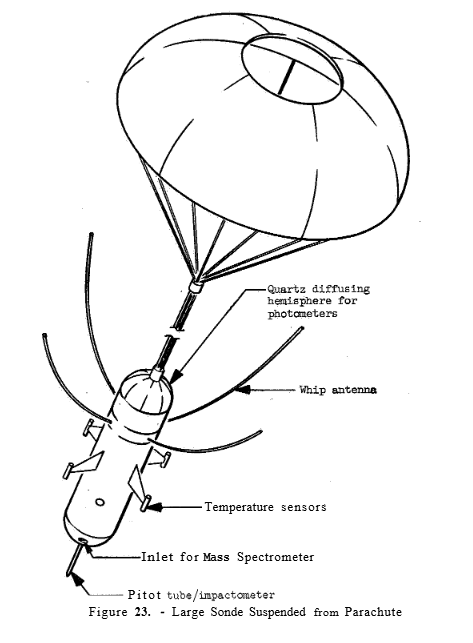
“…The next United States mission to explore Venus may well be a buoyant station which could float a science package approximately 60 kilometers above the planet’s surface. The full-scale design concept has the capability of answering the most important scientific questions concerning Venus. This station is comprised of a 175-pound gondola supported by a16-foot-diameter balloon. The gondola contains a mock-up of instruments and supporting equipment designed to measure atmospheric composition, temperature, pressure, density, cloud structure and organic (biological) matter. Two drop sondes capable of gathering data to reconstruct lower atmosphere and surface structure are also included in the science package.”
By Charles O. Bennett.
www.aerospaceprojectsreview.com/blog/wp-content/uploads/2...
Credit: Aerospace Projects Review website
Rest In Space Mr. Bennett, Thank You:
www.celestis.com/participants-testimonials/charles-oren-b...
Credit: Celestis, Inc. website
Bummer:
www.space.com/venus-clouds-life-not-enough-water
Credit: Space.com website
But:
www.nasa.gov/press-release/nasa-selects-2-missions-to-stu...
“Mars colony of the future SR229 (October 1980)”
I’m assuming Rockwell International as the originator, the artist being the talented, previously elusive, enigmatic, mysterious & chameleon-like (due to his/her signature change/evolution: all caps/block —> mixed case/cursive), Manuel E. Alvarez.
Despite there being plenty of [fill in the heavenly body] circular, concentric, spoked, radial…base, colony, habitat, depot, city, etc. concepts available online - I could not find the image anywhere.
Neither could I find anything on “SR229”.
Nor whatever (if anything?) was possibly convened in October of 1980…conference, symposium, workshop, etc. Nor any evidence of some relevant/pertinent documentation published that month.
And, varied/multiple combinations of the aforementioned ‘key words’ yielded nothing.
Pretty frustrating, and the recurring feeling of “I know I’ve seen this...somewhere”.
Possibly as part of NASA’s 1988 - 1989 Mars Exploration Case Studies, an unmanned articulated Martin Marietta rover is depicted in action. I’ve never seen this before & couldn’t find it anywhere online.
The rover appears to be equipped with a suite of soil analyzing instrumentation…maybe even return capable chambers/canisters?
I like the sporty paint scheme of the wheels, which I’d think would be for engineering photographic documentation. If so, is it logical to assume this is part of a manned exploration proposal? Since a human would likely take those photographs? Along those lines, note the lack of a high-gain antenna, supportive of this being a ‘localized’ component of a larger effort/mission. Maybe?
Oh yeah, doesn’t the sampler arm look like one of those fancy pot filler faucets?
Being of Martin Marietta origin, and the timeframe I’m thinking, this may well be by Robert S. Murray. Although, maybe even Charles O. Bennett.
“In the early ‘60s, as part of the preparations for the Apollo manned moon landing mission, the Jet Propulsion Lab planned a follow-on program to its very successful ‘hard’ landing ‘Ranger’ program, which gave the first close-up views of the moon’s surface. the proposed ‘soft’ lander program was called ‘Surveyor’. An initial concept was for it to disgorge a moon surface-traversing vehicle to conduct a neighborhood survey near its landing position. it was to be commanded by a tv - radio control guidance link. This link was to be relayed to and from the moon via the Surveyor’s earth communication system. A lunar rover competition was opened and the relatively new star on the horizon, Space-General, decided to respond.”
The above & all subsequent I believe, in uncertain order, are excerpts from Dr. Robert F. Brodsky’s book, “On the Cutting Edge: Tales of a Cold War Engineer at the Dawn of the Nuclear, Guided Missile, Computer and Space Ages’, published 2006 by University of Nebraska Press for Richard Altschuler & Associates, Inc./ Gordian Knot Books.
“The damned thing looks like a cross between a crazy Bull Terrier and a Peacock!”, my Boss said. After weeks of in-plant secrecy, we had finally unveiled our robotic entry in the moon rover sweepstakes. To everyone’s amazement and delight, Jack Miller was directing its peregrinations around the back forty of our El Monte campus, using a hand-held radio control link device. With its ridiculous TV camera “head” wagging from side to side on its long tubular swiveling “neck” scanning the local scenery, the six-legged beast really did look outré - like a malformed hound out of Star Wars.
At that time, I was Chief Engineer, reporting to Dr. Fred Eimer, recently recruited from JPL by Jack Froehlich and who, in turn, had reached back there to recruit Jack Miller and Al Morrison for my Design Group. They quickly had proven themselves to be two absolutely top-notch designers. I organized a proposal team, with the sterling duo in the conceptual design lead. The design we came up with was a walking, rather than a rolling or hopping, vehicle. We believed a walker stood a better chance of navigating an unknown surface than the other options. Its body was triangular in shape, longer in the forward moving direction than wide, and about 6 inches thick. Its flat sides were parallel to the ground, with the underside standing about a foot off the ground. The swivel – mounted TV camera that looked like a Cyclops was mounted on the forward – moving point of the triangle. The aft sets of legs emanated from the other two points of the triangle, thus providing a broad stable base to preclude tipping. More than covering the creature’s upper back was a square solar array which provided drive motor, communications, and TV camera power. This array was hinged near the base of the TV camera supporting “neck” and could be raised up to a 45-degree angle to track the sun as it moved through its lunar day. At its larger angle extensions, it gave the beast the appearance of a peacock in heat! The antenna that communicated with the Surveyor was attached to the top end of the array. Adding to the fowl appearance was a forward thrusting claw at the end of a second tubular bendable “neck”, meant to pick up lunar samples, but actually looking more like a peacock pecking at the ground.
However, the feature that made it all work was the unique arrangement and motion of the three pairs of biped-like tubular legs, with both knee and hip joints, which gave it the ability to navigate through minor pitfalls such as rocks and potholes. Any larger impediments would be avoided via command from the earth operator who would see them in time to transmit a “halt” signal. The motion of each leg set looked like a dog’s front legs digging a hole in the ground. The two sets of rear legs were attached to the “haunches” of the triangular body, while the single forward set was attached under the long-necked TV “head”. The footpads themselves were slightly rounded and serrated on the bottom to provide a good grip, and thus precluded the need for an ankle joint.
The driving mechanisms that Jack and Al devised were such that there were always three of the six feet on the ground simultaneously, moving backwards to provide forward motion. The other three leg sets, each located right next to and parallel to the foot already on the ground, were making a rapid return cycle so that they would contact the ground forward just as the propelling feet reached the end of their backward travel. Steering was achieved by simultaneously speeding up one haunch set of legs while proportionately slowing down the other side. The forward pair of legs maintained the normal pace. If forward motion was impeded before the earth controllers could act soon enough to stop and regroup, the robot automatically ceased forward travel and waited for a command, perhaps to back up and make a turn before proceeding forward again. We decided to make a full-scale demonstration model of the concept as part of our proposal submittal. It stood about four feet tall from the ball of its foot to the top of its deployed antenna. It was this model that delighted our peers, with its fey look of a defanged futuristic pet. It truly was sensational!
Alas, by the end of the competition, the SURVEYOR’s final design weight had grown so heavy that the intended launch vehicle did not have the lifting power to accomplish the mission. Weight had to be dropped and, to our everlasting grief, the moon rover portion of the program was summarily deleted. When I heard the news, I almost cried. We had poured so much heart and soul in the frenzied period of the proposal effort. All the participants were simply unwilling to let go of what we perceived as a wondrous device and sought ways to revive the program. The beast was kept around the office like a pet.
At:
cyberneticzoo.com/walking-machines/1961-moonwalker-lunar-...
All above credit the excellent ‘Cybernetic Zoo’ website
My research in trying to identify the artist of an obscure, rarely seen work, led me to discover that it was the cover of the above book, authored by Dr. Brodsky. A few clicks later led me to the above, along with the posted photograph…and many others, revealing the good Doctor’s intimate involvement with the “moonwalker” rover as well.
Proof that some - if not all - rabbit holes, depending on far down you go them, regardless how seemingly desperate, are somehow inter-connected. A pretty cosmic revelation, I think. Might even somehow correlate to wormholes & other possible dimensions.
Pendant tout le Moyen Âge, Conques fut un important sanctuaire où étaient vénérées les reliques du crâne de sainte Foy. Elle est célèbre grâce à son église abbatiale dont l'architecture et les sculptures du porche sont remarquables, et son trésor, notamment la statue en or de Sainte Foy. Depuis le XXe siècle, elle a été déclarée « étape majeure » sur le chemin de Saint-Jacques-de-Compostelle (Via Podiensis) parce qu'elle est citée dans le dernier Livre du Codex Calixtinus, pratiquement inconnu jusqu'à son édition en latin en 1882.
One of many stunning artist’s concepts by John Sentovic, for Convair/Astronautics, General Dynamics, primarily from the mind of Krafft Ehricke. This one featuring a manned interplanetary - possibly lunar in this instance, since it’s in the background, beckoning - spacecraft, with its return glider, IVO an Atlas manned space station, also with its attached return glider.
However, unless there were fairings, shrouds or something like that, with those blunt fuel tanks, exposed engine components, interstitial spaces & all kinds of different shapes, aerodynamic drag, buffeting and whatever else, especially during maximum dynamic pressure (max-q), would’ve been problematic I think.
Speaking of fairings, the booster may also be some sort of Atlas...variant...maybe?
Thank you Krafft Ehricke & Mr. Sentovic!
FR
Ce type de bateau fut utilisé au Portugal pour le transport fluvial des fûts de vin. Les embarcations naviguaient sur le fleuve Douro entre les régions viticoles en amont et les villes de production du vin de porto : Porto et Vila Nova de Gaia.
Les rabelos se laissaient entraîner par le courant la plupart du temps. Pour remonter le courant, ils se laissaient haler.
Aujourd'hui, ces bateaux ont perdu leur fonction d'origine, mais conservent encore un attrait touristique. Les derniers sont ancrés devant les sociétés de vente de porto, sur les rives du Douro. Certains prennent part à des régates.
EN
That kind of boat was used in Portugal to trasnport wine barrels on the Douro river. They were sailing from the winyards upstream to the place where the porto wine is procuded : Porto and Vila Nova de Gaia.
To go downstream the just let them carried by the river. To go upstream they were towed.
Nowadays, these boats have lost their original fuction but are now a verry attractive touristic activity.
Last ones are anchored in front of the companies that sell porto wine on the banks of Douro river.
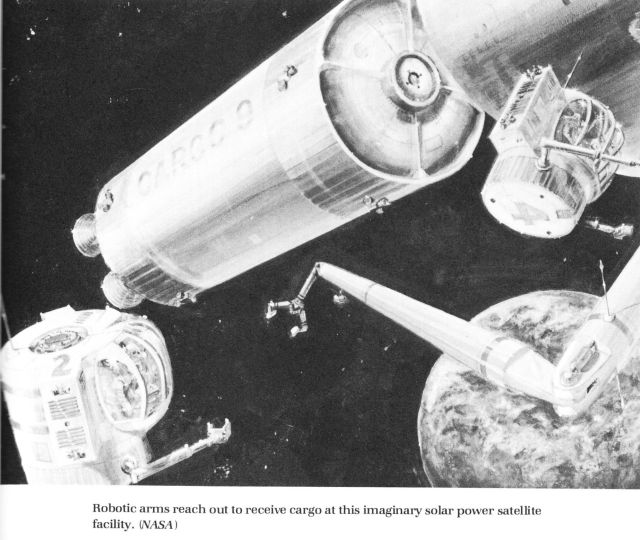
“An artist’s concept depicting the arrival of cargo from low Earth orbit to the Solar Power Satellite fabrication facility in geosynchronous orbit, some 36,000 miles above the Earth. Solar Power Satellites with appropriate electrical conversion systems hold great promise in the near future as an energy source for all mankind.”
Nice, unique & pastel-like (possibly due to ink color-shift?) artwork by R. J. Dubois. First heard on him/her, no idea…I can’t keep up.
Excellent additional information and images, to include this one, at:
cyberneticzoo.com/teleoperators/1978-manned-remote-work-s...
Specifically:
cyberneticzoo.com/wp-content/uploads/2014/09/NASA-manipul...
Credit: Cybernetic Zoo website
Au bon endroit et au bon moment! Le bon endroit c'est ce fameux marché Russe à Phnom Penh au Cambodge! Un melting pot de couleurs et de produits! INOUBLIABLE! Et ce moment où le rayon de soleil a illuminé cette femme a été magique! Cette ambiance ne se vit que là bas...
"Ma rencontre avec les Roms, qui habitent dans les bois à coté de chez moi, fut un moment intense et les amitiés qui s'y sont créées depuis alimentent mon quotidien. Restituer ces moments intenses et les partager est pour moi essentiel et contribue à réduire les aprioris
Marcambye fut, dès le XIIe siècle, le siège d'un fief, celui, à partir de 1195, de Robertus de Marquembeya. Nombre de propriétaires lui ont succédé juqu'en 1780, où un certain M. Le Mengnonnet, dont la postérité, éteinte au début du XXe siècle, a figuré parmi les plus riches familles d'armateurs granvillais, qui se rendit acquéreur de Marcambye. Ce fut ce nouveau propriétaire qui construisit le corps central du château actuel, tel qu'il existait lors de la vente consentie, en 1861, à M. Varin de la Brunelière.
Marcambye was, from the 12th century, the seat of a fief, that of Robertus de Marquembeya from 1195. Many owners succeeded him until 1780, when a certain Mr. Le Mengnonnet, whose posterity, extinguished at the beginning of the 20th century, was among the richest families of shipowners of Granville, who acquired Marcambye. It was this new owner who built the central body of the current castle, as it existed at the time of the sale agreed, in 1861, to Mr. Varin de la Brunelière.
[Photo prise avec un Nikon FG-20]
La synagogue fut bâtie entre 1639 et 1642 à la place d’un bâtiment en bois antérieur (vers 1600). Seuls les hommes pouvaient entrer par la porte sculptée. Les murs intérieurs sont décorés de motifs floraux et de textes en hébreu.
__________________________
The synagogue, also known as "New" (Neuschul), dates from 1669. After 1837, a new part of women's gallery was added to its northern part (according to Jewish religious traditions men and women were not allowed to share the same space in the sanctuary). Since 1925, the synagogue has not been used any more for religious purposes and was converted into a storehouse. Due to lack of maintenance the structure fell into disrepair in the 1980s. The complex and expensive full renovation was completed in 1997 and the synagogue was reopened in that year. Both experts and common visitors will particularly appreciate the mural paintings in its interior dating from the early 18th century. Today, the synagogue is used for exhibitions, concerts, and other cultural events.
A permanent exhibition of Jewish culture is available in the former women´s gallery, displaying many valuable objects used in secular and religious life of the former Jewish community whose last page of history was written by the holocaust during the Second World War.
The Rear Synagogue is open to public daily. Qualified guides provide detailed information, and you can also buy various publications and souvenirs here. For accommodation is available, the boarding-house "U Synagogy" located in the neighbouring house can be used.
www.trebic.cz/en/unesco/zidovska-ctvrt-zadni-synagoga.asp...
Non seulement, papa fut un héros à mes yeux, même aujourd'hui, à plus de soixante ans, mais il l'a été d'autant pour ses petits enfants.
Bien plus que le grand papa "gâteau".
C'était un Seigneur.
Un aristocrate du coeur.
Un modèle de finesse, d'autorité belle, de générosité prodigue.
Ils ont tout eu les petits enfants, affection, vacances à la maison de famille, bonnes choses cuisinées par Mamy, sports d'hiver sur plusieurs années, voitures une fois grands, Noëls de Père-Noël à la hotte bien garnie.
Aide, attention, présence, services multiples, déplacements, études, il a tout soutenu, pour tous et chacun !
Papy, tu étais extraordinaire.
On ne t'oubliera jamais !
Notre coeur reconnaissant t'aime pour l'éternité.
MERCI.
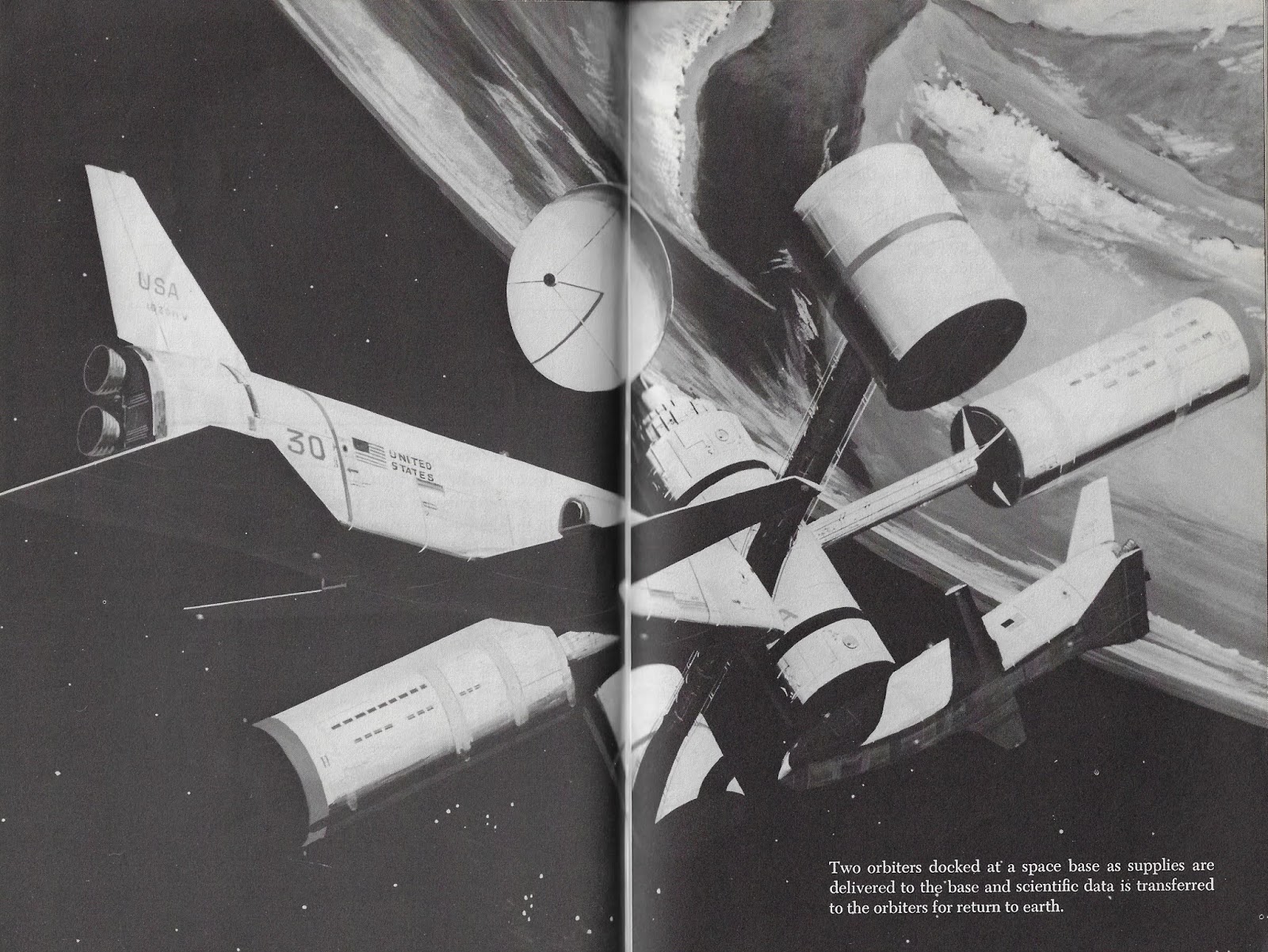
"DC-3 docks with large space base. In June 1969, NASA redirected North American to investigate a bold new concept proposed by the Manned Spacecraft Center's Maxime Faget. The company received a $0.25-million contract extension for this purpose, and another $2.9 million in July 1969 to develop large modular space stations and space base concepts like the early concept depicted here. Faget, the designer of the Mercury capsule, disliked Max Hunter's Starclipper lifting-body design since it had poor low-speed aerodynamics and also would be difficult to develop since the structure was tightly coupled with the aerodynamics. Faget preferred a simple winged design but he also admitted that traditional wings would be very heavy and the leading edges would be difficult to protect from the searing heat of reentry. His solution was the “DC-3” which alleviated the problem by reentering at a very high angle of attack (60 deg.), i.e. coming in nose-high much like the suborbital X-15 rocketplane. This would only expose the flat underside of the vehicle, as most of the thermal energy goes into the shock wave forming in front of the vehicle. The high drag also shortens the duration of the heat pulse, yet does not exceed acceptable crew deceleration load factors beyond 2 g's. The DC-3 wing would only be optimized for subsonic flight and landing, greatly reducing the development cost and time. But the low lift-to-drag ratio reentry profile advocated by Faget would also create some problems since the DC-3 would have limited crossrange during reentry, i.e. it would have been unable to fly larger distances than about 430km to the left and right of an initial direction of flight. Crossrange was an important military requirement, so the USAF opposed the DC-3."
The above, and the photo, along with a plethora of other fantastic images and information, at:
www.pmview.com/spaceodysseytwo/spacelvs/sld022.htm
Credit: PMView website
The exquisite artwork is by Henry Lozano Jr., North American Aviation/North American Rockwell artist/illustrator extraordinaire. Accordingly, Mr. Lozano was 1970 President of the Society of Illustrators of Los Angeles (SILA):
Unfortunately, the record of the above, along with the link itself, has been removed from the following SILA website...:
...and replaced by the following.
Both above credit: SILA website
While still very informative, with reference to other superb ‘aerospace’ artists, it’s nonetheless very disappointing that Mr. Lozano has been omitted from the record.
See also:
1.bp.blogspot.com/-OlAZql_DmEs/Xv0oJa3n2hI/AAAAAAAASts/RY...
Credit: John Sisson/Dreams of Space - Books and Ephemera blogspot
And:
forum.kerbalspaceprogram.com/index.php?/topic/127839-maxi...
Credit: KERBAL SPACE PROGRAM website/LOTS of cool stuff at this website as well.
en.wikipedia.org/wiki/North_American_DC-3
Credit Wikipedia
Fûts de chêne plantés là, selon certains, pendants la guerre par les Allemands, pour décourager les tentatives d'abordage à marée haute qu'auraient pu tenter des troupes alliées.
Une autre explication a été publiée.
Qu'importe. Les fûts rongés par la mer ont gardé St Malo jusqu'en 2022, année où ils ont été enlevés.
Je les trouvais si beaux !
Óbidos est une petite ville médiévale située à 90km de Lisbonne.
Située assez près de la capitale et en hauteur, à proximité de la côte Atlantique, Óbidos eut une importance stratégique sur le territoire. Déjà occupée avant l'arrivée des Romains dans la péninsule Ibérique, cette petite ville devint prospère, dès qu'elle fut choisie par la famille royale. Lorsque le roi Denis Ier l'offrit à son épouse, Isabelle d'Aragon, au XIIIe siècle, elle fut désormais considérée comme la « maison des reines » qui, au fil des différentes dynasties, l'embellirent et l'enrichirent. C'est l'une des principales raisons pour lesquelles, cette petite localité possède autant d'églises.
Dans l'enceinte des murailles se trouvent un château bien préservé et un labyrinthe de rues et de maisons blanches, qui enchantent tous les visiteurs qui s'y promènent. Parmi des portiques manuélins, des fenêtres fleuries et des petites places, se trouvent plusieurs motifs de visite, notamment de beaux spécimens de l'architecture religieuse et civile de l'âge d'or de cette localité (source : www.visitportugal.com/fr/node/73768)
Ma page Facebook
[ Vincent Leroux Photo ] tous droits réservés - all rights reserved. Contacter l'auteur avant toute utilisation - contact the author before any use
“This is an artist concept of the enhanced configuration of the permanently manned Space Station, produced by Martin Marietta. The enhanced configuration includes an upper and lower keel for attaching external payloads, a 50 kilowatt solar dynamic system mounted on the ends of the transverse boom, a servicing bay and a co-orbiting platform (not pictured).”
One of several “dual-keel” proposals during this time period. Note the module(?) which sorta looks like a large telescope, recently delivered by the docked orbiter and being positioned by the station’s manipulators. In fact, the possible “receiving” RMS is attached to some sort of cradle (akin to those in the cargo bays of orbiters). For final placement/further translation along the truss? There appear to be cameras and some sort of optical/sighting (tele?) scope on one end. No idea what the appendages on the other end are. Even an MMU-clad Astronaut conducting an EVA, possibly inspecting the far-left solar array.
Interesting pseudo-negative/silhouette-like depiction…creative…by Les Pettus.
Dual-Keel-palooza:
www.astronautix.com/d/dualkeelspaestation-1985.html
Credit: Astronautix website
“This is artist’s concept of ion rocket vehicle for flight in outer space. As big as present missiles, vehicle would be propelled through vacuum of space at thousands of miles an hour by a few pounds of thrust. Discharge of ionized particles--rather than gas as in conventional rockets--would provide propulsive force. Nuclear reactor would generate power for ionization. Wing-shaped attachments to vehicle are radiators to reject excess heat. Direction would be controlled by swiveling rockets.”
A ca. 1959 Rocketdyne ad depicts the same rendition of the spacecraft nearing the planet Mars.
Beautiful artwork by the amazing yet unheralded Sol Dember:
“Artist Sol Dember died July 23, 2011 in a car accident, however, his passing just recently became known within the SF community.
He began as a scientific illustrator, specializing in astronomical paintings. When Dember was an art director for Rockwell Scientific he drew over 500 illustrations of space vehicles, machinery and surfaces of imaginary planets.
He did SF art for Galaxy, IF and Worlds of Tomorrow in the 1950s and 1960s.
His work also appeared in encyclopedias, dictionaries, books, magazines, greeting cards and record jackets.”
Credit: Andrew Porter
file770.com/sol-dember-death-learned/
Credit: File 770/'Mike Glyer's news of science fiction fandom' website
Again, if the above is anywhere near accurate, then the following is sad & very disappointing, unless intentional. Maybe not my place then, however, an immensely talented, prolific & CONTRIBUTING artist over many years, and this is it???
If not intentional, this is wrong, especially since his death was the result of an accident:
www.legacy.com/obituaries/name/sol-dember-obituary?pid=17...
Credit: Legacy website
Rest in Peace Mr. Dember. THANK YOU.
Original 1958-60 artist’s concept of Boeing Aircraft Company’s bold Program for Astronomical Research and Scientific Experiments Concerning Space (PARSECS) concept/proposal. Within PARSECS, this specifically depicts “Mission II: Moon Base”.
The least detailed mission within the proposal, an unspecified paper states that the image depicts the original concept of the lunar base as envisioned in 1958.
My above paraphrasing is from the excellent discussion and particularly, the contribution of user “Skybolt”, at:
www.secretprojects.co.uk/threads/parsecs-1960.7039/
Credit: SECRET PROJECTS website
Although most of the stunning PARSECS renditions are by the eminently talented Robert Fetterly, I don’t know if this is by his hand.
Regardless, Rest In Peace and thank you for your service:
www.peninsuladailynews.com/news/back-to-the-future-artist...
Credit: Peninsula Daily News website
That’s a LOT of communications/radar? antennas & dishes. And those are some seriously funky looking tri-wheeled ‘rovers’ parked to the lower right.
“UNMANNED MARS VISIT ARTWORK —- Art concept
depicting unmanned exploration of Mars, considered
as a possible precursor to a manned exploration of Mars in the next century. A study at the Jet Propulsion Laboratory lead to a series of art concepts depicting scenarios considered.
pg. 41-3”
Above is per the caption associated with the black & white version of the photo.
Possibly an evolution of JPL’s original “Purple Pigeon” concept/proposal, depicting a Mars Surface Sample Return (MSSR) mission.
In lieu of any other imagery, I refer to this as a possible extension of the Mars Purple Pigeon proposal simply because Mr. Portree alludes to such in referencing an image with similar rovers:
spaceflighthistory.blogspot.com/2018/12/dual-mars-rovers-...
Credit: “No Shortage of Dreams: Mars Multi-Rover Mission (1977)”/David S. F. Portree
One of so many wonderful works for JPL by Ken Hodges.
However, for whatever it's worth, the official caption of a companion?/associated? photo (JPL photo no. P-17055AC) makes absolutely no mention of a sample return intent/capability.
Frankly, the multiple JPL 1970s proposals for Mars exploration during the 1980s & beyond, are rather confusing & convoluted. At least to me.
Circa 1961-63(?) General Dynamics, Convair (Astronautics) depiction of a lunar(?) lander on the moon and the continued evolution(?) of the lunar lander/earth glider combination.
Upon return to earth, the re-entry glider at the top separates and descends to earth.
The wonderful artwork is by Convair/General Dynamics resident artist/illustrator of the time, John Sentovic.
It is the moon, right? If so, the earth has an oddly Jovian appearance, with the widespread banding visible.
Now, about that ladder. Although I love this, it looks as preposterous as SpaceX’s elevator-equipped HLS.