View allAll Photos Tagged because
Relic under my family custody
More miraculous stories in the life of Saint Padre Pio
(This article is a continuation of miraculous stories in the life of St Padre Pio. Part 1 which is entitled "Little known stories in the life of St Padre Pio" can be found here.
I would like to sincerely thank Brother Michael of the Cross and also Thomas Warner M.D. for transcribing these stories. -Webmaster)
The cure of Gaspare di Prazzo, Cianciana, Agrigento
Mr. Gaspare di Prazzo had a case of Mediterranean Fever which had become very serious. A woman, Signora Vacarro, knew of Padre Pio and recommended the patient invoke Padre Pio's help for a cure and Signora Vacarro gave Gaspare a picture of Padre Pio to use while invoking his intercession. Upon receiving the photo, the patient kissed the photograph of Padre Pio and begged him to cure him.
A few days passed when one evening at 6pm the patient said to his wife: "Put someone at the door and don't let anyone in, because Padre Pio is coming, and I don't want to be seen by anyone.'
The wife nodded assent and assured him that their nephew was already near the door.
Later that night, at eleven o'clock, when all were in bed and only his wife was sitting up by the patient's bedside, and the patient had a significant fever he said to his wife: 'Put out the light because Padre Pio is about to come, and I don't want to be seen by anyone, not even by you.'
His wife obeyed and put out the light. All of a sudden the patient began to speak, very joyfully: "Oh! Padre Pio, are you here to heal me? I thank you. Pass your hand from my head to my feet. I cannot go on anymore and I do not want to leave my wife a widow...'
The patient felt Padre Pio near his bed. He passed his stigmatized hand over all his body. His wife saw nobody, but understood that Padre Pio was beside her beloved spouse, and trembling in a corner of the room on her knees, weeping she also prayed to Padre Pio: ' As you have come, Padre Pio, ask Our Lord for the grace of my husband's cure.'
After a few minutes, the wife asked her husband if she could put on the light, and the patient replied: 'No, because Padre Pio has not gone out yet, he is still by my bedside.'
Another ten minutes passed, then the husband told his wife to put on the light, because Padre Pio was gone. After putting on the light, his sister and Dr. Giannone came around the bed of the patient, whose eyes were shining, and who was emitting deep sighs. He said he felt better, and then told them the following:
"A little while ago I found myself in a beautiful church, where Padre Pio was celebrating Mass, and I was on my knees . I saw the Holy Ghost in the beautiful form of a dove above the altar. After Mass, I drew closer to him, and he said to me: 'Have faith in God. But you must go to confession and you must not swear any more.' Being thirsty, I asked Padre Pio for water, and he accompanied me to a cistern. I filled a bottle with lovely fresh water; groaning with pain I drank it in one draught, burning with fever. As soon as I had drunk the water I smelt perfume which resembled the smell of vanilla. Then Padre Pio went away."
After this account the patient repeated that he felt better. The cousin,a medical physician, examined him an noted a very significant change: the fever had already diminished, and by the next morning he was without any, and the fever never returned. Early that next morning Signora Vacarro went to visit him - the reader will recall that it was she who lent him the photograph of Padre Pio - and joyfully upon seeing him she said:
"The grace has been given! I dreamt of Padre Pio last night and he said to me: 'The grace has been given.'"
-and truly the grace had been obtained, for a few days afterwards the patient got up cured and went to church to thank Our Lord. Later he had a solemn day of the Blessed Eucharist celebrated in the Church of the Liguorini, where he confessed and received Holy Communion, after having been away from the Sacraments for ten years. From then on Signor Piazzi has never swore again and he is very grateful to Padre Pio, whose photograph he always carries about with him."
Cure of a diabetic through a vision of Padre Pio
On Corpus Christi, June 20, 1946, at about 6pm a nun named Lucia was suffering from severe diabetes and because of this was impelled to drank quarts of water for relief. Suddenly however she no longer felt the need to drink water and she called the Mother Superior. She said she must now go to the chapel to pray.
Nevertheless, the Mother Superior asked the sister to bring along a glass of water. The Mother Superior had a presentiment that it was the beginning of the end. Lucia told her with a happy smille: "I will die soon, Mother, Padre Pio came to see me. He was just like picture on the bureau. He said I could not be cured (i.e. by the doctors). But he also told me to hope, and to have faith in the help of Heaven.
Evidently, from the succession of events we will read below, Lucia has initially misunderstood Padre Pio. Two sisters assisted her to the chapel. She did not ask for water, and even refused when offered the glass that had been taken along. It was now already a quarter of an hour since she had taken anything to drink. After finishing her prayers she was brought back to her little room as it appeared that she was fainting. The chaplain was called and a drinking tube was put into her mouth, but she immediately pushed it away. Suddenly she opened her eyes with a strange smile on her lips. She sat up in her bed and gesticulated joyously, saying Padre Pio had just told her in the name of God: "You are cured. Get up! Come immediately to my monastery. I want to bless you and thank the Almighty with you." Lucia went to the monastery with two of the sisters on June 17. When they appeared before Padre Pio, he said with a smile: "I was waiting for you," and he blessed her.
__________________
A spiritual grace, Porto Maurizio, September 11, 1940
A gentleman from Porto Maurizio writes:
"No matter how much I say with regard to the graces received through Padre Pio, I could not say enough, for he procured me a great number, and continued to do so. When I saw Padre Pio for the first time, it seemed to me like a dream, and my heart leapt for joy.
"I assisted at the Mass he celebrated with saintly ardor. I was also fortunate enough to see him at close range, for I was kneeling at the side of the altar; large drops of tears fell from his eyes ... in that instant I repented of my sins and implored forgiveness for myself and for all mankind. At the Consecration, I was doubly wrapped in prayer, and at the Elevation of the Host I looked up with faith, and to my astonishment it appeared radiant and beautiful. I said nothing about it to anyone that day, but the following day I went to the confessional of the Padre and I said, 'Father,the Host consecrated by you does not look the same as the others.' 'What,' he said, 'is there something special about mine?' 'Yes, I replied, 'the Host of every other priest looks ordinary, and there is a crucifix in the center, while yours appears beautiful and radiant.' he did not reply, so I continued, "Tell me Father, is this so, or is it an illusion?' Entering into a state of recollection within himself, he replied with gravity, 'What you saw in fact was true.'
________________
Padre Pio predicts a boy to a childless couple, and later baptizes the baby under miraculous circumstances
A couple from Genoa visited Padre Pio to tell him they had no children. "Bring him to me to be baptized when he is born," was his answer. He could often foretell the sex of an unborn child.
The following year the fortunate couple returned to the monastery Church with their new baby boy, but in the Church of Our Lady of Graces there was such a large crowd that it was impossible to reach Padre Pio who was hearing confessions and then reciting the evening prayers . The mother remained in the parish house of San Giovanni Rotundo one mile away, whilst the father went to the monastery to talk to Padre Pio's fellow priests, telling them that Padre Pio had invited them to come there and that they were to meet with him; hoping to try to arrange a meeting with him in the next few days. Since by then it was getting quite late, he was told to come back in the morning. So, he returned to his wife at the parish house and when he arrived his wife informed him that Padre Pio had come to baptise the baby earlier in the evening. "But how is that possible!" he replied, because at the time specified Padre Pio was without a doubt in the Church reciting the evening prayers and hearing confessions of the many people assembled there.
_________________
A woman is revived from a coma
On July 20, 1921, a Monsignor D'Indico of Florence, whom this author [Fr. Charles Carty] met in 1923 when studying theology at the Archbishop's Seminary in Florence, was alone in his study. He felt the sensation of having someone at his back. He turned and saw a monk, who disappeared. He left his room to tell a chaplain what happened. The chaplain thought it was mere hallucination due to his state of anxiety over his sister, who was very ill. He invited him to take a short walk for mental distraction. When they returned they went to see his sister in her sick room. His sister, who a little before had been in state of coma, at the same hour when her brother felt the sensation of being in the presence of Padre Pio, told how she had seen a monk enter her room who approached her and said : "Don't be afraid; tomorrow your fever will disappear, and after a few days there will be no trace of your illness in your body." But, Padre, she answered, "are you then a saint?" "No, I am simply a creature who serves the Lord through His mercies."
"Let me kiss your habit, Padre."
"Kiss the sign of the Passion," and he showed his hands transfixed and bleeding.
"Padre, I recommend to you my husband and child."
"Pray, pray that you will be good, and be assured that your child will be under my protection," and blessing her, he vanished.
She immediately got better and in eight days was entirely cured.
____________________
Fr. Antonio narrates that during the war in Africa an Italian soldier was standing behind a large rock, while a fierce battle was going on. Suddenly a monk stood beside him and pulled him gently by the sleeve, saying he should get out form behind the rock. The soldier did not want to leave what he thought was a safe place. The monk pulled a second time, and was more emphatic. he did not move. Then the monk pulled him out by force. Right after that the entire place where the soldier had been standing blew up. The monk disappeared. Some days after as he was relating this to a fellow soldier, the companion showed him a picture of Padre Pio which he always carried with him. The soldier whose life had been saved exclaimed: "Why, that is definitely the monk who saved my life!"
Prior to this he had never seen Padre Pio or heard of him before.
_____________________
The Church approved miracle for the canonisation of Padre Pio
January 20th , 2000, was a regular school day for seven years old Matteo Pio Colella of San Giovanni Rotondo until he started to shiver and develop a fever. He was brought home weak and vomiting. That he evening he was progressively worse with the development of bleeding into and necrosis of his skin. In the modern hospital of San Giovanni Rotondo (Casa Sollievo della Sofferenza ) he was found to have clots in his blood vessels, signs of kidney and liver failure and hyperacute meningitis with septicaemia : an extremely serious condition, which by next morning, had rapidly affected all organ systems with septic shock, respiratory failure, cyanosis, a heart rate of 20 , dilated pupils and cardiac arrest. Despite therapy, the prognosis for survival was hopeless. Meanwhile, prayers for his recovery were being offered by many through the intercession of Padre Pio. By mid-day, despite the most morbid prognostication, he showed signs of improvement. Even with a persistent lung problem he made great progress within ten days. In a few weeks recovery was complete.
The mortality from his illness ---fulminant meningitis with acute respiratory distress syndrome and multi-organ (nine organ systems) failure ---- is 100 percent. His recovery was medically inexplicable and was declared a miracle by the Congregation for the Causes of the Saints in the presence of Pope John Paul II.
An unusual visitor
While asleep, Matteo said that he was unable to pray to Padre Pio but started to do so, on awakening. “As soon as I awoke, I put out my hand searching for another hand saying: I want Padre Pio “. However during his ‘sleep’ he was not alone but was visited by an old man with a white beard and a long brown garment. This man, smiling, gave him his hand and said “Matteo don’t be worried you will soon be healed “. Beside this man he saw three angels, one dressed in white with green wings and two in red with white wings; their faces were not clear because of their brilliance. Another day afterwards, he told his uncle Giovanni that the very night he was healed there was a child with green eyes and black hair, lying rigid, on a little bed in a hospital in Rome. Subsequently he related the dream to his mother who asked: “How did you get to Rome? “. Matteo told her that he made a kind of flight with Padre Pio who held him by the hand and who spoke to him interiorly; when they arrived Padre Pio asked: “Do you want to be healed ? And Matteo replied “How will that happen? “ “Will it with prayer”.
Then his mother asked: “How did you know you were in Rome? “ Matteo recognized Luna Park ( a theme park ) which he had visited with uncle Giovanni! In conclusion, Matteo said “I was healed by Padre Pio“
Matteo was present in Saint Peter’s Square for the canonization of Padre Pio (June 16th, 2002 ) and at this Mass he made his First Holy Communion. Incidentally, Matteo has green eyes and black hair.
Finally, as if to remind us of an unusual ‘event’ in the Saint’s life, the official missal for the occasion had on the cover an icon depicting Jesus Christ crucified with Saint Francis beneath one arm of the Cross and Padre Pio beneath the other. This ‘event’, to be described briefly, was reported by Fr. Alberto D’Apolito, a friend of Padre Pio’s.
Jacopa and the Third Order
Giovanna Rizzani Boschi, a shy lady from Udine, became a spiritual daughter of Padre Pio in 1923. In 1905, while her father lay dying her mother gave birth to Giovanna in their courtyard where, during labour, she thought she saw a Capuchin friar. Meanwhile , in 1905, as a seminarian in the Capuchin friary Padre Pio wrote about a similar incident in which he found himself in a nobleman’s home during the birth of a child as her father was dying. The Virgin Mary appeared to Padre Pio and said: “I am entrusting this child to you --- she will seek you out --- but first you will meet her in St. Peter’s.
The Boschi family moved to Rome in 1922. One afternoon Giovanna visited St. Peter’s where she discussed doubts about her faith in a confessional with a Capuchin friar. She waited for this “gifted man “ before the Basilica was closed to arrange a further meeting. The sacristan showed her that the confessional was empty; he had vanished. Later, she heard about Padre Pio for the first time and decided she must meet him and arranged a trip to San Giovanni Rotondo. While Padre Pio was passing through a large crowd he stopped in front of her and said: “Giovanna, I know you. You were born the day your father died.” And he continued to reveal details of her birth and her visit to St. Peter’s. On a later visit he asked her to join the Franciscian Third Order, giving her the name Jacopa which she didn’t like. But he insisted, saying that a noble Roman woman called Jacopa was present at the death of St. Francis of Assisi. “One day you will be present at my death”.
In September 1968, the anniversary of the stigmata, Giovanna heard his voice calling her to San Giovanni because he was going away. She arrived and went to confession. After Mass, on September 22nd, Padre Pio became ill, but not seriously. That night, either in a dream or a vision, she found herself in Padre Pio’s cell where he lay dying, surrounded by friars and two doctors. She woke up and cried out to her friend that Padre Pio was dying. She got dressed and outside the monastery was told by a friar that Padre Pio was dead. Later, she related the strange events to Fr. Alberto D’Apolito and described in detail the interior of Padre Pio’s room (which before his death had never been photographed). He agreed with her description.
Indeed, in 1209, when St. Francis travelled to Rome to submit the rule of his new order to Pope Innocent III, he was supported by a Roman noblewoman called Jacopa de Settesoli. Subsequently she followed St. Francis’ life of austerity and was probably the inspiration for the founding of the Third Order of St. Francis. Jacopa was present at the death of St. Francis in Assisi. She died in Assisi in 1239 where her remains were placed in the “Saint’s Crypt“ bearing the inscription : HIC REQUIESCIT IACOPA SANCTA NOBLISQUE ROMANA
Beatification-Canonisation
Patience is a virtue and a virtue that was recognized as such by the devotees, prayer groups and spiritual children of Padre Pio. Even though the cause for canonization could have been initiated in 1973, ten more years elapsed before the complex process of beatification would begin with anihil obstat in 1982. In December 1997 the Decree of heroic virtue was promulgated in the presence of Pope John Paul II. The Servant of God was now Venerable. The medical board of the Congregation for the Causes of the Saints examined a miracle attributed to the intercession of Padre Pio and the Decree on the miracle was promulgated again in the presence of the Pope in December 1998. His beatification by the Pope followed on May 2nd.1999 in the presence of a huge crowd.
Pope John Paul met Padre Pio in 1947, confessed to him and attended his Mass. This made a lasting impression on Fr. Wojtyla who recalled that Padre Pio “physically suffered “during the Eucharistic celebration. Also, in 1962 Bishop Wojtyla wrote to Padre Pio asking for his prayers for a friend who had advanced cancer. The malignancy disappeared the day before scheduled surgery.
There was no shortage of miracles during the life of “the man of prayer and suffering”, as Pope Paul VI called him. However, only those miracles occurring after death are considered for beatification with another, following that, for canonization. Again, the canonical documents were sent from the diocese of Manfredonia-Vieste to the Congregation and the medical testimony from Matteo’s cure was examined. In December 2000 the Theological Consultors met, followed by the Session of Cardinals and Bishops. Finally, the Decree of miracle and subsequently the Decree of Canonization were promulgated in the presence of Pope John Paul II.
Piazza San Pietro was packed for Mass on Sunday, June 16th. 2002. A large tapestry with the image of Padre Pio hung over the main door of the Basilica. No doubt many of his followers and spiritual children were ecstatic. The introduction included prayers, hymns and readings from Padre Pio’s writings. The choir sang the “Canto d’ingresso” followed by Psalm 97. Then the Pope recited a beautiful prayer in Italian, beginning with: “My dear brothers and sisters, today the Church inscribes the name of Blessed Padre Pio of Pietrelcina in the Register of the Saints---“,followed by the Miserere nostri ---. The Litany of the Saints preceded the Rite of Canonization with the Formula solemnly read in Latin by the Pope “ --- Beatum Pium a Pietrelcina Sanctum esse decernimus et definimus, ac Sanctorum Catalogo adscribimus ----“. “In nomine Patris et Filii et Spiritus Sancti”. Amen.
Padre Pio's feast day falls on September 23rd, the anniversary of his holy death.
References:
1. San Pio da Pietrelcina: Gerardo di Flumeri & Luciano Lotti; Frati Minori Cappuccin,Provincia di “Sant’ Angelo e Padre Pio”.
2. "Padre Pio, Man of Hope" Renzo Allegri; Servant Publications, Ann Arbor, MI.
3. "Witness to Hope" George Weigel; Harper Collins, New York.
4. "Padre Pio, The Stigmatist". Fr. Charles Mortimer Carty. Tan Books.
Was setting my camera for my nightsky photography on my tripod. Saw my partner Shaheer was already started his trail shot and sitting there.
Because it just is.
Remember that feeling of digging your little kid fingers into the tightly-packed box of crayons to get JUST the color you wanted? And then trying to squeeze the crayon back in between two others once you were done?
WDYDWYD asks people "Why Do You Do What You Do?" We get some great answers from very creative people. These shots were from Burning Man 2011.
Join up if you are a photographer who likes interacting with people.
"Here's the game: Grab the book nearest you right now. Turn to pg. 56. find the 5th sentence. Post that as your status and post these instructions in a comment to this status. Don't dig for your favorite book, coolest, the most intellectual. Use the closest book." (I have no idea what a 'status' is)
***
So, I could write volumes about ethics or I could finish my pesto pasta and pour a glass of wine and get on with expanding my photographic business. I’ve made my choice:
Basil Pesto Pasta:
Ingredients:
2 bunches of Basil
2-3 cloves of garlic
Handful (metric) of pine nuts
Handful (metric) of parmesan cheese, shaved preferably.
Salt to taste, which means heaps ok?
Rice Bran Oil (enough, you know, some, just pour it on)
The finest pasta you can buy.
The finest wine you can afford.
Preparation:
Chop the basil leaves finely using chopping device of your choice. I use a knife.
Chop the pine nuts. I use a hand powered blender.
Finely chop the garlic.
Combine all the ingredients except the parmesan, with enough oil to make a gluggy, but not too slushy consistency.
Boil the pasta to al-dente perfection.
Spoon pesto mix generously over pasta and sprinkle with shaved parmesan cheese.
Pour wine. Spill wine over keyboard.
Watch the sunset.
Think about atoms, and what thought is, or why we’re here, or watch The Cleveland Show.
Stow Minster
Detail: Brass to Richard Burgh of Stow Hall, in Stow Minster
Also to Amy his wife. He died in 1616.
The Minster Church of St Mary, Stow in Lindsey is one of the oldest parish churches in England. It originally served as the Cathedral Church of the ancient diocese of Lindsey, founded in the 7th century, and stands on the site of a much older one.
History
The bishop's seat at Sidnacester (Syddensis) has been placed, by various commentators, at Caistor, Louth, Horncastle and, most often, at Stow, all in present-day Lincolnshire, England. The location remains unknown. More recently Lincoln has been suggested as a possible site.
There had been a church situated in Stow even before the arrival of the Danes in 870, the year they are documented to have burnt the church down. The building remained in ruins until an Abbey was built in 1040, reputedly by bishop Eadnoth II.
Dedicated to the Blessed Virgin Mary, Stow parish church, sometimes referred to as the "Mother Church of Lincolnshire," is one of the largest and oldest parish churches in England. It is partly Saxon and partly Norman in date and is designated by English Heritage as a “Scheduled Ancient Monument” and was also included in the World Monuments Fund's 2006 list of the world's 100 most endangered sites.[5] It has the tallest Saxon arches of its time in Britain,[6] the earliest known example of Viking graffiti in England (a rough scratching of an oared Viking sailing ship, probably dating from the 10th century), a font that is Early English, standing on nine supports with pagan symbols around its base and an early wall painting dedicated to St Thomas Becket.
Ralph de Diceto attributes the church's foundation to Elnothus Lincolniensis, almost certainly Aelfnoth, Bishop of Dorchester, c. 975, who built the church, possibly on the site of an earlier wooden Saxon church, to serve as Minster (or mother church) for the Lincolnshire part of his large diocese, it was a second cathedral because part of the bishop's household of priests (which later became the cathedral chapter) lived in Stow and administered this part of the diocese. The memory of this period gave rise to the tradition that Stow is the Mother Church of Lincoln Cathedral.
It is said to have been re-founded and re-endowed in 1054 by Leofric and Godiva encouraged by Bishop Wulfwig as a Minster of Secular Canons with the Bishop at its head. In 1091 Bishop Remigius of Fécamp re-founded it as an abbey and brought monks to it from Eynsham Abbey, describing the church as having been a long time deserted and ruined. Within five years his successor had transferred the monks back whence they had come and St Mary's had become a parish church.
In 1865 J. L. Pearson built the stair turret outside the church. This was originally inside the church in the nave up against the north side of the tower arch. At the same time some windows were altered and the church was re-roofed. A new vestry was added in the early 1990s (some skeletons and a broken 13th century limestone cross were found during the work).
One mile (2 km) to the west of the village and lying just to the south of the Roman road from Lincoln to York, known as Tillbridge Lane are to be found the remains of the medieval palace of the Bishops of Lincoln built in 1336. All that can be seen today are the earthworks of the moat and to the north and east of the site the earthwork remains of its associated medieval fish-ponds.
Because I will make a trip to Berlin next week, I thought it might be a cool idea to create some canvasses for the occasion.
There are 2 versions:
Berlin Red (see here)
50 x 60 cm (19,6 x 23,6 inch)
6 layers and coated
4 made, 3 availlable
Price including worldwide postage: 165 euro's.
Berlin Blue (shown above)
50 x 60 cm (19,6 x 23,6 inch)
6 layers and coated
1 made
Price including worldwide postage: 215 euro's.
And I put in a pack of stickers with every canvas offcourse, including the ones designed for the Berlin trip.
Go grab them in The Loveshop.
Because they're not real snowflakes, no matter how they form and freeze their own imaginary waterfall.
Submitted to Monthly Scavenger Hunt - October2008
My daughter wanted a friendly face cut into the pumpkin. My repertory of faces is not very comprehensive, so this one shares a certain family resemblence with the "friendly avocado"
All three of these fashion packs were actually ones I had growing up! They are also definitely among some of my favorite Bratz fashions ever made. I remember buying the swimsuit on Meygan (Spring Blitz) not long after Christmas 2002. I must have had this outfit before my Beach Party Cloe, because I remember I really wanted a swimsuit for my Bratz dolls, which is why I picked it out in the first place. Sadly, I couldn't find one with Yasmin skin toned feet. Xpress It! Yasmin was my favorite doll at the time (and my first Bratz ever), so I was bummed out that it wouldn't match her perfectly. I recall that Yasmin wore this bikini all the time regardless of the mismatched skin tone. For that reason, I have my first Strut It! Yasmin doll modeling my duplicated version of the Spring Blitz fashion on display. I still don't have the Yasmin feet for it, but she wears bare feet instead. I wanted to use her for this photo, but like I said, I don't have the original shoes in the right skin tone, so I had to use "1st Edition" Cloe (who also looks cute as a button in this). I love the palm tree designs on this ensemble. The beach bag (not pictured) is also adorable, and really well made. It looks like it was woven together! The hat though is what makes the outfit. It just makes any doll that wears this bikini look ultra sassy!
My sister picked out the other two fashion packs for me. I got them on Christmas day 2003. The Shoppin' Spree! one on Strut It! Yasmin is my probably my favorite fashion pack of all time...although that's a tough decision. I HAD to put it on an Xpress It! Meygan on my display because my childhood Xpress It! doll was the one who always wore this. I don't think any other doll in my collection looks as great in this ensemble. I also love the furry purse that came with this. I'm fortunate enough to have a variety of skin tones for these shoes. I have Sasha ones, Yasmin ones, and the Jade/Cloe skin tone. I actually have a Yasmin doll modeling this on display too (one of my eight Strut It! Yasmin dolls).
The First Date! fashion on Jade is one of my more versatile fashion packs in my collection. I have a ton of these in storage. I think I'm using all my spare coats though. I know Secret Date Cloe and Head Gamez Cloe are each wearing one on display. I love how it is made from real denim and has glitter detailing! I absolutely adore the shoes that came with this particular fashion pack, but I think the pair in this photo is my only one.
Dolls & fashions in photo from left to right:
-Spring Blitz! on 2001 "1st Edition" Cloe
-Shoppin' Spree! on 2002 Strut It! Yasmin
-First Date! on 2003 Funk 'N' Glow Jade
ODC Theme: Eccentricity
Taken 1st June '11
With postage THAT low, how can I pass this sucker up (is my reasoning). Now pass that collection bowl around and don't be shy throwing in a C-note, I've only got 29 days 17hrs....and I'm starting with 5 bucks!
Stealing the Angels balls. He gave them to Mariner fans right next to the two Angel fans in the bottom of the frame. What a great job! (The guy IS awesome!)
Because of a case of avian influenza in Zoeterwoude near Leiden all transport of poultry and related products is prohibited in the area.
BECAUSE WE WANT THE OLD LAYOUT FOR OUR PHOTOS PAGE
PLEASE,
FOLLOW US IN:
www.flickr.com/groups/we_want_our_old_photo_page
...FLICKR MUST LIVE IN OUR PHOTOS...
AGAINST EACH AND EVERY BAD ACTION...
I REPEAT, AGAINST EACH AND EVERY KIND OF BAD ACTION...
I REPEAT, AGAINST EACH AND EVERY KIND OF BAD ACTION...
.........
....FLICKR IS A COMMUNITY OF PERSONS WHO LOVE PHOTOGRAPHY
FLICKR IS A COMMUNITY OF FRIENDS
FLICKR IS THE BEST WAY FOR SHARING OUR PHOTOS WITH OUR FRIENDS...
FLICKR MUST REMAIN A FREE PLACE TO SHARE PHOTOS ON WHICH ADDED COMMENTS AND/OR AWARDS HAVE IMMINENT PLACE.
PLEASE, DON'T TOUCH FLICKER's LAYOUT
WE KINDLY ASK YOU TO GIVE US BACK THE OLD LAYOUT
YOU HAVE TO LISTEN THE COMMUNITY'S VOICE
Not only that's about DEMOCRACY at the first place but, on top of that, that's about listening to YOUR MEMBERS who are YOUR ONLY CLIENTS.
PLEASE DON'T IMPOSE ON US THINGS WE DON'T WANT.
IF YOU THINK YOU ARE RIGHT, GIVE US AN OPTION TO MAKE OUR CHOICE BETWEEN THE OLD LAYOUT AND YOUR BETA LAYOUT.
I have to admit that BETA gives better quality of photos however we don't understand the reason for which you want tio give the TECHNICAL DETAILS of the photo the imminent place on the BETA photo page LAYOUT.
You can make the TECHNICAL DETAILS visible by a simple click:
In such case, the comments and/or awards would still have the imminent place under the photo LIKE IN THE OLD LAYOUT.
in other words:
PUT THE BETA SYSTEM ON THE OLD PHOTO PAGE LAYOUT
AT LEAST, MAKE IT AN OPTION.
FROM MY SIDE:
I WILL BE PLEASE TO ADOPT THIS OPTION
YES TO BETA ON OLD PHOTO PAGE LAYOUT
UWAMWIMA is an association of smallholder fruit and vegetable farmers in Zanzibar, Tanzania. A coordinated effort by USAID, Volunteer Service Overseas (VSO), and Zanzibar Enterprise and Sustainable Tourism (ZEST) is training UWAMWIMAís 700 members and enabling them to enhance productivity, diversify crops, improve market access, and establish community-banking systems. Finding ìa marketî is a major challenge for Zanzibarís farmers, largely because they are at the wrong end of a complicated supply chain. Prosperous hotels buy their fruit and vegetables from agents, who source them from Stone Townís markets; the Stone Town market traders in turn buy their stock from regional market auctioneers. Itís these auctioneers who individual farmers deal with, and the farmers are in a terrible negotiating position. Auctioneers have no shortage of produce to choose from ñ 80% of vegetables sold in Zanzibar are imported ñ and so prices for farmers are reduced. The farmers have little choice but to accept the prices on offer: they have no means of storing their vegetables, so if they donít make a sale within a day of picking them, the vegetables simply rot. More importantly, however, ZEST has provided UWAMWIMA with a storage site next to Dharajani Market in Stone Town. Farmers will now be able to transport their fruit and vegetables to the site in bulk, where they can be kept in a cold storage facility. From there, the association can sell directly to hotels, restaurants and individual customers. For UWAMWIMAís members, the new storage site should make a world of difference. The cold storage facility will increase the shelf life of vegetables from under a day to over a week, allowing the association to store them until selling conditions are favorable. And because there will no longer be a complex chain of middle-men between the farmers and Stone Townís hotels, the money that flows through to individual farmers will be far higher.
Because in Orange County--where nice abs are a spiritual quest--someone would actually drive a car like this.
This borders on the sublime when you view it LARGE.

This very weird colored BMW M4 is seen at BMW of Jupiter, FL.This is one of only a few M4s that I have seen.I think it looks amazing in this color!
These are my personal notes taken during a geology presentation. I give them here because they may be of some interest. Do not expect them to always be in complete sentences, etc.
-----------------------------------
Graptolites of the Cincinnatian
Presented by: Rich Fuchs (Dry Dredgers, Cincinnati, Ohio, USA)
21 November 1997 & 28 May 2010
----------
Cincinnatian Series Graptolites:
Geniculograptus is the most common graptolites in the Cincinnatian Series (type Upper Ordovician of North America; outcrop belt in & around Cincinnati, Ohio).
(strata.uga.edu/cincy/fauna/graptolithina/DGGeniculograptu...)

(www.flickr.com/photos/jsjgeology/16771115263)
(www.flickr.com/photos/jsjgeology/17203716088)
The Cincinnatian has biserial and uniserial graptoloid graptolites - uniserial forms are not common, while biserial forms are ~common.
James Hall probably was the first to identify Cincinnatian graptolites. Ruedemann named many Cincinnatian species. John Taylor's 1974 University of Cincinnati Master's thesis was about Cincinnatian graptolites - it has some omissions. One problem is tracing original type specimens. Charles Mitchell & Stig Bergström have revised some Cincinnatian graptolites.
Most Cincinnatian forms have had genus reassignments based on modern genus definitions, which are based on sicula structure (the first theca). Graptolite systematics focuses on the proximal end of the skeleton and how thecae begin to bud off.
The nema is attached to the seafloor or something floating in the water or to a float.
Rich Fuchs hasn’t found nemas attached to floats, probably because they got detached. Rich did find a possible float once. Floats are not found because they float away. Graptolites are worldwide.
Dictyonema was a little bush. (www.flickr.com/photos/jsjgeology/15126818037) It’s now shown upside down (attached to floats & hung down, it’s now thought).
Cincinnatian graptolites are usually simple blades.
Tetragraptus from Australia was pendant with 4 stipes.
(www.geo-tools.com/Images/Gallery/Fossil/Big/036.jpg)

Some graptolites were coiled, like the monograptid Spirograptus (Australia; Lower Ordovician of New York).
(www.graptolit.com/spirograptus.png-for-web.jpg)

Many graptolites were floaters - they did get distributed very widely. Graptolites are used for relative dating & correlation.
Ordovician and Silurian rocks are divided into graptolite biozones. The end-Ordovician experienced an Ice Age - all but 1 or 2 genera of graptolite went extinct. Every post-Ordovician graptolite is related to these 1 or 2 genera. All graptolites went extinct in the mid-Mississippian. They may be alive in the present day, though.
There are 7 orders of graptolites.
Dendroidea - sessile, attached; bush-like; have the longest duration of any graptolite group - Middle Cambrian to Middle Mississippian.
Graptoloidea - planktonic (floaters), attached to a float structure; only Ordovician to Silurian.
Dendroids and graptoloids are found in Cincinnatian rocks.
Graptolites like deep water - they are found in shales. They are very fragile. Shale tends to flake as it ages, so that combination means good graptolites are difficult to find.
Sometimes, graptolites are found on limestone - get better preservation.
The Kope Formation (Edenian Stage, lower Cincinnatian Series, Upper Ordovician) has the best Cincinnatian graptolites. There are 16 genera total in the Cincinnatian, not counting the Utica Shale (Middle Ordovician or Upper Ordovician, depending on who you ask). Same for the Fulton Shale.
There are 31 species of graptolites in the Cincinnatian (Upper Ordovician of the Cincinnati, Ohio area): 9 graptoloid graptolites (Kope Formation to Waynesville Formation), 7 dendroid graptolites (including problematic forms) (Kope Formation to Waynesville Formation), 5 encrusters (Kope Formation to Whitewater Formation), plus other problematic species.
Dendroidea
Dictyonema arbusculum - Cincinnatian, Kope Formation; rare; Rich Fuchs hasn’t found one yet; it resembles Dictyonema flabelliforme.
Acanthograptus ulrichi - a dendroid like Dictyonema arbusculum, except that it’s in the Fairview Formation. Rich hasn’t seen it or found one. Acanthograptus ulrichi is bush-like but with thorns.
(digimuse.nmns.edu.tw/DigiMuse/XML/files/000001/80/27/6f/0...)
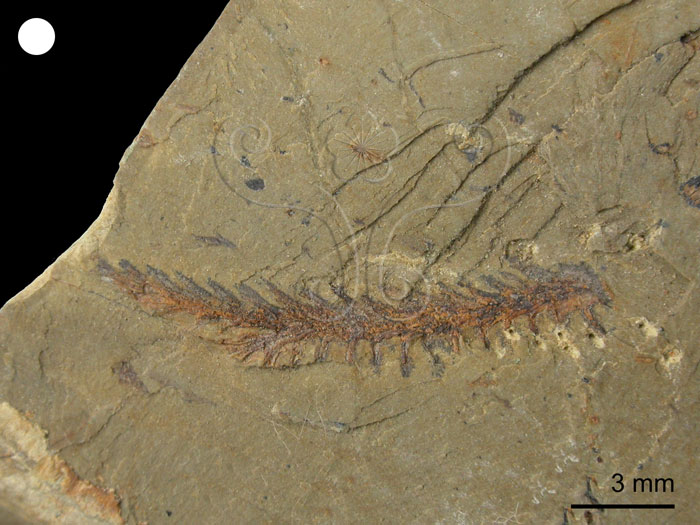
Graptoloidea
The Cincinnatian Series has scandent, reclined, and reflexed forms - these are prevalent in the Upper Ordovician. Pendant, declined, and deflexed forms tend to be Lower Ordovician. So, there’s change through time.
Geniculograptus typicalis typicalis (strata.uga.edu/cincy/fauna/graptolithina/DGGeniculograptu...) (www.flickr.com/photos/jsjgeology/16771115263) (www.flickr.com/photos/jsjgeology/17203716088)
The first identified Cincinnatian graptolite, the most common, and most well studied Cincinnatian graptolite is the graptoloid Geniculograptus typicalis typicalis (there are other subspecies) - it’s common in the Southgate Member of the Kope Formation; it's upper range is not really known, but it goes down into the Middle Ordovician. James Hall’s 1800s list of New York graptolites listed Climacograptus typicalis but no description accompanied the name. Hall named it and figured it. This was the first reference to that graptolite. Ruedemann’s description gave species credit to Hall, though he never originally described Climacograptus typicalis. Ruedemann claims he described it in 1908. James apparently described it in 1892. This species is biserial. Riva recognized that typicalis isn't a Climacograptus. Mitchell, using sicular morphology, put typicalis in Geniculograptus - it is no longer in Climacograptus. Riva also proposed a new genus name (Uticagraptus), but that name was published one month after Mitchell's new genus name. In northern Kentucky, troughs/trough fillings of Geniculograptus have been found with the graptolites all lined up (Ron Fine has found these). Geniculograptus typicalis typicalis is 2 to 5 centimeters long (3/4 inch to 2 inches). Its thecae have a slightly tapering square appearance. These alternate on either side of the virgula.
Geniculograptus typicalis magnificus is a big biserial form in the Maysville Stage. typicalis typicalis has lengths up to 3.5 centimeters (1 3/8 inches), but typicalis magnificus can get to 7 centimeters long (almost 3 inches). It looks like it has smaller thecae, but they are just spread out more, because the rhabdosome is wider between thecae.
Geniculograptus typicalis posterus is a smaller-than-magnificus form in the Fairview Formation.
Geniculograptus pygmaeus is also a now-well studied form. (www.flickr.com/photos/jsjgeology/17389529022) It has been tossed around from time to time as typicalis. It can be confused with typicalis, but it’s a lot smaller than typicalis. pygmaeus is younger - it occurs in the upper Kope Formation and the lower Fairview Formation. pygmaeus and typicalis do overlap, but pygmaeus is younger & typicalis is older. Geniculograptus pygmaeus is usually less than 1 centimeter long and ~1 millimeter or so wide (this species is small & narrow). Geniculograptus typicalis is ~1.25 inches (2 to 3 centimeters) long. Geniculograptus pygmaeus has square thecae that taper more than in Geniculograptus typicalis.
An intermediate form between G. typicalis typicalis and G. pygmaeus is known - it occurs in the top of the Southgate Member of the Kope Formation in Kentucky - it’s not named yet, apparently - Geniculograptus sp. - it is longer and skinnier than pygmaeus, but still smaller than typicalis.
Orthograptus quadrimucronatus - short spines come out from the sides; found in the Kope Formation to Arnheim Formation (the Richmondian Stage form is a subspecies - O. quadrimucronatus richmondensis). Biserial; thecae are more triangular and have thecal spines; the thecae are chevron-shaped (V-shaped), while Geniculograptus, in contrast, has squarish thecae. This is a larger species than Arnheimograptus anacanthus.
(Orthograptus - www.geodil.com/images/30/3004/mid.jpg)

Arnheimograptus anacanthus - found at the Flat Run Trilobite Lagerstätte site near Mt. Orab, Ohio (look for graptolites there, not trilobites!). This is a relatively new genus (named by Mitchell); it is only ~1 centimeter long, with chevron-shaped thecae; biserial.
Dicranograptus nicholsoni (strata.uga.edu/cincy/fauna/graptolithina/DicranograptusNi...) - Rich Fuchs has never seen it; a reclined graptolite - has a scandent portion, then it splits; it has a two-stipe rhabdosome with a biserial extension (Y-shaped rhabdosome - the root is biserial; the two upper branches are uniserial). Occurs in the bottom of the Kope Formation (Fulton Shale Member), which is mostly flooded now by the Ohio River.

Dicellograptus forchammeri (strata.uga.edu/cincy/fauna/graptolithina/DicellograptusFo...) - a uniserial grapolite supposedly in the Fairveiw Formation; formerly Leptograptus annectens (a Ruedemann name). Mitchell and Bergström reassigned it to Dicellograptus, because Leptograptus has a two-stipe rhabdosome. The Cincinnatian form is actually Dicellograptus sp. aff. Dicellograptus forchammeri. It has a V-shaped or U-shaped rhabdosome.

Amplexograptus maxwelli (www.flickr.com/photos/jsjgeology/17203906150) - occurs in the bottom of the Kope Formation, in the Fulton Shale; it is similar to Geniculograptus typicalis posterus, but don't worry - it occurs in beds below water level along the Ohio River in Cincinnati; biserial; square thecae - slightly rounded lip of thecae; tip is different from Geniculograptus.
(Amplexograptus - jpaleontol.geoscienceworld.org/content/76/5/921/F2.large.jpg)

Climacograptus - there’s still one of these in the Fairview Fm.
Uncertain placement graptolites:
Most of what's been assigned to the Cincinnatian dendroid graptolites is Mastigograptus, but there's lots of conjecture about what it is. There are five or so species of Mastigograptus in the Cincinnatian Series. They appear as plain, black lines (flattened tubes) in rock - "pepper rock". The five species range from the Kope Formation to the Waynesville Formation. The best way to figure out the species is to use the stratigraphic horizon.
Mastigograptus tenuiramosus - delicate; occurs in the bottom half of the Kope Formation; usually fragile - forms pepper rock. Pepper rock usually has scolecodonts. Branch angles are at 45°.
Mastigograptus gracillimus (strata.uga.edu/cincy/fauna/graptolithina/MastigograptusGr...) - these are decent-sized fossils compared with Cincinnatian graptoloids; Kope Formation to Fairview Formation.

Mastigograptus perixilis - Waynesville Formation.
(www.flickr.com/photos/jsjgeology/17203569048)
Mastigograptus strictus - has shallow branching angles. Occurs in the Arnheim Formation - can be found at the Flat Run Trilobite Lagerstätte site near Mt. Orab, Ohio. But, it could be the same species as Mastigograptus tenuiramosus.
Mastigograptus multifasciatus - upper Fairview Formation.
Are there visible thecae in Mastigograptus? Ruedemann said thecae in Mastigograptus are known from other areas. Taylor found only one thecae-bearing specimen. Rich has never seen thecae in Cincinnatian Mastigograptus. The Treatise has thecae drawn in on the Mastigograptus illustration.
Mastigograptus is sometimes listed as a dendroid, sometimes listed as uncertain.
Bulman didn’t know where to place Mastigograptus within the graptolites.
Ultrastructure studies show Mastigograptus is a graptolite. But some say they look like seawhips.
Rich Fuchs thinks that Mastigograptus is similar to seawhips. He thinks it is almost definitely not a graptolite. Seawhips are a form of coral (horny coral). After seawhips die, the outer organic material comes off, resulting in a Mastigograptus-like thing.
[Dave Meyer comment: seawhips now are much larger than Mastigograptus, but the point is well taken. There’s nothing saying Ordovician seawhips couldn’t have been small enough to be Mastigograptus.]
Urbanek did an SEM study of Mastigograptus - it’s structure is consistent with graptolites; the chemistry is the same as graptolites; therefore, it could be a graptolite; but, it still could be something else. There’s still no evidence of thecae.
There are 5 or 6 species of Cincinnatian Chaunograptus named. Most are Liberty Formation forms. Most are based on one specimen. Most of the holotypes are now missing (museum-wise). The Smithsonian renumbered their collections a while ago and lost the Chaunograptus. One was lost in a Dayton flood. Few holotypes are left. Chaunograptus are extremely fragile - not often found.
Chaunograptus is an encruster that may not be a graptolite. It is fairly rare and easily overlooked. It is more like to be found in the Richmondian Stage, especially encrusting brachiopod shells. Chaunograptus is classified as a dendroid or uncertain. There are several species, but some don't look like the rest. Ruedemann listed 11 species - 7 were Upper Ordovician - 6 were Cincinnatian. Now we're down to five species. John Taylor said two of them were synonymous. Taylor's thesis says that Chaunograptus shideleri is the same as Chaunograptus delicatus. Most of the species are Richmondian. Chaunograptus fossils have been found at the Newport Shopping Center. Rich Fuchs has found what he calls Chaunograptus contortus and Chaunograptus delicatus in the Kope Formation. This is probably a form whose ranges are not well known.
Chaunograptus contortus - encrusting black spots on nodules. Twisted thecae with extremely thin lines (nemas). Rich Fuchs has found Chaunograptus contortus in the Kope Formation, but it was described from the Liberty Formation. The type is missing - couldn't be found by Taylor.
(www.flickr.com/photos/jsjgeology/17203753020)
(www.flickr.com/photos/jsjgeology/17389341202)
Chaunograptus delicatus - the type specimen is encrusting a nodule; it has thicker lines than C. contortus; the lines trail around; occasional thecae structures; the lines move out from a central point. Also first described from the Liberty Formation. Occurs in the Liberty Formation and Whitewater Formation. The type specimen is known.
(www.flickr.com/photos/jsjgeology/16771017233)
(www.flickr.com/photos/jsjgeology/16771013283)
Chaunograptus vermiformis - Liberty Formation. The type specimen is in the Smithsonian - it's been renumbered, but it has been found.
Chaunograptus macrothecae - Grant Lake Formation. Type specimen can't be found.
Chaunograptus gemmatus - Kope Formation The type specimen (one specimen) is known.
Inocaulis (www.graptolite.net/INOCAUL.jpg) (www.flickr.com/photos/jsjgeology/17203749888) - a worse genus than Mastigograptus in terms of identifying structure and determining affinities. This is a rare fossil that's supposedly a graptolite. Inocaulis is a non-descript collection of tubes, forming a stem - looks like a series of tubes (= the thecae) bundled together. Two Cincinnatian species - Inocaulis simplex (Kope Formation) and Inocaulis grandis (Maysville Stage); it doesn’t look like a graptolite, but it’s listed as a dendroid. Grammaria is a modern hydrozoan (chess.myspecies.info/sites/chess.myspecies.info/files/gra...) - it has a similar arrangement of tubes put together. Inocaulis may be another graptolite that really isn’t.


-------------------
Because of the complex automation, MBR systems require the use of programmable logic controllers (PLC).
Our Daily Challenge - June , 2016 - "Climb, Climbing, or Climber"
Daily Dog Challenge 1680. "Exercise"
Stop on by Zachary and Henry's blog: bzdogs.com - The Secret Life of the Suburban Dog