View allAll Photos Tagged positioning
The local Coop in Radstock has moved to new premises, albeit temporarily, as the old store is redeveloped.
First's Bath depot had vacated the area, with routes operated by Bristol, and mainly by Wells depot. However, Covid changes mean Bath now operate extensively with B9TL 36232 BD12TCV seen on an evening journey.
handstand position - A Caucasian woman in her handstand position. To Download this image without watermarks for Free, visit: www.sourcepics.com/free-stock-photography/24740288-handst...
Jennifer and Janet competing in the Judo section at the Australiasian Masters Games held in Adelaide October 6th 2007. They won the Gold Medal.
Holy Trinity, Balsham, Cambridgeshire
There are three Brasses at Balsham. Two are for former Rectors - John Sleford d.1401 and John Blodwell d.1462 and the third is for an unidentified Knight c. 1480s. None of these is now in its original position where, as far as is known, the bodies of John Sleford (just inside the Chancel), John Blodwell (just outside the Chancel and in the Nave) and the Knight (in the Nave) still lie. There may have been other Brasses now missing. It is common-place to blame the era of Oliver Cromwell (1640s-1660s) for de¬struction but vandalism took place earlier and later; Brasses were often re-cycled.
Brasses were usually ordered by a man during his lifetime so he could control their design as to reflect his career and opinion of himself. Brass dating is no exact science and depends on knowledge about the various "workshops" and their styles. There is a "Cambridge School" but the Sleford and Blodwell Brasses come from the "London B" workshops.
In the 18th Century the Sleford Brass was intact and the inscription recorded. By 1808 (Lyson's Magna Britannia) it had lost a small piece, now there is more missing. The Blodwell Brass is intact but the engraving of the leaden shields is almost all gone and there are only faint traces of the cross hatching on other lead parts. The figure of the Knight is intact but the inscription portions have been long missing.
Three versions of the two Sleford and Blodwell inscriptions are provided - one in Modern idiom within the text and at the end the Latin followed by a Literal Translation. The Latin spelling on the Brasses follows mediaeval practice and abbreviation. This is modernised, with missing parts provided in [] square brackets and contractions extended in () round brackets: The soft "c" is often now written 't" and the "ae" is now so written though in mediaeval times it was contracted to e.
John Sleford was a "King's Clerk" - a man in Holy Orders but primarily a Civil Servant. He began his career in the household of Philippa of Hainault (Queen to King Edward III) and on the merge of her household with that of the King he was transferred to the Wardrobe Administration or 'Supplies Department' of the Crown. He became Keeper of the Privy Wardrobe of the Tower in 1365 (this department dealt with small and valuable objects, including aims, canons and gunpowder), and Keeper also of the Great Wardrobe, which dealt with bulk supplies, in 1371. In both these offices he succeeded Henry Snaith, whom he also followed as Rector of Balsham. He probably took his name from the town of Sleford, Lincs; there is also mention of a (possibly his brother) William Sleford in the royal service as a Clerk of Works and Dean of the King's Free Chapel of St Stephen, Westminster.
King's Clerks had limited basic salaries, augmented by Fees of Office and supplemented by ecclesiastical income drawn from various appointments obtained for them by Royal pressure upon the Bishops.
This is how John Sleford became Rector of Balsham in the mid 1360s and the Public Records reveal his many appointments. Such King's Clerks were seldom in their parishes, where pastoral work was carried out by substitutes, but in the case of John Sleford there is evidence of his local activity from before the time he lost his office as Keeper of the Wardrobe, as well as from afterwards. He held the lease of Oxcroft Farm in the 1370s, he had land at Linton, Essex. His Brass records that he "built the church" and gave the stalls. In 1384 he is known to have owed £400 (later marked paid) and perhaps by this he financed the rebuilding of the Nave with its Clerestory windows and two side aisles.
He was closely identified with the "old regime" of King Edward III which, after the death of Queen Philippa, had been corrupted by the influence of the King's Mistress, Alice Perrers. A rival establishment gathered about the King's grandson (son to the Black Prince), later King Richard II. It was Sleford's duty to superintend the burial of King Edward III, for which records show his acquittance, and with the installation of the new regime Sleford lost his Royal appointment as Keeper of the Wardrobe in 1377 and, probably thereafter retired to Balsham. There is a hint of resignation in the inscription on the Brass.
His Brass shows him wearing a Cope decorated with named Saints, each holding the proper symbol. There are the two SS. John (for his name); the two SS. Mary (the Mother of Jesus and the Magdalene); two popular women saints in the mediaeval era, SS. Margaret and Katherine; S. Etheldreda for Ely and S. Wilfrid (who had received Etheldreda's monastic vows) for Ripon where Sleford was a Canon.
The Brass carries his monogram IS; armorial bearings for his Royal patrons, Queen Philippa of Hainault and King Edward III; and symbols of the Evangelists Mathew, Mark, and Luke but that for John is missing. At the top his path to judgment is depicted - his soul is on a sheet held by two angels while above is God as Holy Trinity and the inscription (freely rendered to English "O Holy Trinity, I beseech you to receive me at the end."
Within the border is a verse inscription with some words abbreviated or left understood. It tells of his career, clerical appointments, connection with King Edward III, and work at Balsham.
(About the Margin).
Portrayed here, John Sleford lies beneath this stone. He was Rector by appointment, and after the World had abandoned him he opened his purse generously. He protected good men and firmly punished vices. He had been loved by King Edward, who lingered into evil times; while he still prospered he was Keeper of the King's Wardrobe (or: while the King still flourished he was keeper of the Wardrobe). He built this church and never regretted his gifts afterwards. He had these stalls made, and poured out money for them freely. He was first a Canon of Wells, and then of Ripon. He ended his life peacefully, dying on the feast of Edward (King and Martyr) ending his life peacefully at the very end of the year of our Lord 1400. When his body was carried down to the grave it was already the first (year of the new century). O merciful Christ, I pray he may enter heaven. May he feel no sorrow, because Christ bore sorrow for the sake of all men.
(Above the soul of Sleford) O Holy Trinity, I beseech you to receive me at the end.
(Above the soul ofSleford), P(er)sonis trine, posco me susc(ipe)re fine.
(About the Margin).
Io(an)n(es) Sleford, di[ct(us) Recto]r, mu(n)do q(ue) relict( us)
Bursa no(n) strict(us), lacet hie s(u)b marmor(e) pict(us),
Fautor iustor(um), consta(n)s ultor vitior(um),
Que(m) rex Edward(us) dilexerat, ad mala tard(us).
Gardroba(m) rexit illi(us) du(m,) bene vixit.
Eccl(es)iam struxit ha(n)c; nu(n)q(ua)m postea luxit;
Haec fecit stalla, large iu(n)de(n)s q(ue) m(e)talla.
Canonic(us) p(ri)mo Wellis, Ryppon fuit imo.
Edwardi festo decessit fine modesto,
[Regis et Anglorum qui detulit acta re(gn)or(um),
(Anno)] mille(si)mo quadri(n)gen(tensim)o quoq(ue) pleno.
Huic adde(n)s p(ri)mu(m), deductu(m) corp(us) ad imu(m).
0 cleme(n)s Chr(ist)e, caelos precor intr(e)t ut iste.
Nil habeat triste, q(uia) p(er)tulit o(mn)ib(us) iste].
5b. THE SLEFORD INSCRIPTION; LITERAL TRANSLATION.
John Sleford, appointed as Rector and having been abandoned by the World, not a severe man in the use of money (lit: as to his purse, in other words not a mean man), lies portrayed here, beneath the stone. He was a protector of just men and a constant punisher of vices, Whom King Edward, lingering into evil days (lit: slow towards evils), had loved. He ruled his (the king's) Wardrobe while he prospered (lit: lived well). He built this church; he never grieved for it afterwards (or: he never shone afterwards). He made these stalls, pouring out gold and silver liberally. He was a Canon first of Wells, then of Ripon. He, who recorded the acts of the English kingdoms, departed (this life) by a gentle death on the feast of Edward the King (or: he departed this life by a gentle death on the feast of Edward the king, who denounced the acts of the English kingdoms), the year 1400 being complete. His body was carried down to the grave, adding to this the first (year of the new century). 0 merciful Christ I pray that this man may enter heaven. May he know nothing sorrowful, because he (Christ) bore it (i.e. sorrow) for all men.
(Above the soul of Sleford) O one, threefold in your persons, I beseech you to receive me at the end.
stepneyrobarts.blogspot.co.uk/2010/07/balsham-cambridgshi...
Overhead Ciego de Ávila, Cuba enroute to Jamaica. My First Officer took this photo...thank you Scott!
Ciego de Ávila Province
There are three Ashfords, really. The modern newtown, Swindonesque newbuilds stretching into the countryside; the Victorian railway town, all neat rows of brick buit houses and the station, and then there is the old town, timber-framed houses along narrow lanes, with St Mary standing towering above all but the modern office blocks.
The west end church was given over to a Christmas Fayre, but is also used now as a concert venue, while under the tower westwards is still in use as a church, with many of its ancient features left alone by the Victorians.
-------------------------------------------
A stately church in a good position set away from the hustle and bustle of this cosmopolitan town. The very narrow tower of 1475 is not visually satisfactory when viewed from a distance but its odd proportions are hardly noticed when standing at its base. The church is very much the product of the families who have been associated with it over the centuries and who are commemorated by monuments within. They include the Fogges and the Smythes. The former is supposed to have wanted to create a college of priests here, but by the late fifteenth century such foundations were going out of fashion and the remodelling of the church undertaken by Sir John Fogge may have just been a philanthropic cause. Unusually, when the church was restored in 1860 the architect Ewan Christian kept the galleries (he usually swept them away), but Christ Church had yet to be built and the population of this growing town would have needed all the accommodation it could get. Even in 1851 1000 people had attended the church in a single sitting. The pulpit, designed by Pearson, was made in 1897.
www.kentchurches.info/church.asp?p=Ashford+1
------------------------------------------
THE TOWN AND PARISH OF ASHFORD
LIES the next adjoining to Hothfield eastward. It is called in Domesday both Estefort and Essetesford, and in other antient records, Eshetisford, taking its name from the river, which runs close to it, which, Lambarde says, ought not to be called the Stour, till it has passed this town, but Eshe or Eschet, a name which has been for a great length of time wholly forgotten; this river being known, even from its first rise at Lenham hither, by the name of the Stour only.
A small part only of this parish, on the east, south and west sides of it, containing the borough of Henwood, alias Hewit, lying on the eastern or further side of the river from the town, part of which extends into the parish of Wilsborough, and the whole of it within the liberty of the manor of Wye, and the borough of Rudlow, which adjoins to Kingsnoth and Great Chart, are in this hundred of Chart and Longbridge; such part of the borough of Rudlow as lies adjoining to Kingsnoth, is said to lie in in jugo de Beavor, or the yoke of Beavor, and is divided from the town and liberty by the river, near a place called Pollbay; in which yoke there is both a hamlet and a green or common, of the name of Beavor; the remainder of the parish having been long separated from it, and made a distinct liberty, or jurisdiction of itself, having a constable of its own, and distinguished by the name of the liberty of the town of Ashford.
ASHFORD, at the time of taking the general survey of Domesday, was part of the possessions of Hugo de Montfort, who had accompanied the Conqueror hither, and was afterwards rewarded with this estate, among many others in different counties; in which record it is thus entered, under the general title of his lands:
¶Maigno holds of Hugo (de Montfort) Estefort. Turgisus held it of earl Godwin, and it is taxed at one suling. The arable land is half a carucate. There is nevertheless in demesne one carucate, and two villeins having one carucate. There are two servants, and eight acres of meadow. In the time of king Edward the Confessor, it was worth twenty five shillings; when he received it, twenty shillings; now thirty shilling.
The same Hugo holds Essela. Three tenants held it of king Edward, and could go whither they would with their lands. It was taxed at three yokes. The arable land is one carucate and an half. There are now four villeins, with two borderers having one carucate, and six acres of meadow. The whole, in the reign of king Edward the Confessor, was worth twenty shillings, and afterwards fifteen shillings, now twenty shillings.
Maigno held another Essetisford of the same Hugo. Wirelm held it of king Edward. It was taxed at one suling. The arable land is four carucates. In demesne there are two, and two villeins, with fifteen borderers having three carucates. There is a church, and a priest, and three servants, and two mills of ten shillings and two pence. In the time of king Edward the Confessor it was worth seventy shillings, and afterwards sixty shillings, now one hundred shillings.
Robert de Montfort, grandson of Hugh abovementioned, favouring the title of Robert Curthose, in opposition to king Henry I. to avoid being called in question upon that account, obtained leave to go on a pilgrimage to Jerusalem, leaving his possessions to the king; by which means this manor came into the hands of the crown. Soon after which it seems to have come into the possession of a family, who took their name from it. William de Asshetesford appears by the register of Horton priory to have been lord of it, and to have been succeeded by another of the same name. After which the family of Criol became owners of it, by whom it was held by knight's service of the king, in capite, by ward to Dover castle, and the repair of a tower in that castle, called the Ashford tower. (fn. 1) Simon de Criol, in the 27th and 28th year of Henry III. obtained a charter of free warren for this manor, whose son William de Criol passed it away to Roger de Leyborne, for Stocton, in Huntingdonshire, and Rumford, in Essex. William de Leyborne his son, in the 7th year of king Edward I. claimed and was allowed the privilege of a market here, before the justices itinerant. He died possessed of this manor in the 3d year of Edward II. leaving his grand-daughter Juliana, daughter of Thomas de Leyborne, who died in his father's life-time, heir both to her grandfather and father's possessions, from the greatness of which she was stiled the Infanta of Kent, (fn. 2) though thrice married, yet she died s. p. by either of her husbands, all of whom she survived, and died in the 41st year of Edward III. Upon which this manor, among the rest of her estates, escheated to the crown, and continued there till king Richard II. vested it, among others, in feoffees, for the performance of certain religious bequests by the will of king Edward III. then lately deceased; and they, in compliance with it, soon afterwards, with the king's licence, purchased this manor, with those of Wall, and Esture, of the crown, towards the endowment of St. Stephen's chapel, in the king's palace of Westminster, all which was confirmed by king Henry IV. and VI. and by king Edward IV. in their first years; the latter of whom, in his 7th year, granted to them a fair in this town yearly, on the feast of St. John Port Latin, together with all liberties, and to have a steward to hold the court of it, &c. In which situation they continued till the 1st year of Edward VI. when this collegiate chapel was, with all its possessions, surrendered into the king's hands, where these manors did not continue long; for that king, in his 3d year, granted the manor of Esshetford, with that of Wall, and the manor of Esture, to Sir Anthony Aucher, of Otterden, to hold in capite; and he, in the 2d and 3d of Philip and Mary, sold them to Sir Andrew Judde, of London, whose daughter and at length heir Alice, afterwards carried them in marriage to Thomas Smith, esq. of Westenhanger, commonly called the Customer, who died possessed of them in 1591, and lies buried in the south cross of this church, having had several sons and daughters, of, whom Sir John Smythe, of Ostenhanger, the eldest, succeeded him here, and was sheriff anno 42 Elizabeth. Sir Thomas Smith, the second son, was of Bidborough and Sutton at Hone, and ambassador to Russia, of whom and his descendants, notice has been taken in the former volumes of this history; (fn. 3) and Henry, the third son, was of Corsham, in Wiltshire, whence this family originally descended, and Sir Richard Smith, the fourth, was of Leeds castle. Sir John Smythe, above-mentioned, died in 1609, and lies buried in the same vault as his father in this church, leaving one son Sir Thomas Smythe, of Westenhanger, K. B. who was in 1628 created Viscount Strangford, of Ireland, whose grandson Philip, viscount Strangford, dying about 1709, Henry Roper, lord Teynham, who had married Catherine his eldest daughter, by his will, became possessed of the manors of Ashford, Wall, and Esture. By her, who died in 1711, he had two sons, Philip and Henry, successively lords Teynham; notwithstanding which, having the uncontrolled power in these manors vested in him, he, on his marriage with Anne, second daughter and coheir of Thomas Lennard, earl of Sussex, and widow of Richard Barrett Lennard, esq. afterwards baroness Dacre, settled them on her and her issue by him in tail male. He died in 1623, and left her surviving, and possessed of these manors for her life. She afterwards married the hon. Robert Moore, and died in 1755. She had by lord Teynham two sons, Charles and Richard-Henry, (fn. 4) Charles Roper, the eldest son, died in 1754 intestate, leaving two sons, Trevor-Charles and Henry, who on their mother's death became entitled to these manors, as coheirs in gavelkind, a recovery having been suffered of them, limiting them after her death to Charles Roper their father, in tail male; but being infants, and there being many incumbrances on these estates, a bill was exhibited in chancery, and an act procured anno 29 George II. for the sale of them; and accordingly these manors were sold, under the direction of that court, in 1765, to the Rev. Francis Hender Foote, of Bishopsborne, who in 1768 parted with the manor of Wall, alias Court at Wall, to John Toke, esq. of Great Chart, whose son Nicholas Roundell Toke, is the present possessor of it; but he died possessed of the manors of Ashford and Esture in 1773, and was succeeded in them by his eldest son John Foote, esq. now of Bishopsborne, the present owner of them. There are several copyhold lands held of the manor of Ashford. A court leet and court baron is regularly held for it.
THE TOWN OF ASHFORD stands most pleasant and healthy, on the knoll of a hill, of a gentle ascent on every side, the high road from Hythe to Maidstone passing through it, from which, in the middle of the town, the high road branches off through a pleasant country towards Canterbury. The houses are mostly modern and well-built, and the high-street, which has been lately new paved, is of considerable width. The markethouse stands in the centre of it, and the church and school on the south side of it, the beautiful tower of the former being a conspicuous object to the adjoining country. It is a small, but neat and chearful town, and many of the inhabitants of a genteel rank in life. Near the market place, is the house of the late Dr. Isaac Rutton, a physician of long and extensive practice in these parts, being the eldest son of Matthias Rutton, gent of this town, by Sarah his wife, daughter of Sir N. Toke, of Godinton. He died in 1792, bearing for his arms, Parted per fess, azure, and or, three unicorns heads, couped at the neck, counterchanged; since which, his eldest son, Isaac Rutton, esq. now of Ospringeplace, has sold this house to Mr. John Basil Duckworth, in whom it is now vested. In the midst of it is a large handsome house, built in 1759, by John Mascall, gent. who resided in it, and died possessed of it in 1769, and was buried in Boughton Aluph church, bearing for his arms, Barry of two, or, and azure, three inescutcheons, ermine; and his only son, Robert Mascall, esq. now of Ashford, who married the daughter of Jeremiah Curteis, esq. is the present owner, and resides in it. At the east end of the town is a seat, called Brooke-place, formerly possessed by the family of Woodward, who were always stiled, in antient deeds, gentlemen, and bore for their arms, Argent, a chevron, sable, between three grasshoppers, or; the last of them, Mr. John Woodward, gent. rebuilt this seat, and died possessed of it in 1757; of whose heirs it was purchased by Martha, widow of Moyle Breton, esq. of Kennington, whose two sons, the Rev. Moyle Breton, and Mr. Whitfield Breton, gent. alienated it to Josias Pattenson, esq. the second son of Mr. Josias Pattenson, of Biddenden, by Elizabeth, daughter and coheir of Felix Kadwell, esq. of Rolvenden; he married Mary, daughter of Mr. Henry Dering, gent. of this parish, and widow of Mr. John Mascall above-mentioned, by whom he has no issue, and he is the present owner of this seat, and resides in it. There have been barracks erected lately here, which at present contain 4000 soldiers. The market is held on a Saturday weekly, for the sale of corn, which is now but little used; and a market for the sale of all sorts of fat and lean stock on the first and third Tuesday in every month, which has been of great use to prevent monopolies. Two fairs are annually held now, by the alteration of the stile, on May 17, and Sept. 9, and another on Oct. 24; besides which, there is an annual fair for wool on August 2, not many years since instituted and encouraged by the principal gentry and landholders, which promises to prove of the greatest utility and benefit to the fair sale of it. That branch of the river Stour which rises at Lenham, runs along the southern part of this parish, and having turned a corn mill belonging to the lord of this manor, continues its course close at the east end of the town, where there is a stone bridge of four arches, repaired at the expence of the county, and so on northwards towards Wye and Canterbury. On the south side of the river in this parish, next to Kingsnoth, within the borough of Rudlow, is the yoke of Beavor, with the hamlet and farm of that name, possessed in very early times, as appears by the register of Horton priory, by a family of that name, one of whom, John Beavor, was possessed of it in the reign of Henry II. and was descended from one of the same furname, who attended the Conqueror in his expedition hither. The parish contains about 2000 acres of land, and three hundred and twenty houses, the whole rental of it being 4000l. per annum; the inhabitants are 2000, of which about one hundred are diffenters. The highways throughout it, which not many years ago were exceeding bad, have been by the unanimity of the inhabitants, which has shewn itself remarkable in all their public improvements, a rare instance in parochial undertakings, and by the great attention to the repairs of them, especially in such parts as were near their own houses, are now excellent. The lands round it are much upon a gravelly soil, though towards the east and south there are some rich fertile pastures, intermixed with arable land, and several plantations of hops; but toward the west, the soil is in general sand, having much quarrystone mixed with it, where there is a great deal of coppice wood, quite to Potter's corner, at the boundary of this parish.
The church, which is dedicated to St. Mary, is a large handsome building, consisting of three isles, with a transept, and three chancels, with the tower in the middle, which is losty and well proportioned, having four pinnacles at the top of it. There are eight bells in it, a set of chimes, and a clock. In the high chancel, on the north side, is the college John Fogge, the founder of the college here, who died in 1490, and his two wives, the brasses of their figures gone; but part of the inscription remains. And formerly, in Weever's time, there hung up in this chancel six atchievements, of those of this family whose burials had been attended by the heralds at arms, and with other ceremonies suitable to their degrees. Underneath the chancel is a large vault, full of the remains of the family. On the pavement in the middle, is a very antient curious gravestone, having on it the figure in brass of a woman, holding in her left hand a banner, with the arms of Ferrers, Six masctes, three and three, in pale; which, with a small part of the inscription round the edge, is all that is remaining; but there was formerly in brass, in her right hand, another banner, with the arms of Valoyns; over her head those of France and England quarterly; and under her feet a shield, being a cross, impaling three chevronels, the whole within a bordure, guttee de sang, and round the edge this inscription, Ici gift Elizabeth Comite D' athels la file sign de Ferrers . . . dieu asoil, qe morust le 22 jour d'octob. can de grace MCCCLXXV. Weever says, she was wife to David de Strabolgie, the fourth of that name, earl of Athol, in Scotland, and daughter of Henry, lord Ferrers, of Groby; and being secondly married to John Malmayns, of this county, died here in this town. Though by a pedigree of the family of Brograve, she is said to marry T. Fogge, esq. of Ashford; if so, he might perhaps have been her third husband. Near her is a memorial for William Whitfield, gent. obt. 1739. The north chancel belonged to Repton manor. In the vault underneath lay three of the family of Tuston, sometime since removed to Rainham, and it has been granted to the Husseys; Thomas Hussey, esq. of this town, died in 1779, and was buried in it. In the south chancel are memorials for the Pattensons, Whitfields, and Apsleys, of this place; and one for Henry Dering, gent. of Shelve, obt. 1752, and Hester his wife; arms, A saltier, a crescent for difference, impaling, on a chevron, between three persons, three crosses, formee; and another memorial for Thomasine, wife of John Handfield, obt. 1704. In the north cross are several antient stones, their brasses all gone, excepting a shield, with the arms of Fogge on one. At the end is a monument for John Norwood, gent. and Mary his wife, of this town, who lie with their children in the vault underneath. The south cross is parted off lengthways, for the family of Smith, lords of Ashford manor, who lie in a vault underneath. In it are three superb monuments, which, not many years since, were beautified and restored to their original state, by the late chief baron Smythe, a descendant of this family. One is for Thomas Smith, esq. of Westenhanger, in 1591; the second for Sir John Smythe, of Ostenhanger, his son, and Elizabeth his wife; and the third for Sir Richard Smyth, of Leeds castle, in 1628: all which have been already mentioned before. Their figures, at full length and proportion, are lying on, each of them, with their several coats of arms and quarterings blazoned. In the other part of this cross, is a memorial for Baptist Pigott, A. M. son of Baptist Pigott, of Dartford, and schoolmaster here, obt. 1657, and at the end of it, is the archbishop's consistory court. In the south isle is a memorial for Thomas Curteis, gent. obt. 1718, and Elizabeth his wife; arms, Curteis impaling Carter. Under the tower is one for Samuel Warren, vicar here forty-eight years, obt. 1720. The three isles were new pewed and handsomely paved in 1745. There are five galleries, and an handsome branch for candles in the middled isle; the whole kept in an excellent state of repair and neatness. There was formerly much curtious painted glass in the windows, particularly the figures of one of the family of Valoyns, his two wives and children, with their arms. In the south window of the cross isle, and in other windows, the figures, kneeling, of king Edward III. the black prince, Richard, duke of Gloucester, the lord Hastings. Sir William Haute, the lord Scales, Richard, earl Rivers, and the dutchess of Bedford his wife, Sir John Fogge, Sir John Peche, Richard Horne, Roger Manstone, and—Guildford, most of which were in the great west window, each habited in their surcoats of arms, not the least traces of which, or of any other coloured glass, are remaining throughout this church. Sir John Goldstone, parson of Ivechurch, as appears by his will in 1503, was buried in the choir of this church, and gave several costly ornaments and vestments for the use of it.
The Metro train has terminated at platform 1 at Tynemouth, and it's been given the "cat's eyes" to draw forward to the crossover north of the station. The train will reverse into platform 2 and return towards St James.
The Breakers, the Gilded Age summer home of Cornelius Vanderbilt II at 44 Ochre Point Avenue, is the most visited attraction in Rhode Island. Part of a 13-acre estate on the seagirt cliffs, it maintains a commanding position facing east overlooking the Atlantic Ocean. Designed by architect Richard Morris Hunt, the home was constructed between 1893 and 1895 at the then-astronomical cost of more than $7 million.
The Breakers Mansion, regarded as the grandest of Newport's summer "cottages", served as a symbol of the Vanderbilt family’s social and financial preeminence. Commodore Cornelius Vanderbilt established the family fortune in steamships and later in the New York Central Railroad. His grandson, Cornelius Vanderbilt II, became Chairman and President of the New York Central Railroad system in 1885. That same year he purchased the Breakers, a wood-framed mansion from Pierre Lorillard IV. After it burned down in 1892, Vanderbilt commissioned Hunt, in what would be his last project, who directed an international team of craftsmen and artisans to create a new 70-room Italian Renaissance-style palazzo, with Beaux Arts and Victorian elements, inspired by the 16th century palaces of Genoa and Turin. Allard and Sons of Paris assisted Hunt with furnishings and fixtures, Austro-American sculptor Karl Bitter designed relief sculpture, Boston architect Ogden Codman decorated the family quarters, and Ernest Bowdtich, a Boston engineer, landscape artist, and student of Frederic Law Olmsted, designed the grounds.
Vanderbilt insisted that The Breakers be made as fireproof as possible. Steel trusses support the masonry and exterior Indiana limestone blocks. The enormous heating plant was set beneath the caretaker’s cottage and joined to the house by a wide tunnel. The finished floors are of marble, tile, terrazzo, and mosaic.
The 250 foot by 120 foot dimensions of the five-story mansion are aligned symmetrically around a central Great Hall. Hunt based the Hall on the concept of rooms grouped around an open courtyard or cortile, but covered them as a concession to climate. He did, however, maintain the structured symmetry, with rooms of the first and second floors opening onto a 45-foot high central space. The walls of the Hall are made of carved Caen limestone from the coast of France and adorned with plaques of rare marbles ranging from the pink marble of Africa to the greens of Italian origin. Elaborately carved pilasters decorated with acorns and oak leaves support a massive carved and gilt cornice which surrounds a ceiling painted to depict a windswept sky. On the ceiling are four blue-green medallions bearing the acorn and oak leaf, a Vanderbilt family symbol representing strength and longevity.
A rounded bay projects from the South wing, accommodating the huge oval Music Room inside and overlooking the South Parterre. The ocean-facing East façade joins the north and south wings with a two-story arched loggia in the Palladian manner—the lower one with a vaulted mosaic ceiling and the upper painted to resemble canopies against the sky. The spandrels of the loggia arches are decorated with figures of the four seasons of the year. The wall between the Hall and the loggias is almost entirely of glass, affording a view of the ocean from inside.
The Main Entrance is approached through by 30-foot high wrought iron gateways, which are part of a 12-foot-high Genoese-style limestone and iron fence that borders the property on all but the ocean side. The gateway was crafted by the William Jackson Company and topped with elaborate scrollwork, including the acorn and oak leaf family symbol surrounding the initials of Cornelius Vanderbilt. A gravel drive leads to the large porte-cochére of the northwest facade. Flanking the entrance drive are four bronze lamp posts, decorated with molded figures executed by Henri Bonnard of New York, mounted on three-foot limestone pedestals with 4-globed bronze standards 13 feet high.
The "Cottage,", located between the side gate and the main house was used as a children's playhouse. A good example of Victorian architecture on a small scale, it was built by Robert Swain Peabody and John Goddard Stearns, the architects of the original Breakers House, whose Queen Anne Revival style elements were in keeping with the original design.
Cornelius Vanderbilt died from a cerebral hemorrhage caused from a second stroke in 1899 at the age of 56, leaving the Breakers to his wife, Alice Gwynne Vanderbilt. She outlived her husband by 35 years and died at the age of 89 in 1934. In her will, The Breakers was given to her youngest daughter Gladys. An ardent supporter of The Preservation Society of Newport County, she opened The Breakers in 1948 to raise funds for the Society. In 1972, the Preservation Society purchased the house from her heirs. Although the mansion is owned by the Society, the original furnishings displayed throughout the house are still owned by the family.
The Breakers National Register #71000019 (1971)
Bellevue Avenue Historic District National Register #72000023 (1972)
Explored :: position 414 on Monday, October 10th, 2010
Huge thanks to all of you !
Still another view of one of the futuristic Lloyd's of London towers, seen from the beautiful and very old Leadenhall Market. Also known as "The Inside-Out Building" because all the services are on the outside of the structure, it has featured in a number of science fiction films.
...and also the last photo I shall post of this building!
The camera and tripod positioned at low level on the muddy shores of the Swale looking west to the setting sun and the chimney of Grain Power Station.
On the morning of the 23rd, we moved up at three o'clock, and got into position. One division of cavalry opposite the gate on the Cabul road; one part of our force moved off to our left, to watch the enemy on the hills, and make a feint attack on their position on the opposite side, so as to draw their attention from us. We were occupied in placing[37] batteries so as to command the gate; at the same time Colonel Thompson, of the Engineers, was laying a chain cable to throw a bridge across the Moat. When this was accomplished, a mine was laid under the stone buttresses, and at a quarter to six o'clock the mine was opening, and up went the gates with a terrific crash. The storming party, consisting of the 13th Light Infantry, under Colonel Robert Sale; the 2nd or Queen's, under Sir Thomas Wiltshire; when the bugle sounded, commenced their attack under a heavy fire—the 13th had the honour of leading. The enemy every where made a terrific resistance. Colonel Sale was knocked off his horse and trampled upon, still he ordered the bugler to sound a retreat, instead of which, whether intentional or not, the advance was sounded. Nothing could daunt the ardour and bravery of the men. They soon gained a footing inside, where hand to hand encounters was carried on in its most relentless form, and in half an hour, both regiments were firmly established inside the walls. By day light the British flag was mounted on the Citadel, many of the enemy having thrown themselves therefrom,[38] rather than surrender, to the Moat below, a distance of 150 feet. We were ordered to enter and seize the horses, which were running wildly without riders, which we did after some hard work, and brought them to the prize agent outside. We were annoyed, however, very much, through having to encounter the worst of firing, as many of the Afghans popped at us from loop-holes and windows in every street of the city. When the sun rose on the hills the Infantry could plainly be seen ascending the greatest heights of the Citadel, far above the city; here they got into the bank, and loaded themselves with money. Many of the enemy were trying to escape to the valley away on our left; these, and the force on the mountains, kept our troops in that direction busy. By 2 o'clock, p.m., all was over, and Ghuznee was in possession of the British.
Feelings after battle.
When all opposition ceased, and one went through the city, now filled with sounds of wailings, he cannot but be struck with the dreadful havoc war brings with it. This was my first general action, and although when in the heat of it, I felt no[39] pity for any one, at least I cannot remember feeling so, still, when the desolation is complete, and you are met everywhere with its sad effects, property destroyed, mutilation of brutes, horses, camels, &c., dead, and writhing in pain from wounds; wounded men and women every where begging for mercy or succour, the dead piled all round, the most hardened must give way to sadness. Shah-Soojah, our newly crowned king, was busy on our right, hanging and shooting traitors, some of them leading Chiefs who had fallen into his hands. The whole of the 24th was occupied in burying the dead, and on the following day Hadjee Kan came in, and gave up his sword, a beautiful one, the hilt studded with costly gems; for its possession the officers had a race, which was won by the 4th Light Dragoons. The horses captured, all of them valuable Arab or Turcoman were sold by auction, the proceeds appropriated as prize money. - W. J. D. Gould, 1880
+++ DISCLAIMER +++
Nothing you see here is real, even though the conversion or the presented background story might be based historical facts. BEWARE!
Some background:
In 1964 the Royal Air Force specified a requirement (Air Staff Target (AST) 362) for a new fast jet trainer to replace the Folland Gnat. The SEPECAT Jaguar was originally intended for this role, but it was soon realized that it would be too complex an aircraft for fast jet training and only a small number of two-seat versions were purchased. Accordingly, in 1968, Hawker Siddeley Aviation (HSA) began studies for a simpler aircraft, initially as special project (SP) 117. The design team was led by Ralph Hooper.
This project was funded by the company as a private venture, in anticipation of possible RAF interest. The design was conceived of as having tandem seating and a combat capability in addition to training, as it was felt the latter would improve export sales potential. By the end of the year HSA had submitted a proposal to the Ministry of Defense based on the design concept, and in early 1970 the RAF issued Air Staff Target (AST) 397 which formalized the requirement for new trainers of this type. The RAF selected the HS.1182 for their requirement on 1 October 1971 and the principal contract, for 175 aircraft, was signed in March 1972.
Design of the Hawk was conventional by any approach. The two-seat crew - made up of an instructor in the rear cockpit and his student pilot in the front - sat in tandem under a wide field-of-view canopy. Controls at each position were redundant with the instructor having the ability to override student functions as needed. The cockpit was situated well-forward in the design behind a pointed, sloped-down nose assembly. Intakes to aspirate the single engine mounting came in the form of two half-circle openings to either side of the rear cockpit. The turbofan engine was buried deep within the short fuselage which was streamlined with a certain engineering elegance common to British military aircraft.
The intake ducts bulged out at the fuselage sides but were absorbed into the fuselage proper to continue the aircraft's smooth design layout. Wings were fitted amidships and sported modest sweep along the leading edge and lesser sweep along the trailing edge. They were also low-mounted assemblies along the fuselage to help increased expediency for ground operation. The empennage was traditional with a single vertical tail fin flanked by a pair of downward-canted horizontal tail planes. The tail planes were all-moving surfaces to add to the Hawk's agility. Small ventral strakes were noted along the empennage base. The undercarriage was conventional in layout and consisted of two main single-wheeled landing gear legs and a single-wheeled nose leg. The main legs retracted inwards towards centerline while the nose leg retracted forwards.
Standard armament for the Hawk was an optional gun pod commonly fitted to the centerline hard point under the fuselage (there were, in effect, five total hard points). The gun pod housed a 30mm ADEN series cannon for close-in work but remained an optional fixture. There were originally two underwing hard points (later expanded to four) cleared for the carrying of external munitions including guided/homing missiles, rocket pods and conventional drop bombs with the two inner-most hard points plumbed to accept fuel from external drop tanks. Up to 6,800lbs of external stores could be lifted by the Hawk airframe.
The prototype aircraft first flew on 21 August 1974. All development aircraft were built on production jigs; the program remained on time and to budget throughout. The Hawk T1 entered RAF service in late 1976. The first export Hawk 50 flew on 17 May 1976. This variant had been specifically designed for the dual-role of lightweight fighter and advanced trainer. It had a greater weapons capacity than the T.1, featured a total of five hard points, avionics improvements, the ability to carry larger drop tanks of 590 liter (156 US gallon) capacity, and an uprated engine which made the Hawk 50 qualified for 30% greater takeoff weight than the RAF's Hawk T.1.
One of the initial foreign customers was the Finnish Air Force (Suomen Ilmavoimat). In January 1978, Britain and Finland announced a deal to in which the Finnish Air Force was to receive 50 Hawk Mk. 51s in 1980. The Finnish Hawk 51s had a unique avionics fit, used a Saab RS-2 gunsight, and were fitted with a VKT 12.7 millimeter gun pod instead of the 30 millimeter Aden cannon pod provided with the T.1. Interestingly, Finnish Hawks are in some cases fitted with the Russian R-60 (AA-8) AAM, and they are also used for reconnaissance, carrying Vinten optical-infrared camera pods. The first four Hawks in the Finnish order were built in the UK, with the other 46 assembled from kits by Valmet of Finland.
These aircraft were built in Finland under licence by Valtion lentokonetehdas. At that time. the Finnish Air Force was still limited to 60 first-line fighter aircraft by the Paris Peace Treaty of 1947. But by acquiring Hawks, which counted as trainers rather than fighters, capacity could be increased while continuing treaty compliance. These conditions were nullified during the 1990s by the break-up of the Soviet Union, though.
Seven additional Mk. 51As were delivered in 1993–94 to make up for losses, and due to rising levels of metal fatigue, a major structural reinforcement program was carried out to extend the operational life of Finland's Hawks during the 1990s.
More variants of the Hawk followed and common improvements to the base design typically include increased range, more powerful engines, redesigned wing and undercarriage, the addition of radar and forward-looking infrared (FLIR), GPS navigation, and night vision compatibility. Later models were manufactured with a great variety in terms of avionics and system compatibility to suit the individual customer nation. Cockpit functionality was often rearranged and programmed, too, in order to be common to an operator's main fighter fleet to increase the Hawk's training value.
General characteristics:
Crew: 2: student, instructor
Length: 12.43 m (40 ft 9 in)
Wingspan: 9.94 m (32 ft 7 in)
Height: 3.98 m (13 ft 1 in)
Wing area: 16.70 m2 (179.64 ft²)
Empty weight: 4,480 kg (9,880 lb)
Useful load: 3,000 kg (6,600 lb)
Max takeoff weight: 9,100 kg (20,000 lb)
Powerplant:
1× Rolls-Royce Adour Mk. 851 non-afterburning turbofan with 23,1 kN (5.200 lbf) static thrust
Performance:
Maximum speed: Mach 0.84 (1,028 km/h, 638 mph) at altitude
Range: 2,520 km (1,360 nmi, 1,565 mi)
Service ceiling: 13,565 m (44,500 ft)
Rate of climb: 47 m/s (9,300 ft/min)
Thrust/weight: 0.65
Armament:
No internal armament, but an optional VKT 12.7 millimeter gun in a centerline pod;
Up to 2.200 lb (1.000 kg) of weapons on four underwing hard points, including 4× AAMs like
AIM-9 Sidewinder or R-60 (AA-8 'Aphid'), bombs of up to 1.000 lb (454 kg) caliber, unguided rocket
pods, drop tanks or reconnaissance pods with cameras
The kit and its assembly:
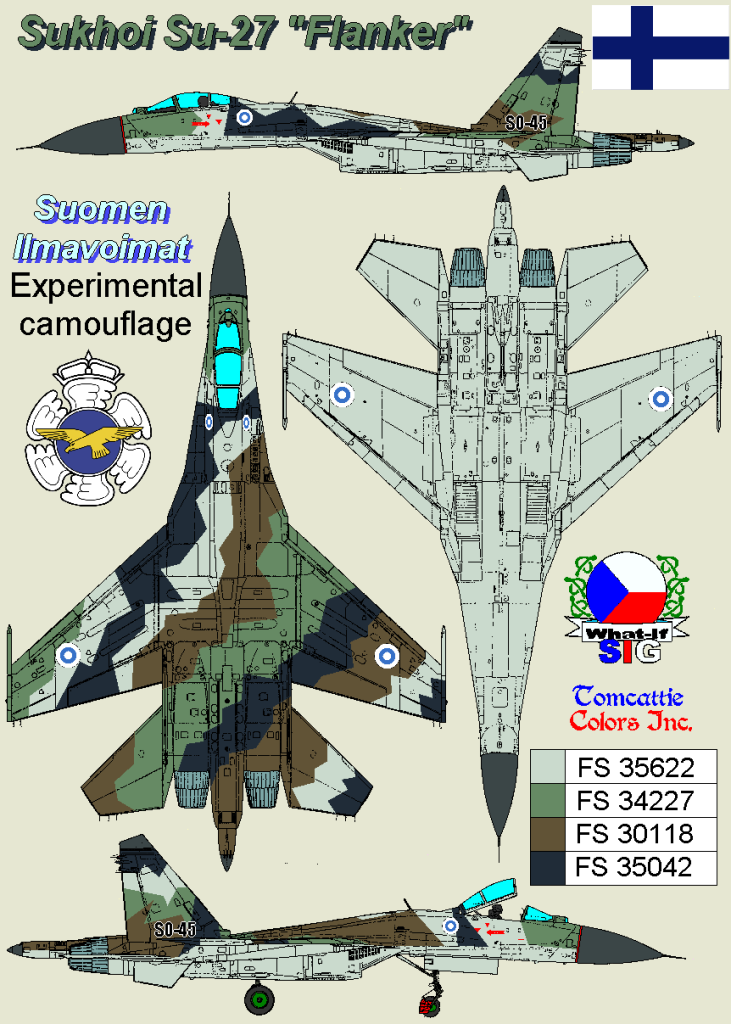
A simple build, sparked from a short-notice inspiration when I did online legwork for paint schemes. Then I stumbled upon profiles of fictional Finnish MiG-29 and Su-27, posted in 2011 by fellow member Wenzel from the CZ What if SIG a.k.a. PantherG at whatifmodelers.com, featuring interesting, fictional four-tone splinter schemes:
i730.photobucket.com/albums/ww303/PoorWhistler/Doodles/Su...
i730.photobucket.com/albums/ww303/PoorWhistler/Doodles/Mi...
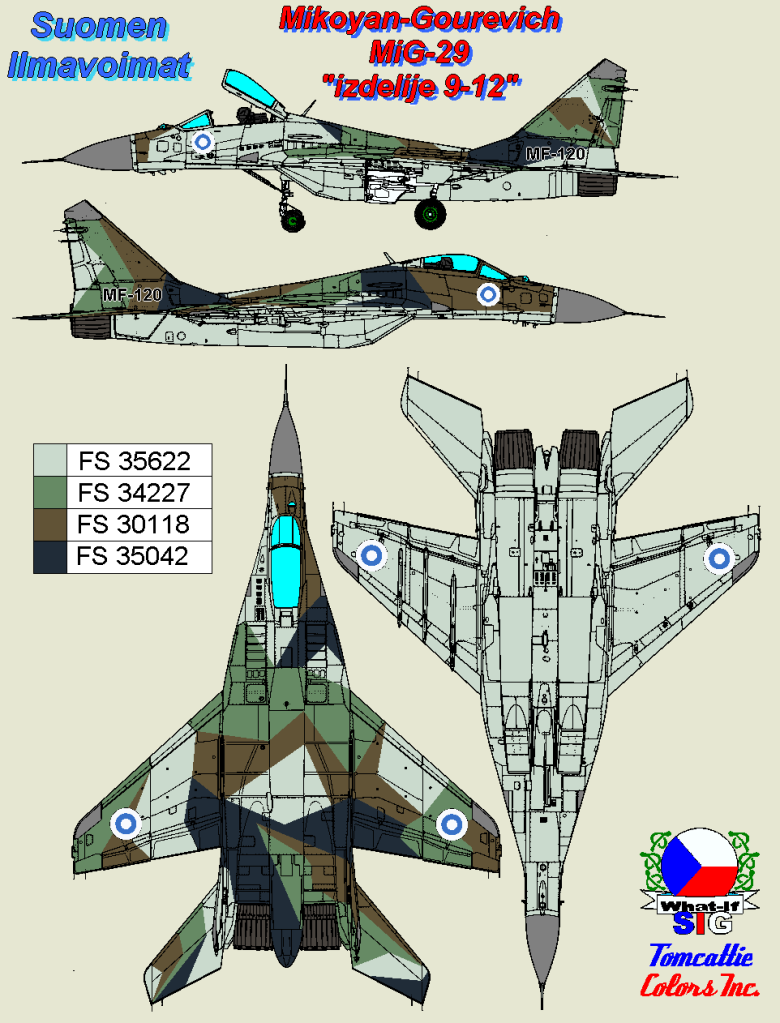
These got me thinking, but instead of building one of the Russian fighters I wondered how this camouflage concept would look on a smaller aircraft already in Ilmavoimat service. This led directly to the Hawk 51!
Thankfully, there are several kits available for this aircraft, and I settled upon the relatively new Airfix kit from 2007. It's main selling point was that it actually contains parts and decals for a Finnish aircraft, esp. a set of the modern, very tiny roundels.
Good experience with recent Airfix offerings were confirmed. Effectively, the Airfix Hawk is a nice and simple build, done in just one and a half day. One of the kit’s positive features is the crew: there are actually two modern and well-sculpted pilot figures included, a rarity these days.
The kit was mostly built OOB, only mods are a cover inside of the ventral air brake (which can be built into open position, but this leaves an ugly seam visible) and some extra antennae. Fit is good (not perfect, though), and only little PSR was needed - biggest issue was the ventral wing/fuselage intersection, esp. its rear end.
One truly tricky feat is the mounting of the protective clear separating screen between the cockpit seats – the clear wall has (somehow) to be glued into the clear canopy, without any reference where to actually place it. Altogether a risky business, and I was lucky to get the wall into place with only a little white glue so that a total mess could be avoided. The positive thing about this construction is that you can mount the canopy in open position with the wall inside.
The engraved panel lines appear a little massive at first glance (far from Matchbox' trenches on the Hawk 200, though!), but once you add paint the kit this evens out and looks much better than on the sprues. A nice and literally simple kit!
Painting and markings:
The more challenging part of the build - and I stuck closely to the inspiring profiles and their color choice, choosing a pattern of diagonal "splinter stripes" in rather unique tones:
• FS 35042 (USN Sea Blue; Humbrol 181)
• FS 34227 (Intermediate Green; Humbrol 120)
• FS 30118 (US Field Drab; Humbrol 142)
• FS 35622 (IDF Pale Blue; Humbrol 122), which was also used for the undersides
Painting was done free-handedly, with brushes and some tape for masking, and I stuck to the original color suggestions except for the pure FS35622 on the upper surfaces: I toned it slightly down with a little RLM76 (Humbrol 247), but it is still very bright and the contrast between all colors is really harsh.
Anyway, painting the splinter scheme was easier than it seems, since the areas of each of the four upper side tones was rather small, so that the straight lines were rather short. Only the tight edges needed some corrections, but that was mostly mended during the washing/shading process.
As a design twist, the drop tanks (taken OOB, these are the bigger tanks for the Hawk's export versions) and their respective pylons received the colors of the standard Ilmavoimat Hawks: the pylons were painted in a light olive green (Humbrol 159) while the tanks were painted in a murky, dark brown (a mix of Humbrol 10 and 66) with pale grey (Humbrol 166) undersides.
The cockpit interior was painted in Gull Gray (FS 36231), while other interior surfaces and the landing gear were kept in lighter RAF Aircraft Grey.
For the markings I relied upon the OOB decal sheet; deviating from the inspiring profiles I stuck to the OOB tiny Finnish roundels that were introduced in the Nineties, and they go well with this experimental scheme. Otherwise, markings are rather minimal, just a lot of stencils were applied, the Airfix OOB sheet is pretty exhaustive (with a zillion of stencils, merely 1x1mm in size… There are even decals to be placed on landing gear joints!? Seriously?). As a side benefit, the OOB Finnish aircraft comes with low-viz stencils, placed on a green background. On the fictional splinter livery of my build they blend well into the overall look, the whole aircraft looks very natural (but still original).
In order to emphasize the engraved panel line the kit received a black ink wash and some panel shading through dry-brushing on the upper surfaces, with only slightly lighter tones (e. g. RAL 5008 on the dark blue and RAF Cockpit Green on the FS 34227). I just wanted a subtle effect. Finally, after the decals had been applied, the kit was sealed with matt acrylic varnish (Italeri).
A quick and pleasant build, and it's actually a relaxing experience to build something OOB, without transplants, major, Frankenstein-ish surgery and endless PSR sessions. In fact, the Airfix Bae Hawk kit makes it easy for the builder to create a decent model with little effort. You see that some thought went into the moulds and the kit’s construction.
The fictional four-tone splinter scheme looks really weird, though, almost like an anniversary scheme? O.K., it is, according to its creator, actually based/inspired by a pre-WWII Fokker D.VII fighter in Finnish service, but this real life version was created from different and less “loud” colors! Anyway, this Hawk is colorful in a certain way, even though I have doubts concerning its camouflage’s effectiveness? However, it’s a nice, bright addition to the whif collection. :D
Chepstow Castle in South Wales occupies a stunning position on an escarpment on the edge of the muddy and fast-flowing River Wye. The Great Tower (effectively a keep) has been dated to 1067 and is probably the oldest or second oldest stone castle in Britain, being contemporary with the White Tower at the Tower of London. It overlooks and dominates a major crossing point of the Wye.
I have a YouTube film here: www.youtube.com/watch?v=I67rE3xwkXY
Its first owner was William FitzOsbern, a Norman conqueror, and is thus one of the earliest of the Welsh Marches castles, strongholds built as the Anglo/Normans pushed their way from England into Wales, a country which was independent from England at this time. The heart of the castle was the Great Tower surrounded by a simple stone wall on three sides and the steep vertical drop into the Wye on the fourth side.
Later owners extended the castle precinct along the cliff edge in both directions, adding extra wards or baileys, strong stone towers and a barbican. The castle was also served by a narrow cleft in the rock at the foot of the cliffs which acted as a dock and allowed supplies to be hoisted up into a cellar beneath the castle.
The castle’s later development owes itself to William Marshall and Roger Bigod - indeed it was Bigod who built the Marten’s Tower which overlooks the entrance and the town and which was so self-contained that this tower has its own portcullis. Bigod also added a town wall, parts of which remain today. The original front gates have been removed and are preserved under an arch - they are believed to be the oldest mortice and tenon joints surviving in Britain.
King Edward I visited in 1284 but it was never really a royal castle. It was garrisoned in 1403 in response to the Owain Glyndower rebellion by 20 men-at-arms and 60 archers but it seems to have been regarded as too powerful to attack and was largely passed-by in the Middle Ages.
The coming of gunpowder artillery was different and Chepstow was besieged twice in the English Civil War - 1645 and 1648 - being one of the last sites to fall to the victorious Parliamentarians. There is a memorial to Sir Nichols Kerneys who died here leading the second defence. To make the castle suitable for defence musket loops were cut into the upper works of the walls on the town side. I also noted that crude holes had been smashed through at least one wall tower (originally meant to STOP medieval attackers moving along the wall walks) to allow defending musketeers to move from one threatened wall to another to shoot.
The Parliamentarians smashed a breach in the wall on the town side but this was repaired after the ECW with a double wall, thick earth infill and an artillery embrasure to permit return fire if the castle ever came under attack again. It did not. It functioned as a prison for a while with one of the commissioners who signed King Charles I’s death warrant being held here.
It was used as a location for the Terry Gilliam/Michael Palin film Jabberwocky in 1977 and also appears in TV’s Robin of Sherwood. Some of the 50th anniversary Dr Who broadcast was recorded here. It is maintained by CADW today and is open at most reasonable times.
Positioning the housing of the thermistor and cable routing to a bicycle charger on a Randonneur bike
Radio is uniquely positioned to bring communities together and foster positive dialogue for change. It also plays a crucial role in emergency communication and public emergency response. Irene Lasu works as a radio presenter for the UN Mission in South Sudan’s Radio Miraya. Peacekeeping radio stations in many countries, such as Mali, the Central African Republic and the DRC are currently providing critical information during the COVID-19 pandemic.
Credit: UN Photo/Isaac Alebe Avoro
Date: 21 April 2020
Highest position:# 65 on Thursday, September 12, 2013
Hedge Bindweed, Common Bindweed,Calystegia, aka Muttergottesgläschen
-->> Click , click
© View LARGE on BLACK
or white, or grey
__ For your Eyes only ©
°°°°°°°°°°°°°°
°°°
Die Zaunwinden (Calystegia) sind eine Pflanzengattung aus der Familie der Windengewächse (Convolvulaceae). Etwa die Hälfte der 30 Arten sind in ihrer Verbreitung auf Kalifornien beschränkt, die anderen sind weit verbreitet.
Die Kelchblätter sind nahezu gleich geformt und bleiben auch an der Frucht beständig. Die Krone aus vollständig miteinander verwachsenen Kronblättern ist weiß, pink oder blassgelb gefärbt, trichterförmig, unbehaart und weist fünf deutliche Bänder in der Mitte der Kronblätter auf. Die gleichgestaltigen Staubblätter ragen nicht über die Krone hinaus. Ihre Staubbeutel geben kugelförmige, pantoporate (mit gleichmäßig verteilten Poren versehene) und nicht stachelige Pollenkörner ab. Der Fruchtknoten ist einkammerig und enthält vier Samenanlagen. Der Griffel ragt nicht über die Krone hinaus und trägt zwei keulenförmige Narben.
°°°
Calystegia (bindweed, false bindweed, or morning glory) is a genus of about 25 species of flowering plants in the bindweed family Convolvulaceae.
The name is derived from two Greek words kalux, "cup", and stegos, "a covering", meaning "a covering cup". The stem is creeping over the ground, not winding or hardly winding. The leaves are dark green and reniform. The petioles are ovate or elleptical. The corolla is pink or pale purplish, with 5 white stripes.
°°°
bighugelabs.com/scout.php?username=40036489@N00&combi...
°°°
C1 - macro presets
kurzes digitales Macro-Zoom
White Balance Manual
Digital Zoom Ratio 2.2x
Focal Length (35mm format) 24 mm
°°°
Reduziert von 18 MB auf 12 MB Aufnahmequalität
°°°
Color Mode Normal
AFArea Mode 1-area by tapping on the sensitive screen
Image Stabilization Off
Intelligent Exposure Off
Intelligent Resolution Off
Scene Mode Off
Macro Mode Macro Zoom
Exposure Bias - 0.33 EV
White Balance Cloudy
Exposure Mode Auto bracket
Sequence Number 3
I draw a circle on the floor to keep the flash to subject distance constant, and to mark 15 equal steps.
My daughter Elisabeth, in front, with one of her partners at the end of their balance excercise this weekend.
They are keeping their heads up but my daughter can't really hide the disappointment because the excercise did not go as planned.
Explore ! Highest position: 414 on Friday, December 25, 2009
Absichtlich kein Winterbild ! Für warme Gedanken...
Engineers and technicians at NASA Glenn's Plum Brook Station in Sandusky, Ohio, are preparing for the first major test in the campaign to verify the structural integrity of Orion’s service module for Exploration Mission-1, the spacecraft’s first flight atop the agency’s Space Launch System (SLS) rocket. Orion’s service module, which will power and propel the vehicle and supply it with air and water, is being provided by ESA and built by Airbus Defence and Space. The solar array wing deployment test will verify that the qualification model wing unfurls as expected. On Saturday, Feb. 20, an international team of engineers and technicians lifted and tilted the service module test article -- which includes structural representations of the service module, crew module adapter, and spacecraft adapter -- to a 90 degree angle to position it for the deployment test of one of Orion’s four solar arrays. The next step in preparation for the test is attaching the solar array before the Feb. 29 deployment test. This is the first in a series of crucial tests to verify the service module’s structural integrity and ability to withstand the dynamic launch environment atop the SLS rocket.
Photo: NASA / Christopher J. Lynch
Barnard Castle in County Durham is set in a stunning position on the edge of the modern town, on a sharp escarpment overlooking the River Tees. In this position it is protected by the sheer drop to the river on one side but it also dominates the river bridge which is within easy longbow/crossbow range of the walls. This emphasis on the river crossing is further confirmed by a medieval sally port, protected by a portcullis, in the castle wall facing directly on to the bridge.
www.flickr.com/photos/barryslemmings/sets/72157628703984483/ to see the full set.
Ownership of the castle site was disputed between the Crown and the Bishops of Durham as the land had been given to the church in the 9th century but had been taken back by the Earls of Northumberland only to revert to the Crown after King William II crushed a rebellion by one of the earls. In 1095 the king granted it to Guy de Baliol of Picardy in France. Guy held the castle for 30 years but its chief association is with his son and grandson - both called Bernard de Baliol - after whom it is named today.
Bernard II fought against Scots King David I at the Battle of the Standard (Northallerton) in 1138. The original Baliols died out in 1199 but Eustance de Helicourt, a member of a local tenant family managed to obtain the succession and changed his name to Baliol. Perhaps he'd been an illegitimate child of the family. The Bishop of Durham held the castle as security for a loan to Eustace but was ordered to return it to Eustace's son Hugh in 1212. In 1216 Northumbrian barons were in revolt against the English king supported by Alexander I of Scotland and the castle was held by Hugh. While Barnard Castle was besieged by the Scots King Alexander's brother-in-law Eustace de Vesci was hit on the forehead by a crossbow bolt fired from inside the castle and killed. There are no further details but the castle apparently held out.
The Baliols later inherited large Scottish estates and John Baliol made a play for the Scottish crown and lost, being imprisoned in the Tower of London. The castle passed first to Bishop of Durham Antony Bek (based on the church's ancient claim to the site) but later reverted to Edward I. On his deathbed in 1307 Edward I granted the lordship to Guy de Beauchamp, Earl of Warwick. The Warwick lands were mainly in the Midlands and he rarely spent time at Barnard Castle. During the Beauchamp period the extensive outer ward of the castle was abandoned as a rationalistion to make the castle easier and cheaper to run. However the family also improved the inner ward defences.
The Beauchamp male line died out in the 15th century but the castle and earldom of Warwick was inherited by Richard Neville known as 'Warwick the Kingmaker' for his power brokering role in the so-called Wars of the Roses. With Warwick's death at the Battle of Barnet in 1471 the castle was again claimed by the Bishops of Durham but was instead passed to Duke Richard of Gloucester, the future King Richard III. Some changes at the castle including a luxurious oriel window bearing his white boar date to his ownership. Gloucester's primary base was at Middleham Castle further south in Yorkshire.
The castle was besieged again in 1536 during the religious unrest against King Henry VIII which led to the Pilgrimage of Grace which attempted to reverse the Dissolution of the Monasteries. A further uprising in 1569 saw the castle held against 5,000 rebels opposing Queen Elizabeth I. In a dramatic incident Sir George Bowes commanding the castle said that his garrison were jumping over the walls of the inner ward to desert and join the rebels. "I found the people in the castle in continual mutinies... in one daye and nyght two hundred and twenty six men leaped over the walles and opened the gaytes and went to the enemy; of which number thirty five broke their necks, legges or arms in the leaping..."
He eventually surrendered the castle on terms and marched out with 400 loyal men. The rebellion was later put down by the Earl of Sussex. The castle later slid into decay and was pillaged for building stone despite orders by the borough court that this should not happen. In 1952 it was placed in the hands of the Ministry of Public Buildings and Works and is now cared-for by English Heritage.
As presented now the castle is a handsome and well managed ruin. The original design was four wards or baileys - an inner ward, a middle ward, and outer ward and a town ward. This last is closest to the present town and may have served as a civilian shelter in time of Scots' raids. The outer ward was lightly defended and housed the castle's farm and a chapel and it was this which the Beauchamps let go, concentrating instead on the town, middle and inner wards. Each ward was separated from the others by ditches, walls and gates and the theory was that defenders could withdraw inwards and shorten their lines of defence during a siege or attack. The castle lacks an obvious strong tower or keep but the size and shape of the inner ward suggests the ward may have once have functioned as a shell keep similar to Carisbrooke Castle. The inner ward is now dominated by a large round tower but this does not seem to fulfill the role of a true keep. This round tower was used as an industrial shot tower for casting musket balls by later owners.