View allAll Photos Tagged develop
Developed from the Beech 35 Bonanza, the piston-engined T-34A and T-34B trainers were built between 1953 and 1959. A second production run of the turboprop T-34C lasted from 1975 to 1990.
So this is a picture from the first roll of film I have developed. It was exciting and fun and I was very anxious that the roll would just come out completely useless. All the debates back and forth online about processing and what to use and how long got me scared. I'm looking for comments, criticism, advice, and encouragement - so please leave your feedback!! Here's the important info:
This is Kodak Tri-X 400. The pictures were taken with a Pentax P30 using variously, a Pentax 50mm F2.0, a Pentax 28mm F2.8, and a JC Penney 135mm F2.8. I believe some of the exposure issues are in camera. I did not do any Photoshop post processing (my Mac crashed last week and I lost Photoshop!). These were scanned on an Epson V500. Some were scanned at 600 dpi, some 1200 and some 1600 (I was experimenting). All scanned at 12 bit greyscale.
I used a Ross darkroom bag. And boy, for a first time experience, that was different. Groping in the dark!
Processing was:
Developer: HC110 Dilution B for 6 minutes, agitation the first 30 seconds, then 5x every 30 seconds thereafter.
Stop Bath: vinegar and water mixture for 1:15, with agitation for first minute
Fix: Kodak fixer for 5 minutes, agitation for first minute, then 5x every 30 seconds thereafter
Wash: 20 minutes with a drop of Hyper-Wet
I'm a little concerned about grain (is it from the 400 speed film, the scan rate, the processing, or am I just picky), but overall, I'm pleased with my first try at developing. Even if the subjects are a bit dull.
Developing two rolls of film from test runs in a camera my cousin asked me to take a look at: Canon AE-1. Replaced battery. Worked fine for a while with intermittent shutter errors related to the shutter button and a electronix release. Hmmm...
How can developing countries ensure they take the path to prosperity, and not the road to ruin? Once a nation has more citizens of working age than dependents, it is poised at the edge of an unprecedented economic boom, known as the demographic dividend. But realizing this dividend demands multisectoral policies, investments, and programs that enable young people to flourish.
“Ensuring access to education, health services and employment for youth can mean the difference between capitalizing on a demographic dividend or taking a road towards disempowerment and disaffection,” says Dr. Babatunde Osotimehin, UNFPA’s Executive Director.
Join us on December 8th to explore how countries can achieve the demographic dividend through empowerment, education, and employment. Panelists will present innovative rights-based approaches to working with women, youth, and marginalized groups in ways that ensure the demographic dividend benefits all.
Just as empowerment, education, and employment are key to unlocking the demographic dividend, environmental sustainability also plays a critical role in the future of today’s youth. Join us for a special reception celebrating the release of ECSP’s “Healthy People, Healthy Environment” documentary trilogy, filmed in Tanzania, Ethiopia, and Nepal. Filmmaker, Sean Peoples, UNFPA’s Benoit Kalasa, and the Wilson Center’s Roger-Mark De Souza will offer brief remarks.
This event is co-sponsored by the United Nations Population Fund.
Read more: www.wilsoncenter.org/event/path-to-prosperity-empower-edu...
4 Testing Ilford Delta 3200 Minolta Dynax 5, Sigma 28-70mm F3.5-4.5 Minolta Program 3200i Flash Ilford Delta 3200 Developed In Ilford Ilfotec DD-X (1+4) January 2023
“Developing Inner Powers” @ Mahaan Institute, Shivaji Enclave,
New Delhi on 26th Feb 2020. Guest - Mr. Amrik Singh
Last year, Lexus partnered with Eddy Merckx Cycles in the development of their latest pro Time Trial (TT) bike. They had set out with one aim: to build the most efficient racing bike.
For the whole story, visit blog.lexus.co.uk/2013/04/lexus-develops-the-next-generati...
While developing in my new jobo cpe2, I turned my back for 5 minutes and the top had come off while bleaching, half of the bleach had leaked out, so I increased bleach time with half a minute. Results are very yellow, but very atmospheric.
I purchased my first, solitary, bee hotel in the spring of 2018. It was quickly discovered by Mason and Leafcutter bees and by the end of the first summer, I had almost "full occupancy." The bee hotel was placed on a shelf in the garage for the winter to protect the developing larvae from sub-zero temperatures. The following spring, it was placed back on the front porch in the same location near the garden where the bees forage. Unlike, honey bees, solitary bees only travel a few hundred feet from where they emerge. I added a second bee hotel during the early summer of 2019 and both hotels had nearly "full occupancy" by the end of the summer of 2019 and again in 2020. It has been amazing to observe the female bees go back and forth from the garden collecting pollen, cutting bits of plant material or gathering mud, then returning to the bee hotel to begin the egg laying process. Once they choose a “nesting tube” they crawl to the far end to begin. The female bee places her provisions, pollen with some sticky nectar that she rolls into a ball, then lays a single egg on the top. Next, she seals the egg into a “cell” with mud or leaf material (depending on which species she is) and repeats this process until the tube is filled the whole way to the front. One female solitary bee can lay about 5-15 eggs depending on the length of the tube. Once the eggs hatch, the larvae feed on the provisions, then form cocoons, and don’t emerge until the following spring. Each year, I would bring the bee hotels out from winter storage, but missed their emergence in 2019 and 2020. However, on March 31, 2021, our first really warm day, I happened to look out the kitchen window, which faces the porch and noticed a swarm of small bees flying around the bee hotels, the porch and even resting on the aluminum siding of the house. They were warming themselves in the sun! I was able to determine that these were all Mason Bees because the bees that were emerging were all breaking through the tubes that were sealed with mud. I observed the male Mason bees fly back to the nesting holes to check on whether the female bees were emerging. The males could apparently detect where the females were and would remain on the bee hotel, to attempt mating as soon as a female came out or would even enter the tube to mate before she emerged. At times, several male bees would pile onto the female, fighting to mate with her, often falling to the ground. As each new bee made its way to the opening of a tube, their tiny faces could be seen peering out from the tubes. Each emerging bee would cautiously come to the edge, clean their antennae with their feet, quiver for a moment, then take their first flight! Since the weather has turned cold again and there aren't many flowers yet, the bees are staying inside. On the intermittent warm days, they emerge to work on cleaning out the tubes, as evidenced by bits of dried mud all over the porch, just below the bee hotels!
As of the time of this posting, the Leafcutter Bees have not emerged, as the holes are still sealed with the plant materials used. This photo series was taken over two hours and is only a small portion of the total number taken of the amazing event.
onegreenworld.com/mason-bee-care/
ento.psu.edu/news/penn-state-pollinator-webinar-series-ma...
Natural arch developed in chalk & impure chalk in the Cretaceous of Kansas, USA.
This western Kansas landscape consists of chalk badlands and chalk pillars and a natural arch. The rocks are chalks and impure chalks (e.g., argillaceous chalk and chalky shale) that range in color from whitish to light gray to yellowish. Chalk is a biogenic, calcitic, marine sedimentary rock composed of numerous coccolith microfossils (see: www.soes.soton.ac.uk/staff/tt/eh/pics/lith2.gif). Coccoliths are individual calcareous plates that covered a single-celled photosynthetic marine organism called a coccolithophorid (a.k.a. coccolithophore) (see: upload.wikimedia.org/wikipedia/commons/d/d9/Emiliania_hux...). These beds were deposited in the ancient Western Interior Seaway, a section of ocean that existed during parts of the Mesozoic Era in what is now the American and Canadian Great Plains.
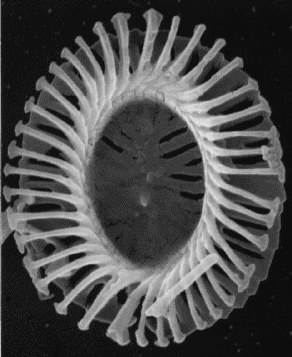
.png)
Rock arches are rare erosional features - those developed in chalk beds are even rarer. If a stream goes under an arch, it is known as a natural bridge. If no stream is present, the feature is a natural arch. Along lakeshores, they are called lake arches. Along oceanic coastlines, they are called sea arches. The highest concentration of natural arches on Earth is Arches National Park in eastern Utah.
Stratigraphy: Smoky Hill Chalk Member (a.k.a. Smoky Hills Member), Niobrara Formation, mid-Upper Cretaceous
Locality: Monument Rocks (also known as the Chalk Pyramids), along Gove County Road 16, north of the Smoky Hill River, Gove County, western Kansas, USA (38° 47' 43.24" North latitude, 100° 45' 52.06" West longitude)
ANTALYA, TURKEY - MAY 29: Turkish Foreign Ministry Deputy Secretary Ayse Sinirlioglu is seen before she holds a press conference after the Midterm Review of the Istanbul Programme of Action for the Least Developed Countries in Antalya, Turkey on May 29, 2016. Aykut Unlupinar / Anadolu Agency
The course presents best practices to develop and operate science centres and museums relating to our natural and cultural heritage, and supporting programmes for the public.
--
Foto: Lisa Zillio
The course presents best practices to develop and operate science centres and museums relating to our natural and cultural heritage, and supporting programmes for the public.
--
Foto: Lisa Zillio
Queen Elizabeth 2 Army Memorial Museum, Developed in the USA in 1950 as the Little Bulldog, the M41 Light Tank first saw action in the Korean War. The M41A1 Walker Bulldog first entered service with the New Zealand Army in 1960, where it replaced the World War II vintage Stuart and Valentine tanks. During the 1970’s and early 1980’s the Walker Bulldog was the New Zealand Army’s only tank and they were used in training exercises all over New Zealand. The Walker Bulldog was replaced in the mid 1980’s by the British Scorpion tracked reconnaissance vehicle. (), M41A1 WALKER BULLDOG LIGHT TANK, 02 July 2015 - Waiouru
I developed this T-max 400 according to Bruce Barnbaum in a Kodak HC-110 two bath developer
1. bath: dilution B (1+31) for the shadows and lower midtones
2. bath: dilution G (1+119) for reducing the highlights.
So it was possible to compress more than 12 stops to 6 stops without getting any flat negative.