View allAll Photos Tagged Simplicity
"Simplicity means the achievement of maximum effect with minimum means." - Dr. Koichi Kawana, Architect, designed the botanical gardens
Simplicity Sewing Pattern
#5479
Juniors' Design Your Own Top In Two Lengths With Bodice And Sleeve Variations
D.Y.O. - Design Your Own Tops
Size 7 - 8, 9 - 10, 11 - 12, 13 - 14, 15 - 16
Out Of Print
©2003
Adopted
Simplicity Vintage Sewing Pattern
#8216
Young Junior / Teens' Jumpsuit In Two Lengths & Bathing Suit
Size 13 / 14 Bust 33 1/2"
©1969
Simplicity Sewing Pattern
#5952
Child's Dress Or Communion Dress In Two Lengths & Veil
Size 6
Out Of Print
©1983
#1915 Simplicity Doily by Elizabeth Hiddleson
D= 36.5 cm Hook 1.00
VITA cotton PELICAN(50gr/330m) #3974
big 02.03.2013
fin 09.03.2013
"Enjoy the little things, for one day you may look back and realize they were the big things." ~ Robert Brault
M4H 5/52
My son loves to pick me flowers, so simple, but they are the best presents ever!
Belt tied in back
~~~~~~~~
For the Simplicity 1880 2-in-1 Sewalong
www.afashionablestitch.com/tag/2-in-1-sewalong/
I made the wrap version, with the short sleeves and the belt.
The fabric is a cotton voile from Westminster Fibers, in a colorway that is ideal for someone with three black and white dogs.
I thought the fabric would be too sheer to wear without a slip or lining but it turns it's absolutely fine without, which is great. This a perfect summer dress.
Project Details
Pattern: Simplicity 4082
Fabric:
Body - 100% wool herringbone tweed coating
Lining - 100% polyester Asian brocade
Notions: three 1 1/4" buttons
This is my version of the Burberry cropped a-line coat that retails for a whopping $850! I couldn't find an exact pattern to copy jacket, but with a little modifying of this pattern, I got a similar look.
Modifications:
* used view C & F
* reshaped the front bottom edge from rounded to square
* added faux welt pockets on the front seam line
* added a lining to the jacket
* interfaced all of the front sections
* mimicked the topstitching of the Burberry coat
* shortened a few inches more than the pattern (I reallly like the length of all of the Balenciaga jackets for this Fall).
I'm quite pleased with the way this jacket turned out and moreso with the cost - $47.91!
I took this photo a long time ago with my first crappy camera. Surprisingly enough, I've loved this image throughout the years.
"The simplicity and uniformity of rural occupations, and their incessant practice, preclude any anxieties and agitations of hope and fear, to which employments of a more precarious and casual nature are subject."
William Falconer
Have a great day!
Tracey Clark's Picture Fall Day 8: Keeping it Simple
Tracey asked us to explore how light enhances our photography. I think I generally am very aware of light, so I tried to do something a little different for me and play with deep shadows.
You may recognize this as my pumpkin baby (see below).
I'm way behind on looking at my friends' streams. I'll be at my in-laws' tomorrow and Monday and hope to do some catching up then.
First of all ... check out the new blog post which features new images from my "birthday party" on the Russian River ... celebrating with the bears, of course.
www.tnwaphotography.wordpress.com
Now, doesn't this bear cub just look so gosh darned cute?
There were primarily 2 brown bear cubs hanging out together on the Russian River, even though mama and their bigger sibling were hanging out on the ridge and keeping close tabs on these two mischievous ones. This one, the smaller of the two, would run around in the river and skillfully catch a salmon, which the other just watched. Well, watched and schemed up ways to get the salmon away from the smaller one. Let's call him (the fisherman) Charlie for simplicity.
Well, Charlie here was fishing in the hole, where the salmon were congregating, and the other bear had just taken off with his salmon. Charlie had a plan of his own in this case. See, soon after Charlie swan over to the "thief" and a sibling brawl began. You know how cubs fight ... 1/2 fight, 1/2 play. :-) It was quite exhilarating for us to observe, as they splashed, slapped, bit, and growled.
When I see this image, and the reason I called him Charlie, the thought of Charlie Brown came to mind ... as well as that jingle ... "why's everybody always picking on me?". LOL
Happy Hump Day everyone!!
Thanks for stopping by to view and especially for sharing your thoughts and comments with us. Remember, if you like bear shots ... check out the blog at www.tnwaphotography.wordpress.com
© 2014 Debbie Tubridy / TNWA Photography
Arfa. All rights reserved. This work may not be copied, reproduced, edited, republished, downloaded, displayed, modified, transmitted, licensed, sold, transferred, distributed or uploaded in any way without my prior written permission.
Project Details
Pattern: Simplicity 2938, View B
Fabric: Stretch Charmeuse
Notions: 12" invisible zipper; grosgrain ribbon
If you are in need a cute, trendy top that's really easy to make, this is the one. When I initially selected the pattern, I didn't have a fabric in mind. I just knew that I wanted it to be this fantastic color! I was prepared to take my pattern to the register in Hancock and then leave and saw this beautiful charmeuse... and it had stretch to boot! I added 2" to the length. This was my first time working with a stretch charmeuse... it was um, er um... interesting to work with. Notice that the bodice is constructed with princess seams. Right at the bust, the directions stated that ease needed to be removed. This caused the fabric to pucker. I had to repeat the process a couple of times to produce a smooth seam. Also, this is NOT the easiest fabric to press, but I made it work with steam and a pressing cloth.
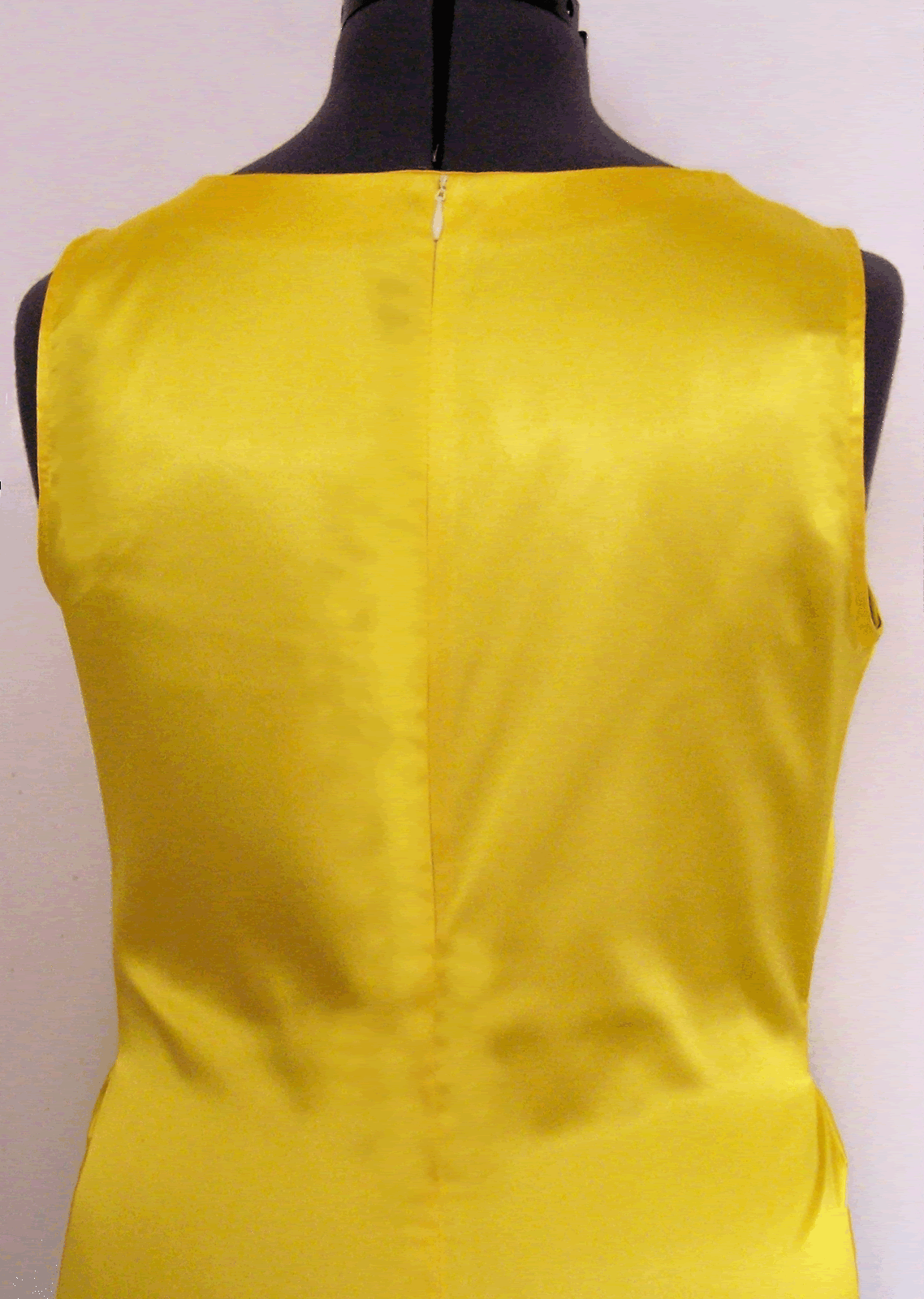
Instead of using the fabric tie, I used grosgrain ribbon. I wanted a look similar to the Tory Burch which appears to have the ties coming from darts or princess seams (I can't tell which). Placed mine in the side seams... just thought it would look better on me. The instructions suggested a lapped zipper but I used an invisible one instead. Overall, this is a great little top that can be whipped up in a couple of hours!
Thiq is my spring 2013 version, for the 2011 version, see: www.flickr.com/photos/teabutterfly/6237152610/
Frugal living: the total cost of what you see depicted here is less than 20€ ! Contents of handbag are:
Compact handbag: a street find in perfect condition. FREE.
Background is made of a vintage pure silk scarf with lotus flowers pattern: gift from a dear friend. FREE
Pocket folding mirror by Lexon: gift from my brotther. FREE
Gauze sachet to keep cosmetics in: came with wood jewelry I bought. FREE.
Certfified organic lipstick by BoHo Revolution: 9.80€
Sample of shea butter: FREE. I refill it with the ''karité soft'' argan oil + shea butter mix by Melvita.
Sample Iris perfume by Prada: swapped with a nice member of fragrantica.com FREE
Citrus liquid deodorant by Weleda, that I use like a daily scent, perfect for summer days, 9.11€ for a full bottle. I then fill a small travel glass spray bottle with some of this Weleda citrus scent.
Lipstick by Nivea - discontinued Cranberry color - less than 5€.
Ain't it awesome?! :-)
On many occasions, the best things in life are the most simple ones. And they're normally free of charge!
A menudo, lo mejor en la vida es lo más simple. ¡Y además suele ser gratis!
"I still color in books,
I use bright blue.
I say my ABC’s to get to 'u.'"
- Simplicity by Amaré
Blog | Instagram | Facebook | Shop
© Victoria Beckett | All Rights Reserved
All photos are property of Victoria Beckett and may not be used, sold, printed, or posted elsewhere without permission.
Is it me or what? Things that land in the realm of simplicity are supposed to be simple! Right? Take today’s assignment for example. It was SUPPOSED to be simple. I wanted to do a simple portrait using minimal tools. Yea, well, after a moment of mild frustration (y’all remember Yosemite Sam – the cartoon character when he would get frustrated? That dude was straight cussin’ in the cartoons!); I did my Yosemite Sam impersonation today trying to pull off this assignment.
Simplicity is complicated. So many things have to be in alignment for simple to happen. But when it does [get in alignment] oh!, what a wonderful thing. I think those old cats had the right I idea (I’m thinking about the ones in the karate movies I used to watch) where they say something like, “one must be at peace with one’s self”. My simplicity is compounded and becomes complex when I am not in alignment with me. Am I doing purpose? Where is my dream? How many excuses have I made or who else will I blame because I don’t have peace. Einstein said something like this: genius is making simple that which is complex [my paraphrase]. I want to be a genius!
Since I’m complicated and your complicated let us work toward simplicity. Here it is – the key: life is going to happen – good or bad – without any effort on our part. So let it do what it do. As for me and my house, we gone make memories, cherish the moments and keep it [uh] simple.
Used white & red embroidered/eyelet-type fabric. I think its maybe a polyester-cotton blend linen. The pattern is designed to fit loosely but I preferred a more fitted look. So I went one size smaller than usual, used larger seam allowances at the waist, and used elastic in the hem all to make it look a little more fitted.
Maybe same in age as the last one, yet a drastic change: one of Le Corbusier's early works, a comission for the French bankier and art collector La Roche. It was raining so crazy, we politely declined the opportunity to visit the workshop of Le Corbusier 20min walk away... sorry about the halo, picture was dark like a... due to the rain