View allAll Photos Tagged Executor
Final assembly has been completed and Lego Executor is setting out to terrorize the galaxy :)
This also means I can finally push on with creating some freestyle building again.
Julgamento do assassinato dos ativistas José Cláudio e Maria dos Espírito Santo, que foram mortos em março de 2011 em Nova Ipixuna. O resultado do júri, que aconteceu nos dias 03 e 04 de abril, foi a condenação dos executores Alberto Lopes e Lindonjonson Silva, e absolvição de José Rodrigues, acusado de ser o mandante do crime. A ação provocou revolta nos familiares e movimentos agrários que acompanhavam o caso em vigília no Fórum de Marabá (PA).
(CC BY-SA) NINJA
Todas as imagens estão sob licença Creative Commons 3.0 e podem ser utilizadas livremente desde que disponibilizadas nas mesmas condições com o uso do código acima. Imagens em alta resolução estão disponíveis através de requerimento no email fotografia@foradoeixo.org.br
Draft Will of Mary Ann Cuttler, Ramsgate, Kent, 5th June 1860.
Executor, brother, John Cutler. Beneficaries, brother John Cutler and sister Eliza Cutler.
This Indenture, made the 24th day of April 1867 between the Reverend William Procter the younger of Doddington in the County of Northumberland Clerk of the 1st part (,) Isabella Young Gilchrist of Berwick upon Tweed, Spinster of the second part and the Reverend Aislabie Proctor of Alwinton in Northumberland Clerk B.A. and Arthur Baxter Visick of Berwick upon Tweed Dentist (,) for themselves and theirs heirs executors and administrators herein after designated the said Trustees of the third part. Whereas a marriage is intended to be solemnised between the parties hereto of the first and second parts and it has been agreed to such settlement as herein after is mentioned Witnesseth that in consideration of the intended marriage they the said William Proctor the younger and Isabella Young Gilchrist do hereby convey assign and transfer unto the said Trustees All sum or sums of money which he the said William Proctor the younger is entitled to in reversion under his Father and Mothers marriage settlement (,) which may come to him at any time from any member of his family descent or will and also all lands tenements or hereditarments now belonging to the said Isabella Young Gilchrist or which may belong to her or over which she has or may have any controlling power and All sum or sums of money which she the said Isabella Young Gilchrist is entitled to in reversion or which may come to her at any time from any member of her family by descent or will (.) To hold the same unto the said trustees upon Trust to call in (,) alter and vary the securities from time to time and invest the same upon Government (,) or real securities (,) or any railway stock upon which all calls which are paid (,) or on preference stock as they (with the consent in writing of the said William Proctor the younger and Isabella Young Gilchrist during their lives and of the survivor according to the discretion of the said Trustees) may think proper and with the like consent to sell all real estate and to give discharges for all purchase moneys (.) And upon trust to pay the rents (,) dividends and interest arising therefrom to the said William Proctor the younger during his life and after his decease (,) upon Trust to pay the same unto the said Isabelle Young Gilchrist for her life (,) then several receipts alone after they fall due to be the only discharge for the same and after both their deaths then upon Trust to pay the said rents (,) dividends and interest towards the maintenance and education of the said intended marriage (,) if any (,) and upon trust to divide the capital and the produce of the real estates equally between or amongst such children as and when they come to the age of twenty one years or day or days of marriage. But if any one or more of such children shall die leaving child or children (,) the child or children so left shall take their parents share and if there shall be no children or all of them shall die before they take a vested interest (,) then as to the property hereinbefore mentioned belonging to the said William Proctor the younger upon Trust to dispose of the same as he shall by will appoint and in default of such appointment to his next of kin according to the statute of distributions as if he had never been married and had died intestate (.) And with respect to the property hereinbefore settled belonging to the said Isabella Young Gilchrist upon trust to dispose of the same as she may by will executed either while covert or discovert appoint the same and in default of such appointment to her next of kin according to the statute of distributions as if she had never been married and had died intestate. And each of them the said Willian Proctor the younger and Isabella Young Gilchrist for himself and herself and for his (,) her and their heirs (,) executors and administrators and assigns hereby irrevocably appoints the said Trustees to be his (,) her and their lawful attorney and attornies to sue for and get in all monies which may arise or fall due to him (,) her and them by virtue of this settlement. And to act for him (,) her and them as fully as he (,) she or they could have acted if they had remained single and unmarried. In witness where of the said parties to these presents have hereunto set their hands and seals the day and the year first above written –
The images shown in this album have been digitized by the project's volunteers. The transcriptions have also been produced by volunteers. All copyrights remain with the Northumberland Archives, please contact them for use of any information.
Draft Will of The Rev’d Charles Grove Snowden, Mitford, Morpeth, Northumberland, 7th May 1859.
Executors: brothers, Thomas Hodges Grove Snowden of Ramsgate and George Silvanus Snowden of Ramsgate, Kent, Surgeon. Sister, Eliza Louisa Grear (?)
Beneficiaries: Thomas Hodge Grove Snowden, George Silvanus Snowden.
Witnesses: J. W. Harbottle, Butler, Mitford Castle, T.S. Waterson, Schoolmaster, Morpeth.
Julgamento do assassinato dos ativistas José Cláudio e Maria dos Espírito Santo, que foram mortos em março de 2011 em Nova Ipixuna. O resultado do júri, que aconteceu nos dias 03 e 04 de abril, foi a condenação dos executores Alberto Lopes e Lindonjonson Silva, e absolvição de José Rodrigues, acusado de ser o mandante do crime. A ação provocou revolta nos familiares e movimentos agrários que acompanhavam o caso em vigília no Fórum de Marabá (PA).
(CC BY-SA) NINJA
Todas as imagens estão sob licença Creative Commons 3.0 e podem ser utilizadas livremente desde que disponibilizadas nas mesmas condições com o uso do código acima. Imagens em alta resolução estão disponíveis através de requerimento no email fotografia@foradoeixo.org.br
(Brasília - DF, 05/08/2020) Presidente da República, Jair Bolsonaro recebe os cumprimentos do Ministro de Estado Minas e Energia, Bento Albuquerque.
Foto: Isac Nóbrega/PR
"Near hee lieth ye body of Thomas Anguish late citizen & alderman of Norwich & sometimes mayor of this city who deceased the 26th January AD 1617 aged 79, who had to wife Elizabeth daughter of Edmund Thurston and had issue by her 9 sonnes and 3 daughters, where of at his death their were living 5 sonnes only"
"William Anguish, gent, dyed the 6th day of July 1668 to whose memorie John Anguish esq, his nephew and executor dedicated this inscription"
Now crammed behind the organ, monument to Thomas Anguish (1536 - 1617) www.flickr.com/gp/52219527@N00/0BX434 in the robes of an alderman, who kneels with his wife & family. Placed here at his request above his "seat where he usually sat" and is by Nicholas Stone costing £20 double the amount he had left in his will for this purpose.
Thomas was the youngest of 3 sons of Thomas Anguish of Foulsham by Anne Thimblethorp
He m Elizabeth c 1619 daughter of grocer Edmund Thurston ++ to whom Thomas was apprenticed . Their house and shop was in Tombland (on the corner of Tombland and Wensum Street, now part of the Maid’s Head Hotel)
He took over his father in law's grocery business and prospered, becoming a freeman of Norwich in 1573. and took an active role in city life, serving as Sheriff, Mayor and Speaker of the Council. He was elected mayor in 1611, and as was usual there was a pageant and firework display. Sadly the cord suspended with fireworks collapsed causing the deaths of 33 bystanders. The occasion was described by a local catholic commentator as "a scourge to that wicked citie and puritan mayor .. being Anguish did portend anguish and sorrow to the people" Thereafter fireworks were banned from Guildhall feasts
Children 9 sons & 3 daughters (5 sons survived their father)
1. John 1569-1571
2. Alexander 1577-1579
3. John 1578-1643, alderman m Mary Aldrich d1640 grand daughter of alderman John Aldrich father in law of Edmund Thurston ++)
4. Edmund 1574-1657 of Great Melton m1 Dorothy Marsham
d1604 in childbirth with her baby m2 Alice d1642 daughter of John Drake of Herringfleet (their grand daughter Anne Wodehouse is at Kimberley flic.kr/p/CdKoLk whose son inherited Great Melton)
5. Alexander 1579-1581
6. Richard 1581- 1616 Fellow of protestant college Corpus Christi
7. Alexander 1582-1654 alderman of St Peter Mancroft m Catherine Barrett
8.. Cicely 1583-1584
9. Hester 1585-1617 m Richard son of John Mann
10, Margaret 1587-1588
11. Thomas 1590-1622 m Anne daughter of Francis Smallpiece & Anne daughter of John Aldrich, who m2 John Dethick
12. William 1593-1668
A patron of the cathedral who with his son Edmund, bequeathed a new organ for the choir and had a standing order for repairs from 1607 to 1609
Thomas also bequeathed a property in Fishergate to the Corporation to be used as a hostel "for the keeping and bringing up and teaching of very poor children" which was opened in 1621 - Boys were first to be admitted, with girls following some years later. It still survives www.anguishseducationalfoundation.org.uk/about-us/ There was also a foundling hospital begun in 1618 where annual sermon was to be preached on its founders day.
Thomas was certainly a Calvinist if not a puritan - The fireworks episode must have preyed on his mind as his will states he died in the assurance that Christ "hath of his own free will and greate mean fully paide and satisfied the wrath of God the Father due unto me for my synne. And that through his blessed merit, death and passion I shall have and enjoy the fruition and benefit of everlasting life to joyn with Him in eternall joy and happiness among the elect children of God for ever" - Church of St George Tombland Norwich , Norfolk
With the sun rising soon after six now, I suggested to Jools she might drop me off in Westcliffe on her way to the pool, and I walk back home.
Which is how I was outside St Peter just after six.
With the path beside the road on grass, we thought it might be better to walk it when frosty.
Well, the frost not so hard and deep as expected, there was a little mud, but after walking round the church and finding the grave of our neighbour and good friend, Bob, I set off along the road.
No buzzards on the poles, but a few flowers out, though the Alexanders were hunkered down due to the cold.
I made good progress and was back home by twenty to seven, enough time to make a brew and be ready for work at seven.
-------------------------------------------
A great surprise meets the visitor who is lucky enough to gain admittance here! The church is entered by walking up a hill, but you actually step down into the interior as the hill drops away steeply to the north, with the church set into its ridge. A Norman flint church of nave, chancel and later south tower, it is a haven of peace and light. Much of the latter floods in through the huge Decorated west window (its lancet predecessors may be seen in the wall outside). The church has a rare interior indeed – box pews run down north and south walls and there is a huge alley between, designed for the benches that still survive dotted about the building. Box pews were rented; the benches were for the non-paying poor. In pride of position is the pulpit. All this woodwork dates from the early nineteenth century, although the chancel was refurnished in the 1877s by the Church Commissioners and is standard fare. The lovely east window, the stonework of which is surely of the 1870s, contains some Georgian coloured glass edging – most delightful. Beautifully cared for and much loved, it is a shame that it is not more accessible to the casual visitor.
www.kentchurches.info/church.asp?p=Westcliffe
-----------------------------------------
WEST CLIFFE
IS so called from its situation westward of the adjoining parish of St. Margaret at Cliffe last described, and to distinguish it from that of Cliff at Hoo, near Rochester.
THIS PARISH lies very high on the hills, and much exposed; it is partly inclosed and partly open, arable and pasture downs; it extends to the high chalk cliffs on the sea shore, and the South Foreland on them, where the light-house stands. The high road from Dover to Deal leads through it. Its greatest extent is from north to south, in the middle of which stands the church, and village adjoining to it. As well as the adjoining parishes it is exceedingly dry and healthy, the soil is mostly chalk, notwithstanding which there is some good and fertile land in it. The height and continuance of the hills, and the depth and spacious width of the valleys, added to a wildness of nature, which is a leading feature throughout this part of the country, contribute altogether to its pleasantness; and the variety of propects, as well over the adjoining country, as the sea, and the coast of France beyond it, are very beautiful.
THE MANOR OF WEST CLIFFE, alias WALLETTSCOURT, was, in the time of the Conqueror, part of those possessions with which he enriched his halfbrother Odo, bishop of Baieux, and earl of Kent, under the general title of whose lands it is thus entered in the survey of Domesday, taken in the 15th year of that reign:
Hugo (de Montfort) holds of the bishop, Westclive. It was taxed at two sulings. The arable land is. . . . . In demesne is one carucate, and seventeen villeins, having two carucates. In the time of king Edward the Con sessor it was worth eight pounds, when he received it six pounds, now eight pounds. Of this manor Hugo de Montfort holds two mills of twenty-eight shilings. Edric held it of king Edward.
Four years afterwards the bishop was disgraced, and all his possessions were confiscated to the crown, upon which this manor was granted to Hamon de Crevequer, a man of much note at that time, who was succeeded in it by the eminent family of Criol, and they continued in the possession of it in the reign of king Henry III. in the 48th year of which, John de Criol, younger son of Bertram, died possessed of it, leaving Bertram his son and heir, and he alienated it to Sir Gilbert Peche. He soon afterwards conveyed it to king Edward I. and Eleanor his queen, for the use of the latter, who died possessed of it in the 19th year of that reign. How long it afterwards continued in the crown I have not found; but in the 20th year of king Edward III. Gawin Corder held it by knight's service of the honor of Perch, viz. of the constabularie of Dover castle.
Sir Gawin Corder possessed this manor only for life, for the next year the king granted the reversion of it to Reginald de Cobham for his services, especially in France, being the son of John de Cobham, of Cobham, by his second wife Joane, daughter of Hugh de Nevill. (fn. 1) His son Reginald was of Sterborough castle, whence all his descendants were called of that place.
Reginald de Cobham, his son, possessed this manor, whose eldest surviving son Sir Thomas Cobham died possessed of this manor held in capite, in the 11th year of king Edward IV. leaving an only daughter and sole heir Anne, who carried it in marriage to Sir Edward Borough, of Gainsborough, in Lincolnshire, (fn. 2) the lands of whose grandson Thomas, lord Burgh, were disgavelled by the act passed in the 31st year of king Henry VIII. His son William, lord Burgh, succeeded to it, holding it in capite, and in the 15th year of queen Elizabeth alienated it to Mr. Thomas Gibbon, who resided here; and it should be observed that though the coat of arms assigned to the Gibbons, of Westcliffe, by Sir William Segar, Sable, a lion rampant, guardant, or, between three escallops, argent—bears a strong resemblance to that assigned by him to the Gibbons, of Rolvenden, and is identically the same as those allowed to the Gibbons of Frid, in Bethersden, who were undoubtedly a branch of those of Rolvenden, yet I do not find any affinity between them; but I should rather suppose, these of Westcliffe were descended of the same branch as those of Castleacre abbey, in Norfolk; Matthew, the eldest son of Thomas Gibbon, the purchaser of this manor, rebuilt this seat in 1627, as the date still remaining on it shews. He resided in it, as did his several descendants afterwards down to Tho. Gibbon, gent. (fn. 3) who in 1660 sold it to Streynsham Master, esq. and he alienated it to admiral Matthew Aylmer, afterwards in 1718 created lord Aylmer, of the kingdom of Ireland, whose descendant Henry, lord Aylmer, devised it to his youngest son the Hon. and Rev. John Aylmer, and he alienated it to George Leith, esq. of Deal, who passed it away by sale to the two daughters and coheirs of Mr. Thomas Peck, surgeon, of Deal; they married two brothers, viz. James Methurst Pointer, and Ambrose Lyon Pointer, gentlemen, of London, and they are now, in right of their wives, jointly entitled to this manor.
BERE, or BYER-COURT, as it is sometimes written, situated in the southern part of this parish, was once accounted a manor, and was parcel of the demesnes of a family of the same name; one of whom, William de Bere, was bailiff of Dover in the 2d and 4th years of king Edward I. After this name was extinct here, this manor passed into the name of Brockman, and from thence into that of Toke, a family who seem before this to have been for some time resident in Westcliffe, (fn. 4) and bore for their arms, Parted per chevron, sable and argent, three griffins heads, erased and counterchanged. John Toke, a descendant of the purchaser of this manor in the fourth generation, lived here in the reigns of king Henry V. and VI. as did his eldest son Thomas Toke, esq. who by Joane, daughter of William Goldwell, esq. of Godington, in Great Chart, whose heir-general she at length was, had three sons, Ralph, who succeeded him in the family seat of Bere; Richard, who died s. p. and John, the youngest, who had the seat and estate of Godington, where his descendants remain at this time. Ralph Toke, esq. the eldest son above-mentioned, resided at Bere in king Henry VIII.'s time, in whose descendants this manor continued till the latter end of the last century, when Nicholas Tooke, or Tuck, as the name came then to be spelt, dying possessed of it, his heirs conveyed it afterwards by sale to the trustees of George Rooke, esq. of St. Laurence, who died possessed of this estate, which had long before this lost all the rights of having ever been a manor, in 1739, s. p. leaving it to his widow Mrs. Frances Rooke, (fn. 5) who alienated it to Thomas Barrett, esq. of Lee, who died in 1757, and his only son and heir Thomas Barrett, esq. of Lee, is the present owner of it. (fn. 6)
SOLTON is an estate in the northern part of this parish, which was once accounted a manor; it was part of the possessions of Odo, bishop of Baieux, under the general title of whose lands it is entered in the survey of Domesday, as follows:
Hugo (de Montfort) holds Soltone of the bishop. It was taxed at one suling. The arable land is . . . . . In demesne there is one carucate, and three villeins, with one borderer, paying four shillings and seven pence. In the time of king Edward the Consessor, it was worth fifteen ponnds, and afterwards and now thirty shillings. In this manor Godric dwelt, and holds twenty acres as his own fee simple.
Four years after the taking of the above survey, the bishop was disgraced, and all his possessions were confiscated to the crown.
Soon after which this manor was granted to Jeffry de Peverel, and together with other lands elsewhere, made up the barony of Peverel, as it was then called, being held of the king in capite by barony, for the defence of Dover castle, to which it owed ward and service. Of the heirs of Jeffery de Peverel, this manor was again held by the family of Cramaville, by knight's service, and it appears by the escheat rolls, that Henry de Cramaville held it in capite at his death, in the 54th year of king Henry III. by yearly rent and ward to the castle of Dover; after which, though part of this estate came into the possession of the Maison Dieu hospital, in Dover, yet the manor and mansion of Solton became the property of the family of Holand, who bore for their arms, Parted per fess, sable and argent, three fleurs de lis, counterchanged. Henry Holand died possessed of this part of it in the 35th year of king Edward I. holding it in capite, as of the honor of Peverel, and it continued in that name till Henry Holand dying anno 10 Richard II. his daughter and heir Jane became possessed of it; after which it passed into the name of Frakners, and then again into that of Laurence, from whom it was conveyed to Finet, and Robert Finet resided here in queen Elizabeth's reign, being descended from John Finet, of Sienne, in Italy, of an antient family of that name there, who came into England with cardinal Campejus, anno 10 Henry VIII. They bore for their arms, Argent, on a cross engrailed, gules, five fleurs de lis of the field. His son Sir John Finet, master of the ceremonies to king James and king Charles I. likewise resided here, and died in 1641. He left by Jane his wife, daughter of Henry, lord Wentworth, two daughters and coheirs, Lucia and Finette, who became entitled to this manor, which at length was afterwards alienated to Matson, whose descendant Henry Matson, about the year 1720, devised it by his will, with other estates, to the value of one hundred and fifty pounds per annum, to the trustees of Dover harbour, for the use, benefit, and repair of it for ever, but the discharging of the trust in Mr. Matson's will being attended with many difficulties, his affairs were put into the court of chancery, and a decree was made, that the commissioners of Dover harbour should have Diggs-place, Solton, Singledge, and other lands, to make up the one hundred and fifty pounds per annum, they paying forty pounds a year out of these estates to the poor relations of his family, as long as any such of the name should remain according to the devise in his will, and the trustees above-mentioned, are at this time entitled to the fee of it.
There are no parochial charities. The poor constantly maintained are about sixteen, casually six.
THIS PARISH is within the ECCLESIASTICAL JURISDICTION of the diocese of Canterbury, and deanry of Dover.
The church, which is dedicated to St. Peter, is small, consisting of only one isle and a chancel. In the chancel is a stone, about one foot square, (not the original one, I apprehend) to the memory of Matthew Gibbon the elder, son of Thomas Gibbon, who built Westcliffe house, and dying in 1629, was buried here. Service being performed in it only once a month, little care is taken of it. This church was given by queen Alianor, wife to king Edward I. together with one acre of land, and the advowson, with the chapels, tithes and appurtenances, to the prior and convent of Christ-church, in pure and perpetual alms, free from all secular service, among other premises, in exchange for the port of Sandwich, which was confirmed by king Edward I. After which, in 1327, anno 2 king Edward III. the parsonage of this church was appropriated to the almnery of the priory, for the sustaining of the chantry founded there by prior Henry de Estry. In which situation it remained till the dissolution of the priory, in the 31st year of king Henry VIII. when it was surrendered, among the other possessions of it; after which, this appropriation and the advowson of the vicarage were settled by the king in his 33d year, among other lands, on his new-erected dean and chapter of Canterbury, part of whose possessions they remain at this time.
On the sequestration of the possessions of deans and chapters, after the death of king Charles I. this parsonage was valued in 1650, by order of the state, when it appeared to consist of the parsonage-house, a large barn and yard, with the parsonage close, of three acres, and four acres lying in Westcliffe common field, together with the tithes of corn and grass, and all other small tithes within the parish, of the improved yearly value of sixty-two pounds. (fn. 7) The lessee repairs the chancel of the parsonage. Thomas Barrett, esq. of Lee, is the present lessee, on a beneficial lease.
The vicarage of Westcliffe is not valued in the king's books. In 1640 it was valued at ten pounds, communicants twenty. It is now of the clear yearly value of twenty-four pounds per annum, which is the augmented pension paid by the dean and chapter, the vicar not being entitled to any tithes whatever, nor even to the profits of the church-yard, all which are demised by the dean and chapter as part of the parsonage.
Maurice Callan, curate in 1466, was buried in this church, and by his will ordered his executors to pave the body of this church with paving tile.
1531 Robert Scargill of Thorpe Hall, Richmond and wife Jane d1546 daughter of Christopher Conyers of Sockburn and Marske by Anne daughter of Sir Thomas Markenfield www.flickr.com/photos/52219527@N00/8668473781/
Robert was the son of William Scargill who founded a chantry here in 1448 and Elizabeth daughter of Thomas Pygott of Clothoram
Children
3 sons who died young leaving their sisters as co-heiresses
1. Margaret d1575 m Sir John Gascoigne d1568 of Cardington son of c1540 Sir William Gascoine by 1st wife Elizabeth Pennington
www.flickr.com/photos/52219527@N00/9710143872/ (They had 2 sons, George d1577 and John, and 1 daughter In July 1543, Margaret complained to the Privy Council about her husband's behaviour and in 1556, Cardinal Pole ordered Gascoigne to end his adultery with a servant. He eventually had to settle an annuity on his ex-mistress).
2. Mary Scargill d1578 m. c.1525 Sir Marmaduke Tunstall 1557 of Thurland
" Orate pro alab' " dmi roberti scargyll millitis & dne Jahne uxoris sue et ancetoru ** suoro fundatora hui' cantarie quor[um animabus] propicietur [Deus •* ac] etiam hie jacent [filii] eorum."*
;Alabaster monument built as stipulated by Jane's Will. "to be built by her executors within 3 years of her death"
Will of "Jane, Ladie Scargill, of Leade Hall "— "That is to sale, firsle and principallie I yelde and bequeathe my soule to Almyghtie God my Creator and Redemer, to that mosle glorious immaculate virgine our ladie Sainte Marie and to all the copanyne in heven and my bodie to bee buried in the psh churche of Whitkirke within the chauntrie quere there besides my saide late
husbinde where I will that myne executores within three years nexte and immediately ensuenge my decease shall cause a tombe of albaster to be raaide and sette over the boannes of my saide laite husbande and me withe such armes and scuptures as to my saide executores shall seme moste convenient : the same to be in facion like to one erected within the Colledge at Macclesfeld."
Church of Simon and St Jude,
Monument to Sir John Pettus †1614 and Bridget Curtis and Sir Augustine Pettus †1613, alabaster. Commissioned by Thomas Pettus, Sir John’s second son, the executor of his will. Unknown, probably Norwich mason, also responsible for the Suckling monuments in St Andrew’s, restored 2007/8.
St Simon and St Jude was declared redundant in the 1890s, and abandoned in the 1930s. Now owned by the Norwich Churches Trust it has been saved from its state of collapse in the 1930s, but the inside has been butchered by the addition of the nave mezzanine. This makes it impossible to appreciate the monument to Sir John and his family, on filling the north wall flanking the chancel arch. Mercifully the late George Plunkett took a full set of photographs of the interior in the 1930s, including the monument (www.norfolkchurches.co.uk/norwichsimonjude/plunkett/plunk...).
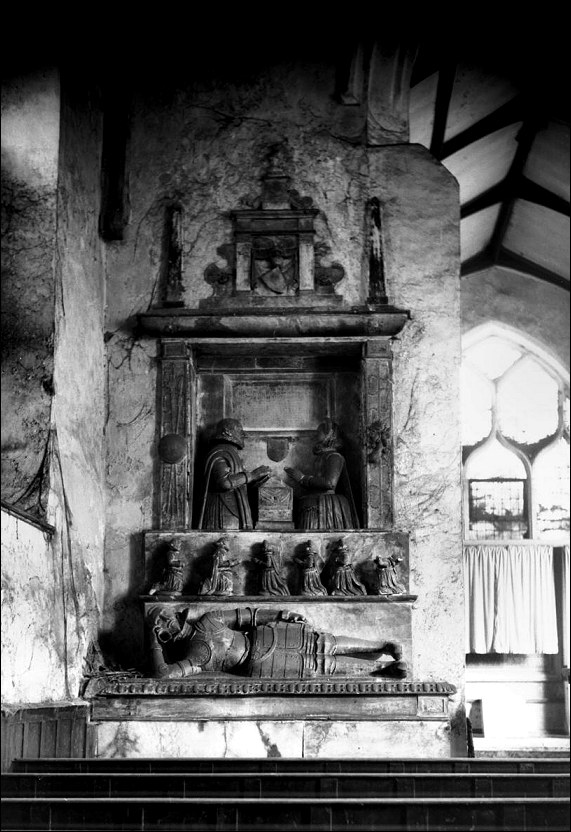
The monument rises from an impressive coloured alabaster base, to the Pettus coat of arms flanked by two obelisks. Sir John in his mayoral robes (he was Mayor in 1608) appears to kneel at a prayer desk opposite his wife, Bridget Curtis, although there is no sign of their legs. Blomefield writing in the 18th century mistook the armorials and identified the kneeling figure as Sir Augustine, who, unlike his father, was never Mayor of Norwich. Most of the literature has followed Blomefield, who was corrected by the Norfolk Heraldry Society (information from Tony Sims). Sir John and Lady Bridget are flanked by pilasters; his decorated with lances, hers with pomegranates and other fruit. Their children, two sons and two daughters kneel underneath, while Sir Augustine, who had died under a year before his father, is repeated lying stiffly in his full armour looking out from the monument, his head propped on his right arm, holding what could be a gauntlet or drinking horn, showing the fingers of a small hand.
Sir John had moved beyond both the family’s relative humble origins as tailors and local politics when in 1604 he had become the first Norwich Member since 1558 to be elected to two consecutive parliaments. He was active as an MP, while continuing his charitable work in Norwich. At the death of his father he had inherited considerable wealth, as well as the family house on Elm Hill, once extending to the churchyard, now nos. 41-43, and the estate at Rackheath, since at death his moveable goods, which included a substantial armoury of nine guns, were valued at £952 19s. 6d and the house on Elm Hill contained 27 rooms, together with stables for eight horses.
Blomefield, An Essay towards a Topographical History of the County of Norfolk: volume 4: The History of the City and County of Norwich, part II, ‘chapter 42: East Wimer ward', (1806), pp. 329-367; Chris Kyle, ‘Sir John Pettus’ in The History of Parliament: the House of Commons 1604-1629, , ed. Andrew Thrush and John P. Ferris, 2010.
detail of kneeling sons
Church of Simon and St Jude,
Monument to Sir John Pettus †1614 and Bridget Curtis and Sir Augustine Pettus †1613, alabaster. Commissioned by Thomas Pettus, Sir John’s second son, the executor of his will. Unknown, probably Norwich mason, also responsible for the Suckling monuments in St Andrew’s, restored 2007/8.
St Simon and St Jude was declared redundant in the 1890s, and abandoned in the 1930s. Now owned by the Norwich Churches Trust it has been saved from its state of collapse in the 1930s, but the inside has been butchered by the addition of the nave mezzanine. This makes it impossible to appreciate the monument to Sir John and his family, on filling the north wall flanking the chancel arch. Mercifully the late George Plunkett took a full set of photographs of the interior in the 1930s, including the monument (www.norfolkchurches.co.uk/norwichsimonjude/plunkett/plunk...).
The monument rises from an impressive coloured alabaster base, to the Pettus coat of arms flanked by two obelisks. Sir John in his mayoral robes (he was Mayor in 1608) appears to kneel at a prayer desk opposite his wife, Bridget Curtis, although there is no sign of their legs. Blomefield writing in the 18th century mistook the armorials and identified the kneeling figure as Sir Augustine, who, unlike his father, was never Mayor of Norwich. Most of the literature has followed Blomefield, who was corrected by the Norfolk Heraldry Society (information from Tony Sims). Sir John and Lady Bridget are flanked by pilasters; his decorated with lances, hers with pomegranates and other fruit. Their children, two sons and two daughters kneel underneath, while Sir Augustine, who had died under a year before his father, is repeated lying stiffly in his full armour looking out from the monument, his head propped on his right arm, holding what could be a gauntlet or drinking horn, showing the fingers of a small hand.
Sir John had moved beyond both the family’s relative humble origins as tailors and local politics when in 1604 he had become the first Norwich Member since 1558 to be elected to two consecutive parliaments. He was active as an MP, while continuing his charitable work in Norwich. At the death of his father he had inherited considerable wealth, as well as the family house on Elm Hill, once extending to the churchyard, now nos. 41-43, and the estate at Rackheath, since at death his moveable goods, which included a substantial armoury of nine guns, were valued at £952 19s. 6d and the house on Elm Hill contained 27 rooms, together with stables for eight horses.
Blomefield, An Essay towards a Topographical History of the County of Norfolk: volume 4: The History of the City and County of Norwich, part II, ‘chapter 42: East Wimer ward', (1806), pp. 329-367; Chris Kyle, ‘Sir John Pettus’ in The History of Parliament: the House of Commons 1604-1629, , ed. Andrew Thrush and John P. Ferris, 2010.
coat of arms detail
Built 1937-1940 in Currie St, first stage completed Nov 1938, second stage opened 5 Apr 1940, architects Woods, Bagot, Laybourne Smith & Irwin, replacing earlier building built 1888, extended 1954. Rear of building replaced 1999 by 7 level office space. Elders moved 2015 to Grenfell St, building retaining its name Elder House, sold 2018.
Alexander Elder arrived 1839, set up as general & commission agent and metal broker, joined by brothers William & George, later all three returned to London & Scotland. Thomas Elder arrived 1854, formed a partnership with Edward Stirling, Robert Barr Smith and John Taylor, known as Elder, Stirling & Co. When Stirling and Taylor retired in 1863, Thomas Elder and Robert Barr Smith set up Elder, Smith & Co. In 1882 Elders Wool & Produce Co Ltd was established, merged 1888. Elder's Trustee and Executor Co Ltd founded 1910. Further mergers, including Goldsbrough Mort 1963.
“the new Elder House, an imposing four-story structure to be erected in Currie street on a frontage of 136 ft. between the Savings Bank and Currie Chambers, for Elder, Smith and Co.. Ltd., and Elder's Trustee and Executor Co., Ltd. Elder House with equipment will cost about £150,000.” [News 25 Feb 1937]
“Demolition of the existing buildings to make way for the new Elder House will begin on Monday.” [News 16 Jul 1937]
“Crossing Currie street we were confronted by the paddock caused by the demolition of Elder's Trustee and Agency Coy. building, once the White Horse Hotel.” [Advertiser 11 Aug 1937]
“the new premises for Elder. Smith and Co. Ltd., and Elder's Executor Co., in Currie street, are well advanced. . . Polished Murray Bridge granite, which will be used for the front, is now being prepared by Standard Quarries, Ltd, at their Mile End works.” [Advertiser 26 Oct 1937]
“A start has been made on the demolition of the old Elder House in Currie street, which will make way for the second portion of the big new building which will house both Elder, Smith and Co.. Ltd., and Elder's Trustee and Executor Co.. Ltd. The first section of the £130,000 building scheme was recently completed. Although intended ultimately for the Trustee Co., it will be occupied by Elder, Smith & Co. until the second section is finished. The Trustee Co. is at present using offices in North terrace.” [News 4 Nov 1938]
“Elder, Smith & Co. Limited, to mark the completion this year of the centenary of the firm. . . For three-quarters of a century, at least, the prosperity of South Australia rested largely on the wealth derived from its flocks, herds, and mines. With those industries the company was associated intimately, and to that extent its interests were the interests of the State.” [Advertiser 7 Mar 1940]
“Tributes to the part played by Elder, Smith & Co. in developing the primary industries of South Australia and the fine team spirit of the staff were paid fine team spirit of the staff were paid yesterday when about 500 guests were entertained at a cocktail party to celebrate the opening of the new Currie street building.” [Advertiser 6 Apr 1940]
“The staff of Elder's Trustee and Executor Co. Ltd. will move into their new building, Elder House, in Currie street, on Monday. They have been situated in Anchor House, North terrace, for nearly four years. In the new building they will be housed beside Elder Smith & Co.” [News 25 May 1940]
“A new storey is to be added to Elder House, Currie street for the Elder Trustee Executor Co. The architects, Messrs. Woods, Bagot, Laybourne Smith & Irwin. . . At present there is a ground floor and three upper storeys. The new storey will provide additional office space for the company.” [Advertiser 25 Aug 1954]
ELDERS
“The undersigned, Agents for South Australia, are prepared to effect Fire and Life Insurances on liberal terms, and issue Policies in both branches, immediately on acceptance of risks. Insurances on Mills effected at the ordinary rates. All claims are settled in Adelaide, no reference home being required. Elder, Stirling, & Co.” [Adelaide Times 13 Aug 1856 advert]
“First Wool Ship for London. — The splendid new clipper ship ALMA, 592 tons register, R. Gilkisen, commander, is now in port, and will be dispatched about the middle of November. This vessel has a full poop, and excellent accommodation for passengers. For freight or passage, apply to Elder, Stirling, & Co.” [Adelaide Observer16 Aug 1856 advert]
“A change has taken place in the well-known firm of Elder, Stirling, & Co., caused by the retirement of Mr. John Taylor. The business of the firm will henceforward be carried on under the style and designation of Elder, Smith, & Co.” [Advertiser 22 Aug 1863]
“Elder’s Wool and Produce Company, Limited. (Late the Wool and Produce Brokerage Business of Messrs. Elder, Smith, and Co.) to be Limited and Incorporated.” [Register 30 Jun 1882]
** FILE ** TO GO WITH STORY SLUGGED CELIA CRUZ PATRIMONIO.- Cuban salsa queen Celia Cruz poses for photographers as she arrives at the 3rd annual Latin Grammy Awards in this Sept. 18, 2002 file photo in the Hollywood district of Los Angeles. Cruz who died in 2003, named two executor's in her will: Luis Falcon and Omer Pardillo. A judge from New Jersey canceled Falcon as Cruz's heritage executor Friday, March 23, 2007 after Pardillo accused him of squandering it. The judge ordered Falcon to make a detailed report with all the expenses he has made. (AP Photo/Kim D. Johnson)
Julgamento do assassinato dos ativistas José Cláudio e Maria dos Espírito Santo, que foram mortos em março de 2011 em Nova Ipixuna. O resultado do júri, que aconteceu nos dias 03 e 04 de abril, foi a condenação dos executores Alberto Lopes e Lindonjonson Silva, e absolvição de José Rodrigues, acusado de ser o mandante do crime. A ação provocou revolta nos familiares e movimentos agrários que acompanhavam o caso em vigília no Fórum de Marabá (PA).
(CC BY-SA) NINJA
Todas as imagens estão sob licença Creative Commons 3.0 e podem ser utilizadas livremente desde que disponibilizadas nas mesmas condições com o uso do código acima. Imagens em alta resolução estão disponíveis através de requerimento no email fotografia@foradoeixo.org.br
Thomas Moore was a nineteenth century Irish poet, bard, biographer and general "literateur." He was also the literary executor of Lord Byron, responsible for burning the poet's memoirs because he deemed them to be too scandalous. Generally Moore is regarded as the Irish equivalent of Robbie Burns.
But the people of Dublin never cared for this sculpture of him - even though the artist Christopher Moore (1790-1863) was Irish himself, and won the commission through a public competion.
The statue figures in one of the episodes in James Joyce's "Ulysses." In the 'Lestrygonians' section, Leopold Bloom "crossed under Tommy Moore's rougish finger." As he does he considers the fact that they built the statue over Dublin's largest public urinal. "They did right to put him over a urinal: meeting of the waters." ["Meeting of the Waters" was the name of one of Moore's most famous verses.]
Draft Will of The Rev’d Charles Grove Snowden, Mitford, Morpeth, Northumberland, 7th May 1859.
Executors: brothers, Thomas Hodges Grove Snowden of Ramsgate and George Silvanus Snowden of Ramsgate, Kent, Surgeon. Sister, Eliza Louisa Grear (?)
Beneficiaries: Thomas Hodge Grove Snowden, George Silvanus Snowden.
Witnesses: J. W. Harbottle, Butler, Mitford Castle, T.S. Waterson, Schoolmaster, Morpeth.
c1536-dsp1610 Sir Thomas Horsman aged 74 who bought the manor in 1552 1st son of Thomas Horsman, sewer of the Kings chamber (who supervised the king's meals and arranged the seating of his guests) who had received a grant of Sleaford manor, Lincs in 1539 from King Henry VIII after the attainder of his wife's uncle, John Hussey. His mother was Elizabeth widow of Thomas Ayscough of Stallingborough: daughter of Sir Robert Hussey of Linwood / Blankney
He m after 1586, Anne d1612 daughter of Robert Wilson, childless widow of Peter Richardson, Goldsmith, of the Savoy,
Escheator of Lincolnshire1592-3, JP 1601, 4 x MP for Grantham, assayer of the table and gentleman server to the Queen. knighted in 1604
He was brought up in the household of Lord Burghley who launched him upon a career at court lasting 40 years.
Thomas owned property here and at Mareham, Willoughby and Doddington and held the lease of Caythorpe manor and the parsonage of Chertsey. In his will dated 16 October 1609, he left his wife the leases he held of the Savoy, its rents and the lease of a house and lands in Chertsey. He bequeathed small sums to the poor of Chertsey, the Savoy, St. Clement Danes, St. Martin-in-the-Fields, St. Mary-le-Strand, Grantham and Burton. His old servant William Bennet received £200, and bonds, - money, plate and the lease of the parsonage of Surfleet went to his nephew and sole executor Thomas Horsman www.flickr.com/photos/52219527@N00/8725707757/ . He died at the Savoy and was buried here in the tomb chest which his nephew erected as he had desired
"To the sacred memory of Sir Thomas Horsman son and heir of Thomas Horsman esquire, sometime Lord of this Manor, and Elizabeth one of the daughters and co-heirs of Sir Robert Hussey knight . Having from his early youth been educated in the liberal arts. Thereafter at the behest of the most distinguished William, Lord Burghley, Treasurer of England, he was for 40 years joined to the household of Queen Elizabeth and served and performed the function of taster / cup bearer to her serene Majesty The Queen".
"A man distinguished for his profound faith, steadfastness and probity of morals, he died the 26th day of November 1610, full of days and well in his body for 74 years, As he desired Thomas Horsman, his nephew and heir, erected this monument to piously commemorate his memory"
www.historyofparliamentonline.org/volume/1558-1603/member...
www.burtonpedwardine.org.uk/index.php?option=com_content&...
Draft Codicil of The Rev’d Charles Grove Snowden, Mitford, Morpeth, Northumberland, in favour of Capt John Joseph Grove, Invercharron, Ross Shire, 28th January, 1864. Also Thomas Marshall, Servant, Godson, Charles Marshall, Mary Ann Marshall, Elizabeth Feather.
Witnesses: P. Marshall, Groom, Tovington, Yorkshire and Thomas Cassells, Joiner, Mitford.
Las tres cintas de las tres películas, por orden, y la película de extras.
Todavía tienen el plástico original porque ni las he abierto, aunque hoy las voy a abrir para verlas de nuevo (¡Aniversario Star Wars!)
Will of William Palmer King, of 57 Claremont Avenue, Gateshead, Northumberland, Engine Fireman, dated 13th March 1916.
Executor: Thomas Douglas of Waterside House, Alnwick, Shepherd.
Beneficiaries: Thomas Douglas and Wife, Elizabeth Douglas.
Witnesses: John Balmbra, Alnwick, W.D. Young, Alnwick
Draft Will of Elizabeth Pottle Teagle, Widow of 13 Havelock Road, West Kensington Park, Middlesex, 1885. Relict of Thomas Teagle.
Executor Frederick Long of Wymondham, Norfolk, Tailor. Beneficiaries, sister Mary Long, wife of Henry Long, of Wymondham, Tailor. Should she die first then to the daughter of Mary Long, Sarah Eliza Long, the wife of Frederick Long.
Elizabeth Pottle Teagle died 4 December 1892. Solicitor, Whites and Pomeroy, Wymondham, Norfolk
Browne's Hospital Broad Street Stamford - corridor stained glass window
Top
Heart with initial B
"X me spede" (Christ speed me) with Stork on a nest - motto of William Browne www.flickr.com/gp/52219527@N00/6zj08z and emblem of his wife Margaret Stocks www.flickr.com/gp/52219527@N00/G702tf
Below
Heraldry / shields - arms of Browne (3 mallets) and Elmes (founder William Browne 1498 and his grandson and executor William Thomas Elmes )
According to J. Stephan Edwards, Ph.D.: Lady Jane Dacre of Lanercost, a sixteenth-century Scotswoman descended from the wealthy Carlisle family, married into the Dacre family late in her life. Prior to that, she had what has been described as a “liaison” with Sir John Lowther, bearing him a daughter and eventually serving as his executor upon his death in 1553. Their relationship seems to have begun in the 1540s, precisely the time at which the wood for the boards of the painting has been dated. Well after Lowther’s death, in about 1565, Jane became the third wife of Sir Thomas Dacre of Lanercost, the illegitimate son of Sir Thomas Dacre, second Baron Dacre of Gilsland (d. 1525).
Draft Will of The Rev’d Charles Grove Snowden, Mitford, Morpeth, Northumberland, 7th May 1859.
Executors: brothers, Thomas Hodges Grove Snowden of Ramsgate and George Silvanus Snowden of Ramsgate, Kent, Surgeon. Sister, Eliza Louisa Grear (?)
Beneficiaries: Thomas Hodge Grove Snowden, George Silvanus Snowden.
Witnesses: J. W. Harbottle, Butler, Mitford Castle, T.S. Waterson, Schoolmaster, Morpeth.
Cross legged effigy of a knight with chain mail surcoat, perhaps Sir Henry de Halton c.1338 whose family held possessions here in 14c . His shield has the arms of a lion rampant
In 1320, Henry de Halton, and Margaret his wife, were parties to an action concerning the manor and advowson of Halton.
His name appears on a number of legal documents.
From December 1335 he was constable of Builth castle Wales succeeding Ebulo Lestrange of whose will he was executor together with the abbot of Revesby
- Halton Holegate church, Lincolnshire
Surabaya Municipal Hall
( The Center of Bovenstad Since 1920)
Surabaya City Hall :This solar Garden had built by Dutch colonial, its architect is C. Citroen and executor of HV. Hollandsche Beton Mij. City hall is located in Taman Surya Street 1.
This solar Garden had built by Dutch colonial. Town Surabaya as Resort Gemeonte (Haminte) officially date of 1 Aprils 1906, what experienced by Dewan Hamite and led by assistant resident. In 1916 lifted the first lord mayor A. Meyroos finite commissioned in 1921.
During the second lord mayor of GJ Dijkerman, it had started the development of lord mayor building and finished in 1927. Its architect is C. Citroen and executor of HV. Hollandsche Beton Mij. Because its total cost 100 guilders, this building had formerly recognized as “1000 Guilders Building ".
The Government of Indonesia had built a city hall with modern architecture, laid at against stripper building. The stripper building has time has applied as 'Gedung Dewan Perwakilan Rakyat Daerah' and now applied as the center of municipal administration Surabaya.
More info: www.eastjava.com
Star Wars Celebration Europe 2013
Die Star Wars Celebration Europe ist das weltgrößte Treffen von Fans der Science-Fiction-Filmsaga Star Wars.
----------------------------------------------------------------------------------------
Celebrations in full swing in the Royal Mercure Hotel in Hull on the occasion of the Philip Larkin Society annual Christmas shindig. Ann Thwaite is a prolific and prize-winning author and biographer and today she chaired an interview session with her husband the poet Anthony Thwaite following his reading from his soon to be published new collection: Going Out. (Anthony Thwaite is one of Philip Larkin's literary executors). Beside Anne is James Booth, late of Hull University English Department, a former friend and colleague of Philip Larkin and the author of the recently published biography: Philip Larkin Life Art And Love.
(Brasília - DF, 05/08/2020) Palavras do Presidente da República, Jair Bolsonaro.
Foto: Isac Nóbrega/PR
19c Drawing by Cotman of the stolen brass of Sir Thomas Blennerhassett 1461-1531 "Here lyeth Sir Thomas Bleuerhayssette, Knyght, which decessyd the ryii Day of June, the Yere of our Lorde M yo rrri. and rrriii Yere of the Reigne of our Sobe raygne Lord Kyng Henry the viiith, whois Soule God Pardon".
Thomas was the son of John Blennerhassett d1510 www.flickr.com/gp/52219527@N00/005tn8 and first wife Margaret Heigham www.flickr.com/photos/52219527@N00/5947090482/
Thomas was the executor for Thomas, Duke of Norfolk in 1514. He lived at Frenze, and also Boyland Hall, Long Stratton. Son George left Frenze to his wife Margaret for her life and then to their heiress Mary m1 Thomas Culpepper m2 Francis Bacon - After the death of Francis it reverted to her half brother John
He m1 Jane Sutton.
Children
1. George 1501-1543 m Margaret Jermyn / Jernegan
2. Edward m Anne Cobbe
3. Mary m John Meux
He m2 Margaret d1561 www.flickr.com/gp/52219527@N00/4M48ZE daughter of John Braham of Wetheringsett and Joan Reyden 1519 www.flickr.com/gp/52219527@N00/30oPQi
Children
1. Thomas a priest
2. John of Barsham & Boyland m1 Elizabeth daughter of John Cornwallis and Elizabeth Sulyard www.flickr.com/photos/52219527@N00/9392340481/ (parents of Elizabeth Blennerhassett, bc.1537 who m 1561 Sir Lionel Throckmorton flic.kr/p/fDaHf7 son of Simon Throckmorton by Anne Louthe )
3. Elizabeth m1 Lionel Lowth m2 Francis Clopton m1 Lionel Lowthe / Louthe www.flickr.com/photos/52219527@N00/13925024374/ (grand daughter Anne Dade www.flickr.com/photos/52219527@N00/527517488/ )
4. Agnes m Sir Anthony Rous 1545 of Dennington & Henham Hall
5. Anne d1577 www.flickr.com/gp/52219527@N00/rqtQq9 www.flickr.com/gp/52219527@N00/65fy0D m1 George Duke (son George Duke is at Honington flic.kr/p/PsFr8 ) m2 Peter Rede / Read of Gimingham
6. Margaret d1558 m1 John Spelman www.flickr.com/gp/52219527@N00/P38o5L Sir John Spelman and Elizabeth Frowyke www.flickr.com/gp/52219527@N00/9Rj86X m2 John Eyre dsp 1561 of Lyn, Receiver General to Queen Elizabeth for the counties of Norfolk, Suffolk, Cambridgshire & Huntingdon
7. Katherine m1 John Gosnold m2 Anthony Wingfield 1593
On his surcoat are the arms of Blenerhassett with the annulet, (which this branch always bare for difference,) with his quarterings, Lowdham, Orton, and Kelvedon / Keldon Under his head lies his crest - a fox passant.
www.british-history.ac.uk/topographical-hist-norfolk/vol1...
humphrysfamilytree.com/Blennerhassett/john.frenze.html
Duneira house and gardens at Mount Macedon.
(Extract from Macedon Ranges cultural heritage and landscape study/Trevor Budge and Associates. 4 v. 1994.).
Henry Suetonius Officer reputedly aquired the Duneira site from
1872-1877 (Blocks 4,5,10,11,14) paying some £84 for 38 acres but
rate listings give Robert Officer as the owner. .
.
Suetonius Henry Officer (1830-1883).
Officer was born in Hullgreen, New Norfolk, Tasmania 1830, the
son of Sir Robert & Lady Officer. He was educated in Edinburgh
with his brother, Charles, and returned to the colonies, seeking
gold in Victoria but eventually settling for pastoralism in
company with his brothers and Charles Miles{ ibid.}. They managed
stations in the Wimmera and the Riverina, James marrying in 1866
and commencing construction of a 20 room homestead at Murray
Downs & Willakool, two adjoining properties fronting the Murray
River. After experimentation with irrigation, via steam pumps and
windmills, he was able to develop extensive orchards and crops. He was also, like his brother, interested in
acclimatisation, having developed an ostrich farm on his property
(Charles was a council member of the Zoological & Acclimatisation
Society for 10 years, president in 1887). .
.
Blighted by illness, Suetonius reputedly moved to Leighwood,
Toorak (Melbourne) in 1881, having erected the first stage of
Duneira at Mount Macedon, but died two years later. However his son, Henry jnr. was
born at South Yarra in 1869 and his next child, Jessie, was born
at Macedon in 1877, indicating that he was in residence at both
places prior to the dates previously supposed..
.
Suetonius probably commissioned the first stage of Duneira to be
erected as a summer house between c1874-6. The architect Levi
Powell is thought to have designed a house for him there around
that date. The first improvements listed on the site were
stables in 1874 when Robert Officer was rated as owning the site. The house was reputedly not occupied regularly
until c1881 when Suetonius moved to Toorak.
However it appears he and his family were in residence at Duneira
by 1877..
.
When Suetonius died in 1883 his wife, Mary Lillias Rigg Officer
(nee Cairns), of Glenbervie, Glenferrie Road, Toorak was the
co-executor of the estate, with merchant Robert Harper; she is
the rate occupier in 1888. Mrs Officer was the
sister of Mrs Robert Harper (Huntly Burn) and Mrs John C lloyd
(Montpelier, later Timsbury): all three houses were reputedly
built in the same period... .
.
The house bricks for the first stage were said to have come from
the Macedon Brick Kiln (once near the Macedon railway station,
set up in c1888-9?) with external walls built in 14" Flemish bond
from slop-moulded bricks (9 inch by 2.1/2). The bricks were reputedly carted
from Macedon by Cogger. The footings were of bluestone
and reputedly dressed sandstone blocks also survive, suggesting
that the first stage was face brick with stone quoins and the
next renovation c1888 added wings and a cement coating to the
whole complex. Floor frames were reputedly supported on stone
dwarf walls and joists were 6x2.1/2 inch jarrah, with flooring
being 6 inch pine}. Seaweed was apparently used for
ceiling insulation..
.
The servants' wing verandah was skillion in form with timber
posts with classical capitals. The main verandah had coupled
posts (rebuilt with single posts) a panelled frieze and slimmer
capitals set just under the frieze rail}. The
balustrade may have been of single cast-iron balusters..
.
Just prior to the sale to the speculator, James Smith Reid in
1890, and during the occupation of Edward Dyer, major additions
were made to the house complex and a reputedly a caretaker's
lodge was placed at the gate (survives, altered c1920s) but this
appears to have been added by Reid in the early 1890s. .
.
The added rooms were reputedly: billiard (32'x24') and dining
rooms, kitchen, servants bathroom, service block with 5 rooms
(engine room, dairy, pantry, store, boiler room, built of
Northcote machine made 9" brickwork). Damp proof coursing was
used in these additions compared to the slate of the first stage
and acetylene gas (engine room) was thought used for lighting
from this period, as reticulated in 1.1.2" mains and 1/2 inch
branches to internal and some external verandah lights.
Cast-iron elaborately detailed water radiators were also used,
with hot water pumped from the boiler room, and later a duplicate
boiler allowed hot water to be reticulated taps in the house{
ibid.}..
.
The description in rate books expands to villa and cottages (on
37 acres) for the first time under Reid in c1893 but the annual
valuation had already peeked in 1888 at £200 in the occupation of
Edward Dyer. An Edward Dyer was listed at that time as a fruiterer in
Burwood Road, Hawthorn..
.
The water supply is from a concrete tank fed by a spring.
Outbuildings include timber clad stables, storerooms,
blacksmith's shop, coachman's room, milking bails, hay shed and a
green house. The stables (extended) were described as having had
a shingled gabled roof (rear skillion) with loft entered via an
external stair at the north end. It had a blacksmith's
shop (altered for garage c1941), carriage and coachman's rooms,
two stores and vertically boarded main doors{ ibid.,p24}. The
milking and hay sheds had hipped roof forms and timber cladding
and frame. The interior was white-washed. The greenhouse
in the secret hedged garden is of a later date, with a timber
frame built up on 11" cavity brickwork walls, with a brick floor
and heated water pipes under each shelf. The boiler is near the
entry..
.
The `Gisborne Gazette' reported on Duneira in 1903 under the
heading of `A Popular Health Resort':.
`Duneira certainly merits a few remarks though beautiful
residences and grounds are by no means rare in that locality..
(when Reid purchased it, it was `little better than a wilderness'
and he had spared no expense to restore it).. After passing the
lodge at the main entrance, a broad serpentine drive leads up to
the house and from there the grounds are laid out in broad
sloping lawns surmounted with choice borders and fringed with
trees which however do not interfere to any great extent with the
view. There is of course no lack of flowers which grow
luxuriantly on the mount but the great feature of Duneira is the
lawns, those open green expanses which delight the eye at all
times of the year. the secret of this perennial verdure is to be
found in the copious water supply with which Macedon is blessed
(spring at rear of house, tapped by tunnelling 40m into the hill,
ie. grass grows up to base of Monterey pines)..
.
During Reid's time there, the valuation increased marginally in
1899-1900 and again soon after, with Reid's address being given
as care of Rosstrevor Magill, South Australia, in c1909-10. JS Reid died in 1922, leaving
the property to the management of JS Reid jun..
.
The main garden elements are: sweeping lawns, box hedges, weeping beech and cherry, extensive hedges (holly, laurel), a hedged
`secret garden' with green house, mature firs, elm and chestnut ì
avenues. There is also a fountain and a wide spreading weeping elm to the rear of the house, near the tennis court..
.
Significant Trees:.
`Ulmus x hollandica'.
`Prunus' "shirotae".
`Albies procera'.
`Ilex kingiana'.
"George Strode late of Parnham esqr & Catherine his wife one of the daughters & coheiresses of Richard Brodrepp late of Mapperton esq this monument is erected by Thomas Strode of Parnham esqr his brother & executor pursuant to his Will
Catherine Strode dyed ye 14th of September 1746 aged 47
George Strode dyed ye 10th of June 1753 aged 73"
Monument by Peter Scheemakers
George in his will asked to be "buried in my isle at Beaminster near my wife .. a monument to be built to my wife and myself to cost no more than £600 or less than £500"
George was the son of Hugh Strode of London brother of Sir John Strode ++by Grace daughter of Sir Jerome Raustorn Catherine was the daughter of Richard Brodrepp 1673-1737 of www.flickr.com/photos/52219527@N00/14871758051/ by Hester d1755 daughter of William Wake, Archbishop of Canterbury who m2 Thomas Strode d1764 ++ brother of her daughters second husband George
Catherine was the widow of George's cousin Hugh Strode d:1727 son of Sir John Strode of Parham 1679 +++ by 2nd wife Ann daughter of Sir Thomas Browne of Walcot (m 1722) an "eminent rich broker who died suddenly of aappoplectik fit " leaving her estates at Seabrough, Somerset and Chantmarle in Cattistock, Dorset.
George inherited the estates as nephew of Sir John Strode 1679 whose children William 1706, Thomas 1718 and Anne 1731 all died without issue George however was also childless and on the death of his brother and executor Thomas in 1764, the heir was Sir John Oglander of Nunwell House, Brading IOW, son of Sir John Strode's +++ daughter Elizabeth by his 2nd wife Ann Browne, who m William Oglander 1734 great grandson of Sir John Oglander 1655 www.flickr.com/photos/52219527@N00/8651996638/
The relationships here get rather complex and perhaps based on wealth conservation
Church of Simon and St Jude,
Monument to Sir John Pettus †1614 and Bridget Curtis and Sir Augustine Pettus †1613, alabaster. Commissioned by Thomas Pettus, Sir John’s second son, the executor of his will. Unknown, probably Norwich mason, also responsible for the Suckling monuments in St Andrew’s, restored 2007/8.
St Simon and St Jude was declared redundant in the 1890s, and abandoned in the 1930s. Now owned by the Norwich Churches Trust it has been saved from its state of collapse in the 1930s, but the inside has been butchered by the addition of the nave mezzanine. This makes it impossible to appreciate the monument to Sir John and his family, on filling the north wall flanking the chancel arch. Mercifully the late George Plunkett took a full set of photographs of the interior in the 1930s, including the monument (www.norfolkchurches.co.uk/norwichsimonjude/plunkett/plunk...).
The monument rises from an impressive coloured alabaster base, to the Pettus coat of arms flanked by two obelisks. Sir John in his mayoral robes (he was Mayor in 1608) appears to kneel at a prayer desk opposite his wife, Bridget Curtis, although there is no sign of their legs. Blomefield writing in the 18th century mistook the armorials and identified the kneeling figure as Sir Augustine, who, unlike his father, was never Mayor of Norwich. Most of the literature has followed Blomefield, who was corrected by the Norfolk Heraldry Society (information from Tony Sims). Sir John and Lady Bridget are flanked by pilasters; his decorated with lances, hers with pomegranates and other fruit. Their children, two sons and two daughters kneel underneath, while Sir Augustine, who had died under a year before his father, is repeated lying stiffly in his full armour looking out from the monument, his head propped on his right arm, holding what could be a gauntlet or drinking horn, showing the fingers of a small hand.
Sir John had moved beyond both the family’s relative humble origins as tailors and local politics when in 1604 he had become the first Norwich Member since 1558 to be elected to two consecutive parliaments. He was active as an MP, while continuing his charitable work in Norwich. At the death of his father he had inherited considerable wealth, as well as the family house on Elm Hill, once extending to the churchyard, now nos. 41-43, and the estate at Rackheath, since at death his moveable goods, which included a substantial armoury of nine guns, were valued at £952 19s. 6d and the house on Elm Hill contained 27 rooms, together with stables for eight horses.
Blomefield, An Essay towards a Topographical History of the County of Norfolk: volume 4: The History of the City and County of Norwich, part II, ‘chapter 42: East Wimer ward', (1806), pp. 329-367; Chris Kyle, ‘Sir John Pettus’ in The History of Parliament: the House of Commons 1604-1629, , ed. Andrew Thrush and John P. Ferris, 2010.
Title: Desk and Bookcase
Artist/Maker: Benjamin Frothingham (American, 1734-1809; active Charlestown 1754-1809)
Place Made: United States: Massachusetts: Charlestown
Date Made: 1753
Medium: wood; mahogany; white pine; eastern red cedar; Spanish cedar
Measurements: Overall: 98 1/4 in x 44 1/2 in x 24 3/4 in; 249.555 cm x 113.03 cm x 62.865 cm
Credit Line: Gift of Mr. Dana C. Ackerly and Mr. Earle S. Thompson, estate executors, in memory of Mrs. Bell McKerlie Watts and Mr. Samuel Hughes Watts of Fairfield, Connecticut
Collection: The Diplomatic Reception Rooms, U.S. Department of State, Washington, D.C.
Accession No: RR-1970.0094
Star Wars Celebration Europe 2013
Die Star Wars Celebration Europe ist das weltgrößte Treffen von Fans der Science-Fiction-Filmsaga Star Wars.
----------------------------------------------------------------------------------------
Draft Will of William Morris Boyton of the Collage, South Eastern Road, Ramsgate, Kent dated 1890.
Executors, wife Clementina Risdom Boyton and brother Henry Strang Boyton.
Beneficiaries: Wife Clementina Risdom Boyton and brother Henry Strang Boyton. Son William John Boyton, 3 daughters of his brother Henry Strang Boyton and 4 daughters of his brother Maurice Boyton (not named). His niece Edith Bennett, wife of Robert Bennett, niece Elizabeth Cleggett, daughter-in-law Georgina Boyton,
Draft Will of Mary Ann Cuttler, Ramsgate, Kent, 5th June 1860.
Executor, brother, John Cutler. Beneficaries, brother John Cutler and sister Eliza Cutler.
From The Leigh Chronicle, 19 October 1861:
“... JOHN JEFFREYS, General Farm Stock Auctioneer and Valuer, and Horse and Cattle Salesman, respectfully announces that he has been honoured with instructions (by the Executors) to SELL by AUCTION, on Monday next, the 21st, and Tuesday, the 22nd, at Twelve o'clock at Noon each day, on the premises lately occupied by Henry Rose, deceased, “The Manor House”, Seneley-green, Ashton-in-Mackerfield, the whole of the valuable STOCK of twenty-two Cows and Heifers, one fat Cow, one well-bred young prize Bull, six Horses and Colts, four Pigs, in feeding; two store Pigs, several farm Implements, two-horse power upright steam Engine (for churning, &c), with four-horse Boiler, steam Pipes, steam Churn &c; three stacks of white Oats, ten stacks of yellow Poland Oats (containing in the thirteen stacks about 600 thraves), upwards of 250 thraves of Wheat, stack of rye Grass and Clover hay (about 18 tons), two stacks of old meadow Hay (about 40 tons), hay of second crop of clover (about four tons), stack of oat Straw (about five tons), 100 bushels of flukes, 1000 bushels of seedlings and 100 bushels of red seedling Potatoes, two acres of Swede Turnips and Mangold Wurtzel; Household FURNITURE, Dairy Vessels, and other Effects...”
So far as I have been able to discover the above notice is the first documented reference to “The Manor House”, a property believed to date back to the 16th or 17th centuries. Comparison between the landholdings of Henry Rose in the 1838 Tithe Apportionment Schedule (National Archives, ref. IR 29/18/18) and the field names mentioned in the lease granted to the Gerards' Land Agent, Randolph Penswick, on 4 May 1799 (Lancashire Archives ref. DDGE(E) 127) confirms that the latter included the former as well as some neighbouring parcels of land which, by 1838, were held under a separate lease from 12th Baronet Sir John Gerard.
Whether the sale actually went ahead on 21 and 22 October 1861 is unclear, but the 1871 census (National Archives ref. RG10/3898) found Henry Rose's widowed daughter-in-law, Elizabeth at the Manor House. By now the acreage had increased from the previous 62 in Henry's time to 92 acres. Elizabeth Rose continued farming at Manor House Farm until her death, aged 80, in 1897. The Roses were followed by the Fairhursts and (from c.1920) the Phythians. The adjoining premises had in the meanwhile been home to the Cunliffe (until1905), Clarkson (c.1909-1920), Wright (from c.1920) and Thomas families.
Some of The Manor House's 20th century residents are included on the selection of photographs above.
Star Wars Celebration Europe 2013
Die Star Wars Celebration Europe ist das weltgrößte Treffen von Fans der Science-Fiction-Filmsaga Star Wars.
----------------------------------------------------------------------------------------
Built 1937-1940 in Currie St, first stage completed Nov 1938, second stage opened 5 Apr 1940, architects Woods, Bagot, Laybourne Smith & Irwin, replacing earlier building built 1888, extended 1954. Rear of building replaced 1999 by 7 level office space. Elders moved 2015 to Grenfell St, building retaining its name Elder House, sold 2018.
Alexander Elder arrived 1839, set up as general & commission agent and metal broker, joined by brothers William & George, later all three returned to London & Scotland. Thomas Elder arrived 1854, formed a partnership with Edward Stirling, Robert Barr Smith and John Taylor, known as Elder, Stirling & Co. When Stirling and Taylor retired in 1863, Thomas Elder and Robert Barr Smith set up Elder, Smith & Co. In 1882 Elders Wool & Produce Co Ltd was established, merged 1888. Elder's Trustee and Executor Co Ltd founded 1910. Further mergers, including Goldsbrough Mort 1963.
“the new Elder House, an imposing four-story structure to be erected in Currie street on a frontage of 136 ft. between the Savings Bank and Currie Chambers, for Elder, Smith and Co.. Ltd., and Elder's Trustee and Executor Co., Ltd. Elder House with equipment will cost about £150,000.” [News 25 Feb 1937]
“Demolition of the existing buildings to make way for the new Elder House will begin on Monday.” [News 16 Jul 1937]
“Crossing Currie street we were confronted by the paddock caused by the demolition of Elder's Trustee and Agency Coy. building, once the White Horse Hotel.” [Advertiser 11 Aug 1937]
“the new premises for Elder. Smith and Co. Ltd., and Elder's Executor Co., in Currie street, are well advanced. . . Polished Murray Bridge granite, which will be used for the front, is now being prepared by Standard Quarries, Ltd, at their Mile End works.” [Advertiser 26 Oct 1937]
“A start has been made on the demolition of the old Elder House in Currie street, which will make way for the second portion of the big new building which will house both Elder, Smith and Co.. Ltd., and Elder's Trustee and Executor Co.. Ltd. The first section of the £130,000 building scheme was recently completed. Although intended ultimately for the Trustee Co., it will be occupied by Elder, Smith & Co. until the second section is finished. The Trustee Co. is at present using offices in North terrace.” [News 4 Nov 1938]
“Elder, Smith & Co. Limited, to mark the completion this year of the centenary of the firm. . . For three-quarters of a century, at least, the prosperity of South Australia rested largely on the wealth derived from its flocks, herds, and mines. With those industries the company was associated intimately, and to that extent its interests were the interests of the State.” [Advertiser 7 Mar 1940]
“Tributes to the part played by Elder, Smith & Co. in developing the primary industries of South Australia and the fine team spirit of the staff were paid fine team spirit of the staff were paid yesterday when about 500 guests were entertained at a cocktail party to celebrate the opening of the new Currie street building.” [Advertiser 6 Apr 1940]
“The staff of Elder's Trustee and Executor Co. Ltd. will move into their new building, Elder House, in Currie street, on Monday. They have been situated in Anchor House, North terrace, for nearly four years. In the new building they will be housed beside Elder Smith & Co.” [News 25 May 1940]
“A new storey is to be added to Elder House, Currie street for the Elder Trustee Executor Co. The architects, Messrs. Woods, Bagot, Laybourne Smith & Irwin. . . At present there is a ground floor and three upper storeys. The new storey will provide additional office space for the company.” [Advertiser 25 Aug 1954]
ELDERS
“The undersigned, Agents for South Australia, are prepared to effect Fire and Life Insurances on liberal terms, and issue Policies in both branches, immediately on acceptance of risks. Insurances on Mills effected at the ordinary rates. All claims are settled in Adelaide, no reference home being required. Elder, Stirling, & Co.” [Adelaide Times 13 Aug 1856 advert]
“First Wool Ship for London. — The splendid new clipper ship ALMA, 592 tons register, R. Gilkisen, commander, is now in port, and will be dispatched about the middle of November. This vessel has a full poop, and excellent accommodation for passengers. For freight or passage, apply to Elder, Stirling, & Co.” [Adelaide Observer16 Aug 1856 advert]
“A change has taken place in the well-known firm of Elder, Stirling, & Co., caused by the retirement of Mr. John Taylor. The business of the firm will henceforward be carried on under the style and designation of Elder, Smith, & Co.” [Advertiser 22 Aug 1863]
“Elder’s Wool and Produce Company, Limited. (Late the Wool and Produce Brokerage Business of Messrs. Elder, Smith, and Co.) to be Limited and Incorporated.” [Register 30 Jun 1882]