View allAll Photos Tagged Executor
1868 abstract of deed of Arrangement under Will of Humphrey Bourne, Draper, 13th June 1855, Ramsgate, Kent. Maria Bourne, Wife, R.S. Cramp, John Kennett appointed Executors.
Humphrey Bourne’s Will left Property and money to his wife Maria Bourne, who carried on the business as a Draper, his 4 Children, Humphrey Bourne, Draper, George Winder Bourne, Harry Bourne and Sally Howland Clements the wife of Edward Clements
1970 Vanden Plas Princess 1300.
Last MoT test expired in January 2013. Anglia Car Auctions, King's Lynn -
"Executor sale. Manual gearbox. Comes with eighteen expired MoT certificates from 1984. Last MoT'd in 2012. Offered for restoration.
V5 present."
Sold for £700. No reserve.
Santa Maria é mais uma cidade do Distrito Federal a priorizar pedestres e pessoas com deficiência. Nove pontos de maior movimentação da região administrativa ganharam calçadas com acessibilidade. Até agora, foram instaladas 3.450m² de passagens construídas à margem das pistas de carro. A previsão para até o fim do ano é de um total de 13 mil metros quadrados. A executora do serviço é a Companhia Urbanizadora da Nova Capital (Novacap). Na foto quadra 102. Fotos: Paulo H. Carvalho / Agência Brasília
John Withers 1692 Barister at law and his wife Ann Cutts / Cutte / Cuttes ister to John Lord Cutts 1707 and daughter of Richard Cutts.
“ Sacred to the memory of John Withers, of the Middle Temple, who lies under this marble, together with his dearly beloved wife, Ann, daughter of Richard Cutts, esq., formerly of this parish: he,after having lived 73 years, died on the 2Sth of November, in the year of our Lord 1692; but she in the bloom of youth. William Withers, nephew and heir, erected this monument, as a testimony of his gratitude to his very dear and worthy uncle.”
Ann was the daughter of Richard Cutts dc1669 of Woodhall manor Arkesden by Joan daughter of Sir Richard Everard of Much Waltham. She predeceased her brother Richard Cutts dsp 1707. Her sister Margaret m John Acton of Basingstoke; another sister Joanna remained unmarried. Richard Cutts left his entire estate to his widowed cousin Mrs Dorothy Pickering, of Lincoln's Inn Fields, and to his sister Joanna, executor of his will.
Monument by Edward Pearce
odnb2.ifactory.com/view/article/6984/6984?docPos=14
monument tomb effigy arkesden essex
Monumento é uma homenagem ao arquiteto Ramos de Azevedo e que também é conhecido como Monumento ao Progresso. Trata-se de um conjunto escultório executado pelo escultor Galileo Emendabili, também executor do obelisco do Ibirapuera. Foi inaugurado em 1934 após seis anos de trabalho, na Avenida Tiradentes em frente ao edifício da Pinacoteca do Estado. Por causa das obras do metrô, o monumento foi desmontado em 1967 e depois transferido para a Cidade Universitária, em 1973, na praça que leva seu nome, em frente ao IPT e à Escola Politécnica.
Title: Desk and Bookcase
Artist/Maker: Benjamin Frothingham (American, 1734-1809; active Charlestown 1754-1809)
Place Made: United States: Massachusetts: Charlestown
Date Made: 1753
Medium: wood; mahogany; white pine; eastern red cedar; Spanish cedar
Measurements: Overall: 98 1/4 in x 44 1/2 in x 24 3/4 in; 249.555 cm x 113.03 cm x 62.865 cm
Credit Line: Gift of Mr. Dana C. Ackerly and Mr. Earle S. Thompson, estate executors, in memory of Mrs. Bell McKerlie Watts and Mr. Samuel Hughes Watts of Fairfield, Connecticut
Collection: The Diplomatic Reception Rooms, U.S. Department of State, Washington, D.C.
Accession No: RR-1970.0094
Juíz Simão Lemos.
Julgamento do assassinato dos ativistas José Cláudio e Maria dos Espírito Santo, que foram mortos em março de 2011 em Nova Ipixuna. O resultado do júri, que aconteceu nos dias 03 e 04 de abril, foi a condenação dos executores Alberto Lopes e Lindonjonson Silva, e absolvição de José Rodrigues, acusado de ser o mandante do crime. A ação provocou revolta nos familiares e movimentos agrários que acompanhavam o caso em vigília no Fórum de Marabá (PA).
(CC BY-SA) NINJA
Todas as imagens estão sob licença Creative Commons 3.0 e podem ser utilizadas livremente desde que disponibilizadas nas mesmas condições com o uso do código acima. Imagens em alta resolução estão disponíveis através de requerimento no email fotografia@foradoeixo.org.br
Draft Conveyance Josiah Adams of Ramsgate, Clerk to A & K Daniel, Solicitors of Ramsgate, Miss Helen Bear, Minnie, Bear and Henry Bear, Grocer’s Assistant all of 7, Lorne Road, St Lawrence to Thomas Robert Tucker, Smacker Owner, of 26 La Belle Alliance Square, Ramsgate Land at Southwood, Ramsgate dated 26th July 1901.
Elizabeth Saxby’s Will of 26th November 1879 her niece Catharine Bear and Josiah Adams as Executors which included her house, Alpha Villa near Southwood and two cottages nearby also land that was formerly a Brickfield. Also held in Trust for her nephew John Bear, who died on 1st February 1881 and the the inheritance passed to his 3 children, Helen, Minnie and Henry Bear. Catherine Bear became the wife of Isaac Fenwick and died 19th January 1891.
The Shipley Art Gallery is an art gallery in Gateshead, Tyne and Wear, England, located at the south end of Prince Consort Road. It has a Designated Collection of national importance.
Origins
The Shipley Art Gallery opened to the public in 1917. This was made possible by a bequest from wealthy local solicitor and art collector, Joseph Ainsley Davidson Shipley (1822–1909).
Shipley was a rather enigmatic person about whom little is known. He was born in Gateshead, near High Street. He was a solicitor in the Newcastle firm of Hoyle, Shipley and Hoyle. From 1884 until his death, he leased Saltwell Park House, now known as Saltwell Towers. Shipley's main passion was art and collecting paintings. He bought his first painting when he was sixteen and by the time he died he had amassed a collection of some 2,500 paintings.
On his death, Shipley left £30,000 and all his pictures to the City of Newcastle, which was to build a new gallery to house the collection. This was to be known as "The Shipley Bequest". Current belief within local history circles is that Shipley’s will expressly banned Newcastle’s art gallery as a recipient of the bequest, but this assertion must be dismissed: since the foundation stone of the Laing Art Gallery was laid only in August 1901 and the gallery opened in October 1904, the institution did not yet exist in 1900, when Shipley’s will was compiled. Shipley’s will did, in fact, declare that ‘the Art Gallery to be erected in Higham Place will not be and shall not be regarded as an Art Gallery within this trust’, owing to its being ‘too small’, but he conceded that if it ‘shall be capable of being enlarged so as to render it capable of holding all, then I direct my Trustees to raise the sum of £30,000 out of my residuary estate and pay the same to the treasurer of the gallery to be applied in or toward such enlargement as aforesaid’. It was only following a lengthy process that Gateshead Municipal Council was offered the collection. As it was impossible to house all of the paintings, 359 of the pictures recommended by the executors of Shipley's will were selected. A further group was then added by the Gateshead Committee, bringing the total to 504.
In 1914, after the sale of the remaining paintings, work began on the new art gallery. The building, which was designed by Arthur Stockwell, M.S.A. of Newcastle, opened on 29 November 1917. The stone entrance portico is distyle in antis – four Corinthian-style stone columns flanked by solid pilasters. These are surmounted by two sculptured figures, one representing the Arts and the other Industry and Learning, by W. Birnie Rhind, RSA. of Edinburgh.
Pevsner described the art gallery as a "bold arrangement of a brick central block and lower wings containing galleries". The building was designated as Grade II listed in 1982.
Present gallery
The original 504 paintings represented all the main European schools from the sixteenth to the nineteenth centuries. Since 1917, the collection has been added to, and now comprises some 10,000 items.
The gallery holds a strong collection of 16th and 17th century Dutch and Flemish paintings, as well as 19th century British works, watercolours, prints, drawings and sculpture. Also featured are items of local interest, which include the popular painting by William C. Irving ((1866–1943) of "Blaydon Races" (1903) and a 1970 street scene of Redheugh Crossroads by Gateshead-born Charlie Rogers.
Since 1977 the gallery has become established as a national centre for contemporary craftwork. It has built up one of the best collections outside London, which includes ceramics, wood, metal, glass, textiles and furniture. The Shipley is home to the Henry Rothschild collection of studio ceramics. In 2008, the Shipley opened its Designs for Life gallery which showcases the gallery's collections of contemporary craft and design. The Gallery also hosts a varied programme of temporary exhibitions and has a strong partnership with the V&A Museum in London.
The Shipley Art Gallery is managed by Tyne & Wear Archives & Museums on behalf of Gateshead Council.
Gateshead is a town in the Gateshead Metropolitan Borough of Tyne and Wear, England. It is on the River Tyne's southern bank. The town's attractions include the twenty metre tall Angel of the North sculpture on the town's southern outskirts, The Glasshouse International Centre for Music and the Baltic Centre for Contemporary Art. The town shares the Millennium Bridge, Tyne Bridge and multiple other bridges with Newcastle upon Tyne.
Historically part of County Durham, under the Local Government Act 1888 the town was made a county borough, meaning it was administered independently of the county council.
In the 2011 Census, the town had a population of 120,046 while the wider borough had 200,214.
History
Gateshead is first mentioned in Latin translation in Bede's Ecclesiastical History of the English People as ad caput caprae ("at the goat's head"). This interpretation is consistent with the later English attestations of the name, among them Gatesheued (c. 1190), literally "goat's head" but in the context of a place-name meaning 'headland or hill frequented by (wild) goats'. Although other derivations have been mooted, it is this that is given by the standard authorities.
A Brittonic predecessor, named with the element *gabro-, 'goat' (c.f. Welsh gafr), may underlie the name. Gateshead might have been the Roman-British fort of Gabrosentum.
Early
There has been a settlement on the Gateshead side of the River Tyne, around the old river crossing where the Swing Bridge now stands, since Roman times.
The first recorded mention of Gateshead is in the writings of the Venerable Bede who referred to an Abbot of Gateshead called Utta in 623. In 1068 William the Conqueror defeated the forces of Edgar the Ætheling and Malcolm king of Scotland (Shakespeare's Malcolm) on Gateshead Fell (now Low Fell and Sheriff Hill).
During medieval times Gateshead was under the jurisdiction of the Bishop of Durham. At this time the area was largely forest with some agricultural land. The forest was the subject of Gateshead's first charter, granted in the 12th century by Hugh du Puiset, Bishop of Durham. An alternative spelling may be "Gatishevede", as seen in a legal record, dated 1430.
Industrial revolution
Throughout the Industrial Revolution the population of Gateshead expanded rapidly; between 1801 and 1901 the increase was over 100,000. This expansion resulted in the spread southwards of the town.
In 1854, a catastrophic explosion on the quayside destroyed most of Gateshead's medieval heritage, and caused widespread damage on the Newcastle side of the river.
Sir Joseph Swan lived at Underhill, Low Fell, Gateshead from 1869 to 1883, where his experiments led to the invention of the electric light bulb. The house was the first in the world to be wired for domestic electric light.
In the 1889 one of the largest employers (Hawks, Crawshay and Company) closed down and unemployment has since been a burden. Up to the Second World War there were repeated newspaper reports of the unemployed sending deputations to the council to provide work. The depression years of the 1920s and 1930s created even more joblessness and the Team Valley Trading Estate was built in the mid-1930s to alleviate the situation.
Regeneration
In the late noughties, Gateshead Council started to regenerate the town, with the long-term aim of making Gateshead a city. The most extensive transformation occurred in the Quayside, with almost all the structures there being constructed or refurbished in this time.
In the early 2010s, regeneration refocused on the town centre. The £150 million Trinity Square development opened in May 2013, it incorporates student accommodation, a cinema, health centre and shops. It was nominated for the Carbuncle Cup in September 2014. The cup was however awarded to another development which involved Tesco, Woolwich Central.
Governance
In 1835, Gateshead was established as a municipal borough and in 1889 it was made a county borough, independent from Durham County Council.
In 1870, the Old Town Hall was built, designed by John Johnstone who also designed the previously built Newcastle Town Hall. The ornamental clock in front of the old town hall was presented to Gateshead in 1892 by the mayor, Walter de Lancey Willson, on the occasion of him being elected for a third time. He was also one of the founders of Walter Willson's, a chain of grocers in the North East and Cumbria. The old town hall also served as a magistrate's court and one of Gateshead's police stations.
Current
In 1974, following the Local Government Act 1972, the County Borough of Gateshead was merged with the urban districts of Felling, Whickham, Blaydon and Ryton and part of the rural district of Chester-le-Street to create the much larger Metropolitan Borough of Gateshead.
Geography
The town of Gateshead is in the North East of England in the ceremonial county of Tyne and Wear, and within the historic boundaries of County Durham. It is located on the southern bank of the River Tyne at a latitude of 54.57° N and a longitude of 1.35° W. Gateshead experiences a temperate climate which is considerably warmer than some other locations at similar latitudes as a result of the warming influence of the Gulf Stream (via the North Atlantic drift). It is located in the rain shadow of the North Pennines and is therefore in one of the driest regions of the United Kingdom.
One of the most distinguishing features of Gateshead is its topography. The land rises 230 feet from Gateshead Quays to the town centre and continues rising to a height of 525 feet at Queen Elizabeth Hospital in Sheriff Hill. This is in contrast to the flat and low lying Team Valley located on the western edges of town. The high elevations allow for impressive views over the Tyne valley into Newcastle and across Tyneside to Sunderland and the North Sea from lookouts in Windmill Hills and Windy Nook respectively.
The Office for National Statistics defines the town as an urban sub-division. The latest (2011) ONS urban sub-division of Gateshead contains the historical County Borough together with areas that the town has absorbed, including Dunston, Felling, Heworth, Pelaw and Bill Quay.
Given the proximity of Gateshead to Newcastle, just south of the River Tyne from the city centre, it is sometimes incorrectly referred to as being a part of Newcastle. Gateshead Council and Newcastle City Council teamed up in 2000 to create a unified marketing brand name, NewcastleGateshead, to better promote the whole of the Tyneside conurbation.
Economy
Gateshead is home to the MetroCentre, the largest shopping mall in the UK until 2008; and the Team Valley Trading Estate, once the largest and still one of the larger purpose-built commercial estates in the UK.
Arts
The Baltic Centre for Contemporary Art has been established in a converted flour mill. The Glasshouse International Centre for Music, previously The Sage, a Norman Foster-designed venue for music and the performing arts opened on 17 December 2004. Gateshead also hosted the Gateshead Garden Festival in 1990, rejuvenating 200 acres (0.81 km2) of derelict land (now mostly replaced with housing). The Angel of the North, a famous sculpture in nearby Lamesley, is visible from the A1 to the south of Gateshead, as well as from the East Coast Main Line. Other public art include works by Richard Deacon, Colin Rose, Sally Matthews, Andy Goldsworthy, Gordon Young and Michael Winstone.
Traditional and former
The earliest recorded coal mining in the Gateshead area is dated to 1344. As trade on the Tyne prospered there were several attempts by the burghers of Newcastle to annex Gateshead. In 1576 a small group of Newcastle merchants acquired the 'Grand Lease' of the manors of Gateshead and Whickham. In the hundred years from 1574 coal shipments from Newcastle increased elevenfold while the population of Gateshead doubled to approximately 5,500. However, the lease and the abundant coal supplies ended in 1680. The pits were shallow as problems of ventilation and flooding defeated attempts to mine coal from the deeper seams.
'William Cotesworth (1668-1726) was a prominent merchant based in Gateshead, where he was a leader in coal and international trade. Cotesworth began as the son of a yeoman and apprentice to a tallow - candler. He ended as an esquire, having been mayor, Justice of the Peace and sheriff of Northumberland. He collected tallow from all over England and sold it across the globe. He imported dyes from the Indies, as well as flax, wine, and grain. He sold tea, sugar, chocolate, and tobacco. He operated the largest coal mines in the area, and was a leading salt producer. As the government's principal agent in the North country, he was in contact with leading ministers.
William Hawks originally a blacksmith, started business in Gateshead in 1747, working with the iron brought to the Tyne as ballast by the Tyne colliers. Hawks and Co. eventually became one of the biggest iron businesses in the North, producing anchors, chains and so on to meet a growing demand. There was keen contemporary rivalry between 'Hawks' Blacks' and 'Crowley's Crew'. The famous 'Hawks' men' including Ned White, went on to be celebrated in Geordie song and story.
In 1831 a locomotive works was established by the Newcastle and Darlington Railway, later part of the York, Newcastle and Berwick Railway. In 1854 the works moved to the Greenesfield site and became the manufacturing headquarters of North Eastern Railway. In 1909, locomotive construction was moved to Darlington and the rest of the works were closed in 1932.
Robert Stirling Newall took out a patent on the manufacture of wire ropes in 1840 and in partnership with Messrs. Liddell and Gordon, set up his headquarters at Gateshead. A worldwide industry of wire-drawing resulted. The submarine telegraph cable received its definitive form through Newall's initiative, involving the use of gutta-percha surrounded by strong wires. The first successful Dover–Calais cable on 25 September 1851, was made in Newall's works. In 1853, he invented the brake-drum and cone for laying cable in deep seas. Half of the first Atlantic cable was manufactured in Gateshead. Newall was interested in astronomy, and his giant 25-inch (640 mm) telescope was set up in the garden at Ferndene, his Gateshead residence, in 1871.
Architecture
JB Priestley, writing of Gateshead in his 1934 travelogue English Journey, said that "no true civilisation could have produced such a town", adding that it appeared to have been designed "by an enemy of the human race".
Victorian
William Wailes the celebrated stained-glass maker, lived at South Dene from 1853 to 1860. In 1860, he designed Saltwell Towers as a fairy-tale palace for himself. It is an imposing Victorian mansion in its own park with a romantic skyline of turrets and battlements. It was originally furnished sumptuously by Gerrard Robinson. Some of the panelling installed by Robinson was later moved to the Shipley Art gallery. Wailes sold Saltwell Towers to the corporation in 1876 for use as a public park, provided he could use the house for the rest of his life. For many years the structure was essentially an empty shell but following a restoration programme it was reopened to the public in 2004.
Post millennium
The council sponsored the development of a Gateshead Quays cultural quarter. The development includes the Gateshead Millennium Bridge, erected in 2001, which won the prestigious Stirling Prize for Architecture in 2002.
Former brutalism
The brutalist Trinity Centre Car Park, which was designed by Owen Luder, dominated the town centre for many years until its demolition in 2010. A product of attempts to regenerate the area in the 1960s, the car park gained an iconic status due to its appearance in the 1971 film Get Carter, starring Michael Caine. An unsuccessful campaign to have the structure listed was backed by Sylvester Stallone, who played the main role in the 2000 remake of the film. The car park was scheduled for demolition in 2009, but this was delayed as a result of a disagreement between Tesco, who re-developed the site, and Gateshead Council. The council had not been given firm assurances that Tesco would build the previously envisioned town centre development which was to include a Tesco mega-store as well as shops, restaurants, cafes, bars, offices and student accommodation. The council effectively used the car park as a bargaining tool to ensure that the company adhered to the original proposals and blocked its demolition until they submitted a suitable planning application. Demolition finally took place in July–August 2010.
The Derwent Tower, another well known example of brutalist architecture, was also designed by Owen Luder and stood in the neighbourhood of Dunston. Like the Trinity Car Park it also failed in its bid to become a listed building and was demolished in 2012. Also located in this area are the Grade II listed Dunston Staithes which were built in 1890. Following the award of a Heritage Lottery Fund grant of almost £420,000 restoration of the structure is expected to begin in April 2014.
Sport
Gateshead International Stadium regularly holds international athletics meetings over the summer months, and is home of the Gateshead Harriers athletics club. It is also host to rugby league fixtures, and the home ground of Gateshead Football Club. Gateshead Thunder Rugby League Football Club played at Gateshead International Stadium until its purchase by Newcastle Rugby Limited and the subsequent rebranding as Newcastle Thunder. Both clubs have had their problems: Gateshead A.F.C. were controversially voted out of the Football League in 1960 in favour of Peterborough United, whilst Gateshead Thunder lost their place in Super League as a result of a takeover (officially termed a merger) by Hull F.C. Both Gateshead clubs continue to ply their trade at lower levels in their respective sports, thanks mainly to the efforts of their supporters. The Gateshead Senators American Football team also use the International Stadium, as well as this it was used in the 2006 Northern Conference champions in the British American Football League.
Gateshead Leisure Centre is home to the Gateshead Phoenix Basketball Team. The team currently plays in EBL League Division 4. Home games are usually on a Sunday afternoon during the season, which runs from September to March. The team was formed in 2013 and ended their initial season well placed to progress after defeating local rivals Newcastle Eagles II and promotion chasing Kingston Panthers.
In Low Fell there is a cricket club and a rugby club adjacent to each other on Eastwood Gardens. These are Gateshead Fell Cricket Club and Gateshead Rugby Club. Gateshead Rugby Club was formed in 1998 following the merger of Gateshead Fell Rugby Club and North Durham Rugby Club.
Transport
Gateshead is served by the following rail transport stations with some being operated by National Rail and some being Tyne & Wear Metro stations: Dunston, Felling, Gateshead Interchange, Gateshead Stadium, Heworth Interchange, MetroCentre and Pelaw.
Tyne & Wear Metro stations at Gateshead Interchange and Gateshead Stadium provide direct light-rail access to Newcastle Central, Newcastle Airport , Sunderland, Tynemouth and South Shields Interchange.
National Rail services are provided by Northern at Dunston and MetroCentre stations. The East Coast Main Line, which runs from London Kings Cross to Edinburgh Waverley, cuts directly through the town on its way between Newcastle Central and Chester-le-Street stations. There are presently no stations on this line within Gateshead, as Low Fell, Bensham and Gateshead West stations were closed in 1952, 1954 and 1965 respectively.
Road
Several major road links pass through Gateshead, including the A1 which links London to Edinburgh and the A184 which connects the town to Sunderland.
Gateshead Interchange is the busiest bus station in Tyne & Wear and was used by 3.9 million bus passengers in 2008.
Cycle routes
Various bicycle trails traverse the town; most notably is the recreational Keelmans Way (National Cycle Route 14), which is located on the south bank of the Tyne and takes riders along the entire Gateshead foreshore. Other prominent routes include the East Gateshead Cycleway, which connects to Felling, the West Gateshead Cycleway, which links the town centre to Dunston and the MetroCentre, and routes along both the old and new Durham roads, which take cyclists to Birtley, Wrekenton and the Angel of the North.
Religion
Christianity has been present in the town since at least the 7th century, when Bede mentioned a monastery in Gateshead. A church in the town was burned down in 1080 with the Bishop of Durham inside.[citation needed] St Mary's Church was built near to the site of that building, and was the only church in the town until the 1820s. Undoubtedly the oldest building on the Quayside, St Mary's has now re-opened to the public as the town's first heritage centre.
Many of the Anglican churches in the town date from the 19th century, when the population of the town grew dramatically and expanded into new areas. The town presently has a number of notable and large churches of many denominations.
Judaism
The Bensham district is home to a community of hundreds of Jewish families and used to be known as "Little Jerusalem". Within the community is the Gateshead Yeshiva, founded in 1929, and other Jewish educational institutions with international enrolments. These include two seminaries: Beis Medrash L'Morot and Beis Chaya Rochel seminary, colloquially known together as Gateshead "old" and "new" seminaries.
Many yeshivot and kollels also are active. Yeshivat Beer Hatorah, Sunderland Yeshiva, Nesivos Hatorah, Nezer Hatorah and Yeshiva Ketana make up some of the list.
Islam
Islam is practised by a large community of people in Gateshead and there are 2 mosques located in the Bensham area (in Ely Street and Villa Place).
Twinning
Gateshead is twinned with the town of Saint-Étienne-du-Rouvray near Rouen in France, and the city of Komatsu in Japan.
Notable people
Eliezer Adler – founder of Jewish Community
Marcus Bentley – narrator of Big Brother
Catherine Booth – wife of William Booth, known as the Mother of The Salvation Army
William Booth – founder of the Salvation Army
Mary Bowes – the Unhappy Countess, author and celebrity
Ian Branfoot – footballer and manager (Sheffield Wednesday and Southampton)
Andy Carroll – footballer (Newcastle United, Liverpool and West Ham United)
Frank Clark – footballer and manager (Newcastle United and Nottingham Forest)
David Clelland – Labour politician and MP
Derek Conway – former Conservative politician and MP
Joseph Cowen – Radical politician
Steve Cram – athlete (middle-distance runner)
Emily Davies – educational reformer and feminist, founder of Girton College, Cambridge
Daniel Defoe – writer and government agent
Ruth Dodds – politician, writer and co-founder of the Little Theatre
Jonathan Edwards – athlete (triple jumper) and television presenter
Sammy Johnson – actor (Spender)
George Elliot – industrialist and MP
Paul Gascoigne – footballer (Newcastle United, Tottenham Hotspur, Lazio, Rangers and Middlesbrough)
Alex Glasgow – singer/songwriter
Avrohom Gurwicz – rabbi, Dean of Gateshead Yeshiva
Leib Gurwicz – rabbi, Dean of Gateshead Yeshiva
Jill Halfpenny – actress (Coronation Street and EastEnders)
Chelsea Halfpenny – actress (Emmerdale)
David Hodgson – footballer and manager (Middlesbrough, Liverpool and Sunderland)
Sharon Hodgson – Labour politician and MP
Norman Hunter – footballer (Leeds United and member of 1966 World Cup-winning England squad)
Don Hutchison – footballer (Liverpool, West Ham United, Everton and Sunderland)
Brian Johnson – AC/DC frontman
Tommy Johnson – footballer (Aston Villa and Celtic)
Riley Jones - actor
Howard Kendall – footballer and manager (Preston North End and Everton)
J. Thomas Looney – Shakespeare scholar
Gary Madine – footballer (Sheffield Wednesday)
Justin McDonald – actor (Distant Shores)
Lawrie McMenemy – football manager (Southampton and Northern Ireland) and pundit
Thomas Mein – professional cyclist (Canyon DHB p/b Soreen)
Robert Stirling Newall – industrialist
Bezalel Rakow – communal rabbi
John William Rayner – flying ace and war hero
James Renforth – oarsman
Mariam Rezaei – musician and artist
Sir Tom Shakespeare - baronet, sociologist and disability rights campaigner
William Shield – Master of the King's Musick
Christina Stead – Australian novelist
John Steel – drummer (The Animals)
Henry Spencer Stephenson – chaplain to King George VI and Queen Elizabeth II
Steve Stone – footballer (Nottingham Forest, Aston Villa and Portsmouth)
Chris Swailes – footballer (Ipswich Town)
Sir Joseph Swan – inventor of the incandescent light bulb
Nicholas Trainor – cricketer (Gloucestershire)
Chris Waddle – footballer (Newcastle United, Tottenham Hotspur and Sheffield Wednesday)
William Wailes – stained glass maker
Taylor Wane – adult entertainer
Robert Spence Watson – public benefactor
Sylvia Waugh – author of The Mennyms series for children
Chris Wilkie – guitarist (Dubstar)
John Wilson - orchestral conductor
Peter Wilson – footballer (Gateshead, captain of Australia)
Thomas Wilson – poet/school founder
Robert Wood – Australian politician
13c - 15c Church of St Botolph Barford Norfolk- 13c Chancel, Aisless nave rebuilt c1470 along with the porch. - Agnes wife of Robert Fulbourn of Carleton Fourhowe by her will of 1397 made a bequest to the building of a "steeple" at Barford - John Dunston made a similar bequest in his 1399 will probably both made toward heightening the structure to accommodate the 3 bells made by William Norwich. There is now only 1 bell after safety problems with the tower and bellframe in 20c.
(Barford derives from the old name Barrowford - there was a medieval bridge here where a ford led to the "barrows" situated 2 miles away at Kimberley - Thomas Bachcroft in his will directed his executors to rebuild the bridge and causeway in 1501 )
Reroofed and reseated in 1849
Assembled imperials are alerted to the intruders. The panels in the control room have similar underlighting to those on the Executor.
The second Ida Rentoul Outhwaite Children's Library Stained Glass Window features the excerpt from a poem; "When the children go away, leaving earth's gray lonely places, God I know has room for play, in his gracious starry spaces". The hand-painted panel features three Australian native koalas in natty moss green sporting tweeds and red checks playing a round of golf (most fashionable in the 1920s) with three cheeky pixies as their caddies. One of the green tweed koalas smokes a pipe. The red check koala appears not only to have nearly hit one of his companion koalas with his club, but has sent his ball flying right into the nose of a pixie spectator. A rabbit, two laughing kookaburras and a goanna watch the scene with amusement; the kookaburras especially! Peeping from over the ridge, a Metroland 1920s clubhouse with a red tile roof, white walls and dormer windows can just be seen. Executed with a muted palate of mossy greens, reddish browns, pink and golden yellow, the colours of the Australian bush in summertime are truly captured in this pane. All the characters come from the book "Fairyland", published by A. and C. Black in London in 1926.
In 1923 with Fitzroy still very much a working class area of Melbourne with pockets of poverty, the parish of St. Mark the Evangelist decided to address the need of the poor in the inner Melbourne suburb. Architects Gawler and Drummond were commissioned to design a two storey red brick Social Settlement Building. It was opened in 1926 by the Vicar of St. Mark the Evangelist, the Reverend Robert G. Nichols (known affectionately amongst the parish as Brother Bill). Known today as the Community Centre, the St. Mark the Evangelist Social Settlements Building looks out onto George Street and also across the St. Mark the Evangelist's forecourt. When it opened, the Social Settlement Building's facilities included a gymnasium, club rooms and children's library.
Opened in 1926, the children's library, which was situated in the corner room of the Social Settlements Building, is believed to be the first known free dedicated children's library in Victoria. The library was given to the children of Fitzroy by Mrs. T. Hackett, in memory of her late husband. The library contained over 3,000 books, as well as children's magazines and even comics. The Social Settlements Building was only erected because Brother Bill organised the commitment of £1,000.00 each from various wealthy businessmen and philanthropists around Melbourne. Mrs Hackett's contribution was the library of £1,000.00 worth of books. Another internationally famous resident of the neighbourhood, Australian children's book illustrator Ida Rentoul Outhwaite, then at the zenith of her career, was engaged by the relentless Brother Bill to create something for the library. Ida donated four stained glass windows each with a hand-painted panel executed by her, based upon illustrations from her books, most notably "Elves and Fairies" which was published to great acclaim in Australia and sold internationally in 1916 and "Fairyland" which had been published earlier that year. These four hand painted stained glass windows were equated to the value of £1,000.00, but are priceless today, as they are the only public works of Ida Rentoul Outhwaite ever commissioned that have been executed in this medium. Ida Rentoul Outhwaite was only ever commissioned to create one other public work; a series of four panels executed in watercolour with pencil underdrawing in 1910 for the Prince Henry Hospital's children's wards in Melbourne (now demolished). Of her panels, only two are believed still to be in existence, buried within the hospital archives. The four Ida Rentoul Outhwaite stained glass windows each depict faeries, pixies, Australian native animals and children, taken from her book illustrations. At the time of photographing, the windows - three overlooking George Street and one St. Mark the Evangelist's forecourt - were located in the community lounge, which served as a drop-in lounge and kitchen for Fitzroy's homeless and marginalised citizens. Today the space has been re-purposed as offices for the Anglicare staff who run the St. Mark's Community Centre, possibly as a way to protect the precious windows from coming to any harm. The only down-side to this is that they are not as easily accessed or viewed as when I photographed them, making my original visit to St. Mark the Evangalist in 2009 extremely fortuitous.
The Ida Rentoul Outhwaite Children's Library Stained Glass Windows are one of Australia's greatest hidden treasures, which seems apt when you consider that the pixies and faeries they depict are also often in hiding when we read about them in children's books and the faerie tales of our childhood. The fact that they are hidden, because it is necessary to enter a little-known and undistinguished building in order to see them, ensures their protection and survival. The windows are unique, not only because they are the only stained glass windows designed and hand-painted by Ida Rentoul Outhwaite, but because they are the earliest and only examples of stained glass art in Australia that deals with theme of childhood.
I am indebted to Peter Bourke who ran the St. Mark's Community Centre in 2009 for giving me the privilege of seeing these beautiful and rare windows created by one of my favourite children's book artists on a hot November afternoon, without me having made prior arrangements. I also appreciate him allowing me the opportunity to photograph them in great detail. I will always be grateful to him for such a wonderful and moving experience.
Ida Sherbourne Outhwaite (1888 - 1960) was an Australian children's book illustrator. She was born on the 9th of June 1888 in the inner Melbourne suburb of Carlton. She was the daughter of the of Presbyterian Reverend John Laurence Rentoul and his wife Annie Isobel. Her family was both literary and artistic, and as such, gifted Ida was encouraged from an early age to embrace her talent of drawing. Her elder sister, Annie Rattray Rentoul (1882 - 1978), was likewise encouraged to write, and both would later form a successful partnership. In 1903 six fairy stories written by Annie and illustrated by Ida were published in the ladies' journal "New Idea". The following year the Rentoul sisters collaborated on a book called "Mollie's Bunyip" which was received with instant success because it combined the idea of European faeries, witches and elves and the Australian bush. "Mollie's Staircase" followed in 1906. In 1908 the Rentoul sisters published their first substantial story book, "The Lady of the Blue Beads". On 9 December 1909 Ida married Arthur Grenbry Outhwaite (1875-1938), manager of the Perpetual Executors and Trustees Association of Australia Ltd. (Annie remained unmarried her entire life). After her marriage, Ida was known as Ida Rentoul Outhwaite, but did not publish anything substantial as she established her family and household until part way through the Great War. In 1916 she brought out her first coloured work; "Elves and Fairies", a de luxe edition produced entirely in Australia by Thomas Lothian. The success of the book, with its delicate watercolour plates, was due both to Ida's artistic talent and to the business acumen of her husband, who provided a £400.00 subsidy to ensure a high-quality production and consigned royalties to the Red Cross, thereby encouraging vice-regal patronage. "Elves and Fairies" is still her best known and loved work. Encouraged by her latest success, Ida travelled to Europe after hostilities ended and in 1920 exhibited in Paris and London. The critics compared her to other artists of the golden years of children's illustration such as Arthur Rackham and Edmund Dulac, thus sealing her international success. She signed a contract with British book publishers A. & C. Black who published five books for her over the next decade, including "The Enchanted Forest" (1921), with text by her husband, and, probably the most popular of all the Rentoul sisters' collaborations, "The Little Green Road to Fairyland" (1922). "The Fairyland of Ida Rentoul Outhwaite" (1926), another sumptuous volume, with text by her husband and sister, was less successful. A. & C. Black also produced a number of postcard series using her illustrations from "Elves and Fairies" as well as her other books published by them. In 1930 the last of her books published by A. & C. Black was released, but already times were changing, and the interest in Ida's work was rapidly fading. Angus & Robertson brought out two more books in 1933 and 1935 but they received relatively little attention. Her last two exhibitions, which between 1916 and 1928 were almost annual events, were held in 1933. The Second World War changed the world, and Ida and Annie's work was relegated to a bygone era, shunned and forgotten. Ida suffered the loss of both of her sons during the war, and she spent her last years sharing a flat in Caulfield with her sister, where, survived by her two daughters, she died on 25 June 1960. She did not live to see the resurgence of interest in her work some twenty-five years later, when in 1985, her picture of "The Little Witch" from "Elves and Fairies" was published on an Australian stamp, opening the fairy world of Ida Rentoul Outhwaite to a whole new generation of children and adults alike.
Instrument of sasine of an annual rent of 21 shillings Scots out of a tenement and yard on the port of Glasgow, disponed by John Oliphant pottar burgess of Glasgow with the consent of Elizabeth Ouchter his mother to Sir Alexander Painter vicar of Carstairs and Lawrence Purdy vicar of Durisdeer, executors of Sir Andrew Purdy querister of Glasgow and by said executors to the vicars of the choir for an obit. (11 March 1499)
(University of Glasgow Archive Services Ref: GUA BL/191)
Image of front with details available here
Mrs. Julia Utten Browne & Cautley papers, letter to Pomeroy & Son, Wymondham, Norfolk from Whites & Co 28 Budge Row, Cannon Street, E.C. re Harry Lawrence dated 15th November 1913
He was Harry Edgar Lawrence of 45 Essex Street, City of London, a Cousin of Julia Utten Browne whom she had appointed a Executor/Trustee of her will following the death of her husband in 1903.
St Marys Collegiate Church, Warwick, Warwickshire
The great east window of the chantry. It was commissioned by Richard Beauchamp's will executors to John Prudde of Westminster, Henry VIs royal glazier for the chapels completion in 1463.
It was dictated that foreign strong glass should be used and that the colours should be fine blue, yellow, red, sanguine, purple and violet. As little green, white and black as possible to be used.
Prudde was to be paid 2 shillings a foot - double to standard cost of the most expensive glass at the time, and the window cost in total £100.
In 1643 the chapel was badly vandelised, and although the destruction of some of the tombs was widely written about the glass was not mentioned, although it is fair to assume that it was at this time it suffered destruction.
The re-arrangement certainly dates back to 1787 but probably goes back to 1708.
Of the family figures that originally adorned the bottom row, only Richard Beauchamp remains. His wives and daughters have gone, although Richards head seems female and so was probably Elizabeth Berkeley.s or one of their daughters who would have been on the right of him. The saints are original, but mostly not in their original places. The mottos and the gloria in excelsis are as they would have originally been,
Final assembly has been completed and Lego Executor is setting out to terrorize the galaxy :)
This also means I can finally push on with creating some freestyle building again.
Julgamento do assassinato dos ativistas José Cláudio e Maria dos Espírito Santo, que foram mortos em março de 2011 em Nova Ipixuna. O resultado do júri, que aconteceu nos dias 03 e 04 de abril, foi a condenação dos executores Alberto Lopes e Lindonjonson Silva, e absolvição de José Rodrigues, acusado de ser o mandante do crime. A ação provocou revolta nos familiares e movimentos agrários que acompanhavam o caso em vigília no Fórum de Marabá (PA).
(CC BY-SA) NINJA
Todas as imagens estão sob licença Creative Commons 3.0 e podem ser utilizadas livremente desde que disponibilizadas nas mesmas condições com o uso do código acima. Imagens em alta resolução estão disponíveis através de requerimento no email fotografia@foradoeixo.org.br
Draft Will of Mary Ann Cuttler, Ramsgate, Kent, 5th June 1860.
Executor, brother, John Cutler. Beneficaries, brother John Cutler and sister Eliza Cutler.
Draft Will of The Rev’d Charles Grove Snowden, Mitford, Morpeth, Northumberland, 7th May 1859.
Executors: brothers, Thomas Hodges Grove Snowden of Ramsgate and George Silvanus Snowden of Ramsgate, Kent, Surgeon. Sister, Eliza Louisa Grear (?)
Beneficiaries: Thomas Hodge Grove Snowden, George Silvanus Snowden.
Witnesses: J. W. Harbottle, Butler, Mitford Castle, T.S. Waterson, Schoolmaster, Morpeth.
(Brasília - DF, 05/08/2020) Presidente da República, Jair Bolsonaro recebe os cumprimentos do Ministro de Estado Minas e Energia, Bento Albuquerque.
Foto: Isac Nóbrega/PR
1531 Robert Scargill of Thorpe Hall, Richmond and wife Jane d1546 daughter of Christopher Conyers of Sockburn and Marske by Anne daughter of Sir Thomas Markenfield www.flickr.com/photos/52219527@N00/8668473781/
Robert was the son of William Scargill who founded a chantry here in 1448 and Elizabeth daughter of Thomas Pygott of Clothoram
Children
3 sons who died young leaving their sisters as co-heiresses
1. Margaret d1575 m Sir John Gascoigne d1568 of Cardington son of c1540 Sir William Gascoine by 1st wife Elizabeth Pennington
www.flickr.com/photos/52219527@N00/9710143872/ (They had 2 sons, George d1577 and John, and 1 daughter In July 1543, Margaret complained to the Privy Council about her husband's behaviour and in 1556, Cardinal Pole ordered Gascoigne to end his adultery with a servant. He eventually had to settle an annuity on his ex-mistress).
2. Mary Scargill d1578 m. c.1525 Sir Marmaduke Tunstall 1557 of Thurland
" Orate pro alab' " dmi roberti scargyll millitis & dne Jahne uxoris sue et ancetoru ** suoro fundatora hui' cantarie quor[um animabus] propicietur [Deus •* ac] etiam hie jacent [filii] eorum."*
;Alabaster monument built as stipulated by Jane's Will. "to be built by her executors within 3 years of her death"
Will of "Jane, Ladie Scargill, of Leade Hall "— "That is to sale, firsle and principallie I yelde and bequeathe my soule to Almyghtie God my Creator and Redemer, to that mosle glorious immaculate virgine our ladie Sainte Marie and to all the copanyne in heven and my bodie to bee buried in the psh churche of Whitkirke within the chauntrie quere there besides my saide late
husbinde where I will that myne executores within three years nexte and immediately ensuenge my decease shall cause a tombe of albaster to be raaide and sette over the boannes of my saide laite husbande and me withe such armes and scuptures as to my saide executores shall seme moste convenient : the same to be in facion like to one erected within the Colledge at Macclesfeld."
Church of Simon and St Jude,
Monument to Sir John Pettus †1614 and Bridget Curtis and Sir Augustine Pettus †1613, alabaster. Commissioned by Thomas Pettus, Sir John’s second son, the executor of his will. Unknown, probably Norwich mason, also responsible for the Suckling monuments in St Andrew’s, restored 2007/8.
St Simon and St Jude was declared redundant in the 1890s, and abandoned in the 1930s. Now owned by the Norwich Churches Trust it has been saved from its state of collapse in the 1930s, but the inside has been butchered by the addition of the nave mezzanine. This makes it impossible to appreciate the monument to Sir John and his family, on filling the north wall flanking the chancel arch. Mercifully the late George Plunkett took a full set of photographs of the interior in the 1930s, including the monument (www.norfolkchurches.co.uk/norwichsimonjude/plunkett/plunk...).
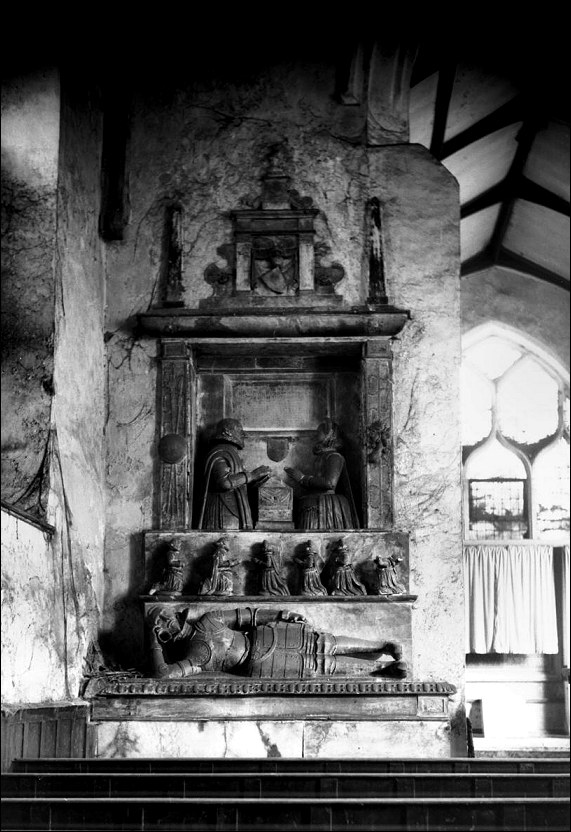
The monument rises from an impressive coloured alabaster base, to the Pettus coat of arms flanked by two obelisks. Sir John in his mayoral robes (he was Mayor in 1608) appears to kneel at a prayer desk opposite his wife, Bridget Curtis, although there is no sign of their legs. Blomefield writing in the 18th century mistook the armorials and identified the kneeling figure as Sir Augustine, who, unlike his father, was never Mayor of Norwich. Most of the literature has followed Blomefield, who was corrected by the Norfolk Heraldry Society (information from Tony Sims). Sir John and Lady Bridget are flanked by pilasters; his decorated with lances, hers with pomegranates and other fruit. Their children, two sons and two daughters kneel underneath, while Sir Augustine, who had died under a year before his father, is repeated lying stiffly in his full armour looking out from the monument, his head propped on his right arm, holding what could be a gauntlet or drinking horn, showing the fingers of a small hand.
Sir John had moved beyond both the family’s relative humble origins as tailors and local politics when in 1604 he had become the first Norwich Member since 1558 to be elected to two consecutive parliaments. He was active as an MP, while continuing his charitable work in Norwich. At the death of his father he had inherited considerable wealth, as well as the family house on Elm Hill, once extending to the churchyard, now nos. 41-43, and the estate at Rackheath, since at death his moveable goods, which included a substantial armoury of nine guns, were valued at £952 19s. 6d and the house on Elm Hill contained 27 rooms, together with stables for eight horses.
Blomefield, An Essay towards a Topographical History of the County of Norfolk: volume 4: The History of the City and County of Norwich, part II, ‘chapter 42: East Wimer ward', (1806), pp. 329-367; Chris Kyle, ‘Sir John Pettus’ in The History of Parliament: the House of Commons 1604-1629, , ed. Andrew Thrush and John P. Ferris, 2010.
detail of kneeling sons
Church of Simon and St Jude,
Monument to Sir John Pettus †1614 and Bridget Curtis and Sir Augustine Pettus †1613, alabaster. Commissioned by Thomas Pettus, Sir John’s second son, the executor of his will. Unknown, probably Norwich mason, also responsible for the Suckling monuments in St Andrew’s, restored 2007/8.
St Simon and St Jude was declared redundant in the 1890s, and abandoned in the 1930s. Now owned by the Norwich Churches Trust it has been saved from its state of collapse in the 1930s, but the inside has been butchered by the addition of the nave mezzanine. This makes it impossible to appreciate the monument to Sir John and his family, on filling the north wall flanking the chancel arch. Mercifully the late George Plunkett took a full set of photographs of the interior in the 1930s, including the monument (www.norfolkchurches.co.uk/norwichsimonjude/plunkett/plunk...).
The monument rises from an impressive coloured alabaster base, to the Pettus coat of arms flanked by two obelisks. Sir John in his mayoral robes (he was Mayor in 1608) appears to kneel at a prayer desk opposite his wife, Bridget Curtis, although there is no sign of their legs. Blomefield writing in the 18th century mistook the armorials and identified the kneeling figure as Sir Augustine, who, unlike his father, was never Mayor of Norwich. Most of the literature has followed Blomefield, who was corrected by the Norfolk Heraldry Society (information from Tony Sims). Sir John and Lady Bridget are flanked by pilasters; his decorated with lances, hers with pomegranates and other fruit. Their children, two sons and two daughters kneel underneath, while Sir Augustine, who had died under a year before his father, is repeated lying stiffly in his full armour looking out from the monument, his head propped on his right arm, holding what could be a gauntlet or drinking horn, showing the fingers of a small hand.
Sir John had moved beyond both the family’s relative humble origins as tailors and local politics when in 1604 he had become the first Norwich Member since 1558 to be elected to two consecutive parliaments. He was active as an MP, while continuing his charitable work in Norwich. At the death of his father he had inherited considerable wealth, as well as the family house on Elm Hill, once extending to the churchyard, now nos. 41-43, and the estate at Rackheath, since at death his moveable goods, which included a substantial armoury of nine guns, were valued at £952 19s. 6d and the house on Elm Hill contained 27 rooms, together with stables for eight horses.
Blomefield, An Essay towards a Topographical History of the County of Norfolk: volume 4: The History of the City and County of Norwich, part II, ‘chapter 42: East Wimer ward', (1806), pp. 329-367; Chris Kyle, ‘Sir John Pettus’ in The History of Parliament: the House of Commons 1604-1629, , ed. Andrew Thrush and John P. Ferris, 2010.
coat of arms detail
Built 1937-1940 in Currie St, first stage completed Nov 1938, second stage opened 5 Apr 1940, architects Woods, Bagot, Laybourne Smith & Irwin, replacing earlier building built 1888, extended 1954. Rear of building replaced 1999 by 7 level office space. Elders moved 2015 to Grenfell St, building retaining its name Elder House, sold 2018.
Alexander Elder arrived 1839, set up as general & commission agent and metal broker, joined by brothers William & George, later all three returned to London & Scotland. Thomas Elder arrived 1854, formed a partnership with Edward Stirling, Robert Barr Smith and John Taylor, known as Elder, Stirling & Co. When Stirling and Taylor retired in 1863, Thomas Elder and Robert Barr Smith set up Elder, Smith & Co. In 1882 Elders Wool & Produce Co Ltd was established, merged 1888. Elder's Trustee and Executor Co Ltd founded 1910. Further mergers, including Goldsbrough Mort 1963.
“the new Elder House, an imposing four-story structure to be erected in Currie street on a frontage of 136 ft. between the Savings Bank and Currie Chambers, for Elder, Smith and Co.. Ltd., and Elder's Trustee and Executor Co., Ltd. Elder House with equipment will cost about £150,000.” [News 25 Feb 1937]
“Demolition of the existing buildings to make way for the new Elder House will begin on Monday.” [News 16 Jul 1937]
“Crossing Currie street we were confronted by the paddock caused by the demolition of Elder's Trustee and Agency Coy. building, once the White Horse Hotel.” [Advertiser 11 Aug 1937]
“the new premises for Elder. Smith and Co. Ltd., and Elder's Executor Co., in Currie street, are well advanced. . . Polished Murray Bridge granite, which will be used for the front, is now being prepared by Standard Quarries, Ltd, at their Mile End works.” [Advertiser 26 Oct 1937]
“A start has been made on the demolition of the old Elder House in Currie street, which will make way for the second portion of the big new building which will house both Elder, Smith and Co.. Ltd., and Elder's Trustee and Executor Co.. Ltd. The first section of the £130,000 building scheme was recently completed. Although intended ultimately for the Trustee Co., it will be occupied by Elder, Smith & Co. until the second section is finished. The Trustee Co. is at present using offices in North terrace.” [News 4 Nov 1938]
“Elder, Smith & Co. Limited, to mark the completion this year of the centenary of the firm. . . For three-quarters of a century, at least, the prosperity of South Australia rested largely on the wealth derived from its flocks, herds, and mines. With those industries the company was associated intimately, and to that extent its interests were the interests of the State.” [Advertiser 7 Mar 1940]
“Tributes to the part played by Elder, Smith & Co. in developing the primary industries of South Australia and the fine team spirit of the staff were paid fine team spirit of the staff were paid yesterday when about 500 guests were entertained at a cocktail party to celebrate the opening of the new Currie street building.” [Advertiser 6 Apr 1940]
“The staff of Elder's Trustee and Executor Co. Ltd. will move into their new building, Elder House, in Currie street, on Monday. They have been situated in Anchor House, North terrace, for nearly four years. In the new building they will be housed beside Elder Smith & Co.” [News 25 May 1940]
“A new storey is to be added to Elder House, Currie street for the Elder Trustee Executor Co. The architects, Messrs. Woods, Bagot, Laybourne Smith & Irwin. . . At present there is a ground floor and three upper storeys. The new storey will provide additional office space for the company.” [Advertiser 25 Aug 1954]
ELDERS
“The undersigned, Agents for South Australia, are prepared to effect Fire and Life Insurances on liberal terms, and issue Policies in both branches, immediately on acceptance of risks. Insurances on Mills effected at the ordinary rates. All claims are settled in Adelaide, no reference home being required. Elder, Stirling, & Co.” [Adelaide Times 13 Aug 1856 advert]
“First Wool Ship for London. — The splendid new clipper ship ALMA, 592 tons register, R. Gilkisen, commander, is now in port, and will be dispatched about the middle of November. This vessel has a full poop, and excellent accommodation for passengers. For freight or passage, apply to Elder, Stirling, & Co.” [Adelaide Observer16 Aug 1856 advert]
“A change has taken place in the well-known firm of Elder, Stirling, & Co., caused by the retirement of Mr. John Taylor. The business of the firm will henceforward be carried on under the style and designation of Elder, Smith, & Co.” [Advertiser 22 Aug 1863]
“Elder’s Wool and Produce Company, Limited. (Late the Wool and Produce Brokerage Business of Messrs. Elder, Smith, and Co.) to be Limited and Incorporated.” [Register 30 Jun 1882]
** FILE ** TO GO WITH STORY SLUGGED CELIA CRUZ PATRIMONIO.- Cuban salsa queen Celia Cruz poses for photographers as she arrives at the 3rd annual Latin Grammy Awards in this Sept. 18, 2002 file photo in the Hollywood district of Los Angeles. Cruz who died in 2003, named two executor's in her will: Luis Falcon and Omer Pardillo. A judge from New Jersey canceled Falcon as Cruz's heritage executor Friday, March 23, 2007 after Pardillo accused him of squandering it. The judge ordered Falcon to make a detailed report with all the expenses he has made. (AP Photo/Kim D. Johnson)
Julgamento do assassinato dos ativistas José Cláudio e Maria dos Espírito Santo, que foram mortos em março de 2011 em Nova Ipixuna. O resultado do júri, que aconteceu nos dias 03 e 04 de abril, foi a condenação dos executores Alberto Lopes e Lindonjonson Silva, e absolvição de José Rodrigues, acusado de ser o mandante do crime. A ação provocou revolta nos familiares e movimentos agrários que acompanhavam o caso em vigília no Fórum de Marabá (PA).
(CC BY-SA) NINJA
Todas as imagens estão sob licença Creative Commons 3.0 e podem ser utilizadas livremente desde que disponibilizadas nas mesmas condições com o uso do código acima. Imagens em alta resolução estão disponíveis através de requerimento no email fotografia@foradoeixo.org.br
Thomas Moore was a nineteenth century Irish poet, bard, biographer and general "literateur." He was also the literary executor of Lord Byron, responsible for burning the poet's memoirs because he deemed them to be too scandalous. Generally Moore is regarded as the Irish equivalent of Robbie Burns.
But the people of Dublin never cared for this sculpture of him - even though the artist Christopher Moore (1790-1863) was Irish himself, and won the commission through a public competion.
The statue figures in one of the episodes in James Joyce's "Ulysses." In the 'Lestrygonians' section, Leopold Bloom "crossed under Tommy Moore's rougish finger." As he does he considers the fact that they built the statue over Dublin's largest public urinal. "They did right to put him over a urinal: meeting of the waters." ["Meeting of the Waters" was the name of one of Moore's most famous verses.]
Draft Will of The Rev’d Charles Grove Snowden, Mitford, Morpeth, Northumberland, 7th May 1859.
Executors: brothers, Thomas Hodges Grove Snowden of Ramsgate and George Silvanus Snowden of Ramsgate, Kent, Surgeon. Sister, Eliza Louisa Grear (?)
Beneficiaries: Thomas Hodge Grove Snowden, George Silvanus Snowden.
Witnesses: J. W. Harbottle, Butler, Mitford Castle, T.S. Waterson, Schoolmaster, Morpeth.
Draft Will of William Morris Boyton of the Collage, South Eastern Road, Ramsgate, Kent dated 1890.
Executors, wife Clementina Risdom Boyton and brother Henry Strang Boyton.
Beneficiaries: Wife Clementina Risdom Boyton and brother Henry Strang Boyton. Son William John Boyton, 3 daughters of his brother Henry Strang Boyton and 4 daughters of his brother Maurice Boyton (not named). His niece Edith Bennett, wife of Robert Bennett, niece Elizabeth Cleggett, daughter-in-law Georgina Boyton,
Draft Codicil of The Rev’d Charles Grove Snowden, Mitford, Morpeth, Northumberland, in favour of Capt John Joseph Grove, Invercharron, Ross Shire, 28th January, 1864. Also Thomas Marshall, Servant, Godson, Charles Marshall, Mary Ann Marshall, Elizabeth Feather.
Witnesses: P. Marshall, Groom, Tovington, Yorkshire and Thomas Cassells, Joiner, Mitford.
Las tres cintas de las tres películas, por orden, y la película de extras.
Todavía tienen el plástico original porque ni las he abierto, aunque hoy las voy a abrir para verlas de nuevo (¡Aniversario Star Wars!)
Will of William Palmer King, of 57 Claremont Avenue, Gateshead, Northumberland, Engine Fireman, dated 13th March 1916.
Executor: Thomas Douglas of Waterside House, Alnwick, Shepherd.
Beneficiaries: Thomas Douglas and Wife, Elizabeth Douglas.
Witnesses: John Balmbra, Alnwick, W.D. Young, Alnwick
Draft Will of Elizabeth Pottle Teagle, Widow of 13 Havelock Road, West Kensington Park, Middlesex, 1885. Relict of Thomas Teagle.
Executor Frederick Long of Wymondham, Norfolk, Tailor. Beneficiaries, sister Mary Long, wife of Henry Long, of Wymondham, Tailor. Should she die first then to the daughter of Mary Long, Sarah Eliza Long, the wife of Frederick Long.
Elizabeth Pottle Teagle died 4 December 1892. Solicitor, Whites and Pomeroy, Wymondham, Norfolk
Draft Will of Elizabeth Pottle Teagle, Widow of 13 Havelock Road, West Kensington Park, Middlesex, 1885. Relict of Thomas Teagle.
Executor Frederick Long of Wymondham, Norfolk, Tailor. Beneficiaries, sister Mary Long, wife of Henry Long, of Wymondham, Tailor. Should she die first then to the daughter of Mary Long, Sarah Eliza Long, the wife of Frederick Long.
Elizabeth Pottle Teagle died 4 December 1892. Solicitor, Whites and Pomeroy, Wymondham, Norfolk
According to J. Stephan Edwards, Ph.D.: Lady Jane Dacre of Lanercost, a sixteenth-century Scotswoman descended from the wealthy Carlisle family, married into the Dacre family late in her life. Prior to that, she had what has been described as a “liaison” with Sir John Lowther, bearing him a daughter and eventually serving as his executor upon his death in 1553. Their relationship seems to have begun in the 1540s, precisely the time at which the wood for the boards of the painting has been dated. Well after Lowther’s death, in about 1565, Jane became the third wife of Sir Thomas Dacre of Lanercost, the illegitimate son of Sir Thomas Dacre, second Baron Dacre of Gilsland (d. 1525).
Draft Will of The Rev’d Charles Grove Snowden, Mitford, Morpeth, Northumberland, 7th May 1859.
Executors: brothers, Thomas Hodges Grove Snowden of Ramsgate and George Silvanus Snowden of Ramsgate, Kent, Surgeon. Sister, Eliza Louisa Grear (?)
Beneficiaries: Thomas Hodge Grove Snowden, George Silvanus Snowden.
Witnesses: J. W. Harbottle, Butler, Mitford Castle, T.S. Waterson, Schoolmaster, Morpeth.
Cross legged effigy of a knight with chain mail surcoat, perhaps Sir Henry de Halton c.1338 whose family held possessions here in 14c . His shield has the arms of a lion rampant
In 1320, Henry de Halton, and Margaret his wife, were parties to an action concerning the manor and advowson of Halton.
His name appears on a number of legal documents.
From December 1335 he was constable of Builth castle Wales succeeding Ebulo Lestrange of whose will he was executor together with the abbot of Revesby
- Halton Holegate church, Lincolnshire
Surabaya Municipal Hall
( The Center of Bovenstad Since 1920)
Surabaya City Hall :This solar Garden had built by Dutch colonial, its architect is C. Citroen and executor of HV. Hollandsche Beton Mij. City hall is located in Taman Surya Street 1.
This solar Garden had built by Dutch colonial. Town Surabaya as Resort Gemeonte (Haminte) officially date of 1 Aprils 1906, what experienced by Dewan Hamite and led by assistant resident. In 1916 lifted the first lord mayor A. Meyroos finite commissioned in 1921.
During the second lord mayor of GJ Dijkerman, it had started the development of lord mayor building and finished in 1927. Its architect is C. Citroen and executor of HV. Hollandsche Beton Mij. Because its total cost 100 guilders, this building had formerly recognized as “1000 Guilders Building ".
The Government of Indonesia had built a city hall with modern architecture, laid at against stripper building. The stripper building has time has applied as 'Gedung Dewan Perwakilan Rakyat Daerah' and now applied as the center of municipal administration Surabaya.
More info: www.eastjava.com
Star Wars Celebration Europe 2013
Die Star Wars Celebration Europe ist das weltgrößte Treffen von Fans der Science-Fiction-Filmsaga Star Wars.
----------------------------------------------------------------------------------------
Celebrations in full swing in the Royal Mercure Hotel in Hull on the occasion of the Philip Larkin Society annual Christmas shindig. Ann Thwaite is a prolific and prize-winning author and biographer and today she chaired an interview session with her husband the poet Anthony Thwaite following his reading from his soon to be published new collection: Going Out. (Anthony Thwaite is one of Philip Larkin's literary executors). Beside Anne is James Booth, late of Hull University English Department, a former friend and colleague of Philip Larkin and the author of the recently published biography: Philip Larkin Life Art And Love.
Draft Will of Job Grant of Ramsgate, Kent (born circa 1783 died 18th August 1866) dated 27 April 1861.
Executors, Wife Elizabeth Long Grant, sons, Job Grant the Younger of 1 Union Street, Southwark, Spirit Merchant and William Grant of Ramsgate, Fish Dealer.
Beneficiaries: Elizabeth Long Grant, wife, Job Grant and William Grant sons. Two daughters, Jane, the wife of Willoughby Carter Hillier of Billingsgate, London, Fish Salesman and Sarah the wife of Robert Bastable of 6 New Road, St. Georges in the East, Veterinary Surgeon.
L. Elgar, Clerk, Snowden Solicitors witness.
The 1851 census shows him and his wife Elizabeth living at Princes Street and that he was a Mariner. The 1861 census shows them at 3 Meeting Street, Ramsgate.