View allAll Photos Tagged Executor
Near this place lyes interr'd the body of Gabriel More esq deceased 21 February 1698 aged 61
He was a just, pious, hospitable & charitable nephew to Henry More DD of Exeter college Cambridge, by his learned wrightings in divinity & philosophy, one of ye great glories of our church & nation. who tho eminently charitable in his life time, at his death left an honourable addition of estate to his said nephew.
He as ye last branch of this worthy stock after proper devises by an apostolicall bounty gave £2000 to the French refugees fled into England for theyr religion & £200 which purchased a rent charge of £10 per ann for ye poor of this corperation.
The large remainder of his estate he gave to charitable uses. His executors in a just honouring his name as also that of the family have erected this memoriall - Church of St Wulfram, Grantham, Lincolnshire
"Near hee lieth ye body of Thomas Anguish late citizen & alderman of Norwich & sometimes mayor of this city who deceased the 26th January AD 1617 aged 79, who had to wife Elizabeth daughter of Edmund Thurston and had issue by her 9 sonnes and 3 daughters, where of at his death their were living 5 sonnes only"
"William Anguish, gent, dyed the 6th day of July 1668 to whose memorie John Anguish esq, his nephew and executor dedicated this inscription"
Now crammed behind the organ, monument to Thomas Anguish (1536 - 1617) www.flickr.com/gp/52219527@N00/0BX434 in the robes of an alderman, who kneels with his wife & family. Placed here at his request above his "seat where he usually sat" and is by Nicholas Stone costing £20 double the amount he had left in his will for this purpose.
Thomas was the youngest of 3 sons of Thomas Anguish of Foulsham by Anne Thimblethorp
He m Elizabeth c 1619 daughter of grocer Edmund Thurston ++ to whom Thomas was apprenticed . Their house and shop was in Tombland (on the corner of Tombland and Wensum Street, now part of the Maid’s Head Hotel)
He took over his father in law's grocery business and prospered, becoming a freeman of Norwich in 1573. and took an active role in city life, serving as Sheriff, Mayor and Speaker of the Council. He was elected mayor in 1611, and as was usual there was a pageant and firework display. Sadly the cord suspended with fireworks collapsed causing the deaths of 33 bystanders. The occasion was described by a local catholic commentator as "a scourge to that wicked citie and puritan mayor .. being Anguish did portend anguish and sorrow to the people" Thereafter fireworks were banned from Guildhall feasts
Children 9 sons & 3 daughters (5 sons survived their father)
1. John 1569-1571
2. Alexander 1577-1579
3. John 1578-1643, alderman m Mary Aldrich d1640 grand daughter of alderman John Aldrich father in law of Edmund Thurston ++)
4. Edmund 1574-1657 of Great Melton m1 Dorothy Marsham
d1604 in childbirth with her baby m2 Alice d1642 daughter of John Drake of Herringfleet (their grand daughter Anne Wodehouse is at Kimberley flic.kr/p/CdKoLk whose son inherited Great Melton)
5. Alexander 1579-1581
6. Richard 1581- 1616 Fellow of protestant college Corpus Christi
7. Alexander 1582-1654 alderman of St Peter Mancroft m Catherine Barrett
8.. Cicely 1583-1584
9. Hester 1585-1617 m Richard son of John Mann
10, Margaret 1587-1588
11. Thomas 1590-1622 m Anne daughter of Francis Smallpiece & Anne daughter of John Aldrich, who m2 John Dethick
12. William 1593-1668
A patron of the cathedral who with his son Edmund, bequeathed a new organ for the choir and had a standing order for repairs from 1607 to 1609
Thomas also bequeathed a property in Fishergate to the Corporation to be used as a hostel "for the keeping and bringing up and teaching of very poor children" which was opened in 1621 - Boys were first to be admitted, with girls following some years later. It still survives www.anguishseducationalfoundation.org.uk/about-us/ There was also a foundling hospital begun in 1618 where annual sermon was to be preached on its founders day.
Thomas was certainly a Calvinist if not a puritan - The fireworks episode must have preyed on his mind as his will states he died in the assurance that Christ "hath of his own free will and greate mean fully paide and satisfied the wrath of God the Father due unto me for my synne. And that through his blessed merit, death and passion I shall have and enjoy the fruition and benefit of everlasting life to joyn with Him in eternall joy and happiness among the elect children of God for ever" - Church of St George Tombland Norwich , Norfolk
1868 abstract of deed of Arrangement under Will of Humphrey Bourne, Draper, 13th June 1855, Ramsgate, Kent. Maria Bourne, Wife, R.S. Cramp, John Kennett appointed Executors.
Humphrey Bourne’s Will left Property and money to his wife Maria Bourne, who carried on the business as a Draper, his 4 Children, Humphrey Bourne, Draper, George Winder Bourne, Harry Bourne and Sally Howland Clements the wife of Edward Clements
Copy of the stolen brass of Sir Thomas Blennerhassett 1461-1531 "Here lyeth Sir Thomas Bleuerhayssette, Knyght, which decessyd the ryii Day of June, the Yere of our Lorde M yo rrri. and rrriii Yere of the Reigne of our Sobe raygne Lord Kyng Henry the viiith, whois Soule God Pardon".
Thomas was the son of John Blennerhassett d1510 www.flickr.com/gp/52219527@N00/005tn8 and first wife Margaret Heigham www.flickr.com/photos/52219527@N00/5947090482/
Thomas was the executor for Thomas, Duke of Norfolk in 1514. He lived at Frenze, and also Boyland Hall, Long Stratton. Son George left Frenze to his wife Margaret for her life and then to their heiress Mary m1 Thomas Culpepper m2 Francis Bacon - After the death of Francis it reverted to her half brother John
He m1 Jane Sutton.
Children
1. George 1501-1543 m Margaret Jermyn / Jernegan
2. Edward m Anne Cobbe
3. Mary m John Meux
He m2 Margaret d1561 www.flickr.com/gp/52219527@N00/4M48ZE daughter of John Braham of Wetheringsett and Joan Reyden 1519 www.flickr.com/gp/52219527@N00/30oPQi
Children
1. Thomas a priest
2. John of Barsham & Boyland m1 Elizabeth daughter of John Cornwallis and Elizabeth Sulyard www.flickr.com/photos/52219527@N00/9392340481/ (parents of Elizabeth Blennerhassett, bc.1537 who m 1561 Sir Lionel Throckmorton flic.kr/p/fDaHf7 son of Simon Throckmorton by Anne Louthe )
3. Elizabeth m1 Lionel Lowth m2 Francis Clopton m1 Lionel Lowthe / Louthe www.flickr.com/photos/52219527@N00/13925024374/ (grand daughter Anne Dade www.flickr.com/photos/52219527@N00/527517488/ )
4. Agnes m Sir Anthony Rous 1545 of Dennington & Henham Hall
5. Anne d1577 www.flickr.com/gp/52219527@N00/rqtQq9 www.flickr.com/gp/52219527@N00/65fy0D m1 George Duke m2 Peter Rede / Read of Gimingham
6. Margaret d1558 m1 John Spelman www.flickr.com/gp/52219527@N00/P38o5L Sir John Spelman and Elizabeth Frowyke www.flickr.com/gp/52219527@N00/9Rj86X m2 John Eyre dsp 1561 of Lyn, Receiver General to Queen Elizabeth for the counties of Norfolk, Suffolk, Cambridgshire & Huntingdon
7. Katherine m1 John Gosnold m2 Anthony Wingfield 1593
On his surcoat are the arms of Blenerhassett with the annulet, (which this branch always bare for difference,) with his quarterings, Lowdham, Orton, and Kelvedon / Keldon Under his head lies his crest - a fox passant.
www.british-history.ac.uk/topographical-hist-norfolk/vol1...
humphrysfamilytree.com/Blennerhassett/john.frenze.html
Draft Will of Miss Eliza Cuttler of Ramsgate, Kent. Draft Will dated 15th June 1860.
Executor was her brother, John Cuttler.
Both John Cuttler and her sister, Mary Ann Cuttler benefited. Solicitor, Snowden, Ramsgate
É oficial: Riacho Fundo II é a primeira região administrativa a zerar todos os buracos mapeados pelo governo neste ano. Um trabalho em conjunto entre funcionários da administração regional e os órgãos executores removeram os 487 buracos que atrapalhavam a trafegabilidade dos pedestres e motoristas. Para atingir essa meta, foram utilizadas 283.277 toneladas de massa asfáltica. Foto: Paulo H. Carvalho/Agência Brasília
Siena. Santa Maria della Scala museum complex.
Company of Saint Mary Under the Vaults.
"The Fraternity of the Obedient to Most Holy Mary, which later became the Society of Executors of Pious Dispositions, is the oldest lay company headquartered in the subterranean spaces of Santa Maria della Scala. Originally formed in the Cathedral of Siena, the existence of a fraternity dedicated to pious works is also mentioned in a letter by Saint Catherine.
On April 14, 1785 a grand ducal decision counted the company among those to be suppressed, re-forming it as the Society of Executors of Pious Dispositions dedicated to charitable works, but divesting it of its religious aspects. Only in 1792 did Grand Duke Ferdinand III definitively restore the Society as a religious brotherhood.
The Society’s artistic patrimony, which over the course of the centuries has been enriched by both furnishings and art works, thanks in part to bequests by artists to whom this same institution had given scholarships, is still today outstanding, even though most of it is conserved in the Via Roma headquarters, including numerous movable art works such as paintings and furnishings of the Sienese School. However, still conserved at Santa Maria della Scala is a beautiful wood Crucifix between terracotta figures of Saint Bernardino and Saint Catherine, which tradition holds is the very same crucifix that induced Saint Bernardino to become a Franciscan. On the Oratory’s other altar we find a canvas by Alessandro Casolani depicting the Madonna with Child and Saints Peter and Paul. The Sacristy contains, among other things, very interesting frescoes attributed to Andrea Vanni and Luca di Tommè.
During restoration work, behind an air space that had been walled in for over two centuries along a stair leading to the historic headquarters of the Society of Executors of Pious Dispositions, a vast early Fourteenth-century fresco cycle depicting a Hermitage came to light, referable to the sphere of Ambrogio Lorenzetti: this was the most important discover of the past twenty years regarding the Sienese School of painting prior to the black plague of 1348.
Finally, we must mention the collection of samples left by the main Sienese artists of the Nineteenth century. This nucleus is the fruit of work by sculptors and painters who utilized scholarships, the so-called Alunnato Biringucci, which were granted by the institution thanks to the bequests of brotherhood members and benefactors."
Una de las láminas de la caja.
(Esta en concreto no me gusta mucho, las caras están muy mal dibujadas).
Urie house, Kincardineshire
Alexander Baird of the Gartsherrie family purchased the estate of Urie in Kincardineshire in 1854 from the executors of the late Robert Barclay Allardice. This fine estate is situated near Stonehaven and lies on both banks of the river Cowrie. Alexander Baird built the present house of Urie (as pictured). In 1860 he increased his property by about a thousand acres from Patrick Keith Murray of Dunottar. On his death the property passed to his brother John. He had also purchased the estates of Inshes and Delmore in Inverness-shire and Drumkilbo in Forfarshire.
The present Trustees, John Castle Pomeroy and James Brummage Account of the Will of Samuel Parker, Residuary Legatees following death of Caroline Parker, widow of Samuel Parker October 1906. Caroline, nee Sparkhall, Parker died 2nd March 1906. Amounts and the details of money paid to Caroline Laura Parker and Jessie Limmer Parker who inherited under the Will.
Daughters Jessie Limmer Parker married Alfred Guiver on 31st January 1894 at Wymondham, Norfolk, England. The other daughter Caroline Laura Parker married James Brummage, 17th March 1894 at Wymondham, Norfolk, England.
Samuel Parker born 1814 at Wymondham was the son of James and Sophia, nee Scarlett, Parker he married Caroline Sparkhall 11th August 1846 at Wymondham. Caroline was the daughter of John Sparkhall and Elizabeth Limmer and was born in 1824 at Wymondham.
The Parker Family of Wymondham Documents.
Bickhram Litigation is a dynamic company in Law Firms & Legal Services industry. At Bickhram Litigation, we handle a wide range of estate, trust, guardianship and family law issues, including: Estate Litigation Guardianship Applications Capacity Litigation Trustee Executor Litigation Probate Application Divorce Child Custody Child Visitation Child Support Spousal Support Media: We are committed to providing our clients with the most up-to-date information regarding the state of our law to keep our clients involved and informed in their case.
Please visit our website, where you will find more information on estate, trust and family law.
Representantes do Governo do Distrito Federal (GDF) conferiram o andamento da primeira etapa do Drenar DF. A visita técnica ocorreu nesta sexta-feira (14) e contou com a presença de servidores do Serviço de Limpeza Urbana (SLU) e das secretarias de Projetos Especiais (Sepe) e de Transporte e Mobilidade (Semob). O encontro foi intermediado por engenheiros da Companhia Imobiliária de Brasília (Terracap), executora da obra. Foto: Lúcio Bernardo Jr./Agência Brasília
Title: Desk and Bookcase
Artist/Maker: Benjamin Frothingham (American, 1734-1809; active Charlestown 1754-1809)
Place Made: United States: Massachusetts: Charlestown
Date Made: 1753
Medium: wood; mahogany; white pine; eastern red cedar; Spanish cedar
Measurements: Overall: 98 1/4 in x 44 1/2 in x 24 3/4 in; 249.555 cm x 113.03 cm x 62.865 cm
Credit Line: Gift of Mr. Dana C. Ackerly and Mr. Earle S. Thompson, estate executors, in memory of Mrs. Bell McKerlie Watts and Mr. Samuel Hughes Watts of Fairfield, Connecticut
Collection: The Diplomatic Reception Rooms, U.S. Department of State, Washington, D.C.
Accession No: RR-1970.0094
Church of St Peter,
Monument to the ancestors of Edward Atkyns. Marble. Commissioned by Edward Atkyns 1750. South wall of chancel. Possibly by Robert Page to a design by Sir Henry Cheere.
The monument, framed in a Gothic arch with trefoil head, is divided between a cartouche with coat of arms, a long inscription set in a lugged architrave under a decorative scroll and the funerary monument whose lions’ paws rest a black marble plinth. The frame was introduced in emulation of the monument in the south transept of Westminster Abbey, commissioned by Edward Atkyns from Sir Henry Cheere and ready by the 15 December 1746. In his will Atkyns specified that: ‘my executors lay out a sum of money not less than two hundred pounds and not more than three hundred in erecting a monument of myself and my ancestors in the chancel of the Parish church at Ketteringham, both in model, size and inscription as near as conveniently be (to that in Westminster Abbey) and that I desire that notice may be taken in the monument in Westminster Abbey that another one is set up in Ketteringham church and to take notice on both monuments that they were erected out of the veneration and regard that I had for the memory of my ancestors.’
The ancestors mentioned in the main inscription on both monuments were:
Sir Edward Atkyns †1669, a Baron of the Exchequer;
Sir Robert †1709, his eldest son, Chief Baron of the Exchequer and Speaker of the House of Lords;
Sir Edward †1698, his youngest son, also Chief Baron of the Exchequer, who retired to Norfolk in the (Cromwellian) revolution;
Sir Robert eldest son of the Sir Robert † 1709, a gentleman scholar, author of a History of Gloucestershire, who died in 1711.
Finally a tablet on the sarcophagus of both added: ‘In memory of his ancestors, who have so honourably presided in the Courts of Justice in Westminster Hall, EDWARD ATYKYNS Esqr. late of Ketteringham in Norfolk, second son of the last named Sir Edward, caused this monument to be erected. He died January the 20th 1750 aged 79 years.’
Atkyns had bought Ketteringham Hall from Henry Heron (ca. 1675-1730) who had inherited the Hall through his marriage to Abigail, Sir William Heveningham’s daughter. The sale was probably around 1695, when Heron inherited his father’s estate of Cressy Hall, Lincolnshire in.
The attribution of the Ketteringham monument remains open. There is no doubt that the monument in Westminster Abbey is by Henry Cheere, two of Cheere’s drawings for it were sold at Christies Dec. 1982 lot 104, but, with the exception of Matthew Craske (The Silent Rhetoric of the Body. A History of Monumental Sculpture and Commemorative Art in England, 1720-1770, 2007, 198-201 and footnotes 30 and 31 on p.467), who believes both monuments are by Cheere, doubts remain and it has been attributed, notably by Pevsner, to the Norwich sculptor Robert Page. The argument was well summed up by Jon Bayliss who noted that the framing arch at Ketteringham, intended to echo that at Westminster Abbey, does not resemble other more up-to frames by Cheere. The Abbey monument rests on four legs, rather than two lion paws, whose ‘furry cuffs’ have no parallels in other comparable monuments. He offered as a possible explanation is that after his work for the Churchman family in St Giles, Cheere was aware that the city had a sculptor in the shape of Robert Page who was capable of matching the standards expected in his own workshop and that he could sub-contract the Atkyns monument to Page.
Matthew Craske, cited above, notes that the family memorial belongs with a group of commissions ‘For great old men planning their death with no sons to inherit, one of the problems was to ensure that their elected heir acted as instructed.’ He interprets the choice of texts with a quote from another scholar working on the same era, Sheerer West: ‘Tory families in particular were intent upon proving their relationship with the past…(and that) their histories sought to prove that their subjects had a long association with the Royal family both before and following the civil war.’
www.westminster-abbey.org/our-history/people/edward-and-r..., accessed 17/07/2015
detail of the top of the monument with cartouche
Incubo Design
Web store:
marketplace.secondlife.com/stores/52240
Inworld store:
maps.secondlife.com/secondlife/Marvel%20Retreat/96/44/3002
Credits:
The Space Dome (1024m edition) by Cold breath
Built 1937-1940 in Currie St, first stage completed Nov 1938, second stage opened 5 Apr 1940, architects Woods, Bagot, Laybourne Smith & Irwin, replacing earlier building built 1888, extended 1954. Rear of building replaced 1999 by 7 level office space. Elders moved 2015 to Grenfell St, building retaining its name Elder House, sold 2018.
Alexander Elder arrived 1839, set up as general & commission agent and metal broker, joined by brothers William & George, later all three returned to London & Scotland. Thomas Elder arrived 1854, formed a partnership with Edward Stirling, Robert Barr Smith and John Taylor, known as Elder, Stirling & Co. When Stirling and Taylor retired in 1863, Thomas Elder and Robert Barr Smith set up Elder, Smith & Co. In 1882 Elders Wool & Produce Co Ltd was established, merged 1888. Elder's Trustee and Executor Co Ltd founded 1910. Further mergers, including Goldsbrough Mort 1963.
“the new Elder House, an imposing four-story structure to be erected in Currie street on a frontage of 136 ft. between the Savings Bank and Currie Chambers, for Elder, Smith and Co.. Ltd., and Elder's Trustee and Executor Co., Ltd. Elder House with equipment will cost about £150,000.” [News 25 Feb 1937]
“Demolition of the existing buildings to make way for the new Elder House will begin on Monday.” [News 16 Jul 1937]
“Crossing Currie street we were confronted by the paddock caused by the demolition of Elder's Trustee and Agency Coy. building, once the White Horse Hotel.” [Advertiser 11 Aug 1937]
“the new premises for Elder. Smith and Co. Ltd., and Elder's Executor Co., in Currie street, are well advanced. . . Polished Murray Bridge granite, which will be used for the front, is now being prepared by Standard Quarries, Ltd, at their Mile End works.” [Advertiser 26 Oct 1937]
“A start has been made on the demolition of the old Elder House in Currie street, which will make way for the second portion of the big new building which will house both Elder, Smith and Co.. Ltd., and Elder's Trustee and Executor Co.. Ltd. The first section of the £130,000 building scheme was recently completed. Although intended ultimately for the Trustee Co., it will be occupied by Elder, Smith & Co. until the second section is finished. The Trustee Co. is at present using offices in North terrace.” [News 4 Nov 1938]
“Elder, Smith & Co. Limited, to mark the completion this year of the centenary of the firm. . . For three-quarters of a century, at least, the prosperity of South Australia rested largely on the wealth derived from its flocks, herds, and mines. With those industries the company was associated intimately, and to that extent its interests were the interests of the State.” [Advertiser 7 Mar 1940]
“Tributes to the part played by Elder, Smith & Co. in developing the primary industries of South Australia and the fine team spirit of the staff were paid fine team spirit of the staff were paid yesterday when about 500 guests were entertained at a cocktail party to celebrate the opening of the new Currie street building.” [Advertiser 6 Apr 1940]
“The staff of Elder's Trustee and Executor Co. Ltd. will move into their new building, Elder House, in Currie street, on Monday. They have been situated in Anchor House, North terrace, for nearly four years. In the new building they will be housed beside Elder Smith & Co.” [News 25 May 1940]
“A new storey is to be added to Elder House, Currie street for the Elder Trustee Executor Co. The architects, Messrs. Woods, Bagot, Laybourne Smith & Irwin. . . At present there is a ground floor and three upper storeys. The new storey will provide additional office space for the company.” [Advertiser 25 Aug 1954]
ELDERS
“The undersigned, Agents for South Australia, are prepared to effect Fire and Life Insurances on liberal terms, and issue Policies in both branches, immediately on acceptance of risks. Insurances on Mills effected at the ordinary rates. All claims are settled in Adelaide, no reference home being required. Elder, Stirling, & Co.” [Adelaide Times 13 Aug 1856 advert]
“First Wool Ship for London. — The splendid new clipper ship ALMA, 592 tons register, R. Gilkisen, commander, is now in port, and will be dispatched about the middle of November. This vessel has a full poop, and excellent accommodation for passengers. For freight or passage, apply to Elder, Stirling, & Co.” [Adelaide Observer16 Aug 1856 advert]
“A change has taken place in the well-known firm of Elder, Stirling, & Co., caused by the retirement of Mr. John Taylor. The business of the firm will henceforward be carried on under the style and designation of Elder, Smith, & Co.” [Advertiser 22 Aug 1863]
“Elder’s Wool and Produce Company, Limited. (Late the Wool and Produce Brokerage Business of Messrs. Elder, Smith, and Co.) to be Limited and Incorporated.” [Register 30 Jun 1882]
This water tower was a perfect spot to tune up targeting of the Serbian cannons in Fall, 1991. Three main executors of this killing of Vukovar are today in Hague and Court procceedings are starting today.
Abstract of Title Trustees of Will of John F Clark to Lewknor Cottage, Picton Road, Ramsgate Kent, 1904. List several previous Indentures etc.plus value of any houses and what and what cannot be built on the Land. First 19th & 25th March 1799 redemption of Land Tax by John Garrett.
Amongst many others:
28th August 1866 Indenture between Sir Robert Garrett, George Young, Edward Newman, Robert Beckford Johnstone, John Francis Bontenis.
7th July 1876 John Frederick Clark died. His wife Mary Ann Clark and son-in-law Birches Frost Wills are named as Executors and Trustees
2nd December 1878 Agreement between John Frederick Clark and Jennings Butler for £100.
28th December 1896 Jennings Butler died and by his Will of 1895 Thomas Newman, Alfred Thomas Brewer and his Niece Isabella Butler Long made Trustees and Executors of his Will.
5th March 1898 Isabella Butler Long died.
15th September 1902 Indenture of Mortgage between Mary Ann Clark, Widow of Ramsgate, Birches Frost Wills, Carpenter, Ramsgate, Sarah Kingdom Klug of 112 Clifton Hill, St Johns Wood, London, Widow.
John Frederick Clark born circa 1821 at Ramsgate was a Carpenter/Builder. He married twice: Elizabeth Hooper Moses 30th June 1844 at Ramsgate and Mary Ann Bobey 23rd October 1871 at St. Lawrence, Kent.
The Burgtheater at Dr.-Karl -Lueger-Ring (from now on, 2013, Universitätsring) in Vienna is an Austrian Federal Theatre. It is one of the most important stages in Europe and after the Comédie-Française, the second oldest European one, as well as the greatest German speaking theater. The original 'old' Burgtheater at Saint Michael's square was utilized from 1748 until the opening of the new building at the ring in October, 1888. The new house in 1945 burnt down completely as a result of bomb attacks, until the re-opening on 14 October 1955 was the Ronacher serving as temporary quarters. The Burgtheater is considered as Austrian National Theatre.
Throughout its history, the theater was bearing different names, first Imperial-Royal Theater next to the Castle, then to 1918 Imperial-Royal Court-Burgtheater and since then Burgtheater (Castle Theater). Especially in Vienna it is often referred to as "The Castle (Die Burg)", the ensemble members are known as Castle actors (Burgschauspieler).
History
St. Michael's Square with the old K.K. Theatre beside the castle (right) and the Winter Riding School of the Hofburg (left)
The interior of the Old Burgtheater, painted by Gustav Klimt. The people are represented in such detail that the identification is possible.
The 'old' Burgtheater at St. Michael's Square
The original castle theater was set up in a ball house that was built in the lower pleasure gardens of the Imperial Palace of the Roman-German King and later Emperor Ferdinand I in 1540, after the old house 1525 fell victim to a fire. Until the beginning of the 18th Century was played there the Jeu de Paume, a precursor of tennis. On 14 March 1741 finally gave the Empress Maria Theresa, ruling after the death of her father, which had ordered a general suspension of the theater, the "Entrepreneur of the Royal Court Opera" and lessees of 1708 built theater at Kärntnertor (Carinthian gate), Joseph Karl Selliers, permission to change the ballroom into a theater. Simultaneously, a new ball house was built in the immediate vicinity, which todays Ballhausplatz is bearing its name.
In 1748, the newly designed "theater next to the castle" was opened. 1756 major renovations were made, inter alia, a new rear wall was built. The Auditorium of the Old Burgtheater was still a solid timber construction and took about 1200 guests. The imperial family could reach her royal box directly from the imperial quarters, the Burgtheater structurally being connected with them. At the old venue at Saint Michael's place were, inter alia, several works of Christoph Willibald Gluck, Ludwig van Beethoven, Wolfgang Amadeus Mozart as well as Franz Grillparzer premiered .
On 17 February 1776, Emperor Joseph II declared the theater to the German National Theatre (Teutsches Nationaltheater). It was he who ordered by decree that the stage plays should not deal with sad events for not bring the Imperial audience in a bad mood. Many theater plays for this reason had to be changed and provided with a Vienna Final (Happy End), such as Romeo and Juliet or Hamlet. From 1794 on, the theater was bearing the name K.K. Court Theatre next to the castle.
1798 the poet August von Kotzebue was appointed as head of the Burgtheater, but after discussions with the actors he left Vienna in 1799. Under German director Joseph Schreyvogel was introduced German instead of French and Italian as a new stage language.
On 12 October 1888 took place the last performance in the old house. The Burgtheater ensemble moved to the new venue at the Ring. The Old Burgtheater had to give way to the completion of Saint Michael's tract of Hofburg. The plans to this end had been drawn almost 200 years before the demolition of the old Burgtheater by Joseph Emanuel Fischer von Erlach.
The "new" K.K. Court Theatre (as the inscription reads today) at the Ring opposite the Town Hall, opened on 14 October 1888 with Grillparzer's Esther and Schiller's Wallenstein's Camp, was designed in neo-Baroque style by Gottfried Semper (plan) and Karl Freiherr von Hasenauer (facade), who had already designed the Imperial Forum in Vienna together. Construction began on 16 December 1874 and followed through 14 years, in which the architects quarreled. Already in 1876 Semper withdrew due to health problems to Rome and had Hasenauer realized his ideas alone, who in the dispute of the architects stood up for a mainly splendid designed grand lodges theater.
However, created the famous Viennese painter Gustav Klimt and his brother Ernst Klimt and Franz Matsch 1886-1888 the ceiling paintings in the two stairwells of the new theater. The three took over this task after similar commissioned work in the city theaters of Fiume and Karlovy Vary and in the Bucharest National Theatre. In the grand staircase on the side facing the café Landtmann of the Burgtheater (Archduke stairs) reproduced Gustav Klimt the artists of the ancient theater in Taormina on Sicily, in the stairwell on the "People's Garden"-side (Kaiserstiege, because it was reserved for the emperor) the London Globe Theatre and the final scene from William Shakespeare's "Romeo and Juliet". Above the entrance to the auditorium is Molière's The Imaginary Invalid to discover. In the background the painter immortalized himself in the company of his two colleagues. Emperor Franz Joseph I liked the ceiling paintings so much that he gave the members of the company of artists of Klimt the Golden Cross of Merit.
The new building resembles externally the Dresden Semper Opera, but even more, due to the for the two theaters absolutely atypical cross wing with the ceremonial stairs, Semper's Munich project from the years 1865/1866 for a Richard Wagner Festspielhaus above the Isar. Above the middle section there is a loggia, which is framed by two side wings, and is divided from a stage house with a gable roof and auditorium with a tent roof. Above the center house there decorates a statue of Apollo the facade, throning between the Muses of drama and tragedy. Above the main entrances are located friezes with Bacchus and Ariadne. At the exterior facade round about, portrait busts of the poets Calderon, Shakespeare, Moliere, Schiller, Goethe, Lessing, Halm, Grillparzer, and Hebbel can be seen. The masks which also can be seen here are indicating the ancient theater, furthermore adorn allegorical representations the side wings: love, hate, humility, lust, selfishness, and heroism. Although the theater since 1919 is bearing the name of Burgtheater, the old inscription KK Hofburgtheater over the main entrance still exists. Some pictures of the old gallery of portraits have been hung up in the new building and can be seen still today - but these images were originally smaller, they had to be "extended" to make them work better in high space. The points of these "supplements" are visible as fine lines on the canvas.
The Burgtheater was initially well received by Viennese people due to its magnificent appearance and technical innovations such as electric lighting, but soon criticism because of the poor acoustics was increasing. Finally, in 1897 the auditorium was rebuilt to reduce the acoustic problems. The new theater was an important meeting place of social life and soon it was situated among the "sanctuaries" of Viennese people. In November 1918, the supervision over the theater was transferred from the High Steward of the emperor to the new state of German Austria.
1922/1923 the Academy Theatre was opened as a chamber play stage of the Burgtheater. On 8th May 1925, the Burgtheater went into Austria's criminal history, as here Mentscha Karnitschewa perpetrated a revolver assassination on Todor Panitza.
The Burgtheater in time of National Socialism
The National Socialist ideas also left traces in the history of the Burgtheater. In 1939 appeared in Adolf Luser Verlag the strongly anti-Semitic characterized book of theater scientist Heinz Kindermann "The Burgtheater. Heritage and mission of a national theater", in which he, among other things, analyzed the "Jewish influence "on the Burgtheater. On 14 October 1938 was on the occasion of the 50th anniversary of the opening of the Burgtheater a Don Carlos production of Karl-Heinz Stroux shown that served Hitler's ideology. The role of the Marquis of Posa played the same Ewald Balser, who in a different Don Carlos production a year earlier (by Heinz Hilpert) at the Deutsches Theater in the same role with the sentence in direction of Joseph Goebbels box vociferated: "just give freedom of thought". The actor and director Lothar Müthel, who was director of the Burgtheater between 1939 and 1945, staged 1943 the Merchant of Venice, in which Werner Kraus the Jew Shylock clearly anti-Semitic represented. The same director staged after the war Lessing's parable Nathan the Wise. Adolf Hitler himself visited during the Nazi regime the Burgtheater only once (1938), and later he refused in pure fear of an assassination.
For actors and theater staff who were classified according to the Reich Citizenship Law of 1935 as "Jews ", were quickly imposed stage bans, within a few days, they were on leave, fired or arrested. The Burgtheater ensemble between 1938 and 1945 did not put up significant resistance against the Nazi ideology, the repertoire was heavily censored, only a few joined the Resistance, as Judith Holzmeister (then also at the People's Theatre engaged) or the actor Fritz Lehmann. Although Jewish members of the ensemble indeed have been helped to emigrate, was still an actor, Fritz Strassny, taken to a concentration camp and murdered there.
The Burgtheater at the end of the war and after the Second World War
In summer 1944, the Burgtheater had to be closed because of the decreed general theater suspension. From 1 April 1945, as the Red Army approached Vienna, camped a military unit in the house, a portion was used as an arsenal. In a bomb attack the house at the Ring was damaged and burned down on 12th April 1945 completely. Auditorium and stage were useless, only the steel structure remained. The ceiling paintings and part of the lobby were almost undamaged.
The Soviet occupying power expected from Viennese City Councillor Viktor Matejka to launch Vienna's cultural life as soon as possible again. The council summoned on 23 April (a state government did not yet exist) a meeting of all Viennese cultural workers into the Town Hall. Result of the discussions was that in late April 1945 eight cinemas and four theaters took up the operation again, including the Burgtheater. The house took over the Ronacher Theater, which was understood by many castle actors as "exile" as a temporary home (and remained there to 1955). This venue chose the newly appointed director Raoul Aslan, who championed particularly active.
The first performance after the Second World War was on 30 April 1945 Sappho by Franz Grillparzer directed by Adolf Rott from 1943 with Maria Eis in the title role. Also other productions from the Nazi era were resumed. With Paul Hoerbiger, a few days ago as Nazi prisoner still in mortal danger, was shown the play of Nestroy Mädl (Girlie) from the suburbs. The Academy Theatre could be played (the first performance was on 19 April 1945 Hedda Gabler, a production of Rott from the year 1941) and also in the ball room (Redoutensaal) at the Imperial Palace took place performances. Aslan the Ronacher in the summer had rebuilt because the stage was too small for classical performances. On 25 September 1945, Schiller's Maid of Orleans could be played on the enlarged stage.
The first new productions are associated with the name of Lothar Müthel: Everyone and Nathan the Wise, in both Raoul Aslan played the main role. The staging of The Merchant of Venice by Müthel in Nazi times seemed to have been fallen into oblivion.
Great pleasure gave the public the return of the in 1938 from the ensemble expelled Else Wohlgemuth on stage. She performaed after seven years in exile in December 1945 in Clare Biharys The other mother in the Academy Theater. 1951 opened the Burgtheater its doors for the first time, but only the left wing, where the celebrations on the 175th anniversary of the theater took place.
1948, a competition for the reconstruction was tendered: Josef Gielen, who was then director, first tended to support the design of ex aequo-ranked Otto Niedermoser, according to which the house was to be rebuilt into a modern gallery theater. Finally, he agreed but then for the project by Michael Engelhardt, whose plan was conservative but also cost effective. The character of the lodges theater was largely taken into account and maintained, the central royal box but has been replaced by two balconies, and with a new slanted ceiling construction in the audience was the acoustics, the shortcoming of the house, improved significantly.
On 14 October 1955 was happening under Adolf Rott the reopening of the restored house at the Ring. For this occasion Mozart's A Little Night Music was played. On 15 and on 16 October it was followed by the first performance (for reasons of space as a double premiere) in the restored theater: King Ottokar's Fortune and End of Franz Grillparzer, staged by Adolf Rott. A few months after the signing of the Austrian State Treaty was the choice of this play, which the beginning of Habsburg rule in Austria makes a subject of discussion and Ottokar of Horneck's eulogy on Austria (... it's a good country / Well worth that a prince bow to it! / where have you yet seen the same?... ) contains highly symbolic. Rott and under his successors Ernst Haeusserman and Gerhard Klingenberg the classic Burgtheater style and the Burgtheater German for German theaters were finally pointing the way .
In the 1950s and 1960s, the Burgtheater participated (with other well-known theaters in Vienna) on the so-called Brecht boycott.
Gerhard Klingenberg internationalized the Burgtheater, he invited renowned stage directors such as Dieter Dorn, Peter Hall, Luca Ronconi, Giorgio Strehler, Roberto Guicciardini and Otomar Krejča. Klingenberg also enabled the castle debuts of Claus Peymann and Thomas Bernhard (1974 world premiere of The Hunting Party). Bernhard was as a successor of Klingenberg mentioned, but eventually was appointed Achim Benning, whereupon the writer with the text "The theatrical shack on the ring (how I should become the director of the Burgtheater)" answered.
Benning, the first ensemble representative of the Burgtheater which was appointed director, continued Klingenberg's way of Europeanization by other means, brought directors such as Adolf Dresen, Manfred Wekwerth or Thomas Langhoff to Vienna, looked with performances of plays of Vaclav Havel to the then politically separated East and took the the public taste more into consideration.
Directorate Claus Peymann 1986-1999
Under the by short-term Minister of Education Helmut Zilk brought to Vienna Claus Peymann, director from 1986 to 1999, there was further modernization of the programme and staging styles. Moreover Peymann was never at a loss for critical contributions in the public, a hitherto unusual attitude for Burgtheater directors. Therefore, he and his program within sections of the audience met with rejection. The greatest theater scandal in Vienna since 1945 occurred in 1988 concerning the premiere of Thomas Bernhard's Heldenplatz (Place of the Heroes) drama which was fiercly fought by conservative politicians and zealots. The play deals with the Vergangenheitsbewältigung (process of coming to terms with the past) and illuminates the present management in Austria - with attacks on the then ruling Social Democratic Party - critically. Together with Claus Peymann Bernhard after the premiere dared to face on the stage applause and boos.
Bernard, to his home country bound in love-hate relationship, prohibited the performance of his plays in Austria before his death in 1989 by will. Peymann, to Bernhard bound in a difficult friendship (see Bernhard's play Claus Peymann buys a pair of pants and goes eating with me) feared harm for the author's work, should his plays precisely in his homeland not being shown. First, it was through permission of the executor Peter Fabjan - Bernhard's half-brother - after all, possible the already in the schedule of the Burgtheater included productions to continue. Finally, shortly before the tenth anniversary of the death of Bernard it came to the revival of the Bernhard play Before retirement by the first performance director Peymann. The plays by Bernhard are since then continued on the programme of the Burgtheater and they are regularly newly produced.
In 1993, the rehearsal stage of the Castle theater was opened in the arsenal (architect Gustav Peichl). Since 1999, the Burgtheater has the operation form of a limited corporation.
Directorate Klaus Bachler 1999-2009
Peymann was followed in 1999 by Klaus Bachler as director. He is a trained actor, but was mostly as a cultural manager (director of the Vienna Festival) active. Bachler moved the theater as a cultural event in the foreground and he engaged for this purpose directors such as Luc Bondy, Andrea Breth, Peter Zadek and Martin Kušej.
Were among the unusual "events" of the directorate Bachler
* The Theatre of Orgies and Mysteries by Hermann Nitsch with the performance of 122 Action (2005 )
* The recording of the MTV Unplugged concert with Die Toten Hosen for the music channel MTV (2005, under the title available)
* John Irving's reading from his book at the Burgtheater Until I find you (2006)
* The 431 animatographische (animatographical) Expedition by Christoph Schlingensief and a big event of him under the title of Area 7 - Matthew Sadochrist - An expedition by Christoph Schlingensief (2006).
* Daniel Hoevels cut in Schiller's Mary Stuart accidentally his throat (December 2008). Outpatient care is enough.
Jubilee Year 2005
In October 2005, the Burgtheater celebrated the 50th Anniversary of its reopening with a gala evening and the performance of Grillparzer's King Ottokar's Fortune and End, directed by Martin Kušej that had been performed in August 2005 at the Salzburg Festival as a great success. Michael Maertens (in the role of Rudolf of Habsburg) received the Nestroy Theatre Award for Best Actor for his role in this play. Actor Tobias Moretti was awarded in 2006 for this role with the Gertrude Eysoldt Ring.
Furthermore, there were on 16th October 2005 the open day on which the 82-minute film "burg/private. 82 miniatures" of Sepp Dreissinger was shown for the first time. The film contains one-minute film "Stand portraits" of Castle actors and guest actors who, without saying a word, try to present themselves with a as natural as possible facial expression. Klaus Dermutz wrote a work on the history of the Burgtheater. As a motto of this season served a quotation from Lessing's Minna von Barnhelm: "It's so sad to be happy alone."
The Burgtheater on the Mozart Year 2006
Also the Mozart Year 2006 was at the Burgtheater was remembered. As Mozart's Singspiel Die Entführung aus dem Serail in 1782 in the courtyard of Castle Theatre was premiered came in cooperation with the Vienna State Opera on the occasion of the Vienna Festival in May 2006 a new production (directed by Karin Beier) of this opera on stage.
Directorate Matthias Hartmann since 2009
From September 2009 to 2014, Matthias Hartmann was Artistic Director of the Burgtheater. A native of Osnabrück, he directed the stage houses of Bochum and Zurich. With his directors like Alvis Hermanis, Roland Schimmelpfennig, David Bösch, Stefan Bachmann, Stefan Pucher, Michael Thalheimer, came actresses like Dorte Lyssweski, Katharina Lorenz, Sarah Viktoria Frick, Mavie Hoerbiger, Lucas Gregorowicz and Martin Wuttke came permanently to the Burg. Matthias Hartmann himself staged around three premieres per season, about once a year, he staged at the major opera houses. For more internationality and "cross-over", he won the Belgian artist Jan Lauwers and his Need Company as "Artists in Residence" for the Castle, the New York group Nature Theater of Oklahoma show their great episode drama Live and Times of an annual continuation. For the new look - the Burgtheater presents itself without a solid logo with word games around the BURG - the Burgtheater in 2011 was awarded the Cultural Brand of the Year .
Since 2014, Karin Bergmann is the commander in chief.
Siena. Santa Maria della Scala museum complex.
Company of Saint Mary Under the Vaults.
"The Fraternity of the Obedient to Most Holy Mary, which later became the Society of Executors of Pious Dispositions, is the oldest lay company headquartered in the subterranean spaces of Santa Maria della Scala. Originally formed in the Cathedral of Siena, the existence of a fraternity dedicated to pious works is also mentioned in a letter by Saint Catherine.
On April 14, 1785 a grand ducal decision counted the company among those to be suppressed, re-forming it as the Society of Executors of Pious Dispositions dedicated to charitable works, but divesting it of its religious aspects. Only in 1792 did Grand Duke Ferdinand III definitively restore the Society as a religious brotherhood.
The Society’s artistic patrimony, which over the course of the centuries has been enriched by both furnishings and art works, thanks in part to bequests by artists to whom this same institution had given scholarships, is still today outstanding, even though most of it is conserved in the Via Roma headquarters, including numerous movable art works such as paintings and furnishings of the Sienese School. However, still conserved at Santa Maria della Scala is a beautiful wood Crucifix between terracotta figures of Saint Bernardino and Saint Catherine, which tradition holds is the very same crucifix that induced Saint Bernardino to become a Franciscan. On the Oratory’s other altar we find a canvas by Alessandro Casolani depicting the Madonna with Child and Saints Peter and Paul. The Sacristy contains, among other things, very interesting frescoes attributed to Andrea Vanni and Luca di Tommè.
During restoration work, behind an air space that had been walled in for over two centuries along a stair leading to the historic headquarters of the Society of Executors of Pious Dispositions, a vast early Fourteenth-century fresco cycle depicting a Hermitage came to light, referable to the sphere of Ambrogio Lorenzetti: this was the most important discover of the past twenty years regarding the Sienese School of painting prior to the black plague of 1348.
Finally, we must mention the collection of samples left by the main Sienese artists of the Nineteenth century. This nucleus is the fruit of work by sculptors and painters who utilized scholarships, the so-called Alunnato Biringucci, which were granted by the institution thanks to the bequests of brotherhood members and benefactors."
Walser Greathouse helped plan the Museum with Charles Frye. After Charles and Emma Frye passed away, Greathouse was the executor of their wishes of creating a free museum for the public. The Frye Art Museum opened on February 8, 1952, with director Greathouse at the helm (1952–66).
It seems incredible to me that there are any churches in East Kent, at least parish churches, that I had yet to visit and photograph. Especially along Stone Street, which I thought that nks to churches and orchids I knew very well. And yet as I cross-referenced between John Vigar's book and the county A-Z, I saw more and more churches I had to visit.
And that brings us to Elmstead.
Elmstead is less a viallage and more a dog leg in a single track lane, and the church sits in the dog leg. Being a small place, surely it would have a small church? No, the church is large with two leat to chapels, and an extraordinary timber topped tower.
You reach Elmstone by taking tiny fork off Stone Street and following the narrowest of lanes, which has high banks and hedges both sides with few passing places. Down through woods, down steep hills crossing streams and up hills the other side, and all the while the road coated with a thick layer of mud, so that one hoped you were still on the road not having driven into a field.
In time I passed the village sign, and no missing the church, a large flint built church, and the triple gabled east end facing towards the road. Behind the tower was partially hidden, but I could already see the wooden upper part.
And it was open, and filled with much of interest, especially the stone altar in the south aisle.
---------------------------------------------
An extremely worthwhile church in remote countryside. The tower is an unusual shape, being almost twice as wide as it is deep and capped by a wooden upper storey with stumpy spire. The church consists of nave, aisles, chancel and equal length chapels. The nave is Norman: the original arch to the tower is still recognisable although a fourteenth-century replacement has been built inside it. At the same time the present arcade was built on the existing piers. In the north aisle is a medieval vestry screen, in front of which is a Norman font. There are very fine altar rails, each baluster looking like an eighteenth-century candlestick. Between the main altar and chapel is a simple thirteenth-century sedilia. The south chapel altar has a twelfth-century mensa which was discovered in the churchyard in 1956. The east window (1880) commemorates Arthur Honeywood who was killed in the Afghan war - only a dog survived and was given an award by Queen Victoria! Honeywood's ancestor, Sir John (d. 1781), is also remembered in the church by a splendid marble bust signed by Scheemakers
www.kentchurches.info/church.asp?p=Elmsted
----------------------------------------------
Parish Church. Late Cll or C12, C13 and C14, restored in 1877. Flint
with stone dressings. Plain tile roofs. West tower, nave with north
and south aisles, south porch, chancel with north and south chapels.
West tower: C13, with late Cll or C12 base: Medieval belfry. Single
stage, but north and south sides reduce in width about half way up
with plain-tile shoulders. Large stone north-west and south-west
quoins to lower half. Diagonal south-west buttress. Shingled timber-
framed belfry jettied to west. Splay-footed octagonal spire. Two
louvred three-light trefoil-headed windows to each face of belfry.
No tower windows to north or east. Broadly-pointed plain-chamfered
lancet towards top of west face, and another to south. Taller plain-
chamfered lancet West window. Plain-chamfered pointed-arched west doorway.
Nave: south elevation: continuous with south wall of tower base. C19
traceried three-light window. South aisle: C14 possibly with late Cll
or early C12 origins. Narrow and gabled, stopping short of west end nave.
Plinthless. Buttress towards east end. C14 or early C15 pointed west window
of two cinquefoil-headed lights, with tracery of vertical bars, and hoodmould.
One straight-headed C15 or C16 south window to east of porch, with two
cinquefoil-headed lights and rectangular hoodmould. South porch: medieval,
restored in C19. Coursed knapped flint. Gabled plain-tile roof.
Window with cambered head, to each side. Crown-post roof; two outer crown
posts plain. Broadly-chamfered rectangular central crown post with broach
stops and head braces. Chamfered tie-beams. Pointed-arched plain-chamfered
inner doorway with broach stops. Unchamfered pointed-arched outer doorway.
South chancel chapel: early C14. Continuous with south aisle, but with
chamfered stone plinth and lower eaves and ridge. East end flush with
chancel. Diagonal south-east buttress. Large straight-headed south window
with three cinquefoil-headed lights and moulded hoodmould. Similar two-
light east window. Chancel: C13, probably with late Cll or C12 origins.
Slightly narrower than nave. No plinth. Two buttresses. C15 or C16
untraceried east window with cambered head, three cinquefoil-headed lights,
and hoodmould. North chancel chapel: early C14. Flush with east end
of chancel. Plinthless. Diagonal north-east buttress. C14 pointed-arched
east window with three cinquefoil-headed lights, tracery of cusped intersecting
glazing bars with trefoils and quatrefoils, and with hoodmould. Pointed-
arched C14 north window with Y tracery and trefoil, without hoodmould.
North aisle: C14. More stone mixed with flint. Continuous with north
chancel chapel, and slightly overlapping tower. Plinthless. One untraceried
C15 or C16 north window, with cambered head, three cinquefoil-headed lights,
and hoodmould. Straight-headed west window with two cinquefoil-headed
lights and hoodmould. Small blocked plain-chamfered pointed-arched north
doorway. Rainwater heads dated 1877. Interior: Structure: two-bay early
C14 south arcade to nave, with doubly plain-chamfered pointed arches and
octagonal columns with moulded capitals and bases. Two-bay C14 north
arcade, similar to south arcade, but extending further to west and with
more intricately-moulded capitals. East end of south arcade rests on
late Cll or C12 pier of large ashlar blocks on plain-chamfered plinth,
and with top heavily corbelled to south side. Footings for further structure
to east and south. Small, probably pre-C14, stone quoins to east pier
of north arcade, capped by single block from which arch springs. Doubly
plain-chamfered pointed early C14 chancel arch, springing from moulded
rectangular capitals which break forwards unusually. Plain-chamfered
piers with broach stops. Two-bay early C16 north and south arcades to
chancel, with doubly hollow-chamfered four-centred arches and octagonal
columns with moulded capitals and bases. Early C14 pointed arch between
south chancel chapel and south aisle, with plain-chamfered inner order
and slightly ovolo-moulded outer order. Moulded rectangular capitals
slightly different from chancel-arch capitals, but similarly breaking
forwards under inner order of arch, each on image corbel. Piers slightly
hollow chamfered, with cushion stops to base and undercut trefoil to tops.
Doubly plain-chamfered pointed arch between north chancel chapel and north
aisle, springing from chamfered imposts which break forwards to centre
with rounded corbel under. Low, pointed C14 tower arch, with plain-chamfered
inner order springing from moulded semi-octagonal piers, and hollow-chamfered
outer order descending to ground with cushion and broach stops. Above
arch, exposed voussoirs of taller, broader, blocked, round-headed late
Cll or C12 tower arch. Roof: C19 crown-post roof to nave and north aisle.
Chancel and north chancel chapel roofs boarded in five cants. Plastered
barrel vault to south chancel chapel. Medieval crown-post roof to south,
with three cambered plain-chamfered tie-beams, with moulded octagonal
crown posts, sous-laces and ashlar pieces. Fittings: piscina in rectangular
recess towards east end of south chancel chapel. C13 piscina in moulded
recess with trefoiled head and moulded hoodmould, towards east end of
south wall of chancel. Image corbel to north wall of north chancel chapel.
Late Cll or C12 font, low, deep, octagonal, with two panels of blind
arcading to each side, circular central pier and eight slender perimeter
columns. Small C17 altar table. Hexagonal C17 pulpit with sunk moulded
panels, strapwork, fleur-de-lys frieze, and enriched cornice. Medieval
screen, probably of domestic origin, with close-studded partition under
moulded and brattished beam, across west end of north aisle. Laudian
altar rails with turned balusters. Monuments: Cartouche on south wall
of south chancel chapel, to Sir William Honeywood, d. 1748. Monument
on same wall, to Thomas Honeywood, d. 1622; grey-painted chalk in form
of triptych. Central section has moulded and pulvinated base, scrolled
base-plate and shield, and raised and moulded inscription panel in eared
surround, flanked by Composite columns. Above it, a recessed panel
with inverted scrolls, and triangular pediment with cherubs head and
achievements. Recessed flanking sections, each carved with angel in
husked surround, and with scrolled base plate and corniced pediment
with shields. Tablet on same wall, to Mary Honeywood, d. 1708, lettered
on a shroud with gilded fringe, cherubs' heads, and shield surmounted
by urn. Brass of a lady, part of a brass to Christopher Gay, d. 1507.
Monument on north wall of north chancel chapel, to William Honeywood,
d. 1669. Black marble inscription panel in a frame which breaks forwards
twice. Each back panel eared, the outer with inverted scrolls to base
and festoon to return sides. Festooned rectangular panel flanked by
acanthus consoles and with scrolled acanthus base plate under inscription
panel. Moulded cornice over oak-leaf frieze, breaking forwards three
times. Segmental pediment with achievements over central break. Monument
by Thomas Scheemakers on same wall, to Sir John Honeywood, d. 1781.
White marble. Rectangular inscription panel, flanked by reeded pilasters
which curve out at top to form consoles under flower paterae. Shaped
base plate, also with inscription. Moulded cornice surmounted by -sarcophagus
with bust above it, against grey marble obelisk back plate. (J. Jewman,
Buildings of England Series, North-east and East Kent, 1983 edn.)
Listing NGR: TR1178645546
www.britishlistedbuildings.co.uk/en-440965-church-of-st-j...
-----------------------------------------------
ELMSTED
IS the next parish northward from Hastingligh lastdescribed, taking its name, as many other places do, which are recorded in the survey of Domesday, from the quantity of elms growing in it, elm signifying in Saxon, that tree, and stede, a place. The manor of Hastingligh claims over some part of this parish, which part is within the liberty of the duchy of Lancaster.
THIS PARISH is situated in a lonely unfrequented part of the country, above the down hills, in a healthy air. It lies mostly on high ground, having continued hill and dale throughout it. The soil is but poor, and in general chalk, and much covered with flints, especially in the dales, where some of the earth is of a reddish cast. The church stands on a hill in the middle of it, having a green, with the village near it, among which is the court-lodge: and at a small distance westward, Helchin-bouse, belonging to Sir John Honywood, but now and for some time past inhabited by the Lushingtons. Lower down in the bottom is Evington-court, in a dull ineligible situation, to which however the present Sir John Honywood has added much, and laid out some park-grounds round it. At a small distance is a small heath, called Evington-lees, with several houses round it. At the southern bounds of the parish lie Botsham, and Holt, both belonging to Sir John Honywood. At the north-east corner of it, near Stone-street, is a hamlet called Northlye, the principal farm in which belongs to Mr. Richard Warlee, gent. of Canterbury, about half a mile from which is Deane, or Dane manor-house; and still further Dowles-farm, belonging to Mr. John Rigden, of Faversham; near Stone-street is the manor of Southligh, now called Mizlings, by which name only it is now known here; and near the same street is Arundel farm, belonging to Thomas Watkinson Payler, esq. and at the southern extremity of the parish, the manor-house of Dunders, with the lands belonging to it, called the Park, formerly belonging to the Graydons, of Fordwich, of whom they were purchased, and are now the property of the right hon. Matthew Robinson Morris, lord Rokeby, who resides at Horton. There are but two small coppice woods in this parish, lying at some distance from each other, in the middle part of it.
There is a fair kept yearly in this parish on St. James's day, the 25th of July.
THE MANOR OF ELMSTED was in the year 811 bought by archbishop Wlfred, of Cenulf, king of Mercia, for the benefit of Christ-church, in Canterbury, L. S. A. which letters meant, that it should be free, and privileged with the same liberties that Adisham was, when given to that church. These privileges were, to be freed from all secular services, excepting the trinoda necessitas of repelling invasions, and the repairing of bridges and fortifications. (fn. 1)
There is no mention of this manor in the survey of Domesday, under the title of the archbishop's lands, and of those held of him by knight's service, and yet I find mention of its being held of him in several records subsequent to that time; for soon afterwards it appears to have been so held by a family who assumed their name from it, one of whom, Hamo de Elmested, held it of the archbishop, by knight's service. But they were extinct here before the middle of king Henry III,'s reign, when the Heringods were become possessed of it, as appears by the Testa de Nevil, bearing for their arms, Gules, three herrings erect, two and one, or; as they were formerly in the windows of Newington church, near Sittingborne. John de Heringod held it at his death in the 41st year of that reign. His grandson, of the same name, died in the next reign of king Edward I. without male issue, leaving three daughters his coheirs, of whom, Grace married Philip de Hardres, of Hardres, in this county; Christiana married William de Kirkby; and Jane married Thomas Burgate, of Suffolk: but he had before his death, by a deed, which bears the form of a Latin will, and, is without a date, settled this manor, with the other lands in this neighbourhood, on the former of them, Philip de Hardres, a man of eminent repute of that time, in whose successors the manor of Elmsted remained till the 13th year of King James I. when Sir Thomas Hardres sold the manor of Dane court, an appendage to this of Elmsted, in the north-east part of this parish, to Cloake, and the manor of Elmsted itself to Thomas Marsh, gent. of Canterbury, whose son ton, whose great-grandson of the same name, at his death left it to his two sons, Richard and John, the former of whom was of Faversham, and left an only daughter Elizabeth, married to Mr. James Taylor, of Rodmersham, who in right of his wife became possessed of his moiety of it, and having in 1787 purchased the other moiety of John Lushington, of Helchin, in this parish, (son of Richard above-mentioned) became possessed of the whole of this manor, and continues owner of it at this time.
THE MANOR OF DANE, now called Deane-court, above-mentioned, remained in the name of Cloake for some time afterwards, and in 1652 Mr. Samuel Cloake held it. It afterwards passed into the name of Elwes, in which it continued down to John Elwes, esq. of Marcham, in Berkshire, who died in 1789, and by will gave it to his nephew Thomas Timms, esq. the present owner of it.
THE YOKE OF EVINGTON is an estate and seat in the south-west part of this parish, over which the manor of Barton, near Canterbury, claims jurisdiction. The mansion of it, called Evington-court, was the inheritance of gentlemen of the same surname, who bore for their arms, Argent, a sess between three burganetts, or steel caps, azure; and in a book, copied out from antient deeds by William Glover, Somerset herald, afterwards in the possession of John Philipott, likewise Somerset, there was the copy of an old deed without date, in which William Fitzneal, called in Latin, Filius Nigelli, passed over some land to Ruallo de Valoigns, which is strengthened by the appendant testimony of one Robert de Evington, who was ancestor of the Evingtons, of Evington-court, of whom there is mention in the deeds of this place, both in the reigns of king Henry III. and king Edward I. After this family was extinct here, the Gays became possessed of it, a family originally descended out of France, where they were called Le Gay, and remained some time afterwards in the province of Normandy, from whence those of this name in Jersey and Guernsey descended, and from them again those of Hampshire, and one of them, before they had left off their French appellation, John le Gay, is mentioned in the leiger book of Horton priory, in this neighbourhood, as a benefactor to it. But to proceed; although Evington-court was not originally erected by the family of Gay, yet it was much improved by them with additional buildings, and in allusion to their name, both the wainscot and windows of it were adorned with nosegays. At length after the Gays, who bore for their arms, Gules, three lions rampant, argent, an orle of cross-croslets, fitchee, or. (fn. 2) had continued owners of this mansion till the beginning of the reign of king Henry VII. Humphry Gay, esq. alienated it to John Honywood, esq. of Sene, in Newington, near Hythe, and afterwards of St. Gregory's, Canterbury, where he died in 1557, and was buried in that cathedral.
The family of Honywood, antiently written Henewood, take their name from the manor of Henewood, in Postling, where they resided as early as Henry III.'s reign, when Edmund de Henewood, or Honywood, as the name was afterwards spelt, of that parish, was a liberal benefactor to the priory of Horton, and is mentioned as such in the leiger book of it. After which, as appears by their wills in the Prerogative-office, in Canterbury, they resided at Hythe, for which port several of them served in parliament, bearing for their arms, Argent, a chevron, between three hawks heads erased, azure; one of them, Thomas Honywood, died in the reign of king Edward IV. leaving a son John, by whose first wife descended the elder branch of this family, settled at Evington, and baronets; and by his second wife descended the younger branch of the Honywoods, seated at Petts, in Charing, and at Markshall, in Effex, which branch is now extinct. (fn. 3) John Honywood, esq. the eldest son of John above-mentioned, by his first wife, was the purchaser of Evington, where his grandson Sir Thomas Honywood resided. He died in 1622, and was buried at Elmsted, the burial place of this family. (fn. 4) He left by his first wife several sons and daughters; of the former, John succeeded him at Evington and Sene, and Edward was ancestor of Frazer Honywood, banker, of London, and of Malling abbey, who died s. p. in 1764. (fn. 5) Sir John Honywood, the eldest son, resided during his father's time at Sene, in Newington, and on his death removed to Evington. He served the office of sheriff in the 18th, 19th, and 20th years of king Charles I. Sir Edward Honywood, his eldest son, resided likewise at Evington, and was created a baronet on July 19, 1660. His great grandson Sir John Honywood, bart. at length in 1748, succeeded to the title and family estates, and afterwards resided at Evington, where he kept his shrievalty in 1752. On the death of his relation Frazer Honywood, esq. banker, of London, in 1764, he succeeded by his will to his seats at Malling abbey, and at Hampsted, in Middlesex, besides a large personal estate; after which he resided at times both here and at Hampsted, at which latter he died in 1781, æt. 71, and was buried with his ancestors in this church. He had been twice married; first to Annabella, daughter of William Goodenough, esq. of Langford, in Berk shire, whose issue will be mentioned hereafter; and secondly to Dorothy, daughter of Sir Edward Filmer, bart. of East Sutton, by whom he had two sons, Filmer Honywood, esq. of Marks-hall, in Essex, to which as well as other large estates in that county, and in this of Kent, he succeeded by the will of his relation Gen. Philip Honywood, and lately was M. P. for this county, and is at present unmarried; and John, late of All Souls college, Oxford, who married Miss Wake, daughter of Dr. Charles Wake, late prebendary of Westminster; and Mary, married to Willshire Emmett, esq. late of Wiarton. By his first wife Sir John Honywood had two sons and four daughters; William the eldest, was of Malling abbey, esq. and died in his father's life time, having married Elizabeth, daughter of Mr. Clack, of Wallingford, in Berkshire, by whom he had three sons and one daughter Annabella, married to R. G. D. Yate, esq of Gloucestershire; of the former, John was heir to his grandfather, and is the present baronet; William is now of Liminge, esq. and married Mary, sister of James Drake Brockman, esq. of Beechborough, and Edward married Sophia, daughter of the Rev. Mr. Long, of Suffolk. Edward, the second son, was in the army, and died without issue. The daughters were, Annabella, married to Edmund Filmer, rector of Crundal; and Thomasine, married to William Western Hugessen, esq. of Provenders, both since deceased. On Sir John Honywood's death in 1781, he was succeeded by his eldest grandson abovementioned, the present Sir John Honywood, bart. who resides at Evington, to which he has made great improvements and additions. He married Frances, one of the daughters of William, viscount Courtenay, by whom he has three daughters, Frances-Elizabeth, Charlotte-Dorothea, and Annabella-Christiana, and one son John, born in 1787. (fn. 6).
BOTTSHAM, antiently and more properly written Bodesham, is a manor in the western part of this parish. About the year 687 Swabert, king of Kent, gave among others, three plough-lands in a place called Bodesham, to Eabba, abbess of Minister, in Thanet, and in the reign of king Edward the Consessor, one Ælgeric Bigg gave another part of it to the abbey of St. Augustine, by the description of the lands called Bodesham, on condition that Wade, his knight, should possess them during his life. (fn. 7) The former of these continued in the monastery till the reign of king Canute, when it was plundered and burnt by the Danes. After which the church and lands of the monastery of Minster, and those of Bodesham among them, were granted to St. Augustine's monastery, and remained, together with those given as above-mentioned by Ælgeric Bigg, part of the possessions of it at the taking of the survey of Domesday, in which record it is thus described:
In Limowart left, in Stotinges hundred, Gaufrid holds Bodesham of the abbot. It was taxed at one suling. The arable land is two carucates, and there are, with eight borderers, wood for the pannage of fifteen hogs. In the time of king Edward the Confessor it was worth four pounds, and afterwards twenty shillings, now four pounds, A certain villein held it.
Hugh, abbot of St. Augustine, and his chapter, in the year 1110, granted to Hamo, steward of the king's houshold, this land of Bodesham, upon condition that he should, if there should be occasion, advise and assist him and his successors in any pleas brought against him by any baron, either in the county or in the king's court.
Hamo above-mentioned, whose surname was Crevequer, had come over into this kingdom with the Conqueror, and was rewarded afterwards with much land in this county, and was made sheriff of it during his life, from whence he was frequently stiled Hamo Vicecomes, or the sheriff. He lived till the middle of king Henry I.'s reign; and in his descendants it most probably remained till it came into the possession of the family of Gay, or Le Gay as they were sometimes written, owners of the yoke of Evington likewise, in which it continued till it was at length sold with it, in the beginning of Henry VII.'s reign, to Honywood, as has been fully mentioned before; in whose descendants it still remains, being now the property of Sir John Honywood, bart. of Evington.
IN THE REIGN of king Edward I. Thomas de Morines held half a knight's fee of the archbishop in Elmsted, which estate afterwards passed into the family of Haut, and in the reign of king Edward III. had acquired the name of the Manor Of Elmsted, alias SOUTHLIGH. In which family of Haut it continued down to Sir William Haut, of Bishopsborne, who lived in the reign of king Henry VIII. and left two daughters his coheirs, Elizabeth, married to Thomas Culpeper, of Bedgbury; and Jane, to Thomas Wyatt. The former of whom, in the division of their inheritance, (fn. 8) became possessed of it; from his heirs it passed by sale to Best, and from thence again to Rich. Hardres, esq. of Hardres, whose descendant Sir Tho. Hardres, possessed it in king James I.'s reign; at length, after some intermediate owners, it passed to Browning, whose descendant M. John Browning, of Yoklets, in Waltham, is the present owner of this manor.
There are no parochial charities. The poor constantly relieved are about thirty, casually seventeen.
Elmsted is within the Ecclesiastical Jurisdiction of the diocese of Canterbury, and deanry of Elham.
The church, which is dedicated to St. James, is a handsome building, consisting of three isles and three chancels, having a low pointed wooden steeple at the west end, in which are six bells. The chancels are open, one towards the other, the spaces between the pillars not being filled up, which gives the whole a light and airy appearance. In the middle chancel, which is dedicated to St. James, are memorials for the Taylors, who intermarried with the Honywoods, and for the Lushingtons, of Helchin; one for John Cloke, gent. of Northlye, obt. 1617. In the east window is a shield of arms, first and fourth, A lion rampant, or; second, On a fess, argent, three eros-croslets; third, obliterated. In another compartment of the window is the figure of an antient man sitting, in robes lined with ermine, a large knotted staff in his left hand. The north chancel is called the parish chancel, in which is an elegant monument, of white marble, with the bust of the late Sir John Honywood, bart.(a gentleman whose worthy character is still remembered with the highest commendation and respect, by all who knew him). He died much lamented by his neighbours and the country in general in 1781; and on the pavement are numbers of gravestones for the family of Honywood and their relatives. The south chancel, dedicated to St. John, belongs to Evington, in which there are several monuments, and numbers of gravestones, the pavement being covered with them, for the Honywood family, some of which have inscriptions and figures on brasses remaining on them. Underneath this chancel is a large vault, in which the remains of the family lie deposited. On the north side of this chancel is a tomb, having had the figures on it of a man between his two wives: and at each corner a shield of arms in brass for Gay. On the capital of a pillar at the east end of this tomb is this legend, in old English letters, in gold, which have been lately repaired: Pray for the sowlys of Xtopher Gay, Agnes and Johan his wifes, ther chylder and all Xtian sowlys, on whose sowlys Jhu have mcy; by which it should seem that he was the founder, or at least the repairer of this chancel. Underneath is carved a shield of arms of Gay. In the east window are two shields of arms, of modern glass, for Honywood. In the south isle is a monument for Sir William Honywood, bart. of Evington, obt. 1748. In the middle isle are several old stones, coffin shaped. William Philpot, of Godmersham, by will anno 1475, ordered that the making of the new seats, calledle pewis, in this church, should be done at his expence, from the place where St. Christopher was painted, to the corner of the stone wall on the north side of the church.
The church of Elmsted belonged to the priory of St. Gregory, in Canterbury, perhaps part of its original endowment by archbishop Lanfranc, in the reign of the Conqueror. It was very early appropriated to it, and was confirmed to the priory by archbishop Hubert, among its other possessions, about the reign of king Richard I. at which time this church, with five acres of arable, and five acres of wood, and the chapel of Dene, appear to have been esteemed as chapels to the adjoining church of Waltham, and the appropriation of it continued part of the possessions of the priory till the dissolution of it in king Henry VIII.'s reign, when it was surrendered into the king's hands, where this appropriation remained but a small time, for an act passed that year, to enable the king and the archbishop to make an exchange of estates, by which means it became part of the revenues of the see of Canterbury, and was afterwards demised by the archbishop, among the rest of the revenues of the above-mentioned priory, which had come to him by the above-mentioned exchange, in one great lease; under which kind of demise it has continued from time to time ever since. Philip, earl of Chesterfield, as heir to the Wottons, was lessee of the above estates, in which this parsonage was included; since whose decease in 1773, his interest in the lease of them has been sold by his executors to Geo. Gipps, esq. of Canterbury, who is the present lessee, under the archbishop, for them.
But the vicarage of this church seems never to have belonged to the priory of St. Gregory, and in the 8th year of Richard II. anno 1384, appears to have been part of the possessions of the abbot of Pontiniac, at which time it was valued at four pounds. How long it staid there, I have not found; but it became afterwards part of the possessions of the see of Canterbury, and remains so at this time, his grace the archbishop being the present patron of it.
¶The vicarage of Elmsted is endowed with the tenths of hay, silva cedua, mills, heifers, calves, chicken, pigs, lambs, wool, geese, ducks, eggs, bees, honey, wax, butter, cheese, milk-meats, flax, hemp, apples, pears, swans, pidgeons, merchandise, fish, onions, fowlings, also all other small tithes or obventions whatsoever within the parish; and also with all grass of gardens or other closes, vulgarly called homestalls, although they should be at any time reduced to arable; and the tithes of all and singular feedings and pastures, even if those lands so lot for feedings and pastures should be accustomed to be ploughed, as often and whensoever they should at any time be let for the use of pasture; which portion to the vicar was then valued at twelve marcs. (fn. 9)
It is valued in the king's books at 61. 13s. 4d. It is now a discharged living, of the clear yearly certified value of forty-five pounds. In 1587 it was valued at thirty pounds, communicants one hundred and eighty. In 1640 it was valued at ninety pounds, the same number of communicants. There was an antient stipend of ten pounds, payable from the parsonage to the vicar, which was augmented with the like sum by archbishop Juxon, anno 15 Charles II. to be paid by the lessee of the parsonage; which sum of twenty pounds continues at this time to be paid yearly by the lesse. There was a yearly pension of 1l. 6s. payable from the vicar of Elmsted to the priory of St. Gregory; which still continues to be paid by him to the archbishop's lessee here.
IMG_2142 - Some dead ones from the garden. Didn't quite live up to the expectations in my head, they never seem to, so it must be the executor :)
SOOC
Canon EOS 7D + EF-S15-85mm f/3.5-5.6 IS USM
Tripod + light if I could explain in a few words, nope. The vase is lit form underneath (some crazy idea I had, the vase is on top of the glass stove top, the upper light is from a torch resting on cups on a shelve.
Do It Daily @ Today's Posting
Shrived, dead or dying flowers can be beautiful, use Light or Black and White, Colour if you prefer., post it then Tag it with #TP269
Built 1937-1940 in Currie St, first stage completed Nov 1938, second stage opened 5 Apr 1940, architects Woods, Bagot, Laybourne Smith & Irwin, replacing earlier building built 1888, extended 1954. Rear of building replaced 1999 by 7 level office space. Elders moved 2015 to Grenfell St, building retaining its name Elder House, sold 2018.
Alexander Elder arrived 1839, set up as general & commission agent and metal broker, joined by brothers William & George, later all three returned to London & Scotland. Thomas Elder arrived 1854, formed a partnership with Edward Stirling, Robert Barr Smith and John Taylor, known as Elder, Stirling & Co. When Stirling and Taylor retired in 1863, Thomas Elder and Robert Barr Smith set up Elder, Smith & Co. In 1882 Elders Wool & Produce Co Ltd was established, merged 1888. Elder's Trustee and Executor Co Ltd founded 1910. Further mergers, including Goldsbrough Mort 1963.
“the new Elder House, an imposing four-story structure to be erected in Currie street on a frontage of 136 ft. between the Savings Bank and Currie Chambers, for Elder, Smith and Co.. Ltd., and Elder's Trustee and Executor Co., Ltd. Elder House with equipment will cost about £150,000.” [News 25 Feb 1937]
“Demolition of the existing buildings to make way for the new Elder House will begin on Monday.” [News 16 Jul 1937]
“Crossing Currie street we were confronted by the paddock caused by the demolition of Elder's Trustee and Agency Coy. building, once the White Horse Hotel.” [Advertiser 11 Aug 1937]
“the new premises for Elder. Smith and Co. Ltd., and Elder's Executor Co., in Currie street, are well advanced. . . Polished Murray Bridge granite, which will be used for the front, is now being prepared by Standard Quarries, Ltd, at their Mile End works.” [Advertiser 26 Oct 1937]
“A start has been made on the demolition of the old Elder House in Currie street, which will make way for the second portion of the big new building which will house both Elder, Smith and Co.. Ltd., and Elder's Trustee and Executor Co.. Ltd. The first section of the £130,000 building scheme was recently completed. Although intended ultimately for the Trustee Co., it will be occupied by Elder, Smith & Co. until the second section is finished. The Trustee Co. is at present using offices in North terrace.” [News 4 Nov 1938]
“Elder, Smith & Co. Limited, to mark the completion this year of the centenary of the firm. . . For three-quarters of a century, at least, the prosperity of South Australia rested largely on the wealth derived from its flocks, herds, and mines. With those industries the company was associated intimately, and to that extent its interests were the interests of the State.” [Advertiser 7 Mar 1940]
“Tributes to the part played by Elder, Smith & Co. in developing the primary industries of South Australia and the fine team spirit of the staff were paid fine team spirit of the staff were paid yesterday when about 500 guests were entertained at a cocktail party to celebrate the opening of the new Currie street building.” [Advertiser 6 Apr 1940]
“The staff of Elder's Trustee and Executor Co. Ltd. will move into their new building, Elder House, in Currie street, on Monday. They have been situated in Anchor House, North terrace, for nearly four years. In the new building they will be housed beside Elder Smith & Co.” [News 25 May 1940]
“A new storey is to be added to Elder House, Currie street for the Elder Trustee Executor Co. The architects, Messrs. Woods, Bagot, Laybourne Smith & Irwin. . . At present there is a ground floor and three upper storeys. The new storey will provide additional office space for the company.” [Advertiser 25 Aug 1954]
ELDERS
“The undersigned, Agents for South Australia, are prepared to effect Fire and Life Insurances on liberal terms, and issue Policies in both branches, immediately on acceptance of risks. Insurances on Mills effected at the ordinary rates. All claims are settled in Adelaide, no reference home being required. Elder, Stirling, & Co.” [Adelaide Times 13 Aug 1856 advert]
“First Wool Ship for London. — The splendid new clipper ship ALMA, 592 tons register, R. Gilkisen, commander, is now in port, and will be dispatched about the middle of November. This vessel has a full poop, and excellent accommodation for passengers. For freight or passage, apply to Elder, Stirling, & Co.” [Adelaide Observer16 Aug 1856 advert]
“A change has taken place in the well-known firm of Elder, Stirling, & Co., caused by the retirement of Mr. John Taylor. The business of the firm will henceforward be carried on under the style and designation of Elder, Smith, & Co.” [Advertiser 22 Aug 1863]
“Elder’s Wool and Produce Company, Limited. (Late the Wool and Produce Brokerage Business of Messrs. Elder, Smith, and Co.) to be Limited and Incorporated.” [Register 30 Jun 1882]
1868 abstract of deed of Arrangement under Will of Humphrey Bourne, Draper, 13th June 1855, Ramsgate, Kent. Maria Bourne, Wife, R.S. Cramp, John Kennett appointed Executors.
Humphrey Bourne’s Will left Property and money to his wife Maria Bourne, who carried on the business as a Draper, his 4 Children, Humphrey Bourne, Draper, George Winder Bourne, Harry Bourne and Sally Howland Clements the wife of Edward Clements
Church of Simon and St Jude,
Monument to Sir John Pettus †1614 and Bridget Curtis and Sir Augustine Pettus †1613, alabaster. Commissioned by Thomas Pettus, Sir John’s second son, the executor of his will. Unknown, probably Norwich mason, also responsible for the Suckling monuments in St Andrew’s, restored 2007/8.
St Simon and St Jude was declared redundant in the 1890s, and abandoned in the 1930s. Now owned by the Norwich Churches Trust it has been saved from its state of collapse in the 1930s, but the inside has been butchered by the addition of the nave mezzanine. This makes it impossible to appreciate the monument to Sir John and his family, on filling the north wall flanking the chancel arch. Mercifully the late George Plunkett took a full set of photographs of the interior in the 1930s, including the monument (www.norfolkchurches.co.uk/norwichsimonjude/plunkett/plunk...).
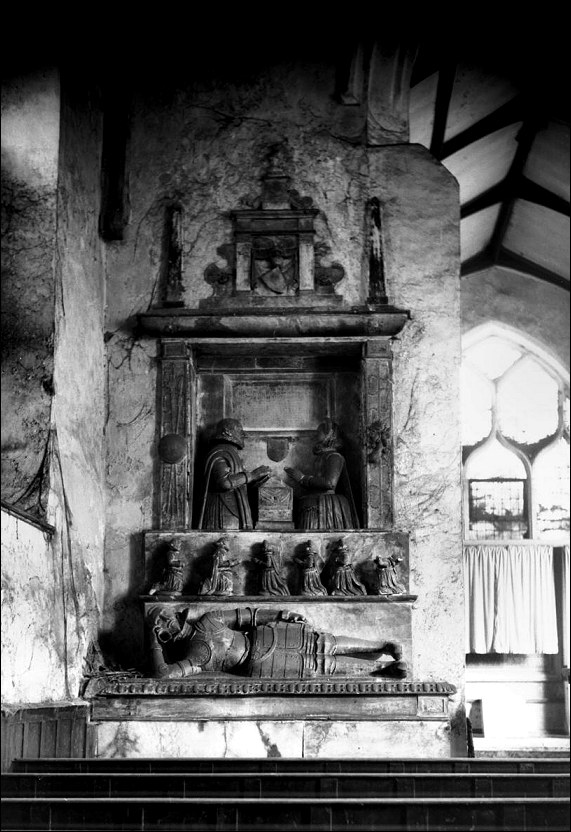
The monument rises from an impressive coloured alabaster base, to the Pettus coat of arms flanked by two obelisks. Sir John in his mayoral robes (he was Mayor in 1608) appears to kneel at a prayer desk opposite his wife, Bridget Curtis, although there is no sign of their legs. Blomefield writing in the 18th century mistook the armorials and identified the kneeling figure as Sir Augustine, who, unlike his father, was never Mayor of Norwich. Most of the literature has followed Blomefield, who was corrected by the Norfolk Heraldry Society (information from Tony Sims). Sir John and Lady Bridget are flanked by pilasters; his decorated with lances, hers with pomegranates and other fruit. Their children, two sons and two daughters kneel underneath, while Sir Augustine, who had died under a year before his father, is repeated lying stiffly in his full armour looking out from the monument, his head propped on his right arm, holding what could be a gauntlet or drinking horn, showing the fingers of a small hand.
Sir John had moved beyond both the family’s relative humble origins as tailors and local politics when in 1604 he had become the first Norwich Member since 1558 to be elected to two consecutive parliaments. He was active as an MP, while continuing his charitable work in Norwich. At the death of his father he had inherited considerable wealth, as well as the family house on Elm Hill, once extending to the churchyard, now nos. 41-43, and the estate at Rackheath, since at death his moveable goods, which included a substantial armoury of nine guns, were valued at £952 19s. 6d and the house on Elm Hill contained 27 rooms, together with stables for eight horses.
Blomefield, An Essay towards a Topographical History of the County of Norfolk: volume 4: The History of the City and County of Norwich, part II, ‘chapter 42: East Wimer ward', (1806), pp. 329-367; Chris Kyle, ‘Sir John Pettus’ in The History of Parliament: the House of Commons 1604-1629, , ed. Andrew Thrush and John P. Ferris, 2010.
detail pomegranates and other fruit
At her will reading, she left $1 to all her relatives, etc and told her will executor John Blakeslee to erect this massive, expensive (maybe $100,000 in today's money) tombstone and three others.
Could you imagine one of your relatives doing such a thing.
Draft Will of Mrs. Elizabeth Weeks, Ramsgate, Kent, 24 April 1861.
Executor: Son, Thomas Scott Weeks. Beneficiaries: Thomas Scott Weeks, Painter and Ann Weeks, daughter.
Looking through the 1880s screen to the chancel begun in late 11c on the site of the 8c Saxon chapel, its east end was originally apsidal before being rebuilt in a rectangular shape in early 14c
Sir John Bridges d1530 instructed his executors to make a marble tomb at his father Thomas's burial place by the high altar and to provide vestments and altar hangings decorated with his coat of arms. He also assigned 10s. a year for an annual obit. - Church of St Mary, Dymock Gloucestershire
(Brasília - DF, 05/08/2020) Presidente da República, Jair Bolsonaro recebe os cumprimentos do Ministro de Estado Minas e Energia, Bento Albuquerque.
Foto: Isac Nóbrega/PR
These views of the Hollytrees Museum in Colchester from the High Street. Saw this side after leaving The Minories. Also home of the Visitor Information Centre.
Hollytrees Museum is a free to visit, publicly owned museum in the centre of Colchester and close to Colchester Castle. It is situated in an eighteenth-century house ("Hollytrees"), which was used as a private residence until 1929, when it became a museum.
The first house on the site, known as "Symnells" after its owner, was later bought by the Shaw family, and passed from John Shaw to John Shaw III and John Shaw IV. When he died a minor, the house passed into chancery; his mother Jane Lessingham bought it but soon died. The modern house was constructed in for Elizabeth Cornelisen, who had bought the site from Lessingham's executors and promptly tore down the existing structure in poor condition. Construction commenced on 10 May 1718 at a cost of £630 plus brickwork and tiling; the total refurbishment was estimated to have cost £2000. She died soon after, bequeathing the house to her niece, Sarah Creffeild (née Webster), who left it to her second husband Charles Gray. It was, at that time, known as "Esqr Creffield's [sic]". Possession of the house reverted to the Creffeilds; through Thamer Creffeild to James Round, who left to his brother Charles, who left it to his son Charles Gray Round, who left to it to his nephew James Round. The Rounds finally sold it to the Corporation of Colchester in 1922, a purchase paid for privately by Viscount Cowdray and his wife. It became a museum in 1929.
The house is known as Hollytrees after two holly trees planted in the grounds by Charles Gray in 1729 and is now a free to visit museum serving the centre of Colchester and specialising in local history. It is a grade I listed building.
Grade I Listed Building
Listing Text
1. HIGH STREET
995 (North Side)
TL 9925 SE 5/111 Holly Trees (Museum)
24.2.50.
I
2.
A fine early C13 brick building, standing back from the road in its own
grounds - now part of the Municipal Castle Park. Good ironwork railings
with gate to the street. Built circa 1717-18, it was formerly the home
of Charles Gray (1696-1783) MP for Colchester and owner of the Castle
estate; he lived here over 60 years. The west wing was added in 1748, by
James Deane. The main building is of 3 storeys and basement, red brick
with rubbed brick dressings, parapet to front and rear elevations.
Both elevations have a 5-window range of double hung sashes with glazing
bars, segmental heads. The front has a fine central doorcase with flat
hood, carved consoles. Fluted pilasters, semi-circular fanlight, 6-panel
door, iron handrail to flight of steps to door. The west wing is of 3
storeys, but at a lower level, with cut brick rustications to the ground
floor, 1st floor window with moulded brick pediment and architrave,
Venetian window on garden elevation, brick bands. Many original interior
features.
Listing NGR: TL9996025268
This text is from the original listing, and may not necessarily reflect the current setting of the building.
Description
1. HIGH STREET
995 (North Side)
TL 9925 SE 5/111 Holly Trees (Museum)
24.2.50.
I
2.
A fine early C13 brick building, standing back from the road in its own
grounds - now part of the Municipal Castle Park. Good ironwork railings
with gate to the street. Built circa 1717-18, it was formerly the home
of Charles Gray (1696-1783) MP for Colchester and owner of the Castle
estate; he lived here over 60 years. The west wing was added in 1748, by
James Deane. The main building is of 3 storeys and basement, red brick
with rubbed brick dressings, parapet to front and rear elevations.
Both elevations have a 5-window range of double hung sashes with glazing
bars, segmental heads. The front has a fine central doorcase with flat
hood, carved consoles. Fluted pilasters, semi-circular fanlight, 6-panel
door, iron handrail to flight of steps to door. The west wing is of 3
storeys, but at a lower level, with cut brick rustications to the ground
floor, 1st floor window with moulded brick pediment and architrave,
Venetian window on garden elevation, brick bands. Many original interior
features.
Listing NGR: TL9996025268
I saw this view from The Minories Galleries, after I left took the photo from the High Street. This is near the Wetzler Garden.
Richard Bourne of Clements Inn esq who departed this life at London 17th June 1705 in his 85th year
Monument erected by order of Mr James Bourne, rector of Wilby, being his nephew & executor - Church of St Andrew, Ufford Northamptonshire
The Dark Lord Darth Vader consults with General Rom Mohc on the Dark Trooper Project.
From Star Wars: Dark Forces.
The 100th picture added to the capture gallery.
Maker: Metro Group Editorial Service
Born: USA
Active: USA
Medium: gelatin silver print
Size: 8" x 10"
Location: USA
Object No. 2012.012
Shelf: C-26
Publication:
Other Collections:
Notes: Caption on verso: INSPECTION -- George L Andrews and his wife examine two of the Brady glass plate negatives that turned up in their barn. They had lain in the barn for 25 years, wrapped in old newspapers. Ansco Division, General Aniline & Film Corp.
According to Robert Wilson in his 2013 book "Mathew Brady, Portraits of a Nation", Brady closed his Washington gallery on August 27, 1873, but it was reopened two months later by a former employee Andrew Burgess. After emerging from bankruptcy in 1875, Brady bought back the studio from Burgess, who moved to Oswego, NY but apparently took some of the studio contents including three small wooden boxes containing 44 negatives.
After Burgess widow died in 1926, the negatives were left to the wife of the executor of Mrs Burgess estate, whose son George Andrews (pictured above) discovered two of the boxes in his barn in 1948.
To view our archive organized by themes and subjects, visit: OUR COLLECTIONS
For information about reproducing this image, visit: THE HISTORY OF PHOTOGRAPHY ARCHIVE
Letter from Henry James Barnaby sent to Earnest William Springall regarding details of his brother Charles Springall’s Will concerning Chapel Farm, Swanton Morley, Norfolk. 2nd May 1919.
In the letter he thanks Earnest for driving his Wife home and outlines the parts of Charles Will in relation to Chapel Farm that Earnest inherited from his brother and how it also applies to Charles wife.
Henry James Barnaby born circa 1858, Kings Lynn, Norfolk was a School Master and Organist and named as an Executor in Charles Springall’s Will. The 1911 Census shows him living with his wife, Ellen Louisa Pecions a Cemetery Road, Theatre Street, East Derehamt Cemetery Road, Theatre Street, East Dereham. With them is their son Harold Barnaby listed as a Music Hall Artist. Harold had married Charles and James Springall’s sister Gertrude Irene Ethel Springall on 10th November 1907 at Swanton.
Charles Springall, Builder Farmer & Brick & Tile Manufacturer born 1859, Swanton, was the son of Joseph Springall and his wife Maria Milk. He married Emma Smith at Docking, Norfolk on 9th October 1881. He died 27th February 1919.
Ernest William Springall was born in 1876, Joseph’s youngest son. He married Daisy Kiend at St John, Upper Holloway Islington on 16th March 1913. During WWI he served in the Royal Artillery. He received the 1914-15 Star, British War Medal and Victory Medal. He died in 1939.
Draft Will of Miss Eliza Cuttler of Ramsgate, Kent. Draft Will dated 15th June 1860.
Executor was her brother, John Cuttler.
Both John Cuttler and her sister, Mary Ann Cuttler benefited. Solicitor, Snowden, Ramsgate
Draft Will of Mrs. Lucy Lewin, 35 Grange Road, Ramsgate, Kent, 1890.
Executor/Executrix Douglas William Lewin, Son, Alice Hevenson Lewin, Daughter.
Beneficiaries: Douglas William Lewin, Son, Alice Hevenson Lewin, Daughter, Constance Lucy Lewin, Daugher, Edward Wotton, Solicitor
Thomas Wolsey (c. March 1473[1] – 29 November 1530; sometimes spelled Woolsey) was an English political figure and cardinal of the Roman Catholic Church. When Henry VIII became king of England in 1509, Wolsey became the King's almoner.[2] Wolsey's affairs prospered, and by 1514 he was the controlling figure in virtually all matters of state and extremely powerful within the Church. The highest political position he attained was Lord Chancellor, the King's chief adviser. In that position, he enjoyed great freedom, and was often depicted as an alter rex (other king).
Within the Church, he became Archbishop of York, the second most important seat in England, and then was made a cardinal in 1515, giving him precedence, even over the Archbishop of Canterbury. His main legacy is from his interest in architecture, in particular his old home of Hampton Court Palace, which stands today.
Thomas Wolsey was born circa 1473, the son of Robert Wolsey of Ipswich and his wife Joan Daundy.[2] His father was widely thought to have been a butcher[3] and a cattle dealer,[4] but sources indicate that Robert Wolsey died at the Battle of Bosworth Field and was a significant casualty. Robert may have been a respected and wealthy cloth merchant, and the butcher story was perhaps invented to demean Wolsey and show how high he had climbed in terms of status.
Thomas Wolsey attended Ipswich School[5] and Magdalen College School before studying theology at Magdalen College, Oxford. On 10 March 1498, he was ordained a priest in Marlborough,[6] Wiltshire and remained in Oxford, first as the Master of Magdalen College School before quickly being appointed the dean of divinity. Between 1500 and 1509 he held the living of Church of Saint Mary, Limington, in Somerset.[7] In 1502, he left and became a chaplain to Henry Deane, archbishop of Canterbury, who died the following year.[2] He was then taken into the household of Sir Richard Nanfan, who trusted Wolsey to be executor of his estate. After Nanfan's death in 1507, Wolsey entered the service of Henry VII.
It was to Wolsey’s advantage that Henry VII had introduced measures to curb the power of the nobility and was prepared to favour those from more humble backgrounds.[8] Henry VII appointed Wolsey royal chaplain.[9] In this position Wolsey was secretary to Richard Foxe, who recognized Wolsey's innate ability and dedication and appreciated his industry and willingness to take on tedious tasks.[10] Thomas Wolsey’s remarkable rise to power from humble origins can be attributed to his high level of intelligence and organisation, his extremely industrious nature, his driving ambition for power, and the rapport he was able to achieve with the King. In April 1508, Wolsey was sent to Scotland to discuss rumours of the renewal of the auld alliance with King James IV.[11]
Wolsey's rise coincided with the accession of the new monarch, Henry VIII, whose character, policies and diplomatic mindset differed significantly from those of his father. In 1509, Henry appointed Wolsey to the post of Almoner,[2] a position that gave him a seat on the Privy Council, providing an opportunity to raise his profile and to establish a rapport with the King.[12] A factor in Wolsey's rise was that the young Henry VIII was not particularly interested in the details of governing during his early years.[13] Under the tight personal monarchy of Henry VII, Wolsey was unlikely to have obtained so much trust and responsibility.
The primary counsellors whom Henry VIII inherited from his father – Richard Foxe (Bishop of Winchester) and William Warham (Archbishop of Canterbury) – were cautious and conservative, advising the King to be a careful administrator like his father. Henry soon appointed to his Privy Council individuals more sympathetic to his own views and inclinations. Until 1511, Wolsey was adamantly anti-war; however, when the King expressed his enthusiasm for an invasion of France, Wolsey was able to adapt to the King's mindset and gave persuasive speeches to the Privy Council in favour of war. Warham and Foxe, who failed to share the King’s enthusiasm for the French war, fell from power (1515/1516) and Wolsey took over as the King's most trusted advisor and administrator. In 1515, Warham resigned as Lord Chancellor, probably under pressure from the King and Wolsey, and Henry appointed Wolsey in his place.[14]
Wolsey carefully tried to destroy or neutralise the influence of other courtiers. He was blamed for the fall of Edward Stafford, 3rd Duke of Buckingham, in 1521; and in 1527 he prosecuted Henry's close friend William Compton and Henry's ex-mistress Anne Stafford, Countess of Huntingdon, through the ecclesiastical courts for adultery. In the case of Charles Brandon, Duke of Suffolk, Wolsey attempted to win his favour instead, by his actions after the Duke secretly married Henry’s sister Mary Tudor, Queen of France, much to the King’s displeasure. Wolsey advised the King not to execute the newlyweds, but to embrace them.
Wolsey's rise to a position of great secular power paralleled increased responsibilities in the Church. He became a Canon of Windsor in 1511, the same year that he became a member of the Privy Council. In 1514 he was made Bishop of Lincoln, and then Archbishop of York in the same year. Pope Leo X made him a cardinal in 1515, with the titular church S. Cæciliæ trans Tiberim. As tribute to the success of his campaign in France and subsequent peace negotiations, Wolsey was further rewarded by the church: in 1523 he became Prince-Bishop of Durham.
The war against France in 1512–14 was the most significant opportunity for Wolsey to demonstrate his talents in the foreign policy arena. A convenient justification for going to war came in 1511 in the form of a plea for help from Pope Julius II, who was beginning to feel threatened by France. England formed an alliance with the Pope, Ferdinand V of Spain, and Maximilian I, Holy Roman Emperor against Louis XII of France.
The first campaign against France was not a success, partly due to the unreliability of the alliance with Ferdinand. Henry learned from the mistakes of the campaign and in 1513, still with papal support, launched a joint attack on France with Maximilian, successfully capturing two French cities and causing the French to retreat. Wolsey's ability to keep a large number of troops supplied and equipped for the duration of the war was a major factor in its success. Wolsey also had a key role in negotiating the Anglo-French treaty of 1514, which secured a temporary peace between the two nations. Under this treaty, the French king, Louis XII would marry Henry’s young sister, Mary. In addition England was able to keep the captured city of Tournai and to secure an increase in the annual pension paid by France.[16]
Meanwhile, a turnover of rulers in Europe threatened to diminish England’s influence. Peace with France in 1514 had been a true achievement for Wolsey and the King. With Henry’s sister, Mary, married to the French King, Louis XII, an alliance was formed, but Louis was not in good health. Less than three months later, Louis died and was replaced by the young and ambitious Francis I.
Queen Mary had allegedly secured a promise from Henry that if Louis died, she could marry whomever she pleased.[citation needed] On Louis' death, she secretly married Charles Brandon, 1st Duke of Suffolk, with Francis I's assistance, which prevented another marriage alliance. As Mary was the only princess Henry could use to secure marriage alliances, this was a bitter blow. Wolsey then proposed an alliance with Spain and the Holy Roman Empire against France.
The death of King Ferdinand of Spain, the father-in-law of Henry VIII, and England's closest ally, in 1516 was a further blow. Ferdinand was succeeded by Charles V, who immediately proposed peace with France. On the death of Maximilian I, Holy Roman Emperor, in 1519, Charles was elected in his stead; thus Charles ruled a substantial portion of Europe and English influence became limited on the continent.
Wolsey, however, managed to assert English influence through another means. In 1517, Pope Leo X sought peace in Europe to form a crusade against the Ottoman Empire. In 1518 Wolsey was made Papal Legate in England, enabling him to work for the Pope’s desire for peace by organising the Treaty of London. The Treaty showed Wolsey as the arbiter of Europe, organising a massive peace summit involving twenty nations. This put England at the forefront of European diplomacy and drew her out of isolation, making her a desirable ally. This is well illustrated by the Anglo-French treaty signed two days afterwards.
It was partly this peace treaty that caused conflict between France and Spain. In 1519, when Charles V ascended to the throne of the Holy Roman Emperor, Francis I, the King of France, was infuriated. He had invested enormous sums in bribing the electorate to elect him as emperor, and thus, he used the Treaty of London as a justification for the Habsburg-Valois conflict. Wolsey appeared to act as mediator between the two powers, both of whom were vying for England’s support.
Another of his diplomatic triumphs was the Field of the Cloth of Gold, in 1520. Wolsey organised much of this grandiose meeting between Francis I of France and Henry VIII, accompanied by some five thousand followers. Though it seemed to open the door to peaceful negotiations with France, if that was the direction the King wished to go, it was also a chance for a lavish display of English wealth and power before the rest of Europe. With both France and Spain vying for England’s allegiance, Wolsey could choose the ally that better suited his policies. Wolsey chose Charles mainly because England's economy would suffer from the loss of the lucrative cloth trade industry between England and the Netherlands had France been chosen instead.
Under Wolsey's guidance, the chief nations of Europe sought to outlaw war forever among Christian nations. Mattingly (1938) studied the causes of wars in that era, finding that treaties of nonaggression such as this one could never be stronger than the armies of their sponsors. When those forces were about equal, these treaties typically widened the conflict. That is, diplomacy could sometimes postpone war, but could not prevent wars based on irreconcilable interests and ambitions. What was lacking, Mattingly concludes, was a neutral power whose judgements were generally accepted either by impartial justice or by overwhelming force
The Treaty of London is often regarded as Wolsey’s finest moment, but it was abandoned within a year. Wolsey developed links with Charles in 1520 at the Field of the Cloth of Gold. Later at the Calais Conference (1521) Wolsey signed the Secret Treaty of Bruges (1521) with Charles, stating that they would join Spain in a war against France if France refused to sign the peace treaty; ignoring the Anglo-French treaty of 1518. Wolsey's relationship with Rome was also ambivalent. Despite his links to the papacy, Wolsey was strictly Henry’s servant. Though the Treaty of London was an elaboration on Pope Leo's ambitions for European peace, it was seen in Rome as a vain attempt by England to assert her influence over Europe and steal some papal thunder. Furthermore, Wolsey’s peace initiatives prevented a crusade to the Holy Land, which was the catalyst for the Pope’s desire for European peace.
Cardinal Lorenzo Campeggio, who represented the Pope at the Treaty of London, was kept waiting for many months in Calais before being allowed to cross the Channel and join the festivities in London; thereby, Wolsey was asserting his independence of Rome. An alternative hypothesis is that Campeggio was kept waiting until Wolsey received his legacy, thus asserting Wolsey's attachment to Rome.
Though the English gain from the wars of 1522–23 was minimal, their contribution certainly aided Charles in his defeat of the French, particularly in 1525 at the Battle of Pavia, where Charles' army captured the French king, Francis I. Henry then felt there was a realistic opportunity for him to seize the French crown, which the kings of England had long laid claim to. Parliament, however, refused to raise taxes. This led Wolsey to devise the Amicable Grant, which was met with even more hostility, and ultimately led to his downfall. In 1525, after Charles had abandoned England as an ally, Wolsey began to negotiate with France, and the Treaty of the More was signed with the Regent of France during Francis' captivity, his mother, Louise of Savoy.
The closeness between England and Rome can be seen in the formulation of the League of Cognac in 1526. Though England was not a part of it, the League was organized in part by Wolsey with papal support. Wolsey’s plan was that the League of Cognac, composed of an alliance between France and some Italian states, would challenge Charles’ League of Cambrai. This initiative was both a gesture of allegiance to Rome and an answer to growing concerns about Charles V's dominance over Europe.
The final blow to this policy came in 1529, when the French made peace with Charles. Meanwhile, the French also continued to honour the "Auld Alliance" with Scotland, stirring up hostility on England's border. With peace between France and the Emperor, there was no one to free the Pope from Charles, who had effectively held Clement VII captive since the Sack of Rome in 1527. Therefore there was little hope of securing Henry an annulment from his marriage to Charles’ aunt, Catherine of Aragon. Since 1527, Wolsey’s foreign policy had been dominated by his attempts to secure an annulment for his master, and, by 1529, none of his endeavours had succeeded.
Henry's marriage to Catherine of Aragon had produced no sons who survived infancy; the Wars of the Roses were still within living memory, leading to the fear of a power struggle after Henry's death. His daughter Mary was not considered capable of holding the country together and continuing the Tudor dynasty because England, until then, had not accepted a queen regnant (with the exception, perhaps, of Empress Matilda, who fought and lost a long civil war in an attempt to keep her throne).
Henry expressed the belief that Catherine's inability to produce a viable male heir was due to her being the widow of his elder brother, Arthur, Prince of Wales, which, he professed, violated Biblical proscription and cursed his marriage as incestuous. He also believed that the papal dispensation for his marriage to Catherine was invalid because it was based upon the claim that Catherine was still a virgin after her first husband's death. Henry argued that Catherine's claim was not credible, and thus, the original papal dispensation must be withdrawn and their marriage annulled. Henry's motivation has been attributed to his determination to have a son and heir, and to his desire for Anne Boleyn, one of his wife's maids-of-honour. Catherine had no further pregnancies after 1519; Henry began annulment proceedings in 1527.
Catherine, however, maintained that she had been a virgin when she married King Henry. Because Catherine was opposed to the annulment and a return to her previous status as Dowager Princess of Wales, the annulment request became a matter of international diplomacy, with Catherine's nephew, Charles V, pressuring the Pope to not annul his aunt's marriage. Pope Clement VII was presented with a problem: he could either anger Charles or else anger Henry. He delayed announcing a decision for as long as possible; this infuriated Henry and Anne Boleyn, who began to doubt the papal legate Wolsey's loyalty to the State over the Church.
Wolsey appealed to the Pope for an annulment on three fronts. Firstly, he tried to convince the Pope that the original papal dispensation was void as the marriage clearly went against words in the Bible, in the book of Leviticus. Secondly, Wolsey objected to the original dispensation on technical grounds, and claimed it was incorrectly worded. (However, shortly afterwards, a correctly worded version was found in Spain). Thirdly, Wolsey wanted the Pope to allow the final decision to be made in England, which of course, as papal legate, he would supervise.
In 1528 the Pope decided to allow two papal legates to decide the outcome in England: Wolsey and Cardinal Campeggio. Wolsey was confident of the decision. However, Campeggio took a long time to arrive, and when he finally did arrive he delayed proceedings so much, the case had to be suspended in July 1529, effectively sealing Wolsey's fate.
During his fourteen years of chancellorship, Cardinal Wolsey had more power than any other Crown servant in English history. As long as he was in the King’s favour, Wolsey had a large amount of freedom within the domestic sphere, and had his hand in nearly every aspect of its ruling. For much of the time, Henry VIII had complete confidence in him, and as Henry's interests inclined more towards foreign policy, he was willing to give Wolsey a free hand in reforming the management of domestic affairs, for which Wolsey had grand plans.
Wolsey made significant changes to the taxation system, devising, with the treasurer of the Chamber, John Heron, the "Subsidy". This revolutionary form of tax was based upon accurate valuations of the taxpayer’s wealth, where one shilling was taken per pound from the income. The old fixed tax of 15ths and 10ths had meant that those who earned very little money had to pay almost as much in tax as the wealthy. With the new income tax the poorer members of society paid much less. This more efficient form of taxation enabled Wolsey to raise enough money for the King’s foreign expeditions, bringing in over £300,000. Wolsey was also able to raise considerable amounts of capital through other means, such as through "benevolences" and enforced loans from the nobility, which raised £200,000 in 1522.
As a legal administrator Wolsey reinvented the equity court, where the verdict was decided by the judge on the principle of "fairness". As an alternative to the Common Law courts, Wolsey re-established the position of the prerogative courts of the Star Chamber and the Court of Chancery. The system in both courts concentrated on simple, inexpensive cases, and promised impartial justice. He also established the Court of Requests (although this court was only given this name later on) for the poor, where no fees were required. Wolsey’s legal reforms were popular, and overflow courts were required to attend to all the cases. Many powerful individuals who had felt themselves invincible under the law found themselves convicted; for example, in 1515, the Earl of Northumberland was sent to Fleet Prison and in 1516 Lord Abergavenny was accused of illegal retaining.
Wolsey also used his courts to tackle national controversies, such as the pressing issue of enclosures. The countryside had been thrown into discord by the entrepreneurial actions of landlords enclosing areas of land and converting from arable farming to pastoral farming, requiring fewer workers. The Tudors valued stability, and this mass urban migration represented a serious crisis. Wolsey conducted national enquires in 1517, 1518 and 1527 into the presence of enclosures. In the course of his administration he used the court of Chancery to prosecute two hundred and sixty-four landowners, including peers, bishops, knights, religious heads, and Oxford colleges. Enclosures were seen as directly linked to rural unemployment and depopulation, vagrancy, food shortages and, accordingly, inflation. This pattern was repeated with many of Wolsey’s other initiatives, particularly his quest to abolish enclosure. Despite spending significant time and effort in investigating the state of the countryside and prosecuting numerous offenders, Wolsey freely surrendered his policy during the parliament of 1523 to ensure that Parliament passed his proposed taxes for Henry’s war in France. Enclosures remained a problem for many years.
Wolsey used the Star Chamber to enforce his 1518 policy of Just Price, which attempted to regulate the price of meat in London and other major cities. Those found to be charging excessive amounts were prosecuted by the Chamber. After the bad harvest of 1527, Wolsey took the initiative of buying up surplus grain and selling it off cheaply to the needy. This act of generosity greatly eased disorder and became common practice after a disappointing harvest.
Although it would be difficult to find a better example of abuses in the Church than the Cardinal himself, Wolsey appeared to make some steps towards reform. In 1524 and 1527 he used his powers as papal legate to dissolve thirty decayed monasteries where corruption had run rife, including abbeys in Ipswich and Oxford. However, he then used the income to found a grammar school in Ipswich (The King's School, Ipswich) and Cardinal College in Oxford. The college in Oxford was renamed King's College after Wolsey's fall. Today, it is known as Christ Church. In 1528 he began to limit the benefit of clergy.
Wolsey died five years before Henry's dissolution of the monasteries began.
Wolsey’s position in power relied solely on maintaining good relations with Henry. He grew increasingly suspicious of the "minions"—young, influential members of the Privy chamber—particularly after infiltrating one of his own men into the group. He attempted many times to disperse them from court, giving them jobs that took them to the Continent and far from the King. After the Amicable Grant failed, the minions began to undermine him once again. Consequently, Wolsey devised a grand plan of administrative reforms, incorporating the notorious Eltham Ordinances of 1526. This reduced the members of the Privy Council from twelve to six, removing Henry's friends such as Sir William Compton and Nicholas Carew.
One of Wolsey’s greatest impediments was his lack of popularity amongst the nobles at court and in Parliament. Their dislike and mistrust partly stemmed from Wolsey’s excessive demands for money in the form of the Subsidy or through Benevolences. They also resented the Act of Resumption of 1486, by which Henry VII had resumed possession of all lands granted by the crown since 1455.[18] These lands had passed onto his heir, Henry VIII. Many nobles resented the rise to power of a low-born man, whilst others simply disliked that he monopolized the court and concealed information from the Privy Council.
When mass riots broke out in East Anglia, which should have been under the control of the Dukes of Norfolk and Suffolk, Henry was quick to denounce the Amicable Grant, and began to lose faith in his chief minister. During the relatively peaceful period in England after the War of the Roses, the population of the nation increased. With more demand for food and no additional supply, prices increased. Landowners were forced to enclose land and convert to pastoral farming, which brought in more profit. Wolsey’s quest against enclosure was fruitless in terms of restoring the stability of the economy.
The same can be said for Wolsey’s legal reforms. By making justice accessible to all and encouraging more people to bring their cases to court, the system was ultimately abused. The courts became overloaded with incoherent, tenuous cases, which would have been far too expensive to have rambled on in the Common Law courts. Wolsey eventually ordered all minor cases out of the Star Chamber in 1528. The result of this venture was further resentment from the nobility and the gentry.
As well as his State duties, Wolsey simultaneously attempted to exert his influence over the Church in England. As cardinal and, from 1524, lifetime papal legate, Wolsey was continually vying for control over others in the Church. His principal rival was William Warham, the Archbishop of Canterbury, who made it more difficult for Wolsey to follow through with his plans for reform. Despite making promises to reform the bishoprics of England and Ireland, and, in 1519, encouraging monasteries to embark on a programme of reform, he did nothing to bring about these changes.
In spite of having many enemies, Cardinal Wolsey retained Henry VIII's confidence until Henry decided to seek an annulment of his marriage to Catherine of Aragon, so that he could marry Anne Boleyn. Wolsey's failure to secure the annulment is widely perceived to have directly caused his downfall and arrest.
Ultimately, Anne Boleyn and her faction, it was rumored, convinced Henry that Wolsey was deliberately slowing proceedings, and as a result, he was arrested in 1529, and the Pope decided the official decision should be made in Rome anyway.
In 1529 Wolsey was stripped of his government office and property, including his magnificently expanded residence of Hampton Court, which Henry chose to replace the Palace of Westminster as his own main London residence. However, Wolsey was permitted to remain Archbishop of York. He travelled to Yorkshire for the first time in his career, but at Cawood in North Yorkshire, he was accused of treason and ordered to London by Henry Percy, 6th Earl of Northumberland. In great distress, he set out for the capital with his personal chaplain, Edmund Bonner. He fell ill on the journey, and died at Leicester on 29 November 1530, around the age of 60. "If I had served my God", the Cardinal said remorsefully, "as diligently as I did my king, He would not have given me over in my grey hairs."[19]
In keeping with his practice of erecting magnificent buildings at Hampton Court, Westminster and Oxford, Wolsey had planned a magnificent tomb at Windsor by Benedetto da Rovezzano and Giovanni da Maiano but he was buried in Leicester Abbey (now Abbey Park) without a monument. After his own even grander plans fell through, Henry VIII eventually intended the impressive black sarcophagus for himself, but Lord Nelson now lies in it, within the crypt of St. Paul's Cathedral. Henry often receives credit for artistic patronage that properly belongs to Wolsey.[20]
Surabaya Municipal Hall
( The Center of Bovenstad Since 1920)
Surabaya City Hall :This solar Garden had built by Dutch colonial, its architect is C. Citroen and executor of HV. Hollandsche Beton Mij. City hall is located in Taman Surya Street 1.
This solar Garden had built by Dutch colonial. Town Surabaya as Resort Gemeonte (Haminte) officially date of 1 Aprils 1906, what experienced by Dewan Hamite and led by assistant resident. In 1916 lifted the first lord mayor A. Meyroos finite commissioned in 1921.
During the second lord mayor of GJ Dijkerman, it had started the development of lord mayor building and finished in 1927. Its architect is C. Citroen and executor of HV. Hollandsche Beton Mij. Because its total cost 100 guilders, this building had formerly recognized as “1000 Guilders Building ".
The Government of Indonesia had built a city hall with modern architecture, laid at against stripper building. The stripper building has time has applied as 'Gedung Dewan Perwakilan Rakyat Daerah' and now applied as the center of municipal administration Surabaya.
More info: www.eastjava.com
"Here lyeth Jane Covert the daughter of John Covert of Slaugham first wife to Sir Frauncis Fleming knight and after to Sir John Fetyplace knight. She died the 25 of Jan 1586 and was here buried by William Covert her nephew & executor who made this tomb"
Jane was the daughter of John Covert and Joane Cooke of Rustington. Grand daughter of Richard Covert 1547 and 1st wife Elizabeth Fagger www.flickr.com/photos/52219527@N00/11034150285/
She m1 Sir Francis Fleming 1558 widower with 1 son. Son of John Fleming and Magdalen Lambert
She m2 Sir John Fettiplace 1580++ www.flickr.com/gp/52219527@N00/2iN9Bt of Besselsleigh, Abingdon widower of Dorothy / Elizabeth Hungerford. Son of Edmund Fettiplace by Margaret daughter of John Mordaunt www.flickr.com/photos/52219527@N00/11119977275/
having 1 daughter
1. Margaret Fettiplace c1565 - 1585/6
Sir John was the grandson of John Fettiplace 1524 and Dorothy Danvers www.flickr.com/photos/52219527@N00/11065270795/ of East Shefford
++Sir John was the father by his 1st wife of Bessels Fettiplace who m Eleanor daughter of Richard Covert 1579 www.flickr.com/photos/52219527@N00/11053444445/
Built 1937-1940 in Currie St, first stage completed Nov 1938, second stage opened 5 Apr 1940, architects Woods, Bagot, Laybourne Smith & Irwin, replacing earlier building built 1888, extended 1954. Rear of building replaced 1999 by 7 level office space. Elders moved 2015 to Grenfell St, building retaining its name Elder House, sold 2018.
Alexander Elder arrived 1839, set up as general & commission agent and metal broker, joined by brothers William & George, later all three returned to London & Scotland. Thomas Elder arrived 1854, formed a partnership with Edward Stirling, Robert Barr Smith and John Taylor, known as Elder, Stirling & Co. When Stirling and Taylor retired in 1863, Thomas Elder and Robert Barr Smith set up Elder, Smith & Co. In 1882 Elders Wool & Produce Co Ltd was established, merged 1888. Elder's Trustee and Executor Co Ltd founded 1910. Further mergers, including Goldsbrough Mort 1963.
“the new Elder House, an imposing four-story structure to be erected in Currie street on a frontage of 136 ft. between the Savings Bank and Currie Chambers, for Elder, Smith and Co.. Ltd., and Elder's Trustee and Executor Co., Ltd. Elder House with equipment will cost about £150,000.” [News 25 Feb 1937]
“Demolition of the existing buildings to make way for the new Elder House will begin on Monday.” [News 16 Jul 1937]
“Crossing Currie street we were confronted by the paddock caused by the demolition of Elder's Trustee and Agency Coy. building, once the White Horse Hotel.” [Advertiser 11 Aug 1937]
“the new premises for Elder. Smith and Co. Ltd., and Elder's Executor Co., in Currie street, are well advanced. . . Polished Murray Bridge granite, which will be used for the front, is now being prepared by Standard Quarries, Ltd, at their Mile End works.” [Advertiser 26 Oct 1937]
“A start has been made on the demolition of the old Elder House in Currie street, which will make way for the second portion of the big new building which will house both Elder, Smith and Co.. Ltd., and Elder's Trustee and Executor Co.. Ltd. The first section of the £130,000 building scheme was recently completed. Although intended ultimately for the Trustee Co., it will be occupied by Elder, Smith & Co. until the second section is finished. The Trustee Co. is at present using offices in North terrace.” [News 4 Nov 1938]
“Elder, Smith & Co. Limited, to mark the completion this year of the centenary of the firm. . . For three-quarters of a century, at least, the prosperity of South Australia rested largely on the wealth derived from its flocks, herds, and mines. With those industries the company was associated intimately, and to that extent its interests were the interests of the State.” [Advertiser 7 Mar 1940]
“Tributes to the part played by Elder, Smith & Co. in developing the primary industries of South Australia and the fine team spirit of the staff were paid fine team spirit of the staff were paid yesterday when about 500 guests were entertained at a cocktail party to celebrate the opening of the new Currie street building.” [Advertiser 6 Apr 1940]
“The staff of Elder's Trustee and Executor Co. Ltd. will move into their new building, Elder House, in Currie street, on Monday. They have been situated in Anchor House, North terrace, for nearly four years. In the new building they will be housed beside Elder Smith & Co.” [News 25 May 1940]
“A new storey is to be added to Elder House, Currie street for the Elder Trustee Executor Co. The architects, Messrs. Woods, Bagot, Laybourne Smith & Irwin. . . At present there is a ground floor and three upper storeys. The new storey will provide additional office space for the company.” [Advertiser 25 Aug 1954]
ELDERS
“The undersigned, Agents for South Australia, are prepared to effect Fire and Life Insurances on liberal terms, and issue Policies in both branches, immediately on acceptance of risks. Insurances on Mills effected at the ordinary rates. All claims are settled in Adelaide, no reference home being required. Elder, Stirling, & Co.” [Adelaide Times 13 Aug 1856 advert]
“First Wool Ship for London. — The splendid new clipper ship ALMA, 592 tons register, R. Gilkisen, commander, is now in port, and will be dispatched about the middle of November. This vessel has a full poop, and excellent accommodation for passengers. For freight or passage, apply to Elder, Stirling, & Co.” [Adelaide Observer16 Aug 1856 advert]
“A change has taken place in the well-known firm of Elder, Stirling, & Co., caused by the retirement of Mr. John Taylor. The business of the firm will henceforward be carried on under the style and designation of Elder, Smith, & Co.” [Advertiser 22 Aug 1863]
“Elder’s Wool and Produce Company, Limited. (Late the Wool and Produce Brokerage Business of Messrs. Elder, Smith, and Co.) to be Limited and Incorporated.” [Register 30 Jun 1882]
A certified reproduction of the "Plan of Marlbank Village situated on the rear end of farm Lots # 34 & 35 in 2nd Concession of Hungerford. Laid out by John Allen executor of the late James Allen." Surveyed by William R. Aylsworth, O.L.S., and signed February 1, 1865.
This copy was made in 1972 of plan #151, as registered in the Hastings Land Registry Office.
Donated by Walter I. Watson, O.L.S.
Duneira house and gardens at Mount Macedon.
(Extract from Macedon Ranges cultural heritage and landscape study/Trevor Budge and Associates. 4 v. 1994.).
Henry Suetonius Officer reputedly aquired the Duneira site from
1872-1877 (Blocks 4,5,10,11,14) paying some £84 for 38 acres but
rate listings give Robert Officer as the owner. .
.
Suetonius Henry Officer (1830-1883).
Officer was born in Hullgreen, New Norfolk, Tasmania 1830, the
son of Sir Robert & Lady Officer. He was educated in Edinburgh
with his brother, Charles, and returned to the colonies, seeking
gold in Victoria but eventually settling for pastoralism in
company with his brothers and Charles Miles{ ibid.}. They managed
stations in the Wimmera and the Riverina, James marrying in 1866
and commencing construction of a 20 room homestead at Murray
Downs & Willakool, two adjoining properties fronting the Murray
River. After experimentation with irrigation, via steam pumps and
windmills, he was able to develop extensive orchards and crops. He was also, like his brother, interested in
acclimatisation, having developed an ostrich farm on his property
(Charles was a council member of the Zoological & Acclimatisation
Society for 10 years, president in 1887). .
.
Blighted by illness, Suetonius reputedly moved to Leighwood,
Toorak (Melbourne) in 1881, having erected the first stage of
Duneira at Mount Macedon, but died two years later. However his son, Henry jnr. was
born at South Yarra in 1869 and his next child, Jessie, was born
at Macedon in 1877, indicating that he was in residence at both
places prior to the dates previously supposed..
.
Suetonius probably commissioned the first stage of Duneira to be
erected as a summer house between c1874-6. The architect Levi
Powell is thought to have designed a house for him there around
that date. The first improvements listed on the site were
stables in 1874 when Robert Officer was rated as owning the site. The house was reputedly not occupied regularly
until c1881 when Suetonius moved to Toorak.
However it appears he and his family were in residence at Duneira
by 1877..
.
When Suetonius died in 1883 his wife, Mary Lillias Rigg Officer
(nee Cairns), of Glenbervie, Glenferrie Road, Toorak was the
co-executor of the estate, with merchant Robert Harper; she is
the rate occupier in 1888. Mrs Officer was the
sister of Mrs Robert Harper (Huntly Burn) and Mrs John C lloyd
(Montpelier, later Timsbury): all three houses were reputedly
built in the same period... .
.
The house bricks for the first stage were said to have come from
the Macedon Brick Kiln (once near the Macedon railway station,
set up in c1888-9?) with external walls built in 14" Flemish bond
from slop-moulded bricks (9 inch by 2.1/2). The bricks were reputedly carted
from Macedon by Cogger. The footings were of bluestone
and reputedly dressed sandstone blocks also survive, suggesting
that the first stage was face brick with stone quoins and the
next renovation c1888 added wings and a cement coating to the
whole complex. Floor frames were reputedly supported on stone
dwarf walls and joists were 6x2.1/2 inch jarrah, with flooring
being 6 inch pine}. Seaweed was apparently used for
ceiling insulation..
.
The servants' wing verandah was skillion in form with timber
posts with classical capitals. The main verandah had coupled
posts (rebuilt with single posts) a panelled frieze and slimmer
capitals set just under the frieze rail}. The
balustrade may have been of single cast-iron balusters..
.
Just prior to the sale to the speculator, James Smith Reid in
1890, and during the occupation of Edward Dyer, major additions
were made to the house complex and a reputedly a caretaker's
lodge was placed at the gate (survives, altered c1920s) but this
appears to have been added by Reid in the early 1890s. .
.
The added rooms were reputedly: billiard (32'x24') and dining
rooms, kitchen, servants bathroom, service block with 5 rooms
(engine room, dairy, pantry, store, boiler room, built of
Northcote machine made 9" brickwork). Damp proof coursing was
used in these additions compared to the slate of the first stage
and acetylene gas (engine room) was thought used for lighting
from this period, as reticulated in 1.1.2" mains and 1/2 inch
branches to internal and some external verandah lights.
Cast-iron elaborately detailed water radiators were also used,
with hot water pumped from the boiler room, and later a duplicate
boiler allowed hot water to be reticulated taps in the house{
ibid.}..
.
The description in rate books expands to villa and cottages (on
37 acres) for the first time under Reid in c1893 but the annual
valuation had already peeked in 1888 at £200 in the occupation of
Edward Dyer. An Edward Dyer was listed at that time as a fruiterer in
Burwood Road, Hawthorn..
.
The water supply is from a concrete tank fed by a spring.
Outbuildings include timber clad stables, storerooms,
blacksmith's shop, coachman's room, milking bails, hay shed and a
green house. The stables (extended) were described as having had
a shingled gabled roof (rear skillion) with loft entered via an
external stair at the north end. It had a blacksmith's
shop (altered for garage c1941), carriage and coachman's rooms,
two stores and vertically boarded main doors{ ibid.,p24}. The
milking and hay sheds had hipped roof forms and timber cladding
and frame. The interior was white-washed. The greenhouse
in the secret hedged garden is of a later date, with a timber
frame built up on 11" cavity brickwork walls, with a brick floor
and heated water pipes under each shelf. The boiler is near the
entry..
.
The `Gisborne Gazette' reported on Duneira in 1903 under the
heading of `A Popular Health Resort':.
`Duneira certainly merits a few remarks though beautiful
residences and grounds are by no means rare in that locality..
(when Reid purchased it, it was `little better than a wilderness'
and he had spared no expense to restore it).. After passing the
lodge at the main entrance, a broad serpentine drive leads up to
the house and from there the grounds are laid out in broad
sloping lawns surmounted with choice borders and fringed with
trees which however do not interfere to any great extent with the
view. There is of course no lack of flowers which grow
luxuriantly on the mount but the great feature of Duneira is the
lawns, those open green expanses which delight the eye at all
times of the year. the secret of this perennial verdure is to be
found in the copious water supply with which Macedon is blessed
(spring at rear of house, tapped by tunnelling 40m into the hill,
ie. grass grows up to base of Monterey pines)..
.
During Reid's time there, the valuation increased marginally in
1899-1900 and again soon after, with Reid's address being given
as care of Rosstrevor Magill, South Australia, in c1909-10. JS Reid died in 1922, leaving
the property to the management of JS Reid jun..
.
The main garden elements are: sweeping lawns, box hedges, weeping beech and cherry, extensive hedges (holly, laurel), a hedged
`secret garden' with green house, mature firs, elm and chestnut ì
avenues. There is also a fountain and a wide spreading weeping elm to the rear of the house, near the tennis court..
.
Significant Trees:.
`Ulmus x hollandica'.
`Prunus' "shirotae".
`Albies procera'.
`Ilex kingiana'.
Draft Conveyance, Mr. William Young to Mr. William Vawden, 24, Avenue Road, Margate, 22nd December 1913.
Details Indenture 11th August 1884 between Edward Johnson Newby and Henry William Young. Henry William Young in his Will of 27th January 1890 (died 8th December 1897) named his two sons as Executors, William Young and Frank Young (Died 29th November 1911 at Devonia Rickmansworth, Hertford).
Indenture 21st December 1883 between Robert Thomas Hiscocks and Edward Johnson Newby