View allAll Photos Tagged Executor
Spesialistit also known as:
20 miljoonan kaappaus - Finland (video title)
Abrechnung in San Franzisko - West Germany
Blåst på 20 miljoner - Sweden
Croce siciliana, La - Italy
Ejecutores, Los - Spain
Ektelestes, Oi - Greece
Exécuteur, L - France
Sokak adamlari - Turkey (Turkish title)
Specialisterna - Finland (Swedish title)
Spesialistit - Finland
Sto stavrodromi ton Sikelon - Greece (reissue title)
Street People - USA
The Executioner - (undefined)
The Executors - UK (video title)
The Man from the Organization - Belgium (English title)
The Sicilian Cross - UK
Uomo del'organizzazione - Italy
Escape to Witch Mountain also known as:
Äventyrliga flykten, Den - Sweden
Apodrasi sto magemeno vouno - Greece
Flucht zum Hexenberg, Die - West Germany
Incredibile viaggio verso l'ignoto - Italy
Montaña embrujada, La - Spain
Montagne ensorcelée, La - France
Pako taikavuorelle - Finland
Sat 09/02/2008 16:02
A portrait of Sir Henry Wyatt which is a copy of a Holbein original.
Sir Henry Wyatt was treasurer of the Chamber from 1524-28 and was paymaster for the 1527 Greenwich festivities. He was one the longest serving courtiers to Henry VII and Henry VIII and had been an opponent of Richard III during that king’s reign. Due to his loyalty to the Tudors he was awarded throughout his lifetime and became master of the king's jewels in June 1488. He became a privy councillor in 1504, and was granted arms in 1507–8. He was also an executor of Henry VII's will. His son Thomas was the famous poet and diplomat.
Pictured is the Bemis/Ransom House, located at 267 North St. Built in 1883, the house was designed by noted architect Joseph Lyman Silsbee, most famous for several iconic buildings in Syracuse, including the Syracuse Savings Bank Building, the Amos Building and the White Memorial Building. Silsbee is also noted for being a mentor to famed architect Frank Lloyd Wright, whom he employed in his Chicago office. This home was built for John M. Bemis and his wife, Mary. John was a lumber baron, profiting greatly off of the vast forests in the area. He relocated to Pennsylvania in 1891, selling the home to Thomas Thornton for $70,000 ($1.9 million in 2017 dollars). A wealthy Buffalo businessman in the milling industry, Thomas purchased the house for his daughter, Helen, and son-in-law, Dr. Robert Campbell, a Buffalo physician, whose patients included many of the city’s wealthiest residents. In 1901, Robert and his wife went through a messy divorce – one that was covered intensely by newspapers from Buffalo to New York City. The home remained in Helen’s possession, although she no longer lived there. From 1901 until her estate was settled in 1906 following her death in 1903, the home was occupied by Frank H. Goodyear, who, like the original owner of the home, John Bemis, was highly successful in the lumber industry. He formed a company with his brother, Charles, known as F. H. & C. W. Goodyear Co. (Charles’ home at 888 Delaware Ave was featured in a previous post). In 1906, the executors of Helen Campbell’s estate sold the home to Capt. Joseph T. Jones and his wife, Melodia. Joseph was a Civil War hero who would go on to become a pioneer in the oil and rail industries, accumulating a vast wealth. Melodia would become a philanthropic fixture in Buffalo, donating hundreds of thousands of dollars to local charities & educational institutions. The home would remain in the Jones family until 1953, when it was sold to its final residential owner, Philip Ransom, a descendant of one of the earliest settlers of Buffalo. Philip was a Dartmouth grad and World War I veteran who operated a real estate business in Buffalo. Today, 267 North St. is home to Collins & Collins Attorneys.
Copy of the stolen brass of Sir Thomas Blennerhassett 1461-1531 "Here lyeth Sir Thomas Bleuerhayssette, Knyght, which decessyd the ryii Day of June, the Yere of our Lorde M yo rrri. and rrriii Yere of the Reigne of our Sobe raygne Lord Kyng Henry the viiith, whois Soule God Pardon".
Thomas was the son of John Blennerhassett d1510 www.flickr.com/gp/52219527@N00/005tn8 and first wife Margaret Heigham www.flickr.com/photos/52219527@N00/5947090482/
Thomas was the executor for Thomas, Duke of Norfolk in 1514. He lived at Frenze, and also Boyland Hall, Long Stratton. Son George left Frenze to his wife Margaret for her life and then to their heiress Mary m1 Thomas Culpepper m2 Francis Bacon - After the death of Francis it reverted to her half brother John
He m1 Jane Sutton.
Children
1. George 1501-1543 m Margaret Jermyn / Jernegan
2. Edward m Anne Cobbe
3. Mary m John Meux
He m2 Margaret d1561 www.flickr.com/gp/52219527@N00/4M48ZE daughter of John Braham of Wetheringsett and Joan Reyden 1519 www.flickr.com/gp/52219527@N00/30oPQi
Children
1. Thomas a priest
2. John of Barsham & Boyland m1 Elizabeth daughter of John Cornwallis and Elizabeth Sulyard www.flickr.com/photos/52219527@N00/9392340481/ (parents of Elizabeth Blennerhassett, bc.1537 who m 1561 Sir Lionel Throckmorton flic.kr/p/fDaHf7 son of Simon Throckmorton by Anne Louthe )
3. Elizabeth m1 Lionel Lowth m2 Francis Clopton m1 Lionel Lowthe / Louthe www.flickr.com/photos/52219527@N00/13925024374/ (grand daughter Anne Dade www.flickr.com/photos/52219527@N00/527517488/ )
4. Agnes m Sir Anthony Rous 1545 of Dennington & Henham Hall
5. Anne d1577 www.flickr.com/gp/52219527@N00/rqtQq9 www.flickr.com/gp/52219527@N00/65fy0D m1 George Duke m2 Peter Rede / Read of Gimingham
6. Margaret d1558 m1 John Spelman www.flickr.com/gp/52219527@N00/P38o5L Sir John Spelman and Elizabeth Frowyke www.flickr.com/gp/52219527@N00/9Rj86X m2 John Eyre dsp 1561 of Lyn, Receiver General to Queen Elizabeth for the counties of Norfolk, Suffolk, Cambridgshire & Huntingdon
7. Katherine m1 John Gosnold m2 Anthony Wingfield 1593
On his surcoat are the arms of Blenerhassett with the annulet, (which this branch always bare for difference,) with his quarterings, Lowdham, Orton, and Kelvedon / Keldon Under his head lies his crest - a fox passant.
www.british-history.ac.uk/topographical-hist-norfolk/vol1...
humphrysfamilytree.com/Blennerhassett/john.frenze.html
A visit to the Hollytrees Museum in Colchester. It's in the same building as the Visitor Information Centre. We entered through Castle Park. Almost went into Colchester Castle, but went into here instead.
Hollytrees Museum is a free to visit, publicly owned museum in the centre of Colchester and close to Colchester Castle. It is situated in an eighteenth-century house ("Hollytrees"), which was used as a private residence until 1929, when it became a museum.
The first house on the site, known as "Symnells" after its owner, was later bought by the Shaw family, and passed from John Shaw to John Shaw III and John Shaw IV. When he died a minor, the house passed into chancery; his mother Jane Lessingham bought it but soon died. The modern house was constructed in for Elizabeth Cornelisen, who had bought the site from Lessingham's executors and promptly tore down the existing structure in poor condition. Construction commenced on 10 May 1718 at a cost of £630 plus brickwork and tiling; the total refurbishment was estimated to have cost £2000. She died soon after, bequeathing the house to her niece, Sarah Creffeild (née Webster), who left it to her second husband Charles Gray. It was, at that time, known as "Esqr Creffield's [sic]". Possession of the house reverted to the Creffeilds; through Thamer Creffeild to James Round, who left to his brother Charles, who left it to his son Charles Gray Round, who left to it to his nephew James Round. The Rounds finally sold it to the Corporation of Colchester in 1922, a purchase paid for privately by Viscount Cowdray and his wife. It became a museum in 1929.
The house is known as Hollytrees after two holly trees planted in the grounds by Charles Gray in 1729 and is now a free to visit museum serving the centre of Colchester and specialising in local history. It is a grade I listed building.
Grade I Listed Building
Listing Text
1. HIGH STREET
995 (North Side)
TL 9925 SE 5/111 Holly Trees (Museum)
24.2.50.
I
2.
A fine early C13 brick building, standing back from the road in its own
grounds - now part of the Municipal Castle Park. Good ironwork railings
with gate to the street. Built circa 1717-18, it was formerly the home
of Charles Gray (1696-1783) MP for Colchester and owner of the Castle
estate; he lived here over 60 years. The west wing was added in 1748, by
James Deane. The main building is of 3 storeys and basement, red brick
with rubbed brick dressings, parapet to front and rear elevations.
Both elevations have a 5-window range of double hung sashes with glazing
bars, segmental heads. The front has a fine central doorcase with flat
hood, carved consoles. Fluted pilasters, semi-circular fanlight, 6-panel
door, iron handrail to flight of steps to door. The west wing is of 3
storeys, but at a lower level, with cut brick rustications to the ground
floor, 1st floor window with moulded brick pediment and architrave,
Venetian window on garden elevation, brick bands. Many original interior
features.
Listing NGR: TL9996025268
This text is from the original listing, and may not necessarily reflect the current setting of the building.
Description
1. HIGH STREET
995 (North Side)
TL 9925 SE 5/111 Holly Trees (Museum)
24.2.50.
I
2.
A fine early C13 brick building, standing back from the road in its own
grounds - now part of the Municipal Castle Park. Good ironwork railings
with gate to the street. Built circa 1717-18, it was formerly the home
of Charles Gray (1696-1783) MP for Colchester and owner of the Castle
estate; he lived here over 60 years. The west wing was added in 1748, by
James Deane. The main building is of 3 storeys and basement, red brick
with rubbed brick dressings, parapet to front and rear elevations.
Both elevations have a 5-window range of double hung sashes with glazing
bars, segmental heads. The front has a fine central doorcase with flat
hood, carved consoles. Fluted pilasters, semi-circular fanlight, 6-panel
door, iron handrail to flight of steps to door. The west wing is of 3
storeys, but at a lower level, with cut brick rustications to the ground
floor, 1st floor window with moulded brick pediment and architrave,
Venetian window on garden elevation, brick bands. Many original interior
features.
Listing NGR: TL9996025268
Entrance on the left, toilets on the right.
Sherborne School, UK, Book of Remembrance for former pupils who have lost their lives in the service of their country, 1919-1939 and 1946 to date.
If you have any additional information about this individual, or if you use one of our images, we would love to hear from you. Please leave a comment below or email us via the Sherborne School Archives website: oldshirburnian.org.uk/school-archives/contact-the-school-...
Credit: Sherborne School Archives, Abbey Road, Sherborne, Dorset, UK, DT9 3AP.
Details: Theodore Ralph Tate Carr-Ellison (1915-1939), born in Newcastle-upon-Tyne on 24 February 1915, son of Herbert George Carr Carr-Ellison (1874-1935) and Mabel Mary Carr-Ellison (née Tate) (1874-1955) of 15, Portland Terrace, Newcastle-on-Tyne, and of Rothley Lake House, Hartburn, Morpeth, Newcastle-on-Tyne.
Nephew of Oswald Fenwicke Clennell Carr-Ellison (1895-1918), who served during the First World War as a Captain in the Northumberland Fusiliers, and was killed in France on 5 October 1918, aged 22 www.flickr.com/photos/sherborneschoolarchives/9342520504/...
Attended Belhaven Hill School, Dunbar.
Attended Sherborne School (Abbey House), May 1928-July 1933; Shooting viii team (1931, 1932, 1933, Captain); OTC ‘cert A’.
Durham University (Engineering). Student apprentice, electrical engineering, Hebburn, South Tyneside.
Flying Officer, Royal Air Force: June 1934 appointed Pilot Officer, 607 County of Durham (B) Squadron. December 1935 promoted to the rank of Flying Officer. In 1939, Flying Officer, 54 Fighter Squadron, RAF, Hornchurch, Essex.
Died on 30 January 1939 in Letchworth Hospital, Letchworth, Hertfordshire, following a flying accident when his Gloster Gladiator K7930 flew into the ground in a snowstorm at Baldock, Hertfordshire on 26 January 1939.
Buried on 2 February 1939 at Guyzance, Northumberland.
Commemorated at:
Sherborne School: Book of Remembrance; no.14 Memorial Pew in the School Chapel; Carr-Ellison OTC Challenge Cup.
RAF Hornchurch Heritage Centre.
The Shirburnian, March 1939:
THEODORE RALPH TATE CARR-ELLISON (b 1928-33) died in hospital at Letchworth, as the result of a flying accident. He was piloting a single-seater Gloster Gladiator, and a severe snow storm is presumed to have been the cause of the disaster. Captain of the VIII in his last year here, he was afterwards a member of the RAF team which won the Inter-Services match at Bisley last year. A brilliant shot, a keen fisherman, and an outstanding pilot, yet it is for what he was, rather than for what he did that he will be remembered. From the day he came to Sherborne he endeared himself to all who knew him by his cheerfulness, his enthusiasm, his unselfishness and unfailing kindness. Wherever he went he made friends and never an enemy. Modest and chivalrous, he gave his life that others might be in peace, and died, as hived, sans peur et sans reproche.
London Gazette, 3 March 1939.
THEODORE RALPH TATE CARR-ELLISON, Deceased. Pursuant to the Trustee Act, 1929. Notice is herby given that all persons having any claim against the estate of Pilot Officer Theodore Ralph Tate Carr-Ellison RAF, late of 54 Fighter Squadron, Royal Air Force, Hornchurch, Essex, and Bank House, Acklington, Morpeth, Northumberland, who died on the 30th day of January 1939, are hereby required to send particulars thereof in writing to the Executors & Trustees Department, Lloyds Bank Limited, Grey Street, Newcastle-upon-Tyne, the executor of the Will of the said Theodore Ralph Tate Carr-Ellison, or to the undersigned the Solicitors to the executor, on or before the 10th day of May, 1939, after which date the executor will proceed to distribute the said estate, having regard only to the claims then notified. Dated his 27th day of February 1939. LEADBITTTER and HARVEY, Solicitors for the said Executor.
Sherborne School Accounts for the year ended 31 March 1939: OFFICERS' TRAINING CORPS CHALLENGE CUP. The late Pilot Officer T.R.T. Carr-Ellison, O.S., has bequeathed a legacy of £20 to the School, to be expended in the provision of a solid silver Challenge Cup "to be awarded annually to such person as is certified to the said Bank by the Head Master for the time being of Sherborne School or other appropriate School Official to be the smartest man carrying himself in an 'Officerly manner' on parade on a day to be fixed by him or the last mentioned Officer and to be announced beforehand to competition for the Cup."
The Carr-Ellison Cup was first awarded in 1942 when it was won for Abbey House by M.J.F. Morrison (b 1937-1942), who went on to serve in WW2 as a Captain in the King’s Royal Rifle Corps.
It's like at the end of ROTJ, except that the coffee table was the Executor. I suspect feline/Bothan spies.
Title: Desk and Bookcase
Artist/Maker: Benjamin Frothingham (American, 1734-1809; active Charlestown 1754-1809)
Place Made: United States: Massachusetts: Charlestown
Date Made: 1753
Medium: wood; mahogany; white pine; eastern red cedar; Spanish cedar
Measurements: Overall: 98 1/4 in x 44 1/2 in x 24 3/4 in; 249.555 cm x 113.03 cm x 62.865 cm
Credit Line: Gift of Mr. Dana C. Ackerly and Mr. Earle S. Thompson, estate executors, in memory of Mrs. Bell McKerlie Watts and Mr. Samuel Hughes Watts of Fairfield, Connecticut
Collection: The Diplomatic Reception Rooms, U.S. Department of State, Washington, D.C.
Accession No: RR-1970.0094
(Brasília - DF, 05/08/2020) Presidente da Eletronorte, Roberto Parucker durante a assinatura.
Foto: Isac Nóbrega/PR
Siena. Santa Maria della Scala museum complex.
Company of Saint Mary Under the Vaults.
"The Fraternity of the Obedient to Most Holy Mary, which later became the Society of Executors of Pious Dispositions, is the oldest lay company headquartered in the subterranean spaces of Santa Maria della Scala. Originally formed in the Cathedral of Siena, the existence of a fraternity dedicated to pious works is also mentioned in a letter by Saint Catherine.
On April 14, 1785 a grand ducal decision counted the company among those to be suppressed, re-forming it as the Society of Executors of Pious Dispositions dedicated to charitable works, but divesting it of its religious aspects. Only in 1792 did Grand Duke Ferdinand III definitively restore the Society as a religious brotherhood.
The Society’s artistic patrimony, which over the course of the centuries has been enriched by both furnishings and art works, thanks in part to bequests by artists to whom this same institution had given scholarships, is still today outstanding, even though most of it is conserved in the Via Roma headquarters, including numerous movable art works such as paintings and furnishings of the Sienese School. However, still conserved at Santa Maria della Scala is a beautiful wood Crucifix between terracotta figures of Saint Bernardino and Saint Catherine, which tradition holds is the very same crucifix that induced Saint Bernardino to become a Franciscan. On the Oratory’s other altar we find a canvas by Alessandro Casolani depicting the Madonna with Child and Saints Peter and Paul. The Sacristy contains, among other things, very interesting frescoes attributed to Andrea Vanni and Luca di Tommè.
During restoration work, behind an air space that had been walled in for over two centuries along a stair leading to the historic headquarters of the Society of Executors of Pious Dispositions, a vast early Fourteenth-century fresco cycle depicting a Hermitage came to light, referable to the sphere of Ambrogio Lorenzetti: this was the most important discover of the past twenty years regarding the Sienese School of painting prior to the black plague of 1348.
Finally, we must mention the collection of samples left by the main Sienese artists of the Nineteenth century. This nucleus is the fruit of work by sculptors and painters who utilized scholarships, the so-called Alunnato Biringucci, which were granted by the institution thanks to the bequests of brotherhood members and benefactors."
Church of Simon and St Jude,
Monument to Sir John Pettus †1614 and Bridget Curtis and Sir Augustine Pettus †1613, alabaster. Commissioned by Thomas Pettus, Sir John’s second son, the executor of his will. Unknown, probably Norwich mason, also responsible for the Suckling monuments in St Andrew’s, restored 2007/8.
St Simon and St Jude was declared redundant in the 1890s, and abandoned in the 1930s. Now owned by the Norwich Churches Trust it has been saved from its state of collapse in the 1930s, but the inside has been butchered by the addition of the nave mezzanine. This makes it impossible to appreciate the monument to Sir John and his family, on filling the north wall flanking the chancel arch. Mercifully the late George Plunkett took a full set of photographs of the interior in the 1930s, including the monument (www.norfolkchurches.co.uk/norwichsimonjude/plunkett/plunk...).
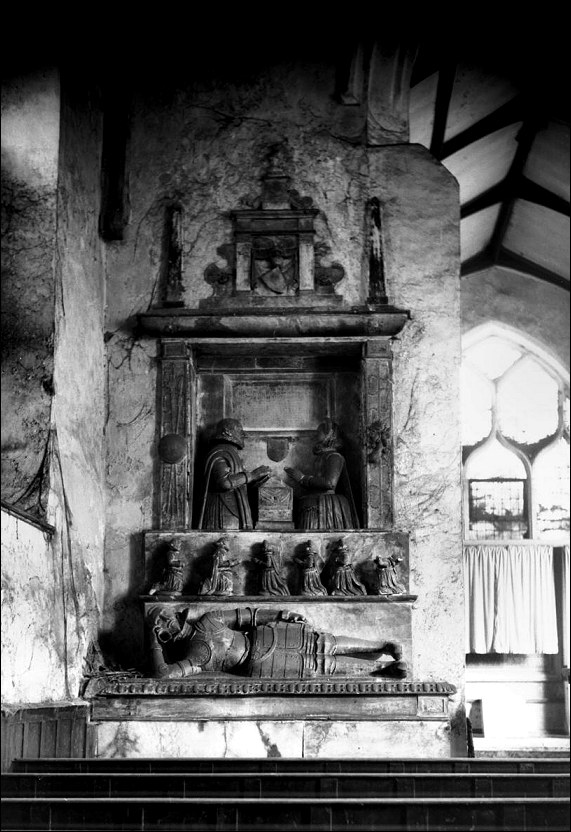
The monument rises from an impressive coloured alabaster base, to the Pettus coat of arms flanked by two obelisks. Sir John in his mayoral robes (he was Mayor in 1608) appears to kneel at a prayer desk opposite his wife, Bridget Curtis, although there is no sign of their legs. Blomefield writing in the 18th century mistook the armorials and identified the kneeling figure as Sir Augustine, who, unlike his father, was never Mayor of Norwich. Most of the literature has followed Blomefield, who was corrected by the Norfolk Heraldry Society (information from Tony Sims). Sir John and Lady Bridget are flanked by pilasters; his decorated with lances, hers with pomegranates and other fruit. Their children, two sons and two daughters kneel underneath, while Sir Augustine, who had died under a year before his father, is repeated lying stiffly in his full armour looking out from the monument, his head propped on his right arm, holding what could be a gauntlet or drinking horn, showing the fingers of a small hand.
Sir John had moved beyond both the family’s relative humble origins as tailors and local politics when in 1604 he had become the first Norwich Member since 1558 to be elected to two consecutive parliaments. He was active as an MP, while continuing his charitable work in Norwich. At the death of his father he had inherited considerable wealth, as well as the family house on Elm Hill, once extending to the churchyard, now nos. 41-43, and the estate at Rackheath, since at death his moveable goods, which included a substantial armoury of nine guns, were valued at £952 19s. 6d and the house on Elm Hill contained 27 rooms, together with stables for eight horses.
Blomefield, An Essay towards a Topographical History of the County of Norfolk: volume 4: The History of the City and County of Norwich, part II, ‘chapter 42: East Wimer ward', (1806), pp. 329-367; Chris Kyle, ‘Sir John Pettus’ in The History of Parliament: the House of Commons 1604-1629, , ed. Andrew Thrush and John P. Ferris, 2010.
detail gauntlet or drinking horn
Title: Desk and Bookcase
Artist/Maker: Benjamin Frothingham (American, 1734-1809; active Charlestown 1754-1809)
Place Made: United States: Massachusetts: Charlestown
Date Made: 1753
Medium: wood; mahogany; white pine; eastern red cedar; Spanish cedar
Measurements: Overall: 98 1/4 in x 44 1/2 in x 24 3/4 in; 249.555 cm x 113.03 cm x 62.865 cm
Credit Line: Gift of Mr. Dana C. Ackerly and Mr. Earle S. Thompson, estate executors, in memory of Mrs. Bell McKerlie Watts and Mr. Samuel Hughes Watts of Fairfield, Connecticut
Collection: The Diplomatic Reception Rooms, U.S. Department of State, Washington, D.C.
Accession No: RR-1970.0094
Church of Simon and St Jude,
Monument to Sir John Pettus †1614 and Bridget Curtis and Sir Augustine Pettus †1613, alabaster. Commissioned by Thomas Pettus, Sir John’s second son, the executor of his will. Unknown, probably Norwich mason, also responsible for the Suckling monuments in St Andrew’s, restored 2007/8.
St Simon and St Jude was declared redundant in the 1890s, and abandoned in the 1930s. Now owned by the Norwich Churches Trust it has been saved from its state of collapse in the 1930s, but the inside has been butchered by the addition of the nave mezzanine. This makes it impossible to appreciate the monument to Sir John and his family, on filling the north wall flanking the chancel arch. Mercifully the late George Plunkett took a full set of photographs of the interior in the 1930s, including the monument (www.norfolkchurches.co.uk/norwichsimonjude/plunkett/plunk...).
The monument rises from an impressive coloured alabaster base, to the Pettus coat of arms flanked by two obelisks. Sir John in his mayoral robes (he was Mayor in 1608) appears to kneel at a prayer desk opposite his wife, Bridget Curtis, although there is no sign of their legs. Blomefield writing in the 18th century mistook the armorials and identified the kneeling figure as Sir Augustine, who, unlike his father, was never Mayor of Norwich. Most of the literature has followed Blomefield, who was corrected by the Norfolk Heraldry Society (information from Tony Sims). Sir John and Lady Bridget are flanked by pilasters; his decorated with lances, hers with pomegranates and other fruit. Their children, two sons and two daughters kneel underneath, while Sir Augustine, who had died under a year before his father, is repeated lying stiffly in his full armour looking out from the monument, his head propped on his right arm, holding what could be a gauntlet or drinking horn, showing the fingers of a small hand.
Sir John had moved beyond both the family’s relative humble origins as tailors and local politics when in 1604 he had become the first Norwich Member since 1558 to be elected to two consecutive parliaments. He was active as an MP, while continuing his charitable work in Norwich. At the death of his father he had inherited considerable wealth, as well as the family house on Elm Hill, once extending to the churchyard, now nos. 41-43, and the estate at Rackheath, since at death his moveable goods, which included a substantial armoury of nine guns, were valued at £952 19s. 6d and the house on Elm Hill contained 27 rooms, together with stables for eight horses.
Blomefield, An Essay towards a Topographical History of the County of Norfolk: volume 4: The History of the City and County of Norwich, part II, ‘chapter 42: East Wimer ward', (1806), pp. 329-367; Chris Kyle, ‘Sir John Pettus’ in The History of Parliament: the House of Commons 1604-1629, , ed. Andrew Thrush and John P. Ferris, 2010.
detail of lances and shield
Draft Will of Job Grant of Ramsgate, Kent (born circa 1783 died 18th August 1866) dated 27 April 1861.
Executors, Wife Elizabeth Long Grant, sons, Job Grant the Younger of 1 Union Street, Southwark, Spirit Merchant and William Grant of Ramsgate, Fish Dealer.
Beneficiaries: Elizabeth Long Grant, wife, Job Grant and William Grant sons. Two daughters, Jane, the wife of Willoughby Carter Hillier of Billingsgate, London, Fish Salesman and Sarah the wife of Robert Bastable of 6 New Road, St. Georges in the East, Veterinary Surgeon.
L. Elgar, Clerk, Snowden Solicitors witness.
The 1851 census shows him and his wife Elizabeth living at Princes Street and that he was a Mariner. The 1861 census shows them at 3 Meeting Street, Ramsgate.
Probate of Will of Joseph Strawson, Boston Lincolnshire dated 5th December 1881 granted to William Palethorpe and Samuel Temple the Executors.
Joseph Strawson born circa 1808 in Boston married Ann Winn 26th May 1835 at Stickney, Lincoln. The 1881 census shows them living at Spileby Road, Fishtoft, Boston. In 1841 he worked as a Drover living at Fishtoft. By 1851 he is listed as a Farmer.
He died 25th August 1881 naming his wife, daughters; Mary, nee Strawson, the wife of Richard Benson, Emma Strawson, Sarah Ann Strawson and son William Winn Strawson as beneficiaries. .
(Brasília - DF, 05/08/2020) Palavras do Presidente do Senado Federal, Davi Alcolumbre.
Foto: Isac Nóbrega/PR
TRUSTEES OF THE DIOCESE OF SOUTHERN OHIO (EPISCOPAL), APPELLANT,
v.
GILCHRIST, EXECUTOR, ET AL., APPELLEES.
Nos. C-800111 and C-800344.
Court of Appeals of Ohio, Hamilton County.
Decided October 7, 1981.
Strauss, Troy & Ruehlmann Co., L.P.A., Mr. Samuel M. Allen and Mr. Richard Boydston, for appellant Trustees of Episcopal Diocese.
Messrs. Kohnen & Kohnen, Mr. Ralph B. Kohnen, Jr., and Mr. Roger W. Healey, for appellee Fifth Third Bank, trustee of testamentary trust of Eugene Zimmerman.
Messrs. Frost & Jacobs, Mr. T. Stephen Phillips and Mr. Larry H. McMillin, for appellee Sidney Arthur Robin George Drogo Montagu, Eleventh Duke of Manchester.
Messrs. Taft, Stettinius & Hollister, Ms. Cynthia F. Blank and Mr. Daniel J. Hoffheimer, for appellees and cross-appellants United States Trust Company of New York, Alton E. Peters and Thomas B. Gilchrist, Jr., executors of the Will of Alexander George Francis Drogo Montagu, Tenth Duke of Manchester
Built 1937-1940 in Currie St, first stage completed Nov 1938, second stage opened 5 Apr 1940, architects Woods, Bagot, Laybourne Smith & Irwin, replacing earlier building built 1888, extended 1954. Rear of building replaced 1999 by 7 level office space. Elders moved 2015 to Grenfell St, building retaining its name Elder House, sold 2018.
Alexander Elder arrived 1839, set up as general & commission agent and metal broker, joined by brothers William & George, later all three returned to London & Scotland. Thomas Elder arrived 1854, formed a partnership with Edward Stirling, Robert Barr Smith and John Taylor, known as Elder, Stirling & Co. When Stirling and Taylor retired in 1863, Thomas Elder and Robert Barr Smith set up Elder, Smith & Co. In 1882 Elders Wool & Produce Co Ltd was established, merged 1888. Elder's Trustee and Executor Co Ltd founded 1910. Further mergers, including Goldsbrough Mort 1963.
“the new Elder House, an imposing four-story structure to be erected in Currie street on a frontage of 136 ft. between the Savings Bank and Currie Chambers, for Elder, Smith and Co.. Ltd., and Elder's Trustee and Executor Co., Ltd. Elder House with equipment will cost about £150,000.” [News 25 Feb 1937]
“Demolition of the existing buildings to make way for the new Elder House will begin on Monday.” [News 16 Jul 1937]
“Crossing Currie street we were confronted by the paddock caused by the demolition of Elder's Trustee and Agency Coy. building, once the White Horse Hotel.” [Advertiser 11 Aug 1937]
“the new premises for Elder. Smith and Co. Ltd., and Elder's Executor Co., in Currie street, are well advanced. . . Polished Murray Bridge granite, which will be used for the front, is now being prepared by Standard Quarries, Ltd, at their Mile End works.” [Advertiser 26 Oct 1937]
“A start has been made on the demolition of the old Elder House in Currie street, which will make way for the second portion of the big new building which will house both Elder, Smith and Co.. Ltd., and Elder's Trustee and Executor Co.. Ltd. The first section of the £130,000 building scheme was recently completed. Although intended ultimately for the Trustee Co., it will be occupied by Elder, Smith & Co. until the second section is finished. The Trustee Co. is at present using offices in North terrace.” [News 4 Nov 1938]
“Elder, Smith & Co. Limited, to mark the completion this year of the centenary of the firm. . . For three-quarters of a century, at least, the prosperity of South Australia rested largely on the wealth derived from its flocks, herds, and mines. With those industries the company was associated intimately, and to that extent its interests were the interests of the State.” [Advertiser 7 Mar 1940]
“Tributes to the part played by Elder, Smith & Co. in developing the primary industries of South Australia and the fine team spirit of the staff were paid fine team spirit of the staff were paid yesterday when about 500 guests were entertained at a cocktail party to celebrate the opening of the new Currie street building.” [Advertiser 6 Apr 1940]
“The staff of Elder's Trustee and Executor Co. Ltd. will move into their new building, Elder House, in Currie street, on Monday. They have been situated in Anchor House, North terrace, for nearly four years. In the new building they will be housed beside Elder Smith & Co.” [News 25 May 1940]
“A new storey is to be added to Elder House, Currie street for the Elder Trustee Executor Co. The architects, Messrs. Woods, Bagot, Laybourne Smith & Irwin. . . At present there is a ground floor and three upper storeys. The new storey will provide additional office space for the company.” [Advertiser 25 Aug 1954]
ELDERS
“The undersigned, Agents for South Australia, are prepared to effect Fire and Life Insurances on liberal terms, and issue Policies in both branches, immediately on acceptance of risks. Insurances on Mills effected at the ordinary rates. All claims are settled in Adelaide, no reference home being required. Elder, Stirling, & Co.” [Adelaide Times 13 Aug 1856 advert]
“First Wool Ship for London. — The splendid new clipper ship ALMA, 592 tons register, R. Gilkisen, commander, is now in port, and will be dispatched about the middle of November. This vessel has a full poop, and excellent accommodation for passengers. For freight or passage, apply to Elder, Stirling, & Co.” [Adelaide Observer16 Aug 1856 advert]
“A change has taken place in the well-known firm of Elder, Stirling, & Co., caused by the retirement of Mr. John Taylor. The business of the firm will henceforward be carried on under the style and designation of Elder, Smith, & Co.” [Advertiser 22 Aug 1863]
“Elder’s Wool and Produce Company, Limited. (Late the Wool and Produce Brokerage Business of Messrs. Elder, Smith, and Co.) to be Limited and Incorporated.” [Register 30 Jun 1882]
Title: Desk and Bookcase
Artist/Maker: Benjamin Frothingham (American, 1734-1809; active Charlestown 1754-1809)
Place Made: United States: Massachusetts: Charlestown
Date Made: 1753
Medium: wood; mahogany; white pine; eastern red cedar; Spanish cedar
Measurements: Overall: 98 1/4 in x 44 1/2 in x 24 3/4 in; 249.555 cm x 113.03 cm x 62.865 cm
Credit Line: Gift of Mr. Dana C. Ackerly and Mr. Earle S. Thompson, estate executors, in memory of Mrs. Bell McKerlie Watts and Mr. Samuel Hughes Watts of Fairfield, Connecticut
Collection: The Diplomatic Reception Rooms, U.S. Department of State, Washington, D.C.
Accession No: RR-1970.0094
Church of Simon and St Jude,
Monument to Sir John Pettus †1614 and Bridget Curtis and Sir Augustine Pettus †1613, alabaster. Commissioned by Thomas Pettus, Sir John’s second son, the executor of his will. Unknown, probably Norwich mason, also responsible for the Suckling monuments in St Andrew’s, restored 2007/8.
St Simon and St Jude was declared redundant in the 1890s, and abandoned in the 1930s. Now owned by the Norwich Churches Trust it has been saved from its state of collapse in the 1930s, but the inside has been butchered by the addition of the nave mezzanine. This makes it impossible to appreciate the monument to Sir John and his family, on filling the north wall flanking the chancel arch. Mercifully the late George Plunkett took a full set of photographs of the interior in the 1930s, including the monument (www.norfolkchurches.co.uk/norwichsimonjude/plunkett/plunk...).
The monument rises from an impressive coloured alabaster base, to the Pettus coat of arms flanked by two obelisks. Sir John in his mayoral robes (he was Mayor in 1608) appears to kneel at a prayer desk opposite his wife, Bridget Curtis, although there is no sign of their legs. Blomefield writing in the 18th century mistook the armorials and identified the kneeling figure as Sir Augustine, who, unlike his father, was never Mayor of Norwich. Most of the literature has followed Blomefield, who was corrected by the Norfolk Heraldry Society (information from Tony Sims). Sir John and Lady Bridget are flanked by pilasters; his decorated with lances, hers with pomegranates and other fruit. Their children, two sons and two daughters kneel underneath, while Sir Augustine, who had died under a year before his father, is repeated lying stiffly in his full armour looking out from the monument, his head propped on his right arm, holding what could be a gauntlet or drinking horn, showing the fingers of a small hand.
Sir John had moved beyond both the family’s relative humble origins as tailors and local politics when in 1604 he had become the first Norwich Member since 1558 to be elected to two consecutive parliaments. He was active as an MP, while continuing his charitable work in Norwich. At the death of his father he had inherited considerable wealth, as well as the family house on Elm Hill, once extending to the churchyard, now nos. 41-43, and the estate at Rackheath, since at death his moveable goods, which included a substantial armoury of nine guns, were valued at £952 19s. 6d and the house on Elm Hill contained 27 rooms, together with stables for eight horses.
Blomefield, An Essay towards a Topographical History of the County of Norfolk: volume 4: The History of the City and County of Norwich, part II, ‘chapter 42: East Wimer ward', (1806), pp. 329-367; Chris Kyle, ‘Sir John Pettus’ in The History of Parliament: the House of Commons 1604-1629, , ed. Andrew Thrush and John P. Ferris, 2010.
detail of Augustine
I struggled to think of an engine flame color that fit OG Blacktron. I eventually settled on trans-blue. (it looks like trans-light blue here, but it's not!)
Henry Hinds of 57 Queen Street, Ramsgate, Kent, Auctioneer and Surveyor to Mrs. Harriet Mary Eliza Goodbourn, wife of Arthur Ernest Goodbourn, 5 Trinity Terrace, Victoria Road, Ramsgate, Lime and Whitening Manufacturer, Draft Conveyance for 3 Trinity Place, Ramsgate, 1st October, 1897.
Quotes Indenture of 5th September 1868 between Richard Farrett, George Wood Hinds (died 9th December 1876), his wife Sarah Parker Hinds (died 22nd September 1896). Daughter Ann Wood Hinds the younger, appointed Executrix of Sarah Parker Hinds Will. Ann Wood Hinds the Younger died 30th November 1896, her cousin Henry Hinds appointed Executor. Witness H. Kenyon Daniel, Solicitor
"Here lieth John Goodryngton, gentleman, which deceased the last day of August AD 1518 - of your charity pray for hys soule and for Dorathe his wife who after his detheh toke relygon in ye monastery of Syon"
He m Dorothy daughter of Richard Fettiplace / Fettyplace 1511 of Besselsleigh and East Shelford, Berks and Elizabeth daughter of William Bessiles / Bessils / Beselles and Alice Harcourt (they were probably married for less than a year, as the marriage contract stipulated that the wedding should take place "before Ascension Day next" - May 13th 1518
Dorothy's sisters also "toke relygon" at Syon abbey Isleworth -
Eleanor who was unmarried becoming a nun and
Susan widow of John Kingston / Kyngeston 1514 flic.kr/p/4PiHcr becoming a vowess flic.kr/p/4PiHcv
Later 2 of their nieces, Elizabeth Yate and Susan Purefoy, also joined the sisters at Syon, and their maternal grandmother, Alice Harcourt, was living there as a vowess at the time of her death
The Syon martyrology records Dorothy "Codryington" dying on April 26th 1586 becoming a pensioner of the crown after the dissolution of Syon, though the same source says her will was proved in 1531, her sister Susan Kingston being one of her executors
She was the aunt of Eleanor Pleyters at Faringdon www.flickr.com/photos/52219527@N00/2385522308/
Carl Mydans/Time & Life Pictures — Getty Images
May 4, 2008
Q.& A. | DMITRI NABOKOV
His Father’s Siren, Still Singing
By STEVE COATES (NY Times 5-5-08)
BEFORE Vladimir Nabokov, the author of “Lolita,” “Pale Fire,” “Speak, Memory” and other masterworks, died in Montreux, Switzerland, in July 1977, he had been hard at work on another novel. The previous December, he told The New York Times that the “not quite finished manuscript” was called “The Original of Laura,” that it had already been “completed in my mind” and that during a recent hospital stay, “in my diurnal delirium,” he had “kept reading it aloud to a small dream audience in a walled garden.” Shortly afterward, Nabokov’s editor at McGraw-Hill revealed that the author was about to do the actual writing, in pencil on 3-by-5-inch index cards (Nabokov never worked with a typewriter). Then, in words parroted by the editor, Nabokov would “deal himself a novel.”
Nabokov, however, was able to build only part of the complete deck — 138 index cards, with many erasures and much emendation — before falling ill for the last time. Known as an artistic perfectionist and a literary purist, he left behind instructions that the cards were to be destroyed. But neither his wife, Véra, nor his son, Dmitri, now nearly 74, could bring themselves to carry out Nabokov’s injunction. Since Véra’s death in 1991, Dmitri — who was also a translator of his father’s early work and is now his literary executor — had by some accounts been wrestling mightily with the question of whether to follow his father’s wishes and consign the cards to the flames, or to preserve the manuscript for posterity.
The last work of a modern master, however fragmentary, is a matter of public interest and scholarly importance. The nuances of “Laura” and her fate have been hotly debated on bookish Web sites and elsewhere, with Tom Stoppard, for example, calling for the matches and John Banville urging clemency in The Times of London. Now, Dmitri Nabokov has announced that “Laura” will indeed be published, and suggests in a Q. and A. conducted by e-mail with the Week in Review that, in fact, her peril has been exaggerated. STEVE COATES
•
It’s been three decades since your father’s death. Why did it take you so long to decide the fate of “Laura”, and how did you come to your final decision? How difficult has it been?
In the words of one blogger, 30 years is tantamount to eternity in the given context, which would absolve me from any disobedience of my father’s wishes. More seriously, it did not take me 30 years to come to a decision with regard to burning the manuscript. I had never imagined myself as a “literary arsonist.” I also recalled, parenthetically, that when my father was asked, not very long before his death, what three books he considered indispensable, he named them in climactic order, concluding with “The Original of Laura” — could he have ever seriously contemplated its destruction?
It took the passing of time, the input of a few good advisers, and, above all, some concentrated thinking on my part, for the idea to crystallize of what exactly to do with the precious cards. Safekeeping, no matter how secure, would never guarantee their permanent immunity from revelation. To publish, then, but how?
How do you respond to those who suspect a financial motivation?
It’s true that my wheelchair requires some costly modifications to fit into the trunk of a Maserati coupe.
Why would your father have wanted “Laura” destroyed?
In a calmer moment, if he were no longer in a race against death to complete the work, I think, sincerely, that he would not. By the same token, if one wants to finish something before dying, one perseveres to the utmost, rather than destroying it. This should be an obvious answer to a rather fatuous question some have posed: Why didn’t he burn it well ahead of time and have done with it?
Your mother didn’t have the heart to burn it either. There’s a famous story about how she stopped your father from burning his manuscript of “Lolita.”
It was an entirely different situation. What my father was carrying to the incinerator was a draft of the completed work, which the publishers feared and, he strongly suspected, the public was bound to misconstrue. At that stage, the working title was “Juanita Dark.” Had she been incinerated, even if not at the stake, she would have become a latter-day Juanita d’Arc.
You have guarded this manuscript very closely. How many people now have seen it, or have direct knowledge of its contents?
Excluding those present at my father’s oneiric reading, five or six.
It is said to involve a corpulent scholar married to a wildly promiscuous woman named Flora; is that accurate?
So far so good.
Can you offer any other tidbits?
Here are a couple of lines I have previously quoted to no one: “A process of self-obliteration conducted by an effort of the will. Pleasure bordering on almost unendurable ecstasy. ...”
How long will it be? I recently reread the very moving “Mary,” your father’s first novel. It’s only a little over 100 pages.
That is a good approximation of the “Laura” volume’s total length.
Would you describe “Laura” more as an outline, or as fragmentary? I mean, are there portions that are more or less finished? I know your father described his method as assembling sections of a puzzle.
Or picking up the cards and dealing himself a novel. I am afraid that the situation is so unusual that I cannot be specific, other than to say that, in addition to the principal portion, there is much else that appears complete.
Even with “Laura” in her present state, Brian Boyd, your father’s biographer, has said the book nevertheless contains wonderful, boundary-pushing “new fictional devices.” Who might appreciate the novel most? Scholars? Readers? Both?
It took Brian quite some time to arrive at that conclusion and I am glad that he did, for it coincides with my own assessment.
My father once said that his ideal reader was the one he saw in his shaving mirror in the morning. To answer your question more pointedly, I would not divide prospective consumers of this work by category, but rather by their eye for image and the capacity of their spine to tingle.
The index cards are a well-known compositional technique of your father’s, which he immortalized in “Pale Fire.” Would you consider publishing a facsimile of the cards themselves?
Yes.
What place does “Laura” hold in your heart? You’ve lived with her for many years. Does she affect the way you see any of your father’s other novels?
She has been a capricious concubine. I am sure she is glad for the permission to survive and — why not? — to affect my vision.
1967 Triumph Spitfire Mk.3.
Anglia Car Auctions, King's Lynn -
"Offered on behalf of the executors. Husband and wife owned from new. Original handbook, service book, shell service records and an A4 folder of invoices and correspondence dating back to 1967. Restored in 2014 at a cost of well in excess of £10,000 by MW restorations. Fitted with wire wheels and both hard and soft tops.
V5 present
MoT May 2016."
Sold for £6562 on an estimate of £7000 to £9000. Previously sold for £7140 at ACA's November 2015 sale.
Urbex Benelux -
What exactly will happen to the deceased homeowner's property depends on many factors. In probate, the executor must pay estate debts before he distributes assets. If the house is heavily mortgaged, or if the estate has no other assets and many debts, the executor may have to sell it to pay off debts.
"George Strode late of Parnham esqr & Catherine his wife one of the daughters & coheiresses of Richard Brodrepp late of Mapperton esq this monument is erected by Thomas Strode of Parnham esqr his brother & executor pursuant to his Will
Catherine Strode dyed ye 14th of September 1746 aged 47
George Strode dyed ye 10th of June 1753 aged 73"
Monument by Peter Scheemakers
George in his will asked to be "buried in my isle at Beaminster near my wife .. a monument to be built to my wife and myself to cost no more than £600 or less than £500"
George was the son of Hugh Strode of London brother of Sir John Strode ++by Grace daughter of Sir Jerome Raustorn Catherine was the daughter of Richard Brodrepp 1673-1737 of www.flickr.com/photos/52219527@N00/14871758051/ by Hester d1755 daughter of William Wake, Archbishop of Canterbury who m2 Thomas Strode d1764 ++ brother of her daughters second husband George
Catherine was the widow of George's cousin Hugh Strode d:1727 son of Sir John Strode of Parham 1679 +++ by 2nd wife Ann daughter of Sir Thomas Browne of Walcot (m 1722) an "eminent rich broker who died suddenly of aappoplectik fit " leaving her estates at Seabrough, Somerset and Chantmarle in Cattistock, Dorset.
George inherited the estates as nephew of Sir John Strode 1679 whose children William 1706, Thomas 1718 and Anne 1731 all died without issue George however was also childless and on the death of his brother and executor Thomas in 1764, the heir was Sir John Oglander of Nunwell House, Brading IOW, son of Sir John Strode's +++ daughter Elizabeth by his 2nd wife Ann Browne, who m William Oglander 1734 great grandson of Sir John Oglander 1655 www.flickr.com/photos/52219527@N00/8651996638/
The relationships here get rather complex and perhaps based on wealth conservation
Church of Simon and St Jude,
Monument to Sir John Pettus †1614 and Bridget Curtis and Sir Augustine Pettus †1613, alabaster. Commissioned by Thomas Pettus, Sir John’s second son, the executor of his will. Unknown, probably Norwich mason, also responsible for the Suckling monuments in St Andrew’s, restored 2007/8.
St Simon and St Jude was declared redundant in the 1890s, and abandoned in the 1930s. Now owned by the Norwich Churches Trust it has been saved from its state of collapse in the 1930s, but the inside has been butchered by the addition of the nave mezzanine. This makes it impossible to appreciate the monument to Sir John and his family, on filling the north wall flanking the chancel arch. Mercifully the late George Plunkett took a full set of photographs of the interior in the 1930s, including the monument (www.norfolkchurches.co.uk/norwichsimonjude/plunkett/plunk...).
The monument rises from an impressive coloured alabaster base, to the Pettus coat of arms flanked by two obelisks. Sir John in his mayoral robes (he was Mayor in 1608) appears to kneel at a prayer desk opposite his wife, Bridget Curtis, although there is no sign of their legs. Blomefield writing in the 18th century mistook the armorials and identified the kneeling figure as Sir Augustine, who, unlike his father, was never Mayor of Norwich. Most of the literature has followed Blomefield, who was corrected by the Norfolk Heraldry Society (information from Tony Sims). Sir John and Lady Bridget are flanked by pilasters; his decorated with lances, hers with pomegranates and other fruit. Their children, two sons and two daughters kneel underneath, while Sir Augustine, who had died under a year before his father, is repeated lying stiffly in his full armour looking out from the monument, his head propped on his right arm, holding what could be a gauntlet or drinking horn, showing the fingers of a small hand.
Sir John had moved beyond both the family’s relative humble origins as tailors and local politics when in 1604 he had become the first Norwich Member since 1558 to be elected to two consecutive parliaments. He was active as an MP, while continuing his charitable work in Norwich. At the death of his father he had inherited considerable wealth, as well as the family house on Elm Hill, once extending to the churchyard, now nos. 41-43, and the estate at Rackheath, since at death his moveable goods, which included a substantial armoury of nine guns, were valued at £952 19s. 6d and the house on Elm Hill contained 27 rooms, together with stables for eight horses.
Blomefield, An Essay towards a Topographical History of the County of Norfolk: volume 4: The History of the City and County of Norwich, part II, ‘chapter 42: East Wimer ward', (1806), pp. 329-367; Chris Kyle, ‘Sir John Pettus’ in The History of Parliament: the House of Commons 1604-1629, , ed. Andrew Thrush and John P. Ferris, 2010.
detail of Augustine
To the memory of
Robert Davey
Late Mafter of the Free School
(Whofe remains be deposited in the
Churchyard)
Is this Monumental Tribute
Refpectfully raif’d
By the Society of the Apollo Lodge
In this town;
With the diftinctive Virtues
Of Candour and Fortitude
He united many focial and scientific Qualities
Which will ever endear him
To his furviving Brethren
As it’s father and their firft Mafter.
Living much refpected
He fell the more regretted victim
To the Stone and Gout
On the 10th May 1797
In the 54th year of his age
Peace to his Manes.
Sir John Leman, Knt., by will, dated 8th July, 1631, devised to his executors a messuage, used for a schoolroom, in Ballygate Street, in this town; and a messuage and lands, called Willowbye's and Girdler's, in Gillingham, Geldeston, &c.; and certain parcels of land, containing about 30 acres, in Barsham; with other lands in St. Andrew Ilketshal, Ringsfield, and Barsham, upon trust, to convey the same lands and premises to the Portreeve and Corporation of the town of Beccles; to the intent that the messuage used as a schoolhouse, with the garden and appurtenances, should be employed for a Free School, for the educating and teaching 48 scholars and children, 44 of them to be of the inhabitants of Beccles, two of the inhabitants of Ringsfield, and two of the inhabitants of Gillingham, in writing, ciphering, casting accounts, and learning and in catechizing and instructing them in the religion established in this realm; every of the scholars to be eight years of age and upwards, and be able to read English perfectly, before he should be admitted; and every scholar to continue there four years, and no longer: and he willed, that certain rules by him given to the said school, should be duly observed; and that the Portreeve and Corporation should be Governors of the school, and that the rent and profit of the land should be disposed of in the payment of £18 thereof yearly to the Usher, and the residue to the Master of the school; and that the charges of repairs he deducted out of the rents and profits; one third part thereof out of the Usher's part, and the residue out of the Master's part. The whole of the property produces a gross rental of about £196 per annum; and the same, after deducting expenses, and the sum of £30 a year, which is paid to the Usher, are retained by the Master of the school.
www.beccles.info/beccles/localinfo/beccleshistory.htm
www.aboutbritain.com/BecclesMuseum.htm
Of the many headmasters of the school, one of the most notable was Robert Davey in the late 18th century. He was a founder member and first Master of the Apollo Lodge of Masons in the town and was commemorated by a fine memorial in St Michael's Church. He painted the Leman Arms on the north end of the house. He became Headmaster at the age of 19 and remained so for 35 years until his death.
www.childrensleisure.co.uk/beccles-and-district-museum-i4...
Current details of the Apollo Lodge, which received its warrant 22nd July 1794
www.suffolkfreemason.org.uk/suffolk-craft-lodges/beccles/...
I haven’t followed the links, but apparently a sermon given by the Reverend John Penn in Beccles on the 29th July 1794 on the founding of the Apollo Lodge can be found via here
trove.nla.gov.au/work/16728826
Simon Knott’s take on St Michaels can be seen here
1531 Robert Scargill of Thorpe Hall, Richmond and wife Jane d1546 daughter of Christopher Conyers of Sockburn and Marske by Anne daughter of Sir Thomas Markenfield www.flickr.com/photos/52219527@N00/8668473781/
Robert was the son of William Scargill who founded a chantry here in 1448 and Elizabeth daughter of Thomas Pygott of Clothoram
Children
3 sons who died young leaving their sisters as co-heiresses
1. Margaret d1575 m Sir John Gascoigne d1568 of Cardington son of c1540 Sir William Gascoine by 1st wife Elizabeth Pennington
www.flickr.com/photos/52219527@N00/9710143872/ (They had 2 sons, George d1577 and John, and 1 daughter In July 1543, Margaret complained to the Privy Council about her husband's behaviour and in 1556, Cardinal Pole ordered Gascoigne to end his adultery with a servant. He eventually had to settle an annuity on his ex-mistress).
2. Mary Scargill d1578 m. c.1525 Sir Marmaduke Tunstall 1557 of Thurland
" Orate pro alab' " dmi roberti scargyll millitis & dne Jahne uxoris sue et ancetoru ** suoro fundatora hui' cantarie quor[um animabus] propicietur [Deus •* ac] etiam hie jacent [filii] eorum."*
;Alabaster monument built as stipulated by Jane's Will. "to be built by her executors within 3 years of her death"
Will of "Jane, Ladie Scargill, of Leade Hall "— "That is to sale, firsle and principallie I yelde and bequeathe my soule to Almyghtie God my Creator and Redemer, to that mosle glorious immaculate virgine our ladie Sainte Marie and to all the copanyne in heven and my bodie to bee buried in the psh churche of Whitkirke within the chauntrie quere there besides my saide late
husbinde where I will that myne executores within three years nexte and immediately ensuenge my decease shall cause a tombe of albaster to be raaide and sette over the boannes of my saide laite husbande and me withe such armes and scuptures as to my saide executores shall seme moste convenient : the same to be in facion like to one erected within the Colledge at Macclesfeld."
Al Simmons, (Spawn) era um soldado a serviço do governo norte-americano, que cumpria todo tipo de tarefas perigosas em território doméstico e no exterior. Seguindo ordens de seu superior Jason Wynn, Simmons era escalado principalmente para missões de execução. Tornou-se herói nacional ao salvar o presidente americano de um atentado.
Entretanto, Al Simmons começou a se tornar um incômodo para Wynn a partir do momento que passou a questionar suas missões. Quando tais questionamentos se tornaram intoleráveis, Simmons foi traído e morto durante uma missão.
Por seus crimes e sua vida de assassino executor, Simmons foi enviado ao inferno. No oitavo círculo fez um pacto com o demônio Malebolgia para voltar à Terra e poder ver sua esposa (Al era extremamente apaixonado por sua esposa, Wanda Blake). Todavia, o pacto incluía a obrigação de Al se tornar um Spawn, um soldado do inferno vestindo um traje simbionte à serviço do demônio, que Malebólgia costuma criar com intervalos de 50 anos (pois a criação de tais soldados consome seu poder) para liderar suas forças no Armagedon. Quando Spawn voltou a Terra, 5 anos haviam se passado e Wanda estava casada com o antigo melhor amigo de Al, Terry Fitzgerald. Confuso por sua nova e inesperada existência como Spawn (que incluía uma pele completamente queimada e feições irreconhecíveis), Al sofre ao ver Wanda com seu velho amigo. Pior ainda: ela tinha com este uma filha chamada Cyan, o que deixou Al ainda mais arrasado, pelo fato de ter sido estéril e portanto não poder ter dado uma filha à Wanda quando era vivo (posteriormente, Wanda teria gêmeos, em uma situação nada natural). Nesse meio tempo, passou a ser atormentado pelo Violador um demônio mandado para confundi-lo e colocá-lo no caminho do mal.
A partir daí, Spawn passa a viver nos becos de Nova York, numa região conhecida por Cidade dos Ratos. Lá o herói faz amizade com os mendigos que vivem nos becos, entre eles Botas, apaixonado por filmes de faroeste e por suas botas achadas no lixo. Posteriormente, Botas revelar-se-ia um anjo chamado Bellazikkal. Outro amigo de Spawn foi Cagliostro, um velho sempre envolto de mistério e que sabia muitas coisas sobre o Céu, o Inferno, Malebólgia, etc. Durante muito tempo o passado de Cagliostro foi um mistério, porém seria revelado que Cagliostro é na verdade Caim, filho de Adão, assassino de seu irmão Abel. Por ter sido o primeiro assassino da história, Cagliostro tornou-se o primeiro Spawn, que ainda resiste graças a uma ínfima dose de Necroplasma que ainda lhe resta. E foi com a ajuda deste 'Spawn aposentado' que Simmons aprendeu a controlar seus poderes infernais, com os quais derrotou a Caçadora de Spawns Ângela pela primeira vez, quando a mesma invadiu os becos para matar Spawn antes que seus poderes se desenvolvessem mais. Ângela trairia o céu se uniria a Spawn posteriormente.
Além de Ângela, Spawn enfretaria outros envidos do paraíso, como o Redentor, também conhecido como Anti-Spawn. O Redentor tem similaridades evidentes com a cria do Inferno, por exemplo : ambos são escolhidos entre humanos, recebem doses equivalentes de poder, e assumiram diversas formas durante as eras.
O pior inimigo de Spawn foi provavelmente Mammon, um dos Esquecidos, uma tribo de anjos que não lutou por Deus e nem por Lúcifer quando este se rebelou no Paraíso. Mammon porém, resolveu se juntar ao inferno, onde iniciou uma escalada de poder gigantesca. Seus planos consisitiam em tomar o trono do Céu. Mammon descobriu que Deus não estava mais lá, e pretendia usurpar o trono do Criador e refazer o universo. Mammon então procurou adiantar um evento chamado Armagedon.
Built 1937-1940 in Currie St, first stage completed Nov 1938, second stage opened 5 Apr 1940, architects Woods, Bagot, Laybourne Smith & Irwin, replacing earlier building built 1888, extended 1954. Rear of building replaced 1999 by 7 level office space. Elders moved 2015 to Grenfell St, building retaining its name Elder House, sold 2018.
Alexander Elder arrived 1839, set up as general & commission agent and metal broker, joined by brothers William & George, later all three returned to London & Scotland. Thomas Elder arrived 1854, formed a partnership with Edward Stirling, Robert Barr Smith and John Taylor, known as Elder, Stirling & Co. When Stirling and Taylor retired in 1863, Thomas Elder and Robert Barr Smith set up Elder, Smith & Co. In 1882 Elders Wool & Produce Co Ltd was established, merged 1888. Elder's Trustee and Executor Co Ltd founded 1910. Further mergers, including Goldsbrough Mort 1963.
“the new Elder House, an imposing four-story structure to be erected in Currie street on a frontage of 136 ft. between the Savings Bank and Currie Chambers, for Elder, Smith and Co.. Ltd., and Elder's Trustee and Executor Co., Ltd. Elder House with equipment will cost about £150,000.” [News 25 Feb 1937]
“Demolition of the existing buildings to make way for the new Elder House will begin on Monday.” [News 16 Jul 1937]
“Crossing Currie street we were confronted by the paddock caused by the demolition of Elder's Trustee and Agency Coy. building, once the White Horse Hotel.” [Advertiser 11 Aug 1937]
“the new premises for Elder. Smith and Co. Ltd., and Elder's Executor Co., in Currie street, are well advanced. . . Polished Murray Bridge granite, which will be used for the front, is now being prepared by Standard Quarries, Ltd, at their Mile End works.” [Advertiser 26 Oct 1937]
“A start has been made on the demolition of the old Elder House in Currie street, which will make way for the second portion of the big new building which will house both Elder, Smith and Co.. Ltd., and Elder's Trustee and Executor Co.. Ltd. The first section of the £130,000 building scheme was recently completed. Although intended ultimately for the Trustee Co., it will be occupied by Elder, Smith & Co. until the second section is finished. The Trustee Co. is at present using offices in North terrace.” [News 4 Nov 1938]
“Elder, Smith & Co. Limited, to mark the completion this year of the centenary of the firm. . . For three-quarters of a century, at least, the prosperity of South Australia rested largely on the wealth derived from its flocks, herds, and mines. With those industries the company was associated intimately, and to that extent its interests were the interests of the State.” [Advertiser 7 Mar 1940]
“Tributes to the part played by Elder, Smith & Co. in developing the primary industries of South Australia and the fine team spirit of the staff were paid fine team spirit of the staff were paid yesterday when about 500 guests were entertained at a cocktail party to celebrate the opening of the new Currie street building.” [Advertiser 6 Apr 1940]
“The staff of Elder's Trustee and Executor Co. Ltd. will move into their new building, Elder House, in Currie street, on Monday. They have been situated in Anchor House, North terrace, for nearly four years. In the new building they will be housed beside Elder Smith & Co.” [News 25 May 1940]
“A new storey is to be added to Elder House, Currie street for the Elder Trustee Executor Co. The architects, Messrs. Woods, Bagot, Laybourne Smith & Irwin. . . At present there is a ground floor and three upper storeys. The new storey will provide additional office space for the company.” [Advertiser 25 Aug 1954]
ELDERS
“The undersigned, Agents for South Australia, are prepared to effect Fire and Life Insurances on liberal terms, and issue Policies in both branches, immediately on acceptance of risks. Insurances on Mills effected at the ordinary rates. All claims are settled in Adelaide, no reference home being required. Elder, Stirling, & Co.” [Adelaide Times 13 Aug 1856 advert]
“First Wool Ship for London. — The splendid new clipper ship ALMA, 592 tons register, R. Gilkisen, commander, is now in port, and will be dispatched about the middle of November. This vessel has a full poop, and excellent accommodation for passengers. For freight or passage, apply to Elder, Stirling, & Co.” [Adelaide Observer16 Aug 1856 advert]
“A change has taken place in the well-known firm of Elder, Stirling, & Co., caused by the retirement of Mr. John Taylor. The business of the firm will henceforward be carried on under the style and designation of Elder, Smith, & Co.” [Advertiser 22 Aug 1863]
“Elder’s Wool and Produce Company, Limited. (Late the Wool and Produce Brokerage Business of Messrs. Elder, Smith, and Co.) to be Limited and Incorporated.” [Register 30 Jun 1882]
Identified
EVIDENCE
Provenance evidence: Inscription, Seller's Mark
Location in book: Inside Front Cover
Transcription: The Library Company of Philadelphia | Purchased by the executors of William Mackenzie, Esq. of the City of Philadelphia. | communiter bona profundere Deorum Est
IDENTIFICATION
Identified: Franklin, Benjamin, 1706-1790, owner
Reference citation: Wolf, Edwin and Kevin J. Hayes. The Library of Benjamin Franklin . Philadelphia : American Philosophical Society/Library Company of Philadelphia, 2006, p.739
COPY
Repository: Library Company of Philadelphia
Call number: Am 1759 Smi 6880.0
Copy title: Discourses on several public occasions during the war in America.Preached chiefly with a view to the explaining the importance of the Protestant cause, in the British colonies; ... With an appendix,
Author(s): Smith, William
Published: England, London, 1759
Printer/Publisher: Printed for A. Millar; and R. Griffiths; and G. Keith
FIND IN POP
The third Ida Rentoul Outhwaite Children's Library Stained Glass Window features the excerpt from a poem; "While underneath in phantom shells, the fairy sailors go, and shining o'er the silent dells, the fairy beacons glow". It, and the painted panel above come from "Fairy Islands" from "Elves and Fairies" published by Thomas Lothian in Melbourne in 1910. The book illustration, much more Art Nouveau in influence than any of the others, is rich with night time blues. Yet the stained glass panel featuring six faeries riding down a river in nautilus shells beneath a silvery full moon, has highlights of pink and golden yellow. The girl faeries all wear Edwardian empire line dancing dresses, such as Isadora Duncan and Anna Pavlova wore, with belts of trailing yellow flowers. Whilst the water looks tranquil enough, the faeries are obviously moving swiftly down the river as their hair and dresses blow in the breeze, and the pink heath sprigs they carry all bend to the wind. The silhouettes of narrow gum trees stand against a full moon glimpsed between two steep banks.
In 1923 with Fitzroy still very much a working class area of Melbourne with pockets of poverty, the parish of St. Mark the Evangelist decided to address the need of the poor in the inner Melbourne suburb. Architects Gawler and Drummond were commissioned to design a two storey red brick Social Settlement Building. It was opened in 1926 by the Vicar of St. Mark the Evangelist, the Reverend Robert G. Nichols (known affectionately amongst the parish as Brother Bill). Known today as the Community Centre, the St. Mark the Evangelist Social Settlements Building looks out onto George Street and also across the St. Mark the Evangelist's forecourt. When it opened, the Social Settlement Building's facilities included a gymnasium, club rooms and children's library.
Opened in 1926, the children's library, which was situated in the corner room of the Social Settlements Building, is believed to be the first known free dedicated children's library in Victoria. The library was given to the children of Fitzroy by Mrs. T. Hackett, in memory of her late husband. The library contained over 3,000 books, as well as children's magazines and even comics. The Social Settlements Building was only erected because Brother Bill organised the commitment of £1,000.00 each from various wealthy businessmen and philanthropists around Melbourne. Mrs Hackett's contribution was the library of £1,000.00 worth of books. Another internationally famous resident of the neighbourhood, Australian children's book illustrator Ida Rentoul Outhwaite, then at the zenith of her career, was engaged by the relentless Brother Bill to create something for the library. Ida donated four stained glass windows each with a hand-painted panel executed by her, based upon illustrations from her books, most notably "Elves and Fairies" which was published to great acclaim in Australia and sold internationally in 1916 and "Fairyland" which had been published earlier that year. These four hand painted stained glass windows were equated to the value of £1,000.00, but are priceless today, as they are the only public works of Ida Rentoul Outhwaite ever commissioned that have been executed in this medium. Ida Rentoul Outhwaite was only ever commissioned to create one other public work; a series of four panels executed in watercolour with pencil underdrawing in 1910 for the Prince Henry Hospital's children's wards in Melbourne (now demolished). Of her panels, only two are believed still to be in existence, buried within the hospital archives. The four Ida Rentoul Outhwaite stained glass windows each depict faeries, pixies, Australian native animals and children, taken from her book illustrations. At the time of photographing, the windows - three overlooking George Street and one St. Mark the Evangelist's forecourt - were located in the community lounge, which served as a drop-in lounge and kitchen for Fitzroy's homeless and marginalised citizens. Today the space has been re-purposed as offices for the Anglicare staff who run the St. Mark's Community Centre, possibly as a way to protect the precious windows from coming to any harm. The only down-side to this is that they are not as easily accessed or viewed as when I photographed them, making my original visit to St. Mark the Evangalist in 2009 extremely fortuitous.
The Ida Rentoul Outhwaite Children's Library Stained Glass Windows are one of Australia's greatest hidden treasures, which seems apt when you consider that the pixies and faeries they depict are also often in hiding when we read about them in children's books and the faerie tales of our childhood. The fact that they are hidden, because it is necessary to enter a little-known and undistinguished building in order to see them, ensures their protection and survival. The windows are unique, not only because they are the only stained glass windows designed and hand-painted by Ida Rentoul Outhwaite, but because they are the earliest and only examples of stained glass art in Australia that deals with theme of childhood.
I am indebted to Peter Bourke who ran the St. Mark's Community Centre in 2009 for giving me the privilege of seeing these beautiful and rare windows created by one of my favourite children's book artists on a hot November afternoon, without me having made prior arrangements. I also appreciate him allowing me the opportunity to photograph them in great detail. I will always be grateful to him for such a wonderful and moving experience.
Ida Sherbourne Outhwaite (1888 - 1960) was an Australian children's book illustrator. She was born on the 9th of June 1888 in the inner Melbourne suburb of Carlton. She was the daughter of the of Presbyterian Reverend John Laurence Rentoul and his wife Annie Isobel. Her family was both literary and artistic, and as such, gifted Ida was encouraged from an early age to embrace her talent of drawing. Her elder sister, Annie Rattray Rentoul (1882 - 1978), was likewise encouraged to write, and both would later form a successful partnership. In 1903 six fairy stories written by Annie and illustrated by Ida were published in the ladies' journal "New Idea". The following year the Rentoul sisters collaborated on a book called "Mollie's Bunyip" which was received with instant success because it combined the idea of European faeries, witches and elves and the Australian bush. "Mollie's Staircase" followed in 1906. In 1908 the Rentoul sisters published their first substantial story book, "The Lady of the Blue Beads". On 9 December 1909 Ida married Arthur Grenbry Outhwaite (1875-1938), manager of the Perpetual Executors and Trustees Association of Australia Ltd. (Annie remained unmarried her entire life). After her marriage, Ida was known as Ida Rentoul Outhwaite, but did not publish anything substantial as she established her family and household until part way through the Great War. In 1916 she brought out her first coloured work; "Elves and Fairies", a de luxe edition produced entirely in Australia by Thomas Lothian. The success of the book, with its delicate watercolour plates, was due both to Ida's artistic talent and to the business acumen of her husband, who provided a £400.00 subsidy to ensure a high-quality production and consigned royalties to the Red Cross, thereby encouraging vice-regal patronage. "Elves and Fairies" is still her best known and loved work. Encouraged by her latest success, Ida travelled to Europe after hostilities ended and in 1920 exhibited in Paris and London. The critics compared her to other artists of the golden years of children's illustration such as Arthur Rackham and Edmund Dulac, thus sealing her international success. She signed a contract with British book publishers A. & C. Black who published five books for her over the next decade, including "The Enchanted Forest" (1921), with text by her husband, and, probably the most popular of all the Rentoul sisters' collaborations, "The Little Green Road to Fairyland" (1922). "The Fairyland of Ida Rentoul Outhwaite" (1926), another sumptuous volume, with text by her husband and sister, was less successful. A. & C. Black also produced a number of postcard series using her illustrations from "Elves and Fairies" as well as her other books published by them. In 1930 the last of her books published by A. & C. Black was released, but already times were changing, and the interest in Ida's work was rapidly fading. Angus & Robertson brought out two more books in 1933 and 1935 but they received relatively little attention. Her last two exhibitions, which between 1916 and 1928 were almost annual events, were held in 1933. The Second World War changed the world, and Ida and Annie's work was relegated to a bygone era, shunned and forgotten. Ida suffered the loss of both of her sons during the war, and she spent her last years sharing a flat in Caulfield with her sister, where, survived by her two daughters, she died on 25 June 1960. She did not live to see the resurgence of interest in her work some twenty-five years later, when in 1985, her picture of "The Little Witch" from "Elves and Fairies" was published on an Australian stamp, opening the fairy world of Ida Rentoul Outhwaite to a whole new generation of children and adults alike.
Surabaya Municipal Hall
( The Center of Bovenstad Since 1920)
Surabaya City Hall :This solar Garden had built by Dutch colonial, its architect is C. Citroen and executor of HV. Hollandsche Beton Mij. City hall is located in Taman Surya Street 1.
This solar Garden had built by Dutch colonial. Town Surabaya as Resort Gemeonte (Haminte) officially date of 1 Aprils 1906, what experienced by Dewan Hamite and led by assistant resident. In 1916 lifted the first lord mayor A. Meyroos finite commissioned in 1921.
During the second lord mayor of GJ Dijkerman, it had started the development of lord mayor building and finished in 1927. Its architect is C. Citroen and executor of HV. Hollandsche Beton Mij. Because its total cost 100 guilders, this building had formerly recognized as “1000 Guilders Building ".
The Government of Indonesia had built a city hall with modern architecture, laid at against stripper building. The stripper building has time has applied as 'Gedung Dewan Perwakilan Rakyat Daerah' and now applied as the center of municipal administration Surabaya.
More info: www.eastjava.com
These wrought iron gates on Queens Road Cambridge are said to date from 1888.
I have been trying to work out the significance of this coat of arms and particularly why it is used above these particular gates.
One account I have read is that these are the Royal Arms with two Yales as supporters, suggesting the arms are those of Henry VII (whose mother was Lady Margaret Beaufort, whose family used them as supporters). She was also the paternal grandmother of King Henry VIII of England. Yales are mythical beasts. These Arms are similar to Lady Margaret Beaufort's Coat of Arms on the Great Gate of St John's College, with the addition of "Dieu et mon Droit."
Lady Margaret Beaufort (1443-1509) is credited with the establishment of two prominent Cambridge colleges, founding Christ's College in 1505 and beginning the development of St John's College, which was completed posthumously by her executors in 1511.
King's College Chapel itself is intricately connected with this Tudor dynasty. See www.kings.cam.ac.uk/chapel/history.html
King's College and its Chapel were founded by Henry VI (1421-71) and work was continued after his reign.
Rani directed a terrible film on Harry Smith someone I consider to be one of America's most interesting curators and collectors. I intend to write my review of this film at the NYTimes website. Let's hope a director with some chops steps up and makes a proper film on the man, it's well deserved! Since Rani is the executor of the Harry Smith Archives I hope she will not block someone else from having access to the same body of work as her in order to tell the story of this fascinating individual and the work he created, saved and brought to the attention of many. Unfortunately, this film is not worth anyones time.
Surabaya Municipal Hall
( The Center of Bovenstad Since 1920)
Surabaya City Hall :This solar Garden had built by Dutch colonial, its architect is C. Citroen and executor of HV. Hollandsche Beton Mij. City hall is located in Taman Surya Street 1.
This solar Garden had built by Dutch colonial. Town Surabaya as Resort Gemeonte (Haminte) officially date of 1 Aprils 1906, what experienced by Dewan Hamite and led by assistant resident. In 1916 lifted the first lord mayor A. Meyroos finite commissioned in 1921.
During the second lord mayor of GJ Dijkerman, it had started the development of lord mayor building and finished in 1927. Its architect is C. Citroen and executor of HV. Hollandsche Beton Mij. Because its total cost 100 guilders, this building had formerly recognized as “1000 Guilders Building ".
The Government of Indonesia had built a city hall with modern architecture, laid at against stripper building. The stripper building has time has applied as 'Gedung Dewan Perwakilan Rakyat Daerah' and now applied as the center of municipal administration Surabaya.
More info: www.eastjava.com
Henry Hinds of 57 Queen Street, Ramsgate, Kent, Auctioneer and Surveyor to Mrs. Harriet Mary Eliza Goodbourn, wife of Arthur Ernest Goodbourn, 5 Trinity Terrace, Victoria Road, Ramsgate, Lime and Whitening Manufacturer, Draft Conveyance for 3 Trinity Place, Ramsgate, 1st October, 1897.
Quotes Indenture of 5th September 1868 between Richard Farrett, George Wood Hinds (died 9th December 1876), his wife Sarah Parker Hinds (died 22nd September 1896). Daughter Ann Wood Hinds the younger, appointed Executrix of Sarah Parker Hinds Will. Ann Wood Hinds the Younger died 30th November 1896, her cousin Henry Hinds appointed Executor. Witness H. Kenyon Daniel, Solicitor
"George Strode late of Parnham esqr & Catherine his wife one of the daughters & coheiresses of Richard Brodrepp late of Mapperton esq this monument is erected by Thomas Strode of Parnham esqr his brother & executor pursuant to his Will
Catherine Strode dyed ye 14th of September 1746 aged 47
George Strode dyed ye 10th of June 1753 aged 73"
Monument by Peter Scheemakers
George in his will asked to be "buried in my isle at Beaminster near my wife .. a monument to be built to my wife and myself to cost no more than £600 or less than £500"
George was the son of Sir John Strode of Parham 1679 +++ and 1st wife Ann daughter of William Hewitt of East Barnet
Catherine was the daughter of Richard Brodrepp 1673-1737 of Mapperton www.flickr.com/photos/52219527@N00/14681128967/ by Hester d1755 daughter of William Wake, Archbishop of Canterbury who m2 Thomas Strode d1764 ++
Catherine was the widow of his half brother Hugh Strode d:1727 son of Sir John Strode of Parham 1679 +++ by 2nd wife Ann daughter of Sir Thomas Browne of Walcot (m 1722) an "eminent rich broker who died suddenly of aappoplectik fit " leaving her estates at Seabrough, Somerset and Chantmarle in Cattistock, Dorset.
George inherited the estates as nephew of Sir John Strode 1679 whose children William 1706, Thomas 1718 and Anne 1731 all died without issue George however was also childless and on the death of his brother and executor Thomas in 1764, the heir was Sir John Oglander of Nunwell House, Brading IOW, son of Sir John Strode's +++ daughter Elizabeth by his 2nd wife Ann Browne, who m William Oglander 1734 great grandson of Sir John Oglander 1655 www.flickr.com/photos/52219527@N00/8651996638/
The relationships here get rather complex and perhaps based on wealth conservation
The Shipley Art Gallery is an art gallery in Gateshead, Tyne and Wear, England, located at the south end of Prince Consort Road. It has a Designated Collection of national importance.
Origins
The Shipley Art Gallery opened to the public in 1917. This was made possible by a bequest from wealthy local solicitor and art collector, Joseph Ainsley Davidson Shipley (1822–1909).
Shipley was a rather enigmatic person about whom little is known. He was born in Gateshead, near High Street. He was a solicitor in the Newcastle firm of Hoyle, Shipley and Hoyle. From 1884 until his death, he leased Saltwell Park House, now known as Saltwell Towers. Shipley's main passion was art and collecting paintings. He bought his first painting when he was sixteen and by the time he died he had amassed a collection of some 2,500 paintings.
On his death, Shipley left £30,000 and all his pictures to the City of Newcastle, which was to build a new gallery to house the collection. This was to be known as "The Shipley Bequest". Current belief within local history circles is that Shipley’s will expressly banned Newcastle’s art gallery as a recipient of the bequest, but this assertion must be dismissed: since the foundation stone of the Laing Art Gallery was laid only in August 1901 and the gallery opened in October 1904, the institution did not yet exist in 1900, when Shipley’s will was compiled. Shipley’s will did, in fact, declare that ‘the Art Gallery to be erected in Higham Place will not be and shall not be regarded as an Art Gallery within this trust’, owing to its being ‘too small’, but he conceded that if it ‘shall be capable of being enlarged so as to render it capable of holding all, then I direct my Trustees to raise the sum of £30,000 out of my residuary estate and pay the same to the treasurer of the gallery to be applied in or toward such enlargement as aforesaid’. It was only following a lengthy process that Gateshead Municipal Council was offered the collection. As it was impossible to house all of the paintings, 359 of the pictures recommended by the executors of Shipley's will were selected. A further group was then added by the Gateshead Committee, bringing the total to 504.
In 1914, after the sale of the remaining paintings, work began on the new art gallery. The building, which was designed by Arthur Stockwell, M.S.A. of Newcastle, opened on 29 November 1917. The stone entrance portico is distyle in antis – four Corinthian-style stone columns flanked by solid pilasters. These are surmounted by two sculptured figures, one representing the Arts and the other Industry and Learning, by W. Birnie Rhind, RSA. of Edinburgh.
Pevsner described the art gallery as a "bold arrangement of a brick central block and lower wings containing galleries". The building was designated as Grade II listed in 1982.
Present gallery
The original 504 paintings represented all the main European schools from the sixteenth to the nineteenth centuries. Since 1917, the collection has been added to, and now comprises some 10,000 items.
The gallery holds a strong collection of 16th and 17th century Dutch and Flemish paintings, as well as 19th century British works, watercolours, prints, drawings and sculpture. Also featured are items of local interest, which include the popular painting by William C. Irving ((1866–1943) of "Blaydon Races" (1903) and a 1970 street scene of Redheugh Crossroads by Gateshead-born Charlie Rogers.
Since 1977 the gallery has become established as a national centre for contemporary craftwork. It has built up one of the best collections outside London, which includes ceramics, wood, metal, glass, textiles and furniture. The Shipley is home to the Henry Rothschild collection of studio ceramics. In 2008, the Shipley opened its Designs for Life gallery which showcases the gallery's collections of contemporary craft and design. The Gallery also hosts a varied programme of temporary exhibitions and has a strong partnership with the V&A Museum in London.
The Shipley Art Gallery is managed by Tyne & Wear Archives & Museums on behalf of Gateshead Council.
Gateshead is a town in the Gateshead Metropolitan Borough of Tyne and Wear, England. It is on the River Tyne's southern bank. The town's attractions include the twenty metre tall Angel of the North sculpture on the town's southern outskirts, The Glasshouse International Centre for Music and the Baltic Centre for Contemporary Art. The town shares the Millennium Bridge, Tyne Bridge and multiple other bridges with Newcastle upon Tyne.
Historically part of County Durham, under the Local Government Act 1888 the town was made a county borough, meaning it was administered independently of the county council.
In the 2011 Census, the town had a population of 120,046 while the wider borough had 200,214.
History
Gateshead is first mentioned in Latin translation in Bede's Ecclesiastical History of the English People as ad caput caprae ("at the goat's head"). This interpretation is consistent with the later English attestations of the name, among them Gatesheued (c. 1190), literally "goat's head" but in the context of a place-name meaning 'headland or hill frequented by (wild) goats'. Although other derivations have been mooted, it is this that is given by the standard authorities.
A Brittonic predecessor, named with the element *gabro-, 'goat' (c.f. Welsh gafr), may underlie the name. Gateshead might have been the Roman-British fort of Gabrosentum.
Early
There has been a settlement on the Gateshead side of the River Tyne, around the old river crossing where the Swing Bridge now stands, since Roman times.
The first recorded mention of Gateshead is in the writings of the Venerable Bede who referred to an Abbot of Gateshead called Utta in 623. In 1068 William the Conqueror defeated the forces of Edgar the Ætheling and Malcolm king of Scotland (Shakespeare's Malcolm) on Gateshead Fell (now Low Fell and Sheriff Hill).
During medieval times Gateshead was under the jurisdiction of the Bishop of Durham. At this time the area was largely forest with some agricultural land. The forest was the subject of Gateshead's first charter, granted in the 12th century by Hugh du Puiset, Bishop of Durham. An alternative spelling may be "Gatishevede", as seen in a legal record, dated 1430.
Industrial revolution
Throughout the Industrial Revolution the population of Gateshead expanded rapidly; between 1801 and 1901 the increase was over 100,000. This expansion resulted in the spread southwards of the town.
In 1854, a catastrophic explosion on the quayside destroyed most of Gateshead's medieval heritage, and caused widespread damage on the Newcastle side of the river.
Sir Joseph Swan lived at Underhill, Low Fell, Gateshead from 1869 to 1883, where his experiments led to the invention of the electric light bulb. The house was the first in the world to be wired for domestic electric light.
In the 1889 one of the largest employers (Hawks, Crawshay and Company) closed down and unemployment has since been a burden. Up to the Second World War there were repeated newspaper reports of the unemployed sending deputations to the council to provide work. The depression years of the 1920s and 1930s created even more joblessness and the Team Valley Trading Estate was built in the mid-1930s to alleviate the situation.
Regeneration
In the late noughties, Gateshead Council started to regenerate the town, with the long-term aim of making Gateshead a city. The most extensive transformation occurred in the Quayside, with almost all the structures there being constructed or refurbished in this time.
In the early 2010s, regeneration refocused on the town centre. The £150 million Trinity Square development opened in May 2013, it incorporates student accommodation, a cinema, health centre and shops. It was nominated for the Carbuncle Cup in September 2014. The cup was however awarded to another development which involved Tesco, Woolwich Central.
Governance
In 1835, Gateshead was established as a municipal borough and in 1889 it was made a county borough, independent from Durham County Council.
In 1870, the Old Town Hall was built, designed by John Johnstone who also designed the previously built Newcastle Town Hall. The ornamental clock in front of the old town hall was presented to Gateshead in 1892 by the mayor, Walter de Lancey Willson, on the occasion of him being elected for a third time. He was also one of the founders of Walter Willson's, a chain of grocers in the North East and Cumbria. The old town hall also served as a magistrate's court and one of Gateshead's police stations.
Current
In 1974, following the Local Government Act 1972, the County Borough of Gateshead was merged with the urban districts of Felling, Whickham, Blaydon and Ryton and part of the rural district of Chester-le-Street to create the much larger Metropolitan Borough of Gateshead.
Geography
The town of Gateshead is in the North East of England in the ceremonial county of Tyne and Wear, and within the historic boundaries of County Durham. It is located on the southern bank of the River Tyne at a latitude of 54.57° N and a longitude of 1.35° W. Gateshead experiences a temperate climate which is considerably warmer than some other locations at similar latitudes as a result of the warming influence of the Gulf Stream (via the North Atlantic drift). It is located in the rain shadow of the North Pennines and is therefore in one of the driest regions of the United Kingdom.
One of the most distinguishing features of Gateshead is its topography. The land rises 230 feet from Gateshead Quays to the town centre and continues rising to a height of 525 feet at Queen Elizabeth Hospital in Sheriff Hill. This is in contrast to the flat and low lying Team Valley located on the western edges of town. The high elevations allow for impressive views over the Tyne valley into Newcastle and across Tyneside to Sunderland and the North Sea from lookouts in Windmill Hills and Windy Nook respectively.
The Office for National Statistics defines the town as an urban sub-division. The latest (2011) ONS urban sub-division of Gateshead contains the historical County Borough together with areas that the town has absorbed, including Dunston, Felling, Heworth, Pelaw and Bill Quay.
Given the proximity of Gateshead to Newcastle, just south of the River Tyne from the city centre, it is sometimes incorrectly referred to as being a part of Newcastle. Gateshead Council and Newcastle City Council teamed up in 2000 to create a unified marketing brand name, NewcastleGateshead, to better promote the whole of the Tyneside conurbation.
Economy
Gateshead is home to the MetroCentre, the largest shopping mall in the UK until 2008; and the Team Valley Trading Estate, once the largest and still one of the larger purpose-built commercial estates in the UK.
Arts
The Baltic Centre for Contemporary Art has been established in a converted flour mill. The Glasshouse International Centre for Music, previously The Sage, a Norman Foster-designed venue for music and the performing arts opened on 17 December 2004. Gateshead also hosted the Gateshead Garden Festival in 1990, rejuvenating 200 acres (0.81 km2) of derelict land (now mostly replaced with housing). The Angel of the North, a famous sculpture in nearby Lamesley, is visible from the A1 to the south of Gateshead, as well as from the East Coast Main Line. Other public art include works by Richard Deacon, Colin Rose, Sally Matthews, Andy Goldsworthy, Gordon Young and Michael Winstone.
Traditional and former
The earliest recorded coal mining in the Gateshead area is dated to 1344. As trade on the Tyne prospered there were several attempts by the burghers of Newcastle to annex Gateshead. In 1576 a small group of Newcastle merchants acquired the 'Grand Lease' of the manors of Gateshead and Whickham. In the hundred years from 1574 coal shipments from Newcastle increased elevenfold while the population of Gateshead doubled to approximately 5,500. However, the lease and the abundant coal supplies ended in 1680. The pits were shallow as problems of ventilation and flooding defeated attempts to mine coal from the deeper seams.
'William Cotesworth (1668-1726) was a prominent merchant based in Gateshead, where he was a leader in coal and international trade. Cotesworth began as the son of a yeoman and apprentice to a tallow - candler. He ended as an esquire, having been mayor, Justice of the Peace and sheriff of Northumberland. He collected tallow from all over England and sold it across the globe. He imported dyes from the Indies, as well as flax, wine, and grain. He sold tea, sugar, chocolate, and tobacco. He operated the largest coal mines in the area, and was a leading salt producer. As the government's principal agent in the North country, he was in contact with leading ministers.
William Hawks originally a blacksmith, started business in Gateshead in 1747, working with the iron brought to the Tyne as ballast by the Tyne colliers. Hawks and Co. eventually became one of the biggest iron businesses in the North, producing anchors, chains and so on to meet a growing demand. There was keen contemporary rivalry between 'Hawks' Blacks' and 'Crowley's Crew'. The famous 'Hawks' men' including Ned White, went on to be celebrated in Geordie song and story.
In 1831 a locomotive works was established by the Newcastle and Darlington Railway, later part of the York, Newcastle and Berwick Railway. In 1854 the works moved to the Greenesfield site and became the manufacturing headquarters of North Eastern Railway. In 1909, locomotive construction was moved to Darlington and the rest of the works were closed in 1932.
Robert Stirling Newall took out a patent on the manufacture of wire ropes in 1840 and in partnership with Messrs. Liddell and Gordon, set up his headquarters at Gateshead. A worldwide industry of wire-drawing resulted. The submarine telegraph cable received its definitive form through Newall's initiative, involving the use of gutta-percha surrounded by strong wires. The first successful Dover–Calais cable on 25 September 1851, was made in Newall's works. In 1853, he invented the brake-drum and cone for laying cable in deep seas. Half of the first Atlantic cable was manufactured in Gateshead. Newall was interested in astronomy, and his giant 25-inch (640 mm) telescope was set up in the garden at Ferndene, his Gateshead residence, in 1871.
Architecture
JB Priestley, writing of Gateshead in his 1934 travelogue English Journey, said that "no true civilisation could have produced such a town", adding that it appeared to have been designed "by an enemy of the human race".
Victorian
William Wailes the celebrated stained-glass maker, lived at South Dene from 1853 to 1860. In 1860, he designed Saltwell Towers as a fairy-tale palace for himself. It is an imposing Victorian mansion in its own park with a romantic skyline of turrets and battlements. It was originally furnished sumptuously by Gerrard Robinson. Some of the panelling installed by Robinson was later moved to the Shipley Art gallery. Wailes sold Saltwell Towers to the corporation in 1876 for use as a public park, provided he could use the house for the rest of his life. For many years the structure was essentially an empty shell but following a restoration programme it was reopened to the public in 2004.
Post millennium
The council sponsored the development of a Gateshead Quays cultural quarter. The development includes the Gateshead Millennium Bridge, erected in 2001, which won the prestigious Stirling Prize for Architecture in 2002.
Former brutalism
The brutalist Trinity Centre Car Park, which was designed by Owen Luder, dominated the town centre for many years until its demolition in 2010. A product of attempts to regenerate the area in the 1960s, the car park gained an iconic status due to its appearance in the 1971 film Get Carter, starring Michael Caine. An unsuccessful campaign to have the structure listed was backed by Sylvester Stallone, who played the main role in the 2000 remake of the film. The car park was scheduled for demolition in 2009, but this was delayed as a result of a disagreement between Tesco, who re-developed the site, and Gateshead Council. The council had not been given firm assurances that Tesco would build the previously envisioned town centre development which was to include a Tesco mega-store as well as shops, restaurants, cafes, bars, offices and student accommodation. The council effectively used the car park as a bargaining tool to ensure that the company adhered to the original proposals and blocked its demolition until they submitted a suitable planning application. Demolition finally took place in July–August 2010.
The Derwent Tower, another well known example of brutalist architecture, was also designed by Owen Luder and stood in the neighbourhood of Dunston. Like the Trinity Car Park it also failed in its bid to become a listed building and was demolished in 2012. Also located in this area are the Grade II listed Dunston Staithes which were built in 1890. Following the award of a Heritage Lottery Fund grant of almost £420,000 restoration of the structure is expected to begin in April 2014.
Sport
Gateshead International Stadium regularly holds international athletics meetings over the summer months, and is home of the Gateshead Harriers athletics club. It is also host to rugby league fixtures, and the home ground of Gateshead Football Club. Gateshead Thunder Rugby League Football Club played at Gateshead International Stadium until its purchase by Newcastle Rugby Limited and the subsequent rebranding as Newcastle Thunder. Both clubs have had their problems: Gateshead A.F.C. were controversially voted out of the Football League in 1960 in favour of Peterborough United, whilst Gateshead Thunder lost their place in Super League as a result of a takeover (officially termed a merger) by Hull F.C. Both Gateshead clubs continue to ply their trade at lower levels in their respective sports, thanks mainly to the efforts of their supporters. The Gateshead Senators American Football team also use the International Stadium, as well as this it was used in the 2006 Northern Conference champions in the British American Football League.
Gateshead Leisure Centre is home to the Gateshead Phoenix Basketball Team. The team currently plays in EBL League Division 4. Home games are usually on a Sunday afternoon during the season, which runs from September to March. The team was formed in 2013 and ended their initial season well placed to progress after defeating local rivals Newcastle Eagles II and promotion chasing Kingston Panthers.
In Low Fell there is a cricket club and a rugby club adjacent to each other on Eastwood Gardens. These are Gateshead Fell Cricket Club and Gateshead Rugby Club. Gateshead Rugby Club was formed in 1998 following the merger of Gateshead Fell Rugby Club and North Durham Rugby Club.
Transport
Gateshead is served by the following rail transport stations with some being operated by National Rail and some being Tyne & Wear Metro stations: Dunston, Felling, Gateshead Interchange, Gateshead Stadium, Heworth Interchange, MetroCentre and Pelaw.
Tyne & Wear Metro stations at Gateshead Interchange and Gateshead Stadium provide direct light-rail access to Newcastle Central, Newcastle Airport , Sunderland, Tynemouth and South Shields Interchange.
National Rail services are provided by Northern at Dunston and MetroCentre stations. The East Coast Main Line, which runs from London Kings Cross to Edinburgh Waverley, cuts directly through the town on its way between Newcastle Central and Chester-le-Street stations. There are presently no stations on this line within Gateshead, as Low Fell, Bensham and Gateshead West stations were closed in 1952, 1954 and 1965 respectively.
Road
Several major road links pass through Gateshead, including the A1 which links London to Edinburgh and the A184 which connects the town to Sunderland.
Gateshead Interchange is the busiest bus station in Tyne & Wear and was used by 3.9 million bus passengers in 2008.
Cycle routes
Various bicycle trails traverse the town; most notably is the recreational Keelmans Way (National Cycle Route 14), which is located on the south bank of the Tyne and takes riders along the entire Gateshead foreshore. Other prominent routes include the East Gateshead Cycleway, which connects to Felling, the West Gateshead Cycleway, which links the town centre to Dunston and the MetroCentre, and routes along both the old and new Durham roads, which take cyclists to Birtley, Wrekenton and the Angel of the North.
Religion
Christianity has been present in the town since at least the 7th century, when Bede mentioned a monastery in Gateshead. A church in the town was burned down in 1080 with the Bishop of Durham inside.[citation needed] St Mary's Church was built near to the site of that building, and was the only church in the town until the 1820s. Undoubtedly the oldest building on the Quayside, St Mary's has now re-opened to the public as the town's first heritage centre.
Many of the Anglican churches in the town date from the 19th century, when the population of the town grew dramatically and expanded into new areas. The town presently has a number of notable and large churches of many denominations.
Judaism
The Bensham district is home to a community of hundreds of Jewish families and used to be known as "Little Jerusalem". Within the community is the Gateshead Yeshiva, founded in 1929, and other Jewish educational institutions with international enrolments. These include two seminaries: Beis Medrash L'Morot and Beis Chaya Rochel seminary, colloquially known together as Gateshead "old" and "new" seminaries.
Many yeshivot and kollels also are active. Yeshivat Beer Hatorah, Sunderland Yeshiva, Nesivos Hatorah, Nezer Hatorah and Yeshiva Ketana make up some of the list.
Islam
Islam is practised by a large community of people in Gateshead and there are 2 mosques located in the Bensham area (in Ely Street and Villa Place).
Twinning
Gateshead is twinned with the town of Saint-Étienne-du-Rouvray near Rouen in France, and the city of Komatsu in Japan.
Notable people
Eliezer Adler – founder of Jewish Community
Marcus Bentley – narrator of Big Brother
Catherine Booth – wife of William Booth, known as the Mother of The Salvation Army
William Booth – founder of the Salvation Army
Mary Bowes – the Unhappy Countess, author and celebrity
Ian Branfoot – footballer and manager (Sheffield Wednesday and Southampton)
Andy Carroll – footballer (Newcastle United, Liverpool and West Ham United)
Frank Clark – footballer and manager (Newcastle United and Nottingham Forest)
David Clelland – Labour politician and MP
Derek Conway – former Conservative politician and MP
Joseph Cowen – Radical politician
Steve Cram – athlete (middle-distance runner)
Emily Davies – educational reformer and feminist, founder of Girton College, Cambridge
Daniel Defoe – writer and government agent
Ruth Dodds – politician, writer and co-founder of the Little Theatre
Jonathan Edwards – athlete (triple jumper) and television presenter
Sammy Johnson – actor (Spender)
George Elliot – industrialist and MP
Paul Gascoigne – footballer (Newcastle United, Tottenham Hotspur, Lazio, Rangers and Middlesbrough)
Alex Glasgow – singer/songwriter
Avrohom Gurwicz – rabbi, Dean of Gateshead Yeshiva
Leib Gurwicz – rabbi, Dean of Gateshead Yeshiva
Jill Halfpenny – actress (Coronation Street and EastEnders)
Chelsea Halfpenny – actress (Emmerdale)
David Hodgson – footballer and manager (Middlesbrough, Liverpool and Sunderland)
Sharon Hodgson – Labour politician and MP
Norman Hunter – footballer (Leeds United and member of 1966 World Cup-winning England squad)
Don Hutchison – footballer (Liverpool, West Ham United, Everton and Sunderland)
Brian Johnson – AC/DC frontman
Tommy Johnson – footballer (Aston Villa and Celtic)
Riley Jones - actor
Howard Kendall – footballer and manager (Preston North End and Everton)
J. Thomas Looney – Shakespeare scholar
Gary Madine – footballer (Sheffield Wednesday)
Justin McDonald – actor (Distant Shores)
Lawrie McMenemy – football manager (Southampton and Northern Ireland) and pundit
Thomas Mein – professional cyclist (Canyon DHB p/b Soreen)
Robert Stirling Newall – industrialist
Bezalel Rakow – communal rabbi
John William Rayner – flying ace and war hero
James Renforth – oarsman
Mariam Rezaei – musician and artist
Sir Tom Shakespeare - baronet, sociologist and disability rights campaigner
William Shield – Master of the King's Musick
Christina Stead – Australian novelist
John Steel – drummer (The Animals)
Henry Spencer Stephenson – chaplain to King George VI and Queen Elizabeth II
Steve Stone – footballer (Nottingham Forest, Aston Villa and Portsmouth)
Chris Swailes – footballer (Ipswich Town)
Sir Joseph Swan – inventor of the incandescent light bulb
Nicholas Trainor – cricketer (Gloucestershire)
Chris Waddle – footballer (Newcastle United, Tottenham Hotspur and Sheffield Wednesday)
William Wailes – stained glass maker
Taylor Wane – adult entertainer
Robert Spence Watson – public benefactor
Sylvia Waugh – author of The Mennyms series for children
Chris Wilkie – guitarist (Dubstar)
John Wilson - orchestral conductor
Peter Wilson – footballer (Gateshead, captain of Australia)
Thomas Wilson – poet/school founder
Robert Wood – Australian politician
1994 Rover Metro Rio 5-door.
Supplied by Mann Egerton of King's Lynn.
Anglia Car Auctions, King's Lynn -
"Executor sale. Husband and wife owned from new with original bill of sale included in the file. Complete with the original service book stamped 1994 to 1997.
V5 present
MoT September 2017
Recorded mileage 22,000
Estimate: NO RESERVE
Result: £450."