View allAll Photos Tagged Executor
Church of Simon and St Jude,
Monument to Sir John Pettus †1614 and Bridget Curtis and Sir Augustine Pettus †1613, alabaster. Commissioned by Thomas Pettus, Sir John’s second son, the executor of his will. Unknown, probably Norwich mason, also responsible for the Suckling monuments in St Andrew’s, restored 2007/8.
St Simon and St Jude was declared redundant in the 1890s, and abandoned in the 1930s. Now owned by the Norwich Churches Trust it has been saved from its state of collapse in the 1930s, but the inside has been butchered by the addition of the nave mezzanine. This makes it impossible to appreciate the monument to Sir John and his family, on filling the north wall flanking the chancel arch. Mercifully the late George Plunkett took a full set of photographs of the interior in the 1930s, including the monument (www.norfolkchurches.co.uk/norwichsimonjude/plunkett/plunk...).
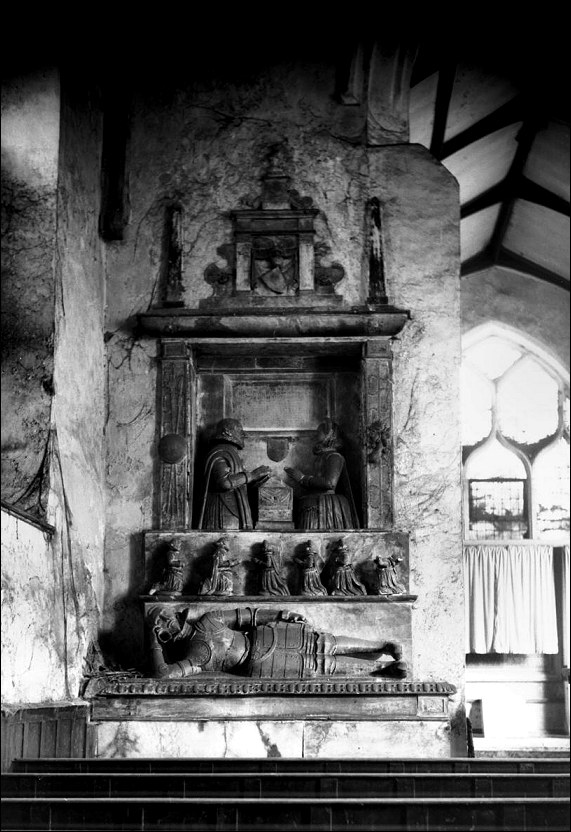
The monument rises from an impressive coloured alabaster base, to the Pettus coat of arms flanked by two obelisks. Sir John in his mayoral robes (he was Mayor in 1608) appears to kneel at a prayer desk opposite his wife, Bridget Curtis, although there is no sign of their legs. Blomefield writing in the 18th century mistook the armorials and identified the kneeling figure as Sir Augustine, who, unlike his father, was never Mayor of Norwich. Most of the literature has followed Blomefield, who was corrected by the Norfolk Heraldry Society (information from Tony Sims). Sir John and Lady Bridget are flanked by pilasters; his decorated with lances, hers with pomegranates and other fruit. Their children, two sons and two daughters kneel underneath, while Sir Augustine, who had died under a year before his father, is repeated lying stiffly in his full armour looking out from the monument, his head propped on his right arm, holding what could be a gauntlet or drinking horn, showing the fingers of a small hand.
Sir John had moved beyond both the family’s relative humble origins as tailors and local politics when in 1604 he had become the first Norwich Member since 1558 to be elected to two consecutive parliaments. He was active as an MP, while continuing his charitable work in Norwich. At the death of his father he had inherited considerable wealth, as well as the family house on Elm Hill, once extending to the churchyard, now nos. 41-43, and the estate at Rackheath, since at death his moveable goods, which included a substantial armoury of nine guns, were valued at £952 19s. 6d and the house on Elm Hill contained 27 rooms, together with stables for eight horses.
Blomefield, An Essay towards a Topographical History of the County of Norfolk: volume 4: The History of the City and County of Norwich, part II, ‘chapter 42: East Wimer ward', (1806), pp. 329-367; Chris Kyle, ‘Sir John Pettus’ in The History of Parliament: the House of Commons 1604-1629, , ed. Andrew Thrush and John P. Ferris, 2010.
Richard Corfield was Churchwarden of Cardington, Salop 1648. One of the executors of the will of Roger Maunsell in 1651 in which document he is termed "Loving Kinsman"
The elder of Chatwall, a staunch loyalist who fought with his cousin Sir Edward Acton, 1st Bt. for the King.
During the Civil War Richard Corfield fought on the side of the King. He joined the King's Army, probably in Shrewsbury in September 1642 when King Charles I was there. He served under his cousin, Sir Edward Acton, 1st Bt and Member of Parliament for Bridgnorth.
On 25th October 1642 Richard fought alongside Sir Edward Acton at the indecisive Battle of Edgehill.
Capt. Richard Corfield fortified the medieval hall at Chatwall, however the fortifications were destroyed shortly afterward by Roundheads to prevent them being used to harry the advance of Roundheads who were marching on Shrewsbury.
Bought the Leahills property from the Wallop family 1648
Richard became the executor of his father in law's will and the old wooden plaque in St James' Church, Cardington commemorates this.
In 1659 Richard constructed the present Hall at Chatwall and was churchwarden at St James', Cardington in 1660 and 1667.
In 1672 he paid 8 shillings tax for 4 hearths at Chatwall Hall.
On 25th March 1676 he signed a deed of grant to Rowland Hunt of Boreatton for £76/10/- in respect of tythes of corn grain or pulse within the townships of Chatwall and Frodsley.
On 2nd January 1678 he leased the Lea Hill and tythes of Chatwall and Frodesley to Thomas Smith of Ruckley and Thomas Browne of Clunton for 5/-, the rent being peppercorn.
On his death an inventory of his possessions was drawn up by Richard Davis, Edmund Taylor and Richard Hooper (his brother in law) which valued his estate at £397. this included £2 of books to be divided between his two younger sons. He also left £71/12/6 in debts.
Richard is my 10x Great GrandFather
1531 Robert Scargill of Thorpe Hall, Richmond and wife Jane d1546 daughter of Christopher Conyers of Sockburn and Marske by Anne daughter of Sir Thomas Markenfield www.flickr.com/photos/52219527@N00/8668473781/
Robert was the son of William Scargill who founded a chantry here in 1448 and Elizabeth daughter of Thomas Pygott of Clothoram
Children
3 sons who died young leaving their sisters as co-heiresses
1. Margaret d1575 m Sir John Gascoigne d1568 of Cardington son of c1540 Sir William Gascoine by 1st wife Elizabeth Pennington
www.flickr.com/photos/52219527@N00/9710143872/ (They had 2 sons, George d1577 and John, and 1 daughter In July 1543, Margaret complained to the Privy Council about her husband's behaviour and in 1556, Cardinal Pole ordered Gascoigne to end his adultery with a servant. He eventually had to settle an annuity on his ex-mistress).
2. Mary Scargill d1578 m. c.1525 Sir Marmaduke Tunstall 1557 of Thurland
" Orate pro alab' " dmi roberti scargyll millitis & dne Jahne uxoris sue et ancetoru ** suoro fundatora hui' cantarie quor[um animabus] propicietur [Deus •* ac] etiam hie jacent [filii] eorum."*
;Alabaster monument built as stipulated by Jane's Will. "to be built by her executors within 3 years of her death"
Will of "Jane, Ladie Scargill, of Leade Hall "— "That is to sale, firsle and principallie I yelde and bequeathe my soule to Almyghtie God my Creator and Redemer, to that mosle glorious immaculate virgine our ladie Sainte Marie and to all the copanyne in heven and my bodie to bee buried in the psh churche of Whitkirke within the chauntrie quere there besides my saide late
husbinde where I will that myne executores within three years nexte and immediately ensuenge my decease shall cause a tombe of albaster to be raaide and sette over the boannes of my saide laite husbande and me withe such armes and scuptures as to my saide executores shall seme moste convenient : the same to be in facion like to one erected within the Colledge at Macclesfeld."
This image is the cover page of “A Background to Winster History” by Margery Rodger with drawings by Jean Carter.
Margery Rodger is an important Winster local historian.
Margery first came to my attention in 1957 when she bought Wesson Cottage, Bank Top, which was sold by the Executors to my Granddad’s Estate. Josiah Greatorex, my Grandad, had lived for as long as I could remember at Wesson Cottage. As I was only 12 in 1957 Margery soon passed out of my life except that the mention of her name was a constant reminder in my family that she now occupied the old family homestead.
Later in the 1970s (when I had long since left Winster) my interest in Winster’s local history developed and I became aware that Margery was a Winster local historian. She kindly allowed me to examine the Deeds of Wesson Cottage as I was then intent on tracing my Greatorex family tree.
I recall that Margery sat me down in an upstairs room at Wesson Cottage and produced the Deeds for my perusal. Understandably, she did not leave me alone to work on them but remained in the room. I felt intimidated by the presence of this much older rather formidable lady: the more so because she talked incessantly about local history. This would have been fine on another occasion but my time was limited and I really wanted to concentrate on my work on her Deeds. In the event I had to combine the two tasks and, rather ungratefully I feel now, did not enjoy the combined experience. She did, however, offer me a piece of advice which I recall today: “Whatever you do in local history, write it down and publish it because someone in the future may be interested in following the same path and will enjoy reading about the work you’ve done before them.”
Later in the late 1970s I had a message from my Mum to the effect that Margery had discovered that I’d done some work on surveying the memorial inscriptions in Winster Churchyard and wanted me (if I couldn’t complete it soon) to pass it on to someone in Birchover who was interested in a similar project. I confess to feeling a mite miffed at what I thought was an intrusive suggestion as to what I should do with my own research work especially as I had every intention of finishing it as soon as circumstances permitted me to do so. Sadly, many years passed before I published!
Later still, my Mum told me that Margery had left the village too and had gone to live in Sheffield. There was a family joke that my Mum had posted Margery a Christmas card addressed to “Margery Rodger, Sheffield.” We often enquired whether Margery had got the card and had sent one to Mum in return. Of course, Mum’s explanation was that she had written the card and had left the address blank (other than Sheffield) in anticipation that she would get the address from another villager but the card had got mixed up with others and must have been posted.
I’ve had my copy of “A Background to Winster History” for many a long year. My own advice to local historians is: “Always put a date on your published work.” Search in vain, there is no date indicating when this item was published. So, what does it contain? There are more drawings by Jean Carter of some Winster historical artifacts; a review of Winster’s development, including the Church, and the Parish Records and some notes about them.
Margery also wrote a smaller printed publication (again undated) about St. John the Baptist Church, Winster, which is No. 3 in her “Winster Parish Records.”
I googled Margery’s name and found that she is credited by amazon.co.uk with other publications (all unavailable) about The Jubilee Room (1980) and A Winster Scrapbook (Winster Parish Records) (1985) neither of which I’ve yet had the pleasure of reading. When I do so, I will recall again her sound advice and the legacy that she has left Winster.
Michael Greatorex
22 January 2009
Star Wars Celebration Europe 2013
Die Star Wars Celebration Europe ist das weltgrößte Treffen von Fans der Science-Fiction-Filmsaga Star Wars.
----------------------------------------------------------------------------------------
Done in Ai, Finalized in Photoshop
In the aftermath of the Celestial Schism, when ancient empires shattered and stars bled across the firmament, the Starfall Accord was forged—a forbidden pact between dying worlds to prevent universal collapse. From this covenant rose a single enforcer: the Executor.
Neither fully mortal nor entirely divine, the Executor drifts between realms, cloaked in cosmic dusk and charged with extinguishing those who violate the Accord. His presence signals judgment, his glowing core a remnant of the collapsed stars whose energy sustains him. Planets fall silent in his wake, and time itself recoils in his shadow.
He does not speak. He does not falter. He simply fulfills the pact.
Surabaya City Hall :This solar Garden had built by Dutch colonial, its architect is C. Citroen and executor of HV. Hollandsche Beton Mij. City hall is located in Taman Surya Street 1.
This solar Garden had built by Dutch colonial. Town Surabaya as Resort Gemeonte (Haminte) officially date of 1 Aprils 1906, what experienced by Dewan Hamite and led by assistant resident. In 1916 lifted the first lord mayor A. Meyroos finite commissioned in 1921.
During the second lord mayor of GJ Dijkerman, it had started the development of lord mayor building and finished in 1927. Its architect is C. Citroen and executor of HV. Hollandsche Beton Mij. Because its total cost 100 guilders, this building had formerly recognized as “1000 Guilders Building ".
The Government of Indonesia had built a city hall with modern architecture, laid at against stripper building. The stripper building has time has applied as 'Gedung Dewan Perwakilan Rakyat Daerah' and now applied as the center of municipal administration Surabaya.
For more detail:
Ordsall Hall dates back over 820 years. Throughout history it has had many uses - a family home, working men's club and church hall.
At the end of the seventeenth century the estate was sold to the Oldfield family of Leftwich, near Northwich, and again in 1704 to John Stock, a trustee of Cross Street Chapel. His son's executors sold the property in 1756 to Samuel Hill of Shenstone, Staffordshire, on whose death two years later it passed to his nephew, Samuel Egerton of Tatton.
When the lease ran out, Earl Egerton of Tatton decided to promote the opening of a Clergy Training School in the hall and to this end he arranged for the Manchester architect, Alfred Darbyshire (1839-1908) to carry out a major restoration at a cost of six thousand pounds.
Legend has it that the Hall was the location used by Guy Fawkes & Robert Catesby to plot the overthrow of King James in what was to become the famous Gun Powder plot.
Ordsall Hall is famous for its resident spirits, most often spotted in the Great Hall, including the mysterious White Lady seen near the portrait and the figure of a young girl often seen on the stairs.
now undergoing extensive renovation it is due to re-open its doors to the public in 2011
This Indenture, made the 24th day of April 1867 between the Reverend William Procter the younger of Doddington in the County of Northumberland Clerk of the 1st part (,) Isabella Young Gilchrist of Berwick upon Tweed, Spinster of the second part and the Reverend Aislabie Proctor of Alwinton in Northumberland Clerk B.A. and Arthur Baxter Visick of Berwick upon Tweed Dentist (,) for themselves and theirs heirs executors and administrators herein after designated the said Trustees of the third part. Whereas a marriage is intended to be solemnised between the parties hereto of the first and second parts and it has been agreed to such settlement as herein after is mentioned Witnesseth that in consideration of the intended marriage they the said William Proctor the younger and Isabella Young Gilchrist do hereby convey assign and transfer unto the said Trustees All sum or sums of money which he the said William Proctor the younger is entitled to in reversion under his Father and Mothers marriage settlement (,) which may come to him at any time from any member of his family descent or will and also all lands tenements or hereditarments now belonging to the said Isabella Young Gilchrist or which may belong to her or over which she has or may have any controlling power and All sum or sums of money which she the said Isabella Young Gilchrist is entitled to in reversion or which may come to her at any time from any member of her family by descent or will (.) To hold the same unto the said trustees upon Trust to call in (,) alter and vary the securities from time to time and invest the same upon Government (,) or real securities (,) or any railway stock upon which all calls which are paid (,) or on preference stock as they (with the consent in writing of the said William Proctor the younger and Isabella Young Gilchrist during their lives and of the survivor according to the discretion of the said Trustees) may think proper and with the like consent to sell all real estate and to give discharges for all purchase moneys (.) And upon trust to pay the rents (,) dividends and interest arising therefrom to the said William Proctor the younger during his life and after his decease (,) upon Trust to pay the same unto the said Isabelle Young Gilchrist for her life (,) then several receipts alone after they fall due to be the only discharge for the same and after both their deaths then upon Trust to pay the said rents (,) dividends and interest towards the maintenance and education of the said intended marriage (,) if any (,) and upon trust to divide the capital and the produce of the real estates equally between or amongst such children as and when they come to the age of twenty one years or day or days of marriage. But if any one or more of such children shall die leaving child or children (,) the child or children so left shall take their parents share and if there shall be no children or all of them shall die before they take a vested interest (,) then as to the property hereinbefore mentioned belonging to the said William Proctor the younger upon Trust to dispose of the same as he shall by will appoint and in default of such appointment to his next of kin according to the statute of distributions as if he had never been married and had died intestate (.) And with respect to the property hereinbefore settled belonging to the said Isabella Young Gilchrist upon trust to dispose of the same as she may by will executed either while covert or discovert appoint the same and in default of such appointment to her next of kin according to the statute of distributions as if she had never been married and had died intestate. And each of them the said Willian Proctor the younger and Isabella Young Gilchrist for himself and herself and for his (,) her and their heirs (,) executors and administrators and assigns hereby irrevocably appoints the said Trustees to be his (,) her and their lawful attorney and attornies to sue for and get in all monies which may arise or fall due to him (,) her and them by virtue of this settlement. And to act for him (,) her and them as fully as he (,) she or they could have acted if they had remained single and unmarried. In witness where of the said parties to these presents have hereunto set their hands and seals the day and the year first above written –
The images shown in this album have been digitized by the project's volunteers. The transcriptions have also been produced by volunteers. All copyrights remain with the Northumberland Archives, please contact them for use of any information.
Draft Will of William Morris Boyton of the Collage, South Eastern Road, Ramsgate, Kent dated 1890.
Executors, wife Clementina Risdom Boyton and brother Henry Strang Boyton.
Beneficiaries: Wife Clementina Risdom Boyton and brother Henry Strang Boyton. Son William John Boyton, 3 daughters of his brother Henry Strang Boyton and 4 daughters of his brother Maurice Boyton (not named). His niece Edith Bennett, wife of Robert Bennett, niece Elizabeth Cleggett, daughter-in-law Georgina Boyton,
Draft Title of Mr. Charles Ratsey Isle of Wight for 23 Camden Road, Ramsgate sold to Edward G. Saxby, 1874.
26th & 27th November 1838: Indenture between Anna Rose, Ramsgate, Widow, William Peal, Ramsgate, Carpenter and Samuel Watkins.
Anna Rose inherited under the Will of her husband John Rose, dated 3rd March 1838. John Mercer of Ramsgate the joint Executor.
The land and premises near that of Edward Lampley and that of John Clark who had also purchased premises from Anna Rose. John Rose had purchased the land under
the Will of Revd. William Abbott.
Indenture dated 8th & 9th March 1836 between Sarah and Jane Abbot, Catherine Daniel and John Rose.
13th March 1839 Mortgage between William Peal and Hannah Peake, West Cowes, Isle of Wight, Hampshire.
Hannah Peake died 15th January 1858 her named Executors, John White and Gilbert Fraught? were minors, under 21 Courts took measures to protect their interests until they became of age.
William Peal died 5th October 1872 and his Will of 26th October 1872 appointed his wife, May Ann and son, William Oliver Peal Executrix and Executor.
24th May 1873 Indenture of Grant between Mary Ann Peal, Cleveland Road, Surbiton, Surrey, Widow, Charles Ratsey, Cowes, Isle of Wight, Sailmaker
Duneira house and gardens at Mount Macedon.
(Extract from Macedon Ranges cultural heritage and landscape study/Trevor Budge and Associates. 4 v. 1994.).
Henry Suetonius Officer reputedly aquired the Duneira site from
1872-1877 (Blocks 4,5,10,11,14) paying some £84 for 38 acres but
rate listings give Robert Officer as the owner. .
.
Suetonius Henry Officer (1830-1883).
Officer was born in Hullgreen, New Norfolk, Tasmania 1830, the
son of Sir Robert & Lady Officer. He was educated in Edinburgh
with his brother, Charles, and returned to the colonies, seeking
gold in Victoria but eventually settling for pastoralism in
company with his brothers and Charles Miles{ ibid.}. They managed
stations in the Wimmera and the Riverina, James marrying in 1866
and commencing construction of a 20 room homestead at Murray
Downs & Willakool, two adjoining properties fronting the Murray
River. After experimentation with irrigation, via steam pumps and
windmills, he was able to develop extensive orchards and crops. He was also, like his brother, interested in
acclimatisation, having developed an ostrich farm on his property
(Charles was a council member of the Zoological & Acclimatisation
Society for 10 years, president in 1887). .
.
Blighted by illness, Suetonius reputedly moved to Leighwood,
Toorak (Melbourne) in 1881, having erected the first stage of
Duneira at Mount Macedon, but died two years later. However his son, Henry jnr. was
born at South Yarra in 1869 and his next child, Jessie, was born
at Macedon in 1877, indicating that he was in residence at both
places prior to the dates previously supposed..
.
Suetonius probably commissioned the first stage of Duneira to be
erected as a summer house between c1874-6. The architect Levi
Powell is thought to have designed a house for him there around
that date. The first improvements listed on the site were
stables in 1874 when Robert Officer was rated as owning the site. The house was reputedly not occupied regularly
until c1881 when Suetonius moved to Toorak.
However it appears he and his family were in residence at Duneira
by 1877..
.
When Suetonius died in 1883 his wife, Mary Lillias Rigg Officer
(nee Cairns), of Glenbervie, Glenferrie Road, Toorak was the
co-executor of the estate, with merchant Robert Harper; she is
the rate occupier in 1888. Mrs Officer was the
sister of Mrs Robert Harper (Huntly Burn) and Mrs John C lloyd
(Montpelier, later Timsbury): all three houses were reputedly
built in the same period... .
.
The house bricks for the first stage were said to have come from
the Macedon Brick Kiln (once near the Macedon railway station,
set up in c1888-9?) with external walls built in 14" Flemish bond
from slop-moulded bricks (9 inch by 2.1/2). The bricks were reputedly carted
from Macedon by Cogger. The footings were of bluestone
and reputedly dressed sandstone blocks also survive, suggesting
that the first stage was face brick with stone quoins and the
next renovation c1888 added wings and a cement coating to the
whole complex. Floor frames were reputedly supported on stone
dwarf walls and joists were 6x2.1/2 inch jarrah, with flooring
being 6 inch pine}. Seaweed was apparently used for
ceiling insulation..
.
The servants' wing verandah was skillion in form with timber
posts with classical capitals. The main verandah had coupled
posts (rebuilt with single posts) a panelled frieze and slimmer
capitals set just under the frieze rail}. The
balustrade may have been of single cast-iron balusters..
.
Just prior to the sale to the speculator, James Smith Reid in
1890, and during the occupation of Edward Dyer, major additions
were made to the house complex and a reputedly a caretaker's
lodge was placed at the gate (survives, altered c1920s) but this
appears to have been added by Reid in the early 1890s. .
.
The added rooms were reputedly: billiard (32'x24') and dining
rooms, kitchen, servants bathroom, service block with 5 rooms
(engine room, dairy, pantry, store, boiler room, built of
Northcote machine made 9" brickwork). Damp proof coursing was
used in these additions compared to the slate of the first stage
and acetylene gas (engine room) was thought used for lighting
from this period, as reticulated in 1.1.2" mains and 1/2 inch
branches to internal and some external verandah lights.
Cast-iron elaborately detailed water radiators were also used,
with hot water pumped from the boiler room, and later a duplicate
boiler allowed hot water to be reticulated taps in the house{
ibid.}..
.
The description in rate books expands to villa and cottages (on
37 acres) for the first time under Reid in c1893 but the annual
valuation had already peeked in 1888 at £200 in the occupation of
Edward Dyer. An Edward Dyer was listed at that time as a fruiterer in
Burwood Road, Hawthorn..
.
The water supply is from a concrete tank fed by a spring.
Outbuildings include timber clad stables, storerooms,
blacksmith's shop, coachman's room, milking bails, hay shed and a
green house. The stables (extended) were described as having had
a shingled gabled roof (rear skillion) with loft entered via an
external stair at the north end. It had a blacksmith's
shop (altered for garage c1941), carriage and coachman's rooms,
two stores and vertically boarded main doors{ ibid.,p24}. The
milking and hay sheds had hipped roof forms and timber cladding
and frame. The interior was white-washed. The greenhouse
in the secret hedged garden is of a later date, with a timber
frame built up on 11" cavity brickwork walls, with a brick floor
and heated water pipes under each shelf. The boiler is near the
entry..
.
The `Gisborne Gazette' reported on Duneira in 1903 under the
heading of `A Popular Health Resort':.
`Duneira certainly merits a few remarks though beautiful
residences and grounds are by no means rare in that locality..
(when Reid purchased it, it was `little better than a wilderness'
and he had spared no expense to restore it).. After passing the
lodge at the main entrance, a broad serpentine drive leads up to
the house and from there the grounds are laid out in broad
sloping lawns surmounted with choice borders and fringed with
trees which however do not interfere to any great extent with the
view. There is of course no lack of flowers which grow
luxuriantly on the mount but the great feature of Duneira is the
lawns, those open green expanses which delight the eye at all
times of the year. the secret of this perennial verdure is to be
found in the copious water supply with which Macedon is blessed
(spring at rear of house, tapped by tunnelling 40m into the hill,
ie. grass grows up to base of Monterey pines)..
.
During Reid's time there, the valuation increased marginally in
1899-1900 and again soon after, with Reid's address being given
as care of Rosstrevor Magill, South Australia, in c1909-10. JS Reid died in 1922, leaving
the property to the management of JS Reid jun..
.
The main garden elements are: sweeping lawns, box hedges, weeping beech and cherry, extensive hedges (holly, laurel), a hedged
`secret garden' with green house, mature firs, elm and chestnut ì
avenues. There is also a fountain and a wide spreading weeping elm to the rear of the house, near the tennis court..
.
Significant Trees:.
`Ulmus x hollandica'.
`Prunus' "shirotae".
`Albies procera'.
`Ilex kingiana'.
Fred loved chatting about anything whatsoever, I tended to just sit there and listen, hard to get a word in to be honest. I ended up one of his executors, leaving that role when things turned nasty.
Lying between the chancel and south chapel - 1531 Robert Scargill of Thorpe Hall, Richmond and wife Jane d1546 daughter of Christopher Conyers of Sockburn and Marske by Anne daughter of Sir Thomas Markenfield www.flickr.com/photos/52219527@N00/8668473781/
Robert was the son of William Scargill who founded a chantry here in 1448 and Elizabeth daughter of Thomas Pygott of Clothoram
Children
3 sons who died young leaving their sisters as co-heiresses
1. Margaret d1575 m Sir John Gascoigne d1568 of Cardington son of c1540 Sir William Gascoine by 1st wife Elizabeth Pennington
www.flickr.com/photos/52219527@N00/9710143872/ (They had 2 sons, George d1577 and John, and 1 daughter In July 1543, Margaret complained to the Privy Council about her husband's behaviour and in 1556, Cardinal Pole ordered Gascoigne to end his adultery with a servant. He eventually had to settle an annuity on his ex-mistress).
2. Mary Scargill d1578 m. c.1525 Sir Marmaduke Tunstall 1557 of Thurland
" Orate pro alab' " dmi roberti scargyll millitis & dne Jahne uxoris sue et ancetoru ** suoro fundatora hui' cantarie quor[um animabus] propicietur [Deus •* ac] etiam hie jacent [filii] eorum."*
;Alabaster monument built as stipulated by Jane's Will. "to be built by her executors within 3 years of her death"
Will of "Jane, Ladie Scargill, of Leade Hall "— "That is to sale, firsle and principallie I yelde and bequeathe my soule to Almyghtie God my Creator and Redemer, to that mosle glorious immaculate virgine our ladie Sainte Marie and to all the copanyne in heven and my bodie to bee buried in the psh churche of Whitkirke within the chauntrie quere there besides my saide late
husbinde where I will that myne executores within three years nexte and immediately ensuenge my decease shall cause a tombe of albaster to be raaide and sette over the boannes of my saide laite husbande and me withe such armes and scuptures as to my saide executores shall seme moste convenient : the same to be in facion like to one erected within the Colledge at Macclesfeld."
Spesialistit also known as:
20 miljoonan kaappaus - Finland (video title)
Abrechnung in San Franzisko - West Germany
Blåst på 20 miljoner - Sweden
Croce siciliana, La - Italy
Ejecutores, Los - Spain
Ektelestes, Oi - Greece
Exécuteur, L - France
Sokak adamlari - Turkey (Turkish title)
Specialisterna - Finland (Swedish title)
Spesialistit - Finland
Sto stavrodromi ton Sikelon - Greece (reissue title)
Street People - USA
The Executioner - (undefined)
The Executors - UK (video title)
The Man from the Organization - Belgium (English title)
The Sicilian Cross - UK
Uomo del'organizzazione - Italy
Escape to Witch Mountain also known as:
Äventyrliga flykten, Den - Sweden
Apodrasi sto magemeno vouno - Greece
Flucht zum Hexenberg, Die - West Germany
Incredibile viaggio verso l'ignoto - Italy
Montaña embrujada, La - Spain
Montagne ensorcelée, La - France
Pako taikavuorelle - Finland
Sat 09/02/2008 16:02
A portrait of Sir Henry Wyatt which is a copy of a Holbein original.
Sir Henry Wyatt was treasurer of the Chamber from 1524-28 and was paymaster for the 1527 Greenwich festivities. He was one the longest serving courtiers to Henry VII and Henry VIII and had been an opponent of Richard III during that king’s reign. Due to his loyalty to the Tudors he was awarded throughout his lifetime and became master of the king's jewels in June 1488. He became a privy councillor in 1504, and was granted arms in 1507–8. He was also an executor of Henry VII's will. His son Thomas was the famous poet and diplomat.
Sorry if you're seeing this get uploaded again, I touched up some stuff I forgot to do the first time around.
'like' my Facebook page at www.facebook.com/hobbes.grocerygettercrew
Copy of the stolen brass of Sir Thomas Blennerhassett 1461-1531 "Here lyeth Sir Thomas Bleuerhayssette, Knyght, which decessyd the ryii Day of June, the Yere of our Lorde M yo rrri. and rrriii Yere of the Reigne of our Sobe raygne Lord Kyng Henry the viiith, whois Soule God Pardon".
Thomas was the son of John Blennerhassett d1510 www.flickr.com/gp/52219527@N00/005tn8 and first wife Margaret Heigham www.flickr.com/photos/52219527@N00/5947090482/
Thomas was the executor for Thomas, Duke of Norfolk in 1514. He lived at Frenze, and also Boyland Hall, Long Stratton. Son George left Frenze to his wife Margaret for her life and then to their heiress Mary m1 Thomas Culpepper m2 Francis Bacon - After the death of Francis it reverted to her half brother John
He m1 Jane Sutton.
Children
1. George 1501-1543 m Margaret Jermyn / Jernegan
2. Edward m Anne Cobbe
3. Mary m John Meux
He m2 Margaret d1561 www.flickr.com/gp/52219527@N00/4M48ZE daughter of John Braham of Wetheringsett and Joan Reyden 1519 www.flickr.com/gp/52219527@N00/30oPQi
Children
1. Thomas a priest
2. John of Barsham & Boyland m1 Elizabeth daughter of John Cornwallis and Elizabeth Sulyard www.flickr.com/photos/52219527@N00/9392340481/ (parents of Elizabeth Blennerhassett, bc.1537 who m 1561 Sir Lionel Throckmorton flic.kr/p/fDaHf7 son of Simon Throckmorton by Anne Louthe )
3. Elizabeth m1 Lionel Lowth m2 Francis Clopton m1 Lionel Lowthe / Louthe www.flickr.com/photos/52219527@N00/13925024374/ (grand daughter Anne Dade www.flickr.com/photos/52219527@N00/527517488/ )
4. Agnes m Sir Anthony Rous 1545 of Dennington & Henham Hall
5. Anne d1577 www.flickr.com/gp/52219527@N00/rqtQq9 www.flickr.com/gp/52219527@N00/65fy0D m1 George Duke m2 Peter Rede / Read of Gimingham
6. Margaret d1558 m1 John Spelman www.flickr.com/gp/52219527@N00/P38o5L Sir John Spelman and Elizabeth Frowyke www.flickr.com/gp/52219527@N00/9Rj86X m2 John Eyre dsp 1561 of Lyn, Receiver General to Queen Elizabeth for the counties of Norfolk, Suffolk, Cambridgshire & Huntingdon
7. Katherine m1 John Gosnold m2 Anthony Wingfield 1593
On his surcoat are the arms of Blenerhassett with the annulet, (which this branch always bare for difference,) with his quarterings, Lowdham, Orton, and Kelvedon / Keldon Under his head lies his crest - a fox passant.
www.british-history.ac.uk/topographical-hist-norfolk/vol1...
humphrysfamilytree.com/Blennerhassett/john.frenze.html
A visit to the Hollytrees Museum in Colchester. It's in the same building as the Visitor Information Centre. We entered through Castle Park. Almost went into Colchester Castle, but went into here instead.
Hollytrees Museum is a free to visit, publicly owned museum in the centre of Colchester and close to Colchester Castle. It is situated in an eighteenth-century house ("Hollytrees"), which was used as a private residence until 1929, when it became a museum.
The first house on the site, known as "Symnells" after its owner, was later bought by the Shaw family, and passed from John Shaw to John Shaw III and John Shaw IV. When he died a minor, the house passed into chancery; his mother Jane Lessingham bought it but soon died. The modern house was constructed in for Elizabeth Cornelisen, who had bought the site from Lessingham's executors and promptly tore down the existing structure in poor condition. Construction commenced on 10 May 1718 at a cost of £630 plus brickwork and tiling; the total refurbishment was estimated to have cost £2000. She died soon after, bequeathing the house to her niece, Sarah Creffeild (née Webster), who left it to her second husband Charles Gray. It was, at that time, known as "Esqr Creffield's [sic]". Possession of the house reverted to the Creffeilds; through Thamer Creffeild to James Round, who left to his brother Charles, who left it to his son Charles Gray Round, who left to it to his nephew James Round. The Rounds finally sold it to the Corporation of Colchester in 1922, a purchase paid for privately by Viscount Cowdray and his wife. It became a museum in 1929.
The house is known as Hollytrees after two holly trees planted in the grounds by Charles Gray in 1729 and is now a free to visit museum serving the centre of Colchester and specialising in local history. It is a grade I listed building.
Grade I Listed Building
Listing Text
1. HIGH STREET
995 (North Side)
TL 9925 SE 5/111 Holly Trees (Museum)
24.2.50.
I
2.
A fine early C13 brick building, standing back from the road in its own
grounds - now part of the Municipal Castle Park. Good ironwork railings
with gate to the street. Built circa 1717-18, it was formerly the home
of Charles Gray (1696-1783) MP for Colchester and owner of the Castle
estate; he lived here over 60 years. The west wing was added in 1748, by
James Deane. The main building is of 3 storeys and basement, red brick
with rubbed brick dressings, parapet to front and rear elevations.
Both elevations have a 5-window range of double hung sashes with glazing
bars, segmental heads. The front has a fine central doorcase with flat
hood, carved consoles. Fluted pilasters, semi-circular fanlight, 6-panel
door, iron handrail to flight of steps to door. The west wing is of 3
storeys, but at a lower level, with cut brick rustications to the ground
floor, 1st floor window with moulded brick pediment and architrave,
Venetian window on garden elevation, brick bands. Many original interior
features.
Listing NGR: TL9996025268
This text is from the original listing, and may not necessarily reflect the current setting of the building.
Description
1. HIGH STREET
995 (North Side)
TL 9925 SE 5/111 Holly Trees (Museum)
24.2.50.
I
2.
A fine early C13 brick building, standing back from the road in its own
grounds - now part of the Municipal Castle Park. Good ironwork railings
with gate to the street. Built circa 1717-18, it was formerly the home
of Charles Gray (1696-1783) MP for Colchester and owner of the Castle
estate; he lived here over 60 years. The west wing was added in 1748, by
James Deane. The main building is of 3 storeys and basement, red brick
with rubbed brick dressings, parapet to front and rear elevations.
Both elevations have a 5-window range of double hung sashes with glazing
bars, segmental heads. The front has a fine central doorcase with flat
hood, carved consoles. Fluted pilasters, semi-circular fanlight, 6-panel
door, iron handrail to flight of steps to door. The west wing is of 3
storeys, but at a lower level, with cut brick rustications to the ground
floor, 1st floor window with moulded brick pediment and architrave,
Venetian window on garden elevation, brick bands. Many original interior
features.
Listing NGR: TL9996025268
Entrance on the left, toilets on the right.
Sherborne School, UK, Book of Remembrance for former pupils who have lost their lives in the service of their country, 1919-1939 and 1946 to date.
If you have any additional information about this individual, or if you use one of our images, we would love to hear from you. Please leave a comment below or email us via the Sherborne School Archives website: oldshirburnian.org.uk/school-archives/contact-the-school-...
Credit: Sherborne School Archives, Abbey Road, Sherborne, Dorset, UK, DT9 3AP.
Details: Theodore Ralph Tate Carr-Ellison (1915-1939), born in Newcastle-upon-Tyne on 24 February 1915, son of Herbert George Carr Carr-Ellison (1874-1935) and Mabel Mary Carr-Ellison (née Tate) (1874-1955) of 15, Portland Terrace, Newcastle-on-Tyne, and of Rothley Lake House, Hartburn, Morpeth, Newcastle-on-Tyne.
Nephew of Oswald Fenwicke Clennell Carr-Ellison (1895-1918), who served during the First World War as a Captain in the Northumberland Fusiliers, and was killed in France on 5 October 1918, aged 22 www.flickr.com/photos/sherborneschoolarchives/9342520504/...
Attended Belhaven Hill School, Dunbar.
Attended Sherborne School (Abbey House), May 1928-July 1933; Shooting viii team (1931, 1932, 1933, Captain); OTC ‘cert A’.
Durham University (Engineering). Student apprentice, electrical engineering, Hebburn, South Tyneside.
Flying Officer, Royal Air Force: June 1934 appointed Pilot Officer, 607 County of Durham (B) Squadron. December 1935 promoted to the rank of Flying Officer. In 1939, Flying Officer, 54 Fighter Squadron, RAF, Hornchurch, Essex.
Died on 30 January 1939 in Letchworth Hospital, Letchworth, Hertfordshire, following a flying accident when his Gloster Gladiator K7930 flew into the ground in a snowstorm at Baldock, Hertfordshire on 26 January 1939.
Buried on 2 February 1939 at Guyzance, Northumberland.
Commemorated at:
Sherborne School: Book of Remembrance; no.14 Memorial Pew in the School Chapel; Carr-Ellison OTC Challenge Cup.
RAF Hornchurch Heritage Centre.
The Shirburnian, March 1939:
THEODORE RALPH TATE CARR-ELLISON (b 1928-33) died in hospital at Letchworth, as the result of a flying accident. He was piloting a single-seater Gloster Gladiator, and a severe snow storm is presumed to have been the cause of the disaster. Captain of the VIII in his last year here, he was afterwards a member of the RAF team which won the Inter-Services match at Bisley last year. A brilliant shot, a keen fisherman, and an outstanding pilot, yet it is for what he was, rather than for what he did that he will be remembered. From the day he came to Sherborne he endeared himself to all who knew him by his cheerfulness, his enthusiasm, his unselfishness and unfailing kindness. Wherever he went he made friends and never an enemy. Modest and chivalrous, he gave his life that others might be in peace, and died, as hived, sans peur et sans reproche.
London Gazette, 3 March 1939.
THEODORE RALPH TATE CARR-ELLISON, Deceased. Pursuant to the Trustee Act, 1929. Notice is herby given that all persons having any claim against the estate of Pilot Officer Theodore Ralph Tate Carr-Ellison RAF, late of 54 Fighter Squadron, Royal Air Force, Hornchurch, Essex, and Bank House, Acklington, Morpeth, Northumberland, who died on the 30th day of January 1939, are hereby required to send particulars thereof in writing to the Executors & Trustees Department, Lloyds Bank Limited, Grey Street, Newcastle-upon-Tyne, the executor of the Will of the said Theodore Ralph Tate Carr-Ellison, or to the undersigned the Solicitors to the executor, on or before the 10th day of May, 1939, after which date the executor will proceed to distribute the said estate, having regard only to the claims then notified. Dated his 27th day of February 1939. LEADBITTTER and HARVEY, Solicitors for the said Executor.
Sherborne School Accounts for the year ended 31 March 1939: OFFICERS' TRAINING CORPS CHALLENGE CUP. The late Pilot Officer T.R.T. Carr-Ellison, O.S., has bequeathed a legacy of £20 to the School, to be expended in the provision of a solid silver Challenge Cup "to be awarded annually to such person as is certified to the said Bank by the Head Master for the time being of Sherborne School or other appropriate School Official to be the smartest man carrying himself in an 'Officerly manner' on parade on a day to be fixed by him or the last mentioned Officer and to be announced beforehand to competition for the Cup."
The Carr-Ellison Cup was first awarded in 1942 when it was won for Abbey House by M.J.F. Morrison (b 1937-1942), who went on to serve in WW2 as a Captain in the King’s Royal Rifle Corps.
It's like at the end of ROTJ, except that the coffee table was the Executor. I suspect feline/Bothan spies.
Title: Desk and Bookcase
Artist/Maker: Benjamin Frothingham (American, 1734-1809; active Charlestown 1754-1809)
Place Made: United States: Massachusetts: Charlestown
Date Made: 1753
Medium: wood; mahogany; white pine; eastern red cedar; Spanish cedar
Measurements: Overall: 98 1/4 in x 44 1/2 in x 24 3/4 in; 249.555 cm x 113.03 cm x 62.865 cm
Credit Line: Gift of Mr. Dana C. Ackerly and Mr. Earle S. Thompson, estate executors, in memory of Mrs. Bell McKerlie Watts and Mr. Samuel Hughes Watts of Fairfield, Connecticut
Collection: The Diplomatic Reception Rooms, U.S. Department of State, Washington, D.C.
Accession No: RR-1970.0094
Siena. Santa Maria della Scala museum complex.
Company of Saint Mary Under the Vaults.
"The Fraternity of the Obedient to Most Holy Mary, which later became the Society of Executors of Pious Dispositions, is the oldest lay company headquartered in the subterranean spaces of Santa Maria della Scala. Originally formed in the Cathedral of Siena, the existence of a fraternity dedicated to pious works is also mentioned in a letter by Saint Catherine.
On April 14, 1785 a grand ducal decision counted the company among those to be suppressed, re-forming it as the Society of Executors of Pious Dispositions dedicated to charitable works, but divesting it of its religious aspects. Only in 1792 did Grand Duke Ferdinand III definitively restore the Society as a religious brotherhood.
The Society’s artistic patrimony, which over the course of the centuries has been enriched by both furnishings and art works, thanks in part to bequests by artists to whom this same institution had given scholarships, is still today outstanding, even though most of it is conserved in the Via Roma headquarters, including numerous movable art works such as paintings and furnishings of the Sienese School. However, still conserved at Santa Maria della Scala is a beautiful wood Crucifix between terracotta figures of Saint Bernardino and Saint Catherine, which tradition holds is the very same crucifix that induced Saint Bernardino to become a Franciscan. On the Oratory’s other altar we find a canvas by Alessandro Casolani depicting the Madonna with Child and Saints Peter and Paul. The Sacristy contains, among other things, very interesting frescoes attributed to Andrea Vanni and Luca di Tommè.
During restoration work, behind an air space that had been walled in for over two centuries along a stair leading to the historic headquarters of the Society of Executors of Pious Dispositions, a vast early Fourteenth-century fresco cycle depicting a Hermitage came to light, referable to the sphere of Ambrogio Lorenzetti: this was the most important discover of the past twenty years regarding the Sienese School of painting prior to the black plague of 1348.
Finally, we must mention the collection of samples left by the main Sienese artists of the Nineteenth century. This nucleus is the fruit of work by sculptors and painters who utilized scholarships, the so-called Alunnato Biringucci, which were granted by the institution thanks to the bequests of brotherhood members and benefactors."
Church of Simon and St Jude,
Monument to Sir John Pettus †1614 and Bridget Curtis and Sir Augustine Pettus †1613, alabaster. Commissioned by Thomas Pettus, Sir John’s second son, the executor of his will. Unknown, probably Norwich mason, also responsible for the Suckling monuments in St Andrew’s, restored 2007/8.
St Simon and St Jude was declared redundant in the 1890s, and abandoned in the 1930s. Now owned by the Norwich Churches Trust it has been saved from its state of collapse in the 1930s, but the inside has been butchered by the addition of the nave mezzanine. This makes it impossible to appreciate the monument to Sir John and his family, on filling the north wall flanking the chancel arch. Mercifully the late George Plunkett took a full set of photographs of the interior in the 1930s, including the monument (www.norfolkchurches.co.uk/norwichsimonjude/plunkett/plunk...).
The monument rises from an impressive coloured alabaster base, to the Pettus coat of arms flanked by two obelisks. Sir John in his mayoral robes (he was Mayor in 1608) appears to kneel at a prayer desk opposite his wife, Bridget Curtis, although there is no sign of their legs. Blomefield writing in the 18th century mistook the armorials and identified the kneeling figure as Sir Augustine, who, unlike his father, was never Mayor of Norwich. Most of the literature has followed Blomefield, who was corrected by the Norfolk Heraldry Society (information from Tony Sims). Sir John and Lady Bridget are flanked by pilasters; his decorated with lances, hers with pomegranates and other fruit. Their children, two sons and two daughters kneel underneath, while Sir Augustine, who had died under a year before his father, is repeated lying stiffly in his full armour looking out from the monument, his head propped on his right arm, holding what could be a gauntlet or drinking horn, showing the fingers of a small hand.
Sir John had moved beyond both the family’s relative humble origins as tailors and local politics when in 1604 he had become the first Norwich Member since 1558 to be elected to two consecutive parliaments. He was active as an MP, while continuing his charitable work in Norwich. At the death of his father he had inherited considerable wealth, as well as the family house on Elm Hill, once extending to the churchyard, now nos. 41-43, and the estate at Rackheath, since at death his moveable goods, which included a substantial armoury of nine guns, were valued at £952 19s. 6d and the house on Elm Hill contained 27 rooms, together with stables for eight horses.
Blomefield, An Essay towards a Topographical History of the County of Norfolk: volume 4: The History of the City and County of Norwich, part II, ‘chapter 42: East Wimer ward', (1806), pp. 329-367; Chris Kyle, ‘Sir John Pettus’ in The History of Parliament: the House of Commons 1604-1629, , ed. Andrew Thrush and John P. Ferris, 2010.
detail gauntlet or drinking horn
Title: Desk and Bookcase
Artist/Maker: Benjamin Frothingham (American, 1734-1809; active Charlestown 1754-1809)
Place Made: United States: Massachusetts: Charlestown
Date Made: 1753
Medium: wood; mahogany; white pine; eastern red cedar; Spanish cedar
Measurements: Overall: 98 1/4 in x 44 1/2 in x 24 3/4 in; 249.555 cm x 113.03 cm x 62.865 cm
Credit Line: Gift of Mr. Dana C. Ackerly and Mr. Earle S. Thompson, estate executors, in memory of Mrs. Bell McKerlie Watts and Mr. Samuel Hughes Watts of Fairfield, Connecticut
Collection: The Diplomatic Reception Rooms, U.S. Department of State, Washington, D.C.
Accession No: RR-1970.0094
Church of Simon and St Jude,
Monument to Sir John Pettus †1614 and Bridget Curtis and Sir Augustine Pettus †1613, alabaster. Commissioned by Thomas Pettus, Sir John’s second son, the executor of his will. Unknown, probably Norwich mason, also responsible for the Suckling monuments in St Andrew’s, restored 2007/8.
St Simon and St Jude was declared redundant in the 1890s, and abandoned in the 1930s. Now owned by the Norwich Churches Trust it has been saved from its state of collapse in the 1930s, but the inside has been butchered by the addition of the nave mezzanine. This makes it impossible to appreciate the monument to Sir John and his family, on filling the north wall flanking the chancel arch. Mercifully the late George Plunkett took a full set of photographs of the interior in the 1930s, including the monument (www.norfolkchurches.co.uk/norwichsimonjude/plunkett/plunk...).
The monument rises from an impressive coloured alabaster base, to the Pettus coat of arms flanked by two obelisks. Sir John in his mayoral robes (he was Mayor in 1608) appears to kneel at a prayer desk opposite his wife, Bridget Curtis, although there is no sign of their legs. Blomefield writing in the 18th century mistook the armorials and identified the kneeling figure as Sir Augustine, who, unlike his father, was never Mayor of Norwich. Most of the literature has followed Blomefield, who was corrected by the Norfolk Heraldry Society (information from Tony Sims). Sir John and Lady Bridget are flanked by pilasters; his decorated with lances, hers with pomegranates and other fruit. Their children, two sons and two daughters kneel underneath, while Sir Augustine, who had died under a year before his father, is repeated lying stiffly in his full armour looking out from the monument, his head propped on his right arm, holding what could be a gauntlet or drinking horn, showing the fingers of a small hand.
Sir John had moved beyond both the family’s relative humble origins as tailors and local politics when in 1604 he had become the first Norwich Member since 1558 to be elected to two consecutive parliaments. He was active as an MP, while continuing his charitable work in Norwich. At the death of his father he had inherited considerable wealth, as well as the family house on Elm Hill, once extending to the churchyard, now nos. 41-43, and the estate at Rackheath, since at death his moveable goods, which included a substantial armoury of nine guns, were valued at £952 19s. 6d and the house on Elm Hill contained 27 rooms, together with stables for eight horses.
Blomefield, An Essay towards a Topographical History of the County of Norfolk: volume 4: The History of the City and County of Norwich, part II, ‘chapter 42: East Wimer ward', (1806), pp. 329-367; Chris Kyle, ‘Sir John Pettus’ in The History of Parliament: the House of Commons 1604-1629, , ed. Andrew Thrush and John P. Ferris, 2010.
detail of lances and shield
Draft Will of Job Grant of Ramsgate, Kent (born circa 1783 died 18th August 1866) dated 27 April 1861.
Executors, Wife Elizabeth Long Grant, sons, Job Grant the Younger of 1 Union Street, Southwark, Spirit Merchant and William Grant of Ramsgate, Fish Dealer.
Beneficiaries: Elizabeth Long Grant, wife, Job Grant and William Grant sons. Two daughters, Jane, the wife of Willoughby Carter Hillier of Billingsgate, London, Fish Salesman and Sarah the wife of Robert Bastable of 6 New Road, St. Georges in the East, Veterinary Surgeon.
L. Elgar, Clerk, Snowden Solicitors witness.
The 1851 census shows him and his wife Elizabeth living at Princes Street and that he was a Mariner. The 1861 census shows them at 3 Meeting Street, Ramsgate.
Probate of Will of Joseph Strawson, Boston Lincolnshire dated 5th December 1881 granted to William Palethorpe and Samuel Temple the Executors.
Joseph Strawson born circa 1808 in Boston married Ann Winn 26th May 1835 at Stickney, Lincoln. The 1881 census shows them living at Spileby Road, Fishtoft, Boston. In 1841 he worked as a Drover living at Fishtoft. By 1851 he is listed as a Farmer.
He died 25th August 1881 naming his wife, daughters; Mary, nee Strawson, the wife of Richard Benson, Emma Strawson, Sarah Ann Strawson and son William Winn Strawson as beneficiaries. .
Church of St. Mary,
Monument to Mrs Everilda Thornhill †1743, and members of her family. Marble, above north arcading of central aisle. Commissioned by the executors of her will on her orders.
The inscription is illegible, but clarified in the photographs. Everilda Thornhill was a spinster from Burnham, who died aged 44. The other members of her family included in the inscription, and buried in a vault nearby, were: her mother, Ann Thornhill †1724; her uncle Thomas Harris †1726; and her brother John Thornhill †1741.
The inscription, under an angel head is set under a broken pediment, with (presumably) the now illegible family coat of arms. It is framed by dark, doubled, Corinthian piers, above gadrooning and a double curved apron. The elegant monument is not signed (or if it had been the signature is now lost) but close to, but more complex than, contemporary monuments by Norwich sculptors, notably John Ivory’s monument to Mary Slater †1748 at Hingham.
(Brasília - DF, 05/08/2020) Palavras do Presidente do Senado Federal, Davi Alcolumbre.
Foto: Isac Nóbrega/PR
TRUSTEES OF THE DIOCESE OF SOUTHERN OHIO (EPISCOPAL), APPELLANT,
v.
GILCHRIST, EXECUTOR, ET AL., APPELLEES.
Nos. C-800111 and C-800344.
Court of Appeals of Ohio, Hamilton County.
Decided October 7, 1981.
Strauss, Troy & Ruehlmann Co., L.P.A., Mr. Samuel M. Allen and Mr. Richard Boydston, for appellant Trustees of Episcopal Diocese.
Messrs. Kohnen & Kohnen, Mr. Ralph B. Kohnen, Jr., and Mr. Roger W. Healey, for appellee Fifth Third Bank, trustee of testamentary trust of Eugene Zimmerman.
Messrs. Frost & Jacobs, Mr. T. Stephen Phillips and Mr. Larry H. McMillin, for appellee Sidney Arthur Robin George Drogo Montagu, Eleventh Duke of Manchester.
Messrs. Taft, Stettinius & Hollister, Ms. Cynthia F. Blank and Mr. Daniel J. Hoffheimer, for appellees and cross-appellants United States Trust Company of New York, Alton E. Peters and Thomas B. Gilchrist, Jr., executors of the Will of Alexander George Francis Drogo Montagu, Tenth Duke of Manchester
Built 1937-1940 in Currie St, first stage completed Nov 1938, second stage opened 5 Apr 1940, architects Woods, Bagot, Laybourne Smith & Irwin, replacing earlier building built 1888, extended 1954. Rear of building replaced 1999 by 7 level office space. Elders moved 2015 to Grenfell St, building retaining its name Elder House, sold 2018.
Alexander Elder arrived 1839, set up as general & commission agent and metal broker, joined by brothers William & George, later all three returned to London & Scotland. Thomas Elder arrived 1854, formed a partnership with Edward Stirling, Robert Barr Smith and John Taylor, known as Elder, Stirling & Co. When Stirling and Taylor retired in 1863, Thomas Elder and Robert Barr Smith set up Elder, Smith & Co. In 1882 Elders Wool & Produce Co Ltd was established, merged 1888. Elder's Trustee and Executor Co Ltd founded 1910. Further mergers, including Goldsbrough Mort 1963.
“the new Elder House, an imposing four-story structure to be erected in Currie street on a frontage of 136 ft. between the Savings Bank and Currie Chambers, for Elder, Smith and Co.. Ltd., and Elder's Trustee and Executor Co., Ltd. Elder House with equipment will cost about £150,000.” [News 25 Feb 1937]
“Demolition of the existing buildings to make way for the new Elder House will begin on Monday.” [News 16 Jul 1937]
“Crossing Currie street we were confronted by the paddock caused by the demolition of Elder's Trustee and Agency Coy. building, once the White Horse Hotel.” [Advertiser 11 Aug 1937]
“the new premises for Elder. Smith and Co. Ltd., and Elder's Executor Co., in Currie street, are well advanced. . . Polished Murray Bridge granite, which will be used for the front, is now being prepared by Standard Quarries, Ltd, at their Mile End works.” [Advertiser 26 Oct 1937]
“A start has been made on the demolition of the old Elder House in Currie street, which will make way for the second portion of the big new building which will house both Elder, Smith and Co.. Ltd., and Elder's Trustee and Executor Co.. Ltd. The first section of the £130,000 building scheme was recently completed. Although intended ultimately for the Trustee Co., it will be occupied by Elder, Smith & Co. until the second section is finished. The Trustee Co. is at present using offices in North terrace.” [News 4 Nov 1938]
“Elder, Smith & Co. Limited, to mark the completion this year of the centenary of the firm. . . For three-quarters of a century, at least, the prosperity of South Australia rested largely on the wealth derived from its flocks, herds, and mines. With those industries the company was associated intimately, and to that extent its interests were the interests of the State.” [Advertiser 7 Mar 1940]
“Tributes to the part played by Elder, Smith & Co. in developing the primary industries of South Australia and the fine team spirit of the staff were paid fine team spirit of the staff were paid yesterday when about 500 guests were entertained at a cocktail party to celebrate the opening of the new Currie street building.” [Advertiser 6 Apr 1940]
“The staff of Elder's Trustee and Executor Co. Ltd. will move into their new building, Elder House, in Currie street, on Monday. They have been situated in Anchor House, North terrace, for nearly four years. In the new building they will be housed beside Elder Smith & Co.” [News 25 May 1940]
“A new storey is to be added to Elder House, Currie street for the Elder Trustee Executor Co. The architects, Messrs. Woods, Bagot, Laybourne Smith & Irwin. . . At present there is a ground floor and three upper storeys. The new storey will provide additional office space for the company.” [Advertiser 25 Aug 1954]
ELDERS
“The undersigned, Agents for South Australia, are prepared to effect Fire and Life Insurances on liberal terms, and issue Policies in both branches, immediately on acceptance of risks. Insurances on Mills effected at the ordinary rates. All claims are settled in Adelaide, no reference home being required. Elder, Stirling, & Co.” [Adelaide Times 13 Aug 1856 advert]
“First Wool Ship for London. — The splendid new clipper ship ALMA, 592 tons register, R. Gilkisen, commander, is now in port, and will be dispatched about the middle of November. This vessel has a full poop, and excellent accommodation for passengers. For freight or passage, apply to Elder, Stirling, & Co.” [Adelaide Observer16 Aug 1856 advert]
“A change has taken place in the well-known firm of Elder, Stirling, & Co., caused by the retirement of Mr. John Taylor. The business of the firm will henceforward be carried on under the style and designation of Elder, Smith, & Co.” [Advertiser 22 Aug 1863]
“Elder’s Wool and Produce Company, Limited. (Late the Wool and Produce Brokerage Business of Messrs. Elder, Smith, and Co.) to be Limited and Incorporated.” [Register 30 Jun 1882]
Title: Desk and Bookcase
Artist/Maker: Benjamin Frothingham (American, 1734-1809; active Charlestown 1754-1809)
Place Made: United States: Massachusetts: Charlestown
Date Made: 1753
Medium: wood; mahogany; white pine; eastern red cedar; Spanish cedar
Measurements: Overall: 98 1/4 in x 44 1/2 in x 24 3/4 in; 249.555 cm x 113.03 cm x 62.865 cm
Credit Line: Gift of Mr. Dana C. Ackerly and Mr. Earle S. Thompson, estate executors, in memory of Mrs. Bell McKerlie Watts and Mr. Samuel Hughes Watts of Fairfield, Connecticut
Collection: The Diplomatic Reception Rooms, U.S. Department of State, Washington, D.C.
Accession No: RR-1970.0094
Church of Simon and St Jude,
Monument to Sir John Pettus †1614 and Bridget Curtis and Sir Augustine Pettus †1613, alabaster. Commissioned by Thomas Pettus, Sir John’s second son, the executor of his will. Unknown, probably Norwich mason, also responsible for the Suckling monuments in St Andrew’s, restored 2007/8.
St Simon and St Jude was declared redundant in the 1890s, and abandoned in the 1930s. Now owned by the Norwich Churches Trust it has been saved from its state of collapse in the 1930s, but the inside has been butchered by the addition of the nave mezzanine. This makes it impossible to appreciate the monument to Sir John and his family, on filling the north wall flanking the chancel arch. Mercifully the late George Plunkett took a full set of photographs of the interior in the 1930s, including the monument (www.norfolkchurches.co.uk/norwichsimonjude/plunkett/plunk...).
The monument rises from an impressive coloured alabaster base, to the Pettus coat of arms flanked by two obelisks. Sir John in his mayoral robes (he was Mayor in 1608) appears to kneel at a prayer desk opposite his wife, Bridget Curtis, although there is no sign of their legs. Blomefield writing in the 18th century mistook the armorials and identified the kneeling figure as Sir Augustine, who, unlike his father, was never Mayor of Norwich. Most of the literature has followed Blomefield, who was corrected by the Norfolk Heraldry Society (information from Tony Sims). Sir John and Lady Bridget are flanked by pilasters; his decorated with lances, hers with pomegranates and other fruit. Their children, two sons and two daughters kneel underneath, while Sir Augustine, who had died under a year before his father, is repeated lying stiffly in his full armour looking out from the monument, his head propped on his right arm, holding what could be a gauntlet or drinking horn, showing the fingers of a small hand.
Sir John had moved beyond both the family’s relative humble origins as tailors and local politics when in 1604 he had become the first Norwich Member since 1558 to be elected to two consecutive parliaments. He was active as an MP, while continuing his charitable work in Norwich. At the death of his father he had inherited considerable wealth, as well as the family house on Elm Hill, once extending to the churchyard, now nos. 41-43, and the estate at Rackheath, since at death his moveable goods, which included a substantial armoury of nine guns, were valued at £952 19s. 6d and the house on Elm Hill contained 27 rooms, together with stables for eight horses.
Blomefield, An Essay towards a Topographical History of the County of Norfolk: volume 4: The History of the City and County of Norwich, part II, ‘chapter 42: East Wimer ward', (1806), pp. 329-367; Chris Kyle, ‘Sir John Pettus’ in The History of Parliament: the House of Commons 1604-1629, , ed. Andrew Thrush and John P. Ferris, 2010.
detail of Augustine
Originally dating to around 1320, the building is important because it has most of its original features; successive owners effected relatively few changes to the main structure, after the completion of the quadrangle with a new chapel in the 16th century. Pevsner described it as "the most complete small medieval manor house in the county", and it remains an example that shows how such houses would have looked in the Middle Ages. Unlike most courtyard houses of its type, which have had a range demolished, so that the house looks outward, Nicholas Cooper observes that Ightham Mote wholly surrounds its courtyard and looks inward, into it, offering little information externally.[9] The construction is of "Kentish ragstone and dull red brick,"[10] the buildings of the courtyard having originally been built of timber and subsequently rebuilt in stone.[11]
The moat of Ightham Mote
The house has more than 70 rooms, all arranged around a central courtyard, "the confines circumscribed by the moat."[10] The house is surrounded on all sides by a square moat, crossed by three bridges. The earliest surviving evidence is for a house of the early 14th century, with the great hall, to which were attached, at the high, or dais end, the chapel, crypt and two solars. The courtyard was completely enclosed by increments on its restricted moated site, and the battlemented tower was constructed in the 15th century. Very little of the 14th century survives on the exterior behind rebuilding and refacing of the 15th and 16th centuries.
The structures include unusual and distinctive elements, such as the porter's squint, a narrow slit in the wall designed to enable a gatekeeper to examine a visitor's credentials before opening the gate. An open loggia with a fifteenth-century gallery above, connects the main accommodations with the gatehouse range. The courtyard contains a large, 19th century dog kennel.[12] The house contains two chapels; the New Chapel, of c.1520, having a barrel roof decorated with Tudor roses. [13] Parts of the interior were remodelled by Richard Norman Shaw.[14] wikipedia
16th century-late 19th century
The house remained in the Selby family for nearly 300 years.[3] Sir William was succeeded by his nephew, also Sir William, who is notable for handing over the keys of Berwick-upon-Tweed to James I on his way south to succeed to the throne.[4] He married Dorothy Bonham of West Malling but had no children. The Selbys continued until the mid-19th century when the line faltered with Elizabeth Selby, the widow of a Thomas who disinherited his only son.[5] During her reclusive tenure, Joseph Nash drew the house for his multi-volume illustrated history Mansions of England in the Olden Time, published in the 1840s.[6] The house passed to a cousin, Prideaux John Selby, a distinguished naturalist, sportsman and scientist. On his death in 1867, he left Ightham Mote to a daughter, Mrs Lewis Marianne Bigge. Her second husband, Robert Luard, changed his name to Luard-Selby. Ightham Mote was rented-out in 1887 to American Railroad magnate William Jackson Palmer and his family. For three years Ightham Mote became a centre for the artists and writers of the Aesthetic Movement with visitors including John Singer Sargent, Henry James, and Ellen Terry. When Mrs Bigge died in 1889, the executors of her son Charles Selby-Bigge, a Shropshire land agent, put the house up for sale in July 1889.[6]
Late 19th century-21st century
The Mote was purchased by Thomas Colyer-Fergusson.[6] He and his wife brought up their six children at the Mote. In 1890-1891, he carried out much repair and restoration, which allowed the survival of the house after centuries of neglect.[7] Ightham Mote was opened to the public one afternoon a week in the early 20th century.[7]
Sir Thomas Colyer-Fergusson's third son, Riversdale, died aged 21 in 1917 in the Third Battle of Ypres, and won a posthumous Victoria Cross. A wooden cross in the New Chapel is in his memory. The oldest brother, Max, was killed at the age of 49 in a bombing raid on an army driving school near Tidworth in 1940 during World War II. One of the three daughters, Mary (called Polly) married Walter Monckton.
On Sir Thomas's death in 1951, the property and the baronetcy passed to Max's son, James. The high costs of upkeep and repair of the house led him to sell the house and auction most of the contents. The sale took place in October 1951 and lasted three days. It was suggested that the house be demolished to harvest the lead on the roofs, or that it be divided into flats. Three local men purchased the house: William Durling, John Goodwin and John Baldock. They paid £5,500 for the freehold, in the hope of being able to secure the future of the house.[8]
In 1953, Ightham Mote was purchased by Charles Henry Robinson, an American of Portland, Maine, United States. He had known the property when stationed nearby during the Second World War. He lived there for only fourteen weeks a year for tax reasons. He made many urgent repairs, and partly refurnished the house with 17th-century English pieces. In 1965, he announced that he would give Ightham Mote and its contents to the National Trust. He died in 1985 and his ashes were immured just outside the crypt. The National Trust took possession in that year.[8]
In 1989, the National Trust began an ambitious conservation project that involved dismantling much of the building and recording its construction methods before rebuilding it. During this process, the effects of centuries of ageing, weathering, and the destructive effect of the deathwatch beetle were highlighted. The project ended in 2004 after revealing numerous examples of structural and ornamental features which had been covered up by later additions.[1]
I struggled to think of an engine flame color that fit OG Blacktron. I eventually settled on trans-blue. (it looks like trans-light blue here, but it's not!)
Henry Hinds of 57 Queen Street, Ramsgate, Kent, Auctioneer and Surveyor to Mrs. Harriet Mary Eliza Goodbourn, wife of Arthur Ernest Goodbourn, 5 Trinity Terrace, Victoria Road, Ramsgate, Lime and Whitening Manufacturer, Draft Conveyance for 3 Trinity Place, Ramsgate, 1st October, 1897.
Quotes Indenture of 5th September 1868 between Richard Farrett, George Wood Hinds (died 9th December 1876), his wife Sarah Parker Hinds (died 22nd September 1896). Daughter Ann Wood Hinds the younger, appointed Executrix of Sarah Parker Hinds Will. Ann Wood Hinds the Younger died 30th November 1896, her cousin Henry Hinds appointed Executor. Witness H. Kenyon Daniel, Solicitor
"Here lieth John Goodryngton, gentleman, which deceased the last day of August AD 1518 - of your charity pray for hys soule and for Dorathe his wife who after his detheh toke relygon in ye monastery of Syon"
He m Dorothy daughter of Richard Fettiplace / Fettyplace 1511 of Besselsleigh and East Shelford, Berks and Elizabeth daughter of William Bessiles / Bessils / Beselles and Alice Harcourt (they were probably married for less than a year, as the marriage contract stipulated that the wedding should take place "before Ascension Day next" - May 13th 1518
Dorothy's sisters also "toke relygon" at Syon abbey Isleworth -
Eleanor who was unmarried becoming a nun and
Susan widow of John Kingston / Kyngeston 1514 flic.kr/p/4PiHcr becoming a vowess flic.kr/p/4PiHcv
Later 2 of their nieces, Elizabeth Yate and Susan Purefoy, also joined the sisters at Syon, and their maternal grandmother, Alice Harcourt, was living there as a vowess at the time of her death
The Syon martyrology records Dorothy "Codryington" dying on April 26th 1586 becoming a pensioner of the crown after the dissolution of Syon, though the same source says her will was proved in 1531, her sister Susan Kingston being one of her executors
She was the aunt of Eleanor Pleyters at Faringdon www.flickr.com/photos/52219527@N00/2385522308/
Carl Mydans/Time & Life Pictures — Getty Images
May 4, 2008
Q.& A. | DMITRI NABOKOV
His Father’s Siren, Still Singing
By STEVE COATES (NY Times 5-5-08)
BEFORE Vladimir Nabokov, the author of “Lolita,” “Pale Fire,” “Speak, Memory” and other masterworks, died in Montreux, Switzerland, in July 1977, he had been hard at work on another novel. The previous December, he told The New York Times that the “not quite finished manuscript” was called “The Original of Laura,” that it had already been “completed in my mind” and that during a recent hospital stay, “in my diurnal delirium,” he had “kept reading it aloud to a small dream audience in a walled garden.” Shortly afterward, Nabokov’s editor at McGraw-Hill revealed that the author was about to do the actual writing, in pencil on 3-by-5-inch index cards (Nabokov never worked with a typewriter). Then, in words parroted by the editor, Nabokov would “deal himself a novel.”
Nabokov, however, was able to build only part of the complete deck — 138 index cards, with many erasures and much emendation — before falling ill for the last time. Known as an artistic perfectionist and a literary purist, he left behind instructions that the cards were to be destroyed. But neither his wife, Véra, nor his son, Dmitri, now nearly 74, could bring themselves to carry out Nabokov’s injunction. Since Véra’s death in 1991, Dmitri — who was also a translator of his father’s early work and is now his literary executor — had by some accounts been wrestling mightily with the question of whether to follow his father’s wishes and consign the cards to the flames, or to preserve the manuscript for posterity.
The last work of a modern master, however fragmentary, is a matter of public interest and scholarly importance. The nuances of “Laura” and her fate have been hotly debated on bookish Web sites and elsewhere, with Tom Stoppard, for example, calling for the matches and John Banville urging clemency in The Times of London. Now, Dmitri Nabokov has announced that “Laura” will indeed be published, and suggests in a Q. and A. conducted by e-mail with the Week in Review that, in fact, her peril has been exaggerated. STEVE COATES
•
It’s been three decades since your father’s death. Why did it take you so long to decide the fate of “Laura”, and how did you come to your final decision? How difficult has it been?
In the words of one blogger, 30 years is tantamount to eternity in the given context, which would absolve me from any disobedience of my father’s wishes. More seriously, it did not take me 30 years to come to a decision with regard to burning the manuscript. I had never imagined myself as a “literary arsonist.” I also recalled, parenthetically, that when my father was asked, not very long before his death, what three books he considered indispensable, he named them in climactic order, concluding with “The Original of Laura” — could he have ever seriously contemplated its destruction?
It took the passing of time, the input of a few good advisers, and, above all, some concentrated thinking on my part, for the idea to crystallize of what exactly to do with the precious cards. Safekeeping, no matter how secure, would never guarantee their permanent immunity from revelation. To publish, then, but how?
How do you respond to those who suspect a financial motivation?
It’s true that my wheelchair requires some costly modifications to fit into the trunk of a Maserati coupe.
Why would your father have wanted “Laura” destroyed?
In a calmer moment, if he were no longer in a race against death to complete the work, I think, sincerely, that he would not. By the same token, if one wants to finish something before dying, one perseveres to the utmost, rather than destroying it. This should be an obvious answer to a rather fatuous question some have posed: Why didn’t he burn it well ahead of time and have done with it?
Your mother didn’t have the heart to burn it either. There’s a famous story about how she stopped your father from burning his manuscript of “Lolita.”
It was an entirely different situation. What my father was carrying to the incinerator was a draft of the completed work, which the publishers feared and, he strongly suspected, the public was bound to misconstrue. At that stage, the working title was “Juanita Dark.” Had she been incinerated, even if not at the stake, she would have become a latter-day Juanita d’Arc.
You have guarded this manuscript very closely. How many people now have seen it, or have direct knowledge of its contents?
Excluding those present at my father’s oneiric reading, five or six.
It is said to involve a corpulent scholar married to a wildly promiscuous woman named Flora; is that accurate?
So far so good.
Can you offer any other tidbits?
Here are a couple of lines I have previously quoted to no one: “A process of self-obliteration conducted by an effort of the will. Pleasure bordering on almost unendurable ecstasy. ...”
How long will it be? I recently reread the very moving “Mary,” your father’s first novel. It’s only a little over 100 pages.
That is a good approximation of the “Laura” volume’s total length.
Would you describe “Laura” more as an outline, or as fragmentary? I mean, are there portions that are more or less finished? I know your father described his method as assembling sections of a puzzle.
Or picking up the cards and dealing himself a novel. I am afraid that the situation is so unusual that I cannot be specific, other than to say that, in addition to the principal portion, there is much else that appears complete.
Even with “Laura” in her present state, Brian Boyd, your father’s biographer, has said the book nevertheless contains wonderful, boundary-pushing “new fictional devices.” Who might appreciate the novel most? Scholars? Readers? Both?
It took Brian quite some time to arrive at that conclusion and I am glad that he did, for it coincides with my own assessment.
My father once said that his ideal reader was the one he saw in his shaving mirror in the morning. To answer your question more pointedly, I would not divide prospective consumers of this work by category, but rather by their eye for image and the capacity of their spine to tingle.
The index cards are a well-known compositional technique of your father’s, which he immortalized in “Pale Fire.” Would you consider publishing a facsimile of the cards themselves?
Yes.
What place does “Laura” hold in your heart? You’ve lived with her for many years. Does she affect the way you see any of your father’s other novels?
She has been a capricious concubine. I am sure she is glad for the permission to survive and — why not? — to affect my vision.
1967 Triumph Spitfire Mk.3.
Anglia Car Auctions, King's Lynn -
"Offered on behalf of the executors. Husband and wife owned from new. Original handbook, service book, shell service records and an A4 folder of invoices and correspondence dating back to 1967. Restored in 2014 at a cost of well in excess of £10,000 by MW restorations. Fitted with wire wheels and both hard and soft tops.
V5 present
MoT May 2016."
Sold for £6562 on an estimate of £7000 to £9000. Previously sold for £7140 at ACA's November 2015 sale.
Urbex Benelux -
What exactly will happen to the deceased homeowner's property depends on many factors. In probate, the executor must pay estate debts before he distributes assets. If the house is heavily mortgaged, or if the estate has no other assets and many debts, the executor may have to sell it to pay off debts.
"George Strode late of Parnham esqr & Catherine his wife one of the daughters & coheiresses of Richard Brodrepp late of Mapperton esq this monument is erected by Thomas Strode of Parnham esqr his brother & executor pursuant to his Will
Catherine Strode dyed ye 14th of September 1746 aged 47
George Strode dyed ye 10th of June 1753 aged 73"
Monument by Peter Scheemakers
George in his will asked to be "buried in my isle at Beaminster near my wife .. a monument to be built to my wife and myself to cost no more than £600 or less than £500"
George was the son of Hugh Strode of London brother of Sir John Strode ++by Grace daughter of Sir Jerome Raustorn Catherine was the daughter of Richard Brodrepp 1673-1737 of www.flickr.com/photos/52219527@N00/14871758051/ by Hester d1755 daughter of William Wake, Archbishop of Canterbury who m2 Thomas Strode d1764 ++ brother of her daughters second husband George
Catherine was the widow of George's cousin Hugh Strode d:1727 son of Sir John Strode of Parham 1679 +++ by 2nd wife Ann daughter of Sir Thomas Browne of Walcot (m 1722) an "eminent rich broker who died suddenly of aappoplectik fit " leaving her estates at Seabrough, Somerset and Chantmarle in Cattistock, Dorset.
George inherited the estates as nephew of Sir John Strode 1679 whose children William 1706, Thomas 1718 and Anne 1731 all died without issue George however was also childless and on the death of his brother and executor Thomas in 1764, the heir was Sir John Oglander of Nunwell House, Brading IOW, son of Sir John Strode's +++ daughter Elizabeth by his 2nd wife Ann Browne, who m William Oglander 1734 great grandson of Sir John Oglander 1655 www.flickr.com/photos/52219527@N00/8651996638/
The relationships here get rather complex and perhaps based on wealth conservation
Church of Simon and St Jude,
Monument to Sir John Pettus †1614 and Bridget Curtis and Sir Augustine Pettus †1613, alabaster. Commissioned by Thomas Pettus, Sir John’s second son, the executor of his will. Unknown, probably Norwich mason, also responsible for the Suckling monuments in St Andrew’s, restored 2007/8.
St Simon and St Jude was declared redundant in the 1890s, and abandoned in the 1930s. Now owned by the Norwich Churches Trust it has been saved from its state of collapse in the 1930s, but the inside has been butchered by the addition of the nave mezzanine. This makes it impossible to appreciate the monument to Sir John and his family, on filling the north wall flanking the chancel arch. Mercifully the late George Plunkett took a full set of photographs of the interior in the 1930s, including the monument (www.norfolkchurches.co.uk/norwichsimonjude/plunkett/plunk...).
The monument rises from an impressive coloured alabaster base, to the Pettus coat of arms flanked by two obelisks. Sir John in his mayoral robes (he was Mayor in 1608) appears to kneel at a prayer desk opposite his wife, Bridget Curtis, although there is no sign of their legs. Blomefield writing in the 18th century mistook the armorials and identified the kneeling figure as Sir Augustine, who, unlike his father, was never Mayor of Norwich. Most of the literature has followed Blomefield, who was corrected by the Norfolk Heraldry Society (information from Tony Sims). Sir John and Lady Bridget are flanked by pilasters; his decorated with lances, hers with pomegranates and other fruit. Their children, two sons and two daughters kneel underneath, while Sir Augustine, who had died under a year before his father, is repeated lying stiffly in his full armour looking out from the monument, his head propped on his right arm, holding what could be a gauntlet or drinking horn, showing the fingers of a small hand.
Sir John had moved beyond both the family’s relative humble origins as tailors and local politics when in 1604 he had become the first Norwich Member since 1558 to be elected to two consecutive parliaments. He was active as an MP, while continuing his charitable work in Norwich. At the death of his father he had inherited considerable wealth, as well as the family house on Elm Hill, once extending to the churchyard, now nos. 41-43, and the estate at Rackheath, since at death his moveable goods, which included a substantial armoury of nine guns, were valued at £952 19s. 6d and the house on Elm Hill contained 27 rooms, together with stables for eight horses.
Blomefield, An Essay towards a Topographical History of the County of Norfolk: volume 4: The History of the City and County of Norwich, part II, ‘chapter 42: East Wimer ward', (1806), pp. 329-367; Chris Kyle, ‘Sir John Pettus’ in The History of Parliament: the House of Commons 1604-1629, , ed. Andrew Thrush and John P. Ferris, 2010.
detail of Augustine
To the memory of
Robert Davey
Late Mafter of the Free School
(Whofe remains be deposited in the
Churchyard)
Is this Monumental Tribute
Refpectfully raif’d
By the Society of the Apollo Lodge
In this town;
With the diftinctive Virtues
Of Candour and Fortitude
He united many focial and scientific Qualities
Which will ever endear him
To his furviving Brethren
As it’s father and their firft Mafter.
Living much refpected
He fell the more regretted victim
To the Stone and Gout
On the 10th May 1797
In the 54th year of his age
Peace to his Manes.
Sir John Leman, Knt., by will, dated 8th July, 1631, devised to his executors a messuage, used for a schoolroom, in Ballygate Street, in this town; and a messuage and lands, called Willowbye's and Girdler's, in Gillingham, Geldeston, &c.; and certain parcels of land, containing about 30 acres, in Barsham; with other lands in St. Andrew Ilketshal, Ringsfield, and Barsham, upon trust, to convey the same lands and premises to the Portreeve and Corporation of the town of Beccles; to the intent that the messuage used as a schoolhouse, with the garden and appurtenances, should be employed for a Free School, for the educating and teaching 48 scholars and children, 44 of them to be of the inhabitants of Beccles, two of the inhabitants of Ringsfield, and two of the inhabitants of Gillingham, in writing, ciphering, casting accounts, and learning and in catechizing and instructing them in the religion established in this realm; every of the scholars to be eight years of age and upwards, and be able to read English perfectly, before he should be admitted; and every scholar to continue there four years, and no longer: and he willed, that certain rules by him given to the said school, should be duly observed; and that the Portreeve and Corporation should be Governors of the school, and that the rent and profit of the land should be disposed of in the payment of £18 thereof yearly to the Usher, and the residue to the Master of the school; and that the charges of repairs he deducted out of the rents and profits; one third part thereof out of the Usher's part, and the residue out of the Master's part. The whole of the property produces a gross rental of about £196 per annum; and the same, after deducting expenses, and the sum of £30 a year, which is paid to the Usher, are retained by the Master of the school.
www.beccles.info/beccles/localinfo/beccleshistory.htm
www.aboutbritain.com/BecclesMuseum.htm
Of the many headmasters of the school, one of the most notable was Robert Davey in the late 18th century. He was a founder member and first Master of the Apollo Lodge of Masons in the town and was commemorated by a fine memorial in St Michael's Church. He painted the Leman Arms on the north end of the house. He became Headmaster at the age of 19 and remained so for 35 years until his death.
www.childrensleisure.co.uk/beccles-and-district-museum-i4...
Current details of the Apollo Lodge, which received its warrant 22nd July 1794
www.suffolkfreemason.org.uk/suffolk-craft-lodges/beccles/...
I haven’t followed the links, but apparently a sermon given by the Reverend John Penn in Beccles on the 29th July 1794 on the founding of the Apollo Lodge can be found via here
trove.nla.gov.au/work/16728826
Simon Knott’s take on St Michaels can be seen here