View allAll Photos Tagged Executor
Robert Wyntryngham 1420 Canon of Lincoln, Prebendary of Liddington, and Provost of the college of priests here from possibly 1349, who resigned in 1398, but was re-appointed in from 1401 until his death .
Round the margin of the stone is a ribbon inscription, having the evangelistic symbols at the corners. is the inscription 'Hic jacet magister Robertus Wyntryngham, nuper Canonicus Ecclĩe Cath. Lincolñ et Prebendarius de Ledyngton ac Prepositus prepositur, sive Cantarie de Cotherstoke qui obiit quinto die julii Anno domini Millo ccccxx cujus amime (sic) ppicietur Deus. Amen.'Between every word one and sometimes two cinquefoils are engraved, and one between each letter of the final Amen, so as to fill up the space
He wears a full surplice with wide hanging sleeves and a canon's tippet with long ends; over this is a cope with orfreys and a clasp embroidered with fleurs-de-lis. The hands are joined in prayer; at the wrists are shown not only portions of the sleeves or cuffs of the cassock but also of an inner vest. The figure stands under an arched canopy with crocketed finial and pinnacles; the base of the canopy rests on a bracket supported by a single pillar.
(In 14c the chancel was rebuilt, larger and higher than the nave after a privately run religious college was founded in 1337 by former rector John Gifford. It was effectively a large royal chantry, its endowments including the manor and advowson of the church. Dedicated to the Blessed Virgin, Blessed Apostles, St. Andrew and All Saints, the college had 12 Chaplains and 2 clerks, Mass being said daily for the king (Edward lll), Queen Phillippa and their children, and for their souls after death, also for John Gifford, his family and other benefactors of the college. John Gifford died in 1359 a victim of the Black Death. The college prospered until the late 15c when it was stripped of its lands and with only 3 priests remaining it was formally dissolved by Henry VIII in 1536).
In his will of 8 Aug. 1415 Robert Wintringham asked to be buried in the chancel of Si Andrew's, Cotherstoke, by the South wall juxta laTatorium (next to where the chaplains washed their hands)
He left a bequest for a new pavement for the chancel, and for a roof of lead. Also 200 marcs for masses for my soul, and the souls of my brother William, my father and mother, and all my benefactors,
There were bequests to the high altars of York and Lincoln Cathedrals, Wintringham and Barneby churches, Friars of Stamford, Northampton, Huntingdon, and Grantham and other religious houses. Also to Johan Skamston of Wyntryngham, and her daughter Isabella.Thomas Swyfte chaplain. Robert Wyntryngham jun., son of Thomas Wyntryngham, 10 marcs.
John Wyntryngham chaplain, son of the said Thomas, 15 marcs and all my books of civil and Common law, and if he dies, the same to go to his brother William.
To every other son of my brother Thomas, 5 marcs, and to Alice his daughter, x^^. for her marriage.
John Cator and Agnes his wife.
Dns. Eic. Butvyleyn prior of Peryho, and his brother Simon Butvyleyn.
My godson Robert, son of John Adam. Thomas atte Hall of Leicester. John Paye and Leticia his wife.
John Malyn. Thomas Hougman.
Several bequests to servants.
A Codicil contains a list of goods given to the house of St.
Andrew of Cotherstok.
A second Codicil limits the lands late of John Gourley to Robert Wyntryngham senior and his heirs male, with remainder to his brothers, Robert Wyntryngham junior and William Wyntryngham, and their heirs male.
Tenements in Oundell to be sold for pious uses. Executors: " Roger fflore, John Wyntryngham chaplain, Thomas Bassett, and William Rusteley.
Witnesses: " Richard Rothewell and Henry Deen chaplains, and Rob. ffetmor and Rob. Carter of Cotherstok.
Proved in Lincoln Cathedral, 18 July 1420, - Church of St Andrew, Cotterstock, Northamptonshire
www.british-history.ac.uk/vch/northants/vol2/pp166-170 archive.org/stream/earlylincolnwil00gibbgoog/earlylincoln...
Draft Will of Eliza Maria Burbridge, 56, Royal Road, Ramsgate, Kent, 10 March 1888. Executor and beneficiary John Coules, 56 Royal Road, Cabinet Maker and Upholsterer. Witnesses: Edward Wotton, Solicitor, Frederick Hollis Plummer, 31 Royal Road, Ramsgate, Commission Agent
Draft Conveyance Josiah Adams of Ramsgate, Clerk to A & K Daniel, Solicitors of Ramsgate, Miss Helen Bear, Minnie, Bear and Henry Bear, Grocer’s Assistant all of 7, Lorne Road, St Lawrence to Thomas Robert Tucker, Smacker Owner, of 26 La Belle Alliance Square, Ramsgate Land at Southwood, Ramsgate dated 26th July 1901.
Elizabeth Saxby’s Will of 26th November 1879 her niece Catharine Bear and Josiah Adams as Executors which included her house, Alpha Villa near Southwood and two cottages nearby also land that was formerly a Brickfield. Also held in Trust for her nephew John Bear, who died on 1st February 1881 and the the inheritance passed to his 3 children, Helen, Minnie and Henry Bear. Catherine Bear became the wife of Isaac Fenwick and died 19th January 1891.
Draft Will of Eliza Maria Burbridge, 56, Royal Road, Ramsgate, Kent, 10 March 1888. Executor and beneficiary John Coules, 56 Royal Road, Cabinet Maker and Upholsterer. Witnesses: Edward Wotton, Solicitor, Frederick Hollis Plummer, 31 Royal Road, Ramsgate, Commission Agent
(Brasília - DF, 05/08/2020) Presidente do Senado Federal, Davi Alcolumbre conversa com a imprensa.
Foto: Isac Nóbrega/PR
Chief Constable of Hertfordhire 1911 to 1928.
ALFRED LETCHWORTH ANNIE LAW
Gazette Issue 26047 published on the 2 May 1890
The Prince of Wale's (North Staffordshire Regiment)
Alfred Letchworth Law (Queen's India Cadet),
vice H. S. Prickard, promoted!
Gazette Issue 33465 published on the 8 February 1929
ALFRED LETCHWORTH ANNIE LAW,
Deceased.
Pursuant to the Trustee Act, 1925.
NOTICE is hereby given, that all creditors and other persons having any debts, claims or demands against the estate of Alfred Letchworth Annie Law, late of " The Dell," Hertingfordbury, near Hertford, in the county of Hertford, a Lieutenant-Colonel in His Majesty's Army (Retired), and Chief Constable of Hertfordshire, deceased,
who died on the 8th November, 1928, and whose will was proved in the Principal Registry of the Probate Division of His Majesty's High Court of Justice on the 20th December, 1928, by Edward Desmond Cooper Law, of " The Dell,"
Hertingfordbury, in the county of Hertford, Assistant Brewer, and John Alexander Longmore, of Hertford aforesaid, Solicitor, the executors named in the said will, are hereby required to send in the particulars of their debts, claims or demands to us, the undersigned, the Solicitors for the said executors, on or before the 12th day of
April, 1929, after which date the said executors will proceed to distribute the assets of the said deceased among the persons entitled thereto, having regard only to claims and demands of which they shall then have had notice; and they will not
be liable for the assets of the said deceased, so distributed, to any person or persons of whose debts, claims or demands they shall not then have had notice.—Dated this 7th day of February, 1929.
LONGMORES, Hertford, Herts, Solicitors to (085) the said Executors.
College is my full time job so I set up my laptop to get the most out of school.
Since I didn't want to spend any money on virus protection, I picked up Comodo Firewall and Avast anti-virus.
I use Executor Instead of desktop shortcuts. It keeps everything tidy. I almost use keywords exclusively.
I use the Vista Sidebar to keep the time and date. I am keen on the weather as well. All the apps or folders I use the most I keep on the app launcher. I also use the Sidebar to keep up on my teams.
Stickies are great for little notes, but lately I've been using them to keep my schedule on my desktop. Along with my classes, I keep any important information like office locations and faculty websites. I can keep track of my work load by locking stickies under each class.
My laptop is on the underpowered side, so I use Stratup Optimizer to make startup easier on my machine as well as clean up junk or old programs.
CCleaner and Glary Utilities cleans up my computer and frees space.
I use System Explorer instead of Windows Task Manager. System Explorer can do everything Task Manager can as well as deeper performance information, action history, and more.
I don’t use foobar200, or CD Art Display, or any of that junk. I can get by with iTunes. It fulfills all my music needs.
You can’t see it, but I am using the NEXTLevel theme for Windows Vista. I have enough distractions on my desktop so I just keep my wallpaper solid black. It helps keep my productive.
Once I put everything together, I have a cheap laptop with free programs that accomplish everything a student needs.
Church of Simon and St Jude,
Monument to Sir John Pettus †1614 and Bridget Curtis and Sir Augustine Pettus †1613, alabaster. Commissioned by Thomas Pettus, Sir John’s second son, the executor of his will. Unknown, probably Norwich mason, also responsible for the Suckling monuments in St Andrew’s, restored 2007/8.
St Simon and St Jude was declared redundant in the 1890s, and abandoned in the 1930s. Now owned by the Norwich Churches Trust it has been saved from its state of collapse in the 1930s, but the inside has been butchered by the addition of the nave mezzanine. This makes it impossible to appreciate the monument to Sir John and his family, on filling the north wall flanking the chancel arch. Mercifully the late George Plunkett took a full set of photographs of the interior in the 1930s, including the monument (www.norfolkchurches.co.uk/norwichsimonjude/plunkett/plunk...).
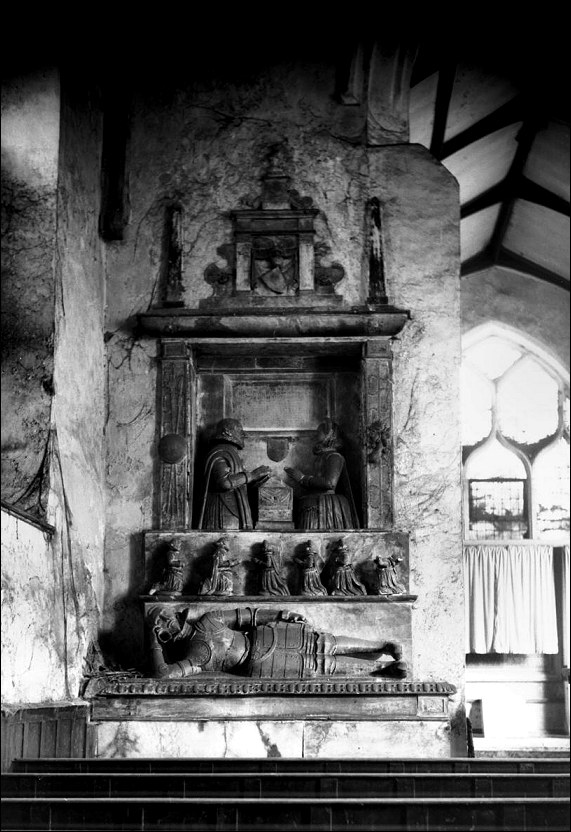
The monument rises from an impressive coloured alabaster base, to the Pettus coat of arms flanked by two obelisks. Sir John in his mayoral robes (he was Mayor in 1608) appears to kneel at a prayer desk opposite his wife, Bridget Curtis, although there is no sign of their legs. Blomefield writing in the 18th century mistook the armorials and identified the kneeling figure as Sir Augustine, who, unlike his father, was never Mayor of Norwich. Most of the literature has followed Blomefield, who was corrected by the Norfolk Heraldry Society (information from Tony Sims). Sir John and Lady Bridget are flanked by pilasters; his decorated with lances, hers with pomegranates and other fruit. Their children, two sons and two daughters kneel underneath, while Sir Augustine, who had died under a year before his father, is repeated lying stiffly in his full armour looking out from the monument, his head propped on his right arm, holding what could be a gauntlet or drinking horn, showing the fingers of a small hand.
Sir John had moved beyond both the family’s relative humble origins as tailors and local politics when in 1604 he had become the first Norwich Member since 1558 to be elected to two consecutive parliaments. He was active as an MP, while continuing his charitable work in Norwich. At the death of his father he had inherited considerable wealth, as well as the family house on Elm Hill, once extending to the churchyard, now nos. 41-43, and the estate at Rackheath, since at death his moveable goods, which included a substantial armoury of nine guns, were valued at £952 19s. 6d and the house on Elm Hill contained 27 rooms, together with stables for eight horses.
Blomefield, An Essay towards a Topographical History of the County of Norfolk: volume 4: The History of the City and County of Norwich, part II, ‘chapter 42: East Wimer ward', (1806), pp. 329-367; Chris Kyle, ‘Sir John Pettus’ in The History of Parliament: the House of Commons 1604-1629, , ed. Andrew Thrush and John P. Ferris, 2010.
Thursday, July 13th
Finding and Applying for Federal Jobs
Federal Track
9:30 AM – 11:30 AM
Federal A&B
Description
Unlock the Secrets to Landing Your Federal Dream Job! Master the Art of Federal Job Hunting and Craft the Perfect Federal Resume to Stand Out in the Crowd!
During this session, you will learn:
The difference between a private sector and federal resume
How to document work history and education
Do’s and Dont’s of a federal resume
Developing a master resume
Navigating USAJOBS
The federal hiring process
Speaker
LaShawn Dobbins(Speaker)U.S. Department of Homeland Security, Director of Strategic Talent Recruitment
--
Shattering the Glass Ceiling: Career Journeys of AANHPIs to the Senior Executive Service
Federal Track
12:30 PM – 2:00 PM
Federal A&B
Description
AANHPIs represent 7% of the Federal workplace, and hold 5% of the executive leadership positions. Hear from AANHPI women in different Federal agencies and departments on their career paths, how their navigated their way through the process, the different pathways for becoming an executive leader, and challenges and opportunities and how you can position yourself to become a Federal executive.
Speakers
Vivian Chen(Moderator)Chief Learning Officer U.S. Department of Agriculture
Natalie Lui Duncan(Speaker)Food Safety and Inspection Service, U.S. Department of Agriculture, Deputy Assistant Administrator
Emily Su(Speaker)U.S. Department of Energy, Assistant General Counsel for Enforcement
Jiashen You(Speaker)U.S. Equal Employment Opportunity Commission, Chief Data Officer and Director for the Office of Enterprise Data and Analytics
--
Civil Rights, Equal Employment Opportunity (EEO), Affirmative Employment, and now DEIA? How do these all play out for people of color in general and AANHPIs specifically?
Federal Track
2:15 PM – 3:45 PM
Pan American
Description
Hear from Federal DEIA leaders on how EEO and Civil Rights laws have been enhanced with DEIA principles promoted in the federal workplace through President Biden's issuance of Executive Orders (EOs) which have advanced equity, civil rights, racial justice and equal opportunity throughout all of the Federal Government. In June 2021, the President specifically issued EO 14035, Diversity, Equity, Inclusion, and Accessibility (DEIA) in the Federal Workforce so that Agency workforces reflect the diversity of America through its employment policies and practices to ensure that public servants at all levels have an equal opportunity to succeed and lead. This builds on other Equity-related EOs such as EO 13985 Advancing Racial Equity and Support for Underserved Communities through the Federal Government. The Federal Government is working to be a model for DEIA, where all employees are treated with dignity and respect through its recruitment, hire, professional development, career advancement and retention of the Nation’s talent with initiatives to remove barriers to equal opportunity. Hear how the Federal Government is ensuring accountability to assure a diverse, equitable, inclusive, and accessible workplaces that yields higher-performing organizations.
Speakers
Javier Inclan(Moderator)National Science Foundation Office of Inspector General, Assistant Inspector General for Management and CIO
Dorris Lin(Speaker)U.S. Department of Homeland Security, Director for Inclusive Diversity
Cyrus Salazar(Speaker)DHS/TSA
Golda Philip(Speaker)Maternal and Child Health Bureau, Senior Advisor for Equity
--
Welcome Reception
6:00 PM – 9:00 PM
Presidential
Description
Kick off the convention with a warm welcome from OCA National and OCA-DC Chapter, and enjoy some appetizers while networking with fellow attendees.
Speakers
Thu Nguyen, Executive Director, OCA
United States Representative, Ted Lieu, California's 36th Congressional District; Vice Chair of the House Democratic Caucus
United States Representative, Judy Chu, California's 28th congressional district; Chair of the Congressional Asian Pacific American Caucus
United States Representative, Grace Meng, New York's Sixth Congressional District
Linda NG, National President, OCA
Scott Sapperstein - AT&T's Assistant Vice President of Public Affairs
Bel Leong-Hong, Past Present of the OCA Greater Washington DC, DNC AAPI Caucus Chair Bel Leong-Hong
Adrienne Ngar-Yee Poon, President, OCA-Greater Washington, DC Chapter, Asian Pacific American Advocates
Ben de Guzman, Director of the Mayor's Office on Asian and Pacific Islander Affairs (MOAPIA)
Claudine Cheng, former OCA National President
Laura Berrocal, Vice President, Policy and External Affairs at Charter Communications
Helen Zia, EXECUTOR - ESTATE OF LILY AND VINCENT CHIN
DEBBIE CHEN, EXECUTIVE VP, OCA
Brandon Tsay, an American hobbyist computer programmer who disarmed the 2023 Monterey Park shooting gunman
--
Copyright ChineseinUS.org. Photograph by Hong
Feel free to distribute these photos as long as they credit "ChineseinUS.org, Photograph by Hong" and this FB page (www.facebook.com/ChineseinusORG/photos_albums) for the original creation.
If you have used photos from our organization please send a link to your work to info@Chineseinus.org
The photograph may not be manipulated in any way and may not be used in advertisements, emails, products, or promotions.
Those ChineseinUS.org photograph is being made available only for publication by news organizations and for noncommercial personal use.
Reproduction or citation of photos requires attribution to Chineseinus.org or ChineseinUS (CUS). If you use the following social media: please cite it on Facebook @ChineseinusORG, Twitter citation please @ChineseinusOrg, Instagram citation please @chineseinusorg. If there is any infringement, please contact for removal.
About Us:
Chineseinus.org or ChineseinUS (CUS), aka ChineseinUS PHL(CUP) in Philadelphia
WeChat Official Account: Chineseinus_org (Philadelphia News)
WeChat Official Account:IRSNEWS
Website: chineseinus.org
--
ChineseinUS.org版权所有。摄影:洪
请自由传播这些照片,只要注明 "ChineseinUS.org, Photograph by Hong "和本FB页面(https://www.facebook.com/ChineseinusORG/photos_albums)的原创。
如果你使用了我们组织的照片,请将你的作品链接发到 info@Chineseinus.org
该照片不得以任何方式进行处理,不得用于广告、电子邮件、产品或促销活动。
这些ChineseinUS.org的照片只提供给新闻机构出版和非商业的个人使用。
复制或引用照片需要注明ChineseinUS.org或ChineseinUS(CUS)。如果你使用以下社交媒体:请在Facebook @ChineseinusORG上引用,Twitter引用请@ChineseinusOrg,Instagram引用请@chineseinusorg。如果有任何侵权行为,请联系删除。
--
关于我们:
中文:华人在美东;在费城又名:费城华人在美东
微信公众号:chineseinus_org (费城新闻)
微信公众号:IRSNEWS(国税局新闻)
网站:chineseinus.org
欢迎引用并注明来源(微信公众号:chineseinus_org ,网站:chineseinus.org)
1857 Will of Crozier Eaton, Part I, from the Pulaski County, Virginia Will Book I & II, Pages 445-448. Obtained from The Library of Virginia, Richmond, VA. Transcribed by Christopher Walker, August 18, 2016©.
This is an important pre-Civil War document that is unique because it contains the first and last names of four slaves: JOHN BLACK, CHARLOTTE BLACK [Charlotte Black Walker (1836-abt. 1895)], LUCINDA ANN BLACK [Lucinda Ann Walker Austin (1855-1890)], and CRAIG BLACK [Craig Black (1830-Unknown)]. This will is also unique in that it gives the following instructions to the executors of Crozier Eaton's estate: "the balance of my slaves I want appraised and sold to my Executors at private sale, to such persons as they, the slaves may respectively select provided the selected person will give the amount of the appeasement, and provided further that no mother and her child are to be separated."
Charlotte Black Walker was my great, great grandmother and Lucinda Ann Walker Austin was her daughter.
The Crozier Eaton House, now known as the John Hoge House, located in Belspring, Pulaski County, Virginia was added in 1988 to the National Register of Historic Places.
Page 445
I Crozier Eaton of the County of Pulaski and State of Virginia being of sound mind but weak in body from a disease from which I have but very little hope of ever recovering, have thought it best to make some disposition of the earthly goods which the Lord in his good providence has blest me with. I therefore make ordain and declare this instrument of writing to be my last Will and Testament.
First—I direct that all my just debts which are but few in number and none of magnitude be paid off by my Executors. Secondly. I give to my wife Kesiah [sic] Eaton who has always been good and kind to me, one Negro Man named John Black, and one Negro woman named Charlotte Black and her child named Lucinda Ann, two head of Horses called Ned and Bolly, two Beds & Bedsteds [sic] with full furniture, one Set Chairs One Cupboard and Cupboard sense and one Cooking Stove with its fixtures, also five hundred dollars in money, all of which is to be bonafidely [sic] hers without reserve or limitation.
Thirdly. I give to my aged Father Two hundred dollars in money not that he is likely to need it, but is a token of my love and affection for him.
Fourthly—I give to my brothers Joseph Eaton, David Eaton, Edward Eaton, and my sister Elizabeth Williams and my sister in law Juliet Eaton, my tract of land lying...
Page 446
...on Proerty [sic] in the County of Montgomery containing about fifteen hundred acres, the land was deeded to me by Lorenzo D. Kirk, and the title is somewhat doubtful, they are therefore to take all my right to it, and hold it if they can, but should they loose [sic] it, they are to have nothing from my Estate in lieu of it, nor are they to have any recourse on Kirk or his heirs for it.
Fifthly. In this fore part of this will I have given to my wife these slaves, John Black, Charlotte Black & her child Lucinda Ann, the balance of my slaves I want appraised and sold to my Executors at private sale, to such persons as they, the slaves may respectively select provided the selected person will give the amount of the appeasement, and provided further that no mother and her child are to be separated. In making sale of these slaves my Executors are to give a credit of Twelve months, the purchasers giving bond with good security.
Sixthly. I direct that my tract of land lying in the County of Pulaski and well known as the Rubush [sic] place be sold at public auction on a credit of say Six Twelve and Eighteen months, and I own the half of a hundred acre tract of land in Giles County which lies on the North side of Walkers Big Mountain, this I want sold also on a like credit, but in each case the purchaser is to give bond with good personal security and the title retained until the purchase money is fully paid. I further direct that all my goods and chattels, stock and farming utensils not specifically devised, be sold according to law, together with two shares of stock in the Giles and Pulaski Turnpike Company, also half of my wheat and Bacon, these being much more than my wife will need, the other half must be left for the use of the family.
Seventhly. I give to my brother Edward Eaton the tract of land on which I now live, lying and being in the County of Pulaski on Neck Creek, containing about Two hundred and fifty Acres, for which he is to pay Thirty Six hundred Dollars at the end of five years from the time of my decease or at the death of my wife, just as the one or the other times may suit him best, four hundred Dollars of which is to be paid to the children of my deceased sister Nancy Scott taken collectively their names are not now recollected, four hundred dollars to the children of my deceased brother Richard Eaton, taken collectively, William F. Eaton only excepted, he is to have no part [illegible] Four hundred Dollars to Joseph Eaton, Four hundred Dollars to John Eaton, Four hundred Dollars to Richard...
The Oxford Dictionary of National Biography provides
"Cassel, Sir Ernest Joseph (1852–1921), merchant banker and financier, was born on 3 March 1852 in Cologne, Germany, the youngest of the three children of Jacob Cassel (1802–1875) and Amalia, née Rosenheim (d. 1874). Jacob Cassel had a small banking business, founded by his father, Moses Cassel, which provided a modest but comfortable income. Since at least the late seventeenth century the Cassels had been active in financial affairs in the Rhineland; several of them were advisers or agents for the prince electors. Ernest had a brother, Max Cassel, born in 1848, who died in 1875, and a sister, Wilhelmina Cassel (later Schoenbrunn), to whom he remained close and who managed his household in England in later years. In later life Cassel gave entirely conflicting accounts of the atmosphere of his early home life and the truth is difficult to establish.
Ernest was educated in Cologne until the age of fourteen, when he started work with the banking firm of Eltzbacher. In 1869 he emigrated to Liverpool, where he is said to have arrived with a bag of clothes and a violin, and no evident promise of a job. He soon started work with a firm of German grain-merchants in Liverpool, but a little over a year later he moved to a clerkship with the Anglo-Egyptian Bank in Paris. The outbreak shortly afterwards of the Franco-Prussian War forced him, as a German subject, to return to England, this time to a clerkship at the London merchant bank, Bischoffsheim and Goldschmidt, where he was closely associated with Henri Bischoffsheim. This move was probably facilitated by an introduction from the powerful but mysterious European financier Baron Maurice de Hirsch. Cassel was linked with the independent and enterprising businessman until the latter's death in 1896, and he may have modelled his career on Hirsch's.
Early career and marriage
Within a year Cassel, aged only nineteen, had demonstrated his flair by rapidly saving the affairs of a Jewish firm in Constantinople in which Bischoffsheims had an interest. In 1874 he was appointed manager, at an unusually early age, at a salary said to have been £5000 a year, following a series of further highly successful negotiations, especially in connection with South American loans. In addition to his salary he obtained substantial commission from the rescue or liquidation of troublesome ventures on Bischoffsheims' behalf. Such activities gained for him international contacts through whom he became profitably involved on his own account in American and other overseas enterprises. When his father died in 1875, leaving Ernest a half share with his sister of RM 91,286 (£4500), Cassel could afford to settle more than his own half (£3000) upon his sister, who was now divorced, and her two children. When he married in 1878 he was able to put aside capital of £150,000.
In 1878 Cassel married Annette (d. 1881), daughter of Robert Thompson Maxwell, of Croft House, Croft, Darlington, and on the day of his marriage he became a naturalized British subject. His wife died of tuberculosis three years later, to his great grief. They had one daughter, Maud. Mrs Cassel had been converted to Roman Catholicism and by her wish Cassel, never devoutly Jewish, was received into the Roman Catholic church shortly after her death. His devotion to his new religion was never very evident, nor was his conversion widely known until, at his appointment to the privy council in 1902 he chose, to general surprise, to be sworn in on the Catholic Bible. He never remarried and is not known to have had any intimate relationships for the remainder of his life. He was known as a warm and sociable man, devoted to his daughter and to what remained of his family, and he sustained a number of close and lasting friendships. Margot Asquith described him as ‘a man of natural authority … dignified, autocratic and wise; with a power of loving those he cared for’. She added that ‘he had no small talk and disliked gossip’ (Adler, 328). Others who knew him less well described him as kind but cold. He was a very private man who left no intimate record of his life or feelings and destroyed most of his personal papers. After his wife's death his sister and her children, Anna (later Anna Jenkins) and Felix (later knighted, and a prominent barrister and Conservative assistant attorney-general) moved to live with him, and they adopted the name Cassel. First Wilhelmina and then Anna acted as his official hostesses.
Expansion of financial affairs
Thereafter Cassel's main preoccupations, other than his family, were with international finance and entry into high society. He increased his fortune vastly and rapidly through investment in the mining, transportation, and processing of Swedish iron ore (he was responsible for introducing the Gilchrist–Thomas processing technique into Sweden) and in the rapidly expanding American railways. In the early 1880s his association with Bischoffsheims was on a profit-sharing rather than a salaried basis, but he never formally became a partner. In 1884 he left the firm, though he continued to occupy part of their offices until 1898 while working on his own account. He did not join another finance house until 1910, preferring to work independently or to associate in consortia with other financiers for specific projects.
International finance in the fast-growing international economy of the late nineteenth century was risky, requiring a cool head, good contacts, and a shrewd capacity to keep on good terms with powerful people in many countries. At this Cassel was adept. He was known for the sharpness of his dealing and he aroused considerable suspicion, antagonism, and jealousy, though no proof of actual dishonesty was ever disclosed. His great wealth endowed him with a useful capacity for flexibility in his dealings when necessary. In Sweden, for example, he countered the hostility of influential men to the degree of economic power he wielded by allowing Swedish representatives to dominate the board of his company (the Grangesborg-Oxelsund Traffic Company Ltd) and by selling many of its fast-rising shares to Swedish bankers, politicians, and journalists at below the market price, though still at considerable profit. His enemies referred to these tactics as ‘Cassel's greasing system’ (Grunwald, 131). He played an important role in the economic development of Sweden.
At least as important in determining Cassel's great success as any dubious dealing in Sweden and elsewhere was his immense, unremitting capacity for hard work. He was constantly in touch with a multitude of simultaneous transactions, delegating effectively yet never losing control, always available for the key meeting or decision, yet rarely working from his office, constantly travelling among business locations or entertaining contacts. He never neglected to keep in contact with the world of influence wherever it was to be found, whether at the card table, the dinner table, or at Cowes. Also important was his capacity to choose shrewd people to assist him with his affairs or to run specific projects. From 1902 he employed the influential Reginald Brett, Viscount Esher, who was succeeded in 1904 by Sir Sidney Peel. He appointed the talented former public servant Sir Henry Babington-Smith to head the National Bank of Turkey in 1909. They remained close friends and associates and Babington-Smith was an executor of Cassel's will. But the essential ingredients of Cassel's success were his own keen observation and judgement of international and financial affairs, which drew on information from his huge range of contacts worldwide.
From his earliest days with Bischoffsheims, Cassel had been profitably involved with American enterprises, notably the disentanglement of the affairs of the New York, Pennsylvania, and Ohio Railway. In the course of such activities he had become a close and lasting friend of Jacob H. Schiff of the banking house of Kuhn, Loeb & Co., through whom he became profitably interested on his own account in other American enterprises. One of his first operations after becoming independent of Bischoffsheims was the reorganization of the Louisville and Nashville Railway, which he carried through in conjunction with Kuhn, Loeb and with Wertheim and Gompertz of Amsterdam.
From the late 1880s Cassel's interests expanded into South America. He arranged the finances of the Mexican Central Railway for some time and in 1893 he issued the Mexican government's 6 per cent loan. In 1896 he issued the Uruguay government's 5 per cent loan. To a lesser extent he was also active in China, still concentrating on transport and mining, and also in 1895 issuing a 6 per cent government loan. Between 1890 and 1910 he was also involved in arranging loans for Japan, Egypt, Turkey, and Russia. He took relatively little interest in domestic investment, though he did play a part in financing the building of the London underground from 1894, through participation in the Electric Traction Company. However, this did not prove to be a profitable investment. From 1897 Cassel began a long and more rewarding association with Vickers, Sons & Co., the shipbuilding and armaments firm. He organized their purchase of the Barrow Naval and Shipbuilding Construction Company and of the Maxim Gun and Nordenfelt companies. For some years he underwrote the financial issues for Vickers and its subsidiaries.
Cassel was an early investor in gold and diamond mining in South Africa, and this was an important source of his increasing fortune in the 1890s and 1900s. In 1897 he agreed to finance the Aswan Dam and Asyut barrage on the upper Nile, another successful intervention in an underdeveloped economy. He later moved, also profitably, into financing the development of sugar production and marketing (through the Daira Sanieh Company) and also of railways in Egypt. In 1898 he established the National Bank of Egypt and the Agricultural Bank of Egypt, which played an especially important role in financing agricultural development. So also did the Société Anonyme de Wadi Kom Ombo, which he played a leading role in establishing for the purpose of irrigating the great desert plain from the Nile to Gebel es Silsila. A similar attempt to stimulate the economic development of Morocco by establishing the State Bank of Morocco, which Cassel reluctantly undertook in 1906 at the urging of the British and French governments, was less successful. The National Bank of Turkey, which he established in association with other London bankers at the urging of the Turkish government in 1909 with the aim of expanding British commercial and financial involvement in Turkey (in particular for the development of mineral resources), was also unsuccessful. It proved impossible to defeat the strength of French financial and commercial interests in Turkey.
Characteristically Cassel calmed the potential for opposition in Egypt by winning the friendship of the khedive of Egypt. He arranged for him to meet Cassel's other good friend, King Edward VII, in 1903 and in 1904, and he made him a loan of £500,000 at the low rate of 2.5 per cent, in return for commercial and land concessions. This infuriated the consul-general, Lord Cromer, who had encouraged Cassel's initial ventures in Egypt as a means of increasing British influence, but who had the thankless task of attempting to curb the khedive's expenditure. In 1903 Cassel also donated £341,000 to equip and operate travelling eye hospitals in Egypt. This may have been motivated by a desire to mollify opposition. His motives were probably mixed, as he also gave generously to philanthropic causes in Britain. Whatever the motive, the outcome was a major contribution to combating the ravages of eye diseases such as trachoma in poverty-stricken rural Egypt.
Cassel was suspected of demanding honours in return for services to governments and this was a persistent theme in London society gossip of the time. There is certainly an interesting congruence between his progress through the honours lists of the world and his financial services. He became KCMG in 1899, following his major Egyptian deals, and was sworn of the privy council in 1902, after the accession of Edward VII. He had been the friend and companion of the prince of Wales at racing and cards, and as Edward's financial adviser (in succession to Hirsch) he was reputed to be responsible for the surprising fact that Edward ascended the throne free from debt. He became a commander of the Légion d'honneur and received the British GCVO in 1906, following the establishment of the State Bank of Morocco. He was made GCB in 1909, following his agreement to a Foreign Office request to put a further £500,000 into the ailing Bank of Morocco. His collection of decorations, of which he was immensely proud, came to include: commander, first class, of the royal order of Vasa, Sweden (1900); the grand cordon of the Imperial Ottoman order of the Osmanieh, conferred by the khedive in 1903; the crown of Prussia, first class (1908); the grand cross of the Polar Star, Sweden (1909); the order of the Rising Sun, first class, Japan (1911); and the Red Eagle of Prussia, first class, with brilliants (1913).
High society, politics, and philanthropy
Cassel penetrated the élite with the same determination and with some of the same methods by which he achieved business success. From the time of his marriage he cultivated, at a succession of rented and, later, personally owned country houses, the social and political élites—on the hunting field, with the shooting party, at the racecourse, and at the card table. By the 1890s he was an accepted house-guest of the Devonshires at Chatsworth. He took up hunting despite a certain dislike of horses and his incompetence at riding them. He started to own and breed racehorses in 1889, and continued until 1894 in company with Lord Willoughby de Broke, and thereafter alone. Among the chief stallions owned by him were Cylgad and Hapsburg; among his mares were Gadfly, Sonatura, and Doctrine. He had some successes on the course, though the nearest he came to winning the Derby was to come second with Hapsburg in 1914. It took him thirteen years to achieve election to the Jockey Club, in 1908. The patronage of Edward VII enabled his entry to circles otherwise closed to a largely self-made German Jew, but it could not win him entire acceptance.
Some prominent politicians were more welcoming to Cassel. Both Randolph and Winston Churchill were his good friends, as were the Asquiths. Cassel's own politics appear to have been Conservative, but he was never active in the political world. Like other prominent financiers his advice was sought on financial matters by politicians of both parties and by civil servants. He was described in 1903 by Sir Edward Hamilton, joint permanent secretary at the Treasury, as ‘one of the representative men—Natty Rothschild, John (Lord) Revelstoke (the head of Barings) and Cassel, whom I now regard as my first counsellors’ (Hamilton diaries, BL, Add. MS 48658, 16 Nov 1903). Cassel was consulted by Sir Michael Hicks Beach and by Asquith when they were chancellors of the exchequer. Lloyd George dined with him while he held the office but was more reserved. A certain aloofness towards party politics was one of the keys to Cassel's business success; in 1909, at the height of the budget crisis, when the City was organizing against Lloyd George's proposed taxes, Cassel wrote to his son-in-law, Wilfred Ashley, stressing his ‘absolute loyalty to whatever government I happen to be serving, and if whoever happened to be in power could not be certain of this he would not give me, and I certainly would not wish, his confidence’ (Cassel to Ashley, 18 Aug 1909, Broadlands Archive, Cassel MS, folder X6). He did not sign the City's anti-budget petition, though he did cautiously arrange to shift funds to the United States to avoid the new taxes. He was an early, though anonymous, contributor to the Tariff Reform League. Also in the 1900s he opposed the City's Jewish-led boycott of Russian finance in retaliation for the persecution of the Jews. He argued that negotiation and alliance with Russia were more likely to mute their antisemitism than was a boycott.
Especially in his earlier years Cassel mixed widely in theatrical and artistic circles. Alma-Tadema and Burne-Jones were both grateful for his friendship and patronage. He amassed an impressive collection of old masters, including important works by Van Dyck, Franz Hals, Romney, Raeburn, Reynolds, and Murillo, and he acquired French and English furniture, Renaissance bronzes, Dresden china, Chinese jade, and old English silver. He gave away at least £2 million in charitable donations, including £200,000 in 1902 for the founding of the King Edward VII Sanatorium for Consumption at Fenhurst, near Midhurst, with a further £20,000 in 1913; £10,000 in 1907 to the Imperial College of Science and Technology; in 1909 a half share of £46,000 with Lord Iveagh for founding the Radium Institute; £210,000 in 1911 for setting up the King Edward VII British–German Foundation for the aid of distressed people in Germany; £30,000 for distressed workers in Swedish mines; £50,000 to Hampshire hospitals in memory of his daughter; in 1913 £10,000 to Egyptian hospitals; and £50,000 for the sick and needy of Cologne.
Despite his formal conversion to Roman Catholicism, Cassel still regarded himself as Jewish and devoted a considerable amount of money and effort to the international attempts of wealthy Jews to acquire a national home for Jews fleeing from Russia, a movement in which Hirsch had been prominent. During the First World War, Cassel gave at least £400,000 for medical services and the relief of servicemen's families. In 1919 he donated £500,000 for an educational trust fund which was used to establish a faculty of commerce at the London School of Economics, to support the Workers' Educational Association, to finance scholarships for the technical and commercial education of working men, to promote the study of foreign languages by the establishment of professorships, lectureships, and scholarships, and finally to support the higher education of women. He gave £212,000 for the founding of a hospital at Penhurst, Kent, for functional nervous disorders.
Personal grief, winding down, and death
In 1910–11 Cassel came to a turning point in his life, for a mixture of personal and political reasons. He felt great personal grief at the death of Edward VII, as well as losing much of his social and political influence, to the undisguised and often openly antisemitic glee of certain members of high society. The friendship between Edward and ‘Windsor-Cassel’ was close and strong. The two had met at the racecourse about 1896, possibly introduced by Hirsch, and were friends thereafter. They even looked somewhat alike: substantially built, bearded, and moustached in similar style.
Equally tragically, in 1911 his only daughter died after a long battle with tuberculosis. Cassel devoted much care to her in her last year. In 1901 she had married Lieutenant-Colonel Wilfred Ashley, grandson of the great earl of Shaftesbury and great-grandson of Lady Palmerston, through whom he had inherited Broadlands House in Hampshire. Ashley had been Conservative MP for Blackpool since 1906; he served as minister of transport in 1924–9, and was created Baron Mount Temple of Lee in 1932. He was on friendly terms with Cassel, who provided him with financial advice. After his daughter's death Cassel's affection centred upon his two granddaughters, especially the elder, Edwina.
Having decided to reduce the volume of his activity, in 1910 Cassel became a partner in the merchant bank of S. Japhet & Co., but he kept up independent interests and an office close to his sumptuous new home, Brook House in Park Lane. He had previously lived at 48 Grosvenor Square. Brook House had six marble-lined kitchens; an oak-panelled dining room, designed to seat one hundred in comfort; and the entrance hall was panelled in lapis lazuli alternating with green-veined cream-coloured marble and was described as the ‘giant's lavatory’ by Edwina's friends. Until his death Cassel lived there much of the time. He also had a flat in Paris, a Swiss villa (Villa Cassel, at Riederfurk, in the canton of Valais), another villa in the south of France, a stud farm at Moulton Paddocks, Newmarket, bought in 1899, and three country houses bought between 1912 and 1917. These were the Six Mile Bottom estate, Cambridgeshire, purchased in 1912; Branksome Dene, Bournemouth, bought in 1913; and Upper Hare Park, Cambridgeshire, which he acquired in 1917.
The more general curtailment of Cassel's activities may have been due to anticipation of that great disrupter of international finance, a major war. Certainly his personal investments were safely concentrated in North America by 1914. He was strongly aware of the danger of war with Germany as early as 1908. Between 1908 and 1912 he and the German shipowner Alfred Ballin made secret efforts to bring together German and British political leaders to try to avert conflict. When war came he made one of the largest contributions to the war loan and was a member of the Anglo-French financial mission to the USA in 1915, which resulted in a large American loan. Such activities did not prevent Cassel from suffering constant attack in Britain for his German birth, including an unsuccessful attempt to remove him from the privy council.
Thereafter Cassel confined his attention to a limited amount of American business and to racing and shooting parties with old friends, and he was cared for by Edwina. He died on 21 September 1921, sitting at his desk at Brook House, and was buried at Kensal Green cemetery, London, according to Roman Catholic rites. Shortly afterwards Edwina married Lord Louis Mountbatten (Earl Mountbatten of Burma), bringing Broadlands House, which she inherited, into the Mountbatten family. Cassel left an estate worth £7,333,411 gross (with a probate value of £6 million), most of it to his immediate family. He left small items from his art, china, and jade collections to a list of old and valued friends who included the Asquiths, Mr and Mrs Winston Churchill, Lord Birkenhead, Mrs Keppel, Lord Revelstoke, Lord and Lady Reading, and the marchioness of Winchester, as well as some banking friends."
Kensal Green Cemetery, London
Church of St Mary, Stamford - Underneath the arch between the north chapel and chancel, tomb of Sir David Phillip / Phelip 1450- 1506 and wife Anne Seymark 1533-1510 www.flickr.com/gp/52219527@N00/VG480o ++
This was the site of a chantry set up after his death, licenced in November 1506 to David Cecille one of his executors "to fund a chantry of 2 chaplins or 1 chaplin perpetual for the good estate of the King while he lives and for his soul afterwards and for the soul of Elizabeth his late consort and the soul of the said David and of his father and mother and Anne his wife (when she dies) and all faithful with licence for the said chaplin to acquire in mortmoin lands to the value of 9l a year".
Anne was the co-heiress daughter of Thomas Seymark / Semark of Thornhaugh by Alice daughter of William Lexham
and Margaret Oldhall. She was the ward of Sir Richard Sapcote of Elton Hunts and later firstly married to his 2nd son William Sapcote having a son Guy Sapcote m Margaret daughter of Guy Wolston
Sir David & Anne m c1485 but had no children,
.Coming from a lowly welsh family Sir David served Henry Tudor (late Henry Vll) in France and fought at the Battle of Bosworth. He became a squire to the body and gentleman usher at court and steward to the kings mother Margaret Beaufort at Colley Weston palace near Stamford living nearby at Thornhaugh, He also held the office of Keeper of the Kings Swans in the waters of Lincolnshire, Northamptonshire, Cambridgeshire and Huntingdonshire and was also keeper of the royal forest of Kings Cliffe which bounded his estates and Windsor Park. .In 1499 he was sheriff of Bedford and Buckingham and a benefactor to the church of Holme in Hunts where there was a window inscription "Of your chartie pray for Sir Davy Phelip and my lady his wife, and for all benefactors of this windowe".
His nephew by marriage Richard Cecil www.flickr.com/gp/52219527@N00/n6C9NX , father of William Cecil, Lord Burghley joined him having married advantageously Alice daughter of John Dicons alderman of Stamford by Margaret Seymark sister of his wife Anne Seymark ++
On the monument is the Dragon of Wales together with crowned Tudor Roses, and the Portcullis emblem of the Beauforts
The Semarks were out of favour after Bosworth and Annes marriage to David Phelip favoured by the Tudors and Ann's inheritance of the Cheyne fortune resulted into a family of position within the Court of Henry VIII.
Portrait of a Gentleman
West Building, Main Floor—Gallery 59
•Date: c. 1770-1773
•Medium: Oil on Canvas
•Dimensions:
oOverall: 128 × 102 cm (50⅜ × 40 3/16 in.)
•Credit Line: Andrew W. Mellon Collection
•Accession Number: 1940.1.11
•Artists/Makers:
oPainter: Joseph Wright, British, 1734-1797
Provenance
William Curzon [1836-1916], Lockington Hall, Derbyshire; purchased 1916, at the dispersal of the Curzon estate, by Mrs. Claire Marion Cox, London, as Richard, Earl Howe, by John Singleton Copley; consigned 1932 by Mrs. Cox to (The Hackett Galleries, New York); returned to Mrs. Cox and later consigned to (Mrs. Chambers Wood, New York), who sold it 1932 to (M. Knoedler & Co., New York);[1] purchased May 1936 by The A.W. Mellon Educational and Charitable Trust, Pittsburgh; gift 1940 to NGA.
[1]Knoedler’s records give the early provenance (letter from Elizabeth Clare to NGA curator William Campbell, 5 November 1963, in NGA curatorial files). Clare quotes a letter from Mrs. Cox to Mrs. Wood, undated but presumably 1932, in which Mrs. Cox states that the 1916 dispersal “was a hurried executors’ sale and few persons attended it.”
Associated Names
•Cox, Claire Marion, Mrs.
•Curzon, William
•Hackett Galleries, The
•Knoedler & Company, M.
•Mellon Educational and Charitable Trust, The A.W.
•Wood, Chambers, Mrs.
Exhibition History
•1932—Inaugural exhibition, Museum of the City of New York, 1932, no catalogue, as by Copley.
•1933—The Opening Exhibition, Museum of Fine Arts, Springfield, Massachusetts, 1933, no. 1, as by Copley.
Technical Summary
The medium-to-heavyweight canvas is twill woven; it has been lined. The ground is off-white, thinly applied. The painting is mostly executed in thin, opaque layers; the costume is rendered in thicker paint applied in small strokes, the furry texture of the lapels being created by means of a stiff white paint covered with a transparent blue glaze; there is a low impasto in the leaves and highlights. The background is extensively abraded, but otherwise there is minimal paint loss. The moderately thick natural resin varnish has discolored yellow to a moderate degree.
Bibliography
•1941—Preliminary Catalogue of Paintings and Sculpture. National Gallery of Art, Washington, 1941: 43, no. 497, as Richard, Earl Howe by John Singleton Copley.
•1942—Book of Illustrations. National Gallery of Art, Washington, 1942: 249, repro. 7, as Richard, Earl Howe by John Singleton Copley.
•1949—Paintings and Sculpture from the Mellon Collection. National Gallery of Art, Washington, 1949 (reprinted 1953 and 1958): 130, repro., as Richard, Earl Howe, by John Singleton Copley.
•1965—Summary Catalogue of European Paintings and Sculpture. National Gallery of Art, Washington, 1965: 140, as Richard, Earl Howe.
•1968—European Paintings and Sculpture, Illustrations. National Gallery of Art, Washington, 1968: 127, repro., as Richard, Earl Howe.
•1968—Nicolson, Benedict. Joseph Wright of Derby: Painter of Light. 2 vols. London, 1968: 1:36, 207; 2:pl. 90.
•1970—American Paintings and Sculpture: An Illustrated Catalogue. National Gallery of Art, Washington, 1970: 166, repro., as Richard, Earl Howe (?).
•1975—European Paintings: An Illustrated Summary Catalogue. National Gallery of Art, Washington, 1975: 376, repro., as Richard, Earl Howe (?).
•1975—Walker, John. National Gallery of Art, Washington. New York, 1975: no. 530, color repro.
•1980—American Paintings: An Illustrated Catalogue. National Gallery of Art, Washington, 1980: 307, as Richard, Earl Howe (?).
•1985—European Paintings: An Illustrated Catalogue. National Gallery of Art, Washington, 1985: 439, repro., as Richard, Earl Howe (?).
•1992—Hayes, John. British Paintings of the Sixteenth through Nineteenth Centuries. The Collections of the National Gallery of Art Systematic Catalogue. Washington, D.C., 1992: 342-344, repro. 343.
From British Paintings of the Sixteenth through Nineteenth Centuries:
1940.1.11 (497)
Portrait of a Gentleman
•c.1770-1773
•Oil on canvas, 128 × 102 (50⅜ × 40⅛)
•Andrew W. Mellon Collection
Technical Notes
The medium-to-heavyweight canvas is twill woven; it has been lined. The ground is off-white, thinly applied. The painting is mostly executed in thin, opaque layers; the costume is rendered in thicker paint applied in small strokes, the furry texture of the lapels being created by means of a stiff white paint covered with a transparent blue glaze; there is a low impasto in the leaves and highlights. The background is extensively abraded, but otherwise there is minimal paint loss. The moderately thick natural resin varnish has discolored yellow to a moderate degree.
Provenance
William Curzon [1836-1916], Lockington Hall, Derbyshire. Purchased 1916, at the dispersal of the Curzon estate, by Mrs. Claire Marion Cox, London, as Richard, Earl Howe, by John Singleton Copley; consigned by Mrs. Cox 1932 to (Hackett Galleries), New York; returned to Mrs. Cox and later consigned to (Mrs. Chambers Wood), New York, who sold it 1932 to (M. Knoedler & Co.), New York,1 from whom it was purchased May 1936 by The A. W. Mellon Educational and Charitable Trust, Pittsburgh.
Exhibitions
Inaugural exhibition, Museum of the City of New York, 1932, no cat., as by Copley. The Opening Exhibition, Museum of Fine Arts, Springfield, Massachusetts, 1933, no. 1, as by Copley.
The traditional identification of the sitter as Admiral Earl Howe (1726-1799), plausible solely on account of a Curzon provenance,2 is now discounted.3 The sitter is not portrayed in naval uniform, and, unlike Howe, he has a cleft chin. He is elegantly dressed, with a felt hat and a waistcoat lined with pale blue velvet.
The traditional attribution to Copley (whose style in the 17608 had affinities with that of Wright) was first corrected in 1965 by Charles Buckley, with the support of Benedict Nicolson.4 The use of an unconventional pose, the delight in materials—notably the furry lapels and the soft leather gloves—the contrived lighting, and the rocky background with trailing vines are all characteristic of Wright’s style. Nicolson described the portrait as a typical work of the early 17705, the period immediately preceding the artist’s Italian years (1773-1775).5 The doublebreasted waistcoat with large pointed lapels worn by the sitter was characteristic of fashion in the 1760s.
A version, rather inferior in quality and differing slightly in the arrangement of the background but identical in pose, costume, and lighting, was formerly owned by Captain R. T. Hinckes, of Foxley, Herefordshire. This portrait was then attributed to Zoffany and identified as representing the Marquis de Rinneau, sometime French ambassador in London.6
Notes
1.Knoedler’s records give the early provenance (Elizabeth Clare to William P. Campbell, 5 November 1963, in NGA curatorial files). Clare quotes a letter from Mrs. Cox to Mrs. Wood, undated but presumably 1932, in which she states that the 1916 dispersal “was a hurried executors’ sale and few persons attended it.”
2.Lord Howe’s eldest daughter, who became Baroness Howe after her father’s death (there were no sons), married in 1787 the Hon. Penn Assheton Curzon. Their son, Richard, who succeeded his paternal grandfather as Viscount Curzon of Penn, took the name of Howe after that of Curzon and in 1821 became the ist Earl Howe of the second creation. The portrait was said to have come from the collection of Baroness Howe, but this cannot be verified.
3.Nicolson 1968; 1 : 207.
4.William P. Campbell, memorandum, 14 June 1965, noting Buckley’s verbal opinions, in NGA curatorial files. The portrait was catalogued as Wright by Campbell in NGA 1970, 166, and by Wilmerding in NGA 1980,307.
5.Nicolson 1968 (see biography), i: 207; compare, for example, the portrait of Sir George Cooke in Kansas City of about 1770-1771 (Nicolson 1968, 2: pl. 86).
6.Hinckes sale, Christie, Manson & Woods, London, 16 April 1937, no. 132, bought in. The evidence for this identification is unknown. No other portraits of anyone named Rinneau seem to be extant, so that the identification cannot be substantiated visually. Moreover, no one bearing the name of Rinneau, or a name remotely similar to it, is listed as ambassador, minister, or chargé d’affaires in London at any time in the eighteenth century (the official list was kindly communicated to me by Anne Lewis-Loubignac, French Embassy, London).
References
•1968—Nicolson 1968, 1: 36,207;2: pi. 90.
•1970—NGA 1970:166, repro. 167.
•1976—Walker 1976: no. 530, color repro.
•1980—NGA 1980: 307.
Draft Title of Mr. Charles Ratsey Isle of Wight for 23 Camden Road, Ramsgate sold to Edward G. Saxby, 1874.
26th & 27th November 1838: Indenture between Anna Rose, Ramsgate, Widow, William Peal, Ramsgate, Carpenter and Samuel Watkins.
Anna Rose inherited under the Will of her husband John Rose, dated 3rd March 1838. John Mercer of Ramsgate the joint Executor.
The land and premises near that of Edward Lampley and that of John Clark who had also purchased premises from Anna Rose. John Rose had purchased the land under
the Will of Revd. William Abbott.
Indenture dated 8th & 9th March 1836 between Sarah and Jane Abbot, Catherine Daniel and John Rose.
13th March 1839 Mortgage between William Peal and Hannah Peake, West Cowes, Isle of Wight, Hampshire.
Hannah Peake died 15th January 1858 her named Executors, John White and Gilbert Fraught? were minors, under 21 Courts took measures to protect their interests until they became of age.
William Peal died 5th October 1872 and his Will of 26th October 1872 appointed his wife, May Ann and son, William Oliver Peal Executrix and Executor.
24th May 1873 Indenture of Grant between Mary Ann Peal, Cleveland Road, Surbiton, Surrey, Widow, Charles Ratsey, Cowes, Isle of Wight, Sailmaker
Draft Will of Jane Moggs of Wymondham, Norfolk, 16th September 1903.
She names her brother, James Moggs, Nephew James Herbert Butolph, her Great Nephew Frederick James Butolph son of her nephew Robert Hilling Butolph, God Child Catherine Neave daughter of John Neave of Ivy House, Broome, her friend Jemima Clitheroe of 106 Park Lane, London as Beneficiaries . She appointed Edward William Routh Clarke of Wattlefield Hall, Wymondham and John Bartle Pomeroy, Solicitor, Wymondham as her executors.
Jane Moggs born 1820 at Woodton, Norwich was the daughter of James and Henrietta Moggs. From at least 1851-1891 she worked for The Clarke Family, first as a Nurse to William Robert Clarke, Brewer and Merchant and his wife Elizabeth at Market Street, Wymondham and then at their home at Wattlefield, Wymondham.
By 1881 she worked as a Companion to their daughter Isabel Eva Clarke and in 1891 as her Housekeeper at Venetian Cottage, Norwich Common, Wymondham, Forehoe, Norfolk. Jene died in 1908 at the age of 89.
ANNAPOLIS, Md. (Jan. 17, 2023) U.S. Naval Academy midshipmen give a presentation to Fabien Cousteau, executor and founder of Proteus Ocean Group (POG), and members of his team on their capstone project. The midshipmen are working with Proteus as part of their final capstone project. (U.S. Navy photo by Mass Communication Specialist 1st Class Jordyn Diomede)
The Prop Store had another couple of panels listed at the time I got mine.
This one had just been sold but I grabbed the image anyway. Looking at it again it differs slightly from mine, having the two round holes in the grill that is visible in the detention corridor and Executor close ups.
It also has more silver paint which looks to have been painted on top of the darker grey.
If the Prop Store had 10 of these, they would have sold in order of how well they had stood the test of time. I'd like to have seen the first one to go!
[Image courtesy of Prop Store]
– I have since matched this one to one in Gus Lopez's collection
On December 2nd., the 29th. Anniversary of the death of Philip Larkin I attended the annual PL Society Christmas event in the Mercure Royal Hotel in Hull. Following the customary formalities and a reading from his latest collection of poems by Anthony Thwaite (one of the literary executors of Philip Larkin's estate) we sat down to afternoon tea.
In the photograph from left to right: The gentleman standing wearing blue knitwear is Professor James Booth author of the recently published biography on Larkin: Philip Larkin a Life Art & Love, on his right closer to camera is the Whitbread Prize- winning author Ann Thwaite (A.A.Milne & Frances Hodgson), on her right her husband the poet and writer Anthony Thwaite. The lady in the wheelchair is Betty Mackereth who was appointed by Larkin as his secretary at Hull University Library in 1957, sorry to see her mobility has deteriorated since I saw her last at this event in 2013.
Draft Title of Mr. Charles Ratsey Isle of Wight for 23 Camden Road, Ramsgate sold to Edward G. Saxby, 1874.
26th & 27th November 1838: Indenture between Anna Rose, Ramsgate, Widow, William Peal, Ramsgate, Carpenter and Samuel Watkins.
Anna Rose inherited under the Will of her husband John Rose, dated 3rd March 1838. John Mercer of Ramsgate the joint Executor.
The land and premises near that of Edward Lampley and that of John Clark who had also purchased premises from Anna Rose. John Rose had purchased the land under
the Will of Revd. William Abbott.
Indenture dated 8th & 9th March 1836 between Sarah and Jane Abbot, Catherine Daniel and John Rose.
13th March 1839 Mortgage between William Peal and Hannah Peake, West Cowes, Isle of Wight, Hampshire.
Hannah Peake died 15th January 1858 her named Executors, John White and Gilbert Fraught? were minors, under 21 Courts took measures to protect their interests until they became of age.
William Peal died 5th October 1872 and his Will of 26th October 1872 appointed his wife, May Ann and son, William Oliver Peal Executrix and Executor.
24th May 1873 Indenture of Grant between Mary Ann Peal, Cleveland Road, Surbiton, Surrey, Widow, Charles Ratsey, Cowes, Isle of Wight, Sailmaker
“[1666, December] 16.—lords day. I went to the funerall of Ann Taylor who was married to Raph Ashton in Abram* and I went fastinge from home so att noone when we had buried the Corps and expected according to custome to have some refreshment and ware a companie of neighbours sate togather round about a table as John Potter Tho Harrison and others the D[octo]r comes and prohibits the filling of any drinke till after prayrs so I came home with Thomas Harrison and we expected to have cald at Neawton but here we ware disappointed but att last with much vexation I gat to Ashton with a hungery belly and honest Thomas Harrison and right true harted Ellin tho hastie yet all love did much refresh my hungry palate with a big cup full an[d] after that ½ full againe of goo[d] pottage.”
[From “Diary of Roger Lowe of Ashton-in-Makerfield”, Wigan Archives ref. D/DZ A58]
Richard Sherlock - “the Doctor”- was nominated for the rectory of Winwick in 1660 but did not actually take up the appointment until 1662. Born at Oxton in 1612, he was educated at Oxford and Dublin, graduating MA in 1633 and receiving a doctorate from Dublin in 1660. Winwick was the culmination of what had already been an eventful ministry. As a young priest he had been caught up in the Irish Rebellion of 1641-3, was taken prisoner by Parliamentarian forces after the Battle of Nantwich in 1644 and, in 1652, was ejected from his curacy in the Oxfordshire village of Cassington. A spell as chaplain to Sir Robert Bindloss of Borwick Hall brought him into contact with Charles Stanley, 8th Earl of Derby. The Earl gave him oversight of certain of his interests in the Isle of Man and afterwards presented him to the living at Winwick, where he remained until his death on 20 June 1689. His published writings include “The Quaker's Wilde Questions..., with brief answers thereunto” (1654; a polemic against Quakerism, to which founder George Fox responded in 1659 with “The Great Mystery of the Great Whore Unfolded”), “The Principles of the Holy Catholick Religion, or the Catechism of the Church of England Paraphrast” (1656) and “Mercurius Christianus: the Practical Christian, a Treatise explaining the duty of Self-examination” (1673). The latter is his best-known work, and has been re-published several times**.
Dr Sherlock's “High Church” religion would probably not have endeared him to Roger Lowe. This may explain why, except in regard to his care for William Harvey***, he does not otherwise feature in the Diary.
*In the appended list of “such as dyd within My Aprentiship...”, Anne Taylor is described as “Aunt Pegges daughter”.
** A biography of Dr Sherlock by Bishop Thomas Wilson is included with the 1712 and later editions of “The Practical Christian”. An edition of 1843 by Rev H H Sherlock, afterwards Rector of Holy Trinity, Ashton in Makerfield, includes some additional biographical information courtesy of “Mr Henry Shaw of Land Gate, Ashton in Winwick; one of whose maternal ancestors, Mr John Sherlock (son of one of the Doctor's cousins), was Bishop Wilson's fellow pupil, both having been educated together by Dr Sherlock”. In his preface to the 1843 edition, Rev Sherlock commended the work “to the parishioners of Winwick generally, and, more especially, to that portion of them residing within his own district of Brynn and Garswood”.
***“Wiliam Harvie cald Nuttoo he livd with Dr. Sherlocke att Winwicke but came to Ashton and there dyed [on 31 August 1673. H]e was basely conceivd of the body of Ellin Harvie uxor to Roger Lowe senr. and begotten by one Marsh”.
Images:
Left: Portrait of Richard Sherlock DD, “late Rector of Winwick”, by Michael van de Gucht. The original can be seen at St Oswald's.
Right, above: Title page from a contemporary printing of “A Sermon Preached at a Visitation held at Warrington in Lancashire May 11, 1669”; Engraving from a 1699 edition of “The Practical Christian”; List of Winwick property-owners in 1673 headed by “Richd Sherlock Rector”, from the Hearth Tax assessments at National Archives ref. E179/132/355.
Right, below: Sherlock memorial brass at St Oswald's, Winwick. Dr Sherlock's will of 14 June 1689 directed that “this corruptible body of mine … be buried in such decent manner as by my executors shall be thought fit betwixt the Chancell and the body of the Church under a stone laid there for that end with this inscription on the stone in Brass Exuviae RICHARDI SHERLOCK D.D., Indignissimi Hujus Ecclesiae Rectoris. Sal infatuatum conculcate”; in translation: “The Remains of Richard Sherlock DD, The Very Unworthy Rector of this Church. Tread under foot the worthless salt”. Below these words was added (anonymously, but attributed to Henry Prescott of Chester): “Behold the modesty of this holy man, who wished this unworthy epitaph inscribed on his grave while his life and merits exceed all praise”.
The photographs were taken on 9 September 2023.
Thursday, July 13th
Finding and Applying for Federal Jobs
Federal Track
9:30 AM – 11:30 AM
Federal A&B
Description
Unlock the Secrets to Landing Your Federal Dream Job! Master the Art of Federal Job Hunting and Craft the Perfect Federal Resume to Stand Out in the Crowd!
During this session, you will learn:
The difference between a private sector and federal resume
How to document work history and education
Do’s and Dont’s of a federal resume
Developing a master resume
Navigating USAJOBS
The federal hiring process
Speaker
LaShawn Dobbins(Speaker)U.S. Department of Homeland Security, Director of Strategic Talent Recruitment
--
Shattering the Glass Ceiling: Career Journeys of AANHPIs to the Senior Executive Service
Federal Track
12:30 PM – 2:00 PM
Federal A&B
Description
AANHPIs represent 7% of the Federal workplace, and hold 5% of the executive leadership positions. Hear from AANHPI women in different Federal agencies and departments on their career paths, how their navigated their way through the process, the different pathways for becoming an executive leader, and challenges and opportunities and how you can position yourself to become a Federal executive.
Speakers
Vivian Chen(Moderator)Chief Learning Officer U.S. Department of Agriculture
Natalie Lui Duncan(Speaker)Food Safety and Inspection Service, U.S. Department of Agriculture, Deputy Assistant Administrator
Emily Su(Speaker)U.S. Department of Energy, Assistant General Counsel for Enforcement
Jiashen You(Speaker)U.S. Equal Employment Opportunity Commission, Chief Data Officer and Director for the Office of Enterprise Data and Analytics
--
Civil Rights, Equal Employment Opportunity (EEO), Affirmative Employment, and now DEIA? How do these all play out for people of color in general and AANHPIs specifically?
Federal Track
2:15 PM – 3:45 PM
Pan American
Description
Hear from Federal DEIA leaders on how EEO and Civil Rights laws have been enhanced with DEIA principles promoted in the federal workplace through President Biden's issuance of Executive Orders (EOs) which have advanced equity, civil rights, racial justice and equal opportunity throughout all of the Federal Government. In June 2021, the President specifically issued EO 14035, Diversity, Equity, Inclusion, and Accessibility (DEIA) in the Federal Workforce so that Agency workforces reflect the diversity of America through its employment policies and practices to ensure that public servants at all levels have an equal opportunity to succeed and lead. This builds on other Equity-related EOs such as EO 13985 Advancing Racial Equity and Support for Underserved Communities through the Federal Government. The Federal Government is working to be a model for DEIA, where all employees are treated with dignity and respect through its recruitment, hire, professional development, career advancement and retention of the Nation’s talent with initiatives to remove barriers to equal opportunity. Hear how the Federal Government is ensuring accountability to assure a diverse, equitable, inclusive, and accessible workplaces that yields higher-performing organizations.
Speakers
Javier Inclan(Moderator)National Science Foundation Office of Inspector General, Assistant Inspector General for Management and CIO
Dorris Lin(Speaker)U.S. Department of Homeland Security, Director for Inclusive Diversity
Cyrus Salazar(Speaker)DHS/TSA
Golda Philip(Speaker)Maternal and Child Health Bureau, Senior Advisor for Equity
--
Welcome Reception
6:00 PM – 9:00 PM
Presidential
Description
Kick off the convention with a warm welcome from OCA National and OCA-DC Chapter, and enjoy some appetizers while networking with fellow attendees.
Speakers
Thu Nguyen, Executive Director, OCA
United States Representative, Ted Lieu, California's 36th Congressional District; Vice Chair of the House Democratic Caucus
United States Representative, Judy Chu, California's 28th congressional district; Chair of the Congressional Asian Pacific American Caucus
United States Representative, Grace Meng, New York's Sixth Congressional District
Linda NG, National President, OCA
Scott Sapperstein - AT&T's Assistant Vice President of Public Affairs
Bel Leong-Hong, Past Present of the OCA Greater Washington DC, DNC AAPI Caucus Chair Bel Leong-Hong
Adrienne Ngar-Yee Poon, President, OCA-Greater Washington, DC Chapter, Asian Pacific American Advocates
Ben de Guzman, Director of the Mayor's Office on Asian and Pacific Islander Affairs (MOAPIA)
Claudine Cheng, former OCA National President
Laura Berrocal, Vice President, Policy and External Affairs at Charter Communications
Helen Zia, EXECUTOR - ESTATE OF LILY AND VINCENT CHIN
DEBBIE CHEN, EXECUTIVE VP, OCA
Brandon Tsay, an American hobbyist computer programmer who disarmed the 2023 Monterey Park shooting gunman
--
Copyright ChineseinUS.org. Photograph by Hong
Feel free to distribute these photos as long as they credit "ChineseinUS.org, Photograph by Hong" and this FB page (www.facebook.com/ChineseinusORG/photos_albums) for the original creation.
If you have used photos from our organization please send a link to your work to info@Chineseinus.org
The photograph may not be manipulated in any way and may not be used in advertisements, emails, products, or promotions.
Those ChineseinUS.org photograph is being made available only for publication by news organizations and for noncommercial personal use.
Reproduction or citation of photos requires attribution to Chineseinus.org or ChineseinUS (CUS). If you use the following social media: please cite it on Facebook @ChineseinusORG, Twitter citation please @ChineseinusOrg, Instagram citation please @chineseinusorg. If there is any infringement, please contact for removal.
About Us:
Chineseinus.org or ChineseinUS (CUS), aka ChineseinUS PHL(CUP) in Philadelphia
WeChat Official Account: Chineseinus_org (Philadelphia News)
WeChat Official Account:IRSNEWS
Website: chineseinus.org
--
ChineseinUS.org版权所有。摄影:洪
请自由传播这些照片,只要注明 "ChineseinUS.org, Photograph by Hong "和本FB页面(https://www.facebook.com/ChineseinusORG/photos_albums)的原创。
如果你使用了我们组织的照片,请将你的作品链接发到 info@Chineseinus.org
该照片不得以任何方式进行处理,不得用于广告、电子邮件、产品或促销活动。
这些ChineseinUS.org的照片只提供给新闻机构出版和非商业的个人使用。
复制或引用照片需要注明ChineseinUS.org或ChineseinUS(CUS)。如果你使用以下社交媒体:请在Facebook @ChineseinusORG上引用,Twitter引用请@ChineseinusOrg,Instagram引用请@chineseinusorg。如果有任何侵权行为,请联系删除。
--
关于我们:
中文:华人在美东;在费城又名:费城华人在美东
微信公众号:chineseinus_org (费城新闻)
微信公众号:IRSNEWS(国税局新闻)
网站:chineseinus.org
欢迎引用并注明来源(微信公众号:chineseinus_org ,网站:chineseinus.org)
Star Wars Celebration Europe 2013
Die Star Wars Celebration Europe ist das weltgrößte Treffen von Fans der Science-Fiction-Filmsaga Star Wars.
----------------------------------------------------------------------------------------
Underneath the arch between the north chapel and chancel, tomb of Sir David Phillip / Phelip 1450- 1506 and wife Anne Seymark 1533-1510 www.flickr.com/gp/52219527@N00/VG480o who is buried Chenies manor Bucks which she inherited ++
This was the site of a chantry set up after his death, licenced in November 1506 to David Cecille one of his executors "to fund a chantry of 2 chaplins or 1 chaplin perpetual for the good estate of the King while he lives and for his soul afterwards and for the soul of Elizabeth his late consort and the soul of the said David and of his father and mother and Anne his wife (when she dies) and all faithful with licence for the said chaplin to acquire in mortmoin lands to the value of 9l a year".
Anne was the co-heiress daughter of Thomas Seymark / Semark of Thornhaugh by Alice daughter of William Lexham
and Margaret Oldhall. She was the ward of Sir Richard Sapcote of Elton Hunts and later firstly married to his 2nd son William Sapcote having a son Guy Sapcote m Margaret daughter of Guy Wolston
Sir David & Anne m c1485 but had no children,
.Coming from a lowly welsh family Sir David served Henry Tudor (late Henry Vll) in France and fought at the Battle of Bosworth. He became a squire to the body and gentleman usher at court and steward to the kings mother Margaret Beaufort at Colley Weston palace near Stamford living nearby at Thornhaugh, He also held the office of Keeper of the Kings Swans in the waters of Lincolnshire, Northamptonshire, Cambridgeshire and Huntingdonshire and was also keeper of the royal forest of Kings Cliffe which bounded his estates and Windsor Park. .In 1499 he was sheriff of Bedford and Buckingham and a benefactor to the church of Holme in Hunts where there was a window inscription "Of your chartie pray for Sir Davy Phelip and my lady his wife, and for all benefactors of this windowe".
His nephew by marriage Richard Cecil www.flickr.com/gp/52219527@N00/z8mxo3 , father of William Cecil, Lord Burghley joined him having married advantageously Alice daughter of John Dicons alderman of Stamford by Margaret Seymark sister of his wife Anne Seymark ++
On the monument is the Dragon of Wales together with crowned Tudor Roses, and the Portcullis emblem of the Beauforts
The Semarks were out of favour after Bosworth and Annes marriage to David Phelip favoured by the Tudors and Ann's inheritance of the Cheyne fortune resulted into a family of position within the Court of Henry VIII.
www.cb5.co.uk/davidphelip.htm - Church of St Mary Stamford Lincolnshire
The second Ida Rentoul Outhwaite Children's Library Stained Glass Window features the excerpt from a poem; "When the children go away, leaving earth's gray lonely places, God I know has room for play, in his gracious starry spaces". The hand-painted panel features three Australian native koalas in natty moss green sporting tweeds and red checks playing a round of golf (most fashionable in the 1920s) with three cheeky pixies as their caddies. One of the green tweed koalas smokes a pipe. The red check koala appears not only to have nearly hit one of his companion koalas with his club, but has sent his ball flying right into the nose of a pixie spectator. A rabbit, two laughing kookaburras and a goanna watch the scene with amusement; the kookaburras especially! Peeping from over the ridge, a Metroland 1920s clubhouse with a red tile roof, white walls and dormer windows can just be seen. Executed with a muted palate of mossy greens, reddish browns, pink and golden yellow, the colours of the Australian bush in summertime are truly captured in this pane. All the characters come from the book "Fairyland", published by A. and C. Black in London in 1926.
In 1923 with Fitzroy still very much a working class area of Melbourne with pockets of poverty, the parish of St. Mark the Evangelist decided to address the need of the poor in the inner Melbourne suburb. Architects Gawler and Drummond were commissioned to design a two storey red brick Social Settlement Building. It was opened in 1926 by the Vicar of St. Mark the Evangelist, the Reverend Robert G. Nichols (known affectionately amongst the parish as Brother Bill). Known today as the Community Centre, the St. Mark the Evangelist Social Settlements Building looks out onto George Street and also across the St. Mark the Evangelist's forecourt. When it opened, the Social Settlement Building's facilities included a gymnasium, club rooms and children's library.
Opened in 1926, the children's library, which was situated in the corner room of the Social Settlements Building, is believed to be the first known free dedicated children's library in Victoria. The library was given to the children of Fitzroy by Mrs. T. Hackett, in memory of her late husband. The library contained over 3,000 books, as well as children's magazines and even comics. The Social Settlements Building was only erected because Brother Bill organised the commitment of £1,000.00 each from various wealthy businessmen and philanthropists around Melbourne. Mrs Hackett's contribution was the library of £1,000.00 worth of books. Another internationally famous resident of the neighbourhood, Australian children's book illustrator Ida Rentoul Outhwaite, then at the zenith of her career, was engaged by the relentless Brother Bill to create something for the library. Ida donated four stained glass windows each with a hand-painted panel executed by her, based upon illustrations from her books, most notably "Elves and Fairies" which was published to great acclaim in Australia and sold internationally in 1916 and "Fairyland" which had been published earlier that year. These four hand painted stained glass windows were equated to the value of £1,000.00, but are priceless today, as they are the only public works of Ida Rentoul Outhwaite ever commissioned that have been executed in this medium. Ida Rentoul Outhwaite was only ever commissioned to create one other public work; a series of four panels executed in watercolour with pencil underdrawing in 1910 for the Prince Henry Hospital's children's wards in Melbourne (now demolished). Of her panels, only two are believed still to be in existence, buried within the hospital archives. The four Ida Rentoul Outhwaite stained glass windows each depict faeries, pixies, Australian native animals and children, taken from her book illustrations. At the time of photographing, the windows - three overlooking George Street and one St. Mark the Evangelist's forecourt - were located in the community lounge, which served as a drop-in lounge and kitchen for Fitzroy's homeless and marginalised citizens. Today the space has been re-purposed as offices for the Anglicare staff who run the St. Mark's Community Centre, possibly as a way to protect the precious windows from coming to any harm. The only down-side to this is that they are not as easily accessed or viewed as when I photographed them, making my original visit to St. Mark the Evangalist in 2009 extremely fortuitous.
The Ida Rentoul Outhwaite Children's Library Stained Glass Windows are one of Australia's greatest hidden treasures, which seems apt when you consider that the pixies and faeries they depict are also often in hiding when we read about them in children's books and the faerie tales of our childhood. The fact that they are hidden, because it is necessary to enter a little-known and undistinguished building in order to see them, ensures their protection and survival. The windows are unique, not only because they are the only stained glass windows designed and hand-painted by Ida Rentoul Outhwaite, but because they are the earliest and only examples of stained glass art in Australia that deals with theme of childhood.
I am indebted to Peter Bourke who ran the St. Mark's Community Centre in 2009 for giving me the privilege of seeing these beautiful and rare windows created by one of my favourite children's book artists on a hot November afternoon, without me having made prior arrangements. I also appreciate him allowing me the opportunity to photograph them in great detail. I will always be grateful to him for such a wonderful and moving experience.
Ida Sherbourne Outhwaite (1888 - 1960) was an Australian children's book illustrator. She was born on the 9th of June 1888 in the inner Melbourne suburb of Carlton. She was the daughter of the of Presbyterian Reverend John Laurence Rentoul and his wife Annie Isobel. Her family was both literary and artistic, and as such, gifted Ida was encouraged from an early age to embrace her talent of drawing. Her elder sister, Annie Rattray Rentoul (1882 - 1978), was likewise encouraged to write, and both would later form a successful partnership. In 1903 six fairy stories written by Annie and illustrated by Ida were published in the ladies' journal "New Idea". The following year the Rentoul sisters collaborated on a book called "Mollie's Bunyip" which was received with instant success because it combined the idea of European faeries, witches and elves and the Australian bush. "Mollie's Staircase" followed in 1906. In 1908 the Rentoul sisters published their first substantial story book, "The Lady of the Blue Beads". On 9 December 1909 Ida married Arthur Grenbry Outhwaite (1875-1938), manager of the Perpetual Executors and Trustees Association of Australia Ltd. (Annie remained unmarried her entire life). After her marriage, Ida was known as Ida Rentoul Outhwaite, but did not publish anything substantial as she established her family and household until part way through the Great War. In 1916 she brought out her first coloured work; "Elves and Fairies", a de luxe edition produced entirely in Australia by Thomas Lothian. The success of the book, with its delicate watercolour plates, was due both to Ida's artistic talent and to the business acumen of her husband, who provided a £400.00 subsidy to ensure a high-quality production and consigned royalties to the Red Cross, thereby encouraging vice-regal patronage. "Elves and Fairies" is still her best known and loved work. Encouraged by her latest success, Ida travelled to Europe after hostilities ended and in 1920 exhibited in Paris and London. The critics compared her to other artists of the golden years of children's illustration such as Arthur Rackham and Edmund Dulac, thus sealing her international success. She signed a contract with British book publishers A. & C. Black who published five books for her over the next decade, including "The Enchanted Forest" (1921), with text by her husband, and, probably the most popular of all the Rentoul sisters' collaborations, "The Little Green Road to Fairyland" (1922). "The Fairyland of Ida Rentoul Outhwaite" (1926), another sumptuous volume, with text by her husband and sister, was less successful. A. & C. Black also produced a number of postcard series using her illustrations from "Elves and Fairies" as well as her other books published by them. In 1930 the last of her books published by A. & C. Black was released, but already times were changing, and the interest in Ida's work was rapidly fading. Angus & Robertson brought out two more books in 1933 and 1935 but they received relatively little attention. Her last two exhibitions, which between 1916 and 1928 were almost annual events, were held in 1933. The Second World War changed the world, and Ida and Annie's work was relegated to a bygone era, shunned and forgotten. Ida suffered the loss of both of her sons during the war, and she spent her last years sharing a flat in Caulfield with her sister, where, survived by her two daughters, she died on 25 June 1960. She did not live to see the resurgence of interest in her work some twenty-five years later, when in 1985, her picture of "The Little Witch" from "Elves and Fairies" was published on an Australian stamp, opening the fairy world of Ida Rentoul Outhwaite to a whole new generation of children and adults alike.
“A Fact a Day About Brooklyn”
Two points along the Shore Road long have disputed the honor of being called Owl’s Head. One is the high promontory just north of the old Crescent Athletic Club, between 80th and 82d Sts. The other, Owl’s Head Park, lies between Bay Ride Ave. and where the Shore Road turns eastward from New York Bay into Shore Drive Extension.
Owl’s Head Park was an extensive estate laid out and developed by Senator Henry C. Murphy. His executors sold the property to Eliphalet W. Bliss, and the city converted it into a park. While both places claimed the right to the name, the consensus has inclined to the park at 81st St.
The Brooklyn Daily Eagle, 19 August 1941
Draft Title of Mr. Charles Ratsey Isle of Wight for 23 Camden Road, Ramsgate sold to Edward G. Saxby, 1874.
26th & 27th November 1838: Indenture between Anna Rose, Ramsgate, Widow, William Peal, Ramsgate, Carpenter and Samuel Watkins.
Anna Rose inherited under the Will of her husband John Rose, dated 3rd March 1838. John Mercer of Ramsgate the joint Executor.
The land and premises near that of Edward Lampley and that of John Clark who had also purchased premises from Anna Rose. John Rose had purchased the land under
the Will of Revd. William Abbott.
Indenture dated 8th & 9th March 1836 between Sarah and Jane Abbot, Catherine Daniel and John Rose.
13th March 1839 Mortgage between William Peal and Hannah Peake, West Cowes, Isle of Wight, Hampshire.
Hannah Peake died 15th January 1858 her named Executors, John White and Gilbert Fraught? were minors, under 21 Courts took measures to protect their interests until they became of age.
William Peal died 5th October 1872 and his Will of 26th October 1872 appointed his wife, May Ann and son, William Oliver Peal Executrix and Executor.
24th May 1873 Indenture of Grant between Mary Ann Peal, Cleveland Road, Surbiton, Surrey, Widow, Charles Ratsey, Cowes, Isle of Wight, Sailmaker
Draft Will of The Rev’d Charles Grove Snowden, Mitford, Morpeth, Northumberland, 7th May 1859.
Executors: brothers, Thomas Hodges Grove Snowden of Ramsgate and George Silvanus Snowden of Ramsgate, Kent, Surgeon. Sister, Eliza Louisa Grear (?)
Beneficiaries: Thomas Hodge Grove Snowden, George Silvanus Snowden.
Witnesses: J. W. Harbottle, Butler, Mitford Castle, T.S. Waterson, Schoolmaster, Morpeth.
"George Strode late of Parnham esqr & Catherine his wife one of the daughters & coheiresses of Richard Brodrepp late of Mapperton esq this monument is erected by Thomas Strode of Parnham esqr his brother & executor pursuant to his Will
Catherine Strode dyed ye 14th of September 1746 aged 47
George Strode dyed ye 10th of June 1753 aged 73"
Monument by Peter Scheemakers
George in his will asked to be "buried in my isle at Beaminster near my wife .. a monument to be built to my wife and myself to cost no more than £600 or less than £500"
George was the son of Hugh Strode of London brother of Sir John Strode ++by Grace daughter of Sir Jerome Raustorn Catherine was the daughter of Richard Brodrepp 1673-1737 of www.flickr.com/photos/52219527@N00/14871758051/ by Hester d1755 daughter of William Wake, Archbishop of Canterbury who m2 Thomas Strode d1764 ++ brother of her daughters second husband George
Catherine was the widow of George's cousin Hugh Strode d:1727 son of Sir John Strode of Parham 1679 +++ by 2nd wife Ann daughter of Sir Thomas Browne of Walcot (m 1722) an "eminent rich broker who died suddenly of aappoplectik fit " leaving her estates at Seabrough, Somerset and Chantmarle in Cattistock, Dorset.
George inherited the estates as nephew of Sir John Strode 1679 whose children William 1706, Thomas 1718 and Anne 1731 all died without issue George however was also childless and on the death of his brother and executor Thomas in 1764, the heir was Sir John Oglander of Nunwell House, Brading IOW, son of Sir John Strode's +++ daughter Elizabeth by his 2nd wife Ann Browne, who m William Oglander 1734 great grandson of Sir John Oglander 1655 www.flickr.com/photos/52219527@N00/8651996638/
The relationships here get rather complex and perhaps based on wealth conservation
Julgamento do assassinato dos ativistas José Cláudio e Maria dos Espírito Santo, que foram mortos em março de 2011 em Nova Ipixuna. O resultado do júri, que aconteceu nos dias 03 e 04 de abril, foi a condenação dos executores Alberto Lopes e Lindonjonson Silva, e absolvição de José Rodrigues, acusado de ser o mandante do crime. A ação provocou revolta nos familiares e movimentos agrários que acompanhavam o caso em vigília no Fórum de Marabá (PA).
(CC BY-SA) NINJA
Todas as imagens estão sob licença Creative Commons 3.0 e podem ser utilizadas livremente desde que disponibilizadas nas mesmas condições com o uso do código acima. Imagens em alta resolução estão disponíveis através de requerimento no email fotografia@foradoeixo.org.br
Draft Conveyance Josiah Adams of Ramsgate, Clerk to A & K Daniel, Solicitors of Ramsgate, Miss Helen Bear, Minnie, Bear and Henry Bear, Grocer’s Assistant all of 7, Lorne Road, St Lawrence to Thomas Robert Tucker, Smacker Owner, of 26 La Belle Alliance Square, Ramsgate Land at Southwood, Ramsgate dated 26th July 1901.
Elizabeth Saxby’s Will of 26th November 1879 her niece Catharine Bear and Josiah Adams as Executors which included her house, Alpha Villa near Southwood and two cottages nearby also land that was formerly a Brickfield. Also held in Trust for her nephew John Bear, who died on 1st February 1881 and the the inheritance passed to his 3 children, Helen, Minnie and Henry Bear. Catherine Bear became the wife of Isaac Fenwick and died 19th January 1891.
Thursday, July 13th
Finding and Applying for Federal Jobs
Federal Track
9:30 AM – 11:30 AM
Federal A&B
Description
Unlock the Secrets to Landing Your Federal Dream Job! Master the Art of Federal Job Hunting and Craft the Perfect Federal Resume to Stand Out in the Crowd!
During this session, you will learn:
The difference between a private sector and federal resume
How to document work history and education
Do’s and Dont’s of a federal resume
Developing a master resume
Navigating USAJOBS
The federal hiring process
Speaker
LaShawn Dobbins(Speaker)U.S. Department of Homeland Security, Director of Strategic Talent Recruitment
--
Shattering the Glass Ceiling: Career Journeys of AANHPIs to the Senior Executive Service
Federal Track
12:30 PM – 2:00 PM
Federal A&B
Description
AANHPIs represent 7% of the Federal workplace, and hold 5% of the executive leadership positions. Hear from AANHPI women in different Federal agencies and departments on their career paths, how their navigated their way through the process, the different pathways for becoming an executive leader, and challenges and opportunities and how you can position yourself to become a Federal executive.
Speakers
Vivian Chen(Moderator)Chief Learning Officer U.S. Department of Agriculture
Natalie Lui Duncan(Speaker)Food Safety and Inspection Service, U.S. Department of Agriculture, Deputy Assistant Administrator
Emily Su(Speaker)U.S. Department of Energy, Assistant General Counsel for Enforcement
Jiashen You(Speaker)U.S. Equal Employment Opportunity Commission, Chief Data Officer and Director for the Office of Enterprise Data and Analytics
--
Civil Rights, Equal Employment Opportunity (EEO), Affirmative Employment, and now DEIA? How do these all play out for people of color in general and AANHPIs specifically?
Federal Track
2:15 PM – 3:45 PM
Pan American
Description
Hear from Federal DEIA leaders on how EEO and Civil Rights laws have been enhanced with DEIA principles promoted in the federal workplace through President Biden's issuance of Executive Orders (EOs) which have advanced equity, civil rights, racial justice and equal opportunity throughout all of the Federal Government. In June 2021, the President specifically issued EO 14035, Diversity, Equity, Inclusion, and Accessibility (DEIA) in the Federal Workforce so that Agency workforces reflect the diversity of America through its employment policies and practices to ensure that public servants at all levels have an equal opportunity to succeed and lead. This builds on other Equity-related EOs such as EO 13985 Advancing Racial Equity and Support for Underserved Communities through the Federal Government. The Federal Government is working to be a model for DEIA, where all employees are treated with dignity and respect through its recruitment, hire, professional development, career advancement and retention of the Nation’s talent with initiatives to remove barriers to equal opportunity. Hear how the Federal Government is ensuring accountability to assure a diverse, equitable, inclusive, and accessible workplaces that yields higher-performing organizations.
Speakers
Javier Inclan(Moderator)National Science Foundation Office of Inspector General, Assistant Inspector General for Management and CIO
Dorris Lin(Speaker)U.S. Department of Homeland Security, Director for Inclusive Diversity
Cyrus Salazar(Speaker)DHS/TSA
Golda Philip(Speaker)Maternal and Child Health Bureau, Senior Advisor for Equity
--
Welcome Reception
6:00 PM – 9:00 PM
Presidential
Description
Kick off the convention with a warm welcome from OCA National and OCA-DC Chapter, and enjoy some appetizers while networking with fellow attendees.
Speakers
Thu Nguyen, Executive Director, OCA
United States Representative, Ted Lieu, California's 36th Congressional District; Vice Chair of the House Democratic Caucus
United States Representative, Judy Chu, California's 28th congressional district; Chair of the Congressional Asian Pacific American Caucus
United States Representative, Grace Meng, New York's Sixth Congressional District
Linda NG, National President, OCA
Scott Sapperstein - AT&T's Assistant Vice President of Public Affairs
Bel Leong-Hong, Past Present of the OCA Greater Washington DC, DNC AAPI Caucus Chair Bel Leong-Hong
Adrienne Ngar-Yee Poon, President, OCA-Greater Washington, DC Chapter, Asian Pacific American Advocates
Ben de Guzman, Director of the Mayor's Office on Asian and Pacific Islander Affairs (MOAPIA)
Claudine Cheng, former OCA National President
Laura Berrocal, Vice President, Policy and External Affairs at Charter Communications
Helen Zia, EXECUTOR - ESTATE OF LILY AND VINCENT CHIN
DEBBIE CHEN, EXECUTIVE VP, OCA
Brandon Tsay, an American hobbyist computer programmer who disarmed the 2023 Monterey Park shooting gunman
--
Copyright ChineseinUS.org. Photograph by Hong
Feel free to distribute these photos as long as they credit "ChineseinUS.org, Photograph by Hong" and this FB page (www.facebook.com/ChineseinusORG/photos_albums) for the original creation.
If you have used photos from our organization please send a link to your work to info@Chineseinus.org
The photograph may not be manipulated in any way and may not be used in advertisements, emails, products, or promotions.
Those ChineseinUS.org photograph is being made available only for publication by news organizations and for noncommercial personal use.
Reproduction or citation of photos requires attribution to Chineseinus.org or ChineseinUS (CUS). If you use the following social media: please cite it on Facebook @ChineseinusORG, Twitter citation please @ChineseinusOrg, Instagram citation please @chineseinusorg. If there is any infringement, please contact for removal.
About Us:
Chineseinus.org or ChineseinUS (CUS), aka ChineseinUS PHL(CUP) in Philadelphia
WeChat Official Account: Chineseinus_org (Philadelphia News)
WeChat Official Account:IRSNEWS
Website: chineseinus.org
--
ChineseinUS.org版权所有。摄影:洪
请自由传播这些照片,只要注明 "ChineseinUS.org, Photograph by Hong "和本FB页面(https://www.facebook.com/ChineseinusORG/photos_albums)的原创。
如果你使用了我们组织的照片,请将你的作品链接发到 info@Chineseinus.org
该照片不得以任何方式进行处理,不得用于广告、电子邮件、产品或促销活动。
这些ChineseinUS.org的照片只提供给新闻机构出版和非商业的个人使用。
复制或引用照片需要注明ChineseinUS.org或ChineseinUS(CUS)。如果你使用以下社交媒体:请在Facebook @ChineseinusORG上引用,Twitter引用请@ChineseinusOrg,Instagram引用请@chineseinusorg。如果有任何侵权行为,请联系删除。
--
关于我们:
中文:华人在美东;在费城又名:费城华人在美东
微信公众号:chineseinus_org (费城新闻)
微信公众号:IRSNEWS(国税局新闻)
网站:chineseinus.org
欢迎引用并注明来源(微信公众号:chineseinus_org ,网站:chineseinus.org)
Title: Desk and Bookcase
Artist/Maker: Benjamin Frothingham (American, 1734-1809; active Charlestown 1754-1809)
Place Made: United States: Massachusetts: Charlestown
Date Made: 1753
Medium: wood; mahogany; white pine; eastern red cedar; Spanish cedar
Measurements: Overall: 98 1/4 in x 44 1/2 in x 24 3/4 in; 249.555 cm x 113.03 cm x 62.865 cm
Credit Line: Gift of Mr. Dana C. Ackerly and Mr. Earle S. Thompson, estate executors, in memory of Mrs. Bell McKerlie Watts and Mr. Samuel Hughes Watts of Fairfield, Connecticut
Collection: The Diplomatic Reception Rooms, U.S. Department of State, Washington, D.C.
Accession No: RR-1970.0094
1868 abstract of deed of Arrangement under Will of Humphrey Bourne, Draper, 13th June 1855, Ramsgate, Kent. Maria Bourne, Wife, R.S. Cramp, John Kennett appointed Executors.
Humphrey Bourne’s Will left Property and money to his wife Maria Bourne, who carried on the business as a Draper, his 4 Children, Humphrey Bourne, Draper, George Winder Bourne, Harry Bourne and Sally Howland Clements the wife of Edward Clements
1970 Vanden Plas Princess 1300.
Last MoT test expired in January 2013. Anglia Car Auctions, King's Lynn -
"Executor sale. Manual gearbox. Comes with eighteen expired MoT certificates from 1984. Last MoT'd in 2012. Offered for restoration.
V5 present."
Sold for £700. No reserve.
Stitched panoramic screenshot
- uncropped raw resolution: 7410 x 3940
- resolution of archived cropped backup: 5920 x 2680
- screenshots used for pano stitching: 30 images
- archive id: Vader006
- camera tools: Universal unlocker
- pc specs: i7 7700k, 16GB ram, gtx 1080
Santa Maria é mais uma cidade do Distrito Federal a priorizar pedestres e pessoas com deficiência. Nove pontos de maior movimentação da região administrativa ganharam calçadas com acessibilidade. Até agora, foram instaladas 3.450m² de passagens construídas à margem das pistas de carro. A previsão para até o fim do ano é de um total de 13 mil metros quadrados. A executora do serviço é a Companhia Urbanizadora da Nova Capital (Novacap). Na foto quadra 102. Fotos: Paulo H. Carvalho / Agência Brasília
John Withers 1692 Barister at law and his wife Ann Cutts / Cutte / Cuttes ister to John Lord Cutts 1707 and daughter of Richard Cutts.
“ Sacred to the memory of John Withers, of the Middle Temple, who lies under this marble, together with his dearly beloved wife, Ann, daughter of Richard Cutts, esq., formerly of this parish: he,after having lived 73 years, died on the 2Sth of November, in the year of our Lord 1692; but she in the bloom of youth. William Withers, nephew and heir, erected this monument, as a testimony of his gratitude to his very dear and worthy uncle.”
Ann was the daughter of Richard Cutts dc1669 of Woodhall manor Arkesden by Joan daughter of Sir Richard Everard of Much Waltham. She predeceased her brother Richard Cutts dsp 1707. Her sister Margaret m John Acton of Basingstoke; another sister Joanna remained unmarried. Richard Cutts left his entire estate to his widowed cousin Mrs Dorothy Pickering, of Lincoln's Inn Fields, and to his sister Joanna, executor of his will.
Monument by Edward Pearce
odnb2.ifactory.com/view/article/6984/6984?docPos=14
monument tomb effigy arkesden essex
Monumento é uma homenagem ao arquiteto Ramos de Azevedo e que também é conhecido como Monumento ao Progresso. Trata-se de um conjunto escultório executado pelo escultor Galileo Emendabili, também executor do obelisco do Ibirapuera. Foi inaugurado em 1934 após seis anos de trabalho, na Avenida Tiradentes em frente ao edifício da Pinacoteca do Estado. Por causa das obras do metrô, o monumento foi desmontado em 1967 e depois transferido para a Cidade Universitária, em 1973, na praça que leva seu nome, em frente ao IPT e à Escola Politécnica.
Title: Desk and Bookcase
Artist/Maker: Benjamin Frothingham (American, 1734-1809; active Charlestown 1754-1809)
Place Made: United States: Massachusetts: Charlestown
Date Made: 1753
Medium: wood; mahogany; white pine; eastern red cedar; Spanish cedar
Measurements: Overall: 98 1/4 in x 44 1/2 in x 24 3/4 in; 249.555 cm x 113.03 cm x 62.865 cm
Credit Line: Gift of Mr. Dana C. Ackerly and Mr. Earle S. Thompson, estate executors, in memory of Mrs. Bell McKerlie Watts and Mr. Samuel Hughes Watts of Fairfield, Connecticut
Collection: The Diplomatic Reception Rooms, U.S. Department of State, Washington, D.C.
Accession No: RR-1970.0094
Draft Conveyance Josiah Adams of Ramsgate, Clerk to A & K Daniel, Solicitors of Ramsgate, Miss Helen Bear, Minnie, Bear and Henry Bear, Grocer’s Assistant all of 7, Lorne Road, St Lawrence to Thomas Robert Tucker, Smacker Owner, of 26 La Belle Alliance Square, Ramsgate Land at Southwood, Ramsgate dated 26th July 1901.
Elizabeth Saxby’s Will of 26th November 1879 her niece Catharine Bear and Josiah Adams as Executors which included her house, Alpha Villa near Southwood and two cottages nearby also land that was formerly a Brickfield. Also held in Trust for her nephew John Bear, who died on 1st February 1881 and the the inheritance passed to his 3 children, Helen, Minnie and Henry Bear. Catherine Bear became the wife of Isaac Fenwick and died 19th January 1891.
Juíz Simão Lemos.
Julgamento do assassinato dos ativistas José Cláudio e Maria dos Espírito Santo, que foram mortos em março de 2011 em Nova Ipixuna. O resultado do júri, que aconteceu nos dias 03 e 04 de abril, foi a condenação dos executores Alberto Lopes e Lindonjonson Silva, e absolvição de José Rodrigues, acusado de ser o mandante do crime. A ação provocou revolta nos familiares e movimentos agrários que acompanhavam o caso em vigília no Fórum de Marabá (PA).
(CC BY-SA) NINJA
Todas as imagens estão sob licença Creative Commons 3.0 e podem ser utilizadas livremente desde que disponibilizadas nas mesmas condições com o uso do código acima. Imagens em alta resolução estão disponíveis através de requerimento no email fotografia@foradoeixo.org.br
Draft Conveyance Josiah Adams of Ramsgate, Clerk to A & K Daniel, Solicitors of Ramsgate, Miss Helen Bear, Minnie, Bear and Henry Bear, Grocer’s Assistant all of 7, Lorne Road, St Lawrence to Thomas Robert Tucker, Smacker Owner, of 26 La Belle Alliance Square, Ramsgate Land at Southwood, Ramsgate dated 26th July 1901.
Elizabeth Saxby’s Will of 26th November 1879 her niece Catharine Bear and Josiah Adams as Executors which included her house, Alpha Villa near Southwood and two cottages nearby also land that was formerly a Brickfield. Also held in Trust for her nephew John Bear, who died on 1st February 1881 and the the inheritance passed to his 3 children, Helen, Minnie and Henry Bear. Catherine Bear became the wife of Isaac Fenwick and died 19th January 1891.
The Shipley Art Gallery is an art gallery in Gateshead, Tyne and Wear, England, located at the south end of Prince Consort Road. It has a Designated Collection of national importance.
Origins
The Shipley Art Gallery opened to the public in 1917. This was made possible by a bequest from wealthy local solicitor and art collector, Joseph Ainsley Davidson Shipley (1822–1909).
Shipley was a rather enigmatic person about whom little is known. He was born in Gateshead, near High Street. He was a solicitor in the Newcastle firm of Hoyle, Shipley and Hoyle. From 1884 until his death, he leased Saltwell Park House, now known as Saltwell Towers. Shipley's main passion was art and collecting paintings. He bought his first painting when he was sixteen and by the time he died he had amassed a collection of some 2,500 paintings.
On his death, Shipley left £30,000 and all his pictures to the City of Newcastle, which was to build a new gallery to house the collection. This was to be known as "The Shipley Bequest". Current belief within local history circles is that Shipley’s will expressly banned Newcastle’s art gallery as a recipient of the bequest, but this assertion must be dismissed: since the foundation stone of the Laing Art Gallery was laid only in August 1901 and the gallery opened in October 1904, the institution did not yet exist in 1900, when Shipley’s will was compiled. Shipley’s will did, in fact, declare that ‘the Art Gallery to be erected in Higham Place will not be and shall not be regarded as an Art Gallery within this trust’, owing to its being ‘too small’, but he conceded that if it ‘shall be capable of being enlarged so as to render it capable of holding all, then I direct my Trustees to raise the sum of £30,000 out of my residuary estate and pay the same to the treasurer of the gallery to be applied in or toward such enlargement as aforesaid’. It was only following a lengthy process that Gateshead Municipal Council was offered the collection. As it was impossible to house all of the paintings, 359 of the pictures recommended by the executors of Shipley's will were selected. A further group was then added by the Gateshead Committee, bringing the total to 504.
In 1914, after the sale of the remaining paintings, work began on the new art gallery. The building, which was designed by Arthur Stockwell, M.S.A. of Newcastle, opened on 29 November 1917. The stone entrance portico is distyle in antis – four Corinthian-style stone columns flanked by solid pilasters. These are surmounted by two sculptured figures, one representing the Arts and the other Industry and Learning, by W. Birnie Rhind, RSA. of Edinburgh.
Pevsner described the art gallery as a "bold arrangement of a brick central block and lower wings containing galleries". The building was designated as Grade II listed in 1982.
Present gallery
The original 504 paintings represented all the main European schools from the sixteenth to the nineteenth centuries. Since 1917, the collection has been added to, and now comprises some 10,000 items.
The gallery holds a strong collection of 16th and 17th century Dutch and Flemish paintings, as well as 19th century British works, watercolours, prints, drawings and sculpture. Also featured are items of local interest, which include the popular painting by William C. Irving ((1866–1943) of "Blaydon Races" (1903) and a 1970 street scene of Redheugh Crossroads by Gateshead-born Charlie Rogers.
Since 1977 the gallery has become established as a national centre for contemporary craftwork. It has built up one of the best collections outside London, which includes ceramics, wood, metal, glass, textiles and furniture. The Shipley is home to the Henry Rothschild collection of studio ceramics. In 2008, the Shipley opened its Designs for Life gallery which showcases the gallery's collections of contemporary craft and design. The Gallery also hosts a varied programme of temporary exhibitions and has a strong partnership with the V&A Museum in London.
The Shipley Art Gallery is managed by Tyne & Wear Archives & Museums on behalf of Gateshead Council.
Gateshead is a town in the Gateshead Metropolitan Borough of Tyne and Wear, England. It is on the River Tyne's southern bank. The town's attractions include the twenty metre tall Angel of the North sculpture on the town's southern outskirts, The Glasshouse International Centre for Music and the Baltic Centre for Contemporary Art. The town shares the Millennium Bridge, Tyne Bridge and multiple other bridges with Newcastle upon Tyne.
Historically part of County Durham, under the Local Government Act 1888 the town was made a county borough, meaning it was administered independently of the county council.
In the 2011 Census, the town had a population of 120,046 while the wider borough had 200,214.
History
Gateshead is first mentioned in Latin translation in Bede's Ecclesiastical History of the English People as ad caput caprae ("at the goat's head"). This interpretation is consistent with the later English attestations of the name, among them Gatesheued (c. 1190), literally "goat's head" but in the context of a place-name meaning 'headland or hill frequented by (wild) goats'. Although other derivations have been mooted, it is this that is given by the standard authorities.
A Brittonic predecessor, named with the element *gabro-, 'goat' (c.f. Welsh gafr), may underlie the name. Gateshead might have been the Roman-British fort of Gabrosentum.
Early
There has been a settlement on the Gateshead side of the River Tyne, around the old river crossing where the Swing Bridge now stands, since Roman times.
The first recorded mention of Gateshead is in the writings of the Venerable Bede who referred to an Abbot of Gateshead called Utta in 623. In 1068 William the Conqueror defeated the forces of Edgar the Ætheling and Malcolm king of Scotland (Shakespeare's Malcolm) on Gateshead Fell (now Low Fell and Sheriff Hill).
During medieval times Gateshead was under the jurisdiction of the Bishop of Durham. At this time the area was largely forest with some agricultural land. The forest was the subject of Gateshead's first charter, granted in the 12th century by Hugh du Puiset, Bishop of Durham. An alternative spelling may be "Gatishevede", as seen in a legal record, dated 1430.
Industrial revolution
Throughout the Industrial Revolution the population of Gateshead expanded rapidly; between 1801 and 1901 the increase was over 100,000. This expansion resulted in the spread southwards of the town.
In 1854, a catastrophic explosion on the quayside destroyed most of Gateshead's medieval heritage, and caused widespread damage on the Newcastle side of the river.
Sir Joseph Swan lived at Underhill, Low Fell, Gateshead from 1869 to 1883, where his experiments led to the invention of the electric light bulb. The house was the first in the world to be wired for domestic electric light.
In the 1889 one of the largest employers (Hawks, Crawshay and Company) closed down and unemployment has since been a burden. Up to the Second World War there were repeated newspaper reports of the unemployed sending deputations to the council to provide work. The depression years of the 1920s and 1930s created even more joblessness and the Team Valley Trading Estate was built in the mid-1930s to alleviate the situation.
Regeneration
In the late noughties, Gateshead Council started to regenerate the town, with the long-term aim of making Gateshead a city. The most extensive transformation occurred in the Quayside, with almost all the structures there being constructed or refurbished in this time.
In the early 2010s, regeneration refocused on the town centre. The £150 million Trinity Square development opened in May 2013, it incorporates student accommodation, a cinema, health centre and shops. It was nominated for the Carbuncle Cup in September 2014. The cup was however awarded to another development which involved Tesco, Woolwich Central.
Governance
In 1835, Gateshead was established as a municipal borough and in 1889 it was made a county borough, independent from Durham County Council.
In 1870, the Old Town Hall was built, designed by John Johnstone who also designed the previously built Newcastle Town Hall. The ornamental clock in front of the old town hall was presented to Gateshead in 1892 by the mayor, Walter de Lancey Willson, on the occasion of him being elected for a third time. He was also one of the founders of Walter Willson's, a chain of grocers in the North East and Cumbria. The old town hall also served as a magistrate's court and one of Gateshead's police stations.
Current
In 1974, following the Local Government Act 1972, the County Borough of Gateshead was merged with the urban districts of Felling, Whickham, Blaydon and Ryton and part of the rural district of Chester-le-Street to create the much larger Metropolitan Borough of Gateshead.
Geography
The town of Gateshead is in the North East of England in the ceremonial county of Tyne and Wear, and within the historic boundaries of County Durham. It is located on the southern bank of the River Tyne at a latitude of 54.57° N and a longitude of 1.35° W. Gateshead experiences a temperate climate which is considerably warmer than some other locations at similar latitudes as a result of the warming influence of the Gulf Stream (via the North Atlantic drift). It is located in the rain shadow of the North Pennines and is therefore in one of the driest regions of the United Kingdom.
One of the most distinguishing features of Gateshead is its topography. The land rises 230 feet from Gateshead Quays to the town centre and continues rising to a height of 525 feet at Queen Elizabeth Hospital in Sheriff Hill. This is in contrast to the flat and low lying Team Valley located on the western edges of town. The high elevations allow for impressive views over the Tyne valley into Newcastle and across Tyneside to Sunderland and the North Sea from lookouts in Windmill Hills and Windy Nook respectively.
The Office for National Statistics defines the town as an urban sub-division. The latest (2011) ONS urban sub-division of Gateshead contains the historical County Borough together with areas that the town has absorbed, including Dunston, Felling, Heworth, Pelaw and Bill Quay.
Given the proximity of Gateshead to Newcastle, just south of the River Tyne from the city centre, it is sometimes incorrectly referred to as being a part of Newcastle. Gateshead Council and Newcastle City Council teamed up in 2000 to create a unified marketing brand name, NewcastleGateshead, to better promote the whole of the Tyneside conurbation.
Economy
Gateshead is home to the MetroCentre, the largest shopping mall in the UK until 2008; and the Team Valley Trading Estate, once the largest and still one of the larger purpose-built commercial estates in the UK.
Arts
The Baltic Centre for Contemporary Art has been established in a converted flour mill. The Glasshouse International Centre for Music, previously The Sage, a Norman Foster-designed venue for music and the performing arts opened on 17 December 2004. Gateshead also hosted the Gateshead Garden Festival in 1990, rejuvenating 200 acres (0.81 km2) of derelict land (now mostly replaced with housing). The Angel of the North, a famous sculpture in nearby Lamesley, is visible from the A1 to the south of Gateshead, as well as from the East Coast Main Line. Other public art include works by Richard Deacon, Colin Rose, Sally Matthews, Andy Goldsworthy, Gordon Young and Michael Winstone.
Traditional and former
The earliest recorded coal mining in the Gateshead area is dated to 1344. As trade on the Tyne prospered there were several attempts by the burghers of Newcastle to annex Gateshead. In 1576 a small group of Newcastle merchants acquired the 'Grand Lease' of the manors of Gateshead and Whickham. In the hundred years from 1574 coal shipments from Newcastle increased elevenfold while the population of Gateshead doubled to approximately 5,500. However, the lease and the abundant coal supplies ended in 1680. The pits were shallow as problems of ventilation and flooding defeated attempts to mine coal from the deeper seams.
'William Cotesworth (1668-1726) was a prominent merchant based in Gateshead, where he was a leader in coal and international trade. Cotesworth began as the son of a yeoman and apprentice to a tallow - candler. He ended as an esquire, having been mayor, Justice of the Peace and sheriff of Northumberland. He collected tallow from all over England and sold it across the globe. He imported dyes from the Indies, as well as flax, wine, and grain. He sold tea, sugar, chocolate, and tobacco. He operated the largest coal mines in the area, and was a leading salt producer. As the government's principal agent in the North country, he was in contact with leading ministers.
William Hawks originally a blacksmith, started business in Gateshead in 1747, working with the iron brought to the Tyne as ballast by the Tyne colliers. Hawks and Co. eventually became one of the biggest iron businesses in the North, producing anchors, chains and so on to meet a growing demand. There was keen contemporary rivalry between 'Hawks' Blacks' and 'Crowley's Crew'. The famous 'Hawks' men' including Ned White, went on to be celebrated in Geordie song and story.
In 1831 a locomotive works was established by the Newcastle and Darlington Railway, later part of the York, Newcastle and Berwick Railway. In 1854 the works moved to the Greenesfield site and became the manufacturing headquarters of North Eastern Railway. In 1909, locomotive construction was moved to Darlington and the rest of the works were closed in 1932.
Robert Stirling Newall took out a patent on the manufacture of wire ropes in 1840 and in partnership with Messrs. Liddell and Gordon, set up his headquarters at Gateshead. A worldwide industry of wire-drawing resulted. The submarine telegraph cable received its definitive form through Newall's initiative, involving the use of gutta-percha surrounded by strong wires. The first successful Dover–Calais cable on 25 September 1851, was made in Newall's works. In 1853, he invented the brake-drum and cone for laying cable in deep seas. Half of the first Atlantic cable was manufactured in Gateshead. Newall was interested in astronomy, and his giant 25-inch (640 mm) telescope was set up in the garden at Ferndene, his Gateshead residence, in 1871.
Architecture
JB Priestley, writing of Gateshead in his 1934 travelogue English Journey, said that "no true civilisation could have produced such a town", adding that it appeared to have been designed "by an enemy of the human race".
Victorian
William Wailes the celebrated stained-glass maker, lived at South Dene from 1853 to 1860. In 1860, he designed Saltwell Towers as a fairy-tale palace for himself. It is an imposing Victorian mansion in its own park with a romantic skyline of turrets and battlements. It was originally furnished sumptuously by Gerrard Robinson. Some of the panelling installed by Robinson was later moved to the Shipley Art gallery. Wailes sold Saltwell Towers to the corporation in 1876 for use as a public park, provided he could use the house for the rest of his life. For many years the structure was essentially an empty shell but following a restoration programme it was reopened to the public in 2004.
Post millennium
The council sponsored the development of a Gateshead Quays cultural quarter. The development includes the Gateshead Millennium Bridge, erected in 2001, which won the prestigious Stirling Prize for Architecture in 2002.
Former brutalism
The brutalist Trinity Centre Car Park, which was designed by Owen Luder, dominated the town centre for many years until its demolition in 2010. A product of attempts to regenerate the area in the 1960s, the car park gained an iconic status due to its appearance in the 1971 film Get Carter, starring Michael Caine. An unsuccessful campaign to have the structure listed was backed by Sylvester Stallone, who played the main role in the 2000 remake of the film. The car park was scheduled for demolition in 2009, but this was delayed as a result of a disagreement between Tesco, who re-developed the site, and Gateshead Council. The council had not been given firm assurances that Tesco would build the previously envisioned town centre development which was to include a Tesco mega-store as well as shops, restaurants, cafes, bars, offices and student accommodation. The council effectively used the car park as a bargaining tool to ensure that the company adhered to the original proposals and blocked its demolition until they submitted a suitable planning application. Demolition finally took place in July–August 2010.
The Derwent Tower, another well known example of brutalist architecture, was also designed by Owen Luder and stood in the neighbourhood of Dunston. Like the Trinity Car Park it also failed in its bid to become a listed building and was demolished in 2012. Also located in this area are the Grade II listed Dunston Staithes which were built in 1890. Following the award of a Heritage Lottery Fund grant of almost £420,000 restoration of the structure is expected to begin in April 2014.
Sport
Gateshead International Stadium regularly holds international athletics meetings over the summer months, and is home of the Gateshead Harriers athletics club. It is also host to rugby league fixtures, and the home ground of Gateshead Football Club. Gateshead Thunder Rugby League Football Club played at Gateshead International Stadium until its purchase by Newcastle Rugby Limited and the subsequent rebranding as Newcastle Thunder. Both clubs have had their problems: Gateshead A.F.C. were controversially voted out of the Football League in 1960 in favour of Peterborough United, whilst Gateshead Thunder lost their place in Super League as a result of a takeover (officially termed a merger) by Hull F.C. Both Gateshead clubs continue to ply their trade at lower levels in their respective sports, thanks mainly to the efforts of their supporters. The Gateshead Senators American Football team also use the International Stadium, as well as this it was used in the 2006 Northern Conference champions in the British American Football League.
Gateshead Leisure Centre is home to the Gateshead Phoenix Basketball Team. The team currently plays in EBL League Division 4. Home games are usually on a Sunday afternoon during the season, which runs from September to March. The team was formed in 2013 and ended their initial season well placed to progress after defeating local rivals Newcastle Eagles II and promotion chasing Kingston Panthers.
In Low Fell there is a cricket club and a rugby club adjacent to each other on Eastwood Gardens. These are Gateshead Fell Cricket Club and Gateshead Rugby Club. Gateshead Rugby Club was formed in 1998 following the merger of Gateshead Fell Rugby Club and North Durham Rugby Club.
Transport
Gateshead is served by the following rail transport stations with some being operated by National Rail and some being Tyne & Wear Metro stations: Dunston, Felling, Gateshead Interchange, Gateshead Stadium, Heworth Interchange, MetroCentre and Pelaw.
Tyne & Wear Metro stations at Gateshead Interchange and Gateshead Stadium provide direct light-rail access to Newcastle Central, Newcastle Airport , Sunderland, Tynemouth and South Shields Interchange.
National Rail services are provided by Northern at Dunston and MetroCentre stations. The East Coast Main Line, which runs from London Kings Cross to Edinburgh Waverley, cuts directly through the town on its way between Newcastle Central and Chester-le-Street stations. There are presently no stations on this line within Gateshead, as Low Fell, Bensham and Gateshead West stations were closed in 1952, 1954 and 1965 respectively.
Road
Several major road links pass through Gateshead, including the A1 which links London to Edinburgh and the A184 which connects the town to Sunderland.
Gateshead Interchange is the busiest bus station in Tyne & Wear and was used by 3.9 million bus passengers in 2008.
Cycle routes
Various bicycle trails traverse the town; most notably is the recreational Keelmans Way (National Cycle Route 14), which is located on the south bank of the Tyne and takes riders along the entire Gateshead foreshore. Other prominent routes include the East Gateshead Cycleway, which connects to Felling, the West Gateshead Cycleway, which links the town centre to Dunston and the MetroCentre, and routes along both the old and new Durham roads, which take cyclists to Birtley, Wrekenton and the Angel of the North.
Religion
Christianity has been present in the town since at least the 7th century, when Bede mentioned a monastery in Gateshead. A church in the town was burned down in 1080 with the Bishop of Durham inside.[citation needed] St Mary's Church was built near to the site of that building, and was the only church in the town until the 1820s. Undoubtedly the oldest building on the Quayside, St Mary's has now re-opened to the public as the town's first heritage centre.
Many of the Anglican churches in the town date from the 19th century, when the population of the town grew dramatically and expanded into new areas. The town presently has a number of notable and large churches of many denominations.
Judaism
The Bensham district is home to a community of hundreds of Jewish families and used to be known as "Little Jerusalem". Within the community is the Gateshead Yeshiva, founded in 1929, and other Jewish educational institutions with international enrolments. These include two seminaries: Beis Medrash L'Morot and Beis Chaya Rochel seminary, colloquially known together as Gateshead "old" and "new" seminaries.
Many yeshivot and kollels also are active. Yeshivat Beer Hatorah, Sunderland Yeshiva, Nesivos Hatorah, Nezer Hatorah and Yeshiva Ketana make up some of the list.
Islam
Islam is practised by a large community of people in Gateshead and there are 2 mosques located in the Bensham area (in Ely Street and Villa Place).
Twinning
Gateshead is twinned with the town of Saint-Étienne-du-Rouvray near Rouen in France, and the city of Komatsu in Japan.
Notable people
Eliezer Adler – founder of Jewish Community
Marcus Bentley – narrator of Big Brother
Catherine Booth – wife of William Booth, known as the Mother of The Salvation Army
William Booth – founder of the Salvation Army
Mary Bowes – the Unhappy Countess, author and celebrity
Ian Branfoot – footballer and manager (Sheffield Wednesday and Southampton)
Andy Carroll – footballer (Newcastle United, Liverpool and West Ham United)
Frank Clark – footballer and manager (Newcastle United and Nottingham Forest)
David Clelland – Labour politician and MP
Derek Conway – former Conservative politician and MP
Joseph Cowen – Radical politician
Steve Cram – athlete (middle-distance runner)
Emily Davies – educational reformer and feminist, founder of Girton College, Cambridge
Daniel Defoe – writer and government agent
Ruth Dodds – politician, writer and co-founder of the Little Theatre
Jonathan Edwards – athlete (triple jumper) and television presenter
Sammy Johnson – actor (Spender)
George Elliot – industrialist and MP
Paul Gascoigne – footballer (Newcastle United, Tottenham Hotspur, Lazio, Rangers and Middlesbrough)
Alex Glasgow – singer/songwriter
Avrohom Gurwicz – rabbi, Dean of Gateshead Yeshiva
Leib Gurwicz – rabbi, Dean of Gateshead Yeshiva
Jill Halfpenny – actress (Coronation Street and EastEnders)
Chelsea Halfpenny – actress (Emmerdale)
David Hodgson – footballer and manager (Middlesbrough, Liverpool and Sunderland)
Sharon Hodgson – Labour politician and MP
Norman Hunter – footballer (Leeds United and member of 1966 World Cup-winning England squad)
Don Hutchison – footballer (Liverpool, West Ham United, Everton and Sunderland)
Brian Johnson – AC/DC frontman
Tommy Johnson – footballer (Aston Villa and Celtic)
Riley Jones - actor
Howard Kendall – footballer and manager (Preston North End and Everton)
J. Thomas Looney – Shakespeare scholar
Gary Madine – footballer (Sheffield Wednesday)
Justin McDonald – actor (Distant Shores)
Lawrie McMenemy – football manager (Southampton and Northern Ireland) and pundit
Thomas Mein – professional cyclist (Canyon DHB p/b Soreen)
Robert Stirling Newall – industrialist
Bezalel Rakow – communal rabbi
John William Rayner – flying ace and war hero
James Renforth – oarsman
Mariam Rezaei – musician and artist
Sir Tom Shakespeare - baronet, sociologist and disability rights campaigner
William Shield – Master of the King's Musick
Christina Stead – Australian novelist
John Steel – drummer (The Animals)
Henry Spencer Stephenson – chaplain to King George VI and Queen Elizabeth II
Steve Stone – footballer (Nottingham Forest, Aston Villa and Portsmouth)
Chris Swailes – footballer (Ipswich Town)
Sir Joseph Swan – inventor of the incandescent light bulb
Nicholas Trainor – cricketer (Gloucestershire)
Chris Waddle – footballer (Newcastle United, Tottenham Hotspur and Sheffield Wednesday)
William Wailes – stained glass maker
Taylor Wane – adult entertainer
Robert Spence Watson – public benefactor
Sylvia Waugh – author of The Mennyms series for children
Chris Wilkie – guitarist (Dubstar)
John Wilson - orchestral conductor
Peter Wilson – footballer (Gateshead, captain of Australia)
Thomas Wilson – poet/school founder
Robert Wood – Australian politician