Metal Deco
View allAll Photos Tagged plating
It looks as if this machine comes from the early industrial era. Clearly electro plating was an important process needed in the railway workshops. This photograph is designed to reflect the grunge and grime of the period.
This was the view of Chrome Hill as I had successfully descended the most treacherous bit of the Parkhouse ridge (mainly on my derriere). My Scarpa Manta boots had a coating of sticky mud on their Vibram soles, which meant staying upright on the slippy limestone quite impossible. There wasn't enough snow and ice for crampons, so I have now ordered some micro-spikes for situations like this in the future.
It was strange to see the Peak District's "Dragon Back Ridge" coated by snow and ice on the North faces, with the South sides being cleared by days of winter sun. I think the effect accentuates the shape of this wonderful reef feature. Hence the pun on "winter chrome-plating"!
It was quite an exhilarating little trek, in fact I found the Parkhouse descent quite embarrassing, having scaled many a peak in the Alps, I have never before had to slither around like a geriatric sloth on a descent from a hill. I'm just glad there were no others around to watch it!
You can see from this shot and another I will post at some point, how exposed this little ridge is. You certainly get a lot of excitement from this Hill and the view of Chrome is just great from here.
A gold plated RCA jack (phono jack). The gold plating provides corrosion resistance for a more reliable connection; its look is just an added benefit.
1960 Plymouth Fury fin at Big M. All the MOPAR cars from this era are notorious for their failure-prone chrome-plating and you can really see it here. Not just a few pits here and there, every inch of this piece is heavily frosted with barnacles. Makes a nice texture for pictures tho. Night, total darkness with white flashlight from 2 directions in 14-seconds.
The Bayon, Prasat Bayoăn is a richly decorated Khmer temple related to Buddhism at Angkor in Cambodia. Built in the late 12th or early 13th century as the state temple of the King Jayavarman VII, the Bayon stands at the centre of Jayavarman's capital, Angkor Thom.
This image is of a 10x12 inch sandstone replica that I purchased in Siam Reap 2003, from Artisans Ankor:
A European program called "REPLIC" provided financial support between 1998 and 2001 to create a project called "Artisans Angkor" to be a workplace for the young Cambodians trained by CEFP in the handicraft sector. In 2003, with support of the Agence Française de Développement (French Agency for Development), Artisans Angkor became an autonomous and semi-public Cambodian company. The profits of the company are wholly reinvested in the new training programs or construction of new workplaces in the Siem Reap province.
The company has developed its own training program (independent from the CEFP) in the craft sector, giving young Cambodians aged from 18 to 25 years free vocational training in stone or wood carving, or lacquering, or silver plating. Young people mostly from remote rural areas close to a new workshop built by Artisans Angkor can apply for this training; they have to pass some of manual and motivational tests. The compensated training period lasts from 6 to 9 months and at the end of this apprenticeship, the trainees are granted the status of "artisans". If they wish, they can then join Artisans Angkor where an employment opportunity is guaranteed to them.
Wikipedia
Nikon F3, Voigtländer Color Skopar 28mm f/2.8 SL IIs, Fuji Neopan Acros II @200 ISO
Film developed in Ilfotec DD-X 1+7.3 dilution.
Negative scanned using Fujifilm X-T5 with Fujinon XF 60mm f/2.4 Macro.
Processed with Capture One and GIMP.
Albums, groups and tags added with github.com/pemcg/flickr_cli
The first fighter sized ship capable of tackling larger targets, the F09 was the only fighter capable of being equipped with both torpedoes and heavy armor. Although it was a sluggish ship, it's tough plating made sure it got back safe from it's missions.
www.brickshelf.com/gallery/Olog/Stargazer/stargazer_3.jpg <--Back
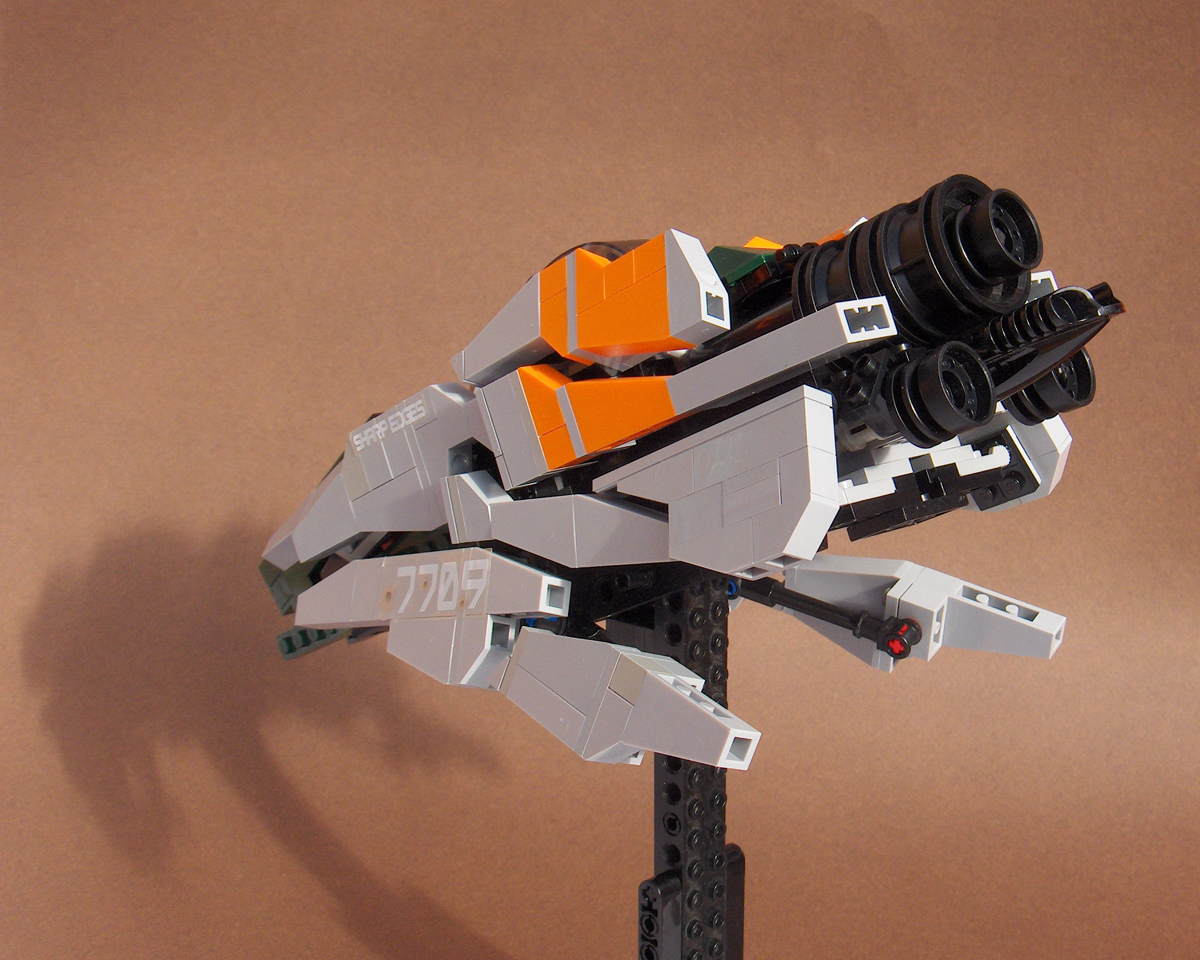
www.brickshelf.com/cgi-bin/gallery.cgi?f=354172 <-- Gallery when public
This and the previous fighter were built yesterday, and both are named after flowers.. odd.
Thanks to Gregador for pointing out this part of Erie. This is where I landed on Street View and ended up liking it the best:
www.google.com/maps/@42.1180421,-80.0962067,3a,90y,147.65...
Listed here as one of the historic and notable bridges of the United States:
bridgehunter.com/pa/erie/bh82538/
Being dismantled in 2021:
Hill & Vine Restaurant
210 South Adams Street
Fredericksburg, Texas 78624
This is trully the BEST Onion Rings .... perfectly done !!
Is this a vessel, a flagon or a chalice? See here: Click
Let's call it a bottle, then.
As (fun) part of a chemistry experiment, we silver-plated the inside of a small glass bottle (about 50 ml, which I had purchased at Woolworth for 75 Euro cents).
The chemical process:
In a solution of silver nitrate in water, the silver nitrate dissociates to silver ions (+) and nitrate ions (-).
Ammonia is added, which decomposes to ammonium ions and hydroxide. Silver ions and hydroxide ions combine to silver oxide and water. The silver oxide has a low solubility and precipitates.
Adding further ammonia, the precipitate is transformed into a silver diammine complex, which again dissolves in water.
Adding potassium hydroxide, then glucose reduces the ions to metallic silver, which is deposited on the interior surface of the glass bottle. In case you are worried about what happens to the glucose in the process: it turns into gluconic acid.
The glass vessel is shown before and after the interior silver plating.
Shot with a Canon EOS600D with a Leica Marcro-Elmar-R 100 lens and a Leica-R bellows.
Plating Geranium backs. I was culling the dead and wilted leaves and thought these were beautiful. If you buy the scented varieties they would be totally edible!
Manufacturer: Packard Motor Car Company, Detroit, Michigan – USA
Type: Standard Eight Convertible Coupé Series 626 Model 339
Engine: 5243cc straight-8 L-head
Power: 90 bhp / 3.200 rpm
Speed: 115 km/h
Production time: 1929
Production outlet: 26,070 (all Series 626)
Curb weight: 1824 kg
Special:
- Packard established its impressive reputation by producing luxury and performance automobiles.
- This Convertible Coupé has a three-speed manual gearbox, a Packhard carburettor, dry plate disc clutch, a 83 liter fuel tank and rear wheel drive.
- The chassis with close-coupled open steel body on a 126.5 inch wheelbase, has a wood grain dash, rumble seat, golf-bag compartment, standard black fenders, roll-up side windows, crank-out windshield, soft-top with landau irons, worm & sector steering, semi-elliptic leaf spring front and rear suspension, a semi-floating type rear axle, standard five disc wheels with balloon tires size 32x6.00 and mechanical internal expanding drum brakes all around.
- The 626 family came available as this Standard Eight Convertible Coupé, as Standard Eight Sedan, as Standard Eight Coupé, as Speedster Eight Roadster (6306cc straight-8 / 132 bhp), as Speedster Eight Phaeton (6306cc straight-8 / 132 bhp) and as rolling chassis.
- Tan Connelly leather interior, wood-spoke Artillery wheels, metal-spoke wheels, trippe lights, a radiator stone shield, dual covered side-mounted spares with side-view mirrors, whitewall tires, chrome plating on the cowl band and cowl lamps, a chrome mesh grille stone guard, driving lights, a rear trunk rack and two-tone colouring were optional.
Copyright © 2019 by Craig Paup. All rights reserved.
Any use, printed or digital, in whole or edited, requires my written permission.
Plating up at the Madklubben dinner at Cail Bruich Restaurant in Glasgow on Monday evening. I am constantly amazed how so many people can work so well together in such a small space - Team work at its best!
More like this one? please click here
1 - Fresh Strawberries
2 - "Chrome Plating" - Airbrush Alclad Chrome (The same I use on my scale models)
3 - Spray water+sugar (some uses paraffin, I prefer sugar it gives a better shining effect to the droplets)
4 - Take the shot! Using a Stack of +2+4 Close up lenses plus a CPL filter lens.
5 - Enjoy but do not eat it! LOL
Location: Cork - Munster - Ireland - IE - Europe - EU
Photoshop Camera Raw Filter + Compositing
********* Thanks for all groups invitations *********
Please do not post default group messages/badges, It will be deleted.If you like my photo, please fave it and/or comment with your own words.
Thanks for understanding.
************************************************************
© Mark Biolchini 2017
All Rights Reserved
Always Learning... Critiques are very welcome.
Serving up the meat (there was a variety by the way) during Saturday night’s meat lovers delight at Locavore to Go in Ubud, Bali … seriously nice food with great service at a great price. All the meat is from their butchery right next door.
4SUB (class 405) 4620 is seen arriving at Clapham Junction's Windsor side platforms with the 17.36 London Waterloo to Waterloo via Richmond and Kingston service on 18 April 1980. The framwork outside the signalbox had once carried armour plating to protect from wartime bomb damage.
8.701 shunts a rake of Internal User wagons away from the billet unloading area. 8.708 can be seen in the background drawing a loaded train from the sidings which 8.701 will provide banking assistance to up the Plating Pit Hill.
New Earth Strategic Trust
Classification: Mid Range / Melee
Armaments:
(1) AR-X99BURST-TG
(1) FW-BONEBUSTER
(2) SH-REACT02H1
After the success of the Mammoth model, the Zenithal was born out of NESF's aim for a better defense combat reFrame with improved mobility. The new heavy model features a thicker armor plating than its predecessor and is equipped with the DASH movement system. This allows it to briefly move in a straight line, closing the gap between enemy combatants.
Equipped with an improved version of the AR-G99BURST, the AR-X99BURST-TG can load armor piercing rounds and carry more ammo. The FW-BONEBUSTER allows the Zenithal to take out enemy reFrames foolish enough to get into close range, while the shoulder-mounted SH-REACT02H1 deflects enemy fire from a distance.
---
This build is highly inspired by the Zenith Wanzer from the Front Mission series. I actually combined elements from various Zenith models (FM1, FM3, Left Alive's Zenith) to make this version.
---
More info, WIP details, and other LEGO mechs over at my blog: messymaru.com/
Follow me at other social media sites:
Facebook: www.facebook.com/MessyWorksLEGO
Twitter: twitter.com/Messymaru
Instagram: www.instagram.com/messymaru/
YouTube: www.youtube.com/messymaru
---
reFrame Version 3.0 frame (instructions) now available
For those interested in LEGO mech building, I also have an eBook from 2015 called Mech Wars 2015 Instructional Primer. It contains some things I wrote about basic mech building, a bit about my Mech Warsuniverse, and all my early models from 2014-2015. If you’re looking for a resource that could help you start or even improve your mech building skills, you might find this eBook useful.
She's finally done! With fifty minutes to spare! That was a close one!
This ugly duckling is "The Ravager Hive". She used to be a military drone fighter carrier, but during a routine training exercise, she was hijacked by a gang of mercenaries. Over the years, many modifications were made to better suit the needs of her new owners. Her own mother wouldn't even recognize her now!
The Ravager Hive carries four drone fighters that are controlled by four crew members inside the upper deck. Crew quarters are also found on the upper deck. The lower deck has a lounge area and an access passage to the bridge. The bridge has room for the pilot and co-pilot. In the rear of the ship is the engine room.
The Hive is equipped with four autonomous twin-barreled ion cannon turrets. None of which are standard issue. She also has an expanded communications array on the nose and much thicker armour plating than usual.
Alright, time for some specs! The Ravager Hive clocks in at 123 studs long, not including Antennae. 136 including them. 57 studs wide and 45 tall. Without using a scale, I'd estimate that it weighs in the neighbourhood of twenty to thirty pounds. So you probably won't see me swooshing this one either.
NS 8100, the Nickel Plate Heritage Unit, leads manifest 11V westbound/northbound over the OC Bridge in the West End of Pittsburgh, Pennsylvania.
one from last years visit to Chester zoo. I planned a series of abstract close ups; in my head I saw Giraffes, Zebras, Tigers etc, etc... but the Rhino's were the only ones willing to play ball :-)
A new sculpture called “The Shipbuilders of Port Glasgow” is the latest attraction in Port Glasgow, where many would possibly argue it is the only attraction in Port Glasgow! It was installed in late 2022 and can be found in Coronation Park, sitting between the lighthouses at what was known as Devils Point and the much-maligned Ferguson’s Marine, the last remaining shipyard of the lower banks of the Clyde.
The almost Stakhanovian-like sculpture, known locally as ‘The Skelpies’ - a wordplay on 'The Kelpies', another giant Scottish public sculpture also made of steel - was designed and built by the renowned artist John McKenna (www.johnmckenna.co.uk). The two 14-tonne figures of stainless steel around 33 feet high depict shipyard workers standing back-to-back wielding sledgehammers to bend steel plates on the hull of a ship, pays homage to the proud shipbuilding past and industrial history of the town and the Lower Clyde.
In the 19th and 20th centuries, over 30,000 ships (20% of the world's shipping) were built along the River Clyde. The artist also paid a fitting tribute to this industrial heritage by making his steel sculptures employing the same techniques of building and plating ships: "This steel plating technique," says McKenna, “gives a strong dramatic faceted surface, a great sense of mass and a solid monumental form for a public sculpture.”
Canon RP & Canon RF 24-105mm f/4-7.1