View allAll Photos Tagged keep
And that's what they did, right up until the very last day...
A few days ago my dad and I decided to have a rumble down the route of the former Woodhead Line aboard a Class 323 from Manchester Piccadilly to the current terminus of the line at Hadfield, and couldn't help but feel rather deflated at seeing all of the infrustructure, such as Dinting Viaduct, the remains of Dewsnap Sidings and the overgrown area of empty land that was Mottram Marshaling Yard, as well as all the overhead gantries that echoed back to the better days. So I decided I'd make another little tribute to this amazing and unique railway by redrawing the following picture in my own style
upload.wikimedia.org/wikipedia/commons/d/d0/Class_76_loco...
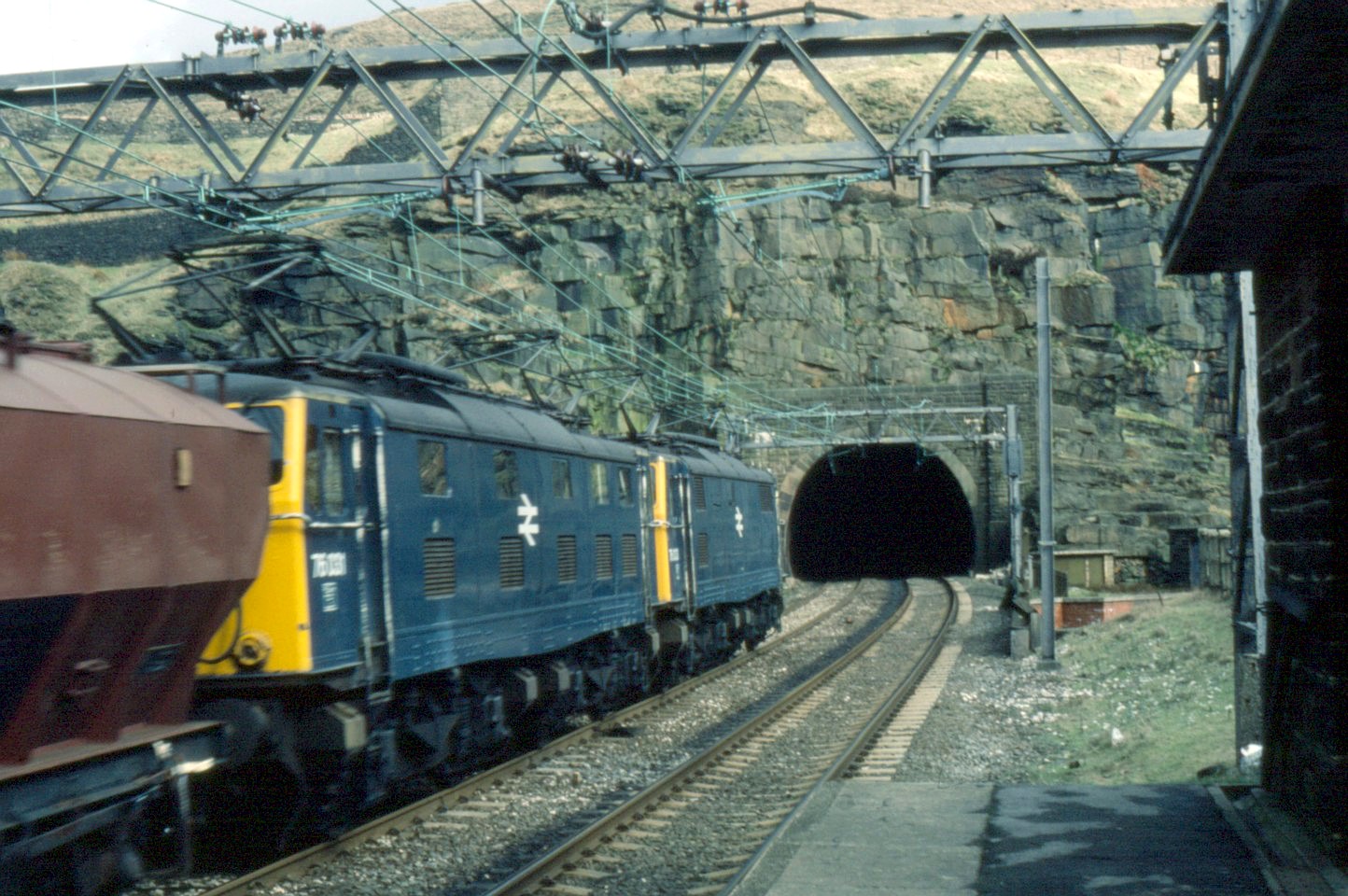
Here we see a pair of Class 76 EM1 locomotives about to enter Woodhead Tunnel with an eastbound coal train in the final days of the route, as seen from the long redundant platforms of Woodhead Station.
The Woodhead Route was opened in 1845 by the Sheffield, Ashton-under-Lyne and Manchester Railway, and stretched from Sheffield Victoria station, up to Penistone, through the hills in Woodhead Tunnel, and then down the valley via Guide Bridge to Manchester London Road (now Piccadilly), a distance of 41 miles. Operations later reverted to the Great Central Railway, and then the London and North Eastern Railway, before finally in 1948, as part of Nationalization and the formation of British Railways, it was designated as part of the Eastern Region, an odd move considering that this was deep Midland Region country.
In 1953 the route was electrified, a plan that had been considered by the GCR and later the LNER but was delayed due to World War II. Electrification of the route included the construction of a third Woodhead Tunnel, the previous two bores being unfit for handling heavy traffic and would need extensive modification to handle overhead wires. In 1955, electric services began fully using LNER designed EM1 and EM2 locomotives, these later being designated Class 76 and Class 77 respectively. The EM1's were used primarily for the haulage of heavy freight, whilst EM2's were specially designated for passenger usage. However, due to the fact that the line failed to serve any large settlements beyond Hadfield, the passenger service was withdrawn in 1971 and the EM2's were sold off to the Dutch Railways, where they continued to operate well into the 1980's.
Eventually, as coal traffic began to dwindle, the demand for trains travelling over the Pennines to be moved to the Hope Valley Line to the south and the outdated and non-standard equipment being used, the Woodhead Route was slated for closure, with the last trains running on the 17th July 1981. Throughout the 1980's the tracks were lifted and now there is very little to say the route ever existed beyond the abrupt buffer stops at Hadfield station, with nothing but an eerie trail leading off into the distance beyond, a hollow reminder of the roaring coal trains that used to pile through the now quiet station.
As for Woodhead Tunnel, the original Victorian bores are used to carry electric cabling for the National Grid, saving the need to construct Pylons over the top of the hills. The third bore has now been sealed off by gates and has been considered for use by the National Grid as a replacement for the dilapidated Victorian bores. However, stiff competition has resisted the use of the third bore as it would remove any chance of the tunnel being reused for railway operations, meaning that there is still a drive to have trains running through the Woodhead once again.
Only time will tell...
MP Photography| Marco Maximus & Peter Loza
For more info:
Mobile: +2 01003101707
Facebook: www.facebook.com/MPPhotography1
Twitter: @MPPhotography1
157/365. Some street art on an electricity box in Galway. I especially like the "TV brain-melting" piece.
Follow me on Twitter: twitter.com/verbal_2002
Australians proudly flying the Australian National Flag
Photographed on the Esplanade at Redcliffe, Queensland.
Rework of a previously posted image.
Somewhere in the Arizona desert.
Photographed while on vacation in 1999. On Ilford Delta 100 Professional B&W film with a Pentax K1000 and recently scanned negative on Epson V600 scanner. Slight adjustments to contrast and cropping made in Photoshop.
There's a lot going on in this shot. Let's start with the small, yellow craft docked alongside the ore boat, J.L. Mauthe. That little yellow boat is the Marine Trader that was built in Superior, Wisconsin in 1939 with hull number 238999. The boat was originally 50 feet 7 inches long but was lengthened 10 feet in 1965. It sported many different paint jobs and color schemes over the years and was available day or night to help keep sailors supplied with nearly anything they wanted to buy. It was a floating ship's store, if not a mini-department store. The craft worked throughout the Duluth-Superior harbor for the first 66 years it was operational. As I understand it, owners Franz and Bruce VonRiedel owned this craft and two others, Marine Supplier and Kaner I, that were owned previously by Al and Bernie Kaner, respectively. All three boats were mothballed for a time when VonRiedel's business—Acme Marine Services—was closed in 2000. The boats were eventually sold to different parties between 2000 and 2005. The Marine Trader left the Ports for good in October 2005 and that was apparently the first time the craft ever sailed across Lake Superior for points east. If you would like to do more research on the Trader and see more pictures too then please visit www.boatnerd.com/ for lots more material on this—and every other vessel on the Great Lakes.
Next, if we look closely we'll see a sailor about to embark on a personal shopping expedition. He's climbing down the ladder to Marine Trader from the working deck of the Mauthe. Then, just beyond him are half a dozen men actively engaged in loading natural ore into the Mauthe's hold. Deck hatches are wide open and spouts from Missabe Dock 5 will be lowered and raised in concert by men on top of the dock who will operate those chutes one or two at a time. Then in turn, corresponding ore pocket doors will be opened to allow the staged iron ore to slide right into the big boat with a loud, almost-prehistoric "whooshing" sound.
Then, pay careful attention to the ore cars on top of Dock 5. This will take considerable explanation.
Each ore dock in Duluth and Superior (Two Harbors and Ashland too) was much more than a staging area where ore was simply dumped into the dock. The ore was actually partially blended in each dock pocket. Then when the ore was dumped into a boat it was further blended as it was directed into the near, middle, or far side of each hold. This wasn't simply a matter of blending different iron content either. Individual vessel size and that vessel's loading characteristics played into it nearly as much as both the iron and silica content of that ore.
Silica content was especially important during unloading of the ore dock as ore with higher silica ran faster out of the dock pockets and allowed for more precise loading to the far side of the vessel. By adjusting the angle of the chutes this fast running ore would slide out of the pocket faster and thereby reach the far side of the vessel to make the loading much more even.
While each pocket on Dock 5 held four car loads of ore, dumping into these pockets was not an even-steven kind of operation. Each ore dock had four tracks on top of it. Two tracks fed the pockets on the north side of the dock while the second pair of tracks fed the south side pockets. So each side of the dock had just two tracks used to fill the pockets, that were in turn used to load vessels on opposite sides of the ore dock. Fast running ores and slow running ores each had their own dumping order with 3/4 of the ore going into each pocket via the two inner tracks. The two outer tracks were used to top of the load or to put stickier ore on top of the fast running ore so that it would slide right out behind the fast ore. If the sticky ore went in first, then the load might not release at all.
So during the modern era of blended ores 75% of the dock was filled via the two inner tracks while just 25% was dumped from the two outer tracks. The whole idea was to make each 4-car load in each pocket to be both a proper chemical content and also the most-free-running consistency to make dock unloading quick and easy. Filling a boat necessitated moving the vessel during loading. Deck hatches were generally spaced for every 2nd or 3rd pocket and chute. So a vessel might make 3 or more passes back and forth to get all of the ore contained in the dock for a given load, from a series of 3-4 adjacent pockets. On a good day things went like this but on a bad day when the ore being dumped was sticky or had a high moisture content then the work was much more difficult. You can read about that here: www.flickr.com/photos/jeff_lemke/29092814325/in/album-721...
There are a couple more things worth pointing out from this shot too. Notice how both tracks above the pockets have many more ore cars parked there. Those loads aren't for the next vessel. They are for this vessel. After each pocket is emptied of its contents the final phases of loading this boat will occur. That will be what they called "speed loading" or "topping off" the load that's already inside of the boat. Ore inside of those cars will be dumped directly into the boat through the pocket while the gate is open and the cute is lowered. The ore will fall directly from the car into the boat. Getting the last bit of ore into each boat in this manner became necessary as the boats became larger and sometimes as loads became stickier and harder to dump. Railroads found that the sticky ores became much more sticky when left in the dock for any time and as each car was dumped on top of the previous load, the problem became even worse.
Other times the pockets simply didn't hold enough ore to satisfy the larger holds in those boats. This was true in the taconite era too. I was invited to ride along on just such a train in Superior at Allouez Dock 2 where we were loading pellets directly from the cars through the pockets to top off a load of taconite. The larger BN Dock 5 at Allouez brought about an end to this practice and the balance of Allouez ore docks were abandoned after Dock 5 was up and running at full capacity.
The last thing that I'll mention is the second track in. Take a close look the the two cars farthest right on top of the dock. The black one is a Northern Pacific car while the ones next to it are Great Northern. This load will include interchange ore that was brought to Saunders, Wisconsin by the Burlington Northern. The Missabe's Interstate Job picked up that ore at Saunders then brought it to Proctor via Adolph, sorted it at Proctor, then the Hill Job brought it down for spotting on Missabe Dock 5. All of the ore roads that ran here cooperated to provide each other with the necessary ore to make a boat load the proper and required chemical consistency to fulfill orders from the steel companies. A large amount of ore loaded into the these massive docks actually came here from the non-owning roads. It was this interchange between the railroads of the various ores (that would then be sorted before being loaded into the docks) that really made the whole system work. Without this ore interchange between the various railroads the mining companies would have been limited to shipping in many cases, unusable or unwanted grades of ore. Without the interchange of ore cars that allowed better grades of ore to be created through yard sorting and dock and hull blending—the ore era as we once knew it would have ended decades earlier than it did.
Of course, way back when, when the ore docks were still very young and made mostly of wood, it was possible to load ore willy-nilly because the earliest ores mined were of a sufficiently high iron content that blending wasn't required or desired. But as those better-resources played out, the operation that I described here today is what quickly became the norm. It is the reason why railroads like the Missabe and Great Northern had such huge sorting yards at Proctor and Allouez. They had to be massive because the mix of cars needing to go down to any one track on the docks became a staggeringly complex project that changed by season. Every year there was a different supply of ores to blend.
It should be obvious by now that if you thought that the iron ore used to make steel went straight from the mine to the dock in solid strings of cars—generally speaking you'd be wrong about that. But as natural or direct shipping ores played out and taconite was developed during the mid-1960s, the dream of being able to load an entire train load of Minnesota ore into a Great Lakes vessel finally became a reality through the advent of the taconite pellet—though even that started out rather slowly. Believe it or not many boats ran with split loads containing half natural iron ore and half taconite pellets. That was until the pellet plants could produce enough pellets to load full vessels. Each taconite plant produced its own variety of product too. Ultimately, taconite production turned a difficult sorting and blending process into a relatively easy one by creating an easily transportable product with a consistent iron content.
After 1968, scenes like this one began to become more rare every day. By the time this shot was taken in 1981 natural ore shipments out of Duluth were practically a thing of the past. Just to contrast complex vs. simple processes, here's a nice view of the Duluth docks that I shot in the post-natural-ore taconite era where we can see two varieties of pellets on the ground that still fill boat holds in present day Duluth: www.flickr.com/photos/jeff_lemke/25449237413/in/album-721...
Of course if you visit either of the Twin Ports area "ore yards" today (that's BNSF's Allouez and CN's Proctor facilities) you'll find that those once-huge ore classification yards are truly conspicuous by their complete absence (Allouez) or nearly complete absence (Proctor). In the taconite era, railroad tracks simply store cars not being used at the moment. There's nothing much left to blend because other than the iron particles themselves that are mated with a binding clay and limestone to make the pellets in the first place—all that's left to do is dump them onto the ground for stockpile and then reload them into the dock when the boat gets near.
While the days of sorting ore are likely gone forever it sure is fun remembering just how complicated that process was and how many men and women earned their livings doing this important work for America. I'm glad that I found this picture of Duluth-Superior's most-recognized bumboat to share with you today. That little floating store provided the guys on the bigger boats with an opportunity to do something besides the everyday grind. The requisite climb up and down the ladder to be able to spend a little money had to be worth it, and I'm certain that when the Marine Trader pulled up alongside the ore boats it was truly a welcome sight for sore eyes. Long live the bumboats and their Captains!
This morning, I have added a few photos taken on 3 July 2020, on the way home after a drive to Forgetmenot Pond, west of Calgary. The Pond was my main destination.
The weather forecast was for several rainy days in a row, so I wanted to make the most of a sunny day. The past week, I have had to be careful about how many kilometres I drove, before getting a service after the maintenance light came on a week ago, as I didn't want to mess up my car warranty.
On 3 July, however, I decided to drive west of the city, just into the eastern edge of the mountains. It's not a long drive and I was hoping to find some wildflowers before they all go to seed. I almost gave up trying to photograph wildflowers, as it was too windy to keep the flowers in the viewfinder.
What a nightmare few hours, as I think half of Calgary decided to do this trip. So many cars and so many people. Parking lots were overflowing and the main highway was lined with parked cars in many places.
My first stop was at a forested area to have a quick look for wildflowers and to see if there were any fungi that had started growing yet. Very little variety in wildflowers, and I only came across one single mushroom plus a little group of a different species.
From there, I kept driving till I reached Forgetmenot Pond. This is actually a man-made pond, left over from the excavation of a gravel pit. The water is crystal clear. It's just a short walk around the pond, but enjoyable to do. The main road this far into Kananaskis only opens in June each year, as a winter gate at Elbow Falls closes in December for the winter months, to protect the wildlife in the area. This day, though, the path around the pond had so many people on it, and some people (families?) had actually set up various tents near the path. I had to keep walking through the trees to avoid everyone. As for Elbow Falls, there were so many cars there that there was no way I was going to even try and call in briefly. This was a Friday, not even a busy weekend day. I guess this is what it is going to be like the whole of the summer - yikes!
I found the following 4-minute video on YouTube, taken by Kenneth Lori using a DJI Phantom 3 Professional quadcopter and taken on 16 June 2016. It travels over Forgetmenot Pond and the surrounding river and mountains. So beautiful.
Later, it was such a contrast to drive a few of my favourite roads closer to home. A few cyclists and a few cars, but, in between them, it was so quiet and peaceful. Felt so good. There was even one Snipe on a fence post to make this extra bit of driving worthwhile. Not that I need any more Snipe photos to post : ) You might be glad to see a Snipe photo as, soon, it will be back to (oh, no!) American White Pelican photos. Just had to get out for a while on 5 July, partly because my place was feeling much too warm. The drive to and from Frank Lake was roughly 145 kilometers.
On 3 July, I found that two of the Mountain Bluebird families had vacated their nest boxes. I had a feeling that I was going to miss their fledging - this is what usually happens each year! However, I was so happy to spot a tiny Bluebird fledgling huddled right against the top of a fence post. Just trying to keep safe. And then, suddenly, it was no longer there. I didn't see it fly and I thought it may have dropped down into the grass. However, when I turned my car around to the other side of the road, I found a fledgling (same one?) down in the field, in an area of dried mud rather than tall grass. SO cute.
To help support a small pub/restaurant in the area, I called in and got take-out. One of the young women who works in the cafe was excited to tell me that they now have homemade chili on the menu again. The minestrone soup is also good.
There was still time, after taking a few photos of some of the usual birds, to drive on a road that I have driven so many times before, but not for a while. Happy to see a beautiful Swainson's Hawk perched on a fence post.
Finally reached home around 5:00 pm, after driving roughly 185 km since 9:30 am. So, not a really long drive, and one that still left me with more spare distance before my car had to go in for service yesterday. Hopefully, that will be that, for the rest of the year, as far as my vehicle is concerned!!
Yesterday, 9 July 2020, I gave my car a good test when I did a long drive to one of my favourite places. I stopped and started the car so many times, feeling nervous that it might not start, but all worked out well. Lots of beautiful sightings that I will start posting in the next few days. I haven't even downloaded my photos from yesterday, which is most unusual for me - I was exhausted after driving somewhere around 460 km!
My mom feels a lot better today and we took a walk to the coast together. :) It was a wonderful evening, I also took many photos of the sky to use on my conceptual photos later. :) Hehe. Hope you're having a great day too.
View of keep.
lease don't use this image on websites, blogs or other media without my explicit permission.
© rogerperriss@aol.com All rights reserved
Students held on 21.4.2010 a demo to support free education in Finland. March ended on the steps of Parliament House, where speeches were made and protestors and little bit of (peaceful) beer and skittles.
Members of the law were naturally present in force.
One of Sir Uridius Dratiphe's Mitgardian seats, Weyworth Keep is situated at the head of one of the many sources of the great Adeler River, and, like Uridius' Keep, was built into the snow-clad mountain itself.
My largest, and quite possibly my favorite, build yet, this took about two months to completely build, but it was destroyed remarkably shortly after photography (and about 24 hours later no two pieces of the build were still attached, except Sir Uridius himself) for all that. Don't miss the interior shots on my photostream, showing the stables, armorer's workplace, and house interior, or the siege version for the Colossal Battle Contest!
Thanks for viewing, C&C are certainly welcome!
*All Rights Reserved*
All works are protected by copyright, and are not to used for any purpose unless direct prior written consent has been given by me.
I was practicing the whole "scene/emo" style on my old Barbies, and I really didn't plan on keeping them afterwards, because I expected to mess up...
But, I don't think they came out that bad! Yeah, I'm not too good with tattoos, but oh well. In photos they look a bit better than in person xD
So, meet Rayce. (pronounced Race xD) He's 21 and from Hollywood. I actually did his hair differently after this photo, but I'll post a photo today, alonng with all my contest photos c:
I was inspired by Lucas_2's dolls, because they are so perfect, and these photos:
data.whicdn.com/images/24706765/64764_10150650224517381_6...

2.bp.blogspot.com/_HHhda_rbT1U/TCAz9XT6roI/AAAAAAAAAnU/H7...

Hope you like him!
I keep a paper record of the photos I add to my two 365 groups. This is the list for the daily self-portrait group 365 Days of which (by dint of long-service) I'm one of the admins.
You will note that this is photograph 3543 of my daily selfies. Early in 2007 I saw Flickr folk posting daily self-portraits but I'd missed the obvious starting point of the First of January so I waited until my 65th birthday on 21 April 2007
The hereios of the We're Here! group have paid a visit to a group which we have each set up for the purpose. I have set up the Bulldog clips group. Admission is free to all, but submissions will be ruthlessly moderated. BULLDOG is a registered trademark of Brandsley Limited which is licensed to Faire Bros & Co Limited. Its registration as a trademark in the United Kingdom dates back to 1944.
Stuck for an idea for your daily 365 shot? Try the hereios of the We're Here! group for inspiration.