View allAll Photos Tagged developing
Fontanometer
Developed to make non-invasive measurements of ICP in infants,
using the principle of applanation
of the fontanelle
A high frequency response gives a good display of respiratory and pulse pressure waves.
A balloon over the sensor enables the baseline to be checked by equalising pressure above and below the sensor in situ, as in the Gaeltec Devices ICT/B transducer.
A major advantage of this system over pneumatic devices is the compatibility with most strain gauge pressure monitors using the extension lead type EL-1, with the appropriate connector, fitted by the customer or by Gaeltec Devices.
Sterilisation is by means of cold aqueous solutions of detergicide (e.g. Cidex) or by ethylene oxide gas. Do not use sodium hypochlorite solution.
More Info
www.gaeltec.com/products/neuro-surgery/fontanometer-FNTM/
Gaeltec Home Page: www.Gaeltec.com
Barcelona, Spain. Do take the elevator top top (of Cathedral) if you're interested in unique city views!
Camera: Pentax645+75mm F2.8
Film: Fuji provia 100F
develop: Naniwa Color Kit-N
scanner: Epson GT-X970 (without color revise)
photograph condition: standard(+0)
develop conditiion: standard time
(same time as naga film standard developing time)
Ilford HP5+ - Nikon FE - Tokina SL 17mm 3.5 - Some sort of Filter - Canon Lide 80 scan
Home Developed
21.11.19. Dublin, Ireland. The Irish Penal Reform Trust and the Irish Criminal Bar Association co-host a seminar on Developing Youth Justice: 18-24s in the Criminal Justice System. Main speakers included; David Stanton TD, Minister of State at the Department of Justice and Equality, Senator Lynn Ruane, Dr Laura Janes, Legal Director with the Howard League for Penal Reform, Ian Power, CEO of Community Creations (SpunOut.ie and Crisis Text Line Ireland), Sarah-Jane Judge BL, Barrister and Lecturer and Eddie D’Arcy, CEO of Solas Project. ©Photo by Derek Speirs
cgi.ebay.co.uk/ws/eBayISAPI.dll?ViewItem&item=2508861...
The 16mm cine film Developing Tank appears unused
or if used has been cleaned meticulously.
The ORIGINAL box shows some signs of wear.
The Developing Tank is from Leningrad, Russian / USSR. It has a certificate.
It dates 18 VIII 1964. (That's 18th of August 1964)
The rubber pipes are in really good condition and not porous or brittle at all.
Quite amazing for this age. The Tank itself is almost scratch free, shining
and just looks fantastic. I do not know how to use it. And I am only selling
as I have course fees to pay, so it is a reluctant sale of an object I adore.
If you are interested in the Developing Tank then please see the
collection of youtube videos I made showing it from all angles
www.youtube.com/playlist?list=PL000C1C02C698EBC3
(at the moment I have 8 or so individual short clips of the developing tank,
arranged in a playlist, please check through them on you tube)
You should be able to see how good it looks. I can re-film any aspect of it
if you are interested, so please just get in touch, with questions and suggestions.
I am uploading the youtube videos at the moment, so they may take an hour or
so before they link up correctly.
I hope you will love this item as I did.
check this page it lists lots of tanks for sale in the US and UK, mine is the cheapest: www.super8camera.com/netsearch.php?zoekterm=developing+ta...
Roll #0006
Lots of snow overnight and into the morning so I wanted to load, shoot, process, scan and post a whole roll same-day!
70 minutes wasn't long enough or I didn't agitate enough so the negatives are thin, most of them having a really narrow dynamic range. Also goofed up loading the roll onto the spool for developing and had some nasty artifacts.
Still - I did what I set out to do!
Ilford Delta 100 shot at 200 (thinking of it as ISO 400 +1 EV comp)
Nikon FE2
Loaded 2022/1/29, Unloaded 2022/1/29, Developed 2022/1/29
Caffenol C-L semi-stand at 68F for 70 minutes with 10 initial agitations, 10 more at 1 minute, and 4 more at 35 minutes.
Digitized 2022/1/29 (Nikon D7200, K-rings, Micro-NIKKOR-P AUTO 55mm, ES-1; 1/3.5", f/8+ @ ISO 100 over cheap USB lightbox)
Got some nice shots of flamingos while they were on their yearly migration trail. Pazhaverkadu aka Pulicat Lake (Thiruvallur - Tamil Nadu) India. Instagram - @nagendran_c4777 – 21-03-2026.
Dear Madam/ Sir,
I happy to share that today I published my autobiography titled With Folded Hands in English and கூப்பியகரங்களுடன் in Tamil. It is my long time desire to bring it out mainly to thank all those helped me survive and thrive. I am alive because of the good deeds of many souls who helped me without any expectations. Through this book I thank them all as I don't have any other ways to express my thanks to them though it is not enough.
The book was released at Aarvam IAS Academy,Anna Nagar, Chennai. The function was presided by Mr. Irulappan founder trustee of DVM Seva Palam , the book was released by Mr . Senthil Velavan IRS And was received by Ms. Tamilarasi IRS. Mr. Shibikumaran the founder director of Aarvam IAS Academy welcomed the gathering and Mr. Damodaran a retired banker, script writer and fiction writer wished me all success. 21- DECEMBER - 2025 TIMING -10AM – Instagram ID:- @nagendran_c4777
=====================================================================
With Folded Hands in English C.NAGENDRAN - 21- DECEMBER - 2025 TIMING -10AM :
Nagendran English : drive.google.com/file/d/1_AWQwdUW0m8wOyASsHqrCwEoHEDyvmFM...
and கூப்பியகரங்களுடன் in Tamil C.NAGENDRAN - 21- DECEMBER - 2025 TIMING -10AM :
Nagendran Tamil :
drive.google.com/file/d/1nHhiz_pLGiUEyVRI1Y7ap0ArikbTHOJ6...
YOUTUBE VIDEO LINK :
Titled With Folded Hands in English and கூப்பியகரங்களுடன் in Tamil | C.NAGENDRAN - 21-12-2025 @10AM : youtube.com/live/TZXvgzzcQac
First roll developing film at home. Diafine. Results are mixed, a bit dodgy, but promising. Can't wait to try the next roll.
However, I think I have bromide drag. Is that what those lines are on the left side in the sky?
My old Ansco/GAF daylight tank and reel, I used this as a teenager in the early 1970's. Still works. The two plastic graduated cylinders with handles are from then too.
Natural arch developed in chalk & impure chalk in the Cretaceous of Kansas, USA.
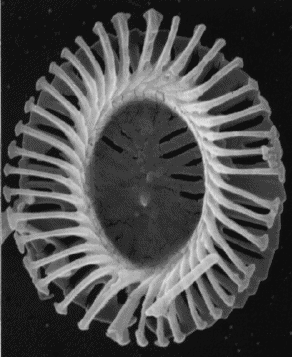
This western Kansas landscape consists of chalk badlands and chalk pillars and a natural arch. The rocks are chalks and impure chalks (e.g., argillaceous chalk and chalky shale) that range in color from whitish to light gray to yellowish. Chalk is a biogenic, calcitic, marine sedimentary rock composed of numerous coccolith microfossils (see: www.soes.soton.ac.uk/staff/tt/eh/pics/lith2.gif). Coccoliths are individual calcareous plates that covered a single-celled photosynthetic marine organism called a coccolithophorid (a.k.a. coccolithophore) (see: upload.wikimedia.org/wikipedia/commons/d/d9/Emiliania_hux...). These beds were deposited in the ancient Western Interior Seaway, a section of ocean that existed during parts of the Mesozoic Era in what is now the American and Canadian Great Plains.
.png)
Rock arches are rare erosional features - those developed in chalk beds are even rarer. If a stream goes under an arch, it is known as a natural bridge. If no stream is present, the feature is a natural arch. Along lakeshores, they are called lake arches. Along oceanic coastlines, they are called sea arches. The highest concentration of natural arches on Earth is Arches National Park in eastern Utah.
Stratigraphy: Smoky Hill Chalk Member (a.k.a. Smoky Hills Member), Niobrara Formation, mid-Upper Cretaceous
Locality: Monument Rocks (also known as the Chalk Pyramids), along Gove County Road 16, north of the Smoky Hill River, Gove County, western Kansas, USA (38° 47' 43.24" North latitude, 100° 45' 52.06" West longitude)
Developing Film in Coffee
2013.01.19 photoed in New Taipei City, Taiwan
咖啡顯影
2013年1月19日於新北市
Caffenol-C-M 14mins
Before 7am Leeds Nikon F80 28mm f/2.8 Ilford Delta 3200 pushed to ISO 51200 developed in Rodinal 1:100, one hour stand development, agitated for first 60 seconds then for 60 seconds at the 30 minute mark.
cgi.ebay.co.uk/ws/eBayISAPI.dll?ViewItem&item=2508861...
The 16mm cine film Developing Tank appears unused
or if used has been cleaned meticulously.
The ORIGINAL box shows some signs of wear.
The Developing Tank is from Leningrad, Russian / USSR. It has a certificate.
It dates 18 VIII 1964. (That's 18th of August 1964)
The rubber pipes are in really good condition and not porous or brittle at all.
Quite amazing for this age. The Tank itself is almost scratch free, shining
and just looks fantastic. I do not know how to use it. And I am only selling
as I have course fees to pay, so it is a reluctant sale of an object I adore.
If you are interested in the Developing Tank then please see the
collection of youtube videos I made showing it from all angles
www.youtube.com/playlist?list=PL000C1C02C698EBC3
(at the moment I have 8 or so individual short clips of the developing tank,
arranged in a playlist, please check through them on you tube)
You should be able to see how good it looks. I can re-film any aspect of it
if you are interested, so please just get in touch, with questions and suggestions.
I am uploading the youtube videos at the moment, so they may take an hour or
so before they link up correctly.
I hope you will love this item as I did.
check this page it lists lots of tanks for sale in the US and UK, mine is the cheapest: www.super8camera.com/netsearch.php?zoekterm=developing+ta...
Developing the design brief for the Vancouver 2010 Workforce uniforms.
L to R: Chloé Douglas, Teena Aujla, Greg Durrell. February 26, 2008.
Developped in Caffenol. Photo Hall color prints 200 iso (a.k.a. Fujifilm superia). Taken by Eho Altissa Altix IV (trioplan 50mm 2,9)
I developed this film using QWD ECN-2 chemistry. It's a long story about a gift of 4 Silbersalz rolls that should have included developing and scanning back in Stuttgart. Instead, the film took a round trip from New York to Frankfurt, getting stuck in German customs for months with indifferent support from Silbersalz. So upon their return to me, I developed and scanned them myself. QWD makes a great product for home development of Vision3.
Develop Don't Destroy Brooklyn
Atlantic Yards Junkyard Bonds Protest
December 14, 2009
Standard & Poor's
55 Water Street
New York
Living in Texas, the state where all four seasons have the potential to occur in just a span of a few days, I was in the position where many tornadoes made contact with the ground from just a matter of a few miles up to a few hours away. Luckily, this tornado did not drop down completely. With the surrounding weather conditions, my area dodged a bullet, as this had the potential to be a major tornado.
A 22 Oct view of some developing Autumn colors at a walking trail adjacent to my favorite summer frog pond. The frogs and dragonflies that I enjoy photographing so much in summer are gone for another year but there is some nice autumn Colors developing in the trees along the path and around the pond.