View allAll Photos Tagged developing
Got some nice shots of flamingos while they were on their yearly migration trail. Pazhaverkadu aka Pulicat Lake (Thiruvallur - Tamil Nadu) India. Instagram - @nagendran_c4777 – 21-03-2026.
Dear Madam/ Sir,
I happy to share that today I published my autobiography titled With Folded Hands in English and கூப்பியகரங்களுடன் in Tamil. It is my long time desire to bring it out mainly to thank all those helped me survive and thrive. I am alive because of the good deeds of many souls who helped me without any expectations. Through this book I thank them all as I don't have any other ways to express my thanks to them though it is not enough.
The book was released at Aarvam IAS Academy,Anna Nagar, Chennai. The function was presided by Mr. Irulappan founder trustee of DVM Seva Palam , the book was released by Mr . Senthil Velavan IRS And was received by Ms. Tamilarasi IRS. Mr. Shibikumaran the founder director of Aarvam IAS Academy welcomed the gathering and Mr. Damodaran a retired banker, script writer and fiction writer wished me all success. 21- DECEMBER - 2025 TIMING -10AM – Instagram ID:- @nagendran_c4777
=====================================================================
With Folded Hands in English C.NAGENDRAN - 21- DECEMBER - 2025 TIMING -10AM :
Nagendran English : drive.google.com/file/d/1_AWQwdUW0m8wOyASsHqrCwEoHEDyvmFM...
and கூப்பியகரங்களுடன் in Tamil C.NAGENDRAN - 21- DECEMBER - 2025 TIMING -10AM :
Nagendran Tamil :
drive.google.com/file/d/1nHhiz_pLGiUEyVRI1Y7ap0ArikbTHOJ6...
YOUTUBE VIDEO LINK :
Titled With Folded Hands in English and கூப்பியகரங்களுடன் in Tamil | C.NAGENDRAN - 21-12-2025 @10AM : youtube.com/live/TZXvgzzcQac
My old Ansco/GAF daylight tank and reel, I used this as a teenager in the early 1970's. Still works. The two plastic graduated cylinders with handles are from then too.
Natural arch developed in chalk & impure chalk in the Cretaceous of Kansas, USA.
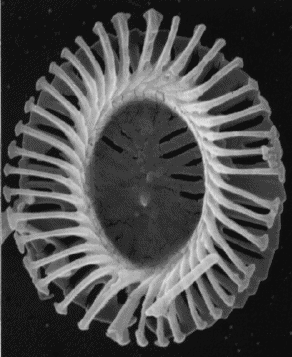
This western Kansas landscape consists of chalk badlands and chalk pillars and a natural arch. The rocks are chalks and impure chalks (e.g., argillaceous chalk and chalky shale) that range in color from whitish to light gray to yellowish. Chalk is a biogenic, calcitic, marine sedimentary rock composed of numerous coccolith microfossils (see: www.soes.soton.ac.uk/staff/tt/eh/pics/lith2.gif). Coccoliths are individual calcareous plates that covered a single-celled photosynthetic marine organism called a coccolithophorid (a.k.a. coccolithophore) (see: upload.wikimedia.org/wikipedia/commons/d/d9/Emiliania_hux...). These beds were deposited in the ancient Western Interior Seaway, a section of ocean that existed during parts of the Mesozoic Era in what is now the American and Canadian Great Plains.
.png)
Rock arches are rare erosional features - those developed in chalk beds are even rarer. If a stream goes under an arch, it is known as a natural bridge. If no stream is present, the feature is a natural arch. Along lakeshores, they are called lake arches. Along oceanic coastlines, they are called sea arches. The highest concentration of natural arches on Earth is Arches National Park in eastern Utah.
Stratigraphy: Smoky Hill Chalk Member (a.k.a. Smoky Hills Member), Niobrara Formation, mid-Upper Cretaceous
Locality: Monument Rocks (also known as the Chalk Pyramids), along Gove County Road 16, north of the Smoky Hill River, Gove County, western Kansas, USA (38° 47' 43.24" North latitude, 100° 45' 52.06" West longitude)
Before 7am Leeds Nikon F80 28mm f/2.8 Ilford Delta 3200 pushed to ISO 51200 developed in Rodinal 1:100, one hour stand development, agitated for first 60 seconds then for 60 seconds at the 30 minute mark.
Developing thunderstorm, photographed from Dead Horse Road, southwest of Chadron, Nebraska, on May 16, 2022.
cgi.ebay.co.uk/ws/eBayISAPI.dll?ViewItem&item=2508861...
The 16mm cine film Developing Tank appears unused
or if used has been cleaned meticulously.
The ORIGINAL box shows some signs of wear.
The Developing Tank is from Leningrad, Russian / USSR. It has a certificate.
It dates 18 VIII 1964. (That's 18th of August 1964)
The rubber pipes are in really good condition and not porous or brittle at all.
Quite amazing for this age. The Tank itself is almost scratch free, shining
and just looks fantastic. I do not know how to use it. And I am only selling
as I have course fees to pay, so it is a reluctant sale of an object I adore.
If you are interested in the Developing Tank then please see the
collection of youtube videos I made showing it from all angles
www.youtube.com/playlist?list=PL000C1C02C698EBC3
(at the moment I have 8 or so individual short clips of the developing tank,
arranged in a playlist, please check through them on you tube)
You should be able to see how good it looks. I can re-film any aspect of it
if you are interested, so please just get in touch, with questions and suggestions.
I am uploading the youtube videos at the moment, so they may take an hour or
so before they link up correctly.
I hope you will love this item as I did.
check this page it lists lots of tanks for sale in the US and UK, mine is the cheapest: www.super8camera.com/netsearch.php?zoekterm=developing+ta...
The Kick-off Meeting Erasmus+ Project “ DeSTRESS – Developing Competencies for Stress Resilience @ SMEs took place at ISCTE-IUL on the 20th and 21st of november 2019.
Fotografia de Hugo Alexandre Cruz.
Research to develop a perfect, artificial soil for the Eden Project has just been completed with results helping the world famous visitor attraction to save money and be even more environmentally sustainable.
It is hoped the research will also have wider applications providing ideas for local communities faced with the challenge of how to generate sustainable soil while reusing scarce mineral resources.
The work by Kate Schofield, a Plymouth University PhD student, was supported by ESF (European Social Fund) Convergence via the Combined Universities in Cornwall Research Project.
Read the full story on our website www.inspiringwork.org/news/%E2%80%99perfect%E2%80%98-soil...
Not for transmission or publication without express permission of the copyright owner, Simon Burt
Develop Don't Destroy Brooklyn
Atlantic Yards Junkyard Bonds Protest
December 14, 2009
Standard & Poor's
55 Water Street
New York
In developing my A2 coursework final piece, I studied the works of Chuck Close, Paul Cezanne and Henry Matisse. Choosing my father as my subject, my aim was to produce a representational work, that was authentic and which captured his essence. I was primarily influenced by Close’s photo-realist portraits. By using techniques of exaggerated tones and brush strokes, such as used by Cezanne and Matisse in their portraiture, my work had a richer depth. A key idea was to build on the effect that these artists created by painting their subject looking straight on, directly at the viewer, yet not giving away any emotion.
My A2 exam work is influenced by the works of Edward Hopper and Ken Howard, their use of light and muted tones to create idyllic scenes has an enthralling effect on the viewer. In my final piece, I tried to ensure the focal point was not just the rays of light within the painting, but the painting as a whole, an effect that Hopper successfully achieves in his scenic paintings. I experimented with different images in order to find one with which, I could achieve similar effects to those of Hopper and Howard’s paintings, in terms of colour and focal points.
My most recent works are comprised of a series of landscapes using watercolour paints. These works have primarily been influenced by walks on Hampstead Heath and David Hockney’s ‘Beyond the trees’, using of bright colours and small detailed brush strokes to create a vibrant effect.
Living in Texas, the state where all four seasons have the potential to occur in just a span of a few days, I was in the position where many tornadoes made contact with the ground from just a matter of a few miles up to a few hours away. Luckily, this tornado did not drop down completely. With the surrounding weather conditions, my area dodged a bullet, as this had the potential to be a major tornado.
PIR Circuit board with photo resist washed off the area to be etched
(I didn't actually end up using this one as it was a little over exposed)
my 1st roll of film developed with CAFFENOL-C. a combination coffee, sodium carbonate & vitamin C.
The recipe I used was
15g instant coffee (6 'rounded' teaspoons) mixed with 150 ml water
8g washing powder (4 'level' teaspoons mixed with 200ml water)
then both combined & 1gm (1/4 tea spoon) ascorbic acid (aka vitamin c) added.
I devloped a roll of lucky100 for 9 min @ 20 deg c & fixed with agfix. Although it worked It was underexposed; mainly because I pushed the lucky film 1 stop & failed to compensate when developing.
Still the results are interesting enough to have me try devloping with CAFFENOL-C again.
thanks to www.caffenol.org for the great recipes.
曼谷街道
Street in Bangkok
Hasselblad Xpan 45mm F4
FUJI PROVIA 100F RDP III 135
Self develop
4CCD E6
Jobo 1520
Nikon Super Coolscan 9000ED
A 22 Oct view of some developing Autumn colors at a walking trail adjacent to my favorite summer frog pond. The frogs and dragonflies that I enjoy photographing so much in summer are gone for another year but there is some nice autumn Colors developing in the trees along the path and around the pond.
Biddulph Grange was developed by James Bateman (1811–1897), the accomplished horticulturist and landowner; he inherited money from his father, who had become rich from coal and steel businesses. He moved to Biddulph Grange around 1840, from nearby Knypersley Hall. He created the gardens with the aid of his friend and painter of seascapes Edward William Cooke. The gardens were meant to display specimens from Bateman's extensive and wide-ranging collection of plants.
The post-1896 house served as a children's hospital from 1923 until the 1960s; known first as the "North Staffordshire Cripples' Hospital" and later as the "Biddulph Grange Orthopaedic Hospital" (though it took patients with non-orthopaedic conditions as well. Under this latter title the hospital's role expanded to accommodate adults, continuing in operation into the mid-1980s.) The 15 acres (6.1 ha) garden became badly run-down and neglected during this period, and the deeply dug-out terraced area near the house around Dahlia Walk was filled in level to make a big lawn for patients to be wheeled out on in summertime. The Bateman property was (and still is) divided: the hospital got the house and its gardens, and the uncultivated remainder of Biddulph Grange's land became the Biddulph Grange Country Park.
Until 1991 the house and gardens "housed an orthopaedic hospital, whose managers (understandably enough) were more concerned with their patients than the weird stuff looming out of rocky outcrops in the grounds. For the best part of a century the gardens decayed, visited only by passing vandals and, more rarely, intrepid folly-hunters."
In 1988 the National Trust took ownership of the property and its gardens, which have now been nearly fully restored.
Developed as a B&W negative in Caffenol CM for 6 minutes at 20 deg C and fixed for 5 minutes in Ilford Fixer.
I made some test shots with my new Yashica a last week, and finally gotten around to scanning them. It was also the first time I used Shanghai GP3 film.
I know I'm still a little clumsy loading 120 film in the spool, but this one gave me particular problems. It got stuck every time, half way down the spool. I solved this by cutting of the first part of the film, but that also ruined the first shot.
I've also found that this film curls more, and scratches a lot easier than other films I've used so far. So the struggle of getting the fragile film in, didn't do it much good...
And last but not least, I've underdeveloped the film.
As it turns out, this time 'the massive dev chart' was not correct.
So the image lacks some contrast.
Despite ending up with an scratched, abused and underdeveloped negative, the images turned out interesting.
They have a vintage and old look to them. But this was not the result I was aiming for.
Next time, I'll have to be a lot more careful. And develop the film longer.
Shanghai GP3, 1/25 f/3.5.
Developed in ID-11 (stock, 20ºC, 8 min.)
The images are scanned and not digitally modified. Though, I do not own a medium-format scanner. So the images where scanned with some improvisation.