Sponsored images from 
View allAll Photos Tagged bleeding
This is the elusive Arctic Bleeding Heart (Dicentra peregrina) which is related to the familiar garden flower Dicentra spectabilis. This plant grows on bare tundra and is only found in Japan and Northeast Siberia. I photographed this on a rainy day at Meinypilgyno in Chukotka. The entire plant was barely 3cm tall but had an exquisitely beautiful pink heart-shaped flower.
Always one of my favorite spring flowers. Reminds me of my child hood. My mom had bunches of these growing on the side of our house. These are from my garden in Candia NH.
- April 30, 2010
- I think this is one of Mother Nature's best creations. However, contact with the plant can cause skin irritation because the entire plant is toxic.
This photo was chosen as a semi-finalist for Nature's Best Photography Magazine Photo Contest for 2013. Nature's Best Photography has a showing at the Smithsonian Museum in Washington, DC every year.
- The bleeding heart flower repels water but those two droplets remained on the flower because it was the only spot that water would stay.
- Baldwin, NY
- April 14, 2012
Sentir cada noche como profundiza mi dolor, si es que tantos palos en un año provocan mi temor, de volver a querer, confiar y sentir, volver a sentir que no estás aquí.
Derramo lágrimas como en aquella semana de pesadillas que se recreaban en mi cama, los llantos dejaban su huella en la almohada, tanto fingir aseguro que no sirve de nada... Si es que cada segundo que pasa noto tu ausencia si te vas, si es que sé que hasta que no vaya no te podré tocar, dulce tacto, cuando nuestras pieles entraron por primera vez en contacto, y será especial...
Dicentra spectabilis
Shot through the chain link gate into the yard.
I really liked the light in this one---straight from the camera.
1. Eastern Black Swallowtail Butterfly 004, 2. Rain Drops On Sunflower Petals Square Crop 003, 3. New Fragrant Hyacinth Up Close 002, 4. Dark Purple Tall Bearded Iris Cropped, 5. Pink Bleeding Hearts Galore 001, 6. Red-Sequins Decoration, 7. Peruvian Lilies With Rain Drops 001 - Alstromeria, 8. Pigeon Walking Towards Me,
9. Big Oriental Poppies Macro Mosaic, 10. May 4th, 2008 Sunset, 11. Snow Ball Ornament 005, 12. Fire Inside Of Steam Engine, 13. Two Comtesse De Bouchard Clematis Blooms Square Crop 002, 14. Pretty Shirley Poppy 002, 15. Honeybee Square Crop 001, 16. Yellow Asiatic Lily And Katydid Nymph Square Crop,
17. Snapdragons Square Cropped 003, 18. Honeybee On Medium Pink Cosmos Centre 002, 19. Yellow Balloon With Rainbow Diamonds 002, 20. Red Balloon In The Sky, 21. Road Closed Due To Flooding, 22. First Crocus Opening, 23. Red Lion Amaryllis And Mitzi Rounded Edges Picnik, 24. New Year's Eve 2007 Snow Rounded Edges Picnik,
25. December 2007 Snow 021, 26. Sweet Mitzi Cuddling In My Lap Picnik, 27. Eastern Black Swallowtail Butterfly Square Crop 006, 28. Male Downy Woodpecker Square Crop 001, 29. Pink Shirley Poppy Square Crop 007, 30. My Favorites Mosaic 020, 31. Monarch Butterfly On Purple Coneflower 061, 32. Monarch Butterfly On Purple Coneflower 059,
33. Two Cranesbill Geraniums Cropped, 34. Dark Mini Pansy Cropped, 35. Gazania Square Cropped 001, 36. Dark Purple Tall Bearded Iris Up Close, 37. Pretty Monarch Butterfly 002, 38. Bleeding Heart, Pink, Fully Opened - Dicentra Spectabilis, 39. Blended Pink-And-White Tulip Up Real Close, 40. Pretty White Painted Lily 002,
41. Katydid On Hollyhock Leaf Mirrored Photo, 42. Viceroy Butterfly 005, 43. Male Baltimore Oriole, 44. Light Purple Tall Bearded Iris With Rain Drops Up Real Close, 45. Some Backyard Blooms Picnik 002, 46. Monarch Butterfly Colour Over B&W 008, 47. Cute Young Cat Circle 003, 48. 2007 Fireworks Collage 003,
49. Monarch Butterfly Mosaic, 50. Goldfinches Recursive, 51. Finches Of Many Kinds Mosaic, 52. Chickadees Collage, 53. Johnny Jump-Up, 54. Pink Grootendorst Roses With Rain Drops, 55. Closed Rembrandt Tulip With Rain Drops, 56. Small White Dahlia Square Crop 003,
57. Pickwick Crocus Fully Opened, 58. Two Wire-Haired Fox Terrier Puppies 001, 59. Peony And Sky Black Framed 002, 60. Honeybee On Medium Pink Cosmos Centre 001, 61. Peppermint Schnapps Hibiscus On Black, 62. Male Goldfinch Video, 63. Bumble Bee In Rosa Rugosa Alba Rose Video, 64. Close-Up Of Spruce Tree Branches,
65. Peruvian Lilies Cropped 001 - Alstromeria, 66. Pink Flowering Crabapple Blossoms 006, 67. Pink Bleeding Hearts En Masse 001, 68. Male Goldfinch, 69. Winter View West Of My House Panorama, 70. Cool Wind Hibiscus Colour Over B&W 004, 71. Snow On Spruce Trees 001, 72. Canada Geese Taking Off Picnik
Created with fd's Flickr Toys
Bleeding Tooth Fungus (Hydnellum peckii)
found in the Rock Close gardens, Blarney Castle, Co. Cork, Ireland
I feel terribly sad. And I shouldnt. I am the one putting on Thought of the Day and tonight my heart feels heavy. Sorry dears.
Remember our lovely Mediterranean area? Well next doors asbestos garage was dropping in. which was the back drop of the area. Oh blast..I forgot to put it on..now I shall have to put it on before this photo! Shows Its got to me a bit....
No wonder I kept having these breathing problems..it was stemming from asbestos dust...from the garage next door to which the neighbour was never going to do anything about it...
The neighbour truly hates us. We are victimised day and night with him staring at us, he calls 999 (9/11) when he is drunk about us...saying we are blocking his drive which we are not....he has been to the authorities about us....telling lies...and his drunkenness is every day and night. Now..I will admit, as you wel know, I like my wine..and Fluffy likes his whisky in an evening, but we are not drunkards. Once he has has a drink his venom spews forth and he is jealous of everyone and everything.
He complains. About everyone and everything and even today I couldnt even move my car on or off the drive for him staring through the window..and i dont mean staring..I mean the look that could kill and I am not joking.
Its ever since i had my sports car.........
To take down an asbestos garage costs well over a thousand pounds. It cost him nothing, as his brother did a secret job of getting some workers to get rid of it. Great we thought, and his brother even promised to get some fences for us.
Did he? Did he B*&%$&*X! Sorry I cannot CANNOT be spiritual about this and..it gets WORSE!
Last week an Inspector called! From the Planning permission to say that he had received a complaint from a neighbour (wonder who?!!) to say we had built a brick extension without asking permission.
I said to the very nice gentleman: "Well its not an extension...because your rules say that if its brick it has to have planning permission. This is made of wood, windows and plastic sheeting.
I led him through and HE FELL IN LOVE WITH IT! Told me not to worry and how he thought it was Heaven!
Sadly.we knew where the complaint had come from.
So Monday came...the neighbours garage came down and we had to spend money we didnt wish to on fences asap as there was no help form the nighbours brother as promised. We could have gone away fro a weekend with the money we had to fork out.
At last.we felt protected and safe once more until Thursday (yesterday) when at 8 15 am the phone rang.
"Mr Ward? he asked
"Yes speaking " I replied
"I am an inspector for your authorities and I have to inspect your bungalow"
"Oh its about the extension?"
"No" he replied..." we have had a written COMPLAINT from a NEIGHBOUR saying you have altered the ENTIRE BUNGALOW and MESSED with the GAS AND ELECTRIC!"
My heart went right down to my shoes....my Thought of the Day was an "I`m gonna kill him!" and then decided to be Spiritual Ed.....
I called Fluffy who had gone out....all of a tremble to say the inspector was coming at ten am.
Fluffy came back.
At 10am the gentleman arrived and HE WAS LOVELY! We showed him around and he could see that we hadnt done anything to the gas or electricityy and that the letter of complaint was a lie. Although my heart did skip a beat when he marched down the garden to look at the Temple of Isis and made a decision that everything was fine.
We hadnt done anything wrong.....but the inspector had to carry it through.
Apparently he knew that we might know where the complaint came from.
We have had to make an official complaint and tomorrow the neighbour will get a warning letter about his anti social behavior and we have to keep a log for the next few weeks about anything he does.
Of course he is going to turn pretty nasty when he gets that letter, turn to the drink and I do predict him getting violent. It may be a good thing if he does as we shall simply call the police.
This is the most harrassed we have ever felt by a neighbour...we have the entire neighbourhood support.as he telephones the authorities about everyone...he has quite a reputation.
Fluffy and I are both very grounded as I write this...and my spiritual side feels mega strong that his nastiness and jealousy can only eat him up.
I mean..he has made complaints and the inspectors have been lovely, and impressed with our work so its getting him nowhere...
But I am only human, however spiritually minded i am. I am not allowing this to affect me but I dont feel too good today.
Look again at my poor Fluffys hands.
How he had to drive in metal stakes to put wood up as a barrier unti; his hands were shaking with the pain....
And, of course....the following photos show what lay behind our mediteranean garden.
There is one thing I would ask of you: Simply send some loving thoughts to us.
There is one particular friend whom we love with all our hearts has shared our story.
Darling, You dont know how much support and love we have felt from you. You know who you are....
I cannot see anything good or peaceful coming from this story. But I will say one thing: Fluffy and I are not going to allow the nastiness, jealousy or evil thoughts from one man make us think for one minute about moving away from our pretty home and garden.
If anyone goes from here.its him!
Than you all for reading this and being here for us. We will keep you updated. Send us some love please, its not often we ask this.
TBC.....
I gave a quick demo the other night on stacked monoprints... this was the result.
there will be more of these bleeding heart doves showing up in my art. they are fascinating birds.
Day 80: When I was little we used to call these 'Love Lies Bleeding', which I always prefer to the other name of 'Bleeding Hearts'... which sounds like someone getting the wrong suit in a game of cards:
Card player 1: What have you got?
Card player 2: Bleeding Hearts.
21st March 2011
5 June 2007
Aren't cell phone cameras great? For example, they can allow me to take a picture of my chin as it bleeds everywhere.
I took one without the baindaid, but (much to your relief, I'm sure), it came out too blurry.
Anyway, this is me lying in the doctor's office, waiting for stitches.
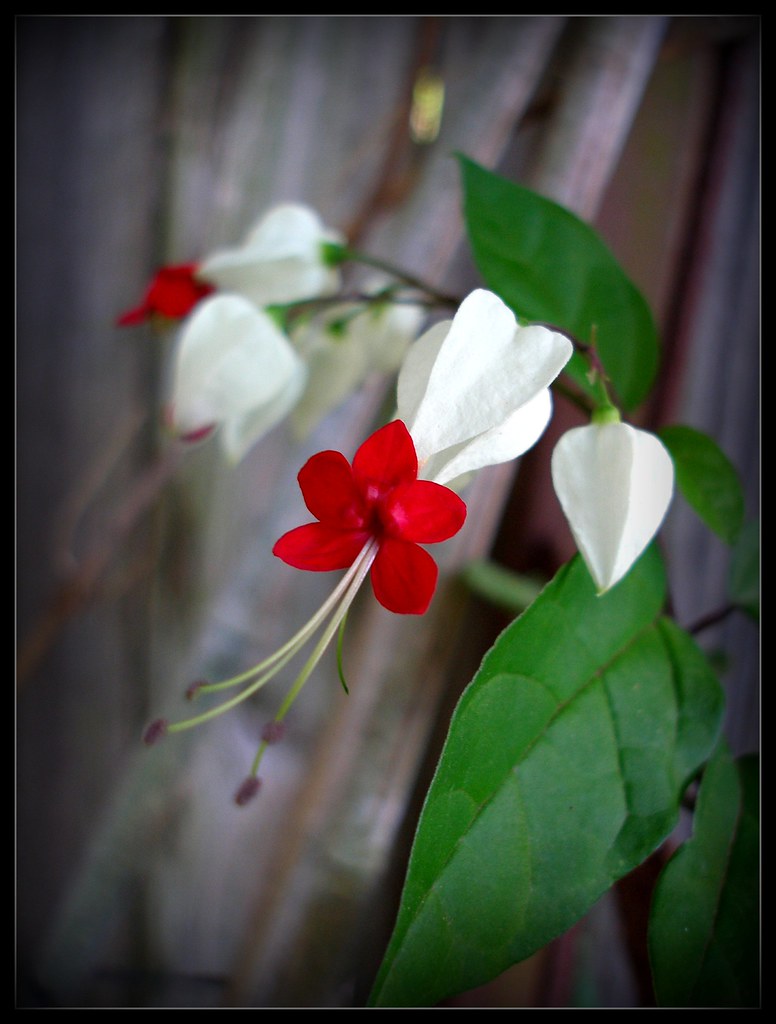
Bleeding Heart vine
Clerodendrum thomsoniae
Family Verbenaceae or Lamiaceae
The Hunt Grove, Merritt Island, Florida, USA.
==============================================================================
ALL MY IMAGES OF BLEEDING HEART;
www.flickr.com/photos/3point141/sets/72157625877093412/de...
==============================================================================