View allAll Photos Tagged Testbed
XV Patrick Blackett (X01) is an experimental ship used by the Royal Navy as a testbed for new technologies, including unmanned underwater vehicles and unmanned surface vehicles.
She is named after Patrick Blackett, a Royal Navy veteran and Nobel Prize-winning British physicist
Pictured here departing Portsmouth Harbour on trials work.
LY-LTF, an Embraer ERJ-175LR of Air Lituanica, lining up on RWY28 at Dublin Airport, operating seasonal charter flight LTU956 to Palanga in North Western Lithuania.
This airframe first took flight in August 2003. It was the 2nd prototype of the ERJ-175, and was operated by Embraer as a testbed aircraft for the first 3 years of its life carrying registration PP-XJG. In December 2006, it began is passenger carrying days, operating for Air Caraïbes as F-OFLY. It then joined German airline Cirrus Airlines as D-ALIB in 2008, before a year later heading back home to Brazil, operating for Brazilian regional airline TRIP Linhas Aéreas as PP-PJD. It stayed with them for 4 years, until TRIP was merged with Azul when they offloaded the aircraft to the lessor. Air Lituanica took over the lease in September 2013 who operated it until the airline ceased trading in May 2015. The aircraft was scrapped in 2015 in Kemble
Honeywell Test Bed, N757HW at Dublin Airport, 24th August 2018 operating a High Speed Wifi connectivity demonstration flight to and from Brno in Czech Republic.
Lockheed C-130 Hercules
From Wikipedia, the free encyclopedia
en.wikipedia.org/wiki/Lockheed_C-130_Hercules
C-130 Hercules
Straight-wing, four-engine turboprop-driven aircraft overflying water
USAF C-130E
Role Military transport aircraft
National origin: United States
Manufacturer: Lockheed
Lockheed Martin
First flight 23 August 1954
Status: In-service
Primary usersUnited States Air Force
United States Marine Corps
Royal Air Force
Royal Canadian Air Force
Produced1954–present
Number built: Over 2,500 as of 2015[1]
Unit cost
C-130E $11.9 million[2]
C-130H $30.1 million[3]
VariantsAC-130 Spectre/Spooky
Lockheed DC-130
Lockheed EC-130
Lockheed HC-130
Lockheed Martin KC-130
Lockheed LC-130
Lockheed MC-130
Lockheed WC-130
Lockheed L-100 Hercules
Developed into: Lockheed Martin C-130J Super Hercules
The Lockheed C-130 Hercules is a four-engine turboprop military transport aircraft designed and built originally by Lockheed, now Lockheed Martin. Capable of using unprepared runways for takeoffs and landings, the C-130 was originally designed as a troop, medivac, and cargo transport aircraft. The versatile airframe has found uses in a variety of other roles, including as a gunship (AC-130), for airborne assault, search and rescue, scientific research support, weather reconnaissance, aerial refueling, maritime patrol, and aerial firefighting. It is now the main tactical airlifter for many military forces worldwide. Over forty models and variants of the Hercules, including a civilian one marketed as Lockheed L-100, operate in more than sixty nations.
The C-130 entered service with the U.S. in the 1950s, followed by Australia and others. During its years of service, the Hercules family has participated in numerous military, civilian and humanitarian aid operations. In 2007, the C-130 became the fifth aircraft—after the English Electric Canberra, B-52 Stratofortress, Tu-95, and KC-135 Stratotanker—to mark 50 years of continuous service with its original primary customer, in this case, the United States Air Force. The C-130 Hercules is the longest continuously produced military aircraft at over 60 years, with the updated C-130J Super Hercules being produced today.[4]
Contents [hide]
1Design and development
1.1Background and requirements
1.2Design phase
1.3Improved versions
1.4More improvements
1.5Later models
1.6Next generation
1.7Upgrades and changes
1.8Replacement
2Operational history
2.1Military
2.2Civilian
3Variants
4Operators
5Accidents
6Aircraft on display
6.1Australia
6.2Canada
6.3Colombia
6.4Indonesia
6.5Norway
6.6Saudi Arabia
6.7United Kingdom
6.8United States
7Specifications (C-130H)
8See also
9References
10External links
Design and development[edit]
This section needs additional citations for verification. Please help improve this article by adding citations to reliable sources. Unsourced material may be challenged and removed. (February 2014)
Background and requirements[edit]
The Korean War, which began in June 1950, showed that World War II-era piston-engine transports—Fairchild C-119 Flying Boxcars, Douglas C-47 Skytrains, and Curtiss C-46 Commandos—were inadequate for modern warfare. Thus, on 2 February 1951, the United States Air Force issued a General Operating Requirement (GOR) for a new transport to Boeing, Douglas, Fairchild, Lockheed, Martin, Chase Aircraft, North American, Northrop, and Airlifts Inc. The new transport would have a capacity of 92 passengers, 72 combat troops or 64 paratroopers in a cargo compartment that was approximately 41 feet (12 m) long, 9 feet (2.7 m) high, and 10 feet (3.0 m) wide. Unlike transports derived from passenger airliners, it was to be designed from the ground-up as a combat transport with loading from a hinged loading ramp at the rear of the fuselage.
A key feature was the introduction of the Allison T56 turboprop powerplant, first developed specifically for the C-130. At the time, the turboprop was a new application of turbine engines that used exhaust gases to turn a propeller, which offered greater range at propeller-driven speeds compared to pure turbojets, which were faster but consumed more fuel. As was the case on helicopters of that era, such as the UH-1 Huey, turboshafts produced much more power for their weight than piston engines. Lockheed would subsequently use the same engines and technology in the Lockheed L-188 Electra. That aircraft failed financially in its civilian configuration but was successfully adapted into the Lockheed P-3 Orion maritime patrol and submarine attack aircraft where the efficiency and endurance of turboprops excelled.
Design phase[edit]
The Hercules resembled a larger four-engine brother to the C-123 Provider with a similar wing and cargo ramp layout that evolved from the Chase XCG-20 Avitruc, which in turn, was first designed and flown as a cargo glider in 1947.[5] The Boeing C-97 Stratofreighter also had a rear ramp, which made it possible to drive vehicles onto the plane (also possible with a forward ramp on a C-124). The ramp on the Hercules was also used to airdrop cargo, which included low-altitude extraction for Sheridan tanks and even dropping large improvised "daisy cutter" bombs.
The new Lockheed cargo plane design possessed a range of 1,100 nmi (1,270 mi; 2,040 km), takeoff capability from short and unprepared strips, and the ability to fly with one engine shut down. Fairchild, North American, Martin, and Northrop declined to participate. The remaining five companies tendered a total of ten designs: Lockheed two, Boeing one, Chase three, Douglas three, and Airlifts Inc. one. The contest was a close affair between the lighter of the two Lockheed (preliminary project designation L-206) proposals and a four-turboprop Douglas design.
The Lockheed design team was led by Willis Hawkins, starting with a 130-page proposal for the Lockheed L-206.[6] Hall Hibbard, Lockheed vice president and chief engineer, saw the proposal and directed it to Kelly Johnson, who did not care for the low-speed, unarmed aircraft, and remarked, "If you sign that letter, you will destroy the Lockheed Company."[6] Both Hibbard and Johnson signed the proposal and the company won the contract for the now-designated Model 82 on 2 July 1951.[7]
The first flight of the YC-130 prototype was made on 23 August 1954 from the Lockheed plant in Burbank, California. The aircraft, serial number 53-3397, was the second prototype, but the first of the two to fly. The YC-130 was piloted by Stanley Beltz and Roy Wimmer on its 61-minute flight to Edwards Air Force Base; Jack Real and Dick Stanton served as flight engineers. Kelly Johnson flew chase in a Lockheed P2V Neptune.[8]
After the two prototypes were completed, production began in Marietta, Georgia, where over 2,300 C-130s have been built through 2009.[9]
The initial production model, the C-130A, was powered by Allison T56-A-9 turboprops with three-blade propellers and originally equipped with the blunt nose of the prototypes. Deliveries began in December 1956, continuing until the introduction of the C-130B model in 1959. Some A-models were equipped with skis and re-designated C-130D. As the C-130A became operational with Tactical Air Command (TAC), the C-130's lack of range became apparent and additional fuel capacity was added in the form of external pylon-mounted tanks at the end of the wings.
Improved versions[edit]
A Michigan Air National Guard C-130E dispatches its flares during a low-level training mission
The C-130B model was developed to complement the A-models that had previously been delivered, and incorporated new features, particularly increased fuel capacity in the form of auxiliary tanks built into the center wing section and an AC electrical system. Four-bladed Hamilton Standard propellers replaced the Aeroproducts three-blade propellers that distinguished the earlier A-models. The C-130B had ailerons with increased boost—3,000 psi (21 MPa) versus 2,050 psi (14 MPa)—as well as uprated engines and four-blade propellers that were standard until the J-model's introduction.
An electronic reconnaissance variant of the C-130B was designated C-130B-II. A total of 13 aircraft were converted. The C-130B-II was distinguished by its false external wing fuel tanks, which were disguised signals intelligence (SIGINT) receiver antennas. These pods were slightly larger than the standard wing tanks found on other C-130Bs. Most aircraft featured a swept blade antenna on the upper fuselage, as well as extra wire antennas between the vertical fin and upper fuselage not found on other C-130s. Radio call numbers on the tail of these aircraft were regularly changed so as to confuse observers and disguise their true mission.
The extended-range C-130E model entered service in 1962 after it was developed as an interim long-range transport for the Military Air Transport Service. Essentially a B-model, the new designation was the result of the installation of 1,360 US gal (5,150 L) Sargent Fletcher external fuel tanks under each wing's midsection and more powerful Allison T56-A-7A turboprops. The hydraulic boost pressure to the ailerons was reduced back to 2050 psi as a consequence of the external tanks' weight in the middle of the wingspan. The E model also featured structural improvements, avionics upgrades and a higher gross weight. Australia took delivery of 12 C130E Hercules during 1966–67 to supplement the 12 C-130A models already in service with the RAAF. Sweden and Spain fly the TP-84T version of the C-130E fitted for aerial refueling capability.
The KC-130 tankers, originally C-130F procured for the US Marine Corps (USMC) in 1958 (under the designation GV-1) are equipped with a removable 3,600 US gal (13,626 L) stainless steel fuel tank carried inside the cargo compartment. The two wing-mounted hose and drogue aerial refueling pods each transfer up to 300 US gal per minute (19 L per second) to two aircraft simultaneously, allowing for rapid cycle times of multiple-receiver aircraft formations, (a typical tanker formation of four aircraft in less than 30 minutes). The US Navy's C-130G has increased structural strength allowing higher gross weight operation.
More improvements[edit]
Royal Australian Air Force C-130H, 2007
The C-130H model has updated Allison T56-A-15 turboprops, a redesigned outer wing, updated avionics and other minor improvements. Later H models had a new, fatigue-life-improved, center wing that was retrofitted to many earlier H-models. For structural reasons, some models are required to land with certain amounts of fuel when carrying heavy cargo, reducing usable range.[10] The H model remains in widespread use with the United States Air Force (USAF) and many foreign air forces. Initial deliveries began in 1964 (to the RNZAF), remaining in production until 1996. An improved C-130H was introduced in 1974, with Australia purchasing 12 of type in 1978 to replace the original 12 C-130A models, which had first entered RAAF Service in 1958.
The United States Coast Guard employs the HC-130H for long-range search and rescue, drug interdiction, illegal migrant patrols, homeland security, and logistics.
C-130H models produced from 1992 to 1996 were designated as C-130H3 by the USAF. The "3" denoting the third variation in design for the H series. Improvements included ring laser gyros for the INUs, GPS receivers, a partial glass cockpit (ADI and HSI instruments), a more capable APN-241 color radar, night vision device compatible instrument lighting, and an integrated radar and missile warning system. The electrical system upgrade included Generator Control Units (GCU) and Bus Switching units (BSU)to provide stable power to the more sensitive upgraded components.[citation needed]
Royal Air Force C-130K (C.3)
The equivalent model for export to the UK is the C-130K, known by the Royal Air Force (RAF) as the Hercules C.1. The C-130H-30 (Hercules C.3 in RAF service) is a stretched version of the original Hercules, achieved by inserting a 100 in (2.54 m) plug aft of the cockpit and an 80 in (2.03 m) plug at the rear of the fuselage. A single C-130K was purchased by the Met Office for use by its Meteorological Research Flight, where it was classified as the Hercules W.2. This aircraft was heavily modified (with its most prominent feature being the long red and white striped atmospheric probe on the nose and the move of the weather radar into a pod above the forward fuselage). This aircraft, named Snoopy, was withdrawn in 2001 and was then modified by Marshall of Cambridge Aerospace as flight-testbed for the A400M turbine engine, the TP400. The C-130K is used by the RAF Falcons for parachute drops. Three C-130K (Hercules C Mk.1P) were upgraded and sold to the Austrian Air Force in 2002.[11]
Later models[edit]
The MC-130E Combat Talon was developed for the USAF during the Vietnam War to support special operations missions in Southeast Asia and led to both the MC-130H Combat Talon II as well as a family of other special missions aircraft. Thirty-seven (37) of the earliest models currently operating with the Air Force Special Operations Command (AFSOC) are scheduled to be replaced by new-production MC-130J versions. The EC-130 Commando Solo is another special missions variant within AFSOC, albeit operated solely by an AFSOC-gained wing in the Pennsylvania Air National Guard, and is a psychological operations/information operations (PSYOP/IO) platform equipped as an aerial radio station and television stations able to transmit messaging over commercial frequencies. Other versions of the EC-130, most notably the EC-130H Compass Call, are also special variants but are assigned to the Air Combat Command (ACC). The AC-130 gunship was first developed during the Vietnam War to provide close air support and other ground-attack duties.
USAF HC-130P refuels a HH-60G Pavehawk helicopter
The HC-130 is a family of long-range search and rescue variants used by the USAF and the U.S. Coast Guard. Equipped for deep deployment of Pararescuemen (PJs), survival equipment, and (in the case of USAF versions) aerial refueling of combat rescue helicopters, HC-130s are usually the on-scene command aircraft for combat SAR missions (USAF only) and non-combat SAR (USAF and USCG). Early USAF versions were also equipped with the Fulton surface-to-air recovery system, designed to pull a person off the ground using a wire strung from a helium balloon. The John Wayne movie The Green Berets features its use. The Fulton system was later removed when aerial refueling of helicopters proved safer and more versatile. The movie The Perfect Storm depicts a real-life SAR mission involving aerial refueling of a New York Air National Guard HH-60G by a New York Air National Guard HC-130P.
The C-130R and C-130T are U.S. Navy and USMC models, both equipped with underwing external fuel tanks. The USN C-130T is similar but has additional avionics improvements. In both models, aircraft are equipped with Allison T56-A-16 engines. The USMC versions are designated KC-130R or KC-130T when equipped with underwing refueling pods and pylons and are fully night vision system compatible.
The RC-130 is a reconnaissance version. A single example is used by the Islamic Republic of Iran Air Force, the aircraft having originally been sold to the former Imperial Iranian Air Force.
The Lockheed L-100 (L-382) is a civilian variant, equivalent to a C-130E model without military equipment. The L-100 also has two stretched versions.
Next generation[edit]
Main article: Lockheed Martin C-130J Super Hercules
In the 1970s, Lockheed proposed a C-130 variant with turbofan engines rather than turboprops, but the U.S. Air Force preferred the takeoff performance of the existing aircraft. In the 1980s, the C-130 was intended to be replaced by the Advanced Medium STOL Transport project. The project was canceled and the C-130 has remained in production.
Building on lessons learned, Lockheed Martin modified a commercial variant of the C-130 into a High Technology Test Bed (HTTB). This test aircraft set numerous short takeoff and landing performance records and significantly expanded the database for future derivatives of the C-130.[12] Modifications made to the HTTB included extended chord ailerons, a long chord rudder, fast-acting double-slotted trailing edge flaps, a high-camber wing leading-edge extension, a larger dorsal fin and dorsal fins, the addition of three spoiler panels to each wing upper surface, a long-stroke main and nose landing gear system, and changes to the flight controls and a change from direct mechanical linkages assisted by hydraulic boost, to fully powered controls, in which the mechanical linkages from the flight station controls operated only the hydraulic control valves of the appropriate boost unit.[13] The HTTB first flew on 19 June 1984, with civil registration of N130X. After demonstrating many new technologies, some of which were applied to the C-130J, the HTTB was lost in a fatal accident on 3 February 1993, at Dobbins Air Reserve Base, in Marietta, Georgia.[14] The crash was attributed to disengagement of the rudder fly-by-wire flight control system, resulting in a total loss of rudder control capability while conducting ground minimum control speed tests (Vmcg). The disengagement was a result of the inadequate design of the rudder's integrated actuator package by its manufacturer; the operator's insufficient system safety review failed to consider the consequences of the inadequate design to all operating regimes. A factor that contributed to the accident was the flight crew's lack of engineering flight test training.[15]
In the 1990s, the improved C-130J Super Hercules was developed by Lockheed (later Lockheed Martin). This model is the newest version and the only model in production. Externally similar to the classic Hercules in general appearance, the J model has new turboprop engines, six-bladed propellers, digital avionics, and other new systems.[16]
Upgrades and changes[edit]
In 2000, Boeing was awarded a US$1.4 billion contract to develop an Avionics Modernization Program kit for the C-130. The program was beset with delays and cost overruns until project restructuring in 2007.[17] On 2 September 2009, Bloomberg News reported that the planned Avionics Modernization Program (AMP) upgrade to the older C-130s would be dropped to provide more funds for the F-35, CV-22 and airborne tanker replacement programs.[18] However, in June 2010, the Department of Defense approved funding for the initial production of the AMP upgrade kits.[19][20] Under the terms of this agreement, the USAF has cleared Boeing to begin low-rate initial production (LRIP) for the C-130 AMP. A total of 198 aircraft are expected to feature the AMP upgrade. The current cost per aircraft is US$14 million although Boeing expects that this price will drop to US$7 million for the 69th aircraft.[17]
An engine enhancement program saving fuel and providing lower temperatures in the T56 engine has been approved, and the US Air Force expects to save $2 billion and extend the fleet life.[21]
Replacement[edit]
In October 2010, the Air Force released a capabilities request for information (CRFI) for the development of a new airlifter to replace the C-130. The new aircraft is to carry a 190 percent greater payload and assume the mission of mounted vertical maneuver (MVM). The greater payload and mission would enable it to carry medium-weight armored vehicles and drop them off at locations without long runways. Various options are being considered, including new or upgraded fixed-wing designs, rotorcraft, tilt-rotors, or even an airship. The development could start in 2014, and become operational by 2024. The C-130 fleet of around 450 planes would be replaced by only 250 aircraft.[22] The Air Force had attempted to replace the C-130 in the 1970s through the Advanced Medium STOL Transport project, which resulted in the C-17 Globemaster III that instead replaced the C-141 Starlifter.[23] The Air Force Research Laboratory funded Lockheed and Boeing demonstrators for the Speed Agile concept, which had the goal of making a STOL aircraft that can take off and land at speeds as low as 70 km (130 km/h; 81 mph) on airfields less than 2,000 ft (610 m) long and cruise at Mach 0.8-plus. Boeing's design used upper-surface blowing from embedded engines on the inboard wing and blown flaps for circulation control on the outboard wing. Lockheed's design also used blown flaps outboard, but inboard used patented reversing ejector nozzles. Boeing's design completed over 2,000 hours of wind tunnel tests in late 2009. It was a 5 percent-scale model of a narrowbody design with a 55,000 lb (25,000 kg) payload. When the AFRL increased the payload requirement to 65,000 lb (29,000 kg), they tested a 5% scale model of a widebody design with a 303,000 lb (137,000 kg) take-off gross weight and an "A400M-size" 158 in (4.0 m) wide cargo box. It would be powered by four IAE V2533 turbofans.[24] In August 2011, the AFRL released pictures of the Lockheed Speed Agile concept demonstrator. A 23% scale model went through wind tunnel tests to demonstrate its hybrid-powered lift, which combines a low drag airframe with simple mechanical assembly to reduce weight and better aerodynamics. The model had four engines, including two Williams FJ44 turbofans.[23][25] On 26 March 2013, Boeing was granted a patent for its swept-wing powered lift aircraft.[26]
As of January 2014, Air Mobility Command, Air Force Materiel Command, and the Air Force Research Lab are in the early stages of defining requirements for the C-X next generation airlifter program to replace both the C-130 and C-17. An aircraft would be produced from the early 2030s to the 2040s. If requirements are decided for operating in contested airspace, Air Force procurement of C-130s would end by the end of the decade to not have them serviceable by the 2030s and operated when they can't perform in that environment. The development of the airlifter depends heavily on the Army's "tactical and operational maneuver" plans. Two different cargo planes could still be created to separately perform tactical and strategic missions, but which course to pursue is to be decided before C-17s need to be retired.[27]
Operational history[edit]
This section needs additional citations for verification. Please help improve this article by adding citations to reliable sources. Unsourced material may be challenged and removed. (February 2014)
Military[edit]
USMC KC-130F Hercules performing takeoffs and landings aboard the aircraft carrier Forrestal in 1963. The aircraft is now displayed at the National Museum of Naval Aviation.
The first production aircraft, C-130As were first delivered beginning in 1956 to the 463d Troop Carrier Wing at Ardmore AFB, Oklahoma and the 314th Troop Carrier Wing at Sewart AFB, Tennessee. Six additional squadrons were assigned to the 322d Air Division in Europe and the 315th Air Division in the Far East. Additional aircraft were modified for electronics intelligence work and assigned to Rhein-Main Air Base, Germany while modified RC-130As were assigned to the Military Air Transport Service (MATS) photo-mapping division.
In 1958, a U.S. reconnaissance C-130A-II of the 7406th Support Squadron was shot down over Armenia by MiG-17s.[28]
Australia became the first non-American force to operate the C-130A Hercules with 12 examples being delivered from late 1958. These aircraft were fitted with AeroProducts three-blade, 15-foot diameter propellers. The Royal Canadian Air Force became another early user with the delivery of four B-models (Canadian designation C-130 Mk I) in October / November 1960.[29]
In 1963, a Hercules achieved and still holds the record for the largest and heaviest aircraft to land on an aircraft carrier.[30] During October and November that year, a USMC KC-130F (BuNo 149798), loaned to the U.S. Naval Air Test Center, made 29 touch-and-go landings, 21 unarrested full-stop landings and 21 unassisted take-offs on Forrestal at a number of different weights.[31] The pilot, LT (later RADM) James H. Flatley III, USN, was awarded the Distinguished Flying Cross for his role in this test series. The tests were highly successful, but the idea was considered too risky for routine "Carrier Onboard Delivery" (COD) operations. Instead, the Grumman C-2 Greyhound was developed as a dedicated COD aircraft. The Hercules used in the test, most recently in service with Marine Aerial Refueler Squadron 352 (VMGR-352) until 2005, is now part of the collection of the National Museum of Naval Aviation at NAS Pensacola, Florida.
In 1964, C-130 crews from the 6315th Operations Group at Naha Air Base, Okinawa commenced forward air control (FAC; "Flare") missions over the Ho Chi Minh Trail in Laos supporting USAF strike aircraft. In April 1965 the mission was expanded to North Vietnam where C-130 crews led formations of B-57 bombers on night reconnaissance/strike missions against communist supply routes leading to South Vietnam. In early 1966 Project Blind Bat/Lamplighter was established at Ubon RTAFB, Thailand. After the move to Ubon the mission became a four-engine FAC mission with the C-130 crew searching for targets then calling in strike aircraft. Another little-known C-130 mission flown by Naha-based crews was Operation Commando Scarf, which involved the delivery of chemicals onto sections of the Ho Chi Minh Trail in Laos that were designed to produce mud and landslides in hopes of making the truck routes impassable.[citation needed]
In November 1964, on the other side of the globe, C-130Es from the 464th Troop Carrier Wing but loaned to 322d Air Division in France, flew one of the most dramatic missions in history in the former Belgian Congo. After communist Simba rebels took white residents of the city of Stanleyville hostage, the U.S. and Belgium developed a joint rescue mission that used the C-130s to airlift and then drop and air-land a force of Belgian paratroopers to rescue the hostages. Two missions were flown, one over Stanleyville and another over Paulis during Thanksgiving weeks.[32] The headline-making mission resulted in the first award of the prestigious MacKay Trophy to C-130 crews.
In the Indo-Pakistani War of 1965, as a desperate measure, the transport No. 6 Squadron of the Pakistan Air Force modified its entire small fleet of C-130Bs for use as heavy bombers, capable of carrying up to 20,000 lb (9,072 kg) of bombs on pallets. These improvised bombers were used to hit Indian targets such as bridges, heavy artillery positions, tank formations, and troop concentrations.[33][34] Some C-130s even flew with anti-aircraft guns fitted on their ramp, apparently shooting down some 17 aircraft and damaging 16 others.[35]
The C-130 Hercules was used in the Battle of Kham Duc in 1968, when the North Vietnamese Army forced U.S.-led forces to abandon the Kham Duc Special Forces Camp.
In October 1968, a C-130Bs from the 463rd Tactical Airlift Wing dropped a pair of M-121 10,000 pound bombs that had been developed for the massive B-36 bomber but had never been used. The U.S. Army and U.S. Air Force resurrected the huge weapons as a means of clearing landing zones for helicopters and in early 1969 the 463rd commenced Commando Vault missions. Although the stated purpose of COMMANDO VAULT was to clear LZs, they were also used on enemy base camps and other targets.[citation needed]
During the late 1960s, the U.S. was eager to get information on Chinese nuclear capabilities. After the failure of the Black Cat Squadron to plant operating sensor pods near the Lop Nur Nuclear Weapons Test Base using a Lockheed U-2, the CIA developed a plan, named Heavy Tea, to deploy two battery-powered sensor pallets near the base. To deploy the pallets, a Black Bat Squadron crew was trained in the U.S. to fly the C-130 Hercules. The crew of 12, led by Col Sun Pei Zhen, took off from Takhli Royal Thai Air Force Base in an unmarked U.S. Air Force C-130E on 17 May 1969. Flying for six and a half hours at low altitude in the dark, they arrived over the target and the sensor pallets were dropped by parachute near Anxi in Gansu province. After another six and a half hours of low altitude flight, they arrived back at Takhli. The sensors worked and uploaded data to a U.S. intelligence satellite for six months before their batteries wore out. The Chinese conducted two nuclear tests, on 22 September 1969 and 29 September 1969, during the operating life of the sensor pallets. Another mission to the area was planned as Operation Golden Whip, but was called off in 1970.[36] It is most likely that the aircraft used on this mission was either C-130E serial number 64-0506 or 64-0507 (cn 382-3990 and 382-3991). These two aircraft were delivered to Air America in 1964.[37] After being returned to the U.S. Air Force sometime between 1966 and 1970, they were assigned the serial numbers of C-130s that had been destroyed in accidents. 64-0506 is now flying as 62-1843, a C-130E that crashed in Vietnam on 20 December 1965 and 64-0507 is now flying as 63-7785, a C-130E that had crashed in Vietnam on 17 June 1966.[38]
The A-model continued in service through the Vietnam War, where the aircraft assigned to the four squadrons at Naha AB, Okinawa and one at Tachikawa Air Base, Japan performed yeoman's service, including operating highly classified special operations missions such as the BLIND BAT FAC/Flare mission and FACT SHEET leaflet mission over Laos and North Vietnam. The A-model was also provided to the South Vietnamese Air Force as part of the Vietnamization program at the end of the war, and equipped three squadrons based at Tan Son Nhut AFB. The last operator in the world is the Honduran Air Force, which is still flying one of five A model Hercules (FAH 558, c/n 3042) as of October 2009.[39] As the Vietnam War wound down, the 463rd Troop Carrier/Tactical Airlift Wing B-models and A-models of the 374th Tactical Airlift Wing were transferred back to the United States where most were assigned to Air Force Reserve and Air National Guard units.
U.S. Marines disembark from C-130 transports at the Da Nang Airbase on 8 March 1965
Another prominent role for the B model was with the United States Marine Corps, where Hercules initially designated as GV-1s replaced C-119s. After Air Force C-130Ds proved the type's usefulness in Antarctica, the U.S. Navy purchased a number of B-models equipped with skis that were designated as LC-130s. C-130B-II electronic reconnaissance aircraft were operated under the SUN VALLEY program name primarily from Yokota Air Base, Japan. All reverted to standard C-130B cargo aircraft after their replacement in the reconnaissance role by other aircraft.
The C-130 was also used in the 1976 Entebbe raid in which Israeli commando forces carried a surprise assault to rescue 103 passengers of an airliner hijacked by Palestinian and German terrorists at Entebbe Airport, Uganda. The rescue force — 200 soldiers, jeeps, and a black Mercedes-Benz (intended to resemble Ugandan Dictator Idi Amin's vehicle of state) — was flown over 2,200 nmi (4,074 km; 2,532 mi) almost entirely at an altitude of less than 100 ft (30 m) from Israel to Entebbe by four Israeli Air Force (IAF) Hercules aircraft without mid-air refueling (on the way back, the planes refueled in Nairobi, Kenya).
During the Falklands War (Spanish: Guerra de las Malvinas) of 1982, Argentine Air Force C-130s undertook highly dangerous, daily re-supply night flights as blockade runners to the Argentine garrison on the Falkland Islands. They also performed daylight maritime survey flights. One was lost during the war. Argentina also operated two KC-130 tankers during the war, and these refueled both the Douglas A-4 Skyhawks and Navy Dassault-Breguet Super Étendards; some C-130s were modified to operate as bombers with bomb-racks under their wings. The British also used RAF C-130s to support their logistical operations.
USMC C-130T Fat Albert performing a rocket-assisted takeoff (RATO)
During the Gulf War of 1991 (Operation Desert Storm), the C-130 Hercules was used operationally by the U.S. Air Force, U.S. Navy and U.S. Marine Corps, along with the air forces of Australia, New Zealand, Saudi Arabia, South Korea, and the UK. The MC-130 Combat Talon variant also made the first attacks using the largest conventional bombs in the world, the BLU-82 "Daisy Cutter" and GBU-43/B "Massive Ordnance Air Blast" bomb, (MOAB). Daisy Cutters were used to clear landing zones and to eliminate minefields. The weight and size of the weapons make it impossible or impractical to load them on conventional bombers. The GBU-43/B MOAB is a successor to the BLU-82 and can perform the same function, as well as perform strike functions against hardened targets in a low air threat environment.
Since 1992, two successive C-130 aircraft named Fat Albert have served as the support aircraft for the U.S. Navy Blue Angels flight demonstration team. Fat Albert I was a TC-130G (151891),[40] while Fat Albert II is a C-130T (164763).[41] Although Fat Albert supports a Navy squadron, it is operated by the U.S. Marine Corps (USMC) and its crew consists solely of USMC personnel. At some air shows featuring the team, Fat Albert takes part, performing flyovers. Until 2009, it also demonstrated its rocket-assisted takeoff (RATO) capabilities; these ended due to dwindling supplies of rockets.[42]
The AC-130 also holds the record for the longest sustained flight by a C-130. From 22 to 24 October 1997, two AC-130U gunships flew 36 hours nonstop from Hurlburt Field Florida to Taegu (Daegu), South Korea while being refueled seven times by KC-135 tanker aircraft. This record flight shattered the previous record longest flight by over 10 hours while the two gunships took on 410,000 lb (190,000 kg) of fuel. The gunship has been used in every major U.S. combat operation since Vietnam, except for Operation El Dorado Canyon, the 1986 attack on Libya.[43]
C-130 Hercules performs a tactical landing on a dirt strip
During the invasion of Afghanistan in 2001 and the ongoing support of the International Security Assistance Force (Operation Enduring Freedom), the C-130 Hercules has been used operationally by Australia, Belgium, Canada, Denmark, France, Italy, the Netherlands, New Zealand, Norway, Portugal, South Korea, Spain, the UK and the United States.
During the 2003 invasion of Iraq (Operation Iraqi Freedom), the C-130 Hercules was used operationally by Australia, the UK and the United States. After the initial invasion, C-130 operators as part of the Multinational force in Iraq used their C-130s to support their forces in Iraq.
Since 2004, the Pakistan Air Force has employed C-130s in the War in North-West Pakistan. Some variants had forward-looking infrared (FLIR Systems Star Safire III EO/IR) sensor balls, to enable close tracking of Islamist militants.[44]
Civilian[edit]
A C-130E fitted with a MAFFS-1 dropping fire retardant
The U.S. Forest Service developed the Modular Airborne FireFighting System for the C-130 in the 1970s, which allows regular aircraft to be temporarily converted to an air tanker for fighting wildfires.[45] In the late 1980s, 22 retired USAF C-130As were removed from storage at Davis-Monthan Air Force Base and transferred to the U.S. Forest Service who then sold them to six private companies to be converted into air tankers (see U.S. Forest Service air tanker scandal). After one of these aircraft crashed due to wing separation in flight as a result of fatigue stress cracking, the entire fleet of C-130A air tankers was permanently grounded in 2004 (see 2002 airtanker crashes). C-130s have been used to spread chemical dispersants onto the massive oil slick in the Gulf Coast in 2010.[46]
A recent development of a C-130–based airtanker is the Retardant Aerial Delivery System developed by Coulson Aviation USA . The system consists of a C-130H/Q retrofitted with an in-floor discharge system, combined with a removable 3,500- or 4,000-gallon water tank. The combined system is FAA certified.[47]
Variants[edit]
This section needs additional citations for verification. Please help improve this article by adding citations to reliable sources. Unsourced material may be challenged and removed. (February 2014)
C-130H Hercules flight deck
A U.S. JC-130 aircraft retrieving a reconnaissance satellite film capsule under parachute.
C-130s from the: U.S., Canada, Australia and Israel (foreground to background)
RAAF C-130J-30 at Point Cook, 2006
Brazilian Air Force C-130 (L-382)
For civilian versions, see Lockheed L-100 Hercules.
Significant military variants of the C-130 include:
C-130A/B/E/F/G/H/K/T
Tactical airlifter basic models
C-130A-II Dreamboat
Early version Electronic Intelligence/Signals Intelligence (ELINT/SIGINT) aircraft[48]
C-130J Super Hercules
Tactical airlifter, with new engines, avionics, and updated systems
C-130K
Designation for RAF Hercules C1/W2/C3 aircraft (C-130Js in RAF service are the Hercules C.4 and Hercules C.5)
AC-130A/E/H/J/U/W
Gunship variants
C-130D/D-6
Ski-equipped version for snow and ice operations United States Air Force / Air National Guard
CC-130E/H/J Hercules
Designation for Canadian Armed Forces / Royal Canadian Air Force Hercules aircraft. U.S. Air Force used the CC-130J designation to differentiate standard C-130Js from "stretched" C-130Js (Company designation C-130J-30s).
DC-130A/E/H
USAF and USN Drone control
EC-130
EC-130E/J Commando Solo – USAF / Air National Guard psychological operations version
EC-130E – Airborne Battlefield Command and Control Center (ABCCC)
EC-130E Rivet Rider – Airborne psychological warfare aircraft
EC-130H Compass Call – Electronic warfare and electronic attack.[49]
EC-130V – Airborne early warning and control (AEW&C) variant used by USCG for counter-narcotics missions[50]
GC-130
Permanently Grounded "Static Display"
HC-130
HC-130B/E/H – Early model combat search and rescue
HC-130P/N Combat King – USAF aerial refueling tanker and combat search and rescue
HC-130J Combat King II – Next-generation combat search and rescue tanker
HC-130H/J – USCG long-range surveillance and search and rescue
JC-130
Temporary conversion for flight test operations
KC-130F/R/T/J
United States Marine Corps aerial refueling tanker and tactical airlifter
LC-130F/H/R
USAF / Air National Guard – Ski-equipped version for Arctic and Antarctic support operations; LC-130F previously operated by USN
MC-130
MC-130E/H Combat Talon I/II – Special operations infiltration/extraction variant
MC-130W Combat Spear/Dragon Spear – Special operations tanker/gunship[51]
MC-130P Combat Shadow – Special operations tanker
MC-130J Commando II (formerly Combat Shadow II) – Special operations tanker Air Force Special Operations Command[52]
YMC-130H – Modified aircraft under Operation Credible Sport for second Iran hostage crisis rescue attempt
NC-130
Permanent conversion for flight test operations
PC-130/C-130-MP
Maritime patrol
RC-130A/S
Surveillance aircraft for reconnaissance
SC-130J Sea Herc
Proposed maritime patrol version of the C-130J, designed for coastal surveillance and anti-submarine warfare.[53][54]
TC-130
Aircrew training
VC-130H
VIP transport
WC-130A/B/E/H/J
Weather reconnaissance ("Hurricane Hunter") version for USAF / Air Force Reserve Command's 53d Weather Reconnaissance Squadron in support of the National Weather Service's National Hurricane Center
Boeing 737-505
cn: 24651 / ln: 1842
ff: 06-04-1990
19-04-1990 LN-BRD Braathens SAFE, config Y125, ans the 2nd 735. Delivered in "Sommerflyet" colours with the first flower decoration earlier shown in 1988 with N197JQ.
10-1990 LN-BRD repainted to stadard BU colours and named "Harald Gille"
23-03-1998 LN-BRD Braathens ASA tfd
1999 LN-BRD repainted into the new blue BU colours, still config Y125, "Harald Gille"
winter 2002/2003 repainted into the final BU colours, "Harald Gille"
01-04-2005 LN-BRD SAS Braathens tfd, "Harald Gille" reconfig CY120, operated in full ex BU colours
01-06-2007 LN-BRD SAS Norge tfd still "Harald Gille"
24-07-2007 VP-BRP Aeroflot-Nord, config CY110
(Leased from Aerco)
01-12-2009 VP-BRP Nordavia tfd, config Y110, /leased from (AerCo)
2016 reconfig Y132
12-03-2019 wfu
20-03-2019 VP-BRP Smartavia tfd, config Y135, (leased from AerCo)
19-10-2020 wfu
02-12-2020 stored at Staunton Shenandoah Valley Regional, USA (KSHD / SHD)
07-12-2020 N735T Dynamic Aivation, testbed
30-06-2023 stored at Wichita McConnell Air Forece Base (KIAB / IAB)
03-04-2024 entered service as testbed again
Seen arriving rwy 24 in August 1990
Scanned from original slide
The BAE Systems’ owned Jetstream (G-BWWW) is a unique aircraft. Known as ‘The Flying Testbed’, is an aerial laboratory which has been developed to be flown by pilots or as an Uninhabited Air Vehicle (UAV).
Reading Buses
Alexander Dennis Enviro400
201 - MRD1
Seen on service 462 at the 2021 Brooklands Summer Gathering.
One of the latest ex-hybrid ADLs to return to Reading, 201 has become a testbed for new technologies including the high-resolution Hanover destination screen.
At the height of the recent heatwave (climbing beyond 30°C in the Clydebank area), the testbed for First Glasgow's Eclipse Gemini-bodied Volvo B9TL refurbishment programme (WLT 408/37195; ex-SF07 FEJ) turns into the 2's Faifley terminus, completing a run from Baillieston.
This registration would have likely been a regular visitor to this area in the late 1980s/early 1990s, as Kelvin Central's Routemaster 1912 (ex-LT RM408) was a regular on the 5A; the 2 being it's modern-day equivalent.
Photo Date: 28th June 2018
Boeing 737-55S
cn: 26541 / ln: 2319
ff 19-06-1992
10-07-1992 OK-XGC CSA - Czech Airlines, config CY108
02-2012 repainted to "Retro" CSA special colours
13-01-2013 wfu
29-01-2015 ZS-TFJ Africa Aircraft Mantenance
02-07-2015 std FAOR/JNB
16-07-2021 ZS-TFJ Paramount Aerospace Systems, as a Testbed, conducting research / test flights
Seen on final approach to rwy 01L as OK446 from Prague this saturday 21 years ago
Scanned from original Fuji HR200 negative film
In some ways, star clusters are like giant families with thousands of stellar siblings. These stars come from the same origins – a common cloud of gas and dust – and are bound to one another by gravity. Astronomers think that our Sun was born in a star cluster about 4.6 billion years ago that quickly dispersed.
By studying young star clusters, astronomers hope to learn more about how stars – including our Sun – are born. NGC 6231, located about 5,200 light years from Earth, is an ideal testbed for studying a stellar cluster at a critical stage of its evolution: not long after star formation has stopped.
NASA’s Chandra X-ray Observatory has been used to identify the young Sun-like stars in NGC 6231, which have, until recently, been hiding in plain sight. Young star clusters like NGC 6231 are found in the band of the Milky Way on the sky. As a result, interloping stars lying in front of or behind NGC 6231 greatly outnumber the stars in the cluster. These stars will generally be much older than those in NGC 6231, so members of the cluster can be identified by selecting signs of stellar youth.
Young stars stand out to Chandra because they have strong magnetic activity that heats their outer atmosphere to tens of millions of degrees Celsius and causes them to emit X-rays. Infrared measurements assist in verifying that an X-ray source is a young star and in inferring the star's properties.
This Chandra X-ray image of NGC 6231 shows a close-up of the inner region of the cluster. Chandra can detect a range of X-ray light, which has been split into three bands to create this image. Red, green, and blue represents the lower, medium, and high-energy X-rays. The brightest X-ray emission is white.
The Chandra data, combined with infrared data from the Visible and Infrared Survey Telescope for Astronomy (VISTA) Variables in the Vía Lactéa survey has provided the best census of young stars in NGC 6231 available. An infrared image from NASA’s Wide-field Infrared Survey explorer is shown on the left.
Image credit: NASA/CXC/University of Valparaiso/M. Kuhn et. al WISE:NASA/JPL/WISE
N789ZB Boeing 787-9 Dreamliner Boeing Testbed 2x GEnx-1B 23. Apr 2013
JA861J Boeing 787-9 Dreamliner Japan Airlines C44W35Y116 2x GEnx-1B 09. Jun 2015 Ferried PAE-NRT 10 - 06/11/2015 on delivery
Prestwick 12 October 1965. Scanned from my father's original slide. Copyright Jim Cain.
Seen in the colours of VX-1 Operational Test and Evaluation Force when used as a testbed for the NADC Deltic programme.
Now preserved at NAS Moffat Field
Another view of Hawker Beechcraft 350 Super King Air N6147U caught on short finals to RAF Brize Norton
Owned by Boeing and festooned with all sorts of sensors and aerials, it is presumably used as some sort of test and evaluation platform?
Either way it was certainly the star item seen there that day
276A1668
One of the best movements in my entire collection!! N747GE is an ex-Pan Am 747-100 testbed aircraft for General Electric although it is powered by Pratt & Whitney JT9D-7A engines.
It’s one of the oldest 747s still in service with its first flight in 1970.
It’s departing via 25L for Victorville via Guam and Honolulu after a month-long stay in HKG where it underwent maintenance at HAECO. The testbed 741 is due to be replaced with a 744 in the future.
The E was the first widescale production variant of the now-widespread Lyftsmiþþan 112, with a relatively average speed for its date of introduction into the Lyftéored in 1938. Its wingspan continually shortened over its development leading to an almost comical appearance from above and below. In 1939 a Naval version was requested from Lyftsmiþþan by the Sjælland Sæmindighed (naval authority), prompting the production of the folding-wing version made in collaboration with Sæweorc, a seaplane manufacturer and passenger airline. Hardened landing gear, arrestor hooks, and the iconic rear-folding wings were all added to the typical Ls. 112 design.
The E-series were the first to be naval-ised in full production, with the D-series of land fighters primarily being a testbed for the technology to be placed on the E. The F-series would feature higher performance, and the G sporting a heavier armament.
Overall a very capable, if small and stout, plane.
Yes, the wings do fold, and the landing gear are functional as well. The wings might seem very short and wide but trust me, they're accurate to an He. 112 B. Terrifying.
See more car pics on my facebook page!
- - -
The XK120 was launched in roadster form at the 1948 London Motor Show as a testbed and show car for the new Jaguar XK engine. It caused a sensation, which persuaded Jaguar founder and design boss William Lyons to put it into production.
The "120" in its name referred to its 120 mph (193 km/h) top speed (faster with the windscreen removed), which made the XK120 the world's fastest standard production car at the time of its launch.
It was available in two open versions, first as the roadster (designated OTS, for open two-seater, in America), then also as a drophead coupé (DHC) from 1953 – and also as a closed, or "fixed-head" coupé (FHC) from 1951. The DHC was a more deluxe open model, with wind-up windows, and wood-veneer dashboard and interior door caps, as on the FHC.
The roadster was successful in racing.
(Wikipedia)
12-7-2016 - Airbus Industrie, Airbus A350-941.
Powering into the air at Farnborough ready to start its display at FIA 2016.
Info:
The aircraft was built in 2013 and is part of the Airbus test bed fleet of A350 aircraft.
C/n - 2
First flight date04/02/1983
Honeywell operates Boeing 757-225 N757HW as an engine testbed at Phoenix Sky Harbor Airport. It is powered by a pair of Rolls royce RB211-535E4B37 turbofans. It carries a third jet engine on the right side of the forward fuselage. The construction number of N757HW is 22194. It first flew on February 4, 1983. It was delivered to Eastern Airlines as N504EA on February 28, 1983. It was withdrawn from use at McCarren Airport, Nevada in January 1991. Airtours International Airways registered it as G-JALC on February 1, 1995. Airtours International Airways changed its name to MyTravel Airways on May 1, 2002. Honeywell International Incorporated gave it its current registration on October 4, 2005. It was flown to Pinal Airpark for painting on October 24, 2005. It made its first flight with three engines on December 20, 2008
Photo taken by Stefan Röhrich.
München-Riem
1979-05-24 (24 May 1979)
YI-AIP
Ilyushin Il-76
073410308
Iraqi Air Force (full Iraqi Airways colours)
Finally without the veil it wore for three days, YI-AIP is lined up for take-off on Riem's runway 07.
The first Il-76 to visit Riem, YI-AIP arrived on 21 May and left on 24 May 1979. It would be followed by other Iraqi Air Force/Iraqi Airways Il-76s: YI-AIO (July 1979), YI-AIM (May 1980), YI-AKQ (February 1982), YI-AKO (April 1982), YI- AKX (April 1982) and YI-ALQ (August 1983). Probably there were more during the mid and late 1980s.
Information from flickr - thanks to Phil Rawlings:
Delivered to the Iraqi Air Force as YI-AIP in September 1977. To Gromov Flight Research Institute as CCCP-76529 in 1989. Became RA-76529 Aeroflot Zhukovsky Flight Research Institute used to test AN-70 Turbofan, at Farnborough Air Show in 1994 and stored 2002 Zhukovsky. Return to service 06.15. Oldest airworthy Il-76 as of 2019.
Registration details for this airframe:
www.scramble.nl/database/soviet/details/85_54380
This airframe as CCCP-76529 at FAB in September 1994 (An-70 turbofan testbed):
www.flickr.com/photos/133813370@N04/50794232853
www.flickr.com/photos/141169709@N06/51185543135
RA-76529 at Zhukovsky in August 1995:
www.flickr.com/photos/pslg05896/30815395322
RA-76529 stored at Zhukovsky in August 2012:
www.flickr.com/photos/ajw1970/8758073033
76529 with Gromov Flight Research Institute at Zhukovsky in January 2016 (bare metal):
cdn.jetphotos.com/full/6/63053_1457811690.jpg

76529 with Gromov Flight Research Institute at Zhukovsky in August 2018 and March 2019:
onespotter.com/photograph/djE6OTQ0OTI5OjEyODB4MS4wOjEwOHg...

onespotter.com/photograph/djE6OTY4MTM5OjEyODB4MS4wOjEwMWg...

russianplanes.net/images/to282000/281443.jpg
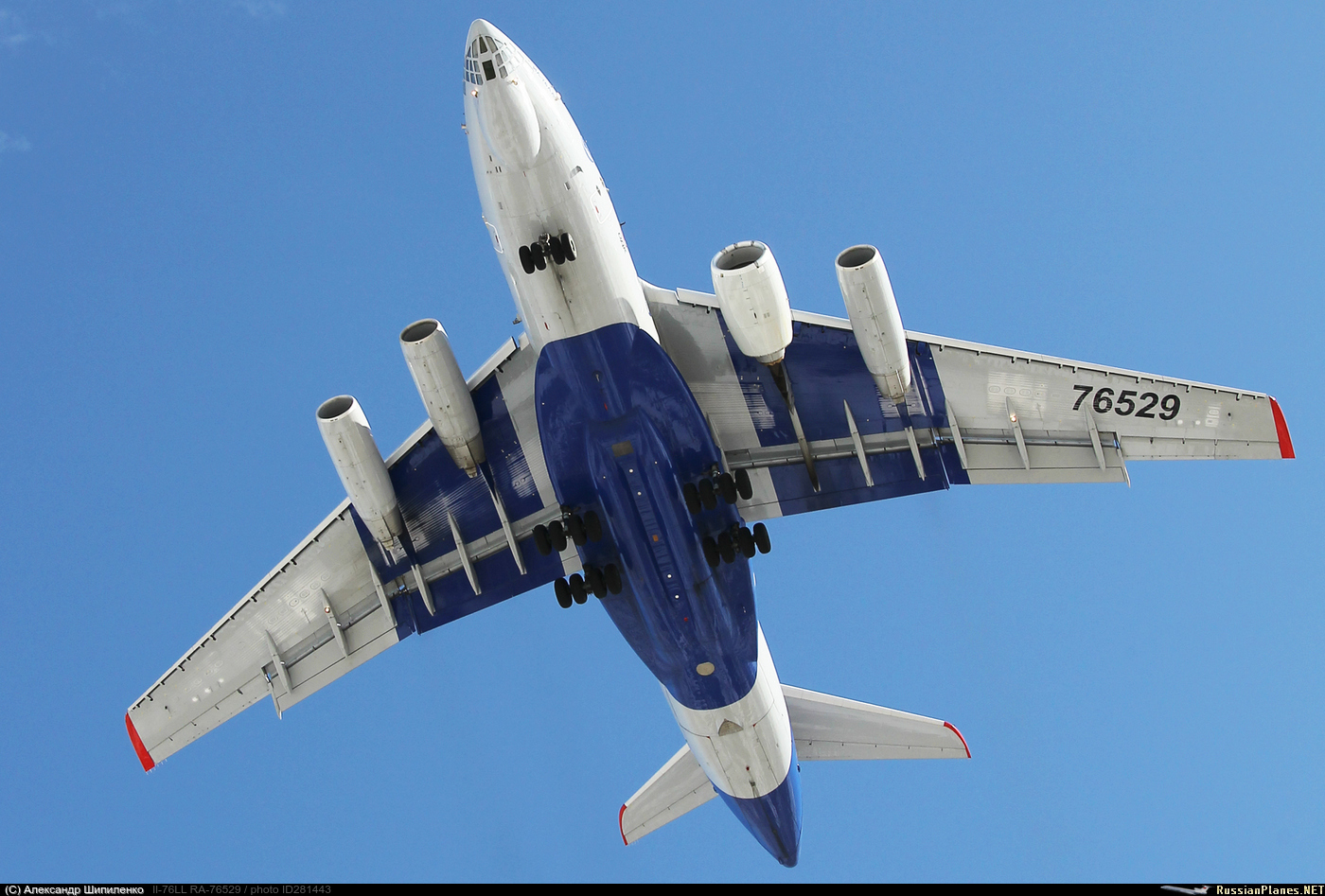
Scan from Kodachrome K25 slide.
J227 OKX is a unique Iveco TurboCity 480.12.21 with Alexander double-deck bodywork. Developed from a single-deck chassis, it was essentially an Iveco testbed and presented the bodybuilder with a number of problems, especially in relation to passing the tilt test. The eventual result was a somewhat unsatisfactory interior layout. After a very protracted construction process, it was registered as a demonstrator in May 1992.
Needless to say it remained unique, and was acquired by Filer, Ilfracombe, later passing to Bluebird.
Testing navigation sofware and acting as engine testbed. Taxiing past the spotting pavilion for a 10:15 departure to Milan-Linate. Returned back to Stockholm-Arlanda at 15:07.
Airbus A380-861
MSN 004 [Engine Alliance testbed]
F-WWDD 'VNO' ['#A380' 'iflyA380.com' decals]
Airbus S.A.S.
Copyright © 2016 A380spotter. All rights reserved.
The 44 year old Rolls Royce 747-200 Series testbed returning home to Tucson after a 1+ year assignment in Waco, TX.
Note the Trent 1000 Dreamliner engine in the number 2 position and the new Pearl 10X engine for the Dassault Falcon 10X added to its right wing.
12/2020 - I had not seen the SD45 testbed unit for a while so I decided to look for it. It's across from Thompson's Pharmacy.
Replacing an earlier scanned slide with a better version 11-Mar-15, plus Topaz DeNoise AI 14-Mar-26.
Test Bed for the Bristol Siddeley Viper engine.
Four Lockheed R7V-1 Super Constellation transports ordered by the U.S. Navy (Bureau Numbers 131630/131631 and 131660/131661) were modified during assembly as experimental turboprop-powered R7V 2s with four 5,550 shaft horsepower Pratt & Whitney YT34-P-12A engines turning three-bladed propellers with squared off tips. Design of the R7V-2 began in 1951 and the aircraft was first flown in September 1954. Lockheed leased one of the R7V-2s back from the Navy to serve as a testbed for the Allison 501 turboprop engines used to power the L 188 Electra airliner. Nicknamed Elation (derived from combing Electra and Constellation), that aircraft was later delivered to the US Air Force as a YC-121F.
G-JALC Boeing 757-200 of MyTravel at Manchester 16/5/04.
Now flying as an engine test bed for Honeywell as N757HW.
CN SD40-2W 5261- a former LNG testbed unit- approaches North Milwaukee Yard with L507 from DBR Junction in Germantown. Upon entering the yard, it will drop these cars and move to the Saukville Sub, running north to serve industries there.
The spur to the right enters what looks to be a steel plant of some sort- I am unsure if it still receives rail service (though judging by the rusty rails, weed growth and cockeyed gate, I'm guessing not) but the same building complex is at least currently home to a rail-related industry in the form of Trackside Services, Inc, manufacturer of rail-yard retarders and related equipment.
N804X operated by Northrup Grumman Systems Corp Bombardier CRJ700-701 Flying testbed, seen landing at Baltimore MD 16th Dec 2021
"#harrymorrowphoto1
flickr.com/harrymorrowphotography
harrymorrowphotography.com
globalairpower.net"
Previously registered VR-BKK & N808V.
Damaged beyond repair 14-Feb-14 at BOH.
Used as a testbed with Tudor Scan Tech at St-Imier, Switzerland.