View allAll Photos Tagged Executor
A shot of a small piece of 'test-greebling' for the main 'city' structure down the spine of the Executor. I am trying to replicate the appearance of the actual studio model which uses lots and lots of flat plate jutting out to create the detail...
Zentralfriedhof IV. TOR 17 25 30
GOLZ Karl aged 61 died 05.07.1959.
I got to know this GOLDFADEN/GOLZ/GARDNER family through a chance encounter at Thos. Cook in London. The end of the story was that I became an executor and arranged for these graves to be restored.
These GOLDFADEN came from Vienna via Znaim/Znojmo in Moravia
- whether they were related to the famous Yiddish theatre GOLDFADEN I do not know and neither did they.
All I do know is that poor Erna and her husband Nathan suffered a terrible fate in Izbica. Erna's, half-brother Eric, who lived in London never got over it [see Yad Vashem pages of testimony] .
Flora court (5, Wiedner Mainstreet 88, Hartmann alley 1), secessionist rental house, built in 1901/1902 by Oskar Laske (student of Otto Wagner and Karl König, from 1907 exclusively painter and graphic artist), Viktor Fiala and builder J. Barak as executors after a draft of Wunibald Deininger. The remarkable building shows (as one of the few rental houses of Vienna) in its brittle outline the tendencies of the Viennese Secessionism around 1900 in the follow-up period after Otto Wagner, the original (partly coloured) decor, unlike the floral-curvilinear trends of Western modernism, always serving to emphasize the tectonics of the structure (see also Villa Vojcsik by Otto Schönthal).
Florahof (5, Wiedner Hauptstraße 88, Hartmanngasse 1), secessionistisches Miethaus, erbaut 1901/1902 von Oskar Laske (Schüler Otto Wagners und Karl Königs, ab 1907 ausschließlich Maler und Graphiker), Viktor Fiala und Baumeister J. Barak als Ausführende nach einem Entwurf von Wunibald Deininger. Der bemerkenswerte Bau zeigt (als eines der wenigen Miethäuser Wiens) in seiner spröden Gliederung die Tendenzen des Wiener Secessionismus um 1900 im Anschluss an Otto Wagner, wobei der originelle (teils färbige) Dekor, im Gegensatz zu den floral-kurvilinearen Tendenzen des westlichen Jugendstils, stets zur Betonung der Tektonik der Gliederung dient (vergleiche Villa Vojcsik von Otto Schönthal).
There was never any doubt I would go to Rob's funeral. Rob was born just two weeks before me, and in our many meetings, we found we had so much in common.
A drive to Ipswich should be something like only two and a half hours, but with the Dartford Crossing that could balloon to four or more.
My choice was to leave early, soon after Jools left for work, or wait to near nine once rush hour was over. If I was up early, I'd leave early, I said.
Which is what happened.
So, after coffee and Jools leaving, I loaded my camera stuff in the car, not bothering to program in a destination, as I knew the route to Suffolk so well.
Checking the internet I found the M2 was closed, so that meant taking the M20, which I like as it runs beside HS2, although over the years, vegetation growth now hides most of it, and with Eurostar cutting services due to Brexit, you're lucky to see a train on the line now.
I had a phone loaded with podcasts, so time flew by, even if travelling through the endless roadworks at 50mph seemed to take forever.
Dartford was jammed. But we inched forward, until as the bridge came in sight, traffic moved smoothly, and I followed the traffic down into the east bore of the tunnel.
Another glorious morning for travel, the sun shone from a clear blue sky, even if traffic was heavy, but I had time, so not pressing on like I usually do, making the drive a pleasant one.
Up through Essex, where most other traffic turned off at Stanstead, then up to the A11 junction, with it being not yet nine, I had several hours to fill before the ceremony.
I stopped at Cambridge services for breakfast, then programmed the first church in: Gazeley, which is just in Suffolk on the border with Cambridgeshire.
I took the next junction off, took two further turnings brought be to the village, which is divided by one of the widest village streets I have ever seen.
It was five past nine: would the church be open?
I parked on the opposite side of the road, grabbed my bag and camera, limped over, passing a warden putting new notices in the parish notice board. We exchange good mornings, and I walk to the porch.
The inner door was unlocked, and the heavy door swung after turning the metal ring handle.
I had made a list of four churches from Simon's list of the top 60 Suffolk churches, picking those on or near my route to Ipswich and which piqued my interest.
Here, it was the reset mediaeval glass.
Needless to say, I had the church to myself, the centuries hanging heavy inside as sunlight flooded in filling the Chancel with warm golden light.
Windows had several devotional dials carved in the surrounding stone, and a huge and "stunningly beautiful piscina, and beside it are sedilia that end in an arm rest carved in the shape of a beast" which caught my eye.
A display in the Chancel was of the decoration of the wooden roof above where panels contained carved beats, some actual and some mythical.
I photographed them all.
I programmed in the next church, a 45 minute drive away just on the outskirts of Ipswich, or so I thought.
The A14 was plagued by roadworks, then most trunk roads and motorways are this time of year, but it was a fine summer morning, I was eating a chocolate bar as I drove, and I wasn't in a hurry.
I turned off at Claydon, and soon lost in a maze of narrow lanes, which brought be to a dog leg in the road, with St Mary nestling in a clearing.
I pulled up, got out and found the air full of birdsong, and was greeted by a friendly spaniel being taken for a walk from the hamlet which the church serves.
There was never any doubt that this would be open, so I went through the fine brick porch, pushed another heavy wooden door and entered the coolness of the church.
I decided to come here for the font, which as you can read below has quite the story: wounded by enemy action no less!
There seems to be a hagioscope (squint) in a window of the south wall, makes one think or an anchorite, but of this there is little evidence.
Samuel and Thomasina Sayer now reside high on the north wall of the Chancel, a stone skull between them, moved here too because of bomb damage in the last war.
I drove a few miles to the next church: Flowton.
Not so much a village as a house on a crossroads. And the church.
Nothing so grand as a formal board outside, just a handwritten sign say "welcome to Flowton church". Again, I had little doubt it would be open.
And it was.
The lychgate still stands, but a fence around the churchyard is good, so serves little practical purpose, other than to be there and hold the signs for the church and forthcoming services.
Inside it is simple: octagonal font with the floor being of brick, so as rustic as can be.
I did read Simon's account (below) when back outside, so went back in to record the tomb of Captain William Boggas and his family, even if part of the stone is hidden by pews now.
I had said to myself, that if I saw signs for another church, I might find time to visit. And so it was with Aldham, I saw the sign pointing down a narrow lane, so I turned and went to investigate.
First it looked like the road ended in a farmyard, but then I saw the flint round tower of the church behind, so followed the lane to the church gate.
There was a large welcoming sign stating, proudly, that the church is always open.
St Mary stands on a mound overlooking a shallow valley, water stand, or runs slowly, in the bottom, and it really is a fine, fine location for a church.
I pushed through the gate and went up the path to the south porch, where the door swung open once again.
The coolness within enveloped me.
An ancient font at the west end was framed by a brick-lined arch, even to my untrained eyes, I knew this was unusual.
There were some carved bench ends, some nice fairly modern glass, but the simplicity of the small church made for a very pleasant whole.
I no longer watch TV much, so was unaware of the view and indeed church being used in the TV show, The Detectorists.
One of Suffolk's hidden treasures, for sure.
--------------------------------------------------
I cycle past this church often - or, at least, the top of the lane that leads down to it. Traffic rushes along the busy Ipswich to Sudbury road not far off, but there is a quieter, parallel road which not many people seem to know about. It leaves Ipswich through Sproughton and will take you all the way to Sudbury, visiting the likes of Burstall, Kersey and Little Waldingfield on the way. Aldham as a village is little more than a straggle of houses, but they lie along this road, and just beyond a cluster of houses you take a sudden turn to the left, on to a pretty track to Aldham Hall. Down through fruit trees you descend, until the walls become older, and there at the end are the farm buildings. Beyond them, is this pretty church.
If the church is pretty, the view from it is doubly so - to the south, the land drops away alarmingly, into a valley full of sheep. You may even think you recognise it, and you could well be right, for the second season of the popular TV series The Detectorists was filmed here, as a small display in the porch of the church reminds you. The church appeared in the opening credits of each programme, the two main characters searching for buried treasure in Aldham Vale below the churchyard.
This is lovely, and splendidly English. Nothing could be more peaceful. But beyond, the land rises to a dark sea of trees, the mysteriously named Wolves Wood, now an RSPB reserve. Looking along to the right, the other hilltop is where the Protestant preacher Roland Taylor was burned at the stake in the 1550s, a site of pilgrimage for his many American descendants. Whatever your reading of the English Reformation, Taylor's burning was a terrible event. One imagines the villagers gathered outside this church, watching the flames and smoke rise.
I remembered the first time I came here, back in the 1990s. We arrived on one of those humid, overcast summer days, on our way to the Bildeston Beer Festival. My young children scattered off to play hide and seek with their mother in the precipitous graveyard. An elderly man was pottering about, looking at 19th Century graves, so I apologised for my family (as you do). But he seemed genuinely pleased that they were running about like mad things. He was tracing his family, and had come down from Norfolk to look for a particular grave of an ancestor. And he'd found it. He was pretty pleased about that, too. He was also following up a theory that his ancestor had been a Rector of this parish. His address had been Aldham Rectory. Did I have any idea how he could find out? I suggested that the church might have a board of 'Rectors of this Parish'. Many do. These are a pleasant Victorianism, intended to overcome the 16th Century breach by claiming a history of the CofE that extended back before the Reformation. We could go inside, and take a look. And we did - the church was militantly open, the inner door wedged wide. We found the board - but the name wasn't there. So, the mystery remained unsolved.
This church was pretty well derelict by the mid 19th Century, and underwent a fairly late restoration, in 1883. The tower was rebuilt, as was the south wall of the nave. The roofs were replaced, giving an overwhelmingly Victorian appearance, although Sam Mortlock detected the Norman, and possibly Saxon, ancestor. The hill itself suggests a very early foundation, perhaps on a site of pagan worship.
The architect was WM Fawcett, and there was another restoration of the inside in the early 20th Century under the eyes of diocesan surveyor and renowned antiquarian H Munro Cautley. The resulting interior is one of those neat and shiny jobs that is certainly grand, and pleasant enough, but rather dated now. Our early 21st Century spirituality seems to respond more to dusty, ancient interiors than to these High Church ritualisations. But you get a sense of a church that is still much loved, well-cared for, and used regularly.
Aldham parish have gone one further than a wedged-open door, and a big sign has been erected at the bottom of the lane proclaiming that Our Church is Always Open, and so it is easy to step inside. And it is not without survivals, some of them fascinating. The benches are mostly Cautleys from the 1920s, but he incorporated a couple of earlier ones. These are unlike anything else I've seen in Suffolk, and their primitive quality suggests a local origin. The one to the west apparently shows a bear, or possibly a lion. My first impulse was that it was some kind of heraldic device, but what is the shaved off object it holds in its mouth, and is the pattern emerging from beneath the head really fur? Back in 1999, my six year old took one look at it and decided that the creature isn't eating the bird, but the bird is flying out of its mouth. Could it be a dove? And could the three objects issuing from beneath the head actually be tongues of fire? In which case, could this be some strange composition representing Pentecost, and the descent of the Holy Spirit?
In the spandrel above the bear, or whatever it is, there is a lily, the symbol of the Annunciation. But it is also a symbol of the crucifixion. It calls to mind the rare lily crucifixes, of which just two are known to survive in Suffolk, at Long Melford and Great Glemham. Could this be an unrecorded third? The other bench end is probably easier to read. The crown is obvious enough. The star and crescent are familiar from representations of the crucifixion. The pike is a familiar instrument of the Passion. And, if you look in the spandrel above, you'll see a crown of thorns, so this may well be a composition representing the Passion.
A third bench end, to the east, shows just a simple spiked tool, that looks as if it might have been used in thatching. So, what's it all about? They are all a bit of a mystery, really.
And what of the font? This is curious too. It appears to be Norman, but a second glance finds it too elegant, too finely detailed. The pillars are almost Classical in design, and the whole piece has a touch of the 18th Century about it. Was it brought here from somewhere else in the 1880s? Or is it a Victorian recutting of a Norman predecessor? Whatever, the revealed brickwork of the late medieval tower arch looks most fitting behind it.
To see Cautley's work in its full glory, step up into the chancel for the reredos and its flanking niches, as grand as a side-chapel in a French cathedral. Cautley was usually a safe pair of hands in these churches he loved so well, but I wonder what he had been thinking to impose this triumphalism on this pretty little country church. Alfred Wilkinson's contemporary glass above it suits it well, but even so it is rather hard to imagine the same thing happening today. Postdating it by a few decades is a set of arms for Elizabeth II above the south doorway. East Anglia has no more than half a dozen sets, and these ones are rather good.
Standing in the nave and looking east to the splendour of the reredos, it is hard to imagine the real glory that once was here. But John Nunn contacted me, to tell me about a will he has a copy of. In 1525, his ancestor Robert Clifford declared: I bequeath I will have the rood there upon the candlebeam set up higher and Mary & John and two new angels and the breast under the rood korvyn and when that is done I will have all this painted and guilt whatsoever the cost. I will have bought two standards of brass stand in the choir and I will my executors bestow therein 40/-. I will my executors shall buy four candlesticks of brass for the candlebeam, I give six kine unto the church of Aldham to keep my obit with as long as the world stand.
What does all this mean? Firstly, you have to remember that England was a devoutly Catholic country in 1525, and the fittings of the church were for the actions of the Catholic liturgy. In the late 15th and early 16th Centuries, all Suffolk churches had a rood in place. This was a representation of the crucifixion, set above the chancel arch. On the left hand side of the cross always stood the Virgin Mary, and on the other side stood St John. Often, the wall behind was painted. The rood either hung on the wall, or was supported by a beam. However, there was always a beam that ran below it for candles to be lit on. This was called the candlebeam, or rood beam. The candles were placed on it by individuals or guilds as part of the process of prayer, particularly prayer for the souls of the dead. A rood loft ran beside it for access, and the space beneath was infilled with a rood screen. To make the rood even more glorious, the roof above was panelled, and the panels were painted blue, with gold stars, and perhaps Marian monograms. This was called the canopy of honour, or more simply, the coving (rendered delightfully in Suffolk dialect as Korvyn above.)
Robert Clifford was paying for a simple rood to be made more glorious. He was going to have it placed higher, with a new canopy of honour. He was paying for brass candlesticks to replace wooden candlestocks.
Why? Simply, the medieval economy of grace depended upon the living praying for the dead, and the dead praying for the living. In donating glorious things to his church, Clifford was ensuring that he would be remembered. The roodscreen would have a dedicatory inscription with his name on. He was saying - I won't forget you, don't you forget me. The Catholic liturgy formalised prayers for the dead in the form of obit masses.These were said on the anniversary of someone's death in perpetuity. The proceeds of the sale of the six cows (kine) would be invested, probably in land to be rented, to pay a priest to say these masses - as long as the world shall stand; that is, for ever.
Unfortunately, 'for ever' didn't last very long. Prayers for the dead were declared illegal by the protestant reformers in the late 1530s. By 1547, every single rood in the land had been toppled and burned. The rood lofts were hacked down, along with many of the candle beams (although about ten beams survive in Suffolk) and most of the rood screens were also destroyed (about 50 survive in Suffolk).
Nothing of Robert Clifford's gifts survive at Aldham. All the gilt would have been stripped, the brass candlesticks melted down, and the proceeds sequestered by the King's commissioners. The collected glory of all the churches of England was squandered by Henry VIII on high living, and on the expensive and pointless siege of Boulogne. A sad thought.
When I first came here in 1999, I remember the graveyard was full of wild thyme and especially sorrel, which we gathered in handfuls and ate later in the day with fresh trout and new potatoes. Twenty years have passed since then, and it was too early for the sorrel this year. Instead I just stood, and looked out across the gentle valley, the sheep cropping their way slowly westward. It was easy to recognise the opening of The Detectorists in the vale below. And I looked beyond to Wolves Wood, and the site of Roland Taylor's martyrdom. Hard to imagine such history happening to such a modest little parish.
Simon Knott, March 2019
The fourth Ida Rentoul Outhwaite Children's Library Stained Glass Window features an excerpt from the poem "A Concert"; "Then clear on a flute of purest gold, a sweet little fairy played, and wonderful fairy tales she told, and marvellous music played". This is Ida Rentoul Outhwaite's most famous quotes, although it was actually written by her elder sister Annie Rattray Rentoul as the quote is taken from "Fairyland" published by A. and C. Black in 1926, for which Annie wrote poems and Ida's husband Arthur Grenbry Outhwaite wrote stories, all of which Ida illustrated. The original illustration was executed in pen and ink, so it is brought to colourful life in the pink, blue, brown and golden yellow stained glass panel. It features a little girl faerie with pink wings and a silvery dress atop a ragged toadstool playing her golden pipe to an assembled audience of six pixies, a koala and a little boy. The little boy (whose name is John) wears contemporary 1920s clothes, with button up short trousers, ankle socks, strap over shoes and a collared shirt. John's hair is also a modern 1920s pageboy cut. The faerie too has a contemporary pageboy cut, with a wreath of flowers about her crown. Her dress is typical of 1920s sundresses for little girls and on her feet she wears a pair of fashionable black Mary Janes. The audience sit beneath a row of spindly gum trees whilst about them through the grass sprout tiny white daisies such as are found in many an Australian lawn today. All the audience appear entranced except the brown koala who sits at the end and the pixie next to him. The pixie looks unimpressed as the koala's head lolls forward and his lids droop. This may be in reference to the remaining part of the poem's stanza which reads: "But Teddy Bear began to nod, and gave a very loud snore, and yet at the end - it's true, though odd -, he grunted out 'Encore!'"
In 1923 with Fitzroy still very much a working class area of Melbourne with pockets of poverty, the parish of St. Mark the Evangelist decided to address the need of the poor in the inner Melbourne suburb. Architects Gawler and Drummond were commissioned to design a two storey red brick Social Settlement Building. It was opened in 1926 by the Vicar of St. Mark the Evangelist, the Reverend Robert G. Nichols (known affectionately amongst the parish as Brother Bill). Known today as the Community Centre, the St. Mark the Evangelist Social Settlements Building looks out onto George Street and also across the St. Mark the Evangelist's forecourt. When it opened, the Social Settlement Building's facilities included a gymnasium, club rooms and children's library.
Opened in 1926, the children's library, which was situated in the corner room of the Social Settlements Building, is believed to be the first known free dedicated children's library in Victoria. The library was given to the children of Fitzroy by Mrs. T. Hackett, in memory of her late husband. The library contained over 3,000 books, as well as children's magazines and even comics. The Social Settlements Building was only erected because Brother Bill organised the commitment of £1,000.00 each from various wealthy businessmen and philanthropists around Melbourne. Mrs Hackett's contribution was the library of £1,000.00 worth of books. Another internationally famous resident of the neighbourhood, Australian children's book illustrator Ida Rentoul Outhwaite, then at the zenith of her career, was engaged by the relentless Brother Bill to create something for the library. Ida donated four stained glass windows each with a hand-painted panel executed by her, based upon illustrations from her books, most notably "Elves and Fairies" which was published to great acclaim in Australia and sold internationally in 1916 and "Fairyland" which had been published earlier that year. These four hand painted stained glass windows were equated to the value of £1,000.00, but are priceless today, as they are the only public works of Ida Rentoul Outhwaite ever commissioned that have been executed in this medium. Ida Rentoul Outhwaite was only ever commissioned to create one other public work; a series of four panels executed in watercolour with pencil underdrawing in 1910 for the Prince Henry Hospital's children's wards in Melbourne (now demolished). Of her panels, only two are believed still to be in existence, buried within the hospital archives. The four Ida Rentoul Outhwaite stained glass windows each depict faeries, pixies, Australian native animals and children, taken from her book illustrations. At the time of photographing, the windows - three overlooking George Street and one St. Mark the Evangelist's forecourt - were located in the community lounge, which served as a drop-in lounge and kitchen for Fitzroy's homeless and marginalised citizens. Today the space has been re-purposed as offices for the Anglicare staff who run the St. Mark's Community Centre, possibly as a way to protect the precious windows from coming to any harm. The only down-side to this is that they are not as easily accessed or viewed as when I photographed them, making my original visit to St. Mark the Evangalist in 2009 extremely fortuitous.
The Ida Rentoul Outhwaite Children's Library Stained Glass Windows are one of Australia's greatest hidden treasures, which seems apt when you consider that the pixies and faeries they depict are also often in hiding when we read about them in children's books and the faerie tales of our childhood. The fact that they are hidden, because it is necessary to enter a little-known and undistinguished building in order to see them, ensures their protection and survival. The windows are unique, not only because they are the only stained glass windows designed and hand-painted by Ida Rentoul Outhwaite, but because they are the earliest and only examples of stained glass art in Australia that deals with theme of childhood.
I am indebted to Peter Bourke who ran the St. Mark's Community Centre in 2009 for giving me the privilege of seeing these beautiful and rare windows created by one of my favourite children's book artists on a hot November afternoon, without me having made prior arrangements. I also appreciate him allowing me the opportunity to photograph them in great detail. I will always be grateful to him for such a wonderful and moving experience.
Ida Sherbourne Outhwaite (1888 - 1960) was an Australian children's book illustrator. She was born on the 9th of June 1888 in the inner Melbourne suburb of Carlton. She was the daughter of the of Presbyterian Reverend John Laurence Rentoul and his wife Annie Isobel. Her family was both literary and artistic, and as such, gifted Ida was encouraged from an early age to embrace her talent of drawing. Her elder sister, Annie Rattray Rentoul (1882 - 1978), was likewise encouraged to write, and both would later form a successful partnership. In 1903 six fairy stories written by Annie and illustrated by Ida were published in the ladies' journal "New Idea". The following year the Rentoul sisters collaborated on a book called "Mollie's Bunyip" which was received with instant success because it combined the idea of European faeries, witches and elves and the Australian bush. "Mollie's Staircase" followed in 1906. In 1908 the Rentoul sisters published their first substantial story book, "The Lady of the Blue Beads". On 9 December 1909 Ida married Arthur Grenbry Outhwaite (1875-1938), manager of the Perpetual Executors and Trustees Association of Australia Ltd. (Annie remained unmarried her entire life). After her marriage, Ida was known as Ida Rentoul Outhwaite, but did not publish anything substantial as she established her family and household until part way through the Great War. In 1916 she brought out her first coloured work; "Elves and Fairies", a de luxe edition produced entirely in Australia by Thomas Lothian. The success of the book, with its delicate watercolour plates, was due both to Ida's artistic talent and to the business acumen of her husband, who provided a £400.00 subsidy to ensure a high-quality production and consigned royalties to the Red Cross, thereby encouraging vice-regal patronage. "Elves and Fairies" is still her best known and loved work. Encouraged by her latest success, Ida travelled to Europe after hostilities ended and in 1920 exhibited in Paris and London. The critics compared her to other artists of the golden years of children's illustration such as Arthur Rackham and Edmund Dulac, thus sealing her international success. She signed a contract with British book publishers A. & C. Black who published five books for her over the next decade, including "The Enchanted Forest" (1921), with text by her husband, and, probably the most popular of all the Rentoul sisters' collaborations, "The Little Green Road to Fairyland" (1922). "The Fairyland of Ida Rentoul Outhwaite" (1926), another sumptuous volume, with text by her husband and sister, was less successful. A. & C. Black also produced a number of postcard series using her illustrations from "Elves and Fairies" as well as her other books published by them. In 1930 the last of her books published by A. & C. Black was released, but already times were changing, and the interest in Ida's work was rapidly fading. Angus & Robertson brought out two more books in 1933 and 1935 but they received relatively little attention. Her last two exhibitions, which between 1916 and 1928 were almost annual events, were held in 1933. The Second World War changed the world, and Ida and Annie's work was relegated to a bygone era, shunned and forgotten. Ida suffered the loss of both of her sons during the war, and she spent her last years sharing a flat in Caulfield with her sister, where, survived by her two daughters, she died on 25 June 1960. She did not live to see the resurgence of interest in her work some twenty-five years later, when in 1985, her picture of "The Little Witch" from "Elves and Fairies" was published on an Australian stamp, opening the fairy world of Ida Rentoul Outhwaite to a whole new generation of children and adults alike.
William Fendick Esq. deceased itemised Bill to Executors, 1866, Bristol, Middlesex
An itemised account from John Hawley to the Executors of the Estate of William Fendick. Executors, Henry Fendick, Robert Fendick, John B. Fendick.
Probate Registers show William Fendick of 41 Cambridge Street, Pimlico died 1 April 1866. Henry Fendick of 46 Fore Street, City of London, Linendraper, Robert Fendick of 23 Portland Square, Bristol, Surgeon and John Brasnett Fendick of 126 Holloway Road, Oil and Italian Warehouseman, the sons of William were the Executors.
The family appear to have originally been from Walton, Norfolk.
The most beautiful women in TV and Movie History now become Barbie Collector Dolls created by acclaimed re-paint Artist Donna Brinkley.
Farrah Leni Fawcett is known as the world's Sexiest Star of all time... she will forever be one of Hollywood's greatest Icons. She was born in Corpus Christi, Texas, the younger of two daughters.[3] Her mother, Pauline Alice January 30, 1914 – March 4, 2005), was a homemaker, and her father, James William Fawcett (October 14, 1917 – August 23, 2010), was an oil field contractor. Her sister was Diane Fawcett Walls (October 27, 1938 – October 16, 2001), a graphic artist. She was of Irish, French, English, and Choctaw Native American ancestry. Fawcett once said the name Ferrah was made up by her mother because it went well with their last name.
A Roman Catholic, Fawcett's early education was at the parish school of the church her family attended, St. Patrick's Roman Catholic Church in Corpus Christi. She graduated from W. B. Ray High School in Corpus Christi, where she was voted Most Beautiful by her classmates her Freshman, Sophomore, Junior and Senior years of High School. For three years, 1965–68, Fawcett attended the University of Texas at Austin, living one semester in Jester Center, and she became a sister of Delta Delta Delta Sorority. During her Freshman year, she was named one of the Ten Most Beautiful Coeds on Campus, the first time a Freshman had been chosen. Their photos were sent to various agencies in Hollywood. David Mirsch, a Hollywood agent called her and urged her to come to Los Angeles. She turned him down but he called her for the next two years. Finally, in 1968, the summer following her junior year, with her parents' permission to try her luck in Hollywood, Farrah moved to Hollywood. She did not return.
Upon arriving in Hollywood in 1968 she was signed to a $350 a week contract with Screen Gems. She began to appear in commercials for UltraBrite toothpaste, Noxema, Max Factor, Wella Balsam shampoo and conditioner, Mercury Cougar automobiles and Beauty Rest matresses. Fawcett's earliest acting appearances were guest spots on The Flying Nun and I Dream of Jeannie. She made numerous other TV appearances including Owen Marshall: Counselor at Law, [Mayberry RFD]] and The Partridge Family. She appeared in four episodes of The Six Million Dollar Man with husband Lee Majors, The Dating Game, S.W.A.T and a recurring role on Harry O alongside David Janssen. She also appeared in the Made for TV movies, The Feminist and the Fuzz, The Great American Beauty Contest, The Girl Who Came Giftwrapped, and Murder of Flight 502.
She had a sizable part in the 1969 French romantic-drama, Love Is a Funny Thing. She played opposite Raquel Welch and Mae West in the film version of, Myra Breckinridge (1970). The film earned negative reviews and was a box office flop. However, much has been written and said about the scene where Farrah and Raquel share a bed, and a near sexual experience. Fawcett co-starred with Michael York and Richard Jordan in the well-received science-fiction film, Logan's Run in 1976.
In 1976, Pro Arts Inc., pitched the idea of a poster of Fawcett to her agent, and a photo shoot was arranged with photographer Bruce McBroom, who was hired by the poster company. According to friend Nels Van Patten, Fawcett styled her own hair and did her make-up without the aid of a mirror. Her blonde highlights were further heightened by a squeeze of lemon juice. From 40 rolls of film, Fawcett herself selected her six favorite pictures, eventually narrowing her choice to the one that made her famous. The resulting poster, of Fawcett in a one-piece red bathing suit, was a best-seller; sales estimates ranged from over 5 million[12] to 8 million to as high as 12 million copies.
On March 21, 1976, the first appearance of Fawcett playing the character Jill Munroe in Charlie's Angels was aired as a movie of the week. Fawcett and her husband were frequent tennis partners of producer Aaron Spelling, and he and his producing partner thought of casting Fawcett as the golden girl Jill because of his friendship with the couple. The movie starred Kate Jackson, Jaclyn Smith and Fawcett (then billed as Farrah Fawcett-Majors) as private investigators for Townsend Associates, a detective agency run by a reclusive multi-millionaire whom the women had never met. Voiced by John Forsythe, the Charles Townsend character presented cases and dispensed advice via a speakerphone to his core team of three female employees, whom he referred to as Angels. They were aided in the office and occasionally in the field by two male associates, played by character actors David Doyle and David Ogden Stiers. The program quickly earned a huge following, leading the network to air it a second time and approve production for a series, with the pilot's principal cast except David Ogden Stiers.
Fawcett's record-breaking poster that sold 12 million copies.
The Charlie's Angels series formally debuted on September 22, 1976. Fawcett emerged as a fan favorite in the show, and the actress won a People's Choice Award for Favorite Performer in a New TV Program. In a 1977 interview with TV Guide, Fawcett said: When the show was number three, I thought it was our acting. When we got to be number one, I decided it could only be because none of us wears a bra.
Fawcett's appearance in the television show boosted sales of her poster, and she earned far more in royalties from poster sales than from her salary for appearing in Charlie's Angels. Her hairstyle went on to become an international trend, with women sporting a Farrah-do a Farrah-flip, or simply Farrah hair Iterations of her hair style predominated American women's hair styles well into the 1980s.
Fawcett left Charlie's Angels after only one season and Cheryl Ladd replaced her on the show, portraying Jill Munroe's younger sister Kris Munroe. Numerous explanations for Fawcett's precipitous withdrawal from the show were offered over the years. The strain on her marriage due to her long absences most days due to filming, as her then-husband Lee Majors was star of an established television show himself, was frequently cited, but Fawcett's ambitions to broaden her acting abilities with opportunities in films have also been given. Fawcett never officially signed her series contract with Spelling due to protracted negotiations over royalties from her image's use in peripheral products, which led to an even more protracted lawsuit filed by Spelling and his company when she quit the show.
The show was a major success throughout the world, maintaining its appeal in syndication, spawning a cottage industry of peripheral products, particularly in the show's first three seasons, including several series of bubble gum cards, two sets of fashion dolls, numerous posters, puzzles, and school supplies, novelizations of episodes, toy vans, and a board game, all featuring Fawcett's likeness. The Angels also appeared on the covers of magazines around the world, from countless fan magazines to TV Guide (four times) to Time Magazine.
The series ultimately ran for five seasons. As part of a settlement to a lawsuit over her early departure, Fawcett returned for six guest appearances over seasons three and four of the series.
In 2004, the television movie Behind the Camera: The Unauthorized Story of Charlie's Angels dramatized the events from the show with supermodel and actress Tricia Helfer portraying Fawcett and Ben Browder portraying Lee Majors, Fawcett's then-husband.
In 1983, Fawcett won critical acclaim for her role in the Off-Broadway stage production of the controversial play Extremities, written by William Mastrosimone. Replacing Susan Sarandon, she was a would-be rape victim who turns the tables on her attacker. She described the role as the most grueling, the most intense, the most physically demanding and emotionally exhausting of her career. During one performance, a stalker in the audience disrupted the show by asking Fawcett if she had received the photos and letters he had mailed her. Police removed the man and were able only to issue a summons for disorderly conduct.
The following year, her role as a battered wife in the fact-based television movie The Burning Bed (1984) earned her the first of her four Emmy Award nominations. The project is noted as being the first television movie to provide a nationwide 800 number that offered help for others in the situation, in this case victims of domestic abuse. It was the highest-rated television movie of the season.
In 1986, Fawcett appeared in the movie version of Extremities, which was also well received by critics, and for which she received a Golden Globe nomination for Best Performance by an Actress in a Motion Picture – Drama.
She appeared in Jon Avnet's Between Two Women with Colleen Dewhurst, and took several more dramatic roles as infamous or renowned women. She was nominated for Golden Globe awards for roles as Beate Klarsfeld in Nazi Hunter: The Beate Klarsfeld Story and troubled Woolworth heiress Barbara Hutton in Poor Little Rich Girl: The Barbara Hutton Story, and won a CableACE Award for her 1989 portrayal of groundbreaking LIFE magazine photojournalist Margaret Bourke-White in Double Exposure: The Story of Margaret Bourke-White. Her 1989 portrayal of convicted murderer Diane Downs in the miniseries Small Sacrifices earned her a second Emmy nomination[20] and her sixth Golden Globe Award nomination. The miniseries won a Peabody Award for excellence in television, with Fawcett's performance singled out by the organization, which stated Ms. Fawcett brings a sense of realism rarely seen in television miniseries (to) a drama of unusual power Art meets life.
Fawcett, who had steadfastly resisted appearing nude in magazines throughout the 1970s and 1980s (although she appeared topless in the 1980 film Saturn 3), caused a major stir by posing semi-nude in the December 1995 issue of Playboy.[citation needed] At the age of 50, she returned to Playboy with a pictorial for the July 1997 issue, which also became a top seller. The issue and its accompanying video featured Fawcett painting on canvas using her body, which had been an ambition of hers for years.
That same year, Fawcett was chosen by Robert Duvall to play his wife in an independent feature film he was producing, The Apostle. Fawcett received an Independent Spirit Award nomination as Best Actress for the film, which was highly critically acclaimed.
In 2000, she worked with director Robert Altman and an all-star cast in the feature film Dr. T the Women, playing the wife of Richard Gere (her character has a mental breakdown, leading to her first fully nude appearance). Also that year, Fawcett's collaboration with sculptor Keith Edmier was exhibited at the Los Angeles County Museum of Art, later traveling to The Andy Warhol Museum. The sculpture was also presented in a series of photographs and a book by Rizzoli.
In November 2003, Fawcett prepared for her return to Broadway in a production of Bobbi Boland, the tragicomic tale of a former Miss Florida. However, the show never officially opened, closing before preview performances. Fawcett was described as vibrating with frustration at the producer's extraordinary decision to cancel the production. Only days earlier the same producer closed an Off-Broadway show she had been backing.
Fawcett continued to work in television, with well-regarded appearances in made-for-television movies and on popular television series including Ally McBeal and four episodes each of Spin City and The Guardian, her work on the latter show earning her a third Emmy nomination in 2004.
Fawcett was married to Lee Majors, star of television's The Six Million Dollar Man, from 1973 to 1982, although the couple separated in 1979. During her marriage, she was known and credited in her roles as Farrah Fawcett-Majors.
From 1979 until 1997 Fawcett was involved romantically with actor Ryan O'Neal. The relationship produced a son, Redmond James Fawcett O'Neal, born January 30, 1985 in Los Angeles.[26] In April 2009, on probation for driving under the influence, Redmond was arrested for possession of narcotics while Fawcett was in the hospital.[citation needed] On June 22, 2009, The Los Angeles Times and Reuters reported that Ryan O'Neal had said that Fawcett had agreed to marry him as soon as she felt strong enough.
From 1997 to 1998, Fawcett had a relationship with Canadian filmmaker James Orr, writer and producer of the Disney feature film in which she co-starred with Chevy Chase and Jonathan Taylor Thomas, Man of the House. The relationship ended when Orr was charged with and later convicted of beating Fawcett during a 1998 fight between the two.
On June 5, 1997, Fawcett received negative commentary after giving a rambling interview and appearing distracted on Late Show with David Letterman. Months later, she told the host of The Howard Stern Show her behavior was just her way of joking around with the television host, partly in the guise of promoting her Playboy pictoral and video, explaining what appeared to be random looks across the theater was just her looking and reacting to fans in the audience. Though the Letterman appearance spawned speculation and several jokes at her expense, she returned to the show a week later, with success, and several years later, after Joaquin Phoenix's mumbling act on a February 2009 appearance on The Late Show, Letterman wrapped up the interview by saying, I'm sorry you couldn't be here tonight and recalled Fawcett's earlier appearance by noting we owe an apology to Farrah Fawcett.
Fawcett's elder sister, Diane Fawcett Walls, died from lung cancer just before her 63rd birthday, on October 16, 2001.[33] The fifth episode of her 2005 Chasing Farrah series followed the actress home to Texas to visit with her father, James, and mother, Pauline. Pauline Fawcett died soon after, on March 4, 2005, at the age of 91.
Fawcett was diagnosed with anal cancer in 2006, and began treatment, including chemotherapy and surgery. Four months later, on her 60th birthday, the Associated Press wire service reported that Fawcett was, at that point, cancer free.
Less than four months later, in May 2007, Fawcett brought a small digital video camera to document a doctor's office visit. There, she was told a malignant polyp was found where she had been treated for the initial cancer. Doctors contemplated whether to implant a radiation seeder (which differs from conventional radiation and is used to treat other types of cancer). Fawcett's U.S. doctors told her that she would require a colostomy. Instead, Fawcett traveled to Germany for treatments described variously in the press as holistic aggressive and alternative. There, Dr. Ursula Jacob prescribed a treatment including surgery to remove the anal tumor, and a course of perfusion and embolization for her liver cancer by Doctors Claus Kiehling and Thomas Vogl in Germany, and chemotherapy back in Fawcett's home town of Los Angeles. Although initially the tumors were regressing, their reappearance a few months later necessitated a new course, this time including laser ablation therapy and chemoembolization. Aided by friend Alana Stewart, Fawcett documented her battle with the disease.
In early April 2009, Fawcett, back in the United States, was hospitalized, with media reports declaring her unconscious and in critical condition, although subsequent reports indicated her condition was not so dire. On April 6, the Associated Press reported that her cancer had metastasized to her liver, a development Fawcett had learned of in May 2007 and which her subsequent treatments in Germany had targeted. The report denied that she was unconscious, and explained that the hospitalization was due not to her cancer but a painful abdominal hematoma that had been the result of a minor procedure. Her spokesperson emphasized she was not at death's door adding - She remains in good spirits with her usual sense of humor ... She's been in great shape her whole life and has an incredible resolve and an incredible resilience. Fawcett was released from the hospital on April 9, picked up by longtime companion O'Neal, and, according to her doctor, was walking and in great spirits and looking forward to celebrating Easter at home.
A month later, on May 7, Fawcett was reported as critically ill, with Ryan O'Neal quoted as saying she now spends her days at home, on an IV, often asleep. The Los Angeles Times reported Fawcett was in the last stages of her cancer and had the chance to see her son Redmond in April 2009, although shackled and under supervision, as he was then incarcerated. Her 91-year-old father, James Fawcett, flew out to Los Angeles to visit.
The cancer specialist that was treating Fawcett in L.A., Dr. Lawrence Piro, and Fawcett's friend and Angels co-star Kate Jackson – a breast cancer survivor – appeared together on The Today Show dispelling tabloid-fueled rumors, including suggestions Fawcett had ever been in a coma, had ever reached 86 pounds, and had ever given up her fight against the disease or lost the will to live. Jackson decried such fabrications, saying they really do hurt a human being and a person like Farrah. Piro recalled when it became necessary for Fawcett to undergo treatments that would cause her to lose her hair, acknowledging Farrah probably has the most famous hair in the world but also that it is not a trivial matter for any cancer patient, whose hair affects [one's] whole sense of who [they] are. Of the documentary, Jackson averred Fawcett didn't do this to show that 'she' is unique, she did it to show that we are all unique ... This was ... meant to be a gift to others to help and inspire them.
The two-hour documentary Farrah's Story, which was filmed by Fawcett and friend Alana Stewart, aired on NBC on May 15, 2009.[47] The documentary was watched by nearly nine million people at its premiere airing, and it was re-aired on the broadcast network's cable stations MSNBC, Bravo and Oxygen. Fawcett earned her fourth Emmy nomination posthumously on July 16, 2009, as producer of Farrah's Story.
Controversy surrounded the aired version of the documentary, with her initial producing partner, who had worked with her four years earlier on her reality series Chasing Farrah, alleging O'Neal's and Stewart's editing of the program was not in keeping with Fawcett's wishes to more thoroughly explore rare types of cancers such as her own and alternative methods of treatment. He was especially critical of scenes showing Fawcett's son visiting her for the last time, in shackles, while she was nearly unconscious in bed. Fawcett had generally kept her son out of the media, and his appearances were minimal in Chasing Farrah.
Fawcett died at approximately 9:28 am, PDT on June 25, 2009, in the intensive care unit of Saint John's Health Center in Santa Monica, California, with O'Neal and Stewart by her side. A private funeral was held in Los Angeles on June 30. Fawcett's son Redmond was permitted to leave his California detention center to attend his mother's funeral, where he gave the first reading.
The night of her death, ABC aired an hour-long special episode of 20/20 featuring clips from several of Barbara Walters' past interviews with Fawcett as well as new interviews with Ryan O'Neal, Jaclyn Smith, Alana Stewart, and Dr. Lawrence Piro. Walters followed up on the story on Friday's episode of 20/20. CNN's Larry King Live planned a show exclusively about Fawcett that evening until the death of Michael Jackson several hours later caused the program to shift to cover both stories. Cher, a longtime friend of Fawcett, and Suzanne de Passe, executive producer of Fawcett's Small Sacrifices mini-series, both paid tribute to Fawcett on the program. NBC aired a Dateline NBC special Farrah Fawcett: The Life and Death of an Angel; the following evening, June 26, preceded by a rebroadcast of Farrah's Story in prime time. That weekend and the following week, television tributes continued. MSNBC aired back-to-back episodes of its Headliners and Legends episodes featuring Fawcett and Jackson. TV Land aired a mini-marathon of Charlie's Angels and Chasing Farrah episodes. E! aired Michael and Farrah: Lost Icons and the The Biography Channel aired Bio Remembers: Farrah Fawcett. The documentary Farrah's Story re-aired on the Oxygen Network and MSNBC.
Larry King said of the Fawcett phenomenon,
TV had much more impact back in the '70s than it does today. Charlie's Angels got huge numbers every week – nothing really dominates the television landscape like that today. Maybe American Idol comes close, but now there are so many channels and so many more shows it's hard for anything to get the audience, or amount of attention, that Charlie's Angels got. Farrah was a major TV star when the medium was clearly dominant.
Playboy founder Hugh Hefner said Farrah was one of the iconic beauties of our time. Her girl-next-door charm combined with stunning looks made her a star on film, TV and the printed page.
Kate Jackson said,
She was a selfless person who loved her family and friends with all her heart, and what a big heart it was. Farrah showed immense courage and grace throughout her illness and was an inspiration to those around her... I will remember her kindness, her cutting dry wit and, of course, her beautiful smile...when you think of Farrah, remember her smiling because that is exactly how she wanted to be remembered: smiling.
She is buried at the Westwood Village Memorial Park in Los Angeles.
The red one-piece bathing suit worn by Farrah in her famous 1976 poster was donated to the Smithsonian's National Museum of American History (NMAH) on February 2, 2011.[65] Said to have been purchased at a Saks Fifth Avenue store, the red Lycra suit made by the leading Australian swimsuit company Speedo, was donated to the Smithsonian by her executors and was formally presented to NMAH in Washington D.C. by her longtime companion Ryan O'Neal.[66] The suit and the poster are expected to go on temporary display sometime in 2011–12. They will be made additions to the Smithsonian's popular culture department.
The famous poster of Farrah in a red swimsuit has been produced as a Barbie doll. The limited edition dolls, complete with a gold chain and the girl-next-door locks, have been snapped up by Barbie fans.
In 2011, Men's Health named her one of the 100 Hottest Women of All-Time ranking her at No. 31
Ancient version (left) of the Star Destroyer, a little to big to be at scale at the Executor.
The new version, at the right.
William Fendick Esq. deceased itemised Bill to Executors, 1866, Bristol, Middlesex
An itemised account from John Hawley to the Executors of the Estate of William Fendick. Executors, Henry Fendick, Robert Fendick, John B. Fendick.
Probate Registers show William Fendick of 41 Cambridge Street, Pimlico died 1 April 1866. Henry Fendick of 46 Fore Street, City of London, Linendraper, Robert Fendick of 23 Portland Square, Bristol, Surgeon and John Brasnett Fendick of 126 Holloway Road, Oil and Italian Warehouseman, the sons of William were the Executors.
The family appear to have originally been from Walton, Norfolk.
Draft Conveyance, Mr. William Young to Mr. William Vawden, 24, Avenue Road, Margate, 22nd December 1913.
Details Indenture 11th August 1884 between Edward Johnson Newby and Henry William Young. Henry William Young in his Will of 27th January 1890 (died 8th December 1897) named his two sons as Executors, William Young and Frank Young (Died 29th November 1911 at Devonia Rickmansworth, Hertford).
Indenture 21st December 1883 between Robert Thomas Hiscocks and Edward Johnson Newby
Abstract of Title Trustees of Will of John F Clark to Lewknor Cottage, Picton Road, Ramsgate Kent, 1904. List several previous Indentures etc.plus value of any houses and what and what cannot be built on the Land. First 19th & 25th March 1799 redemption of Land Tax by John Garrett.
Amongst many others:
28th August 1866 Indenture between Sir Robert Garrett, George Young, Edward Newman, Robert Beckford Johnstone, John Francis Bontenis.
7th July 1876 John Frederick Clark died. His wife Mary Ann Clark and son-in-law Birches Frost Wills are named as Executors and Trustees
2nd December 1878 Agreement between John Frederick Clark and Jennings Butler for £100.
28th December 1896 Jennings Butler died and by his Will of 1895 Thomas Newman, Alfred Thomas Brewer and his Niece Isabella Butler Long made Trustees and Executors of his Will.
5th March 1898 Isabella Butler Long died.
15th September 1902 Indenture of Mortgage between Mary Ann Clark, Widow of Ramsgate, Birches Frost Wills, Carpenter, Ramsgate, Sarah Kingdom Klug of 112 Clifton Hill, St Johns Wood, London, Widow.
John Frederick Clark born circa 1821 at Ramsgate was a Carpenter/Builder. He married twice: Elizabeth Hooper Moses 30th June 1844 at Ramsgate and Mary Ann Bobey 23rd October 1871 at St. Lawrence, Kent.
(Brasília - DF, 05/08/2020) Palavras do Ministro de Estado de Minas e Energia, Bento Albuquerque.
Foto: Isac Nóbrega/PR
The marble-and-bronze tomb monument of the Antipope, created by Donatello and Michelozzo for the Florence Baptistry adjacent to the Duomo.
It was commissioned by the executors of Cossa's will after his death on December 22, 1419 and completed during the 1420s, establishing it as one of the early landmarks of Renaissance Florence.
According to Ferdinand Gregorovius, the tomb is "at once the sepulchre of the Great Schism in the church and the last Papal tomb which is outside Rome itself"
* (Baldassare Cossa)
Edward Denny was the son of the courtier Sir Anthony Denny and Jane Champerknowne, sister of Elizabeth I's governess and lifetime surrogate mother, Katherine Ashley.
It is possible that Sir Anthony named his son after his royal ward, Edward VI. Both parents died while Edward was still a child and he was left, apparently, in the guardianship of his mother's executor, John Tamworth. Sir Anthony made sure his son would be well looked after by leaving him certain lands in Hertfordshire.
Edward Denny's first public appointment seems to have been as 'Receiver General of the counties of Southampton, Wilts, and Gloucester', but early in 1573 he was directed by Elizabeth I to go to Northern Ireland on an expedition formed by Walter Devereux, Earl of Essex to 'reduce' the turbulent district of Clannaboy, in Ulster, and install English settlers. The Earl's mission was constantly delayed and Denny, having sold his stock and part of his revenue to raise the £400 needed to 'furnish' himself for the trip, drew heavily on that amount while waiting in London to depart for Ireland. The ill-fated expedition finally set off in the summer of 1574, but for various reasons it turned out to be a complete failure.
Denny then appears to have done some 'privateering' on his own account, first by capturing a Spanish ship in 1577, and in 1578 taking a Flemish ship, the 'Tennen', off of Portland. That same year he joined a colonising venture to America under the leadership of Sir Humphrey Gilbert and his step-brother Walter Raleigh, both of whom were sons of his mother's sister Catherine and, consequently, his first cousins. But this expedition of discovery, initiated by Gilbert and sanctioned by Elizabeth, was also a failure. One ship turned for home through lack of supplies after just two days, and two months later the remaining ships headed back to Plymouth after being severly hampered by storms, mutinees, sickness, and the deaths of many crew members.
In Jul 1580, both Denny and his cousin, Walter Raleigh, were put in charge of two hundred soldiers and sent to Ireland to put down the rebellion of the Earl of Desmond. Their fee was £100 each, but in Sep that year Denny was already expressing his dissatisfaction with the task. In a letter to his cousin, Sir Francis Walsingham, he wrote:
'I find alreadie my Ireland journey will rather decaie me quite, than amend me anything, and for this kind of service it is so graceless, so devoid of reputation – in respect of the service never seen; but it happens still in boggs, glinnes and woods, as in my opinion it might better fit mastives than brave gentlemen that desier to win honour'
Denny went on to say in his letter that he would only stay on in Ireland because of the love he bore towards Lord Grey. At that time Arthur, Lord Grey de Wilton was the newly appointed Lord Deputy of Ireland – a close friend of Denny and connected to him by marriage.
In Nov that year he was finally able to account for himself at Smerwick Bay when he assisted Lord Grey in the siege of Fort del Ore, held by a large body of Italian and Spanish mercenaries who were assisting the Irish rebellion. Denny and his company fought off four counter-attacks by the besieged mercenaries and eventually took their unconditional surrender.
For this action he was highly commended by Lord Grey and given the honour of delivering his dispatch announcing the capture of the fort to the Queen. In the Autumn of 1581 Denny was put in command of another expedition to Ireland, this time to quash the rebellious O'Tooles who held the mountains near Dublin. His success was such that he returned to England later that year with the head of their chieftain, Garret O'Toole, and the following Jan received formal thanks for his services from the Queen and Council.
Denny then seems to have been frequently employed by the Queen as her private messenger, and it was at court, in 1582, that he met Margaret Edgecumbe. She came from the ancient family of Edgecumbes of Mount Edgecumbe in Cornwall, daughter of Piers Edgecumbe MP, and Margaret Luttrell, whose own mother was a descendant of Edward I, and second cousin to both Catherine Howard and Anne Boleyn. At the age of 18 Margaret became a Maid of Honour to the Queen and within five years was one her majesty’s favourites.
Her acquaintance at court with Edward Denny led to marriage in 1583, or early the following year, and as a wedding present the Queen obtained from Richard, Bishop of London, a 21-year lease on Rectory Manor House to be assigned to Sir Edward.
In 1584, Denny made a bid for a seat in parliament as a knight of the shire but was defeated in the election. Afterwards he reverted to his interests in Hertfordshire, but in 1587 was granted possession of the castle at Tralee in southern Ireland, along with its six thousand acres of rich land, at a charge of £100 per annum payable to the Crown. This was part of Queen Elizabeth's plan to improve England’s control of Ireland, and thousands of acres of land in Munster belonging to the Earl of Desmond were confiscated (including the castle of Tralee which had been the Desmonds chief seat for nearly 400 years). Also Sir Walter Raleigh (he was knighted in 1585) and otthers received land.
In 1588 Denny's previous service in Ireland was rewarded when Sir William Fitzwilliam, the Lord Deputy of Ireland, dubbed him Knight Banneret of Bishop’s Stortford. In that year the Spanish Armada was beaten off and any remaining ships chased into the North Sea where they continued to sail around the coast of Scotland in a desperate attempt to get back to Spain. A violent storm near Tralee caused that most of the ships were wrecked and Edward’s wife, Margaret, ably assisted in capturing many Spaniards.
Sir Edward, by this time High Sheriff of County Kerry, had been in Dublin at the time of the incident but a neighbouring Englishmen, Sir William Herbert, accused him of seizing for himself the treasure of the Duke of Medina Sidonia, cast up by the wreck of the Spanish High Admiral’s flag-ship near Tralee. To allay the situation Sir Richard Bingham, Governor of the Province of Connaught, offered to resign his office in favour of Denny taking his position. An agreement between them was struck and the details later confirmed before Lord Deputy Fitzwilliam.
Denny then returned to England to gain consent for the unopposed position of Governor but never took up the post and was soon back serving in Northern Ireland. From there he returned to Kerry and shortly after sailed for England with his wife and young family aboard a ship captained by George Clifford, Earl of Cumberland, who had put in at Dingle to take on water and provisions on his return from the Azores.
In 1591, at the Queen’s command, Sir Edward was employed on naval service as commander of relief ships sent to Admiral Lord Thomas Howard, at that time in the Azores looking for Spanish treasure ships.
But by now the Munster plantation in Ireland had proved a failure, and on his return to dry land Sir Edward found his property at Tralee had become an unprofitable burden on his resources. His debt in non-payment of rent to the Exchequer was substantial, but with friends in ‘high places’ the debt was waived in 1592.
A further bid for parliament in 1593 resulted in yet another defeat, this time by a protégée of Robert Dudley, Earl of Leicester. Despite this, his ambition was finally realised in 1595 when he became MP for a Cornish borough – coincidently the same county from which both his mother and wife had originated. It would seem, though, that his finances were not all they should have been at this time and that Elizabeth probably gave him a helping hand. Records of 1595 show that the deceased Bishop of London made, 'by her majesty's appointment', a 'gratification' of £500 out of Starford [sic] to Sir Edward Denny, and on 17 Oct that same year an assignment was made to him of the Manor of Stortford to take effect on 5 Nov 1614. Such a 'gift' would certainly have made him financially secure in old age.
But in 1598 Edward’s Irish estate was lost to the rebellious Hugh O'Neill, Earl of Tyrone, and on 12 Feb 1599 he died, aged 52, from what was said to be a sickness acquired while 'in his countrie's service's' [sic]. His body was laid to rest at Waltham Abbey church in Essex – near to his birthplace – and Margaret had a stately monument erected within the church to his memory.
Due to events between the year they were married and his death in Feb 1599, it’s possible the Dennys never actually lived in Rectory manor house as a couple. Margaret Denny isn’t recorded as taking up residence until 1600 – the year administration of the property was granted to her – but she did continued to live there for the next 48 years.
In 1614 her brother’s son, Thomas Edgecumbe, died in Rectory manor house, and in 1642 she gave shelter to her grandson’s widow (Lady Ruth Denny) and her seven children after they fled the Rebellion in Ireland.
That same year saw the start of the English Civil War (1642–1646) and soon after the first major conflict at Edgehill, King Charles I came to Bishop’s Stortford to visit Margaret Denny at this house. In recognition of her loyalty and that of her family, he gave her a charter of protection, signed and dated 19 Dec 1642, which read:
'Our will and pleasure is, and we do hereby signifi, charge and commande all our Colonels, Lieutenant-Colonels and Captains, and all their officers and souldiers of our army whatever, that they shall not do, or suffer to be done any act of force or violence, or offer any interruption or disturbance whatever to the Lady Denny, her Family, goods, or Manor House, being Stortford Manor House or parsonage, in the parish of Stortford, in our county of Hertford. Herein fail you not, as you would incur our heartiest displeasure, and will every one of you answer at your uttermost peril'
Margaret died on 24 Apr 1648, aged 88. After the expense of taking in and caring for her grandson’s widow and seven children in 1642, she abandoned her original wish to be buried alongside her husband at Waltham Abbey and requested in her will that ‘cost be spared and my body be buried in Stortford Chauncell’.
The above text is taken, in part, from 'Biography of Sir Edward Denny' compiled for the 'Hertfordshire Directory of Biography' by Rev H.L.L. Denny BA, 1905.
National Trustees Executors & Agency Co. of Aust. Ltd
93-95 Queen Street
Melbourne VIC
Australia
More info at www.walkingmelbourne.com/building213_national-trustees-ex...
Madisonville, Monroe County, Tennessee Newspaper feature story called Homefolks Dated December 2003found by cousin Nelda Cardin Goins in November 2009.
Great-grandson inherited Kin's traits
Descendant of Larkin Cardin says he admires his ancestor
Enjoyed his Liquor, Whisky, Tea and “Pulling Leg”
HE CAN'T READ or WRITE, but he is tremendously proud of his great-grandfather Larkin Cardin, and he can spin yarns about the Monroe County pioneer that make the person hearing them almost wish that Larkin was ¬their ancestor.
Larkin grew up with a father who was a shrewd business man, a father who enjoyed his liquor including hot toddy; a mixture of hot tea, honey, lemon and whiskey. The Revolutionary War or no, they would not have given up their tea. They may have grown their own, ¬used herbal tea or sassafras tea, but they would not have given up tea. They took afternoon naps, after which it would be teatime.
Teatime included food and talking, the Cardin’s were big on talking. Certain occasions meant only one thing to a Cardin, talking ¬and telling stories. Teasing or pulling someone's leg and relating the latest gossip.
CARDIN GOSSIP
In the Cardin Family it would be hard to decide who was more gossipy, the men or the women. The Cardin’s had a keen sense of humor and never missed an opportunity to use it. A proper tea would have been served, using things having belonged to ancestors.
Arts of blacksmithing & Violin
Larkin's father taught him the art of blacksmithing, just as his father had taught him. Larkin's father also taught him to play a violin as his father had also taught him.
Broidery, Hope Chests & Dowry
Larkin's sisters would have been taught to set a proper table and serve a proper tea. His sisters would have been instructed in broidery and would have spent many hours perfecting it. Each girl would have received a hope chest between the ages of six to eight-years-old. Each girl would have spent her single years filling the chest, in part with assorted linens that she would have embroidered and monogrammed with her initials. This would have been part of her dowry. None of the girls would have dreamed of marriage without a proper dowry, and her linens ¬and embroidery would warm her soul and fill her with pride until the day she died.
Education & Shrewd Businessman
LARKIN RECEIVED AN education and he in turn ¬became a shrewd businessman. He was stingy and was I said to have the first dollar he ever made. He supplied his families’ needs and doled out money as needed, but no one in the family ever knew where he kept his gold hidden.
Sugar Cane, Popcorn, Watermelon & Lullabies
The Cardin’s specialized in the growing of their weak¬nesses of sugar cane, popcorn and watermelon. Of course, they also grew other crops.
Every evening they would pop popcorn in the fireplace. The family would sit around the fireplace and talk, sing and play musical instruments. Children were lullabied to sleep by violin music. As chil¬dren, some Cardin’s ruined their teeth by chewing on sugar cane. In a business deal no one ever came out on top, except for Larkin Cardin, unless his son, Jordan Cardin, succeeded a time or two.
Of course, Larkin taught his sons blacksmithing¬ and violin.
Larkin Reaches Forward In Time to the Great Depression
JORDAN CARDIN (1820 to July 14, 1842 Monroe County, Tn, 6th child of Larkin Cardin & Elizabeth Sentell, wife was Nancy Jane North) TAUGHT his son, John Leonard Cardin (June 1862 to Feb 5, 1926 wife was Sarah Elizabeth Massengale), and he taught grandfather, Harvey Johnson, the arts of blacksmithing and violin. The blacksmithing saved my grandparents during the Depression. In a way, it is like Larkin reached forward in time to teach succeeding generations.
Ice-Skating Cardin Winter Pastime
In winter, when and where a Pond, Lake or River was frozen over, the Cardin’s were ice-skating. Each family member owned his or her own pair of ice skates.
Christmas Special Cardin Holiday
Christmas was a big holiday for them. Maybe it was a German influence. (Larkin’s wife, Elizabeth Sentell, was of German descent. She was born in Halifax North Carolina on March 1, 1787 and died March 17 1866 in Monroe County, Tennessee.). Every year they had a very special fruitcake. It took a full year to properly prepare it for the event. The fruitcake had to be properly wrapped and tightly stored. Then for a full year liquor would be poured over the fruitcake until moist, then checked often, and more liquor poured on. After a year, one whiff was enough to knock a person out. No one could wait for a slice.
Voices Into a Whisper
IT IS A FACT that Larkin Cardin owned slaves, as many as 40 at a time. I wish this had not been so, but it was. The only thing worse than a slave owner is a slave trader. My Cardin’s would lower their voices into a whisper while putting a hand to the side of their mouth to whisper that Larkin had been both. Some Cardin’s never touched the sub¬ject.
I would like to get this out in the open and find out more about this. I am so sorry that any ancestor of mine would do such a thing in Monroe County, Tennessee.
THE “BIGHOUSE”
Larkin's house was known as the "big-house”. The Cardin’s had a yearly reunion there. I was told that we have Black ¬Cardin relatives and I would like to meet them.
GRAVE DECORATION
Once a year, my grandmother made cemetery rounds to decorate graves. Several times I went with her. There was a small Cardin cemetery and in this small cemetery were tomb¬stones and in one connected area, there were fieldstones. My grandmother said the field¬stones marked the graves of Cardin slaves. I used to stand there and wonder what they looked like, what their names were, how they died and how old were they when they died, whether they left descendants and if they knew where their ancestors were buried and how I could let them know. I always felt a special marker should be put there and I won¬dered how many were field slaves or house slaves and how many were relatives?
LARKIN’S HOUSE TORN DOWN
I have a picture in my head of Larkin's house. It stood until about the 1950's. I think.
It was torn apart carefully, piece by piece, looking for Larkin's lost gold. My uncle so went there looking for Larkin’s gold.
THE MYSTERY OF LARKIN'S LOST GOLD
LARKIN CARDIN never allowed any family member to know where in the house he kept his gold hidden. He had house servants (slaves) who the Cardin’s talked about as if they were family. They always said the servants knew far more about the family than the rest of the family and no secrets could escape them.
Civil War: Larkin hanged but is saved by Slave
One day during the Civil War period, a slave warned Larkin that Union Bushwhackers were riding to the house.
Larkin told his family and his slaves to go hide in a cave on his property. Larkin being as stubborn as he was stingy, said he was staying with the house to protect his gold. Later, when the bushwhack¬ers left, everyone came out of the cave and made their way back to the house. A slave was the first person to find Larkin hanging from the attic rafters and saved his life by cutting him down. I was told that Larkin lived some weeks or months after this. Larkin had been hung by the bushwhackers to force him to reveal the whereabouts of his gold. He never did tell them. I was also told that after the hanging he could not talk but when asked where the gold was hidden, pointed to the fireplace in the parlor.
Larkin Cardin died in 1866 just after the Civil War ended. He was 84 years old, born in Goochland, Virginia and lived from 1782 to November 16, 1866. In 1868 Larkin’s son Jordan Cardin was appointed administrator to the Larkin Cardin estate.
Slaves Leave and Larkin’s Ghost Haunts His Home
As soon as Larkin died the slaves all ran away. The family searched and searched for the gold. The house was lived in continuously by Cardin’s until it was torn down. However, as soon as Larkin died, the occupants were awakened every night by a loud thump coming from the attic. It sounded like the thump Larkin's body had made by hitting the floor when the slave cut the rope that had been thrown over an attic rafter and stretched about Larkin's neck.
THE CARDIN RESI¬DENTS of Larkin's house were soon scared and suffer¬ing from disturbed sleep. The attic was on a landing at the top of walk upstairs. The door was a keyhole door. In the process of investigating the source of the noise the attic was completely sweep clean. Not even a piece of paper remained in it. The door was locked for good with the in¬tentions of never ever entering the attic again. The thump¬ing continued and the family had to live with it.
The Cardin’s could only reach one conclusion as to the source of thumps. It was Larkin Cardin's ghost. Every¬one whoever spent a night in Larkin's house heard the thumps. And the thumps con¬tinued until the house was torn down.
Larkin Cardin’s Family Among Earliest Monroe County Settlers
The Larkin Cardin family was among the earliest settlers of Monroe County, first buying land which had previously been the reservation of Bell Rattle, a Cherokee Indian. This Indian reservation was located on Cain Creek in what is still known as Bell Town, hence the name.
Larkin Cardin’s petition to the Tennessee State Legisla¬ture is shown on page 122 of Volume I, Part 1 of this his¬tory.
Larkin’s Parents were Robert Carden born Goochland City, Virginia 1742 and died Monroe County, Tennessee 1848 and Elizabeth Robards born 1742 in Goochland City, Virginia and died Monroe County, Tennessee in 1847. The name is spelled ‘Carden’, but most present day families (including ours) spell the name ‘Cardin’. Our first Cardin ancestors to arrive in America were Robert Carden born 1630 in Hackney, Middlesex England and died in 1684 in Rappahannock, Virginia and Robert’s wife was Elizabeth Moss born 1634 England and died 1688 in Rappahannock, Virginia. Currently our earliest known Cardin ancestor is John Carden 1575 in Carden, Cheshire, England and died in Isle of Wright, Virginia and wife M. Hedger born 1578. Our Cardin family at this date in 1575 therefore originates from Carden, Cheshire, England. Future DNA testing of a Cardin male Y-chromosome would take us earlier in time.
Larkin gave each of his eleven children a quarter section of land, a cow and a team of horses when they married and began a family of their own.
He owned forty slaves and when the Yankee soldiers tried to hang him during the Civil War to take his money, it was one of his slaves that cut him down and saved his life.
He also owned and operated a blacksmith shop on his farm in the Ball Play area of Monroe County.
1868 Jordan Cardin was appointed administrator to Larkin Cardin deceased. Will of Larkin Cardin
Larkin Cardin Will in Bk. A, Pg. 175 I, --being old, my wife dead, and having eleven children--. To be buried by my wife. To son James J. and to dau. Patsy Erwin the lands they live on. To son Robert H. NWQ or Section 15. To son Jones land where he lives. To son Leonard land where he lives. To dau. Caroline Evans, Nancy Morelock all that Morelock owed me for land, and also $50.00. To dau. Edaline Ellis land where she lives. To dau. Hetty Heflin $800.00. Some property to be sold and divided between James Cardin, Abner Ervin, Robert Cardin, Jonas Cardin, Leonard Cardin, Caroline Evans, Jourdin Cardin, Nancy Morelock, Washington Ervin, B.D. Ellis, and Leander Heflin. Execs. James, Leonard, Jordan Cardin. Wits. Larkin F. Cardin, F.M. Bradford, Francis M. Satterwhite. Exec. 3/17/1866. Codicil 11/16/1866. Redivision of lands to children. Wits. W.J. and L.F. Cardin. Codicil #2 not dated--Some land to R.H. Cardin. Wits. Benedict Ellis, David Baker. Probated Dec. 1866.
Larkin Cardin had a brother, Leonard Cardin, who, accord¬ing to his will found in court records, was old in 1854. He stated that his second wife was Sintha and that their children were: Catherine Cardin Clowers, Leonard and Joseph Callaway Cardin.
His first wife’s children were John, Paly, Reuben Adeline, Larkin, Malinda J. Cardin Case, Alfred, Andrew and James Cardin.
Leonard Cardin stated in his will that his children by his second wife were to have his land when they came of age. The children of his first wife had already received their share.
The executors of his will were his second wife and son, Larkin Cardin. The witnesses were Larkin Cardin, Jr., Leo¬nidas Taylor and Jacob F. Peck.
Leonard Carden here is the brother to our Larkin Cardin and father of Larkin F. Carden
Will of Leonard Carden
Leonard Carden, was born in 1780 in Virginia. He died in 1857 in Monroe County, TN. He married Tabitha Peace (1793-1847). They had the following children: Paty Polly, Andrew, Adaline, Reuben A., James M., Catherine, John L., Alfred, Malinda J., Larkin F., Adria, Joseph C. and Amos. Sometime before 1850, he married Sintha Henson who was born in 1822 in Buncombe County, N. Carolina. She died in Monroe County, TN. Children of Leonard and Sintha were: Leonard, Caroline, Andra A., Sarah, Joseph Callaway, and Stonewall Jackson.
Leonard's will is dated 6 Dec 1854. See History of Monroe County, TN. Vol.
#3, by Sarah G. Sands, (DPL G976.8888S221hi).
His will is in Will Book "A", Monroe Co., TN.
"In the name of God amen, I Leonard Carden being old but of sound mind and memory knowing before long shall have to die I desire to make this my last will and testament revoking all others. Item 1st I give my soul to Almighty God who gave it to me, and my ...to be buried...my surviving friends and all my debts paid and all that is due me collected.
Item 2nd John Carden, Paty, Rueben, Adaline, Larkin & Malinda Case, Alfred Carden, Andrew Carden, and James Carden, all those are my first wife's children and I have given to them each what I have allowed them.
Item 3rd To my wife Sintha I give to her all the land that I own and all the property that I am possessed of except one cow and calf during her life in widowhood, and for my wife to give to each of her children one cow and calf, one bed and furniture as they get free and leave her.
Item 4th I give to Catharine Clauers one cow and calf and her bed she has got.
Item 5th I give to my son Leonard Carden one half of my land when he comes of age and the other half to Joseph Calloway Carden when he comes of age and their mother is still to remain on the land as above mentioned. I want that if my wife shall die before my youngest son comes of age for my executor to rent out his part of the land for him till he comes of age and let him have the profits for which I appoint my wife Sintha and my son Larkin Carden my executors hoping they will discharge their duty as such. In witness thereof I have hereunto set my hand and fix my seal this the 6th day of December 1854.
his
Leonard X Carden
mark
Larkin Carden Junior
? Taylor
Jacob F. Peck
This Larkin is the nephew of our Larkin Cardin. His father Leonard was our Larkin’s brother.
Larkin F. Cardin, a stirring and energetic farmer of the Fourteenth District of Monroe County, Tenn., was born in the Spartanburg District, S. C., August 4, 1816. He is the son of Leonard and Tobitha (Peace) Cardin. The Cardin family originally came from England. Leonard Cardin was born in Virginia, and died in Monroe County, Tenn., in 1857, at an advanced age. He moved to South Carolina in his younger days, and to Monroe County, Tenn., in 1817. He was a soldier in the war of 1812, a farmer and a Democrat. The mother was born in South Carolina about the same time as her husband, and died in Monroe County, Tenn., about 1847. She was of German descent. Of their ten children our subject is the seventh. He remained with his parents until sixteen years of age, and secured his education at Scruggs Academy. He then went to the State of Georgia, and was cook for a company of railroad hands for two years, after which he came to Polk County, Tenn., and taught school for seven years. At the end of this time he came to Monroe County, and again engaged in teaching school, which occupation he followed for three years. During this time, February 29, 1850, he married Miss Nancy Henderson, a daughter of Robert Henderson. She was born in Monroe County, Tenn., in 1827, and is a member of the Methodist Episcopal Church South. Nine children were born to this union, seven now living: Malinda J., Cornelius P. and Florence A., (twins), Decatur A., Sarah A., Marcus C. and Winnie L.; Julia A. and Penelope died in infancy. Part of the land our subject now owns belonged to his wife; the rest he bought of other persons. He has served as school commissioner for thirty-six years, and as justice of peace for twenty-six years; is a member of the Baptist Church, and a Democrat in politics.
The remains of the old Cardin-Hunt cemetery are located on the farm of Boyd H. Burns, on the Bell Town road, about 2½ miles northeast of Tellico Plains, across the road from the Burns home.
There are at least sixteen tombstones which are still readable. The first row is unmarked fieldstones.
The second row is Marie Blair born March 9, 1917, died 1920; Sarah Rider born 1859, died 1907; Austin Rider born 1847, died 1911; Etter Lou Rider born Jan. 29, 1883, died 1928.
Third row are Florence Hunt born Sept. 1, 1876, died 1878; sister, Bertha D. Hunt born August 27, 1883, died 1897, sister; M. J. Cardin, wife of W. J. Cardin, born Dec. 25, 1850, died 1898, mother; William J. Hunt born Jan. 5, 1847, died 1923, father.
Fourth row are Alfred, son of W. M. Cardin, born March 6, 1872, died 1880; Arty M. Cardin born April 5, 1825, died May 28, 1883.
There are many unmarked graves among the above mentioned. In many of the old court records of Monroe County, the name is spelled ‘Carden’, but most present day families spell the name ‘Cardin’.
Madisonville, Monroe County, Tennessee Newspaper feature story called Homefolks Dated December 2003found by cousin Nelda Cardin Goins in November 2009.
Great-grandson inherited Kin's traits'¬
Descendant of Larkin Cardin says he admires his ancestor
Enjoyed his Liquor, Whisky, Tea and “Pulling Leg”
HE CAN'T READ or WRITE, but he is tremendously proud of his great-grandfather Larkin Cardin, and he can spin yarns about the Monroe County pioneer that make the person hearing them almost wish that Larkin was ¬their ancestor.
Larkin grew up with a father who was a shrewd business man, a father who enjoyed his liquor including hot toddy; a mixture of hot tea, honey, lemon and whiskey. The Revolutionary War or no, they would not have given up their tea. They may have grown their own, ¬used herbal tea or sassafras tea, but they would not have given up tea. They took afternoon naps, after which it would be teatime.
Teatime included food and talking, the Cardin’s were big on talking. Certain occasions meant only one thing to a Cardin, talking ¬and telling stories. Teasing or pulling someone's leg and relating the latest gossip.
CARDIN GOSSIP
In the Cardin Family it would be hard to decide who was more gossipy, the men or the women. The Cardin’s had a keen sense of humor and never missed an opportunity to use it. A proper tea would have been served, using things having belonged to ancestors.
Arts of blacksmithing & Violin
Larkin's father taught him the art of blacksmithing, just as his father had taught him. Larkin's father also taught him to play a violin as his father had also taught him.
Broidery, Hope Chests & Dowry
Larkin's sisters would have been taught to set a proper table and serve a proper tea. His sisters would have been instructed in broidery and would have spent many hours perfecting it. Each girl would have received a hope chest between the ages of six to eight-years-old. Each girl would have spent her single years filling the chest, in part with assorted linens that she would have embroidered and monogrammed with her initials. This would have been part of her dowry. None of the girls would have dreamed of marriage without a proper dowry, and her linens ¬and embroidery would warm her soul and fill her with pride until the day she died.
Education & Shrewd Businessman
LARKIN RECEIVED AN education and he in turn ¬became a shrewd businessman. He was stingy and was I said to have the first dollar he ever made. He supplied his families’ needs and doled out money as needed, but no one in the family ever knew where he kept his gold hidden.
Sugar Cane, Popcorn, Watermelon & Lullabies
The Cardin’s specialized in the growing of their weak¬nesses of sugar cane, popcorn and watermelon. Of course, they also grew other crops.
Every evening they would pop popcorn in the fireplace. The family would sit around the fireplace and talk, sing and play musical instruments. Children were lullabied to sleep by violin music. As chil¬dren, some Cardin’s ruined their teeth by chewing on sugar cane. In a business deal no one ever came out on top, except for Larkin Cardin, unless his son, Jordan Cardin, succeeded a time or two.
Of course, Larkin taught his sons blacksmithing¬ and violin.
Larkin Reaches Forward In Time to the Great Depression
JORDAN CARDIN (1820 to July 14, 1842 Monroe County, Tn, 6th child of Larkin Cardin & Elizabeth Sentell, wife was Nancy Jane North) TAUGHT his son, John Leonard Cardin (June 1862 to Feb 5, 1926 wife was Sarah Elizabeth Massengale), and he taught grandfather, Harvey Johnson, the arts of blacksmithing and violin. The blacksmithing saved my grandparents during the Depression. In a way, it is like Larkin reached forward in time to teach succeeding generations.
Ice-Skating Cardin Winter Pastime
In winter, when and where a Pond, Lake or River was frozen over, the Cardin’s were ice-skating. Each family member owned his or her own pair of ice skates.
Christmas Special Cardin Holiday
Christmas was a big holiday for them. Maybe it was a German influence. (Larkin’s wife, Elizabeth Sentell, was of German descent. She was born in Halifax North Carolina on March 1, 1787 and died March 17 1866 in Monroe County, Tennessee.). Every year they had a very special fruitcake. It took a full year to properly prepare it for the event. The fruitcake had to be properly wrapped and tightly stored. Then for a full year liquor would be poured over the fruitcake until moist, then checked often, and more liquor poured on. After a year, one whiff was enough to knock a person out. No one could wait for a slice.
Voices Into a Whisper
IT IS A FACT that Larkin Cardin owned slaves, as many as 40 at a time. I wish this had not been so, but it was. The only thing worse than a slave owner is a slave trader. My Cardin’s would lower their voices into a whisper while putting a hand to the side of their mouth to whisper that Larkin had been both. Some Cardin’s never touched the sub¬ject.
I would like to get this out in the open and find out more about this. I am so sorry that any ancestor of mine would do such a thing in Monroe County, Tennessee.
THE “BIGHOUSE”
Larkin's house was known as the "big-house”. The Cardin’s had a yearly reunion there. I was told that we have Black ¬Cardin relatives and I would like to meet them.
GRAVE DECORATION
Once a year, my grandmother made cemetery rounds to decorate graves. Several times I went with her. There was a small Cardin cemetery and in this small cemetery were tomb¬stones and in one connected area, there were fieldstones. My grandmother said the field¬stones marked the graves of Cardin slaves. I used to stand there and wonder what they looked like, what their names were, how they died and how old were they when they died, whether they left descendants and if they knew where their ancestors were buried and how I could let them know. I always felt a special marker should be put there and I won¬dered how many were field slaves or house slaves and how many were relatives?
LARKIN’S HOUSE TORN DOWN
I have a picture in my head of Larkin's house. It stood until about the 1950's. I think.
It was torn apart carefully, piece by piece, looking for Larkin's lost gold. My uncle so went there looking for Larkin’s gold.
THE MYSTERY OF LARKIN'S LOST GOLD
LARKIN CARDIN never allowed any family member to know where in the house he kept his gold hidden. He had house servants (slaves) who the Cardin’s talked about as if they were family. They always said the servants knew far more about the family than the rest of the family and no secrets could escape them.
Civil War: Larkin hanged but is saved by Slave
One day during the Civil War period, a slave warned Larkin that Union Bushwhackers were riding to the house.
Larkin told his family and his slaves to go hide in a cave on his property. Larkin being as stubborn as he was stingy, said he was staying with the house to protect his gold. Later, when the bushwhack¬ers left, everyone came out of the cave and made their way back to the house. A slave was the first person to find Larkin hanging from the attic rafters and saved his life by cutting him down. I was told that Larkin lived some weeks or months after this. Larkin had been hung by the bushwhackers to force him to reveal the whereabouts of his gold. He never did tell them. I was also told that after the hanging he could not talk but when asked where the gold was hidden, pointed to the fireplace in the parlor.
Larkin Cardin died in 1866 just after the Civil War ended. He was 84 years old, born in Goochland, Virginia and lived from 1782 to November 16, 1866. In 1868 Larkin’s son Jordan Cardin was appointed administrator to the Larkin Cardin estate.
Slaves Leave and Larkin’s Ghost Haunts His Home
As soon as Larkin died the slaves all ran away. The family searched and searched for the gold. The house was lived in continuously by Cardin’s until it was torn down. However, as soon as Larkin died, the occupants were awakened every night by a loud thump coming from the attic. It sounded like the thump Larkin's body had made by hitting the floor when the slave cut the rope that had been thrown over an attic rafter and stretched about Larkin's neck.
THE CARDIN RESI¬DENTS of Larkin's house were soon scared and suffer¬ing from disturbed sleep. The attic was on a landing at the top of walk upstairs. The door was a keyhole door. In the process of investigating the source of the noise the attic was completely sweep clean. Not even a piece of paper remained in it. The door was locked for good with the in¬tentions of never ever entering the attic again. The thump¬ing continued and the family had to live with it.
The Cardin’s could only reach one conclusion as to the source of thumps. It was Larkin Cardin's ghost. Every¬one whoever spent a night in Larkin's house heard the thumps. And the thumps con¬tinued until the house was torn down.
Larkin Cardin’s Family Among Earliest Monroe County Settlers
The Larkin Cardin family was among the earliest settlers of Monroe County, first buying land which had previously been the reservation of Bell Rattle, a Cherokee Indian. This Indian reservation was located on Cain Creek in what is still known as Bell Town, hence the name.
Larkin Cardin’s petition to the Tennessee State Legisla¬ture is shown on page 122 of Volume I, Part 1 of this his¬tory.
Larkin’s Parents were Robert Carden born Goochland City, Virginia 1742 and died Monroe County, Tennessee 1848 and Elizabeth Robards born 1742 in Goochland City, Virginia and died Monroe County, Tennessee in 1847. The name is spelled ‘Carden’, but most present day families (including ours) spell the name ‘Cardin’. Our first Cardin ancestors to arrive in America were Robert Carden born 1630 in Hackney, Middlesex England and died in 1684 in Rappahannock, Virginia and Robert’s wife was Elizabeth Moss born 1634 England and died 1688 in Rappahannock, Virginia. Currently our earliest known Cardin ancestor is John Carden 1575 in Carden, Cheshire, England and died in Isle of Wright, Virginia and wife M. Hedger born 1578. Our Cardin family at this date in 1575 therefore originates from Carden, Cheshire, England. Future DNA testing of a Cardin male Y-chromosome would take us earlier in time.
Larkin gave each of his eleven children a quarter section of land, a cow and a team of horses when they married and began a family of their own.
He owned forty slaves and when the Yankee soldiers tried to hang him during the Civil War to take his money, it was one of his slaves that cut him down and saved his life.
He also owned and operated a blacksmith shop on his farm in the Ball Play area of Monroe County.
1868 Jordan Cardin was appointed administrator to Larkin Cardin deceased. Will of Larkin Cardin
Larkin Cardin Will in Bk. A, Pg. 175 I, --being old, my wife dead, and having eleven children--. To be buried by my wife. To son James J. and to dau. Patsy Erwin the lands they live on. To son Robert H. NWQ or Section 15. To son Jones land where he lives. To son Leonard land where he lives. To dau. Caroline Evans, Nancy Morelock all that Morelock owed me for land, and also $50.00. To dau. Edaline Ellis land where she lives. To dau. Hetty Heflin $800.00. Some property to be sold and divided between James Cardin, Abner Ervin, Robert Cardin, Jonas Cardin, Leonard Cardin, Caroline Evans, Jourdin Cardin, Nancy Morelock, Washington Ervin, B.D. Ellis, and Leander Heflin. Execs. James, Leonard, Jordan Cardin. Wits. Larkin F. Cardin, F.M. Bradford, Francis M. Satterwhite. Exec. 3/17/1866. Codicil 11/16/1866. Redivision of lands to children. Wits. W.J. and L.F. Cardin. Codicil #2 not dated--Some land to R.H. Cardin. Wits. Benedict Ellis, David Baker. Probated Dec. 1866.
Larkin Cardin had a brother, Leonard Cardin, who, accord¬ing to his will found in court records, was old in 1854. He stated that his second wife was Sintha and that their children were: Catherine Cardin Clowers, Leonard and Joseph Callaway Cardin.
His first wife’s children were John, Paly, Reuben Adeline, Larkin, Malinda J. Cardin Case, Alfred, Andrew and James Cardin.
Leonard Cardin stated in his will that his children by his second wife were to have his land when they came of age. The children of his first wife had already received their share.
The executors of his will were his second wife and son, Larkin Cardin. The witnesses were Larkin Cardin, Jr., Leo¬nidas Taylor and Jacob F. Peck.
Leonard Carden here is the brother to our Larkin Cardin and father of Larkin F. Carden
Will of Leonard Carden
Leonard Carden, was born in 1780 in Virginia. He died in 1857 in Monroe County, TN. He married Tabitha Peace (1793-1847). They had the following children: Paty Polly, Andrew, Adaline, Reuben A., James M., Catherine, John L., Alfred, Malinda J., Larkin F., Adria, Joseph C. and Amos. Sometime before 1850, he married Sintha Henson who was born in 1822 in Buncombe County, N. Carolina. She died in Monroe County, TN. Children of Leonard and Sintha were: Leonard, Caroline, Andra A., Sarah, Joseph Callaway, and Stonewall Jackson.
Leonard's will is dated 6 Dec 1854. See History of Monroe County, TN. Vol.
#3, by Sarah G. Sands, (DPL G976.8888S221hi).
His will is in Will Book "A", Monroe Co., TN.
"In the name of God amen, I Leonard Carden being old but of sound mind and memory knowing before long shall have to die I desire to make this my last will and testament revoking all others. Item 1st I give my soul to Almighty God who gave it to me, and my ...to be buried...my surviving friends and all my debts paid and all that is due me collected.
Item 2nd John Carden, Paty, Rueben, Adaline, Larkin & Malinda Case, Alfred Carden, Andrew Carden, and James Carden, all those are my first wife's children and I have given to them each what I have allowed them.
Item 3rd To my wife Sintha I give to her all the land that I own and all the property that I am possessed of except one cow and calf during her life in widowhood, and for my wife to give to each of her children one cow and calf, one bed and furniture as they get free and leave her.
Item 4th I give to Catharine Clauers one cow and calf and her bed she has got.
Item 5th I give to my son Leonard Carden one half of my land when he comes of age and the other half to Joseph Calloway Carden when he comes of age and their mother is still to remain on the land as above mentioned. I want that if my wife shall die before my youngest son comes of age for my executor to rent out his part of the land for him till he comes of age and let him have the profits for which I appoint my wife Sintha and my son Larkin Carden my executors hoping they will discharge their duty as such. In witness thereof I have hereunto set my hand and fix my seal this the 6th day of December 1854.
his
Leonard X Carden
mark
Larkin Carden Junior
? Taylor
Jacob F. Peck
This Larkin is the nephew of our Larkin Cardin. His father Leonard was our Larkin’s brother.
Larkin F. Cardin, a stirring and energetic farmer of the Fourteenth District of Monroe County, Tenn., was born in the Spartanburg District, S. C., August 4, 1816. He is the son of Leonard and Tobitha (Peace) Cardin. The Cardin family originally came from England. Leonard Cardin was born in Virginia, and died in Monroe County, Tenn., in 1857, at an advanced age. He moved to South Carolina in his younger days, and to Monroe County, Tenn., in 1817. He was a soldier in the war of 1812, a farmer and a Democrat. The mother was born in South Carolina about the same time as her husband, and died in Monroe County, Tenn., about 1847. She was of German descent. Of their ten children our subject is the seventh. He remained with his parents until sixteen years of age, and secured his education at Scruggs Academy. He then went to the State of Georgia, and was cook for a company of railroad hands for two years, after which he came to Polk County, Tenn., and taught school for seven years. At the end of this time he came to Monroe County, and again engaged in teaching school, which occupation he followed for three years. During this time, February 29, 1850, he married Miss Nancy Henderson, a daughter of Robert Henderson. She was born in Monroe County, Tenn., in 1827, and is a member of the Methodist Episcopal Church South. Nine children were born to this union, seven now living: Malinda J., Cornelius P. and Florence A., (twins), Decatur A., Sarah A., Marcus C. and Winnie L.; Julia A. and Penelope died in infancy. Part of the land our subject now owns belonged to his wife; the rest he bought of other persons. He has served as school commissioner for thirty-six years, and as justice of peace for twenty-six years; is a member of the Baptist Church, and a Democrat in politics.
The remains of the old Cardin-Hunt cemetery are located on the farm of Boyd H. Burns, on the Bell Town road, about 2½ miles northeast of Tellico Plains, across the road from the Burns home.
There are at least sixteen tombstones which are still rea¬dable. The first row is unmarked fieldstones.
The second row is Marie Blair born March 9, 1917, died 1920; Sarah Rider born 1859, died 1907; Austin Rider born 1847, died 1911; Etter Lou Rider born Jan. 29, 1883, died 1928.
Third row are Florence Hunt born Sept. 1, 1876, died 1878; sister, Bertha D. Hunt born August 27, 1883, died 1897, sister; M. J. Cardin, wife of W. J. Cardin, born Dec. 25, 1850, died 1898, mother; William J. Hunt born Jan. 5, 1847, died 1923, father.
Fourth row are Alfred, son of W. M. Cardin, born March 6, 1872, died 1880; Arty M. Cardin born April 5, 1825, died May 28, 1883.
There are many unmarked graves among the above mentioned. In many of the old court records of Monroe County, the name is spelled ‘Carden’, but most present day families spell the name ‘Cardin’.
Here is my little Chelsea with me by the edge of the pool. The last time I saw her she barely came up to my waist and she had platinum blonde hair. She still has the same baby sweet face and she has turned out to be just as lovely as you would think she would. I really like her. I like her parents. Her Mom Danielle used to be one of my best friends and her Father is our attorney, the executor of my families estate. But they moved to Newport Beach and we never see them. I have missed them, a lot, I'm really hoping that we'll renew our friendship, that would make this whole weird boat hospital scenario make more sense.
Church of Simon and St Jude,
Monument to Sir John Pettus †1614 and Bridget Curtis and Sir Augustine Pettus †1613, alabaster. Commissioned by Thomas Pettus, Sir John’s second son, the executor of his will. Unknown, probably Norwich mason, also responsible for the Suckling monuments in St Andrew’s, restored 2007/8.
St Simon and St Jude was declared redundant in the 1890s, and abandoned in the 1930s. Now owned by the Norwich Churches Trust it has been saved from its state of collapse in the 1930s, but the inside has been butchered by the addition of the nave mezzanine. This makes it impossible to appreciate the monument to Sir John and his family, on filling the north wall flanking the chancel arch. Mercifully the late George Plunkett took a full set of photographs of the interior in the 1930s, including the monument (www.norfolkchurches.co.uk/norwichsimonjude/plunkett/plunk...).
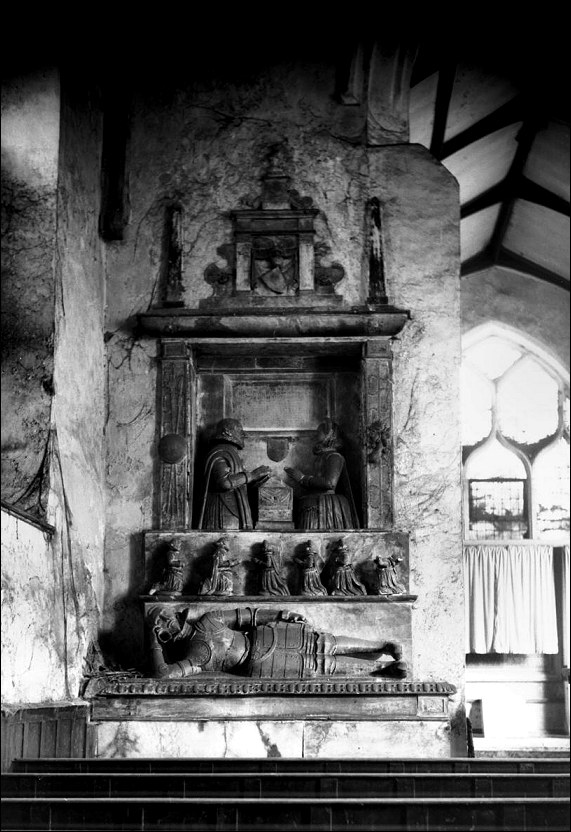
The monument rises from an impressive coloured alabaster base, to the Pettus coat of arms flanked by two obelisks. Sir John in his mayoral robes (he was Mayor in 1608) appears to kneel at a prayer desk opposite his wife, Bridget Curtis, although there is no sign of their legs. Blomefield writing in the 18th century mistook the armorials and identified the kneeling figure as Sir Augustine, who, unlike his father, was never Mayor of Norwich. Most of the literature has followed Blomefield, who was corrected by the Norfolk Heraldry Society (information from Tony Sims). Sir John and Lady Bridget are flanked by pilasters; his decorated with lances, hers with pomegranates and other fruit. Their children, two sons and two daughters kneel underneath, while Sir Augustine, who had died under a year before his father, is repeated lying stiffly in his full armour looking out from the monument, his head propped on his right arm, holding what could be a gauntlet or drinking horn, showing the fingers of a small hand.
Sir John had moved beyond both the family’s relative humble origins as tailors and local politics when in 1604 he had become the first Norwich Member since 1558 to be elected to two consecutive parliaments. He was active as an MP, while continuing his charitable work in Norwich. At the death of his father he had inherited considerable wealth, as well as the family house on Elm Hill, once extending to the churchyard, now nos. 41-43, and the estate at Rackheath, since at death his moveable goods, which included a substantial armoury of nine guns, were valued at £952 19s. 6d and the house on Elm Hill contained 27 rooms, together with stables for eight horses.
Blomefield, An Essay towards a Topographical History of the County of Norfolk: volume 4: The History of the City and County of Norwich, part II, ‘chapter 42: East Wimer ward', (1806), pp. 329-367; Chris Kyle, ‘Sir John Pettus’ in The History of Parliament: the House of Commons 1604-1629, , ed. Andrew Thrush and John P. Ferris, 2010.
It seems incredible to me that there are any churches in East Kent, at least parish churches, that I had yet to visit and photograph. Especially along Stone Street, which I thought that nks to churches and orchids I knew very well. And yet as I cross-referenced between John Vigar's book and the county A-Z, I saw more and more churches I had to visit.
And that brings us to Elmstead.
Elmstead is less a viallage and more a dog leg in a single track lane, and the church sits in the dog leg. Being a small place, surely it would have a small church? No, the church is large with two leat to chapels, and an extraordinary timber topped tower.
You reach Elmstone by taking tiny fork off Stone Street and following the narrowest of lanes, which has high banks and hedges both sides with few passing places. Down through woods, down steep hills crossing streams and up hills the other side, and all the while the road coated with a thick layer of mud, so that one hoped you were still on the road not having driven into a field.
In time I passed the village sign, and no missing the church, a large flint built church, and the triple gabled east end facing towards the road. Behind the tower was partially hidden, but I could already see the wooden upper part.
And it was open, and filled with much of interest, especially the stone altar in the south aisle.
---------------------------------------------
An extremely worthwhile church in remote countryside. The tower is an unusual shape, being almost twice as wide as it is deep and capped by a wooden upper storey with stumpy spire. The church consists of nave, aisles, chancel and equal length chapels. The nave is Norman: the original arch to the tower is still recognisable although a fourteenth-century replacement has been built inside it. At the same time the present arcade was built on the existing piers. In the north aisle is a medieval vestry screen, in front of which is a Norman font. There are very fine altar rails, each baluster looking like an eighteenth-century candlestick. Between the main altar and chapel is a simple thirteenth-century sedilia. The south chapel altar has a twelfth-century mensa which was discovered in the churchyard in 1956. The east window (1880) commemorates Arthur Honeywood who was killed in the Afghan war - only a dog survived and was given an award by Queen Victoria! Honeywood's ancestor, Sir John (d. 1781), is also remembered in the church by a splendid marble bust signed by Scheemakers
www.kentchurches.info/church.asp?p=Elmsted
----------------------------------------------
Parish Church. Late Cll or C12, C13 and C14, restored in 1877. Flint
with stone dressings. Plain tile roofs. West tower, nave with north
and south aisles, south porch, chancel with north and south chapels.
West tower: C13, with late Cll or C12 base: Medieval belfry. Single
stage, but north and south sides reduce in width about half way up
with plain-tile shoulders. Large stone north-west and south-west
quoins to lower half. Diagonal south-west buttress. Shingled timber-
framed belfry jettied to west. Splay-footed octagonal spire. Two
louvred three-light trefoil-headed windows to each face of belfry.
No tower windows to north or east. Broadly-pointed plain-chamfered
lancet towards top of west face, and another to south. Taller plain-
chamfered lancet West window. Plain-chamfered pointed-arched west doorway.
Nave: south elevation: continuous with south wall of tower base. C19
traceried three-light window. South aisle: C14 possibly with late Cll
or early C12 origins. Narrow and gabled, stopping short of west end nave.
Plinthless. Buttress towards east end. C14 or early C15 pointed west window
of two cinquefoil-headed lights, with tracery of vertical bars, and hoodmould.
One straight-headed C15 or C16 south window to east of porch, with two
cinquefoil-headed lights and rectangular hoodmould. South porch: medieval,
restored in C19. Coursed knapped flint. Gabled plain-tile roof.
Window with cambered head, to each side. Crown-post roof; two outer crown
posts plain. Broadly-chamfered rectangular central crown post with broach
stops and head braces. Chamfered tie-beams. Pointed-arched plain-chamfered
inner doorway with broach stops. Unchamfered pointed-arched outer doorway.
South chancel chapel: early C14. Continuous with south aisle, but with
chamfered stone plinth and lower eaves and ridge. East end flush with
chancel. Diagonal south-east buttress. Large straight-headed south window
with three cinquefoil-headed lights and moulded hoodmould. Similar two-
light east window. Chancel: C13, probably with late Cll or C12 origins.
Slightly narrower than nave. No plinth. Two buttresses. C15 or C16
untraceried east window with cambered head, three cinquefoil-headed lights,
and hoodmould. North chancel chapel: early C14. Flush with east end
of chancel. Plinthless. Diagonal north-east buttress. C14 pointed-arched
east window with three cinquefoil-headed lights, tracery of cusped intersecting
glazing bars with trefoils and quatrefoils, and with hoodmould. Pointed-
arched C14 north window with Y tracery and trefoil, without hoodmould.
North aisle: C14. More stone mixed with flint. Continuous with north
chancel chapel, and slightly overlapping tower. Plinthless. One untraceried
C15 or C16 north window, with cambered head, three cinquefoil-headed lights,
and hoodmould. Straight-headed west window with two cinquefoil-headed
lights and hoodmould. Small blocked plain-chamfered pointed-arched north
doorway. Rainwater heads dated 1877. Interior: Structure: two-bay early
C14 south arcade to nave, with doubly plain-chamfered pointed arches and
octagonal columns with moulded capitals and bases. Two-bay C14 north
arcade, similar to south arcade, but extending further to west and with
more intricately-moulded capitals. East end of south arcade rests on
late Cll or C12 pier of large ashlar blocks on plain-chamfered plinth,
and with top heavily corbelled to south side. Footings for further structure
to east and south. Small, probably pre-C14, stone quoins to east pier
of north arcade, capped by single block from which arch springs. Doubly
plain-chamfered pointed early C14 chancel arch, springing from moulded
rectangular capitals which break forwards unusually. Plain-chamfered
piers with broach stops. Two-bay early C16 north and south arcades to
chancel, with doubly hollow-chamfered four-centred arches and octagonal
columns with moulded capitals and bases. Early C14 pointed arch between
south chancel chapel and south aisle, with plain-chamfered inner order
and slightly ovolo-moulded outer order. Moulded rectangular capitals
slightly different from chancel-arch capitals, but similarly breaking
forwards under inner order of arch, each on image corbel. Piers slightly
hollow chamfered, with cushion stops to base and undercut trefoil to tops.
Doubly plain-chamfered pointed arch between north chancel chapel and north
aisle, springing from chamfered imposts which break forwards to centre
with rounded corbel under. Low, pointed C14 tower arch, with plain-chamfered
inner order springing from moulded semi-octagonal piers, and hollow-chamfered
outer order descending to ground with cushion and broach stops. Above
arch, exposed voussoirs of taller, broader, blocked, round-headed late
Cll or C12 tower arch. Roof: C19 crown-post roof to nave and north aisle.
Chancel and north chancel chapel roofs boarded in five cants. Plastered
barrel vault to south chancel chapel. Medieval crown-post roof to south,
with three cambered plain-chamfered tie-beams, with moulded octagonal
crown posts, sous-laces and ashlar pieces. Fittings: piscina in rectangular
recess towards east end of south chancel chapel. C13 piscina in moulded
recess with trefoiled head and moulded hoodmould, towards east end of
south wall of chancel. Image corbel to north wall of north chancel chapel.
Late Cll or C12 font, low, deep, octagonal, with two panels of blind
arcading to each side, circular central pier and eight slender perimeter
columns. Small C17 altar table. Hexagonal C17 pulpit with sunk moulded
panels, strapwork, fleur-de-lys frieze, and enriched cornice. Medieval
screen, probably of domestic origin, with close-studded partition under
moulded and brattished beam, across west end of north aisle. Laudian
altar rails with turned balusters. Monuments: Cartouche on south wall
of south chancel chapel, to Sir William Honeywood, d. 1748. Monument
on same wall, to Thomas Honeywood, d. 1622; grey-painted chalk in form
of triptych. Central section has moulded and pulvinated base, scrolled
base-plate and shield, and raised and moulded inscription panel in eared
surround, flanked by Composite columns. Above it, a recessed panel
with inverted scrolls, and triangular pediment with cherubs head and
achievements. Recessed flanking sections, each carved with angel in
husked surround, and with scrolled base plate and corniced pediment
with shields. Tablet on same wall, to Mary Honeywood, d. 1708, lettered
on a shroud with gilded fringe, cherubs' heads, and shield surmounted
by urn. Brass of a lady, part of a brass to Christopher Gay, d. 1507.
Monument on north wall of north chancel chapel, to William Honeywood,
d. 1669. Black marble inscription panel in a frame which breaks forwards
twice. Each back panel eared, the outer with inverted scrolls to base
and festoon to return sides. Festooned rectangular panel flanked by
acanthus consoles and with scrolled acanthus base plate under inscription
panel. Moulded cornice over oak-leaf frieze, breaking forwards three
times. Segmental pediment with achievements over central break. Monument
by Thomas Scheemakers on same wall, to Sir John Honeywood, d. 1781.
White marble. Rectangular inscription panel, flanked by reeded pilasters
which curve out at top to form consoles under flower paterae. Shaped
base plate, also with inscription. Moulded cornice surmounted by -sarcophagus
with bust above it, against grey marble obelisk back plate. (J. Jewman,
Buildings of England Series, North-east and East Kent, 1983 edn.)
Listing NGR: TR1178645546
www.britishlistedbuildings.co.uk/en-440965-church-of-st-j...
-----------------------------------------------
ELMSTED
IS the next parish northward from Hastingligh lastdescribed, taking its name, as many other places do, which are recorded in the survey of Domesday, from the quantity of elms growing in it, elm signifying in Saxon, that tree, and stede, a place. The manor of Hastingligh claims over some part of this parish, which part is within the liberty of the duchy of Lancaster.
THIS PARISH is situated in a lonely unfrequented part of the country, above the down hills, in a healthy air. It lies mostly on high ground, having continued hill and dale throughout it. The soil is but poor, and in general chalk, and much covered with flints, especially in the dales, where some of the earth is of a reddish cast. The church stands on a hill in the middle of it, having a green, with the village near it, among which is the court-lodge: and at a small distance westward, Helchin-bouse, belonging to Sir John Honywood, but now and for some time past inhabited by the Lushingtons. Lower down in the bottom is Evington-court, in a dull ineligible situation, to which however the present Sir John Honywood has added much, and laid out some park-grounds round it. At a small distance is a small heath, called Evington-lees, with several houses round it. At the southern bounds of the parish lie Botsham, and Holt, both belonging to Sir John Honywood. At the north-east corner of it, near Stone-street, is a hamlet called Northlye, the principal farm in which belongs to Mr. Richard Warlee, gent. of Canterbury, about half a mile from which is Deane, or Dane manor-house; and still further Dowles-farm, belonging to Mr. John Rigden, of Faversham; near Stone-street is the manor of Southligh, now called Mizlings, by which name only it is now known here; and near the same street is Arundel farm, belonging to Thomas Watkinson Payler, esq. and at the southern extremity of the parish, the manor-house of Dunders, with the lands belonging to it, called the Park, formerly belonging to the Graydons, of Fordwich, of whom they were purchased, and are now the property of the right hon. Matthew Robinson Morris, lord Rokeby, who resides at Horton. There are but two small coppice woods in this parish, lying at some distance from each other, in the middle part of it.
There is a fair kept yearly in this parish on St. James's day, the 25th of July.
THE MANOR OF ELMSTED was in the year 811 bought by archbishop Wlfred, of Cenulf, king of Mercia, for the benefit of Christ-church, in Canterbury, L. S. A. which letters meant, that it should be free, and privileged with the same liberties that Adisham was, when given to that church. These privileges were, to be freed from all secular services, excepting the trinoda necessitas of repelling invasions, and the repairing of bridges and fortifications. (fn. 1)
There is no mention of this manor in the survey of Domesday, under the title of the archbishop's lands, and of those held of him by knight's service, and yet I find mention of its being held of him in several records subsequent to that time; for soon afterwards it appears to have been so held by a family who assumed their name from it, one of whom, Hamo de Elmested, held it of the archbishop, by knight's service. But they were extinct here before the middle of king Henry III,'s reign, when the Heringods were become possessed of it, as appears by the Testa de Nevil, bearing for their arms, Gules, three herrings erect, two and one, or; as they were formerly in the windows of Newington church, near Sittingborne. John de Heringod held it at his death in the 41st year of that reign. His grandson, of the same name, died in the next reign of king Edward I. without male issue, leaving three daughters his coheirs, of whom, Grace married Philip de Hardres, of Hardres, in this county; Christiana married William de Kirkby; and Jane married Thomas Burgate, of Suffolk: but he had before his death, by a deed, which bears the form of a Latin will, and, is without a date, settled this manor, with the other lands in this neighbourhood, on the former of them, Philip de Hardres, a man of eminent repute of that time, in whose successors the manor of Elmsted remained till the 13th year of King James I. when Sir Thomas Hardres sold the manor of Dane court, an appendage to this of Elmsted, in the north-east part of this parish, to Cloake, and the manor of Elmsted itself to Thomas Marsh, gent. of Canterbury, whose son ton, whose great-grandson of the same name, at his death left it to his two sons, Richard and John, the former of whom was of Faversham, and left an only daughter Elizabeth, married to Mr. James Taylor, of Rodmersham, who in right of his wife became possessed of his moiety of it, and having in 1787 purchased the other moiety of John Lushington, of Helchin, in this parish, (son of Richard above-mentioned) became possessed of the whole of this manor, and continues owner of it at this time.
THE MANOR OF DANE, now called Deane-court, above-mentioned, remained in the name of Cloake for some time afterwards, and in 1652 Mr. Samuel Cloake held it. It afterwards passed into the name of Elwes, in which it continued down to John Elwes, esq. of Marcham, in Berkshire, who died in 1789, and by will gave it to his nephew Thomas Timms, esq. the present owner of it.
THE YOKE OF EVINGTON is an estate and seat in the south-west part of this parish, over which the manor of Barton, near Canterbury, claims jurisdiction. The mansion of it, called Evington-court, was the inheritance of gentlemen of the same surname, who bore for their arms, Argent, a sess between three burganetts, or steel caps, azure; and in a book, copied out from antient deeds by William Glover, Somerset herald, afterwards in the possession of John Philipott, likewise Somerset, there was the copy of an old deed without date, in which William Fitzneal, called in Latin, Filius Nigelli, passed over some land to Ruallo de Valoigns, which is strengthened by the appendant testimony of one Robert de Evington, who was ancestor of the Evingtons, of Evington-court, of whom there is mention in the deeds of this place, both in the reigns of king Henry III. and king Edward I. After this family was extinct here, the Gays became possessed of it, a family originally descended out of France, where they were called Le Gay, and remained some time afterwards in the province of Normandy, from whence those of this name in Jersey and Guernsey descended, and from them again those of Hampshire, and one of them, before they had left off their French appellation, John le Gay, is mentioned in the leiger book of Horton priory, in this neighbourhood, as a benefactor to it. But to proceed; although Evington-court was not originally erected by the family of Gay, yet it was much improved by them with additional buildings, and in allusion to their name, both the wainscot and windows of it were adorned with nosegays. At length after the Gays, who bore for their arms, Gules, three lions rampant, argent, an orle of cross-croslets, fitchee, or. (fn. 2) had continued owners of this mansion till the beginning of the reign of king Henry VII. Humphry Gay, esq. alienated it to John Honywood, esq. of Sene, in Newington, near Hythe, and afterwards of St. Gregory's, Canterbury, where he died in 1557, and was buried in that cathedral.
The family of Honywood, antiently written Henewood, take their name from the manor of Henewood, in Postling, where they resided as early as Henry III.'s reign, when Edmund de Henewood, or Honywood, as the name was afterwards spelt, of that parish, was a liberal benefactor to the priory of Horton, and is mentioned as such in the leiger book of it. After which, as appears by their wills in the Prerogative-office, in Canterbury, they resided at Hythe, for which port several of them served in parliament, bearing for their arms, Argent, a chevron, between three hawks heads erased, azure; one of them, Thomas Honywood, died in the reign of king Edward IV. leaving a son John, by whose first wife descended the elder branch of this family, settled at Evington, and baronets; and by his second wife descended the younger branch of the Honywoods, seated at Petts, in Charing, and at Markshall, in Effex, which branch is now extinct. (fn. 3) John Honywood, esq. the eldest son of John above-mentioned, by his first wife, was the purchaser of Evington, where his grandson Sir Thomas Honywood resided. He died in 1622, and was buried at Elmsted, the burial place of this family. (fn. 4) He left by his first wife several sons and daughters; of the former, John succeeded him at Evington and Sene, and Edward was ancestor of Frazer Honywood, banker, of London, and of Malling abbey, who died s. p. in 1764. (fn. 5) Sir John Honywood, the eldest son, resided during his father's time at Sene, in Newington, and on his death removed to Evington. He served the office of sheriff in the 18th, 19th, and 20th years of king Charles I. Sir Edward Honywood, his eldest son, resided likewise at Evington, and was created a baronet on July 19, 1660. His great grandson Sir John Honywood, bart. at length in 1748, succeeded to the title and family estates, and afterwards resided at Evington, where he kept his shrievalty in 1752. On the death of his relation Frazer Honywood, esq. banker, of London, in 1764, he succeeded by his will to his seats at Malling abbey, and at Hampsted, in Middlesex, besides a large personal estate; after which he resided at times both here and at Hampsted, at which latter he died in 1781, æt. 71, and was buried with his ancestors in this church. He had been twice married; first to Annabella, daughter of William Goodenough, esq. of Langford, in Berk shire, whose issue will be mentioned hereafter; and secondly to Dorothy, daughter of Sir Edward Filmer, bart. of East Sutton, by whom he had two sons, Filmer Honywood, esq. of Marks-hall, in Essex, to which as well as other large estates in that county, and in this of Kent, he succeeded by the will of his relation Gen. Philip Honywood, and lately was M. P. for this county, and is at present unmarried; and John, late of All Souls college, Oxford, who married Miss Wake, daughter of Dr. Charles Wake, late prebendary of Westminster; and Mary, married to Willshire Emmett, esq. late of Wiarton. By his first wife Sir John Honywood had two sons and four daughters; William the eldest, was of Malling abbey, esq. and died in his father's life time, having married Elizabeth, daughter of Mr. Clack, of Wallingford, in Berkshire, by whom he had three sons and one daughter Annabella, married to R. G. D. Yate, esq of Gloucestershire; of the former, John was heir to his grandfather, and is the present baronet; William is now of Liminge, esq. and married Mary, sister of James Drake Brockman, esq. of Beechborough, and Edward married Sophia, daughter of the Rev. Mr. Long, of Suffolk. Edward, the second son, was in the army, and died without issue. The daughters were, Annabella, married to Edmund Filmer, rector of Crundal; and Thomasine, married to William Western Hugessen, esq. of Provenders, both since deceased. On Sir John Honywood's death in 1781, he was succeeded by his eldest grandson abovementioned, the present Sir John Honywood, bart. who resides at Evington, to which he has made great improvements and additions. He married Frances, one of the daughters of William, viscount Courtenay, by whom he has three daughters, Frances-Elizabeth, Charlotte-Dorothea, and Annabella-Christiana, and one son John, born in 1787. (fn. 6).
BOTTSHAM, antiently and more properly written Bodesham, is a manor in the western part of this parish. About the year 687 Swabert, king of Kent, gave among others, three plough-lands in a place called Bodesham, to Eabba, abbess of Minister, in Thanet, and in the reign of king Edward the Consessor, one Ælgeric Bigg gave another part of it to the abbey of St. Augustine, by the description of the lands called Bodesham, on condition that Wade, his knight, should possess them during his life. (fn. 7) The former of these continued in the monastery till the reign of king Canute, when it was plundered and burnt by the Danes. After which the church and lands of the monastery of Minster, and those of Bodesham among them, were granted to St. Augustine's monastery, and remained, together with those given as above-mentioned by Ælgeric Bigg, part of the possessions of it at the taking of the survey of Domesday, in which record it is thus described:
In Limowart left, in Stotinges hundred, Gaufrid holds Bodesham of the abbot. It was taxed at one suling. The arable land is two carucates, and there are, with eight borderers, wood for the pannage of fifteen hogs. In the time of king Edward the Confessor it was worth four pounds, and afterwards twenty shillings, now four pounds, A certain villein held it.
Hugh, abbot of St. Augustine, and his chapter, in the year 1110, granted to Hamo, steward of the king's houshold, this land of Bodesham, upon condition that he should, if there should be occasion, advise and assist him and his successors in any pleas brought against him by any baron, either in the county or in the king's court.
Hamo above-mentioned, whose surname was Crevequer, had come over into this kingdom with the Conqueror, and was rewarded afterwards with much land in this county, and was made sheriff of it during his life, from whence he was frequently stiled Hamo Vicecomes, or the sheriff. He lived till the middle of king Henry I.'s reign; and in his descendants it most probably remained till it came into the possession of the family of Gay, or Le Gay as they were sometimes written, owners of the yoke of Evington likewise, in which it continued till it was at length sold with it, in the beginning of Henry VII.'s reign, to Honywood, as has been fully mentioned before; in whose descendants it still remains, being now the property of Sir John Honywood, bart. of Evington.
IN THE REIGN of king Edward I. Thomas de Morines held half a knight's fee of the archbishop in Elmsted, which estate afterwards passed into the family of Haut, and in the reign of king Edward III. had acquired the name of the Manor Of Elmsted, alias SOUTHLIGH. In which family of Haut it continued down to Sir William Haut, of Bishopsborne, who lived in the reign of king Henry VIII. and left two daughters his coheirs, Elizabeth, married to Thomas Culpeper, of Bedgbury; and Jane, to Thomas Wyatt. The former of whom, in the division of their inheritance, (fn. 8) became possessed of it; from his heirs it passed by sale to Best, and from thence again to Rich. Hardres, esq. of Hardres, whose descendant Sir Tho. Hardres, possessed it in king James I.'s reign; at length, after some intermediate owners, it passed to Browning, whose descendant M. John Browning, of Yoklets, in Waltham, is the present owner of this manor.
There are no parochial charities. The poor constantly relieved are about thirty, casually seventeen.
Elmsted is within the Ecclesiastical Jurisdiction of the diocese of Canterbury, and deanry of Elham.
The church, which is dedicated to St. James, is a handsome building, consisting of three isles and three chancels, having a low pointed wooden steeple at the west end, in which are six bells. The chancels are open, one towards the other, the spaces between the pillars not being filled up, which gives the whole a light and airy appearance. In the middle chancel, which is dedicated to St. James, are memorials for the Taylors, who intermarried with the Honywoods, and for the Lushingtons, of Helchin; one for John Cloke, gent. of Northlye, obt. 1617. In the east window is a shield of arms, first and fourth, A lion rampant, or; second, On a fess, argent, three eros-croslets; third, obliterated. In another compartment of the window is the figure of an antient man sitting, in robes lined with ermine, a large knotted staff in his left hand. The north chancel is called the parish chancel, in which is an elegant monument, of white marble, with the bust of the late Sir John Honywood, bart.(a gentleman whose worthy character is still remembered with the highest commendation and respect, by all who knew him). He died much lamented by his neighbours and the country in general in 1781; and on the pavement are numbers of gravestones for the family of Honywood and their relatives. The south chancel, dedicated to St. John, belongs to Evington, in which there are several monuments, and numbers of gravestones, the pavement being covered with them, for the Honywood family, some of which have inscriptions and figures on brasses remaining on them. Underneath this chancel is a large vault, in which the remains of the family lie deposited. On the north side of this chancel is a tomb, having had the figures on it of a man between his two wives: and at each corner a shield of arms in brass for Gay. On the capital of a pillar at the east end of this tomb is this legend, in old English letters, in gold, which have been lately repaired: Pray for the sowlys of Xtopher Gay, Agnes and Johan his wifes, ther chylder and all Xtian sowlys, on whose sowlys Jhu have mcy; by which it should seem that he was the founder, or at least the repairer of this chancel. Underneath is carved a shield of arms of Gay. In the east window are two shields of arms, of modern glass, for Honywood. In the south isle is a monument for Sir William Honywood, bart. of Evington, obt. 1748. In the middle isle are several old stones, coffin shaped. William Philpot, of Godmersham, by will anno 1475, ordered that the making of the new seats, calledle pewis, in this church, should be done at his expence, from the place where St. Christopher was painted, to the corner of the stone wall on the north side of the church.
The church of Elmsted belonged to the priory of St. Gregory, in Canterbury, perhaps part of its original endowment by archbishop Lanfranc, in the reign of the Conqueror. It was very early appropriated to it, and was confirmed to the priory by archbishop Hubert, among its other possessions, about the reign of king Richard I. at which time this church, with five acres of arable, and five acres of wood, and the chapel of Dene, appear to have been esteemed as chapels to the adjoining church of Waltham, and the appropriation of it continued part of the possessions of the priory till the dissolution of it in king Henry VIII.'s reign, when it was surrendered into the king's hands, where this appropriation remained but a small time, for an act passed that year, to enable the king and the archbishop to make an exchange of estates, by which means it became part of the revenues of the see of Canterbury, and was afterwards demised by the archbishop, among the rest of the revenues of the above-mentioned priory, which had come to him by the above-mentioned exchange, in one great lease; under which kind of demise it has continued from time to time ever since. Philip, earl of Chesterfield, as heir to the Wottons, was lessee of the above estates, in which this parsonage was included; since whose decease in 1773, his interest in the lease of them has been sold by his executors to Geo. Gipps, esq. of Canterbury, who is the present lessee, under the archbishop, for them.
But the vicarage of this church seems never to have belonged to the priory of St. Gregory, and in the 8th year of Richard II. anno 1384, appears to have been part of the possessions of the abbot of Pontiniac, at which time it was valued at four pounds. How long it staid there, I have not found; but it became afterwards part of the possessions of the see of Canterbury, and remains so at this time, his grace the archbishop being the present patron of it.
¶The vicarage of Elmsted is endowed with the tenths of hay, silva cedua, mills, heifers, calves, chicken, pigs, lambs, wool, geese, ducks, eggs, bees, honey, wax, butter, cheese, milk-meats, flax, hemp, apples, pears, swans, pidgeons, merchandise, fish, onions, fowlings, also all other small tithes or obventions whatsoever within the parish; and also with all grass of gardens or other closes, vulgarly called homestalls, although they should be at any time reduced to arable; and the tithes of all and singular feedings and pastures, even if those lands so lot for feedings and pastures should be accustomed to be ploughed, as often and whensoever they should at any time be let for the use of pasture; which portion to the vicar was then valued at twelve marcs. (fn. 9)
It is valued in the king's books at 61. 13s. 4d. It is now a discharged living, of the clear yearly certified value of forty-five pounds. In 1587 it was valued at thirty pounds, communicants one hundred and eighty. In 1640 it was valued at ninety pounds, the same number of communicants. There was an antient stipend of ten pounds, payable from the parsonage to the vicar, which was augmented with the like sum by archbishop Juxon, anno 15 Charles II. to be paid by the lessee of the parsonage; which sum of twenty pounds continues at this time to be paid yearly by the lesse. There was a yearly pension of 1l. 6s. payable from the vicar of Elmsted to the priory of St. Gregory; which still continues to be paid by him to the archbishop's lessee here.
Codicil to the 1861 Will of Job Grant of Ramsgate, Kent dated 30th April 1864. He disinherits his Grandson, the only son of his daughter Sarah Bastable. That the annual income from the trust goes to his Granddaughters, Jane, only daughter of his daughter Jane Hillier and Sarah Elizabeth Bastable the daughter of his daughter Sarah Bastable.
1980 BMW 635CSi auto.
Supplied by Sorensons of King's Lynn (BMW).
Last MoT test expired in August 2012.
Anglia Car Auctions, King's Lynn -
"Offered on behalf of the executors, this 87,515 mile example was supplied new by Sorensons of King's Lynn, now Listers. Obviously cherished by it's four owners, the car has not been used since, we believe, around 2012 and will require a degree of straight-forward mechanical recommissioning. The brakes are sticking and a fuel line has split rendering it impossible for us to start the car. However, the engine turns freely and attempts to fire. Complete with full original tool-kit, torch and service wallet.
Chassis number: WBA53420005585364
Result inc Premium: £10,070."
This is an update post, since some minor details have changed. More exciting though is that the instructions are now available! It’s on the Simplethinker page on rebrickable
Amanda America Dickson, the daughter of a slave and her owner, became one of the wealthiest black women in nineteenth-century America.She was born on November 20 or 21, 1849, on the Hancock County plantation of her father, the famous white agricultural reformer, David Dickson (1809-85). Her birth was the result of the rape of her slave mother, Julia Frances Lewis Dickson, when Julia was twelve years old. At the time, David Dickson was forty and the wealthiest planter in the county. Amanda America Dickson spent her childhood and adolescence in the house of her white grandmother and owner, Elizabeth Sholars Dickson, where she learned to read and write and play the piano—the survival skills of a young lady but not ordinarily the opportunities of a slave. According to the Dickson family oral history, David Dickson doted on Amanda, and Julia quite openly became his concubine and housekeeper. In 1865 or 1866 Dickson married her white first cousin, Charles Eubanks, a recently returned Civil War veteran. The union produced two sons: Julian Henry (1866-1937), who married Eva Walton, the daughter of Isabella and George Walton of Augusta; and Charles Green (1870-ca. 1900), who married Kate Holsey, the daughter of Harriet and Bishop Lucius Holsey of Augusta. Dickson left Eubanks in 1870 and with her sons returned to her father's plantation. At that time she and her children took the last name of Dickson.
From 1876 to 1878 she left the plantation to attend the Normal School of Atlanta University. In the winter of 1885 David Dickson died, leaving the bulk of his estate to Amanda Dicksonand subsequently to her children after her death. Executors appraised the estate, which included 17,000 acres of land in Hancock and Washington counties, at $309,000. In his will David Dickson stated that the administration of his estate was to be left to the sound judgment and unlimited discretion of Amanda Dickson without interference from any quarter, including any husband she might have. A host of David Dickson's white relatives contested the will, but the superior court of Hancock County ruled in favor of Amanda Dickson in November 1885. The disgruntled relatives then appealed to the Georgia Supreme Court, which upheld the lower court decision in 1887. The higher court stated that the "rights of each race are controlled and governed by the same enactments or principles of law"—in other words, whatever rights and privileges belonged to a bastard white child belonged to a mixed-race child as well.
Before the supreme court decision, Dickson purchased a large house at 452 Telfair Street, in the wealthiest section of the then-integrated city of Augusta. By the time the courts settled the Dickson will case, she had firmly ensconced herself in this new home and decorated it with Brussels carpets, oil paintings, a walnut dining room table and chairs, and books. While white Georgians were establishing segregation as the ruling social order in the public sphere, members of the Dickson family went about their private lives.
In 1892 Dickson married Nathan Toomer of Perry. Toomer was born in 1839 in Chatham County, North Carolina, the slave of Richard Pilkinson. As a child Toomer was purchased by John Toomer, who moved to Houston County, Georgia, in the 1850s. Upon John Toomer's death in 1859, his brother Colonel Henry Toomer purchased Nathan's mother, Kit, and seven of her children from the estate. As Henry Toomer's personal assistant, Nathan Toomer learned the manner of the white upper class. Toomer and Dickson's marriage lasted until her death on June 11, 1893, of neurasthenia, or nervous exhaustion. Shortly thereafter Nathan Toomer married Nina Pinchback. The son of this marriage was Jean Toomer, the author of the novel Cane (1923).
Amanda America Dickson's life reflected the power of family and class to erode the boundaries of race in the nineteenth-century South.
A massive perpendicular limestone church, built by the executors of the will of Ralph Cromwell, 3rd Baron Cromwell, in 1469, Cromwell died in 1453, so there was some delay in implementing his wishes. This is a building on a monumental scale, far in excess of the needs of the village and castle surely, it is remarkably devoid of character, a building to admire rather than love. There are some interesting survivals here, a pulpitum is not to be seen in many churches these days, the E window contains half a window of medieval glass and the N transept boasts a fine collection of brasses, currently cordoned off as a brass rubbing area. I’d been here in 2008 but needed to improve the quality of the pictures I took then, one of the great Lincolnshire churches, impressive but soulless, sadly. NB Externals from previous (2007) visit.
(Brasília - DF, 05/08/2020) Palavras do Ministro de Estado de Minas e Energia, Bento Albuquerque.
Foto: Isac Nóbrega/PR
A water fountain with the bust of one of Frankfurt's clowns / funny men on top of the plinth, seen in the Wallenlage (park where the city walls used to be...) near the Alte Opera. (Old Opera House - there's a new one...) Taken by a Nikon D610 at ISO 400 with a Nikkor 35-105mm ƒ 3.5-4.5 AF lens. (at 52)
The plaque reads:
Gesegnet soll der Trunk uns sein: Das Wasser Euch, und mir der Wein ("Blessed be the trunk of us: the water for you, and for me the wine") I'm sure there is a story behind this, but the present scribe knoweth it not...
If an artistic executor of the sculptor has any copyright objections to this photo, Flickr-mail the poster stating that you are such an executor, state the objection(s), and it will be taken down... (While you are at that task, please tell me who the sculptor is, as the statue wasn't labeled, that I saw...)
Richard Corfield was Churchwarden of Cardington, Salop 1648. One of the executors of the will of Roger Maunsell in 1651 in which document he is termed "Loving Kinsman"
The elder of Chatwall, a staunch loyalist who fought with his cousin Sir Edward Acton, 1st Bt. for the King.
During the Civil War Richard Corfield fought on the side of the King. He joined the King's Army, probably in Shrewsbury in September 1642 when King Charles I was there. He served under his cousin, Sir Edward Acton, 1st Bt and Member of Parliament for Bridgnorth.
On 25th October 1642 Richard fought alongside Sir Edward Acton at the indecisive Battle of Edgehill.
Capt. Richard Corfield fortified the medieval hall at Chatwall, however the fortifications were destroyed shortly afterward by Roundheads to prevent them being used to harry the advance of Roundheads who were marching on Shrewsbury.
Bought the Leahills property from the Wallop family 1648
Richard became the executor of his father in law's will and the old wooden plaque in St James' Church, Cardington commemorates this.
In 1659 Richard constructed the present Hall at Chatwall and was churchwarden at St James', Cardington in 1660 and 1667.
In 1672 he paid 8 shillings tax for 4 hearths at Chatwall Hall.
On 25th March 1676 he signed a deed of grant to Rowland Hunt of Boreatton for £76/10/- in respect of tythes of corn grain or pulse within the townships of Chatwall and Frodsley.
On 2nd January 1678 he leased the Lea Hill and tythes of Chatwall and Frodesley to Thomas Smith of Ruckley and Thomas Browne of Clunton for 5/-, the rent being peppercorn.
On his death an inventory of his possessions was drawn up by Richard Davis, Edmund Taylor and Richard Hooper (his brother in law) which valued his estate at £397. this included £2 of books to be divided between his two younger sons. He also left £71/12/6 in debts.
Richard is my 10x Great grandFather
Designers created solutions and draughtsmen realised the designs they were assigned. Everything was drawn by hand, which placed heavy demands on the executor.
The picture above was taken in drafting room K1 in Linköping in the early 1950s, where the Lansen was designed. Today, however, each individual designer sits at a computer with an advanced CAD program. Greater focus on the technical solution is now possible – while the software brings it to life.
For the next generation of Gripen, Saab has chosen to completely abandon two-dimensional drawings in favour of entirely 3D-based documentation. The aim is to streamline the entire product life cycle by simplifying documentation management and to increase understanding of how product requirements must be realised.
The way in which the documentation for the Gripen NG is being produced is based on experience and makes Saab a world-class player.
The Public Library of New London 1876-1891
The New London Public Library owes its origin to the generosity of Henry P. Haven and to the public spirit and wise judgement of his executors.
In 1876 Henry P. Haven died, leaving a fund of about $65,000 to be used for educational or charitable purposes at the discretion of the trustees: Henry R. Bond, Charles Augustus Williams and Dr. H.C. Haven.
Mr. Haven was one of New London's most prosperous owners of whaling ships and, as one of the founders of the Alaska Commercial Company, also carried on a lucrative sealing business. He was noted for his "gigantic schemes of commerce, extending from Alaska to the Shetlands," and "his vessels were widely known in all the extreme northern and eastern portions of the globe." (Obituary, New London Evening Telegram). Nor did he neglect civic duties, serving as mayor of the city, representative in the General Assembly and state senator.
Henry R. Bond was the moving force in the creation of the library, being co-executor with C.A. Williams and Dr. H.C. Haven. Mr. Bond, an associate in the whaling business of Williams and Barnes and a bank president, was treasurer of the enterprise. The library was described as "an institution whose benefits are broad and beneficent, and in which he (Mr. Bond) took a constant and daily interest until illness compelled him to rest from some of his labors." (Obituary, The Day, Oct. 30, 1909.)
Another benefactor was Anna H. Perkins, only daughter of Mr. Haven, who died on January 28, 1890, while the building was under construction, and left a portion of her estate to the library. With this bequest, about 10,000 volumes were purchased, the library being planned to accommodate 30,000 volumes eventually.
Henry Hobson Richardson, whose design contributions include the New London railroad station and Trinity Church in Boston, is credited with the style of the building, which was constructed by Shepley (his son-in-law), Rutan and Coolidge of Boston, successors to Richardson's firm. The building was completed in 1890 and opened in 1891, with a bronze relief of Henry P. Haven by Augustus St. Gaudens adorning the entrance. The carved stone tympanum above bears the seal of New London, a ship under full sail with the motto Mare Liberum, and instead of memorializing its founder as was customary, the new library reflected its dedication to civic service by its name, The Public Library of New London.
THE HISTORY IS USED WITH PERMISSION.
COPYRIGHT BY THE NEW LONDON PUBLIC LIBRARY.
Sir Kenelm Digby (July 11, 1603 – June 11, 1665) was an English courtier and diplomat. He was also a highly reputed natural philosopher, and known as a leading Roman Catholic intellectual and Blackloist. For his versatility, Anthony à Wood called him the "magazine of all arts".
He was born at Gayhurst, Buckinghamshire, England. He was of gentry stock, but his family's adherence to Roman Catholicism coloured his career. His father, Sir Everard, was executed in 1606 for his part in the Gunpowder Plot. Kenelm was sufficiently in favour with James I to be proposed as a member of Edmund Bolton's projected Royal Academy (with George Chapman, Michael Drayton, Ben Jonson, John Selden, and Sir Henry Wotton).[2]
He went to Gloucester Hall, Oxford in 1618, where he was taught by Thomas Allen; but left without taking a degree. In time Allen bequeathed to Digby his library, and the latter donated it to the Bodleian.[3][4]
He spent three years in Europe between 1620 and 1623, where Marie de Medici fell madly in love with him (as he later recounted). He was granted a Cambridge M.A. on the King's visit to the university in 1624.[5] Around 1625, he married Venetia Stanley, whose wooing he cryptically described in his memoirs. He had also become a member of the Privy Council of Charles I of England. His Roman Catholicism being a hindrance in the way of government office, he switched to Anglicanism.
In 1628, Digby became a privateer, with some success: on January 18 he arrived off Gibraltar and captured several Spanish and Flemish vessels. From February 5 to March 27 he remained at anchor off Algiers on account of the sickness of his men, and extracted a promise from the authorities of better treatment of the English ships. He seized a rich Dutch vessel near Majorca, and after other adventures gained a complete victory over the French and Venetian ships in the harbour of Iskanderun on the June 11. His successes, however, brought upon the English merchants the risk of reprisals, and he was urged to depart.
He returned to become a naval administrator and later Governor of Trinity House. His wife died suddenly in 1633, prompting a famous deathbed portrait by Van Dyck and a eulogy by Ben Jonson. (Digby was later Jonson's literary executor. Jonson's poem about Venetia is now mostly lost, because of the loss of the center sheet of a leaf of papers which held the only copy.) Digby, stricken with grief and the object of enough suspicion that the Crown had ordered an autopsy (rare at the time) on Venetia's body, secluded himself in Gresham College and attempted to forget his personal woes through scientific experimentation and a return to Catholicism. At that period, public servants were often rewarded with patents of monopoly; Digby received the regional monopoly of sealing wax in Wales and the Welsh Borders. This was a guaranteed income; more speculative were the monopolies of trade with the Gulf of Guinea and with Canada. These were doubtless more difficult to police.
Digby became a Catholic once more in 1635. He went into voluntary exile in Paris, where he spent most of his time until 1660. There he met both Marin Mersenne and Thomas Hobbes.[6]
Returning to support Charles I in his struggle to establish episcopacy in Scotland (the Bishops' Wars), he found himself increasingly unpopular with the growing Puritan party. He left England for France again in 1641. Following an incident in which he killed a French nobleman, Mont le Ros, in a duel,[7] he returned to England via Flanders in 1642, and was jailed by the House of Commons. He was eventually released at the intervention of Anne of Austria, and went back again to France. He remained there during the remainder of the period of the English Civil War. Parliament declared his property in England forfeit.
Queen Henrietta Maria had fled England in 1644, and he became her Chancellor. He was then engaged in unsuccessful attempts to solicit support for the English monarchy from Pope Innocent X. Following the establishment of The Protectorate under Oliver Cromwell, who believed in freedom of conscience, Digby was received by the government as a sort of unofficial representative of English Roman Catholics, and was sent in 1655 on a mission to the Papacy to try to reach an understanding. This again proved unsuccessful.
At the Restoration, Digby found himself in favor with the new regime due to his ties with Henrietta Maria, the Queen Mother. However, he was often in trouble with Charles II, and was once even banished from Court. Nonetheless, he was generally highly regarded until his death at the age of 62 from "the stone", likely caused by kidney stones.
He published a work of apologetics in 1638, A Conference with a Lady about choice of a Religion. In it he argued that the Catholic Church, possessing alone the qualifications of universality, unity of doctrine and uninterrupted apostolic succession, is the only true church, and that the intrusion of error into it is impossible.
Digby was regarded as an eccentric by contemporaries, partly because of his effusive personality, and partly because of his interests in scientific matters. Henry Stubbe called him "the very Pliny of our age for lying".[9] He lived in a time when scientific enquiry had not settled down in any disciplined way. He spent enormous time and effort in the pursuits of astrology, and alchemy which he studied in the 1630s with Van Dyck.[10][11][12]
Notable among his pursuits was the concept of the Powder of Sympathy. This was a kind of sympathetic magic; one manufactured a powder using appropriate astrological techniques, and daubed it, not on the injured part, but on whatever had caused the injury. His book on this salve went through 29 editions.[13] Synchronising the effects of the powder, which apparently caused a noticeable effect on the patient when applied, was actually suggested in 1687 as a means of solving the longitude problem.
In 1644 he published together two major philosophical treatises, The Nature of Bodies and On the Immortality of Reasonable Souls. The latter was translated into Latin in 1661 by John Leyburn. These Two Treatises were his major natural-philosophical works, and showed a combination of Aristotelianism and atomism.[14]
He was in touch with the leading intellectuals of the time, and was highly regarded by them; he was a founding member of the Royal Society[10] and a member of its governing council from 1662 to 1663. His correspondence with Fermat contains the only extant mathematical proof by Fermat, a demonstration, using his method of descent, that the area of a Pythagorean triangle cannot be a square. His Discourse Concerning the Vegetation of Plants (1661) proved controversial among the Royal Society's members.[15] He is credited with being the first person to note the importance of "vital air," or oxygen, to the sustenance of plants.[16]
Digby is known for the publication of a cookbook, The Closet of the Eminently Learned Sir Kenelme Digbie Knight Opened, but it was actually published by a close servant, from his notes, in 1669, several years after his death. It is currently considered an excellent source of period recipes, particularly for beverages such as mead.
Digby is also considered the father of the modern wine bottle. During the 1630s, Digby owned a glassworks and manufactured wine bottles which were globular in shape with a high, tapered neck, a collar, and a punt. His manufacturing technique involved a coal furnace, made hotter than usual by the inclusion of a wind tunnel, and a higher ratio of sand to potash and lime than was customary. Digby's technique produced wine bottles which were stronger and more stable than most of their day, and which, due to their dark color, protected the contents from light. During his exile and prison term, others claimed his technique as their own, but in 1662 Parliament recognized his claim to the invention as valid.
Possibly George COUSINS, brother of William Edward COUSINS however Mary Abigail COUSINS nee WILLIAMS had a brother George. His actual identity is not known though. His photograph is amongst several of the HARDY members of the family in the album and he does bear a physical resemblance to them so it could well be that he is a from that side of the family instead. The HARDY girls had an uncle George Simpson HARDY who was lord of the manor and farmer at Ramsey Hall, Ramsey, Essex. He was the executor of their father's estate.
“The friends at Haydock and others have long desired a Bethesda Home in the North, but it was not feasible until Miss Annie Dawson left the Gospel Standard Bethesda Fund a legacy, estimated to produce the sum of £18,000 to £20,000, but which under the careful management of the Executor, Mr R H Wilkinson of Manchester, ultimately realised the munificent sum of £25,346. With this benefaction the Bethesda Committee felt they could go ahead in building a Home for their requirements. The first thing was the selection of a site in Lancashire, for the terms of the Will stipulated that it should be in that county and that the Home should be primarily, but not exclusively, for applicants from Lancashire and Yorkshire. After much prayerful consideration the Bethesda Committee decided to purchase a site at the rear of the Haydock Chapel....”
[From “Gospel Standard Bethesda Fund and Homes”, 2nd ed, 1964]
The Gospel Standard Bethesda Fund had been established in 1944 to make provision for “the care of invalids or infirm friends [i.e. persons connected with the Gospel Standard Baptist churches] in their declining days”. The Fund's home at Haydock was the first to be purpose-built, following conversions of pre-existing buildings at Redhill (1948), Brighton (1951) and Tunbridge Wells (1953). It was constructed by Messrs Pearce and Baker to a design by Mr S W G Hunt, architect, on a plot of land behind “Providence” Strict Baptist Chapel, Clipsley Lane, that had previously been used for rearing turkeys. The home was designed for occupation by 18 residents in 14 single rooms and 2 double rooms, with a lounge, study, sick bay, kitchen etc, all on the ground floor and staff accommodation on an upper level. Externally, gardens were laid out to provide a lawn on each side of the building, with fruit trees on the western edge and rose beds and ornamental shrubs. A public address system enabled residents with severe mobility issues to follow services taking place in the Chapel.
The “Dawson Home” -as Miss Dawson's will had stipulated it should be called- was officially opened on 4 April 1964, David Evans (minister and member at Haydock) conducting a prayer meeting in the morning and Benjamin Ramsbottom (“Gospel Standard” editor, 1971-2015, and pastor at Bethel Luton) preaching in the afternoon.
William Fendick Esq. deceased itemised Bill to Executors, 1866, Bristol, Middlesex
An itemised account from John Hawley to the Executors of the Estate of William Fendick. Executors, Henry Fendick, Robert Fendick, John B. Fendick.
Probate Registers show William Fendick of 41 Cambridge Street, Pimlico died 1 April 1866. Henry Fendick of 46 Fore Street, City of London, Linen Draper, Robert Fendick of 23 Portland Square, Bristol, Surgeon and John Brasnett Fendick of 126 Holloway Road, Oil and Italian Warehouseman, the sons of William were the Executors.
The family appear to have originally been from Walton, Norfolk.
And so after a busy day at work, we finished by half four, rushed back to the hotel and were out walking to St Jakobi by five; it was to close to visitors at six, so I felt time was tight. I had visited the evening before, but there was an organ recital on, and the church was very full.
St Jakobi is a huge church, and is seldom used, if I understood the guide correctly. At the west end, the magnificent 16th century organ towers over everything, and is brightly decorated with portraits of the saints and Jesus.
-----------------------------------------------------------
The Jakobi Church is a triple nave brick hall church . The present building at Koberg was built around 1300 and replaced after the great fire of 1276 a Romanesque hall church on the same site that has already been mentioned around 1227. [B 1] It is believed that arched friezes in the area of the church tower and the nave walls components of this earlier building are. Since the Gothic building in 1300, the church has three naves with five bays, which are enclosed on the east respectively of a choir. The walls of the nave, tower over the two aisles by five meters. The tower of the church reveals similar to that of St. Petri about the changing over time Bauabsichten. Initially planned as a central single Tower and started in execution, the northern and southern side chapel were so badly executed, that the plan must have existed first as well as in St. Peter, the Church, like St. Mary's Church and the Cathedral equipped with a twin-towered complex. Also the plan, probably the church hall end of the 13th century to a basilica rebuild is easy to read from the still existing Baubefunden, the implementation started but again been abandoned. [B 2] The main construction period of the current building structure is based on sources the Gothic altars concerning determined. For a new altar was a 1287 Vikarie donated. This altar is then assigned for 1312. The new altar table with the choir was founded in 1334 by Bishop Henry II Bochholt consecrated. [B 3] On this altar table was in 1435 as a retable the oldest surviving Lübeck high altar reredos of the hand of the Master of the Jacobi altar donated, presumably by the parish. He is now in the Medieval Collection of the State Museum Schwerin in Güstrow Castle .
The tower of this church towered over the ridge of the nave at first only two full floors. It is pointed gables were like at St. Mary's Church. In addition there was the octagonal pyramid of the spire. The tower is probably one of the more problematic of the Lübeck church towers. The reading Master Detmar reported in his chronicle, the 1375 storm broke up a quarter of the tower roof and in the court of the Holy Ghost Hospital was blown. [B 4] in 1628 the tower was removed "to the bells" and received by the renewal of the masonry in 1636, first a simple plank roof. The spire was not until 1657/58 and was renewed only now the appearance typical for the Church four balls at the tower corners so that the four corner turrets shots of St. Peter, but not copied. About this renovation and all those involved reported a scribed in copper certificate of Lübeck mathematician Arnold Moeller , which survived even fires. [B 5] The spire was several times, most recently in 1901, the lightning struck and burned in 1901 for about a day.
Among the cultivated chapels Brömbsen Chapel is probably the most well-known because of the obtained therein Brömbsen altar on the south side. It is based on a foundation of canon Detmar Schulop in 1338 and went in 1488 to the Mayor of Lübeck Heinrich Brömse over. She remained until 1826 in his family. In 1877 it fell by an executor of Brömse family to the church back. Beside it Vellin or Warendorp Chapel back based on a foundation of alderman Gotthardt Vellin († 1350) and went with the death of his widow on the Warendorp family, which she held until the 18th century. The Hoghehus or even Haleholtscho Chapel, by Konrad Hogehus († 1351) is located on the north side opposite the Brömbsenkapelle was donated. Later, they went one after the other in the possession of the families Haleholtscho, Warendorp, of Dorne (1712) on. The other two located in the west of the north side chapels are attested for the year 1392. The sacristy of the church in the southeast is an extension of the early 15th century. The shell motif of its wood paneling of 1667 is reminiscent of the shell as a symbol of the pilgrims. The tower chapel under the central tower was owned by the guild of brewers. The chapel north of the tower was named after the Mayor of Lübeck Hinrich Witte as Witten chapel, called pallbearers chapel later because of the equipment stored there. This chapel commemorates today the sinking of the Pamir. Under the chapel is located since 2007 as a columbarium urn grave lay.
The southern tower was formerly the chapel Marientiden Chapel.
translate.google.co.uk/translate?hl=en&sl=de&u=ht...(L%25C3%25BCbeck)&prev=/search%3Fq%3Dst%2Bjakobi%2Blubeck%2Bgermany%2Bhistory%26biw%3D1600%26bih%3D805