View allAll Photos Tagged Executor
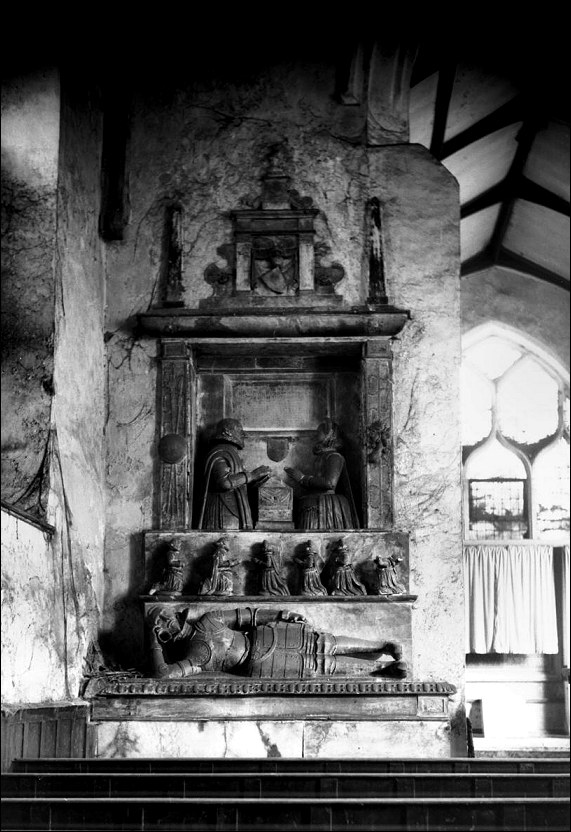
Sir Reginald Cobham 1382-1446 3rd Baron Sterborough lies beside second wife Anne Bardolf ++
Reginald was the son of Reynold de Cobham 2nd Baron Sterborough www.flickr.com/photos/52219527@N00/748860258/ and Eleanor Maltravers.
He m1 Eleanor www.flickr.com/photos/52219527@N00/748149859/ daughter of Sir Thomas Culpepper 1428 and Alianore Green
Children
1. Eleanor d1454 m Humphrey Plantagenet 2nd Duke of Gloucester son of Henry Bolingbroke Henry IV and Mary de Bohun (accused of witchcraft . divorced)
2. Elizabeth m1 Richard 7th Baron Knockin, son of John le Strange 6th Baron and Maud de Mohun.m2 Sir Roger Kynaston of Hordley (son John m Jacquette www.flickr.com/photos/52219527@N00/8435157731/ sister of Queen Elizabeth Woodville)
3.. Reynald 4th Baron dsp m Elizabeth daughter of Sir Arnold Savage & Joan Etchingham flic.kr/p/2SKYk8
4. Thomas 5th Baron Sterborough m1 Elizabeth daughter of Sir John Chideock 1450 & Alianore FitzWarin m2: Anne daughter of Humphrey de Stafford 6th Earl of Stafford, Duke of Buckingham 1460 & Lady Anne Neville
++Second wife Anne d1454 widow of Sir William Clifford was the daughter of Thomas Bardolf 5th Baron Bardolf 1408 & Amice de Cromwell. was the widow of Sir William Clifford d1418 son of Roger de Clifford, Lord Clifford 1389 by Maud de Beauchamp
Her sister Joan who m William Phelps 6th Lord Bardolf is at Dennington www.flickr.com/photos/52219527@N00/9461069432/
Reginald was the rebuilder of Lingfield Church which he made collegiate in 1431. In his will he requested his monument before the altar .
Reginald was the rebuilder of Lingfield Church which he made collegiate in 1431. In his will he requested "to be buried in the collegiate church of St Peter of Lyngefeld before the high altar where a monument of alabaster is to be constructed anew according to the discretion and ordination of my executors"
"To the fabric of the mother church of Winchester 20s. To the high altar of Wyngfeld 100s. I leave 100s. between poor tenants of Oxsted, Billesershe, Hexshed, Edenbregge, Cowden and Chidynstone. I leave for books, copes, vestments and other ornaments for my college of Lyngfeld.
Executors my dearly loved son Thomas Cobham, Knight, John Ardern, Wm. Gagnesford, Sir John Swetecok, Master of the College of St. Peter of Lyngfeld, John Bayhall, Richard Hendyman and Sir Richard Howlet, chaplain and my very dear consort Anna supervisor. Rents to the value of £200 I leave to my executors to dispose for my soul.
Codicil made 14 August 1446, certain legacies of me Reginald Cobham Knight Lord of Starburgh. I leave to Dame Anne my consort all hustilments, utensils etc. of the hall, parlure, pantry, kitchen and chamber in the castle of Starburgh, except Jewels vessels of silver, silver gilt or gold. Nevertheless I leave the same Dame Anne half of all the cups, masers, salts etc. My executors to permit her to occupy all necessaries of my chapel within my castle and afterwards to remain to John Swetcok now Master of the College of St. Peter of Lingfeld by me lately constructed and founded and to the chaplains of the same College. I leave to Richard Howlet, chaplain, 20 marcs and £20 between my servants. My feoffees in 38s. yearly rent out of certain lands &c called Morehall and Pakeneslond in parishes of Lyngefeld and Est Grenested in Surrey and Sussex." - The Collegiate Church of St. Peter and St. Paul, Lingfield, Surrey
Now crammed behind the organ, monument to Thomas Anguish (1536 - 1617) www.flickr.com/gp/52219527@N00/0BX434 in the robes of an alderman, who kneels with his wife & family. Placed here at his request above his "seat where he usually sat" and is by Nicholas Stone costing £20 double the amount he had left in his will for this purpose.
"Near heer lieth ye body of Thomas Anguish late citizen & alderman of Norwich & sometimes mayor of this city who deceased the 26th January AD 1617 aged 79, who had to wife Elizabeth daughter of Edmund Thurston and had issue by her 9 sonnes and 3 daughters, where of at his death their were living 5 sonnes only"
"William Anguish, +++ gent, dyed the 6th day of July 1668 to whose memorie John Anguish esq, his nephew and executor dedicated this inscription"
Thomas was the youngest of 3 sons of Thomas Anguish of Foulsham by Anne Thimblethorp
He m Elizabeth c 1619 daughter of grocer Edmund Thurston ++ to whom Thomas was apprenticed . Their house and shop was in Tombland (on the corner of Tombland and Wensum Street, now part of the Maid’s Head Hotel)
He took over his father in law's grocery business and prospered, becoming a freeman of Norwich in 1573. and took an active role in city life, serving as Sheriff, Mayor and Speaker of the Council. He was elected mayor in 1611, and as was usual there was a pageant and firework display. Sadly the cord suspended with fireworks collapsed causing the deaths of 33 bystanders. The occasion was described by a local catholic commentator as "a scourge to that wicked citie and puritan mayor .. being Anguish did portend anguish and sorrow to the people" Thereafter fireworks were banned from Guildhall feasts
Children 9 sons & 3 daughters (5 sons survived their father)
1. John 1569-1571
2. Alexander 1577-1579
3. John 1578-1643, alderman m Mary Aldrich d1640 grand daughter of alderman John Aldrich father in law of Edmund Thurston ++)
4. Edmund 1574-1657 of Great Melton m1 Dorothy Marsham
d1604 in childbirth with her baby m2 Alice d1642 daughter of John Drake of Herringfleet (their grand daughter Anne Wodehouse is at Kimberley flic.kr/p/CdKoLk whose son inherited Great Melton)
5. Alexander 1579-1581
6. Richard 1581- 1616 Fellow of protestant college Corpus Christi
7. Alexander 1582-1654 alderman of St Peter Mancroft m Catherine Barrett
8.. Cicely 1583-1584
9. Hester 1585-1617 m Richard son of John Mann
10, Margaret 1587-1588
11. Thomas 1590-1622 m Anne daughter of Francis Smallpiece & Anne daughter of John Aldrich, who m2 John Dethick
12. William 1593-1668
A patron of the cathedral who with his son Edmund, bequeathed a new organ for the choir and had a standing order for repairs from 1607 to 1609
Thomas also bequeathed a property in Fishergate to the Corporation to be used as a hostel "for the keeping and bringing up and teaching of very poor children" which was opened in 1621 - Boys were first to be admitted, with girls following some years later. It still survives www.anguishseducationalfoundation.org.uk/about-us/ There was also a foundling hospital begun in 1618 where annual sermon was to be preached on its founders day.
Thomas was certainly a Calvinist if not a puritan - The fireworks episode must have preyed on his mind as his will states he died in the assurance that Christ "hath of his own free will and greate mean fully paide and satisfied the wrath of God the Father due unto me for my synne. And that through his blessed merit, death and passion I shall have and enjoy the fruition and benefit of everlasting life to joyn with Him in eternall joy and happiness among the elect children of God for ever"
+++ Will of William Anguish of Norwich, gentleman. To be buried in St. George Tombland parish, where I was born. ;£10 to the parish for his burying-place in that church, near my father; poor at death, £20, to be sent for distribution to Court of Aldermen ; all my tenants in St. Tedmond's a quarter's rent ; Goody Dix, widow, " that have my ground," £2 ; cousin Ann
James, widow; cousin Edmund Anguish of Great Melton, £10; cousin Ann Blackborne, wife of Henry, ;{£10 ; cousin Elizabeth Cassell, widow, £10; cousin Ester Bayfield, £10; cousin
Mary Browne, wife of Miles Browne, ^10 ; cousin Ann Rix, dau. of my sister, dec. long ago ; William Anguish, godson; son of cousin Richard, a clerk; Mr. Richard Wenman of Norwich,
alderman ; Edward Lome of Cawston ; Mr. Thomas Stoughton of Hockering, clerk ; cousin Ester Clark, widow ; cousin William Anguish, godson, of London, son of cousin Edmund of Great Melton; cousin Mr. John Anguish of Great Melton, now of Lynn, son of bro. Edmund, deceased ; to said John, garden, &c., bought of Alderman Rose and Abraham Leman, now
occupied by widow Dix, gardener; houses, &c., in St. Tedmond to cousin John Anguish of Great Melton, which my father, Mr. Thomas Anguish of Norwich, alderman, dec, gave me. Residue to said cousin John, sole executor. Witnesses, Thomas and William Gorie. Dated 13 July, 1666; proved g July, 1668. - Church of St George Tombland Norwich , Norfolk
An orphan goes to live with his free-spirited aunt. Conflict ensues when the executor of his father's estate objects to the aunt's lifestyle. Starred Rosalind Russell, Forrest Tucker, Coral Browne, Fred Clark, Roger Smith, Patric Knowles, directed by Morton DaCosta (info from www.imdb.com).
Recognise this guy? Fond of trophies and money, he's the executor of some of the football world's most feared free kicks.
Letter to Joseph Springall, 1836-1918 of Swanton Morley, East Dereham, Norfolk, offering all Property, consisting of 10 Cottages and the Old Chapel belonging to Mrs Ester Williams, widow of Daynes Williams for £300. Letter from Jesse Larwood, Gressenhall, East Dereham Executor of late Daynes Williams. Dated, 25th May 1901
Joseph Springall born 1836, Swanton Morley, son of Charles Springall and Ann Hammond, A Builder and Contractor the 1911 census shows him living at Greengate, Swanton Morley, East Dereham with his second wife Alice Mary Dennis.
Esther Wright born1851, Hockering, Norfolk, was the daughter of William Wright and Mary Ann Walpole. She married Daynes Williams in 1877 at East Dereham. Daynes died in 1899.
The 1891 census shows them living at Commercial Road, East Dereham
Instrument of sasine of an annual rent of 21 shillings Scots out of a tenement and yard on the port of Glasgow, disponed by John Oliphant pottar burgess of Glasgow with the consent of Elizabeth Ouchter his mother to Sir Alexander Painter vicar of Carstairs and Lawrence Purdy vicar of Durisdeer, executors of Sir Andrew Purdy querister of Glasgow and by said executors to the vicars of the choir for an obit. (11 March 1499)
(University of Glasgow Archive Services Ref: GUA BL/191)
The document was written in Latin on parchment by the notary John Thornton and it is bearing his authentification mark. It is written in a very neat cursive hand with secretary hand features such as the letter s looking like a Greek sigma, the letter p looking like an x, the letter a with a slight attacking stroke. The first letter is ornamented and the first words are written in bookhand.
Image of back available here
Mrs. Julia Utten Browne & Cautley papers, Letter from H E Evans, Trustee & Legal opinion re Mrs Cautley dated 9th September 1913. In the letter he states that it should not be assumed that his cousin Dorothea Cautley will confirm the Settlement, though he thinks it is likely she might. He also asks for Counsel’s opinion, does the Agreement made for he before her marriage hold good if she does repudiates it and would she then become entitled to take over the fund under the terms of Mrs Julia Utten Browne, Lilly’s Will. Also an outline of the opinion that is being sought.
Attached to the letter is the Counsel’s opinion by J. F. W. Galbraith. 3 New Square, Lincoln’s Inn dated 17th October 1913 which was made 9 days after the death of Mrs Julia Utten Browne, Lilly on the 8th October 1913.
He was Harry Edgar Lawrence of 45 Essex Street, City of London, a Cousin of Julia Utten Browne whom she had appointed a Executor/Trustee of her will following the death of her husband in 1903. He was also a Trustee of the Will which contained the Trust to which her daughter Dorothea Julia Beatrice Gertrude, nee Browne, Cautley became entitled to.
1981 Reliant Robin Super.
Supplied by J W Milward of Newmarket (Reliant).
Last MoT test expired in September 2010.
East Anglian Motor Auctions, Wymondham -
"On behalf of executors. Non-runner. V5 document. Estimate: £200 - £300."
Sold for £850 plus premium.
ANNAPOLIS, Md. (Jan. 17, 2023) U.S. Naval Academy midshipmen give a presentation to Fabien Cousteau, executor and founder of Proteus Ocean Group (POG), and members of his team on their capstone project. The midshipmen are working with Proteus as part of their final capstone project. (U.S. Navy photo by Mass Communication Specialist 1st Class Jordyn Diomede)
Promotoria de acusação.
Julgamento do assassinato dos ativistas José Cláudio e Maria dos Espírito Santo, que foram mortos em março de 2011 em Nova Ipixuna. O resultado do júri, que aconteceu nos dias 03 e 04 de abril, foi a condenação dos executores Alberto Lopes e Lindonjonson Silva, e absolvição de José Rodrigues, acusado de ser o mandante do crime. A ação provocou revolta nos familiares e movimentos agrários que acompanhavam o caso em vigília no Fórum de Marabá (PA).
(CC BY-SA) NINJA
Todas as imagens estão sob licença Creative Commons 3.0 e podem ser utilizadas livremente desde que disponibilizadas nas mesmas condições com o uso do código acima. Imagens em alta resolução estão disponíveis através de requerimento no email fotografia@foradoeixo.org.br
ANNAPOLIS, Md. (Jan. 17, 2023) U.S. Naval Academy midshipmen give a presentation to Fabien Cousteau, executor and founder of Proteus Ocean Group (POG), and members of his team on their capstone project. The midshipmen are working with Proteus as part of their final capstone project. (U.S. Navy photo by Mass Communication Specialist 1st Class Jordyn Diomede)
ANNAPOLIS, Md. (Jan. 17, 2023) Fabien Cousteau, executor and founder of the Proteus Ocean Group (POG), and members of his team take a tour of various departments during a visit to the U.S. Naval Academy. Proteus is the world’s most advanced underwater research station, a collaborative global platform for researchers, academics, government agencies, and corporations to advance ocean science. U.S. Naval Academy midshipmen are working with Proteus as part of their final capstone project.(U.S. Navy photo by Mass Communication Specialist 1st Class Jordyn Diomede)
Pink Bridge - Beginning - first coat - the lightest pink shade.
The Pink Bridge I designed for San Diego's New Children's Museum opening show is finally done :) I am still missing images from the mirror wall on the bridge interior anyway in the following sequence of 12 images a bit of the pink process.
Many thanks to Alberto Caro who invited me to participate in the exhibition, Rachel Teagle who give the follow up to my project and to my whole work team - as much to the permanent executors - specially Helen (the head of work team) - as to all the volunteers that help to made it :)
The Pink Bridge was executed between march 16th and April 2nd 2008. Official Museum opening is scheduled for May 4th.
Folio from Quran, 750-800 AD (2nd century AH) (Syria?)
Black, red and green ink on vellum
33.3 x 400 mm (leaf)
267 x 320 mm (text block)
A QUR'AN FOLIO, NORTH AFRICA OR THE NEAR EAST, LATE 8TH CENTURY
Qur'an manuscript leaf on vellum, with 16ll. of elegant black kufic with pronounced circular letters, diacritics indicated with black lines, vocalization of red and occasional green dots, verse endings marked with groups of three diagonal lines.
Roundel 10-verse marker on obverse, line 8
Alif 5-verse marker on reverse, line 8
According to a friend, the entire folio is from Surah 5: al-Ma'ida: The Table Spread With Food and starts with the last part of Verse 101 and runs through the first part of verse 106. Verses 101-105 address faith, with Allah (the Beneficent and Merciful) demanding believers give up their other faiths they've held onto out of tradition, but also forgives them for having done so. Verse 103 alludes to some of those traditions, which are similar to the Hindu practice of letting cows loose to wander freely. Verse 106 addresses appointing two good and pious men as executors of one's dying will.
Condition: Well... Top and bottom halves are completely separated horizontally and there's a vertical crease in the middle, suggesting the leaf was folded into quarters. Numerous other signs of wear. Text on both sides is complete but barely legible on obverse (pages are turned left to right). Tear and repairs (obverse) affect all of line 9 and the 10-verse marker, and some of lines 7 and 9. Remnants on obverse of tape used to hold top and bottom together at one time. The only mitigating factors are that descriptions of other leaves suggest similar horizontal tears, and even a leaf missing its last three lines was desirable, though it came from a famous collection.
Provenance: Acquired in 2018 from an Amsterdam antiques dealer retiring and selling off his eclectic stock (viz. paintings, prints, glass, nautical antiques, etc.). I had known him several years. When I asked him where he'd gotten this manuscript, he couldn't recall, but he had had it in storage since the 1980s.
As about 90 leaves appear extant, out of a conjectured 500-600 in the total text, my leaf has at least a 1 in 6 or 7 chance of following or preceding a known page.
Similar folios I have found online:
Two at LACMA - "Abbasid Caliphate, late 8th century"
(M.73.5.508) - collections.lacma.org/node/240038
(M.2002.1.383) - collections.lacma.org/node/204570 (white and green alif every 5 verses, roundel every 10)
One at Brooklyn Museum - Abbasid / 8th-9th century (same white and green alif every 5 verses, roundel every 10, as LACMA)
(1995.186 ) www.brooklynmuseum.org/opencollection/objects/154555
One at Bonhams - Sale 25 April 2017, 11:00 BST - late 8th century - early 9th century AD (Syria?)
www.bonhams.com/auctions/24197/lot/3/?category=list - (Roundel, no alif)
One at Ashmolean - late 8th century - early 9th century AD - Roundel, no alif
jameelcentre.ashmolean.org/collection/8/per_page/25/offse...
Three individual leaves and an incredible bonanza of 76 leaves, at Christies:
Art of the Islamic and Indian Worlds Including Oriental Rugs and Carpets, 2019 (76 leaves)
A SUBSTANTIAL GROUP OF LARGE KUFIC QUR’AN LEAVES
LATE UMAYYAD OR EARLY ABBASID, PROBABLY DAMASCUS OR JERUSALEM, MID-8TH CENTURY
www.christies.com/en/lot/lot-6229646
The Saeed Motamed Collection - Part I, London, South Kensington, 22 April 2013
Lot 38 - A LARGE KUFIC QUR'AN FOLIO - NEAR EAST OR NORTH AFRICA, LATE 8TH CENTURY (Roundel, no alif)
www.christies.com/lotfinder/books-manuscripts/a-large-kuf...
Art of the Islamic and Indian Worlds, London, 5 October 2010
Lot 53 - A KUFIC QUR'AN FOLIO - NEAR EAST OR NORTH AFRICA, END OF THE 8TH CENTURY (Roundel, no alif)
www.christies.com/lotfinder/lot/a-kufic-quran-folio-near-...
Indian & Islamic Works of Art, London, South Kensington, 26 October 2007
Lot 257 - A QUR'AN FOLIO, NORTH AFRICA OR THE NEAR EAST, LATE 8TH CENTURY (Dire condition, missing top line and most of bottom line; roundel, no alif)
www.christies.com/lotfinder/lot/a-quran-folio-north-afric...
Two lots (1 & 5) at Sothebys London, in 2019: THE SHAKERINE COLLECTION: Calligraphy in Qur’ans and other Manuscripts, 23 October 2019:
www.sothebys.com/en/buy/auction/2019/the-shakerine-collec...
All of these match this item in the Khalili Collection, in page size, text size, style, number of lines, and ornamentation:
Francois Deroche, The Abbasid Tradition: Qurans in the 8th to 10th Centuries - the Nasser D. Khalili Collection of Islamic Art, London 1992, pp. 120-123, no. 66.
Draft Conveyance Josiah Adams of Ramsgate, Clerk to A & K Daniel, Solicitors of Ramsgate, Miss Helen Bear, Minnie, Bear and Henry Bear, Grocer’s Assistant all of 7, Lorne Road, St Lawrence to Thomas Robert Tucker, Smacker Owner, of 26 La Belle Alliance Square, Ramsgate Land at Southwood, Ramsgate dated 26th July 1901.
Elizabeth Saxby’s Will of 26th November 1879 her niece Catharine Bear and Josiah Adams as Executors which included her house, Alpha Villa near Southwood and two cottages nearby also land that was formerly a Brickfield. Also held in Trust for her nephew John Bear, who died on 1st February 1881 and the the inheritance passed to his 3 children, Helen, Minnie and Henry Bear. Catherine Bear became the wife of Isaac Fenwick and died 19th January 1891.
At the age of 24 years Susanna Shalespeare announced her marriage to Dr. John Hall who had settled in Stratford around 1600 building up a very successful medical practice and becoming one of the town's leading lights, their wedding took place on June 5th 1607. Shakespeare appointed John and Susanna executors of his will and in due course they inherited and moved into New Place after Shakespeare's death.
The fourth Ida Rentoul Outhwaite Children's Library Stained Glass Window features an excerpt from the poem "A Concert"; "Then clear on a flute of purest gold, a sweet little fairy played, and wonderful fairy tales she told, and marvellous music played". This is Ida Rentoul Outhwaite's most famous quotes, although it was actually written by her elder sister Annie Rattray Rentoul as the quote is taken from "Fairyland" published by A. and C. Black in 1926, for which Annie wrote poems and Ida's husband Arthur Grenbry Outhwaite wrote stories, all of which Ida illustrated. The original illustration was executed in pen and ink, so it is brought to colourful life in the pink, blue, brown and golden yellow stained glass panel. It features a little girl faerie with pink wings and a silvery dress atop a ragged toadstool playing her golden pipe to an assembled audience of six pixies, a koala and a little boy. The little boy (whose name is John) wears contemporary 1920s clothes, with button up short trousers, ankle socks, strap over shoes and a collared shirt. John's hair is also a modern 1920s pageboy cut. The faerie too has a contemporary pageboy cut, with a wreath of flowers about her crown. Her dress is typical of 1920s sundresses for little girls and on her feet she wears a pair of fashionable black Mary Janes. The audience sit beneath a row of spindly gum trees whilst about them through the grass sprout tiny white daisies such as are found in many an Australian lawn today. All the audience appear entranced except the brown koala who sits at the end and the pixie next to him. The pixie looks unimpressed as the koala's head lolls forward and his lids droop. This may be in reference to the remaining part of the poem's stanza which reads: "But Teddy Bear began to nod, and gave a very loud snore, and yet at the end - it's true, though odd -, he grunted out 'Encore!'"
In 1923 with Fitzroy still very much a working class area of Melbourne with pockets of poverty, the parish of St. Mark the Evangelist decided to address the need of the poor in the inner Melbourne suburb. Architects Gawler and Drummond were commissioned to design a two storey red brick Social Settlement Building. It was opened in 1926 by the Vicar of St. Mark the Evangelist, the Reverend Robert G. Nichols (known affectionately amongst the parish as Brother Bill). Known today as the Community Centre, the St. Mark the Evangelist Social Settlements Building looks out onto George Street and also across the St. Mark the Evangelist's forecourt. When it opened, the Social Settlement Building's facilities included a gymnasium, club rooms and children's library.
Opened in 1926, the children's library, which was situated in the corner room of the Social Settlements Building, is believed to be the first known free dedicated children's library in Victoria. The library was given to the children of Fitzroy by Mrs. T. Hackett, in memory of her late husband. The library contained over 3,000 books, as well as children's magazines and even comics. The Social Settlements Building was only erected because Brother Bill organised the commitment of £1,000.00 each from various wealthy businessmen and philanthropists around Melbourne. Mrs Hackett's contribution was the library of £1,000.00 worth of books. Another internationally famous resident of the neighbourhood, Australian children's book illustrator Ida Rentoul Outhwaite, then at the zenith of her career, was engaged by the relentless Brother Bill to create something for the library. Ida donated four stained glass windows each with a hand-painted panel executed by her, based upon illustrations from her books, most notably "Elves and Fairies" which was published to great acclaim in Australia and sold internationally in 1916 and "Fairyland" which had been published earlier that year. These four hand painted stained glass windows were equated to the value of £1,000.00, but are priceless today, as they are the only public works of Ida Rentoul Outhwaite ever commissioned that have been executed in this medium. Ida Rentoul Outhwaite was only ever commissioned to create one other public work; a series of four panels executed in watercolour with pencil underdrawing in 1910 for the Prince Henry Hospital's children's wards in Melbourne (now demolished). Of her panels, only two are believed still to be in existence, buried within the hospital archives. The four Ida Rentoul Outhwaite stained glass windows each depict faeries, pixies, Australian native animals and children, taken from her book illustrations. At the time of photographing, the windows - three overlooking George Street and one St. Mark the Evangelist's forecourt - were located in the community lounge, which served as a drop-in lounge and kitchen for Fitzroy's homeless and marginalised citizens. Today the space has been re-purposed as offices for the Anglicare staff who run the St. Mark's Community Centre, possibly as a way to protect the precious windows from coming to any harm. The only down-side to this is that they are not as easily accessed or viewed as when I photographed them, making my original visit to St. Mark the Evangalist in 2009 extremely fortuitous.
The Ida Rentoul Outhwaite Children's Library Stained Glass Windows are one of Australia's greatest hidden treasures, which seems apt when you consider that the pixies and faeries they depict are also often in hiding when we read about them in children's books and the faerie tales of our childhood. The fact that they are hidden, because it is necessary to enter a little-known and undistinguished building in order to see them, ensures their protection and survival. The windows are unique, not only because they are the only stained glass windows designed and hand-painted by Ida Rentoul Outhwaite, but because they are the earliest and only examples of stained glass art in Australia that deals with theme of childhood.
I am indebted to Peter Bourke who ran the St. Mark's Community Centre in 2009 for giving me the privilege of seeing these beautiful and rare windows created by one of my favourite children's book artists on a hot November afternoon, without me having made prior arrangements. I also appreciate him allowing me the opportunity to photograph them in great detail. I will always be grateful to him for such a wonderful and moving experience.
Ida Sherbourne Outhwaite (1888 - 1960) was an Australian children's book illustrator. She was born on the 9th of June 1888 in the inner Melbourne suburb of Carlton. She was the daughter of the of Presbyterian Reverend John Laurence Rentoul and his wife Annie Isobel. Her family was both literary and artistic, and as such, gifted Ida was encouraged from an early age to embrace her talent of drawing. Her elder sister, Annie Rattray Rentoul (1882 - 1978), was likewise encouraged to write, and both would later form a successful partnership. In 1903 six fairy stories written by Annie and illustrated by Ida were published in the ladies' journal "New Idea". The following year the Rentoul sisters collaborated on a book called "Mollie's Bunyip" which was received with instant success because it combined the idea of European faeries, witches and elves and the Australian bush. "Mollie's Staircase" followed in 1906. In 1908 the Rentoul sisters published their first substantial story book, "The Lady of the Blue Beads". On 9 December 1909 Ida married Arthur Grenbry Outhwaite (1875-1938), manager of the Perpetual Executors and Trustees Association of Australia Ltd. (Annie remained unmarried her entire life). After her marriage, Ida was known as Ida Rentoul Outhwaite, but did not publish anything substantial as she established her family and household until part way through the Great War. In 1916 she brought out her first coloured work; "Elves and Fairies", a de luxe edition produced entirely in Australia by Thomas Lothian. The success of the book, with its delicate watercolour plates, was due both to Ida's artistic talent and to the business acumen of her husband, who provided a £400.00 subsidy to ensure a high-quality production and consigned royalties to the Red Cross, thereby encouraging vice-regal patronage. "Elves and Fairies" is still her best known and loved work. Encouraged by her latest success, Ida travelled to Europe after hostilities ended and in 1920 exhibited in Paris and London. The critics compared her to other artists of the golden years of children's illustration such as Arthur Rackham and Edmund Dulac, thus sealing her international success. She signed a contract with British book publishers A. & C. Black who published five books for her over the next decade, including "The Enchanted Forest" (1921), with text by her husband, and, probably the most popular of all the Rentoul sisters' collaborations, "The Little Green Road to Fairyland" (1922). "The Fairyland of Ida Rentoul Outhwaite" (1926), another sumptuous volume, with text by her husband and sister, was less successful. A. & C. Black also produced a number of postcard series using her illustrations from "Elves and Fairies" as well as her other books published by them. In 1930 the last of her books published by A. & C. Black was released, but already times were changing, and the interest in Ida's work was rapidly fading. Angus & Robertson brought out two more books in 1933 and 1935 but they received relatively little attention. Her last two exhibitions, which between 1916 and 1928 were almost annual events, were held in 1933. The Second World War changed the world, and Ida and Annie's work was relegated to a bygone era, shunned and forgotten. Ida suffered the loss of both of her sons during the war, and she spent her last years sharing a flat in Caulfield with her sister, where, survived by her two daughters, she died on 25 June 1960. She did not live to see the resurgence of interest in her work some twenty-five years later, when in 1985, her picture of "The Little Witch" from "Elves and Fairies" was published on an Australian stamp, opening the fairy world of Ida Rentoul Outhwaite to a whole new generation of children and adults alike.
Candid photos of people in Prague.
Rough translation - Help, Czech state stole my home. Wrong executor of court sold the stolen house.
August 2014.
Margaret Brent (c. 1601 – c. 1671), an English immigrant to the Colony of Maryland, was the first woman in the English North American colonies to appear before a court of the Common Law. She was a significant founding settler in the early histories of the colonies of Maryland and Virginia. Lord Calvert, Governor of the Maryland Colony, appointed her as the executor of his estate in 1647, at a time of political turmoil and risk to the future of the settlement. She helped ensure soldiers were paid and given food to keep their loyalty to the colony.
With Anne Hutchinson, Brent ranks among the most prominent women figures in early Colonial American history. Hailed as a feminist by some in modern times in advancing rights of women under the laws, her insistent advocacy of her legal prerogatives as an unmarried gentlewoman of property, while notable in its exceptional energy, was consistent with English law.
John William Stableford, Coalville, Leics
Kelly's Leicestershire Directory 1891 -1900
THE LONDON GAZETTE, 31 JANUARY, 1928.
JOHN WILLIAM STABLEFORD, Deceased.
Pursuant to the Trustee Act, 1925.
NOTICE is hereby given, that all creditors and other persons having any claims or demand for against the estate of John William Stableford, late of The Poplars, London-road, Coalville, in the county of Leicester, who died on the 25th day of July, 1915, and whose will was proved in the Probate Division of the High Court of Justice, at the Principal Registry, on the 29th day of April, 1916, by Hannah Stableford and Harry James Taylor, the executors named in the said will, are hereby required to send the particulars, in writing, of their claims or demands to us, the undersigned, on or before the 3rd day of April, 1928, after which date the said estate will be distributed, having regard only to the claims of which the executors shall then have had notice.—Dated this 28th day of January, 1928.
BROWN, WILLATT and MARRIOTT, Eldon Chambers, Wheeler Gate, Nottingham, Solicitors to the Executors.
Church of St Margaret,
Monument to Bussy †1719 and Mary †1730 Greene. Marble, 1745, Signed Robt Page Fecit. Commissioned by his daughter and executor, Mary. Now east wall of north nave, moved from south wall of chancel, east end in 1881.
The impressive monument would once have filled the south wall of the chancel, at the very east end, before it was moved by the architect R.M. Phipson in 1881 to make way for a new window. It is dominated by the beautiful veined grey pyramid, decorated with the family coat of arms on a scrolled cartouche, with oak leaves and scallops. The pyramid rests on the base which houses the inscription, now difficult to make out because of the pews, and frames the darker commemorative chest. This rests on lions’ paws and the upper tiers rise to an acorn, symbol of strength and growth and is flanked by two mourning youthful angels. One sheds a tear while wiping his other eye, his foot resting on a skull, while his companion clutches his hands in palpable grief.
The inscription is the only source of information about Bussy and Mary Greene. It included four of their children whose deaths dated from 1709 down to 1737. Both the impressive scale of the monument, with its accomplished handling of a range of colour within a deliberately limited palette, and its original position in the chancel underline the inscription’s reference to Bussy Greene as a gentleman of Catton, who died when he was fifty two years old.
detail of mourning angel on left
Church of Simon and St Jude,
Monument to Sir John Pettus †1614 and Bridget Curtis and Sir Augustine Pettus †1613, alabaster. Commissioned by Thomas Pettus, Sir John’s second son, the executor of his will. Unknown, probably Norwich mason, also responsible for the Suckling monuments in St Andrew’s, restored 2007/8.
St Simon and St Jude was declared redundant in the 1890s, and abandoned in the 1930s. Now owned by the Norwich Churches Trust it has been saved from its state of collapse in the 1930s, but the inside has been butchered by the addition of the nave mezzanine. This makes it impossible to appreciate the monument to Sir John and his family, on filling the north wall flanking the chancel arch. Mercifully the late George Plunkett took a full set of photographs of the interior in the 1930s, including the monument (www.norfolkchurches.co.uk/norwichsimonjude/plunkett/plunk...).
The monument rises from an impressive coloured alabaster base, to the Pettus coat of arms flanked by two obelisks. Sir John in his mayoral robes (he was Mayor in 1608) appears to kneel at a prayer desk opposite his wife, Bridget Curtis, although there is no sign of their legs. Blomefield writing in the 18th century mistook the armorials and identified the kneeling figure as Sir Augustine, who, unlike his father, was never Mayor of Norwich. Most of the literature has followed Blomefield, who was corrected by the Norfolk Heraldry Society (information from Tony Sims). Sir John and Lady Bridget are flanked by pilasters; his decorated with lances, hers with pomegranates and other fruit. Their children, two sons and two daughters kneel underneath, while Sir Augustine, who had died under a year before his father, is repeated lying stiffly in his full armour looking out from the monument, his head propped on his right arm, holding what could be a gauntlet or drinking horn, showing the fingers of a small hand.
Sir John had moved beyond both the family’s relative humble origins as tailors and local politics when in 1604 he had become the first Norwich Member since 1558 to be elected to two consecutive parliaments. He was active as an MP, while continuing his charitable work in Norwich. At the death of his father he had inherited considerable wealth, as well as the family house on Elm Hill, once extending to the churchyard, now nos. 41-43, and the estate at Rackheath, since at death his moveable goods, which included a substantial armoury of nine guns, were valued at £952 19s. 6d and the house on Elm Hill contained 27 rooms, together with stables for eight horses.
Blomefield, An Essay towards a Topographical History of the County of Norfolk: volume 4: The History of the City and County of Norwich, part II, ‘chapter 42: East Wimer ward', (1806), pp. 329-367; Chris Kyle, ‘Sir John Pettus’ in The History of Parliament: the House of Commons 1604-1629, , ed. Andrew Thrush and John P. Ferris, 2010.
Manhattan, New York City, New York, United States
Summary
The stable building at 136 West 18th Street is one of nine remaining brick-fronted stables from an original row of thirteen erected in 1864-66. Designed in a round-arched utilitarian style related to the German Rundbogenstil, it still features a mix of Romanesque and Renaissance Revival details. No. 136 West 18 th Street has a tripartite triumphal arch composition which focuses on a central bifurcated Renaissance arch at the second story. The building has had several notable owners, among them Charles Landon and Benjamin H. Hutton, partners in one of the most prestigious dress goods importing firms in the New York City during the second half of the nineteenth century.
As a component of one of the two uniformly designed mid-nineteenth-century private carriage house groups remaining in Manhattan, it is a rare survivor. These stable rows reflect a period in the city's developmental history when private carriage houses began to be erected some blocks away from their owners' homes, on streets devoted almost exclusively to private stables and commercial liveries. An early manifestation of this trend, which became common practice during the late-nineteenth and early-twentieth centuries, the West 18th Street row was one of the most extensive of the period and contained unusually large and handsomely decorated stables.
The Tonnele Estate and the Development of the Private Stables on West 18th Street
Once part of the eigthteenth-century farm of Peter Warren, the lots on the south side of West 18th Street between Sixth Avenue and the old Warren Road to the west were acquired by John Tonnele around 1817. Senior partner in the firm of Tonnele & Hall, the country's leading dealer in wool, Tonnele had extensive real estate holdings in Manhattan including large tracts on
Sixth Avenue, 14th and 15th, and 17th and 18th Streets.
In his will of 1846, Tonnele divided his real estate among his family, giving them the option of selling the property and investing the proceeds in trust for their heirs. A total of thirty-two lots on West 17th and 18th Streets were left to his daughter Susan G. Hall. In March of 1863, she and the executors of the estate, her husband Valentine G. Hall and his brother George Hall, began selling her lots which were then occupied by small dwellings and wood shanties.
As the area was semi-industrial in character, with a brewery located on the north side of 18th Street and the Weber piano factory occupying the northeast corner of Seventh Avenue and 17th Street, the Halls must have regarded the lots as unsuitable for first-class residential or commercial development. However, the lots' proximity to the fashionable Fifth Avenue residential district north of Union Square must have made them seem ideal for private stables and apparently they were offered for sale as such. By 1867, all the former Tonnele Estate lots on 17th and 18th Streets were occupied by private stables with restrictive covenants on the properties prohibiting their conversion to factories or commercial livery stables.
Stables were a necessity during the period when private urban transportation was limited to horses and carriages. While the majority of New Yorkers rented or boarded their horses in large commercial stables, the very wealthy maintained private stables. (Since private stables invariably provided storage space for carriages, the terms carriage house and private stable are used interchangeably hereafter.)
Traditionally, these were located directly behind their owners' houses, sometimes facing onto the less desirable street front of a through-the-block lot. By the mid-nineteenth century, carriage-house rows developed to serve a few of the city's most exclusive streets. Remnants of these stable rows survive at 127 and 129 East 19th Street, originally part of a group of stables serving the houses on Gramercy Park South and Irving Place,^ and at 57 Great Jones Street, the sole survivor of a long row of stables which once backed onto the mansions on the north side of Bond Street between Broadway and Lafayette Street.
Around 1860, carriage houses began to be erected a few blocks from their owners' homes, on convenient but less fashionable streets, where land costs were lower and where the noises and smells associated with stables would not mar the character of a residential neighborhood. Eventually a number of streets in Manhattan were devoted almost exclusively to private and livery stables. These included East 35th and East 36th Streets between Lexington and Third Avenues (developed largely in the 1860s and 1870s), East 73rd Street between Lexington and Third Avenues (stables erected between 1883 and 1904), and West 58th Street between Broadway and Seventh Avenue (stables erected c. 1885-1905).
The twenty-nine stables erected on the former Tonnele Estate in the 1860s, extending from 121 to 143 West 17th Street and from 112 to 146 West 18th Street, were an early example of this type of development and together formed one of the most extensive groups of private stables built in Manhattan in the 1860s.
It should be noted that throughout the 1860s, most of the private carriage houses on these "stable streets" were commissioned on an individual basis and that speculatively-built rows were a rarity. Perhaps the most extensive speculative development was Sniffen Court, a group of ten private carriage houses on a blind alley off East 36th Street, erected in 1864 for four investors by local builder John Sniff in, and subsequently sold to wealthy residents of Murray Hill.
Although uniform in design, the row from 122 to 146 West 18th Street was created through a combination of small-scale speculative development and individual commissions. In May and June of 1864, Elisha Brooks, a partner in the successful Brooks Brothers clothing firm, purchased the lots from 122 to 126 West 18th Street and had three identical stables erected on the site.
As work was proceeding on the Brooks stables, Susan Hall and her children agreed to use part of the proceeds from the sale of the lots on 18th Street to build a stable at 128 West 18th Street which would be retained for the family's use.
Though commissioned by a different client, this stable was identical in plan and design to the recently completed Brooks stables. By 1866, the nine remaining lots extending from 130 to 146 West 18th Street had been sold. Their new owners also had stables erected which followed the articulation established by the Brooks stables, creating a uniform row of thirteen stables.
This would suggest that Brooks had made the plans for his stables available to the other owners and/or that the same builder or architect was commissioned for all thirteen buildings. The result was one of the most extensive stable rows in the city, containing unusually large and handsomely decorated buildings whose owners included a number of New York's wealthiest and most prominent citizens, among them Samuel F.B. Morse who was the original owner of the stable at 144 West 18th Street (demolished).
The stable at 136 West 18th Street was constructed for Cornelia Gilman, wife of Samuel Gilman, a merchant with offices in the financial district at 91 Beaver Street. The Gilmans lived at 29 West 20th Street and presumably built the West 18th Street stable for their personal use. In 1870, Cornelia, then a widow, sold the stable to Benjamin H. Hutton and Charles G. Landon.
Hutton and landon were brothers-in-law and partners in a leading drygoods business located at 419-421 Broome Street. Hutton, the senior of the two partners, began his career in the firm of James Benkard, an importer of dress goods. Hutton became a partner in Benkard's firm in 1831 and brought Landon into the business following Benkard's death in 1864. Their firm imported French, German, and English fabrics and was the American representative for some of the most important textile manufacturers in France.
Both partners grew wealthy and Landon's business acumen earned him directorships on the boards of several major financial institutions including the Equitable Life Assurance Company, the Central Trust Company, the Bank of America, and the Greenwich Savings Bank.
In 1865, when Hutton and Landon bought the stable at 136 West 18th Street, Hutton was living on 14th Street near Fifth Avenue — thus, it is likely that the building was first employed for his personal use. In the late 1870s, however, he moved to Orange, New Jersey, where he was involved in the development of a suburban villa community known as Hutton Park. Landon then moved into the 14th Street house and presumably took over the 18th Street stable. In 1880, perhaps motivated by the increasing commercialization of East 14th Street, Landon moved uptown to Fifth Avenue and 38th Street. It seems probable that the stable was put up for rent at that time.
The Design of the 136 West 18th Street Stable
The stable at 136 West 18th Street is characteristic of contemporary carriage house design as adapted to a narrow urban lot. Typically, the stable would have been divided into two major ground-floor spaces — a front room for carriages and a rear room with stalls for horses. The front portion of the second floor would have contained quarters for the coachman or groom, while the rear would have been used as a hayloft. Windows were restricted to the front of the building to spare neighbors the sights and smells associated with horses, but two large skylights provided additional light to the second-floor rooms.
The facade is designed in a round-arched utilitarian style derived from the German Rundbogenstil (round-arch style). The Rundbogenstil evolved in Germany in the 1820s among a group of progressive architects who sought to create a synthesis of classical and medieval architecture by drawing on historic precedents in the round-arched Byzantine, Romanesque, and Renaissance styles.
Transmitted to this country through the immigration of German and Central European architects in the 1840s, as well as through architectural publications, the Rundboaenstil tended to be conflated with other mid-nineteenth century round-arched styles such as the Romanesque and Renaissance Revivals.
Among the major American examples of the round-arched style are Charles Blesch and Leopold Eidlitz's St. George's Church (1846-56) on Stuyvesant Square at 16th Street, Alexander Saeltzer's Astor Library (1849-53, later additions 1859, 1881), at 425 Lafayette Street, and Thomas Tefft's Union Depot, Providence, R.I. (1847, demolished). The style is reflected in the design of the stable at 136 West 18th Street by the choice of materials (unstuccoed brick and locally available sandstone), an emphasis on flat wall surfaces, and a clear definition of architectural elements.
The meshing of classical and medieval motifs is apparent in the the composition, which recalls both a Roman triumphal arch and the elevation of a medieval nave arcade, and in the incorporation of such details as the Renaissance-inspired cornice and diamond-pointed keystones and the Romanesque-inspired arcades and rusticated bands.
The facade's chief feature is a large central arch with a pair of inscribed arches and a bull's-eye tympanum. This motif, which was thought by nineteenth-century theorists to have originated in northern Italy during the Romanesque period and was widely used during the Renaissance, became a hallmark of the nineteenth-century round-arched styles, both here and in Germany.
Interestingly, the only other remaining group of mid-nineteenth century carriage houses in Manhattan, located at Sniffen Court, was also designed in the round-arched style and featured a triumphal arch composition with arched windows and doors flanking a central two-story arch. At 18th Street, the stables are larger and more elaborate in design.
In addition to its ties to the round-arched style, the design of the 136 West 18th Street stable is distinguished by its skillful superimpos it ion of recessed and projected planes. The double-height arcade, carried on slender projected piers, is on a forward plane, while the wall membrane with its door and window openings is recessed.
A series of horizontal moldings break forward over the piers to unite the two planes. The moldings at the arches' imposts at the second story form the capitals for two pilaster orders (a major order which articulates the piers, and a minor order which frames the windows). In addition to their function in this individual design, the repeated use of horizontal elements and the alternation of large and small arches are important elements in creating a strong sense of rhythm .and harmony within the row.
Description
The two-story stable structure at 136 West 18th Street has a frontage of twenty-three feet on West 18th Street, and has been extended from its original depth of eighty-one feet to occupy the entire length of its ninety-two-foot-deep lot. Its painted brick and stone facade is designed in the round-arched style and incorporates Romanesque and Renaissance details.
The facade is organized in a tripartite triumphal arch composition that focuses on a double-width center bay. At the ground story, the bays are articulated by projected piers. Originally, the wide center bay contained a pair of wood carriage doors, the eastern bay an arched entrance, and the western bay an arched window; the arches were ornamented by diamond-pointed keystones and stone bands ran across the facade at the sill, watertable, impost, and cornice lines.
Today, most of the stonework has been cut flush with the brickwork. The eastern bay of the ground story remains relatively intact, although the door and transom are replacements. The center and west bay were joined in 1936 when the vehicle entrance was enlarged. This opening is filled by a wood storefront, installed in the 1980s, which echoes the window treatment employed in the center bay on the second story. Only a few traces remain from the cornice that originally separated the first and second stories.
On the second story the piers carry an arcade in which the center arch is both wider and taller than the flanking arches. The arches are set-off by stone keystones. Stone bands mark the impost line of the arches and stone sills are set beneath the windows. (The stone bands and sills have been cut flush with the brickwork and the keystones have lost their original profile due to weathering.) A small pilaster bisects the center bay into a pair of arched windows which are topped by a molded wood surround that features a central bull's-eye. The windows retain their original four-over-four wood sash. The building is crowned by a simple molded brick entablature.
Subsequent History
In the 1870s and 1880s, the neighborhood to the east of the stables on 18th Street, which had once been exclusively residential, became the heart of New York's chief shopping district as the retail trade expanded along Broadway, Sixth Avenue, and 14th and 23rd Streets. Several of the original owners of the stables on 18th Street responded to the change in the character of the neighborhood by moving uptown or to the suburbs. At least two of the stables were sold to neighboring businesses. Other owners
retained their stables as investments, property values on Sixth Avenue having skyrocketed with the opening of such department stores as B. Altman's at 19th Street (begun 1876) and Hugh O'Neill's near 20th Street (original store opened 1870, present building 1887) , and the completion of the Sixth Avenue Elevated Railway in 1878.
In 1887 the stable at 136 West 18th Street was purchased by Nicholas Sheldon, a Rhode Island resident who owned a soap business, Nicholas Sheldon & Company, located at 154 Chambers Street.
Soon after acquiring the West 18th Street property, Sheldon commissioned Napoleon Le Brun & Son to remodel the interior and raise the sloping roof at the rear of the building by three feet.18 In 1891, Sheldon purchased the adjoining building at 134 West 18th Street.
A few years later he moved his soap business to the two 18th Street buildings. At his death the two properties passed to his daughter Helen Sheldon Potter and in 1917 they were acquired by William Leslie. No. 136 was leased to various businesses including the Atlantic Food Products Company (1924) and the Chelsea Botanical Products Company (1931). The building was in use as a garage in 1936 when the original carriage entry was enlarged.
Today, the 136 West 18th Street stable building is a component of one of the two remaining mid-nineteenth century carriage house groups in Manhattan. While the ground story has been partially altered, the second story is generally well preserved and distinguishes the building as a notable example of the round-arched style as applied to a utilitarian building type.
- From the 1990 NYCLPC Landmark Designation Report
Chancel begun in late 11c on the site of the 8c Saxon chapel, its east end was originally apsidal before being rebuilt in a rectangular shape in early 14c
Sir John Bridges d1530 instructed his executors to make a marble tomb at his father Thomas's burial place by the high altar and to provide vestments and altar hangings decorated with his coat of arms. He also assigned 10s. a year for an annual obit. - Church of St Mary, Dymock Gloucestershire
14th century–16th century
The origins of the house date from circa 1340–1360.[2] The earliest recorded owner is Sir Thomas Cawne, who was resident towards the middle of the 14th century.[1] The house passed by the marriage of his daughter Alice to Nicholas Haute and their descendants, their grandson Richard Haute being Sheriff of Kent in the late 15th century.[1] It was then purchased in 1521 by the courtier Sir Richard Clement (d.1538).[1] In 1591, Sir William Selby bought the estate.[1]
16th century-late 19th century
The house remained in the Selby family for nearly 300 years.[3] Sir William was succeeded by his nephew, also Sir William, who is notable for handing over the keys of Berwick-upon-Tweed to James I on his way south to succeed to the throne.[4] He married Dorothy Bonham of West Malling but had no children. The Selbys continued until the mid-19th century when the line faltered with Elizabeth Selby, the widow of a Thomas who disinherited his only son.[5] During her reclusive tenure, Joseph Nash drew the house for his multi-volume illustrated history Mansions of England in the Olden Time, published in the 1840s.[6] A brownwash watercolour painting dated c.1828 by Samuel Palmer shows that part of the building had been converted to an oast house.[7]
The house passed to a cousin, Prideaux John Selby, a distinguished naturalist, sportsman and scientist. On his death in 1867, he left Ightham Mote to a daughter, Mrs Lewis Marianne Bigge. Her second husband, Robert Luard, changed his name to Luard-Selby. Ightham Mote was rented-out in 1887 to American Railroad magnate William Jackson Palmer and his family. For three years Ightham Mote became a centre for the artists and writers of the Aesthetic Movement with visitors including John Singer Sargent, Henry James, and Ellen Terry. When Mrs Bigge died in 1889, the executors of her son Charles Selby-Bigge, a Shropshire land agent, put the house up for sale in July 1889.[6]
Late 19th century-21st century
The Mote was purchased by Thomas Colyer-Fergusson.[6] He and his wife brought up their six children at the Mote. In 1890–1891, he carried out much repair and restoration, which allowed the survival of the house after centuries of neglect.[8] Ightham Mote was opened to the public one afternoon a week in the early 20th century.[8]
Sir Thomas Colyer-Fergusson's third son, Riversdale, died aged 21 in 1917 in the Third Battle of Ypres, and won a posthumous Victoria Cross. A wooden cross in the New Chapel is in his memory. The oldest brother, Max, was killed at the age of 49 in a bombing raid on an army driving school near Tidworth in 1940 during World War II. One of the three daughters, Mary (called Polly) married Walter Monckton.
On Sir Thomas's death in 1951, the property and the baronetcy passed to Max's son, James. The high costs of upkeep and repair of the house led him to sell the house and auction most of the contents. The sale took place in October 1951 and lasted three days. It was suggested that the house be demolished to harvest the lead on the roofs, or that it be divided into flats. Three local men purchased the house: William Durling, John Goodwin and John Baldock. They paid £5,500 for the freehold, in the hope of being able to secure the future of the house.[9]
In 1953, Ightham Mote was purchased by Charles Henry Robinson, an American of Portland, Maine, United States. He had known the property when stationed nearby during the Second World War. He lived there for only fourteen weeks a year for tax reasons. He made many urgent repairs, and partly refurnished the house with 17th-century English pieces. In 1965, he announced that he would give Ightham Mote and its contents to the National Trust. He died in 1985 and his ashes were immured just outside the crypt. The National Trust took possession in that year.[9]
In 1989, the National Trust began an ambitious conservation project that involved dismantling much of the building and recording its construction methods before rebuilding it. During this process, the effects of centuries of ageing, weathering, and the destructive effect of the deathwatch beetle were highlighted. The project ended in 2004 after revealing numerous examples of structural and ornamental features which had been covered up by later additions.[1]
Letter from Charles Emerson, 40 Prince of Wales Road, Norwich re settlement (Elizabeth) Betts v (Elizabeth) Mears heirs of William Burton & James Knights, Norfolk 4th March 1899. He writes that the Plaintiff had refused to settle because Mr. Mears wished to deduct Land Tax from the payment.
Charles Emerson was a Solicitor and engaged by Pomeroy and Son to represent Elizabeth Mears.
The Will of William Burton who had died 30th March 1891 was proven by Thomas Betts of Fritton and Edward Betts of Moulton. Thomas Betts had married William Burton’s daughter Elizabeth Burton. He had died in 1897. Edward Betts had married William Burton’s daughter Ellen Bourton. He died in 1910 and Ellen in 1913. Another brother, John Betts had married another daughter of William Burton, Catharine Ann Burton. He had died in 1882.
Horace Mears had married Elizabeth Knights born 1856 at Carleton Rode, Norfolk the daughter of James Knights and Susannah Palmer. James Knights had died in 1898 and was bankrupt but the farm was made over to his daughter Elizabeth. The Executors of William Burton’s Will were seeking to have this overturned. A deal was eventually reached.
Julgamento do assassinato dos ativistas José Cláudio e Maria dos Espírito Santo, que foram mortos em março de 2011 em Nova Ipixuna. O resultado do júri, que aconteceu nos dias 03 e 04 de abril, foi a condenação dos executores Alberto Lopes e Lindonjonson Silva, e absolvição de José Rodrigues, acusado de ser o mandante do crime. A ação provocou revolta nos familiares e movimentos agrários que acompanhavam o caso em vigília no Fórum de Marabá (PA).
(CC BY-SA) NINJA
Todas as imagens estão sob licença Creative Commons 3.0 e podem ser utilizadas livremente desde que disponibilizadas nas mesmas condições com o uso do código acima. Imagens em alta resolução estão disponíveis através de requerimento no email fotografia@foradoeixo.org.br
Chelsea, Manhattan, New York City, New York, United States
The stable building at 126 West 18th Street is one of nine remaining brick-fronted stables from an original row of thirteen erected in 1864-66. The only survivor of the three initial stables in the group, the design of which formed the model for the rest of the row, No. 126 was erected for Elisha Brooks in 1864.
Executed in a round-arched utilitarian style related to the German Rundbcaenstil, it still features a mix of Romanesque and Renaissance Revival details. No. 126 West 18th Street has a tripartite triumphal arch composition which focuses on a central bifurcated Renaissance arch at the second story. The building has had several notable owners, among them the socially prominent banker Archibald Gracie King.
As a component of one of the two uniformly designed mid-nineteenth-century private carriage house groups remaining in Manhattan, it is a rare survivor. These stable rows reflect a period in the city's developmental history when private carriage houses began to be erected some blocks away from their owners' homes, on streets devoted almost exclusively to private stables and commercial liveries.
An early manifestation of this trend, which became common practice during the late-nineteenth and early-twentieth centuries, the West 18th Street row was one of the most extensive of the period and contained unusually large and handsomely decorated stables.
The Tonnele Estate and the Development of the Private Stables on West 18th Street
Once part of the eighteenth-century farm of Peter Warren, the lots on the south side of West 18th Street between Sixth Avenue and the old Warren Road to the west were acquired by John Tonnele around 1817. Senior partner in the firm of Tonnele & Hall, the country's leading dealer in wool, Tonnele had extensive real estate holdings in Manhattan including large tracts on
Sixth Avenue, 14th and 15th, and 17th and 18th Streets.2 In his will of 1846, Tonnele divided his real estate among his family, giving them the option of selling the property and investing the proceeds in trust for their heirs.
A total of thirty-two lots on West 17th and 18th Streets were left to his daughter Susan G. Hall. In March of 1863, she and the executors of the estate, her husband Valentine G. Hall and his brother George Hall, began selling her lots which were then occupied by snail dwellings and wood shanties.
As the area was semi-industrial in character, with a brewery located on the north side of 18th Street and the Weber piano factory occupying the northeast corner of Seventh Avenue and 17th Street, the Halls must have regarded the lots as unsuitable for first-class residential or commercial development.
However, the lots' proximity to the fashionable Fifth Avenue residential district north of Union Square must have made them seem ideal for private stables and apparently they were offered for sale as such. By 1867, all the former Tonnele Estate lots on 17th and 18th Streets were occupied by private stables with restrictive covenants on the properties prohibiting their conversion to factories or commercial livery stables.
Stables were a necessity during the period when private urban transportation was limited to horses and carriages. While the majority of New Yorkers rented or boarded their horses in large commercial stables, the very wealthy maintained private stables.
Traditionally, these were located directly behind their owners' houses, sometimes facing onto the less desirable street front of a through-the-block lot. By the mid-nineteenth century/ carriage-house rows developed to serve a few of the city's most exclusive streets. Remnants of these stable rows survive at 127 and 129 East 19th Street, originally part of a group of stables serving the houses on Gramercy Park South and Irving Place, and at 57 Great Jones Street, the sole survivor of a long row of stables which once backed onto the mansions on the north side of Bond Street between Broadway and Lafayette Street.
Around 1860, carriage houses began to be erected a few blocks from their owners' homes, on convenient but less fashionable streets, where land costs were lower and where the noises and smells associated with stables would not mar the character of a residential neighborhood.
Eventually a number of streets in Manhattan were devoted almost exclusively to private and livery stables. These included East 35th and East 36th Streets between Lexington and Third Avenues , East 73rd Street between Lexington and Third Avenues , and West 58th Street between Broadway and Seventh Avenue .
The twenty-nine stables erected on the former Tonnele Estate in the 1860s, extending from 121 to 143 West 17th Street and from 112 to 146 West 18th Street, were an early example of this type of development and together formed one of the most extensive groups of private stables built in Manhattan in the 1860s.
It should be noted that throughout the 1860s, most of the private carriage houses on these "stable streets" were commissioned on an individual basis and that speculatively-built rows were a rarity. Perhaps the most extensive speculative development was Sniff en Court, a group of ten private carriage houses on a blind alley off East 36th Street, erected in 1864 for four investors by local builder John Sniff in, and subsequently sold to wealthy residents of Murray Hill.
Although uniform in design, the row from 122 to 146 West 18th Street was created through a combination of small-scale speculative development and individual commissions.
In May and June of 1864, Elisha Brooks, a partner in the successful Brooks Brothers clothing firm, purchased the lots from 122 to 126 West 18th Street and had three identical stables erected on the site.
Brooks, who lived on East 16th Street near Fifth Avenue, retained the stable at 122 West 18th Street for his own use.
The newly completed stables at 124 and 126 West 18th Street were sold in October of 1864; 124 West 18th Street was purchased by Elisha's brother John, a partner in the Brooks firm who lived on Fifth Avenue, and No. 126 was sold to Thomas Vyse, Jr., a wealthy strawgoods importer who lived at 20 West 17th Street.
As work was proceeding on the Brooks stables, Susan Hall and her children agreed to use part of the proceeds from the sale of the lots on 18th Street to build a stable at 128 West 18th Street which would be retained for the family's use.
In mid-September, Valentine Hall entered into an agreement with Elisha Brooks to use the western wall of No. 126 as a party wall for the new stable at 128 West 18th Street. Though commissioned by a different client, this stable was identical in plan and design to the recently completed Brooks stables.
By 1866, the nine remaining lots extending from 130 to 146 West 18th Street had been sold. Their new owners also had stables erected which followed the articulation established by the Brooks stables, creating a uniform row of thirteen stables.
This would suggest that Brooks had made the plans for his stables available to the other owners and/or that the same builder or architect was commissioned for all thirteen buildings. The result was one of the most extensive stable rows in the city, containing unusually large and handsomely decorated buildings whose owners included a number of New York's wealthiest and most prominent citizens, among them Samuel F.B. Morse who was the original owner of the stable at 144 West 18th Street .
The most notable of the subsequent owners at 126 West 18th Street was Archibald Gracie King , who purchased the stable from Thomas Vyse, Jr. in May of 1866.
A resident of East 19th Street near Gramercy Park, King was senior partner in the firm of James G. King's Sons, a leading bank dealing primarily in foreign exchange. The grandson of both the great eighteenth-century merchant Archibald Gracie and the Federalist statesman Pufus King, King enjoyed a secure position in New York society. King seems to have kept several carriages for the use of his family.
His daughter, Mrs. John King Van Rensselaer, recalled that she created something of a scandal when she drove unescorted past the august Union Club in "the first pony phaeton on Fifth Avenue."
The Design of the 126 West 18th Street Stable
The stable at 126 West 18th Street is characteristic of contemporary carriage house design as adapted to a narrow urban lot. Typically, the stable would have been divided into two major ground-floor spaces — a front room for carriages and a rear room with stalls for horses.
The front portion of the second floor would have contained quarters for the coachman or groom, while the rear would have been used as a hayloft. Windows were restricted to the front of the building to spare neighbors the sights and smells associated with horses, but two large skylights provided additional light to the second-floor rooms.
The facade is designed in a round-arched utilitarian style derived from the German Rundbocrenstil . The Rundbogenstil evolved in Germany in the 1820s among a group of progressive architects who sought to create a synthesis of classical and medieval architecture by drawing on historic precedents in the round-arched Byzantine, Romanesque, and Renaissance styles.
Transmitted to this country through the immigration of German and Central European architects in the 1840s, as well as through architectural publications, the Rundbocrenstil tended to be conflated with other mid-nineteenth century round-arched styles such as the Romanesque and Renaissance Revivals.
Among the major American examples of the round-arched style are Charles Blesch and Leopold Eidlitz's St. George's Church on Stuyvesant Square at 16th Street, Alexander Saeltzer's Astor Library , at 425 lafayette Street, and Thomas Tefft's Union Depot, Providence, R.I. .
The style is reflected in the design of the stable at 126 West 18th Street by the choice of materials , an emphasis on flat wall surfaces, and a clear definition of architectural elements.
The meshing of classical and medieval motifs is apparent in the composition, which recalls both a Roman triumphal arch and the elevation of a medieval nave arcade, and in the incorporation of such details as the Renaissance-inspired cornice and diamond-pointed keystones and the Romanesque-inspired arcades and rusticated bands.
The facade's chief feature is a large central arch with a pair of inscribed arches and a bull's-eye tympanum. This motif, which was thought by nineteenth-century theorists to have originated in northern Italy during the Romanesque period and was widely used during the Renaissance, became a hallmark of the nineteenth-century round-arched styles, both here and in Germany.
Interestingly, the only other remaining group of mid-nineteenth century carriage houses in Manhattan, located at Sniff en Court, was also designed in the round-arched style and featured a triumphal arch composition with arched windows and doors flanking a central two-story arch. At 18th Street, the stables are larger and more elaborate in design.
In addition to its ties to the round-arched style, the design of the 126 West 18 th Street stable is distinguished by its skillful super impos it ion of recessed and projected planes. The double-height arcade, carried on slender projected piers, is on a forward plane, while the wall membrane with its door and window openings is recessed. A series of horizontal moldings break forward over the piers to unite the two planes.
The moldings at the arches' imposts at the second story form the capitals for two pilaster orders . In addition to their function in this individual design, the repeated use of horizontal elements and the alternation of large and small arches are important elements in creating a strong sense of rhythm and harmony within the row.
Description
The two-story stable structure at 126 West 18th Street has a frontage of twenty-two feet on West 18th Street, and has been extended from its original depth of eighty-one feet to occupy the entire length of its ninety-two-foot-deep lot. Its painted brick and stone facade is designed in a round-arched style that incorporates Romanesque and Renaissance details.
The facade is organized in a tripartite triumphal arch composition that focuses on a double-width center bay. At the ground story, the bays are articulated by projected piers. Originally, the wide center bay contained a pair of wood carriage doors, the eastern bay an arched entrance, and the western bay an arched window; the arches were ornamented by diamond-pointed keystones and stone bards ran across the facade at the sill, watertable, impost, and cornice lines.
Today, the eastern bay of the ground story remains relatively intact, although the corner pier was re faced when the adjacent building at 122-24 West 18th Street was erected, and the door and transom are replacements. The center and west bay were joined in 1945 when the vehicle entrance was enlarged.
The wood folding doors were installed at that time, and the metal roll-down gates appear to be relatively new. The cornice that separates the two stories seems to have been removed and stuccoed when the driveway entrance was enlarged.
Aside from the refaced eastern corner pier, the second story remains virtually intact. Here the piers carry an arcade in which the center arch is both wider and taller than the flanking arches. The arches are set-off by stone keystones and stone sills beneath the windows.
Stone bands, which break forward over the piers at the impost line of the arches, form the capitals for two pilaster orders — a major order articulating the arcade and a minor order framing the windows.
A small pilaster bisects the center bay into a pair of arched windows which are topped by a molded wood surround that features a central bull's-eye. The windows retain their original molded wood frames but the original four-over-four double-hung sash have been replaced. The building is crowned by a simple molded brick entablature.
Subsequent History
In the 1870s and 1880s, the neighborhood to the east of the stables on 18th Street, which had once been exclusively residential, became the heart of New York's chief shopping district as the retail trade expanded along Broadway, Sixth Avenue, and 14th and 23rd Streets.
Several of the original owners of the stables on 18th Street responded to the change in the character of the neighborhood by moving uptown or to the suburbs. At least two of the stables were sold to neighboring businesses.
Other owners retained their stables as investments, property values on Sixth Avenue having skyrocketed with the opening of such department stores as B. Altman's at 19th Street and Hugh O'Neill's near 20th Street , and the completion of the Sixth Avenue Elevated Railway in 1878.
Archibald Gracie King retained ownership of 126 West 18th Street until 1883, when he moved to Weehawken, New Jersey. The stable was then purchased by David and John P. Duncan of John Duncan's Sons, a wine and food importing firm located on Union Square.
It is not known whether the Duncans used the stable for their business or purchased it as an investment, though it undoubtedly would have been leased after the Duncan firm moved downtown to Park Place in the late 1880s. In 1904, the Duncans' heirs sold the building, which was still being used as a stable, to the Security Safety Elevator Company.
The building was altered to accommodate manufacturing and a tower for testing elevators was constructed on the roof. In 1923, the Otis Elevator Company purchased the building, retaining it for only five years before selling it to William H. Awe, Inc. in 1928. That company used the building as a garage and warehouse until 1945, when the second floor was remodeled for office use. The original carriage entrance was enlarged at that time.
Today, the 126 West 18th Street stable building is a component of one of the two remaining mid-nineteenth century carriage house groups in Manhattan. While the ground story has been partially altered, the second story is largely intact and distinguishes the building as a notable example of the round-arched style as applied to a utilitarian building type.
- From the 1990 NYCLPC Landmark Designation Report
Laísa Santos Sampaio, irmã da vítima Maria dos Espírito Santo. Laísa continua recebendo ameaças de morte frequentes.
Julgamento do assassinato dos ativistas José Cláudio e Maria dos Espírito Santo, que foram mortos em março de 2011 em Nova Ipixuna. O resultado do júri, que aconteceu nos dias 03 e 04 de abril, foi a condenação dos executores Alberto Lopes e Lindonjonson Silva, e absolvição de José Rodrigues, acusado de ser o mandante do crime. A ação provocou revolta nos familiares e movimentos agrários que acompanhavam o caso em vigília no Fórum de Marabá (PA).
(CC BY-SA) NINJA
Todas as imagens estão sob licença Creative Commons 3.0 e podem ser utilizadas livremente desde que disponibilizadas nas mesmas condições com o uso do código acima. Imagens em alta resolução estão disponíveis através de requerimento no email fotografia@foradoeixo.org.br
It’s been since 2018 when I first built the Simplethinker Desk-Scale Millennium Falcon.
Just like last year with LEGO’s Executor and mine, when they released the Starship Collection Millennium Falcon, I decided mine needed some TLC, including borrowing some parts and techniques from the official one. I’m keeping it the same style so it’s different than most Falcons, but I’m still really proud of how it looks.
What do you think?
Started by for Henry, 1st Lord Marney and Lord Privy Seal, who died in 1523 and continued by his son John who died in 1525, leaving no male heirs to continue the work
John’s daughters became wards of the Duke of Norfolk, who eventually sold the house to Sir Brian Tuke, Treasurer to the Royal Household and Governor of the King’s Posts.
In 1667 Nicholas Corsellis bought the estate who gave it to his old headmaster, the Rev. William Drake. They lived here for 6 generations, until the tower was sold by Mathew Corsellis’ executors in 1835 to Quintin Dick, MP for Maldon.
The buildings suffered damage from the Great Earthquake of 1884 but they were restored. In 1901 stockbroker Walter de Zoete bought the house and modernisation it. It was then sold to Dr and Mrs Campbell who sold to the Charrington family, the current owners in 1959.
Berry Belyeu of the Talbot Co., Georgia Belyeus. I'm not a direct descendant of him, but of his brother Colson.
Talbot County, GA Wills Volume A, 1827 - 1856
29 Apr 1854 L W & T of BERRY BELLYEU of Talbot Co, weak in body. To my beloved wife Caroline and my children, Wesley Freeman, Berry Ellison, John Brazeldam, Osborn Sims, Daniel Collendon, Mary Ann Eliza and James Harvey, my whole estate of all description, consisting of 300 acres in Talbot Co and 10 slaves: Enoch, Bob, Henry, Ambrose, Eli, Amy, Susy. Milly, Mary & Sarah, one horse, 5 mules, stock, sheep, 1 road wagon, 1 pleasure carriage & harness, etc. All my property should be kept together until the children arrive at age 21 or my daughters marry, if earlier than that. My wife to receive an equal portion with my children. Executors: beloved wife Caroline and worth friend, Frederick J. H. Terry. Signed: Berry Bellyeu Wit: Simeon Deloach, A. Sanderson, Elijah Wells Caroline Bellyeu qualified as executrix 5 June 1854 before Marion Bethune, Ordinary. Rec: 8 June 1854, pgs 339-341
Draft Will of George Burges, 28 Hardres Street, Ramsgate, Kent dated 22nd March 1861.
Executors: Rev’d Henry Richards Luard, Fellow of Trinity College, Cambridge and Charles Thomas Hill of 51, Beaumont Square, Mile End, London.
Beneficiaries: Wife Jane Burges, daughters, Maria Burges, Anne Burges, infant, Fanny Burges, infant.
Property: 28 Hardres Street, Ramsgate, 2, St. Augustine Place, Ramsgate.
ANNAPOLIS, Md. (Jan. 17, 2023) U.S. Naval Academy midshipmen give a presentation to Fabien Cousteau, executor and founder of Proteus Ocean Group (POG), and members of his team on their capstone project. The midshipmen are working with Proteus as part of their final capstone project. (U.S. Navy photo by Mass Communication Specialist 1st Class Jordyn Diomede)
HEY, A LITTLE CAT CAN DREAM, CAN'T HE?
Going through my cat photographs now that both
Sirocco and Montana are no longer alive, makes me feel a bit like the executor of their digital estate....
I'm finding a large number of especially neat piccys that I shall post as time goes by.
Rocky was always game to be photographed; he was a real Rock-star!
I like to fancy that when we washed these curtains that the cheetahs would run....
Draft Will of George Burges, 28 Hardres Street, Ramsgate, Kent dated 22nd March 1861.
Executors: Rev’d Henry Richards Luard, Fellow of Trinity College, Cambridge and Charles Thomas Hill of 51, Beaumont Square, Mile End, London.
Beneficiaries: Wife Jane Burges, daughters, Maria Burges, Anne Burges, infant, Fanny Burges, infant.
Property: 28 Hardres Street, Ramsgate, 2, St. Augustine Place, Ramsgate.
The Montefiore Windmill is a landmark windmill in Jerusalem. Designed as a flour mill, it was built in 1857 on a slope opposite the western city walls of Jerusalem, where three years later the new Jewish neighbourhood of Mishkenot Sha'ananim was erected, both by the efforts of British Jewish banker and philanthropist Moses Montefiore. Jerusalem at the time was part of Ottoman-ruled Palestine. Today the windmill serves as a small museum dedicated to the achievements of Montefiore. It was restored in 2012 with a new cap and sails in the style of the originals. The mill can turn in the wind.
History
Ottoman era
The windmill and the neighbourhood of Mishkenot Sha'ananim were both funded by the British Jewish banker and philanthropist Moses Montefiore, who devoted his life to promoting industry, education and health in the Land of Israel. Montefiore built the windmill with funding from the estate of an American Jew, Judah Touro, who appointed Montefiore executor of his will. Montefiore mentions the windmill in his diaries (1875), noting that he had built it 18 years earlier on the estate of Kerem-Moshe-ve-Yehoodit (lit. "the orchard of Moses and Judith"), and that it had since been joined by two other windmills nearby, owned by Greeks. The project, bearing the hallmarks of nineteenth-century artisan revival, aimed to promote productive enterprise in the yishuv.
The mill was designed by Messrs Holman Brothers, the Canterbury, Kent millwrights. The stone for the tower was quarried locally. The tower walls were 3 feet (0.91 m) thick at the base and almost 50 feet (15.24 m) high. Parts were shipped to Jaffa, where there were no suitable facilities for landing the heavy machinery. Transport of the machinery to Jerusalem had to be carried out by camel. In its original form, the mill had a Kentish-style cap and four patent sails. It was turned to face into the wind by a fantail. The mill drove two pairs of millstones, flour dressers, wheat cleaners and other machinery.
The construction of the mill was part of a broader program to enable the Jews of Palestine to become self-supporting. Montefiore also built a printing press and a textile factory, and helped to finance several agricultural colonies. He attempted to acquire land for Jewish cultivation, but was hampered by Ottoman restrictions on land sale to non-Muslims.
On the night of 1 January 1873, Aaron Hershler was standing guard at the windmill, when a group of Arab Muslims from Silwan attempted to rob his family's home in Mishkenot Sha'ananim, the first Jewish neighborhood outside the walls of the Old City of Jerusalem. Hershler took chase and was shot 12 times. He died in the hospital on 5 January and was buried on the Mount of Olives. Seventy-five years after his death, Hershler was recognized by the Israel Defense Forces as the first "national martyr" in the Jewish-Arab conflict. He is one of approximately three dozen Jews killed during Ottoman-ruled Palestine, who are commemorated as part of Israeli's annual Yom Hazikaron memorial day.
The mill was not a success due to a lack of wind. Wind conditions in Jerusalem could not guarantee its continued operation. There were probably no more than 20 days a year with strong enough breezes. Another reason for the mill's failure was technological. The machinery was designed for soft European wheat, which required less wind power than the local wheat. Nevertheless, the mill operated for nearly two decades until the first steam-powered mill was completed in Jerusalem in 1878. In the late 19th century the mill became neglected and abandoned.
British Mandate
It was not until the 1930s that the mill was cosmetically restored by British Mandate authorities together with the Pro-Jerusalem Society. During this restoration decorative, non-functional fixed sails were placed at the top of the structure.
1947–48 civil war
During the 1948 blockade of Jerusalem the Jewish Haganah fighters built an observation post at the top of the tower. In an attempt to impede their activities, the British authorities ordered the windmill be blown up in an operation mockingly dubbed by the population "Operation Don Quixote." By chance however, the unit tasked with destroying the windmill happened to be from Ramsgate, home to Montefiore's long-time residence. When the soldiers observed the name of their hometown next to Montefiore's on a plaque displayed on the building, they "re-interpreted" their orders and blew up only the observation post at the top of the tower, rather than the entire structure.
State of Israel
Over the years the building's condition had deteriorated again and following the reunification of Jerusalem in the Six-Day War another cosmetic restoration was carried out, as part of which a decorative bronze cap was added to the structure.
Restoration
In 2012 the mill was completely restored to full working order using the original 1850s plans (which were located in the British Library) as a guide. The restoration was part of Israel's 60th anniversary celebrations.
A Dutch organisation, "Christians for Israel" (Dutch: Stichting Christenen voor Israël) promoted the scheme. A model of Stelling Minnis windmill, built by Tom Holman, was taken to the Netherlands to raise funds for the restoration. None of the original machinery survives. Millwright Willem Dijkstra rebuilt the floors, sails, cap and machinery in his workshop in Sloten in cooperation with Dutch construction company Lont and British millwright Vincent Pargeter. The windshaft was cast and machined at Sanders IJzergieterij en Machinefabriek B.V. (Sanders’ foundry and machines factory) in Goor. The parts were then shipped to Israel and reassembled on site. Dijkstra, his family and employee temporarily moved to Israel to help with the restoration. The cap and sails were lifted into place on July 25, 2012, and the mill was turning for the first time again on August 6. The first bag of flour was ground in May 2013.
Anecdotes
Two anecdotes about the windmill appear in a 1933 book, which refers to it as the Jaffa Gate Mill. The first is that there was much opposition from among the local millers to the windmill, who looked upon it with the evil eye and sent their head man to curse it. Predictions were made that the mill would be washed away during the rainy season; after it survived intact, it was declared to be the work of Satan. The second is that the Arabs developed a taste for the lubricating oil on the bearings and would lick them, prompting fear the mill would burn down from the resulting friction. The solution was said to be placing a leg of pork in the oil barrel, whereafter the Arabs lost a taste for the oil.
Montefiore carriage
In a glassed-in room at the windmill is a replica of the famous carriage Sir Moses Montefiore used in his travels. The original carriage was brought to Palestine in 1906 by Boris Schatz, the founder of the Bezalel Academy of Art, but was destroyed in a fire in 1986. The carriage was part of the collection of the Bezalel Museum which became the basis of the Israel Museum.
Jerusalem is an ancient city in West Asia, on a plateau in the Judaean Mountains between the Mediterranean and the Dead Sea. It is one of the oldest cities in the world, and is considered holy to the three major Abrahamic religions—Judaism, Christianity, and Islam. Both Israel and Palestine claim Jerusalem as their capital; Israel maintains its primary governmental institutions there, and the State of Palestine ultimately foresees it as its seat of power. Neither claim, however, is widely recognized internationally.
Throughout its long history, Jerusalem has been destroyed at least twice, besieged 23 times, captured and recaptured 44 times, and attacked 52 times. The part of Jerusalem called the City of David shows first signs of settlement in the 4th millennium BCE, in the shape of encampments of nomadic shepherds. During the Canaanite period (14th century BCE), Jerusalem was named as Urusalim on ancient Egyptian tablets, probably meaning "City of Shalem" after a Canaanite deity. During the Israelite period, significant construction activity in Jerusalem began in the 10th century BCE (Iron Age II), and by the 9th century BCE, the city had developed into the religious and administrative centre of the Kingdom of Judah. In 1538, the city walls were rebuilt for a last time around Jerusalem under Suleiman the Magnificent of the Ottoman Empire. Today those walls define the Old City, which since the 19th century has been divided into four quarters – the Armenian, Christian, Jewish, and Muslim quarters. The Old City became a World Heritage Site in 1981, and is on the List of World Heritage in Danger. Since 1860, Jerusalem has grown far beyond the Old City's boundaries. In 2022, Jerusalem had a population of some 971,800 residents, of which almost 60% were Jews and almost 40% Palestinians. In 2020, the population was 951,100, of which Jews comprised 570,100 (59.9%), Muslims 353,800 (37.2%), Christians 16,300 (1.7%), and 10,800 unclassified (1.1%).
According to the Hebrew Bible, King David conquered the city from the Jebusites and established it as the capital of the United Kingdom of Israel, and his son, King Solomon, commissioned the building of the First Temple. Modern scholars argue that Jews branched out of the Canaanite peoples and culture through the development of a distinct monolatrous—and later monotheistic—religion centred on El/Yahweh. These foundational events, straddling the dawn of the 1st millennium BCE, assumed central symbolic importance for the Jewish people. The sobriquet of holy city (Hebrew: עיר הקודש, romanized: 'Ir ha-Qodesh) was probably attached to Jerusalem in post-exilic times. The holiness of Jerusalem in Christianity, conserved in the Greek translation of the Hebrew Bible, which Christians adopted as their own "Old Testament", was reinforced by the New Testament account of Jesus's crucifixion and resurrection there. In Sunni Islam, Jerusalem is the third-holiest city, after Mecca and Medina. The city was the first qibla, the standard direction for Muslim prayers (salah), and in Islamic tradition, Muhammad made his Night Journey there in 621, ascending to heaven where he speaks to God, according to the Quran. As a result, despite having an area of only 0.9 km2 (3⁄8 sq mi), the Old City is home to many sites of seminal religious importance, among them the Temple Mount with its Western Wall, Dome of the Rock and al-Aqsa Mosque, and the Church of the Holy Sepulchre.
Today, the status of Jerusalem remains one of the core issues in the Israeli–Palestinian conflict. During the 1948 Arab–Israeli War, West Jerusalem was among the areas captured and later annexed by Israel while East Jerusalem, including the Old City, was captured and later annexed by Jordan. Israel captured East Jerusalem from Jordan during the 1967 Six-Day War and subsequently effectively annexed it into Jerusalem, together with additional surrounding territory.[note 6] One of Israel's Basic Laws, the 1980 Jerusalem Law, refers to Jerusalem as the country's undivided capital. All branches of the Israeli government are located in Jerusalem, including the Knesset (Israel's parliament), the residences of the Prime Minister (Beit Aghion) and President (Beit HaNassi), and the Supreme Court. The international community rejects the annexation as illegal and regards East Jerusalem as Palestinian territory occupied by Israel.
Etymology
The name "Jerusalem" is variously etymologized to mean "foundation (Semitic yry' 'to found, to lay a cornerstone') of the pagan god Shalem"; the god Shalem was thus the original tutelary deity of the Bronze Age city.
Shalim or Shalem was the name of the god of dusk in the Canaanite religion, whose name is based on the same root S-L-M from which the Hebrew word for "peace" is derived (Shalom in Hebrew, cognate with Arabic Salam). The name thus offered itself to etymologizations such as "The City of Peace", "Abode of Peace", "Dwelling of Peace" ("founded in safety"), or "Vision of Peace" in some Christian authors.
The ending -ayim indicates the dual, thus leading to the suggestion that the name Yerushalayim refers to the fact that the city initially sat on two hills.
Ancient Egyptian sources
The Execration Texts of the Middle Kingdom of Egypt (c. 19th century BCE), which refer to a city called rwšꜣlmm or ꜣwšꜣmm, variously transcribed as Rušalimum, or Urušalimum, may indicate Jerusalem. Alternatively, the Amarna letters of Abdi-Heba (1330s BCE), which reference an Úrušalim, may be the earliest mention of the city.
Hebrew Bible and Jewish sources
The form Yerushalem or Yerushalayim first appears in the Bible, in the Book of Joshua. According to a Midrash, the name is a combination of two names united by God, Yireh ("the abiding place", the name given by Abraham to the place where he planned to sacrifice his son) and Shalem ("Place of Peace", the name given by high priest Shem).
Oldest written mention of Jerusalem
One of the earliest extra-biblical Hebrew writing of the word Jerusalem is dated to the sixth or seventh century BCE and was discovered in Khirbet Beit Lei near Beit Guvrin in 1961. The inscription states: "I am Yahweh thy God, I will accept the cities of Judah and I will redeem Jerusalem", or as other scholars suggest: "Yahweh is the God of the whole earth. The mountains of Judah belong to him, to the God of Jerusalem". An older example on papyrus is known from the previous century.
In extra-biblical inscriptions, the earliest known example of the -ayim ending was discovered on a column about 3 km west of ancient Jerusalem, dated to the first century BCE.
Jebus, Zion, City of David
An ancient settlement of Jerusalem, founded as early as the Bronze Age on the hill above the Gihon Spring, was, according to the Bible, named Jebus. Called the "Fortress of Zion" (metsudat Zion), it was renamed as the "City of David", and was known by this name in antiquity. Another name, "Zion", initially referred to a distinct part of the city, but later came to signify the city as a whole, and afterwards to represent the whole biblical Land of Israel.
Greek, Roman and Byzantine names
In Greek and Latin, the city's name was transliterated Hierosolyma (Greek: Ἱεροσόλυμα; in Greek hieròs, ἱερός, means holy), although the city was renamed Aelia Capitolina for part of the Roman period of its history.
Salem
The Aramaic Apocryphon of Genesis of the Dead Sea Scrolls (1QapGen 22:13) equates Jerusalem with the earlier "Salem" (שלם), said to be the kingdom of Melchizedek in Genesis 14. Other early Hebrew sources, early Christian renderings of the verse and targumim, however, put Salem in Northern Israel near Shechem (Sichem), now Nablus, a city of some importance in early sacred Hebrew writing. Possibly the redactor of the Apocryphon of Genesis wanted to dissociate Melchizedek from the area of Shechem, which at the time was in possession of the Samaritans. However that may be, later Rabbinic sources also equate Salem with Jerusalem, mainly to link Melchizedek to later Temple traditions.
Arabic names
In Arabic, Jerusalem is most commonly known as القُدس, transliterated as al-Quds and meaning "the holy" or "the holy sanctuary", cognate with Hebrew: הקדש, romanized: ha-qodesh. The name is possibly a shortened form of مدينة القُدس Madīnat al-Quds "city of the holy sanctuary" after the Hebrew nickname with the same meaning, Ir ha-Qodesh (עיר הקדש). The ق (Q) is pronounced either with a voiceless uvular plosive (/q/), as in Classical Arabic, or with a glottal stop (ʔ) as in Levantine Arabic. Official Israeli government policy mandates that أُورُشَلِيمَ, transliterated as Ūrušalīm, which is the name frequently used in Christian translations of the Bible into Arabic, be used as the Arabic language name for the city in conjunction with القُدس, giving أُورُشَلِيمَ-القُدس, Ūrušalīm-al-Quds. Palestinian Arab families who hail from this city are often called "Qudsi" (قُدسي) or "Maqdasi" (مقدسي), while Palestinian Muslim Jerusalemites may use these terms as a demonym.
Given the city's central position in both Jewish nationalism (Zionism) and Palestinian nationalism, the selectivity required to summarize some 5,000 years of inhabited history is often influenced by ideological bias or background. Israeli or Jewish nationalists claim a right to the city based on Jewish indigeneity to the land, particularly their origins in and descent from the Israelites, for whom Jerusalem is their capital, and their yearning for return. In contrast, Palestinian nationalists claim the right to the city based on modern Palestinians' longstanding presence and descent from many different peoples who have settled or lived in the region over the centuries. Both sides claim the history of the city has been politicized by the other in order to strengthen their relative claims to the city, and that this is borne out by the different focuses the different writers place on the various events and eras in the city's history.
Prehistory
The first archaeological evidence of human presence in the area comes in the form of flints dated to between 6000 and 7000 years ago, with ceramic remains appearing during the Chalcolithic period, and the first signs of permanent settlement appearing in the Early Bronze Age in 3000–2800 BCE.
Bronze and Iron Ages
The earliest evidence of city fortifications appear in the Mid to Late Bronze Age and could date to around the 18th century BCE. By around 1550–1200 BCE, Jerusalem was the capital of an Egyptian vassal city-state, a modest settlement governing a few outlying villages and pastoral areas, with a small Egyptian garrison and ruled by appointees such as king Abdi-Heba. At the time of Seti I (r. 1290–1279 BCE) and Ramesses II (r. 1279–1213 BCE), major construction took place as prosperity increased. The city's inhabitants at this time were Canaanites, who are believed by scholars to have evolved into the Israelites via the development of a distinct Yahweh-centric monotheistic belief system.
Archaeological remains from the ancient Israelite period include the Siloam Tunnel, an aqueduct built by Judahite king Hezekiah and once containing an ancient Hebrew inscription, known as the Siloam Inscription; the so-called Broad Wall, a defensive fortification built in the 8th century BCE, also by Hezekiah; the Silwan necropolis (9th–7th c. BCE) with the Monolith of Silwan and the Tomb of the Royal Steward, which were decorated with monumental Hebrew inscriptions; and the so-called Israelite Tower, remnants of ancient fortifications, built from large, sturdy rocks with carved cornerstones. A huge water reservoir dating from this period was discovered in 2012 near Robinson's Arch, indicating the existence of a densely built-up quarter across the area west of the Temple Mount during the Kingdom of Judah.
When the Assyrians conquered the Kingdom of Israel in 722 BCE, Jerusalem was strengthened by a great influx of refugees from the northern kingdom. When Hezekiah ruled, Jerusalem had no fewer than 25,000 inhabitants and covered 25 acres (10 hectares).
In 587–586 BCE, Nebuchadnezzar II of the Neo-Babylonian Empire conquered Jerusalem after a prolonged siege, and then systematically destroyed the city, including Solomon's Temple. The Kingdom of Judah was abolished and many were exiled to Babylon. These events mark the end of the First Temple period.
Biblical account
This period, when Canaan formed part of the Egyptian empire, corresponds in biblical accounts to Joshua's invasion, but almost all scholars agree that the Book of Joshua holds little historical value for early Israel.
In the Bible, Jerusalem is defined as lying within territory allocated to the tribe of Benjamin though still inhabited by Jebusites. David is said to have conquered these in the siege of Jebus, and transferred his capital from Hebron to Jerusalem which then became the capital of a United Kingdom of Israel, and one of its several religious centres. The choice was perhaps dictated by the fact that Jerusalem did not form part of Israel's tribal system, and was thus suited to serve as the centre of its confederation. Opinion is divided over whether the so-called Large Stone Structure and the nearby Stepped Stone Structure may be identified with King David's palace, or dates to a later period.
According to the Bible, King David reigned for 40 years and was succeeded by his son Solomon, who built the Holy Temple on Mount Moriah. Solomon's Temple (later known as the First Temple), went on to play a pivotal role in Jewish religion as the repository of the Ark of the Covenant. On Solomon's death, ten of the northern tribes of Israel broke with the United Monarchy to form their own nation, with its kings, prophets, priests, traditions relating to religion, capitals and temples in northern Israel. The southern tribes, together with the Aaronid priesthood, remained in Jerusalem, with the city becoming the capital of the Kingdom of Judah.
Classical antiquity
In 538 BCE, the Achaemenid King Cyrus the Great invited the Jews of Babylon to return to Judah to rebuild the Temple. Construction of the Second Temple was completed in 516 BCE, during the reign of Darius the Great, 70 years after the destruction of the First Temple.
Sometime soon after 485 BCE Jerusalem was besieged, conquered and largely destroyed by a coalition of neighbouring states. In about 445 BCE, King Artaxerxes I of Persia issued a decree allowing the city (including its walls) to be rebuilt. Jerusalem resumed its role as capital of Judah and centre of Jewish worship.
Many Jewish tombs from the Second Temple period have been unearthed in Jerusalem. One example, discovered north of the Old City, contains human remains in a 1st-century CE ossuary decorated with the Aramaic inscription "Simon the Temple Builder". The Tomb of Abba, also located north of the Old City, bears an Aramaic inscription with Paleo-Hebrew letters reading: "I, Abba, son of the priest Eleaz(ar), son of Aaron the high (priest), Abba, the oppressed and the persecuted, who was born in Jerusalem, and went into exile into Babylonia and brought (back to Jerusalem) Mattathi(ah), son of Jud(ah), and buried him in a cave which I bought by deed." The Tomb of Benei Hezir located in Kidron Valley is decorated by monumental Doric columns and Hebrew inscription, identifying it as the burial site of Second Temple priests. The Tombs of the Sanhedrin, an underground complex of 63 rock-cut tombs, is located in a public park in the northern Jerusalem neighbourhood of Sanhedria. These tombs, probably reserved for members of the Sanhedrin and inscribed by ancient Hebrew and Aramaic writings, are dated to between 100 BCE and 100 CE.
When Alexander the Great conquered the Achaemenid Empire, Jerusalem and Judea came under Macedonian control, eventually falling to the Ptolemaic dynasty under Ptolemy I. In 198 BCE, Ptolemy V Epiphanes lost Jerusalem and Judea to the Seleucids under Antiochus III. The Seleucid attempt to recast Jerusalem as a Hellenized city-state came to a head in 168 BCE with the successful Maccabean revolt of Mattathias and his five sons against Antiochus IV Epiphanes, and their establishment of the Hasmonean Kingdom in 152 BCE with Jerusalem as its capital.
In 63 BCE, Pompey the Great intervened in a struggle for the Hasmonean throne and captured Jerusalem, extending the influence of the Roman Republic over Judea. Following a short invasion by Parthians, backing the rival Hasmonean rulers, Judea became a scene of struggle between pro-Roman and pro-Parthian forces, eventually leading to the emergence of an Edomite named Herod. As Rome became stronger, it installed Herod as a client king of the Jews. Herod the Great, as he was known, devoted himself to developing and beautifying the city. He built walls, towers and palaces, and expanded the Temple Mount, buttressing the courtyard with blocks of stone weighing up to 100 tons. Under Herod, the area of the Temple Mount doubled in size. Shortly after Herod's death, in 6 CE Judea came under direct Roman rule as the Iudaea Province, although the Herodian dynasty through Agrippa II remained client kings of neighbouring territories until 96 CE.
Roman rule over Jerusalem and Judea was challenged in the First Jewish–Roman War (66–73 CE), which ended with a Roman victory. Early on, the city was devastated by a brutal civil war between several Jewish factions fighting for control of the city. In 70 CE, the Romans destroyed Jerusalem and the Second Temple. The contemporary Jewish historian Josephus wrote that the city "was so thoroughly razed to the ground by those that demolished it to its foundations, that nothing was left that could ever persuade visitors that it had once been a place of habitation." Of the 600,000 (Tacitus) or 1,000,000 (Josephus) Jews of Jerusalem, all of them either died of starvation, were killed or were sold into slavery. Roman rule was again challenged during the Bar Kokhba revolt, beginning in 132 CE and suppressed by the Romans in 135 CE. More recent research indicates that the Romans had founded Aelia Capitolina before the outbreak of the revolt, and found no evidence for Bar Kokhba ever managing to hold the city.
Jerusalem reached a peak in size and population at the end of the Second Temple Period, when the city covered two km2 (3⁄4 sq mi) and had a population of 200,000.
Late Antiquity
Following the Bar Kokhba revolt, Emperor Hadrian combined Iudaea Province with neighbouring provinces under the new name of Syria Palaestina, replacing the name of Judea. The city was renamed Aelia Capitolina, and rebuilt it in the style of a typical Roman town. Jews were prohibited from entering the city on pain of death, except for one day each year, during the holiday of Tisha B'Av. Taken together, these measures (which also affected Jewish Christians) essentially "secularized" the city. Historical sources and archaeological evidence indicate that the rebuilt city was now inhabited by veterans of the Roman military and immigrants from the western parts of the empire.
The ban against Jews was maintained until the 7th century, though Christians would soon be granted an exemption: during the 4th century, the Roman emperor Constantine I ordered the construction of Christian holy sites in the city, including the Church of the Holy Sepulchre. Burial remains from the Byzantine period are exclusively Christian, suggesting that the population of Jerusalem in Byzantine times probably consisted only of Christians.
Jerusalem.
In the 5th century, the eastern continuation of the Roman Empire, ruled from the recently renamed Constantinople, maintained control of the city. Within the span of a few decades, Jerusalem shifted from Byzantine to Persian rule, then back to Roman-Byzantine dominion. Following Sassanid Khosrau II's early 7th century push through Syria, his generals Shahrbaraz and Shahin attacked Jerusalem (Persian: Dej Houdkh) aided by the Jews of Palaestina Prima, who had risen up against the Byzantines.
In the Siege of Jerusalem of 614, after 21 days of relentless siege warfare, Jerusalem was captured. Byzantine chronicles relate that the Sassanids and Jews slaughtered tens of thousands of Christians in the city, many at the Mamilla Pool, and destroyed their monuments and churches, including the Church of the Holy Sepulchre. This episode has been the subject of much debate between historians. The conquered city would remain in Sassanid hands for some fifteen years until the Byzantine emperor Heraclius reconquered it in 629.
Middle Ages
After the Muslim conquest of the Levant, Byzantine Jerusalem was taken by Umar ibn al-Khattab in 638 CE. Among the first Muslims, it was referred to as Madinat bayt al-Maqdis ("City of the Temple"), a name restricted to the Temple Mount. The rest of the city "was called Iliya, reflecting the Roman name given the city following the destruction of 70 CE: Aelia Capitolina". Later the Temple Mount became known as al-Haram al-Sharif, "The Noble Sanctuary", while the city around it became known as Bayt al-Maqdis, and later still, al-Quds al-Sharif "The Holy, Noble". The Islamization of Jerusalem began in the first year A.H. (623 CE), when Muslims were instructed to face the city while performing their daily prostrations and, according to Muslim religious tradition, Muhammad's night journey and ascension to heaven took place. After 13 years, the direction of prayer was changed to Mecca. In 638 CE the Islamic Caliphate extended its dominion to Jerusalem. With the Muslim conquest, Jews were allowed back into the city. The Rashidun caliph Umar ibn al-Khattab signed a treaty with Christian Patriarch of Jerusalem Sophronius, assuring him that Jerusalem's Christian holy places and population would be protected under Muslim rule. Christian-Arab tradition records that, when led to pray at the Church of the Holy Sepulchre, one of the holiest sites for Christians, the caliph Umar refused to pray in the church so that Muslims would not request conversion of the church to a mosque. He prayed outside the church, where the Mosque of Umar (Omar) stands to this day, opposite the entrance to the Church of the Holy Sepulchre. According to the Gaullic bishop Arculf, who lived in Jerusalem from 679 to 688, the Mosque of Umar was a rectangular wooden structure built over ruins which could accommodate 3,000 worshipers.
When the Arab armies under Umar went to Bayt Al-Maqdes in 637 CE, they searched for the site of al-masjid al-aqsa, "the farthest place of prayer/mosque", that was mentioned in the Quran and Hadith according to Islamic beliefs. Contemporary Arabic and Hebrew sources say the site was full of rubbish, and that Arabs and Jews cleaned it. The Umayyad caliph Abd al-Malik commissioned the construction of a shrine on the Temple Mount, now known as the Dome of the Rock, in the late 7th century. Two of the city's most-distinguished Arab citizens of the 10th-century were Al-Muqaddasi, the geographer, and Al-Tamimi, the physician. Al-Muqaddasi writes that Abd al-Malik built the edifice on the Temple Mount in order to compete in grandeur with Jerusalem's monumental churches.
Over the next four hundred years, Jerusalem's prominence diminished as Arab powers in the region vied for control of the city. Jerusalem was captured in 1073 by the Seljuk Turkish commander Atsız. After Atsız was killed, the Seljuk prince Tutush I granted the city to Artuk Bey, another Seljuk commander. After Artuk's death in 1091 his sons Sökmen and Ilghazi governed in the city up to 1098 when the Fatimids recaptured the city.
A messianic Karaite movement to gather in Jerusalem took place at the turn of the millennium, leading to a "Golden Age" of Karaite scholarship there, which was only terminated by the Crusades.
Crusader/Ayyubid period
In 1099, the Fatimid ruler expelled the native Christian population before Jerusalem was besieged by the soldiers of the First Crusade. After taking the solidly defended city by assault, the Crusaders massacred most of its Muslim and Jewish inhabitants, and made it the capital of their Kingdom of Jerusalem. The city, which had been virtually emptied, was recolonized by a variegated inflow of Greeks, Bulgarians, Hungarians, Georgians, Armenians, Syrians, Egyptians, Nestorians, Maronites, Jacobite Miaphysites, Copts and others, to block the return of the surviving Muslims and Jews. The north-eastern quarter was repopulated with Eastern Christians from the Transjordan. As a result, by 1099 Jerusalem's population had climbed back to some 30,000.
In 1187, the city was wrested from the Crusaders by Saladin who permitted Jews and Muslims to return and settle in the city. Under the terms of surrender, once ransomed, 60,000 Franks were expelled. The Eastern Christian populace was permitted to stay. Under the Ayyubid dynasty of Saladin, a period of huge investment began in the construction of houses, markets, public baths, and pilgrim hostels as well as the establishment of religious endowments. However, for most of the 13th century, Jerusalem declined to the status of a village due to city's fall of strategic value and Ayyubid internecine struggles.
From 1229 to 1244, Jerusalem peacefully reverted to Christian control as a result of a 1229 treaty agreed between the crusading Holy Roman Emperor Frederick II and al-Kamil, the Ayyubid sultan of Egypt, that ended the Sixth Crusade. The Ayyubids retained control of the Muslim holy places, and Arab sources suggest that Frederick was not permitted to restore Jerusalem's fortifications.
In 1244, Jerusalem was sacked by the Khwarezmian Tatars, who decimated the city's Christian population and drove out the Jews. The Khwarezmian Tatars were driven out by the Ayyubids in 1247.
Mamluk period
From 1260 to 1516/17, Jerusalem was ruled by the Mamluks. In the wider region and until around 1300, many clashes occurred between the Mamluks on one side, and the crusaders and the Mongols, on the other side. The area also suffered from many earthquakes and black plague. When Nachmanides visited in 1267 he found only two Jewish families, in a population of 2,000, 300 of whom were Christians, in the city. The well-known and far-traveled lexicographer Fairuzabadi (1329–1414) spent ten years in Jerusalem.
The 13th to 15th centuries was a period of frequent building activity in the city, as evidenced by the 90 remaining structures from this time. The city was also a significant site of Mamluk architectural patronage. The types of structures built included madrasas, libraries, hospitals, caravanserais, fountains (or sabils), and public baths. Much of the building activity was concentrated around the edges of the Temple Mount or Haram al-Sharif. Old gates to the Haram lost importance and new gates were built, while significant parts of the northern and western porticoes along the edge of the Temple Mount plaza were built or rebuilt in this period. Tankiz, the Mamluk amir in charge of Syria during the reign of al-Nasir Muhammad, built a new market called Suq al-Qattatin (Cotton Market) in 1336–7, along with the gate known as Bab al-Qattanin (Cotton Gate), which gave access to the Temple Mount from this market. The late Mamluk sultan al-Ashraf Qaytbay also took interest in the city. He commissioned the building of the Madrasa al-Ashrafiyya, completed in 1482, and the nearby Sabil of Qaytbay, built shortly after in 1482; both were located on the Temple Mount. Qaytbay's monuments were the last major Mamluk constructions in the city.
Modern era
In 1517, Jerusalem and its environs fell to the Ottoman Turks, who generally remained in control until 1917.[180] Jerusalem enjoyed a prosperous period of renewal and peace under Suleiman the Magnificent—including the rebuilding of magnificent walls around the Old City. Throughout much of Ottoman rule, Jerusalem remained a provincial, if religiously important centre, and did not straddle the main trade route between Damascus and Cairo. The English reference book Modern history or the present state of all nations, written in 1744, stated that "Jerusalem is still reckoned the capital city of Palestine, though much fallen from its ancient grandeaur".
The Ottomans brought many innovations: modern postal systems run by the various consulates and regular stagecoach and carriage services were among the first signs of modernization in the city. In the mid 19th century, the Ottomans constructed the first paved road from Jaffa to Jerusalem, and by 1892 the railroad had reached the city.
With the annexation of Jerusalem by Muhammad Ali of Egypt in 1831, foreign missions and consulates began to establish a foothold in the city. In 1836, Ibrahim Pasha allowed Jerusalem's Jewish residents to restore four major synagogues, among them the Hurva. In the countrywide Peasants' Revolt, Qasim al-Ahmad led his forces from Nablus and attacked Jerusalem, aided by the Abu Ghosh clan, and entered the city on 31 May 1834. The Christians and Jews of Jerusalem were subjected to attacks. Ibrahim's Egyptian army routed Qasim's forces in Jerusalem the following month.
Ottoman rule was reinstated in 1840, but many Egyptian Muslims remained in Jerusalem and Jews from Algiers and North Africa began to settle in the city in growing numbers. In the 1840s and 1850s, the international powers began a tug-of-war in Palestine as they sought to extend their protection over the region's religious minorities, a struggle carried out mainly through consular representatives in Jerusalem. According to the Prussian consul, the population in 1845 was 16,410, with 7,120 Jews, 5,000 Muslims, 3,390 Christians, 800 Turkish soldiers and 100 Europeans. The volume of Christian pilgrims increased under the Ottomans, doubling the city's population around Easter time.
In the 1860s, new neighbourhoods began to develop outside the Old City walls to house pilgrims and relieve the intense overcrowding and poor sanitation inside the city. The Russian Compound and Mishkenot Sha'ananim were founded in 1860, followed by many others that included Mahane Israel (1868), Nahalat Shiv'a (1869), German Colony (1872), Beit David (1873), Mea Shearim (1874), Shimon HaZadiq (1876), Beit Ya'aqov (1877), Abu Tor (1880s), American-Swedish Colony (1882), Yemin Moshe (1891), and Mamilla, Wadi al-Joz around the turn of the century. In 1867 an American Missionary reports an estimated population of Jerusalem of 'above' 15,000, with 4,000 to 5,000 Jews and 6,000 Muslims. Every year there were 5,000 to 6,000 Russian Christian Pilgrims. In 1872 Jerusalem became the centre of a special administrative district, independent of the Syria Vilayet and under the direct authority of Istanbul called the Mutasarrifate of Jerusalem.
The great number of Christian orphans resulting from the 1860 civil war in Mount Lebanon and the Damascus massacre led in the same year to the opening of the German Protestant Syrian Orphanage, better known as the Schneller Orphanage after its founder. Until the 1880s there were no formal Jewish orphanages in Jerusalem, as families generally took care of each other. In 1881 the Diskin Orphanage was founded in Jerusalem with the arrival of Jewish children orphaned by a Russian pogrom. Other orphanages founded in Jerusalem at the beginning of the 20th century were Zion Blumenthal Orphanage (1900) and General Israel Orphan's Home for Girls (1902).
Referência Elogiosa consignada ao deixar o Comando da AD5.
Por ter sido designado para frequenta a escola superior de guerra deixa o Comando da AD/5 o Exmo Gen Bda IGNÁCIO JÓSE VERISSIMO. A permanência dês te ilustre e digno camarada nesta Região Militar, durante mais de um ano, serviu para pôr em evidência mais uma vêz suas comprovadas qualidades de chefe, dedicado desde cedo a todos os problemas da segurança nacional e da instrução do exército e que, por sua cultura, por atitudes retas e por notável “savoir favore” , impor-se à admiração de seus camaradas e da sociedade civil.
Independente de sua atuação privativa de comandante de arma, o Gen VERISSIMO foi, como já se assinalou, eficiente e consciencioso Cooperador deste Comando, que nele sempre teve um amigo, um conselheiro um executor vigilante da orientação adotada no quadro geral da vida da 5ª Região Militar.
Este Comando com os seus louvores e agradecimentos pela maneira por que o Gen VERISSIMO desempenhou sua função augura-lhe o melhor êxito no curso que vai empreender, consolidando os pontos de vista com que tem encarrado os problemas da segurança e da sobrevivências da Nação
Certificate of Identity of Joseph Springall for Norwich Union and Life Insurance Society signed by Robert Reyner, Wymondham, Norfolk 7th August 1919.
Joseph Springall born 1835, Swanton Morley, Norfolk was the son of Charles and Ann Springall. A Builder and Contractor he was married twice. On 9th August 1857 he married Maria Milk at Swanton Morley. Following her death he then married Alice Mary Dennis on 4th August 1884 at St John, Upper Holloway, Islington. Joseph Springall died 6th December 1918.
Robert Violet Reyner born circa 1860, Litcham, Norfolk was a House Painter. The 1911 census shows him living at 18 Standard Road, Great Yarmouth with wife Edith Jane, nee Bowgen, Reyner and family.
ANNAPOLIS, Md. (Jan. 17, 2023) Fabien Cousteau, executor and founder of the Proteus Ocean Group (POG), and members of his team take a tour of various departments during a visit to the U.S. Naval Academy. Proteus is the world’s most advanced underwater research station, a collaborative global platform for researchers, academics, government agencies, and corporations to advance ocean science. U.S. Naval Academy midshipmen are working with Proteus as part of their final capstone project.(U.S. Navy photo by Mass Communication Specialist 1st Class Jordyn Diomede)
Letter to Joseph Springall, of Swanton Morley, East Dereham, Norfolk, receipt for £20 Deposit of £270 paid for Property belonging to Mrs Esther Williams. Letter from Jesse Larwood, Gressenhall, East Dereham Executor of late Daynes Williams. 21st June 1901
Joseph Springall born 1836, Swanton Morley, son of Charles Springall and Ann Hammond, A Builder and Contractor the 1911 census shows him living at Greengate, Swanton Morley, East Dereham with his second wife Alice Mary Dennis.
Esther Wright born1851, Hockering, Norfolk, was the daughter of William Wright and Mary Ann Walpole. She married Daynes Williams in 1877 at East Dereham. Daynes died in 1899.
The 1891 census shows them living at Commercial Road, East Dereham
Letter to Joseph Springall, of Swanton Morley, East Dereham, Norfolk, naming the tenants and rent of Property consisting of 10 Cottages and the Old Chapel belonging to Mrs Ester Williams, widow of Daynes Williams for £300. Letter from Jesse Larwood, Gressenhall, East Dereham Executor of late Daynes Williams. Dated 28th May 1901.
Joseph Springall born 1836, Swanton Morley, son of Charles Springall and Ann Hammond, A Builder and Contractor the 1911 census shows him living at Greengate, Swanton Morley, East Dereham with his second wife Alice Mary Dennis.
Esther Wright born1851, Hockering, Norfolk, was the daughter of William Wright and Mary Ann Walpole. She married Daynes Williams in 1877 at East Dereham. Daynes died in 1899.
The 1891 census shows them living at Commercial Road, East Dereham