View allAll Photos Tagged Configuration
Serial number: 27349, LN: 1048
Type: 747-436
First flight date: 23/11/1994
Test registration: -
Seat configuration: F14 C52 W36 Y235
Engines: 4 x RR RB211-524G
Viron Transit
Bus Number: 1018
Coachbuilder: Pilipinas Hino Bus Body
Model: Hino RK
Engine: JO8C-TK
Engine Layout: Rear Mounted Engine
Chassis: RK1JST
Suspension: Leaf Spring SuspensionClassification: Airconditioned, Provincial Operation
Seating Configuration: 2x2
Capacity: 45
Shot Location: Balintawak
“AFT CARGO CARRIER (ACC) CONCEPT SPACE STATION
This configuration uses modules of two sizes. One size is compatible with the Space Shuttle cargo bay dimensions; the other, with a proposed Aft Cargo Carrier (ACC). Teleoperator Maneuvering System (TMS) would retrieve cargo brought up in the ACC. This system permits the launching of modules up to 25 feet in diameter. The space station depicted will house 12 crew members.”
I suppose the external tank in the background still has the payload attached, with the TMS enroute to get it.
Beautiful work by Martin Marietta artist/illustrator John G. Tieleman. A hollow win, gone way too early:
allstatescremation.com/tribute/details/149267/John-Tielem...
Credit: All-States Cremation website
Excellent context, with additional images. Always excellent. I really gotta become a Patreon:
www.aerospaceprojectsreview.com/blog/?p=426
www.aerospaceprojectsreview.com/blog/?p=777
www.aerospaceprojectsreview.com/blog/?p=3938
Specifically, the configuration being the one at lower left/"pg. 18":
www.aerospaceprojectsreview.com/catalog/spacedoc58.jpg

All above credit: Aerospace Projects Review Blog website
Genesis Transport and Service Inc.
Bus Number: 81804
Manufacturer: Santarosa Motor Works, Inc.
Model: SR Exfoh High Deck
Chassis: MAN 18.310 (A55) HOCL
Engine: MAN D2866LOH27
Suspension: Air Suspension
Seating Configuration: 2x2
Capacity: 49
Shot Location: Balintawak
Victory Liner Inc.
Bus Number: 1863
Body: Santarosa Philippines
Model: 2000 SR-EXFOH AC Series
Chassis: Nissan Diesel JA450SSN
Engine: Nissan Diesel PF6A
Fare: Airconditioned
Transmission System: M/T
Seating Configuration: 2x2
Capacity: 49
Shot Location: Victory Liner Cubao Terminal
Dagupan Bus Co. Inc / GV Florida Transport
Bus Number: GD62
Classification: Air Conditioned Provincial Operation Bus
Model: PHI Grandeza (GV Florida Grandeza)
Manufacturer: Pilipinas Hino, Inc.
Chassis: RM2P
Engine P11C-TH
Suspension Air Suspension "Wide Sus"
Seating Configuration: 2x2
Capacity:
Shot Location: SM North EDSA
The beauty from an Imagination of the Bus Enthusiasts who were also working in a bus bodymaker.
Bicol Isarog TSI 1681
Company/Owner: Bicol Isarog Transportation Systems, Inc.
Route: Masbate-Cubao
Area of Service: Masbate, Bicol Region (R5)
Type of Service: PUB Provincial Operation Bus
Classification: Regular Aircondtioned Bus
Coachbuilder: Santarosa Motorworks, Inc.
Refurbished by: Del Monte Motorworks, Inc.
Model: CMANC SR Daewoo BV115
Chassis: PL5UN
Engine: DE12TiS
Transmission: M/T
Speed: 6 Forward, 1 Reverse
Suspension Type: Leafspring
Seat Configuration: 2x2
Maximum Capacity: 49+2
Shot Location: Bicol Isarog Cubao Terminal, Brgy. San Martin De Porres, Cubao, Quezon City
Date Taken: March 5, 2023
Del Monte Land Transport Bus Company, Inc.
Bus Number: 247
Coachbuilder: Del Monte Motor Works, Corp.
Body Model: DMMC DM12
Air-Conditioning Unit: Dependent Overhead Unit
Chassis Hyundai KMJRJ18BPYC
Engine Hyundai D6AB
Suspension: Air-Suspension
Seating Configuration: 2x2
Capacity: 49
Shot Location: Gil Puyat
Fröhlich Tours Tourist Service, Inc.
Bus Number:
Manufacturer: Daewoo Bus Corp - Korea
Model:
Chassis:
Engine:
Suspension:
Seating Configuration:
Seating Capacity:
Shot Location: A.boni
The former Northern Pacific Railway express and mail car owned by the Minnesota Transportation Museum (MNTX) was on display at the 2016 National Train Day in St. Paul. The car was built in 1914 by the Pullman Standard Company as an 86-passenger coach named "Reba." In 1947, Northern Pacific Railway rebuilt the coach car to a triple combine car--passenger, baggage and Post Office. The car was used on branch lines in mixed trains--passenger and freight. In 1965, the car was modified as a training car and renumbered to No. 1931. With NP's merger into Burlington Northern Railroad, the car was retired in 1970. Minnesota Transportation Museum purchased the car from BN in 1976 and restored the car back to the triple combine configuration. (See Minnesota Transportation Museum webpage for a more complete history.)
ALPS The Bus Inc.
Bus Number: V-727 "Kim Cyril"
Coachbuilder: Zhengzhou Yutong Bus Company, Ltd. (Yutong Bus)
Body Model: Yutong ZK6119HA
Engine: Yuchai YC6L280-30 (L38MA)
Chassis : Yutong ZK6119CRA
Suspension: Air-Suspension
Seating Configuration: 2x2
Seating Capacity: 49
Shot Location: ALPS Cubao Terminal
Partas Trans
Bus Number: 81648
Model: DMMC DM10-2
Manufacturer: Del Monte Motor Works Corp.
Chassis: Hino RM2P
Engine: P11C-TH
Suspension: Air Suspension
Seating Configuration: 2x2
Capacity:
Shot Location: A.boni
Del Monte Land Transportation Bus Company.
Bus Number: 613
Coachbuilder: Falcon Corporation
Model: Ashok Leyland
Chassis Model:
Suspension: Leaf Spring Suspension
Engine Model:
Seating Configuration: 2x3
Capacity: 66 Passengers
Shot Location: DLTBco. Pasay Terminal
Victory Liner Inc.
Bus Number: 1284
Coachbuilder: DMMC
Chassis: KMJKJ18BPSC
Model: DelMonte DM14 Series 3
Engine: Hyundai
Airconditioning Unit: Overhead Unit
Suspension: Air-Suspension
Seating Configuration: 2x2
Seating Capacity: 45 Passengers
Shot Location: Balintawak
Welcome to the Royal Nest! A new castle for the new griffin faction which was designed for Bricklink Designer Program Series 9. You can support my submissions by voting and commenting:
www.bricklink.com/v3/designer-program/series-9/main.page?...
The round bastions, the decorated main gate, Gothic windows, the yellow half-timbered house, the plants, and many other details make this castle a worthy home for the king of the griffin faction. It can be displayed either closed or in multiple open formats, and in the open configurations, the interior becomes accessible. It includes a throne room, the king's bedroom, an attic with a treasure chest, a dining hall, a kitchen with a masonry oven, a blacksmith's forge with an anvil, a prison in the basement, and servants' quarters. All the doors are functional.
Victory Liner Inc.
Bus Number: 1859
Body: Santarosa Motorworks Inc.
Model: 2000 SR-EXFOH AC Series
Chassis: Nissan Diesel JA450SSN
Engine: Nissan Diesel PF6A
Seating Configuration: 2x2
Capacity: 49
Shot Location: Victory Liner Cubao Terminal
Cagsawa Travel & Tours
Bus Number: 888-10
Model: Golden Dragon XML6127 "Marcopolo"
Manufacturer: Xiamen Golden Dragon Tourism Autos (Golden Dragon)
Chassis: Xml 6127 LL3BHCDJ79A
Engine: Yuchai YC6L330-30
Suspension: Air Suspension
Seating Configuration: 2x1
Seating Capacity: 27 Passengers
Shot Location: Araneta Center Bus Station
Victory Liner Inc.
Bus Number: 10
Manufacturer: Del Monte Motor Works
Model: DMMW DM10-2
Chassis: Hyundai KMJRL18CPAC
Engine: Hyundai D6AC
Seating Configuration: 2x1
Capacity: 29
Shot Location: Victory Liner Cubao Terminal
Dagupan Bus Co. Inc.
Bus Number: 2062
Bus Manufacture Del Monte Motorworks
Former Body: Pilipinas Hino Bus Body
Model: DMMC DM12 Series 2
Chassis: Hino RM2PSS
Engine: Hino P11C-TH
Seating Configuration: 2x2
Capacity: 49
Shot Location: Balintawak
ES Transport
Bus Number: 47062
Classification: Air Conditioned Provincial Operation Bus
Model: Yutong ZK6119HA
Manufacturer: Zhengzhou Yutong Bus Company, Ltd. (Yutong Bus)
Chassis: Yutong ZK6119CRA (LZYTATE6)
Engine: YuChai YC6L280-30
Suspension: Air Suspension
Seating Configuration: 2x2
Seating Capacity: 49 Passengers
Shot Location: Cubao
Fermina Express
Bus Number: A-219
Body: Santarosa Philippines
Model: 2007 SR-EXFOH AC Series
Engine: Nissan Diesel PF6
Fare: Airconditioned
Aircon System: Denso LD8i overhead a/c
Transmission System: M/T
Seating Configuration: 2x2
Capacity: 49
Shot Location: DAU Mabalacat Bus Terminal
Victory Liner Inc.
Bus Number: 1243
Bus Manufacturer: Hyundai Motor Company
Model: Hyundai Universe Space Luxury
Chassis: Hyundai KMJKJ18BPSC
Engine: Hyundai D6AB-D
Suspension: Air Suspension
Seating Configuration: 2x2
Capacity: 45
Shot Location: Victory Liner Cubao Terminal
ang ride namin :)
Victory Liner Inc.
Bus Number: 92
Bus Manufacturer: Hyundai Motor Company
Model: Hyundai Universe Space Luxury
Chassis: Hyundai KMJKJ18BPSC
Engine: Hyundai D6AB-D
Suspension: Air Suspension
Seating Configuration: 2x2
Capacity: 45
Shot Location: Victory Liner Capas Stop over
VLI 92 at
NLEX: www.youtube.com/watch?v=HyBJX8DSldc
Dau Terminal: www.youtube.com/watch?v=kQFjFiJwLNA&feature=relmfu
Marcos Highway: www.youtube.com/watch?v=zzcIUq8lRJM
Genesis Transport Service, Inc.
Bus number: 818132
Bus Manufacturer: Santarosa Motor Works, Inc.
Model: SR NV620
Chassis: Nissan Diesel JA450SSN
Engine: Nissan Diesel PF6-A
Suspension: Leaf Spring Suspension
Seating Configuration: 2x2
Seating : 49
Shot Location: A.boni
Victory Liner Inc.
Bus Number: 214
Model: Yutong ZK6107HA
Chassis: Yutong ZK6107CRA
Engine: Yuchai YC6A260-30
Suspension: Air Suspension
Seating Configuration: 2x2
Seating Capacity: 45
Shot Location: Victory Liner Cubao Terminal
Lucena Lines Inc.
Bus Number: 7004
Bus Manufacturer: Almazora Motors Corporation
Model: AMC Tourist Star RE
Chassis: MAN 16.290 HOC
Engine: MAN D2866TOH
Suspension: Leaf Spring Suspension
Seating Configuration: 2x2
Capacity: 49
Shot Location: Araneta Center Bus Station
Truck Manufacturer: MAN Truck & Bus AG
Model: MAN TGA
Chassis 26.410
Engine:
Suspension:
Axle Configuration: 6x4
Shot Location: A.boni
EagleStar
Bus Number: 8998
Bus Body: Santarosa Motor Works Inc.
Bus Model: SR PKB212 - A/C
Engine: UD Diesel FE6-D
Chassis: UD Truck PKB212N
Suspension: Leaf-Spring
Seating Configuration:
Capacity:
Shot Location: Sampaloc
Partas Trans
Bus Number.: 81628
Body: Xiamen Golden Dragon Tourism Autos (Golden Dragon)
Model: Golden Dragon Snow Fox
Chassis: Forta FZ6120A5
Engine: Yuchai YC6G270-20
Suspension: AirSuspension
Seating Configuration: 2x2
Capacity: 49
Shot Location: Balintawak
A mature space station configuration might look like this one, conceived at Rockwell International’s North American Space Operations Division as part of contracted NASA studies. Two solar panels provide power. Cylindrical modules are arranged for living and for experimental activity. Prominently featured is an advanced Remote Manipulator System (RMS), for assembly of large structures and the servicing or storage of satellites and instruments, facilitated by the open basket-like structure. In this artist’s concept, an Astronaut is seen conducting an Extravehicular Activity (EVA), secured to the RMS arm, controlling it in a ‘cherry picker’ fashion in order to possibly grapple/maneuver the Orbital Transfer Vehicle (OTV). Note also the dual floodlights attached to the RMS platform on either side of the Astronaut, to provide illumination during nighttime passes. Finally, a shuttle orbiter is seen, either prior to/after docking with the space station, or possibly after delivery of the OTV?
Although the image is not contained within, this exact space station configuration, with its caption, from which I paraphrased the above, is at the following, on page 11 (of the actual document):
docshare01.docshare.tips/files/4606/46060281.pdf
Credit: “NASA Space Station” (EP-211), 1985, by David A. Anderton
See also, from two years earlier:
www.astronautix.com/s/spacestationdesigns-1982.html
Specifically. Looks to me to be the same configuration, from the other side:
www.astronautix.com/graphics/s/ss8232.jpg
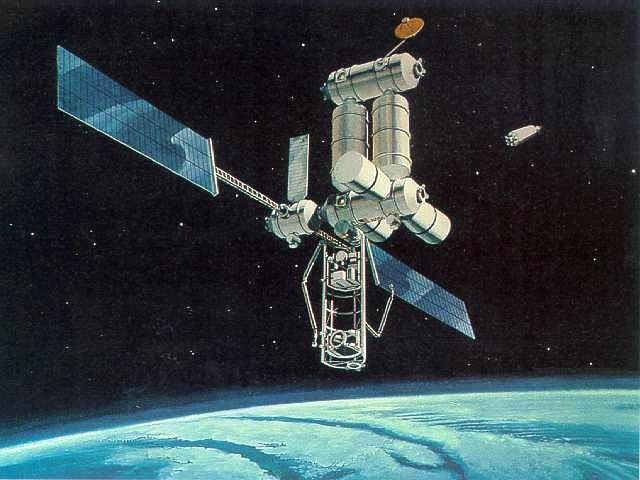
Credit: Astronautix website
A Grumman design, also from 1982. A very similar open basket-like structure is referred to as a/the “surrogate”:
www.astronautix.com/graphics/s/ssg82a.gif
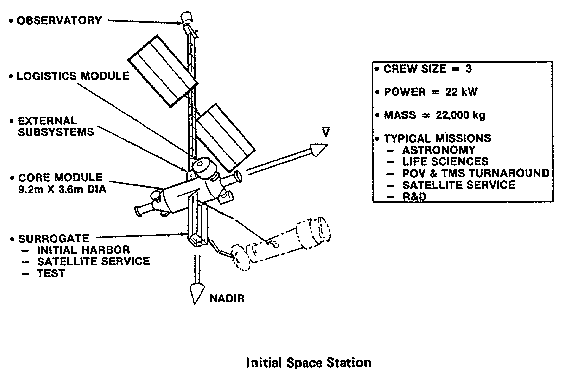
Credit: Astronautix website
Hmmm. Rockwell International. 1984/85. Manuel E. Alvarez? I'm pretty sure this was after Henry Lozano Jr's tenure. Maybe Ted Brown? Who knows. 😐
The Volkswagen Type 1, widely known as the Volkswagen Beetle and Volkswagen Bug, is an economy car produced by the German auto maker Volkswagen (VW) from 1938 until 2003. With over 21 million manufactured in an air-cooled, rear-engined, rear-wheel drive configuration, the Beetle is the longest-running and most-manufactured automobile of a single design platform anywhere in the world.
Although designed in the 1930s, the Beetle was only produced in significant numbers from 1945 onwards, when the model was internally designated the Volkswagen Type 1, and marketed simply as the "Volkswagen". Later models were designated VW 1200, 1300, 1500, 1302 or 1303, the former three indicating engine displacement and the latter two being derived from the type number and not indicative of engine capacity. The model became widely known in its home country as the Käfer (German for "beetle") and was later marketed as such in Germany and as the Volkswagen Beetle in other countries.
In the 1950s, the Beetle was more comfortable and powerful than most European small cars, having been designed for sustained high speed on the Autobahn. It remained a top seller in the U.S., owing much of its success to high build-quality and innovative advertising, ultimately giving rise to variants, including the Volkswagen Karmann Ghia and the Volkswagen Type 2 van.
Along with cars including the Morris Minor, Fiat 500, Renault 4CV and Dauphine, and Citroen 2CV, the Beetle pioneered the modern continental economy car and later served as the benchmark for the initial two generations of North American compact cars, including the Chevrolet Corvair and Ford Falcon, as well as later subcompact cars such as the Chevrolet Vega and Ford Pinto.
The Beetle had marked a significant trend led by Volkswagen, Fiat, and Renault whereby the rear-engine, rear-wheel drive layout had increased from 2.6 percent of continental Western Europe's car production in 1946 to 26.6 percent in 1956. The 1948 Citroen 2CV and other European models marked a later trend to front-wheel drive in the European small car market, a trend that would come to dominate that market. In 1974, Volkswagen's own front-wheel drive Golf model succeeded the Beetle, and in 1998 VW introduced the "New Beetle", built on the Golf platform with styling that recalled the original Beetle.
In a 1999 international poll for the world's most influential car of the 20th century the Beetle came fourth after the Ford Model T, the Mini, and the Citroën DS.
The Beetle featured a rear-located, rear-wheel drive, air-cooled four cylinder, boxer engine in a two-door bodywork featuring a flat front windscreen, accommodating four passengers and providing luggage storage under the front bonnet and behind the rear seat – and offering a Cx or coefficient of drag of 0.41. The bodywork attached with eighteen bolts to its nearly flat chassis which featured a central structural tunnel. Front and rear suspension featured torsion bars along with front and rear stabilizer bars – providing independent suspensions at all wheels. Certain initial features were subsequently revised, including mechanical drum brakes, split-window rear windows, mechanical direction-indicators and the non-synchronized gearbox. Other features, including its distinctive overall shape, endured.
Its engine, transmission, and cylinder heads were constructed of light alloy. An engine oil cooler (located in the engine fan's shroud) ensured optimal engine operating temperature and long engine life, optimized by a thermostat that bypassed the oil cooler when the engine was cold. Later models of the carburetor featured an automatic choke. Engine intake air passed through a metallic filter, while heavier particles were captured by an oil bath. After 1960, steering featured a hydraulic damper that absorbed steering irregularities.
Indicative of the car's simple, no-nonsense design, the interior featured painted metal surfaces, a metal dash consolidating instruments in a single, circular binnacle, adjustable front seats, a fold-down rear seat, optional swing-out rear windows, front windows with pivoting vent windows, heating via air-to-air exchange manifolds operating off the engine's heat, and a windshield washer system that eschewed the complexity and cost of an additional electric pump and instead received its pressurization from the car's spare tire (located in the front luggage compartment) which was accordingly overinflated to accommodate the washer function.
While the overall appearance of the Beetle changed little over its life span, it received over 78,000 incremental changes during its production.
Dr. (h.c.) Ferdinand Porsche
In 1931, Ferdinand Porsche developed the Porsche Type 12, or "Auto für Jedermann" (car for everybody) for Zündapp. Porsche already preferred the flat-4 cylinder engine, and selected a swing axle rear suspension (invented by Edmund Rumpler), while Zündapp insisted on a water-cooled 5-cylinder radial engine. In 1932, three prototypes were running. All of those cars were lost during the war, the last in a bombing raid in Stuttgart in 1945.
The Zündapp prototypes were followed by the Porsche Type 32, designed in 1933 for NSU Motorenwerke AG, another motorcycle company. The Type 32 was similar in design to the Type 12, but had a flat-4 engine. NSU's exit from car manufacturing resulted in the Type 32 being abandoned at the prototype stage.
In 1933, Adolf Hitler gave the order to Ferdinand Porsche to develop a Volkswagen (literally, "people's car" in German, pronounced [ˈfɔlksvaːɡən]). The epithet Volks- literally, "people's-" had been previously applied to other Nazi sponsored consumer goods such as the Volksempfänger ("people's radio"). Hitler required a basic vehicle capable of transporting two adults and three children at 100 km/h (62 mph). The "People's Car" would be available to citizens of the Third Reich through a savings scheme, or Sparkarte (savings booklet), at 990 Reichsmark, about the price of a small motorcycle (an average income being around 32RM a week).
Development
KDF Propaganda – "A family playing by a river with a KDF-Wagen and radio receiver"
Initially designated the Porsche Type 60 by Ferdinand Porsche, the design team included Erwin Komenda and Karl Rabe. In October 1935 the first two Type 60 prototypes, known as the V1 and V2 (V for Versuchswagen, or "test car"), were ready. In 1936, testing of three further V3 prototypes, built in Porsche's Stuttgart shop, began. A batch of thirty W30 development models, produced for Porsche by Daimler-Benz, underwent 1,800,000 mi (2,900,000 km) of further testing in 1937. All cars already had the distinctive round shape and the air-cooled, rear-mounted engine. Included in this batch was a rollback soft top called the Cabrio Limousine. A further batch of 44 VW38 pre-production cars produced in 1938 introduced split rear windows; both the split window and the dash were retained on production Type 1s until 1952. The VW38 cars were followed by another batch of 50 VW39 cars, completed in July 1939.
The car was designed to be as simple as possible mechanically, so that there was less to go wrong; the aircooled 25 hp (19 kW) 995 cc (60.7 cu in) motors proved especially effective in actions of the German Afrika Korps in Africa's desert heat. This was due to the built-in oil cooler and the superior performance of the flat-4 engine configuration. The suspension design used compact torsion bars instead of coil or leaf springs. The Beetle is nearly airtight and will float for a few minutes on water.
The Volkswagen was officially named the KdF-Wagen by Hitler when the project was officially announced in 1938. The name refers to Kraft durch Freude ('Strength Through Joy'), the official leisure organization of the Third Reich. The model village of Stadt des KdF-Wagens was created near Fallersleben in Lower Saxony in 1938 for the benefit of the workers at the newly-built factory. After World War II, it was known as the Volkswagen Type 1, but became more commonly known as the Beetle.
Influence of Tatra
The Austrian car designer Hans Ledwinka was a contemporary of Porsche working at the Czechoslovakian company Tatra. In 1931, Tatra built the V570 prototype, which had a air-cooled flat-twin engine engine mounted at the rear. This was followed in 1933 by a second V570 prototype with a streamlined body similar to that of the Porsche Type 32. The rear-engine, rear-wheel drive layout was a challenge for effective air cooling, and during development of the much larger V8 engined Tatra T77 in 1933 Tatra registered numerous patents related to air flow into the rear engine compartment. The use of Tatra's patented air cooling designs later became one of ten issues for which Tatra filed suit against VW.
Both Hitler and Porsche were influenced by the Tatras. Hitler was a keen automotive enthusiast, and had ridden in Tatras during political tours of Czechoslovakia. He had also dined numerous times with Ledwinka.[9] After one of these dinners Hitler remarked to Porsche, "This is the car for my roads". From 1933 onwards, Ledwinka and Porsche met regularly to discuss their designs, and Porsche admitted "Well, sometimes I looked over his shoulder and sometimes he looked over mine" while designing the Volkswagen. The Tatra T97 of 1936 had a 1749 cc, rear-located, rear-wheel drive, air-cooled four-cylinder boxer engine. It cost 5600 RM and accommodated five passengers in its extensively streamlined 4-door body, which provided luggage storage under the front bonnet and behind the rear seats. It also featured a similar central structural tunnel found in the Beetle.
Just before the start of the Second World War, Tatra had ten legal claims filed against VW for infringement of patents. Although Ferdinand Porsche was about to pay a settlement to Tatra, he was stopped by Hitler who said he would "solve his problem". Tatra launched a lawsuit, but this was stopped when Germany invaded Czechoslovakia in 1938, resulting in the Tatra factory coming under Nazi administration in October 1938. The T97, along with the T57, were ordered by Hitler to be removed from the Tatra display at the 1939 Berlin Autosalon and Tatra was later directed to concentrate on heavy trucks and diesel engines, with all car models, except for the V8-engined Tatra T87, being discontinued. The matter was re-opened after World War II and in 1961 Volkswagen paid Ringhoffer-Tatra 3,000,000 Deutsche Marks in an out of court settlement.
Wartime production
The factory had only produced a handful of cars by the start of the war in 1939; the first volume-produced versions of the car's chassis were military vehicles, the Type 82 Kübelwagen (approximately 52,000 built) and the amphibious Type 166 Schwimmwagen (about 14,000 built).
A handful of Beetles were produced specifically for civilians, primarily for the Nazi elite, in the years 1940–1945, but production figures were small. Because of gasoline shortages, a few wartime "Holzbrenner" Beetles were fueled by wood pyrolysis gas producers under the hood. In addition to the Kübelwagen, Schwimmwagen, and a handful of others, the factory managed another wartime vehicle: the Kommandeurwagen; a Beetle body mounted on the Kübelwagen chassis. 669 Kommandeurwagens were produced up to 1945, when all production was halted because of heavy damage to the factory by Allied air raids. Much of the essential equipment had already been moved to underground bunkers for protection, which let production resume quickly after hostilities ended.
Post-war production and boom
1949 Volkswagen Type 1
In occupied Germany, the Allies followed the Morgenthau plan to remove all German war potential by complete or partial pastoralization. As part of this, in the Industrial plans for Germany, the rules for which industry Germany was to be allowed to retain were set out. German car production was set at a maximum of 10% of the 1936 car production numbers.
Mass production of civilian VW automobiles did not start until post-war occupation. The Volkswagen factory was handed over by the Americans to British control in 1945; it was to be dismantled and shipped to Britain. Thankfully for Volkswagen, no British car manufacturer was interested in the factory; "the vehicle does not meet the fundamental technical requirement of a motor-car ... it is quite unattractive to the average buyer ... To build the car commercially would be a completely uneconomic enterprise." The factory survived by producing cars for the British Army instead. Allied dismantling policy changed in late 1946 to mid 1947, although heavy industry continued to be dismantled until 1951. In March 1947, Herbert Hoover helped change policy by stating
"There is the illusion that the New Germany left after the annexations can be reduced to a 'pastoral state'. It cannot be done unless we exterminate or move 25,000,000 people out of it."
The re-opening of the factory is largely accredited to British Army officer Major Ivan Hirst (1916–2000). Hirst was ordered to take control of the heavily bombed factory, which the Americans had captured. His first task was to remove an unexploded bomb that had fallen through the roof and lodged itself between some pieces of irreplaceable production equipment; if the bomb had exploded, the Beetle's fate would have been sealed. Hirst persuaded the British military to order 20,000 of the cars, and by March 1946 the factory was producing 1,000 cars a month, which Hirst said "was the limit set by the availability of materials". During this period, the car reverted to its original name of Volkswagen and the town was renamed Wolfsburg. The first 1,785 Volkswagen Type 1's or "Beetles" were made in 1945.
Following the British Army-led restart of production, former Opel manager (and formerly a detractor of the Volkswagen) Heinz Nordhoff was appointed director of the Volkswagen factory. Under Nordhoff, production increased dramatically over the following decade, with the one-millionth car coming off the assembly line by 1955. During this post-war period, the Beetle had superior performance in its category with a top speed of 115 km/h (71 mph) and 0–100 km/h (0–60 mph) in 27.5 seconds with fuel consumption of 6.7 l/100 km (36 mpg) for the standard 25 kW (34 hp) engine. This was far superior to the Citroën 2CV which was aimed at a low speed/poor road rural peasant market and Morris Minor that was designed for a market that had no motorways / freeways, and even competitive with more advanced and fragile small cars like the Austin Mini.
In Small Wonder, Walter Henry Nelson wrote:
"The engine fires up immediately without a choke. It has tolerable road-handling and is economical to maintain. Although a small car, the engine has great elasticity and gave the feeling of better output than its small nominal size."
Opinion in the United States was not flattering, however, perhaps because of the characteristic differences between the American and European car markets. Henry Ford II once described the car as "a little box." The Ford company was offered the entire VW works after the war for free. Ford's right-hand man Ernest Breech was asked what he thought, and told Henry II, "What we're being offered here, Mr. Ford, isn't worth a damn!"
During the 1950s, the car was modified progressively: the obvious visual changes mostly concerned the rear windows. In March 1953, the small oval two-piece rear window was replaced by a slightly larger single-piece window. More dramatically, in August 1957 a much larger full width rear window replaced the oval one. 1964 saw the introduction of a widened cover for the light over the rear licence plate. Towards the end of 1964, the height of the side windows and windscreen grew slightly, giving the cabin a less pinched look: this coincided with the introduction of a very slightly curved ("panoramic") windscreen, though the curve was barely noticeable. The same body appeared during 1966, with a 1300 cc engine in place of the 1200 cc engine: it was only in the 1973 model Super Beetle that the Beetle acquired an obviously curved windscreen. The flat windscreen remained on the standard Beetle.
There were also changes under the bonnet. In 1954, Volkswagen added 2 mm to the cylinder bore, increasing the displacement from 1,131 cc to 1,192 cc.[30] This coincided with upgrades to various key components including a redesign of the crankshaft. This increased power from 33 bhp to a claimed 40 bhp and improved the engine's free revving abilities without compromising torque at lower engine speeds. At the same time, compression ratios were progressively raised as, little by little, the octane ratings of available fuel was raised in major markets during the 1950s and 1960s.
There were other, less-numerous models, as well. The Hebmüller cabriolet (officially Type 14A), a sporty two-seater, was built between 1949 and 1953; it numbered 696. The Type 18A, a fixed-top cabriolet, was produced by Austro-Tatra as a police and fire unit; 203 were assembled between January 1950 and March 1953.
Beetle sales boomed in the 1960s, thanks to clever advertising campaigns, and the Beetle's reputation for reliability and sturdiness. On 17 February 1972, when Beetle No. 15,007,034 was produced, Beetle production surpassed that of the previous record holder, the Ford Model T. By 1973, total production was over 16 million, and by 23 June 1992, over 21 million had been produced.
As of 2009, the Beetle is arguably the world's best-selling car design. More units of the Toyota Corolla brand have been sold, but there have been 10 total redesigns of the Corolla, each amounting to a new car design with the same name.
Diesel
In 1951, Volkswagen prototyped a 1.3 L diesel engine. Volkswagen made only 2 air-cooled boxer diesel engines that were not turbocharged, and installed one engine in a Type 1 and another in a Type 2. The diesel Beetle was time tested on the Nürburgring and achieved 0–100 km/h (0–62 mph) in 60 seconds.
Introduction to Ireland
Volkswagen began its involvement in Ireland when in 1949, Motor Distributors Limited, founded by Stephen O'Flaherty secured the franchise for the country at that years Paris Motor Show. In 1950, Volkswagen Beetles started arriving into Dublin packed in crates in what was termed "completely knocked down" (CKD) form ready to be assembled. The vehicles were assembled in a former tram depot at 162 Shelbourne Road in Ballsbridge. This is now the premises for Ballsbridge Motors who are still a Volkswagen dealer. The first Volkswagen ever assembled outside Germany was built here.[35] This vehicle is now on display at the Volkswagen Museum in Wolfsburg.
Introduction to the UK
The first Volkswagen Beetle dealer in the UK was J.Gilder & Co. Ltd. in Sheffield, which began selling Volkswagens in 1953. Jack Gilder had been fascinated by both the design and engineering of the Beetle when he came across one in Belgium during the war.[citation needed] He applied for the franchise as soon as the opportunity presented itself and became Volkswagen’s representative in the North of England.
VW Beetle 1953–1957
During this period, the rear window of the VW Beetle lost the "bar" in the center and as a result has been referred to as the "oval" or "oval window" Beetle.
VW Beetle 1967
Engine1500 cc OHV H4, 40 kilowatts (54 hp) @ 4200 rpm, 105 N·m (77 lb·ft) @ 2600,
bore 83 mm,
stroke 69 mm,
comp ratio 7.5:1
Transmission4-speed manual
Wheelbase2,400 mm (94.5 in)
Length4,079 mm (160.6 in)
Width1,539 mm (60.6 in)
Curb weight840 kg (1,900 lb)
The Volkswagen Beetle underwent significant changes for the 1967 model. While the car appeared similar to earlier models, much of the drivetrain was noticeably upgraded. Some of the changes to the Beetle included a bigger engine for the second year in a row. Horsepower had been increased to 37 kW (50 hp) the previous year, and for 1967 it was increased even more, to 40 kW (54 hp).
On US models, the output of the electrical generator was increased from 180 to 360 watts, and upgraded from a 6-volt to a 12-volt system. The clutch disc also increased in size, and changes were made to the flywheel, braking system, and rear axle. New standard equipment included two-speed windscreen wipers, reversing lights, a driver's armrest on the door, locking buttons on the doors, and a passenger's side exterior mirror.
In February 1967, inventor Don P. Dixon of San Antonio, Texas filed and was ultimately granted a patent for the first air conditioning unit specifically designed for the Beetle, which were soon offered by US dealerships.
The 1967 model weighed 840 kg (1,900 lb), which was a typical weight for a European car at this time. Top speed was 130 km/h (81 mph).[citation needed]
That same year, in accord with the newly enacted U.S. Federal Motor Vehicle Safety Standard 108, the clear glass headlamp covers were deleted; the headlamps were brought forward to the leading edge of the front fenders, and the sealed-beam units were exposed and surrounded by chrome bezels. For the 1968 model year, Beetles sold outside North America received the same more upright and forward headlamp placement, but with replaceable-bulb headlamps compliant with ECE regulations rather than the U.S. sealed beams.
The Super Beetle and final evolution
In 1971, alongside continued production of the "standard" Beetle, a Type 1 variant which featured MacPherson strut front suspension and a redesigned front end. Officially known (and marketed in Europe) as the VW 1302 from 1971–1972, and VW 1303 from 1973 onwards, but commonly called Super Beetle, the new stretched nose design replaced the dual parallel torsion bar beams which had compromised trunk space and relocated the spare tire from a near vertical to a low horizontal position. The redesign resulted in a tighter turning radius despite a 20 mm (0.79 in) longer wheelbase, and a doubling of the front compartment's cargo volume. As with previous models, air pressure from the spare tire pressurized the windshield washer canister, in lieu of an electric pump.
1972 Super Beetles had an 11% larger rear window (4 mm (0.16 in) taller), larger front brakes, four rows of vents (versus two rows previously) on the engine deck lid, tail lights incorporating reverse lights, a four-spoke energy-absorbing steering wheel and steering column, and an engine compartment socket for a proprietary VW Diagnosis system.
In 1973, the VW 1303 introduced a curved windscreen, pushed forward and away from the passengers, allowing a redesigned, padded dashboard to replace the pre-1973 vertical dash. A 2-speed heater fan, higher rear mudguards, and larger tail lights were added. The changes to the heater/windshield wiper housing and curved windshield resulted in slight redesign of the front hood, making the 1971 and 1972 Super Beetle hoods unique.
For 1974, the previous flat steel bumper mounting brackets were replaced with tubular "self restoring energy absorbing" attachments, effectively shock absorbers for the bumpers, on North American market Beetles. These cars also got stronger "5mph" bumpers that added an inch to the length of the car. The steering knuckle and consequently the lower attachment point of the strut was redesigned to improve handling and stability in the event of a tire blowout. This means struts from pre-1974 Super Beetles are not interchangeable with 1974–79s.[39]
1975 models featured Air Flow Control (AFC) Fuel Injection on U.S., Canadian, and Japanese Beetles, a derivative of the more complex Bosch fuel injection system used in the Volkswagen Type III – and equivalent to Bosch L-jetronic. The fuel injected engine also received a new muffler and the option of an upstream catalytic converter required on some models (e.g. California), necessitating a bulge in the rear apron sheet metal directly under the rear bumper, and replacing the distinctive dual "pea shooter" pipes with a single offset tailpipe – making fuel injected models identifiable at a glance. Other changes were rack and pinion steering replacing the traditional worm and roller gearbox on Super Beetles, and a larger license plate lamp housing below the engine lid. The front turn indicators were moved from the top of the fenders into the bumper bars on European models.
In 1976, the optional "Auto-stick" transmission and the Super Beetle sedan were discontinued, with VW continuing to market the standard sedan and VW 1303 convertible. 1976-on convertibles received no significant engineering changes, only a few cosmetic touches and new paint options, including the "Champagne Edition" models (white on white was one example) to the final 1979 "Epilogue Edition" black on black, in salute to the first Beetles produced in the 1930s. 1977 model sedans received front seats with separate head restraints.
Beetle Cabriolet
The Beetle Cabriolet began production in 1949 by Karmann in Osnabrück. It was in 1948 when Wilhelm Karmann bought a VW Beetle limousine and converted it into a four-seated convertible. After successfully presenting it at VW in Wolfsburg, production started in 1949. After a number of stylistic and technical alterations made to the Karmann Cabriolet (corresponding to the many changes VW made to the Beetle throughout its history), the last of 331,847 cabriolets came off the conveyor belt on 10 January 1980.
Decline
Though extremely successful in the 1960s, the Beetle was faced with stiff competition from more modern designs. The Japanese had refined rear-wheel-drive, water-cooled, front-engine small cars to where they sold well in the North American market, and Americans introduced their own similarly sized rear-wheel-drive Chevrolet Vega, Ford Pinto and AMC Gremlin in the 1970s. The superminis in Europe adopted even more efficient transverse-engine front-wheel-drive layouts, and sales began dropping off in the mid 1970s. There had been several unsuccessful attempts to replace or supplement the Beetle in the VW product line throughout the 1960s; the Type 3, Type 4, and the NSU-based K70 were all less successful than the Beetle, though aimed at more upscale markets for which VW lacked credibility. The over-reliance on the Beetle meant that Volkswagen was in financial crisis by 1974. It needed German government funding to produce the Beetle's replacement. Only when production lines at Wolfsburg switched to the new watercooled, front-engined, front-wheel drive Golf designed by Giorgetto Giugiaro in 1974, (sold in North America as the "Rabbit") did Volkswagen produce a car as successful as the Beetle. The Golf would be periodically redesigned over its lifetime – entering its sixth generation in 2008 – with only a few components carried over between generations, while the Beetle used only minor refinements of its original design.
The Golf did not kill Beetle production, which continued in smaller numbers at other German factories until 19 January 1978, when mainstream production shifted to Brazil and Mexico, markets where low operating cost was more important. It is important to note that the Beetle Cabriolet was still produced for the North American and European markets in Germany until 10 January 1980. The last Beetle was produced in Puebla, Mexico, in July 2003. The final batch of 3,000 Beetles were sold as 2004 models and badged as the Última Edición, with whitewall tires, a host of previously discontinued chrome trim, and the choice of two special paint colors taken from the New Beetle. Production in Brazil ended in 1986, then started again in 1993 and continued until 1996. Volkswagen sold Beetle sedans in the United States until August 1977 (the Beetle convertible/Cabriolet was sold until January 1980) and in Europe until 1985, with private companies continuing to import cars produced in Mexico after 1985. The Beetle outlasted most other automobiles which had copied the rear air-cooled engine layout such as those by Subaru, Fiat, Renault and General Motors. Porsche's sport coupes which were originally based on Volkswagen parts and platforms continue to use the classic rear engine layout (which later became water-cooled) in the Porsche 911 series, which remains competitive in the first decade of the 21st century.
Worldwide end of production
The final original Beetle (No. 21,529,464, VIN 3VWS1A1B54M905162)
As of 2002 over 21 million Type 1s had been produced, but by 2003, annual production had fallen to 30,000 from a peak of 1.3 million in 1971. VW announced the end of production in June 2003, citing decreasing demand, and the final original Type 1 VW Beetle (No. 21,529,464) rolled off the production line at Puebla, Mexico, on 30 July 2003[40] – 65 years after its original launch and unprecedented 58-year production run (counting from 1945, the year VW recognizes as the first year of non-Nazi funded production). This last Beetle, nicknamed El Rey (Spanish for "The King" after a legendary Mexican song by José Alfredo Jiménez). was delivered to the company's museum in Wolfsburg, Germany.
To celebrate the occasion, Volkswagen marketed a final special series of 3,000 Beetles marketed as "Última Edición" (Final Edition) in light blue (Aquarius Blue) or beige (Harvest Moon Beige). Each car included the 1.6 engine, whitewall tires, a CD player with four speakers, chrome bumpers, trim, hub caps and exterior mirrors, a Wolfsburg emblem above the front trunk's handle, chrome glove box badge, body coloured wheels, tinted glass, a rear parcel shelf, and VW Ultima Edicion plaque. At 84,000 pesos, the model cost approximately $1,300 more than the typical model.
A mariachi band serenaded production of the last car. In Mexico, there was also an advertising campaign as a goodbye for the Beetle. For example, in one of the ads was a very small parking space on the street, and many big cars tried to park in it, but could not. After a while, a sign appears in that parking space saying: "Es increíble que un auto tan pequeño deje un vacío tan grande" (It is incredible that a car so small can leave such a large void). Another depicted the rear end of a 1954 Beetle (year in which Volkswagen first established in Mexico) in the left side of the ad, reading "Erase una vez..." (Once upon a time...) and the last 2003 Beetle in the right side, reading "Fin" (The end). There were other ads with the same nostalgic tone.[41] The Volkswagen Sedan is used as a taxi in Mexico City up to 2013. The Mexican government is removing this type of taxi and already made the green colours change into red-gold.
Engine: Fuel injected (Bosch Digifant) 4 Cyl horizontally opposed,1584 cc, 50 hp (37 kW), 98.1 N·m (72.4 lb·ft) @2200 rpm, 3-way catalytic converter
Rated fuel milage: 32.5 mpg-US (7.24 L/100 km; 39.0 mpg-imp)
Max cruising speed: 130 km/h (81 mph)
Brakes: front disc, rear drum
Passengers: Five
Tank: 40 L (11 US gal; 9 imp gal)
Colours: Aquarius blue, Harvest Moon beige.
(Source Wikipedia)
Victory Liner Inc.
Bus Number: 2124
Bus Manufacturer: Almazora Motors Corporation
Former Model: AMC Travel Star
Model: Exfutong
Chassis: MAN 18.310 HOCL-SKD
Engine: MAN D2866LOH
Suspension: Air Suspension
Seating Configuration: 2x2
Seating Capacity: 49
Shot Location: Balintawak
Nissan SR na Hyundai pa! :)
Victory Liner Inc.
Bus Number: 8021
Body: Hyundai Motors Korea(facelifted by Del Monte Motors Corp.)
Model: 2008 Hyundai AeroCity
Engine: Hyundai D6AC
Capacity: 49
Seating configuration : 2x2
Shot Location: Victory Liner Caloocan Terminal
Don Mariano Transit, Corp
Bus Number: 866
Bus Manufacture:
Model:
Engine: Isuzu
Chassis:
Suspension:
Seating Configuration: 2x3
Capacity:
Shot Location: Cubao
Del monte Land Transport bus company
Bus number: 813
Classification: Airconditioned Provincial Operation Bus
Model: Kinglong XMQ6129Y2 "Longwei"
Manufacturer: Xiamen Kinglong United Co. (Kinglong Bus)
Chassis: King Long XMQ6120R
Engine: Shanghai Hino P11C-UH
Suspension: Air Suspension
Seating Configuration: 2x2
Capacity: 45
Shot Location :Araneta Center Bus Station
Victory Liner Inc.
Bus number: 7012
Area of Operation: Provincial Operation
Bus Manufacturer: Almazora Motor Corporation
Model: AMC Travel Star
Chassis: MAN 18.280 HOCL-CKD
Engine: MAN D0836LOH
Suspension: Air Suspension
Seating Configuration: 2x2
Seating Capacity: 49
Shot Location: Victory Liner Kamias Terminal
Five Star Bus Company
Bus Number: 2201
Chassis Manufacturer: Nissan Diesel
Body Manufacturer: Santarosa Motor Works
Model: Exfoh
Chassis: Nissan Diesel JA450SSN
Engine: Nissan Diesel PF6-A
Suspension: Leaf Spring
Seating Configuration: 2x2
Capacity:
Shot Location: Five Star Bus Legarda Terminal
NIKON NIKKOR-P.C 1:2 8.5cm S mount + S to M mount adaptor + Voigtländer VM-E close focus mount adaptor
DelMonte Land Transportation Bus Co. Greyhound Express Service
Bus Number: 22M
Classification: "Deluxe Type" Air Conditioned Provincial Operation Bus
Bus Body Model: DMMW DM14
Manufacturer: Del Monte Motor Works Inc.
Engine MAN D2066LOH
Chassis: MAN R39 18.430 HOCL Tipmatic
Suspension: Air Suspension
Seating Configuration: 2x1
Capacity: 29
Shot Location: Pasay
KLAX (Los Angeles International Airport) - 26 DEC 2012
"Delta 1554 Heavy" climbing out from RWY 25R en route to Hartsfield-Jackson Atlanta International Airport (KATL).
Production Site: Everett (PAE)
First Flight: 31 MAY 1991
Delivery to Delta Air Lines: 15 JUN 1991 as N136DL
Hex Code: A091D1
Fleet Number: 136
Configuration: C30Y231
Engines: 2x General Electric CF6-80A2
*** Update ***
Withdrawn from use and stored at Marana (MZJ) 31 OCT 2016
Partially scrapped
This artist concept shows the 70-metric-ton configuration of NASA's Space Launch System (SLS) during flight. (Note: artist concept updated July 30, 2013)
The Space Launch System, or SLS, will be designed to carry the Orion Multi-Purpose Crew Vehicle, as well as important cargo, equipment and science experiments to Earth's orbit and destinations beyond.
America’s new heavy-lift rocket will be the largest launch vehicle ever built and more powerful than the Saturn V rocket that carried Apollo astronauts to the moon. The 70-metric-ton configuration (77 tons) will lift more than 154,000 pounds and will provide 10 percent more thrust than the Saturn V rocket. The 130-metric-ton-configuration (143 tons) will lift more than 286,000 pounds and provide 20 percent more thrust than the Saturn V.
The first SLS mission — Exploration Mission 1 — in 2017 will launch an uncrewed Orion spacecraft to demonstrate the integrated system performance of the SLS rocket and spacecraft prior to a crewed flight.
Image credit: NASA/MSFC
More about SLS:
www.nasa.gov/exploration/systems/sls/index.html
More SLS Photos:
www.nasa.gov/exploration/systems/sls/multimedia/gallery/S...
Space Launch System Flickr photoset:
www.flickr.com/photos/28634332@N05/sets/72157627559536895/
_____________________________________________
These official NASA photographs are being made available for publication by news organizations and/or for personal use printing by the subject(s) of the photographs. The photographs may not be used in materials, advertisements, products, or promotions that in any way suggest approval or endorsement by NASA. All Images used must be credited. For information on usage rights please visit: www.nasa.gov/audience/formedia/features/MP_Photo_Guidelin...
GV Florida/Dagupan Bus Co Inc.
Bus Number.: GD68
Classification: Air Conditioned Provincial Operation Bus
Model: DMMW DM14
Coachbuilder: Del Monte Motor Works, Inc.
Manufacturer: Pilipinas Hino, Inc.
Chassis: Hino RM2PSS
Engine: Hino P11C-TH
Suspension: Air Suspension
Seating configuration: 2x2
Capacity:
Shot Location: GV Florida Sampaloc Terminal
KORF (Norfolk International Airport) - 08 JUN 2025
"Allegiant 1020" from St Petersburg/Clearwater International Airport (KPIE) rolling out on RWY 5 after landing.
Production Site: Renton (RNT)
First Flight: 21 JAN 2025
Test Registrations: N4022T, N4025T
Delivery to Allegiant Air: 14 FEB 2025 as N815NV
Ferried BFI-SFB on 14 FEB 2025 on delivery
Hex Code: AB1D2F
Fleet Number: 815
Configuration: Y190
Engines: 2x CFMI LEAP-1B27
Victory Liner Tanker Truck
Truck Manufacturer: MAN Truck & Bus AG
Model: TGA 18.350
Chassis: MAN 18.350
Engine: MAN D2066LF03
Suspension:
Axle Configuration: 4x2
The Volkswagen Type 2, known officially (depending on body type) as the Transporter, Kombi or Microbus, or, informally, as the Bus (US) or Camper (UK), is a forward control panel van introduced in 1950 by the German automaker Volkswagen as its second car model. Following – and initially deriving from Volkswagen's first model, the Type 1 (Beetle) – it was given the factory designation Type 2.
As one of the forerunners of the modern cargo and passenger vans, the Type 2 gave rise to forward control competitors in the United States in the 1960s, including the Ford Econoline, the Dodge A100, and the Chevrolet Corvair 95 Corvan, the latter adopting the Type 2's rear-engine configuration.
European competition included the 1947-1981 Citroën H Van, the 1959-1980 Renault Estafette (both FF layout), and the 1953-1965 FR layout Ford Transit.
Japanese manufacturers also introduced the platform in different configurations, such as the Nissan Caravan, Toyota LiteAce and the Subaru Sambar.
Like the Beetle, the van has received numerous nicknames worldwide, including the "microbus", "minibus", and, because of its popularity during the counterculture movement of the 1960s, Hippie van/wagon, and still remains iconic for many hippies today.
Brazil contained the last factory in the world that produced the T2. Production in Brazil ceased on December 31, 2013, due to the introduction of more stringent safety regulations in the country. This marks the end of an era with the rear-engine Volkswagens manufactured (after the 2002 termination of its T3 successor in South Africa), which originated in 1935 with their Type 1 prototypes.
HISTORY
The concept for the Type 2 is credited to Dutch Volkswagen importer Ben Pon. (It has similarities in concept to the 1920s Rumpler Tropfenwagen and 1930s Dymaxion car by Buckminster Fuller, neither of which reached production.) Pon visited Wolfsburg in 1946, intending to purchase Type 1s for import to the Netherlands, where he saw an improvised parts-mover and realized something better was possible using the stock Type 1 pan. He first sketched the van in a doodle dated April 23, 1947, proposing a payload of 690 kg and placing the driver at the very front. Production would have to wait, however, as the factory was at capacity producing the Type 1.
When capacity freed up, a prototype known internally as the Type 29 was produced in a short three months. The stock Type 1 pan proved to be too weak so the prototype used a ladder chassis with unit body construction. Coincidentally the wheelbase was the same as the Type 1's. Engineers reused the reduction gear from the Type 81, enabling the 1.5 ton van to use a 25 hp (19 kW) flat four engine.
Although the aerodynamics of the first prototypes were poor (with an initial drag coefficient of Cd=0.75), engineers used the wind tunnel at the Technical University of Braunschweig to optimize the design. Simple changes such as splitting the windshield and roofline into a "vee" helped the production Type 2 achieve Cd=0.44, exceeding the Type 1's Cd=0.48. Volkswagen's new chief executive officer Heinz Nordhoff (appointed 1 January 1948) approved the van for production on 19 May 1949 and the first production model, now designated Type 2, rolled off the assembly line to debut 12 November. Only two models were offered: the Kombi (with two side windows and middle and rear seats that were easily removable by one person), and the Commercial. The Microbus was added in May 1950, joined by the Deluxe Microbus in June 1951. In all 9,541 Type 2s were produced in their first year of production.
An ambulance model was added in December 1951 which repositioned the fuel tank in front of the transaxle, put the spare tire behind the front seat, and added a "tailgate"-style rear door. These features became standard on the Type 2 from 1955 to 1967. 11,805 Type 2s were built in the 1951 model year. These were joined by a single-cab pickup in August 1952, and it changed the least of the Type 2s until all were heavily modified in 1968.
Unlike other rear engine Volkswagens, which evolved constantly over time but never saw the introduction of all-new models, the Transporter not only evolved, but was completely revised periodically with variations retrospectively referred to as versions "T1" to "T5" (a nomenclature only invented after the introduction of the front-drive T4 which replaced the T25). However, only generations T1 to T3 (or T25 as it is still called in Ireland and Great Britain) can be seen as directly related to the Beetle (see below for details).
The Type 2, along with the 1947 Citroën H Van, are among the first 'forward control' vans in which the driver was placed above the front roadwheels. They started a trend in Europe, where the 1952 GM Bedford CA, 1958 RAF-977, 1959 Renault Estafette, 1960 BMC Morris J4, and 1960 Commer FC also used the concept. In the United States, the Corvair-based Chevrolet Corvan cargo van and Greenbrier passenger van went so far as to copy the Type 2's rear-engine layout, using the Corvair's horizontally opposed, air-cooled engine for power. Except for the Greenbrier and various 1950s–70s Fiat minivans, the Type 2 remained unique in being rear-engined. This was a disadvantage for the early "barndoor" Panel Vans, which could not easily be loaded from the rear because the engine cover intruded on interior space, but generally advantageous in traction and interior noise.
VARIANTS
The Type 2 was available as a:
Panel van, a delivery van without side windows or rear seats.
Double-door Panel Van, a delivery van without side windows or rear seats and cargo doors on both sides.
High Roof Panel Van (German: Hochdach), a delivery van with raised roof.
Kombi, from German: Kombinationskraftwagen (combination motor vehicle), with side windows and removable rear seats, both a passenger and a cargo vehicle combined.
Bus, also called a Volkswagen Caravelle, a van with more comfortable interior reminiscent of passenger cars since the third generation.
Lotação (share-taxi), a version exclusive to Brazil, with 6 front-hinged doors for the passenger area and 4 bench-seats, catering to the supplemental public transport segment.[citation needed] Available from 1960 to 1989, in both the split-window and "clipper" (fitted with the bay-window front panel) bodystyles.
Samba-Bus, a van with skylight windows and cloth sunroof, first generation only, also known as a Deluxe Microbus. They were marketed for touring the Alps.
Flatbed pickup truck, or Single Cab, also available with wider load bed.
Crew cab pick-up, a flatbed truck with extended cab and two rows of seats, also called a Doka, from German: Doppelkabine.
Westfalia camping van, "Westy", with Westfalia roof and interior. Included optional "pop up" top.
Adventurewagen camping van, with high roof and camping units from Adventurewagen.
Semi-camping van that can also still be used as a passenger car and transporter, sacrificing some camping comforts. "Multivan" or "Weekender", available from the third generation on.
Apart from these factory variants, there were a multitude of third-party conversions available, some of which were offered through Volkswagen dealers. They included, but were not limited to, refrigerated vans, hearses, ambulances, police vans, fire engines and ladder trucks, and camping van conversions by companies other than Westfalia. There were even 30 Klv 20 rail-going draisines built for Deutsche Bundesbahn in 1955.
In South Africa, it is known as a well-loved variation of the ice cream van (first, second and third generations). The mere sight of one (in South Africa) sparks the familiar rhyme: I scream, We scream, We all scream for Ice-Cream!
FIRST GENERATION (T1; 1950–1967)
The first generation of the Volkswagen Type 2 with the split windshield, informally called the Microbus, Splitscreen, or Splittie among modern fans, was produced from 8 March 1950 through the end of the 1967 model year. From 1950 to 1956, the T1 (not called that at the time) was built in Wolfsburg; from 1956, it was built at the completely new Transporter factory in Hanover. Like the Beetle, the first Transporters used the 1100 Volkswagen air-cooled engine, an 1,131 cc, DIN-rated 18 kW (24 PS; 24 bhp), air-cooled flat-four-cylinder 'boxer' engine mounted in the rear. This was upgraded to the 1200 – an 1,192 cc 22 kW (30 PS; 30 bhp) in 1953. A higher compression ratio became standard in 1955; while an unusual early version of the 30 kW (41 PS; 40 bhp) engine debuted exclusively on the Type 2 in 1959. This engine proved to be so uncharacteristically troublesome that Volkswagen recalled all 1959 Transporters and replaced the engines with an updated version of the 30 kW engine. Any 1959 models that retain that early engine today are true survivors. Since the engine was totally discontinued at the outset, no parts were ever made available.
The early versions of the T1 until 1955 were often called the "Barndoor" (retrospectively called T1a since the 1990s), owing to the enormous rear engine cover, while the later versions with a slightly modified body (the roofline above the windshield is extended), smaller engine bay, and 15" roadwheels instead of the original 16" ones are nowadays called the T1b (again, only called this since the 1990s, based on VW's retrospective T1,2,3,4 etc. naming system.). From the 1964 model year, when the rear door was made wider (same as on the bay-window or T2), the vehicle could be referred to as the T1c. 1964 also saw the introduction of an optional sliding door for the passenger/cargo area instead of the outwardly hinged doors typical of cargo vans.
In 1962, a heavy-duty Transporter was introduced as a factory option. It featured a cargo capacity of 1,000 kg instead of the previous 750 kg, smaller but wider 14" roadwheels, and a 1.5 Le, 31 kW (42 PS; 42 bhp) DIN engine. This was so successful that only a year later, the 750 kg, 1.2 L Transporter was discontinued. The 1963 model year introduced the 1500 engine – 1,493 cc as standard equipment to the US market at 38 kW (52 PS; 51 bhp) DIN with an 83 mm bore, 69 mm (2.72 in) stroke, and 7.8:1 compression ratio. When the Beetle received the 1.5 L engine for the 1967 model year, its power was increased to 40 kW (54 PS; 54 bhp) DIN.
German production stopped after the 1967 model year; however, the T1 still was made in Brazil until 1975, when it was modified with a 1968–79 T2-style front end, and big 1972-vintage taillights into the so-called "T1.5" and produced until 1996. The Brazilian T1s were not identical to the last German models (the T1.5 was locally produced in Brazil using the 1950s and 1960s-era stamping dies to cut down on retooling, alongside the Beetle/Fusca, where the pre-1965 body style was retained), though they sported some characteristic features of the T1a, such as the cargo doors and five-stud 205 mm Pitch Circle Diameter rims. Wheel tracks varied between German and Brazilian production and with 14-inch, 15-inch and 16-inch wheel variants but commonly front track varied from 1290 mm to 1310 mm and rear track from 1370 mm to 1390 mm.
Among American enthusiasts, it is common to refer to the different models by the number of their windows. The basic Kombi or Bus is the 11-window (a.k.a. three-window bus because of three side windows) with a split windshield, two front cabin door windows, six rear side windows, and one rear window. The DeLuxe model featured eight rear side windows and two rear corner windows, making it the 15-window (not available in Europe). Meanwhile, the sunroof DeLuxe with its additional eight small skylight windows is, accordingly, the 23-window. From the 1964 model year, with its wider rear door, the rear corner windows were discontinued, making the latter two the 13-window and 21-window respectively. The 23- and later 21-window variants each carry the nickname 'Samba', or in Australia, officially 'Alpine'.
SAMBA
The Volkswagen Samba, in the United States also known as Sunroof Deluxe, was the most luxurious version of the T1. Volkswagen started producing Sambas in 1951.
Originally Volkswagen Vans were classified according to the number of windows they had. This particular model had 23 and later 21 windows including eight panoramic windows in the roof. To distinguish it from the normal 23 or 21-window Volkswagen van the name Samba was coined.
Instead of a sliding door at the side the Samba had two pivot doors. In addition the Samba had a fabric sunroof. At that time Volkswagen advertised with the idea of using the Samba to make tourist trips through the Alps.
Sambas were painted standard in two colors. Usually, the upper part was colored white. The two colored sections were separated by a decorative strip. Further the bus had a so-called "hat": at the front of the van the roof was just a little longer than the car itself to block the sun for the driver. The windows had chrome tables and the van had a more comprehensive dashboard than the normal T1.
When Volkswagen started producing the successor of the T1 (the T2) the company also stopped producing the Samba so there are no Sambas in later versions of the Transporter.
US CHICKEN TAX
Certain models of the Volkswagen Type 2 played a role in a historic episode during the early 1960s, known as the Chicken War. France and West Germany had placed tariffs on imports of U.S. chicken. Diplomacy failed, and in January 1964, two months after taking office, President Johnson imposed a 25% tax (almost ten times the average U.S. tariff) on potato starch, dextrin, brandy, and light trucks. Officially, the tax targeted items imported from Europe as approximating the value of lost American chicken sales to Europe.
In retrospect, audio tapes from the Johnson White House, revealed a quid pro quo unrelated to chicken. In January 1964, President Johnson attempted to convince United Auto Workers' president Walter Reuther not to initiate a strike just before the 1964 election, and to support the president's civil rights platform. Reuther, in turn, wanted Johnson to respond to Volkswagen's increased shipments to the United States.
The Chicken Tax directly curtailed importation of German-built Type 2s in configurations that qualified them as light trucks – that is, commercial vans (panel vans) and pickups. In 1964, U.S. imports of automobile trucks from West Germany declined to a value of $5.7 million – about one-third the value imported in the previous year. After 1971, Volkswagen cargo vans and pickup trucks, the intended targets, "practically disappeared from the U.S. market". While post-1971 Type 2 commercial vans and single-cab and double-cab pickups can be found in the United States today, they are exceedingly rare. Any post-1971 specimen found ostensibly has had its import tariff paid. As of 2013, the "chicken tax" remains in effect.
SECOND GENERATION (T2; 1967–1979)
In late 1967, the second generation of the Volkswagen Type 2 (T2) was introduced. It was built in Germany until 1979. In Mexico, the Volkswagen Kombi and Panel were produced from 1970 to 1994. Models before 1971 are often called the T2a (or "Early Bay"), while models after 1972 are called the T2b (or "Late Bay").
This second-generation Type 2 lost its distinctive split front windshield, and was slightly larger and considerably heavier than its predecessor. Its common nicknames are Breadloaf and Bay-window, or Loaf and Bay for short. At 1.6 L and 35 kW (48 PS; 47 bhp) DIN, the engine was also slightly larger. The battery and electrical system was upgraded to 12 volts, making it incompatible with electric accessories from the previous generation. The new model also did away with the swing axle rear suspension and transfer boxes previously used to raise ride height. Instead, half-shaft axles fitted with constant velocity joints raised ride height without the wild changes in camber of the Beetle-based swing axle suspension. The updated Bus transaxle is usually sought after by off-road racers using air-cooled Volkswagen components.
The T2b was introduced by way of gradual change over three years. The first models featured rounded bumpers incorporating a step for use when the door was open (replaced by indented bumpers without steps on later models), front doors that opened to 90° from the body, no lip on the front guards, unique engine hatches, and crescent air intakes in the D-pillars (later models after the Type 4 engine option was offered, have squared off intakes). The 1971 Type 2 featured a new, 1.6 L engine with dual intake ports on each cylinder head and was DIN-rated at 37 kW (50 PS; 50 bhp). An important change came with the introduction of front disc brakes and new roadwheels with brake ventilation holes and flatter hubcaps. Up until 1972, front indicators are set low on the nose rather than high on either side of the fresh air grille – giving rise to their being nicknamed "Low Lights". 1972's most prominent change was a bigger engine compartment to fit the larger 1.7- to 2.0-litre engines from the Volkswagen Type 4, and a redesigned rear end which eliminated the removable rear apron and introduced the larger late tail lights. The air inlets were also enlarged to accommodate the increased cooling air needs of the larger engines.
In 1971 the 1600cc Type 1 engine as used in the Beetle, was supplemented with the 1700cc Type 4 engine – as it was originally designed for the Type 4 (411 and 412) models. European vans kept the option of upright fan Type 1 1600 engine but the 1700 Type 4 became standard for US spec models.
In the Type 2, the Type 4 engine was an option for the 1972 model year onward. This engine was standard in models destined for the US and Canada. Only with the Type 4 engine did an automatic transmission become available for the first time in the 1973 model year. Both engines displaced 1.7 L, DIN-rated at 49 kW (67 PS; 66 bhp) with the manual transmission and 46 kW (63 PS; 62 bhp) with the automatic. The Type 4 engine was enlarged to 1.8 L and 50 kW (68 PS; 67 bhp) DIN for the 1974 model year and again to 2.0 L and 52 kW (71 PS; 70 bhp) DIN for the 1976 model year. The two-litre option appeared in South African manufactured models during 1976, originally only in a comparably well-equipped "Executive" model. The 1978 2.0 L now featured hydraulic valve lifters, eliminating the need to periodically adjust the valve clearances as on earlier models. The 1975 and later U.S. model years received Bosch L-Jetronic electronic fuel injection as standard equipment; 1978 was the first year for electronic ignition, utilizing a hall effect sensor and digital controller, eliminating maintenance-requiring contact-breaker points. As with all Transporter engines, the focus in development was not on power, but on low-end torque. The Type 4 engines were considerably more robust and durable than the Type 1 engines, particularly in Transporter service.
In 1972, for the 1973 model year, exterior revisions included relocated front turn indicators, squared off and set higher in the valance, above the headlights. Also, square-profiled bumpers, which became standard until the end of the T2 in 1979, were introduced in 1973. Crash safety improved with this change because of a compressible structure behind the front bumper. This meant that the T2b was capable of meeting US safety standards for passenger cars of the time, though not required of vans. The "VW" emblem on the front valance became slightly smaller.
Later model changes were primarily mechanical. By 1974, the T2 had gained its final shape. Very late in the T2's design life, during the late 1970s, the first prototypes of Type 2 vans with four-wheel drive (4WD) were built and tested.
T2c
The T2c, with a roof raised by about 10 cm was built starting in the early 1990s for the South American and Central American markets. Since 1991, the T2c has been built in México with the water-cooled 1.8 L inline four-cylinder 53 kW (72 PS; 71 bhp) carbureted engine - easily identified by the large, black front-mounted radiator - and since 1995 with the 1.6 L air-cooled engines for the Brazilian market.
Once production of the original Beetle was halted in late 2003, the T2 was the only Volkswagen model with an air-cooled, rear-mounted boxer engine, but then the Brazilian model shifted to a water-cooled engine on 23 December 2005. There was a 1.6 L 50 hp (37 kW; 51 PS) water-cooled diesel engine available from 1981 to 1985, which gave fuel economy of 15 km/l to 18 km/l - but gave slow performance and its insufficient cooling system led to short engine life.
The end of the Volkswagen air-cooled engine on a worldwide basis was marked by a Special Edition Kombi. An exclusive Silver paint job, and limited edition emblems were applied to only 200 units in late 2005, and were sold as 2006 models.
Stricter emissions regulations introduced by the Brazilian government for 2006 forced a shift to a flexible-fuel water-cooled engine[citation needed] able to run on petrol or alcohol. Borrowed from the Volkswagen Fox, the engine is a rear-mounted EA-111 1.4 L 8v Total Flex 1,390 cc, 58 kW (79 PS; 78 bhp) on petrol, and 60 kW (82 PS; 80 bhp) when run on ethanol, and 124 N·m (91 lbf·ft) torque. This version was very successful, despite the minor changes made to the overall T2-bodied vehicle. It still included the four-speed transmission, but a new final-drive ratio enabled cruising at 120 km/h (75 mph) at 4,100 rpm. Top speed was 130 km/h (81 mph). 0 to 100 km/h (0 to 62 mph) acceleration took 22.7 seconds (vs. 29.5 seconds for the last air-cooled version). Other improvements included 6.6% better fuel economy, and nearly 2 dB less engine noise.
The Volkswagen Type 2 is by far the longest model run in Brazil, having been introduced in September 1950 as the Volkswagen "Kombi", a name it has kept throughout production.[citation needed] Only produced in two versions, bus (nine-seater or 12-seater – a fourth row is added for metro transportation or school bus market) or panel van, it offers only one factory option, a rear window defogger.[citation needed] As of June 2009, the T2 was being built at the Volkswagen Group's São Bernardo do Campo plant at a rate of 97 per day.
The production of the Brazilian Volkswagen Kombi ended in 2013 with a production run of 600 Last Edition vehicles.[28] A short movie called "Kombi's last wishes" was made by VW Brazil.
POST_TYPE 2 GENERATIONS
THIRD GENERATION (T3; 1979–1992)
The Volkswagen Type 2 (T3) also known as the T25, (or Vanagon in the United States), the T3 platform was introduced in 1980, and was one of the last new Volkswagen platforms to use an air-cooled engine. The Volkswagen air-cooled engine was phased out for a water-cooled boxer engine (still rear-mounted) in 1984. Compared to its predecessor the T2, the T3 was larger and heavier, with square corners replacing the rounded edges of the older models. The T3 is sometimes called "the wedge" by enthusiasts to differentiate it from earlier Kombis.
FOURTH GENERATION (T4; 1990–2003)
Since 1990, the Transporter in most world markets has been front-engined and water-cooled, similar to other contemporary Volkswagens, almost two decades later than it did for the passenger cars. T4s are marketed as Transporter in Europe. In the United States, Volkswagen Eurovan is the brand name.
FITH GENERATION (T5; 2003–2015)
The Volkswagen Transporter T5 range is the fifth generation of Volkswagen Commercial Vehicles medium-sized light commercial vehicle and people movers. Launched 6 January 2003, the T5 went into full production in April 2003, replacing the fourth generation range.
Key markets for the T5 are Germany, the United Kingdom, Russia, France and Turkey. It is not sold in the US market because it is classed as a light truck, accruing the 25% chicken tax on importation. The T5 has a more aerodynamic design. The angle of the windshield and A-pillar is less; this makes for a large dashboard and small bonnet.
In June 2009, Volkswagen Commercial Vehicles announced the one-millionth T5 rolled off the production line in Hanover.
T5 GP introduced in 2010. Heavily face-lifted with some new power plants including the 180 bi-turbo range topper. These new engines saw the demise of the now "dirty" 5 cylinder units.
Late 2015 will see the arrival of the "Neu Sechs", the New 6. The T6 will offer further engine changes in early 2016, but will launch with the previous generation engines. The new engines will see the introduction of Ad-Blu to meet with euro 6 emission compliance. The new 6 was expected by many to be more than just a face lift.
With the T6 now hitting the roads it is very clear it would appear to be just a face lift. New front, new tailgate and a new dash. There are quality improvements, sound deadening, new colours and improved consumption, but many believe VW have missed an opportunity to go back to the top.
Sixth generation (T6; 2015–)
The new T6 will launch with the old Euro 5 non AdBlue power-plants, but will be offered with a Euro 6 diesel engine with 204bhp and AdBlue. Three further Euro 6 Adblue diesel power-plants with 84ps, 102ps and 150ps will also be offered.
There is some debate in the community over whether the T6 is a new model, or simply a face-lift. There are obvious external changes to the nose and tailgate, while internally there is a new dash in 2 versions. Volkswagen are claiming refinement to ride, handling and noise levels.
ADDITIONAL DEVELOPMENTS
In 2001, a Volkswagen Microbus Concept was created, with design cues from the T1 generation in a spirit similar to the New Beetle nostalgia movement. Volkswagen planned to start selling it in the United States market in 2007, but it was scrapped in May 2004 and replaced with a more cost-effective design to be sold worldwide.
NAMES AND NICKNAMES
Like the Beetle, from the beginning, the Type 2 earned many nicknames from its fans. Among the most popular,[citation needed] at least in Germany, are VW-Bus and Bulli (or Bully) or Hippie-van or the bus. The Type 2 was meant to be officially named the Bully, but Heinrich Lanz, producer of the Lanz Bulldog farm tractor, intervened. The model was then presented as the Volkswagen Transporter and Volkswagen Kleinbus, but the Bully nickname still caught on.
The official German-language model names Transporter and Kombi (Kombinationskraftwagen, combined-use vehicle) have also caught on as nicknames. Kombi is not only the name of the passenger variant, but is also the Australasian and Brazilian term for the whole Type 2 family; in much the same way that they are all called VW-Bus in Germany, even the pickup truck variations. In Mexico, the German Kombi was translated as Combi, and became a household word thanks to the vehicle's popularity in Mexico City's public transportation system. In Peru, where the term Combi was similarly adopted, the term Combi Asesina (Murdering Combi) is often used for buses of similar size, because of the notorious recklessness and competition of bus drivers in Lima to get passengers. In Portugal it is known as Pão-de-Forma (Breadloaf) because its design resembles a bread baked in a mold. Similarly, in Denmark, the Type 2 is referred to as Rugbrød (Rye bread). Finns dubbed it Kleinbus (mini-bus), as many taxicab companies adopted it for group transportation; the name Kleinbus has become an appellative for all passenger vans. The vehicle is also known as Kleinbus in Chile.
In the US, however, it is a VW bus, a "vee-dub", a minibus, a hippie-mobile, hippie bus, or hippie van, "combie", Microbus or a Transporter to aficionados. The early versions produced before 1967 used a split front windshield (giving rise to the nickname "Splitty"), and their comparative rarity has led to their becoming sought after by collectors and enthusiasts. The next version, sold in the US market from 1968 to 1979, is characterised by a large, curved windshield and is commonly called a "bay-window". It was replaced by the Vanagon, of which only the Westfalia camper version has a common nickname, "Westy".
It was called Volksie Bus in South Africa, notable in a series of that country's TV commercials. Kombi is also a generic nickname for vans and minibuses in South Africa and Swaziland, often used as a means of public transportation. In Nigeria it was called Danfo.
In the UK, it is known as a "Campervan". In France, it was called a "camping-car" (usually hyphenated) though this has been expanded to include other, often more specialized vehicles in more recent times.
MEXICAN PRODUCTION
T2 production began in 1970 at the Puebla assembly factory.
Offered initially only as a nine-passenger version called the Volkswagen Kombi, and from 1973 also its cargo van version called the Volkswagen Panel, both variants were fitted with the 1.5 L air-cooled boxer engine and four-speed manual gearbox. In 1974, the 1.6 L 44 bhp (33 kW; 45 PS) boxer engine replaced the 1.5 previous one, and production continued this way up to 1987. In 1987, the water-cooled 1.8 L 85 bhp (63 kW; 86 PS) inline four-cylinder engine replaced the air-cooled 1.6 L. This new model is recognisable by its black grille (for its engine coolant radiator), bumpers and moldings.
In 1975, Volkswagen de Mexico ordered two specially made pickups from Germany, one single cab and one double cab, for the Puebla plant. These were evaluated for the possibility of building pickups in Mexico, and were outfitted with every option except the Arctic package, including front and rear fog lights, intermittent wipers, trip odometer, clock, bumper rubber, PVC tilt, and dual doors on the single cab storage compartment. VW de Mexico was interested in having the lights, wiring, brake systems and other parts manufactured in Mexico. Ultimately, VW de Mexico declined to produce pickups, and the pickups were sold to an Autohaus, a Volkswagen dealer in San Antonio, Texas, since they could not be sold in Mexico. By law, no German-made Volkswagens were to be sold in Mexico. These are probably the only pickups that were produced in Germany for Mexican import, and have the "ME" export code on the M-code plate. The green double cab was sold to a new owner in New York, and has been lost track of. The light gray (L345, licht grau) single cab still exists. Pickups were not manufactured in Mexico, nor were they imported into Mexico from Germany, save for these two examples.
In 1988, a luxury variant – the Volkswagen Caravelle – made its debut in the Mexican market to compete with the Nissan Ichi Van, which was available in cargo, passenger and luxury versions.
The main differences between the two are that the Caravelle was sold as an eight-passenger version, while the Combi was available as a nine-passenger version, the Caravelle was only painted in metallic colors, while the Combi was only available in non-metallic colors, and the Caravelle was fitted with an AM/FM stereo cassette sound system, tinted windows, velour upholstery, reading lights, mid and rear headrests, and wheel covers from the European T25 model.
In 1991, the 10 cm higher roof made its debut in all variants, and the Combi began to be offered in eight- or nine-passenger variants. In 1991, since Mexican anti-pollution regulations required a three-way catalytic converter, a Digifant fuel injection system replaced the previous carburetor. The three variants continued without change until 1994.
In 1994, production ended in Mexico, with models being imported from Brazil. The Caravelle was discontinued, and both the Combi and the Panel were only offered in white color and finally in 2002, replaced by the T4 EuroVan Pasajeros and EuroVan Carga, passenger and cargo van in long wheelbase version, inline five-cylinder 2.5 L 115 bhp and five-speed manual gearbox imported from Germany.
WIKIPEDIA
Pangasinan FiveStar Bus Company
Bus Number: 1008
Bus Manufacturer: Higer Bus (China)
Bus Model: MAN Higer A80
Chassis: MAN R39 18.350 HOCL
Engine: MAN D2066LOH
Seating Configuration: 2x2
Capacity: 49
Shot Location: Five Star Cubao Terminal
Maria De Leon Trans
Bus number: 7
Classification: Airconditioned Provincial Operation Bus
Coachbuilder: Nissan Diesel Philippines, Corporation
Chassis: Nissan Diesel JA520SAN
Model: NDPC Euro Bus
Engine: Nissan Diesel RF8
Airconditioning Unit: Overhead Unit
Suspension: Air-Suspension
Seating Configuration: 2x2
Seating Capacity: 41 Passengers
Shot Location: Sampaloc
Solid North
Bus Number: 1623
Classification: Airconditioned Provincial Operation Bus
Seating Configuration: 2x2
Seating Capacity: 45 Passengers
Model: Yutong ZK6107HA
Manufacturer: Zhengzhou Yutong Bus Company, Ltd. (Yutong Bus)
Chassis: Yutong ZK6107CRA (LZYTBTD6)
Engine: YuChai YC6A260
Suspension: Air Suspension
Shot Location: North EDSA