View allAll Photos Tagged tiny
Welcome to BOSS Tiny House, the manufacturer of the Shell Plus, a DIY transformable kit. This kit comes with amazing features like vaulted ceiling, steel insulated roof, lockable doors and windows and more. This tiny house shell kit also gives unique livable ideas. Choose BOSS if you are planning to build your own tiny house by investing in a tiny house shell kit. Visit our website and request a quote.
It was so tiny and so bright! And above all so damn tiny I barely know how I saw it.
Edit: And I now know the name! Mycena interrupta! Gorgeous little blue species of mushroom, also known as pixie's parasol. I can see why. So cute!
Tiny Vipers prima che se ne andasse dopo due canzoni dicendo : "I feel like I'm playing for anyone, thank you"
Pubblico molto maleducato.
Officina 49, Cesena
www.messersmith.name/wordpress/2010/05/21/tiny-bubbles/
I'm three days behind posting to Madang - Ples Bilong Mi. I don't know how it happened. It's certainly not because I've been lazy during the last week. I was so knackered yesterday (actually not yesterday, but never mind) after coming home from two dives that I slept fourteen hours last night, possibly a personal record. Maybe my body is whispering something to me.
So, here I sit on Sunday morning, hoping dearly to go to the beach and needing to write three posts - this one if for Friday. It's getting grim. Therefore, I check marked the little box under Categories titled Humor to give myself a challenge. Right! Excuse for a moment while I retrieve a beer from the bar fridge to fortify myself. We'll see if I can stand up to my own challenge. The clown's gauntlet has been thrown down. Do I have The Right Stuff to pick it up? We shall see.
I had some cockamamie idea of comparing water drops to bubbles. My half-baked theory was that water drops are bubbles turned inside out. While this appeals strongly to my sense of whimsy, alas, upon careful examination, this reduces to ignorance of the nature of both. Let's examine this example:
Now, clearly there are many similarities between bubbles and water drops. The both are formed by the surface tension of a . . . er . . . surface at the interface between two substances which may or may not be identical. Confused yet? If you are not, then please hurry to catch up with me. Surface tension most efficiently reduces the energy required to containerise whatever is being contained. We learn this simple fact in Physics 101. I aspired to be a physicist, but refused to do the maths homework. So much for physics. Anyway, surface tension tugs everything together and packs it neatly in a near-sphere. That's why the little kid can blow perfectly round bubbles every time from the bubble toy. Skill doesn't enter into it. Physics does all the hard work.
The crucial difference is, of course, that a bubble is a film (Hah, you thought film was dead, eh? - AAAAAAANNNHHHH! WRONG!) which separates two gasses (Or two liquids, I suppose, as in the case of a Lava Lamp, and, yes, I do have one.) while a drop is liquid contained by surface tension into a more or less round shape and surrounded by a gas.
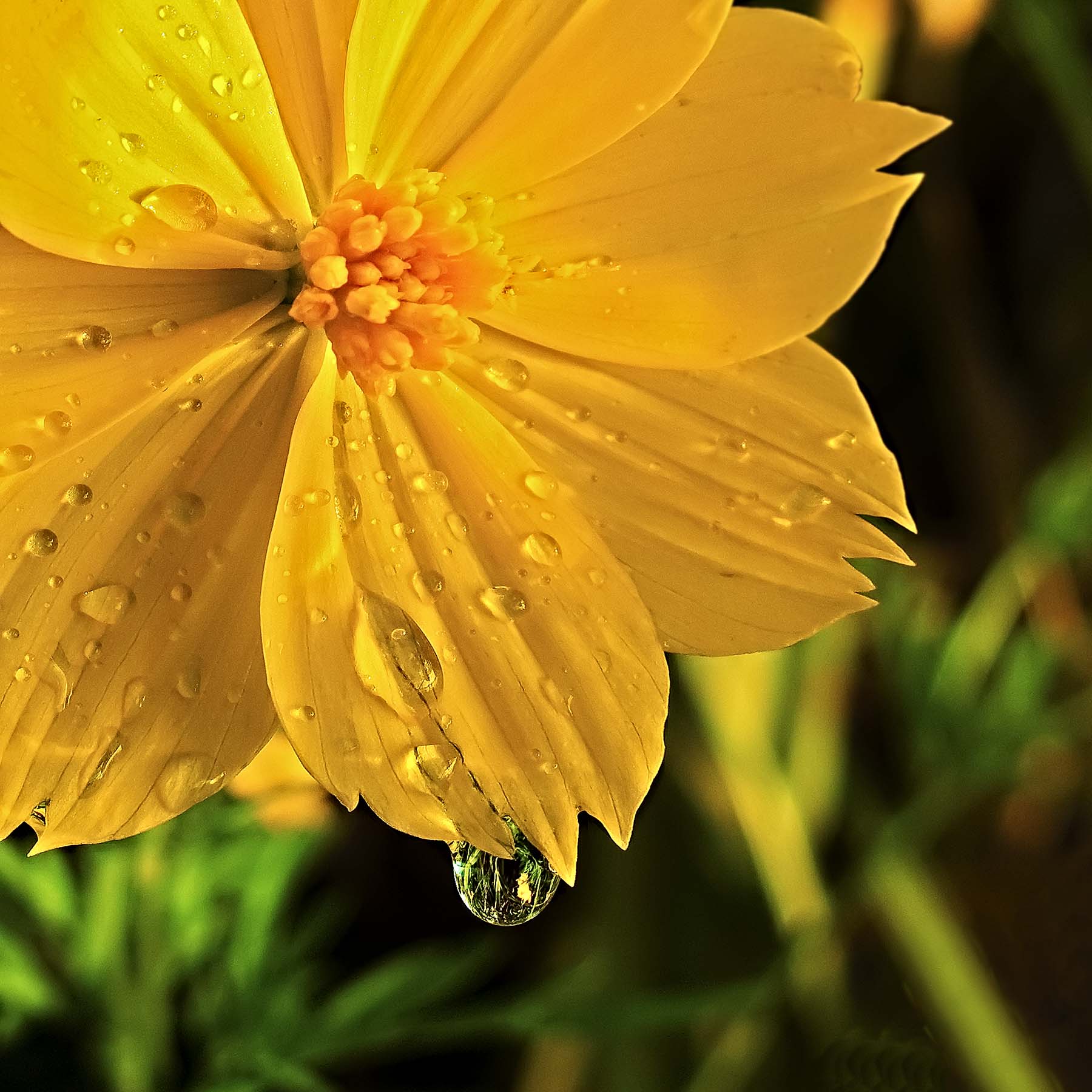
A couple of other differences are illustrated by the stunning image above. Drops are saggy, according to their size. Little drops sag little and big drops sag more. Ladies, this explains a lot. It's a battle between the astoundingly strong power of surface tension and the puny little tug of gravity. Think about it. We can walk around, jump up and down an whoop and holler and even fly, more or less, while being pulled down relentlessly by an entire planet! Gravity is pathetic. Gravity is the 97 pound weakling of the physical forces.
The other difference is that, while bubbles can make pretty reflections, they can't act as lenses, at least as long as the gas inside has the same index of refraction at the gas outside. I told you this is humour. Now, wasn't that funny? Come on, work with me. No, usually bubbles don't work well as lenses, but drops can. Click to enlarge the image above and examining the beautiful lensing in the drop. You can clearly see the upside-down flowers and stems behind it. *
Both drops and bubbles can be very pretty. I see them nearly every morning in my garden. I love to stroll in my garden in the morning. It makes me feel very manly. Yes, its a manly garden. Never mind that the gardener is our haus meri Juli, who will not tolerate me so much as pulling a weed: This is just as well, since I wouldn't know which are weeds until I'm told. Early on, I once pulled out a huge patch of aibika which seemed to me to be a useless, bug eaten, scraggly nuisance. She was enraged and scolded me most severely. "Hey, stupid! We EATaibika. that. It's good stuff!" Thereafter I allowed myself to be satisfied by supervising in a Country Gentleman manner. Actually, I've come to like The bug holes make it dissolve into a slimy green mess much more quickly.
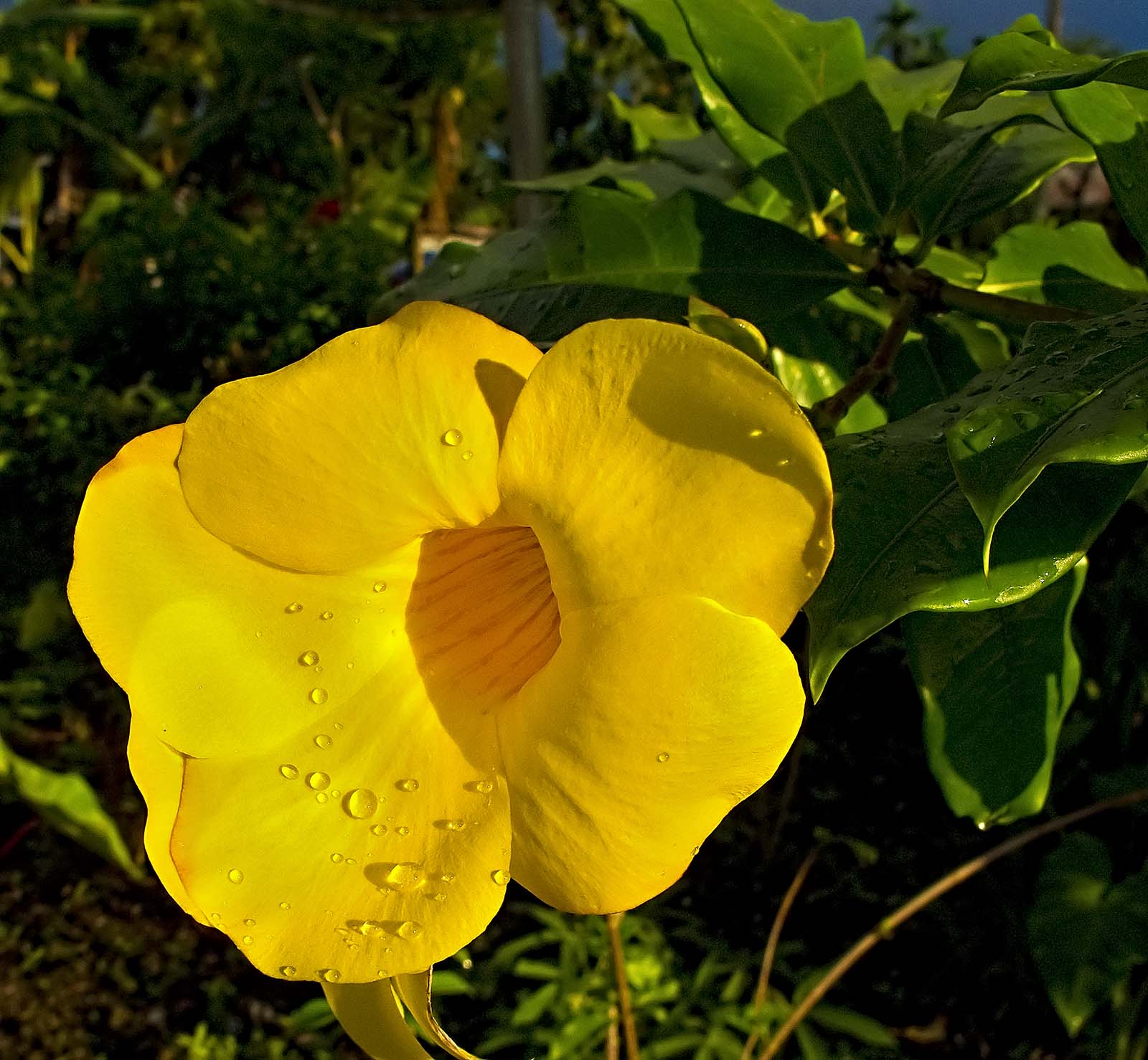
As I said, drops can be quite pleasant to view as long as they are not falling on your forehead one-by-one for house during a Chinese water Torture. Here's a close-up of the ones above: See, they look bigger now. This is what close-ups do. Notice how each drop focuses the sun's rays into a tiny dot. I might be possible to use these as miniature magnifying glasses to fry tiny ants. I'll have to try that sometime. I'm not sure that I have any tweezers small enough.

Of course, my favourites in my Manly Garden are my Manly Orange Lilies. This one has just stepped from the shower:
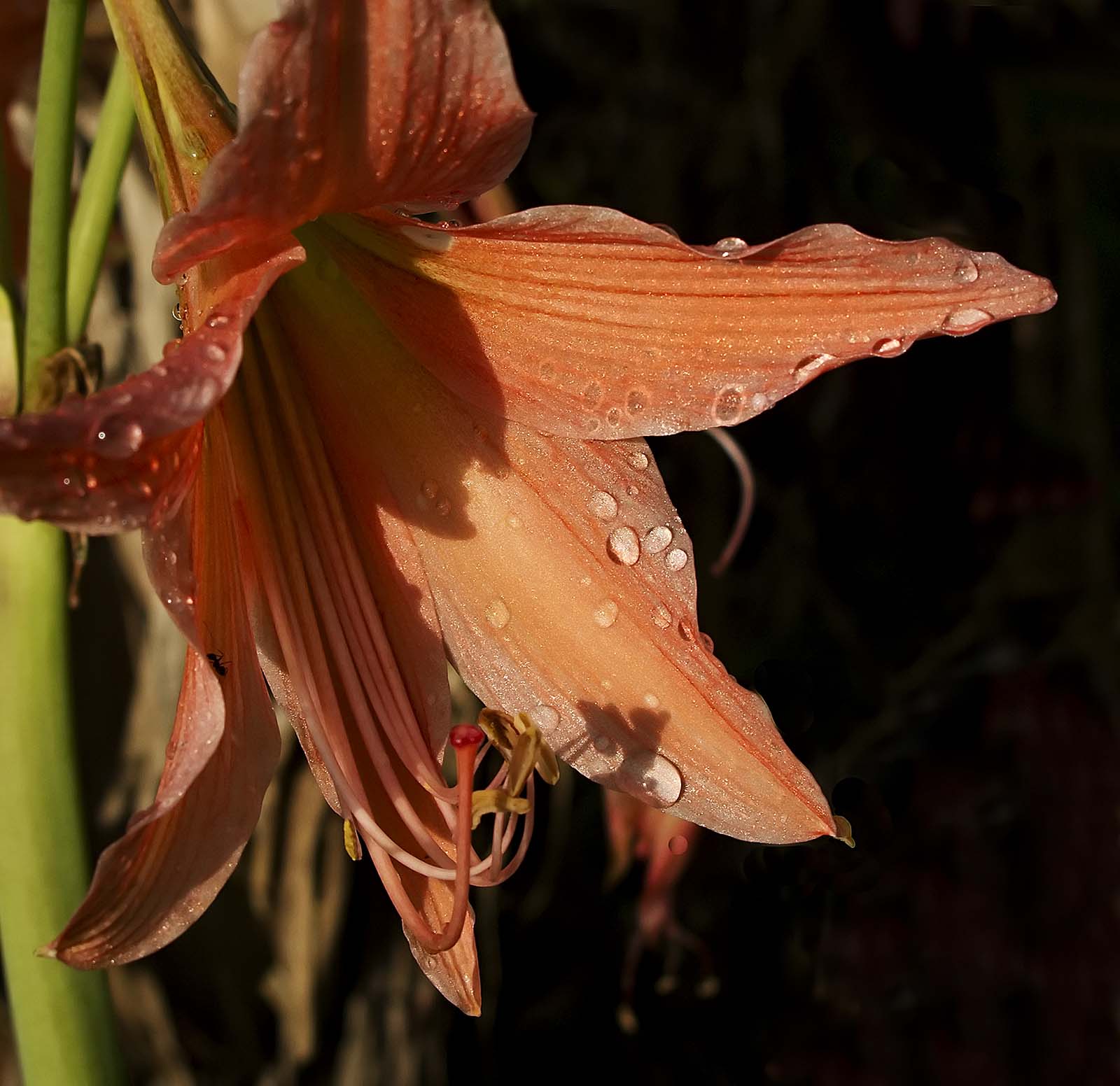
Excuse the lily-porn. If you look at the top petal you can see, through the thin material, the outline of drops on the back side. This is the first time that I've noticed this. Obviously, I need to pay more attention to wet, naked flowers.
No, we're not finished with lilies yet. You won't get off that easy. Here is another one soaked to the skin:
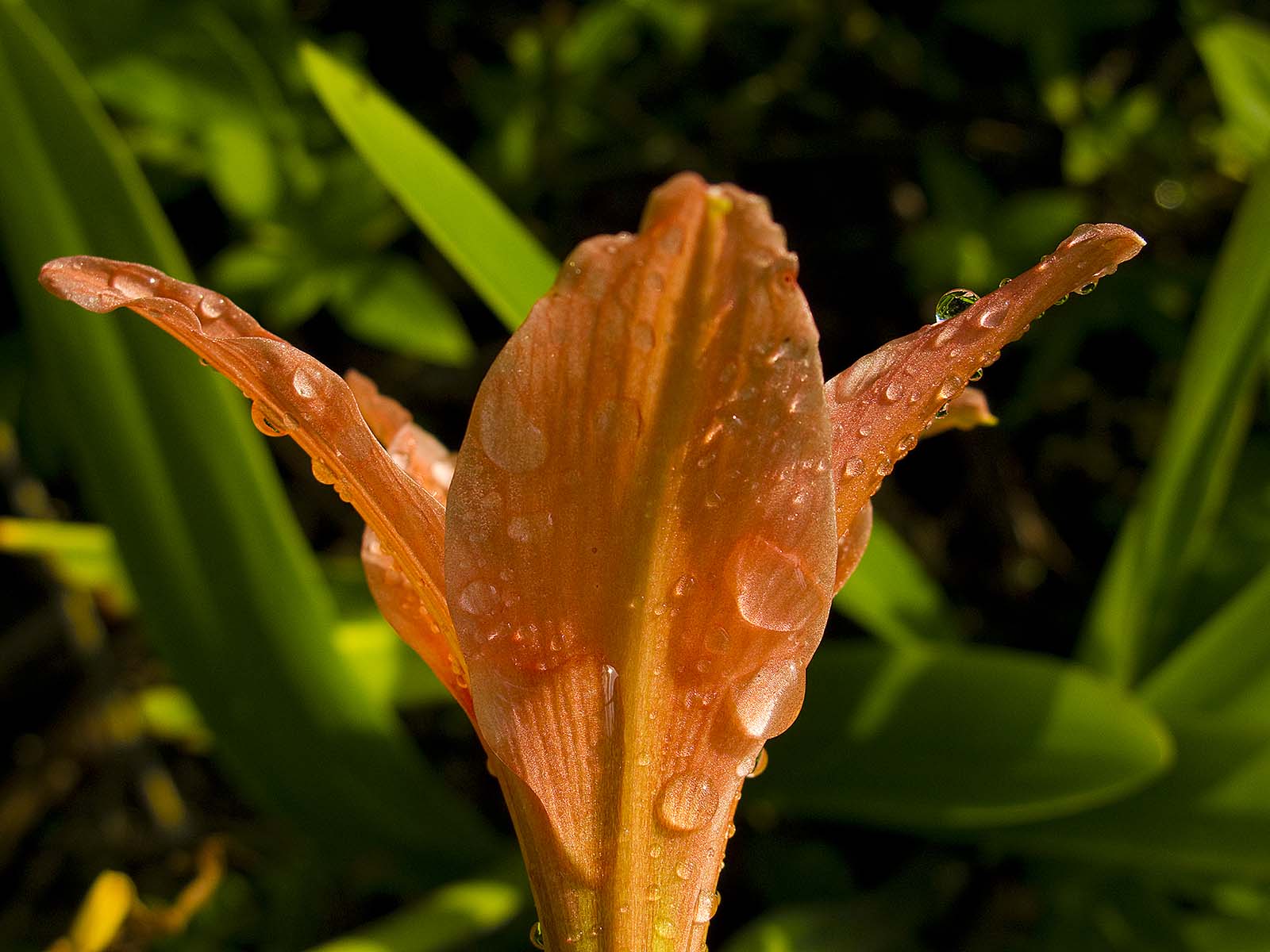
Now, I could, at this point, allow this to degrade into a low-brow essay containing poetic allusions about the opening of petals and the moistness of . . . No, wait, I'm not going there. This is a family-friendly site . . . so far.
Since I never take only one picture of a single flower, I turned around the other way and shot it from the other side. Sounds brutal, eh?
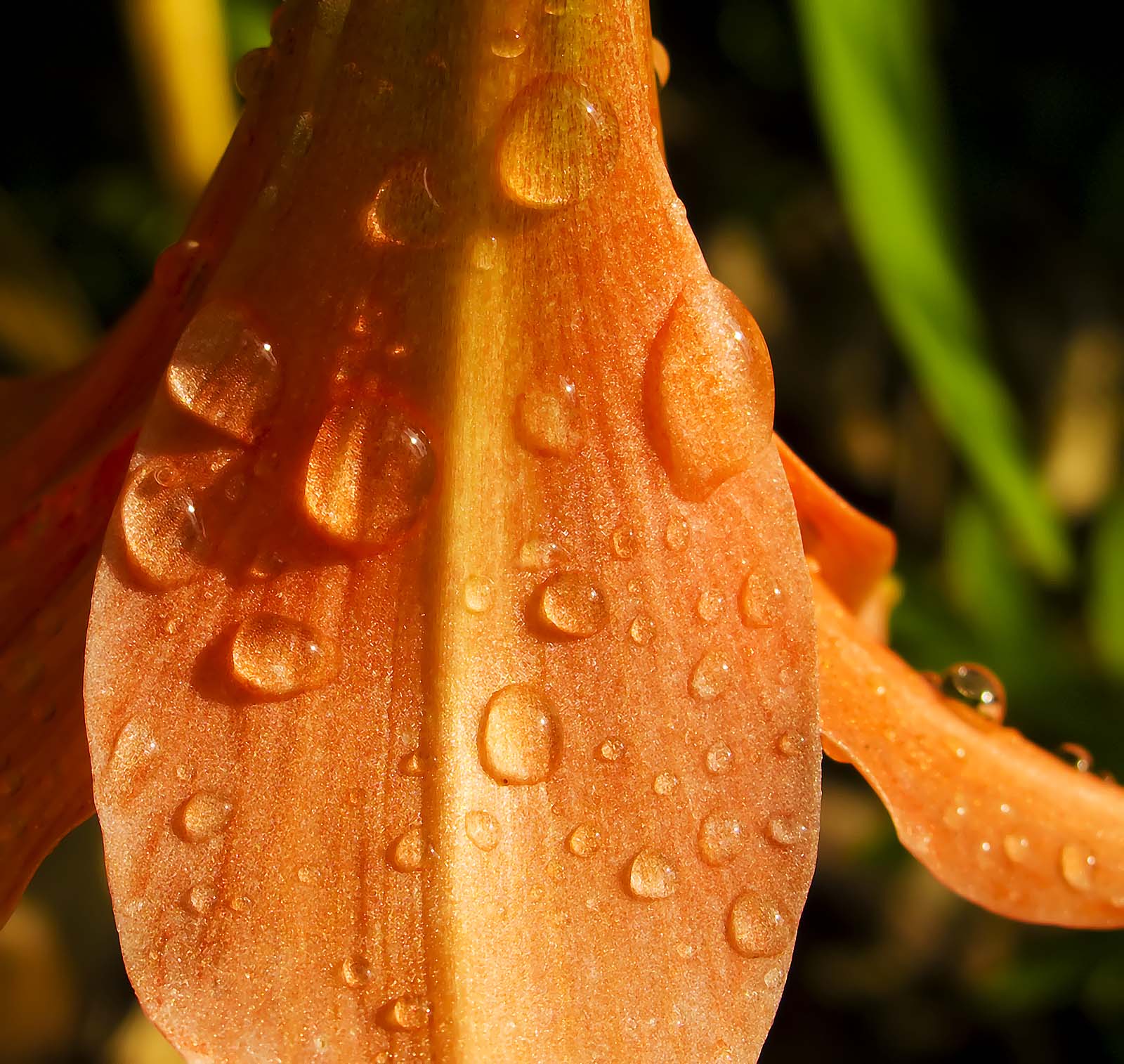
Well, I told you. It's a Manly Garden.
* This is the sad lot of the photographer. We brave perilous gardens full of mosquitoes and great hairy spiders to take photographs of itsy-bitsy things and then slave for hours over a hot computer to create images that will be viewed once for two seconds.and evoke a mild "Hmmm . . ." at best. It's a pathetic and narcissistic pursuit. The most it has ever paid me keeps beer in the fridge. However, it does allow me to fancy myself an artíst.
A reader made a doll of Schuyler and her device, and then sent it to her. Bonus? She added a tiny little copy of the book!
This tiny quahog was spotted in our Long Island Sound tank by Johann. Notice it is only a bit larger than the medium coarse sand in the tank.
Tiny Toad, for Thursday Photo Challenge, Tiny, by Mary Stebbins Taitt. In the hands of a small child.
This is what Tiny does ALL the time to Andy...she HUGS him and nuzzles in his beard!
Project 365 - Day 121