View allAll Photos Tagged study
The study that gave this book its title was inspired by a survey initiated in the '70s by Chou EnLai as he was dying of cancer. Ninety-six% of the population (880 million people) participated in 2,400 counties in China. The survey included death rates for four dozen different diseases including 12 different kinds of cancers. The resulting atlas implied that cancer was a disease of environmental conditions and lifestyle rather than genetics. The counties with the highest occurrences of some cancers were 100 times greater than in counties with the lowest occurrences.
In the '80s, to further study these results, the author, T. Colin Campbell, a nutritional biochemist at Cornell University, and a handful of other notable scientists from both the United States and China, embarked on an in depth study of the dietary habits of the Chinese in correlation with disease. Thus was born the China Study. Their findings were startling and are the basis of discussion for the rest of the book.
The study showed that high cholesterol was a prevalent indicator of numerous diseases, not just heart disease. More significantly those with very low levels of cholesterol subsisted on a predominantly plant based diet. They were basically vegans. Poor vegans who died of nutritional inadequacy and poor sanitation while the diseases of affluence, the ones that scare us most, were chiefly a result of extravagant living, (but not as extravagant as in the US). The study compared people of the same age so does not mean that poor people died young before they got a chance to get the other diseases.
The conclusions of the scientists were that a high carbohydrate diet of unrefined plant based whole foods, resulted in much more fiber consumed and many plant based antioxidants providing a host of benefits. While consuming diets high in protein and fat transfers the calories into storage as fat rather than into body heat. (The only reason people lost weight on the famous high protein, meat based Atkins diet was because they were severely limiting their calorie intake to 33% less than normal. Over half of those on the Atkins diet suffered from constipation, bad breath, headaches and a 53% increase in calcium excreted in the urine. Plus many more health problems down the road.)
The book does not stop at the results of the China Study alone, but cross references the results with a host of other compelling American studies supporting research on breast, prostate and colon cancers, diabetes, obesity, autoimmune diseases, osteoporosis, kidney stones and Alzheimer's. These studies all point in the same general direction. Diet is more important than genes or environmental toxins in the development of these diseases. An animal based diet is what gets the bad genes to fully express themselves, while a plant based diet can minimize the impact of toxins. Consuming a high fat, high protein, animal based diet increases the rate at which toxins bind to DNA to form products that cause cancer.
It is further revealed that cows milk (casein) is a significant factor in the development of cancers especially prostate cancer and is linked to Type 1 diabetes. As one who is lactose intolerant, growing up in a country that doesn't consume milk products, I've always been suspicious of the myth that milk was necessary for bone health. So what were we thinking to feed human babies milk that is meant to put 1000 pounds on a calf within the first few months of life? According to research, the reason our body doesn't absorb enough calcium is because animal protein increases metabolic acids and this condition actually leaches calcium from bones. Only 5 to 6% of our diet needs to be protein to replace what is excreted as amino acids, not 35% as recommended by industry driven government dietary guidelines. The manipulation of such dietary guidelines accounted for in the book.
The role of big industry, i.e. diary producers, meat producers and big ag in protecting and promoting their product translates to considerable ability to influence government policy with industry driven science while suppressing inconvenient facts, in much the same fashion as the politics of global warming has been obfuscated.
The last third of the book describes how reductionist science is in the habit of studying only one element at a time without regard to how elements react with each other in the environment of the body. The Western habit of isolating just one ingredient in order to derive conclusions about its affect on the body, only makes sense if you plan to use pharmaceuticals to run your body; this lack of context is misleading and confuses the public.
Western doctors are also only peripherally trained in nutrition, as it affects drugs, so are not going to prescribe a diet based treatment for disease despite evidence that a plant based diet can reverse the symptons of disease. Those mavericks that do research diet treatments risk being marginalized and their careers truncated. Campbell describes accounts of such from his own career and those of other doctors doing this work. (He and his colleagues eat a vegan diet and recommends such because it is simpler than focusing on what you can't eat and because he believes the benefits are increased with a zero animal product diet than with the 10% actually consumed by many of those he studied.)
So in the end it is not only the Western diet that is killing us, but Western reductionist thinking and Western propaganda-driven-capitalism. And then there is my pet theory — identity politics. America doesn't want to be taking its diet cues from a Chinese peasant; as Campbell points out, Americans believe that our animal based, protein rich diet is the best in the world and that it is somehow unAmerican to think otherwise. Plus Americans like to eat it so no study is going to change that; annoying vegans being the fanatical exceptions that prove the rule.
We did change our diet though. I am happy to return to my Chinese and Thai lactose free roots with a tiny bit of meat while Catherine again embraces vegetarianism with some cheese. This book was recommended to C by her boss, a big brain science and numbers person, in response to the news of her cancer.
© Anvilcloud Photography
Sue and Heather (wife and SIL) study the floorplan at the National Gallery to try to find their way to the Rideau Chapel to listen to the motet.
There were two other people in the photo, but when they moved I snapped another photo and then used a layer mask in Photoshop to paint in the vacated spaces.
The photo below is the original, uncropped version of the same photo. I like both versions for different reasons.
Here is some information of the motet when it was at the Met.
www.metmuseum.org/about-the-museum/now-at-the-met/feature...
12/28/2012 A man studying in the Public Catalog Room in the New York Public Library. Kodak Portra 400NC. Olympus 35 SP. G.Zuiko 42mm 1:1.7.
That's me on the couch. Sorry, I can't remember who took this photo.
Indiana Memorial Union
IU Bloomington
Circa 1988
Source: wallboat.com/study-with-coffee/
This is a free image you can use it.More free Images @ wallboat.com All images are Public Domain/Free and you can use any where for any purpose without any permission.Even you can use for commercial purpose.
#animal #wallpaper #freephotos #freeimages #business #education #beauty #fashion #architecture #cars #food #drink #landscapes #nature #people #religion #travel #vacation #science #technology #communication #love #relation #beach
This is the little room that Holly and I have just finished up as a study. Pretty happy with it. I'm sat at that desk right now.
budget renovation of a 1970's townhouse
blogged fededesigntextiles.blogspot.com/2009/06/before-and-after....
Jul14Tu
Studying for Friday.
First day back in the office after vacation. Nothing spectacular. We had a drummer at practice this evening, but even that was made un-spectacular by people's crankiness.
Then John called. Husband talked to him at length about ... everything. He literally started with Adam and went all the way to the Cross. They got to the point where John has to decide who he's living for, and said good night. Husband is convinced he's saved. I say he's at least very close. Good evening.
Looking to take a masters in african american studies? Learn more about the program at Pacific Oaks College and click the link above.
Have so many reasons to choose Study Box as your study space.
Check out the seat no before you choose your preferred seats :)
Al– Mas’abain Village, Aden Governate
Al Mas’bain village has a long history. It is believed that the village was established approximately 800 years ago. Mines were planted in 1994 (the last civil war). Before mines were planted its inhabitants lived a typical lifestyle. The community members were able to make use of their lands and travel from village to village in the area without any feelings of fear or insecurity.
After the area became mined, the villagers’ lives changed dramatically. Local people started to move around with caution and with fear. They became reluctance to travel even within the village boundaries.
The demining started in 2001 and 2002. After demining, local people started moving freely. The value of the land increased and many local community members were able to sell their lands for construction purposes for good prices. The revenues from the sales were used to improve the livelihood of the individuals in the community. Fortunately, there were no victims of mine explosions in the village. There were no accidents involving mines after the year 2000.
The feeling of security was one of the most important benefits from demining. The demined area was used as an asphalted ring road connecting the village with neighboring urban center of Dar Sa’ad in Sheikh Othman District. The major beneficiary is Mr Ali Dirhim, who bought a big area in the village after it was demined. Mr Ali Dirhim established a residential housing complex in the purchased land. The remaining demined land is the property of local people in the village.
Page 27
Al Masharia, Al Dhale Governate
Before planting of mines, the village was an ordinary rural area. Agriculture is the major activity of the local people in the village. Crops grown in the village are sorghum, millet, maize, pulses and qat. The area is very ancient and its history goes back more than 500 years.
Mines were planted over a long period starting in 1972, and from 1974 till the mid eighties. The first mines were anti tank mines, later on the mines were anti individuals. After the planting of mines in the area, people’s lives changed completely. A feeling of insecurity was evident every-where. The fact that the area was a sensitive border area led to the intensive planting of mines. This complicated the situation even further.
Local people became scared for their property, families and for their own lives. The total number of victims was more than 38 from mines. The number of animals killed because of mines exceeded 4 cows and tens of sheep and goats. Several households migrated from the village because of the security situation. Others were forced to sell their animals because of the dangers of mines and the scarce rangelands remaining in the area after planting of mines.
Demining in the area started in 2002 till the end of 2004. Demining teams from “YEMAC’ were responsible for the whole process of demining. Local people appreciated the humanitarian role of “YEMAC” in clearing the area of mines and restoring peace in the village.
Estimated financial returns on demining in Al– Masharia
Details– return from herding
No. of households = 240
The village and the neighboring village herd daily with average return = 50 YR
Return of herding from two villages = 2 x 50 x 365 days x 240 = 8,760,000
There are three villages herding at a rate of 4 times per month. The number is 240 households.
Return from herding for three villages per year = 3 x 50 x 4x 12x 240 = 1,728,000
Net Income for five villages 10,368,000 Yemeni Riyal
Details- return from Qat cultivation
No. of households benefiting from qat cultivation= 120 households
Average annual return from qat cultivation = 300,000 YR.
Total return for all households = 36,000,000 YR
Total annual cost of production (irrigation + land preparation+ chemicals and fertilizers + without tax= 150,000 YR.
Total costs of households per year = 150,000 x 120 = 18,000,000 YR.
Net income for the 5 villages=18,000,000 YR
Details– Cereals cultivation
Households cultivating cereals= 80
Average annual return from land = 15 Kadah
Cost per kadah = 1800 YR.
Total cost of cereals per year = 80 x 15 x 1800 = 2,160,000
Net Income for the 5 villages= 1,440,000 YR
Made this in the early 1980's or late 70's when I was studying survival food. Came to the conclusion that corn & soybeans in a 2:1 ratio was best with 250mg of vitamin C and a pinch of salt. For a year I lived on nothing but corn & soybeans. Bought the corn at a feed store in 50-pound sacks for about $7.00 in Arizona, half that price out east and the soybeans (60-pound sack/bushel) from a tofu manufacturer (in Tucson), a seed store (New Jersey) and a farmer I saw loading in Missouri.
Tip # 3: make time to workout. Get the blood flowing to your brain; plus if you're a fit and healthy person chances are you won't get sick very often and will be able to make it to class (always important to making good grades!).
Kansallismuseon freskojen mallit auton lavalla lähdössä Tarvaspäästä Helsinkiin 1928. Kuorman päällä seisovat kuljettaja Yrjö Lampila (vasemmalla) sekä Akseli ja Jorma Gallen-Kallela.
Gallen-Kallela työryhmineen maalasi keväällä 1928 Kansallismuseoon Kalevala-aiheiset kattofreskot. Hän oli maalannut vastaavat työt jo Pariisin maailmannäyttelyn Suomen paviljonkiin vuonna 1900. Neljästä freskosta kolme, Ilmarinen kyntää kyisen pellon, Sammon taonta ja Sammon puolustus, säilyivät aiheiltaan samoina, mutta Suuri hauki -fresko korvasi Kansallismuseossa Pariisin paviljongin Pakanuus ja kristinusko -aiheen. Myös Gallen-Kallelan tyyli ehti välillä jonkin verran muuttua.
Akseli Gallen-Kallelan ateljeelinna Tarvaspää sijaitsee Linuddin niemellä nykyisessä Espoossa. Se rakennettiin aluksi 1911-1913 vain ateljeeksi, ja Gallen-Kallelat asuivat sen vieressä puuhuvilassa. Myöhemmin Tarvaspää muokattiin sopivaksi asuinkäyttöön ja sitä muunneltiin muutenkin sekä Gallen-Kallelan elinaikana että sen jälkeen. Nyt linna on pääosin palautettu 1920-1930-luvun asuun. Gallen-Kallela suunnitteli linnaa jatkuvasti uudelleen vielä viimeisinä vuosinaan, ja tarkoittikin rakennuksen enemmän jälkipolville kuin itselleen.
kuvauspaikka: Tarvaspää
ajoitus: 1928
kuvaaja:
kuva-alan mitat: 109x81mm
tekniikka:
merkintöjä:
inventointinumero: GKM_VV_1023
kokoelma: Akseli Gallen-Kallelan valokuvakokoelma
tutki lisää / explore further:
Tiedätkö lisää tästä kuvasta? Kerro meille!
Do you have information on this photo? Let us know!
+++ DISCLAIMER +++
Nothing you see here is real, even though the conversion or the presented background story might be based historical facts. BEWARE!
Some background:
In 1964 the Royal Air Force specified a requirement (Air Staff Target (AST) 362) for a new fast jet trainer to replace the Folland Gnat. The SEPECAT Jaguar was originally intended for this role, but it was soon realized that it would be too complex an aircraft for fast jet training and only a small number of two-seat versions were purchased. Accordingly, in 1968, Hawker Siddeley Aviation (HSA) began studies for a simpler aircraft, initially as special project (SP) 117. The design team was led by Ralph Hooper.
This project was funded by the company as a private venture, in anticipation of possible RAF interest. The design was conceived of as having tandem seating and a combat capability in addition to training, as it was felt the latter would improve export sales potential. By the end of the year HSA had submitted a proposal to the Ministry of Defense based on the design concept, and in early 1970 the RAF issued Air Staff Target (AST) 397 which formalized the requirement for new trainers of this type. The RAF selected the HS.1182 for their requirement on 1 October 1971 and the principal contract, for 175 aircraft, was signed in March 1972.
Design of the Hawk was conventional by any approach. The two-seat crew - made up of an instructor in the rear cockpit and his student pilot in the front - sat in tandem under a wide field-of-view canopy. Controls at each position were redundant with the instructor having the ability to override student functions as needed. The cockpit was situated well-forward in the design behind a pointed, sloped-down nose assembly. Intakes to aspirate the single engine mounting came in the form of two half-circle openings to either side of the rear cockpit. The turbofan engine was buried deep within the short fuselage which was streamlined with a certain engineering elegance common to British military aircraft.
The intake ducts bulged out at the fuselage sides but were absorbed into the fuselage proper to continue the aircraft's smooth design layout. Wings were fitted amidships and sported modest sweep along the leading edge and lesser sweep along the trailing edge. They were also low-mounted assemblies along the fuselage to help increased expediency for ground operation. The empennage was traditional with a single vertical tail fin flanked by a pair of downward-canted horizontal tail planes. The tail planes were all-moving surfaces to add to the Hawk's agility. Small ventral strakes were noted along the empennage base. The undercarriage was conventional in layout and consisted of two main single-wheeled landing gear legs and a single-wheeled nose leg. The main legs retracted inwards towards centerline while the nose leg retracted forwards.
Standard armament for the Hawk was an optional gun pod commonly fitted to the centerline hard point under the fuselage (there were, in effect, five total hard points). The gun pod housed a 30mm ADEN series cannon for close-in work but remained an optional fixture. There were originally two underwing hard points (later expanded to four) cleared for the carrying of external munitions including guided/homing missiles, rocket pods and conventional drop bombs with the two inner-most hard points plumbed to accept fuel from external drop tanks. Up to 6,800lbs of external stores could be lifted by the Hawk airframe.
The prototype aircraft first flew on 21 August 1974. All development aircraft were built on production jigs; the program remained on time and to budget throughout. The Hawk T1 entered RAF service in late 1976. The first export Hawk 50 flew on 17 May 1976. This variant had been specifically designed for the dual-role of lightweight fighter and advanced trainer. It had a greater weapons capacity than the T.1, featured a total of five hard points, avionics improvements, the ability to carry larger drop tanks of 590 liter (156 US gallon) capacity, and an uprated engine which made the Hawk 50 qualified for 30% greater takeoff weight than the RAF's Hawk T.1.
One of the initial foreign customers was the Finnish Air Force (Suomen Ilmavoimat). In January 1978, Britain and Finland announced a deal to in which the Finnish Air Force was to receive 50 Hawk Mk. 51s in 1980. The Finnish Hawk 51s had a unique avionics fit, used a Saab RS-2 gunsight, and were fitted with a VKT 12.7 millimeter gun pod instead of the 30 millimeter Aden cannon pod provided with the T.1. Interestingly, Finnish Hawks are in some cases fitted with the Russian R-60 (AA-8) AAM, and they are also used for reconnaissance, carrying Vinten optical-infrared camera pods. The first four Hawks in the Finnish order were built in the UK, with the other 46 assembled from kits by Valmet of Finland.
These aircraft were built in Finland under licence by Valtion lentokonetehdas. At that time. the Finnish Air Force was still limited to 60 first-line fighter aircraft by the Paris Peace Treaty of 1947. But by acquiring Hawks, which counted as trainers rather than fighters, capacity could be increased while continuing treaty compliance. These conditions were nullified during the 1990s by the break-up of the Soviet Union, though.
Seven additional Mk. 51As were delivered in 1993–94 to make up for losses, and due to rising levels of metal fatigue, a major structural reinforcement program was carried out to extend the operational life of Finland's Hawks during the 1990s.
More variants of the Hawk followed and common improvements to the base design typically include increased range, more powerful engines, redesigned wing and undercarriage, the addition of radar and forward-looking infrared (FLIR), GPS navigation, and night vision compatibility. Later models were manufactured with a great variety in terms of avionics and system compatibility to suit the individual customer nation. Cockpit functionality was often rearranged and programmed, too, in order to be common to an operator's main fighter fleet to increase the Hawk's training value.
General characteristics:
Crew: 2: student, instructor
Length: 12.43 m (40 ft 9 in)
Wingspan: 9.94 m (32 ft 7 in)
Height: 3.98 m (13 ft 1 in)
Wing area: 16.70 m2 (179.64 ft²)
Empty weight: 4,480 kg (9,880 lb)
Useful load: 3,000 kg (6,600 lb)
Max takeoff weight: 9,100 kg (20,000 lb)
Powerplant:
1× Rolls-Royce Adour Mk. 851 non-afterburning turbofan with 23,1 kN (5.200 lbf) static thrust
Performance:
Maximum speed: Mach 0.84 (1,028 km/h, 638 mph) at altitude
Range: 2,520 km (1,360 nmi, 1,565 mi)
Service ceiling: 13,565 m (44,500 ft)
Rate of climb: 47 m/s (9,300 ft/min)
Thrust/weight: 0.65
Armament:
No internal armament, but an optional VKT 12.7 millimeter gun in a centerline pod;
Up to 2.200 lb (1.000 kg) of weapons on four underwing hard points, including 4× AAMs like
AIM-9 Sidewinder or R-60 (AA-8 'Aphid'), bombs of up to 1.000 lb (454 kg) caliber, unguided rocket
pods, drop tanks or reconnaissance pods with cameras
The kit and its assembly:
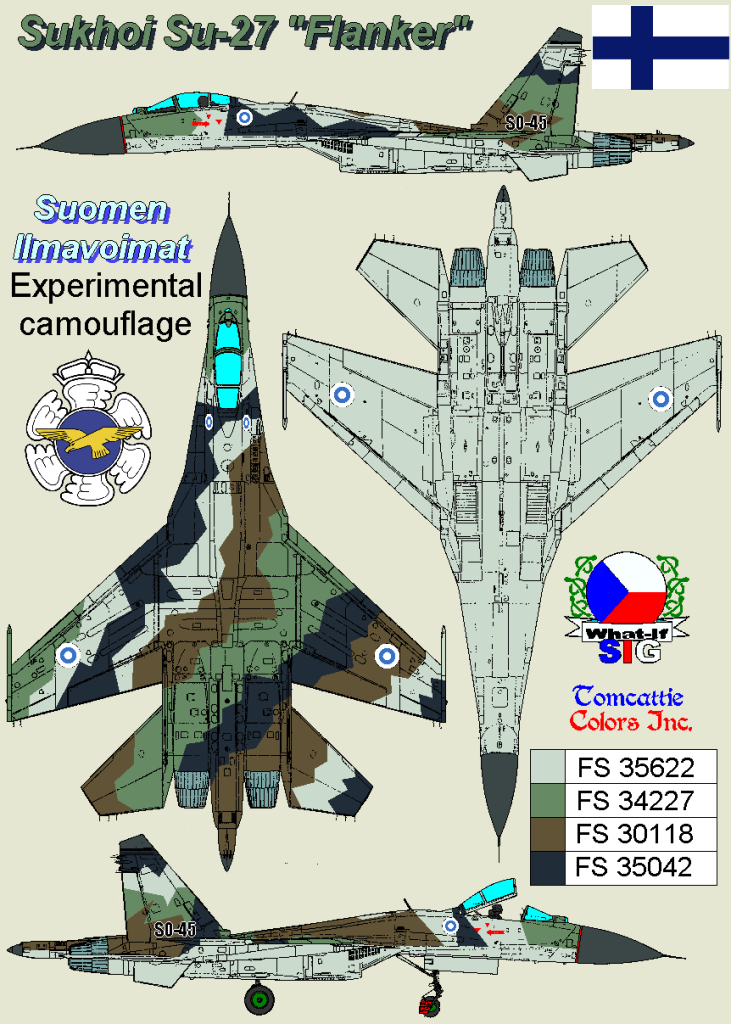
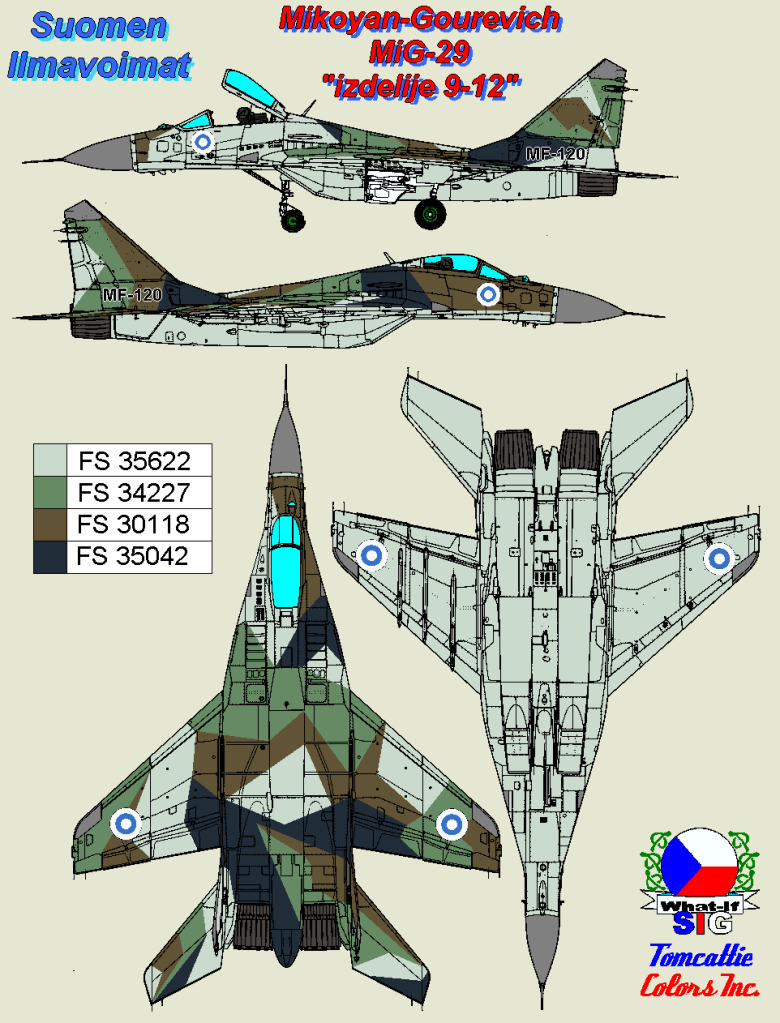
A simple build, sparked from a short-notice inspiration when I did online legwork for paint schemes. Then I stumbled upon profiles of fictional Finnish MiG-29 and Su-27, posted in 2011 by fellow member Wenzel from the CZ What if SIG a.k.a. PantherG at whatifmodelers.com, featuring interesting, fictional four-tone splinter schemes:
i730.photobucket.com/albums/ww303/PoorWhistler/Doodles/Su...
i730.photobucket.com/albums/ww303/PoorWhistler/Doodles/Mi...
These got me thinking, but instead of building one of the Russian fighters I wondered how this camouflage concept would look on a smaller aircraft already in Ilmavoimat service. This led directly to the Hawk 51!
Thankfully, there are several kits available for this aircraft, and I settled upon the relatively new Airfix kit from 2007. It's main selling point was that it actually contains parts and decals for a Finnish aircraft, esp. a set of the modern, very tiny roundels.
Good experience with recent Airfix offerings were confirmed. Effectively, the Airfix Hawk is a nice and simple build, done in just one and a half day. One of the kit’s positive features is the crew: there are actually two modern and well-sculpted pilot figures included, a rarity these days.
The kit was mostly built OOB, only mods are a cover inside of the ventral air brake (which can be built into open position, but this leaves an ugly seam visible) and some extra antennae. Fit is good (not perfect, though), and only little PSR was needed - biggest issue was the ventral wing/fuselage intersection, esp. its rear end.
One truly tricky feat is the mounting of the protective clear separating screen between the cockpit seats – the clear wall has (somehow) to be glued into the clear canopy, without any reference where to actually place it. Altogether a risky business, and I was lucky to get the wall into place with only a little white glue so that a total mess could be avoided. The positive thing about this construction is that you can mount the canopy in open position with the wall inside.
The engraved panel lines appear a little massive at first glance (far from Matchbox' trenches on the Hawk 200, though!), but once you add paint the kit this evens out and looks much better than on the sprues. A nice and literally simple kit!
Painting and markings:
The more challenging part of the build - and I stuck closely to the inspiring profiles and their color choice, choosing a pattern of diagonal "splinter stripes" in rather unique tones:
• FS 35042 (USN Sea Blue; Humbrol 181)
• FS 34227 (Intermediate Green; Humbrol 120)
• FS 30118 (US Field Drab; Humbrol 142)
• FS 35622 (IDF Pale Blue; Humbrol 122), which was also used for the undersides
Painting was done free-handedly, with brushes and some tape for masking, and I stuck to the original color suggestions except for the pure FS35622 on the upper surfaces: I toned it slightly down with a little RLM76 (Humbrol 247), but it is still very bright and the contrast between all colors is really harsh.
Anyway, painting the splinter scheme was easier than it seems, since the areas of each of the four upper side tones was rather small, so that the straight lines were rather short. Only the tight edges needed some corrections, but that was mostly mended during the washing/shading process.
As a design twist, the drop tanks (taken OOB, these are the bigger tanks for the Hawk's export versions) and their respective pylons received the colors of the standard Ilmavoimat Hawks: the pylons were painted in a light olive green (Humbrol 159) while the tanks were painted in a murky, dark brown (a mix of Humbrol 10 and 66) with pale grey (Humbrol 166) undersides.
The cockpit interior was painted in Gull Gray (FS 36231), while other interior surfaces and the landing gear were kept in lighter RAF Aircraft Grey.
For the markings I relied upon the OOB decal sheet; deviating from the inspiring profiles I stuck to the OOB tiny Finnish roundels that were introduced in the Nineties, and they go well with this experimental scheme. Otherwise, markings are rather minimal, just a lot of stencils were applied, the Airfix OOB sheet is pretty exhaustive (with a zillion of stencils, merely 1x1mm in size… There are even decals to be placed on landing gear joints!? Seriously?). As a side benefit, the OOB Finnish aircraft comes with low-viz stencils, placed on a green background. On the fictional splinter livery of my build they blend well into the overall look, the whole aircraft looks very natural (but still original).
In order to emphasize the engraved panel line the kit received a black ink wash and some panel shading through dry-brushing on the upper surfaces, with only slightly lighter tones (e. g. RAL 5008 on the dark blue and RAF Cockpit Green on the FS 34227). I just wanted a subtle effect. Finally, after the decals had been applied, the kit was sealed with matt acrylic varnish (Italeri).
A quick and pleasant build, and it's actually a relaxing experience to build something OOB, without transplants, major, Frankenstein-ish surgery and endless PSR sessions. In fact, the Airfix Bae Hawk kit makes it easy for the builder to create a decent model with little effort. You see that some thought went into the moulds and the kit’s construction.
The fictional four-tone splinter scheme looks really weird, though, almost like an anniversary scheme? O.K., it is, according to its creator, actually based/inspired by a pre-WWII Fokker D.VII fighter in Finnish service, but this real life version was created from different and less “loud” colors! Anyway, this Hawk is colorful in a certain way, even though I have doubts concerning its camouflage’s effectiveness? However, it’s a nice, bright addition to the whif collection. :D