View allAll Photos Tagged sacral
Dieses Foto ist urheberrechtlich geschützt. Ohne meine vorherige schriftliche Genehmigung darf das Foto weder ganz, noch auszugsweise kopiert, verändert, vervielfältigt oder veröffentlicht werden.
Das Nutzungsrecht meiner Fotos ist immer kostenpflichtig.
©Andreas Dlugosch
===================================================
Info hier:
www.puerten.com/index.php/35-kirche-puerten
===================================================
The fortified early Gothic church from the first half of the 14th century was built on the site of an older building. In the 15th century it was fortified with a wall and a wooden bell tower was built on the grounds in 1657. The single-nave space with a square-ended presbytery and a built-in sacristy has a painted cassette ceiling from 1758, the presbytery is characteristic by its rib vault. The mural paintings date back to the 60s of the 14th century and the creator of at least a part of them is the Master of Ochtiná presbytery. These interior frescoes were discovered in the early 20th century by I. Huszka who was restoring them in 1905. All the paintings, interior and exterior ones, were completely restored between 1983 and 1985 by J. Josefík, L. Székely and I. Žuch.
Within the almost intact medieval church, the murals have a uniquely strong impression and informative value, thanks to their scale and complexity of preservation. Thematically they focus on individual scenes from the Marian and the Passion cycle, but they do not have a uniform concept unlike the upper belt on the nave’s northern wall with a complete depiction of the St. Ladislaus legend.
This beautiful parish church, which is dedicated to St. Mauritius, is located in the municipality of Appenzell, the capital of the canton of Appenzell Innerrhoden.
The current church building was built between 1823 and 1826. The choir and the church tower are taken over from the late Gothic predecessor church. Enoch Breitmeier and his journeymen act as the builder.
Joseph Anton and Joseph Simon Moosbrugger stucco the church in the Rococo style.
Franz Vettinger paints the ceiling paintings and the 14 medallions.
The high altar dates from 1622. From 1890 to 1892 the Greppi company builds the side altars together with the sculptor Eduard Müller.
The eight windows in the nave show the 14 stations of the cross.
Magnificent is the set of the Virgin of Granada in the Scalas Chapel (measures 2.50x1.80m) made of baked and polychrome clay, the background being cobalt blue and milky white figures, work attributed to the 19th century Florentine workshop of Andrea della Robbia .
In the altarpiece where the Virgin of Granada is located we see her complete image, which has the Child, seated on her right leg offering her a pomegranate, a symbol of redemption. The Virgin receives the crown carried by cherubs and to her right and left Saint Francis of Assisi, Saint Sebastian, Saint Dominic de Guzmán and Saint Casilda, found on the frieze of the altarpiece, little heads of winged angels and on the curved tympanum of the pediment the Christ, Man of Sorrows in the center, the Virgin and Saint John. Another gem of the many that this unbeatable Sevillian Cathedral contains
In April in the year 1792 in Buchenberg, a town in bavaria, there was the laying of the foundation stone.. Master builder is Joseph Beck. The style of this sacral building is early classicism.
Undredal stavkyrkje (The little white church in the valley)
Undredal Stave Church (Norwegian: Undredal stavkyrkje) is a parish church in Aurland Municipality in Vestland county, Norway. It is located in the village of Undredal, on the shore of the Aurlandsfjorden. It is the church for the Undredal parish which is part of the Sogn prosti (deanery) in the Diocese of Bjørgvin. The white, wooden church was built in a stave church style around the year 1147.
The door to the right as you enter the basilica leads to the crypt, a series of eerie vaults at the bottom of 50 steps, with tombs guarded by monoliths representing Mourning and Eternity. Among those at rest here are Cardinal József Mindszenty.
Fünfstetten is a municipality in the Bavarian district of Donau-Ries.
The municipality's Catholic parish church, outwardly simple, reveals itself as a true Rococo gem within. Built in 1626, the interior was redesigned in the Rococo style between 1765 and 1766. Rich rocailles stucco, probably by Andreas Henkel, and the magnificent frescoes by Johann Baptist Enderle characterize the magnificent appearance. The other Rococo furnishings, such as the pulpit, choir stalls, and pews, have also been preserved in their original form.
Die Kirche verfügt über eine bedeutende Orgel.
Das Jugendstil-Instrument steht auf der Westempore und wurde im Jahre 1906 von der Giengener Orgelmanufaktur Gebr. Link erbaut.
Das Instrument steht unter Denkmalschutz. Es ist bis heute weitgehend unverändert erhalten und ist die einzige große Orgel Süddeutschlands aus der Zeit der Spätromantik.
Die Orgel hat einen orchestralen Klang und verfügt über eine Vielzahl verschiedener Flötenregister und Streicher.
-Wikipedia-
Tomb of Christopher Columbus is held by four allegorical figures representing the four kingdoms of Spain during Columbus’ life, Castille, Aragon, Navara, and Leon. The tomb was installed 1899 by Arturo Melida.
He travelled a lot not only in in his life but also after death. He died in 1506; the year Seville cathedral was completed, and was first interred in Valladolid. His bones were then moved to Seville. In 1542 they travelled across the Atlantic to Santo Domingo where his son had been a governor. The French took over Santo Domingo in 1795 and Columbus found himself on the move again, to Havana. After the Spanish American War, in 1898, Cuba became independent and the bones returned to Seville during the Cuban revolution in 1902 to finally come to rest in the monumental Late Romantic style tomb on display today.
Urheberrecht bei Andreas Dlugosch
Dieses Foto ist urheberrechtlich geschützt. Ohne meine vorherige schriftliche Genehmigung darf das Foto weder ganz, noch auszugsweise kopiert, verändert, vervielfältigt oder veröffentlicht werden.
Das Nutzungsrecht meiner Fotos ist immer kostenpflichtig.
©Andreas Dlugosch
===================================================
Info's zum Foto hier
www.erzbistum-muenchen.de/pfarrei/pv-kraiburg/cont/74487
===================================================
In the middle of the Graubünden community of Domat / Ems is the parish church of the Assumption of Mary, which can be seen from afar.
The foundation stone was laid in May 1730 and the church was consecrated in May 1739.
The master builder is Johann Baptist Berna from Lombardy, who creates his main work with this church.
Urheberrecht bei Andreas Dlugosch
Dieses Foto ist urheberrechtlich geschützt. Ohne meine vorherige schriftliche Genehmigung darf das Foto weder ganz, noch auszugsweise kopiert, verändert, vervielfältigt oder veröffentlicht werden.
Das Nutzungsrecht meiner Fotos ist immer kostenpflichtig.
©Andreas Dlugosch
===================================================
Info's zum Foto hier
de.wikipedia.org/wiki/Flossing
================================================
The Cathedral of the Resurrection of Christ (in the foreground) is the main cathedral of the Ukrainian Greek Catholic Church, located in Kyiv.
The temple was built in a modern style that distinguishes it from the Ukrainian sacral architectural tradition and makes it one of the unique buildings of Ukraine.
It was opened on March 27, 2011 by the enthronement of Svyatoslav Shevchuk, who was elected Supreme Archbishop of the Ukrainian Greek Catholic Church. Consecrated on August 18, 2013.
While the locally used term "patriarchal" reflects Ukrainian Greek Catholic desire to have their major archbishop recognized as a "patriarch," the Catholic Church does not officially regard this sui iuris church as a "patriarchate," just as the largest branches of Orthodox Christianity in Ukraine do not regard their respective bishops of Kyiv as "patriarchs."
Патріа́рший собо́р Воскресі́ння Христо́вого УГКЦ — головний собор та осередок Української греко-католицької церкви.
Образне вирішення у сучасному стилі виділяє храм з української сакральної архітектурної традиції та ставить його у ряд унікальних споруд України.
Патріарший собор Воскресіння Христового на лівому березі Дніпра в Києві є продовженням великих зусиль багатьох поколінь українців та одним з проявів духовного відродження Української греко-католицької церкви.
Відкритий 27 березня 2011 року інтронізацією Святослава Шевчука, що був обраний Верховним архієпископом Української греко-католицької церкви. Освячений 18 серпня 2013 року.
Urheberrecht bei Andreas Dlugosch
Dieses Foto ist urheberrechtlich geschützt. Ohne meine vorherige schriftliche Genehmigung darf das Foto weder ganz, noch auszugsweise kopiert, verändert, vervielfältigt oder veröffentlicht werden.
Das Nutzungsrecht meiner Fotos ist immer kostenpflichtig.
©Andreas Dlugosch
===================================================
Info's zum Foto hier
de.wikipedia.org/wiki/St._Michael_
===================================================
Urheberrecht bei Andreas Dlugosch
Dieses Foto ist urheberrechtlich geschützt. Ohne meine vorherige schriftliche Genehmigung darf das Foto weder ganz, noch auszugsweise kopiert, verändert, vervielfältigt oder veröffentlicht werden.
Das Nutzungsrecht meiner Fotos ist immer kostenpflichtig.
©Andreas Dlugosch
===================================================
Info's zum Foto hier
www.erzbistum-muenchen.de/pfarrei/pv-waldkraiburg/unsere-...
===================================================
The Cathedral of Seville is built on the old aljama mosque of the city, this shows the power that one culture exercises over another when it is conquered. This fact makes its plan different, facing Mecca and not Jerusalem, that is, facing south instead of east. It should be clarified that Mecca is oriented at 10o from Seville and not at 86o as the old mosque is oriented, this is due to the fact that in Al-Andalus the mosques had to be oriented towards the south quadrant and not towards the east, as the Christian churches did. When the Cathedral Chapter commissioned the design of the Gothic Cathedral, it stated verbatim that it wanted a Cathedral that everyone who saw it would take for crazy. For this, 5 naves were created that covered the 116 by 76 meter rectangle occupied by the Almohad mosque, this results, unlike what was usual in the great European Gothic Cathedrals, a hall plan with a Latin cross marked in height and in width by the central naves and the transept. This hall plan also results in the absence of an ambulatory at the head, which ends in a straight line like the wall of the old mosque. Later the Royal Chapel would be added, which is a Renaissance apse, but it does not really correspond to the Gothic company. In the naves of the Gospel and the Epistle, which are the lateral naves, there are many chapels. The 60 pillars support 68 ogive vaults, highlighting those of the transept and central nave with their star shapes. Instead of placing a clerestory, a continuous balcony was chosen along the main nave in order to be able to wander around the temple without being seen. Located in the central nave, in order from the feet, are the Retrochoir, the Choir, with two organs, the Transept, the Main Altar, the Back of Altar and the Royal Chapel.
This area is closed off by a magnificent wrough-iron screen by the Franciscan Friar José Cordero who finished it in 1780. The interior of the capel is lit by a stained-glass window above the reredos. It dates from 1775 and shows St Peter Pope. Another stained-glass window in the wall on the left dates from 1784 amd shows the symbols by which St Peter is recognized.
The reredos adorning this chapel was paid for by the Marquesses Of Malagon in 1625. Its structure was built by the craftsman Diego López Bueno. The paintings were carried out by Francisco de Zurbarán around 1630. The predella of the reredos has paintings of Christ and St Peter walking on the Water, Christ giving the Keys to St Peter and St Peter healing the Lame. The first section shows St Peter´s Vision, St Peter Pope and St Peter´s Repentance. in the second section there are St Peter is released by the Angel, The Immaculate Conception and Quo Vadis. The Heavenly Father in the upper part is an 18C copy of Zurbaran´s original and is therefore not by him.
In the left-hand wall of the Chapel there is the sepulchre of the Archbishop Diego de Deza, which dates from 1430. The right-hand wall has a series of four paintings which used to be ascribed to Francisco Reyna, one of Zurbaran´s disciples, but which may be connected with Juan Luis Zambrano according to the fragment of a signature on one of them. They come from La Merced Convent in Seville and represent The Virgin of La Merced appears to St Peter Nolasco in the Choir of the Novices, The Miracle of the Boat, San Fernando giving the image of the Virgin of La Merced to St Peter Nolasco and St Peter Nolasco`s Death.
Above these paintings there are another three showing St Peter repentant, a copy of an original by the Flemish painter Gerard Seghers, St Peter released by the Angel and The Maryrdom of Santa Agueda, of the 17C Italian school.
www.hispalis.net/turismo_y_cultura/monumentos/catedral/sa...
I always loved contemplating that kind of image and this time, I've been well inspired when walking to the banks of the river with these stones. I hope you will enjoy it and how knows... maybe till feeling a little wave of zen... zenitude!!! ;)
.
.
I choose a Buddha Bar sound track: SACRAL NIRVANA to listen with ;)
Hope you will enjoy and have a good time !.
.
As always, I'm really thankful for all your comments, invitations, and faves, thank you so much!! - © Fab Aeb :)
.
.
Tomb of Christopher Columbus is held by four allegorical figures representing the four kingdoms of Spain during Columbus’ life, Castille, Aragon, Navara, and Leon. The tomb was installed 1899 by Arturo Melida.
He travelled a lot not only in in his life but also after death. He died in 1506; the year Seville cathedral was completed, and was first interred in Valladolid. His bones were then moved to Seville. In 1542 they travelled across the Atlantic to Santo Domingo where his son had been a governor. The French took over Santo Domingo in 1795 and Columbus found himself on the move again, to Havana. After the Spanish American War, in 1898, Cuba became independent and the bones returned to Seville during the Cuban revolution in 1902 to finally come to rest in the monumental Late Romantic style tomb on display today.
The landmark of the old mining village with interesting spindle-shaped urbanism is the Lutheran Church located on a low hill at the upper end of the village called Koceľovce. The church is an almost intactly preserved Gothic building from the first half of the 14th century, originally dedicated to St. Bartholomew.
The single-nave space with a polygonal chancel, a sacristy on the north side and a high tower on a square plan in the west, which turns into an octogon on the upper floors, is covered by a high gabled roof with shingles. The roofing of the tower, with an atypical metal Art Nouveau helmet, dates from the beginning of the 20th century. The nave is vaulted with classicist Theresian vaults instead of the original beamed ceiling, which is stylishly followed by an equally vaulted brick porch. During the last third of the 14th century, the polygonal chancel was built and vaulted with a cross rib vault. The stylistic purity of the church is emphasized by high windows divided by profiled bars and tracery and a system of supporting pillars of the chancel. The current southern entrance to the church was opened during the restoration in the 2nd half of the 18th century, it is closed by a Gothic door with decorative fittings, which were transferred here from the original entrance portal in the tower. Another Gothic door with rich wrought iron decoration is in the portal to the sacristy. This interesting wrought iron door also became the logo of the church.
Urheberrecht bei Andreas Dlugosch
Dieses Foto ist urheberrechtlich geschützt. Ohne meine vorherige schriftliche Genehmigung darf das Foto weder ganz, noch auszugsweise kopiert, verändert, vervielfältigt oder veröffentlicht werden.
Das Nutzungsrecht meiner Fotos ist immer kostenpflichtig.
©Andreas Dlugosch
===================================================
Info's zum Foto hier
de.wikipedia.org/wiki/Mari%C3%A4_Himmelfahrt_(Haag)
===================================================
Urheberrecht bei Andreas Dlugosch
Dieses Foto ist urheberrechtlich geschützt. Ohne meine vorherige schriftliche Genehmigung darf das Foto weder ganz, noch auszugsweise kopiert, verändert, vervielfältigt oder veröffentlicht werden.
Das Nutzungsrecht meiner Fotos ist immer kostenpflichtig.
©Andreas Dlugosch
===================================================
Info's zum Foto hier
www.erzbistum-muenchen.de/pfarrei/pv-kraiburg/cont/74487
===================================================
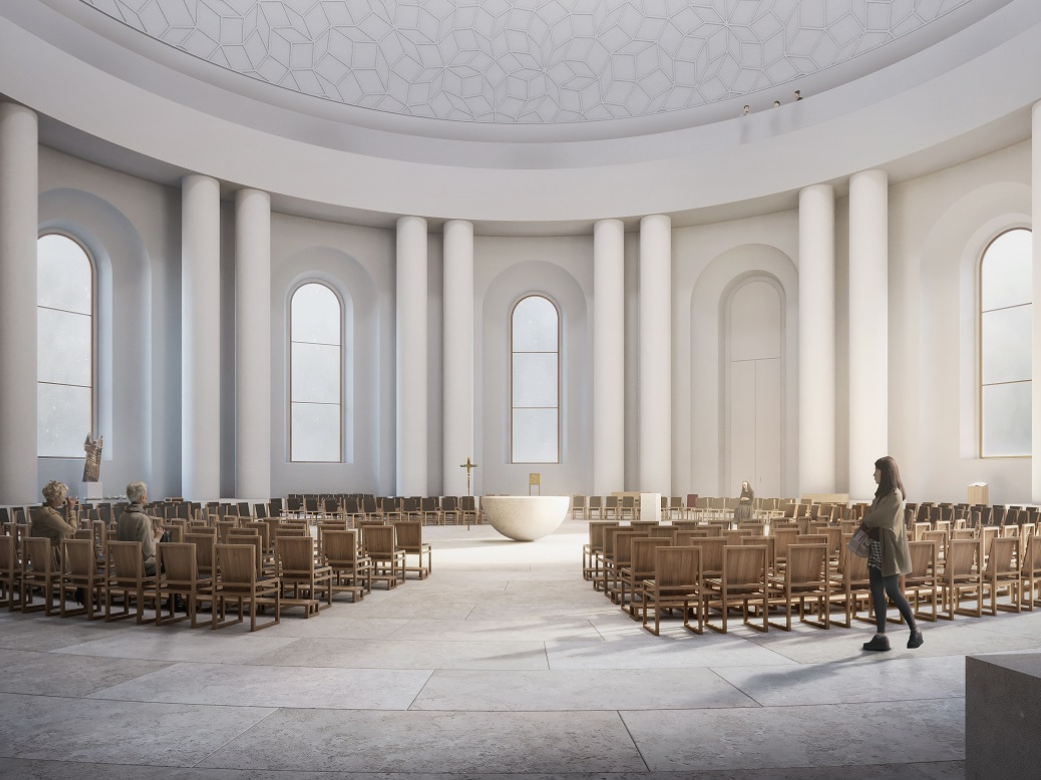
Der bereits laufende Umbau der St. Hedwigs Kathedrale in Berlin-Mitte scheidet die Geister. Neben einer notwendigen Sanierung des Kirchenbaus wird auch der vom Architekten Hans Schwippert gebaute, berühmte Innenraum vollkommen neu strukturiert. Ein Vorhaben, das nicht nur die Fachwelt spaltet.
Seit November 2023 ist der neue Altar geweiht - man hatte zu diesem Zweck Gläubige aufgerufen, einen Stein ihrer Wahl abzugeben... alle erbeuteten Steine - vom Kiesel bis zum Bernstein - wurden dann als neuer, halbkugelförmiger Altar gegossen.
Im Herbst soll der Umbau dann fertig sein und man darf gespannt auf den Tag der Wiedereröffnung warten.
Bilder sind im Netz bereits zu sehen - guckst du hier... www.hedwigs-kathedrale.de/fileadmin/_subsites/_St._Hedwig...
° ENLIGHTENED °
© by Jean Claude Castor I 030mm - Photography
www.facebook.com/030mm-photography/
Urheberrecht bei Andreas Dlugosch
Dieses Foto ist urheberrechtlich geschützt. Ohne meine vorherige schriftliche Genehmigung darf das Foto weder ganz, noch auszugsweise kopiert, verändert, vervielfältigt oder veröffentlicht werden.
Das Nutzungsrecht meiner Fotos ist immer kostenpflichtig.
©Andreas Dlugosch
===================================================
Info's zum Foto hier
gottesdienstheute.de/bayern/waldkraiburg/stadtpfarrkirche...
=================================================
I wish you all my loyal Flickr friends a Merry Christmas and a healthy passage into a hopefully peaceful 2024. Not to forget lots of light for beautiful photos.....
Urheberrecht bei Andreas Dlugosch
Dieses Foto ist urheberrechtlich geschützt. Ohne meine vorherige schriftliche Genehmigung darf das Foto weder ganz, noch auszugsweise kopiert, verändert, vervielfältigt oder veröffentlicht werden.
Das Nutzungsrecht meiner Fotos ist immer kostenpflichtig.
©Andreas Dlugosch
===================================================
Info's zum Foto hier
de.wikipedia.org/wiki/Rupert_von_Salzburg
===================================================
Small church in Karpacz with interesting history :)
Vang Stave Church (Polish: Świątynia Wang) is a stave church which was bought by King Frederick William IV of Prussia and transferred from Norway and re-erected in 1842 in Karpacz in the Karkonosze mountains of Poland. The church is a four-post single-nave stave church originally built around 1200 in the parish of Vang in the Valdres region of Norway. In 1832, the local council decided to pull down the stave church because it was too small and had become structurally unsafe over the years. The Norwegian painter Johan Christian Dahl would like to save it as a cultural monument. The solution came from Crown Prince, later King Frederick William IV of Prussia, whom Dahl knew personally. He persuaded the prince to take over responsibility for the Vang Stave Church and cover the costs of re-erecting it in Potsdam. The original plan had been to re-erect the church on the Pfaueninsel near Potsdam. But in the meantime, this plan was discarded in favour of a site at the remote village of Brückenberg near Krummhübel (today Karpacz) in the Giant Mountains (now the Karkonosze mountains), in the province of Silesia. The idea probably came from countess Friederike von Reden of Buchwald, now Bukowiec, whose memorial stands beside the church. The foundation stone was laid on 2 August 1842 in the presence of King Friedrich Wilhelm himself. In spite of excellent drawings, most of the materials were discarded. Only the main construction, consisting of sills, posts and wall plates, were made use of, in addition to the carved doorframes. All of the external gallery was built with new materials, and every wall plank was precisely replaced. The original elements are placed in the center of the church - four wooden columns and carved portals, as well as carved Nordic lions. Wang Church followed the best examples of the Scandinavian sacral architecture and is now a unique work of the old Nordic art. Built in the way the Viking longships were, that is without a single nail, it features wooden bolts and dovetails. Nowadays, serving a Polish Lutheran community, Wang church has become a major tourist attraction and is probably the world's most visited stave church with about 200 000 visitors each year.
-------------------------------------------------------------------------------------
Kościółek Wang w Karpaczu, ładny i z ciekawą historią :)
Kościół Górski Naszego Zbawiciela (powszechnie znany jako Świątynia Wang) – ewangelicki kościół parafialny w Karpaczu w Karkonoszach, przeniesiony w 1842 z miejscowości Vang, leżącej nad jeziorem Vangsmjosa w Norwegii. Zbudowany został z sosnowych bali w miejscowości Vang w południowej Norwegii, na przełomie XII i XIII wieku. Powstał jako jeden z około tysiąca (przetrwało kilkadziesiąt) norweskich kościołów klepkowych. Uważany jest za najstarszy drewniany kościół w Polsce. W XIX wieku świątynia stała się już za mała na potrzeby ludności miejscowości Vang, która chcąc wybudować sobie nowy kościół, musiała zaciągnąć pożyczkę na pokrycie kosztów budowy. Kościół był mocno zniszczony, ale nadawał się do sprzedaży w celu rozbiórki i odbudowania w innym miejscu. Wtedy norweski malarz Jan Krystian Dahl przebywający w Dreźnie skłonił pruskiego króla Fryderyka Wilhelma IV do jej zakupu za 427 marek dla berlińskiego muzeum. W 1841 rozebraną świątynię przewieziono najpierw do Szczecina, a potem do Berlina, jednak zaprzyjaźniona z królem hrabina Fryderyka von Reden z Bukowca przekonała go, żeby przewieźć ją na Śląsk. Świątynię najpierw Odrą przewieziono do Malczyc, potem drogą lądową do Karpacza Górnego, w którym znalazł się w roku 1842. Znaczna część oryginalnych elementów kościoła nie nadawała się do użytku. Brakujące części dorabiano w trakcie budowy na podstawie rysunków. Oryginalne są umieszczone pośrodku kościoła cztery drewniane kolumny oraz bogato rzeźbione portale, a także rzeźbione lwy nordyckie. Konstrukcja kościoła wykonana jest bez użycia gwoździ, wszystkie połączenia zrealizowano przy pomocy drewnianych złączy ciesielskich. 28 lipca 1844 świątynia Wang stała się kościołem miejscowej parafii ewangelickiej i jest nim nadal. Stanowi atrakcję turystyczną Karpacza.
Urheberrecht bei Andreas Dlugosch
Dieses Foto ist urheberrechtlich geschützt. Ohne meine vorherige schriftliche Genehmigung darf das Foto weder ganz, noch auszugsweise kopiert, verändert, vervielfältigt oder veröffentlicht werden.
Das Nutzungsrecht meiner Fotos ist immer kostenpflichtig.
©Andreas Dlugosch
===================================================
Info's zum Foto hier
de.wikipedia.org/wiki/St._Johann_Evangelist_und_Johann_Ba...
===================================================
The Monastery at Lébény was established between 1199 and 1203, by a nobleman, for private worship. The complex was dedicated to the Apostle Saint James the Great. Though the existing charter for approving the donations and construction was signed by Andreas II (1208), one of the walls of the church had “1206” engraved in them, which may indicate that the church was already built at that time. It is also mentioned in the RegestrumVaradiense (an important language memorial), which was made in the late cathedral chapter of the present Oradea (Nagyvárad) in the 13th century. The monastery of Lébény was attacked and burnt down several times; the first by Mongols, then the second by King Ottokar I of Bohemia; and thereafter by the Turks, which was probably in 1529 and definitely in 1683. The monastery was taken back from the Turks by the arch-abbot of Pannonhalma in 1540. He named a new abbot, though the title only existed on paper for a little bit longer than two decades. In 1563 the monastery was burnt down again for the third time and was left devoured. Presently, the only part of the complex that is still standing is the iconic three-nave Romanesque church in the middle of Lébény village. This church is one of the most important Romanesque style buildings of Hungary, which was most probably restored in the 17th century by the Jesuits, and it was the first ever Hungarian monument that was restored in the second half of the 19th century. In addition, the Romanesque church is also operating as a parish of the village.
Urheberrecht bei Andreas Dlugosch
Dieses Foto ist urheberrechtlich geschützt. Ohne meine vorherige schriftliche Genehmigung darf das Foto weder ganz, noch auszugsweise kopiert, verändert, vervielfältigt oder veröffentlicht werden.
Das Nutzungsrecht meiner Fotos ist immer kostenpflichtig.
©Andreas Dlugosch
===================================================
Info's zum Foto hier
www.egglkofen.de/fileadmin/Dateien/Egglkofen/Egglkofen_-_...
===================================================
Wang Temple is a wooden Protestant church in Upper Karpacz. Arose in the twelfth / thirteenth century in Vang in southern Norway. Hence its name. Intended to demolish the building purchased in the nineteenth century Prussia Friedrich Wilhelm IV. Thanks to the efforts of the Countess Frederica von Reden from Bukowiec hit the church in the Giant Mountains. July 28, 1844 there was a grand opening and dedication of the church. Wang church was built on the model of the best examples of Scandinavian wooden sacral architecture and a priceless work of art of ancient Norse. This medieval building is probably the biggest attraction, so there's no way to visit while in Karpacz.
A jewel among churches - the wooden Church of St. St. Nicholas is one of the oldest and most beautiful wooden churches in Slovakia. The three-part log building with a richly ornamented shingled roof and three towers was built in 1658. In 2008 it was entered in the UNESCO World Heritage List together with seven other wooden churches from the area of Slovak Carpathians.
The sacral monument is a part of a unique complex located in the center of Bodružal in the Svidník district. In addition to the temple, it also consists of a separate bell tower, an adjacent cemetery and a wooden fence with a shingled roof and an entrance gate covered by a conical roof.
The three church towers symbolizing the Holy Trinity will catch your attention for sure. The highest tower houses the bells, which were used for military purposes at the beginning of the World War I - the inhabitants of the village replaced them in the second half of the 1920s. The oldest preserved bell features the inscription “1759”.
www.severovychod.sk/vylet/dreveny-chram-bodruzal-unesco?l...
L'uomo lascia tracce innumerevoli nel paesaggio. Spesso è la qualità stessa della vegetazione a testimoniare il suo ruolo. Altre volte, invece, è la presenza di strutture e di manufatti speciali. Come in questo caso, in cui sugli orizzonti della palude affacciata al mare si staglia l'inconfondibile profilo di un piccolo edificio religioso. Proprio a lui si deve pertanto la dimensione sacrale di questo paesaggio, altrimenti del tutto naturale ..... ..
Bratislavský hrad - BRATISLAVA CASTLE
BRATISLAVA CASTLE
RECONSTRUCTION OF NATIONAL CULTURAL MONUMENT
The oldest written mention of Bratislava Castle dates back to 907, when the name Pressalauspurch is mentioned in the Salzburg Annals in connection with the great battle between the Hungarians and the Bavarians.
This name bore an important Great Moravian fort built during the 9th century. The wood-based fortification protected the area, in which, in addition to wooden buildings, stood a brick three-nave basilica and probably a stone palace, whose foundations were also uncovered.
The dimensions of the aforementioned basilica rank it among the largest sacral buildings of Great Moravia ever, which suggests the importance of the Bratislava fortified settlement in this period.