View allAll Photos Tagged impartial
Nel corpo a corpo ingaggiato dal leader del Pdl contro la Costituzione italiana, passato attraverso l’accaparramento dei mezzi di comunicazione di massa (in spregio all’art. 21 della Costituzione); attraverso progetti di grande riforma (bocciati con il referendum costituzionale del 2006 dal popolo italiano); mediante leggi ad personam per garantire l’impunità al Capo politico e agli uomini della sua Corte (bocciate dalla Corte costituzionale); nonché malattie impeditive (per i processi) e guarigioni miracolose per il ritorno alla vita politica, alla fine la palla è passata ai giudici che hanno pronunciato – probabilmente – l’ultima parola.
La sentenza pronunciata il 24 giugno dal Tribunale di Milano non ci dice soltanto che l’imputato Berlusconi è colpevole di concussione per costrizione e di prostituzione minorile e per questo deve essere condannato a sette anni di reclusione ed interdetto in perpetuo dai pubblici, ci annuncia qualcosa di molto più importante. Ci conferma che la Costituzione è viva ed i suoi meccanismi di garanzia funzionano ancora e possono sconfiggere l’arroganza del potere, fino al punto da rimuovere dalle funzioni pubbliche quei soggetti che hanno disonorato le istituzioni con comportamenti riprovevoli, censurati dalla legge penale. Essa ci testimonia che il caposaldo costituzionale dell’indipendenza della magistratura, malgrado le difficoltà del tempo presente, non è stato ancora espugnato; che i giudici, malgrado le intimidazioni ricevute attraverso lo squadrismo, mediatico e non, di Berlusconi, malgrado la marcia dei 200 parlamentari che hanno occupato il Tribunale di Milano, malgrado Brescia, riescono ancora ad amministrare la giustizia in modo imparziale, senza piegarsi ai voleri dei potenti o cedere alla piazza.
Per questo, quei cittadini che hanno intonato il canto di “Bella ciao” alla lettura della sentenza hanno capito perfettamente il significato di questo evento: è una vittoria della Costituzione di fronte alla prova più dura che le istituzioni hanno dovuto affrontare nella vita della Repubblica. Ed è naturale che questa sentenza faccia paura al Pdl, come ha dichiarato il capogruppo dei deputati Pdl, on. Brunetta: “Fa paura non solo e non tanto perché cerca di assassinare moralmente e politicamente Berlusconi, ma perché mostra agli italiani in che mani sia oggi la giustizia”. In realtà quello che fa paura ai cortigiani di Berlusconi è il fallimento dei loro ripetuti sforzi di addomesticare il controllo di legalità esercitato dall’autorità giudiziaria per garantire l’impunità del Capo politico e l’onnipotenza del suo sistema di potere.
Chi è immerso fino al collo in vicende di malaffare di ogni tipo ha perfettamente ragione ad avere paura della giustizia, se non riesce a controllare i giudici e ad annullarne l’autonomia. Brunetta lamenta che “da ormai vent’anni si tenta di eliminare un competitor politico di altissimo calibro usando, di volta in volta, i processi, le sentenze, la mala giustizia” e quindi conclude che: “tutto ciò non è più accettabile. È arrivato il momento di dire definitivamente basta a questo attacco alla libertà”. Dal suo punto di vista non gli si può dare torto! Ormai siamo ai tempi supplementari, la partita sta per finire: o Berlusconi demolisce la Costituzione e mette – finalmente – sotto tutela la magistratura, oppure la Costituzione si sbarazzerà di Berlusconi, facendo sì – attraverso il controllo di legalità – che egli paghi il prezzo dei suoi discutibili comportamenti pubblici e privati, come succede per i comuni mortali.
galo_simansi
In the melee hired by the leader of the PDL against the Italian Constitution, passed through the seizure of the means of mass communication (in breach of Article. 21 of the Constitution); through projects of major reform (rejected by the constitutional referendum of 2006 by the Italian people), through ad personam laws to guarantee impunity to the political leader and the men of his Court (rejected by the Constitutional Court), as well as diseases that do not permit (for processes) and miraculous healings for the return to political life, at the end the ball is passed to the judges who pronounced - probably - the last word.
The judgment delivered on June 24 by the Milan Court not only tells us that the accused Berlusconi is guilty of extortion and child prostitution by coercion and therefore it must be sentenced to seven years in prison and banned forever from the public, we announced something much more important. This confirms that the Constitution is alive and his assurance mechanisms still work and can defeat the arrogance of power, to the point to be removed from public office those persons who have dishonored the institutions with misconduct, censored by criminal law. It testifies that the cornerstone of the constitutional independence of the judiciary, despite the difficulties of the present time, has not yet been conquered, that the judges, despite the intimidation through the squads, and not the media, Berlusconi, despite the march of 200 MPs who have occupied the Court of Milan, in spite of Brescia, still manage to administer justice impartially, without bending to the will of the powerful or give in to the square.
For this reason, those citizens who have sung the song "Hello Beautiful" at the verdict they understood perfectly the meaning of this event is a victory of the Constitution in front of the toughest test that the institutions have had to face in the life of the Republic. And it is natural that this judgment is to face fear PDL, as stated by the leader of the PDL deputies, Hon. Brunette: "It's scary not only and not so much because it tries to kill morally and politically Berlusconi, but because it shows that Italians in hand today is justice." In reality, what scares the courtiers of Berlusconi is the failure of their repeated efforts to tame the control of legality exercised by the court to ensure the impunity of the political leader and the omnipotence of its power system.
Who is neck deep in matters of wrongdoing of any kind is absolutely right to be afraid of justice, if he can not control the judges and to eliminate its autonomy. Brunette complains that "twenty years from now you try to delete a political competitor of the highest caliber using, in turn, processes, judgments, bad justice," and then concludes that "everything is no longer acceptable. It's time to say definitively stop to this attack on freedom. " From his point of view, one can not blame him! We are now in extra time, the game is about to end or demolishes the Constitution and puts Berlusconi - finally - under the protection of the judiciary, or the Constitution will get rid of Berlusconi, doing so - through the control of legality - that he pay the price of his questionable public and private behavior, as happens for ordinary mortals.
galo_simansi
A referee and a damn good player himself.
June 2012, Kabul, Afghanistan.
The International Committee of the Red Cross (ICRC) is an impartial, neutral and independent organization whose exclusively humanitarian mission is to protect the lives and dignity of victims of armed conflict and other situations of violence and to provide them with assistance. The ICRC also endeavours to prevent suffering by promoting and strengthening humanitarian law and universal humanitarian principles. The ICRC is at the origin of the Geneva Conventions and the International Red Cross and Red Crescent Movement. It directs and coordinates the international activities conducted by the Movement in armed conflicts and other situations of violence.
THE ICRC has been permanently present in Afghanistan since 1987, and the orthopaedic programme was one of its first activities. The ICRC orthopaedic center opened in Kabul in 1988. More than 90,000 Afghan disabled have been assisted through it. Those are combatants and civilians caught up in fighting, hurt during bombardments, or struck by landmines. At present the ICRC directly manages six orthopaedic center in Afghanistan and supports four non-ICRC prosthetic workshops.
Of close to 200 employees running Kabul orthopaedic center, including a large hospital and workshops producing prostheses and wheelchairs, all are disabled themselves. The whole center is effectively run by people who had been affected by warfare, loosing limbs, but not losing their spirit.
Some of ICRC workers and patients have, under the leadership of Alberto Cairo, legendary head of the center, started a wheelchair basketball team, and practice almost every day after office hours. In June 2012 first wheelchair basketball tournament took place in Afghanistan. Kabul team did not win although they gave a tough fight.
It’s been a moving experience to see them practising and playing, an experience that cannot be forgotten.
More about the work of ICRC – www.icrc.org
Texts quoted after ICRC.
293 Hampstead Road, home of British caricaturist and book illustrator George Cruikshank between 1850 until his death in 1878.
Cruikshank's early career was renowned for his social caricatures of English life for popular publications.
He achieved early success collaborating with William Hone in his political satire The Political House That Jack Built (1819).
In the same year he produced the remarkable anti-abolitionist New Union Club. It satirised a dinner party organised by abolitionists with black guests.
His first major work was Pierce Egan's Life in London (1821). This was followed by The Comic Almanack (1835–1853) and Omnibus (1842).
He gained notoriety with his political prints that attacked the royal family and leading politicians. In 1820 he received a royal bribe of £100 for a pledge "not to caricature His Majesty" (George IV of the United Kingdom) "in any immoral situation". His work included a personification of England named John Bull who was developed from about 1790 in conjunction with other British satirical artists such as James Gillray, and Thomas Rowlandson.
Cruikshank replaced one of his major influences, James Gillray, as England's most popular satirist. For a generation he delineated Tories, Whigs and Radicals impartially. Satirical material came to him from every public event – wars abroad, the enemies of Britain (he was highly patriotic), the frolic, among other qualities, such as the weird and terrible, in which he excelled. His hostility to enemies of Britain and a crude racism is evident in his illustrations commissioned to accompany William Maxwell's History of the Irish rebellion in 1798 (1845) where his lurid depictions of incidents in the rebellion were characterised by the simian-like portrayal of Irish rebels. Among the other racially engaged works of Cruikshank there were caricatures about the "legal barbarities" of the Chinese, the subject given by his friend, Dr. W. Gourley, a participant in the ideological battle around the Arrow War, 1856–60.
For Charles Dickens, Cruikshank illustrated Sketches by Boz (1836), The Mudfog Papers (1837–38) and Oliver Twist (1838). Cruikshank even acted in Dickens's amateur theatrical company.
On 30 December 1871 Cruikshank published a letter in The Times which claimed credit for much of the plot of Oliver Twist. The letter launched a fierce controversy around who created the work. Cruikshank was not the first Dickens illustrator to make such a claim. Robert Seymour who illustrated the Pickwick Papers suggested that the idea for that novel was originally his; however, in his preface to the 1867 edition, Dickens strenuously denied any specific input.
The friendship between Cruikshank and Dickens soured further when Cruikshank became a fanatical teetotaler in opposition to Dickens's views of moderation.
In Somerset Maugham's short story "Miss King", Cruickshank's influence is referenced: "She wore a large white cotton nightcap (on entering Ashenden has noticed the brown wig on a stand on the dressing-table) tied under the chin and a white voluminous nightdress that came high up in the neck. Nightcap and nightdress belonged to a past age and reminded you of Cruickshank's illustrations to the novels of Charles Dickens."
After he developed palsy in later life, Cruikshank's health and work began to decline in quality. He died on 1 February 1878 and was originally buried in Kensal Green Cemetery. In November 1878 his remains were exhumed and reburied in St. Paul's Cathedral.
Upon his death, it was discovered that Cruikshank had fathered 11 illegitimate children with a mistress named Adelaide Attree, his former servant, who lived close to where he lived with his wife. Adelaide was ostensibly married and had taken the married surname 'Archibold'.
Punch magazine, which presumably did not know of his large illegitimate family, said in its obituary: "There never was a purer, simpler, more straightforward or altogether more blameless man. His nature had something childlike in its transparency."
In his lifetime he created nearly 10,000 prints, illustrations, and plates. There are collections of his works in the British Museum and the Victoria and Albert Museum. A Royal Society of Arts blue plaque commemorates Cruikshank at 293 Hampstead Road in Camden Town.
READING James 3:17-18
Wisdom from above is first of all innocent. It is also peaceable, lenient, docile, rich in sympathy and the kindly deeds that are its fruits, impartial and sincere. The harvest of justice is sown in peace for those who cultivate peace.
Here we see Joni offering an alternative, yet tasteful, view of her legs as her "Leg Show" continues. . . . Unlike the previous photo which was taken by a pair of late night. passersby, this one was taken as a selfie by Joni's camera from a low vantage point on a ten second timer. . . . .
Taking a photo like this was more difficult than one might imagine. . . . While crouching in heels, Joni had to set the timer on the camera and balance it on the edge of a low pile of bricks and make sure the camera was pointing in the right direction. . . . tick, tick, . . . Then she had to pop back up out of her crouch and maintain her balance as her knees reminded her that she's no longer a spring chick any more. . . .tick, tick . . . Then rush over about 10 feet away without tripping on the bricks. . . . tick, tick . . . Turn around, straighten her skirt and plop down as gracefully as possible onto the brick wall. . . . tick, tick . . . Brush the hair back out of her face, look at the camera, and lift those legs up and SMIILE for the camera. . . . tick, tick, . . . And FLASH!!! . . . .
Judging the photo and Joni's efforts as a fair and impartial Olympic Judge might on a ten point scale, (Assuming neither Joni nor the Judge was Russian.) Joni would have to be penalized for not getting her legs up high enough into the air. She would be further heavily penalized for not maintaining perfect symmetry by keeping her legs tightly wrapped together. (A rather Puritanical standard!) Additionally, points would be deducted for not having her left hand and fingers placed flat on the bricks, as well as her right hand's fingers dangling below her legs. (Hopefully those are her fingers and not something else!) Finally, the Judge would expect to see a far more dramatic and proud forward thrusting of Joni's modestly sized breasts. . . .Yes, she has a nice smile, which counts for something, but . . . .
Joni's final score . . . Read it and weep, Ms. Joni: 2.5!!!!
Joni doesn't even want to know how the Russian Judge would have scored it. . . .
Although lying largely in ruins, Pasargadae offers the glimpse into the remains of what once was the memorial city of Cyrus the Great - the emperor still regarded by many as history's most just and impartial ruler.
It is also the place where for the first time an eclectic miscellany of art and architecture, adopted from the countries incorporated into the vast Achaemenid Empire, was mastered and elaborately developed to generate the unique Old Persian Style, which was later perfected in Persepolis.
Love the light-play in these 3D white spider-Chrysanthemums.
for WHITE WEEK.
White is an achromatic colour, literally a "color without hue", that is a mixture of the frequencies of all the colours of the visible spectrum. It is one of the most common colours in nature, the color of sunlight, snow, milk, chalk, limestone and other common minerals.
In many cultures white represents or signifies purity, innocence, and light, and is the symbolic opposite of black, or darkness. According to surveys in Europe and the United States, white is the color most often associated with perfection, the good, honesty, cleanliness, the beginning, the new, neutrality, and exactitude.
In colour psychology white is the colour of new beginnings, wiping the slate clean, so to speak. It is the blank canvas waiting to be written upon. While white isn't stimulating to the senses, it opens the way for the creation of anything the mind can conceive.
White contains an equal balance of all the colours of the spectrum, representing both the positive and negative aspects of all colours. Its basic feature is equality, implying fairness and impartiality, neutrality and independence. It is interesting to note that babies come into the world with a perfect balance of white, ready to imprint their lives with all the colours of the spectrum (hopefully!) from all their life experiences.
The white colour on television screens and computer monitors is created with the RGB color model by mixing red, green and blue light at equal intensities.
Some non-European languages have a wide variety of terms for white. The Inuit language has seven different words for seven different nuances of white. Sanskrit has specific words for bright white, the white of teeth, the white of sandalwood, the white of the autumn moon, the white of silver, the white of cow's milk, the white of pearls, the white of a ray of sunlight, and the white of stars. Japanese has six different words, depending upon brilliance or dullness, or if the colour is inert or dynamic.
For more on the colour white: en.wikipedia.org/wiki/White
With love to you and thank you for ALL your faves and comments, M, (* _ *)
For more of my other work or if you want to PURCHASE (ONLY PLACE TO BUY!), VIEW THE NEW PORTFOLIOS AND LATEST NEWS: www.indigo2photography.co.uk/magda-portfolio.htm
IT IS STRICTLY FORBIDDEN (BY LAW!!!) TO USE ANY OF MY images or TEXT on websites, blogs or any other media without my explicit permission. If you do, without accreditation, it is STEALING © All rights reserved
Gonna do one for every tag I get so you can know my crew better C:
Tagged by TURBOW
This time my mysterious girl random facts, Doña Sol's:
1- Her name comes from one of El Cid's daugthers; Doña Sol (the other one was Doña Elvira), which translation in english would be "Mrs. Sun"
2-She's Satan's croupier, the one that deals the card on the poker game of your life.
3-The Devil usually calls her when someone's betting their poor soul, she's the impartial judge.
4- Doesn't like cheating, nothing at all, and if you try she will always catch you, and believe me, you don't want it to happen.
5- Doña Sol can look so fragile and delicated, but she really isn't, just like a mysterious and mostly dangerous creature...
6- Even though she "works" for Satan she's totally independent, she's the one that makes obey the rules of life and death.
7- Likes playing with the fragile soul and gullible thoughs of humans.
8- You cannot touch her.
9- Doesn't usually talk, or people who heard her voice couldn't live enough to tell...
10- Her soul burns constantly, hidden somewhere, but she cannot reach it... she's trapped.
The image above is the front and back cover of a publication containing the Charter of the United Nations and the Statute of the International Court of Justice (ICJ). This is the foundational treaty of the United Nations, signed in San Francisco on June 26, 1945, and it is an instrument of international law by which all UN Member States are bound. Content: The booklet contains the full text of the UN Charter and the annexed Statute of the ICJ, which forms an integral part of the Charter. Purpose of the Charter: To maintain international peace and security, reaffirm human rights, and promote the prosperity of all humankind. Function of the ICJ: The ICJ is the principal judicial organ of the UN, established by the Charter to settle legal disputes between States and give advisory opinions on legal questions when requested by authorized UN organs. Publication: Various editions of this booklet are published by the United Nations and are available for purchase from booksellers. This booklet has been autographed by U Thant.
----------------------------------------------------------------------------------------
U Thant - (In this Burmese name, U is an honorific, not a given name) - Thant (22 January 1909 – 25 November 1974), known honorifically as U Thant was a Burmese diplomat and the third secretary-general of the United Nations from 1961 to 1971, the first non-Scandinavian as well as Asian to hold the position. He held the office for a record 10 years and one month.
A native of Pantanaw, Thant was educated at the National High School and at Rangoon University. In the days of tense political climate in Burma, he held moderate views positioning himself between fervent nationalists and British loyalists. He was a close friend of Burma's first Prime Minister U Nu and served in various positions in Nu's cabinet from 1948 to 1961. Thant had a calm and unassuming demeanour that won his colleagues' respect.
He succeeded James Barrington as Burma's Permanent Representative to the United Nations. He was appointed Secretary-General in 1961, six weeks after his predecessor, Dag Hammarskjöld, had died in an air crash. In his first term, Thant facilitated negotiations between U.S. president John F. Kennedy and Soviet premier Nikita Khrushchev during the Cuban Missile Crisis of 1962, helping to avert a global catastrophe. Later, in December that year, Thant ordered Operation Grandslam, which ended a secessionist insurgency in Congo. He was reappointed as Secretary-General on 2 December 1966, by a unanimous vote of the Security Council. During his second term Thant was well known for publicly criticizing U.S. conduct in the Vietnam War. He oversaw the entry of several newly independent African and Asian states into the UN. He refused to serve a third term, and retired in 1971.
Thant died of lung cancer in 1974. A devout Buddhist and the foremost Burmese diplomat on the international stage, he was widely admired and held in great respect by the Burmese populace. When the military government refused him any honours, riots erupted in Rangoon; these were violently crushed by the government, leaving scores of casualties.
LINK to video - U Thant - the third Secretary-General of the United Nations - www.youtube.com/watch?v=H2nwvLUSPaU
LINK to video - SYND 23-10-71 U THANT SPEAKS ON UNITED NATIONS DAY - www.youtube.com/watch?v=_ojsSdDtjDo
Janiform (double-headed) herm of the Greek historians Herodotus and Thucydides. As is usual with this kind of herm, the heads represent opposites.
Herodotus was a Greek historian and geographer from the Greek city of Halicarnassus, then part of the Persian Empire (he later became a citizen of Thurii, modern Calabria, Italy), who Cicero dubbed 'The Father of History'. His 'Histories' gave detailed accounts of the Greco-Persian wars, but he suffered criticism - particularly from Thucydides - that he included 'legends and fanciful accounts' in his work for the entertainment value.
Thucydides was an Athenian historian and general, who actually first met Herodotus when he was a boy, listening to the older historian orate. His 'History of the Peloponnesian War' recounts the 5th century BCE war between Sparta and Athens until the year 411 BCE. Thucydides has been dubbed the 'Father of Scientific History' by those who accept his claims to have applied strict standards of impartiality and evidence-gathering and analysis of cause and effect, without reference to intervention by the gods. He dismissed Herodotus as a story-spinner, holding up his own scientific method as rigorous and without embellishment. You can see how these two approached history via opposing viewpoints. Yet apparently they were buried in the same tomb, having become close in later life.
Early 2nd century CE copy of a Greek originals of the early 4th century BCE. Found in Hadrian's Villa in Tivoli around 1547-1555.
Museo Archeologico Nazionale di Napoli (MANN inv. 6239)
20 July 2025
A cast member at the Royal Opera House unfurled a Palestinian flag on stage during a curtain call on Saturday night.
Video shows a brief scuffle as an official at the central London venue tries unsuccessfully to stop the protest, with the performer refusing to let go of the large flag.
It came on the closing night of Il trovatore, a four-act opera by Giuseppe Verdi.
Royal Ballet and Opera said the protest was "completely inappropriate for a curtain call".
A spokesperson said: "The display of the flag was spontaneous and unauthorised action by the artist.
"It was not approved by the Royal Ballet and Opera and is not in line with our commitment to political impartiality."
Palestinian flags are commonly seen at protests held in support of people living in Gaza as the war between Israel and Hamas continues.
Videos of the incident show one cast member standing at the top of the stage silently displaying a large Palestinian flag, at one point shaking it gently.
While the audience continues to applaud the performance, a man from the stage wings is seen attempting to wrestle the flag away from the cast member but they resist and hold on to it for the remainder of the curtain call.
Two other performers, standing alongside the one launching the protest, can be seen lurching to their side as the tussle plays out.
Some cast members further forward on the stage appear not to realise what is happening behind them.
Other officials standing in the wings can be seen shouting messages to the protesting cast member, who looks ahead and appears to ignore them.
By A. Pushkin
1829
If I walk the noisy streets,
Or enter a many thronged church,
Or sit among the wild young generation,
I give way to my thoughts.
I say to myself: the years are fleeting,
And however many there seem to be,
We must all go under the eternal vault,
And someone's hour is already at hand.
When I look at a solitary oak
I think: the patriarch of the woods.
It will outlive my forgotten age
As it outlived that of my grandfathers'.
If I caress a young child,
Immediately I think: farewell!
I will yield my place to you,
For I must fade while your flower blooms.
Each day, every hour
I habitually follow in my thoughts,
Trying to guess from their number
The year which brings my death.
And where will fate send death to me?
In battle, in my travels, or on the seas?
Or will the neighbouring valley
Receive my chilled ashes?
And although to the senseless body
It is indifferent wherever it rots,
Yet close to my beloved countryside
I still would prefer to rest.
And let it be, beside the grave's vault
That young life forever will be playing,
And impartial, indifferent nature
Eternally be shining in beauty.
========================================
Александр Сергеевич Пушкин
1829
Брожу ли я вдоль улиц шумных,
Вхожу ль во многолюдный храм,
Сижу ль меж юношей безумных,
Я предаюсь моим мечтам.
Я говорю: промчатся годы,
И сколько здесь ни видно нас,
Мы все сойдем под вечны своды —
И чей-нибудь уж близок час.
Гляжу ль на дуб уединенный,
Я мыслю: патриарх лесов
Переживет мой век забвенный,
Как пережил он век отцов.
Младенца ль милого ласкаю,
Уже я думаю; прости!
Тебе я место уступаю:
Мне время тлеть, тебе цвести.
День каждый, каждую годину
Привык я думой провождать,
Грядущей смерти годовщину
Меж их стараясь угадать.
И где мне смерть пошлет судьбина?
В бою ли, в странствии, в волнах?
Или соседняя долина
Мой примет охладелый прах?
И хоть бесчувственному телу
Равно повсюду истлевать,
Но ближе к милому пределу
Мне все б хотелось почивать.
И пусть у гробового входа
Младая будет жизнь играть,
И равнодушная природа
Красою вечною сиять.
Yesterday, Tuesday 22 January 2019, Greater Manchester Police welcomed 100 new recruits to the Force. The officers were officially sworn in at a formal ceremony attended by Chief Constable Ian Hopkins, senior officers and magistrate Stephen Paine.
The attestation ceremony was held at Stockport Town Hall.
The Mayor of Stockport, Councillor Walter Brett, was also on hand to welcome the new recruits.
Family and friends watched the new officers make their oath to uphold their role with fairness, integrity, diligence and impartiality throughout their time in post.
New recruits have to complete a two year probation period which includes classroom based learning and a year of active patrol. During their training they will have the same of level of authority as regular officers, including the power of arrest.
The new recruits are replacing those who have either retired or left the organisation and therefore helping GMP to maintain current officer numbers.
To find out more about Greater Manchester Police please visit our website. www.gmp.police.uk
You should call 101, the national non-emergency number, to report crime and other concerns that do not require an emergency response.
Always call 999 in an emergency, such as when a crime is in progress, violence is being used or threatened or where there is danger to life.
You can also call anonymously with information about crime to Crimestoppers on 0800 555 111. Crimestoppers is an independent charity who will not want your name, just your information. Your call will not be traced or recorded and you do not have to go to court or give a statement.
Mighty. Morphin. Power. Rangers.
The OG as introduced by Saban into the English speaking work, and international phenomenon, this adaptation of the Super Sentai Zyuranger became a household name back in 1993, and has been in the hearts of fans since. Me? Well, I enjoyed the show for what it is.. a fun way to kill half an hour, but as always, it was about the toys for me. In recent years, the MMPR franchise has been revisited, first with Bandai of America creating the Legacy product line and milking the MMPR brand, then with the 2017 motion picture that didn't quite make the money Saban wanted it to (I have a theory about this and how it didn't matter, but that's for another discussion). The biggest news would be how Hasbro, now the holders of the Power Ranger toy license, would revisit MMPR and other past Power Rangers characters through something they called the Lightning Collection, a series of collectors grade figures. Personally, I was impartial to this - while others were excited to add these to their collection, I never really got into it when Bandai did it with their Legacy figures and as such, I wouldn't really be pursuing these releases, with the exception of buying one or two to do a bit of comparison and contrast, as well as satisfy my own curiosity regarding a conspiracy theory.
In case it wasn't obvious by now, I tend to buy female figures because not only do they generally look better, but it's harder to hidd things on their comparatively smaller bodies. I bought exactly one figure from the Bandai Legacy line - Ninja Storm Blue (or in my case, Hurricane Blue) and while I never really reviewed it, it can summarize it as follows - it was alright. Nothing earth shattering, and definitely not worth the $25 CAD MSRP to me. Well, in Wave 2 of the Hasbro Lightning series, we see the release of the first female Ranger of the line, Kimberly Hart, the original Pink Ranger and Mistress of the Pterodactyl Zord. For the record, Kat was always my MMPR Pink of choice... I always found Kimberly kind of boring.
Finding her was a bit of a pain, though not as bad as others have had it.. definitely much easier than finding Springer, that's for sure. Just a few phone calls and a 10 minute drive from home.
Normally I'd wait to open this up, as I have been stocking up on some other goodies lately, but questions needed answering dammit, so Kimberly here jumped the queue and was opened next.. about an hour after purchase, in fact. So, without further ado, here is my overview and thoughts on the Power Rangers Lightning Collection Mighty Morphin Pink Ranger.
Each Lightning figure comes with the figure itself, an unmorphed (helmetless) head sculpt, a combination of posing and weapon holding hands, the trademark weapons of the character, and some sort of energy effect. In the case of Kimberly, she comes with her bow and arrow, her Blade Blaster side arm, as well as an energy arrow. MSRP is about $20 USD, or roughly what a Marvel Legends figure costs in your area.
As the picture shows, Kimberly is roughly the same size as Captain Marvel who is my benchmark female Marvel Legends figure. These figures are of course a smidgen bigger than your typical female S.H. Figuarts figure (i.e. Black Widow), but smaller than the Bandai Legacy female body. While Kimberly isn't as busty as the Blue Ranger, she's certainly less NFL Quarterback in terms of build. Now we got that out of the way, let us focus the comparison on the two players that really matter - Kimberly, and Captain Marvel. Now, the cynic in me pretty much assumed that Hasbro wouldn't reinvent the wheel when it didn't have to, both for better and worse. After all, they developed a body for their Legends line, and it would make sense to reuse it for this line, considering that the price point is the same. So, was I right?
Let's start things off with a discussion of aesthetics, articulation, and build quality. Now, no action figure, even the almighty Figuarts release, ever actually replicated the proportions of the suit actors perfectly, so it's not a surprise that things haven't changed here, though I'd like them to resemble human proportions a little better. For whatever reason, her chest area uses plastics that are harder than the rest of her body, and are a tint or two darker than the other pinks on her body. It doesn't show up on my photos, which are powered by flash, but in the crappy room lights I have here, it's clear as day. But in general, unless you're blind, it's pretty clear that this is the MMPR Pink Ranger.
I mentioned before that Kimberly has a different height and body shape than your standard Figuarts and Bandai Legacy body. Having said that, however, I think you should be able to see that Kimberly and Captain Marvel share the same general overall silhouette - in fact, if you look really close, you can see the retooling of common parts (upper arms and thighs, for example). I submit to you that the female Lightning body is at its core, an upcycled Legends body, which somehow manages to improve things, and make them worse at the same time. The Lightning female takes the Legends articulation (pivoting and rotating ankles, double jointed knees, thigh swivel, rotating hips, mid torso ball joint, rotating/pivoting shoulders, rotating/pivoting elbows, wrist rotate/pivot (depending on hand) and ball jointed head with a pivoting neck) and adds to it with boots that rotate and shoulders that allow for chest collapse, improving range of motion and posing options. The knee joints are new, most likely needing a redesign due to the the new lower foot/boot combo used. Design of the lower body basically prevents limits the motion of the lower legs to.. I'm going say about 110 degrees or so. No high kicking for this girl...
So, overall, I've talked about some nice improvements to the status quo - what am I babbling about with regards to better AND worse then?
Well, you see, this is why I looped in build quality into this first point of discussion. Now whatever material Captain Marvel is made of, it's pretty durable and tough, being hard without being brittle. Kimberly, on the other hand, is predominately made up of what they make Transformers of these days, which feels to me like the plastics used in the 3D printing system. This material is softer than the stuff the good Captain is made from. Not an issue on its own, because if this were the end of the story the most I could talk about is how you can't really get any good detailing in the plastics and that it feels like of rough.
You notice how Kimberly seems to be bow legged? Well, unlike the lovely DC Icons Wonder Woman I just looked at, THESE joints are made of that same soft plastic that basically was warped due to the restraints of the packaging. Not sure if this is a material issue, or perhaps they didn't wait long enough for the plastic to settle, but the end result is Kimberly is destined to walk like a freakin' cowboy for the rest of her days. Her elbows are made of the same soft plastic, but due to the way she was packaged I guess there was no warping.
Another gripe I have is that the ratcheting joints used for shoulders of the Legends figures remain, which normally isn't a problem as you're able to easily apply the necessary force to move it. Now, with her collapsing shoulders, the whole joint has a tendency to move, rather than just the part you want to rotate, making raising and lowering the arms a potential exercise in annoyance.
So there you go.. better.. AND worse.. all at the same time.
Paint apps are pretty standard affair for anything that Hasbro does on their own (Transformers are shared with Takara as a unified product, so there are higher standards there to be met), namely that paint isn't applied on places that it isn't deemed necessary, and the quality of the apps themselves range from alright to oversprayed with not the greatest masking work. The larger paint apps generally made it through in one piece, though clearly not so much the minute details. Sculpting detailing on the suit, helmet, and weapons are alright. Nothing overly bad about it, and generally the work is quite competent, and includes some more detailing on the helmet that I didn't expect to see, as well as the gloves. I do enjoy the pink energy effect, though I'd enjoy it more if the figure could hold the bloody thing better. The bow fits alright and I'll be honest, I didn't bother with the Blade Blaster, but it seems to me the hand pictured holding the arrow is actually moulded to hold this weapon specifically.
We're not QUITE done yet, as I've saved best for last. Let's talk about that unhelmeted sculpt. It looks like the artist who made that Paul Rudd sculpt I can't stand decided to give Kimberly Hart a try with equally disastrous results. I think they got the hairline right, and possibly her earrings. Other than that... YIKES. Definitely keeping the helmeted on this figure.
So in conclusion, my overall feeling is a resounding "meh". It's pretty much what I expected, and not exactly the new standard to beat, but it is a step in the right direction. Knowing Hasbro, I don't exactly see them making changes that I complained about here, so I really have no need to revisit this line, but perhaps there is hope that the Legends line can be provided with improvements seen here, most notable being the ability to collapse the shoulders towards the chest. But that's me, and as admitted before, Domestic figures really aren't my thing. For everyone else out there, you really need to be aware of the issues with the knee joints - it's been almost 10 hours since I've opened mine and it's not her legs have straightened out, and the legs can be bent so easily it's not funny.
A decent looking figure with some good strengths balanced by some awful design choices.
On Holocaust Memorial Day, I thought I would share pictures of a memorial to one of my heroes, Raoul Wallenberg.
Raoul Wallenberg was a Swedish businessman who in 1944 accepted an assignment from the US War Refugee Board to help save members of the Jewish Community in Budapest, Hungary from the Nazis. Classed as a “Diplomat”, he did this by issuing protective passports and setting up “safe houses” as Swedish diplomatic missions. He has been attributed to saving more than 100,000 Jews.
However, Raoul Wallenberg did not enjoy freedom after the war. In January 1945 he was arrested by the Soviet Union. From this time onwards he was lost in the Soviet prison system. It appears that the Soviets considered him a spy, and despite many sightings after 1945, it took many years for the Soviet Union to admit they had arrested him.
Eventually the Soviet Union produced a death certificate, stating he died in Lubyanka Prison on 17 July 1947. However, witnesses have reported seeing Raoul Wallenberg as late as 1980. Research to find out what actually happened is still being chased by the Wallenberg family, but until the archives in Russia are opened to impartial researchers, the truth of what happened to Raoul will never be known.
A Sikh is a follower of Sikhism, a monotheistic religion which originated during the 15th century in the Punjab region. The term "Sikh" has its origin in the Sanskrit words शिष्य (śiṣya; disciple, student) or शिक्ष (śikṣa; instruction). A Sikh is a disciple of a guru. According to Article I of the Sikh Rehat Maryada (the Sikh code of conduct), a Sikh is "any human being who faithfully believes in One Immortal Being; ten Gurus, from Guru Nanak to Guru Gobind Singh; Guru Granth Sahib; the teachings of the ten Gurus and the baptism bequeathed by the tenth Guru". "Sikh" properly refers to adherents of Sikhism as a religion, not an ethnic group. However, because Sikhs often share strong ethno-religious ties, many countries, such as the U.K., recognize Sikh as a designated ethnicity on their censuses. The American non-profit organization United Sikhs has fought to have Sikh included on the U.S. census as well, arguing that Sikhs "self-identify as an 'ethnic minority'" and believe "that they are more than just a religion".
Male Sikhs usually have "Singh" (Lion), and female Sikhs have "Kaur" (Princess) as their middle or last name. Sikhs who have undergone the khanḍe-kī-pahul (the Sikh initiation ceremony) may also be recognized by the five Ks: uncut hair (kesh); an iron or steel bracelet (kara); a kirpan (a sword tucked into a gatra strap); kachehra, a cotton undergarment, and kanga, a small wooden comb. Baptized male Sikhs must cover their hair with a turban, which is optional for baptized female Sikhs. The greater Punjab region is the historic homeland of the Sikhs, although significant communities exist around the world.
HISTORY
Sikh political history may be said to begin with the death of the fifth Sikh guru, Guru Arjan Dev, in 1606. Guru Nanak was a religious leader and social reformer in the 15th-century Punjab. Religious practices were formalized by Guru Gobind Singh on 30 March 1699. Singh baptized five people from a variety of social backgrounds, known as the Panj Piare (the five beloved ones) to form the Khalsa, or collective body of initiated Sikhs. Sikhism has generally had amicable relations with other religions, except for the period of Mughal rule in India (1556–1707). Several Sikh gurus were killed by the Mughals for opposing their persecution of minority religious communities including Sikhs. Sikhs subsequently militarized to oppose Mughal rule. The emergence of the Sikh Confederacy under Ranjit Singh was characterized by religious tolerance and pluralism, with Christians, Muslims and Hindus in positions of power. The confederacy is considered the zenith of political Sikhism, encompassing Kashmir, Ladakh and Peshawar. Hari Singh Nalwa, the commander-in-chief of the Sikh army in the North West Frontier, expanded the confederacy to the Khyber Pass. Its secular administration implemented military, economic and governmental reforms. The months leading up to the partition of India in 1947 were marked by conflict in the Punjab between Sikhs and Muslims. This caused the religious migration of Punjabi Sikhs and Hindus from West Punjab, mirroring a similar religious migration of Punjabi Muslims from East Punjab.
The 1960s saw growing animosity between Sikhs and Hindus in India, with the Sikhs demanding the creation of a Punjab state on a linguistic basis similar to other states in India. This was promised to Sikh leader Master Tara Singh by Jawaharlal Nehru, in return for Sikh political support during negotiations for Indian independence. Although the Sikhs obtained the Punjab, they lost Hindi-speaking areas to Himachal Pradesh, Haryana and Rajasthan. Chandigarh was made a union territory and the capital of Haryana and Punjab on 1 November 1966.
Tensions arose again during the late 1970s, fueled by Sikh claims of discrimination and marginalisation by the Hindu-dominated Indian National Congress party and tactics adopted by the Prime Minister Indira Gandhi.
According to Katherine Frank, Indira Gandhi's assumption of emergency powers in 1975 resulted in the weakening of the "legitimate and impartial machinery of government", and her increasing "paranoia" about opposing political groups led her to institute a "despotic policy of playing castes, religions and political groups against each other for political advantage". Sikh leader Jarnail Singh Bhindranwale articulated Sikh demands for justice, and this triggered violence in the Punjab. The prime minister's 1984 defeat of Bhindranwale led to an attack on the Golden Temple in Operation Blue Star and to her assassination by her Sikh bodyguards. Gandhi's assassination resulted in an explosion of violence against Sikh communities and the killing of thousands of Sikhs throughout India. Khushwant Singh described the riots as a Sikh pogrom; he "felt like a refugee in my country. In fact, I felt like a Jew in Nazi Germany". Since 1984, relations between Sikhs and Hindus have moved toward a rapprochement aided by economic prosperity. However, a 2002 claim by the Hindu right-wing Rashtriya Swayamsevak Sangh (RSS) that "Sikhs are Hindus" disturbed Sikh sensibilities. The Khalistan movement campaigns for justice for the victims of the violence, and for the political and economic needs of the Punjab.
In 1996, United Nations Commission on Human Rights Freedom of Religion or Belief Special Rapporteur Abdelfattah Amor (Tunisia, 1993–2004) visited India to report on religious discrimination. The following year Amor concluded, "In India it appears that the situation of the Sikhs in the religious field is satisfactory, but that difficulties are arising in the political (foreign interference, terrorism, etc.), economic (in particular with regard to sharing of water supplies) and even occupational fields. Information received from nongovernment (sic) sources indicates that discrimination does exist in certain sectors of the public administration; examples include the decline in the number of Sikhs in the police force and the military, and the absence of Sikhs in personal bodyguard units since the murder of Indira Gandhi".
Although Sikhs comprise 10 to 15 percent of all ranks of the Indian Army and 20 percent of its officers, they make up 1.87 percent of the Indian population.
During the 1999 Vaisakhi, Sikhs worldwide celebrated the 300th anniversary of the creation of the Khalsa. Canada Post honoured Sikh Canadians with a commemorative stamp in conjunction with the 300th anniversary of Vaisakhi. On April 9, 1999, Indian president K.R. Narayanan issued a stamp commemorating the 300th anniversary of the Khalsa.
DEFINITION
According to Guru Granth Sahib:
One who calls himself a Sikh of the Guru, the True Guru, shall rise in the early morning hours and meditate on the Lord's Name. Upon arising early in the morning, the Sikh is to bathe, and cleanse himself in the pool of nectar. Following the Instructions of the Guru, the Sikh is to chant the Name of the Lord, Har. All sins, misdeeds and negativity shall be erased. Then, at the rising of the sun, the Sikh is to sing Gurbani; whether sitting down or standing up, the Sikh is to meditate on the Lord's Name. One who meditates on my Lord, Har, with every breath and every morsel of food – that Gursikh becomes pleasing to the Guru's Mind. That person, unto whom my Lord and Master is kind and compassionate – upon that Gursikh, the Guru's Teachings are bestowed. Servant Nanak begs for the dust of the feet of that Gursikh, who himself chants the Naam, and inspires others to chant it.
Simran of the Lord's name is a recurring theme of Guru Granth Sahib, and Sukhmani Sahib were composed to allow a devotee to recite Nam throughout the day. Rising at Amrit Velā (before sunrise) is a common Sikh practice. Sikhism considers the spiritual and secular lives to be intertwined: "In the Sikh Weltanschauung ... the temporal world is part of the Infinite and partakes of its characteristics." According to Guru Nanak, living an "active, creative, and practical life" of "truthfulness, fidelity, self-control and purity" is superior to a purely contemplative life.
FIVE Ks
The five Ks (panj kakaar) are five articles of faith which all baptized Sikhs (Amritdhari Sikhs) are obliged to wear. The symbols represent the ideals of Sikhism: honesty, equality, fidelity, meditating on God and never bowing to tyranny. The five symbols are:
- Kesh: Uncut hair, usually tied and wrapped in a Dastar
- Kanga: A wooden comb, usually worn under a Dastar
- Katchera: Cotton undergarments, historically appropriate in battle due to increased mobility when compared to a dhoti. Worn by both sexes, the katchera is a symbol of chastity.
- Kara: An iron bracelet, a weapon and a symbol of eternity
- Kirpan: An iron dagger in different sizes. In the UK Sikhs can wear a small dagger, but in the Punjab they might wear a traditional curved sword from one to three feet in length.
MUSIC & INSTRUMENTS
The Sikhs have a number of musical instruments: the rebab, dilruba, taus, jori and sarinda. Playing the sarangi was encouraged in Guru Har Gobind. The rubab was first played by Bhai Mardana as he accompanied Guru Nanak on his journeys. The jori and sarinda were designed by Guru Arjan. The taus was made by Guru Hargobind, who supposedly heard a peacock singing and wanted to create an instrument mimicking its sounds (taus is the Persian word for peacock). The dilruba was made by Guru Gobind Singh at the request of his followers, who wanted a smaller instrument than the taus. After Japji Sahib, all of the shabda in the Guru Granth Sahib were composed as ragas. This type of singing is known as Gurmat Sangeet.
When they marched into battle, the Sikhs would play a Ranjit Nagara (victory drum) to boost morale. Nagaras (usually two to three feet in diameter, although some were up to five feet in diameter) are played with two sticks. The beat of the large drums, and the raising of the Nishan Sahib, meant that the singhs were on their way.
DISTRIBUTION
Numbering about 27 million worldwide, Sikhs make up 0.39 percent of the world population; approximately 83 percent live in India. About 76 percent of all Sikhs live in the north Indian State of Punjab, where they form a majority (about two-thirds) of the population. Substantial communities of Sikhs (more than 200,000) live in the Indian states or union territories of Haryana (more than 1.1 million), Rajasthan, West Bengal, Uttar Pradesh, Delhi, Maharashtra, Uttarakhand, Madhya Pradesh Assam and Jammu and Kashmir.
Sikh migration from British India began in earnest during the second half of the 19th century, when the British completed their annexation of the Punjab. The British Raj recruited Sikhs for the Indian Civil Service (particularly the British Indian Army), which led to Sikh migration throughout India and the British Empire. During the Raj, semiskilled Sikh artisans were transported from the Punjab to British East Africa to help build railroads. Sikhs emigrated from India and Pakistan after World War II, most going to the United Kingdom but many to North America. Some Sikhs who had settled in eastern Africa were expelled by Ugandan dictator Idi Amin in 1972. Economics is a major factor in Sikh migration, and significant communities exist in the United Kingdom, Canada, the United States, Malaysia, East Africa, Australia and Thailand.
Although the rate of Sikh migration from the Punjab has remained high, traditional patterns of Sikh migration favouring English-speaking countries (particularly the United Kingdom) have changed during the past decade due to stricter immigration laws. Moliner (2006) wrote that as a consequence of Sikh migration to the UK "becom[ing] virtually impossible since the late 1970s", migration patterns evolved to continental Europe. Italy is a rapidly growing destination for Sikh migration, with Reggio Emilia and Vicenza having significant Sikh population clusters. Italian Sikhs are generally involved in agriculture, agricultural processing, the manufacture of machine tools and horticulture.
Primarily for socio-economic reasons, Indian Sikhs have the lowest adjusted growth rate of any major religious group in India, at 16.9 percent per decade (estimated from 1991 to 2001). Johnson and Barrett (2004) estimate that the global Sikh population increases annually by 392,633 (1.7 percent per year, based on 2004 figures); this percentage includes births, deaths and conversions.
REPRESENTATION
Sikhs have been represented in Indian politics by former Indian prime minister Manmohan Singh and the deputy chairman of the Indian Planning Commission, Montek Singh Ahluwalia. Punjab Chief Minister Parkash Singh Badal is also a Sikh. Past Sikh politicians in India include former president Giani Zail Singh, Sardar Swaran Singh (India's first foreign minister), Speaker of Parliament Gurdial Singh Dhillon and former Chief Minister of Punjab Pratap Singh Kairon.
Politicians from the Sikh diaspora include the first Asian American member of the United States Congress, Dalip Singh Saund, British MPs Piara Khabra, Parmjit Dhanda and Paul Uppal, the first couple to sit together in a Commonwealth parliament (Gurmant Grewal and Nina Grewal, who requested a Canadian government apology for the Komagata Maru incident), former Canadian Shadow Social Development Minister Ruby Dhalla, Canadian Minister of State for Sport Baljit Singh Gosal and Legislative Assembly of Ontario members Vic Dhillon and Jagmeet Singh. Ujjal Dosanjh was the New Democratic Party Premier of British Columbia from July 2004 to February 2005, and was later a Liberal frontbench MP in Ottawa. In Malaysia, two Sikhs were elected MPs in the 2008 general elections: Karpal Singh (Bukit Gelugor) and his son, Gobind Singh Deo (Puchong). Two Sikhs were elected assemblymen: Jagdeep Singh Deo (Datuk Keramat) and Keshvinder Singh (Malim Nawar).
Sikhs comprise 10 to 15 percent of all ranks in the Indian Army and 20 percent of its officers, while making up 1.87 percent of the Indian population. The Sikh Regiment is one of the most-decorated regiments in the army, with 73 Battle Honours, 14 Victoria Crosses, 21 first-class Indian Orders of Merit (equivalent to the Victoria Cross), 15 Theatre Honours, five COAS Unit Citations, two Param Vir Chakras, 14 Maha Vir Chakras, five Kirti Chakras, 67 Vir Chakras and 1,596 other awards. The highest-ranking general in the history of the Indian Air Force is a Punjabi Sikh, Marshal of the Air Force Arjan Singh. Plans by the United Kingdom Ministry of Defence for a Sikh infantry regiment were scrapped in June 2007.
Historically, most Indians have been farmers and 66 percent of the Indian population are engaged in agriculture. Indian Sikhs are employed in agriculture to a lesser extent; India's 2001 census found 39 percent of the working population of the Punjab employed in this sector. The success of the 1960s Green Revolution, in which India went from "famine to plenty, from humiliation to dignity", was based in the Punjab (which became known as "the breadbasket of India"). The Punjab is the wealthiest Indian state per capita, with the average Punjabi income three times the national average. The Green Revolution centred on Indian farmers adopting more intensive and mechanised agricultural methods, aided by the electrification of the Punjab, cooperative credit, consolidation of small holdings and the existing, British Raj-developed canal system. According to Swedish political scientist Ishtiaq Ahmad, a factor in the success of the Indian green revolution was the "Sikh cultivator, often the Jat, whose courage, perseverance, spirit of enterprise and muscle prowess proved crucial". However, not all aspects of the green revolution were beneficial. Indian physicist Vandana Shiva wrote that the green revolution made the "negative and destructive impacts of science [i.e. the green revolution] on nature and society" invisible, and was a catalyst for Punjabi Sikh and Hindu tensions despite a growth in material wealth.
Punjabi Sikhs are engaged in a number of professions which include science, engineering and medicine. Notable examples are nuclear scientist Piara Singh Gill (who worked on the Manhattan Project), fibre-optics pioneer Narinder Singh Kapany and physicist, science writer and broadcaster Simon Singh.
In business, the UK-based clothing retailers New Look and the Thai-based Jaspal were founded by Sikhs. India's largest pharmaceutical company, Ranbaxy Laboratories, is headed by Sikhs. UK Sikhs have the highest percentage of home ownership (82 percent) of any religious community. UK Sikhs are the second-wealthiest (after the Jewish community) religious group in the UK, with a median total household wealth of £229,000. In Singapore Kartar Singh Thakral expanded his family's trading business, Thakral Holdings, into total assets of almost $1.4 billion and is Singapore's 25th-richest person. Sikh Bob Singh Dhillon is the first Indo-Canadian billionaire. The Sikh diaspora has been most successful in North America, especially in California’s fertile Central Valley. American Sikh farmers such as Harbhajan Singh Samra and Didar Singh Bains dominate California agriculture, with Samra specialising in okra and Bains in peaches.
Sikh intellectuals, sportsmen and artists include writer Khushwant Singh, England cricketer Monty Panesar, former 400m runner Milkha Singh, Indian wrestler and actor Dara Singh, former Indian hockey team captains Ajitpal Singh and Balbir Singh Sr., former Indian cricket captain Bishen Singh Bedi, Harbhajan Singh (India's most successful off spin cricket bowler), Bollywood actress Neetu Singh, Sunny Leone, actors Parminder Nagra, Neha Dhupia, Gul Panag, Mona Singh, Namrata Singh Gujral, Archie Panjabi and director Gurinder Chadha.
Sikhs have migrated worldwide, with a variety of occupations. The Sikh Gurus preached ethnic and social harmony, and Sikhs comprise a number of ethnic groups. Those with over 1,000 members include the Ahluwalia, Arain, Arora, Bhatra, Bairagi, Bania, Basith, Bawaria, Bazigar, Bhabra, Chamar, Chhimba, Darzi, Dhobi, Gujar, Jatt, Jhinwar, Kahar, Kalal, Kamboj, Khatri, Kumhar, Labana, Lohar, Mahtam, Mazhabi, Megh, Mirasi, Mochi, Nai, Rajput, Ramgarhia, Saini, Sarera, Sikligar, Sunar, Sudh, Tarkhan and Zargar.
An order of Punjabi Sikhs, the Nihang or the Akalis, was formed during Ranjit Singh's time. Under their leader, Akali Phula Singh, they won many battles for the Sikh Confederacy during the early 19th century.
IN THE INDIAN & BRITISH ARMIES
Sikhs supported the British during the Indian Rebellion of 1857. By the beginning of World War I, Sikhs in the British Indian Army totaled over 100,000 (20 percent of the force). Until 1945 fourteen Victoria Crosses were awarded to Sikhs, a per-capita regimental record. In 2002 the names of all Sikh VC and George Cross recipients were inscribed on the monument of the Memorial Gates on Constitution Hill, next to Buckingham Palace. Chanan Singh Dhillon was instrumental in campaigning for the memorial.
During World War I, Sikh battalions fought in Egypt, Palestine, Mesopotamia, Gallipoli and France. Six battalions of the Sikh Regiment were raised during World War II, serving in the Second Battle of El Alamein, the Burma and Italian campaigns and in Iraq and receiving 27 battle honours. Around the world, Sikhs are commemorated in Commonwealth cemeteries.
In the last two world wars 83,005 turban wearing Sikh soldiers were killed and 109,045 were wounded. They all died or were wounded for the freedom of Britain and the world, and during shell fire, with no other protection but the turban, the symbol of their faith.
—General Sir Frank Messervy
British people are highly indebted and obliged to Sikhs for a long time. I know that within this century we needed their help twice [in two world wars] and they did help us very well. As a result of their timely help, we are today able to live with honour, dignity, and independence. In the war, they fought and died for us, wearing the turbans.
—Sir Winston Churchill
IN THE WEST
During the late 19th and early 20th centuries, Sikhs began to emigrate to East Africa, the Far East, Canada, the United States and the United Kingdom. In 1907 the Khalsa Diwan Society was established in Vancouver, and four years later the first gurdwara was established in London. In 1912 the first gurdwara in the United States was founded in Stockton, California.
Since Sikhs (like Middle Eastern men) wear turbans, some in Western countries have been mistaken for Muslim or Arabic men since the September 11 attacks and the Iraq War. Several days after the 9/11 attacks Sikh Balbir Singh Sodhi was murdered by Frank Roque, who thought Sodhi was connected with al-Qaeda. CNN suggested an increase in hate crimes against Sikh men in the United States and the UK after the 9/11 attacks.
Since Sikhism has never actively sought converts, the Sikhs have remained a relatively homogeneous ethnic group. The Kundalini Yoga-based activities of Harbhajan Singh Yogi in his 3HO (Happy, Healthy, Holy) organisation claim to have inspired a moderate growth in non-Indian adherents of Sikhism. In 1998 an estimated 7,800 3HO Sikhs, known colloquially as ‘gora’ (ਗੋਰਾ) or ‘white’ Sikhs, were mainly centred around Española, New Mexico and Los Angeles, California. Sikhs and the Sikh American Legal Defense and Education Fund overturned a 1925 Oregon law banning the wearing of turbans by teachers and government officials.
In an attempt to foster Sikh leaders in the Western world, youth initiatives by a number of organisations have begun. The Sikh Youth Alliance of North America sponsors an annual Sikh Youth Symposium, a public-speaking and debate competition held in gurdwaras throughout the U.S. and Canada.
ART & CULTURE
Sikh art and culture are nearly synonymous with that of the Punjab, and Sikhs are easily recognised by their distinctive turban (Dastar). The Punjab has been called India’s melting pot, due to the confluence of invading cultures (Greek, Mughal and Persian) from the rivers from which the region gets its name. Sikh culture is therefore a synthesis of cultures. Sikhism has forged a unique architecture, which S. S. Bhatti described as "inspired by Guru Nanak’s creative mysticism" and "is a mute harbinger of holistic humanism based on pragmatic spirituality".
During the Mughal and Afghan persecution of the Sikhs during the 17th and 18th centuries, the latter were concerned with preserving their religion and gave little thought to art and culture. With the rise of Ranjit Singh and the Sikh Raj in Lahore and Delhi, there was a change in the landscape of art and culture in the Punjab; Hindus and Sikhs could build decorated shrines without the fear of destruction or looting.
The Sikh Confederacy was the catalyst for a uniquely Sikh form of expression, with Ranjit Singh commissioning forts, palaces, bungas (residential places) and colleges in a Sikh style. Sikh architecture is characterised by gilded fluted domes, cupolas, kiosks, stone lanterns, ornate balusters and square roofs. A pinnacle of Sikh style is Harmandir Sahib (also known as the Golden Temple) in Amritsar.
Sikh culture is influenced by militaristic motifs (with the Khanda the most obvious), and most Sikh artifacts - except for the relics of the Gurus - have a military theme. This theme is evident in the Sikh festivals of Hola Mohalla and Vaisakhi, which feature marching and displays of valor.
Although the art and culture of the Sikh diaspora have merged with that of other Indo-immigrant groups into categories like "British Asian", "Indo-Canadian" and "Desi-Culture", a minor cultural phenomenon which can be described as "political Sikh" has arisen. The art of diaspora Sikhs like Amarjeet Kaur Nandhra and Amrit and Rabindra Kaur Singh (the "Singh Twins") is influenced by their Sikhism and current affairs in the Punjab.
Bhangra and Giddha are two forms of Punjabi folk dancing which have been adapted and pioneered by Sikhs. Punjabi Sikhs have championed these forms of expression worldwide, resulting in Sikh culture becoming linked to Bhangra (although "Bhangra is not a Sikh institution but a Punjabi one").
PAINTING
Sikh painting is a direct offshoot of the Kangra school of painting. In 1810, Ranjeet Singh (1780–1839) occupied Kangra Fort and appointed Sardar Desa Singh Majithia his governor of the Punjab hills. In 1813 the Sikh army occupied Guler State, and Raja Bhup Singh became a vassal of the Sikhs. With the Sikh kingdom of Lahore becoming the paramount power, some of the Pahari painters from Guler migrated to Lahore for the patronage of Maharaja Ranjeet Singh and his Sardars.
The Sikh school adapted Kangra painting to Sikh needs and ideals. Its main subjects are the ten Sikh gurus and stories from Guru Nanak's Janamsakhis. The tenth Guru, Gobind Singh, left a deep impression on the followers of the new faith because of his courage and sacrifices. Hunting scenes and portraits are also common in Sikh painting.
WIKIPEDIA
A Sikh is a follower of Sikhism, a monotheistic religion which originated during the 15th century in the Punjab region. The term "Sikh" has its origin in the Sanskrit words शिष्य (śiṣya; disciple, student) or शिक्ष (śikṣa; instruction). A Sikh is a disciple of a guru. According to Article I of the Sikh Rehat Maryada (the Sikh code of conduct), a Sikh is "any human being who faithfully believes in One Immortal Being; ten Gurus, from Guru Nanak to Guru Gobind Singh; Guru Granth Sahib; the teachings of the ten Gurus and the baptism bequeathed by the tenth Guru". "Sikh" properly refers to adherents of Sikhism as a religion, not an ethnic group. However, because Sikhs often share strong ethno-religious ties, many countries, such as the U.K., recognize Sikh as a designated ethnicity on their censuses. The American non-profit organization United Sikhs has fought to have Sikh included on the U.S. census as well, arguing that Sikhs "self-identify as an 'ethnic minority'" and believe "that they are more than just a religion".
Male Sikhs usually have "Singh" (Lion), and female Sikhs have "Kaur" (Princess) as their middle or last name. Sikhs who have undergone the khanḍe-kī-pahul (the Sikh initiation ceremony) may also be recognized by the five Ks: uncut hair (kesh); an iron or steel bracelet (kara); a kirpan (a sword tucked into a gatra strap); kachehra, a cotton undergarment, and kanga, a small wooden comb. Baptized male Sikhs must cover their hair with a turban, which is optional for baptized female Sikhs. The greater Punjab region is the historic homeland of the Sikhs, although significant communities exist around the world.
HISTORY
Sikh political history may be said to begin with the death of the fifth Sikh guru, Guru Arjan Dev, in 1606. Guru Nanak was a religious leader and social reformer in the 15th-century Punjab. Religious practices were formalized by Guru Gobind Singh on 30 March 1699. Singh baptized five people from a variety of social backgrounds, known as the Panj Piare (the five beloved ones) to form the Khalsa, or collective body of initiated Sikhs. Sikhism has generally had amicable relations with other religions, except for the period of Mughal rule in India (1556–1707). Several Sikh gurus were killed by the Mughals for opposing their persecution of minority religious communities including Sikhs. Sikhs subsequently militarized to oppose Mughal rule. The emergence of the Sikh Confederacy under Ranjit Singh was characterized by religious tolerance and pluralism, with Christians, Muslims and Hindus in positions of power. The confederacy is considered the zenith of political Sikhism, encompassing Kashmir, Ladakh and Peshawar. Hari Singh Nalwa, the commander-in-chief of the Sikh army in the North West Frontier, expanded the confederacy to the Khyber Pass. Its secular administration implemented military, economic and governmental reforms. The months leading up to the partition of India in 1947 were marked by conflict in the Punjab between Sikhs and Muslims. This caused the religious migration of Punjabi Sikhs and Hindus from West Punjab, mirroring a similar religious migration of Punjabi Muslims from East Punjab.
The 1960s saw growing animosity between Sikhs and Hindus in India, with the Sikhs demanding the creation of a Punjab state on a linguistic basis similar to other states in India. This was promised to Sikh leader Master Tara Singh by Jawaharlal Nehru, in return for Sikh political support during negotiations for Indian independence. Although the Sikhs obtained the Punjab, they lost Hindi-speaking areas to Himachal Pradesh, Haryana and Rajasthan. Chandigarh was made a union territory and the capital of Haryana and Punjab on 1 November 1966.
Tensions arose again during the late 1970s, fueled by Sikh claims of discrimination and marginalisation by the Hindu-dominated Indian National Congress party and tactics adopted by the Prime Minister Indira Gandhi.
According to Katherine Frank, Indira Gandhi's assumption of emergency powers in 1975 resulted in the weakening of the "legitimate and impartial machinery of government", and her increasing "paranoia" about opposing political groups led her to institute a "despotic policy of playing castes, religions and political groups against each other for political advantage". Sikh leader Jarnail Singh Bhindranwale articulated Sikh demands for justice, and this triggered violence in the Punjab. The prime minister's 1984 defeat of Bhindranwale led to an attack on the Golden Temple in Operation Blue Star and to her assassination by her Sikh bodyguards. Gandhi's assassination resulted in an explosion of violence against Sikh communities and the killing of thousands of Sikhs throughout India. Khushwant Singh described the riots as a Sikh pogrom; he "felt like a refugee in my country. In fact, I felt like a Jew in Nazi Germany". Since 1984, relations between Sikhs and Hindus have moved toward a rapprochement aided by economic prosperity. However, a 2002 claim by the Hindu right-wing Rashtriya Swayamsevak Sangh (RSS) that "Sikhs are Hindus" disturbed Sikh sensibilities. The Khalistan movement campaigns for justice for the victims of the violence, and for the political and economic needs of the Punjab.
In 1996, United Nations Commission on Human Rights Freedom of Religion or Belief Special Rapporteur Abdelfattah Amor (Tunisia, 1993–2004) visited India to report on religious discrimination. The following year Amor concluded, "In India it appears that the situation of the Sikhs in the religious field is satisfactory, but that difficulties are arising in the political (foreign interference, terrorism, etc.), economic (in particular with regard to sharing of water supplies) and even occupational fields. Information received from nongovernment (sic) sources indicates that discrimination does exist in certain sectors of the public administration; examples include the decline in the number of Sikhs in the police force and the military, and the absence of Sikhs in personal bodyguard units since the murder of Indira Gandhi".
Although Sikhs comprise 10 to 15 percent of all ranks of the Indian Army and 20 percent of its officers, they make up 1.87 percent of the Indian population.
During the 1999 Vaisakhi, Sikhs worldwide celebrated the 300th anniversary of the creation of the Khalsa. Canada Post honoured Sikh Canadians with a commemorative stamp in conjunction with the 300th anniversary of Vaisakhi. On April 9, 1999, Indian president K.R. Narayanan issued a stamp commemorating the 300th anniversary of the Khalsa.
DEFINITION
According to Guru Granth Sahib:
One who calls himself a Sikh of the Guru, the True Guru, shall rise in the early morning hours and meditate on the Lord's Name. Upon arising early in the morning, the Sikh is to bathe, and cleanse himself in the pool of nectar. Following the Instructions of the Guru, the Sikh is to chant the Name of the Lord, Har. All sins, misdeeds and negativity shall be erased. Then, at the rising of the sun, the Sikh is to sing Gurbani; whether sitting down or standing up, the Sikh is to meditate on the Lord's Name. One who meditates on my Lord, Har, with every breath and every morsel of food – that Gursikh becomes pleasing to the Guru's Mind. That person, unto whom my Lord and Master is kind and compassionate – upon that Gursikh, the Guru's Teachings are bestowed. Servant Nanak begs for the dust of the feet of that Gursikh, who himself chants the Naam, and inspires others to chant it.
Simran of the Lord's name is a recurring theme of Guru Granth Sahib, and Sukhmani Sahib were composed to allow a devotee to recite Nam throughout the day. Rising at Amrit Velā (before sunrise) is a common Sikh practice. Sikhism considers the spiritual and secular lives to be intertwined: "In the Sikh Weltanschauung ... the temporal world is part of the Infinite and partakes of its characteristics." According to Guru Nanak, living an "active, creative, and practical life" of "truthfulness, fidelity, self-control and purity" is superior to a purely contemplative life.
FIVE Ks
The five Ks (panj kakaar) are five articles of faith which all baptized Sikhs (Amritdhari Sikhs) are obliged to wear. The symbols represent the ideals of Sikhism: honesty, equality, fidelity, meditating on God and never bowing to tyranny. The five symbols are:
- Kesh: Uncut hair, usually tied and wrapped in a Dastar
- Kanga: A wooden comb, usually worn under a Dastar
- Katchera: Cotton undergarments, historically appropriate in battle due to increased mobility when compared to a dhoti. Worn by both sexes, the katchera is a symbol of chastity.
- Kara: An iron bracelet, a weapon and a symbol of eternity
- Kirpan: An iron dagger in different sizes. In the UK Sikhs can wear a small dagger, but in the Punjab they might wear a traditional curved sword from one to three feet in length.
MUSIC & INSTRUMENTS
The Sikhs have a number of musical instruments: the rebab, dilruba, taus, jori and sarinda. Playing the sarangi was encouraged in Guru Har Gobind. The rubab was first played by Bhai Mardana as he accompanied Guru Nanak on his journeys. The jori and sarinda were designed by Guru Arjan. The taus was made by Guru Hargobind, who supposedly heard a peacock singing and wanted to create an instrument mimicking its sounds (taus is the Persian word for peacock). The dilruba was made by Guru Gobind Singh at the request of his followers, who wanted a smaller instrument than the taus. After Japji Sahib, all of the shabda in the Guru Granth Sahib were composed as ragas. This type of singing is known as Gurmat Sangeet.
When they marched into battle, the Sikhs would play a Ranjit Nagara (victory drum) to boost morale. Nagaras (usually two to three feet in diameter, although some were up to five feet in diameter) are played with two sticks. The beat of the large drums, and the raising of the Nishan Sahib, meant that the singhs were on their way.
DISTRIBUTION
Numbering about 27 million worldwide, Sikhs make up 0.39 percent of the world population; approximately 83 percent live in India. About 76 percent of all Sikhs live in the north Indian State of Punjab, where they form a majority (about two-thirds) of the population. Substantial communities of Sikhs (more than 200,000) live in the Indian states or union territories of Haryana (more than 1.1 million), Rajasthan, West Bengal, Uttar Pradesh, Delhi, Maharashtra, Uttarakhand, Madhya Pradesh Assam and Jammu and Kashmir.
Sikh migration from British India began in earnest during the second half of the 19th century, when the British completed their annexation of the Punjab. The British Raj recruited Sikhs for the Indian Civil Service (particularly the British Indian Army), which led to Sikh migration throughout India and the British Empire. During the Raj, semiskilled Sikh artisans were transported from the Punjab to British East Africa to help build railroads. Sikhs emigrated from India and Pakistan after World War II, most going to the United Kingdom but many to North America. Some Sikhs who had settled in eastern Africa were expelled by Ugandan dictator Idi Amin in 1972. Economics is a major factor in Sikh migration, and significant communities exist in the United Kingdom, Canada, the United States, Malaysia, East Africa, Australia and Thailand.
Although the rate of Sikh migration from the Punjab has remained high, traditional patterns of Sikh migration favouring English-speaking countries (particularly the United Kingdom) have changed during the past decade due to stricter immigration laws. Moliner (2006) wrote that as a consequence of Sikh migration to the UK "becom[ing] virtually impossible since the late 1970s", migration patterns evolved to continental Europe. Italy is a rapidly growing destination for Sikh migration, with Reggio Emilia and Vicenza having significant Sikh population clusters. Italian Sikhs are generally involved in agriculture, agricultural processing, the manufacture of machine tools and horticulture.
Primarily for socio-economic reasons, Indian Sikhs have the lowest adjusted growth rate of any major religious group in India, at 16.9 percent per decade (estimated from 1991 to 2001). Johnson and Barrett (2004) estimate that the global Sikh population increases annually by 392,633 (1.7 percent per year, based on 2004 figures); this percentage includes births, deaths and conversions.
REPRESENTATION
Sikhs have been represented in Indian politics by former Indian prime minister Manmohan Singh and the deputy chairman of the Indian Planning Commission, Montek Singh Ahluwalia. Punjab Chief Minister Parkash Singh Badal is also a Sikh. Past Sikh politicians in India include former president Giani Zail Singh, Sardar Swaran Singh (India's first foreign minister), Speaker of Parliament Gurdial Singh Dhillon and former Chief Minister of Punjab Pratap Singh Kairon.
Politicians from the Sikh diaspora include the first Asian American member of the United States Congress, Dalip Singh Saund, British MPs Piara Khabra, Parmjit Dhanda and Paul Uppal, the first couple to sit together in a Commonwealth parliament (Gurmant Grewal and Nina Grewal, who requested a Canadian government apology for the Komagata Maru incident), former Canadian Shadow Social Development Minister Ruby Dhalla, Canadian Minister of State for Sport Baljit Singh Gosal and Legislative Assembly of Ontario members Vic Dhillon and Jagmeet Singh. Ujjal Dosanjh was the New Democratic Party Premier of British Columbia from July 2004 to February 2005, and was later a Liberal frontbench MP in Ottawa. In Malaysia, two Sikhs were elected MPs in the 2008 general elections: Karpal Singh (Bukit Gelugor) and his son, Gobind Singh Deo (Puchong). Two Sikhs were elected assemblymen: Jagdeep Singh Deo (Datuk Keramat) and Keshvinder Singh (Malim Nawar).
Sikhs comprise 10 to 15 percent of all ranks in the Indian Army and 20 percent of its officers, while making up 1.87 percent of the Indian population. The Sikh Regiment is one of the most-decorated regiments in the army, with 73 Battle Honours, 14 Victoria Crosses, 21 first-class Indian Orders of Merit (equivalent to the Victoria Cross), 15 Theatre Honours, five COAS Unit Citations, two Param Vir Chakras, 14 Maha Vir Chakras, five Kirti Chakras, 67 Vir Chakras and 1,596 other awards. The highest-ranking general in the history of the Indian Air Force is a Punjabi Sikh, Marshal of the Air Force Arjan Singh. Plans by the United Kingdom Ministry of Defence for a Sikh infantry regiment were scrapped in June 2007.
Historically, most Indians have been farmers and 66 percent of the Indian population are engaged in agriculture. Indian Sikhs are employed in agriculture to a lesser extent; India's 2001 census found 39 percent of the working population of the Punjab employed in this sector. The success of the 1960s Green Revolution, in which India went from "famine to plenty, from humiliation to dignity", was based in the Punjab (which became known as "the breadbasket of India"). The Punjab is the wealthiest Indian state per capita, with the average Punjabi income three times the national average. The Green Revolution centred on Indian farmers adopting more intensive and mechanised agricultural methods, aided by the electrification of the Punjab, cooperative credit, consolidation of small holdings and the existing, British Raj-developed canal system. According to Swedish political scientist Ishtiaq Ahmad, a factor in the success of the Indian green revolution was the "Sikh cultivator, often the Jat, whose courage, perseverance, spirit of enterprise and muscle prowess proved crucial". However, not all aspects of the green revolution were beneficial. Indian physicist Vandana Shiva wrote that the green revolution made the "negative and destructive impacts of science [i.e. the green revolution] on nature and society" invisible, and was a catalyst for Punjabi Sikh and Hindu tensions despite a growth in material wealth.
Punjabi Sikhs are engaged in a number of professions which include science, engineering and medicine. Notable examples are nuclear scientist Piara Singh Gill (who worked on the Manhattan Project), fibre-optics pioneer Narinder Singh Kapany and physicist, science writer and broadcaster Simon Singh.
In business, the UK-based clothing retailers New Look and the Thai-based Jaspal were founded by Sikhs. India's largest pharmaceutical company, Ranbaxy Laboratories, is headed by Sikhs. UK Sikhs have the highest percentage of home ownership (82 percent) of any religious community. UK Sikhs are the second-wealthiest (after the Jewish community) religious group in the UK, with a median total household wealth of £229,000. In Singapore Kartar Singh Thakral expanded his family's trading business, Thakral Holdings, into total assets of almost $1.4 billion and is Singapore's 25th-richest person. Sikh Bob Singh Dhillon is the first Indo-Canadian billionaire. The Sikh diaspora has been most successful in North America, especially in California’s fertile Central Valley. American Sikh farmers such as Harbhajan Singh Samra and Didar Singh Bains dominate California agriculture, with Samra specialising in okra and Bains in peaches.
Sikh intellectuals, sportsmen and artists include writer Khushwant Singh, England cricketer Monty Panesar, former 400m runner Milkha Singh, Indian wrestler and actor Dara Singh, former Indian hockey team captains Ajitpal Singh and Balbir Singh Sr., former Indian cricket captain Bishen Singh Bedi, Harbhajan Singh (India's most successful off spin cricket bowler), Bollywood actress Neetu Singh, Sunny Leone, actors Parminder Nagra, Neha Dhupia, Gul Panag, Mona Singh, Namrata Singh Gujral, Archie Panjabi and director Gurinder Chadha.
Sikhs have migrated worldwide, with a variety of occupations. The Sikh Gurus preached ethnic and social harmony, and Sikhs comprise a number of ethnic groups. Those with over 1,000 members include the Ahluwalia, Arain, Arora, Bhatra, Bairagi, Bania, Basith, Bawaria, Bazigar, Bhabra, Chamar, Chhimba, Darzi, Dhobi, Gujar, Jatt, Jhinwar, Kahar, Kalal, Kamboj, Khatri, Kumhar, Labana, Lohar, Mahtam, Mazhabi, Megh, Mirasi, Mochi, Nai, Rajput, Ramgarhia, Saini, Sarera, Sikligar, Sunar, Sudh, Tarkhan and Zargar.
An order of Punjabi Sikhs, the Nihang or the Akalis, was formed during Ranjit Singh's time. Under their leader, Akali Phula Singh, they won many battles for the Sikh Confederacy during the early 19th century.
IN THE INDIAN & BRITISH ARMIES
Sikhs supported the British during the Indian Rebellion of 1857. By the beginning of World War I, Sikhs in the British Indian Army totaled over 100,000 (20 percent of the force). Until 1945 fourteen Victoria Crosses were awarded to Sikhs, a per-capita regimental record. In 2002 the names of all Sikh VC and George Cross recipients were inscribed on the monument of the Memorial Gates on Constitution Hill, next to Buckingham Palace. Chanan Singh Dhillon was instrumental in campaigning for the memorial.
During World War I, Sikh battalions fought in Egypt, Palestine, Mesopotamia, Gallipoli and France. Six battalions of the Sikh Regiment were raised during World War II, serving in the Second Battle of El Alamein, the Burma and Italian campaigns and in Iraq and receiving 27 battle honours. Around the world, Sikhs are commemorated in Commonwealth cemeteries.
In the last two world wars 83,005 turban wearing Sikh soldiers were killed and 109,045 were wounded. They all died or were wounded for the freedom of Britain and the world, and during shell fire, with no other protection but the turban, the symbol of their faith.
—General Sir Frank Messervy
British people are highly indebted and obliged to Sikhs for a long time. I know that within this century we needed their help twice [in two world wars] and they did help us very well. As a result of their timely help, we are today able to live with honour, dignity, and independence. In the war, they fought and died for us, wearing the turbans.
—Sir Winston Churchill
IN THE WEST
During the late 19th and early 20th centuries, Sikhs began to emigrate to East Africa, the Far East, Canada, the United States and the United Kingdom. In 1907 the Khalsa Diwan Society was established in Vancouver, and four years later the first gurdwara was established in London. In 1912 the first gurdwara in the United States was founded in Stockton, California.
Since Sikhs (like Middle Eastern men) wear turbans, some in Western countries have been mistaken for Muslim or Arabic men since the September 11 attacks and the Iraq War. Several days after the 9/11 attacks Sikh Balbir Singh Sodhi was murdered by Frank Roque, who thought Sodhi was connected with al-Qaeda. CNN suggested an increase in hate crimes against Sikh men in the United States and the UK after the 9/11 attacks.
Since Sikhism has never actively sought converts, the Sikhs have remained a relatively homogeneous ethnic group. The Kundalini Yoga-based activities of Harbhajan Singh Yogi in his 3HO (Happy, Healthy, Holy) organisation claim to have inspired a moderate growth in non-Indian adherents of Sikhism. In 1998 an estimated 7,800 3HO Sikhs, known colloquially as ‘gora’ (ਗੋਰਾ) or ‘white’ Sikhs, were mainly centred around Española, New Mexico and Los Angeles, California. Sikhs and the Sikh American Legal Defense and Education Fund overturned a 1925 Oregon law banning the wearing of turbans by teachers and government officials.
In an attempt to foster Sikh leaders in the Western world, youth initiatives by a number of organisations have begun. The Sikh Youth Alliance of North America sponsors an annual Sikh Youth Symposium, a public-speaking and debate competition held in gurdwaras throughout the U.S. and Canada.
ART & CULTURE
Sikh art and culture are nearly synonymous with that of the Punjab, and Sikhs are easily recognised by their distinctive turban (Dastar). The Punjab has been called India’s melting pot, due to the confluence of invading cultures (Greek, Mughal and Persian) from the rivers from which the region gets its name. Sikh culture is therefore a synthesis of cultures. Sikhism has forged a unique architecture, which S. S. Bhatti described as "inspired by Guru Nanak’s creative mysticism" and "is a mute harbinger of holistic humanism based on pragmatic spirituality".
During the Mughal and Afghan persecution of the Sikhs during the 17th and 18th centuries, the latter were concerned with preserving their religion and gave little thought to art and culture. With the rise of Ranjit Singh and the Sikh Raj in Lahore and Delhi, there was a change in the landscape of art and culture in the Punjab; Hindus and Sikhs could build decorated shrines without the fear of destruction or looting.
The Sikh Confederacy was the catalyst for a uniquely Sikh form of expression, with Ranjit Singh commissioning forts, palaces, bungas (residential places) and colleges in a Sikh style. Sikh architecture is characterised by gilded fluted domes, cupolas, kiosks, stone lanterns, ornate balusters and square roofs. A pinnacle of Sikh style is Harmandir Sahib (also known as the Golden Temple) in Amritsar.
Sikh culture is influenced by militaristic motifs (with the Khanda the most obvious), and most Sikh artifacts - except for the relics of the Gurus - have a military theme. This theme is evident in the Sikh festivals of Hola Mohalla and Vaisakhi, which feature marching and displays of valor.
Although the art and culture of the Sikh diaspora have merged with that of other Indo-immigrant groups into categories like "British Asian", "Indo-Canadian" and "Desi-Culture", a minor cultural phenomenon which can be described as "political Sikh" has arisen. The art of diaspora Sikhs like Amarjeet Kaur Nandhra and Amrit and Rabindra Kaur Singh (the "Singh Twins") is influenced by their Sikhism and current affairs in the Punjab.
Bhangra and Giddha are two forms of Punjabi folk dancing which have been adapted and pioneered by Sikhs. Punjabi Sikhs have championed these forms of expression worldwide, resulting in Sikh culture becoming linked to Bhangra (although "Bhangra is not a Sikh institution but a Punjabi one").
PAINTING
Sikh painting is a direct offshoot of the Kangra school of painting. In 1810, Ranjeet Singh (1780–1839) occupied Kangra Fort and appointed Sardar Desa Singh Majithia his governor of the Punjab hills. In 1813 the Sikh army occupied Guler State, and Raja Bhup Singh became a vassal of the Sikhs. With the Sikh kingdom of Lahore becoming the paramount power, some of the Pahari painters from Guler migrated to Lahore for the patronage of Maharaja Ranjeet Singh and his Sardars.
The Sikh school adapted Kangra painting to Sikh needs and ideals. Its main subjects are the ten Sikh gurus and stories from Guru Nanak's Janamsakhis. The tenth Guru, Gobind Singh, left a deep impression on the followers of the new faith because of his courage and sacrifices. Hunting scenes and portraits are also common in Sikh painting.
WIKIPEDIA
A statue of Lady Justice, with her famous blindfold (symbol of impartiality), scales (to weigh the strength of the proof of guilt and innocence) and sword (symbol of the power of Justice).
This statue is located in the Council Chambers of the Gevangenpoort / Prison Gate museum in The Hague.
From the autumn 2016 trip to Vietnam:
If ever there were a good way to finish up a trip, this particular Sunday in October would be it. Before arriving in Hanoi, I honestly had exceptionally low expectations. A bit like Saigon, if you are to go online and try to look up a list of places to visit – basically a tourist’s stock photography checklist, as it may be – you don’t find much that’s appealing. Well…I didn’t, anyway, and as a result, I had pretty low expectations for Hanoi.
The charm and beauty of Hanoi, however, isn’t in any one particular place. It’s in the experience of the entire city. (I’d say the same for Saigon, but multiply that a few times for Hanoi.) On this day in the Old Quarter in particular, I kept finding myself thinking, “Oh, my God, I shouldn’t be this lucky as a photographer…” Today ended up being mostly about people, with a little food and historical locations mixed in.
As I mentioned in the last set of posting, today would start off a bit sad with Junebug leaving for China a day before I would. So, we were checked out of our room by 6:00 in the morning or so. The breakfast at the Art Trendy was wonderful. Buffet with a mix of made-to-order omelets mixed in. Strong work, Art Trendy, strong work…
When June left, I really had nothing to do since it was still six in the morning and I was temporarily homeless as I had to switch hotels. So…I sat around the lobby for about two hours (possibly slightly awkward for the poor girls working there, but oh, well; I had to sit somewhere).
Around 8:00, I finally dragged my old bones out of the hotel and walked the five to ten minutes down the street to the Aquarius, where I politely asked them to hold my non-camera bag until I come back around 1:00 in the afternoon to check in.
After that, I was finally off with my cameras to enjoy an early Sunday morning in the bustling Old Quarter. On the street where the hotel is situated are a number of restaurants where locals were jammed in to enjoy noodles, steamed buns, and the like. It was wonderful to be among that crowd (though someone tried to scold me ever so slightly for taking pictures of people eating).
Since this was right next to St. Joseph’s Cathedral – and it was Sunday morning – I found my way back into the church where we crashed the wedding the afternoon before and realized that I almost got locked into Sunday mass while walking around taking pictures. So…I stayed. I prayed. And my prayer was answered when I realized the side doors and even the back door were open. (Ok…I didn’t really think I was locked in a church, but it did feel like it a little bit.)
Upon exiting the church, a handful of frames under my belt, I walked along the lovely streets photographing shops and people. At Caphe, I piggybacked on someone else’s photo shoot – it looked like they were doing a promo for the place, or possibly just a personal shoot for five women, though I have a feeling it was the former. At any rate, I was quite pleased with that little set and am presenting quite a few of those here, even if they’re a little redundant.
My ultimate goal with this wandering was to find my way to the Hanoi Hilton. Now, I’m not taking about the hotel chain, of course, but rather the prison that U.S. prisoners of war sarcastically called the Hanoi Hilton during the Vietnam War. (This is the prison where Senator John McCain was interred while a POW, and there are one or two pictures to that effect here.)
This prison has a particularly interesting history (and morbid since…well…it’s a prison). It’s about a hundred years old and was founded by the French colonialists around the turn of the 20th century. During the first 50 years of its history, the French imprisoned Vietnamese insurgents and those who wanted independence. In the eyes of the French…renegades (hence the imprisonment). In the eyes of the Vietnamese – especially the current government – patriots and national heroes. If they were truly freedom fighters, then I would probably side with the current government on that one.
The French even had a guillotine installed here and overcrowding was a major problem. There were plenty of escape attempts, and more were successful than you may think, which is a little peculiar.
After the battle of Bien Dien Phu and the ejection of the French from the north (and before the U.S. got involved in the south), the prison changed hands and was under control of Ho Chi Minh. During the Vietnam War, it became one of the main prisons for U.S. POWs, as I alluded to above.
The propaganda claims that the Vietcong were absolutely humane and decent with U.S. prisoners, allowing them to observe their religious rites (Christmas celebrations, etc.), allowed prisoners to smoke and enjoy leisure (board games, basketball, etc.), and claimed they were well-fed.
This is certainly how it’s presented in the prison/museum currently. If you were to go online, though, and try to find a contrary report, you would find that this was all coerced and staged to make it appear as if things were on the up and up. (For anyone curious, per my Vietnamese friends, the general education in Vietnam today is how terrible the French and U.S. were for colonizing and torturing the country and keeping it from its independence.)
So, what’s the truth of what really happened? Who knows? Outside of firsthand accounts, it’s impossible to know for certain and even then, memory can be a tricky thing. I tend to like to say the truth is always somewhere between two opposing viewpoints, no matter what the topic may be.
From an impartial and purely photographic point of view, the prison, currently a museum/memorial, is an interesting place to spend an hour or two. Some of the exhibits seem a bit cheesy, but some are quite tasteful and well done. There’s also an informational video. You’ll have to see this with a bit of imagination (the prison, that is), as at least half of it has been leveled for high rise buildings. At least there’s some tangible piece of it left to visit, including the main gate (Maison Centrale).
After about two hours here at the Hanoi Hilton, I walked over towards the Opera House to get a few daytime shots but, really, to get lunch at El Gaucho. I was looking forward to a proper steak. The prices were astronomical (though justifiable based on what I ate), though I just opted for a steak salad. It was so good I contemplated going back for dinner, but had other plans.
With a happy stomach, I went back to finally check in at the Aquarius Hotel and got my workout huffing up six flights of stairs each time I went out. I relaxed here for a few hours until 4:00 when a dear friend of mine came to town to see me.
Ngan and I had an ice cream at Baskin Robbins right in front of St. Joe’s before heading over to the Temple of Literature. This is a temple dedicated to education and, bless my soul, it’s a place where university graduates come for graduation pictures.
On this particular day – a warm, sunny, late Sunday afternoon – it was packed with college students. And it was beautiful to see that many people happy, full of hopes and dreams, and dressed in either cap and gown or traditional Vietnamese clothes. In short…I had a field day shooting for an hour here.
Around 5:00, Ngan had to head back to school, and I went back to my hotel. I had one more meeting. Hoa, who traveled around Thailand & Cambodia with me in May, flew back to see me this evening. She picked me up at 6:00 on her scooter and rode me all around Hanoi by evening.
She started by taking me to Ho Chi Minh’s Mausoleum (which I consider a lot more photogenic in its setting than the Great Gangster’s Mausoleum on Tiananmen Square). This one, at least, was in a parklike setting. At evening, it’s well-lit and you can find people relaxing in the grass in front of it. During the day, you can visit and there are quite a few buildings behind the mausoleum that you can also see.
After a few minutes here, Hoa took me by West Lake – the largest lake in Hanoi, as I mentioned yesterday – and just drove me around for over an hour, it seemed. My impressions that Hanoi (even out of the Old Quarter) seemed to be a good place to live – though I’d be concerned about the air pollution – and people here seemed to be happy. Also…Vietnamese really love their coffee.
We finally returned to the Old Quarter for dinner at one of the famous restaurants she recommended and she treated me to a wonderful dinner. I can’t recall what we ate (the Vietnamese names of it, anyway), but it was nice.
After dinner, she drove me over towards the Opera House and then, finally, we stopped by Hoan Kiem Lake in the heart of the Quarter and walked around the lake. It was getting close to 10:00 by this time, and I wanted to get back to the hotel to get a few hours sleep before waking up for my early flight in the morning. Hoa came to the airport with me to see me off.
If ever there were a great way to finish a great trip, this was it. I absolutely loved Vietnam – honestly, a lot more than I imagined I would, even with every single person I know who’d ever come here saying what a fantastic country this is – and would gladly come back. This seems to be one of the kinds of countries that you would never get tired of or, if you did, it would sure take a long time. With that, I’ll bid goodbye to Vietnam for now with the hopes that I’ll someday return to this land of amazing food, landscapes, and people.
As always, thanks for dropping by and viewing these pictures. Please feel free to leave any questions or comments and I’ll answer as I have time.
I have not been able to find any information relating to this particular weighbridge in Trim.
The public weighbridge was once a common feature of Irish towns. Most goods were traded in bulk and by weight so both the seller and the buyer needed to have accurate measurements. Since the public weighbridge was owned and operated by the local authority, it could be relied upon to give an accurate and impartial measurement.
N'oublies pas qu'un jour tu as été comme moi !--------------Don't forget that one day you was like me !
N'oublies pas qu'un jour tu sera comme moi !-----------------Don't forget that one day you will be like me !
www.youtube.com/watch?v=m-XY2icNZow
or
www.dailymotion.com/video/xd396_brassens-quand-on-est-con...
When they are brand new
They emerge from the egg
the cocoon
All young callow
Take the old guys
For cons
When they came to
Hoary heads
graubünden
All the old furnaces
Take the youngsters
For cons
Me, that balance between two ages
I send them all a message
Time does nothing to the case
When you are con you are con
Whether you have twenty years, wheter you are grandfather
When you are con you are con
Between you, no more controversy
Con obsolete or con beginners
Little con of the last rain
Old con from snow of yesteryear
You, the emerging cons
The cons innocent
The young cons
Who do not deny that
Take Dads
For cons
You, the older cons
The cons used
The old cons
Who confess
Take the little blue
For cons
Ponder the impartial message
Of one that balance between two ages
Time does nothing to the case
When you are con you are con
Wether you have twenty years, wether you are grandfather
When you are con you are con
Between you no more controversy
Cons obsolete or cons beginners
Little cons of the last rain
Old cons from snow of yesteryear
Négatif argentique scanné 1990.
Pentax super A + 50mm.
An artificial feet being prepared for an Afghan child.
ICRC orthopaedic center, Kabul, Afghanistan, June 2012.
Perhaps this is not the kind of photographs one expects to see when he or she searches for photos from Afghanistan. We look for the kind of war we’ve been told about, the so-called “European War” where one side is ultimately good and the other – utterly evil. The kind of war shown in Western movies.
Polish Canal Plus just starts our (in the meaning of Poland) first ever, longer tv material about Afghanistan. It is called Mission Afganistan, it’s a TV series (non-documentary) and.. it shows Polish soldiers and their daily problems of life and war in the country.
The Afghan nation, yet again, is treated as a speechless entity, a crowd disallowed to say something, to voice their opinions, perspectives and needs. Poland was treated just the same way till 1989 and it amazes me that we needed only two decades to treat others just the same way. I am sincerely sorry and I am ashamed for this.
After six years of military engagement of Poland in Afghanistan, we are going to see… brave Polish soldiers at war. They are given enough voice. The whole Afghan nation is treated marginally. Not even as a background in the movie, because it was filmed - in Poland.
Over last few years I have tried to document and show what I saw as a daily life in Afghanistan. It’s beautiful inhabitants, their happiness and sorrow. I made many mistakes on the way but I always tried my best.
I’m bringing pictures of an orthopaedic center in Kabul to show what Mission Afghanistan really should be about.
International Committee of Red Cross assists and puts back on artificial legs and arms those that were deprived of their limbs by a bullet to spine from a U.S., British, Polish, Taliban, Mujaheddin or Soviet rifle, that lost their limbs in IED explosions, in bombardments, in war, while going to a wedding, taking a flock of sheep to grazing land or at home, while sleeping, praying, eating.
ICRC helps through a lens of neutrality, impartiality and with a focus on respecting human dignity. Since two decades they assisted hundreds of thousands of Afghan amputees, people that were made physically impaired just because someone decided to wage a war in their neighbourhood.
These are my heroes, who fight with troubles and problems on daily basis. These are the heroes of Afghanistan, not international soldiers. They commit acts of bravery.
Heroism is not about bravery, it is just about something else.
I had a chance to watch ICRC at work in their largest orthopaedic center in Kabul. Of 200 workers in it, including in hospital, workshop, management etc., almost each and every one is an amputee.
ICRC managed to create a unique place for those that work there and those receiving assistance. A place one of a kind many call their second home.
British postcard in the Picturegoer Series, London, no. 955. Photo: Paramount. Richard Cromwell in The Lives of a Bengal Lancer (Henry Hathaway, 1935).
With his smooth, boyish good looks, American actor Richard Cromwell (1910-1960) had the makings of a Hollywood star in the early 1930s. The handsome actor became well known with The Lives of a Bengal Lancer (1935), sharing top billing with Gary Cooper and Franchot Tone. His film career reached its pinnacle with Jezebel (1938) with Bette Davis and Henry Fonda and John Ford's Young Mr. Lincoln (1939) also with Fonda. But soon after that, his meteoric career crashed and burned.
Richard Cromwell was born LeRoy Melvin Radabaugh in Long Beach, California, in 1910. he was the second of five children of Fay B. (née Stocking) and Ralph R. Radabaugh, who was an inventor. In 1918, when Radabaugh was still in grade school, his father died of the Spanish flu. Roy earnestly delivered morning newspapers to help out the family's budget crisis. on a scholarship, he attended the Chouinard Art Institute in Los Angeles, a precursor to the California Institute of the Arts. He continued to work part-time as a maintenance man, custodian and soda jerk. He set up a small art shop in Hollywood in the late 1920s and made masks and oil paintings there. He sold pictures, made lampshades, and designed colour schemes for houses. The handsome Cromwell made contacts with film stars of the time such as Anna Q. Nilsson, Colleen Moore, Beatrice Lillie, Greta Garbo, Joan Crawford and Tallulah Bankhead, some of whom he also immortalised in his paintings and masks. He painted scenery for community theatre productions and eventually took on acting roles. His first film appearance was an extra role in King of Jazz (John Murray Anderson, Walter Lantz, 1930), along with the film's star, Paul Whiteman and his orchestra. On a whim, his friends encouraged him to audition for the lead role in a Columbia remake of D.W. Griffith's silent classic Tol'able David (1921) starring Richard Barthelmess. Radabaugh won the role over thousands of hopefuls. In storybook fashion, studio mogul Harry Cohn gave him his screen name Richard Cromwell and launched his career. Cromwell earned $75 per week for his work on Tol'able David (John G. Blystone, 1930), which co-starred Noah Beery Sr. and John Carradine. Gary Brumburgh at IMDb: "the studio publicity machines worked overtime to promote both the film and their new leading man. Richard lived up to all the hype once the reviews came out, giving a terrific debut performance in a very difficult role. As the rather weak-willed young boy who finds the strength and courage to right the injustice done to him, he hit overnight stardom". Amid the flurry of publicity, Cromwell toured the country and was even invited to the White House to meet President Herbert Hoover. Cohn signed Cromwell to a multi-year contract based on the strength of his performance and the success at the box office of his debut. In the following years, Richard played several leading roles in smaller films, often in youthful, somewhat sensitive roles. Leslie Halliwell later described him in his Filmgoer's Companion as the "friendly hero of the early talkies". Cromwell maintained a deep friendship with Marie Dressler, which continued until her death from cancer in 1934. Dressler personally insisted that her studio bosses cast Cromwell on a loan-out in the lead opposite her in Emma (Clarence Brown, 1932), also with Myrna Loy. Dressler was nominated for a second Best Actress award for her portrayal of the title role in Emma. This was another break that helped sustain Cromwell's rising status in Hollywood. He was now much in demand and his next roles were in The Age of Consent (Gregory La Cava, 1932) co-starring Arline Judge and Eric Linden, Tom Brown of Culver (William Wyler, 1932), and Hoopla (Frank Lloyd, 1933), where he is seduced by Clara Bow, in her final film. He made an early standout performance as the leader of the youth gang in Cecil B. DeMille's unusual cult-favourite, This Day and Age (1933). To ensure that Cromwell's character used the right slang, DeMille asked high school student Horace Hahn to read the script and comment. Cromwell then starred with Jean Arthur in Most Precious Thing in Life (Lambert Hillyer, 1934). He had his definitive breakthrough when he co-starred with Gary Cooper and Franchot Tone in the adventure film The Lives of a Bengal Lancer (Henry Hathaway, 1935), which was nominated for seven Oscars. Cromwell played the son of a senior officer who is tortured by insurgents. His father refuses to rescue him in order to demonstrate his impartiality. After this promising start, Cromwell's career received a bump when he wanted more artistic independence.
Richard Cromwell's next pictures at Columbia Pictures and elsewhere were mostly inconsequential. Cromwell starred with Will Rogers in Life Begins at 40 (1935) and appeared in Poppy (1936) as the suitor of W.C. Fields' daughter, Rochelle Hudson. In 1937, he portrayed the young bank robber in love with Helen Mack and on the lam from Lionel Atwill in The Wrong Road. A challenge was his lead role in The Road Back (James Whale, 1937), a sequel to the classic All Quiet on the Western Front (Lewis Milestone, 1930). The film chronicled the story of young German soldiers readjusting to civilian life after WWI. Fearful that this film would not do well in Germany, the new regime at Universal Pictures severely edited the film before release, removing much of the strongly anti-Nazi slant that author Erich Maria Remarque included in the original novel, and which director James Whale had intended to retain in the film version. The resulting film was not well-received. Richard Cromwell took a detour in his career to Broadway for the chance to star as an evil cadet in an original play by Joseph Viertel, 'So Proudly We Hail!'. The military drama was directed by future film director Charles Walters, co-starred Edward Andrews and Eddie Bracken, and opened to much fanfare. The New York Herald Tribune called Cromwell's acting "a striking portrayal" and The New York Times said that he "ran the gamut of emotions" in the play. Cromwell had shed his restrictive Columbia contract and pursued acting work as a freelancer in other media. Cromwell guest-starred on the radio in 'The Royal Gelatin Hour' (1937) hosted by Rudy Vallee, in a dramatic skit opposite Fay Wray. Enjoying the experience, Cromwell acted in the role of Kit Marshall on the radio soap opera Those We Love, which ran from 1938 until 1942. On-screen, Cromwell appeared in Storm Over Bengal (Sidney Salkow, 1938), for Republic Pictures, in order to capitalise on his success in The Lives of a Bengal Lancer. He stood out in supporting roles as Henry Fonda's brother, who kills a man in a duel of honour, in the romantic drama Jezebel (William Wyler, 1938) starring Bette Davis and as defendant Matt Clay to Henry Fonda's title performance in Young Mr. Lincoln (John Ford, 1939). In 1939, Cromwell again tried his luck on stage in a regional production of Sutton Vane's play 'Outward Bound', co-starring Dorothy Jordan. Cromwell drifted into secondary features. He enjoyed an active social Hollywood life with friends including Barbara Stanwyck, Joan Crawford, Franchot Tone, George Cukor, Cole Porter and William Haines. For Universal Pictures, Cromwell starred as a draftsman who thwarts the Nazis in Enemy Agent. He went on to appear in marginal but still watchable fare such as Baby Face Morgan (Arthur Dreifuss, 1942), with Mary Carlisle. Cromwell enjoyed a career boost with Cosmo Jones, Crime Smasher (1943), the film adaptation of the hit radio serial. However, he was next up at Monogram Pictures, where he was cast as a doctor working covertly for a police department to catch mobsters in the forgettable though endearing Riot Squad.
During the last two years of World War II, Richard Cromwell served with the United States Coast Guard. Upon returning to California following the war's end, he acted in local theatre productions. He also signed on for live performances in summer stock in the East during this period. Cromwell's break from films due to his stint in the Service meant that he was not much in demand after the War's end. He failed to make a comeback as a film actor with a role in the Film Noir Bungalow 13 (Edward L. Cahn, 1948) and he retired from the film industry. All told, Cromwell's film career spanned 39 films. In the 1950s, he returned to his artistic roots and studied ceramics. He built a pottery studio on his property, becoming especially known and admired for his creative tile designs. Returning to the name Roy Radabaugh, Cromwell also wrote extensively, producing several published stories and an unfinished novel in the 1950s. Cromwell was married once, briefly (1945–1946), to actress Angela Lansbury, when she was 19 and Cromwell was 35. They were married in a small civil ceremony in Independence, California. Lansbury later stated in a 1966 interview that her first marriage was a mistake because Cromwell was gay. His homosexuality had been kept secret from the public and Lansbury had not known about it before the marriage. However, Cromwell and Lansbury remained friends until his death in 1960. She later described him as "charming with a good knowledge of jazz music". In 1960 he tried a second comeback in the film business. In July 1960, Cromwell signed with producer Maury Dexter for 20th Century Fox's planned production of The Little Shepherd of Kingdom Come (Andrew V. McLaglen, 1961), starring singer Jimmie Rogers. Diagnosed with liver cancer shortly thereafter, he was forced to withdraw and Chill Wills replaced Cromwell in the film. Richard Cromwell was a heavy smoker for many years and at times advertised Lucky Strike. He died on 11 October 1960 in Hollywood, at the age of 50. He is interred at Fairhaven Memorial Park in Santa Ana, California. For his services to the film industry, Cromwell has a star on the Hollywood Walk of Fame (1627 Vine Street). Cromwell's legacy is preserved today by his nephew Dan Putnam and his cousin Bill Keane IV. In 2005, Keane donated materials relating to Cromwell's radio performances to the Thousand Oaks Library's Special Collection, "The American Radio Archive". In 2007, Keane donated memorabilia relating to Cromwell's film career and ceramics work to the AMPAS Margaret Herrick Library in Beverly Hills.
Sources: Gary Brumburgh (IMDb), Leslie Halliwell (Filmgoer's Companion), Wikipedia (English and German) and IMDb.
And, please check out our blog European Film Star Postcards.
Judgment of Solomon (1430s)
Istrian stone
Palazzo Ducale, Venice
The near life-sized Judgment of Solomon is at the corner of the Palazzo Ducale nearest St Mark's. It is set at an angle around the corner of the palace so as to be fully visible to anyone approaching the entrance from St Mark's. It depicts the story in which two women appeal to Solomon, each claiming to be the mother of a child. The king blandly orders a soldier to cut the baby in half and give one half to each woman, whereupon the true mother, aghast, relinquishes her claim in order to save the child's life. The drama is eloquently conveyed by the facial expressions of the main participants: Solomon appears impassive, befitting impartial justice; the true mother, horrified, as she leans forward to prevent the soldier from obeying the order; the imposter at the far right, dispassionate.
I cannot pretend to feel impartial about colors. I rejoice with the brilliant ones and am genuinely sorry for the poor browns. ~ Winston Churchill
Well yes sometimes we do need the warmth of color !
British postcard in the Picturegoer Series, London, no. 955a. Photo: Herbert Wilcox. Richard Cromwell in Our Fighting Navy (Norman Walker, 1937).
With his smooth, boyish good looks, American actor Richard Cromwell (1910-1960) had the makings of a Hollywood star in the early 1930s. The handsome actor became well known with The Lives of a Bengal Lancer (1935), sharing top billing with Gary Cooper and Franchot Tone. His film career reached its pinnacle with Jezebel (1938) with Bette Davis and Henry Fonda and John Ford's Young Mr. Lincoln (1939) also with Fonda. But soon after that, his meteoric career crashed and burned.
Richard Cromwell was born LeRoy Melvin Radabaugh in Long Beach, California, in 1910. he was the second of five children of Fay B. (née Stocking) and Ralph R. Radabaugh, who was an inventor. In 1918, when Radabaugh was still in grade school, his father died of the Spanish flu. Roy earnestly delivered morning newspapers to help out the family's budget crisis. on a scholarship, he attended the Chouinard Art Institute in Los Angeles, a precursor to the California Institute of the Arts. He continued to work part-time as a maintenance man, custodian and soda jerk. He set up a small art shop in Hollywood in the late 1920s and made masks and oil paintings there. He sold pictures, made lampshades, and designed colour schemes for houses. The handsome Cromwell made contacts with film stars of the time such as Anna Q. Nilsson, Colleen Moore, Beatrice Lillie, Greta Garbo, Joan Crawford and Tallulah Bankhead, some of whom he also immortalised in his paintings and masks. He painted scenery for community theatre productions and eventually took on acting roles. His first film appearance was an extra role in King of Jazz (John Murray Anderson, Walter Lantz, 1930), along with the film's star, Paul Whiteman and his orchestra. On a whim, his friends encouraged him to audition for the lead role in a Columbia remake of D.W. Griffith's silent classic Tol'able David (1921) starring Richard Barthelmess. Radabaugh won the role over thousands of hopefuls. In storybook fashion, studio mogul Harry Cohn gave him his screen name Richard Cromwell and launched his career. Cromwell earned $75 per week for his work on Tol'able David (John G. Blystone, 1930), which co-starred Noah Beery Sr. and John Carradine. Gary Brumburgh at IMDb: "the studio publicity machines worked overtime to promote both the film and their new leading man. Richard lived up to all the hype once the reviews came out, giving a terrific debut performance in a very difficult role. As the rather weak-willed young boy who finds the strength and courage to right the injustice done to him, he hit overnight stardom". Amid the flurry of publicity, Cromwell toured the country and was even invited to the White House to meet President Herbert Hoover. Cohn signed Cromwell to a multi-year contract based on the strength of his performance and the success at the box office of his debut. In the following years, Richard played several leading roles in smaller films, often in youthful, somewhat sensitive roles. Leslie Halliwell later described him in his Filmgoer's Companion as the "friendly hero of the early talkies". Cromwell maintained a deep friendship with Marie Dressler, which continued until her death from cancer in 1934. Dressler personally insisted that her studio bosses cast Cromwell on a loan-out in the lead opposite her in Emma (Clarence Brown, 1932), also with Myrna Loy. Dressler was nominated for a second Best Actress award for her portrayal of the title role in Emma. This was another break that helped sustain Cromwell's rising status in Hollywood. He was now much in demand and his next roles were in The Age of Consent (Gregory La Cava, 1932) co-starring Arline Judge and Eric Linden, Tom Brown of Culver (William Wyler, 1932), and Hoopla (Frank Lloyd, 1933), where he is seduced by Clara Bow, in her final film. He made an early standout performance as the leader of the youth gang in Cecil B. DeMille's unusual cult-favourite, This Day and Age (1933). To ensure that Cromwell's character used the right slang, DeMille asked high school student Horace Hahn to read the script and comment. Cromwell then starred with Jean Arthur in Most Precious Thing in Life (Lambert Hillyer, 1934). He had his definitive breakthrough when he co-starred with Gary Cooper and Franchot Tone in the adventure film The Lives of a Bengal Lancer (Henry Hathaway, 1935), which was nominated for seven Oscars. Cromwell played the son of a senior officer who is tortured by insurgents. His father refuses to rescue him in order to demonstrate his impartiality. After this promising start, Cromwell's career received a bump when he wanted more artistic independence.
Richard Cromwell's next pictures at Columbia Pictures and elsewhere were mostly inconsequential. Cromwell starred with Will Rogers in Life Begins at 40 (1935) and appeared in Poppy (1936) as the suitor of W.C. Fields' daughter, Rochelle Hudson. In 1937, he portrayed the young bank robber in love with Helen Mack and on the lam from Lionel Atwill in The Wrong Road (James Cruze, 1937). A challenge was his lead role in The Road Back (James Whale, 1937), a sequel to the classic All Quiet on the Western Front (Lewis Milestone, 1930). The film chronicled the story of young German soldiers readjusting to civilian life after WWI. Fearful that this film would not do well in Germany, the new regime at Universal Pictures severely edited the film before release, removing much of the strongly anti-Nazi slant that author Erich Maria Remarque included in the original novel, and which director James Whale had intended to retain in the film version. The resulting film was not well-received. Richard Cromwell took a detour in his career to Broadway for the chance to star as an evil cadet in an original play by Joseph Viertel, 'So Proudly We Hail!'. The military drama was directed by future film director Charles Walters, co-starred Edward Andrews and Eddie Bracken, and opened to much fanfare. The New York Herald Tribune called Cromwell's acting "a striking portrayal" and The New York Times said that he "ran the gamut of emotions" in the play. Cromwell had shed his restrictive Columbia contract and pursued acting work as a freelancer in other media. Cromwell guest-starred on the radio in 'The Royal Gelatin Hour' (1937) hosted by Rudy Vallee, in a dramatic skit opposite Fay Wray. Enjoying the experience, Cromwell acted in the role of Kit Marshall on the radio soap opera Those We Love, which ran from 1938 until 1942. On-screen, Cromwell appeared in Storm Over Bengal (Sidney Salkow, 1938), for Republic Pictures, in order to capitalise on his success in The Lives of a Bengal Lancer. He stood out in supporting roles as Henry Fonda's brother, who kills a man in a duel of honour, in the romantic drama Jezebel (William Wyler, 1938) starring Bette Davis and as defendant Matt Clay to Henry Fonda's title performance in Young Mr. Lincoln (John Ford, 1939). In 1939, Cromwell again tried his luck on stage in a regional production of Sutton Vane's play 'Outward Bound', co-starring Dorothy Jordan. Cromwell drifted into secondary features. He enjoyed an active social Hollywood life with friends including Barbara Stanwyck, Joan Crawford, Franchot Tone, George Cukor, Cole Porter and William Haines. For Universal Pictures, Cromwell starred as a draftsman who thwarts the Nazis in Enemy Agent. He went on to appear in marginal but still watchable fare such as Baby Face Morgan (Arthur Dreifuss, 1942), with Mary Carlisle. Cromwell enjoyed a career boost with Cosmo Jones, Crime Smasher (1943), the film adaptation of the hit radio serial. However, he was next up at Monogram Pictures, where he was cast as a doctor working covertly for a police department to catch mobsters in the forgettable though endearing Riot Squad.
During the last two years of World War II, Richard Cromwell served with the United States Coast Guard. Upon returning to California following the war's end, he acted in local theatre productions. He also signed on for live performances in summer stock in the East during this period. Cromwell's break from films due to his stint in the Service meant that he was not much in demand after the War's end. He failed to make a comeback as a film actor with a role in the Film Noir Bungalow 13 (Edward L. Cahn, 1948) and he retired from the film industry. All told, Cromwell's film career spanned 39 films. In the 1950s, he returned to his artistic roots and studied ceramics. He built a pottery studio on his property, becoming especially known and admired for his creative tile designs. Returning to the name Roy Radabaugh, Cromwell also wrote extensively, producing several published stories and an unfinished novel in the 1950s. Cromwell was married once, briefly (1945–1946), to actress Angela Lansbury, when she was 19 and Cromwell was 35. They were married in a small civil ceremony in Independence, California. Lansbury later stated in a 1966 interview that her first marriage was a mistake because Cromwell was gay. His homosexuality had been kept secret from the public and Lansbury had not known about it before the marriage. However, Cromwell and Lansbury remained friends until his death in 1960. She later described him as "charming with a good knowledge of jazz music". In 1960 he tried a second comeback in the film business. In July 1960, Cromwell signed with producer Maury Dexter for 20th Century Fox's planned production of The Little Shepherd of Kingdom Come (Andrew V. McLaglen, 1961), starring singer Jimmie Rogers. Diagnosed with liver cancer shortly thereafter, he was forced to withdraw and Chill Wills replaced Cromwell in the film. Richard Cromwell was a heavy smoker for many years and at times advertised Lucky Strike. He died on 11 October 1960 in Hollywood, at the age of 50. He is interred at Fairhaven Memorial Park in Santa Ana, California. For his services to the film industry, Cromwell has a star on the Hollywood Walk of Fame (1627 Vine Street). Cromwell's legacy is preserved today by his nephew Dan Putnam and his cousin Bill Keane IV. In 2005, Keane donated materials relating to Cromwell's radio performances to the Thousand Oaks Library's Special Collection, "The American Radio Archive". In 2007, Keane donated memorabilia relating to Cromwell's film career and ceramics work to the AMPAS Margaret Herrick Library in Beverly Hills.
Sources: Gary Brumburgh (IMDb), Leslie Halliwell (Filmgoer's Companion), Wikipedia (English and German) and IMDb.
And, please check out our blog European Film Star Postcards.
Marble, AD 1-79
This new portrait type marked Nero’s fve-year anniversary as emperor in AD 59. His wavy locks are combed towards his forehead and styled into a bold fringe. Aged 21, Nero celebrated the frst shaving of his beard with private games (Iuvenalia), taking to the stage in front of members of the upper classes. In AD 60, Nero established quinquennial games called Neronia. Five years later, at the second Neronia, the emperor performed publicly in Rome for the frst time.
...Nero’s biographer, Suetonius, wrote that the emperor performed the roles of Orestes and Oedipus, mythical fgures who committed matricide and incest respectively. Both parts offered the opportunity to recite strong monologues and provided insight into the human psyche. However, Suetonius may have edited this list deliberately in order to link Nero to alleged crimes against his mother Agrippina.
[British Museum]
Nero: the Man Behind the Myth
(May - Oct 2021)
Nero is known as one of Rome's most infamous rulers, notorious for his cruelty, debauchery and madness.
The last male descendant of the emperor Augustus, Nero succeeded to the throne in AD 54 aged just 16 and died a violent death at 30. His turbulent rule saw momentous events including the Great Fire of Rome, Boudicca's rebellion in Britain, the execution of his own mother and first wife, grand projects and extravagant excesses.
Drawing on the latest research, this major exhibition questions the traditional narrative of the ruthless tyrant and eccentric performer, revealing a different Nero, a populist leader at a time of great change in Roman society.
Through some 200 spectacular objects, from the imperial palace in Rome to the streets of Pompeii, follow the young emperor’s rise and fall and make up your own mind about Nero. Was he a young, inexperienced ruler trying his best in a divided society, or the merciless, matricidal megalomaniac history has painted him to be?
Nero was the 5th emperor of Rome and the last of Rome’s first dynasty, the Julio-Claudians, founded by Augustus (the adopted son of Julius Caesar). Nero is known as one of Rome’s most infamous rulers, notorious for his cruelty and debauchery. He ascended to power in AD 54 aged just 16 and died at 30. He ruled at a time of great social and political change, overseeing momentous events such as the Great Fire of Rome and Boudica’s rebellion in Britain. He allegedly killed his mother and two of his wives, only cared about his art and had very little interest in ruling the empire.
Most of what we know about Nero comes from the surviving works of three historians – Tacitus, Suetonius and Cassius Dio. All written decades after Nero’s death, their accounts have long shaped our understanding of this emperor’s rule. However, far from being impartial narrators presenting objective accounts of past events, these authors and their sources wrote with a very clear agenda in mind. Nero’s demise brought forward a period of chaos and civil war – one that ended only when a new dynasty seized power, the Flavians. Authors writing under the Flavians all had an interest in legitimising the new ruling family by portraying the last of the Julio-Claudians in the worst possible light, turning history into propaganda. These accounts became the ‘historical’ sources used by later historians, therefore perpetuating a fabricated image of Nero, which has survived all the way to the present.
Nero was born Lucius Domitius Ahenobarbus on 15 December AD 37.
He was the son of Gnaeus Domitius Ahenobarbus and Agrippina the Younger. Both Gnaeus and Agrippina were the grandchildren of Augustus, making Nero Augustus’ great, great grandson with a strong claim to power.
Nero was only two years old when his mother was exiled and three when his father died. His inheritance was taken from him and he was sent to live with his aunt. However, Nero’s fate changed again when Claudius became emperor, restoring the boy’s property and recalling his mother Agrippina from exile.
In AD 49 the emperor Claudius married Agrippina, and adopted Nero the following year. It is at this point that Lucius Domitius Ahenobarbus changed his name to Nero Claudius Caesar Drusus Germanicus. In Roman times it was normal to change your name when adopted, abandoning your family name in favour of your adoptive father’s. Nero was a common name among members of the Claudian family, especially in Claudius’ branch.
Nero and Agrippina offered Claudius a politically useful link back to Augustus, strengthening his position.
Claudius appeared to favour Nero over his natural son, Britannicus, marking Nero as the designated heir.
When Claudius died in AD 54, Nero became emperor just two months before turning 17.
As he was supported by both the army and the senate, his rise to power was smooth. His mother Agrippina exerted a significant influence, especially at the beginning of his rule.
The Roman historians Tacitus, Suetonius and Cassius Dio all claim that Nero, fed up with Agrippina’s interference, decided to kill her.
Given the lack of eyewitnesses, there is no way of knowing if or how this happened. However, this did not stop historians from fabricating dramatic stories of Agrippina’s murder, asserting that Nero tried (and failed) to kill her with a boat engineered to sink, before sending his men to do the job.
Agrippina allegedly told them to stab her in the womb that bore Nero, her last words clearly borrowed from stage plays.
It is entirely possible, as claimed by Nero himself, that Agrippina chose (or was more likely forced) to take her own life after her plot against her son was discovered.
Early in his rule, Nero had to contend with a rebellion in the newly conquered province of Britain.
In AD 60–61, Queen Boudica of the Iceni tribe led a revolt against the Romans, attacking and laying waste to important Roman settlements. The possible causes of the rebellion were numerous – the greed of the Romans exploiting the newly conquered territories, the recalling of loans made to local leaders, ongoing conflict in Wales and, above all, violence against the family of Prasutagus, Boudica’s husband and king of the Iceni.
Boudica and the rebels destroyed Colchester, London and St Albans before being heavily defeated by Roman troops. After the uprising, the governor of Britain Suetonius Paulinus introduced harsher laws against the Britons, until Nero replaced him with the more conciliatory governor Publius Petronius Turpilianus.
The marriage between Nero and Octavia, aged 15 and 13/14 at the time, was arranged by their parents in order to further legitimise Nero’s claim to the throne. Octavia was the daughter of the emperor Claudius from a previous marriage, so when Claudius married Agrippina and adopted her son Nero, Nero and Octavia became brother and sister. In order to arrange their marriage, Octavia had to be adopted into another family.
Their marriage was not a happy one. According to ancient writers, Nero had various affairs until his lover Poppaea Sabina convinced him to divorce his wife. Octavia was first exiled then executed in AD 62 on adultery charges. According to ancient writers, her banishment and death caused great unrest among the public, who sympathised with the dutiful Octavia.
No further motives were offered for Octavia’s death other than Nero’s passion for Poppaea, and we will probably never know what transpired at court. The fact that Octavia couldn’t produce an heir while Poppaea was pregnant with Nero’s daughter likely played an important role in deciding Octavia’s fate.
On 19 July AD 64, a fire started close to the Circus Maximus. The flames soon encompassed the entire city of Rome and the fire raged for nine days. Only four of the 14 districts of the capital were spared, while three were completely destroyed.
Rome had already been razed by flames – and would be again in its long history – but this event was so severe it came to be known as the Great Fire of Rome.
Later historians blamed Nero for the event, claiming that he set the capital ablaze in order to clear land for the construction of a vast new palace. According to Suetonius and Cassius Dio, Nero took in the view of the burning city from the imperial residence while playing the lyre and singing about the fall of Troy. This story, however, is fictional.
Tacitus, the only historian who was actually alive at the time of the Great Fire of Rome (although only 8 years old), wrote that Nero was not even in Rome when the fire started, but returned to the capital and led the relief efforts.
Tacitus, Suetonius and Cassius Dio all describe Nero as being blinded by passion for his wife Poppaea, yet they accuse him of killing her, allegedly by kicking her in an outburst of rage while she was pregnant.
Interestingly, pregnant women being kicked to death by enraged husbands is a recurring theme in ancient literature, used to explore the (self) destructive tendencies of autocrats. The Greek writer Herodotus tells the story of how the Persian king Cambyses kicked his pregnant wife in the stomach, causing her death. A similar episode is told of Periander, tyrant of Corinth. Nero is just one of many allegedly ‘mad’ tyrants for which this literary convention was used.
Poppaea probably died from complications connected with her pregnancy and not at Nero’s hands. She was given a lavish funeral and was deified.
Centred on greater Iran, the Parthian empire was a major political and cultural power and a long-standing enemy of Rome. The two powers had long been contending for control over the buffer state of Armenia and open conflict sparked again during Nero’s rule. The Parthian War started in AD 58 and, after initial victories and following set-backs, ended in AD 63 when a diplomatic solution was reached between Nero and the Parthian king Vologases I.
According to this settlement Tiridates, brother of the Parthian king, would rule over Armenia, but only after having travelled all the way to Rome to be crowned by Nero.
The journey lasted 9 months, Tiridates’ retinue included 3,000 Parthian horsemen and many Roman soldiers. The coronation ceremony took place in the summer of AD 66 and the day was celebrated with much pomp: all the people of Rome saw the new king of Armenia kneeling in front of Nero. This was the Golden Day of Nero’s rule
In AD 68, Vindex, the governor of Gaul (France), rebelled against Nero and declared his support for Galba, the governor of Spain. Vindex was defeated in battle by troops loyal to Nero, yet Galba started gaining more military support.
It was at this point that Nero lost the support of Rome’s people due to a grain shortage, caused by a rebellious commander who cut the crucial food supply from Egypt to the capital. Abandoned by the people and declared an enemy of the state by the senate, Nero tried to flee Rome and eventually committed suicide.
Following his death, Nero’s memory was condemned (a practice called damnatio memoriae) and the images of the emperor were destroyed, removed or reworked. However, Nero was still given an expensive funeral and for a long time people decorated his tomb with flowers, some even believing he was still alive.
After Nero’s death, civil war ensued. At the end of the so-called ‘Year of the Four Emperors’ (AD 69), Vespasian became emperor and started a new dynasty: the Flavians.
[Francesca Bologna, curator, for British Museum]
Taken in the British Museum
Museum Piece
by Richard Wilbur
The good grey guardians of art
Patrol the halls on spongy shoes,
Impartially protective, though
Perhaps supicious of Toulouse,
Here dozes one against the wall,
Disposed upon a funeral chair.
A Degas dancer pirouettes
Upon the parting of his hair.
See how she spins! The grace is there,
But strain as well is plain to see.
Degas loved the two together:
Beauty joined to energy.
Edgar Degas purchased one
A fine El Greco, which he kept
Against the wall beside his bed
To hang his pants on while he slept.
************************************
*Our Daily Challenge:
THE ELEMENTS... is the topic for Sunday ~ June 21st, 2020
My journalist friend DJ Clark had said about his newborn daughter: "I have applied my 25 years of impartial journalistic integrity to the question and still conclude that Alisa is beyond any doubt the most beautiful baby in the world." This is true of all parents, as indeed it is for my niece Sofia and her daughter Lylah. The photographic skills or artistry may take second seat in this case. It is more important to get a picture that captures the moment. Mobile phones are ideal for that. They can get down to the unreachable parts that babies find themselves in, can take pictures quickly and can perhaps also withstand the quick grab of the lens that occasionally accompanies such adventures :-). Gentle sidelight of course always helps.
Fightin’ Texas A&M Aggie Ring ’84 loves good BBQ. In fact, he’s positive most Texas Aggie Rings do. “I’m sure that there’s a vegetarian Aggie Ring or two out there, but that leaves more for the rest of the Aggie Rings, doesn’t it?” is what Aggie Ring ’84 always says.
Now Aggie Ring ’84 likes the BBQ in New Jersey where he lives and rules the boardwalk on the Jersey Shore. He loved the BBQ in Central and South Texas when he used to live there and he found the BBQ up around Monterey, California where he was once stationed identical to Texas BBQ which was all good for Aggie Ring.
All of that aside, Aggie Ring ’84 has found the BBQ in Kansas City to be the “gold standard” for BBQ. “It just doesn’t get any better than KC BBQ.” said Aggie Ring. (Note: Aggie Ring ’84 has never lived in Kansas City, so he is a truly impartial Aggie Ring!) Now, every state has some special features. Aggie Ring ’84 especially loves some of the hot peppers and apple empanadas, not to mention the greens, that Texas offers. California BBQ had some damn good fresh sliced artichoke served along with it. New Jersey BBQ has, well, the Jersey Shore, according to Aggie Ring ’84.
Aggie Ring ’84 has had some extremely excellent BBQ on his many Aggie Ring vacations to Kansas City of the brisket and rib variety. Aggie Ring ’84 still thinks Texas rules on the BBQ chicken and German/Polish sausage. However, Kansas City has the best brisket and ribs (steaks too) in the United States in Aggie Ring’s simple Aggie Ring opinion.
When Aggie Ring ’84 is gracing Kansas City with his Aggie Ringliness, he especially likes visiting Historic Westport Kansas City for a variety of reasons: best doughnuts in KC, best cigar lounge in KC, and bar in the oldest building in KC. This year, Aggie Ring ’84 ran into three locals in Westport and asked them where the best BBQ in Kansas City was. All three of them replied. “Go to the Char Bar in Westport. It’s the best!”
Aggie Ring decided that local recommendations about food are the best. “Screw Yelp!” said Aggie Ring. So, Aggie Ring went to this “Char Bar” that came highly recommended by the locals. Upon entering the “Char Bar,” Aggie Ring ’84 was in awe. First of all, the place was huge. Aggie Ring could have line danced in the inside and outside portions of the “joint.” Secondly, they had a full top-shelf bar. In Texas Aggie Ring’s humble opinion, BBQ just isn’t BBQ without “adult beverage.” However, Aggie Ring ’84 decided to reserve his Aggie Ring opinion until he tried the “goods.”
Texas Aggie Ring promptly took a seat at the bar and, after ordering a fine bourbon, began to peruse the menu. There were so many choices that a simple Texas Aggie Ring couldn’t even guess at what to order. For “starters” they had: Lobster Deviled Eggs (charred lobster and pea shoots), Grit Hushpuppies, Fried Green Tomatoes (Aggie Ring fell in love with these in Alabama), Jumbo Smoked Chicken Wings (bbq drizzle and buttermilk-chive dressing), amongst many others.
Fixin’s included: BBQ Pit Beans, Potato Salad, Cabbage Slaw, Carrot-Rasin Slaw and Smoked Corn Succotash, BBQ Pork Rinds, Beer-Battered Pickles, and too many other things to mention in this short summary.
The smoked meats included: Naked Burnt Brisket Ends (Kansas City is known for these), Ribs, Pulled Pork Butt, Black Angus Brisket, Hand-Cranked Sausage, Pulled Smoked Chicken, Smoked Turkey Breast, and something unknown to a simple Texas Aggie Ring called “Smoked Jackfruit.”
The dessert menu consisted of “Burnt Puddin’” (butterscotch custard and fresh blackberries), Bourbon Peach Crisp (almond crust, sticky male glaze and vanilla bean ice cream) and the “Velvet Elvis” (banana bread-peanut butter ice cream sandwich, spiced walnuts, bananas, cracker jacks, hot fudge, whipped cream, and a bourbon-soaked cherry.
There were a number of non-meat items on the menu with a skull and crossbones symbol next to them as a warning to real men and women who eat meat but I’ll not enumerate on them because Aggie Ring ’84 says, “Who cares about that stuff?”
Now Aggie Ring ’84 watches my weight because he doesn’t want me to become a “Fat AG” and have to get him resized. So I let him do the ordering. After much cogitation on Aggie Ring 84’s part. He allowed me to order the BBQ Tray with Naked Burnt Brisket Ends and Smoked Corn Succotash served with pickles and toast. Also, an appetizer of lobster deviled eggs. I asked Aggie Ring ’84 “What about dessert?” Aggie Ring replied, “You can have another glass of bourbon for dessert. It’s got much less calories.”
The service at Char Bar was quick. I mean really, really quick. Before Aggie Ring had a chance to put a dent into his bourbon, our order was served. First, I have to say that the presentation was incredible. Our meal was served on butcher paper on a tray with the sides in hand thrown pottery bowls. Even the ramekin with a side sauce was steel and not plastic like something you’d get at Arby’s.
Aggie Ring looked at his meal and almost wept. The tray, the brown butcher paper, the freshly toasted bread, the ceramic bowl. It was almost too much for Aggie Ring. “This,” said Texas Aggie Ring, “Is how they roll in Kansas City!” Aggie Ring ’84 says that BBQ served on a plate or in a red plastic basket is for “lady boys” and not really BBQ. The “burnt ends” were “pure delight” said Aggie Ring. The lobster deviled eggs and smoked corn brought tears to Aggie Ring’s eye.
Aggie Ring ’84 ate his entire lunch and said, “This is the best BBQ in any state I’ve lived in!”
As Texas Aggie Ring ’84 and I were leaving the “Char Bar,” he said to me, “Did you see their Sunday only Fried Chicken special with a whole chicken southern fried with whipped potatoes, pan gravy, “big-ass” buttermilk biscuits, and Tabasco honey?” I told Aggie Ring, “Hell, I’d come back just for the Tabasco honey!”
#AggieRing #TexasAggie #AggiesEverywhere
Marble, AD 1-79
These architectural decorations represent the theatrical masks worn by Roman actors performing tragic scenes. Nero’s biographer, Suetonius, wrote that the emperor performed the roles of Orestes and Oedipus, mythical fgures who committed matricide and incest respectively. Both parts offered the opportunity to recite strong monologues and provided insight into the human psyche. However, Suetonius may have edited this list deliberately in order to link Nero to alleged crimes against his mother Agrippina.
[British Museum]
Nero: the Man Behind the Myth
(May - Oct 2021)
Nero is known as one of Rome's most infamous rulers, notorious for his cruelty, debauchery and madness.
The last male descendant of the emperor Augustus, Nero succeeded to the throne in AD 54 aged just 16 and died a violent death at 30. His turbulent rule saw momentous events including the Great Fire of Rome, Boudicca's rebellion in Britain, the execution of his own mother and first wife, grand projects and extravagant excesses.
Drawing on the latest research, this major exhibition questions the traditional narrative of the ruthless tyrant and eccentric performer, revealing a different Nero, a populist leader at a time of great change in Roman society.
Through some 200 spectacular objects, from the imperial palace in Rome to the streets of Pompeii, follow the young emperor’s rise and fall and make up your own mind about Nero. Was he a young, inexperienced ruler trying his best in a divided society, or the merciless, matricidal megalomaniac history has painted him to be?
Nero was the 5th emperor of Rome and the last of Rome’s first dynasty, the Julio-Claudians, founded by Augustus (the adopted son of Julius Caesar). Nero is known as one of Rome’s most infamous rulers, notorious for his cruelty and debauchery. He ascended to power in AD 54 aged just 16 and died at 30. He ruled at a time of great social and political change, overseeing momentous events such as the Great Fire of Rome and Boudica’s rebellion in Britain. He allegedly killed his mother and two of his wives, only cared about his art and had very little interest in ruling the empire.
Most of what we know about Nero comes from the surviving works of three historians – Tacitus, Suetonius and Cassius Dio. All written decades after Nero’s death, their accounts have long shaped our understanding of this emperor’s rule. However, far from being impartial narrators presenting objective accounts of past events, these authors and their sources wrote with a very clear agenda in mind. Nero’s demise brought forward a period of chaos and civil war – one that ended only when a new dynasty seized power, the Flavians. Authors writing under the Flavians all had an interest in legitimising the new ruling family by portraying the last of the Julio-Claudians in the worst possible light, turning history into propaganda. These accounts became the ‘historical’ sources used by later historians, therefore perpetuating a fabricated image of Nero, which has survived all the way to the present.
Nero was born Lucius Domitius Ahenobarbus on 15 December AD 37.
He was the son of Gnaeus Domitius Ahenobarbus and Agrippina the Younger. Both Gnaeus and Agrippina were the grandchildren of Augustus, making Nero Augustus’ great, great grandson with a strong claim to power.
Nero was only two years old when his mother was exiled and three when his father died. His inheritance was taken from him and he was sent to live with his aunt. However, Nero’s fate changed again when Claudius became emperor, restoring the boy’s property and recalling his mother Agrippina from exile.
In AD 49 the emperor Claudius married Agrippina, and adopted Nero the following year. It is at this point that Lucius Domitius Ahenobarbus changed his name to Nero Claudius Caesar Drusus Germanicus. In Roman times it was normal to change your name when adopted, abandoning your family name in favour of your adoptive father’s. Nero was a common name among members of the Claudian family, especially in Claudius’ branch.
Nero and Agrippina offered Claudius a politically useful link back to Augustus, strengthening his position.
Claudius appeared to favour Nero over his natural son, Britannicus, marking Nero as the designated heir.
When Claudius died in AD 54, Nero became emperor just two months before turning 17.
As he was supported by both the army and the senate, his rise to power was smooth. His mother Agrippina exerted a significant influence, especially at the beginning of his rule.
The Roman historians Tacitus, Suetonius and Cassius Dio all claim that Nero, fed up with Agrippina’s interference, decided to kill her.
Given the lack of eyewitnesses, there is no way of knowing if or how this happened. However, this did not stop historians from fabricating dramatic stories of Agrippina’s murder, asserting that Nero tried (and failed) to kill her with a boat engineered to sink, before sending his men to do the job.
Agrippina allegedly told them to stab her in the womb that bore Nero, her last words clearly borrowed from stage plays.
It is entirely possible, as claimed by Nero himself, that Agrippina chose (or was more likely forced) to take her own life after her plot against her son was discovered.
Early in his rule, Nero had to contend with a rebellion in the newly conquered province of Britain.
In AD 60–61, Queen Boudica of the Iceni tribe led a revolt against the Romans, attacking and laying waste to important Roman settlements. The possible causes of the rebellion were numerous – the greed of the Romans exploiting the newly conquered territories, the recalling of loans made to local leaders, ongoing conflict in Wales and, above all, violence against the family of Prasutagus, Boudica’s husband and king of the Iceni.
Boudica and the rebels destroyed Colchester, London and St Albans before being heavily defeated by Roman troops. After the uprising, the governor of Britain Suetonius Paulinus introduced harsher laws against the Britons, until Nero replaced him with the more conciliatory governor Publius Petronius Turpilianus.
The marriage between Nero and Octavia, aged 15 and 13/14 at the time, was arranged by their parents in order to further legitimise Nero’s claim to the throne. Octavia was the daughter of the emperor Claudius from a previous marriage, so when Claudius married Agrippina and adopted her son Nero, Nero and Octavia became brother and sister. In order to arrange their marriage, Octavia had to be adopted into another family.
Their marriage was not a happy one. According to ancient writers, Nero had various affairs until his lover Poppaea Sabina convinced him to divorce his wife. Octavia was first exiled then executed in AD 62 on adultery charges. According to ancient writers, her banishment and death caused great unrest among the public, who sympathised with the dutiful Octavia.
No further motives were offered for Octavia’s death other than Nero’s passion for Poppaea, and we will probably never know what transpired at court. The fact that Octavia couldn’t produce an heir while Poppaea was pregnant with Nero’s daughter likely played an important role in deciding Octavia’s fate.
On 19 July AD 64, a fire started close to the Circus Maximus. The flames soon encompassed the entire city of Rome and the fire raged for nine days. Only four of the 14 districts of the capital were spared, while three were completely destroyed.
Rome had already been razed by flames – and would be again in its long history – but this event was so severe it came to be known as the Great Fire of Rome.
Later historians blamed Nero for the event, claiming that he set the capital ablaze in order to clear land for the construction of a vast new palace. According to Suetonius and Cassius Dio, Nero took in the view of the burning city from the imperial residence while playing the lyre and singing about the fall of Troy. This story, however, is fictional.
Tacitus, the only historian who was actually alive at the time of the Great Fire of Rome (although only 8 years old), wrote that Nero was not even in Rome when the fire started, but returned to the capital and led the relief efforts.
Tacitus, Suetonius and Cassius Dio all describe Nero as being blinded by passion for his wife Poppaea, yet they accuse him of killing her, allegedly by kicking her in an outburst of rage while she was pregnant.
Interestingly, pregnant women being kicked to death by enraged husbands is a recurring theme in ancient literature, used to explore the (self) destructive tendencies of autocrats. The Greek writer Herodotus tells the story of how the Persian king Cambyses kicked his pregnant wife in the stomach, causing her death. A similar episode is told of Periander, tyrant of Corinth. Nero is just one of many allegedly ‘mad’ tyrants for which this literary convention was used.
Poppaea probably died from complications connected with her pregnancy and not at Nero’s hands. She was given a lavish funeral and was deified.
Centred on greater Iran, the Parthian empire was a major political and cultural power and a long-standing enemy of Rome. The two powers had long been contending for control over the buffer state of Armenia and open conflict sparked again during Nero’s rule. The Parthian War started in AD 58 and, after initial victories and following set-backs, ended in AD 63 when a diplomatic solution was reached between Nero and the Parthian king Vologases I.
According to this settlement Tiridates, brother of the Parthian king, would rule over Armenia, but only after having travelled all the way to Rome to be crowned by Nero.
The journey lasted 9 months, Tiridates’ retinue included 3,000 Parthian horsemen and many Roman soldiers. The coronation ceremony took place in the summer of AD 66 and the day was celebrated with much pomp: all the people of Rome saw the new king of Armenia kneeling in front of Nero. This was the Golden Day of Nero’s rule
In AD 68, Vindex, the governor of Gaul (France), rebelled against Nero and declared his support for Galba, the governor of Spain. Vindex was defeated in battle by troops loyal to Nero, yet Galba started gaining more military support.
It was at this point that Nero lost the support of Rome’s people due to a grain shortage, caused by a rebellious commander who cut the crucial food supply from Egypt to the capital. Abandoned by the people and declared an enemy of the state by the senate, Nero tried to flee Rome and eventually committed suicide.
Following his death, Nero’s memory was condemned (a practice called damnatio memoriae) and the images of the emperor were destroyed, removed or reworked. However, Nero was still given an expensive funeral and for a long time people decorated his tomb with flowers, some even believing he was still alive.
After Nero’s death, civil war ensued. At the end of the so-called ‘Year of the Four Emperors’ (AD 69), Vespasian became emperor and started a new dynasty: the Flavians.
[Francesca Bologna, curator, for British Museum]
Taken in the British Museum
A Sikh is a follower of Sikhism, a monotheistic religion which originated during the 15th century in the Punjab region. The term "Sikh" has its origin in the Sanskrit words शिष्य (śiṣya; disciple, student) or शिक्ष (śikṣa; instruction). A Sikh is a disciple of a guru. According to Article I of the Sikh Rehat Maryada (the Sikh code of conduct), a Sikh is "any human being who faithfully believes in One Immortal Being; ten Gurus, from Guru Nanak to Guru Gobind Singh; Guru Granth Sahib; the teachings of the ten Gurus and the baptism bequeathed by the tenth Guru". "Sikh" properly refers to adherents of Sikhism as a religion, not an ethnic group. However, because Sikhs often share strong ethno-religious ties, many countries, such as the U.K., recognize Sikh as a designated ethnicity on their censuses. The American non-profit organization United Sikhs has fought to have Sikh included on the U.S. census as well, arguing that Sikhs "self-identify as an 'ethnic minority'" and believe "that they are more than just a religion".
Male Sikhs usually have "Singh" (Lion), and female Sikhs have "Kaur" (Princess) as their middle or last name. Sikhs who have undergone the khanḍe-kī-pahul (the Sikh initiation ceremony) may also be recognized by the five Ks: uncut hair (kesh); an iron or steel bracelet (kara); a kirpan (a sword tucked into a gatra strap); kachehra, a cotton undergarment, and kanga, a small wooden comb. Baptized male Sikhs must cover their hair with a turban, which is optional for baptized female Sikhs. The greater Punjab region is the historic homeland of the Sikhs, although significant communities exist around the world.
HISTORY
Sikh political history may be said to begin with the death of the fifth Sikh guru, Guru Arjan Dev, in 1606. Guru Nanak was a religious leader and social reformer in the 15th-century Punjab. Religious practices were formalized by Guru Gobind Singh on 30 March 1699. Singh baptized five people from a variety of social backgrounds, known as the Panj Piare (the five beloved ones) to form the Khalsa, or collective body of initiated Sikhs. Sikhism has generally had amicable relations with other religions, except for the period of Mughal rule in India (1556–1707). Several Sikh gurus were killed by the Mughals for opposing their persecution of minority religious communities including Sikhs. Sikhs subsequently militarized to oppose Mughal rule. The emergence of the Sikh Confederacy under Ranjit Singh was characterized by religious tolerance and pluralism, with Christians, Muslims and Hindus in positions of power. The confederacy is considered the zenith of political Sikhism, encompassing Kashmir, Ladakh and Peshawar. Hari Singh Nalwa, the commander-in-chief of the Sikh army in the North West Frontier, expanded the confederacy to the Khyber Pass. Its secular administration implemented military, economic and governmental reforms. The months leading up to the partition of India in 1947 were marked by conflict in the Punjab between Sikhs and Muslims. This caused the religious migration of Punjabi Sikhs and Hindus from West Punjab, mirroring a similar religious migration of Punjabi Muslims from East Punjab.
The 1960s saw growing animosity between Sikhs and Hindus in India, with the Sikhs demanding the creation of a Punjab state on a linguistic basis similar to other states in India. This was promised to Sikh leader Master Tara Singh by Jawaharlal Nehru, in return for Sikh political support during negotiations for Indian independence. Although the Sikhs obtained the Punjab, they lost Hindi-speaking areas to Himachal Pradesh, Haryana and Rajasthan. Chandigarh was made a union territory and the capital of Haryana and Punjab on 1 November 1966.
Tensions arose again during the late 1970s, fueled by Sikh claims of discrimination and marginalisation by the Hindu-dominated Indian National Congress party and tactics adopted by the Prime Minister Indira Gandhi.
According to Katherine Frank, Indira Gandhi's assumption of emergency powers in 1975 resulted in the weakening of the "legitimate and impartial machinery of government", and her increasing "paranoia" about opposing political groups led her to institute a "despotic policy of playing castes, religions and political groups against each other for political advantage". Sikh leader Jarnail Singh Bhindranwale articulated Sikh demands for justice, and this triggered violence in the Punjab. The prime minister's 1984 defeat of Bhindranwale led to an attack on the Golden Temple in Operation Blue Star and to her assassination by her Sikh bodyguards. Gandhi's assassination resulted in an explosion of violence against Sikh communities and the killing of thousands of Sikhs throughout India. Khushwant Singh described the riots as a Sikh pogrom; he "felt like a refugee in my country. In fact, I felt like a Jew in Nazi Germany". Since 1984, relations between Sikhs and Hindus have moved toward a rapprochement aided by economic prosperity. However, a 2002 claim by the Hindu right-wing Rashtriya Swayamsevak Sangh (RSS) that "Sikhs are Hindus" disturbed Sikh sensibilities. The Khalistan movement campaigns for justice for the victims of the violence, and for the political and economic needs of the Punjab.
In 1996, United Nations Commission on Human Rights Freedom of Religion or Belief Special Rapporteur Abdelfattah Amor (Tunisia, 1993–2004) visited India to report on religious discrimination. The following year Amor concluded, "In India it appears that the situation of the Sikhs in the religious field is satisfactory, but that difficulties are arising in the political (foreign interference, terrorism, etc.), economic (in particular with regard to sharing of water supplies) and even occupational fields. Information received from nongovernment (sic) sources indicates that discrimination does exist in certain sectors of the public administration; examples include the decline in the number of Sikhs in the police force and the military, and the absence of Sikhs in personal bodyguard units since the murder of Indira Gandhi".
Although Sikhs comprise 10 to 15 percent of all ranks of the Indian Army and 20 percent of its officers, they make up 1.87 percent of the Indian population.
During the 1999 Vaisakhi, Sikhs worldwide celebrated the 300th anniversary of the creation of the Khalsa. Canada Post honoured Sikh Canadians with a commemorative stamp in conjunction with the 300th anniversary of Vaisakhi. On April 9, 1999, Indian president K.R. Narayanan issued a stamp commemorating the 300th anniversary of the Khalsa.
DEFINITION
According to Guru Granth Sahib:
One who calls himself a Sikh of the Guru, the True Guru, shall rise in the early morning hours and meditate on the Lord's Name. Upon arising early in the morning, the Sikh is to bathe, and cleanse himself in the pool of nectar. Following the Instructions of the Guru, the Sikh is to chant the Name of the Lord, Har. All sins, misdeeds and negativity shall be erased. Then, at the rising of the sun, the Sikh is to sing Gurbani; whether sitting down or standing up, the Sikh is to meditate on the Lord's Name. One who meditates on my Lord, Har, with every breath and every morsel of food – that Gursikh becomes pleasing to the Guru's Mind. That person, unto whom my Lord and Master is kind and compassionate – upon that Gursikh, the Guru's Teachings are bestowed. Servant Nanak begs for the dust of the feet of that Gursikh, who himself chants the Naam, and inspires others to chant it.
Simran of the Lord's name is a recurring theme of Guru Granth Sahib, and Sukhmani Sahib were composed to allow a devotee to recite Nam throughout the day. Rising at Amrit Velā (before sunrise) is a common Sikh practice. Sikhism considers the spiritual and secular lives to be intertwined: "In the Sikh Weltanschauung ... the temporal world is part of the Infinite and partakes of its characteristics." According to Guru Nanak, living an "active, creative, and practical life" of "truthfulness, fidelity, self-control and purity" is superior to a purely contemplative life.
FIVE Ks
The five Ks (panj kakaar) are five articles of faith which all baptized Sikhs (Amritdhari Sikhs) are obliged to wear. The symbols represent the ideals of Sikhism: honesty, equality, fidelity, meditating on God and never bowing to tyranny. The five symbols are:
- Kesh: Uncut hair, usually tied and wrapped in a Dastar
- Kanga: A wooden comb, usually worn under a Dastar
- Katchera: Cotton undergarments, historically appropriate in battle due to increased mobility when compared to a dhoti. Worn by both sexes, the katchera is a symbol of chastity.
- Kara: An iron bracelet, a weapon and a symbol of eternity
- Kirpan: An iron dagger in different sizes. In the UK Sikhs can wear a small dagger, but in the Punjab they might wear a traditional curved sword from one to three feet in length.
MUSIC & INSTRUMENTS
The Sikhs have a number of musical instruments: the rebab, dilruba, taus, jori and sarinda. Playing the sarangi was encouraged in Guru Har Gobind. The rubab was first played by Bhai Mardana as he accompanied Guru Nanak on his journeys. The jori and sarinda were designed by Guru Arjan. The taus was made by Guru Hargobind, who supposedly heard a peacock singing and wanted to create an instrument mimicking its sounds (taus is the Persian word for peacock). The dilruba was made by Guru Gobind Singh at the request of his followers, who wanted a smaller instrument than the taus. After Japji Sahib, all of the shabda in the Guru Granth Sahib were composed as ragas. This type of singing is known as Gurmat Sangeet.
When they marched into battle, the Sikhs would play a Ranjit Nagara (victory drum) to boost morale. Nagaras (usually two to three feet in diameter, although some were up to five feet in diameter) are played with two sticks. The beat of the large drums, and the raising of the Nishan Sahib, meant that the singhs were on their way.
DISTRIBUTION
Numbering about 27 million worldwide, Sikhs make up 0.39 percent of the world population; approximately 83 percent live in India. About 76 percent of all Sikhs live in the north Indian State of Punjab, where they form a majority (about two-thirds) of the population. Substantial communities of Sikhs (more than 200,000) live in the Indian states or union territories of Haryana (more than 1.1 million), Rajasthan, West Bengal, Uttar Pradesh, Delhi, Maharashtra, Uttarakhand, Madhya Pradesh Assam and Jammu and Kashmir.
Sikh migration from British India began in earnest during the second half of the 19th century, when the British completed their annexation of the Punjab. The British Raj recruited Sikhs for the Indian Civil Service (particularly the British Indian Army), which led to Sikh migration throughout India and the British Empire. During the Raj, semiskilled Sikh artisans were transported from the Punjab to British East Africa to help build railroads. Sikhs emigrated from India and Pakistan after World War II, most going to the United Kingdom but many to North America. Some Sikhs who had settled in eastern Africa were expelled by Ugandan dictator Idi Amin in 1972. Economics is a major factor in Sikh migration, and significant communities exist in the United Kingdom, Canada, the United States, Malaysia, East Africa, Australia and Thailand.
Although the rate of Sikh migration from the Punjab has remained high, traditional patterns of Sikh migration favouring English-speaking countries (particularly the United Kingdom) have changed during the past decade due to stricter immigration laws. Moliner (2006) wrote that as a consequence of Sikh migration to the UK "becom[ing] virtually impossible since the late 1970s", migration patterns evolved to continental Europe. Italy is a rapidly growing destination for Sikh migration, with Reggio Emilia and Vicenza having significant Sikh population clusters. Italian Sikhs are generally involved in agriculture, agricultural processing, the manufacture of machine tools and horticulture.
Primarily for socio-economic reasons, Indian Sikhs have the lowest adjusted growth rate of any major religious group in India, at 16.9 percent per decade (estimated from 1991 to 2001). Johnson and Barrett (2004) estimate that the global Sikh population increases annually by 392,633 (1.7 percent per year, based on 2004 figures); this percentage includes births, deaths and conversions.
REPRESENTATION
Sikhs have been represented in Indian politics by former Indian prime minister Manmohan Singh and the deputy chairman of the Indian Planning Commission, Montek Singh Ahluwalia. Punjab Chief Minister Parkash Singh Badal is also a Sikh. Past Sikh politicians in India include former president Giani Zail Singh, Sardar Swaran Singh (India's first foreign minister), Speaker of Parliament Gurdial Singh Dhillon and former Chief Minister of Punjab Pratap Singh Kairon.
Politicians from the Sikh diaspora include the first Asian American member of the United States Congress, Dalip Singh Saund, British MPs Piara Khabra, Parmjit Dhanda and Paul Uppal, the first couple to sit together in a Commonwealth parliament (Gurmant Grewal and Nina Grewal, who requested a Canadian government apology for the Komagata Maru incident), former Canadian Shadow Social Development Minister Ruby Dhalla, Canadian Minister of State for Sport Baljit Singh Gosal and Legislative Assembly of Ontario members Vic Dhillon and Jagmeet Singh. Ujjal Dosanjh was the New Democratic Party Premier of British Columbia from July 2004 to February 2005, and was later a Liberal frontbench MP in Ottawa. In Malaysia, two Sikhs were elected MPs in the 2008 general elections: Karpal Singh (Bukit Gelugor) and his son, Gobind Singh Deo (Puchong). Two Sikhs were elected assemblymen: Jagdeep Singh Deo (Datuk Keramat) and Keshvinder Singh (Malim Nawar).
Sikhs comprise 10 to 15 percent of all ranks in the Indian Army and 20 percent of its officers, while making up 1.87 percent of the Indian population. The Sikh Regiment is one of the most-decorated regiments in the army, with 73 Battle Honours, 14 Victoria Crosses, 21 first-class Indian Orders of Merit (equivalent to the Victoria Cross), 15 Theatre Honours, five COAS Unit Citations, two Param Vir Chakras, 14 Maha Vir Chakras, five Kirti Chakras, 67 Vir Chakras and 1,596 other awards. The highest-ranking general in the history of the Indian Air Force is a Punjabi Sikh, Marshal of the Air Force Arjan Singh. Plans by the United Kingdom Ministry of Defence for a Sikh infantry regiment were scrapped in June 2007.
Historically, most Indians have been farmers and 66 percent of the Indian population are engaged in agriculture. Indian Sikhs are employed in agriculture to a lesser extent; India's 2001 census found 39 percent of the working population of the Punjab employed in this sector. The success of the 1960s Green Revolution, in which India went from "famine to plenty, from humiliation to dignity", was based in the Punjab (which became known as "the breadbasket of India"). The Punjab is the wealthiest Indian state per capita, with the average Punjabi income three times the national average. The Green Revolution centred on Indian farmers adopting more intensive and mechanised agricultural methods, aided by the electrification of the Punjab, cooperative credit, consolidation of small holdings and the existing, British Raj-developed canal system. According to Swedish political scientist Ishtiaq Ahmad, a factor in the success of the Indian green revolution was the "Sikh cultivator, often the Jat, whose courage, perseverance, spirit of enterprise and muscle prowess proved crucial". However, not all aspects of the green revolution were beneficial. Indian physicist Vandana Shiva wrote that the green revolution made the "negative and destructive impacts of science [i.e. the green revolution] on nature and society" invisible, and was a catalyst for Punjabi Sikh and Hindu tensions despite a growth in material wealth.
Punjabi Sikhs are engaged in a number of professions which include science, engineering and medicine. Notable examples are nuclear scientist Piara Singh Gill (who worked on the Manhattan Project), fibre-optics pioneer Narinder Singh Kapany and physicist, science writer and broadcaster Simon Singh.
In business, the UK-based clothing retailers New Look and the Thai-based Jaspal were founded by Sikhs. India's largest pharmaceutical company, Ranbaxy Laboratories, is headed by Sikhs. UK Sikhs have the highest percentage of home ownership (82 percent) of any religious community. UK Sikhs are the second-wealthiest (after the Jewish community) religious group in the UK, with a median total household wealth of £229,000. In Singapore Kartar Singh Thakral expanded his family's trading business, Thakral Holdings, into total assets of almost $1.4 billion and is Singapore's 25th-richest person. Sikh Bob Singh Dhillon is the first Indo-Canadian billionaire. The Sikh diaspora has been most successful in North America, especially in California’s fertile Central Valley. American Sikh farmers such as Harbhajan Singh Samra and Didar Singh Bains dominate California agriculture, with Samra specialising in okra and Bains in peaches.
Sikh intellectuals, sportsmen and artists include writer Khushwant Singh, England cricketer Monty Panesar, former 400m runner Milkha Singh, Indian wrestler and actor Dara Singh, former Indian hockey team captains Ajitpal Singh and Balbir Singh Sr., former Indian cricket captain Bishen Singh Bedi, Harbhajan Singh (India's most successful off spin cricket bowler), Bollywood actress Neetu Singh, Sunny Leone, actors Parminder Nagra, Neha Dhupia, Gul Panag, Mona Singh, Namrata Singh Gujral, Archie Panjabi and director Gurinder Chadha.
Sikhs have migrated worldwide, with a variety of occupations. The Sikh Gurus preached ethnic and social harmony, and Sikhs comprise a number of ethnic groups. Those with over 1,000 members include the Ahluwalia, Arain, Arora, Bhatra, Bairagi, Bania, Basith, Bawaria, Bazigar, Bhabra, Chamar, Chhimba, Darzi, Dhobi, Gujar, Jatt, Jhinwar, Kahar, Kalal, Kamboj, Khatri, Kumhar, Labana, Lohar, Mahtam, Mazhabi, Megh, Mirasi, Mochi, Nai, Rajput, Ramgarhia, Saini, Sarera, Sikligar, Sunar, Sudh, Tarkhan and Zargar.
An order of Punjabi Sikhs, the Nihang or the Akalis, was formed during Ranjit Singh's time. Under their leader, Akali Phula Singh, they won many battles for the Sikh Confederacy during the early 19th century.
IN THE INDIAN & BRITISH ARMIES
Sikhs supported the British during the Indian Rebellion of 1857. By the beginning of World War I, Sikhs in the British Indian Army totaled over 100,000 (20 percent of the force). Until 1945 fourteen Victoria Crosses were awarded to Sikhs, a per-capita regimental record. In 2002 the names of all Sikh VC and George Cross recipients were inscribed on the monument of the Memorial Gates on Constitution Hill, next to Buckingham Palace. Chanan Singh Dhillon was instrumental in campaigning for the memorial.
During World War I, Sikh battalions fought in Egypt, Palestine, Mesopotamia, Gallipoli and France. Six battalions of the Sikh Regiment were raised during World War II, serving in the Second Battle of El Alamein, the Burma and Italian campaigns and in Iraq and receiving 27 battle honours. Around the world, Sikhs are commemorated in Commonwealth cemeteries.
In the last two world wars 83,005 turban wearing Sikh soldiers were killed and 109,045 were wounded. They all died or were wounded for the freedom of Britain and the world, and during shell fire, with no other protection but the turban, the symbol of their faith.
—General Sir Frank Messervy
British people are highly indebted and obliged to Sikhs for a long time. I know that within this century we needed their help twice [in two world wars] and they did help us very well. As a result of their timely help, we are today able to live with honour, dignity, and independence. In the war, they fought and died for us, wearing the turbans.
—Sir Winston Churchill
IN THE WEST
During the late 19th and early 20th centuries, Sikhs began to emigrate to East Africa, the Far East, Canada, the United States and the United Kingdom. In 1907 the Khalsa Diwan Society was established in Vancouver, and four years later the first gurdwara was established in London. In 1912 the first gurdwara in the United States was founded in Stockton, California.
Since Sikhs (like Middle Eastern men) wear turbans, some in Western countries have been mistaken for Muslim or Arabic men since the September 11 attacks and the Iraq War. Several days after the 9/11 attacks Sikh Balbir Singh Sodhi was murdered by Frank Roque, who thought Sodhi was connected with al-Qaeda. CNN suggested an increase in hate crimes against Sikh men in the United States and the UK after the 9/11 attacks.
Since Sikhism has never actively sought converts, the Sikhs have remained a relatively homogeneous ethnic group. The Kundalini Yoga-based activities of Harbhajan Singh Yogi in his 3HO (Happy, Healthy, Holy) organisation claim to have inspired a moderate growth in non-Indian adherents of Sikhism. In 1998 an estimated 7,800 3HO Sikhs, known colloquially as ‘gora’ (ਗੋਰਾ) or ‘white’ Sikhs, were mainly centred around Española, New Mexico and Los Angeles, California. Sikhs and the Sikh American Legal Defense and Education Fund overturned a 1925 Oregon law banning the wearing of turbans by teachers and government officials.
In an attempt to foster Sikh leaders in the Western world, youth initiatives by a number of organisations have begun. The Sikh Youth Alliance of North America sponsors an annual Sikh Youth Symposium, a public-speaking and debate competition held in gurdwaras throughout the U.S. and Canada.
ART & CULTURE
Sikh art and culture are nearly synonymous with that of the Punjab, and Sikhs are easily recognised by their distinctive turban (Dastar). The Punjab has been called India’s melting pot, due to the confluence of invading cultures (Greek, Mughal and Persian) from the rivers from which the region gets its name. Sikh culture is therefore a synthesis of cultures. Sikhism has forged a unique architecture, which S. S. Bhatti described as "inspired by Guru Nanak’s creative mysticism" and "is a mute harbinger of holistic humanism based on pragmatic spirituality".
During the Mughal and Afghan persecution of the Sikhs during the 17th and 18th centuries, the latter were concerned with preserving their religion and gave little thought to art and culture. With the rise of Ranjit Singh and the Sikh Raj in Lahore and Delhi, there was a change in the landscape of art and culture in the Punjab; Hindus and Sikhs could build decorated shrines without the fear of destruction or looting.
The Sikh Confederacy was the catalyst for a uniquely Sikh form of expression, with Ranjit Singh commissioning forts, palaces, bungas (residential places) and colleges in a Sikh style. Sikh architecture is characterised by gilded fluted domes, cupolas, kiosks, stone lanterns, ornate balusters and square roofs. A pinnacle of Sikh style is Harmandir Sahib (also known as the Golden Temple) in Amritsar.
Sikh culture is influenced by militaristic motifs (with the Khanda the most obvious), and most Sikh artifacts - except for the relics of the Gurus - have a military theme. This theme is evident in the Sikh festivals of Hola Mohalla and Vaisakhi, which feature marching and displays of valor.
Although the art and culture of the Sikh diaspora have merged with that of other Indo-immigrant groups into categories like "British Asian", "Indo-Canadian" and "Desi-Culture", a minor cultural phenomenon which can be described as "political Sikh" has arisen. The art of diaspora Sikhs like Amarjeet Kaur Nandhra and Amrit and Rabindra Kaur Singh (the "Singh Twins") is influenced by their Sikhism and current affairs in the Punjab.
Bhangra and Giddha are two forms of Punjabi folk dancing which have been adapted and pioneered by Sikhs. Punjabi Sikhs have championed these forms of expression worldwide, resulting in Sikh culture becoming linked to Bhangra (although "Bhangra is not a Sikh institution but a Punjabi one").
PAINTING
Sikh painting is a direct offshoot of the Kangra school of painting. In 1810, Ranjeet Singh (1780–1839) occupied Kangra Fort and appointed Sardar Desa Singh Majithia his governor of the Punjab hills. In 1813 the Sikh army occupied Guler State, and Raja Bhup Singh became a vassal of the Sikhs. With the Sikh kingdom of Lahore becoming the paramount power, some of the Pahari painters from Guler migrated to Lahore for the patronage of Maharaja Ranjeet Singh and his Sardars.
The Sikh school adapted Kangra painting to Sikh needs and ideals. Its main subjects are the ten Sikh gurus and stories from Guru Nanak's Janamsakhis. The tenth Guru, Gobind Singh, left a deep impression on the followers of the new faith because of his courage and sacrifices. Hunting scenes and portraits are also common in Sikh painting.
WIKIPEDIA
Marble, AD 1-79
These architectural decorations represent the theatrical masks worn by Roman actors performing tragic scenes. Nero’s biographer, Suetonius, wrote that the emperor performed the roles of Orestes and Oedipus, mythical fgures who committed matricide and incest respectively. Both parts offered the opportunity to recite strong monologues and provided insight into the human psyche. However, Suetonius may have edited this list deliberately in order to link Nero to alleged crimes against his mother Agrippina.
[British Museum]
Nero: the Man Behind the Myth
(May - Oct 2021)
Nero is known as one of Rome's most infamous rulers, notorious for his cruelty, debauchery and madness.
The last male descendant of the emperor Augustus, Nero succeeded to the throne in AD 54 aged just 16 and died a violent death at 30. His turbulent rule saw momentous events including the Great Fire of Rome, Boudicca's rebellion in Britain, the execution of his own mother and first wife, grand projects and extravagant excesses.
Drawing on the latest research, this major exhibition questions the traditional narrative of the ruthless tyrant and eccentric performer, revealing a different Nero, a populist leader at a time of great change in Roman society.
Through some 200 spectacular objects, from the imperial palace in Rome to the streets of Pompeii, follow the young emperor’s rise and fall and make up your own mind about Nero. Was he a young, inexperienced ruler trying his best in a divided society, or the merciless, matricidal megalomaniac history has painted him to be?
Nero was the 5th emperor of Rome and the last of Rome’s first dynasty, the Julio-Claudians, founded by Augustus (the adopted son of Julius Caesar). Nero is known as one of Rome’s most infamous rulers, notorious for his cruelty and debauchery. He ascended to power in AD 54 aged just 16 and died at 30. He ruled at a time of great social and political change, overseeing momentous events such as the Great Fire of Rome and Boudica’s rebellion in Britain. He allegedly killed his mother and two of his wives, only cared about his art and had very little interest in ruling the empire.
Most of what we know about Nero comes from the surviving works of three historians – Tacitus, Suetonius and Cassius Dio. All written decades after Nero’s death, their accounts have long shaped our understanding of this emperor’s rule. However, far from being impartial narrators presenting objective accounts of past events, these authors and their sources wrote with a very clear agenda in mind. Nero’s demise brought forward a period of chaos and civil war – one that ended only when a new dynasty seized power, the Flavians. Authors writing under the Flavians all had an interest in legitimising the new ruling family by portraying the last of the Julio-Claudians in the worst possible light, turning history into propaganda. These accounts became the ‘historical’ sources used by later historians, therefore perpetuating a fabricated image of Nero, which has survived all the way to the present.
Nero was born Lucius Domitius Ahenobarbus on 15 December AD 37.
He was the son of Gnaeus Domitius Ahenobarbus and Agrippina the Younger. Both Gnaeus and Agrippina were the grandchildren of Augustus, making Nero Augustus’ great, great grandson with a strong claim to power.
Nero was only two years old when his mother was exiled and three when his father died. His inheritance was taken from him and he was sent to live with his aunt. However, Nero’s fate changed again when Claudius became emperor, restoring the boy’s property and recalling his mother Agrippina from exile.
In AD 49 the emperor Claudius married Agrippina, and adopted Nero the following year. It is at this point that Lucius Domitius Ahenobarbus changed his name to Nero Claudius Caesar Drusus Germanicus. In Roman times it was normal to change your name when adopted, abandoning your family name in favour of your adoptive father’s. Nero was a common name among members of the Claudian family, especially in Claudius’ branch.
Nero and Agrippina offered Claudius a politically useful link back to Augustus, strengthening his position.
Claudius appeared to favour Nero over his natural son, Britannicus, marking Nero as the designated heir.
When Claudius died in AD 54, Nero became emperor just two months before turning 17.
As he was supported by both the army and the senate, his rise to power was smooth. His mother Agrippina exerted a significant influence, especially at the beginning of his rule.
The Roman historians Tacitus, Suetonius and Cassius Dio all claim that Nero, fed up with Agrippina’s interference, decided to kill her.
Given the lack of eyewitnesses, there is no way of knowing if or how this happened. However, this did not stop historians from fabricating dramatic stories of Agrippina’s murder, asserting that Nero tried (and failed) to kill her with a boat engineered to sink, before sending his men to do the job.
Agrippina allegedly told them to stab her in the womb that bore Nero, her last words clearly borrowed from stage plays.
It is entirely possible, as claimed by Nero himself, that Agrippina chose (or was more likely forced) to take her own life after her plot against her son was discovered.
Early in his rule, Nero had to contend with a rebellion in the newly conquered province of Britain.
In AD 60–61, Queen Boudica of the Iceni tribe led a revolt against the Romans, attacking and laying waste to important Roman settlements. The possible causes of the rebellion were numerous – the greed of the Romans exploiting the newly conquered territories, the recalling of loans made to local leaders, ongoing conflict in Wales and, above all, violence against the family of Prasutagus, Boudica’s husband and king of the Iceni.
Boudica and the rebels destroyed Colchester, London and St Albans before being heavily defeated by Roman troops. After the uprising, the governor of Britain Suetonius Paulinus introduced harsher laws against the Britons, until Nero replaced him with the more conciliatory governor Publius Petronius Turpilianus.
The marriage between Nero and Octavia, aged 15 and 13/14 at the time, was arranged by their parents in order to further legitimise Nero’s claim to the throne. Octavia was the daughter of the emperor Claudius from a previous marriage, so when Claudius married Agrippina and adopted her son Nero, Nero and Octavia became brother and sister. In order to arrange their marriage, Octavia had to be adopted into another family.
Their marriage was not a happy one. According to ancient writers, Nero had various affairs until his lover Poppaea Sabina convinced him to divorce his wife. Octavia was first exiled then executed in AD 62 on adultery charges. According to ancient writers, her banishment and death caused great unrest among the public, who sympathised with the dutiful Octavia.
No further motives were offered for Octavia’s death other than Nero’s passion for Poppaea, and we will probably never know what transpired at court. The fact that Octavia couldn’t produce an heir while Poppaea was pregnant with Nero’s daughter likely played an important role in deciding Octavia’s fate.
On 19 July AD 64, a fire started close to the Circus Maximus. The flames soon encompassed the entire city of Rome and the fire raged for nine days. Only four of the 14 districts of the capital were spared, while three were completely destroyed.
Rome had already been razed by flames – and would be again in its long history – but this event was so severe it came to be known as the Great Fire of Rome.
Later historians blamed Nero for the event, claiming that he set the capital ablaze in order to clear land for the construction of a vast new palace. According to Suetonius and Cassius Dio, Nero took in the view of the burning city from the imperial residence while playing the lyre and singing about the fall of Troy. This story, however, is fictional.
Tacitus, the only historian who was actually alive at the time of the Great Fire of Rome (although only 8 years old), wrote that Nero was not even in Rome when the fire started, but returned to the capital and led the relief efforts.
Tacitus, Suetonius and Cassius Dio all describe Nero as being blinded by passion for his wife Poppaea, yet they accuse him of killing her, allegedly by kicking her in an outburst of rage while she was pregnant.
Interestingly, pregnant women being kicked to death by enraged husbands is a recurring theme in ancient literature, used to explore the (self) destructive tendencies of autocrats. The Greek writer Herodotus tells the story of how the Persian king Cambyses kicked his pregnant wife in the stomach, causing her death. A similar episode is told of Periander, tyrant of Corinth. Nero is just one of many allegedly ‘mad’ tyrants for which this literary convention was used.
Poppaea probably died from complications connected with her pregnancy and not at Nero’s hands. She was given a lavish funeral and was deified.
Centred on greater Iran, the Parthian empire was a major political and cultural power and a long-standing enemy of Rome. The two powers had long been contending for control over the buffer state of Armenia and open conflict sparked again during Nero’s rule. The Parthian War started in AD 58 and, after initial victories and following set-backs, ended in AD 63 when a diplomatic solution was reached between Nero and the Parthian king Vologases I.
According to this settlement Tiridates, brother of the Parthian king, would rule over Armenia, but only after having travelled all the way to Rome to be crowned by Nero.
The journey lasted 9 months, Tiridates’ retinue included 3,000 Parthian horsemen and many Roman soldiers. The coronation ceremony took place in the summer of AD 66 and the day was celebrated with much pomp: all the people of Rome saw the new king of Armenia kneeling in front of Nero. This was the Golden Day of Nero’s rule
In AD 68, Vindex, the governor of Gaul (France), rebelled against Nero and declared his support for Galba, the governor of Spain. Vindex was defeated in battle by troops loyal to Nero, yet Galba started gaining more military support.
It was at this point that Nero lost the support of Rome’s people due to a grain shortage, caused by a rebellious commander who cut the crucial food supply from Egypt to the capital. Abandoned by the people and declared an enemy of the state by the senate, Nero tried to flee Rome and eventually committed suicide.
Following his death, Nero’s memory was condemned (a practice called damnatio memoriae) and the images of the emperor were destroyed, removed or reworked. However, Nero was still given an expensive funeral and for a long time people decorated his tomb with flowers, some even believing he was still alive.
After Nero’s death, civil war ensued. At the end of the so-called ‘Year of the Four Emperors’ (AD 69), Vespasian became emperor and started a new dynasty: the Flavians.
[Francesca Bologna, curator, for British Museum]
Taken in the British Museum
A Sikh is a follower of Sikhism, a monotheistic religion which originated during the 15th century in the Punjab region. The term "Sikh" has its origin in the Sanskrit words शिष्य (śiṣya; disciple, student) or शिक्ष (śikṣa; instruction). A Sikh is a disciple of a guru. According to Article I of the Sikh Rehat Maryada (the Sikh code of conduct), a Sikh is "any human being who faithfully believes in One Immortal Being; ten Gurus, from Guru Nanak to Guru Gobind Singh; Guru Granth Sahib; the teachings of the ten Gurus and the baptism bequeathed by the tenth Guru". "Sikh" properly refers to adherents of Sikhism as a religion, not an ethnic group. However, because Sikhs often share strong ethno-religious ties, many countries, such as the U.K., recognize Sikh as a designated ethnicity on their censuses. The American non-profit organization United Sikhs has fought to have Sikh included on the U.S. census as well, arguing that Sikhs "self-identify as an 'ethnic minority'" and believe "that they are more than just a religion".
Male Sikhs usually have "Singh" (Lion), and female Sikhs have "Kaur" (Princess) as their middle or last name. Sikhs who have undergone the khanḍe-kī-pahul (the Sikh initiation ceremony) may also be recognized by the five Ks: uncut hair (kesh); an iron or steel bracelet (kara); a kirpan (a sword tucked into a gatra strap); kachehra, a cotton undergarment, and kanga, a small wooden comb. Baptized male Sikhs must cover their hair with a turban, which is optional for baptized female Sikhs. The greater Punjab region is the historic homeland of the Sikhs, although significant communities exist around the world.
HISTORY
Sikh political history may be said to begin with the death of the fifth Sikh guru, Guru Arjan Dev, in 1606. Guru Nanak was a religious leader and social reformer in the 15th-century Punjab. Religious practices were formalized by Guru Gobind Singh on 30 March 1699. Singh baptized five people from a variety of social backgrounds, known as the Panj Piare (the five beloved ones) to form the Khalsa, or collective body of initiated Sikhs. Sikhism has generally had amicable relations with other religions, except for the period of Mughal rule in India (1556–1707). Several Sikh gurus were killed by the Mughals for opposing their persecution of minority religious communities including Sikhs. Sikhs subsequently militarized to oppose Mughal rule. The emergence of the Sikh Confederacy under Ranjit Singh was characterized by religious tolerance and pluralism, with Christians, Muslims and Hindus in positions of power. The confederacy is considered the zenith of political Sikhism, encompassing Kashmir, Ladakh and Peshawar. Hari Singh Nalwa, the commander-in-chief of the Sikh army in the North West Frontier, expanded the confederacy to the Khyber Pass. Its secular administration implemented military, economic and governmental reforms. The months leading up to the partition of India in 1947 were marked by conflict in the Punjab between Sikhs and Muslims. This caused the religious migration of Punjabi Sikhs and Hindus from West Punjab, mirroring a similar religious migration of Punjabi Muslims from East Punjab.
The 1960s saw growing animosity between Sikhs and Hindus in India, with the Sikhs demanding the creation of a Punjab state on a linguistic basis similar to other states in India. This was promised to Sikh leader Master Tara Singh by Jawaharlal Nehru, in return for Sikh political support during negotiations for Indian independence. Although the Sikhs obtained the Punjab, they lost Hindi-speaking areas to Himachal Pradesh, Haryana and Rajasthan. Chandigarh was made a union territory and the capital of Haryana and Punjab on 1 November 1966.
Tensions arose again during the late 1970s, fueled by Sikh claims of discrimination and marginalisation by the Hindu-dominated Indian National Congress party and tactics adopted by the Prime Minister Indira Gandhi.
According to Katherine Frank, Indira Gandhi's assumption of emergency powers in 1975 resulted in the weakening of the "legitimate and impartial machinery of government", and her increasing "paranoia" about opposing political groups led her to institute a "despotic policy of playing castes, religions and political groups against each other for political advantage". Sikh leader Jarnail Singh Bhindranwale articulated Sikh demands for justice, and this triggered violence in the Punjab. The prime minister's 1984 defeat of Bhindranwale led to an attack on the Golden Temple in Operation Blue Star and to her assassination by her Sikh bodyguards. Gandhi's assassination resulted in an explosion of violence against Sikh communities and the killing of thousands of Sikhs throughout India. Khushwant Singh described the riots as a Sikh pogrom; he "felt like a refugee in my country. In fact, I felt like a Jew in Nazi Germany". Since 1984, relations between Sikhs and Hindus have moved toward a rapprochement aided by economic prosperity. However, a 2002 claim by the Hindu right-wing Rashtriya Swayamsevak Sangh (RSS) that "Sikhs are Hindus" disturbed Sikh sensibilities. The Khalistan movement campaigns for justice for the victims of the violence, and for the political and economic needs of the Punjab.
In 1996, United Nations Commission on Human Rights Freedom of Religion or Belief Special Rapporteur Abdelfattah Amor (Tunisia, 1993–2004) visited India to report on religious discrimination. The following year Amor concluded, "In India it appears that the situation of the Sikhs in the religious field is satisfactory, but that difficulties are arising in the political (foreign interference, terrorism, etc.), economic (in particular with regard to sharing of water supplies) and even occupational fields. Information received from nongovernment (sic) sources indicates that discrimination does exist in certain sectors of the public administration; examples include the decline in the number of Sikhs in the police force and the military, and the absence of Sikhs in personal bodyguard units since the murder of Indira Gandhi".
Although Sikhs comprise 10 to 15 percent of all ranks of the Indian Army and 20 percent of its officers, they make up 1.87 percent of the Indian population.
During the 1999 Vaisakhi, Sikhs worldwide celebrated the 300th anniversary of the creation of the Khalsa. Canada Post honoured Sikh Canadians with a commemorative stamp in conjunction with the 300th anniversary of Vaisakhi. On April 9, 1999, Indian president K.R. Narayanan issued a stamp commemorating the 300th anniversary of the Khalsa.
DEFINITION
According to Guru Granth Sahib:
One who calls himself a Sikh of the Guru, the True Guru, shall rise in the early morning hours and meditate on the Lord's Name. Upon arising early in the morning, the Sikh is to bathe, and cleanse himself in the pool of nectar. Following the Instructions of the Guru, the Sikh is to chant the Name of the Lord, Har. All sins, misdeeds and negativity shall be erased. Then, at the rising of the sun, the Sikh is to sing Gurbani; whether sitting down or standing up, the Sikh is to meditate on the Lord's Name. One who meditates on my Lord, Har, with every breath and every morsel of food – that Gursikh becomes pleasing to the Guru's Mind. That person, unto whom my Lord and Master is kind and compassionate – upon that Gursikh, the Guru's Teachings are bestowed. Servant Nanak begs for the dust of the feet of that Gursikh, who himself chants the Naam, and inspires others to chant it.
Simran of the Lord's name is a recurring theme of Guru Granth Sahib, and Sukhmani Sahib were composed to allow a devotee to recite Nam throughout the day. Rising at Amrit Velā (before sunrise) is a common Sikh practice. Sikhism considers the spiritual and secular lives to be intertwined: "In the Sikh Weltanschauung ... the temporal world is part of the Infinite and partakes of its characteristics." According to Guru Nanak, living an "active, creative, and practical life" of "truthfulness, fidelity, self-control and purity" is superior to a purely contemplative life.
FIVE Ks
The five Ks (panj kakaar) are five articles of faith which all baptized Sikhs (Amritdhari Sikhs) are obliged to wear. The symbols represent the ideals of Sikhism: honesty, equality, fidelity, meditating on God and never bowing to tyranny. The five symbols are:
- Kesh: Uncut hair, usually tied and wrapped in a Dastar
- Kanga: A wooden comb, usually worn under a Dastar
- Katchera: Cotton undergarments, historically appropriate in battle due to increased mobility when compared to a dhoti. Worn by both sexes, the katchera is a symbol of chastity.
- Kara: An iron bracelet, a weapon and a symbol of eternity
- Kirpan: An iron dagger in different sizes. In the UK Sikhs can wear a small dagger, but in the Punjab they might wear a traditional curved sword from one to three feet in length.
MUSIC & INSTRUMENTS
The Sikhs have a number of musical instruments: the rebab, dilruba, taus, jori and sarinda. Playing the sarangi was encouraged in Guru Har Gobind. The rubab was first played by Bhai Mardana as he accompanied Guru Nanak on his journeys. The jori and sarinda were designed by Guru Arjan. The taus was made by Guru Hargobind, who supposedly heard a peacock singing and wanted to create an instrument mimicking its sounds (taus is the Persian word for peacock). The dilruba was made by Guru Gobind Singh at the request of his followers, who wanted a smaller instrument than the taus. After Japji Sahib, all of the shabda in the Guru Granth Sahib were composed as ragas. This type of singing is known as Gurmat Sangeet.
When they marched into battle, the Sikhs would play a Ranjit Nagara (victory drum) to boost morale. Nagaras (usually two to three feet in diameter, although some were up to five feet in diameter) are played with two sticks. The beat of the large drums, and the raising of the Nishan Sahib, meant that the singhs were on their way.
DISTRIBUTION
Numbering about 27 million worldwide, Sikhs make up 0.39 percent of the world population; approximately 83 percent live in India. About 76 percent of all Sikhs live in the north Indian State of Punjab, where they form a majority (about two-thirds) of the population. Substantial communities of Sikhs (more than 200,000) live in the Indian states or union territories of Haryana (more than 1.1 million), Rajasthan, West Bengal, Uttar Pradesh, Delhi, Maharashtra, Uttarakhand, Madhya Pradesh Assam and Jammu and Kashmir.
Sikh migration from British India began in earnest during the second half of the 19th century, when the British completed their annexation of the Punjab. The British Raj recruited Sikhs for the Indian Civil Service (particularly the British Indian Army), which led to Sikh migration throughout India and the British Empire. During the Raj, semiskilled Sikh artisans were transported from the Punjab to British East Africa to help build railroads. Sikhs emigrated from India and Pakistan after World War II, most going to the United Kingdom but many to North America. Some Sikhs who had settled in eastern Africa were expelled by Ugandan dictator Idi Amin in 1972. Economics is a major factor in Sikh migration, and significant communities exist in the United Kingdom, Canada, the United States, Malaysia, East Africa, Australia and Thailand.
Although the rate of Sikh migration from the Punjab has remained high, traditional patterns of Sikh migration favouring English-speaking countries (particularly the United Kingdom) have changed during the past decade due to stricter immigration laws. Moliner (2006) wrote that as a consequence of Sikh migration to the UK "becom[ing] virtually impossible since the late 1970s", migration patterns evolved to continental Europe. Italy is a rapidly growing destination for Sikh migration, with Reggio Emilia and Vicenza having significant Sikh population clusters. Italian Sikhs are generally involved in agriculture, agricultural processing, the manufacture of machine tools and horticulture.
Primarily for socio-economic reasons, Indian Sikhs have the lowest adjusted growth rate of any major religious group in India, at 16.9 percent per decade (estimated from 1991 to 2001). Johnson and Barrett (2004) estimate that the global Sikh population increases annually by 392,633 (1.7 percent per year, based on 2004 figures); this percentage includes births, deaths and conversions.
REPRESENTATION
Sikhs have been represented in Indian politics by former Indian prime minister Manmohan Singh and the deputy chairman of the Indian Planning Commission, Montek Singh Ahluwalia. Punjab Chief Minister Parkash Singh Badal is also a Sikh. Past Sikh politicians in India include former president Giani Zail Singh, Sardar Swaran Singh (India's first foreign minister), Speaker of Parliament Gurdial Singh Dhillon and former Chief Minister of Punjab Pratap Singh Kairon.
Politicians from the Sikh diaspora include the first Asian American member of the United States Congress, Dalip Singh Saund, British MPs Piara Khabra, Parmjit Dhanda and Paul Uppal, the first couple to sit together in a Commonwealth parliament (Gurmant Grewal and Nina Grewal, who requested a Canadian government apology for the Komagata Maru incident), former Canadian Shadow Social Development Minister Ruby Dhalla, Canadian Minister of State for Sport Baljit Singh Gosal and Legislative Assembly of Ontario members Vic Dhillon and Jagmeet Singh. Ujjal Dosanjh was the New Democratic Party Premier of British Columbia from July 2004 to February 2005, and was later a Liberal frontbench MP in Ottawa. In Malaysia, two Sikhs were elected MPs in the 2008 general elections: Karpal Singh (Bukit Gelugor) and his son, Gobind Singh Deo (Puchong). Two Sikhs were elected assemblymen: Jagdeep Singh Deo (Datuk Keramat) and Keshvinder Singh (Malim Nawar).
Sikhs comprise 10 to 15 percent of all ranks in the Indian Army and 20 percent of its officers, while making up 1.87 percent of the Indian population. The Sikh Regiment is one of the most-decorated regiments in the army, with 73 Battle Honours, 14 Victoria Crosses, 21 first-class Indian Orders of Merit (equivalent to the Victoria Cross), 15 Theatre Honours, five COAS Unit Citations, two Param Vir Chakras, 14 Maha Vir Chakras, five Kirti Chakras, 67 Vir Chakras and 1,596 other awards. The highest-ranking general in the history of the Indian Air Force is a Punjabi Sikh, Marshal of the Air Force Arjan Singh. Plans by the United Kingdom Ministry of Defence for a Sikh infantry regiment were scrapped in June 2007.
Historically, most Indians have been farmers and 66 percent of the Indian population are engaged in agriculture. Indian Sikhs are employed in agriculture to a lesser extent; India's 2001 census found 39 percent of the working population of the Punjab employed in this sector. The success of the 1960s Green Revolution, in which India went from "famine to plenty, from humiliation to dignity", was based in the Punjab (which became known as "the breadbasket of India"). The Punjab is the wealthiest Indian state per capita, with the average Punjabi income three times the national average. The Green Revolution centred on Indian farmers adopting more intensive and mechanised agricultural methods, aided by the electrification of the Punjab, cooperative credit, consolidation of small holdings and the existing, British Raj-developed canal system. According to Swedish political scientist Ishtiaq Ahmad, a factor in the success of the Indian green revolution was the "Sikh cultivator, often the Jat, whose courage, perseverance, spirit of enterprise and muscle prowess proved crucial". However, not all aspects of the green revolution were beneficial. Indian physicist Vandana Shiva wrote that the green revolution made the "negative and destructive impacts of science [i.e. the green revolution] on nature and society" invisible, and was a catalyst for Punjabi Sikh and Hindu tensions despite a growth in material wealth.
Punjabi Sikhs are engaged in a number of professions which include science, engineering and medicine. Notable examples are nuclear scientist Piara Singh Gill (who worked on the Manhattan Project), fibre-optics pioneer Narinder Singh Kapany and physicist, science writer and broadcaster Simon Singh.
In business, the UK-based clothing retailers New Look and the Thai-based Jaspal were founded by Sikhs. India's largest pharmaceutical company, Ranbaxy Laboratories, is headed by Sikhs. UK Sikhs have the highest percentage of home ownership (82 percent) of any religious community. UK Sikhs are the second-wealthiest (after the Jewish community) religious group in the UK, with a median total household wealth of £229,000. In Singapore Kartar Singh Thakral expanded his family's trading business, Thakral Holdings, into total assets of almost $1.4 billion and is Singapore's 25th-richest person. Sikh Bob Singh Dhillon is the first Indo-Canadian billionaire. The Sikh diaspora has been most successful in North America, especially in California’s fertile Central Valley. American Sikh farmers such as Harbhajan Singh Samra and Didar Singh Bains dominate California agriculture, with Samra specialising in okra and Bains in peaches.
Sikh intellectuals, sportsmen and artists include writer Khushwant Singh, England cricketer Monty Panesar, former 400m runner Milkha Singh, Indian wrestler and actor Dara Singh, former Indian hockey team captains Ajitpal Singh and Balbir Singh Sr., former Indian cricket captain Bishen Singh Bedi, Harbhajan Singh (India's most successful off spin cricket bowler), Bollywood actress Neetu Singh, Sunny Leone, actors Parminder Nagra, Neha Dhupia, Gul Panag, Mona Singh, Namrata Singh Gujral, Archie Panjabi and director Gurinder Chadha.
Sikhs have migrated worldwide, with a variety of occupations. The Sikh Gurus preached ethnic and social harmony, and Sikhs comprise a number of ethnic groups. Those with over 1,000 members include the Ahluwalia, Arain, Arora, Bhatra, Bairagi, Bania, Basith, Bawaria, Bazigar, Bhabra, Chamar, Chhimba, Darzi, Dhobi, Gujar, Jatt, Jhinwar, Kahar, Kalal, Kamboj, Khatri, Kumhar, Labana, Lohar, Mahtam, Mazhabi, Megh, Mirasi, Mochi, Nai, Rajput, Ramgarhia, Saini, Sarera, Sikligar, Sunar, Sudh, Tarkhan and Zargar.
An order of Punjabi Sikhs, the Nihang or the Akalis, was formed during Ranjit Singh's time. Under their leader, Akali Phula Singh, they won many battles for the Sikh Confederacy during the early 19th century.
IN THE INDIAN & BRITISH ARMIES
Sikhs supported the British during the Indian Rebellion of 1857. By the beginning of World War I, Sikhs in the British Indian Army totaled over 100,000 (20 percent of the force). Until 1945 fourteen Victoria Crosses were awarded to Sikhs, a per-capita regimental record. In 2002 the names of all Sikh VC and George Cross recipients were inscribed on the monument of the Memorial Gates on Constitution Hill, next to Buckingham Palace. Chanan Singh Dhillon was instrumental in campaigning for the memorial.
During World War I, Sikh battalions fought in Egypt, Palestine, Mesopotamia, Gallipoli and France. Six battalions of the Sikh Regiment were raised during World War II, serving in the Second Battle of El Alamein, the Burma and Italian campaigns and in Iraq and receiving 27 battle honours. Around the world, Sikhs are commemorated in Commonwealth cemeteries.
In the last two world wars 83,005 turban wearing Sikh soldiers were killed and 109,045 were wounded. They all died or were wounded for the freedom of Britain and the world, and during shell fire, with no other protection but the turban, the symbol of their faith.
—General Sir Frank Messervy
British people are highly indebted and obliged to Sikhs for a long time. I know that within this century we needed their help twice [in two world wars] and they did help us very well. As a result of their timely help, we are today able to live with honour, dignity, and independence. In the war, they fought and died for us, wearing the turbans.
—Sir Winston Churchill
IN THE WEST
During the late 19th and early 20th centuries, Sikhs began to emigrate to East Africa, the Far East, Canada, the United States and the United Kingdom. In 1907 the Khalsa Diwan Society was established in Vancouver, and four years later the first gurdwara was established in London. In 1912 the first gurdwara in the United States was founded in Stockton, California.
Since Sikhs (like Middle Eastern men) wear turbans, some in Western countries have been mistaken for Muslim or Arabic men since the September 11 attacks and the Iraq War. Several days after the 9/11 attacks Sikh Balbir Singh Sodhi was murdered by Frank Roque, who thought Sodhi was connected with al-Qaeda. CNN suggested an increase in hate crimes against Sikh men in the United States and the UK after the 9/11 attacks.
Since Sikhism has never actively sought converts, the Sikhs have remained a relatively homogeneous ethnic group. The Kundalini Yoga-based activities of Harbhajan Singh Yogi in his 3HO (Happy, Healthy, Holy) organisation claim to have inspired a moderate growth in non-Indian adherents of Sikhism. In 1998 an estimated 7,800 3HO Sikhs, known colloquially as ‘gora’ (ਗੋਰਾ) or ‘white’ Sikhs, were mainly centred around Española, New Mexico and Los Angeles, California. Sikhs and the Sikh American Legal Defense and Education Fund overturned a 1925 Oregon law banning the wearing of turbans by teachers and government officials.
In an attempt to foster Sikh leaders in the Western world, youth initiatives by a number of organisations have begun. The Sikh Youth Alliance of North America sponsors an annual Sikh Youth Symposium, a public-speaking and debate competition held in gurdwaras throughout the U.S. and Canada.
ART & CULTURE
Sikh art and culture are nearly synonymous with that of the Punjab, and Sikhs are easily recognised by their distinctive turban (Dastar). The Punjab has been called India’s melting pot, due to the confluence of invading cultures (Greek, Mughal and Persian) from the rivers from which the region gets its name. Sikh culture is therefore a synthesis of cultures. Sikhism has forged a unique architecture, which S. S. Bhatti described as "inspired by Guru Nanak’s creative mysticism" and "is a mute harbinger of holistic humanism based on pragmatic spirituality".
During the Mughal and Afghan persecution of the Sikhs during the 17th and 18th centuries, the latter were concerned with preserving their religion and gave little thought to art and culture. With the rise of Ranjit Singh and the Sikh Raj in Lahore and Delhi, there was a change in the landscape of art and culture in the Punjab; Hindus and Sikhs could build decorated shrines without the fear of destruction or looting.
The Sikh Confederacy was the catalyst for a uniquely Sikh form of expression, with Ranjit Singh commissioning forts, palaces, bungas (residential places) and colleges in a Sikh style. Sikh architecture is characterised by gilded fluted domes, cupolas, kiosks, stone lanterns, ornate balusters and square roofs. A pinnacle of Sikh style is Harmandir Sahib (also known as the Golden Temple) in Amritsar.
Sikh culture is influenced by militaristic motifs (with the Khanda the most obvious), and most Sikh artifacts - except for the relics of the Gurus - have a military theme. This theme is evident in the Sikh festivals of Hola Mohalla and Vaisakhi, which feature marching and displays of valor.
Although the art and culture of the Sikh diaspora have merged with that of other Indo-immigrant groups into categories like "British Asian", "Indo-Canadian" and "Desi-Culture", a minor cultural phenomenon which can be described as "political Sikh" has arisen. The art of diaspora Sikhs like Amarjeet Kaur Nandhra and Amrit and Rabindra Kaur Singh (the "Singh Twins") is influenced by their Sikhism and current affairs in the Punjab.
Bhangra and Giddha are two forms of Punjabi folk dancing which have been adapted and pioneered by Sikhs. Punjabi Sikhs have championed these forms of expression worldwide, resulting in Sikh culture becoming linked to Bhangra (although "Bhangra is not a Sikh institution but a Punjabi one").
PAINTING
Sikh painting is a direct offshoot of the Kangra school of painting. In 1810, Ranjeet Singh (1780–1839) occupied Kangra Fort and appointed Sardar Desa Singh Majithia his governor of the Punjab hills. In 1813 the Sikh army occupied Guler State, and Raja Bhup Singh became a vassal of the Sikhs. With the Sikh kingdom of Lahore becoming the paramount power, some of the Pahari painters from Guler migrated to Lahore for the patronage of Maharaja Ranjeet Singh and his Sardars.
The Sikh school adapted Kangra painting to Sikh needs and ideals. Its main subjects are the ten Sikh gurus and stories from Guru Nanak's Janamsakhis. The tenth Guru, Gobind Singh, left a deep impression on the followers of the new faith because of his courage and sacrifices. Hunting scenes and portraits are also common in Sikh painting.
WIKIPEDIA
Saturday 08, January 2011
From 2013, the Civil List will be scrapped and the monarchy will be financed by what’s been titled the Sovereign Support Grant – comprising a share of the profits made by the Crown Estate, a vast £6.6billion property empire where the profits go to the Treasury. Initially, that share of the Crown Estate’s profits was to be 15 per cent, but not surprisingly it’s now being negotiated down.
So just how did this hugely significant development in royal financing come about?
For Charles, the Chancellor’s announcement was the culmination of a personal campaign he has waged for more than 20 years.
Charles, whose extravagance has even been criticised by the Queen, wasn’t playing things by halves. His original proposal, presented to the Thatcher government (only to see it refused), was that the entire income from the Crown Estates should revert to the sovereign, just as it did before George III was forced to strike a deal with ministers.
The Estate’s income is immense: £211million last year and it is expected to rise to a whopping £450million by 2020. It was already approaching £60million – no small sum – when, as Charles’ official biographer Jonathan Dimbleby put it back in 1994, he ‘floated the notion’ after ‘his back-of-an-envelope calculations (showed) it would more than match the total government expenditure on the monarchy’.
The prince not only wrote letters detailing his big idea, but also initiated talks with the Thatcher government. His view, as explained by one of his circle involved in the discussions, was that ‘it would have been enormously effective in making the household independent and vigorous, even better in terms of financial management and good for the standing of the monarchy as an autonomous institution’.
Quite so. And it would also have turned the future King Charles into probably the richest monarch in British history. This would have helped a man who has been criticised by his own mother for employing too many servants and taking too much equipment (his personal white leather loo seat, for example) whenever he travels.
To be fair to Charles, he understandably deplores the ‘cap in hand’ element that tends to characterise the negotiations that take place every ten years between palace advisers and Government over what is inevitably described in Left-wing newspapers as the Queen’s ‘pay rise’.
‘Charles sees it as a deeply unedifying spectacle that belittles the Royal Family,’ explains one of his circle. ‘He feels it is unseemly for the monarchy to have to go round with a begging bowl. He has always wanted to put an end to that.’
But the questions is, why has George Osborne apparently acceded to Charles’s demand, particularly at a time of national austerity? Did he simply succumb to the Prince’s concerted campaign?
Osborne is said to have been persuaded by the ‘cap in hand’ argument and, for his part, says the change in the way the royal family is funded is simply to ensure Chancellors who succeed him ‘will not have to return to the issue’.
But there is also a deep suspicion in certain political quarters that Charles is intent on feathering the royal nest. There is concern, too, that reverting to the old system will destroy a process that serves to underline the crucial democratic principle that the monarchy exists only by the consent of the people.
Even King George V’s keeper of the privy purse, Sir Frederick Ponsonby, declared in 1922 that it was ‘an essential part of the constitution that the sovereign should be dependent on Parliament for the Civil List and should not receive money direct from the crown lands’.
As Prince of Wales, Charles receives an independent income from the Duchy of Cornwall – a comforting £17.1million last year, before tax. As king, he would no longer get this, but instead receive the profits from the Duchy of Lancaster — yet another land and property portfolio (172,000 acres of land, estuaries and rivers, huge Stock Exchange and property investments, with the most valuable possession being the Manor of Savoy in London, an area between the Strand and the Embankment) held in trust for the royals.
The duchy provided the Queen with £13.2million last year (which she uses to cover the expenses of her immediate family who carry out royal duties, including her children Andrew, Edward and Anne). Her income from this source has risen by an impressive 125 per cent in the past ten years.
But neither of the two duchies is more than a minnow compared to the vast Crown Estates, with assets ranging from Regent Street in London’s West End shopping area, Ascot racecourse and Windsor Great Park, 265,000 acres of farmland, as well as ownership of our national seabed stretching out 12 nautical miles around Britain.
It was the huge wealth potential from this seabed beneath 7,700 miles of coastline that attracted attention to George Osborne’s proposal for the monarch to receive 15 per cent of the Crown Estate’s profits. Otherwise the new royal finance plans might have gone through unnoticed.
For it’s no secret that the natural resources in our seabed are a goldmine that could hoist the Crown Estate’s income into the stratosphere.
That will certainly be the case if one development which Prince Charles has been pushing for with all his usual eco-enthusiasm — offshore wind farms — gets the go-ahead. Charles, a student and vociferous campaigner for renewable energy, is vehemently opposed to wind turbines being erected on land where, he says, they are a ‘horrendous blot on the landscape’. He refuses to have them on his Duchy of Cornwall estates.
But he supports them being built offshore. And by a happy coincidence, any offshore wind farm will have to pay rent to the Crown Estates. At present there are 436 wind turbines around the UK’s coastline. By 2020, that number is predicted to rise to almost 7,000 and could push the Crown Estate’s present income to something approaching half a billion pounds a year — and rising.
It’s quite a thought that Prince Charles originally wanted ALL of this money — as opposed to just 15 per cent — to pay for the upkeep of the monarchy.
For he believes that turning back the clock to the old system — by which it is funded by the Crown Estate and not directly by the Government — would give the monarchy financial independence, as well as freedom from politicians.
The deal he has struck is set to make him the richest king in history
But critics of his vision fear that, free from constraint by parliamentary control, he would be free to indulge himself by interfering in national issues instead of adhering to the crucial tradition of strict impartiality so coolly maintained by the Queen. Professor Robert Hazell, Professor of Government at University College London, says: ‘It seems a retrograde step. It would remove Parliament’s role in approving the size of the Civil List.’
Even by taking the proposed 15 per cent of the Crown Estate’s profits, the sums projected in the future are so large that no one — not even George Osborne — believes it is sustainable.
At such a rate of growth, the royals’ income would more than double to around £67.6million in ten years — just at the same time as millions of subjects will have been forced into a decade of belt-tightening. There wouldn’t be too much ‘consent of the people’ in that.
Sensibly, Osborne — pressured by Lib Dems in the Coalition and aware of accusations of unfairness at a time of austerity everywhere else — has insisted on limits and has decided that the sums paid under the new system must be capped.
Conversely, in the highly unlikely circumstance that the Crown Estate’s earnings might fall, there will also be a safety-net minimum payment.
But it’s difficult to avoid the conclusion that a system that has existed for 251 years seems suddenly to have been replaced by something akin to chaos.
One wouldn’t expect Prince Charles to accept blame for this mess.
www.downloadsedge.com/ones-in-the-money-why-prince-charle...
Marble, AD 63-8
This statue was found during underwater excavations in a submerged Roman villa at Baiae, Italy. It recalls sculptures of very young girls from classical Greece. The butterfly in her right hand represents the soul, suggesting that the statue had funerary connotations.
...the hairstyle directly copies Nero's own. Perhaps this was an idealised portrait of Claudia Augusta, his daughter by his second wife Poppaea Sabina, who died only three months.
[British Museum]
Nero: the Man Behind the Myth
(May - Oct 2021)
Nero is known as one of Rome's most infamous rulers, notorious for his cruelty, debauchery and madness.
The last male descendant of the emperor Augustus, Nero succeeded to the throne in AD 54 aged just 16 and died a violent death at 30. His turbulent rule saw momentous events including the Great Fire of Rome, Boudicca's rebellion in Britain, the execution of his own mother and first wife, grand projects and extravagant excesses.
Drawing on the latest research, this major exhibition questions the traditional narrative of the ruthless tyrant and eccentric performer, revealing a different Nero, a populist leader at a time of great change in Roman society.
Through some 200 spectacular objects, from the imperial palace in Rome to the streets of Pompeii, follow the young emperor’s rise and fall and make up your own mind about Nero. Was he a young, inexperienced ruler trying his best in a divided society, or the merciless, matricidal megalomaniac history has painted him to be?
Nero was the 5th emperor of Rome and the last of Rome’s first dynasty, the Julio-Claudians, founded by Augustus (the adopted son of Julius Caesar). Nero is known as one of Rome’s most infamous rulers, notorious for his cruelty and debauchery. He ascended to power in AD 54 aged just 16 and died at 30. He ruled at a time of great social and political change, overseeing momentous events such as the Great Fire of Rome and Boudica’s rebellion in Britain. He allegedly killed his mother and two of his wives, only cared about his art and had very little interest in ruling the empire.
Most of what we know about Nero comes from the surviving works of three historians – Tacitus, Suetonius and Cassius Dio. All written decades after Nero’s death, their accounts have long shaped our understanding of this emperor’s rule. However, far from being impartial narrators presenting objective accounts of past events, these authors and their sources wrote with a very clear agenda in mind. Nero’s demise brought forward a period of chaos and civil war – one that ended only when a new dynasty seized power, the Flavians. Authors writing under the Flavians all had an interest in legitimising the new ruling family by portraying the last of the Julio-Claudians in the worst possible light, turning history into propaganda. These accounts became the ‘historical’ sources used by later historians, therefore perpetuating a fabricated image of Nero, which has survived all the way to the present.
Nero was born Lucius Domitius Ahenobarbus on 15 December AD 37.
He was the son of Gnaeus Domitius Ahenobarbus and Agrippina the Younger. Both Gnaeus and Agrippina were the grandchildren of Augustus, making Nero Augustus’ great, great grandson with a strong claim to power.
Nero was only two years old when his mother was exiled and three when his father died. His inheritance was taken from him and he was sent to live with his aunt. However, Nero’s fate changed again when Claudius became emperor, restoring the boy’s property and recalling his mother Agrippina from exile.
In AD 49 the emperor Claudius married Agrippina, and adopted Nero the following year. It is at this point that Lucius Domitius Ahenobarbus changed his name to Nero Claudius Caesar Drusus Germanicus. In Roman times it was normal to change your name when adopted, abandoning your family name in favour of your adoptive father’s. Nero was a common name among members of the Claudian family, especially in Claudius’ branch.
Nero and Agrippina offered Claudius a politically useful link back to Augustus, strengthening his position.
Claudius appeared to favour Nero over his natural son, Britannicus, marking Nero as the designated heir.
When Claudius died in AD 54, Nero became emperor just two months before turning 17.
As he was supported by both the army and the senate, his rise to power was smooth. His mother Agrippina exerted a significant influence, especially at the beginning of his rule.
The Roman historians Tacitus, Suetonius and Cassius Dio all claim that Nero, fed up with Agrippina’s interference, decided to kill her.
Given the lack of eyewitnesses, there is no way of knowing if or how this happened. However, this did not stop historians from fabricating dramatic stories of Agrippina’s murder, asserting that Nero tried (and failed) to kill her with a boat engineered to sink, before sending his men to do the job.
Agrippina allegedly told them to stab her in the womb that bore Nero, her last words clearly borrowed from stage plays.
It is entirely possible, as claimed by Nero himself, that Agrippina chose (or was more likely forced) to take her own life after her plot against her son was discovered.
Early in his rule, Nero had to contend with a rebellion in the newly conquered province of Britain.
In AD 60–61, Queen Boudica of the Iceni tribe led a revolt against the Romans, attacking and laying waste to important Roman settlements. The possible causes of the rebellion were numerous – the greed of the Romans exploiting the newly conquered territories, the recalling of loans made to local leaders, ongoing conflict in Wales and, above all, violence against the family of Prasutagus, Boudica’s husband and king of the Iceni.
Boudica and the rebels destroyed Colchester, London and St Albans before being heavily defeated by Roman troops. After the uprising, the governor of Britain Suetonius Paulinus introduced harsher laws against the Britons, until Nero replaced him with the more conciliatory governor Publius Petronius Turpilianus.
The marriage between Nero and Octavia, aged 15 and 13/14 at the time, was arranged by their parents in order to further legitimise Nero’s claim to the throne. Octavia was the daughter of the emperor Claudius from a previous marriage, so when Claudius married Agrippina and adopted her son Nero, Nero and Octavia became brother and sister. In order to arrange their marriage, Octavia had to be adopted into another family.
Their marriage was not a happy one. According to ancient writers, Nero had various affairs until his lover Poppaea Sabina convinced him to divorce his wife. Octavia was first exiled then executed in AD 62 on adultery charges. According to ancient writers, her banishment and death caused great unrest among the public, who sympathised with the dutiful Octavia.
No further motives were offered for Octavia’s death other than Nero’s passion for Poppaea, and we will probably never know what transpired at court. The fact that Octavia couldn’t produce an heir while Poppaea was pregnant with Nero’s daughter likely played an important role in deciding Octavia’s fate.
On 19 July AD 64, a fire started close to the Circus Maximus. The flames soon encompassed the entire city of Rome and the fire raged for nine days. Only four of the 14 districts of the capital were spared, while three were completely destroyed.
Rome had already been razed by flames – and would be again in its long history – but this event was so severe it came to be known as the Great Fire of Rome.
Later historians blamed Nero for the event, claiming that he set the capital ablaze in order to clear land for the construction of a vast new palace. According to Suetonius and Cassius Dio, Nero took in the view of the burning city from the imperial residence while playing the lyre and singing about the fall of Troy. This story, however, is fictional.
Tacitus, the only historian who was actually alive at the time of the Great Fire of Rome (although only 8 years old), wrote that Nero was not even in Rome when the fire started, but returned to the capital and led the relief efforts.
Tacitus, Suetonius and Cassius Dio all describe Nero as being blinded by passion for his wife Poppaea, yet they accuse him of killing her, allegedly by kicking her in an outburst of rage while she was pregnant.
Interestingly, pregnant women being kicked to death by enraged husbands is a recurring theme in ancient literature, used to explore the (self) destructive tendencies of autocrats. The Greek writer Herodotus tells the story of how the Persian king Cambyses kicked his pregnant wife in the stomach, causing her death. A similar episode is told of Periander, tyrant of Corinth. Nero is just one of many allegedly ‘mad’ tyrants for which this literary convention was used.
Poppaea probably died from complications connected with her pregnancy and not at Nero’s hands. She was given a lavish funeral and was deified.
Centred on greater Iran, the Parthian empire was a major political and cultural power and a long-standing enemy of Rome. The two powers had long been contending for control over the buffer state of Armenia and open conflict sparked again during Nero’s rule. The Parthian War started in AD 58 and, after initial victories and following set-backs, ended in AD 63 when a diplomatic solution was reached between Nero and the Parthian king Vologases I.
According to this settlement Tiridates, brother of the Parthian king, would rule over Armenia, but only after having travelled all the way to Rome to be crowned by Nero.
The journey lasted 9 months, Tiridates’ retinue included 3,000 Parthian horsemen and many Roman soldiers. The coronation ceremony took place in the summer of AD 66 and the day was celebrated with much pomp: all the people of Rome saw the new king of Armenia kneeling in front of Nero. This was the Golden Day of Nero’s rule
In AD 68, Vindex, the governor of Gaul (France), rebelled against Nero and declared his support for Galba, the governor of Spain. Vindex was defeated in battle by troops loyal to Nero, yet Galba started gaining more military support.
It was at this point that Nero lost the support of Rome’s people due to a grain shortage, caused by a rebellious commander who cut the crucial food supply from Egypt to the capital. Abandoned by the people and declared an enemy of the state by the senate, Nero tried to flee Rome and eventually committed suicide.
Following his death, Nero’s memory was condemned (a practice called damnatio memoriae) and the images of the emperor were destroyed, removed or reworked. However, Nero was still given an expensive funeral and for a long time people decorated his tomb with flowers, some even believing he was still alive.
After Nero’s death, civil war ensued. At the end of the so-called ‘Year of the Four Emperors’ (AD 69), Vespasian became emperor and started a new dynasty: the Flavians.
[Francesca Bologna, curator, for British Museum]
Taken in the British Museum
St Thomas More was born in London, the son of a judge, and himself became an eminent lawyer. He married twice, and had four children. He was a humanist and a reformer, and his book, Utopia, depicting a society regulated by the natural virtues, is still read today.
Thomas More was a close friend of King Henry VIII. As a judge, he was famous for his incorruptibility and impartiality, and he was made Lord Chancellor – the highest legal position in England – in 1529.
When Henry VIII demanded a divorce from Catherine of Aragon, Thomas More opposed him. He resigned the chancellorship in 1532 and retired from public life; but he could not retire from his reputation, and so it was demanded that he take an oath to support the Act of Succession, which effectively repudiated papal religious authority. He refused, and was imprisoned in the Tower of London. After the execution of John Fisher, he was tried on the charge of high treason for denying the King’s supreme headship of the Church, found guilty, and sentenced to death. He went to his execution, on 6 July 1535, with a clear conscience and a light heart; he told the spectators that he was still “the king’s good servant – but God’s first,” and carefully adjusted his beard before he was beheaded.
He wrote a number of devotional works, some of the best of them while in prison awaiting trial. He fought his fight without acrimony, telling his judges that he wished that “we may yet hereafter in Heaven merrily all meet together to everlasting salvation.”
Today, 22 June, is his feast day which he keeps with St John Fisher, the saintly Bishop of Rochester who was also martyred under Henry VIII. This stained glass window of the saint is in Harvington Hall.
www.nytimes.com/2010/06/03/world/americas/03jamaica.html
Amnesty International has already put on record a call for a thorough probe. Now Human Rights Watch (HRW) has called on the Jamaican authorities to conduct prompt, thorough, and impartial investigations.
The group said, in a statement released to the media, that it has received credible reports from local human rights advocates indicating that some of the more than 70 deaths in a joint police and military operation to arrest alleged illegal drug trafficker Christopher ‘Dudus’ Coke may have involved extrajudicial executions of civilians by members of the security forces.
It said that in several instances, witnesses reported seeing soldiers shoot unarmed men at point-blank range.
“An independent and impartial investigation is critical to determine whether any of the killings were in fact the result of excessive force or outright executions,” said José Miguel Vivanco, Americas director at Human Rights Watch.
A short video by Amnesty International on Violence i Jamaica.
www.youtube.com/watch?v=tfOGrOSvmX8
www.amnestyusa.org/document.php?id=ENGNAU2010052716953&am...
All of life views you and knows your secrets. The trees whisper about your sadness, the fairies leave you a feather as a sign you are loved and watched over. The birds sing to heal you. Listen to what earth speaks to you. Hear with your heart. Use the silent sounds within your own quiet universe. Allow the pulsing of your blood the beat of your heart, the sound of your breath to be heard as music of the spheres. Even the cracking of your knees and bones gives to you the sound of life, in all its frailties and vulnerabilities. Humanly you expand, and spiritually you will soar.
There is no longer just white or black in the universal playing field. there exists a gray unbiased area that asks you to enter. The gray says that you can sit and rest as your self decides about right or wrong, dark or light, good or bad. The gray area is impartial, free of comment free of pressure and stress. Use this gray time to decode the secrets that live within you. You exist multi-dimensionality. All of your actions of earth are as a centerpiece. You are an intersection of dimensional fluxes. All of your choices here on earth also influence the outcomes of other stellar and galactic experiences. All avenues of time and space deliver you messages, incoming and out going, time to listen and learn.
By Channeler:
Gillian MacBeth-Louthan
Do these pants make me look fat?
Valley Fair Shopping Center, Santa Clara, California
Panasonic Lumix DMC-LX1
Aperture (RAW fine tuning, levels, white balance, crop), NeatImage (noise, sharpen), Photoshop (slim/trim, liquefy, clone stamp), nik CEP (sunshine)
1/25 sec @ f/2.8, iso 200, 6mm (28mm)
____________________________________________________
Clothing shopping at Valley Fair mall.
It doesn’t matter if she’s just a friend or a lover, you are going to be asked if her pants are going to make her butt look fat. Let’s face it, even if you say, “No, they make me forget that I broke up with you and think of some very naughty stuff involving you, losing those jeans, and that changing room,” they’re not going to believe you. Even if that’s the God to honest truth!
I’m trying a new solution. I instead let the “impartial” eyes of my camera decide it for her. I take a few photos of her modelling the clothing and then let her decide. Ahh! the wonders of digital photography. New rule: There is nothing wrong with chimping a hottie you aren’t dating.
(After this shot, I had her ask the sales clerk to help with layering the shirt. Having relatively plain shirts and camis and then layering them seems to be the new thing. I don’t know if I have any good shots showing layering.)
The Panasonic Lumix DMC-LX1 is a perfect camera for this. The 16:9 aspect ratio and 28mm lens (practical given the amount of room in the hallway) really help!
I actually wasn’t enthusiastic about editing this photo because I already have another one cropping out her face and I had to do crop this one because she blinked when I took the shot. But Caitlin processed another of my shots which you can see here that shows her face. I figure I can get away with this.
Of course, I couldn’t pass up the opportunity to play around a little with liquefy. But I was very conservative, I promise! The sunshine filter from Nik Color Effects makes removes the antiseptic lighting.
She ended up purchasing those jeans. :-D For the curious, they are Express X2 W10 denim pants with a flare leg and inky rinse finish. You can find it here and a very different look from the other pair of jeans she bought that day. Variety is good.
(And no, I don’t think they make her look fat.)
On a completely different note, nearly every clothing store I went to had at least one guy sales clerk set off my “gaydar.” Is this usual or just a Bay Area thing? I haven’t been shopping in years so I haven’t a clue.
Click for original photograph (If you cannot view this, add me to your contacts and I’ll add you to my friends. If you are already a contact of mine then just jet me a message and I'll fix your status.)
Japanese and other East Asian artists and here primary school children often draw pictures from an elevated birds eye view (Masuda, Gonzalez, Kwan & Nisbett, 2008). Part of the reason for this is their there desire to show everything in their pictures, to the extent that in some of these pictures the viewpoint is from that of an all-seeing eye that can look downards in all directions. So as Masuda, Gonzalez, Kawan and Nisbett argue, part of the motivation for this is the desire to see the context of actions, events, and people. I argue that another motivation is that the internalisation of this viewpoint enables them to gain a self view in a similar way to that provided by George Herbert Mead's "generalised other." And as argued by Derrida they become addicted to this view of the world since they become libidinally involved in the self relationship that viewing themselves facilitates. Contra the Western self, there may be no sexual element to this self-viewing but rather an enjoyment of seeing themselves and their actions, as cute, from the point of view of an all seeing co-viewing mother.
This internalised other sometimes makes a reapparane in the horrible women that appear from images, television sets, developer fluid, lanterns and scrolls, or sometimes hiding in a mass of black hair on the ceiling, in Japanese horror movies and legends.
It is I believe the internalisation of this self-viewing intra-psychic Other that keeps the Japapnese as moral as their are and not any external sword (or bits of wire) as argued by Ruth Benedict.
Incidentally, my father's Art School Graduation picture was of a group of people around a table drawn from above. I believe that the auto-scopic eye in the sky is present in everyone to a degree, and felt more keenly by those of Scottish Descent such as Adam Smith (whose impartial spectator appears to be a mixture of both a linguistic and visual audience), my father, and myself.
Images Copyright their respective artists.
お取下げご希望でありましたら、下記のコメント欄またはnihonbunka.comのメールリンクからご連絡いただければ幸いです。
Bibliography
Masuda, T., Gonzalez, R., Kwan, L., & Nisbett, R. E. (2008). Culture and aesthetic preference: Comparing the attention to context of East Asians and Americans. Personality and Social Psychology Bulletin, 34(9), 1260-1275.
Benedict, R. (2006). The Chrysanthemum and the Sword (1st ed.). Mariner Books.
Lummis, D. (2007). Ruth Benedict’s Obituary for Japanese Culture. Japan Focus, 23. Retrieved from www.japanfocus.org/-C__Douglas-Lummis/2474
On Holocaust Memorial Day, I thought I would share pictures of a memorial to one of my heroes, Raoul Wallenberg.
Raoul Wallenberg was a Swedish businessman who in 1944 accepted an assignment from the US War Refugee Board to help save members of the Jewish Community in Budapest, Hungary from the Nazis. Classed as a “Diplomat”, he did this by issuing protective passports and setting up “safe houses” as Swedish diplomatic missions. He has been attributed to saving more than 100,000 Jews.
However, Raoul Wallenberg did not enjoy freedom after the war. In January 1945 he was arrested by the Soviet Union. From this time onwards he was lost in the Soviet prison system. It appears that the Soviets considered him a spy, and despite many sightings after 1945, it took many years for the Soviet Union to admit they had arrested him.
Eventually the Soviet Union produced a death certificate, stating he died in Lubyanka Prison on 17 July 1947. However, witnesses have reported seeing Raoul Wallenberg as late as 1980. Research to find out what actually happened is still being chased by the Wallenberg family, but until the archives in Russia are opened to impartial researchers, the truth of what happened to Raoul will never be known.
Mighty. Morphin. Power. Rangers.
The OG as introduced by Saban into the English speaking work, and international phenomenon, this adaptation of the Super Sentai Zyuranger became a household name back in 1993, and has been in the hearts of fans since. Me? Well, I enjoyed the show for what it is.. a fun way to kill half an hour, but as always, it was about the toys for me. In recent years, the MMPR franchise has been revisited, first with Bandai of America creating the Legacy product line and milking the MMPR brand, then with the 2017 motion picture that didn't quite make the money Saban wanted it to (I have a theory about this and how it didn't matter, but that's for another discussion). The biggest news would be how Hasbro, now the holders of the Power Ranger toy license, would revisit MMPR and other past Power Rangers characters through something they called the Lightning Collection, a series of collectors grade figures. Personally, I was impartial to this - while others were excited to add these to their collection, I never really got into it when Bandai did it with their Legacy figures and as such, I wouldn't really be pursuing these releases, with the exception of buying one or two to do a bit of comparison and contrast, as well as satisfy my own curiosity regarding a conspiracy theory.
In case it wasn't obvious by now, I tend to buy female figures because not only do they generally look better, but it's harder to hidd things on their comparatively smaller bodies. I bought exactly one figure from the Bandai Legacy line - Ninja Storm Blue (or in my case, Hurricane Blue) and while I never really reviewed it, it can summarize it as follows - it was alright. Nothing earth shattering, and definitely not worth the $25 CAD MSRP to me. Well, in Wave 2 of the Hasbro Lightning series, we see the release of the first female Ranger of the line, Kimberly Hart, the original Pink Ranger and Mistress of the Pterodactyl Zord. For the record, Kat was always my MMPR Pink of choice... I always found Kimberly kind of boring.
Finding her was a bit of a pain, though not as bad as others have had it.. definitely much easier than finding Springer, that's for sure. Just a few phone calls and a 10 minute drive from home.
Normally I'd wait to open this up, as I have been stocking up on some other goodies lately, but questions needed answering dammit, so Kimberly here jumped the queue and was opened next.. about an hour after purchase, in fact. So, without further ado, here is my overview and thoughts on the Power Rangers Lightning Collection Mighty Morphin Pink Ranger.
Each Lightning figure comes with the figure itself, an unmorphed (helmetless) head sculpt, a combination of posing and weapon holding hands, the trademark weapons of the character, and some sort of energy effect. In the case of Kimberly, she comes with her bow and arrow, her Blade Blaster side arm, as well as an energy arrow. MSRP is about $20 USD, or roughly what a Marvel Legends figure costs in your area.
As the picture shows, Kimberly is roughly the same size as Captain Marvel who is my benchmark female Marvel Legends figure. These figures are of course a smidgen bigger than your typical female S.H. Figuarts figure (i.e. Black Widow), but smaller than the Bandai Legacy female body. While Kimberly isn't as busty as the Blue Ranger, she's certainly less NFL Quarterback in terms of build. Now we got that out of the way, let us focus the comparison on the two players that really matter - Kimberly, and Captain Marvel. Now, the cynic in me pretty much assumed that Hasbro wouldn't reinvent the wheel when it didn't have to, both for better and worse. After all, they developed a body for their Legends line, and it would make sense to reuse it for this line, considering that the price point is the same. So, was I right?
Let's start things off with a discussion of aesthetics, articulation, and build quality. Now, no action figure, even the almighty Figuarts release, ever actually replicated the proportions of the suit actors perfectly, so it's not a surprise that things haven't changed here, though I'd like them to resemble human proportions a little better. For whatever reason, her chest area uses plastics that are harder than the rest of her body, and are a tint or two darker than the other pinks on her body. It doesn't show up on my photos, which are powered by flash, but in the crappy room lights I have here, it's clear as day. But in general, unless you're blind, it's pretty clear that this is the MMPR Pink Ranger.
I mentioned before that Kimberly has a different height and body shape than your standard Figuarts and Bandai Legacy body. Having said that, however, I think you should be able to see that Kimberly and Captain Marvel share the same general overall silhouette - in fact, if you look really close, you can see the retooling of common parts (upper arms and thighs, for example). I submit to you that the female Lightning body is at its core, an upcycled Legends body, which somehow manages to improve things, and make them worse at the same time. The Lightning female takes the Legends articulation (pivoting and rotating ankles, double jointed knees, thigh swivel, rotating hips, mid torso ball joint, rotating/pivoting shoulders, rotating/pivoting elbows, wrist rotate/pivot (depending on hand) and ball jointed head with a pivoting neck) and adds to it with boots that rotate and shoulders that allow for chest collapse, improving range of motion and posing options. The knee joints are new, most likely needing a redesign due to the the new lower foot/boot combo used. Design of the lower body basically prevents limits the motion of the lower legs to.. I'm going say about 110 degrees or so. No high kicking for this girl...
So, overall, I've talked about some nice improvements to the status quo - what am I babbling about with regards to better AND worse then?
Well, you see, this is why I looped in build quality into this first point of discussion. Now whatever material Captain Marvel is made of, it's pretty durable and tough, being hard without being brittle. Kimberly, on the other hand, is predominately made up of what they make Transformers of these days, which feels to me like the plastics used in the 3D printing system. This material is softer than the stuff the good Captain is made from. Not an issue on its own, because if this were the end of the story the most I could talk about is how you can't really get any good detailing in the plastics and that it feels like of rough.
You notice how Kimberly seems to be bow legged? Well, unlike the lovely DC Icons Wonder Woman I just looked at, THESE joints are made of that same soft plastic that basically was warped due to the restraints of the packaging. Not sure if this is a material issue, or perhaps they didn't wait long enough for the plastic to settle, but the end result is Kimberly is destined to walk like a freakin' cowboy for the rest of her days. Her elbows are made of the same soft plastic, but due to the way she was packaged I guess there was no warping.
Another gripe I have is that the ratcheting joints used for shoulders of the Legends figures remain, which normally isn't a problem as you're able to easily apply the necessary force to move it. Now, with her collapsing shoulders, the whole joint has a tendency to move, rather than just the part you want to rotate, making raising and lowering the arms a potential exercise in annoyance.
So there you go.. better.. AND worse.. all at the same time.
Paint apps are pretty standard affair for anything that Hasbro does on their own (Transformers are shared with Takara as a unified product, so there are higher standards there to be met), namely that paint isn't applied on places that it isn't deemed necessary, and the quality of the apps themselves range from alright to oversprayed with not the greatest masking work. The larger paint apps generally made it through in one piece, though clearly not so much the minute details. Sculpting detailing on the suit, helmet, and weapons are alright. Nothing overly bad about it, and generally the work is quite competent, and includes some more detailing on the helmet that I didn't expect to see, as well as the gloves. I do enjoy the pink energy effect, though I'd enjoy it more if the figure could hold the bloody thing better. The bow fits alright and I'll be honest, I didn't bother with the Blade Blaster, but it seems to me the hand pictured holding the arrow is actually moulded to hold this weapon specifically.
We're not QUITE done yet, as I've saved best for last. Let's talk about that unhelmeted sculpt. It looks like the artist who made that Paul Rudd sculpt I can't stand decided to give Kimberly Hart a try with equally disastrous results. I think they got the hairline right, and possibly her earrings. Other than that... YIKES. Definitely keeping the helmeted on this figure.
So in conclusion, my overall feeling is a resounding "meh". It's pretty much what I expected, and not exactly the new standard to beat, but it is a step in the right direction. Knowing Hasbro, I don't exactly see them making changes that I complained about here, so I really have no need to revisit this line, but perhaps there is hope that the Legends line can be provided with improvements seen here, most notable being the ability to collapse the shoulders towards the chest. But that's me, and as admitted before, Domestic figures really aren't my thing. For everyone else out there, you really need to be aware of the issues with the knee joints - it's been almost 10 hours since I've opened mine and it's not her legs have straightened out, and the legs can be bent so easily it's not funny.
A decent looking figure with some good strengths balanced by some awful design choices.
Agrippina
Basanite, AD 49-59
This imposing statue of Agrippina was carved from dark-green stone to imitate the metallic sheen of bronze. Agrippina's power during the reigns of Claudius and Nero alienated many senators and other traditionalists. They slandered prominent women like her with wild tales of sexual promiscuity. Agrippina and Nero were even accused of incest.
Nero justified Agrippina's death in a letter to the senate, claiming that she had planned to assassinate him. Officially, his salvation was celebrated, but Nero's detractors accused him of matricide.
[British Museum]
Nero: the Man Behind the Myth
(May - Oct 2021)
Nero is known as one of Rome's most infamous rulers, notorious for his cruelty, debauchery and madness.
The last male descendant of the emperor Augustus, Nero succeeded to the throne in AD 54 aged just 16 and died a violent death at 30. His turbulent rule saw momentous events including the Great Fire of Rome, Boudicca's rebellion in Britain, the execution of his own mother and first wife, grand projects and extravagant excesses.
Drawing on the latest research, this major exhibition questions the traditional narrative of the ruthless tyrant and eccentric performer, revealing a different Nero, a populist leader at a time of great change in Roman society.
Through some 200 spectacular objects, from the imperial palace in Rome to the streets of Pompeii, follow the young emperor’s rise and fall and make up your own mind about Nero. Was he a young, inexperienced ruler trying his best in a divided society, or the merciless, matricidal megalomaniac history has painted him to be?
Nero was the 5th emperor of Rome and the last of Rome’s first dynasty, the Julio-Claudians, founded by Augustus (the adopted son of Julius Caesar). Nero is known as one of Rome’s most infamous rulers, notorious for his cruelty and debauchery. He ascended to power in AD 54 aged just 16 and died at 30. He ruled at a time of great social and political change, overseeing momentous events such as the Great Fire of Rome and Boudica’s rebellion in Britain. He allegedly killed his mother and two of his wives, only cared about his art and had very little interest in ruling the empire.
Most of what we know about Nero comes from the surviving works of three historians – Tacitus, Suetonius and Cassius Dio. All written decades after Nero’s death, their accounts have long shaped our understanding of this emperor’s rule. However, far from being impartial narrators presenting objective accounts of past events, these authors and their sources wrote with a very clear agenda in mind. Nero’s demise brought forward a period of chaos and civil war – one that ended only when a new dynasty seized power, the Flavians. Authors writing under the Flavians all had an interest in legitimising the new ruling family by portraying the last of the Julio-Claudians in the worst possible light, turning history into propaganda. These accounts became the ‘historical’ sources used by later historians, therefore perpetuating a fabricated image of Nero, which has survived all the way to the present.
Nero was born Lucius Domitius Ahenobarbus on 15 December AD 37.
He was the son of Gnaeus Domitius Ahenobarbus and Agrippina the Younger. Both Gnaeus and Agrippina were the grandchildren of Augustus, making Nero Augustus’ great, great grandson with a strong claim to power.
Nero was only two years old when his mother was exiled and three when his father died. His inheritance was taken from him and he was sent to live with his aunt. However, Nero’s fate changed again when Claudius became emperor, restoring the boy’s property and recalling his mother Agrippina from exile.
In AD 49 the emperor Claudius married Agrippina, and adopted Nero the following year. It is at this point that Lucius Domitius Ahenobarbus changed his name to Nero Claudius Caesar Drusus Germanicus. In Roman times it was normal to change your name when adopted, abandoning your family name in favour of your adoptive father’s. Nero was a common name among members of the Claudian family, especially in Claudius’ branch.
Nero and Agrippina offered Claudius a politically useful link back to Augustus, strengthening his position.
Claudius appeared to favour Nero over his natural son, Britannicus, marking Nero as the designated heir.
When Claudius died in AD 54, Nero became emperor just two months before turning 17.
As he was supported by both the army and the senate, his rise to power was smooth. His mother Agrippina exerted a significant influence, especially at the beginning of his rule.
The Roman historians Tacitus, Suetonius and Cassius Dio all claim that Nero, fed up with Agrippina’s interference, decided to kill her.
Given the lack of eyewitnesses, there is no way of knowing if or how this happened. However, this did not stop historians from fabricating dramatic stories of Agrippina’s murder, asserting that Nero tried (and failed) to kill her with a boat engineered to sink, before sending his men to do the job.
Agrippina allegedly told them to stab her in the womb that bore Nero, her last words clearly borrowed from stage plays.
It is entirely possible, as claimed by Nero himself, that Agrippina chose (or was more likely forced) to take her own life after her plot against her son was discovered.
Early in his rule, Nero had to contend with a rebellion in the newly conquered province of Britain.
In AD 60–61, Queen Boudica of the Iceni tribe led a revolt against the Romans, attacking and laying waste to important Roman settlements. The possible causes of the rebellion were numerous – the greed of the Romans exploiting the newly conquered territories, the recalling of loans made to local leaders, ongoing conflict in Wales and, above all, violence against the family of Prasutagus, Boudica’s husband and king of the Iceni.
Boudica and the rebels destroyed Colchester, London and St Albans before being heavily defeated by Roman troops. After the uprising, the governor of Britain Suetonius Paulinus introduced harsher laws against the Britons, until Nero replaced him with the more conciliatory governor Publius Petronius Turpilianus.
The marriage between Nero and Octavia, aged 15 and 13/14 at the time, was arranged by their parents in order to further legitimise Nero’s claim to the throne. Octavia was the daughter of the emperor Claudius from a previous marriage, so when Claudius married Agrippina and adopted her son Nero, Nero and Octavia became brother and sister. In order to arrange their marriage, Octavia had to be adopted into another family.
Their marriage was not a happy one. According to ancient writers, Nero had various affairs until his lover Poppaea Sabina convinced him to divorce his wife. Octavia was first exiled then executed in AD 62 on adultery charges. According to ancient writers, her banishment and death caused great unrest among the public, who sympathised with the dutiful Octavia.
No further motives were offered for Octavia’s death other than Nero’s passion for Poppaea, and we will probably never know what transpired at court. The fact that Octavia couldn’t produce an heir while Poppaea was pregnant with Nero’s daughter likely played an important role in deciding Octavia’s fate.
On 19 July AD 64, a fire started close to the Circus Maximus. The flames soon encompassed the entire city of Rome and the fire raged for nine days. Only four of the 14 districts of the capital were spared, while three were completely destroyed.
Rome had already been razed by flames – and would be again in its long history – but this event was so severe it came to be known as the Great Fire of Rome.
Later historians blamed Nero for the event, claiming that he set the capital ablaze in order to clear land for the construction of a vast new palace. According to Suetonius and Cassius Dio, Nero took in the view of the burning city from the imperial residence while playing the lyre and singing about the fall of Troy. This story, however, is fictional.
Tacitus, the only historian who was actually alive at the time of the Great Fire of Rome (although only 8 years old), wrote that Nero was not even in Rome when the fire started, but returned to the capital and led the relief efforts.
Tacitus, Suetonius and Cassius Dio all describe Nero as being blinded by passion for his wife Poppaea, yet they accuse him of killing her, allegedly by kicking her in an outburst of rage while she was pregnant.
Interestingly, pregnant women being kicked to death by enraged husbands is a recurring theme in ancient literature, used to explore the (self) destructive tendencies of autocrats. The Greek writer Herodotus tells the story of how the Persian king Cambyses kicked his pregnant wife in the stomach, causing her death. A similar episode is told of Periander, tyrant of Corinth. Nero is just one of many allegedly ‘mad’ tyrants for which this literary convention was used.
Poppaea probably died from complications connected with her pregnancy and not at Nero’s hands. She was given a lavish funeral and was deified.
Centred on greater Iran, the Parthian empire was a major political and cultural power and a long-standing enemy of Rome. The two powers had long been contending for control over the buffer state of Armenia and open conflict sparked again during Nero’s rule. The Parthian War started in AD 58 and, after initial victories and following set-backs, ended in AD 63 when a diplomatic solution was reached between Nero and the Parthian king Vologases I.
According to this settlement Tiridates, brother of the Parthian king, would rule over Armenia, but only after having travelled all the way to Rome to be crowned by Nero.
The journey lasted 9 months, Tiridates’ retinue included 3,000 Parthian horsemen and many Roman soldiers. The coronation ceremony took place in the summer of AD 66 and the day was celebrated with much pomp: all the people of Rome saw the new king of Armenia kneeling in front of Nero. This was the Golden Day of Nero’s rule
In AD 68, Vindex, the governor of Gaul (France), rebelled against Nero and declared his support for Galba, the governor of Spain. Vindex was defeated in battle by troops loyal to Nero, yet Galba started gaining more military support.
It was at this point that Nero lost the support of Rome’s people due to a grain shortage, caused by a rebellious commander who cut the crucial food supply from Egypt to the capital. Abandoned by the people and declared an enemy of the state by the senate, Nero tried to flee Rome and eventually committed suicide.
Following his death, Nero’s memory was condemned (a practice called damnatio memoriae) and the images of the emperor were destroyed, removed or reworked. However, Nero was still given an expensive funeral and for a long time people decorated his tomb with flowers, some even believing he was still alive.
After Nero’s death, civil war ensued. At the end of the so-called ‘Year of the Four Emperors’ (AD 69), Vespasian became emperor and started a new dynasty: the Flavians.
[Francesca Bologna, curator, for British Museum]
Taken in the British Museum
Victoria Bees - Northwestern League - The Victoria Bees played in the Northwestern League, a Class B circuit that included teams from Vancouver, Seattle Spokane, and Portland. Professional Baseball returned in 1911 to Victoria and although the Victoria Bees, lost 125 games in 151 outings, they were well supported by local business and fans.
------------------------------------------------------------------------------------------
Con Starkel
Position: Pitcher
Bats: Right • Throws: Right
6-0, 200 lbs
Born: November 16, 1880 in Neu-Norka, Russia - family settled in Red Oak, IA around 1890
Died: January 19, 1933 (Aged 52) in Tacoma, WA
Buried: New Tacoma Memorial Park, Tacoma, WA
Full Name: Conrad Starkel
Nicknames: Connie / Cooney
Conrad Starkel (b. November 16, 1880 – d. January 19, 1933 at age 52), was a professional baseball player who played pitcher in the Major Leagues in 1906. He would play in one game for the Washington Senators.
A chronological summary of his career is as follows:
1901 - He joined the Northern Pacific ships team of Tacoma, his first effort in organized baseball.
1902-03 - Played at Walla Walla, WA, Wallace, ID and in four games for Olympia of the Southwest Washington League finishing with a 0-3 record.
1904 - Played in Idaho for the Boise Fruit Pickers, the Pacific National League champions where he fashioned a 21-10 record and finished the season with a 3-8 record for Portland of the Pacific Coast League.
1905 - Drafted by the New York Yankees club but was “farmed out” to Montgomery, AL where he was 15-7 and then for three games with Indianapolis.
1906 - Con made his major league debut on April 19th, 1906 with the Washington Senators of the American League. Unfortunately, he saw little action with the Senators, pitching three innings in just one game, and gave up six runs on seven hits and recording two walks and one strikeout. He completed the season appearing in 27 games for Albany of the New York State League and in seven games for Baltimore of the Eastern League.
1907-09 - With his pitching arm starting to weaken, Con joined up with the Aberdeen Black Cats of the Northwestern League in 1907 and 1908 and then the Grays Harbor entry in 1909. Starkel compiled a 20-17 record for the Black Cats in 1907 and went 15-21 his second year with the club. One of his teammates was 18 year-old Jack Fournier, a native of Aberdeen, who went on to enjoy a 15 year major league career with the Chicago White Sox, St. Louis Browns and Brooklyn Dodgers where he lead the National League in home runs in 1924 with 27. As a member of the Grays Harbor Grays in 1909 the team won the Northwestern League championship.
1910 - Starkel’s next journey took him north of the border where he played for the Moose Jaw Robin Hoods of the Western Canada League where he appeared in 35 games while amassing a 9-8 record before moving closer to home to play briefly for the Chehalis Gophers of the Washington State League.
Link to photo of the 1910 Moose Jaw Robins - www.attheplate.com/wcbl/1910_1g4.html
Con was back up in Canada in 1911 as a member of the Victoria Bees of the Northwestern League and finished with a 5-12 record.
1911 Victoria Bees
Classification: B
League: Northwestern League
Record: 41-125, Finished 6th out of 6 teams
Manager: William Holmes
Location: Victoria, BC, Canada
Conrad Starkel's 1911 Minor League pitching stats:
Games - 18
Games started - n/a
Win–loss record 5 - 12
ERA - n/a
Innings pitched - n/a
Hits - n/a
Runs - n/a
Earned runs - n/a
BB - n/a
WHIP - n/a
His 1911 Hitting Stats:
Games - 20
AB - 58
Hits - 11
Doubles - 0
Triples - 0
Home runs - 0
Batting avg. - .190
Slugging - .190
Total bases - 11
Starkel then gave professional baseball one final fling playing for the Tacoma Tigers of the Northwestern League in 1912 under manager Mike Lynch and alongside notable teammates Ten Million of Seattle and Bert Hall and Cy Neighbors of Tacoma. When Con finally hung up the cleats, at age 31, he had endured 10 seasons in the minor leagues and finished with a 103-111 won-lost record.
(The Tacoma Times, March 10, 1911) - Eddie Householder has grabbed Pitcher Con Starkell for his new Victoria club.
(The Seattle Star., June 14, 1911) - LUCKY SLAM DEFEATS VICTORIA - VANCOUVER. June 14 - With the bases loaded in the third, Brashear slammed a home run yesterday giving the Beavers the lead in a game they won 6 to 4. The Bees played good ball and fought hard. Ten Million got three hits In five times at bat. Batteries Starkell (5 hitter) and Spiesman for Victoria, Cates and Shea for Vancouver.
(The Seattle Star, July 05, 1911) - Indians and (Victoria) Islanders Break Even - SPOKANE, July 5 Spokane trimmed the Islanders 5 to 0 in the afternoon game yesterday, getting revenge for their 6 to 3 defeat in the morning. Bonner held the Bees to two blngles. Starkell pitched well with the exception of the seventh when he was pounded hard.
(The Tacoma Times, July 20, 1911) - Cooney Starkell, up to yesterday, a member of the Victoria pitching staff, was yesterday made an umpire of the league and will hereafter be calling balls and strikes instead of throwing them over.
(The Tacoma Times, July 25, 1911) - "Cooney" Starkell made his debut to Tacoma fans as an umpire yesterday and did real well, making $5 for the league by fining Captain Ostdiek for a few loud remarks. Cooney used to be a Tiger pitcher and had some stuff behind him, but was one of the unluckiest pitchers in the league, always loosing his game no matter what kind of ball he pitched. He makes his home in Tacoma with his family.
(9 April 1913) - STARKELL WILL BE THIRD UMP IN WESTERN TRI-STATE - "Con" Starkell will be the third umpire in the Western TrI-State league, according to an announcement from President W. N. Sweet to Secretary L. M. Brown. Starkell held an indicator in the league at the close of the season last year and gave general satisfaction. He was good on balls and strikes, ran the games fast, was fair and Impartial and kept the players under control without any unseeming display of authority. His selection will meet with satisfaction here.
(15 July 1913) - Connie Starkell, memories of whom still make local fans scowl, got In bad with North Yakima fans last week and, according to reports, was chased over the center field fence after one game. However, he will hold the indicator in that town this week while Russ Hall will do duty here. We should worry.
(23 July 1913) - Richardson Replaces Starkell - WALLA WALLA, Wash., July 22. (Special) Con Starkell was released as Western Tri-State League umpire today and James Richardson, of Boise, was appointed in his place. Connie Starkell ex Northwestern League pitcher, who made the unfortunate slip of getting in bad with some of the team managers and fans. A demand was made for his release and President Sweet handed him his time. The league lost a good Indicator-holder as a result.
Link to a blog about Conrad "Con" Starkel - www.norkarussia.info/conrad-starkel.html
Link to a photo - The 1912 Tacoma Tigers. Con Starkel is shown in the middle row to the far right of the photo (kneeling with arms crossed). - www.norkarussia.info/uploads/3/7/7/9/37792067/1912_tacoma...
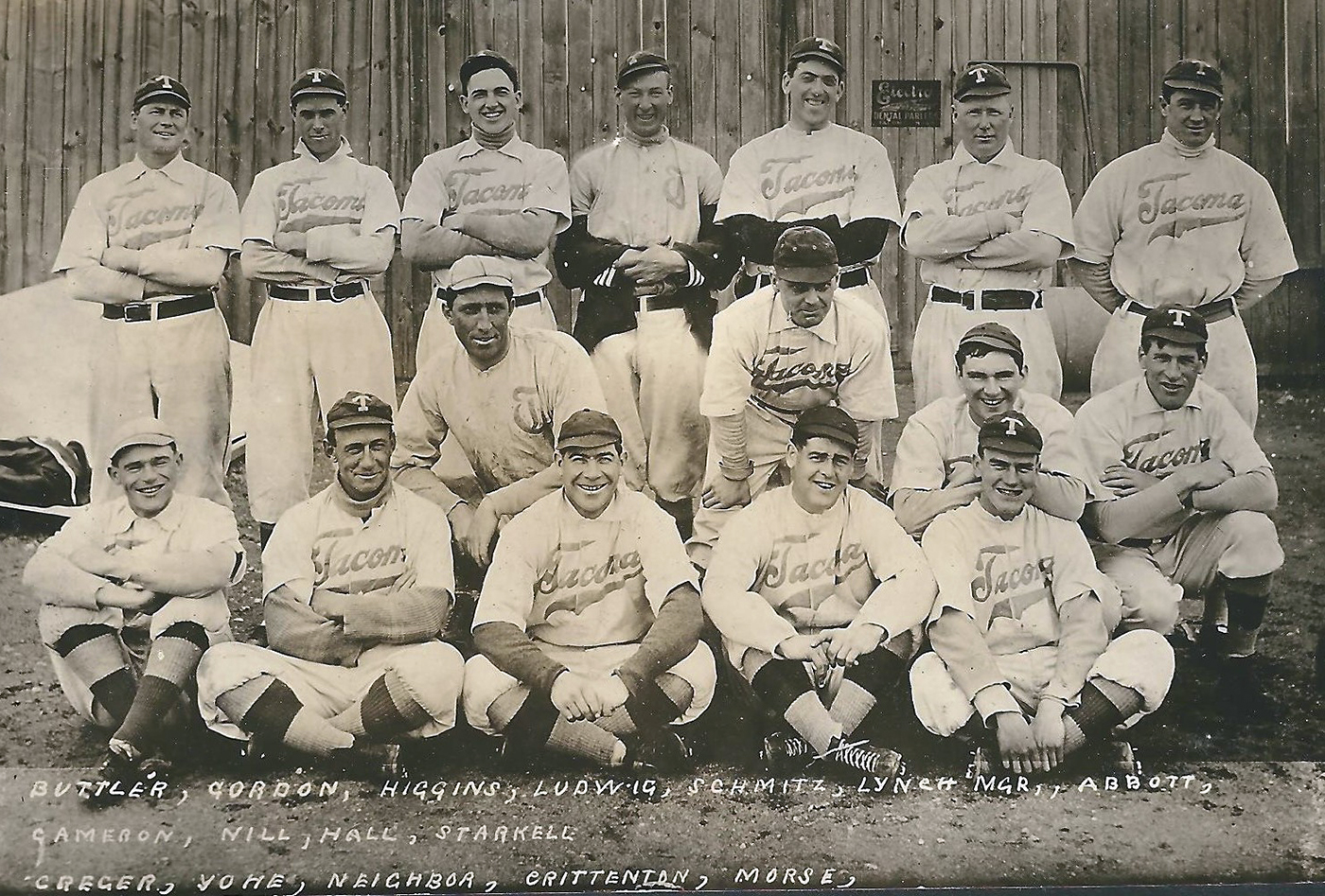
Link to his minor league stats - www.baseball-reference.com/register/player.fcgi?id=starke...
MLB debut - April 19, 1906, for the Washington Senators
Last MLB appearance - April 19, 1906, for the Washington Senators
MLB statistics:
Win–loss record 0–0
ERA - 18.00
Strikeouts - 1
Teams:
Washington Senators (1906)
(San Bernardino Sun, Volume 39, 20 January 1933) - FRIDAY, JANUARY 20, 1933 - PITCHER DIES TACOMA, Wash., Jan. 19 -Conrad Starkel, 52, who pitched them down the groove for the New York Yankees and the St. Louis Cardinals for four years in the early 1900's, died at home here today.
Mighty. Morphin. Power. Rangers.
The OG as introduced by Saban into the English speaking work, and international phenomenon, this adaptation of the Super Sentai Zyuranger became a household name back in 1993, and has been in the hearts of fans since. Me? Well, I enjoyed the show for what it is.. a fun way to kill half an hour, but as always, it was about the toys for me. In recent years, the MMPR franchise has been revisited, first with Bandai of America creating the Legacy product line and milking the MMPR brand, then with the 2017 motion picture that didn't quite make the money Saban wanted it to (I have a theory about this and how it didn't matter, but that's for another discussion). The biggest news would be how Hasbro, now the holders of the Power Ranger toy license, would revisit MMPR and other past Power Rangers characters through something they called the Lightning Collection, a series of collectors grade figures. Personally, I was impartial to this - while others were excited to add these to their collection, I never really got into it when Bandai did it with their Legacy figures and as such, I wouldn't really be pursuing these releases, with the exception of buying one or two to do a bit of comparison and contrast, as well as satisfy my own curiosity regarding a conspiracy theory.
In case it wasn't obvious by now, I tend to buy female figures because not only do they generally look better, but it's harder to hidd things on their comparatively smaller bodies. I bought exactly one figure from the Bandai Legacy line - Ninja Storm Blue (or in my case, Hurricane Blue) and while I never really reviewed it, it can summarize it as follows - it was alright. Nothing earth shattering, and definitely not worth the $25 CAD MSRP to me. Well, in Wave 2 of the Hasbro Lightning series, we see the release of the first female Ranger of the line, Kimberly Hart, the original Pink Ranger and Mistress of the Pterodactyl Zord. For the record, Kat was always my MMPR Pink of choice... I always found Kimberly kind of boring.
Finding her was a bit of a pain, though not as bad as others have had it.. definitely much easier than finding Springer, that's for sure. Just a few phone calls and a 10 minute drive from home.
Normally I'd wait to open this up, as I have been stocking up on some other goodies lately, but questions needed answering dammit, so Kimberly here jumped the queue and was opened next.. about an hour after purchase, in fact. So, without further ado, here is my overview and thoughts on the Power Rangers Lightning Collection Mighty Morphin Pink Ranger.
Each Lightning figure comes with the figure itself, an unmorphed (helmetless) head sculpt, a combination of posing and weapon holding hands, the trademark weapons of the character, and some sort of energy effect. In the case of Kimberly, she comes with her bow and arrow, her Blade Blaster side arm, as well as an energy arrow. MSRP is about $20 USD, or roughly what a Marvel Legends figure costs in your area.
As the picture shows, Kimberly is roughly the same size as Captain Marvel who is my benchmark female Marvel Legends figure. These figures are of course a smidgen bigger than your typical female S.H. Figuarts figure (i.e. Black Widow), but smaller than the Bandai Legacy female body. While Kimberly isn't as busty as the Blue Ranger, she's certainly less NFL Quarterback in terms of build. Now we got that out of the way, let us focus the comparison on the two players that really matter - Kimberly, and Captain Marvel. Now, the cynic in me pretty much assumed that Hasbro wouldn't reinvent the wheel when it didn't have to, both for better and worse. After all, they developed a body for their Legends line, and it would make sense to reuse it for this line, considering that the price point is the same. So, was I right?
Let's start things off with a discussion of aesthetics, articulation, and build quality. Now, no action figure, even the almighty Figuarts release, ever actually replicated the proportions of the suit actors perfectly, so it's not a surprise that things haven't changed here, though I'd like them to resemble human proportions a little better. For whatever reason, her chest area uses plastics that are harder than the rest of her body, and are a tint or two darker than the other pinks on her body. It doesn't show up on my photos, which are powered by flash, but in the crappy room lights I have here, it's clear as day. But in general, unless you're blind, it's pretty clear that this is the MMPR Pink Ranger.
I mentioned before that Kimberly has a different height and body shape than your standard Figuarts and Bandai Legacy body. Having said that, however, I think you should be able to see that Kimberly and Captain Marvel share the same general overall silhouette - in fact, if you look really close, you can see the retooling of common parts (upper arms and thighs, for example). I submit to you that the female Lightning body is at its core, an upcycled Legends body, which somehow manages to improve things, and make them worse at the same time. The Lightning female takes the Legends articulation (pivoting and rotating ankles, double jointed knees, thigh swivel, rotating hips, mid torso ball joint, rotating/pivoting shoulders, rotating/pivoting elbows, wrist rotate/pivot (depending on hand) and ball jointed head with a pivoting neck) and adds to it with boots that rotate and shoulders that allow for chest collapse, improving range of motion and posing options. The knee joints are new, most likely needing a redesign due to the the new lower foot/boot combo used. Design of the lower body basically prevents limits the motion of the lower legs to.. I'm going say about 110 degrees or so. No high kicking for this girl...
So, overall, I've talked about some nice improvements to the status quo - what am I babbling about with regards to better AND worse then?
Well, you see, this is why I looped in build quality into this first point of discussion. Now whatever material Captain Marvel is made of, it's pretty durable and tough, being hard without being brittle. Kimberly, on the other hand, is predominately made up of what they make Transformers of these days, which feels to me like the plastics used in the 3D printing system. This material is softer than the stuff the good Captain is made from. Not an issue on its own, because if this were the end of the story the most I could talk about is how you can't really get any good detailing in the plastics and that it feels like of rough.
You notice how Kimberly seems to be bow legged? Well, unlike the lovely DC Icons Wonder Woman I just looked at, THESE joints are made of that same soft plastic that basically was warped due to the restraints of the packaging. Not sure if this is a material issue, or perhaps they didn't wait long enough for the plastic to settle, but the end result is Kimberly is destined to walk like a freakin' cowboy for the rest of her days. Her elbows are made of the same soft plastic, but due to the way she was packaged I guess there was no warping.
Another gripe I have is that the ratcheting joints used for shoulders of the Legends figures remain, which normally isn't a problem as you're able to easily apply the necessary force to move it. Now, with her collapsing shoulders, the whole joint has a tendency to move, rather than just the part you want to rotate, making raising and lowering the arms a potential exercise in annoyance.
So there you go.. better.. AND worse.. all at the same time.
Paint apps are pretty standard affair for anything that Hasbro does on their own (Transformers are shared with Takara as a unified product, so there are higher standards there to be met), namely that paint isn't applied on places that it isn't deemed necessary, and the quality of the apps themselves range from alright to oversprayed with not the greatest masking work. The larger paint apps generally made it through in one piece, though clearly not so much the minute details. Sculpting detailing on the suit, helmet, and weapons are alright. Nothing overly bad about it, and generally the work is quite competent, and includes some more detailing on the helmet that I didn't expect to see, as well as the gloves. I do enjoy the pink energy effect, though I'd enjoy it more if the figure could hold the bloody thing better. The bow fits alright and I'll be honest, I didn't bother with the Blade Blaster, but it seems to me the hand pictured holding the arrow is actually moulded to hold this weapon specifically.
We're not QUITE done yet, as I've saved best for last. Let's talk about that unhelmeted sculpt. It looks like the artist who made that Paul Rudd sculpt I can't stand decided to give Kimberly Hart a try with equally disastrous results. I think they got the hairline right, and possibly her earrings. Other than that... YIKES. Definitely keeping the helmeted on this figure.
So in conclusion, my overall feeling is a resounding "meh". It's pretty much what I expected, and not exactly the new standard to beat, but it is a step in the right direction. Knowing Hasbro, I don't exactly see them making changes that I complained about here, so I really have no need to revisit this line, but perhaps there is hope that the Legends line can be provided with improvements seen here, most notable being the ability to collapse the shoulders towards the chest. But that's me, and as admitted before, Domestic figures really aren't my thing. For everyone else out there, you really need to be aware of the issues with the knee joints - it's been almost 10 hours since I've opened mine and it's not her legs have straightened out, and the legs can be bent so easily it's not funny.
A decent looking figure with some good strengths balanced by some awful design choices.
"...to dissolve the unholy alliance between corrupt business and corrupt politics, is the first task of the statesmanship of the day." - Theodore Roosevelt
Do you want to share a relevant quote? Please do so in comments below.
THE WEB GOES ON STRIKE! Read All About It!
NOTE: After experiencing the day of protest about SOPA/PIP it is clear that the action could better be called a Web Blackout rather than a Strike.
TAKE ACTION! Google has a form.
Political parties exist to secure responsible government and to execute the will of the people. From these great tasks both of the old parties have turned aside. Instead of instruments to promote the general welfare they have become the tools of corrupt interests, which use them impartially to serve their selfish purposes. Behind the ostensible government sits enthroned an invisible government owing no allegiance and acknowledging no responsibility to the people. To destroy this invisible government, to dissolve the unholy alliance between corrupt business and corrupt politics, is the first task of the statesmanship of the day.
The source image for this caricature was adapted from a black and white image available at the Library of Congress website.
Found beneath the floor of a house there, probably buried for safekeeping during Boudica's attack by fleeing Romans. The building was destroyed by fire and the hoard was never retrieved. Its owners were probably killed. The hoard comprises Roman republican and imperial coins as well as earrings, bracelets, armlets, finger rings and an amulet box. The jewellery was probably made in Italy. Two of the armlets are military decorations, awarded to a retired soldier.
[British Museum]
Nero: the Man Behind the Myth
(May - Oct 2021)
Nero is known as one of Rome's most infamous rulers, notorious for his cruelty, debauchery and madness.
The last male descendant of the emperor Augustus, Nero succeeded to the throne in AD 54 aged just 16 and died a violent death at 30. His turbulent rule saw momentous events including the Great Fire of Rome, Boudicca's rebellion in Britain, the execution of his own mother and first wife, grand projects and extravagant excesses.
Drawing on the latest research, this major exhibition questions the traditional narrative of the ruthless tyrant and eccentric performer, revealing a different Nero, a populist leader at a time of great change in Roman society.
Through some 200 spectacular objects, from the imperial palace in Rome to the streets of Pompeii, follow the young emperor’s rise and fall and make up your own mind about Nero. Was he a young, inexperienced ruler trying his best in a divided society, or the merciless, matricidal megalomaniac history has painted him to be?
Nero was the 5th emperor of Rome and the last of Rome’s first dynasty, the Julio-Claudians, founded by Augustus (the adopted son of Julius Caesar). Nero is known as one of Rome’s most infamous rulers, notorious for his cruelty and debauchery. He ascended to power in AD 54 aged just 16 and died at 30. He ruled at a time of great social and political change, overseeing momentous events such as the Great Fire of Rome and Boudica’s rebellion in Britain. He allegedly killed his mother and two of his wives, only cared about his art and had very little interest in ruling the empire.
Most of what we know about Nero comes from the surviving works of three historians – Tacitus, Suetonius and Cassius Dio. All written decades after Nero’s death, their accounts have long shaped our understanding of this emperor’s rule. However, far from being impartial narrators presenting objective accounts of past events, these authors and their sources wrote with a very clear agenda in mind. Nero’s demise brought forward a period of chaos and civil war – one that ended only when a new dynasty seized power, the Flavians. Authors writing under the Flavians all had an interest in legitimising the new ruling family by portraying the last of the Julio-Claudians in the worst possible light, turning history into propaganda. These accounts became the ‘historical’ sources used by later historians, therefore perpetuating a fabricated image of Nero, which has survived all the way to the present.
Nero was born Lucius Domitius Ahenobarbus on 15 December AD 37.
He was the son of Gnaeus Domitius Ahenobarbus and Agrippina the Younger. Both Gnaeus and Agrippina were the grandchildren of Augustus, making Nero Augustus’ great, great grandson with a strong claim to power.
Nero was only two years old when his mother was exiled and three when his father died. His inheritance was taken from him and he was sent to live with his aunt. However, Nero’s fate changed again when Claudius became emperor, restoring the boy’s property and recalling his mother Agrippina from exile.
In AD 49 the emperor Claudius married Agrippina, and adopted Nero the following year. It is at this point that Lucius Domitius Ahenobarbus changed his name to Nero Claudius Caesar Drusus Germanicus. In Roman times it was normal to change your name when adopted, abandoning your family name in favour of your adoptive father’s. Nero was a common name among members of the Claudian family, especially in Claudius’ branch.
Nero and Agrippina offered Claudius a politically useful link back to Augustus, strengthening his position.
Claudius appeared to favour Nero over his natural son, Britannicus, marking Nero as the designated heir.
When Claudius died in AD 54, Nero became emperor just two months before turning 17.
As he was supported by both the army and the senate, his rise to power was smooth. His mother Agrippina exerted a significant influence, especially at the beginning of his rule.
The Roman historians Tacitus, Suetonius and Cassius Dio all claim that Nero, fed up with Agrippina’s interference, decided to kill her.
Given the lack of eyewitnesses, there is no way of knowing if or how this happened. However, this did not stop historians from fabricating dramatic stories of Agrippina’s murder, asserting that Nero tried (and failed) to kill her with a boat engineered to sink, before sending his men to do the job.
Agrippina allegedly told them to stab her in the womb that bore Nero, her last words clearly borrowed from stage plays.
It is entirely possible, as claimed by Nero himself, that Agrippina chose (or was more likely forced) to take her own life after her plot against her son was discovered.
Early in his rule, Nero had to contend with a rebellion in the newly conquered province of Britain.
In AD 60–61, Queen Boudica of the Iceni tribe led a revolt against the Romans, attacking and laying waste to important Roman settlements. The possible causes of the rebellion were numerous – the greed of the Romans exploiting the newly conquered territories, the recalling of loans made to local leaders, ongoing conflict in Wales and, above all, violence against the family of Prasutagus, Boudica’s husband and king of the Iceni.
Boudica and the rebels destroyed Colchester, London and St Albans before being heavily defeated by Roman troops. After the uprising, the governor of Britain Suetonius Paulinus introduced harsher laws against the Britons, until Nero replaced him with the more conciliatory governor Publius Petronius Turpilianus.
The marriage between Nero and Octavia, aged 15 and 13/14 at the time, was arranged by their parents in order to further legitimise Nero’s claim to the throne. Octavia was the daughter of the emperor Claudius from a previous marriage, so when Claudius married Agrippina and adopted her son Nero, Nero and Octavia became brother and sister. In order to arrange their marriage, Octavia had to be adopted into another family.
Their marriage was not a happy one. According to ancient writers, Nero had various affairs until his lover Poppaea Sabina convinced him to divorce his wife. Octavia was first exiled then executed in AD 62 on adultery charges. According to ancient writers, her banishment and death caused great unrest among the public, who sympathised with the dutiful Octavia.
No further motives were offered for Octavia’s death other than Nero’s passion for Poppaea, and we will probably never know what transpired at court. The fact that Octavia couldn’t produce an heir while Poppaea was pregnant with Nero’s daughter likely played an important role in deciding Octavia’s fate.
On 19 July AD 64, a fire started close to the Circus Maximus. The flames soon encompassed the entire city of Rome and the fire raged for nine days. Only four of the 14 districts of the capital were spared, while three were completely destroyed.
Rome had already been razed by flames – and would be again in its long history – but this event was so severe it came to be known as the Great Fire of Rome.
Later historians blamed Nero for the event, claiming that he set the capital ablaze in order to clear land for the construction of a vast new palace. According to Suetonius and Cassius Dio, Nero took in the view of the burning city from the imperial residence while playing the lyre and singing about the fall of Troy. This story, however, is fictional.
Tacitus, the only historian who was actually alive at the time of the Great Fire of Rome (although only 8 years old), wrote that Nero was not even in Rome when the fire started, but returned to the capital and led the relief efforts.
Tacitus, Suetonius and Cassius Dio all describe Nero as being blinded by passion for his wife Poppaea, yet they accuse him of killing her, allegedly by kicking her in an outburst of rage while she was pregnant.
Interestingly, pregnant women being kicked to death by enraged husbands is a recurring theme in ancient literature, used to explore the (self) destructive tendencies of autocrats. The Greek writer Herodotus tells the story of how the Persian king Cambyses kicked his pregnant wife in the stomach, causing her death. A similar episode is told of Periander, tyrant of Corinth. Nero is just one of many allegedly ‘mad’ tyrants for which this literary convention was used.
Poppaea probably died from complications connected with her pregnancy and not at Nero’s hands. She was given a lavish funeral and was deified.
Centred on greater Iran, the Parthian empire was a major political and cultural power and a long-standing enemy of Rome. The two powers had long been contending for control over the buffer state of Armenia and open conflict sparked again during Nero’s rule. The Parthian War started in AD 58 and, after initial victories and following set-backs, ended in AD 63 when a diplomatic solution was reached between Nero and the Parthian king Vologases I.
According to this settlement Tiridates, brother of the Parthian king, would rule over Armenia, but only after having travelled all the way to Rome to be crowned by Nero.
The journey lasted 9 months, Tiridates’ retinue included 3,000 Parthian horsemen and many Roman soldiers. The coronation ceremony took place in the summer of AD 66 and the day was celebrated with much pomp: all the people of Rome saw the new king of Armenia kneeling in front of Nero. This was the Golden Day of Nero’s rule
In AD 68, Vindex, the governor of Gaul (France), rebelled against Nero and declared his support for Galba, the governor of Spain. Vindex was defeated in battle by troops loyal to Nero, yet Galba started gaining more military support.
It was at this point that Nero lost the support of Rome’s people due to a grain shortage, caused by a rebellious commander who cut the crucial food supply from Egypt to the capital. Abandoned by the people and declared an enemy of the state by the senate, Nero tried to flee Rome and eventually committed suicide.
Following his death, Nero’s memory was condemned (a practice called damnatio memoriae) and the images of the emperor were destroyed, removed or reworked. However, Nero was still given an expensive funeral and for a long time people decorated his tomb with flowers, some even believing he was still alive.
After Nero’s death, civil war ensued. At the end of the so-called ‘Year of the Four Emperors’ (AD 69), Vespasian became emperor and started a new dynasty: the Flavians.
[Francesca Bologna, curator, for British Museum]
Taken in the British Museum
Mighty. Morphin. Power. Rangers.
The OG as introduced by Saban into the English speaking work, and international phenomenon, this adaptation of the Super Sentai Zyuranger became a household name back in 1993, and has been in the hearts of fans since. Me? Well, I enjoyed the show for what it is.. a fun way to kill half an hour, but as always, it was about the toys for me. In recent years, the MMPR franchise has been revisited, first with Bandai of America creating the Legacy product line and milking the MMPR brand, then with the 2017 motion picture that didn't quite make the money Saban wanted it to (I have a theory about this and how it didn't matter, but that's for another discussion). The biggest news would be how Hasbro, now the holders of the Power Ranger toy license, would revisit MMPR and other past Power Rangers characters through something they called the Lightning Collection, a series of collectors grade figures. Personally, I was impartial to this - while others were excited to add these to their collection, I never really got into it when Bandai did it with their Legacy figures and as such, I wouldn't really be pursuing these releases, with the exception of buying one or two to do a bit of comparison and contrast, as well as satisfy my own curiosity regarding a conspiracy theory.
In case it wasn't obvious by now, I tend to buy female figures because not only do they generally look better, but it's harder to hidd things on their comparatively smaller bodies. I bought exactly one figure from the Bandai Legacy line - Ninja Storm Blue (or in my case, Hurricane Blue) and while I never really reviewed it, it can summarize it as follows - it was alright. Nothing earth shattering, and definitely not worth the $25 CAD MSRP to me. Well, in Wave 2 of the Hasbro Lightning series, we see the release of the first female Ranger of the line, Kimberly Hart, the original Pink Ranger and Mistress of the Pterodactyl Zord. For the record, Kat was always my MMPR Pink of choice... I always found Kimberly kind of boring.
Finding her was a bit of a pain, though not as bad as others have had it.. definitely much easier than finding Springer, that's for sure. Just a few phone calls and a 10 minute drive from home.
Normally I'd wait to open this up, as I have been stocking up on some other goodies lately, but questions needed answering dammit, so Kimberly here jumped the queue and was opened next.. about an hour after purchase, in fact. So, without further ado, here is my overview and thoughts on the Power Rangers Lightning Collection Mighty Morphin Pink Ranger.
Each Lightning figure comes with the figure itself, an unmorphed (helmetless) head sculpt, a combination of posing and weapon holding hands, the trademark weapons of the character, and some sort of energy effect. In the case of Kimberly, she comes with her bow and arrow, her Blade Blaster side arm, as well as an energy arrow. MSRP is about $20 USD, or roughly what a Marvel Legends figure costs in your area.
As the picture shows, Kimberly is roughly the same size as Captain Marvel who is my benchmark female Marvel Legends figure. These figures are of course a smidgen bigger than your typical female S.H. Figuarts figure (i.e. Black Widow), but smaller than the Bandai Legacy female body. While Kimberly isn't as busty as the Blue Ranger, she's certainly less NFL Quarterback in terms of build. Now we got that out of the way, let us focus the comparison on the two players that really matter - Kimberly, and Captain Marvel. Now, the cynic in me pretty much assumed that Hasbro wouldn't reinvent the wheel when it didn't have to, both for better and worse. After all, they developed a body for their Legends line, and it would make sense to reuse it for this line, considering that the price point is the same. So, was I right?
Let's start things off with a discussion of aesthetics, articulation, and build quality. Now, no action figure, even the almighty Figuarts release, ever actually replicated the proportions of the suit actors perfectly, so it's not a surprise that things haven't changed here, though I'd like them to resemble human proportions a little better. For whatever reason, her chest area uses plastics that are harder than the rest of her body, and are a tint or two darker than the other pinks on her body. It doesn't show up on my photos, which are powered by flash, but in the crappy room lights I have here, it's clear as day. But in general, unless you're blind, it's pretty clear that this is the MMPR Pink Ranger.
I mentioned before that Kimberly has a different height and body shape than your standard Figuarts and Bandai Legacy body. Having said that, however, I think you should be able to see that Kimberly and Captain Marvel share the same general overall silhouette - in fact, if you look really close, you can see the retooling of common parts (upper arms and thighs, for example). I submit to you that the female Lightning body is at its core, an upcycled Legends body, which somehow manages to improve things, and make them worse at the same time. The Lightning female takes the Legends articulation (pivoting and rotating ankles, double jointed knees, thigh swivel, rotating hips, mid torso ball joint, rotating/pivoting shoulders, rotating/pivoting elbows, wrist rotate/pivot (depending on hand) and ball jointed head with a pivoting neck) and adds to it with boots that rotate and shoulders that allow for chest collapse, improving range of motion and posing options. The knee joints are new, most likely needing a redesign due to the the new lower foot/boot combo used. Design of the lower body basically prevents limits the motion of the lower legs to.. I'm going say about 110 degrees or so. No high kicking for this girl...
So, overall, I've talked about some nice improvements to the status quo - what am I babbling about with regards to better AND worse then?
Well, you see, this is why I looped in build quality into this first point of discussion. Now whatever material Captain Marvel is made of, it's pretty durable and tough, being hard without being brittle. Kimberly, on the other hand, is predominately made up of what they make Transformers of these days, which feels to me like the plastics used in the 3D printing system. This material is softer than the stuff the good Captain is made from. Not an issue on its own, because if this were the end of the story the most I could talk about is how you can't really get any good detailing in the plastics and that it feels like of rough.
You notice how Kimberly seems to be bow legged? Well, unlike the lovely DC Icons Wonder Woman I just looked at, THESE joints are made of that same soft plastic that basically was warped due to the restraints of the packaging. Not sure if this is a material issue, or perhaps they didn't wait long enough for the plastic to settle, but the end result is Kimberly is destined to walk like a freakin' cowboy for the rest of her days. Her elbows are made of the same soft plastic, but due to the way she was packaged I guess there was no warping.
Another gripe I have is that the ratcheting joints used for shoulders of the Legends figures remain, which normally isn't a problem as you're able to easily apply the necessary force to move it. Now, with her collapsing shoulders, the whole joint has a tendency to move, rather than just the part you want to rotate, making raising and lowering the arms a potential exercise in annoyance.
So there you go.. better.. AND worse.. all at the same time.
Paint apps are pretty standard affair for anything that Hasbro does on their own (Transformers are shared with Takara as a unified product, so there are higher standards there to be met), namely that paint isn't applied on places that it isn't deemed necessary, and the quality of the apps themselves range from alright to oversprayed with not the greatest masking work. The larger paint apps generally made it through in one piece, though clearly not so much the minute details. Sculpting detailing on the suit, helmet, and weapons are alright. Nothing overly bad about it, and generally the work is quite competent, and includes some more detailing on the helmet that I didn't expect to see, as well as the gloves. I do enjoy the pink energy effect, though I'd enjoy it more if the figure could hold the bloody thing better. The bow fits alright and I'll be honest, I didn't bother with the Blade Blaster, but it seems to me the hand pictured holding the arrow is actually moulded to hold this weapon specifically.
We're not QUITE done yet, as I've saved best for last. Let's talk about that unhelmeted sculpt. It looks like the artist who made that Paul Rudd sculpt I can't stand decided to give Kimberly Hart a try with equally disastrous results. I think they got the hairline right, and possibly her earrings. Other than that... YIKES. Definitely keeping the helmeted on this figure.
So in conclusion, my overall feeling is a resounding "meh". It's pretty much what I expected, and not exactly the new standard to beat, but it is a step in the right direction. Knowing Hasbro, I don't exactly see them making changes that I complained about here, so I really have no need to revisit this line, but perhaps there is hope that the Legends line can be provided with improvements seen here, most notable being the ability to collapse the shoulders towards the chest. But that's me, and as admitted before, Domestic figures really aren't my thing. For everyone else out there, you really need to be aware of the issues with the knee joints - it's been almost 10 hours since I've opened mine and it's not her legs have straightened out, and the legs can be bent so easily it's not funny.
A decent looking figure with some good strengths balanced by some awful design choices.