View allAll Photos Tagged impartial
Do these pants make me look fat?
Valley Fair Shopping Center, Santa Clara, California
Panasonic Lumix DMC-LX1
Aperture (RAW fine tuning, levels, white balance, crop), NeatImage (noise, sharpen), Photoshop (slim/trim, liquefy, clone stamp), nik CEP (sunshine)
1/25 sec @ f/2.8, iso 200, 6mm (28mm)
____________________________________________________
Clothing shopping at Valley Fair mall.
It doesn’t matter if she’s just a friend or a lover, you are going to be asked if her pants are going to make her butt look fat. Let’s face it, even if you say, “No, they make me forget that I broke up with you and think of some very naughty stuff involving you, losing those jeans, and that changing room,” they’re not going to believe you. Even if that’s the God to honest truth!
I’m trying a new solution. I instead let the “impartial” eyes of my camera decide it for her. I take a few photos of her modelling the clothing and then let her decide. Ahh! the wonders of digital photography. New rule: There is nothing wrong with chimping a hottie you aren’t dating.
(After this shot, I had her ask the sales clerk to help with layering the shirt. Having relatively plain shirts and camis and then layering them seems to be the new thing. I don’t know if I have any good shots showing layering.)
The Panasonic Lumix DMC-LX1 is a perfect camera for this. The 16:9 aspect ratio and 28mm lens (practical given the amount of room in the hallway) really help!
I actually wasn’t enthusiastic about editing this photo because I already have another one cropping out her face and I had to do crop this one because she blinked when I took the shot. But Caitlin processed another of my shots which you can see here that shows her face. I figure I can get away with this.
Of course, I couldn’t pass up the opportunity to play around a little with liquefy. But I was very conservative, I promise! The sunshine filter from Nik Color Effects makes removes the antiseptic lighting.
She ended up purchasing those jeans. :-D For the curious, they are Express X2 W10 denim pants with a flare leg and inky rinse finish. You can find it here and a very different look from the other pair of jeans she bought that day. Variety is good.
(And no, I don’t think they make her look fat.)
On a completely different note, nearly every clothing store I went to had at least one guy sales clerk set off my “gaydar.” Is this usual or just a Bay Area thing? I haven’t been shopping in years so I haven’t a clue.
Click for original photograph (If you cannot view this, add me to your contacts and I’ll add you to my friends. If you are already a contact of mine then just jet me a message and I'll fix your status.)
Japanese and other East Asian artists and here primary school children often draw pictures from an elevated birds eye view (Masuda, Gonzalez, Kwan & Nisbett, 2008). Part of the reason for this is their there desire to show everything in their pictures, to the extent that in some of these pictures the viewpoint is from that of an all-seeing eye that can look downards in all directions. So as Masuda, Gonzalez, Kawan and Nisbett argue, part of the motivation for this is the desire to see the context of actions, events, and people. I argue that another motivation is that the internalisation of this viewpoint enables them to gain a self view in a similar way to that provided by George Herbert Mead's "generalised other." And as argued by Derrida they become addicted to this view of the world since they become libidinally involved in the self relationship that viewing themselves facilitates. Contra the Western self, there may be no sexual element to this self-viewing but rather an enjoyment of seeing themselves and their actions, as cute, from the point of view of an all seeing co-viewing mother.
This internalised other sometimes makes a reapparane in the horrible women that appear from images, television sets, developer fluid, lanterns and scrolls, or sometimes hiding in a mass of black hair on the ceiling, in Japanese horror movies and legends.
It is I believe the internalisation of this self-viewing intra-psychic Other that keeps the Japapnese as moral as their are and not any external sword (or bits of wire) as argued by Ruth Benedict.
Incidentally, my father's Art School Graduation picture was of a group of people around a table drawn from above. I believe that the auto-scopic eye in the sky is present in everyone to a degree, and felt more keenly by those of Scottish Descent such as Adam Smith (whose impartial spectator appears to be a mixture of both a linguistic and visual audience), my father, and myself.
Images Copyright their respective artists.
お取下げご希望でありましたら、下記のコメント欄またはnihonbunka.comのメールリンクからご連絡いただければ幸いです。
Bibliography
Masuda, T., Gonzalez, R., Kwan, L., & Nisbett, R. E. (2008). Culture and aesthetic preference: Comparing the attention to context of East Asians and Americans. Personality and Social Psychology Bulletin, 34(9), 1260-1275.
Benedict, R. (2006). The Chrysanthemum and the Sword (1st ed.). Mariner Books.
Lummis, D. (2007). Ruth Benedict’s Obituary for Japanese Culture. Japan Focus, 23. Retrieved from www.japanfocus.org/-C__Douglas-Lummis/2474
On Holocaust Memorial Day, I thought I would share pictures of a memorial to one of my heroes, Raoul Wallenberg.
Raoul Wallenberg was a Swedish businessman who in 1944 accepted an assignment from the US War Refugee Board to help save members of the Jewish Community in Budapest, Hungary from the Nazis. Classed as a “Diplomat”, he did this by issuing protective passports and setting up “safe houses” as Swedish diplomatic missions. He has been attributed to saving more than 100,000 Jews.
However, Raoul Wallenberg did not enjoy freedom after the war. In January 1945 he was arrested by the Soviet Union. From this time onwards he was lost in the Soviet prison system. It appears that the Soviets considered him a spy, and despite many sightings after 1945, it took many years for the Soviet Union to admit they had arrested him.
Eventually the Soviet Union produced a death certificate, stating he died in Lubyanka Prison on 17 July 1947. However, witnesses have reported seeing Raoul Wallenberg as late as 1980. Research to find out what actually happened is still being chased by the Wallenberg family, but until the archives in Russia are opened to impartial researchers, the truth of what happened to Raoul will never be known.
Mighty. Morphin. Power. Rangers.
The OG as introduced by Saban into the English speaking work, and international phenomenon, this adaptation of the Super Sentai Zyuranger became a household name back in 1993, and has been in the hearts of fans since. Me? Well, I enjoyed the show for what it is.. a fun way to kill half an hour, but as always, it was about the toys for me. In recent years, the MMPR franchise has been revisited, first with Bandai of America creating the Legacy product line and milking the MMPR brand, then with the 2017 motion picture that didn't quite make the money Saban wanted it to (I have a theory about this and how it didn't matter, but that's for another discussion). The biggest news would be how Hasbro, now the holders of the Power Ranger toy license, would revisit MMPR and other past Power Rangers characters through something they called the Lightning Collection, a series of collectors grade figures. Personally, I was impartial to this - while others were excited to add these to their collection, I never really got into it when Bandai did it with their Legacy figures and as such, I wouldn't really be pursuing these releases, with the exception of buying one or two to do a bit of comparison and contrast, as well as satisfy my own curiosity regarding a conspiracy theory.
In case it wasn't obvious by now, I tend to buy female figures because not only do they generally look better, but it's harder to hidd things on their comparatively smaller bodies. I bought exactly one figure from the Bandai Legacy line - Ninja Storm Blue (or in my case, Hurricane Blue) and while I never really reviewed it, it can summarize it as follows - it was alright. Nothing earth shattering, and definitely not worth the $25 CAD MSRP to me. Well, in Wave 2 of the Hasbro Lightning series, we see the release of the first female Ranger of the line, Kimberly Hart, the original Pink Ranger and Mistress of the Pterodactyl Zord. For the record, Kat was always my MMPR Pink of choice... I always found Kimberly kind of boring.
Finding her was a bit of a pain, though not as bad as others have had it.. definitely much easier than finding Springer, that's for sure. Just a few phone calls and a 10 minute drive from home.
Normally I'd wait to open this up, as I have been stocking up on some other goodies lately, but questions needed answering dammit, so Kimberly here jumped the queue and was opened next.. about an hour after purchase, in fact. So, without further ado, here is my overview and thoughts on the Power Rangers Lightning Collection Mighty Morphin Pink Ranger.
Each Lightning figure comes with the figure itself, an unmorphed (helmetless) head sculpt, a combination of posing and weapon holding hands, the trademark weapons of the character, and some sort of energy effect. In the case of Kimberly, she comes with her bow and arrow, her Blade Blaster side arm, as well as an energy arrow. MSRP is about $20 USD, or roughly what a Marvel Legends figure costs in your area.
As the picture shows, Kimberly is roughly the same size as Captain Marvel who is my benchmark female Marvel Legends figure. These figures are of course a smidgen bigger than your typical female S.H. Figuarts figure (i.e. Black Widow), but smaller than the Bandai Legacy female body. While Kimberly isn't as busty as the Blue Ranger, she's certainly less NFL Quarterback in terms of build. Now we got that out of the way, let us focus the comparison on the two players that really matter - Kimberly, and Captain Marvel. Now, the cynic in me pretty much assumed that Hasbro wouldn't reinvent the wheel when it didn't have to, both for better and worse. After all, they developed a body for their Legends line, and it would make sense to reuse it for this line, considering that the price point is the same. So, was I right?
Let's start things off with a discussion of aesthetics, articulation, and build quality. Now, no action figure, even the almighty Figuarts release, ever actually replicated the proportions of the suit actors perfectly, so it's not a surprise that things haven't changed here, though I'd like them to resemble human proportions a little better. For whatever reason, her chest area uses plastics that are harder than the rest of her body, and are a tint or two darker than the other pinks on her body. It doesn't show up on my photos, which are powered by flash, but in the crappy room lights I have here, it's clear as day. But in general, unless you're blind, it's pretty clear that this is the MMPR Pink Ranger.
I mentioned before that Kimberly has a different height and body shape than your standard Figuarts and Bandai Legacy body. Having said that, however, I think you should be able to see that Kimberly and Captain Marvel share the same general overall silhouette - in fact, if you look really close, you can see the retooling of common parts (upper arms and thighs, for example). I submit to you that the female Lightning body is at its core, an upcycled Legends body, which somehow manages to improve things, and make them worse at the same time. The Lightning female takes the Legends articulation (pivoting and rotating ankles, double jointed knees, thigh swivel, rotating hips, mid torso ball joint, rotating/pivoting shoulders, rotating/pivoting elbows, wrist rotate/pivot (depending on hand) and ball jointed head with a pivoting neck) and adds to it with boots that rotate and shoulders that allow for chest collapse, improving range of motion and posing options. The knee joints are new, most likely needing a redesign due to the the new lower foot/boot combo used. Design of the lower body basically prevents limits the motion of the lower legs to.. I'm going say about 110 degrees or so. No high kicking for this girl...
So, overall, I've talked about some nice improvements to the status quo - what am I babbling about with regards to better AND worse then?
Well, you see, this is why I looped in build quality into this first point of discussion. Now whatever material Captain Marvel is made of, it's pretty durable and tough, being hard without being brittle. Kimberly, on the other hand, is predominately made up of what they make Transformers of these days, which feels to me like the plastics used in the 3D printing system. This material is softer than the stuff the good Captain is made from. Not an issue on its own, because if this were the end of the story the most I could talk about is how you can't really get any good detailing in the plastics and that it feels like of rough.
You notice how Kimberly seems to be bow legged? Well, unlike the lovely DC Icons Wonder Woman I just looked at, THESE joints are made of that same soft plastic that basically was warped due to the restraints of the packaging. Not sure if this is a material issue, or perhaps they didn't wait long enough for the plastic to settle, but the end result is Kimberly is destined to walk like a freakin' cowboy for the rest of her days. Her elbows are made of the same soft plastic, but due to the way she was packaged I guess there was no warping.
Another gripe I have is that the ratcheting joints used for shoulders of the Legends figures remain, which normally isn't a problem as you're able to easily apply the necessary force to move it. Now, with her collapsing shoulders, the whole joint has a tendency to move, rather than just the part you want to rotate, making raising and lowering the arms a potential exercise in annoyance.
So there you go.. better.. AND worse.. all at the same time.
Paint apps are pretty standard affair for anything that Hasbro does on their own (Transformers are shared with Takara as a unified product, so there are higher standards there to be met), namely that paint isn't applied on places that it isn't deemed necessary, and the quality of the apps themselves range from alright to oversprayed with not the greatest masking work. The larger paint apps generally made it through in one piece, though clearly not so much the minute details. Sculpting detailing on the suit, helmet, and weapons are alright. Nothing overly bad about it, and generally the work is quite competent, and includes some more detailing on the helmet that I didn't expect to see, as well as the gloves. I do enjoy the pink energy effect, though I'd enjoy it more if the figure could hold the bloody thing better. The bow fits alright and I'll be honest, I didn't bother with the Blade Blaster, but it seems to me the hand pictured holding the arrow is actually moulded to hold this weapon specifically.
We're not QUITE done yet, as I've saved best for last. Let's talk about that unhelmeted sculpt. It looks like the artist who made that Paul Rudd sculpt I can't stand decided to give Kimberly Hart a try with equally disastrous results. I think they got the hairline right, and possibly her earrings. Other than that... YIKES. Definitely keeping the helmeted on this figure.
So in conclusion, my overall feeling is a resounding "meh". It's pretty much what I expected, and not exactly the new standard to beat, but it is a step in the right direction. Knowing Hasbro, I don't exactly see them making changes that I complained about here, so I really have no need to revisit this line, but perhaps there is hope that the Legends line can be provided with improvements seen here, most notable being the ability to collapse the shoulders towards the chest. But that's me, and as admitted before, Domestic figures really aren't my thing. For everyone else out there, you really need to be aware of the issues with the knee joints - it's been almost 10 hours since I've opened mine and it's not her legs have straightened out, and the legs can be bent so easily it's not funny.
A decent looking figure with some good strengths balanced by some awful design choices.
Fightin’ Texas A&M Aggie Ring ’84 loves good BBQ. In fact, he’s positive most Texas Aggie Rings do. “I’m sure that there’s a vegetarian Aggie Ring or two out there, but that leaves more for the rest of the Aggie Rings, doesn’t it?” is what Aggie Ring ’84 always says.
Now Aggie Ring ’84 likes the BBQ in New Jersey where he lives and rules the boardwalk on the Jersey Shore. He loved the BBQ in Central and South Texas when he used to live there and he found the BBQ up around Monterey, California where he was once stationed identical to Texas BBQ which was all good for Aggie Ring.
All of that aside, Aggie Ring ’84 has found the BBQ in Kansas City to be the “gold standard” for BBQ. “It just doesn’t get any better than KC BBQ.” said Aggie Ring. (Note: Aggie Ring ’84 has never lived in Kansas City, so he is a truly impartial Aggie Ring!) Now, every state has some special features. Aggie Ring ’84 especially loves some of the hot peppers and apple empanadas, not to mention the greens, that Texas offers. California BBQ had some damn good fresh sliced artichoke served along with it. New Jersey BBQ has, well, the Jersey Shore, according to Aggie Ring ’84.
Aggie Ring ’84 has had some extremely excellent BBQ on his many Aggie Ring vacations to Kansas City of the brisket and rib variety. Aggie Ring ’84 still thinks Texas rules on the BBQ chicken and German/Polish sausage. However, Kansas City has the best brisket and ribs (steaks too) in the United States in Aggie Ring’s simple Aggie Ring opinion.
When Aggie Ring ’84 is gracing Kansas City with his Aggie Ringliness, he especially likes visiting Historic Westport Kansas City for a variety of reasons: best doughnuts in KC, best cigar lounge in KC, and bar in the oldest building in KC. This year, Aggie Ring ’84 ran into three locals in Westport and asked them where the best BBQ in Kansas City was. All three of them replied. “Go to the Char Bar in Westport. It’s the best!”
Aggie Ring decided that local recommendations about food are the best. “Screw Yelp!” said Aggie Ring. So, Aggie Ring went to this “Char Bar” that came highly recommended by the locals. Upon entering the “Char Bar,” Aggie Ring ’84 was in awe. First of all, the place was huge. Aggie Ring could have line danced in the inside and outside portions of the “joint.” Secondly, they had a full top-shelf bar. In Texas Aggie Ring’s humble opinion, BBQ just isn’t BBQ without “adult beverage.” However, Aggie Ring ’84 decided to reserve his Aggie Ring opinion until he tried the “goods.”
Texas Aggie Ring promptly took a seat at the bar and, after ordering a fine bourbon, began to peruse the menu. There were so many choices that a simple Texas Aggie Ring couldn’t even guess at what to order. For “starters” they had: Lobster Deviled Eggs (charred lobster and pea shoots), Grit Hushpuppies, Fried Green Tomatoes (Aggie Ring fell in love with these in Alabama), Jumbo Smoked Chicken Wings (bbq drizzle and buttermilk-chive dressing), amongst many others.
Fixin’s included: BBQ Pit Beans, Potato Salad, Cabbage Slaw, Carrot-Rasin Slaw and Smoked Corn Succotash, BBQ Pork Rinds, Beer-Battered Pickles, and too many other things to mention in this short summary.
The smoked meats included: Naked Burnt Brisket Ends (Kansas City is known for these), Ribs, Pulled Pork Butt, Black Angus Brisket, Hand-Cranked Sausage, Pulled Smoked Chicken, Smoked Turkey Breast, and something unknown to a simple Texas Aggie Ring called “Smoked Jackfruit.”
The dessert menu consisted of “Burnt Puddin’” (butterscotch custard and fresh blackberries), Bourbon Peach Crisp (almond crust, sticky male glaze and vanilla bean ice cream) and the “Velvet Elvis” (banana bread-peanut butter ice cream sandwich, spiced walnuts, bananas, cracker jacks, hot fudge, whipped cream, and a bourbon-soaked cherry.
There were a number of non-meat items on the menu with a skull and crossbones symbol next to them as a warning to real men and women who eat meat but I’ll not enumerate on them because Aggie Ring ’84 says, “Who cares about that stuff?”
Now Aggie Ring ’84 watches my weight because he doesn’t want me to become a “Fat AG” and have to get him resized. So I let him do the ordering. After much cogitation on Aggie Ring 84’s part. He allowed me to order the BBQ Tray with Naked Burnt Brisket Ends and Smoked Corn Succotash served with pickles and toast. Also, an appetizer of lobster deviled eggs. I asked Aggie Ring ’84 “What about dessert?” Aggie Ring replied, “You can have another glass of bourbon for dessert. It’s got much less calories.”
The service at Char Bar was quick. I mean really, really quick. Before Aggie Ring had a chance to put a dent into his bourbon, our order was served. First, I have to say that the presentation was incredible. Our meal was served on butcher paper on a tray with the sides in hand thrown pottery bowls. Even the ramekin with a side sauce was steel and not plastic like something you’d get at Arby’s.
Aggie Ring looked at his meal and almost wept. The tray, the brown butcher paper, the freshly toasted bread, the ceramic bowl. It was almost too much for Aggie Ring. “This,” said Texas Aggie Ring, “Is how they roll in Kansas City!” Aggie Ring ’84 says that BBQ served on a plate or in a red plastic basket is for “lady boys” and not really BBQ. The “burnt ends” were “pure delight” said Aggie Ring. The lobster deviled eggs and smoked corn brought tears to Aggie Ring’s eye.
Aggie Ring ’84 ate his entire lunch and said, “This is the best BBQ in any state I’ve lived in!”
As Texas Aggie Ring ’84 and I were leaving the “Char Bar,” he said to me, “Did you see their Sunday only Fried Chicken special with a whole chicken southern fried with whipped potatoes, pan gravy, “big-ass” buttermilk biscuits, and Tabasco honey?” I told Aggie Ring, “Hell, I’d come back just for the Tabasco honey!”
#AggieRing #TexasAggie #AggiesEverywhere
Agrippina
Basanite, AD 49-59
This imposing statue of Agrippina was carved from dark-green stone to imitate the metallic sheen of bronze. Agrippina's power during the reigns of Claudius and Nero alienated many senators and other traditionalists. They slandered prominent women like her with wild tales of sexual promiscuity. Agrippina and Nero were even accused of incest.
Nero justified Agrippina's death in a letter to the senate, claiming that she had planned to assassinate him. Officially, his salvation was celebrated, but Nero's detractors accused him of matricide.
[British Museum]
Nero: the Man Behind the Myth
(May - Oct 2021)
Nero is known as one of Rome's most infamous rulers, notorious for his cruelty, debauchery and madness.
The last male descendant of the emperor Augustus, Nero succeeded to the throne in AD 54 aged just 16 and died a violent death at 30. His turbulent rule saw momentous events including the Great Fire of Rome, Boudicca's rebellion in Britain, the execution of his own mother and first wife, grand projects and extravagant excesses.
Drawing on the latest research, this major exhibition questions the traditional narrative of the ruthless tyrant and eccentric performer, revealing a different Nero, a populist leader at a time of great change in Roman society.
Through some 200 spectacular objects, from the imperial palace in Rome to the streets of Pompeii, follow the young emperor’s rise and fall and make up your own mind about Nero. Was he a young, inexperienced ruler trying his best in a divided society, or the merciless, matricidal megalomaniac history has painted him to be?
Nero was the 5th emperor of Rome and the last of Rome’s first dynasty, the Julio-Claudians, founded by Augustus (the adopted son of Julius Caesar). Nero is known as one of Rome’s most infamous rulers, notorious for his cruelty and debauchery. He ascended to power in AD 54 aged just 16 and died at 30. He ruled at a time of great social and political change, overseeing momentous events such as the Great Fire of Rome and Boudica’s rebellion in Britain. He allegedly killed his mother and two of his wives, only cared about his art and had very little interest in ruling the empire.
Most of what we know about Nero comes from the surviving works of three historians – Tacitus, Suetonius and Cassius Dio. All written decades after Nero’s death, their accounts have long shaped our understanding of this emperor’s rule. However, far from being impartial narrators presenting objective accounts of past events, these authors and their sources wrote with a very clear agenda in mind. Nero’s demise brought forward a period of chaos and civil war – one that ended only when a new dynasty seized power, the Flavians. Authors writing under the Flavians all had an interest in legitimising the new ruling family by portraying the last of the Julio-Claudians in the worst possible light, turning history into propaganda. These accounts became the ‘historical’ sources used by later historians, therefore perpetuating a fabricated image of Nero, which has survived all the way to the present.
Nero was born Lucius Domitius Ahenobarbus on 15 December AD 37.
He was the son of Gnaeus Domitius Ahenobarbus and Agrippina the Younger. Both Gnaeus and Agrippina were the grandchildren of Augustus, making Nero Augustus’ great, great grandson with a strong claim to power.
Nero was only two years old when his mother was exiled and three when his father died. His inheritance was taken from him and he was sent to live with his aunt. However, Nero’s fate changed again when Claudius became emperor, restoring the boy’s property and recalling his mother Agrippina from exile.
In AD 49 the emperor Claudius married Agrippina, and adopted Nero the following year. It is at this point that Lucius Domitius Ahenobarbus changed his name to Nero Claudius Caesar Drusus Germanicus. In Roman times it was normal to change your name when adopted, abandoning your family name in favour of your adoptive father’s. Nero was a common name among members of the Claudian family, especially in Claudius’ branch.
Nero and Agrippina offered Claudius a politically useful link back to Augustus, strengthening his position.
Claudius appeared to favour Nero over his natural son, Britannicus, marking Nero as the designated heir.
When Claudius died in AD 54, Nero became emperor just two months before turning 17.
As he was supported by both the army and the senate, his rise to power was smooth. His mother Agrippina exerted a significant influence, especially at the beginning of his rule.
The Roman historians Tacitus, Suetonius and Cassius Dio all claim that Nero, fed up with Agrippina’s interference, decided to kill her.
Given the lack of eyewitnesses, there is no way of knowing if or how this happened. However, this did not stop historians from fabricating dramatic stories of Agrippina’s murder, asserting that Nero tried (and failed) to kill her with a boat engineered to sink, before sending his men to do the job.
Agrippina allegedly told them to stab her in the womb that bore Nero, her last words clearly borrowed from stage plays.
It is entirely possible, as claimed by Nero himself, that Agrippina chose (or was more likely forced) to take her own life after her plot against her son was discovered.
Early in his rule, Nero had to contend with a rebellion in the newly conquered province of Britain.
In AD 60–61, Queen Boudica of the Iceni tribe led a revolt against the Romans, attacking and laying waste to important Roman settlements. The possible causes of the rebellion were numerous – the greed of the Romans exploiting the newly conquered territories, the recalling of loans made to local leaders, ongoing conflict in Wales and, above all, violence against the family of Prasutagus, Boudica’s husband and king of the Iceni.
Boudica and the rebels destroyed Colchester, London and St Albans before being heavily defeated by Roman troops. After the uprising, the governor of Britain Suetonius Paulinus introduced harsher laws against the Britons, until Nero replaced him with the more conciliatory governor Publius Petronius Turpilianus.
The marriage between Nero and Octavia, aged 15 and 13/14 at the time, was arranged by their parents in order to further legitimise Nero’s claim to the throne. Octavia was the daughter of the emperor Claudius from a previous marriage, so when Claudius married Agrippina and adopted her son Nero, Nero and Octavia became brother and sister. In order to arrange their marriage, Octavia had to be adopted into another family.
Their marriage was not a happy one. According to ancient writers, Nero had various affairs until his lover Poppaea Sabina convinced him to divorce his wife. Octavia was first exiled then executed in AD 62 on adultery charges. According to ancient writers, her banishment and death caused great unrest among the public, who sympathised with the dutiful Octavia.
No further motives were offered for Octavia’s death other than Nero’s passion for Poppaea, and we will probably never know what transpired at court. The fact that Octavia couldn’t produce an heir while Poppaea was pregnant with Nero’s daughter likely played an important role in deciding Octavia’s fate.
On 19 July AD 64, a fire started close to the Circus Maximus. The flames soon encompassed the entire city of Rome and the fire raged for nine days. Only four of the 14 districts of the capital were spared, while three were completely destroyed.
Rome had already been razed by flames – and would be again in its long history – but this event was so severe it came to be known as the Great Fire of Rome.
Later historians blamed Nero for the event, claiming that he set the capital ablaze in order to clear land for the construction of a vast new palace. According to Suetonius and Cassius Dio, Nero took in the view of the burning city from the imperial residence while playing the lyre and singing about the fall of Troy. This story, however, is fictional.
Tacitus, the only historian who was actually alive at the time of the Great Fire of Rome (although only 8 years old), wrote that Nero was not even in Rome when the fire started, but returned to the capital and led the relief efforts.
Tacitus, Suetonius and Cassius Dio all describe Nero as being blinded by passion for his wife Poppaea, yet they accuse him of killing her, allegedly by kicking her in an outburst of rage while she was pregnant.
Interestingly, pregnant women being kicked to death by enraged husbands is a recurring theme in ancient literature, used to explore the (self) destructive tendencies of autocrats. The Greek writer Herodotus tells the story of how the Persian king Cambyses kicked his pregnant wife in the stomach, causing her death. A similar episode is told of Periander, tyrant of Corinth. Nero is just one of many allegedly ‘mad’ tyrants for which this literary convention was used.
Poppaea probably died from complications connected with her pregnancy and not at Nero’s hands. She was given a lavish funeral and was deified.
Centred on greater Iran, the Parthian empire was a major political and cultural power and a long-standing enemy of Rome. The two powers had long been contending for control over the buffer state of Armenia and open conflict sparked again during Nero’s rule. The Parthian War started in AD 58 and, after initial victories and following set-backs, ended in AD 63 when a diplomatic solution was reached between Nero and the Parthian king Vologases I.
According to this settlement Tiridates, brother of the Parthian king, would rule over Armenia, but only after having travelled all the way to Rome to be crowned by Nero.
The journey lasted 9 months, Tiridates’ retinue included 3,000 Parthian horsemen and many Roman soldiers. The coronation ceremony took place in the summer of AD 66 and the day was celebrated with much pomp: all the people of Rome saw the new king of Armenia kneeling in front of Nero. This was the Golden Day of Nero’s rule
In AD 68, Vindex, the governor of Gaul (France), rebelled against Nero and declared his support for Galba, the governor of Spain. Vindex was defeated in battle by troops loyal to Nero, yet Galba started gaining more military support.
It was at this point that Nero lost the support of Rome’s people due to a grain shortage, caused by a rebellious commander who cut the crucial food supply from Egypt to the capital. Abandoned by the people and declared an enemy of the state by the senate, Nero tried to flee Rome and eventually committed suicide.
Following his death, Nero’s memory was condemned (a practice called damnatio memoriae) and the images of the emperor were destroyed, removed or reworked. However, Nero was still given an expensive funeral and for a long time people decorated his tomb with flowers, some even believing he was still alive.
After Nero’s death, civil war ensued. At the end of the so-called ‘Year of the Four Emperors’ (AD 69), Vespasian became emperor and started a new dynasty: the Flavians.
[Francesca Bologna, curator, for British Museum]
Taken in the British Museum
Victoria Bees - Northwestern League - The Victoria Bees played in the Northwestern League, a Class B circuit that included teams from Vancouver, Seattle Spokane, and Portland. Professional Baseball returned in 1911 to Victoria and although the Victoria Bees, lost 125 games in 151 outings, they were well supported by local business and fans.
------------------------------------------------------------------------------------------
Con Starkel
Position: Pitcher
Bats: Right • Throws: Right
6-0, 200 lbs
Born: November 16, 1880 in Neu-Norka, Russia - family settled in Red Oak, IA around 1890
Died: January 19, 1933 (Aged 52) in Tacoma, WA
Buried: New Tacoma Memorial Park, Tacoma, WA
Full Name: Conrad Starkel
Nicknames: Connie / Cooney
Conrad Starkel (b. November 16, 1880 – d. January 19, 1933 at age 52), was a professional baseball player who played pitcher in the Major Leagues in 1906. He would play in one game for the Washington Senators.
A chronological summary of his career is as follows:
1901 - He joined the Northern Pacific ships team of Tacoma, his first effort in organized baseball.
1902-03 - Played at Walla Walla, WA, Wallace, ID and in four games for Olympia of the Southwest Washington League finishing with a 0-3 record.
1904 - Played in Idaho for the Boise Fruit Pickers, the Pacific National League champions where he fashioned a 21-10 record and finished the season with a 3-8 record for Portland of the Pacific Coast League.
1905 - Drafted by the New York Yankees club but was “farmed out” to Montgomery, AL where he was 15-7 and then for three games with Indianapolis.
1906 - Con made his major league debut on April 19th, 1906 with the Washington Senators of the American League. Unfortunately, he saw little action with the Senators, pitching three innings in just one game, and gave up six runs on seven hits and recording two walks and one strikeout. He completed the season appearing in 27 games for Albany of the New York State League and in seven games for Baltimore of the Eastern League.
1907-09 - With his pitching arm starting to weaken, Con joined up with the Aberdeen Black Cats of the Northwestern League in 1907 and 1908 and then the Grays Harbor entry in 1909. Starkel compiled a 20-17 record for the Black Cats in 1907 and went 15-21 his second year with the club. One of his teammates was 18 year-old Jack Fournier, a native of Aberdeen, who went on to enjoy a 15 year major league career with the Chicago White Sox, St. Louis Browns and Brooklyn Dodgers where he lead the National League in home runs in 1924 with 27. As a member of the Grays Harbor Grays in 1909 the team won the Northwestern League championship.
1910 - Starkel’s next journey took him north of the border where he played for the Moose Jaw Robin Hoods of the Western Canada League where he appeared in 35 games while amassing a 9-8 record before moving closer to home to play briefly for the Chehalis Gophers of the Washington State League.
Link to photo of the 1910 Moose Jaw Robins - www.attheplate.com/wcbl/1910_1g4.html
Con was back up in Canada in 1911 as a member of the Victoria Bees of the Northwestern League and finished with a 5-12 record.
1911 Victoria Bees
Classification: B
League: Northwestern League
Record: 41-125, Finished 6th out of 6 teams
Manager: William Holmes
Location: Victoria, BC, Canada
Conrad Starkel's 1911 Minor League pitching stats:
Games - 18
Games started - n/a
Win–loss record 5 - 12
ERA - n/a
Innings pitched - n/a
Hits - n/a
Runs - n/a
Earned runs - n/a
BB - n/a
WHIP - n/a
His 1911 Hitting Stats:
Games - 20
AB - 58
Hits - 11
Doubles - 0
Triples - 0
Home runs - 0
Batting avg. - .190
Slugging - .190
Total bases - 11
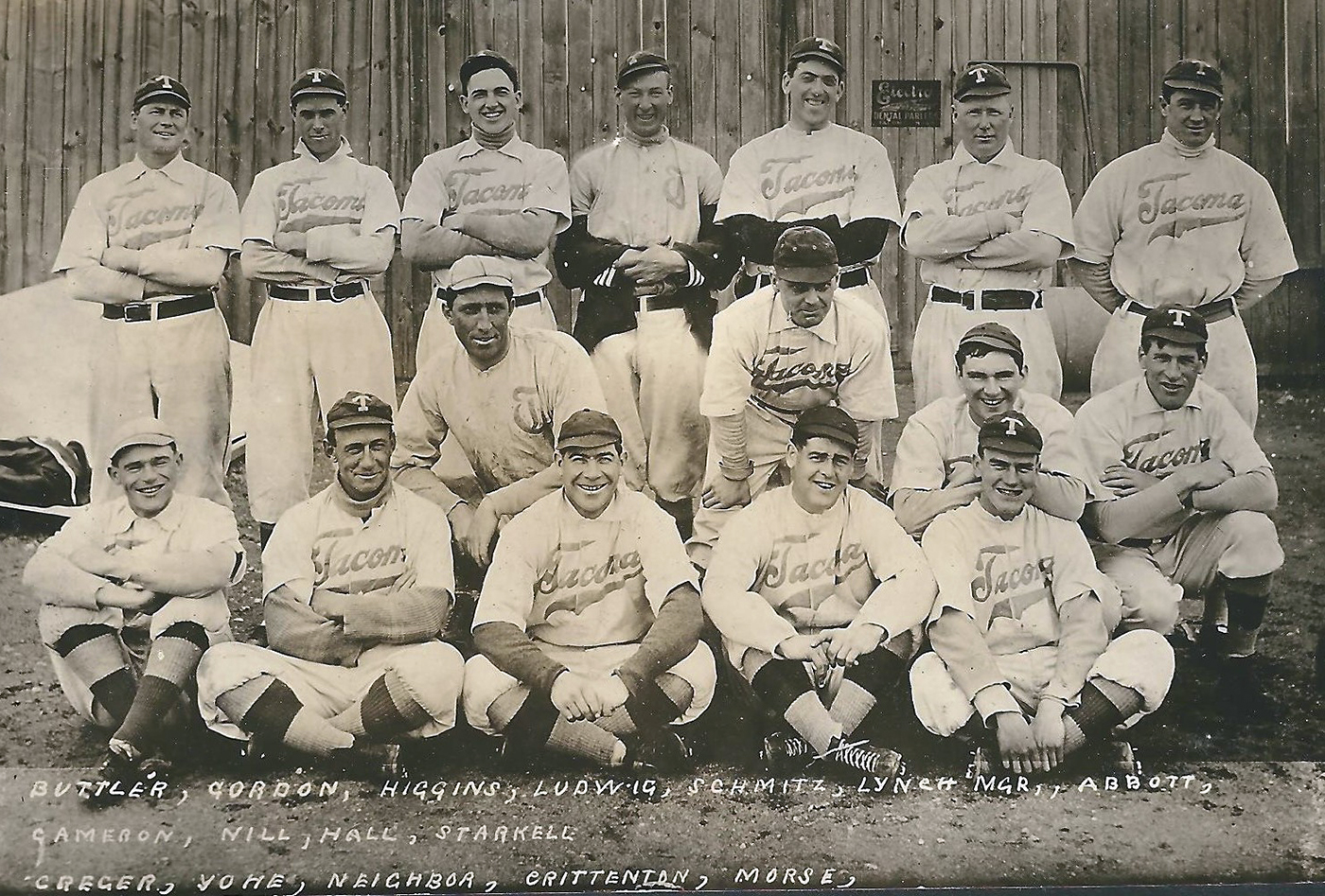
Starkel then gave professional baseball one final fling playing for the Tacoma Tigers of the Northwestern League in 1912 under manager Mike Lynch and alongside notable teammates Ten Million of Seattle and Bert Hall and Cy Neighbors of Tacoma. When Con finally hung up the cleats, at age 31, he had endured 10 seasons in the minor leagues and finished with a 103-111 won-lost record.
(The Tacoma Times, March 10, 1911) - Eddie Householder has grabbed Pitcher Con Starkell for his new Victoria club.
(The Seattle Star., June 14, 1911) - LUCKY SLAM DEFEATS VICTORIA - VANCOUVER. June 14 - With the bases loaded in the third, Brashear slammed a home run yesterday giving the Beavers the lead in a game they won 6 to 4. The Bees played good ball and fought hard. Ten Million got three hits In five times at bat. Batteries Starkell (5 hitter) and Spiesman for Victoria, Cates and Shea for Vancouver.
(The Seattle Star, July 05, 1911) - Indians and (Victoria) Islanders Break Even - SPOKANE, July 5 Spokane trimmed the Islanders 5 to 0 in the afternoon game yesterday, getting revenge for their 6 to 3 defeat in the morning. Bonner held the Bees to two blngles. Starkell pitched well with the exception of the seventh when he was pounded hard.
(The Tacoma Times, July 20, 1911) - Cooney Starkell, up to yesterday, a member of the Victoria pitching staff, was yesterday made an umpire of the league and will hereafter be calling balls and strikes instead of throwing them over.
(The Tacoma Times, July 25, 1911) - "Cooney" Starkell made his debut to Tacoma fans as an umpire yesterday and did real well, making $5 for the league by fining Captain Ostdiek for a few loud remarks. Cooney used to be a Tiger pitcher and had some stuff behind him, but was one of the unluckiest pitchers in the league, always loosing his game no matter what kind of ball he pitched. He makes his home in Tacoma with his family.
(9 April 1913) - STARKELL WILL BE THIRD UMP IN WESTERN TRI-STATE - "Con" Starkell will be the third umpire in the Western TrI-State league, according to an announcement from President W. N. Sweet to Secretary L. M. Brown. Starkell held an indicator in the league at the close of the season last year and gave general satisfaction. He was good on balls and strikes, ran the games fast, was fair and Impartial and kept the players under control without any unseeming display of authority. His selection will meet with satisfaction here.
(15 July 1913) - Connie Starkell, memories of whom still make local fans scowl, got In bad with North Yakima fans last week and, according to reports, was chased over the center field fence after one game. However, he will hold the indicator in that town this week while Russ Hall will do duty here. We should worry.
(23 July 1913) - Richardson Replaces Starkell - WALLA WALLA, Wash., July 22. (Special) Con Starkell was released as Western Tri-State League umpire today and James Richardson, of Boise, was appointed in his place. Connie Starkell ex Northwestern League pitcher, who made the unfortunate slip of getting in bad with some of the team managers and fans. A demand was made for his release and President Sweet handed him his time. The league lost a good Indicator-holder as a result.
Link to a blog about Conrad "Con" Starkel - www.norkarussia.info/conrad-starkel.html
Link to a photo - The 1912 Tacoma Tigers. Con Starkel is shown in the middle row to the far right of the photo (kneeling with arms crossed). - www.norkarussia.info/uploads/3/7/7/9/37792067/1912_tacoma...
Link to his minor league stats - www.baseball-reference.com/register/player.fcgi?id=starke...
MLB debut - April 19, 1906, for the Washington Senators
Last MLB appearance - April 19, 1906, for the Washington Senators
MLB statistics:
Win–loss record 0–0
ERA - 18.00
Strikeouts - 1
Teams:
Washington Senators (1906)
(San Bernardino Sun, Volume 39, 20 January 1933) - FRIDAY, JANUARY 20, 1933 - PITCHER DIES TACOMA, Wash., Jan. 19 -Conrad Starkel, 52, who pitched them down the groove for the New York Yankees and the St. Louis Cardinals for four years in the early 1900's, died at home here today.
"Year 2018 marks 100 years since the Finnish civil war, violent conflict that casted a long shadow over Finnish society. In Helsinki, the war entered the life of all residents when the leftist Reds occupied the city at the end of January 1918. During the spring, Helsinki was the capital of Red Finland. The German troops that fought alongside the bourgeois Whites seized it in April. How did the civil war look like for a young female photographer in Helsinki?"
"Tyyne Böök had a popular photographic studio in a worker’s district to the north of the Pitkäsilta bridge. Elsa Sillman was a medical student and an amateur photographer. In the spring of 1918, Böök tried to remain impartial, working in her studio in Siltasaari, which was located next to the Helsinki Workers' House, a base for the Red Guards. Sillman was an ardent underground activist for the White Guards. The backgrounds and life stories of the two women were so different that it is unlikely that they ever met."
"After the Battle of Helsinki, both women moved about the city with their cameras. They recorded the traces of war, the smiles of victors, and the rows of coffins at funerals – scenes familiar from the work of other Helsinki photographers. Images such as these later formed the official pictorial narrative of White Finland of the end of the civil war in Helsinki. The spontaneity and unintentionally captured everyday details of Sillman and Böök's hand-held photographs convey a sense of immediacy. What is not shown in the images is the viewpoint of the defeated Reds: executions, hunger, insecurity and suffering in prison camps."
See more here:
www.valokuvataiteenmuseo.fi/en/exhibitions/elsa-tyyne-191...
Mighty. Morphin. Power. Rangers.
The OG as introduced by Saban into the English speaking work, and international phenomenon, this adaptation of the Super Sentai Zyuranger became a household name back in 1993, and has been in the hearts of fans since. Me? Well, I enjoyed the show for what it is.. a fun way to kill half an hour, but as always, it was about the toys for me. In recent years, the MMPR franchise has been revisited, first with Bandai of America creating the Legacy product line and milking the MMPR brand, then with the 2017 motion picture that didn't quite make the money Saban wanted it to (I have a theory about this and how it didn't matter, but that's for another discussion). The biggest news would be how Hasbro, now the holders of the Power Ranger toy license, would revisit MMPR and other past Power Rangers characters through something they called the Lightning Collection, a series of collectors grade figures. Personally, I was impartial to this - while others were excited to add these to their collection, I never really got into it when Bandai did it with their Legacy figures and as such, I wouldn't really be pursuing these releases, with the exception of buying one or two to do a bit of comparison and contrast, as well as satisfy my own curiosity regarding a conspiracy theory.
In case it wasn't obvious by now, I tend to buy female figures because not only do they generally look better, but it's harder to hidd things on their comparatively smaller bodies. I bought exactly one figure from the Bandai Legacy line - Ninja Storm Blue (or in my case, Hurricane Blue) and while I never really reviewed it, it can summarize it as follows - it was alright. Nothing earth shattering, and definitely not worth the $25 CAD MSRP to me. Well, in Wave 2 of the Hasbro Lightning series, we see the release of the first female Ranger of the line, Kimberly Hart, the original Pink Ranger and Mistress of the Pterodactyl Zord. For the record, Kat was always my MMPR Pink of choice... I always found Kimberly kind of boring.
Finding her was a bit of a pain, though not as bad as others have had it.. definitely much easier than finding Springer, that's for sure. Just a few phone calls and a 10 minute drive from home.
Normally I'd wait to open this up, as I have been stocking up on some other goodies lately, but questions needed answering dammit, so Kimberly here jumped the queue and was opened next.. about an hour after purchase, in fact. So, without further ado, here is my overview and thoughts on the Power Rangers Lightning Collection Mighty Morphin Pink Ranger.
Each Lightning figure comes with the figure itself, an unmorphed (helmetless) head sculpt, a combination of posing and weapon holding hands, the trademark weapons of the character, and some sort of energy effect. In the case of Kimberly, she comes with her bow and arrow, her Blade Blaster side arm, as well as an energy arrow. MSRP is about $20 USD, or roughly what a Marvel Legends figure costs in your area.
As the picture shows, Kimberly is roughly the same size as Captain Marvel who is my benchmark female Marvel Legends figure. These figures are of course a smidgen bigger than your typical female S.H. Figuarts figure (i.e. Black Widow), but smaller than the Bandai Legacy female body. While Kimberly isn't as busty as the Blue Ranger, she's certainly less NFL Quarterback in terms of build. Now we got that out of the way, let us focus the comparison on the two players that really matter - Kimberly, and Captain Marvel. Now, the cynic in me pretty much assumed that Hasbro wouldn't reinvent the wheel when it didn't have to, both for better and worse. After all, they developed a body for their Legends line, and it would make sense to reuse it for this line, considering that the price point is the same. So, was I right?
Let's start things off with a discussion of aesthetics, articulation, and build quality. Now, no action figure, even the almighty Figuarts release, ever actually replicated the proportions of the suit actors perfectly, so it's not a surprise that things haven't changed here, though I'd like them to resemble human proportions a little better. For whatever reason, her chest area uses plastics that are harder than the rest of her body, and are a tint or two darker than the other pinks on her body. It doesn't show up on my photos, which are powered by flash, but in the crappy room lights I have here, it's clear as day. But in general, unless you're blind, it's pretty clear that this is the MMPR Pink Ranger.
I mentioned before that Kimberly has a different height and body shape than your standard Figuarts and Bandai Legacy body. Having said that, however, I think you should be able to see that Kimberly and Captain Marvel share the same general overall silhouette - in fact, if you look really close, you can see the retooling of common parts (upper arms and thighs, for example). I submit to you that the female Lightning body is at its core, an upcycled Legends body, which somehow manages to improve things, and make them worse at the same time. The Lightning female takes the Legends articulation (pivoting and rotating ankles, double jointed knees, thigh swivel, rotating hips, mid torso ball joint, rotating/pivoting shoulders, rotating/pivoting elbows, wrist rotate/pivot (depending on hand) and ball jointed head with a pivoting neck) and adds to it with boots that rotate and shoulders that allow for chest collapse, improving range of motion and posing options. The knee joints are new, most likely needing a redesign due to the the new lower foot/boot combo used. Design of the lower body basically prevents limits the motion of the lower legs to.. I'm going say about 110 degrees or so. No high kicking for this girl...
So, overall, I've talked about some nice improvements to the status quo - what am I babbling about with regards to better AND worse then?
Well, you see, this is why I looped in build quality into this first point of discussion. Now whatever material Captain Marvel is made of, it's pretty durable and tough, being hard without being brittle. Kimberly, on the other hand, is predominately made up of what they make Transformers of these days, which feels to me like the plastics used in the 3D printing system. This material is softer than the stuff the good Captain is made from. Not an issue on its own, because if this were the end of the story the most I could talk about is how you can't really get any good detailing in the plastics and that it feels like of rough.
You notice how Kimberly seems to be bow legged? Well, unlike the lovely DC Icons Wonder Woman I just looked at, THESE joints are made of that same soft plastic that basically was warped due to the restraints of the packaging. Not sure if this is a material issue, or perhaps they didn't wait long enough for the plastic to settle, but the end result is Kimberly is destined to walk like a freakin' cowboy for the rest of her days. Her elbows are made of the same soft plastic, but due to the way she was packaged I guess there was no warping.
Another gripe I have is that the ratcheting joints used for shoulders of the Legends figures remain, which normally isn't a problem as you're able to easily apply the necessary force to move it. Now, with her collapsing shoulders, the whole joint has a tendency to move, rather than just the part you want to rotate, making raising and lowering the arms a potential exercise in annoyance.
So there you go.. better.. AND worse.. all at the same time.
Paint apps are pretty standard affair for anything that Hasbro does on their own (Transformers are shared with Takara as a unified product, so there are higher standards there to be met), namely that paint isn't applied on places that it isn't deemed necessary, and the quality of the apps themselves range from alright to oversprayed with not the greatest masking work. The larger paint apps generally made it through in one piece, though clearly not so much the minute details. Sculpting detailing on the suit, helmet, and weapons are alright. Nothing overly bad about it, and generally the work is quite competent, and includes some more detailing on the helmet that I didn't expect to see, as well as the gloves. I do enjoy the pink energy effect, though I'd enjoy it more if the figure could hold the bloody thing better. The bow fits alright and I'll be honest, I didn't bother with the Blade Blaster, but it seems to me the hand pictured holding the arrow is actually moulded to hold this weapon specifically.
We're not QUITE done yet, as I've saved best for last. Let's talk about that unhelmeted sculpt. It looks like the artist who made that Paul Rudd sculpt I can't stand decided to give Kimberly Hart a try with equally disastrous results. I think they got the hairline right, and possibly her earrings. Other than that... YIKES. Definitely keeping the helmeted on this figure.
So in conclusion, my overall feeling is a resounding "meh". It's pretty much what I expected, and not exactly the new standard to beat, but it is a step in the right direction. Knowing Hasbro, I don't exactly see them making changes that I complained about here, so I really have no need to revisit this line, but perhaps there is hope that the Legends line can be provided with improvements seen here, most notable being the ability to collapse the shoulders towards the chest. But that's me, and as admitted before, Domestic figures really aren't my thing. For everyone else out there, you really need to be aware of the issues with the knee joints - it's been almost 10 hours since I've opened mine and it's not her legs have straightened out, and the legs can be bent so easily it's not funny.
A decent looking figure with some good strengths balanced by some awful design choices.
"...to dissolve the unholy alliance between corrupt business and corrupt politics, is the first task of the statesmanship of the day." - Theodore Roosevelt
Do you want to share a relevant quote? Please do so in comments below.
THE WEB GOES ON STRIKE! Read All About It!
NOTE: After experiencing the day of protest about SOPA/PIP it is clear that the action could better be called a Web Blackout rather than a Strike.
TAKE ACTION! Google has a form.
Political parties exist to secure responsible government and to execute the will of the people. From these great tasks both of the old parties have turned aside. Instead of instruments to promote the general welfare they have become the tools of corrupt interests, which use them impartially to serve their selfish purposes. Behind the ostensible government sits enthroned an invisible government owing no allegiance and acknowledging no responsibility to the people. To destroy this invisible government, to dissolve the unholy alliance between corrupt business and corrupt politics, is the first task of the statesmanship of the day.
The source image for this caricature was adapted from a black and white image available at the Library of Congress website.
Found beneath the floor of a house there, probably buried for safekeeping during Boudica's attack by fleeing Romans. The building was destroyed by fire and the hoard was never retrieved. Its owners were probably killed. The hoard comprises Roman republican and imperial coins as well as earrings, bracelets, armlets, finger rings and an amulet box. The jewellery was probably made in Italy. Two of the armlets are military decorations, awarded to a retired soldier.
[British Museum]
Nero: the Man Behind the Myth
(May - Oct 2021)
Nero is known as one of Rome's most infamous rulers, notorious for his cruelty, debauchery and madness.
The last male descendant of the emperor Augustus, Nero succeeded to the throne in AD 54 aged just 16 and died a violent death at 30. His turbulent rule saw momentous events including the Great Fire of Rome, Boudicca's rebellion in Britain, the execution of his own mother and first wife, grand projects and extravagant excesses.
Drawing on the latest research, this major exhibition questions the traditional narrative of the ruthless tyrant and eccentric performer, revealing a different Nero, a populist leader at a time of great change in Roman society.
Through some 200 spectacular objects, from the imperial palace in Rome to the streets of Pompeii, follow the young emperor’s rise and fall and make up your own mind about Nero. Was he a young, inexperienced ruler trying his best in a divided society, or the merciless, matricidal megalomaniac history has painted him to be?
Nero was the 5th emperor of Rome and the last of Rome’s first dynasty, the Julio-Claudians, founded by Augustus (the adopted son of Julius Caesar). Nero is known as one of Rome’s most infamous rulers, notorious for his cruelty and debauchery. He ascended to power in AD 54 aged just 16 and died at 30. He ruled at a time of great social and political change, overseeing momentous events such as the Great Fire of Rome and Boudica’s rebellion in Britain. He allegedly killed his mother and two of his wives, only cared about his art and had very little interest in ruling the empire.
Most of what we know about Nero comes from the surviving works of three historians – Tacitus, Suetonius and Cassius Dio. All written decades after Nero’s death, their accounts have long shaped our understanding of this emperor’s rule. However, far from being impartial narrators presenting objective accounts of past events, these authors and their sources wrote with a very clear agenda in mind. Nero’s demise brought forward a period of chaos and civil war – one that ended only when a new dynasty seized power, the Flavians. Authors writing under the Flavians all had an interest in legitimising the new ruling family by portraying the last of the Julio-Claudians in the worst possible light, turning history into propaganda. These accounts became the ‘historical’ sources used by later historians, therefore perpetuating a fabricated image of Nero, which has survived all the way to the present.
Nero was born Lucius Domitius Ahenobarbus on 15 December AD 37.
He was the son of Gnaeus Domitius Ahenobarbus and Agrippina the Younger. Both Gnaeus and Agrippina were the grandchildren of Augustus, making Nero Augustus’ great, great grandson with a strong claim to power.
Nero was only two years old when his mother was exiled and three when his father died. His inheritance was taken from him and he was sent to live with his aunt. However, Nero’s fate changed again when Claudius became emperor, restoring the boy’s property and recalling his mother Agrippina from exile.
In AD 49 the emperor Claudius married Agrippina, and adopted Nero the following year. It is at this point that Lucius Domitius Ahenobarbus changed his name to Nero Claudius Caesar Drusus Germanicus. In Roman times it was normal to change your name when adopted, abandoning your family name in favour of your adoptive father’s. Nero was a common name among members of the Claudian family, especially in Claudius’ branch.
Nero and Agrippina offered Claudius a politically useful link back to Augustus, strengthening his position.
Claudius appeared to favour Nero over his natural son, Britannicus, marking Nero as the designated heir.
When Claudius died in AD 54, Nero became emperor just two months before turning 17.
As he was supported by both the army and the senate, his rise to power was smooth. His mother Agrippina exerted a significant influence, especially at the beginning of his rule.
The Roman historians Tacitus, Suetonius and Cassius Dio all claim that Nero, fed up with Agrippina’s interference, decided to kill her.
Given the lack of eyewitnesses, there is no way of knowing if or how this happened. However, this did not stop historians from fabricating dramatic stories of Agrippina’s murder, asserting that Nero tried (and failed) to kill her with a boat engineered to sink, before sending his men to do the job.
Agrippina allegedly told them to stab her in the womb that bore Nero, her last words clearly borrowed from stage plays.
It is entirely possible, as claimed by Nero himself, that Agrippina chose (or was more likely forced) to take her own life after her plot against her son was discovered.
Early in his rule, Nero had to contend with a rebellion in the newly conquered province of Britain.
In AD 60–61, Queen Boudica of the Iceni tribe led a revolt against the Romans, attacking and laying waste to important Roman settlements. The possible causes of the rebellion were numerous – the greed of the Romans exploiting the newly conquered territories, the recalling of loans made to local leaders, ongoing conflict in Wales and, above all, violence against the family of Prasutagus, Boudica’s husband and king of the Iceni.
Boudica and the rebels destroyed Colchester, London and St Albans before being heavily defeated by Roman troops. After the uprising, the governor of Britain Suetonius Paulinus introduced harsher laws against the Britons, until Nero replaced him with the more conciliatory governor Publius Petronius Turpilianus.
The marriage between Nero and Octavia, aged 15 and 13/14 at the time, was arranged by their parents in order to further legitimise Nero’s claim to the throne. Octavia was the daughter of the emperor Claudius from a previous marriage, so when Claudius married Agrippina and adopted her son Nero, Nero and Octavia became brother and sister. In order to arrange their marriage, Octavia had to be adopted into another family.
Their marriage was not a happy one. According to ancient writers, Nero had various affairs until his lover Poppaea Sabina convinced him to divorce his wife. Octavia was first exiled then executed in AD 62 on adultery charges. According to ancient writers, her banishment and death caused great unrest among the public, who sympathised with the dutiful Octavia.
No further motives were offered for Octavia’s death other than Nero’s passion for Poppaea, and we will probably never know what transpired at court. The fact that Octavia couldn’t produce an heir while Poppaea was pregnant with Nero’s daughter likely played an important role in deciding Octavia’s fate.
On 19 July AD 64, a fire started close to the Circus Maximus. The flames soon encompassed the entire city of Rome and the fire raged for nine days. Only four of the 14 districts of the capital were spared, while three were completely destroyed.
Rome had already been razed by flames – and would be again in its long history – but this event was so severe it came to be known as the Great Fire of Rome.
Later historians blamed Nero for the event, claiming that he set the capital ablaze in order to clear land for the construction of a vast new palace. According to Suetonius and Cassius Dio, Nero took in the view of the burning city from the imperial residence while playing the lyre and singing about the fall of Troy. This story, however, is fictional.
Tacitus, the only historian who was actually alive at the time of the Great Fire of Rome (although only 8 years old), wrote that Nero was not even in Rome when the fire started, but returned to the capital and led the relief efforts.
Tacitus, Suetonius and Cassius Dio all describe Nero as being blinded by passion for his wife Poppaea, yet they accuse him of killing her, allegedly by kicking her in an outburst of rage while she was pregnant.
Interestingly, pregnant women being kicked to death by enraged husbands is a recurring theme in ancient literature, used to explore the (self) destructive tendencies of autocrats. The Greek writer Herodotus tells the story of how the Persian king Cambyses kicked his pregnant wife in the stomach, causing her death. A similar episode is told of Periander, tyrant of Corinth. Nero is just one of many allegedly ‘mad’ tyrants for which this literary convention was used.
Poppaea probably died from complications connected with her pregnancy and not at Nero’s hands. She was given a lavish funeral and was deified.
Centred on greater Iran, the Parthian empire was a major political and cultural power and a long-standing enemy of Rome. The two powers had long been contending for control over the buffer state of Armenia and open conflict sparked again during Nero’s rule. The Parthian War started in AD 58 and, after initial victories and following set-backs, ended in AD 63 when a diplomatic solution was reached between Nero and the Parthian king Vologases I.
According to this settlement Tiridates, brother of the Parthian king, would rule over Armenia, but only after having travelled all the way to Rome to be crowned by Nero.
The journey lasted 9 months, Tiridates’ retinue included 3,000 Parthian horsemen and many Roman soldiers. The coronation ceremony took place in the summer of AD 66 and the day was celebrated with much pomp: all the people of Rome saw the new king of Armenia kneeling in front of Nero. This was the Golden Day of Nero’s rule
In AD 68, Vindex, the governor of Gaul (France), rebelled against Nero and declared his support for Galba, the governor of Spain. Vindex was defeated in battle by troops loyal to Nero, yet Galba started gaining more military support.
It was at this point that Nero lost the support of Rome’s people due to a grain shortage, caused by a rebellious commander who cut the crucial food supply from Egypt to the capital. Abandoned by the people and declared an enemy of the state by the senate, Nero tried to flee Rome and eventually committed suicide.
Following his death, Nero’s memory was condemned (a practice called damnatio memoriae) and the images of the emperor were destroyed, removed or reworked. However, Nero was still given an expensive funeral and for a long time people decorated his tomb with flowers, some even believing he was still alive.
After Nero’s death, civil war ensued. At the end of the so-called ‘Year of the Four Emperors’ (AD 69), Vespasian became emperor and started a new dynasty: the Flavians.
[Francesca Bologna, curator, for British Museum]
Taken in the British Museum
Mighty. Morphin. Power. Rangers.
The OG as introduced by Saban into the English speaking work, and international phenomenon, this adaptation of the Super Sentai Zyuranger became a household name back in 1993, and has been in the hearts of fans since. Me? Well, I enjoyed the show for what it is.. a fun way to kill half an hour, but as always, it was about the toys for me. In recent years, the MMPR franchise has been revisited, first with Bandai of America creating the Legacy product line and milking the MMPR brand, then with the 2017 motion picture that didn't quite make the money Saban wanted it to (I have a theory about this and how it didn't matter, but that's for another discussion). The biggest news would be how Hasbro, now the holders of the Power Ranger toy license, would revisit MMPR and other past Power Rangers characters through something they called the Lightning Collection, a series of collectors grade figures. Personally, I was impartial to this - while others were excited to add these to their collection, I never really got into it when Bandai did it with their Legacy figures and as such, I wouldn't really be pursuing these releases, with the exception of buying one or two to do a bit of comparison and contrast, as well as satisfy my own curiosity regarding a conspiracy theory.
In case it wasn't obvious by now, I tend to buy female figures because not only do they generally look better, but it's harder to hidd things on their comparatively smaller bodies. I bought exactly one figure from the Bandai Legacy line - Ninja Storm Blue (or in my case, Hurricane Blue) and while I never really reviewed it, it can summarize it as follows - it was alright. Nothing earth shattering, and definitely not worth the $25 CAD MSRP to me. Well, in Wave 2 of the Hasbro Lightning series, we see the release of the first female Ranger of the line, Kimberly Hart, the original Pink Ranger and Mistress of the Pterodactyl Zord. For the record, Kat was always my MMPR Pink of choice... I always found Kimberly kind of boring.
Finding her was a bit of a pain, though not as bad as others have had it.. definitely much easier than finding Springer, that's for sure. Just a few phone calls and a 10 minute drive from home.
Normally I'd wait to open this up, as I have been stocking up on some other goodies lately, but questions needed answering dammit, so Kimberly here jumped the queue and was opened next.. about an hour after purchase, in fact. So, without further ado, here is my overview and thoughts on the Power Rangers Lightning Collection Mighty Morphin Pink Ranger.
Each Lightning figure comes with the figure itself, an unmorphed (helmetless) head sculpt, a combination of posing and weapon holding hands, the trademark weapons of the character, and some sort of energy effect. In the case of Kimberly, she comes with her bow and arrow, her Blade Blaster side arm, as well as an energy arrow. MSRP is about $20 USD, or roughly what a Marvel Legends figure costs in your area.
As the picture shows, Kimberly is roughly the same size as Captain Marvel who is my benchmark female Marvel Legends figure. These figures are of course a smidgen bigger than your typical female S.H. Figuarts figure (i.e. Black Widow), but smaller than the Bandai Legacy female body. While Kimberly isn't as busty as the Blue Ranger, she's certainly less NFL Quarterback in terms of build. Now we got that out of the way, let us focus the comparison on the two players that really matter - Kimberly, and Captain Marvel. Now, the cynic in me pretty much assumed that Hasbro wouldn't reinvent the wheel when it didn't have to, both for better and worse. After all, they developed a body for their Legends line, and it would make sense to reuse it for this line, considering that the price point is the same. So, was I right?
Let's start things off with a discussion of aesthetics, articulation, and build quality. Now, no action figure, even the almighty Figuarts release, ever actually replicated the proportions of the suit actors perfectly, so it's not a surprise that things haven't changed here, though I'd like them to resemble human proportions a little better. For whatever reason, her chest area uses plastics that are harder than the rest of her body, and are a tint or two darker than the other pinks on her body. It doesn't show up on my photos, which are powered by flash, but in the crappy room lights I have here, it's clear as day. But in general, unless you're blind, it's pretty clear that this is the MMPR Pink Ranger.
I mentioned before that Kimberly has a different height and body shape than your standard Figuarts and Bandai Legacy body. Having said that, however, I think you should be able to see that Kimberly and Captain Marvel share the same general overall silhouette - in fact, if you look really close, you can see the retooling of common parts (upper arms and thighs, for example). I submit to you that the female Lightning body is at its core, an upcycled Legends body, which somehow manages to improve things, and make them worse at the same time. The Lightning female takes the Legends articulation (pivoting and rotating ankles, double jointed knees, thigh swivel, rotating hips, mid torso ball joint, rotating/pivoting shoulders, rotating/pivoting elbows, wrist rotate/pivot (depending on hand) and ball jointed head with a pivoting neck) and adds to it with boots that rotate and shoulders that allow for chest collapse, improving range of motion and posing options. The knee joints are new, most likely needing a redesign due to the the new lower foot/boot combo used. Design of the lower body basically prevents limits the motion of the lower legs to.. I'm going say about 110 degrees or so. No high kicking for this girl...
So, overall, I've talked about some nice improvements to the status quo - what am I babbling about with regards to better AND worse then?
Well, you see, this is why I looped in build quality into this first point of discussion. Now whatever material Captain Marvel is made of, it's pretty durable and tough, being hard without being brittle. Kimberly, on the other hand, is predominately made up of what they make Transformers of these days, which feels to me like the plastics used in the 3D printing system. This material is softer than the stuff the good Captain is made from. Not an issue on its own, because if this were the end of the story the most I could talk about is how you can't really get any good detailing in the plastics and that it feels like of rough.
You notice how Kimberly seems to be bow legged? Well, unlike the lovely DC Icons Wonder Woman I just looked at, THESE joints are made of that same soft plastic that basically was warped due to the restraints of the packaging. Not sure if this is a material issue, or perhaps they didn't wait long enough for the plastic to settle, but the end result is Kimberly is destined to walk like a freakin' cowboy for the rest of her days. Her elbows are made of the same soft plastic, but due to the way she was packaged I guess there was no warping.
Another gripe I have is that the ratcheting joints used for shoulders of the Legends figures remain, which normally isn't a problem as you're able to easily apply the necessary force to move it. Now, with her collapsing shoulders, the whole joint has a tendency to move, rather than just the part you want to rotate, making raising and lowering the arms a potential exercise in annoyance.
So there you go.. better.. AND worse.. all at the same time.
Paint apps are pretty standard affair for anything that Hasbro does on their own (Transformers are shared with Takara as a unified product, so there are higher standards there to be met), namely that paint isn't applied on places that it isn't deemed necessary, and the quality of the apps themselves range from alright to oversprayed with not the greatest masking work. The larger paint apps generally made it through in one piece, though clearly not so much the minute details. Sculpting detailing on the suit, helmet, and weapons are alright. Nothing overly bad about it, and generally the work is quite competent, and includes some more detailing on the helmet that I didn't expect to see, as well as the gloves. I do enjoy the pink energy effect, though I'd enjoy it more if the figure could hold the bloody thing better. The bow fits alright and I'll be honest, I didn't bother with the Blade Blaster, but it seems to me the hand pictured holding the arrow is actually moulded to hold this weapon specifically.
We're not QUITE done yet, as I've saved best for last. Let's talk about that unhelmeted sculpt. It looks like the artist who made that Paul Rudd sculpt I can't stand decided to give Kimberly Hart a try with equally disastrous results. I think they got the hairline right, and possibly her earrings. Other than that... YIKES. Definitely keeping the helmeted on this figure.
So in conclusion, my overall feeling is a resounding "meh". It's pretty much what I expected, and not exactly the new standard to beat, but it is a step in the right direction. Knowing Hasbro, I don't exactly see them making changes that I complained about here, so I really have no need to revisit this line, but perhaps there is hope that the Legends line can be provided with improvements seen here, most notable being the ability to collapse the shoulders towards the chest. But that's me, and as admitted before, Domestic figures really aren't my thing. For everyone else out there, you really need to be aware of the issues with the knee joints - it's been almost 10 hours since I've opened mine and it's not her legs have straightened out, and the legs can be bent so easily it's not funny.
A decent looking figure with some good strengths balanced by some awful design choices.
Pinzolo’s 10th century Church of San Vigilio features, on its main facade, one of the most extraordinary frescoes of the entire valley, and perhaps of all the Alps: the Danse Macabre. Having largely survived the passing of the centuries, weather erosion and even vandalism, the work (which stretches 21 meters across the church’s facade) is a series of frescoes depicting various life-sized figures from medieval society, including religious and military figures, nobility and emperors, officers of the court, farmers, crippled people, and other men, women and children, all engaged in the danse macabre alongside skeletons (that represent death) pierced by arrows.
The succession of couples reflects the rigid concept of hierarchy in medieval society, with its division of laymen and clergymen. The message being conveyed underscores the concept of the inevitability and impartiality of death. Throughout the work there are symbols pointing to the frailty of terrestrial things and the inexorable passing of time, including many systems of measurement from the era, such as a curious verge and foliot clock, precursor to the pendulum clock, being held by a child skeleton.
The entire series, including the lower works depicting the Seven Capital Sins that have partially been lost, was executed in 1539 by Simone II Baschenis, together with the works within the church, particularly the entire apse on which the artist included the Stories of Saint Vigilius in twenty-six episodes. Simone would also go on to decorate the lunettes, where he made fake loggias in which he depicted the apostles interrupted by the great work of Christ on the Cross and Our Lady of Sorrows, St. John and the Pious Women.
The central dome, which is divided into slices, is also by Simone and features Christ Pantocrator, St. Vigilius on the throne, the Doctors of the Church and the Evangelists. Simone also affixed his signature to Christ crucified held up by two angels with Saint Roch and the martyred saint above the left altar, as well as to the images of saints along the nave and to the portraits of kings and prophets along the holy arch.
In other areas of the church, there are traces of the previous works of other members of the family, executed in the late fifteenth century, such as the external lunettes of the side entrances, decorated by Dionisio Baschenis (born in 1493) and depicting St. Vigilius and Christ crucified with the Virgin Mary and St. John. Angelo Baschenis (brother of Antonio) also contributed with frescoes (including his signature and the date, 1490) on the south, interior wall depicting the life of Christ, although much of this series has since been lost, with the exception of the scene of the Virgin Mary on the Throne, the Apparition to Mary Magdalene, the Ascension of Christ, the Doubting of St. Thomas, and the Descent into Limbo.
Mighty. Morphin. Power. Rangers.
The OG as introduced by Saban into the English speaking work, and international phenomenon, this adaptation of the Super Sentai Zyuranger became a household name back in 1993, and has been in the hearts of fans since. Me? Well, I enjoyed the show for what it is.. a fun way to kill half an hour, but as always, it was about the toys for me. In recent years, the MMPR franchise has been revisited, first with Bandai of America creating the Legacy product line and milking the MMPR brand, then with the 2017 motion picture that didn't quite make the money Saban wanted it to (I have a theory about this and how it didn't matter, but that's for another discussion). The biggest news would be how Hasbro, now the holders of the Power Ranger toy license, would revisit MMPR and other past Power Rangers characters through something they called the Lightning Collection, a series of collectors grade figures. Personally, I was impartial to this - while others were excited to add these to their collection, I never really got into it when Bandai did it with their Legacy figures and as such, I wouldn't really be pursuing these releases, with the exception of buying one or two to do a bit of comparison and contrast, as well as satisfy my own curiosity regarding a conspiracy theory.
In case it wasn't obvious by now, I tend to buy female figures because not only do they generally look better, but it's harder to hidd things on their comparatively smaller bodies. I bought exactly one figure from the Bandai Legacy line - Ninja Storm Blue (or in my case, Hurricane Blue) and while I never really reviewed it, it can summarize it as follows - it was alright. Nothing earth shattering, and definitely not worth the $25 CAD MSRP to me. Well, in Wave 2 of the Hasbro Lightning series, we see the release of the first female Ranger of the line, Kimberly Hart, the original Pink Ranger and Mistress of the Pterodactyl Zord. For the record, Kat was always my MMPR Pink of choice... I always found Kimberly kind of boring.
Finding her was a bit of a pain, though not as bad as others have had it.. definitely much easier than finding Springer, that's for sure. Just a few phone calls and a 10 minute drive from home.
Normally I'd wait to open this up, as I have been stocking up on some other goodies lately, but questions needed answering dammit, so Kimberly here jumped the queue and was opened next.. about an hour after purchase, in fact. So, without further ado, here is my overview and thoughts on the Power Rangers Lightning Collection Mighty Morphin Pink Ranger.
Each Lightning figure comes with the figure itself, an unmorphed (helmetless) head sculpt, a combination of posing and weapon holding hands, the trademark weapons of the character, and some sort of energy effect. In the case of Kimberly, she comes with her bow and arrow, her Blade Blaster side arm, as well as an energy arrow. MSRP is about $20 USD, or roughly what a Marvel Legends figure costs in your area.
As the picture shows, Kimberly is roughly the same size as Captain Marvel who is my benchmark female Marvel Legends figure. These figures are of course a smidgen bigger than your typical female S.H. Figuarts figure (i.e. Black Widow), but smaller than the Bandai Legacy female body. While Kimberly isn't as busty as the Blue Ranger, she's certainly less NFL Quarterback in terms of build. Now we got that out of the way, let us focus the comparison on the two players that really matter - Kimberly, and Captain Marvel. Now, the cynic in me pretty much assumed that Hasbro wouldn't reinvent the wheel when it didn't have to, both for better and worse. After all, they developed a body for their Legends line, and it would make sense to reuse it for this line, considering that the price point is the same. So, was I right?
Let's start things off with a discussion of aesthetics, articulation, and build quality. Now, no action figure, even the almighty Figuarts release, ever actually replicated the proportions of the suit actors perfectly, so it's not a surprise that things haven't changed here, though I'd like them to resemble human proportions a little better. For whatever reason, her chest area uses plastics that are harder than the rest of her body, and are a tint or two darker than the other pinks on her body. It doesn't show up on my photos, which are powered by flash, but in the crappy room lights I have here, it's clear as day. But in general, unless you're blind, it's pretty clear that this is the MMPR Pink Ranger.
I mentioned before that Kimberly has a different height and body shape than your standard Figuarts and Bandai Legacy body. Having said that, however, I think you should be able to see that Kimberly and Captain Marvel share the same general overall silhouette - in fact, if you look really close, you can see the retooling of common parts (upper arms and thighs, for example). I submit to you that the female Lightning body is at its core, an upcycled Legends body, which somehow manages to improve things, and make them worse at the same time. The Lightning female takes the Legends articulation (pivoting and rotating ankles, double jointed knees, thigh swivel, rotating hips, mid torso ball joint, rotating/pivoting shoulders, rotating/pivoting elbows, wrist rotate/pivot (depending on hand) and ball jointed head with a pivoting neck) and adds to it with boots that rotate and shoulders that allow for chest collapse, improving range of motion and posing options. The knee joints are new, most likely needing a redesign due to the the new lower foot/boot combo used. Design of the lower body basically prevents limits the motion of the lower legs to.. I'm going say about 110 degrees or so. No high kicking for this girl...
So, overall, I've talked about some nice improvements to the status quo - what am I babbling about with regards to better AND worse then?
Well, you see, this is why I looped in build quality into this first point of discussion. Now whatever material Captain Marvel is made of, it's pretty durable and tough, being hard without being brittle. Kimberly, on the other hand, is predominately made up of what they make Transformers of these days, which feels to me like the plastics used in the 3D printing system. This material is softer than the stuff the good Captain is made from. Not an issue on its own, because if this were the end of the story the most I could talk about is how you can't really get any good detailing in the plastics and that it feels like of rough.
You notice how Kimberly seems to be bow legged? Well, unlike the lovely DC Icons Wonder Woman I just looked at, THESE joints are made of that same soft plastic that basically was warped due to the restraints of the packaging. Not sure if this is a material issue, or perhaps they didn't wait long enough for the plastic to settle, but the end result is Kimberly is destined to walk like a freakin' cowboy for the rest of her days. Her elbows are made of the same soft plastic, but due to the way she was packaged I guess there was no warping.
Another gripe I have is that the ratcheting joints used for shoulders of the Legends figures remain, which normally isn't a problem as you're able to easily apply the necessary force to move it. Now, with her collapsing shoulders, the whole joint has a tendency to move, rather than just the part you want to rotate, making raising and lowering the arms a potential exercise in annoyance.
So there you go.. better.. AND worse.. all at the same time.
Paint apps are pretty standard affair for anything that Hasbro does on their own (Transformers are shared with Takara as a unified product, so there are higher standards there to be met), namely that paint isn't applied on places that it isn't deemed necessary, and the quality of the apps themselves range from alright to oversprayed with not the greatest masking work. The larger paint apps generally made it through in one piece, though clearly not so much the minute details. Sculpting detailing on the suit, helmet, and weapons are alright. Nothing overly bad about it, and generally the work is quite competent, and includes some more detailing on the helmet that I didn't expect to see, as well as the gloves. I do enjoy the pink energy effect, though I'd enjoy it more if the figure could hold the bloody thing better. The bow fits alright and I'll be honest, I didn't bother with the Blade Blaster, but it seems to me the hand pictured holding the arrow is actually moulded to hold this weapon specifically.
We're not QUITE done yet, as I've saved best for last. Let's talk about that unhelmeted sculpt. It looks like the artist who made that Paul Rudd sculpt I can't stand decided to give Kimberly Hart a try with equally disastrous results. I think they got the hairline right, and possibly her earrings. Other than that... YIKES. Definitely keeping the helmeted on this figure.
So in conclusion, my overall feeling is a resounding "meh". It's pretty much what I expected, and not exactly the new standard to beat, but it is a step in the right direction. Knowing Hasbro, I don't exactly see them making changes that I complained about here, so I really have no need to revisit this line, but perhaps there is hope that the Legends line can be provided with improvements seen here, most notable being the ability to collapse the shoulders towards the chest. But that's me, and as admitted before, Domestic figures really aren't my thing. For everyone else out there, you really need to be aware of the issues with the knee joints - it's been almost 10 hours since I've opened mine and it's not her legs have straightened out, and the legs can be bent so easily it's not funny.
A decent looking figure with some good strengths balanced by some awful design choices.
Nero: the Man Behind the Myth
(May - Oct 2021)
Nero is known as one of Rome's most infamous rulers, notorious for his cruelty, debauchery and madness.
The last male descendant of the emperor Augustus, Nero succeeded to the throne in AD 54 aged just 16 and died a violent death at 30. His turbulent rule saw momentous events including the Great Fire of Rome, Boudicca's rebellion in Britain, the execution of his own mother and first wife, grand projects and extravagant excesses.
Drawing on the latest research, this major exhibition questions the traditional narrative of the ruthless tyrant and eccentric performer, revealing a different Nero, a populist leader at a time of great change in Roman society.
Through some 200 spectacular objects, from the imperial palace in Rome to the streets of Pompeii, follow the young emperor’s rise and fall and make up your own mind about Nero. Was he a young, inexperienced ruler trying his best in a divided society, or the merciless, matricidal megalomaniac history has painted him to be?
Nero was the 5th emperor of Rome and the last of Rome’s first dynasty, the Julio-Claudians, founded by Augustus (the adopted son of Julius Caesar). Nero is known as one of Rome’s most infamous rulers, notorious for his cruelty and debauchery. He ascended to power in AD 54 aged just 16 and died at 30. He ruled at a time of great social and political change, overseeing momentous events such as the Great Fire of Rome and Boudica’s rebellion in Britain. He allegedly killed his mother and two of his wives, only cared about his art and had very little interest in ruling the empire.
Most of what we know about Nero comes from the surviving works of three historians – Tacitus, Suetonius and Cassius Dio. All written decades after Nero’s death, their accounts have long shaped our understanding of this emperor’s rule. However, far from being impartial narrators presenting objective accounts of past events, these authors and their sources wrote with a very clear agenda in mind. Nero’s demise brought forward a period of chaos and civil war – one that ended only when a new dynasty seized power, the Flavians. Authors writing under the Flavians all had an interest in legitimising the new ruling family by portraying the last of the Julio-Claudians in the worst possible light, turning history into propaganda. These accounts became the ‘historical’ sources used by later historians, therefore perpetuating a fabricated image of Nero, which has survived all the way to the present.
Nero was born Lucius Domitius Ahenobarbus on 15 December AD 37.
He was the son of Gnaeus Domitius Ahenobarbus and Agrippina the Younger. Both Gnaeus and Agrippina were the grandchildren of Augustus, making Nero Augustus’ great, great grandson with a strong claim to power.
Nero was only two years old when his mother was exiled and three when his father died. His inheritance was taken from him and he was sent to live with his aunt. However, Nero’s fate changed again when Claudius became emperor, restoring the boy’s property and recalling his mother Agrippina from exile.
In AD 49 the emperor Claudius married Agrippina, and adopted Nero the following year. It is at this point that Lucius Domitius Ahenobarbus changed his name to Nero Claudius Caesar Drusus Germanicus. In Roman times it was normal to change your name when adopted, abandoning your family name in favour of your adoptive father’s. Nero was a common name among members of the Claudian family, especially in Claudius’ branch.
Nero and Agrippina offered Claudius a politically useful link back to Augustus, strengthening his position.
Claudius appeared to favour Nero over his natural son, Britannicus, marking Nero as the designated heir.
When Claudius died in AD 54, Nero became emperor just two months before turning 17.
As he was supported by both the army and the senate, his rise to power was smooth. His mother Agrippina exerted a significant influence, especially at the beginning of his rule.
The Roman historians Tacitus, Suetonius and Cassius Dio all claim that Nero, fed up with Agrippina’s interference, decided to kill her.
Given the lack of eyewitnesses, there is no way of knowing if or how this happened. However, this did not stop historians from fabricating dramatic stories of Agrippina’s murder, asserting that Nero tried (and failed) to kill her with a boat engineered to sink, before sending his men to do the job.
Agrippina allegedly told them to stab her in the womb that bore Nero, her last words clearly borrowed from stage plays.
It is entirely possible, as claimed by Nero himself, that Agrippina chose (or was more likely forced) to take her own life after her plot against her son was discovered.
Early in his rule, Nero had to contend with a rebellion in the newly conquered province of Britain.
In AD 60–61, Queen Boudica of the Iceni tribe led a revolt against the Romans, attacking and laying waste to important Roman settlements. The possible causes of the rebellion were numerous – the greed of the Romans exploiting the newly conquered territories, the recalling of loans made to local leaders, ongoing conflict in Wales and, above all, violence against the family of Prasutagus, Boudica’s husband and king of the Iceni.
Boudica and the rebels destroyed Colchester, London and St Albans before being heavily defeated by Roman troops. After the uprising, the governor of Britain Suetonius Paulinus introduced harsher laws against the Britons, until Nero replaced him with the more conciliatory governor Publius Petronius Turpilianus.
The marriage between Nero and Octavia, aged 15 and 13/14 at the time, was arranged by their parents in order to further legitimise Nero’s claim to the throne. Octavia was the daughter of the emperor Claudius from a previous marriage, so when Claudius married Agrippina and adopted her son Nero, Nero and Octavia became brother and sister. In order to arrange their marriage, Octavia had to be adopted into another family.
Their marriage was not a happy one. According to ancient writers, Nero had various affairs until his lover Poppaea Sabina convinced him to divorce his wife. Octavia was first exiled then executed in AD 62 on adultery charges. According to ancient writers, her banishment and death caused great unrest among the public, who sympathised with the dutiful Octavia.
No further motives were offered for Octavia’s death other than Nero’s passion for Poppaea, and we will probably never know what transpired at court. The fact that Octavia couldn’t produce an heir while Poppaea was pregnant with Nero’s daughter likely played an important role in deciding Octavia’s fate.
On 19 July AD 64, a fire started close to the Circus Maximus. The flames soon encompassed the entire city of Rome and the fire raged for nine days. Only four of the 14 districts of the capital were spared, while three were completely destroyed.
Rome had already been razed by flames – and would be again in its long history – but this event was so severe it came to be known as the Great Fire of Rome.
Later historians blamed Nero for the event, claiming that he set the capital ablaze in order to clear land for the construction of a vast new palace. According to Suetonius and Cassius Dio, Nero took in the view of the burning city from the imperial residence while playing the lyre and singing about the fall of Troy. This story, however, is fictional.
Tacitus, the only historian who was actually alive at the time of the Great Fire of Rome (although only 8 years old), wrote that Nero was not even in Rome when the fire started, but returned to the capital and led the relief efforts.
Tacitus, Suetonius and Cassius Dio all describe Nero as being blinded by passion for his wife Poppaea, yet they accuse him of killing her, allegedly by kicking her in an outburst of rage while she was pregnant.
Interestingly, pregnant women being kicked to death by enraged husbands is a recurring theme in ancient literature, used to explore the (self) destructive tendencies of autocrats. The Greek writer Herodotus tells the story of how the Persian king Cambyses kicked his pregnant wife in the stomach, causing her death. A similar episode is told of Periander, tyrant of Corinth. Nero is just one of many allegedly ‘mad’ tyrants for which this literary convention was used.
Poppaea probably died from complications connected with her pregnancy and not at Nero’s hands. She was given a lavish funeral and was deified.
Centred on greater Iran, the Parthian empire was a major political and cultural power and a long-standing enemy of Rome. The two powers had long been contending for control over the buffer state of Armenia and open conflict sparked again during Nero’s rule. The Parthian War started in AD 58 and, after initial victories and following set-backs, ended in AD 63 when a diplomatic solution was reached between Nero and the Parthian king Vologases I.
According to this settlement Tiridates, brother of the Parthian king, would rule over Armenia, but only after having travelled all the way to Rome to be crowned by Nero.
The journey lasted 9 months, Tiridates’ retinue included 3,000 Parthian horsemen and many Roman soldiers. The coronation ceremony took place in the summer of AD 66 and the day was celebrated with much pomp: all the people of Rome saw the new king of Armenia kneeling in front of Nero. This was the Golden Day of Nero’s rule
In AD 68, Vindex, the governor of Gaul (France), rebelled against Nero and declared his support for Galba, the governor of Spain. Vindex was defeated in battle by troops loyal to Nero, yet Galba started gaining more military support.
It was at this point that Nero lost the support of Rome’s people due to a grain shortage, caused by a rebellious commander who cut the crucial food supply from Egypt to the capital. Abandoned by the people and declared an enemy of the state by the senate, Nero tried to flee Rome and eventually committed suicide.
Following his death, Nero’s memory was condemned (a practice called damnatio memoriae) and the images of the emperor were destroyed, removed or reworked. However, Nero was still given an expensive funeral and for a long time people decorated his tomb with flowers, some even believing he was still alive.
After Nero’s death, civil war ensued. At the end of the so-called ‘Year of the Four Emperors’ (AD 69), Vespasian became emperor and started a new dynasty: the Flavians.
[Francesca Bologna, curator, for British Museum]
Taken in the British Museum
Fightin’ Texas A&M Aggie Ring ’84 loves good BBQ. In fact, he’s positive most Texas Aggie Rings do. “I’m sure that there’s a vegetarian Aggie Ring or two out there, but that leaves more for the rest of the Aggie Rings, doesn’t it?” is what Aggie Ring ’84 always says.
Now Aggie Ring ’84 likes the BBQ in New Jersey where he lives and rules the boardwalk on the Jersey Shore. He loved the BBQ in Central and South Texas when he used to live there and he found the BBQ up around Monterey, California where he was once stationed identical to Texas BBQ which was all good for Aggie Ring.
All of that aside, Aggie Ring ’84 has found the BBQ in Kansas City to be the “gold standard” for BBQ. “It just doesn’t get any better than KC BBQ.” said Aggie Ring. (Note: Aggie Ring ’84 has never lived in Kansas City, so he is a truly impartial Aggie Ring!) Now, every state has some special features. Aggie Ring ’84 especially loves some of the hot peppers and apple empanadas, not to mention the greens, that Texas offers. California BBQ had some damn good fresh sliced artichoke served along with it. New Jersey BBQ has, well, the Jersey Shore, according to Aggie Ring ’84.
Aggie Ring ’84 has had some extremely excellent BBQ on his many Aggie Ring vacations to Kansas City of the brisket and rib variety. Aggie Ring ’84 still thinks Texas rules on the BBQ chicken and German/Polish sausage. However, Kansas City has the best brisket and ribs (steaks too) in the United States in Aggie Ring’s simple Aggie Ring opinion.
When Aggie Ring ’84 is gracing Kansas City with his Aggie Ringliness, he especially likes visiting Historic Westport Kansas City for a variety of reasons: best doughnuts in KC, best cigar lounge in KC, and bar in the oldest building in KC. This year, Aggie Ring ’84 ran into three locals in Westport and asked them where the best BBQ in Kansas City was. All three of them replied. “Go to the Char Bar in Westport. It’s the best!”
Aggie Ring decided that local recommendations about food are the best. “Screw Yelp!” said Aggie Ring. So, Aggie Ring went to this “Char Bar” that came highly recommended by the locals. Upon entering the “Char Bar,” Aggie Ring ’84 was in awe. First of all, the place was huge. Aggie Ring could have line danced in the inside and outside portions of the “joint.” Secondly, they had a full top-shelf bar. In Texas Aggie Ring’s humble opinion, BBQ just isn’t BBQ without “adult beverage.” However, Aggie Ring ’84 decided to reserve his Aggie Ring opinion until he tried the “goods.”
Texas Aggie Ring promptly took a seat at the bar and, after ordering a fine bourbon, began to peruse the menu. There were so many choices that a simple Texas Aggie Ring couldn’t even guess at what to order. For “starters” they had: Lobster Deviled Eggs (charred lobster and pea shoots), Grit Hushpuppies, Fried Green Tomatoes (Aggie Ring fell in love with these in Alabama), Jumbo Smoked Chicken Wings (bbq drizzle and buttermilk-chive dressing), amongst many others.
Fixin’s included: BBQ Pit Beans, Potato Salad, Cabbage Slaw, Carrot-Rasin Slaw and Smoked Corn Succotash, BBQ Pork Rinds, Beer-Battered Pickles, and too many other things to mention in this short summary.
The smoked meats included: Naked Burnt Brisket Ends (Kansas City is known for these), Ribs, Pulled Pork Butt, Black Angus Brisket, Hand-Cranked Sausage, Pulled Smoked Chicken, Smoked Turkey Breast, and something unknown to a simple Texas Aggie Ring called “Smoked Jackfruit.”
The dessert menu consisted of “Burnt Puddin’” (butterscotch custard and fresh blackberries), Bourbon Peach Crisp (almond crust, sticky male glaze and vanilla bean ice cream) and the “Velvet Elvis” (banana bread-peanut butter ice cream sandwich, spiced walnuts, bananas, cracker jacks, hot fudge, whipped cream, and a bourbon-soaked cherry.
There were a number of non-meat items on the menu with a skull and crossbones symbol next to them as a warning to real men and women who eat meat but I’ll not enumerate on them because Aggie Ring ’84 says, “Who cares about that stuff?”
Now Aggie Ring ’84 watches my weight because he doesn’t want me to become a “Fat AG” and have to get him resized. So I let him do the ordering. After much cogitation on Aggie Ring 84’s part. He allowed me to order the BBQ Tray with Naked Burnt Brisket Ends and Smoked Corn Succotash served with pickles and toast. Also, an appetizer of lobster deviled eggs. I asked Aggie Ring ’84 “What about dessert?” Aggie Ring replied, “You can have another glass of bourbon for dessert. It’s got much less calories.”
The service at Char Bar was quick. I mean really, really quick. Before Aggie Ring had a chance to put a dent into his bourbon, our order was served. First, I have to say that the presentation was incredible. Our meal was served on butcher paper on a tray with the sides in hand thrown pottery bowls. Even the ramekin with a side sauce was steel and not plastic like something you’d get at Arby’s.
Aggie Ring looked at his meal and almost wept. The tray, the brown butcher paper, the freshly toasted bread, the ceramic bowl. It was almost too much for Aggie Ring. “This,” said Texas Aggie Ring, “Is how they roll in Kansas City!” Aggie Ring ’84 says that BBQ served on a plate or in a red plastic basket is for “lady boys” and not really BBQ. The “burnt ends” were “pure delight” said Aggie Ring. The lobster deviled eggs and smoked corn brought tears to Aggie Ring’s eye.
Aggie Ring ’84 ate his entire lunch and said, “This is the best BBQ in any state I’ve lived in!”
As Texas Aggie Ring ’84 and I were leaving the “Char Bar,” he said to me, “Did you see their Sunday only Fried Chicken special with a whole chicken southern fried with whipped potatoes, pan gravy, “big-ass” buttermilk biscuits, and Tabasco honey?” I told Aggie Ring, “Hell, I’d come back just for the Tabasco honey!”
#AggieRing #TexasAggie #AggiesEverywhere
In a midst of a game.
June 2012, Kabul, Afghanistan.
The International Committee of the Red Cross (ICRC) is an impartial, neutral and independent organization whose exclusively humanitarian mission is to protect the lives and dignity of victims of armed conflict and other situations of violence and to provide them with assistance. The ICRC also endeavours to prevent suffering by promoting and strengthening humanitarian law and universal humanitarian principles. The ICRC is at the origin of the Geneva Conventions and the International Red Cross and Red Crescent Movement. It directs and coordinates the international activities conducted by the Movement in armed conflicts and other situations of violence.
THE ICRC has been permanently present in Afghanistan since 1987, and the orthopaedic programme was one of its first activities. The ICRC orthopaedic center opened in Kabul in 1988. More than 90,000 Afghan disabled have been assisted through it. Those are combatants and civilians caught up in fighting, hurt during bombardments, or struck by landmines. At present the ICRC directly manages six orthopaedic center in Afghanistan and supports four non-ICRC prosthetic workshops.
Of close to 200 employees running Kabul orthopaedic center, including a large hospital and workshops producing prostheses and wheelchairs, all are disabled themselves. The whole center is effectively run by people who had been affected by warfare, loosing limbs, but not losing their spirit.
Some of ICRC workers and patients have, under the leadership of Alberto Cairo, legendary head of the center, started a wheelchair basketball team, and practice almost every day after office hours. In June 2012 first wheelchair basketball tournament took place in Afghanistan. Kabul team did not win although they gave a tough fight.
It’s been a moving experience to see them practising and playing, an experience that cannot be forgotten.
More about the work of ICRC – www.icrc.org
Texts quoted after ICRC.
Our Lady's Catholic Church on Stricklands Road in Stowmarket the largest town in the Mid Suffolk, East Anglia, England.
Before the Reformation, Catholic priests ministered to the faithful at two churches, St Mary and St Peter, either side of a central churchyard. St Mary has now gone, and the other church bears a dual dedication to both saints. It also, enjoys, of course, the stewardship of the Church of England, since the Reformation swept the Catholic church from the English parishes in the 16th century.
Stowmarket is an industrial town, and in the 19th century its atmosphere was strongly protestant. All over England, the Oxford Movement was slowly, but relentlessly, beginning to return some aspects of Catholic doctrine and practice back into the established church. However, this cut little ice with the Rector of St Peter and St Mary, the strongly evangelical George Staunton Barrow. In the 1870s, Stowmarket was renowned in Suffolk for its resistance to 'papist' ideas, so one can well imagine the feelings of the Reverend Barrow when his sister, Adelaide Clutterbuck, who had recently been received into the Catholic church, moved to the town with her husband.
At this time, the Catholics of Stowmarket were few and far between, and had to make the 15 mile journey to either Bury or Ipswich for Mass, or for their children to attend Catholic school. Throughout the long penal years, the Faith had been maintained in this area by priests, many of them Jesuits, kept hidden at several country houses, including Haughley Park and Wetherden Hall. These brave men lived uncertain lives, always at the risk of a grisly public death if they were caught.
Adelaide Clutterbuck convinced the Bishop of Northampton, in whose Diocese Stowmarket came, to appoint a permanent priest to serve a new parish centred on the church. Father Francis Warmoll arrived in Stowmarket in 1879. Like Mrs Clutterbuck, he was a former Anglican, the son of the Vicar of St Margaret, Sotterley. With his brother, he had been received into the Catholic church along with hundreds of others in the 1860s, part of a haemorrhaging that coincided with a renewed resistance to Oxford Movement teaching in some Anglican parishes.
Within a few months, he had negotiated with an order of Ursuline sisters to move their community to the town. By devious negotiation, he bought up half a dozen ajoining plots of land off of Strickland Road. One of the vendors realised who he was, and immediately raised the price from £30 to £300, which had to be accepted.
The Suffolk Free Press, when rumours of the purchase reached its staunchly impartial ears, reacted: "Stowmarket has long been deemed the shining light of Evangelical truth in central Suffolk, but it is now becoming notorious for the activity with which Roman Catholic propaganda is being pushed within its midst. Prudent men will not be misled by glowing descriptions of increasing numbers until they have made themselves acquainted with the social and religious conditions under which a comparitively new agent came into work, and have analysed the modes by which the new agent effects its purpose."
Before it could be built, the convent chapel was used as a temporary parish church. This was opened in 1884, and dedicated to Our Lady of the Seven Dolours. It was on the first floor of the building, with the infant school below.
Information source:
A Sikh is a follower of Sikhism, a monotheistic religion which originated during the 15th century in the Punjab region. The term "Sikh" has its origin in the Sanskrit words शिष्य (śiṣya; disciple, student) or शिक्ष (śikṣa; instruction). A Sikh is a disciple of a guru. According to Article I of the Sikh Rehat Maryada (the Sikh code of conduct), a Sikh is "any human being who faithfully believes in One Immortal Being; ten Gurus, from Guru Nanak to Guru Gobind Singh; Guru Granth Sahib; the teachings of the ten Gurus and the baptism bequeathed by the tenth Guru". "Sikh" properly refers to adherents of Sikhism as a religion, not an ethnic group. However, because Sikhs often share strong ethno-religious ties, many countries, such as the U.K., recognize Sikh as a designated ethnicity on their censuses. The American non-profit organization United Sikhs has fought to have Sikh included on the U.S. census as well, arguing that Sikhs "self-identify as an 'ethnic minority'" and believe "that they are more than just a religion".
Male Sikhs usually have "Singh" (Lion), and female Sikhs have "Kaur" (Princess) as their middle or last name. Sikhs who have undergone the khanḍe-kī-pahul (the Sikh initiation ceremony) may also be recognized by the five Ks: uncut hair (kesh); an iron or steel bracelet (kara); a kirpan (a sword tucked into a gatra strap); kachehra, a cotton undergarment, and kanga, a small wooden comb. Baptized male Sikhs must cover their hair with a turban, which is optional for baptized female Sikhs. The greater Punjab region is the historic homeland of the Sikhs, although significant communities exist around the world.
HISTORY
Sikh political history may be said to begin with the death of the fifth Sikh guru, Guru Arjan Dev, in 1606. Guru Nanak was a religious leader and social reformer in the 15th-century Punjab. Religious practices were formalized by Guru Gobind Singh on 30 March 1699. Singh baptized five people from a variety of social backgrounds, known as the Panj Piare (the five beloved ones) to form the Khalsa, or collective body of initiated Sikhs. Sikhism has generally had amicable relations with other religions, except for the period of Mughal rule in India (1556–1707). Several Sikh gurus were killed by the Mughals for opposing their persecution of minority religious communities including Sikhs. Sikhs subsequently militarized to oppose Mughal rule. The emergence of the Sikh Confederacy under Ranjit Singh was characterized by religious tolerance and pluralism, with Christians, Muslims and Hindus in positions of power. The confederacy is considered the zenith of political Sikhism, encompassing Kashmir, Ladakh and Peshawar. Hari Singh Nalwa, the commander-in-chief of the Sikh army in the North West Frontier, expanded the confederacy to the Khyber Pass. Its secular administration implemented military, economic and governmental reforms. The months leading up to the partition of India in 1947 were marked by conflict in the Punjab between Sikhs and Muslims. This caused the religious migration of Punjabi Sikhs and Hindus from West Punjab, mirroring a similar religious migration of Punjabi Muslims from East Punjab.
The 1960s saw growing animosity between Sikhs and Hindus in India, with the Sikhs demanding the creation of a Punjab state on a linguistic basis similar to other states in India. This was promised to Sikh leader Master Tara Singh by Jawaharlal Nehru, in return for Sikh political support during negotiations for Indian independence. Although the Sikhs obtained the Punjab, they lost Hindi-speaking areas to Himachal Pradesh, Haryana and Rajasthan. Chandigarh was made a union territory and the capital of Haryana and Punjab on 1 November 1966.
Tensions arose again during the late 1970s, fueled by Sikh claims of discrimination and marginalisation by the Hindu-dominated Indian National Congress party and tactics adopted by the Prime Minister Indira Gandhi.
According to Katherine Frank, Indira Gandhi's assumption of emergency powers in 1975 resulted in the weakening of the "legitimate and impartial machinery of government", and her increasing "paranoia" about opposing political groups led her to institute a "despotic policy of playing castes, religions and political groups against each other for political advantage". Sikh leader Jarnail Singh Bhindranwale articulated Sikh demands for justice, and this triggered violence in the Punjab. The prime minister's 1984 defeat of Bhindranwale led to an attack on the Golden Temple in Operation Blue Star and to her assassination by her Sikh bodyguards. Gandhi's assassination resulted in an explosion of violence against Sikh communities and the killing of thousands of Sikhs throughout India. Khushwant Singh described the riots as a Sikh pogrom; he "felt like a refugee in my country. In fact, I felt like a Jew in Nazi Germany". Since 1984, relations between Sikhs and Hindus have moved toward a rapprochement aided by economic prosperity. However, a 2002 claim by the Hindu right-wing Rashtriya Swayamsevak Sangh (RSS) that "Sikhs are Hindus" disturbed Sikh sensibilities. The Khalistan movement campaigns for justice for the victims of the violence, and for the political and economic needs of the Punjab.
In 1996, United Nations Commission on Human Rights Freedom of Religion or Belief Special Rapporteur Abdelfattah Amor (Tunisia, 1993–2004) visited India to report on religious discrimination. The following year Amor concluded, "In India it appears that the situation of the Sikhs in the religious field is satisfactory, but that difficulties are arising in the political (foreign interference, terrorism, etc.), economic (in particular with regard to sharing of water supplies) and even occupational fields. Information received from nongovernment (sic) sources indicates that discrimination does exist in certain sectors of the public administration; examples include the decline in the number of Sikhs in the police force and the military, and the absence of Sikhs in personal bodyguard units since the murder of Indira Gandhi".
Although Sikhs comprise 10 to 15 percent of all ranks of the Indian Army and 20 percent of its officers, they make up 1.87 percent of the Indian population.
During the 1999 Vaisakhi, Sikhs worldwide celebrated the 300th anniversary of the creation of the Khalsa. Canada Post honoured Sikh Canadians with a commemorative stamp in conjunction with the 300th anniversary of Vaisakhi. On April 9, 1999, Indian president K.R. Narayanan issued a stamp commemorating the 300th anniversary of the Khalsa.
DEFINITION
According to Guru Granth Sahib:
One who calls himself a Sikh of the Guru, the True Guru, shall rise in the early morning hours and meditate on the Lord's Name. Upon arising early in the morning, the Sikh is to bathe, and cleanse himself in the pool of nectar. Following the Instructions of the Guru, the Sikh is to chant the Name of the Lord, Har. All sins, misdeeds and negativity shall be erased. Then, at the rising of the sun, the Sikh is to sing Gurbani; whether sitting down or standing up, the Sikh is to meditate on the Lord's Name. One who meditates on my Lord, Har, with every breath and every morsel of food – that Gursikh becomes pleasing to the Guru's Mind. That person, unto whom my Lord and Master is kind and compassionate – upon that Gursikh, the Guru's Teachings are bestowed. Servant Nanak begs for the dust of the feet of that Gursikh, who himself chants the Naam, and inspires others to chant it.
Simran of the Lord's name is a recurring theme of Guru Granth Sahib, and Sukhmani Sahib were composed to allow a devotee to recite Nam throughout the day. Rising at Amrit Velā (before sunrise) is a common Sikh practice. Sikhism considers the spiritual and secular lives to be intertwined: "In the Sikh Weltanschauung ... the temporal world is part of the Infinite and partakes of its characteristics." According to Guru Nanak, living an "active, creative, and practical life" of "truthfulness, fidelity, self-control and purity" is superior to a purely contemplative life.
FIVE Ks
The five Ks (panj kakaar) are five articles of faith which all baptized Sikhs (Amritdhari Sikhs) are obliged to wear. The symbols represent the ideals of Sikhism: honesty, equality, fidelity, meditating on God and never bowing to tyranny. The five symbols are:
- Kesh: Uncut hair, usually tied and wrapped in a Dastar
- Kanga: A wooden comb, usually worn under a Dastar
- Katchera: Cotton undergarments, historically appropriate in battle due to increased mobility when compared to a dhoti. Worn by both sexes, the katchera is a symbol of chastity.
- Kara: An iron bracelet, a weapon and a symbol of eternity
- Kirpan: An iron dagger in different sizes. In the UK Sikhs can wear a small dagger, but in the Punjab they might wear a traditional curved sword from one to three feet in length.
MUSIC & INSTRUMENTS
The Sikhs have a number of musical instruments: the rebab, dilruba, taus, jori and sarinda. Playing the sarangi was encouraged in Guru Har Gobind. The rubab was first played by Bhai Mardana as he accompanied Guru Nanak on his journeys. The jori and sarinda were designed by Guru Arjan. The taus was made by Guru Hargobind, who supposedly heard a peacock singing and wanted to create an instrument mimicking its sounds (taus is the Persian word for peacock). The dilruba was made by Guru Gobind Singh at the request of his followers, who wanted a smaller instrument than the taus. After Japji Sahib, all of the shabda in the Guru Granth Sahib were composed as ragas. This type of singing is known as Gurmat Sangeet.
When they marched into battle, the Sikhs would play a Ranjit Nagara (victory drum) to boost morale. Nagaras (usually two to three feet in diameter, although some were up to five feet in diameter) are played with two sticks. The beat of the large drums, and the raising of the Nishan Sahib, meant that the singhs were on their way.
DISTRIBUTION
Numbering about 27 million worldwide, Sikhs make up 0.39 percent of the world population; approximately 83 percent live in India. About 76 percent of all Sikhs live in the north Indian State of Punjab, where they form a majority (about two-thirds) of the population. Substantial communities of Sikhs (more than 200,000) live in the Indian states or union territories of Haryana (more than 1.1 million), Rajasthan, West Bengal, Uttar Pradesh, Delhi, Maharashtra, Uttarakhand, Madhya Pradesh Assam and Jammu and Kashmir.
Sikh migration from British India began in earnest during the second half of the 19th century, when the British completed their annexation of the Punjab. The British Raj recruited Sikhs for the Indian Civil Service (particularly the British Indian Army), which led to Sikh migration throughout India and the British Empire. During the Raj, semiskilled Sikh artisans were transported from the Punjab to British East Africa to help build railroads. Sikhs emigrated from India and Pakistan after World War II, most going to the United Kingdom but many to North America. Some Sikhs who had settled in eastern Africa were expelled by Ugandan dictator Idi Amin in 1972. Economics is a major factor in Sikh migration, and significant communities exist in the United Kingdom, Canada, the United States, Malaysia, East Africa, Australia and Thailand.
Although the rate of Sikh migration from the Punjab has remained high, traditional patterns of Sikh migration favouring English-speaking countries (particularly the United Kingdom) have changed during the past decade due to stricter immigration laws. Moliner (2006) wrote that as a consequence of Sikh migration to the UK "becom[ing] virtually impossible since the late 1970s", migration patterns evolved to continental Europe. Italy is a rapidly growing destination for Sikh migration, with Reggio Emilia and Vicenza having significant Sikh population clusters. Italian Sikhs are generally involved in agriculture, agricultural processing, the manufacture of machine tools and horticulture.
Primarily for socio-economic reasons, Indian Sikhs have the lowest adjusted growth rate of any major religious group in India, at 16.9 percent per decade (estimated from 1991 to 2001). Johnson and Barrett (2004) estimate that the global Sikh population increases annually by 392,633 (1.7 percent per year, based on 2004 figures); this percentage includes births, deaths and conversions.
REPRESENTATION
Sikhs have been represented in Indian politics by former Indian prime minister Manmohan Singh and the deputy chairman of the Indian Planning Commission, Montek Singh Ahluwalia. Punjab Chief Minister Parkash Singh Badal is also a Sikh. Past Sikh politicians in India include former president Giani Zail Singh, Sardar Swaran Singh (India's first foreign minister), Speaker of Parliament Gurdial Singh Dhillon and former Chief Minister of Punjab Pratap Singh Kairon.
Politicians from the Sikh diaspora include the first Asian American member of the United States Congress, Dalip Singh Saund, British MPs Piara Khabra, Parmjit Dhanda and Paul Uppal, the first couple to sit together in a Commonwealth parliament (Gurmant Grewal and Nina Grewal, who requested a Canadian government apology for the Komagata Maru incident), former Canadian Shadow Social Development Minister Ruby Dhalla, Canadian Minister of State for Sport Baljit Singh Gosal and Legislative Assembly of Ontario members Vic Dhillon and Jagmeet Singh. Ujjal Dosanjh was the New Democratic Party Premier of British Columbia from July 2004 to February 2005, and was later a Liberal frontbench MP in Ottawa. In Malaysia, two Sikhs were elected MPs in the 2008 general elections: Karpal Singh (Bukit Gelugor) and his son, Gobind Singh Deo (Puchong). Two Sikhs were elected assemblymen: Jagdeep Singh Deo (Datuk Keramat) and Keshvinder Singh (Malim Nawar).
Sikhs comprise 10 to 15 percent of all ranks in the Indian Army and 20 percent of its officers, while making up 1.87 percent of the Indian population. The Sikh Regiment is one of the most-decorated regiments in the army, with 73 Battle Honours, 14 Victoria Crosses, 21 first-class Indian Orders of Merit (equivalent to the Victoria Cross), 15 Theatre Honours, five COAS Unit Citations, two Param Vir Chakras, 14 Maha Vir Chakras, five Kirti Chakras, 67 Vir Chakras and 1,596 other awards. The highest-ranking general in the history of the Indian Air Force is a Punjabi Sikh, Marshal of the Air Force Arjan Singh. Plans by the United Kingdom Ministry of Defence for a Sikh infantry regiment were scrapped in June 2007.
Historically, most Indians have been farmers and 66 percent of the Indian population are engaged in agriculture. Indian Sikhs are employed in agriculture to a lesser extent; India's 2001 census found 39 percent of the working population of the Punjab employed in this sector. The success of the 1960s Green Revolution, in which India went from "famine to plenty, from humiliation to dignity", was based in the Punjab (which became known as "the breadbasket of India"). The Punjab is the wealthiest Indian state per capita, with the average Punjabi income three times the national average. The Green Revolution centred on Indian farmers adopting more intensive and mechanised agricultural methods, aided by the electrification of the Punjab, cooperative credit, consolidation of small holdings and the existing, British Raj-developed canal system. According to Swedish political scientist Ishtiaq Ahmad, a factor in the success of the Indian green revolution was the "Sikh cultivator, often the Jat, whose courage, perseverance, spirit of enterprise and muscle prowess proved crucial". However, not all aspects of the green revolution were beneficial. Indian physicist Vandana Shiva wrote that the green revolution made the "negative and destructive impacts of science [i.e. the green revolution] on nature and society" invisible, and was a catalyst for Punjabi Sikh and Hindu tensions despite a growth in material wealth.
Punjabi Sikhs are engaged in a number of professions which include science, engineering and medicine. Notable examples are nuclear scientist Piara Singh Gill (who worked on the Manhattan Project), fibre-optics pioneer Narinder Singh Kapany and physicist, science writer and broadcaster Simon Singh.
In business, the UK-based clothing retailers New Look and the Thai-based Jaspal were founded by Sikhs. India's largest pharmaceutical company, Ranbaxy Laboratories, is headed by Sikhs. UK Sikhs have the highest percentage of home ownership (82 percent) of any religious community. UK Sikhs are the second-wealthiest (after the Jewish community) religious group in the UK, with a median total household wealth of £229,000. In Singapore Kartar Singh Thakral expanded his family's trading business, Thakral Holdings, into total assets of almost $1.4 billion and is Singapore's 25th-richest person. Sikh Bob Singh Dhillon is the first Indo-Canadian billionaire. The Sikh diaspora has been most successful in North America, especially in California’s fertile Central Valley. American Sikh farmers such as Harbhajan Singh Samra and Didar Singh Bains dominate California agriculture, with Samra specialising in okra and Bains in peaches.
Sikh intellectuals, sportsmen and artists include writer Khushwant Singh, England cricketer Monty Panesar, former 400m runner Milkha Singh, Indian wrestler and actor Dara Singh, former Indian hockey team captains Ajitpal Singh and Balbir Singh Sr., former Indian cricket captain Bishen Singh Bedi, Harbhajan Singh (India's most successful off spin cricket bowler), Bollywood actress Neetu Singh, Sunny Leone, actors Parminder Nagra, Neha Dhupia, Gul Panag, Mona Singh, Namrata Singh Gujral, Archie Panjabi and director Gurinder Chadha.
Sikhs have migrated worldwide, with a variety of occupations. The Sikh Gurus preached ethnic and social harmony, and Sikhs comprise a number of ethnic groups. Those with over 1,000 members include the Ahluwalia, Arain, Arora, Bhatra, Bairagi, Bania, Basith, Bawaria, Bazigar, Bhabra, Chamar, Chhimba, Darzi, Dhobi, Gujar, Jatt, Jhinwar, Kahar, Kalal, Kamboj, Khatri, Kumhar, Labana, Lohar, Mahtam, Mazhabi, Megh, Mirasi, Mochi, Nai, Rajput, Ramgarhia, Saini, Sarera, Sikligar, Sunar, Sudh, Tarkhan and Zargar.
An order of Punjabi Sikhs, the Nihang or the Akalis, was formed during Ranjit Singh's time. Under their leader, Akali Phula Singh, they won many battles for the Sikh Confederacy during the early 19th century.
IN THE INDIAN & BRITISH ARMIES
Sikhs supported the British during the Indian Rebellion of 1857. By the beginning of World War I, Sikhs in the British Indian Army totaled over 100,000 (20 percent of the force). Until 1945 fourteen Victoria Crosses were awarded to Sikhs, a per-capita regimental record. In 2002 the names of all Sikh VC and George Cross recipients were inscribed on the monument of the Memorial Gates on Constitution Hill, next to Buckingham Palace. Chanan Singh Dhillon was instrumental in campaigning for the memorial.
During World War I, Sikh battalions fought in Egypt, Palestine, Mesopotamia, Gallipoli and France. Six battalions of the Sikh Regiment were raised during World War II, serving in the Second Battle of El Alamein, the Burma and Italian campaigns and in Iraq and receiving 27 battle honours. Around the world, Sikhs are commemorated in Commonwealth cemeteries.
In the last two world wars 83,005 turban wearing Sikh soldiers were killed and 109,045 were wounded. They all died or were wounded for the freedom of Britain and the world, and during shell fire, with no other protection but the turban, the symbol of their faith.
—General Sir Frank Messervy
British people are highly indebted and obliged to Sikhs for a long time. I know that within this century we needed their help twice [in two world wars] and they did help us very well. As a result of their timely help, we are today able to live with honour, dignity, and independence. In the war, they fought and died for us, wearing the turbans.
—Sir Winston Churchill
IN THE WEST
During the late 19th and early 20th centuries, Sikhs began to emigrate to East Africa, the Far East, Canada, the United States and the United Kingdom. In 1907 the Khalsa Diwan Society was established in Vancouver, and four years later the first gurdwara was established in London. In 1912 the first gurdwara in the United States was founded in Stockton, California.
Since Sikhs (like Middle Eastern men) wear turbans, some in Western countries have been mistaken for Muslim or Arabic men since the September 11 attacks and the Iraq War. Several days after the 9/11 attacks Sikh Balbir Singh Sodhi was murdered by Frank Roque, who thought Sodhi was connected with al-Qaeda. CNN suggested an increase in hate crimes against Sikh men in the United States and the UK after the 9/11 attacks.
Since Sikhism has never actively sought converts, the Sikhs have remained a relatively homogeneous ethnic group. The Kundalini Yoga-based activities of Harbhajan Singh Yogi in his 3HO (Happy, Healthy, Holy) organisation claim to have inspired a moderate growth in non-Indian adherents of Sikhism. In 1998 an estimated 7,800 3HO Sikhs, known colloquially as ‘gora’ (ਗੋਰਾ) or ‘white’ Sikhs, were mainly centred around Española, New Mexico and Los Angeles, California. Sikhs and the Sikh American Legal Defense and Education Fund overturned a 1925 Oregon law banning the wearing of turbans by teachers and government officials.
In an attempt to foster Sikh leaders in the Western world, youth initiatives by a number of organisations have begun. The Sikh Youth Alliance of North America sponsors an annual Sikh Youth Symposium, a public-speaking and debate competition held in gurdwaras throughout the U.S. and Canada.
ART & CULTURE
Sikh art and culture are nearly synonymous with that of the Punjab, and Sikhs are easily recognised by their distinctive turban (Dastar). The Punjab has been called India’s melting pot, due to the confluence of invading cultures (Greek, Mughal and Persian) from the rivers from which the region gets its name. Sikh culture is therefore a synthesis of cultures. Sikhism has forged a unique architecture, which S. S. Bhatti described as "inspired by Guru Nanak’s creative mysticism" and "is a mute harbinger of holistic humanism based on pragmatic spirituality".
During the Mughal and Afghan persecution of the Sikhs during the 17th and 18th centuries, the latter were concerned with preserving their religion and gave little thought to art and culture. With the rise of Ranjit Singh and the Sikh Raj in Lahore and Delhi, there was a change in the landscape of art and culture in the Punjab; Hindus and Sikhs could build decorated shrines without the fear of destruction or looting.
The Sikh Confederacy was the catalyst for a uniquely Sikh form of expression, with Ranjit Singh commissioning forts, palaces, bungas (residential places) and colleges in a Sikh style. Sikh architecture is characterised by gilded fluted domes, cupolas, kiosks, stone lanterns, ornate balusters and square roofs. A pinnacle of Sikh style is Harmandir Sahib (also known as the Golden Temple) in Amritsar.
Sikh culture is influenced by militaristic motifs (with the Khanda the most obvious), and most Sikh artifacts - except for the relics of the Gurus - have a military theme. This theme is evident in the Sikh festivals of Hola Mohalla and Vaisakhi, which feature marching and displays of valor.
Although the art and culture of the Sikh diaspora have merged with that of other Indo-immigrant groups into categories like "British Asian", "Indo-Canadian" and "Desi-Culture", a minor cultural phenomenon which can be described as "political Sikh" has arisen. The art of diaspora Sikhs like Amarjeet Kaur Nandhra and Amrit and Rabindra Kaur Singh (the "Singh Twins") is influenced by their Sikhism and current affairs in the Punjab.
Bhangra and Giddha are two forms of Punjabi folk dancing which have been adapted and pioneered by Sikhs. Punjabi Sikhs have championed these forms of expression worldwide, resulting in Sikh culture becoming linked to Bhangra (although "Bhangra is not a Sikh institution but a Punjabi one").
PAINTING
Sikh painting is a direct offshoot of the Kangra school of painting. In 1810, Ranjeet Singh (1780–1839) occupied Kangra Fort and appointed Sardar Desa Singh Majithia his governor of the Punjab hills. In 1813 the Sikh army occupied Guler State, and Raja Bhup Singh became a vassal of the Sikhs. With the Sikh kingdom of Lahore becoming the paramount power, some of the Pahari painters from Guler migrated to Lahore for the patronage of Maharaja Ranjeet Singh and his Sardars.
The Sikh school adapted Kangra painting to Sikh needs and ideals. Its main subjects are the ten Sikh gurus and stories from Guru Nanak's Janamsakhis. The tenth Guru, Gobind Singh, left a deep impression on the followers of the new faith because of his courage and sacrifices. Hunting scenes and portraits are also common in Sikh painting.
WIKIPEDIA
Made for Abbot Suger, c. 1140. CLARK, Kenneth (1970). Civilisatie. Een persoonlijke visie. Dutch version by Unieboek N.V., Fibula - van Dishoeck. Bussum.
---
Suger (Latin: Sugerius; c. 1081 – 13 January 1151) was a French abbot, statesman, and historian. He was one of the earliest patrons of Gothic architecture, and is widely credited with popularizing the style.
Suger's family origins are unknown. Several times in his writings he suggests that his was a humble background, though this may just be a topos or convention of autobiographical writing. In 1091, at the age of ten, Suger was given as an oblate to the abbey of St. Denis, where he began his education. He trained at the priory of Saint-Denis de l'Estrée, and there first met the future king Louis VI of France. From 1104 to 1106, Suger attended another school, perhaps that attached to the abbey of Saint-Benoît-sur-Loire. In 1106 he became secretary to the abbot of Saint-Denis. In the following year he became provost of Berneval in Normandy, and in 1109 of Toury. In 1118, Louis VI sent Suger to the court of Pope Gelasius II at Maguelonne (at Montpellier, Gulf of Lyon), and he lived from 1121 to 1122 at the court of Gelasius's successor, Calixtus II.
On his return from Maguelonne, Suger became abbot of St-Denis. Until 1127, he occupied himself at court mainly with the temporal affairs of the kingdom, while during the following decade he devoted himself to the reorganization and reform of St-Denis. In 1137, he accompanied the future king, Louis VII, into Aquitaine on the occasion of that prince's marriage to Eleanor of Aquitaine, and during the Second Crusade served as one of the regents of the kingdom (1147–1149). He bitterly opposed the king's divorce, having himself advised the marriage. Although he disapproved of the Second Crusade, he himself, at the time of his death, had started preaching a new crusade.
Suger served as the friend and counsellor both of Louis VI and Louis VII. He urged the king to destroy the feudal bandits, was responsible for the royal tactics in dealing with the communal movements, and endeavoured to regularize the administration of justice. He left his abbey, which possessed considerable property, enriched and embellished by the construction of a new church built in the nascent Gothic style. Suger wrote extensively on the construction of the abbey in Liber de Rebus in Administratione sua Gestis, Libellus Alter de Consecratione Ecclesiae Sancti Dionysii, and Ordinatio. In the 1940s, the prominent art-historian Erwin Panofsky claimed that the theology of Pseudo-Dionysius the Areopagite influenced the architectural style of the abbey of St. Denis, though later scholars have argued against such a simplistic link between philosophy and architectural form. Similarly the assumption by 19th century French authors that Suger was the "designer" of St Denis (and hence the "inventor" of Gothic architecture) has been almost entirely discounted by more recent scholars. Instead he is generally seen as having been a bold and imaginative patron who encouraged the work of an innovative (but now unknown) master mason.
Abbot Suger, friend and confidant of the French Kings, Louis VI and Louis VII, decided in about 1137 to rebuild the great Church of Saint-Denis, the burial church of the French monarchs.
Suger began with the West front, reconstructing the original Carolingian façade with its single door. He designed the façade of Saint-Denis to be an echo of the Roman Arch of Constantine with its three-part division and three large portals to ease the problem of congestion. The rose window above the West portal is the earliest-known such example, although Romanesque circular windows preceded it in general form.
At the completion of the west front in 1140, Abbot Suger moved on to the reconstruction of the eastern end, leaving the Carolingian nave in use. He designed a choir (chancel) that would be suffused with light. To achieve his aims, his masons drew on the several new features which evolved or had been introduced to Romanesque architecture, the pointed arch, the ribbed vault, the ambulatory with radiating chapels, the clustered columns supporting ribs springing in different directions and the flying buttresses which enabled the insertion of large clerestory windows.
The new structure was finished and dedicated on 11 June 1144, in the presence of the King. The Abbey of Saint-Denis thus became the prototype for further building in the royal domain of northern France. It is often cited as the first building in the Gothic style. A hundred years later, the old nave of Saint-Denis was rebuilt in the Gothic style, gaining, in its transepts, two spectacular rose windows.
Suger was also a patron of art. Among the liturgical vessels he commissioned are a gilt eagle, the Queen Eleanor vase, the King Roger decanter, a gold chalice and a sardonyx ewer.
Suger became the foremost historian of his time. He wrote a panegyric on Louis VI (Vita Ludovici regis), and collaborated in writing the perhaps more impartial history of Louis VII (Historia gloriosi regis Ludovici). In his Liber de rebus in administratione sua gestis, and its supplement Libellus de consecratione ecclesiae S. Dionysii, he treats of the improvements he had made to St Denis, describes the treasure of the church, and gives an account of the rebuilding. Suger's works served to imbue the monks of St Denis with a taste for history and called forth a long series of quasi-official chronicles (Wikipedia).
Complexe Guy-Favreau, Montréal
"Dans le cadre de son travail minutieux alliant réalité et fiction, Rebecca Marino tente allègrement de concrétiser un intérêt personnel dans certains lieux et objets. Cet intérêt naît souvent d’une fascination constante de la perspective cosmique et des qualités astronomiques ou scientifiques de la vie quotidienne. En reconnaissant ce qui est souvent négligé ou ignoré et en y prenant part, l’artiste espère en restituer la valeur.
The Best Available Evidence s’inspire d’abord d’un document portant sur la preuve de l’existence et la légitimité des objets volants non identifiés (OVNI), que l’artiste a découvert. En s’appuyant sur le sujet précité, l’œuvre a été créée comme un moyen allègre de jouer avec l’idée de preuve ainsi que pour remettre en question les seuils de croyance personnels. Qu’est-ce qui indique la fiabilité? La vérité? Ces normes sont dictées par la lutte acharnée du désir et du cynisme. En manipulant les failles des différents médiums et surtout le contexte, de nouvelles incidences surgissent et des liens sont établis entre la banalité et la splendeur.
« Dans bon nombre de ces cas, nous ne sommes pas des observateurs impartiaux. L’émotion joue un rôle dans le résultat – peut-être tout simplement parce que le système de croyances limites, s’il est vrai, fait du monde un endroit plus intéressant; mais peut-être aussi parce qu’il y a là quelque chose qui touche plus profondément à la psyché humaine. » – Carl Sagan, Broca’s Brain: Reflections on the Romance of Science"
Commissaire : Art Souterrain
Greater Manchester Police welcomed 116 new recruits to the force on Monday 2 March 2020.
The officers were officially sworn in at a formal ceremony attended by Chief Constable Ian Hopkins, Assistant Chief Constable Nick Bailey, senior officers and magistrate Joan Cooper.
The attestation ceremony, which gives officers their policing powers, was held at Stockport Town Hall.
The Deputy Mayor and Mayoress of Stockport, Councillor John Wright and Mrs Christine Wright, were also on hand to welcome the new recruits.
Family and friends watched the new officers make their oath to uphold their role with fairness, integrity, diligence and impartiality throughout their time in post.
New recruits have to complete a two year probation period which includes classroom based learning and a year of active patrol.
The new recruits are replacing those who have either retired or left the organisation and therefore helping GMP to maintain current officer numbers.
To find out more about Greater Manchester Police please visit our website. www.gmp.police.uk
You should call 101, the national non-emergency number, to report crime and other concerns that do not require an emergency response.
Always call 999 in an emergency, such as when a crime is in progress, violence is being used or threatened or where there is danger to life.
You can also call anonymously with information about crime to Crimestoppers on 0800 555 111. Crimestoppers is an independent charity who will not want your name, just your information. Your call will not be traced or recorded and you do not have to go to court or give a statement.
You can access many of our services online at www.gmp.police.uk.
Greater Manchester Police (GMP) has welcomed 99 new police officers to the ranks.
The new officers were sworn in at an attestation ceremony in Prestwich on Wednesday 4 April 2018.
Chief Constable Ian Hopkins, Baroness Beverley Hughes, Deputy Mayor for Policing and Crime and the Mayor of Bury, Councillor Dorothy Gunther attended the legally binding event.
Friends and family were also invited to watch as each of the officers took the oath to uphold the officer of constable with fairness, integrity, diligence and impartiality. More than 200 friends and family members attended the event.
To find out more about Greater Manchester Police please visit our website. www.gmp.police.uk
You should call 101, the national non-emergency number, to report crime and other concerns that do not require an emergency response.
Always call 999 in an emergency, such as when a crime is in progress, violence is being used or threatened or where there is danger to life.
You can also call anonymously with information about crime to Crimestoppers on 0800 555 111. Crimestoppers is an independent charity who will not want your name, just your information. Your call will not be traced or recorded and you do not have to go to court or give a statement.
"He who experiences the unity of life sees his own Self in all beings, and all beings in his own Self, and looks
on everything with an impartial eye."
~Bhagavad Gita
Linnell Landing in Brewster
2007
James 3:17 But the wisdom that comes from heaven is first of all pure; then peace-loving, considerate, submissive, full of mercy and good fruit, impartial and sincere.
His Holiness Younus AlGohar introduces the Religion of God (Divine Love) by HDE Gohar Shahi (thereligionofgod.com/) - the complete authoritative textbook on spirituality. He also explains in light of this book why people become terrorists.
- The Religion of God covers everything. There is nothing that exists that doesn’t exist in this book. It contains the untold mysteries and secrets of God.
- Answers people spend years seeking are found in The Religion of God. An important aspect of this book, which is the case with any divine book: you will feel connected to the author.
- Everyone who reads this book, whether they are a Hindu, Jew or atheist, will feel as if they are being directly addressed. If an atheist reads this book they will see that the author is a fair mediator who is impartial, building a bridge between man and God.
- For someone to become radicalised, they do not need a special hateful knowledge or doctrine. There are two types of knowledge: the outer and the inner. HDE explains, ‘The outer knowledge hardens the heart. The inner knowledge softens the heart.’ If you only have outer knowledge, you have the spoken word of God but don't know the intention or reason of God. Inner knowledge connects your heart to God.
- The fundamental definition of terrorism is to keep people under terror and disturb their quality of life. We have people in every street who like to terrorise. To spread terror is in human nature, whether it's on a local level or on a larger level.
- The only way to overcome the negative aspects of human nature is to adopt spirituality which will soften the heart and transform you into a good human being.
You can watch the live recordings of these videos every day at 22:00 GMT on younusalgohar.com
Can't access this video? Watch it on Daily Motion: www.dailymotion.com/mehdifound...
Listen to this speech on the go with SoundCloud: soundcloud.com/younusalgohar/
From the autumn 2016 trip to Vietnam:
If ever there were a good way to finish up a trip, this particular Sunday in October would be it. Before arriving in Hanoi, I honestly had exceptionally low expectations. A bit like Saigon, if you are to go online and try to look up a list of places to visit – basically a tourist’s stock photography checklist, as it may be – you don’t find much that’s appealing. Well…I didn’t, anyway, and as a result, I had pretty low expectations for Hanoi.
The charm and beauty of Hanoi, however, isn’t in any one particular place. It’s in the experience of the entire city. (I’d say the same for Saigon, but multiply that a few times for Hanoi.) On this day in the Old Quarter in particular, I kept finding myself thinking, “Oh, my God, I shouldn’t be this lucky as a photographer…” Today ended up being mostly about people, with a little food and historical locations mixed in.
As I mentioned in the last set of posting, today would start off a bit sad with Junebug leaving for China a day before I would. So, we were checked out of our room by 6:00 in the morning or so. The breakfast at the Art Trendy was wonderful. Buffet with a mix of made-to-order omelets mixed in. Strong work, Art Trendy, strong work…
When June left, I really had nothing to do since it was still six in the morning and I was temporarily homeless as I had to switch hotels. So…I sat around the lobby for about two hours (possibly slightly awkward for the poor girls working there, but oh, well; I had to sit somewhere).
Around 8:00, I finally dragged my old bones out of the hotel and walked the five to ten minutes down the street to the Aquarius, where I politely asked them to hold my non-camera bag until I come back around 1:00 in the afternoon to check in.
After that, I was finally off with my cameras to enjoy an early Sunday morning in the bustling Old Quarter. On the street where the hotel is situated are a number of restaurants where locals were jammed in to enjoy noodles, steamed buns, and the like. It was wonderful to be among that crowd (though someone tried to scold me ever so slightly for taking pictures of people eating).
Since this was right next to St. Joseph’s Cathedral – and it was Sunday morning – I found my way back into the church where we crashed the wedding the afternoon before and realized that I almost got locked into Sunday mass while walking around taking pictures. So…I stayed. I prayed. And my prayer was answered when I realized the side doors and even the back door were open. (Ok…I didn’t really think I was locked in a church, but it did feel like it a little bit.)
Upon exiting the church, a handful of frames under my belt, I walked along the lovely streets photographing shops and people. At Caphe, I piggybacked on someone else’s photo shoot – it looked like they were doing a promo for the place, or possibly just a personal shoot for five women, though I have a feeling it was the former. At any rate, I was quite pleased with that little set and am presenting quite a few of those here, even if they’re a little redundant.
My ultimate goal with this wandering was to find my way to the Hanoi Hilton. Now, I’m not taking about the hotel chain, of course, but rather the prison that U.S. prisoners of war sarcastically called the Hanoi Hilton during the Vietnam War. (This is the prison where Senator John McCain was interred while a POW, and there are one or two pictures to that effect here.)
This prison has a particularly interesting history (and morbid since…well…it’s a prison). It’s about a hundred years old and was founded by the French colonialists around the turn of the 20th century. During the first 50 years of its history, the French imprisoned Vietnamese insurgents and those who wanted independence. In the eyes of the French…renegades (hence the imprisonment). In the eyes of the Vietnamese – especially the current government – patriots and national heroes. If they were truly freedom fighters, then I would probably side with the current government on that one.
The French even had a guillotine installed here and overcrowding was a major problem. There were plenty of escape attempts, and more were successful than you may think, which is a little peculiar.
After the battle of Bien Dien Phu and the ejection of the French from the north (and before the U.S. got involved in the south), the prison changed hands and was under control of Ho Chi Minh. During the Vietnam War, it became one of the main prisons for U.S. POWs, as I alluded to above.
The propaganda claims that the Vietcong were absolutely humane and decent with U.S. prisoners, allowing them to observe their religious rites (Christmas celebrations, etc.), allowed prisoners to smoke and enjoy leisure (board games, basketball, etc.), and claimed they were well-fed.
This is certainly how it’s presented in the prison/museum currently. If you were to go online, though, and try to find a contrary report, you would find that this was all coerced and staged to make it appear as if things were on the up and up. (For anyone curious, per my Vietnamese friends, the general education in Vietnam today is how terrible the French and U.S. were for colonizing and torturing the country and keeping it from its independence.)
So, what’s the truth of what really happened? Who knows? Outside of firsthand accounts, it’s impossible to know for certain and even then, memory can be a tricky thing. I tend to like to say the truth is always somewhere between two opposing viewpoints, no matter what the topic may be.
From an impartial and purely photographic point of view, the prison, currently a museum/memorial, is an interesting place to spend an hour or two. Some of the exhibits seem a bit cheesy, but some are quite tasteful and well done. There’s also an informational video. You’ll have to see this with a bit of imagination (the prison, that is), as at least half of it has been leveled for high rise buildings. At least there’s some tangible piece of it left to visit, including the main gate (Maison Centrale).
After about two hours here at the Hanoi Hilton, I walked over towards the Opera House to get a few daytime shots but, really, to get lunch at El Gaucho. I was looking forward to a proper steak. The prices were astronomical (though justifiable based on what I ate), though I just opted for a steak salad. It was so good I contemplated going back for dinner, but had other plans.
With a happy stomach, I went back to finally check in at the Aquarius Hotel and got my workout huffing up six flights of stairs each time I went out. I relaxed here for a few hours until 4:00 when a dear friend of mine came to town to see me.
Ngan and I had an ice cream at Baskin Robbins right in front of St. Joe’s before heading over to the Temple of Literature. This is a temple dedicated to education and, bless my soul, it’s a place where university graduates come for graduation pictures.
On this particular day – a warm, sunny, late Sunday afternoon – it was packed with college students. And it was beautiful to see that many people happy, full of hopes and dreams, and dressed in either cap and gown or traditional Vietnamese clothes. In short…I had a field day shooting for an hour here.
Around 5:00, Ngan had to head back to school, and I went back to my hotel. I had one more meeting. Hoa, who traveled around Thailand & Cambodia with me in May, flew back to see me this evening. She picked me up at 6:00 on her scooter and rode me all around Hanoi by evening.
She started by taking me to Ho Chi Minh’s Mausoleum (which I consider a lot more photogenic in its setting than the Great Gangster’s Mausoleum on Tiananmen Square). This one, at least, was in a parklike setting. At evening, it’s well-lit and you can find people relaxing in the grass in front of it. During the day, you can visit and there are quite a few buildings behind the mausoleum that you can also see.
After a few minutes here, Hoa took me by West Lake – the largest lake in Hanoi, as I mentioned yesterday – and just drove me around for over an hour, it seemed. My impressions that Hanoi (even out of the Old Quarter) seemed to be a good place to live – though I’d be concerned about the air pollution – and people here seemed to be happy. Also…Vietnamese really love their coffee.
We finally returned to the Old Quarter for dinner at one of the famous restaurants she recommended and she treated me to a wonderful dinner. I can’t recall what we ate (the Vietnamese names of it, anyway), but it was nice.
After dinner, she drove me over towards the Opera House and then, finally, we stopped by Hoan Kiem Lake in the heart of the Quarter and walked around the lake. It was getting close to 10:00 by this time, and I wanted to get back to the hotel to get a few hours sleep before waking up for my early flight in the morning. Hoa came to the airport with me to see me off.
If ever there were a great way to finish a great trip, this was it. I absolutely loved Vietnam – honestly, a lot more than I imagined I would, even with every single person I know who’d ever come here saying what a fantastic country this is – and would gladly come back. This seems to be one of the kinds of countries that you would never get tired of or, if you did, it would sure take a long time. With that, I’ll bid goodbye to Vietnam for now with the hopes that I’ll someday return to this land of amazing food, landscapes, and people.
As always, thanks for dropping by and viewing these pictures. Please feel free to leave any questions or comments and I’ll answer as I have time.
La question de savoir si le Christ a été crucifié avec trois ou avec quatre clous a longtemps fait l'objet de débats.
La croyance la plus répandue est que le porteur de lumière était cloué à la croix par quatre clous, un dans chaque paume et un dans chaque semelle. Cette croyance est représentée dans la "Croix copte", qui montre les quatre clous et la croix elle-même, le centre étant le cœur du porteur de lumière. En confondant la croix avec les quatre directions primitives, nous comprenons comment le Cœur doit s'identifier au centre des mondes, qui est aussi le centre de la boussole de la sorcière. Ici nous nous rappelons les quatre fleuves de sang qui émanent des quatre blessures et qui coulent aux quatre coins du monde, et en cela nous trouvons une certaine similitude avec la philosophie qui a inspiré le dessin et le casernement du roi pendu, les quatre parties étant enterrées aux coins de l'enceinte sacrée.Selon la légende, le « Saint Mors » de Constantin aurait été forgé avec l'un des clous de la Passion (celui qui aurait percé la main droite du Christ, ou les deux clous des mains selon Grégoire de Tours). Mais la tradition chrétienne évoque le fait que l'impératrice Hélène aurait fait forger un mors pour le cheval de son fils avec l'un d'eux, et en aurait inséré un autre dans le diadème impérial.Une autre tradition veut que l’impératrice Hélène fit faire avec le premier clou le Saint Mors, avec le deuxième clou une visière de casque pour protéger le front de l’empereur et avec le troisième un bouclier pour protéger son cœur.Selon la tradition orale tzigane, les soldats romains avaient assez d'argent pour acheter quatre clous. Mais ayant utilisé la moitié de la somme d'argent pour boire à la taverne, ils cherchèrent en vain un forgeron qui travaillerait pour la moitié du prix. Ils allèrent voir un forgeron juif, qui refusa de fabriquer les clous qui crucifieraient le Christ. Ils le tuèrent et allèrent en voir un autre qui refusa aussi. Ne trouvant personne, ils allèrent à la sortie de la ville voir un forgeron tzigane, qui avait déjà fabriqué trois clous qui séchaient. Ils lui demandèrent d'en faire un quatrième en lui cachant leur utilité, mais les esprits des premiers forgerons tués lui révélèrent la vérité. Refusant et prenant peur, il se sauva à toutes jambes, mais en abandonnant les trois clous qui servirent sur la croix.
Bien plus tard, le forgeron arrêta sa course, retrouva une forge et se remit à travailler, essayant d'oublier son aventure. Au premier coup de marteau, il vit apparaître un quatrième clou, brillant si fort qu'il illuminait le désert tout entier. Il considéra ce quatrième clou, comme un reproche. Le Tzigane s'enfuit encore, très loin mais en vain car le clou le poursuivait. Et il poursuivit de même ses enfants, et ses petits-enfants. Voilà pourquoi, selon la légende, les Tziganes se déplacent sans fin ni trêve, à cause du quatrième clou.Ces trois clous codifient également un triangle pointant vers le bas sur la croix quadruple, faisant allusion à la relation entre les forces représentées dans le triangle & croix / carré. Le modèle de la Tau est également révélé, et nous pourrions ruminer ici sur l'autel de la stang, que Evan John Jones décrit comme " l'autel symbolique du sacrifice, l'ancienne croix Tau du chêne kerm, d'où pendit le corps mourant du sacrifice Dieu / Roi ". Dans sa fourchette et sa base, nous observons les mains et les pieds percés de clous, et en enfonçant un clou dans le mégot, nous faisons allusion au quatrième clou du mythe rom, le marteau lui-même évoquant la croix Tau.
Dans la doctrine du triclavianisme, le Coeur du Porteur de Lumière est blessé par un quatrième clou, ce qui porte à cinq le nombre total de stigmates. Ce quatrième clou, forgé dans la mythologie rom par un forgeron tzigane, refusa de se tempérer, et en découvrant son destin, le Smith s'enfuit avec le cœur du Christ, sa récompense étant la vie éternelle dans le corps de la Lune. Ce clou'errant' rouge et chaud est emblématique du Feu, le seul élément donné à l'homme et au Dieu forgeron ; c'est le quatrième clou comme le couteau, l'épée ou la lance qui perce le cœur du dieu-homme qui est suspendu par trois clous à la croix Tau et qui le tue.
La croyance que Jésus n'a été crucifié que par trois clous est connue sous le nom de triclavianisme, ce qui signifie correctement "Trois Clés". Les ongles ont été frappés un à travers chaque paume et un à travers les deux pieds, formant un triangle pointant vers le bas. Mais trois clous ou quatre, les blessures restent les mêmes, et s'étirent pour personnifier l'homme-dieu crucifié imprimé dans l'Espace, représenté dans le carrefour.
Emblème de la souffrance de Jésus, ces clous représentent l'épreuve et l'acceptation du destin, c'est-à-dire le choix d'accepter ce qui doit être fait, l'évolution résultant de l'engagement des épreuves de la vie ; c'est dans l'épreuve et le sacrifice que l'esprit se libère de la chair. Il s'agit de "l'enlèvement de la Rose de la Croix", car ce qui fixe l'esprit au corps peut aussi être enlevé. Ceci est réalisé par trois initiations alchimiques qui travaillent à " tirer " les clous, permettant ainsi à la nature divine de l'homme de descendre de sa croix ; la troisième et dernière initiation étant la découverte de la pierre du philosophe.
Ce symbole " chrétien ", qui apparaît parfois sous la forme de trois lances en bois, apparaît également sur les amulettes des divinités solaires. L'arrangement est celui de l'Awen, c'est-à-dire l'inspiration qui tombe du Ciel vers la Terre, assimilant les clous aux reines élémentaires qui ont pré-ordonné la mort du roi sacrificiel. Ce symbole en vient ainsi à représenter non seulement la triple nature de l'Awen et des trois essences sacrées de la Reine du Destin, mais aussi la formule IAO, les éléments alchimiques, les parties de la lune, etc.
Certaines sorcières font ce signe dans leurs rites en tenant haut trois doigts évasés. Comme la lettre Shin, qui signifie "dent", elle signifie Shaddai & est faite par les mains du prêtre lors de la bénédiction du Yom Kippour (concernant le bouc émissaire sacrificiel). Hargrave Jennings remarque que la " flèche large " (), qui marque la propriété royale, symbolise également les Trois Clous, la flèche centrale proéminente signifiant la " Deuxième Personne de la Trinité (avec une signification féminine) ". Un tel symbole se retrouve également dans le Trishul indien, le Trushul gitan, la rune d'Algiz, le trident et le râteau à trois dents utilisé par certaines sorcières comme un outil de la'Déesse'.
Cependant, les blessures totales ne sont pas au nombre de quatre, mais de cinq, la cinquième étant la blessure de son "côté", ou plus probablement de ses organes génitaux, semblable à celle subie par le Roi Fisher, qui l'a rendu "boiteux" et sa terre stérile. Curieusement, certaines représentations de la crucifixion montrent Jésus assis sur un sédile, qui est un petit siège fixé à mi-chemin sur le devant de la croix pour permettre aux parties génitales d'être empalées par un clou, confirmant ainsi Jésus comme un avatar du roi blessé ou sacrificiel de la lumière.
La blessure du Roi Pêcheur est faite par la Lance Saignante, identifiée par certains avec la Lance de Lugh, tandis que celle du Christ est donnée par la Lance de Longinus, dont l'histoire ésotérique atteste qu'elle a été forgée par Tubal-Cain, avatar du maître sorcier. En transperçant le Cœur du Porteur de Lumière, la lance transperce aussi celui des cieux, le révélant comme un simulacre du Clou Céleste travaillé par la main du dieu tzigane du Feu Tubalo.
Le traitement de la Crucifixion dans l'art du Moyen Âge primitif soutient fortement la tradition des quatre clous, et le langage de certains auteurs historiques (aucun, cependant, avant Grégoire de Tours, "De glor. mart.", vi ; car le supposé sermon de saint Cyprien, "De passione", est une fabrication médiévale), favorise le même regard.La crucifixion et le sacrifice par l'accrochage à un arbre n'est pas un motif exclusif au mythe chrétien, c'est plutôt un destin rencontré par de nombreux mortels immortels pour donner la vie éternelle, y compris "Prométhée, Adonis, Apollon, Arys, Bacchus, Bouddha, Christna, Horus, Indra, Ixion, Mithras, Osiris, Pythagore, Quetzalcoatl, Semiramis et Jupiter "4. Nous pourrions ajouter à cet Odin qui, pendu à Yggdrasill, est mort et est entré dans les Enfers pour apprendre la sagesse d'un autre monde qui pourrait être transmise au monde des hommes.
La croix a été définie par Schulke comme "la formule magique suprême d'incarnation-sacrifique-apothéose résultant de la fixation de l'esprit dans les quatre voies de la matière". Ici, nous pourrions comprendre la crucifixion comme la liaison de l'esprit céleste à la chair terrestre, ou la Lumière à la Matière. Dans ce cas, la Croix de la Matière représente la division du monde matériel en quatre divisions, que ce soit en points cardinaux, saisons, éléments ou similaires. C'est le sens sous-jacent du dieu porteur de Lumière, normalement solaire, pionné à la Croix, fixant ainsi le Feu Céleste dans la chair tout en le libérant par la Mort.
La tradition veut depuis longtemps que la Lumière soit fixée à la Croix à l'aide d'un clou de fixation. Dans la tradition chrétienne, le nombre exact de clous utilisés a longtemps fait l'objet de débats, une école de pensée les comptant comme quatre et une autre comme trois ; dans ce simple article de foi réside une philosophie ésotérique profonde.
D'autre part, au XIIIe siècle, l'art occidental a commencé à représenter les pieds du Crucifié comme placés les uns sur les autres et percés d'un seul clou. Cela correspond au langage de Nonnus et de Socrate et au poème "Christus patiens" attribué à saint Grégoire de Nazianzus, qui parle de trois clous. Des critiques archéologiques plus récentes ont souligné non seulement que les deux premières représentations de la Crucifixion (le graffiti palatin n'est pas pris en compte ici), à savoir la porte sculptée de Sainte-Sabine à Rome et le panneau en ivoire du British Museum, ne montrent aucun signe de clou dans les pieds, mais que Saint Ambroise ("De obitu Theodosii" dans P.L., XVI, 1402) et autres premiers auteurs laissent clairement entendre qu'il y a seulement deux ongles. Ambroise nous informe en outre que sainte Hélène a fait transformer un clou en bride pour le cheval de Constantin (les premiers commentateurs citent Zacharie 14:20, à ce propos), et qu'un diadème impérial a été fait de l'autre clou. Grégoire de Tours parle d'un clou jeté (deponi), ou peut-être plongé dans l'Adriatique pour calmer une tempête. Il est impossible de discuter adéquatement de ces problèmes dans un espace restreint, mais l'information que l'on peut tirer de l'archéologie générale de la punition de la crucifixion telle que les Romains la connaissent ne contredit en rien la tradition chrétienne des quatre clous.
On ne peut guère se fier à l'authenticité des trente ou plus clous sacrés qui sont encore vénérés, ou qui l'ont été jusqu'à une époque récente, dans des trésors comme celui de Santa Croce à Rome, ou ceux de Venise, Aix-la-Chapelle, l'Escurial, Nuremberg, Prague, etc. La majorité d'entre eux ont probablement commencé par prétendre être des fac-similés qui avaient touché ou contenu des limailles d'un autre clou dont la revendication était plus ancienne. Sans fraude délibérée de la part de qui que ce soit, il est très facile pour des imitations de cette façon de venir dans un très court laps de temps pour être réputés originaux. La bride de Constantin serait identique à une relique de cette forme conservée depuis plusieurs siècles à Carpentras, mais il en existe une autre du même type à Milan. De même, le diadème de Constantin est affirmé à Monza, et il a longtemps été connu comme "la couronne de fer de la Lombardie".
Les trois clous de la Passion ont trouvé leur chemin dans le symbolisme de nombreuses races et religions. Il existe de nombreuses légendes concernant ces ongles. L'un d'eux est qu'à l'origine il y avait quatre clous, mais l'un d'eux a été dématérialisé par un Qabbaliste et un magicien hébreu juste au moment où ils étaient sur le point de le faire passer au pied du Maître. Il fallait donc croiser les pieds. Une autre légende raconte que l'un des clous a été enfoncé dans une couronne et qu'il existe toujours comme diadème impérial d'une maison européenne. Une autre histoire encore raconte que le mors sur la bride du cheval de Constantin était un clou de la Passion. Il est cependant improbable que les clous aient été faits de fer, car à cette époque il était d'usage d'utiliser des chevilles de bois aiguisées. Hargrave Jennings, dans ses Rose-Croix, Rites et Mystères, attire l'attention sur le fait que la marque ou le signe utilisé en Angleterre pour désigner la propriété royale et appelé la flèche large n'est ni plus ni moins que les trois clous de la crucifixion regroupés ensemble, et que par leur placement point à point le symbole antique du TAU égyptien croix est formée.
Dans son ouvrage Ancient Alchemy, Frank C. Higgins reproduit le tablier d'alchimiste d'une figure colossale en pierre à Quirigua, Guatemala. L'ornement central du tablier est constitué des trois clous Passion, disposés exactement comme la flèche large britannique. Que trois clous soient utilisés pour crucifier le Christ, trois meurtriers pour tuer CHiram Abiff, et trois blessures pour tuer le prince Coh, l'Osiris indien mexicain, est significatif.
C. W. King, dans ses Gnostiques et leurs restes, décrit ainsi un joyau gnostique : "Le clérôme gnostique, ou combinaison de tous les Æons[est] exprimé par le contour d'un homme tenant un rouleau * * * *. La main gauche est formée comme trois pointes ou clous pliés ; sans aucun doute le même symbole que Bélus tient souvent dans sa main tendue sur les cylindres babyloniens, découvert ensuite par les Cabalistes juifs dans les pointes de la lettre Shin, et par les mystiques médiévaux dans les Trois Clous de la Croix.". À partir de ce point, Hargrave Jennings poursuit les spéculations de King, notant la ressemblance du clou avec un obélisque, ou pilier, et que la valeur qabbalistique de la lettre hébraïque Shin, ou Sin, est 300, soit 100 pour chaque pointe.
Les clous de la Passion sont des symboles très importants, surtout quand on se rend compte que, selon les systèmes ésotériques de la culture, il y a certains centres secrets de force dans la paume des mains et dans la plante des pieds.
La enfoncement des clous et l'écoulement du sang et de l'eau des plaies symbolisaient certaines pratiques philosophiques secrètes du Temple. Beaucoup de divinités orientales ont des symboles mystérieux sur les mains et les pieds. Les soi-disant empreintes de pas de Bouddha sont généralement ornées d'un magnifique rayon de soleil à l'endroit où le clou a percé le pied du Christ.
Une vieille tradition napolitaine d'évocation sorcière utilisant un triangle de clous autour d'un feu et d'un couteau à manche noir s'y rattache. Le triangle signifie "la cristallisation de la Forme hors du Chaos "1 & désigne les Mères Elémentaires triples, tandis que le Couteau comme Quatrième Clou représente le Dieu du Feu à pied de chèvre. Il peut s'agir d'un édifice à trois côtés qui tourne sans mouvement sur un axe central, le point central étant le couteau, la lance, l'épée ou l'ongle céleste.
En parlant de la pierre de Saint-Duzac, Robert Cochrane précise qu'il s'agit de " ce que les archéologues appellent trois clous... ce peuvent être des clous ou des couteaux puisque trois clous ou trois couteaux sont utilisés dans certaines formes de pratique magique ". Certains prétendent qu'il s'agit d'un rite de malédiction, mais en vérité c'est un souvenir d'une vieille coutume païenne pour obtenir les bénédictions du Destin, ainsi inscrit à côté des clous sont trois carrés représentant "trois lunes, qui signifie pouvoir sur le destin" ; cette coutume est confirmée par les suivants :
"Avez-vous fait comme certaines femmes, à certaines époques de l'année, répandu une table avec de la viande et des boissons et trois couteaux, afin que si ces trois sœurs viennent, que les descendants de l'Antiquité et de la folie ancienne appelaient les Parques, elles puissent se régaler ? Croyez-vous que ceux qu'on appelle les Sœurs peuvent vous aider maintenant ou à l'avenir ?"
Dans ses notes sur la théologie de Jakob Böhme, Franz Hartmann résume ainsi le symbolisme mystique de la crucifixion : "La croix représente la vie terrestre, et la couronne d'épines les souffrances de l'âme dans le corps élémentaire, mais aussi la victoire de l'esprit sur les éléments des ténèbres. Le corps est nu, pour indiquer que le candidat à l'immortalité doit se dépouiller de tout désir de choses terrestres. La figure est clouée à la croix, qui symbolise la mort et l'abandon de la volonté de soi, et qu'elle ne doit pas tenter d'accomplir quoi que ce soit par son propre pouvoir, mais simplement servir d'instrument où la volonté divine s'exécute. Au-dessus de la tête sont inscrites les lettres : I. N. R. R. J. dont le sens le plus important est : In Nobis Regnat Jésus (En nous règne Jésus). Mais cette signification de cette inscription ne peut être connue dans la pratique que par ceux qui sont effectivement morts par rapport au monde des désirs et se sont élevés au-dessus de la tentation de l'existence personnelle ; ou, en d'autres termes, par ceux qui sont devenus vivants en Christ, et en qui le royaume de Jésus (le saint amour - volonté émanant du cœur de Dieu) a ainsi été établi". Une des interprétations les plus intéressantes de l'allégorie de la crucifixion est celle qui identifie l'homme Jésus avec la conscience personnelle de l'individu. C'est cette conscience personnelle qui conçoit et habite dans le sens de la séparation, et avant que l'âme aspirante puisse être réunie avec le Père toujours présent et omniprésent, cette personnalité doit être sacrifiée pour que la Conscience Universelle puisse être libérée.
La liste des mortels immortels qui ont souffert pour l'homme afin qu'il reçoive la bénédiction de la vie éternelle est imposante. Parmi ceux qui sont historiquement ou allégoriquement liés à une crucifixion sont Prométhée, Adonis, Apollon, Arys, Bacchus, Bouddha, Christna, Horus, Indra, Ixion, Mithras, Osiris, Pythagore, Quetzalcoatl, Semiramis, et Jupiter. Selon les récits fragmentaires qui existent, tous ces héros ont donné leur vie au service de l'humanité et, à une ou deux exceptions près, sont morts en martyrs pour la cause du progrès humain. De bien des façons mystérieuses, la manière dont ils sont morts a été dissimulée, mais il est possible que la plupart d'entre eux aient été crucifiés sur une croix ou un arbre. Le premier ami de l'homme, l'immortel Prométhée, fut crucifié sur le sommet du mont Caucase, et un vautour fut placé sur son foie pour le tourmenter pour l'éternité en lui arrachant la chair avec ses serres. Prométhée désobéit à l'édit de Zeus en apportant le feu et l'immortalité à l'homme, de sorte que l'homme souffrit jusqu'à ce que la venue d'Hercule le libère de son âge de tourment.
Au sujet de la crucifixion des Mithras persans, J.P. Lundy a écrit : "Dupuis nous dit que Mithra a été mise à mort par la crucifixion et qu'elle est ressuscitée le 25 mars. Dans les mystères persans, le corps d'un jeune homme, apparemment mort, a été exposé, qui a été simulé pour être restauré à la vie. Par ses souffrances, on croyait qu'il avait œuvré à leur salut, et c'est pour cette raison qu'on l'appelait leur Sauveur. Ses prêtres regardèrent son tombeau jusqu'à minuit de la veillée du 25 mars, avec de grands cris et dans les ténèbres ; quand tout à coup la lumière jaillit de toutes parts, le prêtre cria : Réjouis-toi, ô initiés sacrés, ton Dieu est ressuscité. "Sa mort, ses douleurs et ses souffrances ont contribué à ton salut." (Voir Christianisme Monumental.)
Dans certains cas, comme dans celui du Bouddha, le mythe de la crucifixion doit être pris dans un sens allégorique plutôt que littéral, car la manière dont il est mort a été décrite par ses propres disciples dans le Livre du Grand Deuil. Cependant, le simple fait que la référence symbolique à la mort sur un arbre ait été associée à ces héros suffit à prouver l'universalité de l'histoire de la crucifixion.
L'équivalent antillais du Christ est l'immortel Christna, qui, assis dans la forêt, jouant de sa flûte, charmait les oiseaux et les bêtes par sa musique. On suppose que ce Sauveur de l'humanité d'inspiration divine a été crucifié sur un arbre par ses ennemis, mais on a pris grand soin de détruire toute preuve allant dans cette direction. Louis Jacolliot, dans son livre La Bible en Inde, décrit ainsi la mort de Christna : "Christna a compris que l'heure était venue pour lui de quitter la terre et de retourner au sein de celui qui l'avait envoyé. Interdisant à ses disciples de le suivre, il alla, un jour, faire ses ablutions sur les rives du Gange * * * *. Arrivé au fleuve sacré, il s'y plongea trois fois, puis, s'agenouillant et regardant vers le ciel, il pria, attendant la mort. Dans cette position, il fut transpercé de flèches par l'un de ceux dont il avait dévoilé les crimes, et qui, entendant parler de son voyage dans le Gange, avait, avec la génération. une troupe forte, suivie par le dessein de l'assassiner * * * *. Le corps du Dieu-homme a été suspendu aux branches d'un arbre par son meurtrier, afin qu'il devienne la proie de vautours. La nouvelle de la mort s'étant répandue, le peuple est venu dans une foule conduite par Ardjouna, le plus cher des disciples de Christna, pour récupérer ses restes sacrés. Mais le cadre mortel du rédempteur avait disparu - sans doute qu'il avait regagné les demeures célestes * * * * et l'arbre auquel il était attaché s'était soudain couvert de grandes fleurs rouges et diffusait autour de lui le parfum le plus doux." D'autres récits de la mort de Christna déclarent qu'il était attaché à un arbre en forme de croix avant que les flèches ne soient dirigées vers lui.
L'existence dans le Panthéon hindou de Maure d'une plaque de Christna avec des blessures aux ongles dans les mains et les pieds, et d'une plaque dans les anciennes religions d'Inman montrant une divinité orientale avec ce qui pourrait bien être un trou dans un de ses pieds, devrait être un motif suffisant pour une investigation plus approfondie de ce sujet par ceux qui ont un esprit impartial. En ce qui concerne les découvertes surprenantes qui peuvent être faites dans ce sens, J. P. Lundy, dans son Monumental Christianity, présente les informations suivantes : "D'où les Perses ont-ils tiré leur conception de cette prophétie comme étant ainsi interprétée dans le respect du Christ, de sa miséricorde salvatrice et de son amour affiché sur la croix ? Tant par le symbole que par le crucifix actuel, nous le voyons sur tous leurs monuments. S'il venait de l'Inde, comment y serait-il arrivé, si ce n'est à partir du centre commun et original de toute religion primitive et pure ? Il y a une plaque tout à fait extraordinaire, illustrant l'ensemble du sujet, dont je crois qu'elle représente une représentation antérieure au christianisme. Il est copié du Panthéon hindou de Maure, non pas comme une curiosité, mais comme un monument très singulier de la crucifixion. Je ne m'aventure pas.
Des sauveurs non numérotés sont morts pour les péchés de l'homme et par les mains de l'homme, et par leur mort ont intercédé dans le ciel pour l'âme de leurs bourreaux. Le martyre de l'Homme-Dieu et la rédemption du monde par Son sang a été un principe essentiel de nombreuses grandes religions. Presque toutes ces histoires peuvent être retracées à l'adoration du soleil, car l'orbe glorieux du jour est le Sauveur qui meurt chaque année pour chaque créature dans son univers, mais qui, année après année, se relève victorieux de la tombe de l'hiver. Sans doute la doctrine de la crucifixion se fonde-t-elle sur les traditions secrètes de l'Ancienne Sagesse ; c'est un rappel constant que la nature divine de l'homme est perpétuellement crucifiée sur l'organisme animal. Certains des Mystères païens incluaient dans la cérémonie d'initiation la crucifixion du candidat sur une croix, ou l'imposition de son corps sur un autel cruciforme. On a prétendu qu'Apollonios de Tyane (l'Antichrist) fut initié à l'Arcane d'Egypte dans la Grande Pyramide, où il s'accrocha à une croix jusqu'à ce qu'il perde connaissance et fut ensuite déposé dans la tombe (le coffre) pendant trois jours. Après avoir vaincu la mort (en reconnaissant que la vie est éternelle), elle est retournée au corps, qui s'est ensuite relevé du coffre, après quoi il a été salué comme un frère par les prêtres, qui ont cru qu'il était revenu du pays des morts. Ce concept était, en substance, l'enseignement des Mystères.
Les Saints Clous appelé aussi Clous de la Sainte Croix sont des reliques chrétiennes ayant servi lors de la crucifixion du Christ. Selon la tradition chrétienne ils seraient au nombre de trois.Selon la légende, Jésus Christ aurait été attaché avec les Saints Clous à la Croix lors de la crucifixion. Après la descente de la croix, les clous auraient été enterrés avec elle. Selon la tradition légendaire1, sainte Hélène, la mère de Constantin, aurait fait fouiller l'emplacement du calvaire à Jérusalem et aurait découvert le 3 mai 326, par miracle, les reliques de la Passion du Christ. Lors de ces fouilles, de la lumière aurait jailli en présence d'Hélène et de l'évêque Quiriace et aurait révélé l'endroit exact des reliques. La découverte des Saints Clous a été relayée par des documents émis par les évêques Gélase de Césarée et Rufin d'Aquilée. Hélène a envoyé les clous et une partie de la croix à son fils Constantin le Grand.
Le Saint Mors dans son reliquaire.
Une multitude de sites à travers le monde revendiquent la propriété de relique faite à partir de ces clous ; or vu ce grand nombre, une partie de ces clous pourrait provenir de la structure même de la croix, de la traverse, du repose-pied, ou même du Titulus cruris, le panneau de INRI . Il est supposé aussi qu'il proviendraient de la passion des autres martyrs, ou que, les clous auraient été divisés en petites parties et incorporés dans des reliques et reliquaires. Une partie des Saints Clous existants est probablement issue du fait qu'ils ont touché des reliques fabriquées à partir des Saints Clous du Christ. Entre autres, l'évêque Charles Borromée de Milan a fait distribuer huit clous, en contact avec une relique, à Milan.
www.mfe.govt.nz/publications/hazards/report-royal-commiss...
Report of the Royal Commission on Genetic Modification
Publication date:
July 2001. Retired Judge, Thomas Eichelbaum chaired the Royal Commission on Genetic Modification.
A Royal Commission on Genetic Modification was established by the Government on 8 May 2000 to look into and report on issues about genetic modification in New Zealand. This report presents their findings: "proceed with caution".
www.beehive.govt.nz/release/about-royal-commission-geneti...
The Royal Commission on Genetic Modification was established in May 2000 to report to the government on the options available to New Zealand to deal with genetic modification and to advise on appropriate changes to the relevant laws and policies.
Its members were Sir Thomas Eichelbaum (Chair), Dr Jacqueline Allan GP, Dr Jean Fleming (chemist) and the Rt Rev Richard Randerson (Anglican Bishop)
In the formal part of its consultation it heard from approximately 400 witnesses and other interested people in more than three months of formal hearings resulting in close to 5,000 pages of transcripts. The people who gave evidence during those hearings included representatives from research institutions and the biotechnology industry, New Zealand's primary production sector, the organics industry, church and religious groups, Maori organisations, the health and food sectors and environmental groups.
As well, more than 10,000 members of the public provided written submissions and, in the course of its 14-month inquiry, the Royal Commission consulted widely with the New Zealand public, holding 50 public meetings, hui and workshops in regional centres from Invercargill in the south to Kaikohe in the north.
There was also a three-day national hui at Turangawaewae marae in Ngaruawahia and special youth forum in Wellington.
The Commissioners considered all the material submitted to them and produced a four-volume report, including 49 recommendations that have provided the basis for the government's decision making on how New Zealand should proceed in managing genetic modification.
The Royal Commission on Genetic Modification report is available online at:
www.gmcommission.govt.nz/RCGM/index.html
More information is available at :
Marian Hobbs
Former Environment Minister
The Corngate scandal during this time challenged the Ministers credibility and competence.GE /GMO food became an election issue for 2002 and beyond.
en.wikipedia.org/wiki/Corngate
home.greens.org.nz/factsheets/notes-select-committees-cor...
"Corngate" was a political scandal which took place in New Zealand in 2002 and involved the suspected release of genetically modified corn seed in 2000. The possibility of the presence of a small percentage of GE corn in a seed shipment from the U.S. was raised publicly by Nicky Hager in his book 'Seeds of Distrust'.[1] The percentage was found well after sowing to be above "allowable limits" of contamination - the allowable limit being zero as the question of the accidental presence of GE content or the unreliability of low level testing had not been considered. The results showing GE contamination were later seen as being a PCR artifact, likely being due to contamination of the samples rather than the corn?
It became politically important due to the New Zealand Green Party stance on genetically engineered crops. The ruling Labour Party policy regarding GE research was brought into the argument allowing Corngate to become an election issue as the book, Seeds of Distrust was released a few months prior to the 2002 Parliamentary elections.
A select committee, including members of the Green Party, was formed to investigate the matter. Green Party statements claim the committee was "obstructed" by Syngenta refusing to release test results.[2] The final report, released in late 2004, was inconclusive due to a lack of clear evidence, poor reporting in the original incident and the deletion of raw data critical for a full re-evaluation. Scientific assessment highlighted a lack of rigor in the testing procedures at that time and noted failures in the administration and interpretation of the results by the regulatory body, the Environmental Risk Management Authority (ERMA).So ERMA has been given the more American like name under the later National government since: the EPA the Environmental Protection Authority. It may have continued without doing its own on testing on GMOs.The 'economy' becomes more important than much else. "In achieving our mission to protect people and the environment, we understand the need to consider New Zealand’s ability to develop economically, culturally and socially. We do this by delivering robust, objective decisions on environmental matters, and ensuring compliance with rules."
www.epa.govt.nz/new-organisms/for-ibscs/Pages/default.aspx
The incident also highlighted the problems of testing for the presence of GMOs down to a regulatory level of zero when all available detection methods have a relatively high base threshold before results become unreliable.
The scandal was further intensified when news journalist John Campbell interviewed then NZ Prime Minister Helen Clark about the issue.[3] It ended with Clark labelling Campbell a "sanctimonious" due to what she considered the "ambush" style of the interview.[4] The Broadcasting Standards Authority (BSA) later ruled that the infamous "Corngate" interview was unbalanced, unfair and lacked impartiality and objectivity.[5]. Clark did not like surprises.
Corngate is one of many scandals suffixed with "-gate", ultimately originating from the Watergate scandal in U.S. politics.
After Jeff Sessions was fired by President Trump, concern grew that Acting Attorney General Matthew Whitaker could not be impartial on the probe into Russian election interference and potential collusion by the Trump campaign.
Protests erupted nationwide. In Chicago, a crowd that began at Federal Plaza grew to 3,000 as it marched to Trump Tower.
Fred. Roeskestraat 84, 1076 ED Amsterdam.
- -
Gerard Groote (October 1340 – 20 August 1384), otherwise Gerrit or Gerhard Groet, in Latin Gerardus Magnus, was a Dutch Roman Catholic deacon, who was a popular preacher and the founder of the Brethren of the Common Life. He was a key figure in the Devotio Moderna movement.
He was born in the Hanseatic city Deventer in the Bishopric of Utrecht, where his father held a good civic position. He studied at Aachen, then went to the University of Paris when only fifteen. Here he studied scholastic philosophy and theology at the Sorbonne under a pupil of William of Occam's, from whom he imbibed the nominalist conception of philosophy; in addition he studied Canon law, medicine, astronomy and even magic, and apparently some Hebrew. After a brilliant course he graduated in 1358. In 1362 he was appointed teacher at the Deventer chapter school. In 1366 his admiring countrymen sent him to Avignon on a secret mission to Pope Urban V.
Soon after Groote settled in Cologne, teaching philosophy and theology, and was granted a prebend in Utrecht and another in Aachen. The life of the brilliant young scholar was rapidly becoming luxurious, secular and selfish, when a great spiritual change passed over him which resulted in a final renunciation of every worldly enjoyment. This conversion, which took place in 1374, appears to have been due partly to the effects of a dangerous illness and partly to the influence of a fellow student, Henry de Calcar, the learned and pious prior of the Charterhouse at Munnikhuizen (Monnikenhuizen) near Arnhem, who had remonstrated with him on the vanity of his life.
In 1374 Groote turned his family home in Deventer into a shelter for poor women and lived for several years as a guest of a Carthusian monastery. In 1379, having received ordination as a deacon, he became a missionary preacher throughout the diocese of Utrecht. The success which followed his labors not only in the city of Utrecht, but also in Zwolle, Deventer, Kampen, Amsterdam, Haarlem, Gouda, Leiden, Delft, Zutphen and elsewhere, was immense; according to Thomas à Kempis the people left their business and their meals to hear his sermons, so that the churches could not hold the crowds that flocked together wherever he came.
The bishop of Utrecht supported him warmly, and got him to preach against concubinage in the presence of the clergy assembled in synod. The impartiality of his censures, which he directed not only against the prevailing sins of the laity, but also against heresy, simony, avarice, and impurity among the secular and regular clergy, provoked the hostility of the clergy, and accusations of heterodoxy were brought against him. It was in vain that Groote emitted a Publica Protestatio, in which he declared that Jesus was the great subject of his discourses, that in all of them he believed himself to be in harmony with Catholic doctrine, and that he willingly subjected them to the candid judgment of the Roman Church.
The bishop was induced to issue an edict which prohibited from preaching all who were not in priestly orders, and an appeal to Pope Urban VI was without effect. There is a difficulty as to the date of this prohibition; either it was only a few months before Groote's death, or else it must have been removed by the bishop, for Groote seems to have preached in public in the last year of his life.
At some period (perhaps 1381, perhaps earlier) he paid a visit of some days' duration to the famous mystic John Ruysbroeck, prior of the Augustinian canons at Groenendaal near Brussels; during this visit was formed Groote's attraction for the rule and life of the Augustinian canons which was destined to bear notable fruit. At the close of his life he was asked by some of the clerics who attached themselves to him to form them into a religious order and Groote resolved that they should be Canons Regular of St. Augustine. No time was lost in the effort to carry out the project, but Groote died before a foundation could be made.
The initiation of this movement was the great achievement of Groote's life; he lived to preside over the birth and first days of his other creation, the society of Brethren of the Common Life. He died of the plague at Deventer, which he had contracted while nursing the sick, in 1384 at the age of 44.
Young men especially flocked to him in great numbers. Some of these he sent to his schools, others he occupied at transcribing good books, to all he taught thorough Christian piety. Groote and Florence Radewyns, his favourite disciple, founded at Zwolle the Brethren of the Common Life. In 1387 a site was secured at Windesheim, some 24 km (15 mi) north of Deventer, and here was established the monastery that became the cradle of the Windesheim Congregation of canons regular embracing in course of time nearly one hundred houses, and leading the way in the series of reforms undertaken during the 15th century by all the religious orders in Germany. Henceforth his communities, which were spreading rapidly through the Netherlands, Lower Germany, and Westphalia, claimed and received all his attention. He contemplated organizing his clerics into a community of canons regular, but it was left to Radewyns, his successor, to realize this plan at Windesheim two years later.[1]
Devotio Moderna
A movement known as the Modern Devotion (Devotio Moderna) was founded in the Netherlands by Groote and Florens Radewyns, in the late fourteenth century. For Grote the pivotal point is the search for inner peace, which results from the denial of one's own self and is to be achieved by "ardour" and "silence". This is the heart of the "New Devotion", the "Devotio moderna". Solitary meditation on Christ’s Passion and redemption, on one’s own death, the Last Judgment, heaven, and hell was essential.
In the course of the 15th century, the Modern Devotion found adherents throughout the Netherlands and Germany. Its precepts were further disseminated in texts such as The Imitation of Christ by Thomas à Kempis, which reached an increasingly literate public. In this context small works of art such as diptychs that provided a focus for private worship enjoyed wide popularity.
Geert Groote College is located in Amsterdam.
From the autumn 2016 trip to Vietnam:
If ever there were a good way to finish up a trip, this particular Sunday in October would be it. Before arriving in Hanoi, I honestly had exceptionally low expectations. A bit like Saigon, if you are to go online and try to look up a list of places to visit – basically a tourist’s stock photography checklist, as it may be – you don’t find much that’s appealing. Well…I didn’t, anyway, and as a result, I had pretty low expectations for Hanoi.
The charm and beauty of Hanoi, however, isn’t in any one particular place. It’s in the experience of the entire city. (I’d say the same for Saigon, but multiply that a few times for Hanoi.) On this day in the Old Quarter in particular, I kept finding myself thinking, “Oh, my God, I shouldn’t be this lucky as a photographer…” Today ended up being mostly about people, with a little food and historical locations mixed in.
As I mentioned in the last set of posting, today would start off a bit sad with Junebug leaving for China a day before I would. So, we were checked out of our room by 6:00 in the morning or so. The breakfast at the Art Trendy was wonderful. Buffet with a mix of made-to-order omelets mixed in. Strong work, Art Trendy, strong work…
When June left, I really had nothing to do since it was still six in the morning and I was temporarily homeless as I had to switch hotels. So…I sat around the lobby for about two hours (possibly slightly awkward for the poor girls working there, but oh, well; I had to sit somewhere).
Around 8:00, I finally dragged my old bones out of the hotel and walked the five to ten minutes down the street to the Aquarius, where I politely asked them to hold my non-camera bag until I come back around 1:00 in the afternoon to check in.
After that, I was finally off with my cameras to enjoy an early Sunday morning in the bustling Old Quarter. On the street where the hotel is situated are a number of restaurants where locals were jammed in to enjoy noodles, steamed buns, and the like. It was wonderful to be among that crowd (though someone tried to scold me ever so slightly for taking pictures of people eating).
Since this was right next to St. Joseph’s Cathedral – and it was Sunday morning – I found my way back into the church where we crashed the wedding the afternoon before and realized that I almost got locked into Sunday mass while walking around taking pictures. So…I stayed. I prayed. And my prayer was answered when I realized the side doors and even the back door were open. (Ok…I didn’t really think I was locked in a church, but it did feel like it a little bit.)
Upon exiting the church, a handful of frames under my belt, I walked along the lovely streets photographing shops and people. At Caphe, I piggybacked on someone else’s photo shoot – it looked like they were doing a promo for the place, or possibly just a personal shoot for five women, though I have a feeling it was the former. At any rate, I was quite pleased with that little set and am presenting quite a few of those here, even if they’re a little redundant.
My ultimate goal with this wandering was to find my way to the Hanoi Hilton. Now, I’m not taking about the hotel chain, of course, but rather the prison that U.S. prisoners of war sarcastically called the Hanoi Hilton during the Vietnam War. (This is the prison where Senator John McCain was interred while a POW, and there are one or two pictures to that effect here.)
This prison has a particularly interesting history (and morbid since…well…it’s a prison). It’s about a hundred years old and was founded by the French colonialists around the turn of the 20th century. During the first 50 years of its history, the French imprisoned Vietnamese insurgents and those who wanted independence. In the eyes of the French…renegades (hence the imprisonment). In the eyes of the Vietnamese – especially the current government – patriots and national heroes. If they were truly freedom fighters, then I would probably side with the current government on that one.
The French even had a guillotine installed here and overcrowding was a major problem. There were plenty of escape attempts, and more were successful than you may think, which is a little peculiar.
After the battle of Bien Dien Phu and the ejection of the French from the north (and before the U.S. got involved in the south), the prison changed hands and was under control of Ho Chi Minh. During the Vietnam War, it became one of the main prisons for U.S. POWs, as I alluded to above.
The propaganda claims that the Vietcong were absolutely humane and decent with U.S. prisoners, allowing them to observe their religious rites (Christmas celebrations, etc.), allowed prisoners to smoke and enjoy leisure (board games, basketball, etc.), and claimed they were well-fed.
This is certainly how it’s presented in the prison/museum currently. If you were to go online, though, and try to find a contrary report, you would find that this was all coerced and staged to make it appear as if things were on the up and up. (For anyone curious, per my Vietnamese friends, the general education in Vietnam today is how terrible the French and U.S. were for colonizing and torturing the country and keeping it from its independence.)
So, what’s the truth of what really happened? Who knows? Outside of firsthand accounts, it’s impossible to know for certain and even then, memory can be a tricky thing. I tend to like to say the truth is always somewhere between two opposing viewpoints, no matter what the topic may be.
From an impartial and purely photographic point of view, the prison, currently a museum/memorial, is an interesting place to spend an hour or two. Some of the exhibits seem a bit cheesy, but some are quite tasteful and well done. There’s also an informational video. You’ll have to see this with a bit of imagination (the prison, that is), as at least half of it has been leveled for high rise buildings. At least there’s some tangible piece of it left to visit, including the main gate (Maison Centrale).
After about two hours here at the Hanoi Hilton, I walked over towards the Opera House to get a few daytime shots but, really, to get lunch at El Gaucho. I was looking forward to a proper steak. The prices were astronomical (though justifiable based on what I ate), though I just opted for a steak salad. It was so good I contemplated going back for dinner, but had other plans.
With a happy stomach, I went back to finally check in at the Aquarius Hotel and got my workout huffing up six flights of stairs each time I went out. I relaxed here for a few hours until 4:00 when a dear friend of mine came to town to see me.
Ngan and I had an ice cream at Baskin Robbins right in front of St. Joe’s before heading over to the Temple of Literature. This is a temple dedicated to education and, bless my soul, it’s a place where university graduates come for graduation pictures.
On this particular day – a warm, sunny, late Sunday afternoon – it was packed with college students. And it was beautiful to see that many people happy, full of hopes and dreams, and dressed in either cap and gown or traditional Vietnamese clothes. In short…I had a field day shooting for an hour here.
Around 5:00, Ngan had to head back to school, and I went back to my hotel. I had one more meeting. Hoa, who traveled around Thailand & Cambodia with me in May, flew back to see me this evening. She picked me up at 6:00 on her scooter and rode me all around Hanoi by evening.
She started by taking me to Ho Chi Minh’s Mausoleum (which I consider a lot more photogenic in its setting than the Great Gangster’s Mausoleum on Tiananmen Square). This one, at least, was in a parklike setting. At evening, it’s well-lit and you can find people relaxing in the grass in front of it. During the day, you can visit and there are quite a few buildings behind the mausoleum that you can also see.
After a few minutes here, Hoa took me by West Lake – the largest lake in Hanoi, as I mentioned yesterday – and just drove me around for over an hour, it seemed. My impressions that Hanoi (even out of the Old Quarter) seemed to be a good place to live – though I’d be concerned about the air pollution – and people here seemed to be happy. Also…Vietnamese really love their coffee.
We finally returned to the Old Quarter for dinner at one of the famous restaurants she recommended and she treated me to a wonderful dinner. I can’t recall what we ate (the Vietnamese names of it, anyway), but it was nice.
After dinner, she drove me over towards the Opera House and then, finally, we stopped by Hoan Kiem Lake in the heart of the Quarter and walked around the lake. It was getting close to 10:00 by this time, and I wanted to get back to the hotel to get a few hours sleep before waking up for my early flight in the morning. Hoa came to the airport with me to see me off.
If ever there were a great way to finish a great trip, this was it. I absolutely loved Vietnam – honestly, a lot more than I imagined I would, even with every single person I know who’d ever come here saying what a fantastic country this is – and would gladly come back. This seems to be one of the kinds of countries that you would never get tired of or, if you did, it would sure take a long time. With that, I’ll bid goodbye to Vietnam for now with the hopes that I’ll someday return to this land of amazing food, landscapes, and people.
As always, thanks for dropping by and viewing these pictures. Please feel free to leave any questions or comments and I’ll answer as I have time.
Yes kids - when you grow up like me, you will know what is impartiality !!
Snapped at Mukkombu, Tiruchirapallly, India.
On Jan. 23, 2018, McGeorge hosted a forum to explore the importance of an independent and impartial judiciary in the U.S. Presenters included Calif. Supreme Court Chief Justice Tani Cantil-Sakauye and U.S. District Judge Morrison C. England, Jr. '83, and Distinguished Professor of Law Michael Vitiello. The Moderator was Judge Barbara A. Kronlund, Civil Judge Superior Court, San Joaquin County.
As an agnostic, the notion of a "soul" seems a little much like man-made buffoonery. Simply some religiously created "entity" as to give reason why man will live on beyond his death. Notice, the specific usage of the term, "Man." Arbitrarily, it has been decided that, while animals are clearly alive, they do not actually share the same privilege of having a "soul."
First, there is no evidence, in any forum, to suggest the "soul' is anything more than a human construct. Nothing about it is scientifically measurable, demonstrable, or otherwise detectable. It is simply an axiom of faith-based thought. Thus, if we care to be impartial in our logic and thoughts at all, why is it that, with something we cannot measure, prove, or detect in any way, we can "know" that animals do not possess?
I find tremendous fault with this belief of "selective dissemination" of "souls." Not only is it lacking fundamentally in logic and impartiality, it's arrogantly making assertions of man's "supremacy" in the eyes of a deity.
Scientifically, everything about this irritates me; I understand Evolution. I understand genetics, and realize that humans are, genetically, more than 90 percent the same as primates. For instance, we share almost all cytochrome-c matches with primates. . . We're cousins to them, at best. Where, in a logically thinking world, could one make the distinction of what beings get souls and which do not? We're so closely related to them, genetically, and behaviorally, it simply doesn't make sense.
Does one have to pass an IQ test to have a soul? Does one need to recite the pledge, or perhaps learn to tie his or her shoes correctly? What of children born, then, technically mentally inferior to primates? Does our mental competency determine our celestial worth? If so, what of all of these "gift from god" babies that cannot so much as suck from a bottle? Do they have souls? If so, why would a waste of carbon such as that have a soul when a being capable of emotional expression and thought -- two things the disabled child will never have -- not have a "soul?" This perplexes me greatly, and fills me with anger at the inherent need of "man" to be "above" the animals. We're still mammals, after all; we still copulate, excrete, and ceaselessly consume.
The "soul dissemination" must either be all or nothing. Life existed for millions of years prior to Homo Sapiens. Why would "god" selectively deem Homo Sapiens worthy of this great gift? What about pre-man (as to say, Erectus, Ergaster, etc.)? Were they worthy? Or did "god" randomly step in somewhere in the evolutionary cycle and gift Homo Sapiens with "souls?" This seems, again, a little too silly for my scientific mind, and leaves me again thinking that it's an "all or nothing," case, as we all arose from the same ooze.
There are simply too many logical gaps to make the assertion that animals do not have souls, while humans apparently do. Personally, I see it as a big part of the mind-control, money-steal trick-fuck game that is religion: convince people there will be repercussions for their actions through medium that cannot specifically be disproved? Well, god damn, you have yourself a winner. Not only do you have an explanation for an apparent lack of morality in nature by means of simply saying animals do not have souls, you have a solid tool through which money can be earned, and control can be instilled.
This world is sick. I think Foucalt hit the nail on the head: there is no morality beyond what we make. It's a construct of man. As is the soul.
Is it enough to record and report that all is not well in our communities? Or should I be more active in addressing these #socialjustice issues with less of an #impartial #privilege viewpoint?
Faces cachées de la seconde guerre mondiale
La guerre d’Algérie a commencé à Sétif
Le 8 mai 1945, tandis que la France fêtait la victoire, son armée massacrait des milliers d’Algériens à Sétif et à Guelma. Ce traumatisme radicalisera irréversiblement le mouvement national.
par Mohammed Harbi
Désignés par euphémisme sous l’appellation d’« événements » ou de « troubles du Nord constantinois », les massacres du 8 mai 1945 dans les régions de Sétif et de Guelma sont considérés rétrospectivement comme le début de la guerre algérienne d’indépendance. Cet épisode appartient aux lignes de clivage liées à la conquête coloniale.
La vie politique de l’Algérie, plus distincte de celle de la France au fur et à mesure que s’affirme un mouvement national, a été dominée par les déchirements résultant de cette situation. Chaque fois que Paris s’est trouvé engagé dans une guerre, en 1871, en 1914 et en 1940, l’espoir de mettre à profit la conjoncture pour réformer le système colonial ou libérer l’Algérie s’est emparé des militants. Si, en 1871 en Kabylie et dans l’Est algérien et en 1916 dans les Aurès, l’insurrection était au programme, il n’en allait pas de même en mai 1945. Cette idée a sans doute agité les esprits, mais aucune preuve n’a pu en être avancée, malgré certaines allégations.
La défaite de la France en juin 1940 a modifié les données du conflit entre la colonisation et les nationalistes algériens. Le monde colonial, qui s’était senti menacé par le Front populaire – lequel avait pourtant, sous sa pression, renoncé à ses projets sur l’Algérie –, accueille avec enthousiasme le pétainisme, et avec lui le sort fait aux juifs, aux francs-maçons et aux communistes.
Avec le débarquement américain, le climat se modifie. Les nationalistes prennent au mot l’idéologie anticolonialiste de la Charte de l’Atlantique (12 août 1942) et s’efforcent de dépasser leurs divergences. Le courant assimilationniste se désagrège. Aux partisans d’un soutien inconditionnel à l’effort de guerre allié, rassemblés autour du Parti communiste algérien et des « Amis de la démocratie », s’opposent tous ceux qui, tel le chef charismatique du Parti du peuple algérien (PPA), Messali Hadj, ne sont pas prêts à sacrifier les intérêts de l’Algérie colonisée sur l’autel de la lutte antifasciste.
Vient se joindre à eux un des représentants les plus prestigieux de la scène politique : Ferhat Abbas. L’homme qui, en 1936, considérait la patrie algérienne comme un mythe se prononce pour « une République autonome fédérée à une République française rénovée, anticoloniale et anti-impérialiste », tout en affirmant ne rien renier de sa culture française et occidentale. Avant d’en arriver là, Ferhat Abbas avait envoyé aux autorités françaises, depuis l’accession au pouvoir de Pétain, des mémorandums qui restèrent sans réponse. En désespoir de cause, il transmet aux Américains un texte signé par 28 élus et conseillers financiers, qui devient le 10 février 1943, avec le soutien du PPA et des oulémas, le Manifeste du peuple algérien.
Alors, l’histoire s’accélère. Les gouvernants français continuent à se méprendre sur leur capacité à maîtriser l’évolution. De Gaulle n’a pas compris l’authenticité des poussées nationalistes dans les colonies. Contrairement à ce qui a été dit, son discours de Brazzaville, le 30 janvier 1944, n’annonce aucune politique d’émancipation, d’autonomie (même interne). « Cette incompréhension se manifeste au grand jour avec l’ordonnance du 7 mars 1944 qui, reprenant le projet Blum-Violette de 1936, accorde la citoyenneté française à 65 000 personnes environ et porte à deux cinquièmes la proportion des Algériens dans les assemblées locales », écrit Pierre Mendès France à André Nouschi (1). Trop peu et trop tard : ces miniréformes ne touchent ni à la domination française ni à la prépondérance des colons, et l’on reste toujours dans une logique où c’est la France qui accorde des droits...
L’ouverture de vraies discussions avec les nationalistes s’imposait. Mais Paris ne les considère pas comme des interlocuteurs. Leur riposte à l’ordonnance du 7 mars intervient le 14 : à la suite d’échanges de vues entre Messali Hadj pour les indépendantistes du PPA, Cheikh Bachir El Ibrahimi pour les oulémas et Ferhat Abbas pour les autonomistes, l’unité des nationalistes se réalise au sein d’un nouveau mouvement, les Amis du Manifeste et de la liberté (AML). Le PPA s’y intègre en gardant son autonomie. Plus rompus aux techniques de la politique moderne et à l’instrumentalisation de l’imaginaire islamique, ses militants orientent leur action vers une délégitimation du pouvoir colonial. La jeunesse urbaine leur emboîte le pas. Partout, les signes de désobéissance se multiplient. Les antagonismes se durcissent. La colonie européenne et les juifs autochtones prennent peur et s’agitent.
Au mois de mai 1945, lors du congrès des AML, les élites plébéiennes du PPA affirmeront leur suprématie. Le programme initial convenu entre les chefs de file du nationalisme – la revendication d’un Etat autonome fédéré à la France – sera rangé au magasin des accessoires. La majorité optera pour un Etat séparé de la France et uni aux autres pays du Maghreb et proclamera Messali Hadj « leader incontesté du peuple algérien ». L’administration s’affolera et fera pression sur Ferhat Abbas pour qu’il se dissocie de ses partenaires.
Cette confrontation s’était préparée dès avril. Les dirigeants du PPA – et plus précisément les activistes, avec à leur tête le Dr Mohamed Lamine Debaghine – sont séduits par la perspective d’une insurrection, espérant que le réveil du millénarisme et l’appel au djihad favoriseront le succès de leur entreprise. Mais leur projet irréaliste avorte. Dans le camp colonial, où l’on craint de voir les Algériens rejeter les « Européens » à la mer, le complot mis au point par la haute administration, à l’instigation de Pierre-René Gazagne, haut fonctionnaire du Gouvernement général, pour décapiter les AML et le PPA prend jour après jour de la consistance.
L’enlèvement de Messali Hadj et sa déportation à Brazzaville, le 25 avril 1945, après les incidents de Reibell, où il est assigné à résidence, préparent l’incendie. La crainte d’une intervention américaine à la faveur de démonstrations de force nationalistes hantait certains, dont l’islamologue Augustin Berque (2). Exaspéré par le coup de force contre son leader, le PPA fait de la libération de Messali Hadj un objectif majeur et décide de défiler à part le 1er mai, avec ses propres mots d’ordre, ceux de la CGT et des PC français et algérien restant muets sur la question nationale. A Oran et à Alger, la police et des Européens tirent sur le cortège nationaliste. Il y a des morts, des blessés, de nombreuses arrestations, mais la mobilisation continue.
Le 8 mai, le Nord constantinois, délimité par les villes de Bougie, Sétif, Bône et Souk-Ahras et quadrillé par l’armée, s’apprête, à l’appel des AML et du PPA, à célébrer la victoire des alliés. Les consignes sont claires : rappeler à la France et à ses alliés les revendications nationalistes, et ce par des manifestations pacifiques. Aucun ordre n’avait été donné en vue d’une insurrection. On ne comprendrait pas sans cela la limitation des événements aux régions de Sétif et de Guelma. Dès lors, pourquoi les émeutes et pourquoi les massacres ?
La guerre a indéniablement suscité des espoirs dans le renversement de l’ordre colonial. L’évolution internationale les conforte. Les nationalistes, PPA en tête, cherchent à précipiter les événements. De la dénonciation de la misère et de la corruption à la défense de l’islam, tout est mis en œuvre pour mobiliser. « Le seul môle commun à toutes les couches sociales reste (...) le djihad, compris comme arme de guerre civile plus que religieuse. Ce cri provoque une terreur sacrée qui se mue en énergie guerrière », écrit l’historienne Annie Rey-Goldzeiguer (3). La maturité politique n’était pas au rendez-vous chez les ruraux, qui ne suivaient que leurs impulsions.
Chez les Européens, une peur réelle succède à l’angoisse diffuse. Malgré les changements, l’égalité avec les Algériens leur reste insupportable. Il leur faut coûte que coûte écarter cette alternative. Même la pâle menace de l’ordonnance du 7 mars 1944 les effraie. Leur seule réponse, c’est l’appel à la constitution de milices et à la répression. Ils trouvent une écoute chez Pierre-René Gazagne, chez le préfet de Constantine Lestrade Carbonnel et le sous-préfet de Guelma André Achiary, qui s’assignent pour but de « crever l’abcès ».
A Sétif, la violence commence lorsque les policiers veulent se saisir du drapeau du PPA, devenu depuis le drapeau algérien, et des banderoles réclamant la libération de Messali Hadj et l’indépendance. Elle s’étend au monde rural, où l’on assiste à une levée en masse des tribus. A Guelma, les arrestations et l’action des milices déclenchent les événements, incitant à la vengeance contre les colons des environs. Les civils européens et la police se livrent à des exécutions massives et à des représailles collectives. Pour empêcher toute enquête, ils rouvrent les charniers et incinèrent les cadavres dans les fours à chaux d’Héliopolis. Quant à l’armée, son action a fait dire à un spécialiste, Jean-Charles Jauffret, que son intervention « se rapproche plus des opérations de guerre en Europe que des guerres coloniales traditionnelles (4) ». Dans la région de Bougie, 15 000 femmes et enfants doivent s’agenouiller avant d’assister à une prise d’armes.
Le bilan des « événements » prête d’autant plus à contestation que le gouvernement français a mis un terme à la commission d’enquête présidée par le général Tubert et accordé l’impunité aux tueurs. Si on connaît le chiffre des victimes européennes, celui des victimes algériennes recèle bien des zones d’ombre. Les historiens algériens (5) continuent légitimement à polémiquer sur leur nombre. Les données fournies par les autorités françaises n’entraînent pas l’adhésion. En attendant des recherches impartiales (6), convenons avec Annie Rey-Goldzeiguer que, pour les 102 morts européens, il y eut des milliers de morts algériens.
Les conséquences du séisme sont multiples. Le compromis tant recherché entre le peuple algérien et la colonie européenne apparaît désormais comme un vœu pieux.
En France, les forces politiques issues de la Résistance se laissent investir par le parti colonial. « Je vous ai donné la paix pour dix ans ; si la France ne fait rien, tout recommencera en pire et probablement de façon irrémédiable », avait averti le général Duval, maître d’œuvre de la répression. Le PCF – qui a qualifié les chefs nationalistes de « provocateurs à gages hitlériens » et demandé que « les meneurs soient passés par les armes » – sera, malgré son revirement ultérieur et sa lutte pour l’amnistie, considéré comme favorable à la colonisation. En Algérie, après la dissolution des AML le 14 mai, les autonomistes et les oulémas accusent le PPA d’avoir joué les apprentis sorciers et mettent fin à l’union du camp nationaliste. Les activistes du PPA imposent à leurs dirigeants la création d’une organisation paramilitaire à l’échelle nationale. Le 1er novembre 1954, on les retrouvera à la tête d’un Front de libération nationale. La guerre d’Algérie a bel et bien commencé à Sétif le 8 mai 1945.
Mohammed Harbi
Historien, auteur, avec Benjamin Stora, de La Guerre d’Algérie, 1954-2004, la fin de l’amnésie, Robert Laffont, Paris, 2004.
(1) André Nouschi, « Notes de lecture sur la guerre d’Algérie », dans Relations internationales, n° 114, 2003.
(2) C’est le père du grand islamologue Jacques Berque.
(3) Annie Rey-Godzeiguer (1990), Aux origines de la guerre d’Algérie 1940-1945. De Mers El Kébir aux massacres du Nord constantinois, La Découverte, Paris, 2002.
(4) Jean-Charles Jauffret (1990), La Guerre d’Algérie par les documents. Tome I, L’Avertissement (1943-1946), Services historiques de l’armée de terre (SHAT), Paris.
(5) Redouane Ainad Tabet, Le 8 mai 1945 en Algérie, OPU, Alger, 1987, et Boucif Mekhaled, Chronique d’un massacre. 8 mai 1945, Sétif, Guelma, Kherrata, Syros, Paris, 1995.
(6) On en a eu un avant-goût dans les travaux en cours de Jean-Pierre Peyrouloux. Voir à ce propos « Rétablir et maintenir l’ordre colonial », Mohammed Harbi et Benjamin Stora, op. cit.
3 traductions
8 mai 1945
Les faces cachées d’une guerre mondiale
Éditorial, par Ignacio Ramonet
Le 8 mai 1945, après cinq ans et huit mois du plus meurtrier des conflits qu’ait connus l’humanité, l’Allemagne nazie capitulait. L’Italie fasciste l’avait précédée, mais l’Empire japonais tiendra encore trois mois, jusqu’à ce que la foudre atomique s’abatte sur Hiroshima et Nagasaki. Le soixantième anniversaire de cet événement majeur du XXe siècle va, sans nul doute, mobiliser les grands moyens d’information. Hélas, cette commémoration médiatique – comme celles, l’an dernier, du débarquement de Normandie, de la libération de Paris et, fin janvier 2005, de la libération des derniers prisonniers du camp d’extermination d’Auschwitz – privilégie le spectaculaire et l’émotion au détriment de l’histoire et des leçons qu’il convient d’en tirer. Pis : des pans entiers du second conflit mondial, jugés encore trop dérangeants par ceux qui prétendent épurer les mémoires, resteront vraisemblablement dans l’ombre.
Voilà pourquoi Le Monde diplomatique a choisi de braquer, dans son « dossier de mai », les projecteurs sur des pages oubliées, voire occultées, de la seconde guerre mondiale. C’est le cas du rôle, pourtant décisif, de l’Union soviétique, passé par pertes et profits au point que seule une minorité de Français la classent parmi les principaux vainqueurs. Presque complètement ignorées, les guerres qui se livrèrent dans l’Asie britannique virent, parfois, des mouvements de libération converger, un temps, avec l’envahisseur nippon, malgré la barbarie de celui-ci.
Autre moment quasiment inconnu : les manifestations de femmes allemandes mariées à des juifs qui, durant l’hiver 1943, dans la Rosenstrasse, parvinrent à faire libérer leurs conjoints. De même, les bonnes feuilles d’un livre, inédit en français, de l’historien allemand Götz Aly éclairent d’un jour nouveau les raisons du consensus dont bénéficia le régime nazi : le pillage des territoires occupés, à commencer par les biens juifs, permit à Hitler d’« acheter » les Allemands. Toujours s’agissant du IIIe Reich, on ignore souvent que, avant de gazer industriellement des millions de juifs, les nazis utilisèrent ce cruel procédé, à un stade artisanal, pour liquider les malades mentaux allemands – au nom de l’« euthanasie »...
Enfin, ce même 8 mai 1945, tandis que la France fêtait la victoire, ses forces de répression perpétraient en Afrique du Nord, à Sétif et à Guelma, de terribles massacres qui, radicalisant le mouvement nationaliste, conduiront à la guerre d’Algérie.
La mémoire ne se divise pas.
Ignacio Ramonet
Directeur du Monde diplomatique de 1990 à 2008.
Fixing a wheelchair before a game. Of 200 employees working and well managing the ICRC orthopaedic center in Kabul, all are disabled.
Kabul, Afghanistan, June 2012.
The International Committee of the Red Cross (ICRC) is an impartial, neutral and independent organization whose exclusively humanitarian mission is to protect the lives and dignity of victims of armed conflict and other situations of violence and to provide them with assistance. The ICRC also endeavours to prevent suffering by promoting and strengthening humanitarian law and universal humanitarian principles. The ICRC is at the origin of the Geneva Conventions and the International Red Cross and Red Crescent Movement. It directs and coordinates the international activities conducted by the Movement in armed conflicts and other situations of violence.
THE ICRC has been permanently present in Afghanistan since 1987, and the orthopaedic programme was one of its first activities. The ICRC orthopaedic center opened in Kabul in 1988. More than 90,000 Afghan disabled have been assisted through it. Those are combatants and civilians caught up in fighting, hurt during bombardments, or struck by landmines. At present the ICRC directly manages six orthopaedic center in Afghanistan and supports four non-ICRC prosthetic workshops.
Of close to 200 employees running Kabul orthopaedic center, including a large hospital and workshops producing prostheses and wheelchairs, all are disabled themselves. The whole center is effectively run by people who had been affected by warfare, loosing limbs, but not losing their spirit.
Some of ICRC workers and patients have, under the leadership of Alberto Cairo, legendary head of the center, started a wheelchair basketball team, and practice almost every day after office hours. In June 2012 first wheelchair basketball tournament took place in Afghanistan. Kabul team did not win although they gave a tough fight.
It’s been a moving experience to see them practising and playing, an experience that cannot be forgotten.
More about the work of ICRC www.icrc.org
Texts partially quoted after ICRC.
Preparing prosthesis (painted with Hello Kitty symbols) for small girls.
ICRC orthopaedic center, Kabul, Afghanistan, June 2012.
Perhaps this is not the kind of photographs one expects to see when he or she searches for photos from Afghanistan. We look for the kind of war we’ve been told about, the so-called “European War” where one side is ultimately good and the other – utterly evil. The kind of war shown in Western movies.
Polish Canal Plus just starts our (in the meaning of Poland) first ever, longer tv material about Afghanistan. It is called Mission Afganistan, it’s a TV series (non-documentary) and.. it shows Polish soldiers and their daily problems of life and war in the country.
The Afghan nation, yet again, is treated as a speechless entity, a crowd disallowed to say something, to voice their opinions, perspectives and needs. Poland was treated just the same way till 1989 and it amazes me that we needed only two decades to treat others just the same way. I am sincerely sorry and I am ashamed for this.
After six years of military engagement of Poland in Afghanistan, we are going to see… brave Polish soldiers at war. They are given enough voice. The whole Afghan nation is treated marginally. Not even as a background in the movie, because it was filmed - in Poland.
Over last few years I have tried to document and show what I saw as a daily life in Afghanistan. It’s beautiful inhabitants, their happiness and sorrow. I made many mistakes on the way but I always tried my best.
I’m bringing pictures of an orthopaedic center in Kabul to show what Mission Afghanistan really should be about.
International Committee of Red Cross assists and puts back on artificial legs and arms those that were deprived of their limbs by a bullet to spine from a U.S., British, Polish, Taliban, Mujaheddin or Soviet rifle, that lost their limbs in IED explosions, in bombardments, in war, while going to a wedding, taking a flock of sheep to grazing land or at home, while sleeping, praying, eating.
ICRC helps through a lens of neutrality, impartiality and with a focus on respecting human dignity. Since two decades they assisted hundreds of thousands of Afghan amputees, people that were made physically impaired just because someone decided to wage a war in their neighbourhood.
These are my heroes, who fight with troubles and problems on daily basis. These are the heroes of Afghanistan, not international soldiers. They commit acts of bravery.
Heroism is not about bravery, it is just about something else.
I had a chance to watch ICRC at work in their largest orthopaedic center in Kabul. Of 200 workers in it, including in hospital, workshop, management etc., almost each and every one is an amputee.
ICRC managed to create a unique place for those that work there and those receiving assistance. A place one of a kind many call their second home.
• Tillasurp: One of the larger free-swimming marine predators out there, this particular beast reigns supreme among all other fish and assorted sea-dwellers within the waters of planet Dexwhupra, of which the Tillasurp is also the most massive native creature overall, as well as the most physically adept. Leaner and less bulbous in shape, and thus far more agile, compared to other aquatic animals of similar and/or greater caliber, such as the Wresher, Tillasurps propel themselves through water primarily through high-energy stroking of their powerful fins, whose front and hind pairs are curiously rather analogous in their proportional respective lengths to the arms and legs of many a typical humanoid race. This resemblance is further reinforced by the uniquely upright posture in which they do most of their long-distance swimming. Locomotion-wise, Tillasurps are renowned for both their raw speed capacity and their immense stamina, being able to maintain the former across miles and miles of ocean by virtue of the latter, and with them being simple-mindedly ravenous beings that spend nearly their entire lives pursuing food, this high aptitude for mobility makes most of their existences very undemanding, at the expense of the assorted smaller marine critters that compose their predominantly carnivorous diet. The Tillasurp's highly-complex and equally-efficient system of oral structures, including a wide and tall-opening jaw, an intensely powerful bite, externally-embedded extra teeth for drawing in matter that might otherwise escape its chomping maw and a long, adhesively-gripping tongue, additionally make things even easier for itself, and likewise harder for its prey. Furthermore, the thorny protrusions at the bottoms of a Tillasurp's rear/lower fin-limbs bear a form of venom that can be delivered into enemies via a lashing, stabbing-esque attack. Instances of this specialized attack's necessity are seldom, however, and the venom it administers, while lethal to most other forms of aquatic life present on Dexwhupra, is generally non-deadly to any humanoid explorer who might come into hostile contact with a Tillasurp, in which event said explorer should be far more concerned about being bitten in half or even swallowed whole by its previously-described jaws. Tillasurps, though, are usually unaggressive towards any non-provoking humanoids they come across, and face-to-face encounters with them by Rekadolays are uncommon, the latter Dexwhupran natives rarely venturing into their homeworld's major water-bodies. Strangely, it has nevertheless been verifiably noted that the vast majority of violent altercations between Tillasurps and Rekadolays, ostensibly explainable on their own as freak accidents, have historically involved the young, ethically-impartial forms of the humanoids, as opposed to either of their race's transformed states, as the victims.
The raw flesh of the Tillasurp is not particularly resilient against piercing and other forms of physical trauma, but any and all such shortcomings that the animal might suffer from in terms of sturdiness are more-than-compensated for by its possession of blood that coagulates very quickly, even in water, plus a selective handful of redundant "backup" organs, ensuring that the creature's effective toughness is up-to-par with that of other comparably-sized organisms; its average durability value range is calculated at 2,200-2,800. Ultimately, the only real inherent weakness of the Tillasurp species is one that affects not the individual specimen, but rather the reproductive sustainability of its race: the majority of matings do not yield viable offspring, multiple births from a single coupling are nigh-unheard of, and freshly-born Tillasurps take several cycles' worth to properly develop in size and physical aptitude, during which time they must fend for themselves, and frequently end up failing to do so. These procreative limitations are largely necessary to keep the otherwise-overly-fit beasts from becoming too numerous for the good of the natural ecosystem.
• Abinocker: Being a machine-esque angelic entity composed of extra-corporeal material (and one of many varieties that can be accurately described as such), the Abinocker is a fairly rare angel, fewer in number than most other Heavenly creatures of comparable complexity and caliber, whose population originates and mainly dwells inside and around the Super-Supernal Spire, the many-tiered structure acting as a bridge between the central peak of Paradise, where Bestamiak resides and presides, and the Temple of Infinity. Primarily acting as guardians and stewards of this location, Abinockers are also occasionally deployed to other sites throughout the Heavenly Realms and, more rarely, in the mortal realm, per the volition of Bestamiak and/or Vaynmizs, both of whom jointly hold command over them as their breed's patron Heavenly Lord(s) and share this role without any discernible conflict or disagreements between them, surely by virtue of their high-order divine nature.
Standing roughly four feet in height while weighing several times as much as any likewise-sized mortal being, the Abinocker's most defining features are the extremities of its two arms, only one of which can even loosely be called a "hand", as well as its primary means of locomotion. The aforementioned extremity of the angel that one could reasonably argue qualifies as a hand, and which may interchangeably reside upon either of its arms, right or left, from specimen to specimen, consists of multiple sets of specialized digits with which the Abinocker comes equipped for the purpose of being able to perform a wide variety of manual tasks, ranging from both simple and complex gripping to such functions as twisting screws in (or out), manually picking locks and even precision welding with a miniature heat-ray. The decided non-hand opposite, meanwhile, consists in its entirety of a large mounted cannon that, despite possessing only a single barrel and lacking any perceivable indicators of function-shifting capabilities, can indeed discharge a great number of different plasma-like materials and energies whose application the Abinocker is able to switch between so seamlessly that doing so while firing continuously will produce no visible disruption in the stream being emitted beyond a smooth shift in color hue. The Abinocker's all-in-one arsenal includes, but is not limited to, volatile Rainbow Energy blasts, standard ballistic fire, lava-like molten energy, controlled application of heat-force for welding on large structures, a freezing beam of ice, a nonlethal "sleep-ray", and even beams that benefit their targets through healing or generating shields of kinetic energy.
Although possessing basic legs, Abinockers, while on the move, rely much more heavily on their singular, large treaded wheels whose traction not only allows for movement across all solid surfaces but additionally defies gravity for all intents and purposes, enabling the angels to move up walls at ninety-degree angles (and all other angles, for that matter) and even upside-down across ceilings. In the exceedingly unlikely event that an Abinocker does end up falling from any considerable height, it will automatically land right-side up, wheel-first, sustaining no damage whatsoever regardless of the distance fallen; this has been best-demonstrated through assorted incidents wherein Abinockers have literally fallen from Paradise (or higher) down to the lowermost planes of Neo-Skyhold and immediately resumed unfazed movement back towards their stations without delay thereafter.
The headpiece of an Abinocker resembles a triangular prism and features a single eyeball with multiple, clustered pupils in addition to a small mouth that exists strictly for speech purposes but rarely vocalizes much of interest. Encircling this head is a physically-attached ringlike structure, which is counted as a halo by some. Abinockers are very sturdy beings for their size even by the standards of other angels, with an almost exact durability value of 3,000 for nearly all individuals.
• Sumnewto: Reputed as a fiend of particularly nightmarish repugnance even by the standards of most other Underworld-spawned beings, this animalistic and masterless demon is best-known for its habitual inclination to appear and proceed to make itself at home within elaborate tombs, temples and other sites of veneration vainly dedicated to famous mortals by their peers, a pattern of behavior that has earned it the popular nickname of the "Defiler". Liable to spontaneous formation from coagulations of dark energies that sporadically occur throughout the Gomorran Desert Plane, the Cycian Deadlands and the Sea of Sludge, Sumnewtos instinctively drift upward towards and into the mortal realm in sub-corporeal energy form subsequent to their "birth", and as such are encountered almost exclusively across various worlds of the Prime Galaxy as opposed to within the Underworld. They are considered among the rarer, scarcer-in-number demonic varieties altogether, with the race's total current population estimated at between 3,000 and 5,000, although this number is believed to be slowly increasing as more new specimens come into being than those that are killed over time.
The form in which the Sumnewto is most commonly seen and consequently envisioned in popular consciousness amounts to a towering, brutishly bulky, stout and large-fisted humanoid figure externally composed of largely metallic and stone-like textures and bearing an upwards-protruding, long-necked and tiny-skulled head structure of squishier composition than any other readily visible part of the monster's body and generally resembling a worm and/or maggot. This lumpen core, which extends considerably further downward into its shell past the "neck-hole", is in actuality representative of the Sumnewto's entire fundamental being in the sense that the rest of the demon's active physical form is made to take shape around it through a channeling of Dark Magic energy, and in the event of its destruction, the central entity, provided it remains intact, survives and maintains the ability to form a new body for itself. This rarely matters in practice, though, since almost every instance of a Sumnewto's bodily destruction is due to someone or something else actively setting out to kill it, and once exposed, the wormlike core by itself is nigh-defenseless. The official, rounded durability value calculation for a standard fully-formed Sumnewto is 2,500, while the durability of the demon's "true" body by itself is less than one fifth of said value.
Once having situated itself into a mortal-made site of dedication to one or more deceased figures of perceived special importance, a Sumnewto will wordlessly decree the location in question to now be its personal abode and its abode alone, aggressively attacking any and all others who come inside or, in some cases, even near its claimed home. It will never leave until/unless killed or otherwise removed through force, and in the meantime will almost invariably make an utter mess of the place and those contents of it which are held as sacred, subjecting important objects, including the bodies of the site's venerated themselves, to mutilation, consumption, soiling and worse. Some sects of divine worship have suggested Sumnewtos to be intended as part of a natural order rather than being strictly aberrant monsters, believing the demons to serve as a means of deterring and punishing vain worship and idolatry of mortal men and women that is perceived to interfere with the true way of God. It should be noted, however, that no Sumnewto has ever been known to associate itself with sites related to the much more obvious form of such "interference" that is Primal worship.
• Umptydon: An omnivorous six-limbed animal of contested classification regarding the basic zoological categories, the Umptydon is an indigenous yet somewhat uncommon denizen of Namyufefe, where its presence can be felt most strongly in and around the world's less-developed territories inhabited by the Hernolalls as opposed to near large Yunstoxan cities and other settlements, towards which it seldom ventures. Generally viewed as a pest - mostly incapable of causing serious harm yet still distinctly troublesome and with its existence in the local ecosystem lacking in beneficial effects to other beings - the Umptydon can be characterized as, above all else, an exceptionally avaricious creature. This holds not only in terms of gluttony but also, and indeed more-so, in its habitual and seemingly pointless collection and hoarding of anything and everything it comes across that it sees value, warranted or otherwise (usually the latter), in. This typically includes, but is far from limited to, mortal-made tools and crafts, rare mineral ores and gems identifiable to an Umptydon for their "sparkly" quality, random (as far as anyone else can tell or is concerned) rocks, leaves and twigs, and even such filth as other animals' waste matter and small critters' carcasses. All these objects in addition to whatever others the Umptydon finds, picks up and decides to keep are then stored inside an organic pouch that is mounted upon the beast's back and is roughly as deep as its torso (which includes its face, the organism lacking a distinct and separate cranium) is tall, and stay there indefinitely until their new owner either is felled or reaches the point where its pouch is filled to capacity. In the event of the latter occurrence, the overburdened Umptydon will deposit the contents of its collected load at a remote personal caching site, usually never to revisit any of it again except to dump even more clutter onto the pile after filling its bag to the brim once more. Curiously and in spite of the Umptydon's elsewhere-evident irrationality and low intelligence, these sites tend to be very well-hidden, to the point that their stumbling-upon by other beings, accidental or otherwise, is quite rare.
Umptydons are notorious among Hernolalls for their thieving tendencies, with the creatures commonly wandering into the primitive humanoids' villages and stealing random items, potentially (and, given the tendency of the objects in question to be visibly striking by design, frequently) including crafted idols and other relics of designated importance. Though they are lacking in stealth as well as in basic discretion over when it is ideal to strike, often doing so in broad daylight when dozens of Hernolalls are around to hinder them, Umptydon thieves remain tricky intruders to stop from making off with things of value thanks primarily to their strongly-built legs and consequent natural fleet-footedness. This includes the ability, eerily similar to - and surpassing, speed-wise - a Hernolall's capacity to sprint on all-fours, to fall down forward onto all-sixes for even faster movement carried by every one of its limbs, all while keeping the main body arched upward at such an angle that little-to-nothing is spilled from its mounted pouch as it scurries in this position. Vision, however, is severely impaired while doing this, and large tree trunks and the like have time-and-time-again foiled various unlucky Umptydons' attempts to escape in this fashion from hostile situations of their own provocation. The active hunting of Umptydons, meanwhile, is widely considered to represent more trouble than it's worth, due to both the beast's aforementioned swiftness which is generally unaffected by the load it carries as well as
the infrequency of anything significantly valuable being salvageable from their back-bags compared to how much debris, junk, garbage and worse must invariably be searched through in search of any such treasure. Furthermore, no natural part of the Umptydon's body is of any worthwhile use to Hernolalls or anyone else, which is also why the strange pests have no natural predators on Namyufefe. Considering this, it thusly stands as fortunate that these animals have little instinctive drive to mate, whether for reproductive purposes or otherwise, and as a result are far less numerous than they would be were they more sexually active.
An Umptydon's only real method of attack consists of jabbing with its upper pair of arms which each bear a single spiked talon, and when threatened, it is much more liable to run away than to stand and fight in this manner. Umptydon durability values range from just above 600 to just below 900.
• Fangazzik: The largest and strongest naturally-occurring avian being in the whole of the Prime Galaxy, the Fangazzik boasts a legendary reputation with historians and animal enthusiasts for being the only creature among Ultavnah's native array of naturally-oversized inhabitants that still freely exists elsewhere in the galaxy following its home planet's forcibly-induced isolation and can be met and interacted with to this day.
Standing between twenty-five feet and ten meters tall in default, upright standing position, Fangazziks possess very broad and heavy-built central torsos that connect and support limbs and craniums of only marginally lesser proportional mass. Many of their prominent features can be described as considerably upscale versions of ones characteristic of more common birds, including sharp and strong-gripping talons, ruffly masses of variously-colored feathers and, perhaps most pronouncedly of all in the Fangazziks' specific case, large, beaked mouths which here not only are particularly tremendous even relative to the rest of their bodies, but are more often than not held open, revealing the beasts' gaping, toothy maws to palpably intimidating effect. Most notable among of all the Fangazzik's physical attributes, however, are its immense and majestic wings, which represent one of nature's prime candidates for the largest such structures to be found on any mortal animal, with the strength to match. This brings us back to the above-mentioned matter of the Fangazzik species' ultimate escape from the curse that has effectively rendered all other forms of life unique to Ultavnah as lost to the rest of the rest of the universe, which was indeed made possible by the great avians' mighty wings and consequent capacity for free-flight on top of their related ability to store excess oxygen inside a special "third lung"-resembling sack within their bodies and subsequently release it into their respiratory systems at will, effectively allowing them to breathe in zero-atmosphere space for limited periods of time. This combination of abilities, found in nary any other mortal animal, amounts to the Fangazzik being capable of interplanetary travel without the aid of any sort of vehicular apparatus, an endeavor in which the colossal birds have engaged freely and regularly ever since first coming into being, with some individuals even managing within their lifetimes (approximately sixty years, which is actually known to be the shortest natural lifespan of any Ultavnahn creature) to visit all eight octants of the Prime Galaxy; such a feat is otherwise unheard of for non-humanoids. When Ultavnah was sealed off by Lord Reson's magic, thousands of Fangazziks were out and about on, or traveling between, other worlds, and in the present day, a similar number remain active throughout the Prime Galaxy; most live alone, roosting up in remote and secluded locations, but several small, settled herds of Fangazziks, evidently formed for the purpose of maintaining steady reproduction in light of the species population's otherwise scattered and sparse state, are also known to exist.
Virtually all known Ultavnahn organisms have been noted to be very physically and environmentally resilient even relative to their great size, and the Fangazzik is no exception; in fact, it could even be argued as a particular standout among the others (based on what remains known about them) in this regard, with most specimens having durability values of well over 4,000, and the strongest individuals frequently surpassing 5,000 or even approaching (though never outright reaching) 6,000. One visible factor that contributes to this toughness is the presence of armored scales on select parts of the Fangazzik's body, which also serves to give the beast somewhat of a "reptilian" vibe to its overall appearance.
• Malroquo: Amphibious arthropods found plentifully throughout most regions of Nonfialy's map, Malroquo are widely acknowledged as said planet's apex predatory animals not by the virtues of individual brute force and toughness, in which respects they are hardly special, but rather by those of terrain-versatility and strength in numbers, including group-coordination thereof. A quadrupedal beast standing just-about-evenly with the average Ojohkey height-wise but being considerably more massive than its humanoid peers with girth and density accounted, much of the Malroquo's external body is prominently lined with visibly-striated muscle tissue that is tempered from its typical form to effectively serve as a moderately-durable, leathery natural hide. The Malroquo additionally possesses a jagged, bluish crystal-like shell upon its upper-posterior, covering from its waistline to its shoulders (or the equivalents thereof, in any case) and representing, as one might easily deduce from appearances, another form of built-in protection for the animal: the crystalline structure is on par with many forms of bone damage-absorption-wise, but its usefulness is limited by how little of the overall body it covers. Rather peculiarly, though, the creature's tenderly fleshy head is among its only parts to bear no protective features of note whatsoever, a weakness for which the Malroquo's toughness elsewhere may very well have been developed to compensate… or vice versa. All in all as trauma-resistance goes, the durability values of varying Malroquo specimens start around 800 and peak near 1,200.
As for means of attacking prey and/or actively defending itself, a Malroquo generally has two forms of physical aggression at its disposal, the first and arguably primary of these being its large and powerful hands which boast both surprisingly well-formed and articulate sets of fingers and jagged, spiny formations upon their knuckles and wrists, which effectively enhance punching ability while also aiding in the breaking-through of miscellaneous surfaces for other purposes outside of hostile engagement. The beast's other, less-frequently-practical method of attack lies in its feet and the functional, reflex-activated pincers mounted in the fronts of their bases, which are often made use of in conjunction with the simultaneous kicking of two of the Malroquo's legs; the intended result of this maneuver is akin to a pinning tackle, although it has been demonstrated in numerous cases to be a less-than-reliable attack, particularly against sufficiently fast-reflexed humanoids including Ojohkeys.
The greatest assets of the Malroquo species, however, lie not in their physical statistics as combatants but in the less-obviously-visible fields of adaptability, with the creatures being more-than-reasonably able to survive and thrive in a very wide range of environment types, including just about all of planet Nonfialy's naturally-occurring biome variations, and communication among others of their own kind to cooperative ends, which is especially impressive considering that Malroquo do not operate in packs by default. Rather, they simply possess the situational discretion and cooperativeness among each other to converge into groups whenever a task is perceived to be worth undertaking yet too monumental for any one of them to individually accomplish. The most recurrent of Malroquo group undertakings has been observed to be the construction of communal nesting grounds, which is often preceded by the mass-clearing-out of debris and/or rival creatures from the sites chosen to serve as such. Also common is the raiding of food stocks from supply-bases belonging to local Ojohkeys, who usually respond to incidents of this nature by going out in armed groups and slaughtering Malroquo on an almost military scale before quickly and inevitably growing bored of this, declaring their vengeance to be exacted and returning home.
From the autumn 2016 trip to Vietnam:
If ever there were a good way to finish up a trip, this particular Sunday in October would be it. Before arriving in Hanoi, I honestly had exceptionally low expectations. A bit like Saigon, if you are to go online and try to look up a list of places to visit – basically a tourist’s stock photography checklist, as it may be – you don’t find much that’s appealing. Well…I didn’t, anyway, and as a result, I had pretty low expectations for Hanoi.
The charm and beauty of Hanoi, however, isn’t in any one particular place. It’s in the experience of the entire city. (I’d say the same for Saigon, but multiply that a few times for Hanoi.) On this day in the Old Quarter in particular, I kept finding myself thinking, “Oh, my God, I shouldn’t be this lucky as a photographer…” Today ended up being mostly about people, with a little food and historical locations mixed in.
As I mentioned in the last set of posting, today would start off a bit sad with Junebug leaving for China a day before I would. So, we were checked out of our room by 6:00 in the morning or so. The breakfast at the Art Trendy was wonderful. Buffet with a mix of made-to-order omelets mixed in. Strong work, Art Trendy, strong work…
When June left, I really had nothing to do since it was still six in the morning and I was temporarily homeless as I had to switch hotels. So…I sat around the lobby for about two hours (possibly slightly awkward for the poor girls working there, but oh, well; I had to sit somewhere).
Around 8:00, I finally dragged my old bones out of the hotel and walked the five to ten minutes down the street to the Aquarius, where I politely asked them to hold my non-camera bag until I come back around 1:00 in the afternoon to check in.
After that, I was finally off with my cameras to enjoy an early Sunday morning in the bustling Old Quarter. On the street where the hotel is situated are a number of restaurants where locals were jammed in to enjoy noodles, steamed buns, and the like. It was wonderful to be among that crowd (though someone tried to scold me ever so slightly for taking pictures of people eating).
Since this was right next to St. Joseph’s Cathedral – and it was Sunday morning – I found my way back into the church where we crashed the wedding the afternoon before and realized that I almost got locked into Sunday mass while walking around taking pictures. So…I stayed. I prayed. And my prayer was answered when I realized the side doors and even the back door were open. (Ok…I didn’t really think I was locked in a church, but it did feel like it a little bit.)
Upon exiting the church, a handful of frames under my belt, I walked along the lovely streets photographing shops and people. At Caphe, I piggybacked on someone else’s photo shoot – it looked like they were doing a promo for the place, or possibly just a personal shoot for five women, though I have a feeling it was the former. At any rate, I was quite pleased with that little set and am presenting quite a few of those here, even if they’re a little redundant.
My ultimate goal with this wandering was to find my way to the Hanoi Hilton. Now, I’m not taking about the hotel chain, of course, but rather the prison that U.S. prisoners of war sarcastically called the Hanoi Hilton during the Vietnam War. (This is the prison where Senator John McCain was interred while a POW, and there are one or two pictures to that effect here.)
This prison has a particularly interesting history (and morbid since…well…it’s a prison). It’s about a hundred years old and was founded by the French colonialists around the turn of the 20th century. During the first 50 years of its history, the French imprisoned Vietnamese insurgents and those who wanted independence. In the eyes of the French…renegades (hence the imprisonment). In the eyes of the Vietnamese – especially the current government – patriots and national heroes. If they were truly freedom fighters, then I would probably side with the current government on that one.
The French even had a guillotine installed here and overcrowding was a major problem. There were plenty of escape attempts, and more were successful than you may think, which is a little peculiar.
After the battle of Bien Dien Phu and the ejection of the French from the north (and before the U.S. got involved in the south), the prison changed hands and was under control of Ho Chi Minh. During the Vietnam War, it became one of the main prisons for U.S. POWs, as I alluded to above.
The propaganda claims that the Vietcong were absolutely humane and decent with U.S. prisoners, allowing them to observe their religious rites (Christmas celebrations, etc.), allowed prisoners to smoke and enjoy leisure (board games, basketball, etc.), and claimed they were well-fed.
This is certainly how it’s presented in the prison/museum currently. If you were to go online, though, and try to find a contrary report, you would find that this was all coerced and staged to make it appear as if things were on the up and up. (For anyone curious, per my Vietnamese friends, the general education in Vietnam today is how terrible the French and U.S. were for colonizing and torturing the country and keeping it from its independence.)
So, what’s the truth of what really happened? Who knows? Outside of firsthand accounts, it’s impossible to know for certain and even then, memory can be a tricky thing. I tend to like to say the truth is always somewhere between two opposing viewpoints, no matter what the topic may be.
From an impartial and purely photographic point of view, the prison, currently a museum/memorial, is an interesting place to spend an hour or two. Some of the exhibits seem a bit cheesy, but some are quite tasteful and well done. There’s also an informational video. You’ll have to see this with a bit of imagination (the prison, that is), as at least half of it has been leveled for high rise buildings. At least there’s some tangible piece of it left to visit, including the main gate (Maison Centrale).
After about two hours here at the Hanoi Hilton, I walked over towards the Opera House to get a few daytime shots but, really, to get lunch at El Gaucho. I was looking forward to a proper steak. The prices were astronomical (though justifiable based on what I ate), though I just opted for a steak salad. It was so good I contemplated going back for dinner, but had other plans.
With a happy stomach, I went back to finally check in at the Aquarius Hotel and got my workout huffing up six flights of stairs each time I went out. I relaxed here for a few hours until 4:00 when a dear friend of mine came to town to see me.
Ngan and I had an ice cream at Baskin Robbins right in front of St. Joe’s before heading over to the Temple of Literature. This is a temple dedicated to education and, bless my soul, it’s a place where university graduates come for graduation pictures.
On this particular day – a warm, sunny, late Sunday afternoon – it was packed with college students. And it was beautiful to see that many people happy, full of hopes and dreams, and dressed in either cap and gown or traditional Vietnamese clothes. In short…I had a field day shooting for an hour here.
Around 5:00, Ngan had to head back to school, and I went back to my hotel. I had one more meeting. Hoa, who traveled around Thailand & Cambodia with me in May, flew back to see me this evening. She picked me up at 6:00 on her scooter and rode me all around Hanoi by evening.
She started by taking me to Ho Chi Minh’s Mausoleum (which I consider a lot more photogenic in its setting than the Great Gangster’s Mausoleum on Tiananmen Square). This one, at least, was in a parklike setting. At evening, it’s well-lit and you can find people relaxing in the grass in front of it. During the day, you can visit and there are quite a few buildings behind the mausoleum that you can also see.
After a few minutes here, Hoa took me by West Lake – the largest lake in Hanoi, as I mentioned yesterday – and just drove me around for over an hour, it seemed. My impressions that Hanoi (even out of the Old Quarter) seemed to be a good place to live – though I’d be concerned about the air pollution – and people here seemed to be happy. Also…Vietnamese really love their coffee.
We finally returned to the Old Quarter for dinner at one of the famous restaurants she recommended and she treated me to a wonderful dinner. I can’t recall what we ate (the Vietnamese names of it, anyway), but it was nice.
After dinner, she drove me over towards the Opera House and then, finally, we stopped by Hoan Kiem Lake in the heart of the Quarter and walked around the lake. It was getting close to 10:00 by this time, and I wanted to get back to the hotel to get a few hours sleep before waking up for my early flight in the morning. Hoa came to the airport with me to see me off.
If ever there were a great way to finish a great trip, this was it. I absolutely loved Vietnam – honestly, a lot more than I imagined I would, even with every single person I know who’d ever come here saying what a fantastic country this is – and would gladly come back. This seems to be one of the kinds of countries that you would never get tired of or, if you did, it would sure take a long time. With that, I’ll bid goodbye to Vietnam for now with the hopes that I’ll someday return to this land of amazing food, landscapes, and people.
As always, thanks for dropping by and viewing these pictures. Please feel free to leave any questions or comments and I’ll answer as I have time.
Here is the history of this fascinating place.
633: St Sigebert, a younger son of King Raedwald (of Sutton Hoo fame), the first Christian king of the East Angles and the first English king to be baptised, founded a monastery here in the days when the town was called Beodericsworth (meaning house of Beodric, a previous lord of the manor). Sigebert retired to the monastery (the first English king to do so) and left the throne to his son, Egric. Then, King Penda, the pagan king of Mercia, invaded East Anglia in the early 640s and St Sigebert was called upon to defend his people (and his son). Reluctantly, he went onto the battlefield but refused to bear arms and only carried a rod; his army was defeated and he was killed.
902: King Edward the Elder (son of Alfred the Great) won a battle against his cousin Aethelwald (who was challenging his right to rule). The battle took place in the Fornham St Genevieve and Fornham All Saints area.
9th-11th Centuries: St Edmund was born about 841 AD, possibly in Nuremberg, Germany, possibly the son of King Alcmund of Saxony, possibly arriving in England at Hunstanton (Norfolk) in about 865 AD. He became King of East Anglia on Christmas Day 845 AD when he was crowned at Bures, aged about 14. He was killed by the Danes on 20th November 869 at a place generally thought to be Hoxne, Suffolk: when he refused to renounce his Christian faith, the Danes tied him to a tree, whipped him, shot his body full of arrows and then decapitated him and flung his head into the woods. According to legend, his head was later discovered being guarded by a she-wolf and calling “here, here, here”! His reunited head and body were originally housed in a small chapel near Hoxne but, 33 years later in 903, his body was brought to Bury – it was miraculously undecayed, it had healed itself of all arrow wounds and his head and neck were now joined together (the sure sign of a miracle). He was initially interred in a wooden church in the town; in 1095 it was re-interred in a stone church.
1010-1014: King Edmund is now revered as a saint, but his ghost has a decidedly vindictive and unchristian history!
In 1010, when the shrine’s guardian (Alwyne) took his remains to London to safeguard them from rampaging Vikings, an Essex priest who refused to help them on the journey had his house burnt to the ground.
In London, a Viking who mocked Edmund’s saint credentials was struck blind.
Then, when Alwnye took his remains back to Bury and those vicious Vikings besieged the town, St Edmund’s ghost – perhaps forgivably – intervened again and killed Sweyn Forkbeard, the King of Denmark. Sweyn was no great loss, mind you: he was notably ruthless and vicious, even for those times. In 1014, he surrounded the town and threatened to destroy both church and clergy unless the hated Danegeld was paid – he apparently also foolishly said some unwise words about St Edmund as well. Suddenly, Sweyn had a crystal clear and terrifying vision: St Edmund was on a ghostly horse and aiming a ghostly lance at his heart. In front of all of his men, he screamed for help against the terrifying ghost and then was struck dead (a heart attack? convulsions?) on the siege field.
For many centuries, belief in St Edmund’s avenging ghost protected the abbey and its treasures.
For example, in the 12th century, the Barons of the Exchequer did not dare take the shrine’s gold and jewels to contribute to Richard I’s ransom.
In the 13th century, King Edward I wanted to tax the abbey’s property and the abbot cleverly said that he “would place this matter between Edmund the martyr and yourself”: that night King Edmund dreamt of Sweyn Forkbeard and then backtracked on his proposal!
1014-32: Sweyn’s son, King Canute, had been present at the siege when St Edmund’s ghost had killed his ruthless father. Whilst he went on to conquer all of England, he treated Bury St Edmunds with kid gloves. In 1032, he established a Benedictine abbey with 20 monks to replace Sigebert’s small monastery, laid his crown upon King Edmund’s shrine and then exempted the townsfolk from paying the hated Danegeld – on condition that they paid taxes to the abbey. This made the abbey the wealthiest in England for many years.
1020-65: More unchristian ghostly revenge takes place.
A sheriff was driven insane when he tried to arrest a woman who had taken refuge within the shrine.
A warrior was also driven mad for the “crime” of wearing a sword inside the sacred shrine.
Then the second abbot, Leofstan, was foolish enough – and disrespectful enough – to lift the coffin lid to see if the body was still, indeed, miraculously preserved. Worse, he had the cheek to lay his hand upon the saint’s head to see if it was truly still attached to the body. St Edmund – dead or not – was having none of that. The flesh instantly withered from Leofstan’s hands and Leofstan was left in crippling agony – so much so that King Edmund the Confessor sent his own physician (Baldwin) to try to assist him.
1042-66: King Edmund the Confessor visited the abbey and granted the abbot jurisdiction over most of West Suffolk. He also granted it a charter to have its own mint.
10th-11th century: due to the many miracles attributed to St Edmund (he wasn’t always a vengeful, unholy ghost), the town changed its name from Beodericsworth to St Edmund’s Bury. Note that “bury” is from the Germanic/Norse word for a fortress – and does NOT refer to the “burial” of St Edmund!
No-one knows where St Edmund now lies. See Prince Louis and St Edmund below. Note that is possible that the saint’s bones were accidentally cremated in a fierce fire in 1465. Certainly, when Henry VIII’s officers arrived to plunder the abbey during the Dissolution of the Monasteries, the saint’s bones were no longer in the shrine.
The town’s motto is “Shrine of king; Cradle of the law“. The king concerned is King Edmund.
Norman Nuggets – The Death of a Prince
During Norman times, King William the Conqueror increased the number of monks from 20 to 80.
11th century: Abbot Baldwin (the physician that Edward the Confessor had sent to heal Leofstan’s withered hands) liked Bury so much that he stayed and became Abbot. He was of French origins and was trusted to be a physician to King William the Conqueror. Perhaps because he was a fellow Norman, the Normans did not build a castle to enforce domination at Bury and Baldwin was left to rule in peace.
1070-72: Bishop Herfast of Elmham tried to establish the See of East Anglia at Bury (with himself in charge). This did not suit Abbot Baldwin at all. Instead of considering it an honour for the town, he was concerned that this would bring him under the rule of Bishop Elmham (a loss of his own personal authority!) and he appealed to Pope Alexander II. His appeal was successful, the Pope took the monks of Bury under the personal protection of the Holy see and the see was moved from Thetford to Norwich.
1093: Alan Rufus, a companion of William the Conqueror who is thought by some to have commanded the Bretons at the Battle of Hastings, was buried outside the south door of the abbey. He was later reburied inside the abbey after a petition by his family and the abbey monks.
1132: Henry I visited the abbey.
In 1153, Eustace de Blois – the only legitimate son of King Stephen – died at Bury St Edmunds after a confrontation with the abbey monks. 17 year-old Eustace was furious that the Truce of Wallingford had effectively stripped him of the right to rule after his father’s death and so refused the monks’ hospitality and plundered the abbey’s possessions. One story says that, as soon as he sat down to eat, he choked to death on his food (divine retribution?) whilst another has him dying of natural causes. Eustace’s death at Bury caused his rival for the throne – the future Henry II – to like the abbey!
Angevin Times – the Battle of Fornham St Genevieve, the Taming of King John (the Famous Magna Carta!) and the – Alleged – Theft of St Edmund’s Remains
1157: St Edmund’s ghost makes his presence felt again! Henry of Essex, an abbey knight who was less than generous to the abbey, annoyed the saint enough for his armoured body to appear, floating in mid-air, scowling and making threatening gestures whilst he was struggling to win a duel. Not surprisingly, Henry lost the duel and suffered severe injuries.
1173-1202: Jocelyn of Brakelond, one of the Benedictine monks at Bury, wrote a chronicle detailing life at the abbey.
1173: the army of King Henry II met the army of Earl Bigod (from Framlingham), the Earl of Leicester and Flemish mercenaries at the Battle of Fornham St Genevieve on the banks of the Lark on the 17th or 27th October. The Bigod/Leiceester alliance were en-route to relieve a siege of Leicester Castle having just (viciously) won a battle at Haughley Castle. They were intercepted at Fornham St Genevieve by royal troops under command of the Constable of England, Humphrey de Bohun. The abbey rallied to the king and the royal troops attacked raising the banner of St Edmund. Local peasants also joined in on the side of king and country – after all, Bigod’s mercenaries had caused local hatred by looting and pillaging their way through the county. No peasant likes his crops stolen, his livestock butchered and then stolen, his home plundered and his lands trampled upon; Suffolk peasants were no exception. It was a massacre and the royal forces (viciously) were victorious. Earl Hugh Bigod fled to Bungay Castle but the Earl and Countess of Leicester were captured, their Norman followers were taken prisoner. Many of the Flemish mercenaries were drowned trying to escape across the Lark or else impaled by local peasants upon a pitch fork or flail. It is said that 10,000 of the rebel forces were killed in this battle and that the blood stained the fields for miles around. Mounds still exist today where the slaughtered were buried.
1174 and 1181: King Henry II visited the abbey.
1181: St Robert of Bury was a young choirboy from the abbey who was found murdered (crucified), it is said on Good Friday. His death was blamed on the town’s Jewish community – maybe because the Jewish community were money lenders (and therefore unpopular). Rumours began to circulate that the Jews had gained their wealth through sacrificial murders. Robert was buried in the Abbey church and Jocelyn of Brakelond states that miracles were attributed to him. He became the focus of much anti-Jewish feeling.
1182: Abbot Samson walked all the way to Rome with only his staff for protection. He was protesting against King Henry II’s misappropriation of the tithes from Woolpit church (these tithes had been used to pay for the Abbey infirmary). He won his cause, got a papal letter and the king was forced to return the money!
1188: King Henry II visited Bury on November 20th to pray for the success of his own upcoming Crusade.
20 November 1189: King Richard I visits Bury to celebrate St Edmund’s death prior to his own crusade and Abbot Samson of Tottington gave him 1000 marks for the crusade (a large sum in those days). When Richard I was captured and imprisoned by Duke Leopold of Austria at Durnstein in 1192, Prince John tried to stir up trouble. Abbot Samson and all of the Bury monks excommunicated the trouble makers and then Abbot Samson raised money for his ransom in 1193 and is said to have travelled to Germany (Richard I was then being held by Emperor Henry VI) to take gifts to the imprisoned king. Whilst some say that Bury contributed to the ransom, all historians agree that Samson refused to allow the shrine of St Edmund to be despoiled – indeed, Jocelin of Brackland records that when the Barons of the Exchequer tried to force Abbot Samson to comply and give them the priceless gold and jewels on St Edmund’s shrine, he opened the church doors and told them to take what they dared. They were so frightened of the powers of St Edmund’s avenging ghost that they refused!
1190: at a time of rising anti-Semitism, Bury St Edmunds became the first town in England to expel a Jew. This is thought to have been triggered, in part, by the death of St Robert of Bury in 1181. Nine years later, on Palm Sunday 1190, 57 Jews were killed in a very-unchristian massacre. Abbot Samson – who just so happened to be in debt to Jewish money-lenders – petitioned the King Richard I for permission to expel the Jews on the grounds that everything that was in St Edmund’s town belonged to the saint and therefore the Jews should be St Edmund’s men or should be banished. The remaining Jews were marched out of town – a low point in our town’s history.
1194: One of Richard I’s first acts upon returning to England from captivity was to pay a visit of thanksgiving to the abbey.
1198: St Edmund’s avenging ghost was learning some tolerance. After a fire damaged the shrine, Abbot Samson opened the coffin and found his remains to be still miraculously intact and without decay. Equally miraculously, Abbot Samson was not punished – maybe because he showed more respect than his predecessor Leofstan? This is the last recorded opening of the coffin.
1199: Soon after his coronation, King John – who had not appreciated Abbot Samson’s support for Richard I – visited the abbey but, in place of the customary gifts (visiting monarchs often donated a manor house or two to offset the considerable cost of feeding, entertaining and housing a royal’s retinue of courtiers and friends), he presented Abbot Samson with 1 shilling and a silk scarf taken from the Sacrist!
1203: King John again visited the abbey and again caused massive resentment when he reclaimed the jewels that his mother, Eleanor of Aquitaine, had given.
1214: King John visited the abbey in November. The town is known as “cradle of the law” because the Archbishop of Canterbury (Stephen Langton) and 25 barons met here in secret under cover of attending the Feast of St Edmund on 20th November 1214. At the time, the town was in the middle of fenland to the north and forests and marshes to the south and so was ideal for sheltering them from the prying eyes of the king’s agents. King John himself was away fighting in France (a common hobby at the time) and there was no abbot at the abbey to keep order. The barons met in the abbey’s great hall, then took mass in the church and then, one by one, beginning with the highest rank, they swore on the great altar that they would make the hugely unpopular King John agree to the proclamations of King Henry I at his coronation over 100 years before. (Whilst Henry I conveniently shelved this charter once he was on the throne and never implemented it, a royal charter gave their rebellion a veneer of legality and respectability.) They swore that, if the king failed to do so, then they would withdraw allegiance and make war on him. This led to King John – reluctantly – signing Magna Carta at Runnymede in 1215.
Note that when, in 1776, the USA fashioned its constitution, it based it upon the principles of Magna Carta.
Note: the town’s motto is “shrine of a king; cradle of the law“. Bury is called cradle of the law because of its Magna Carta connections.
1215-16: Civil war broke out between King John and the barons when King John tried to revoke Magna Carta, claiming (perhaps understandably) that it had been signed under duress. In 1216, Prince Louis of France invaded at the request of the barons and allegedly – marched from Orford to Bury and took the saint’s remains from the abbey and took them to Toulouse, France. (The abbey records do not record this event.)
Note that, in the early 20th century, these bones were returned to England, analysed, and it was discovered that they belonged to several different people. They were not, therefore, buried at Westminster Cathedral as planned.
Plantagenets – Kings Visit and People Riot
1267: King Henry III came to the town on February 6th to put down rebellions in the Fens after fugitives known as “the Disinherited” seized Ely and also attacked King’s Lynn. Papal legate, Ottobuono, arrived on the 7th and threatened to excommunicate the Disinherited. This sparked further arrest and King Henry III marched with his army to Cambridge and then on to Ely.
1272: King Henry III arrived back in Bury on 1st September whilst en-route to punish a large uprising at Norwich. He held a parliament at the abbey before leaving on the 15th.
1275: King Edward I and his wife, Eleanor of Castille, came to Bury on a pilgrimage after a vow made whilst on Crusade; in 1285 they returned with three daughters after a vow he had made whilst campaigning in Wales. (Owing to St Edmund’s reputation as a worker of miracles, kings often prayed to him to invoke his protection before battle.) King Edward returned again in 1289, 1292, 1294, 1296 (when he held a parliament there), 1298, 1299, 1300 and 1301. In total, this devout king visited the abbey 15 times.
1326: King Edward II spent Christmas at Bury St Edmunds abbey.
January 1327: an angry mob of 3000 attacked the abbey during the Great Riot. As well as being at the time of Edward II’s abdication crisis, this was at a time when other monastic towns were winning some degree of independence from the abbeys, whilst the monks at Bury were retaining control of rights (for example, the right to elect Aldermen and to appoint the gatekeepers) and money (for example, the tronage or duty charged on wool). It was also a time when the morality of the monks had declined to such an extent that prostitutes paraded the cloisters and mass was skipped and the townsfolk had lost all respect for the monks.
For some years, discontent had been rumbling on with minor skirmishes. For example, in 1315, the townspeople fought the Abbot’s bailiffs, caught and flogged a few monks and threw stones at workmen repairing the roof. They were somewhat annoyed to be fined £200 by King Edward II! More fuel to their grievances with the abbey.
Then, in January 1327, some London trouble-makers met a few leading men from the town; the next day, the Toll House bell summoned everyone to the Great Market and it is said that some 3000 people forced the abbey gates, beating up everyone they found. They ransacked the archives (which contained the abbey’s charters and registers – the foundations of its power), stole the abbey’s treasures and sent the Prior and 13 monks off to jail. A charismatic tailor, John Berton, established himself as leader and on 28th January, he demanded that Abbot Richard (who had just returned from London) sign a Charter of Liberties which effectively gave up all of the abbey’s power over the town. To help the poor abbot make up his mind, they placed a headsman’s chopping block and nice, sharp axe in his view. The abbot promised to try to get the new king to sign this but, on gaining the security of London, he backtracked and claimed (with some justification) that he had only signed under coercion. Somewhat annoyed, John Berton got the local serfs on-board with the rebellion by promising them freedom – the serfs promptly joined in the looting.
By October, the monks were tired of waiting for outside help that did not come (the king merely issued a royal mandate banning armed assemblies) and so they made an armed raid into St James’ church trying to arrest any they could find – unfortunately for them, the bells on the Norman Gate and the Toll House alerted an angry mob and a massacre occurred, many buildings were set alight and the abbey gates were set atop a bonfire. Finally, a sheriff arrived with troops. Leaders were hung (or outlawed if they had scarpered) and 30 cartloads of lesser rioters were sent to Norwich jail.
Outlawing the leaders and not hunting them down proved to be a mistake. When Abbot Richard eventually ventured back from London, he was kidnapped and smuggled to Babrant in Belgium.
The abbey claimed for malicious damage against the townsfolk and a jury awarded it £14,000 (about £8 million in today’s money). A decade later, the disgruntled townsfolk had still not repaid this money and so Edward III proposed that the townsfolk repay £67 per year over 20 years and that the abbey would write off the £12,000 balance; to sweeten the deal, he gave the abbey the rights to numerous East Anglian rabbit warrens. (Abbot Richard – released by his captors once the demand for £14,000 was dropped – described this as the “most expensive supply of rabbit stew in history”!)
1338: Thomas of Brotherton, son of King Edward I, 1st Earl of Norfolk and Earl Marshal of England, was buried in the abbey choir after dying at Framlingham. The abbey would most likely have benefited financially from this royal burial – useful income after the riots of the previous decade.
1381: During The Peasants’ Revolt, the Angels of Satan under the leadership of John Wrawe, a former Essex chaplain, reached the Southgate from Sudbury on June 13th armed with the slogan “Brounfield for Abbot and Freedom for Bury”. (Edmund Brounfield had been nominated by Pope Urban VI as Abbot and many of the townsfolk had been bribed and flattered into supporting him but their wishes were ignored by the monks and John Tymworth had been elected as a – less than popular – abbot.) The townsfolk let them in to do their dirty work for them and the Angels of Satan ransacked many houses, including that of Sir John Cavendish (the Chief Justice and the Chancellor of Cambridge University) and John de Cambridge (the unpopular Prior who had been left to run the abbey whilst Tymworth was away and the people’s choice of abbot, Edmund Brounfield, languished in prison).
Sir John Cavendish and John de Cambridge initially tried to take sanctuary in the abbey. A mistake. The monks – frightened of yet more mob attacks – handed their guests over or forced them out. Their treachery didn’t protect them, however – old resentments resurfaced, and the abbey got looted yet again.
Somehow, the two men escaped. (For a while.) The Friar fled to the house of a servant at Mildenhall monastery but, when he tried to leave for Ely, he was betrayed by his guide and hunted like an animal through woods near Newmarket; after a farce of a trial, he was beheaded and his head was planted on a tall pole in the Great Market. When Sir John Cavendish was captured trying to get to the ferry at Brandon, he was also beheaded and his head was arranged on a second pole. As the two men had been friends, the mob amused themselves by arranging the heads so that they seemed to be whispering (at times) or kissing (at other times). Another monk (John de Lakenheath who had been tasked with collecting the poll tax and was therefore hugely unpopular) was also beheaded (with eight blows!) John Wrawe tried to use Bury as his base for spreading unrest – for example, he threatened to burn Sudbury unless the mayor found large sums of gold.
By June 23rd, however, The Peasants’ Revolt was over in Bury – 5000 troops charged into the town and John Wrawe and his Angels fled. When Parliament declared a national amnesty, Bury St Edmunds was the only town in England to be specifically excluded and its people were fined £1300 for their “outrageous and horrible misdeeds, long continued”.
1383: King Richard II and his wife Anne of Bohemia visited the abbey for 10 days en-route to a pilgrimage at Walsingham in Norfolk. King Richard adopted St Edmund as one of his personal patron saints.
Lancastrians and Yorkists: the Murder of the Heir to the Throne
1426: Thomas Beaufort, Earl of Exeter, illegitimate son of John of Gaunt, died at Greenwich but was buried in the Chapel of St Mary in the abbey of Bury St Edmunds. he was interred next to his wife.
1433-4: the 12 year old King Henry VI came to Bury with his uncle Duke Humphrey on Christmas Eve; they spent four months in the town and left on St George’s Day. He returned in 1436 and then held a parliament at Bury in 1446.
1447, the heir to the throne, Humphrey Duke of Gloucester, died in suspicious circumstances at St Saviour’s Hospital. He was the uncle of King Henry VI and one of the most powerful men in the kingdom. Henry VI had summoned parliament to attend him at the Great Refectory Hall in the abbey and Duke Humphrey arrived without protection. He was charged with treason, put under house arrest at St Saviour’s Hospital and 12 days later, on the 24th February, he was dead. His doctor claimed that he died of a stroke due to the stress of being charged with treason and his body was put on public display to try to squash rumours of murder, but suspicion remained. Rumours ran rife.
One person who was suspected was the Duke of Gloucester’s enemy: William, Duke of Suffolk. Suffolk was later banished from the country. In “Henry VI, Part II”, Shakespeare portrays this as murder instigated by the Duke of Suffolk.
Another suspect was a young nun called Maude Carew. Maude was a nun at Fornham Priory. Showing a complete disregard for her nun’s vows, she was said to be obsessed with her lover, Father Bernard, a monk at the abbey. Father Bernard was to be called as a prosecution witness against the Duke of Gloucester and Maude was said to be worried for the safety of her lover should Gloucester (as seemed likely) win his trial. She was apparently approached by Queen Margaret of Anjou (wife of King Henry VI) to do the deadly deed. The story goes that she used an underground tunnel to enter the room of the “Good Duke Humphrey” and dropped poison onto his lips as he slept before using the remaining poison to commit suicide in the arms of her lover. Showing no gratitude whatsoever, and a very un-monkly attitude, Father Bernard cursed her to wander as a spirit forever more. She is now said to be the Grey Lady who reputedly haunts the abbey and parts of Bury; perhaps due to some degree of conscience, Father Bernard is said to be the Brown Monk who also haunts parts of the town. The 24th February, the anniversary of the death/murder of the “Good Duke Humphrey”, is said to be a favourite time to see these unhappy spirits.
1448, Henry VI again holds parliament at Bury.
1448 and 1449: Henry VI visits Our Lady of Woolpit – a statue of the Virgin Mary at Woolpit church that was once an object of pilgrimage in the 15th and 16th centuries.
1469: King Edward IV visited the abbey.
Tudor Times – a Royal Divorce, a King’s Sister and Lady Jane Grey
1486: King Henry VII visited the abbey shortly after his victory at Bosworth Field.
1528: When King Henry VIII tasked Cardinal Wolsey of Ipswich to secure his divorce from Catherine of Aragon, Stephen Gardiner of Bury St Edmunds was the private secretary whom Cardinal Wolsey sent to Rome to secure an annulment from Pope Clement VII. As the Pope was currently the prisoner of Catherine’s nephew, Holy Roman Emperor Charles V, Gardiner was fighting a losing battle! Unlike Wolsey, however, who was later charged with High Treason for failing to secure an annulment, Gardiner was made Bishop of Winchester and then secretary to the king and escaped the fatal wrath of King Henry.
16th century: Lady Jane Gray‘s grandmother was Mary Tudor – the sister of Henry VIII and widow of King Louis XII of France. Mary Tudor was re-buried in St Mary’s church six years after her death (she was originally buried at the abbey in 1533 but her body was moved after the Dissolution of the Monasteries.) She married Charles Brandon (a commoner from nearby Brandon) in secret when Henry VIII sent him to escort her back to England after the death of King Louis; Henry VIII was initially furious as he had planned to make another politically-enriching marriage for her but relented when the sent him jewels and pleading letters. Henry VIII created them Duke and Duchess of Suffolk and they lived at Westhorpe Hall. Mary Tudor died at Westhorpe on 25 June 1533.
1555-85: Religious martyrs are tried and/or executed at Bury.
1555: Rowland Taylor, the rector of Hadleigh who was burnt at the stake by Bloody Mary after supporting Lady Jane Grey and refusing to renounce his wife and children, was Archdeacon of Bury St Edmunds and had preached his views here.
1553-8: at least 19 Protestant martyrs were burnt at the stake at Thingoe Hill outside Bury during the (thankfully) brief reign of Bloody Mary. Martyrs included a wheelwright, two weavers, a labourer, a husbandsman and, of course, churchmen.
1585: Elizabeth 1 was no more tolerant of independent religious thought than Bloody Mary had been. On the 4th and 5th of June 1585, Elias Thacker and John Copping were hanged for preaching against the official Protestant teachings – including denying the supremacy of Elizabeth I in ecclesiastical matters. A memorial to these two Elizabethan martyrs is in Whiting Street.
1578: Elizabeth I visited Thomas Kytson the younger at Hengrave Hall en-route to Norwich; she knighted him for his hospitality.
The Stuarts – Gunpowder, Treason and Witch Trials
1605: one of the chief financers of the failed Gunpowder Plot was Ambrose Rookwood from Stanningfield. As well as financing the gunpowder and weapons, his stable of fast horses (he was a horse-breeder) was considered essential for the uprising that the plotters planned to follow the total destruction of the State Opening of Parliament on the 5th November. Unfortunately for Rookwood, the plot was discovered and – even though he initially escaped using a relay of his best horses – he was eventually captured. Not surprisingly given the charge of high treason, his pleas for mercy were ignored and he was hung, drawn and quartered on 31st January 1606 at the Old Palace Yard, Westminster. On the scaffold, he prayed that God would turn King James I into a good Catholic.
1599-1694: The Bury St Edmunds Witch Trials were yet another dark stain on our town’s history. As Bury was then the largest town in Suffolk, and the seat of the county court, important trials from throughout the county were heard in the town.
1645: on 27th August, 18 “witches” were hanged on a single day at Bury because of “trials” overseen by the notorious Witchfinder General, Matthew Hopkins. Victims included an 80 year old vicar of Brandeston.
1662: One famous case that was to have far-reaching repercussions was the trial, at the Court of County Assizes in Bury, of Amy Denny and Rose Cullender from Lowestoft. These two unfortunate elderly widows were accused of causing a toad to fall out of a child’s blanket and then vanish with a hiss in the fire. Once suspicion of witchraft began, they were then accused of making Samuel Pacey’s children vomit pins and nails after he refused to sell them herrings; they were also “credited” with infesting another man with lice, causing a cart to collapse and a chimney to fall down, not to mention causing the deaths of local pigs, cattle and horses. Basically, whatever misfortunes the good people of Lowestoft suffered, these two helpless ladies were said to be to blame. They were found guilty and hanged at Thingoe Hill on 17th March 1662.
What caused the trial to be so significant was that it was presided over by Sir Mathew Hale, Lord Chief Baron of the Exchequer, and an eminent and respected judge. Sir Thomas Browne, an equally eminent physician, also gave evidence of a similar trial in Denmark. Together, the two men gave the hysteria-based, pig-ignorant trial a sense of learned, impartial respectability. This had terrible consequences 30 years later in Salem, Massachusetts, where the proceedings became a model for the Salem Witch Trials where 122 people were imprisoned for witchcraft and 20 were executed.
1611: King James I created the hereditary Order of Baronets in England on 22nd May. 16 men were initially honoured; one of these men was Sir Nicholas Bacon of Culford Hall. he became Baronet Bacon of Redgrave.
1647: Just to prove that the good people of Bury were up for a riot even after the abbey’s powers had long since been lost with the Dissolution of the Monasteries, in 1647 the town saw the Maypole Riots. Masterminded by Colonel Blague, a staunch Royalist from Horringer, the townspeople rebelled against the Puritan’s forbidding them to dance around the maypole. Maybe because they valued their ancient tradition, maybe because they were Royalists, the townsfolk erected their maypole and prepared to dance in defiance of the Puritans. A riot erupted when orders were given (by the town elders) to take down the maypole and Cromwell’s Roundhead Model Army had to be called in.
1658-85: During the second English Civil War, the exiled Charles II sent William Crofts of Little Saxham to Lithuania and Poland to raise money for the Royalists. He rewarded him by making him Baron Crofts of Saxham in 1658. He was also made guardian of Charles’ eldest, but illegitimate, son – James. James took the surname of his guardian and became James Crofts. He was then created Duke of Monmouth when he was 14 and, handsome and charming, was and spoilt and showered with other honours. When Charles II died in 1685 with no legitimate heir, the throne went to Charles’s brother, another James – King James II .When Protestant Parliamentarians rallied to his support, James Duke of Monmouth declared himself the true king with a “legitimate and legal” right to the crown; after a few battles, he was captured and beheaded for treason in 1685 for attempting to depose his uncle King James II.
Note that James Duke of Monmouth was the son of Charles II’s romance with Lucy Walter when he was exiled on the Continent after the arrest and execution of Charles I; Lucy claimed they were married in secret, her detractors claimed there had been no marriage and that James Duke of Monmouth was therefore illegitimate. James II obviously played upon supposed the illegitimacy of his nephew!
1668: Charles II visited Lord Cornwallis at Culford Hall. According to the diarist Samuel Pepys, a scandal ensued when the amorous monarch persuaded Lord Cornwallis to procure the parson’s daughter for his pleasure. She flung herself out of an upstairs window and died – whether as suicide or a desperate escape bid, it is not known.
The Hanoverians – a Forgotten Anti-Slavery Campaigner and the Infamous Murder in the Red Barn
Sir James Reynolds, Junior, who was MP for Bury St Edmunds and was buried at St Edmundsbury Cathedral on his death in 1739, was one of 12 barristers called to determine whether King George I should have sole decision-making power over the educational and other aspects of his grandchildren’s upbringing or whether his son (the future George II) should be allowed parental control. Sir Reynolds argued in favour of the father (the future King George II) but was defeated by a vote of 10-2.
1781-1802: Charles Cornwallis, 1st Marquis Cornwallis, was a major political and military figure. After marrying Jemima Tullekin Jones, the couple settled at Culford Hall and their children were born there.
1781: Cornwallis commanded the British force in Yorktown, Virginia, during the American War of Independence. Outnumbered by almost two to one, he surrendered his 8000 soldiers and seamen to the 14,000 American and French soldiers under the command of George Washington on 19th October 1781. (In actual fact, he pleaded illness and left his deputy to surrender his sword whilst the British band played “And the World Turned Upside Down”, but the effect was the same.) There were some skirmishes after this, especially at sea, but this defeat effectively marked the end of the war in America and peace negotiations began the following year.
1798-1801: He served as Lord Lieutenant of Ireland and Commander-in-Chief of Ireland. As the holder of both the highest civilian and the highest military post in Ireland, he dealt with the Irish Rebellion of 1798 and was instrumental in securing the 1800 Act of Union between the Kingdom of Great Britain and the Kingdom of Ireland.
1802: Charles Cornwallis and Joseph Bonaparte signed the Treaty of Amiens on 25th March 1802. This was a peace treaty between Britain and France and Cornwallis signed on behalf of Britain. peace lasted for just one year.
18th and 19th centuries: Thomas Clarkson, who was a leading figure in the abolition of the slave trade, married Catherine Buck from Bury at St Mary’s Church on 21st January 1796. Catherine was the daughter of yarn maker William Buck who founded the Green King Brewery. The Clarkson’s lived in St Mary’s Square, Bury, from 1805 (some sources say 1806) until their move to Playford, Ipswich, in 1816. It was Clarkson and another man (Granville Sharp) who formed the Committee for the Abolition of the Slave Trade in 1787; whilst they recruited William Wilberforce as their spokesperson, it was Clarkson who collected the evidence that led to the 1807 Abolition of the Slave Trade Act.
1827: In May 1827, Maria Martin, the daughter of a Polstead mole-catcher disappeared and was later found buried in the Red Barn at Polstead. Maria’s lover, William Corder, was found guilty of her murder and thrown into Bury gaol before being executed in the town on 11th August 1832. The Murder in the Red Barn became infamous in its day and his hanging drew an estimated 70,000 spectators from all over the country. After the hanging, his body was placed on public view in Shire Hall. Then it was cut open for the titillation of the spectators and an account of the murder was bound in leather made from his own skin. His death mask can still be seen at Moyses Hall Museum.
1836: The town benefitted from a charter signed by King William IV giving the borough the right to hold Quarter Sessions of the Peace.
Freedom is good. Freedom from lots of crap, but crap will always impair freedom. I will never drive while impaired again. I am impartial toward being partial. If it were not for having to earn my income while wearing boxers, I would wear panties, and be a girl. But there is the income thing. Also, the fact that I was born a Tim. What IS a girl to do ?
An elderly Afghan is being taken for emergency treatment after being brought to ICRC hospital with a spinal cord injury. He was hit by a bullet in his spine.
Kabul, Afghanistan, June 2012.
Perhaps this is not the kind of photographs one expects to see when he or she searches for photos from Afghanistan. We look for the kind of war we’ve been told about, the so-called “European War” where one side is ultimately good and the other – utterly evil. The kind of war shown in Western movies.
Polish Canal Plus just starts our (in the meaning of Poland) first ever, longer tv material about Afghanistan. It is called Mission Afganistan, it’s a TV series (non-documentary) and.. it shows Polish soldiers and their daily problems of life and war in the country.
The Afghan nation, yet again, is treated as a speechless entity, a crowd disallowed to say something, to voice their opinions, perspectives and needs. Poland was treated just the same way till 1989 and it amazes me that we needed only two decades to treat others just the same way. I am sincerely sorry and I am ashamed for this.
After six years of military engagement of Poland in Afghanistan, we are going to see… brave Polish soldiers at war. They are given enough voice. The whole Afghan nation is treated marginally. Not even as a background in the movie, because it was filmed - in Poland.
Over last few years I have tried to document and show what I saw as a daily life in Afghanistan. It’s beautiful inhabitants, their happiness and sorrow. I made many mistakes on the way but I always tried my best.
I’m bringing pictures of an orthopaedic center in Kabul to show what Mission Afghanistan really should be about.
International Committee of Red Cross assists and puts back on artificial legs and arms those that were deprived of their limbs by a bullet to spine from a U.S., British, Polish, Taliban, Mujaheddin or Soviet rifle, that lost their limbs in IED explosions, in bombardments, in war, while going to a wedding, taking a flock of sheep to grazing land or at home, while sleeping, praying, eating.
ICRC helps through a lens of neutrality, impartiality and with a focus on respecting human dignity. Since two decades they assisted hundreds of thousands of Afghan amputees, people that were made physically impaired just because someone decided to wage a war in their neighbourhood.
These are my heroes, who fight with troubles and problems on daily basis. These are the heroes of Afghanistan, not international soldiers. They commit acts of bravery.
Heroism is not about bravery, it is just about something else.
I had a chance to watch ICRC at work in their largest orthopaedic center in Kabul. Of 200 workers in it, including in hospital, workshop, management etc., almost each and every one is an amputee.
ICRC managed to create a unique place for those that work there and those receiving assistance. A place one of a kind many call their second home.
Agriculture - Industry - Marine Survey & Inspection Group (AIM Control) in Viet Nam and Worldwide. AIM Control is an independent inspection company acting globally and providing a complete range of inspection, quality goods control and consulting service to trade and industry as well as governmental buying organizations.
ACTIVITIES:
Certification
Inspection & Survey, Superintendence
Quality Goods Control Inspection & Adjuster
Third Party Inspection & Laboratory Services
Technical Consultancy & Engineering Control
Diving and Underwater Works
BUSINESS LINES:
Agriculture - Industry – Marine Operations
Consumer - Manufacture Testing
Governments and Institutions
Minerals
Oil gas - Chemical - Offshore
Systems and Service Certification
Outsourcing
Risk Management
It would be very happy for AIM Control to be nominated as independent Agency & Inspection, Survey Company and/ or Representative on behalf of your company in Vietnam and worldwide. We would like to take the opportunity to sign in co-operation with your company with an Agent Agreement Contract.
It is pleasure to introduce ourselves to you, our Group: Agriculture - Industry - Marine Survey & Inspection Group (AIM Control), Vietnam and Worldwide
1. Background
1.1. Agriculture – Industry – Marine Inspection and Survey Group (AIM Control), Our Group was founded with 30% share capital from the Multinational Group holdings and its business operated under Business Register Certificate No. 4103003457 to meet the requirements of our clients and comply with the requirements of the Vietnam Government and International Rules for Survey, Inspection, and Consultant & Superintendence.
1.2. As from its foundation, AIM Control has provided a full range of survey, inspection and superintendence services to domestic and foreign clients since 1993 via its prompt and accurate for commodities, non-commodities, others and as well consultant, property appraisal in Industry, Marine and Agriculture fields. Most important of all, we offer a high level of attention to the needs of our customers.
1.3. Our experienced surveyors/inspectors are committed to understanding each client's particular situation and survey/inspection objectives. We do our best to provide the kind of information, analysis and advice that will assist our clients in making informed and comfortable decisions.
1.3. AIM Control has established and applied Quality Management System in conformity with ISO 9001: 2000 by BVQI London. The scope of services offered and the techniques and procedures applied are constantly adapted to the demands of the market place. The company is member of IFIA, GAFTA, FOSFA, THE SUGAR ASSOCIATION and corresponding associations and has been certified for ISO 45001, 45004, 45012 ( ISO 17020, 17025 ).
1.4. The Logo of AIM Control was registered at National Office of Industrial Property belonging directly to Ministry of Science, Industry and Environment.
1.5. Our Mission promotes improvements in quality, health, safety, and environmental and technical standards through the publication of guidance and information notes, codes of practice, and by other appropriate means to our staff and the Vietnamese community.
1.6. AIM Control provides inspection & survey services by National & International Inspector, Surveyor who meet the qualifications of the Inspector, Surveyors. The term Inspector, Surveyor refers to a National & International Commissioned Inspector, Surveyor as defined in this document.
1.7. Administrative Criteria of AIM Control demonstrates exclusive administrative and technical supervision of the surveyor, inspector's activities.
1.8. Independence, Impartiality and Integrity
General: The personnel of AIM Control shall be free from any financial and other pressures which might affect their judgment. Procedures shall be implemented to ensure that persons or organizations external to AIM Control; cannot influence the results of inspections carried out.
Independence: AIM Control shall be independent to the extent that is required with regard to the conditions under which it performs its services. It shall meet the criteria described: shall be independent of the parties involved; its staff responsible for carrying out the inspection, survey shall not be the designer, manufacturer or supplier of the items which they inspect, nor the authorized representative of any of these parties; shall not engage in any activities that may conflict with their independence of judgment and integrity in relation to their inspection, survey activities.
1.9. Organization and Management
AIM Control has the capability to perform its technical functions satisfactorily, as described in Paragraph 1.10.
AIM Control defines and document the responsibilities and reporting structure of the organization.
In some case of the inspection, survey, AIM Control shall employ one or more high-technology supervisor(s)/technical manager(s) and equipment(s)/device(s) however named, who have the overall responsibility for carrying out inspection activities in accordance with this document, and to monitor the performance of the inspector, surveyor. The supervisor/technical manager shall provide instructions to Inspectors, Surveyors specifying their respective duties and responsibilities, including the duty to perform inspections in accordance with department requirements.
1.10. Technical Management
Management controls to ensure development and implementation of a quality process.
Verify its technical capability with respect to inspection, examination, repair, alteration or other core competencies.
Provide for initial and ongoing training to maintain the competence of its personnel.
1.11. Evaluation for Membership Certificate of AIM Control
Membership required a survey at a location or locations where the applicant's inspection activities are controlled. The applicant shall specify the location(s) at which the quality program will be fully demonstrated. The applicant must provide the formal name of the agency and under what department it was formed. It is not necessary to survey each regional office or location covered by the same program provided documentation is made available to the survey team. The purpose of the survey is to evaluate the applicant's quality program including its implementation.
1.12. Issuance of Certificate and/or Report
The Certificate and/or Report will be promptly completed to the client upon request.
2. Members
2.1 Membership of AIM Control is available to companies and organizations active in the survey, inspection, consultant profession. The company's service organization is present in all major countries of all continents either with own Branch Offices or through Team Offices and is co-ordinated by the Head Offices in Ho Chi Minh City, Vietnam:
Toa Consultant Co., Ltd. in Marine Consultants & Ship Designs and of Panama Marine Survey & Certificate Services Inc, (PMSCS) – Malta Flag in Japan
Cesmec WSS S.A. Group in Chile
Overseas Associate Surveyors Brazil Ltd.
BASE SPA in Italy
Henderson International Iran Ltd
International Goods Inspection Company
Asian Divers & Equipment Sdn. Bhd.
VDL Marine Services (Pty) Ltd in Seychelles
Carsurin Co., Ltd, and PT. Andisha Sompa Co. in Indonesia
Global Surveyors & Inspectors Ltd. in Korea
Triumph Marine S.A. in Bulgaria
M/s J.C Gupta & Co., Pvt. Ltd. in India
Asian Divers & Equipment SDN BHD. in Malaysia
Hyopsung Surveyors & Adjusters Group in Korea
International Register of Shipping in USA
Eurogal Surveys Co., Ltd. (ESC) in Cambodia
MACOSNAR GROUP in Panama
BroadPulsee Group in North America
European Operations Group (“GMG”) in U.K
P & F S.r.l. (STCR) in Italy
BULCARGO Ltd.,7, VasilDrumev Str., BG-9002 Varna, Bulgaria
2.2 Our Clients are Ship Owners, Cargo, Shippers, Consignees, Chatterers, P&I, H&M & Cargo Underwriters, Banks, Lawyers, Shipyards, Enterprises, Group, Group, Shippers, Consignees, and some Government and Official bodies and the International Associations and any of its clients.
3. Personnel
3.1 Staff of the office is variously Members or Fellows of the Institute of Marine Engineers, The Royal Institution of Naval Architects, The Nautical Institute and The Society of Consulting Marine Engineers & Ship Surveyors, in The Marine Technical Consultants’ Association, having the Professional Qualifications Marine, Diver, Construction & Architecture, Environment, Design, and Industrial & Electrical Engineers.
3.2 Key of our personnel, CEO. Nguyen Te Nhan, Master Ha Van Truong and Marine Pilot, Eng. Tran Duc Nhat, Capt. Nguyen An Thanh, Marine Chief Electrical Eng. Le Quang Dat, Electrical Industry Eng. Nguyen Hai Phong, Marine Dive Master Nguyen Hoang Hung, Master of Architecture Pham Ngoc Thao, Construction Eng. Nguyen Van Khoa, Construction Eng. Tran Duy An, Business Accountant Management Dang Viet Ha, Business Economical Management Nguyen Sy Huy, Master-Engineer Officer Nguyen Ngoc Phu, Chief Engineer Nguyen Dinh Hung.
4. Equipment
4.1 In Marine, Industry Fields, We carry equipment for shipping casualty investigations such as the normal still & motion picture photography including digital photography for transferring photographs of casualties to Clients direct over the Internet. Ultrasonic steel plate thickness gauging tools, refrigeration spear thermometers, grain temperature, moisture & humidity meters, Dynamometers, Pyrometers, Binoculars, The Ocean Imaging System Digital, GPS System, Corrosion Testing Equipment, In-Plan Quality Control Thin Film, Coating Thickness Meters, Electronic Spray Gun Testing, Temperature Dew point, Hydrometer, Amperemeters, Electrodynamometer, Mega-Ohm Meters and measurement Devices, are also carried. An ultra-sonic cargo hatch cover tightness instrument which permits testing of hatch covers with cargo on board and a digital fan-wheel anemometer for measuring air flows through cargo holds prior to loading perishable products are some more of our equipment, NTD. Furthermore a chromium steel tank contents’ sampling device suitable to obtain samples from any level is available for use.
4.2 In Diving & Offshore Field, survey and working : Chamber, Diver Gas Recovery System, Diver Gas Reclaim Helmet, Membrane Gas Separation System, Bell Gas Management Panel, High Flow Big Mask, Cuttings Rods, Cutting/Welding Torch, Battery Operated Sets, Ultra weld, Cox Submarine Gun, Underwater Video System, Pins, Hand lamps, wetsuits, hot water suits and accessories, Marker Lights, Diver Communication, Pressure Testing Gause, Decompression Chambers, Container Diving System, Built-in Compressor and Gas Storage, Bell Survival Suit, Underwater Digital Photography, Video Camera, Underwater Radio Communication.
4.4 Our Laboratory: Testing products & Material Lab Analysis.
Pursuant to the mottos:
Accurate
Unprejudiced
Prompt
We dedicate ourselves to continually improving the quality of our services by focusing on skills of the specialized staff and technique to and hope to obtain close cooperation with you all soon in the spirit of equality and bilateral benefit.
Thanks your help and your attention would be highly appreciated,
Thanks & Best regards,
Dr Capt Nguyen
Tel: +848-3832-7204; Fax: +848-3832-8393
Cell: +8490-3615-612
Skype: aimcontrol
E-mail: aimcontrol@vnn.vn; aimcontrol@hotmail.com