View allAll Photos Tagged developing
Residential International 100 hr Yoga Teacher Training
In our 100 hours Yoga Teacher Training, you will be given complete knowledge of Yoga Darshan, Asana and Pranayama, Kriya, Bandha, Mudra and Chakra, Meditation Technique, General Anatomy and Teaching Method.
The courses are designed with a holistic approach, emphasizing actual practice. You will experience how to teach yoga from the first module, develop your self-confidence and increase your skills, always under the guidance and supervision of qualified teachers.
TO REGISTER!
...
Call/WhatsApp: +91 9528023387 | +91 7017276754
About the course: yogateachertraininggoa.com/100-hour-yoga-teacher-training...
Leica M-A, HP5 Plus @800
Developed in D-76 by Schwarzweiß Fotolabor Düsseldorf, scanned at home with a Venus Laowa 65mm f/2.8 Macro attached to my Fujifilm X-E4
I developed this film using QWD ECN-2 chemistry. It's a long story about a gift of 4 Silbersalz rolls that should have included developing and scanning back in Stuttgart. Instead, the film took a round trip from New York to Frankfurt, getting stuck in German customs for months with indifferent support from Silbersalz. So upon their return to me, I developed and scanned them myself. QWD makes a great product for home development of Vision3.
Rollei Retro 400S developed in Firstcall D74 developer 5.5mins at 30'c.
The roll of film displayed light leaking around the top of the sprockets but I don't know the reason for this, but it did allow me to create a more interesting panoramic feel to the images.
Shot with a Canon EOS300X.
Since the 1990s, a more active and open civil society sector has developed across the Russian Federation. While civil society institutions and civic engagement in Russia are not new, the growth of the sector in recent years created hopes that Russian civil society could become the voice for a more effective democratic system, more efficient social services, and a check against corruption and centralized power. At the same time, the increasing interconnectivity between Russian and international civil society institutions created a sense of optimism that an interconnected “Euro-Atlantic civil society” could make positive contributions to difficult geo-political challenges.
Of late, however, these hopes have largely been put on hold. Russian civil society institutions are facing a variety of political and social pressures, and are becoming less connected to international partners. Geo-political relations between Russia and the Euro-Atlantic community have worsened, and international civil society groups and donors have become the object of suspicion as instruments of external interference. At a political level, prior optimism about a “re-set” in Russia-Euro-Atlantic relations has faltered, however, with implications for support for civil society institutions.
There is an urgent need to rebuild bridges and to reestablish a serious dialogue about the role of Russian civil society and relations between diverse civic actors domestically, as well as between Russian organizations and international partners. In cooperation with, and with the generous support of, the Yeltsin Presidential Center and Yeltsin Foundation, this Symposium will address the challenges and opportunities currently facing civil society in Russia as a means to understand the needs and perspective of Russian civil society groups and to consider new approaches to international civil society engagement with Russia.
ANTALYA, TURKEY - MAY 27: Representatives of participating countries pose for family photo during the Midterm Review of the Istanbul Programme of Action in Antalya, Turkey on May 27, 2016. The Midterm Review conference for the Istanbul Programme of Action for the Least Developed Countries takes place in Antalya, Turkey from 27-29 May 2016. The conference will undertake a comprehensive review of the implementation of the Istanbul Programme of Action by the least developed countries (LDCs) and their development partners and likewise reaffirm the global commitment to address the special needs of the LDCs. Mustafa Kamaci / Anadolu Agency
Sugar seems to have developed a reputation as the big bad wolf in relation to health. We have reported on numerous studies associating sugar intake with increased aging, cardiovascular disease, obesity and even cancer. Such research has led to many health experts around the globe calling for...
eonculture.com/new-study-may-lead-to-improved-treatment-o...
ANTALYA, TURKEY - MAY 28: "Science, Technology and Innovation Inspired Sustainable Development: Building Capacity in the LDCs" session is held during the Midterm Review of the Istanbul Programme of Action at Titanic Hotel in Antalya, Turkey on May 28, 2016. The Midterm Review conference for the Istanbul Programme of Action for the Least Developed Countries takes place in Antalya, Turkey from 27-29 May 2016.
Mustafa Kamaci / Anadolu Agency
History of the suburb Country road
The suburban Landstraße is, with regard to surface, of the three former suburbs the greatest one. It gave its name to the later third district. The suburban Landstraße has developed from that settlement which was formed around the convent of Saint Nicholas previously located here before the Stubentor. In the area of today's Rochus church where the climb to the terrace of the Vienna valley is overcome developed the old core of the later district. The suburb was originally called, by 1200, "Niklas suburb", about a century later Country road.
Traffic routes
The two already in ancient times used traffic routes are the Landstraße and the Rennweg. Because of their importance, surely they contributed to the decision to establish here a settlement. The at the foot of the Arsenal terrace situated part was called Rennweg, the other, lain deeper, maintained the name Landstraße. Both parts were connected by the later Hungarian alley (Ungargasse). Its name derived from the fact that already in the early days many, mainly coming from Hungary merchants quartered here. The existence of this alley Hungargasse, as it was called earlier, the Landstraße owed much in terms of its development into a major suburb. Much like the later main street of the suburb also the second most important stretch of road of the Landstraße, the Rennweg, goes back to the Roman Limes Route. In the early days there only a kind of mule track may have passed through the shoreland.
Infrastructure
From the 14th century onwards, along the Rennweg (Racing lane) vineyards are provable. In the first half of the 16th century at Rennweg existed a shooting range at which the citizens could practice in the use of weapons. The name of this traffic route is derived from a horse race that from 1382-1534 here usually was held twice a year: the so-called "Scharlachrennen (Scarlet race)".
The Citizen's Hospital of St. Marx was one of the oldest institutions of the district Country road. 1394, it emerged from a former hospice for lepers. It was located far outside the city, also because of the then legitimate fear of contagious diseases. In the 16th century the hospital by generous foundations got to goods such as vineyards, fields and gardens, whose income was used for the maintenance of the hospital. As 1784 the (now old) General Hospital was opened and took over the patient care, the Citizen's Hospital for several decades still served as a retirement home. Finally, Adolf Mautner adapted it to a brewery. This one soon evolved into one of the largest breweries in Austria. As part of the centralization of beer production in Schwechat, St. Marx brewery was closed. The remains of the Citizen's Hospital were damaged during World War II and replaced after the war by new buildings.
Economic Development
From the middle of the 13th century for the suburban Landstraße began a 170-year period of peace. This important fact is often overlooked due to a lack of historic incisions. Not until the end of the Middle Ages Vienna found itself exposed to several sieges. The heavily affected suburbs needed decades to recover.
Only after the last Turkish siege, as no further threat coming from the east had to be expected, in the suburb Country road a very dynamic development set in, so also in the commercial sector. In addition to grocery stores emerged a sugar refinery, clothing stores, tailors, leather goods producers and glassware stores. Also manufactories and factories were founded in the 18th and 19th centuries: a chemical factory, textile factories, mirror factories, book printings. Particularly noteworthy is the piano factory of Johann Andreas Streicher. The stemming from Stuttgart Streicher his manufacturing facility in the first half of the 19th century soon developed to the center of piano manufacturing. In the concert hall in his house at Ungargasse 46 many prominent artists were guests; the "Streicher Hall" was the site of many concerts.
Decisive changes in the overall structure of the Landstraße brought the incorporation of the three suburban communities in 1850 which had been aggregated to the third district of Vienna. The quiet suburb was transformed into a modern district.
www.wien.gv.at/bezirke/landstrasse/geschichte-kultur/land...
Developed, wrote and initiated advertising campaign for Sensible Solutions featuring Tully's Coffee CEO, Tom O'Keefe; Value Village CEO, Tom Ellison; John L. Scott President, J. Lennox Scott and AAA Washington President, Charlie Liekweg.
ANTALYA, TURKEY - MAY 28: Dancers perform during Evliya Celebi musical, staged for the guests of Istanbul Programme of Action for the Least Developed Countries, at Antalya Expo amphitheater in Antalya, Turkey on May 28, 2016.
Abdullah Coskun / Anadolu Agency
Hardwick Heath, Abbots Gate, Spensley Meadow, Bury St Edmunds Nikon F80, Nikkor 28-80mm Kentmere Pan 400, Home Developed, Ilfosol 3 (1+14) 12-8-2022
Natural arch developed in chalk & impure chalk in the Cretaceous of Kansas, USA.
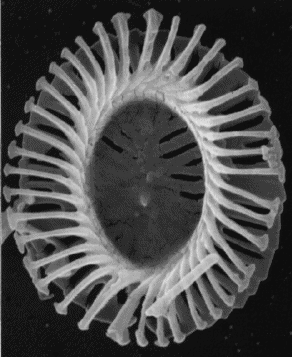
This western Kansas landscape consists of chalk badlands and chalk pillars and a natural arch. The rocks are chalks and impure chalks (e.g., argillaceous chalk and chalky shale) that range in color from whitish to light gray to yellowish. Chalk is a biogenic, calcitic, marine sedimentary rock composed of numerous coccolith microfossils (see: www.soes.soton.ac.uk/staff/tt/eh/pics/lith2.gif). Coccoliths are individual calcareous plates that covered a single-celled photosynthetic marine organism called a coccolithophorid (a.k.a. coccolithophore) (see: upload.wikimedia.org/wikipedia/commons/d/d9/Emiliania_hux...). These beds were deposited in the ancient Western Interior Seaway, a section of ocean that existed during parts of the Mesozoic Era in what is now the American and Canadian Great Plains.
.png)
Rock arches are rare erosional features - those developed in chalk beds are even rarer. If a stream goes under an arch, it is known as a natural bridge. If no stream is present, the feature is a natural arch. Along lakeshores, they are called lake arches. Along oceanic coastlines, they are called sea arches. The highest concentration of natural arches on Earth is Arches National Park in eastern Utah.
Stratigraphy: Smoky Hill Chalk Member (a.k.a. Smoky Hills Member), Niobrara Formation, mid-Upper Cretaceous
Locality: Monument Rocks (also known as the Chalk Pyramids), along Gove County Road 16, north of the Smoky Hill River, Gove County, western Kansas, USA (38° 47' 43.24" North latitude, 100° 45' 52.06" West longitude)
Army researchers developed a system that populates immersive environments with complex, heterogeneous data, allowing warfighters to retrieve relevant information quickly in support of mission-critical decisions. www.army.mil/article/240299
Masahito Enomoto, Former Senior Deputy Director Japan International Cooperation Agency (JICA) addressing at the AfDB's Annual Meetings 2017 - Developing Africa’s Grey Matter Infrastructure Addressing Africa’s Nutrition Challenges on May 22, 2017, at Mahatma Mandir Exhibition-cum-Convention Centre in Ahmedabad, India.
Guy Degen - freelance journalist
You may know Lego as a child’s toy but those colourful bricks are also a highly effective system for creative thinking.
Lego Serious Play is a facilitated thinking, communication and problem solving technique designed for organisations, teams and individuals.
Working with a facilitator skilled in Lego Serious Play can help editorial teams craft new strategies, develop audiences, visualise ideas, rapid prototype new concepts, complement collaborative processes such as design thinking and much more.
In this workshop journalist Guy Degen will introduce you to Lego Serious Play, offer some insight into applying the methodology in a media context and explain why news organisations are turning to play for inspiration. Come along and be ready to play with your ideas!