View allAll Photos Tagged develop
My old Ansco/GAF daylight tank and reel, I used this as a teenager in the early 1970's. Still works. The two plastic graduated cylinders with handles are from then too.
Natural arch developed in chalk & impure chalk in the Cretaceous of Kansas, USA.
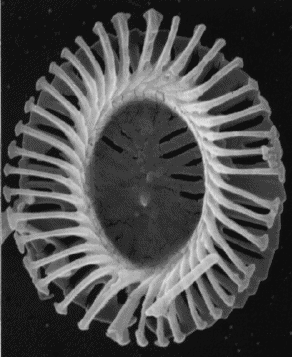
This western Kansas landscape consists of chalk badlands and chalk pillars and a natural arch. The rocks are chalks and impure chalks (e.g., argillaceous chalk and chalky shale) that range in color from whitish to light gray to yellowish. Chalk is a biogenic, calcitic, marine sedimentary rock composed of numerous coccolith microfossils (see: www.soes.soton.ac.uk/staff/tt/eh/pics/lith2.gif). Coccoliths are individual calcareous plates that covered a single-celled photosynthetic marine organism called a coccolithophorid (a.k.a. coccolithophore) (see: upload.wikimedia.org/wikipedia/commons/d/d9/Emiliania_hux...). These beds were deposited in the ancient Western Interior Seaway, a section of ocean that existed during parts of the Mesozoic Era in what is now the American and Canadian Great Plains.

Rock arches are rare erosional features - those developed in chalk beds are even rarer. If a stream goes under an arch, it is known as a natural bridge. If no stream is present, the feature is a natural arch. Along lakeshores, they are called lake arches. Along oceanic coastlines, they are called sea arches. The highest concentration of natural arches on Earth is Arches National Park in eastern Utah.
Stratigraphy: Smoky Hill Chalk Member (a.k.a. Smoky Hills Member), Niobrara Formation, mid-Upper Cretaceous
Locality: Monument Rocks (also known as the Chalk Pyramids), along Gove County Road 16, north of the Smoky Hill River, Gove County, western Kansas, USA (38° 47' 43.24" North latitude, 100° 45' 52.06" West longitude)
Wirral Chamber of Commerce has officially opened the recently developed Pacific Road Business Hub.
The building, formerly a performance and arts centre and heritage tram museum, will now be a major office location in Birkenhead encouraging and supporting the development of both existing and new businesses.
A key priority of Wirral Chamber of Commerce has been to create the right climate for investment, employment and economic prosperity for the area, and Pacific Road is a key piece of this jigsaw, now joining a successful property portfolio including The Lauries and Egerton House in Birkenhead.
Developing a global brand of prison products moved a step closer to being realized in May 2017 with the bringing together of key prison administrators from across Latin America.
Part of UNODC's Doha Declaration Global Programme, the event was organized to explore new and innovative approaches within the Latin American region which are being used to mitigate the social, economic and personal challenges faced by prisoners and reduce the risk of recidivism through rehabilitation. By identifying programmes which support prisoner's ability to lead self-sustained lives, the aim is to support the wider ideal of promoting a culture of lawfulness.
Developed in conjunction with Around the Table, the San Jose Museum of Art's community initiative, Sip. Do Not Gulp. examines the interconnectedness of food and water throughout Santa Clara Valley's long history. Created by Bay Area artist Michele Guieu, the site-specific installation calls attention to the shifting patterns and practices of water usage in this area. Once an abundant resource, agricultural development, population increase, and urban sprawl have placed stress on fresh water availability. Comprised of a painted mural, a documentary video, and a symbolic acorn "rug," Guieu highlights the preciousness of water as a local resource and draws salient connections to food production in this region: if there is no water, there is no food.
the de Saisset Museum
Santa Clara university
Santa Clara, CA.
January 17 - March 16, 2014
Exhibition Reception February 13, from 7:00 to 8:30pm.
www.scu.edu/desaisset/exhibitions/Food-and-Water.cfm
Also on view:
A Serving of Shapes: An Exploration in 3D Printing by Corinne Takara
- See more at: www.scu.edu/desaisset/exhibitions/servingshapes.cfm
cgi.ebay.co.uk/ws/eBayISAPI.dll?ViewItem&item=2508861...
The 16mm cine film Developing Tank appears unused
or if used has been cleaned meticulously.
The ORIGINAL box shows some signs of wear.
The Developing Tank is from Leningrad, Russian / USSR. It has a certificate.
It dates 18 VIII 1964. (That's 18th of August 1964)
The rubber pipes are in really good condition and not porous or brittle at all.
Quite amazing for this age. The Tank itself is almost scratch free, shining
and just looks fantastic. I do not know how to use it. And I am only selling
as I have course fees to pay, so it is a reluctant sale of an object I adore.
If you are interested in the Developing Tank then please see the
collection of youtube videos I made showing it from all angles
www.youtube.com/playlist?list=PL000C1C02C698EBC3
(at the moment I have 8 or so individual short clips of the developing tank,
arranged in a playlist, please check through them on you tube)
You should be able to see how good it looks. I can re-film any aspect of it
if you are interested, so please just get in touch, with questions and suggestions.
I am uploading the youtube videos at the moment, so they may take an hour or
so before they link up correctly.
I hope you will love this item as I did.
check this page it lists lots of tanks for sale in the US and UK, mine is the cheapest: www.super8camera.com/netsearch.php?zoekterm=developing+ta...
Developped in Caffenol. Photo Hall color prints 200 iso (a.k.a. Fujifilm superia). Taken by Eho Altissa Altix IV (trioplan 50mm 2,9)
I developed this film using QWD ECN-2 chemistry. It's a long story about a gift of 4 Silbersalz rolls that should have included developing and scanning back in Stuttgart. Instead, the film took a round trip from New York to Frankfurt, getting stuck in German customs for months with indifferent support from Silbersalz. So upon their return to me, I developed and scanned them myself. QWD makes a great product for home development of Vision3.
Canon EOS Rebel X Fuji Superia 200 Canon 1:4.5.6 35-80mm Zoom Developed with Jobo C-41 Press Kit Scanned on Epson Perfection V500
Develop Don't Destroy Brooklyn
Atlantic Yards Junkyard Bonds Protest
December 14, 2009
Standard & Poor's
55 Water Street
New York
In developing my A2 coursework final piece, I studied the works of Chuck Close, Paul Cezanne and Henry Matisse. Choosing my father as my subject, my aim was to produce a representational work, that was authentic and which captured his essence. I was primarily influenced by Close’s photo-realist portraits. By using techniques of exaggerated tones and brush strokes, such as used by Cezanne and Matisse in their portraiture, my work had a richer depth. A key idea was to build on the effect that these artists created by painting their subject looking straight on, directly at the viewer, yet not giving away any emotion.
My A2 exam work is influenced by the works of Edward Hopper and Ken Howard, their use of light and muted tones to create idyllic scenes has an enthralling effect on the viewer. In my final piece, I tried to ensure the focal point was not just the rays of light within the painting, but the painting as a whole, an effect that Hopper successfully achieves in his scenic paintings. I experimented with different images in order to find one with which, I could achieve similar effects to those of Hopper and Howard’s paintings, in terms of colour and focal points.
My most recent works are comprised of a series of landscapes using watercolour paints. These works have primarily been influenced by walks on Hampstead Heath and David Hockney’s ‘Beyond the trees’, using of bright colours and small detailed brush strokes to create a vibrant effect.
Developing inflorescences of Helichrysum pumilum (dwarf everlasting) emerging a year after fire on the Sentinel Range, Tasmania.
Archidendron vaillantii
Family:Mimosaceae
Synonyms:Albizia vaillantii , Affonsea vaillantii, Pithecellobium vaillantii
Common name:Salmon Bean; Red Bean
Flowers white and pedicellate.(with stalk)
Endemic to NEQ, well developed rain forest .
IDENTIFYING AUSTRALIAN RAINFOREST PLANTS,TREES & FUNGI - Flick Group --> DATABASE INDEX
PIR Circuit board with photo resist washed off the area to be etched
(I didn't actually end up using this one as it was a little over exposed)
It’s about developing confident, communication skills for every area of your life, which will help you discover who you really are and how to be natural and successful with people.Life Transforming Two Day Leadership Program by Tarun Ahuja in Hotel Paul @ Bangalore
Biddulph Grange was developed by James Bateman (1811–1897), the accomplished horticulturist and landowner; he inherited money from his father, who had become rich from coal and steel businesses. He moved to Biddulph Grange around 1840, from nearby Knypersley Hall. He created the gardens with the aid of his friend and painter of seascapes Edward William Cooke. The gardens were meant to display specimens from Bateman's extensive and wide-ranging collection of plants.
The post-1896 house served as a children's hospital from 1923 until the 1960s; known first as the "North Staffordshire Cripples' Hospital" and later as the "Biddulph Grange Orthopaedic Hospital" (though it took patients with non-orthopaedic conditions as well. Under this latter title the hospital's role expanded to accommodate adults, continuing in operation into the mid-1980s.) The 15 acres (6.1 ha) garden became badly run-down and neglected during this period, and the deeply dug-out terraced area near the house around Dahlia Walk was filled in level to make a big lawn for patients to be wheeled out on in summertime. The Bateman property was (and still is) divided: the hospital got the house and its gardens, and the uncultivated remainder of Biddulph Grange's land became the Biddulph Grange Country Park.
Until 1991 the house and gardens "housed an orthopaedic hospital, whose managers (understandably enough) were more concerned with their patients than the weird stuff looming out of rocky outcrops in the grounds. For the best part of a century the gardens decayed, visited only by passing vandals and, more rarely, intrepid folly-hunters."
In 1988 the National Trust took ownership of the property and its gardens, which have now been nearly fully restored.
Developed as a B&W negative in Caffenol CM for 6 minutes at 20 deg C and fixed for 5 minutes in Ilford Fixer.
Second film developed this year. Film used was Ilford Medium Format 120 FP4 125. Film was developed using out of date brown Ilford Multigrade paper developer. Dev time was 5mins 1+19. Film was hung on the line to dry. Camera used was a Rolleiflex Automat TLR dating from the late 1930's. The film was taken at Woolpit 2010. Film scanned with Xsane running under Ununtu 9.04. Scanner used was a flatbed Epson 2480. Edited with Photoscape,