View allAll Photos Tagged because
Because of its agreeable climate, Santa Monica had become a famed resort town by the early 20th century. The city has experienced a boom since the late 1980s through the revitalization of its downtown core with significant job growth and increased tourism. California.
© All Rights Reserved - No Usage Allowed in Any Form Without the Written Consent of Sharon C Johnson/MyRidgebacks - metadata embedded
...just because it's thursday
...just because i wanted something close-up
...just because pink makes me ridiculously happy
because you're ...
trc giờ tính từ mt gd toàn là swag , crazy , cool , cute ,...
khi Gờ chụp quảng cáo cho Saem ...
đẹp ko tả nổi
i've need to invent new word to describe how beautiful you are ...
Because of the low clouds, we were not able to see Mount Cook (3,754 m), not even a glimpse of any part of it. So having a quick glimpse of the snow on Mount Sefton (3,151 m) was a consolation.
Mount Sefton, Aoraki Mount Cook National Park, South Island, New Zealand (Tuesday 3 May 2011 @ 2:21pm).
I will not make the same mistakes that you did
I will not let myself cause my heart so much misery
I will not break the way you did
You fell so hard
I've learned the hard way, to never let it get that far
Because of you
I never stray too far from the sidewalk
Because of you
I learned to play on the safe side
So I don't get hurt
Because of you
I find it hard to trust
Not only me, but everyone around me
Because of you
I am afraid
I lose my way
And it's not too long before you point it out
I cannot cry
Because I know that's weakness in your eyes
I'm forced to fake a smile, a laugh
Every day of my life
My heart can't possibly break
When it wasn't even whole to start with
Because of you
I never stray too far from the sidewalk
Because of you
I learned to play on the safe side
So I don't get hurt
Because of you
I tried my hardest just to forget everything
Because of you
I don't know how to let anyone else in
Because of you
I'm ashamed of my life because it's empty
Because of you
I am afraid
I watched you die
I heard you cry
Every night in your sleep
I was so young
You should have known better than to lean on me
You never thought of anyone else
You just saw your pain
And now I cry
In the middle of the night
For the same damn thing
Because of you
I never stray too far from the sidewalk
Because of you
I learned to play on the safe side
So I don't get hurt
Because of you
I tried my hardest just to forget everything
Because of you
I don't know how to let anyone else in
Because of you
I'm ashamed of my life because it's empty
Because of you
I am afraid
Because of you
Because of you
I bought these today, because I just can't resist a pair of snuggly socks. They are the best thing in the winter.
This isn't my duvet in the picture, it's the spare one. But I think it's gorgeous, so I used it :D My new cover, for my new bed that is, is pale blue with pink flowers on (: When I get it set up, I'll take pictures on it.
Oh, please excuse the nasty cellulite on my thighs. Cheese and dairy is my downfall.
Anywways, I got my A-level results today. Which is why I'm taking a photo, despite the fact it's now dark out and the lighting is crappp.
I got an A in photography, a B in Art and Design, and a D in English Language. Which i'm pretty chuffed with.
It also means I got into AUCB, but that wasn't hard - i only needed an E in any subject to get a place on the foundation diploma course. But still, that A means I can apply for Oxford once i'm done with my diploma :D
Oh yess, I got tagged.
1) I'm a cross between excited and nervous for uni.
2) I'm nervous because of the whole moving out thing, so much to sort out etc.
3) I'm excited because this course isn't going to be completely ACE.
4) It's going to be strange waking up in my new house without Lauren there, or mum nagging us to feed the animals.
5) it's going to be really sad without my kitties.
6) But art is going to be funnn.
7) I think it's thunderstorming outside.
8) I love thunderstorms. We don't get them often, here. Just rain.
9) But that's British weather for you.
10) SNUGGLY SOCKKKSSS <3
Because I let mine go on vacation so sissy will do just fine fetching and filing and scurrying around for me
Because the theme for this year’s Convention was Supermodel, I did have a few expectations and one specific wish that I have was to see Adele with the 2.0 sculpt. It was such a relief to find out that Glamazon Adele is (almost) everything that I hoped for. There are other characters that could channel Naomi Campbell but it’s really a no-brainer Adele is that one doll who should, but for some reason I can’t see her represent Naomi with the 3.0 sculpt. Sure that sculpt is very close to Naomi’s facial features but l’m gonna call it like it is. 2.0 is a much better sculpt… for many reasons. One of those reasons is that 2.0 has a much relaxed expression. There’s a certain ease and effortlessness to the sculpt which is a contrast to 3.0’s stern expression. I also find 2.0’s face balanced and much more symmetrical. Of course 2.0 have those sultry lips that I can’t get enough of. She is just mesmerizing in every angle I can’t even stop from staring. She is modeling 360 degrees! As fabulous as the OOAK Obsession Adele was with the 3.0 sculpt which may have been considered for Adele, I’m so glad that we got 2.0 mass produced.
One of the things I was worried about was for the Convention dolls to have the same face designs as the main collection and true enough they do. But the designers proved me wrong. It didn’t matter. For almost three years now I find the face designs for Fashion Royalty to be lackluster. It was the “almost there but not quite” faces that didn’t impress me. In 2013 the "Classic" look seemed out-dated. In 2014 we had great eye designs but the eyebrows were not on point. In 2015 the vintage style which was a departure from the usual designs turned out to be unimpressive. This year Fashion Royalty put their best face forward. Something we haven’t seen in ages. We have the sass, the haughty expressions, and the arched eyebrows back. Each of the dolls’ faces, particularly for the Convention, were designed flawlessly. I love that the entire FR collection is consistent and cohesive with the face design as that does not happen all the time like in some of the past collections. Half of the dolls look great and half are so-so.
While Glamazon is flawless in my eyes, she was that one doll I wanted side glancing. It’s like everyone else was side glancing except for her. Integrity why are you doing this to me?! LOL. Why am I obsessed with side glancing eyes and why does it matter you ask? For Adele in particular, the last time she had the best side glance was The Muse, Paparazzi Bait, Something Sexy and Bodacious. It’s the squint and the side eye that I want perfected with Adele. To me side glancing eyes gives the dolls’ personality as opposed to the stoic look that they give when they’re looking straight forward. Although I’m not holding my breath, I’m hoping to see Adele with the 2.0 sculpt as the W Club Exclusive and hopefully they give her a variant of the face design that has side glancing eyes like what they did to Love, Life and Lace and Sister Moguls Agnes this year. Vanessa 1.0 showed up as the Exclusive last year, so it’s not impossible to see Adele 2.0 as the Exclusive this time.
For Glamazon to have the lowest edition size of 350 in the collection is somehow frustrating. Integrity lowered her edition size as last year’s table centerpiece Time and Again Adele is still in stock up to this day and they don’t want that to happen again. In my opinion, dolls of color do not sell not because of their skin tone but for me the design is a huge factor on that. I mean, looking at those two versions of the same character and I think it’s safe to say they are miles apart. Time and Again is matronly while Glamazon is sexy. Obviously with Glamazon selling out at the Convention only means they’ve done something right with the character and we want our sexy and sultry Adele back and hopefully this won’t be the last.
Because everything needed a monkey back in the day! Beppo was a test animal from Jor-El's lab that was sent to Earth with Clark - because a lab monkey is just as important to Jor-El as his own son apparently? Beppo was a member of the Super-Pets, a team of other super-powered animals (most of which were also owned by Superman, for whatever reason).
I finally bought the Superman vs Bizarro Mighty Micros set for this guy! I'm pretty pleased with how he turned out, but still hoping that Beppo gets to join the ranks of Krypto and Ace and find his way into a set! Some better printing on one of the traditional monkey pieces seems much more fitting than a full minifigure for this guy.
Because like so many others he and his wife cannot live on their pension, they have a garden where they raise their vegetables.
Zugsuchbild – Train searching shot
Mišulinovac, 30.03.2016, 7121-026, Pu 986
TriX in Moersch EFD
Ilford Classic in Meritol
Selentonig MT1 1/15 70 sec.
Bow Bridge.
Winter in Central Park, New York City.
"When Frederick Law Olmsted (1822-1903) and Calvert Vaux (1824-1895) designed Central Park in 1858, they developed an innovative interwoven transportation system of pedestrian paths, bridle trails, and carriage drives. Since the park is only one-half mile wide, the designers had to create a compact system of bridges and arches that allowed for separate levels of pathways. Vaux and his assistant Jacob Wrey Mould (1825-1886) created 35 unique structures, each with its own distinct style. They used brick, granite, marble, cast iron, and rustic wood and fashioned rusticated gneiss boulders out of the rock outcrops. Subsequent changes in the system of paths led to tearing down three of the original arches and the construction of four others.
Bow Bridge, shaped like an archer's bow, was built between 1859 and 1862. It connects the Ramble and Cherry Hill, and spans more than 60 feet of the Lake. Because the south bank was higher than the north, construction of the cast iron bridge included raising the height of its northern abutment. Janes, Kirkland, and Co., the firm responsible for the dome of The Capitol in Washington, D.C., did the ironwork for the span of Bow Bridge. Vaux and Mould created the ornamental iron railing that incorporates elements of Gothic, Neo-Classical, and Renaissance design."
--
View my New York City photography at my website NY Through The Lens.
Interested in my work and have questions about PR and media? Check out my:
About Page | PR Page | Media Page
To use any of my photos commercially, feel free to contact me via email at photos@nythroughthelens.com
This endangered Angolan Black and White Colobus is an arboreal primate native to Africa. Colobus comes from Greek ekolobóse or "he cut short" and the species is so named because it's thumbs are stumps. They are very social animals and groups can contain over 100 individuals. Lowery Park in Tampa, Florida.
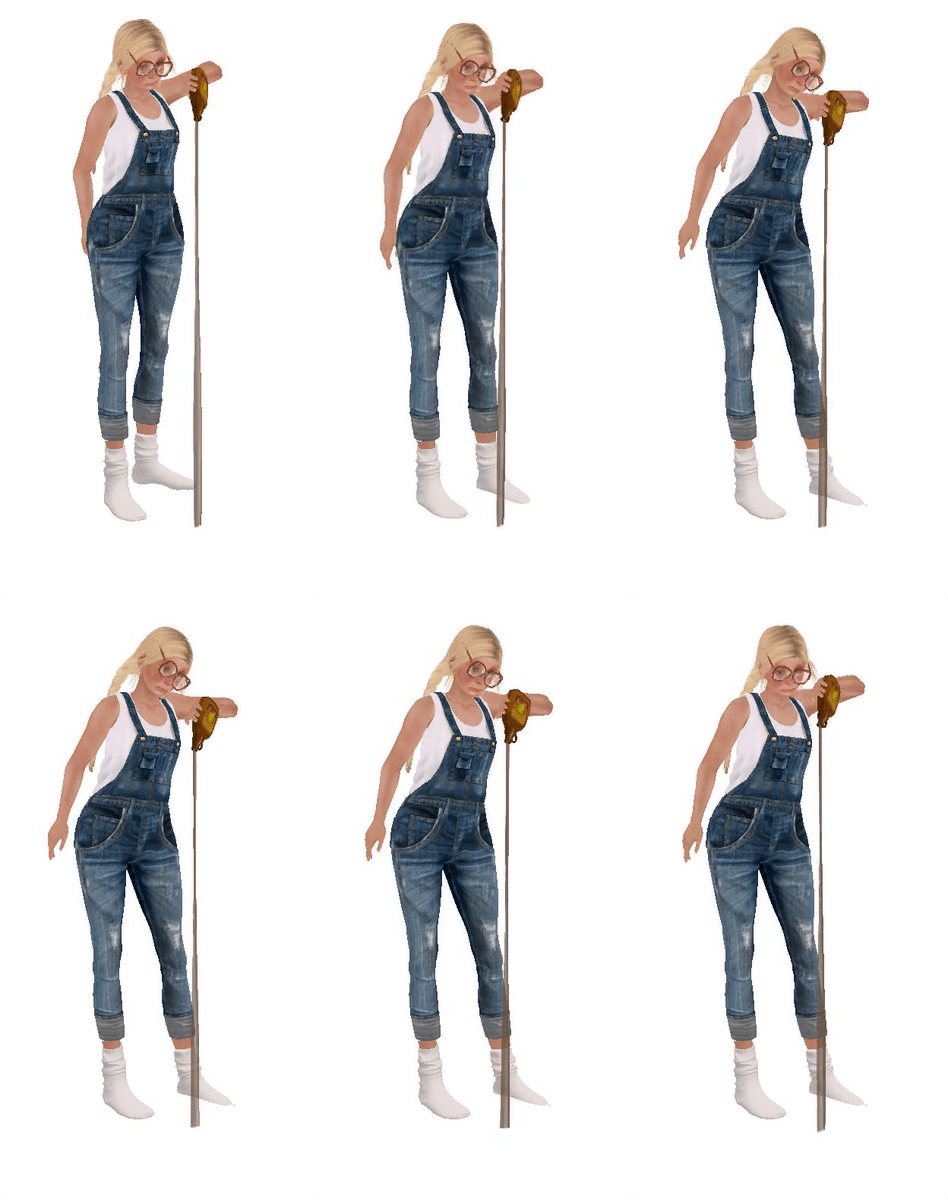
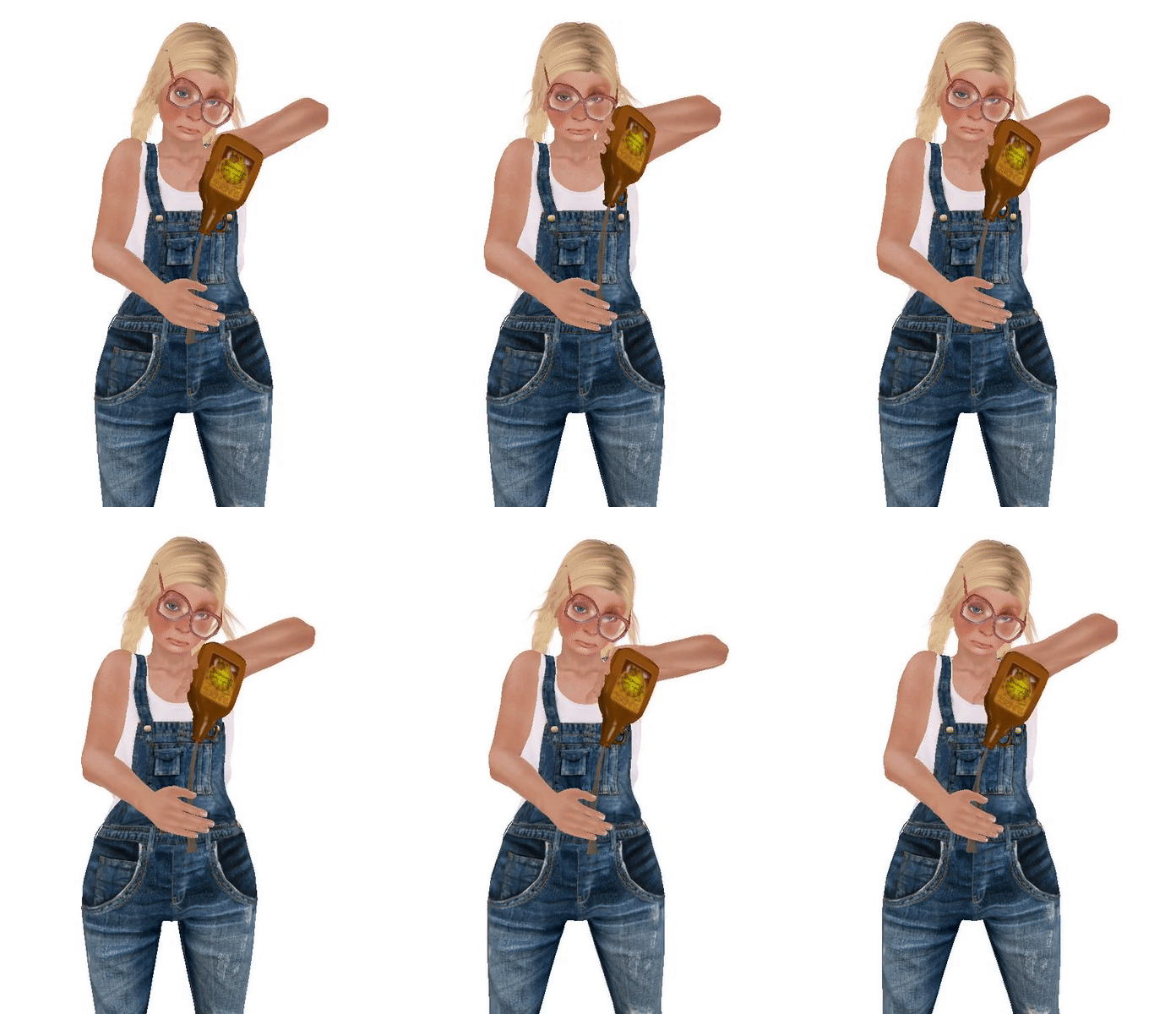
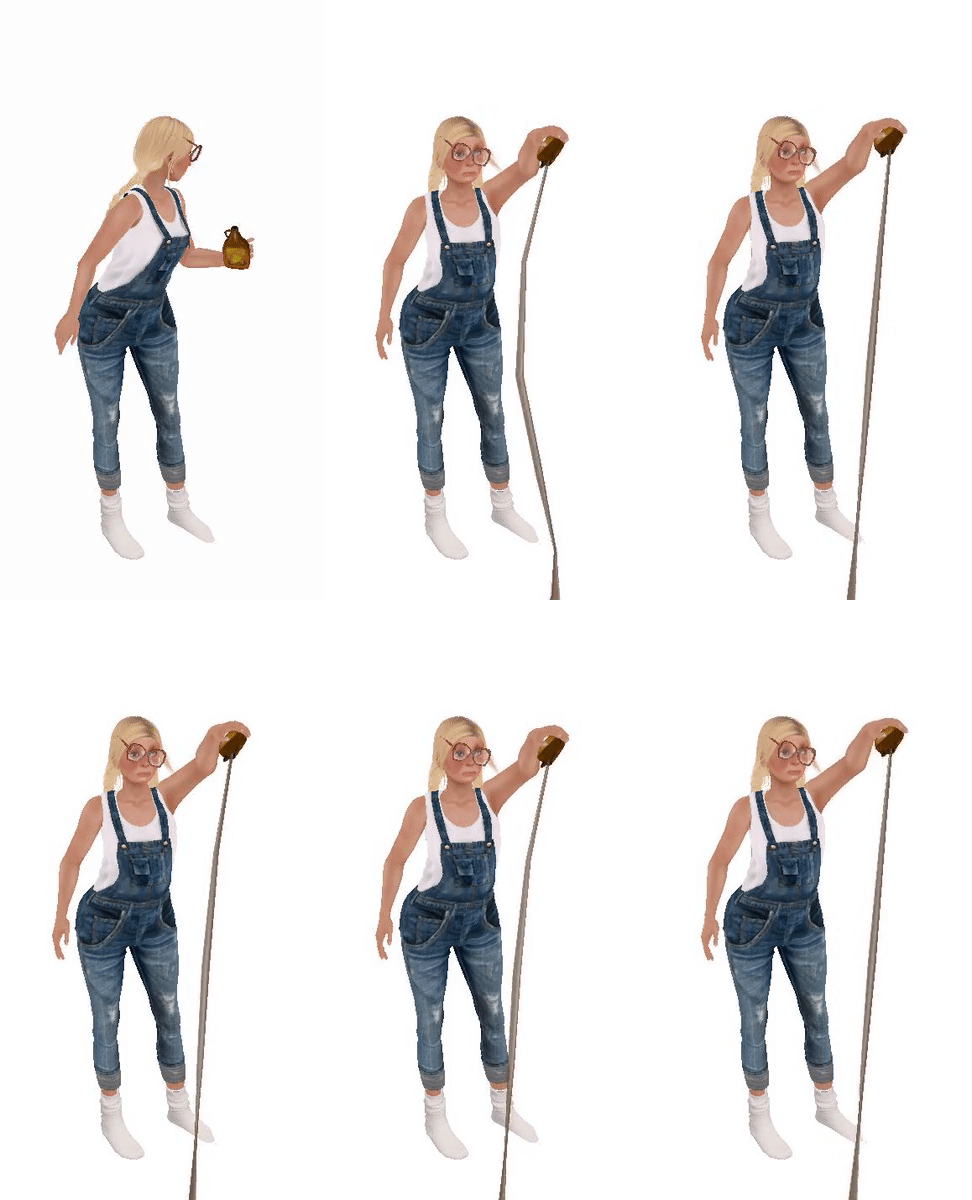
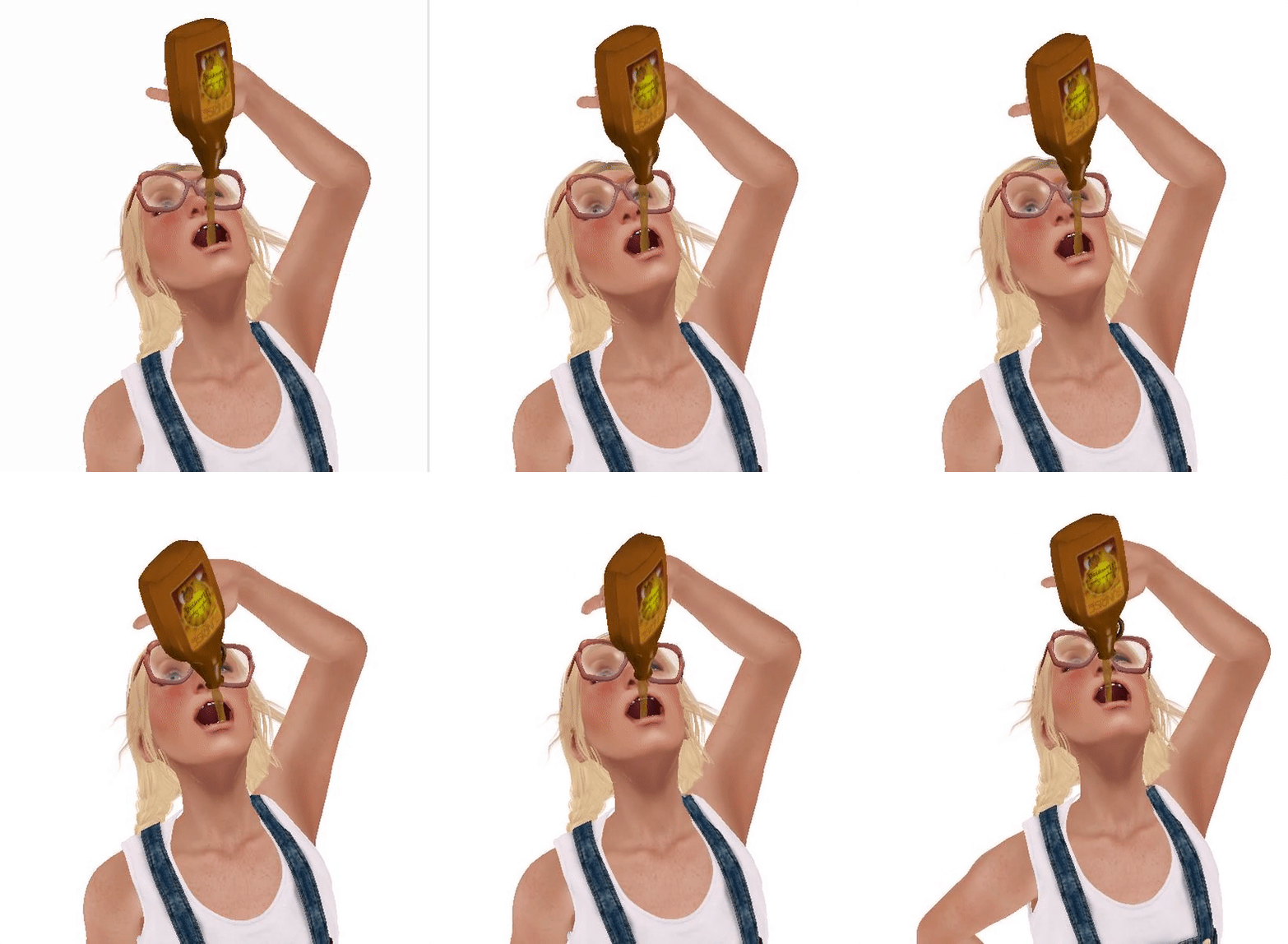
A bottle of pumpkin spice syrup and flavoring to pour all over your entire life.
Comes with a bottle to rez, pour onto the floor or things near the floor (click this version to pour into something you hold in your other hand), or just drink this straight out of the bottle because who really needs more than that?
Animation GIFs:
i.gyazo.com/65992dc5c9661d5d78ccc3754046c0a8.gif
i.gyazo.com/050fb0b9db9784fce00787de17a15f37.gif
i.gyazo.com/090eb05f5ad288595ee5719454aaf413.gif
i.gyazo.com/4b5ade62bbf0e1bf5b439a1d0b0a9a96.gif
Available at the Main Store:
maps.secondlife.com/secondlife/Salchicha%20County/203/35/23
or the Marketplace:
marketplace.secondlife.com/p/RC-Pumpkin-Spice-Everything/...
On this day in 1780 the English prison reformer, social reformer & Quaker Elizabeth Fry was born.
Elizabeth Fry was one of Britain's most influential 19th century social reformers and is best known for her work on improving the conditions of Britain's gaols. Because of her work, first on the treatment of female prisoners at Newgate Prison and then more generally on the conditions in British and European gaols, she has often been referred to as the "angel of prisons".
Elizabeth was born on May 21st 1780 in Gurney Court, off Magdalen Street, Norwich, Norfolk, England into a prominent Quaker family, the Gurneys. Her father, John Gurney (1749–1809), was a partner in Gurney's Bank. Her mother, Catherine, was a member of the Barclay family who were among the founders of Barclays Bank. Her mother died when Elizabeth was twelve years old so as one of the oldest girls in the family, she was partly responsible for the care and education of the younger children.
She married Joseph Fry, who was also a Quaker, in August 1800 at the Norwich Goat Lane Friends Meeting House and moved to St Mildred's Court in the City of London. In 1811 she was recorded as a minister of the Religious Society of Friends.
Prompted by a family friend, Stephen Grellet, Fry visited Newgate Prison in 1813. The conditions she saw there horrified her. The women's section was overcrowded with women and children, some of whom had not even received a trial. The prisoners did their own cooking and washing in the small cells in which they slept on straw.
She returned the following day with food and clothes for some prisoners. She was unable to personally further her work for nearly four years because of difficulties within the Fry family, including financial difficulties in the Fry bank.
Fry returned in 1816 and was eventually able to fund a prison school for the children who were imprisoned with their mothers. Rather than attempt to impose discipline on the women, she suggested rules and then asked the prisoners to vote on them. In 1817 she helped found the Association for the Reformation of the Female Prisoners in Newgate. This association provided materials for women so that they could learn to sew patchwork which was calming and also allowed skills to develop, such as needlework and knitting which could offer employment when they were out of prison and then could earn money for themselves. This approach was copied elsewhere and led to the eventual creation of the British Ladies' Society for Promoting the Reformation of Female Prisoners in 1821. She also promoted the idea of rehabilitation instead of harsh punishment which was taken on by the city authorities in London as well as many other authorities and prisons.
Elizabeth Fry also campaigned for the rights and welfare of prisoners who were being transported. The women of Newgate Prison were taken through the streets of London in open carts, often in chains, huddled together with their few possessions. They were pelted with rotten food and filth by the people of the city. The fear was often enough to make women condemned to transportation riot on the evening before. Fry's first action was to persuade the Governor of Newgate prison to send the women in closed carriages and spare them this last indignity before transportation. She visited prison ships and persuaded captains to implement systems to ensure each woman and child would at least get a share of food and water on the long journey. Later she arranged each woman to be given scraps of material and sewing tools so that they could use the long journey to make quilts and have something to sell as well as useful skills when they reached their destination. She also included a bible and useful items such as string and knives and forks in this vital care package. Elizabeth Fry visited 106 transport ships and saw 12,000 convicts. Her work helped to start a movement for the abolition of transportation. Transportation was officially abolished in 1837, however Elizabeth Fry was still visiting transportation ships until 1843.
Fry wrote in her book Prisons in Scotland and the North of England that she stayed the night in some of the prisons and invited nobility to come and stay and see for themselves the conditions prisoners lived in. Her kindness helped her gain the friendship of the prisoners and they began to try to improve their conditions for themselves. Thomas Fowell Buxton, Fry's brother-in-law, was elected to Parliament for Weymouth and began to promote her work among his fellow MPs. In 1818 Fry gave evidence to a House of Commons committee on the conditions prevalent in British prisons, becoming the first woman to present evidence in Parliament.
Her humanitarian work didn’t stop at prisons. For example, she helped the homeless, establishing a "nightly shelter" in London after seeing the body of a young boy in the winter of 1819/1820. She also campaigned for the abolition of the slave trade and opened a training school for nurses. Her programme inspired Florence Nightingale, who took a team of Fry's nurses to assist wounded soldiers in the Crimean War.
Her work gained her admiration from people in high places. One such was Queen Victoria, who granted her an audience a few times before she was Queen and contributed money to her cause after she ascended to the throne. Another admirer was Robert Peel who passed several acts to further her cause including the Gaols Act 1823. The act was however largely ineffective, because there were no inspectors to make sure that it was being followed.
Fry died from a stroke in Ramsgate, England, on October 12th 1845. From 2001–2016, Fry was depicted on the reverse of £5 notes issued by the Bank of England.
Because the sum of its road numbers equaled “21,” crews nicknamed the locomotive “Blackjack.”
Let me strongly suggest you go to rrmuseumpa.org/collections/roster/ and click on "Pennsylvania Railroad No. 4935" and then click on "Click Here for Virtual Tour" which is a video tour inside the cab.
Because I am finally happy again.
And I requested 86 books at the library which opens in four days.
You're jealous.
Tumblr. Follow me. ::::: Formspring. Ask questions or write me something.</a
+ more in comments
EDIT: I REPLACED IT WITH THE ONE THAT WAS SECOND IN COMMENTS
because I can.
++++ from WIKIPEDIA ++++++
Abruzzo (UK: /æˈbrʊtsoʊ/,[5] US: /ɑːˈbruːtsoʊ, əˈ-/; Italian: [aˈbruttso]; Abbrùzze [abˈbruttsə], Abbrìzze [abˈbrittsə] or Abbrèzze [abˈbrɛttsə] in Neapolitan Abruzzese; Aquilano: Abbrùzzu) or Abruzzi is a region of Southern Italy with an area of 10,763 square km (4,156 sq mi) and a population of 1.3 million. It is divided into four provinces: L'Aquila, Teramo, Pescara, and Chieti. Its western border lies 80 km (50 mi) east of Rome. Abruzzo borders the region of Marche to the north, Lazio to the west and south-west, Molise to the south-east, and the Adriatic Sea to the east. Geographically, Abruzzo is divided into a mountainous area in the west, which includes the Gran Sasso d'Italia, and a coastal area in the east with beaches on the Adriatic Sea.
Abruzzo is considered a region of Southern Italy in terms of its culture, language, history and economy, although geographically it may also be considered central.[8] The Italian Statistical Authority (ISTAT) also deems it to be part of Southern Italy, partly because of Abruzzo's historic association with the Kingdom of the Two Sicilies.
Abruzzo is known as "the greenest region in Europe" as almost half of its territory, the largest in Europe,[9] is set aside as national parks and protected nature reserves. There are three national parks, one regional park, and 38 protected nature reserves. These ensure the survival of 75% of Europe's living species, including rare species such as the golden eagle, the Abruzzo (or Abruzzese) chamois, the Apennine wolf and the Marsican brown bear.[10] Abruzzo is also home to Calderone, Europe's southernmost glacier.
The visiting nineteenth-century Italian diplomat and journalist Primo Levi (1853–1917) said that the adjectives "forte e gentile" (strong and kind) best describe the beauty of the region and the character of its people. "Forte e gentile" has since become the motto of the region and its inhabitants.
Provinces and politics
Abruzzo provinces
Provinces
Abruzzo is divided into four administrative provinces:
Province Area (km2) Population Density (inh./km2)
Chieti 2,588 396,190 153.1
L'Aquila 5,034 308,876 61.3
Pescara 1,225 318,701 260.1
Teramo 1,948 308,769 158.5
Politics
History
Human settlements in Abruzzo have existed since at least the Neolithic times. A skeleton from Lama dei Peligni in the province of Chieti dates back to 6,540 BC under radiometric dating.[13] The name Abruzzo appears to be derivative of the Latin word "Aprutium". In Roman times, the region was known as Picenum, Sabina et Samnium, Flaminia et Picenum, and Campania et Samnium.[14] The region was known as Aprutium in the Middle Ages, arising from four possible sources: it is a combination of Praetutium, or rather of the name of the people Praetutii, applied to their chief city, Interamnia, the old Teramo.
Many cities in Abruzzo date back to ancient times. Corfinio was known as Corfinium when it was the chief city of the Paeligni, and later was renamed Pentima by the Romans. Chieti is built on the site of the ancient city of Teate, Atri was known as Adria. Teramo, known variously in ancient times as Interamnia and Teramne, has Roman ruins which attract tourists.
After the fall of the Roman Empire, a string of invasions and rulers dominated the region, including the Lombards, Byzantines, and Hungarians. Between the 9th and 12th centuries, the region was dominated by the popes. Subsequently, the Normans took over, and Abruzzo became part of the Kingdom of Sicily, later the Kingdom of Naples. Spain ruled the kingdom from the sixteenth to the eighteenth centuries. The French Bourbon dynasty took over in 1815, establishing the Kingdom of the Two Sicilies, and ruled until Italian unification (also known as the Risorgimento) in 1860.
Until 1963, Abruzzo was part of the combined Abruzzi e Molise region. The term Abruzzi (plural of Abruzzo) derives from the time when the region was part of the Kingdom of the Two Sicilies. The territory was administered as Abruzzo Citeriore (nearer Abruzzo) and Abruzzo Ulteriore I and II (farther Abruzzo I and II) from Naples, the capital of the kingdom.[14] Abruzzo Citeriore is now Chieti province. Teramo and Pescara provinces now comprise what was Abruzzo Ulteriore I. Abruzzo Ulteriore II is now the province of L'Aquila.
In the twentieth century, war had a great impact on the region. During the Second World War, Abruzzo was on the Gustav Line, part of the German's Winter Line. One of the most brutal battles was the Battle of Ortona. Abruzzo was the location of two prisoner of war camps, Campo 21 in Chieti,[18] and Campo 78 in Sulmona. The Sulmona camp also served as a POW camp in World War 1; much of the facility is still intact and attracts tourists interested in military history.
Geography
Geographically, Abruzzo is located in central Italy and southern Italy, stretching from the heart of the Apennines to the Adriatic Sea, and includes mainly mountainous and wild land. The mountainous land is occupied by a vast plateau, including Gran Sasso, at 2,912 metres (9,554 ft) the highest peak of the Apennines, and Mount Majella at 2,793 metres (9,163 ft). The Adriatic coastline is characterized by long sandy beaches to the North and pebbly beaches to the South. Abruzzo is well known for its landscapes and natural environment, parks and nature reserves, characteristic hillside areas rich in vineyards and olive groves, and one of the highest densities of Blue Flag beaches.
Climate
The Abruzzo region has two types of climate that are strongly influenced by the Apennine Mountains, dividing the climate of the coastal and sub-Apennine hills from the interior's high mountain ranges. Coastal areas have a Mediterranean climate with hot dry summers and mild winters and rainy hills with a sublittoral climate where temperatures decrease progressively with increasing altitude and precipitation with altitude. Precipitation is also strongly affected by the presence of the Apennines mountain ridges of the region; it increases with the proportion being more abundant in the field and on the slopes exposed to the west, instead of decreasing towards the east and east-facing slopes. Often the Adriatic coast are sidelined rainfall from the west to the barrier effect of the Apennines undergoing the action of gentle winds descending from it (or Libeccio).[21] The minimum annual rainfall, however, is found in some inland valleys, sheltered from much disturbance to the blocking action of mountain ridges, such as the Peligna Valley, or the valley of the river Tirino, which in some places (Ofena, Capestrano) showed barely 500 millimetres (19.7 inches), and not along the coast where it never falls below 600 millimetres (23.6 inches); for if Teramo is relatively little watered by rain (Teramo less than 800 millimetres (31.5 inches)), the metre is exceeded in Chieti, reaching maximum levels in the Adriatic, while between Ortona and Vasto in Costa dei Trabocchi decrease again.[21] The highest rainfall occurs in upland areas on the border with Lazio; they are especially vulnerable to Atlantic disturbances. Around 1,500 to 2,000 millimetres (59 to 79 inches) of precipitation is typical (Pescara in 2010 showed a value close to 2,800 millimetres (110.2 inches)).
Flora and fauna
As with many Mediterranean regions, Abruzzo's vegetation is characterized by different Mediterranean ecosystems. The coast and the surrounding areas are characterized by the presence of typical plants of Mediterranean shrubland, such as myrtle, heather and mastic, while in the hilly areas other species grow, including olive, pine, willow, oak, poplar, alder, arbutus, broom, acacia, capers, rosemary, hawthorn, licorice and almond trees, interspersed with oak trees. At elevations between 600 and 1,000 metres (2,000 and 3,300 ft) there is sub-montane vegetation, mainly characterized by mixed forests of oak and turkey oak, maple and hornbeam; shrubs include dog rose and red juniper. Elevations between 1,000 and 1,900 metres (3,300 and 6,200 ft) are dominated by beech trees. In the Apennine Mountains at elevations above 2,000 metres (6,600 ft) species include alpine orchid, mountain juniper, silver fir, black cranberry and the Abruzzo edelweiss.
The fauna of Abruzzo is highly varied, including the region's symbol, the Abruzzo chamois (Rupicapra pyrenaica ornata), which has recovered from near-extinction. Animals typical of this region include: marsican brown bear, along with Italian wolf, deer, lynx, roe deer, snow vole, fox, porcupine, wild cat, wild boar, badger, otter, and viper.
The natural parks of the region include the Abruzzo National Park, the Gran Sasso and Monti della Laga National Park,[24] the Maiella National Park and the Sirente-Velino Regional Park, as well as many other natural reserves and protected areas.
Economy
Until a few decades ago, Abruzzo was a region of poverty in Southern Italy; over the past decades, however, it has developed to such an extent that it has escaped from the spiral of underdevelopment to become the 'first' region of the 'Italian Mezzogiorno'. This confirms its pivotal role in the national economic system. Since the 1950s, Abruzzo has had steady economic growth. In 1951, Abruzzo per capita income or GDP was 53% of that of Northern Italy, the nation's richest region. By 1971, Abruzzo was at 65% and, by 1994, per capita income was at 76% of Northern Italy's per capita income, giving Abruzzo the highest per capita GDP of Southern Italy and surpassing the growth of every other region of Italy. The construction of autostrade (motorways) from Rome to Teramo (A24) and Rome to Pescara (A25) opened Abruzzo to easy access. State and private investment in the region increased, and Abruzzo attained higher per capita education levels and greater productivity growth than the rest of the South. As of 2003, Abruzzo's per capita GDP was €19,506 or 84% of the national average of €23,181 and well outpacing that of the South (€15,808). The region's average GDP per capita was approximately 20,100 EUR.
The 2009 L'Aquila earthquake led to a sharp economic slowdown. However, according to statistics at the end of 2010, it seems that the economy of Abruzzo is recovering, despite the negative on regarding employment.[28] In fact, at the end of 2010, Abruzzo's growth was 1.47%, which placed it fourth among the Italian regions with the highest annual growth rates after Lazio, Lombardy and Calabria.[30] In 2011 Abruzzo's economic growth was +2.3%, the highest percentage among the regions of Southern Italy.[31] The region is also the richest region of Southern Italy, with a GDP per capita of €25,700.[21]
Travel poster from the 1920s.
Abruzzo's industrial sector expanded rapidly, especially in mechanical engineering, transportation equipment and telecommunications. The structure of production in the region reflects the transformation of the economy from agriculture to industry and services. Although industry has developed strongly, it retains weak points due to the existence of only a few large businesses alongside a huge fabric of small and medium-sized businesses. Both pure and applied research are carried out in the region, where there are major institutes and factories involved in research in the fields of pharmaceutics, biomedicine, electronics, aerospace and nuclear physics. The industrial infrastructure is spread throughout the region in industrial zones. The most important of these are: Val Pescara, Val Sangro, Val Trigno, Val Vibrata and Conca del Fucino. A further activity worthy of note is seaside and mountain tourism, which is of considerable importance to the economy of the region.[33] Agriculture, involving small holdings, has succeeded in modernising and offering high-quality products. The mostly small, agricultural holdings produce: wine, cereals, sugar beet, potatoes, olives, vegetables, fruit and dairy products. Traditional products are saffron and liquorice. Most famous in the world is Abruzzo's wine Montepulciano d'Abruzzo; in the late 20th and early 21st century, Montepulciano d'Abruzzo earned a reputation as being one of the most widely exported DOC classed wine in Italy.[34]
In the past decade, tourism has increased, in particular by internal and European arrivals. Abruzzo is world-famous for its wildlife parks (Abruzzo National Park, Gran Sasso and Monti della Laga National Park, Maiella National Park) and regional park (Sirente Velino), and 38 protected areas between oasis, regional reserves, and state reserves. The inland mountainous region contains several ski resorts, and coastal tourism is also well-developed, in particular, the Trabocchi Coast. Abruzzo's castles and medieval towns, especially around the town of L'Aquila, have earned it in some quarters the nickname of "Abruzzoshire", by analogy with the "Chiantishire", nickname sometimes used to refer to the Chianti area of Tuscany, but Abruzzo is still off the beaten path for most visitors to Italy.[35]
Chieti
Although the population density of Abruzzo has increased over recent decades, it is still well below the Italian national average: in 2008, 123.4 inhabitants per km2, compared to 198.8. In the provinces, the density varies: as of 2008 Pescara is the most densely populated with 260.1 inhabitants per km2, whereas L'Aquila is the least densely populated with 61.3 inhabitants per km2, although it has the largest area. After decades of emigration from the region, the main feature of the 1980s is immigration from third world countries. The population increase is due to the positive net migration. Since 1991 more deaths than births were registered in Abruzzo (except for 1999, when their numbers were equal).[36] In 2008, the Italian national institute of statistics ISTAT estimated that 59,749 foreign-born immigrants live in Abruzzo, equal to 4.5% of the total regional population.
The most serious demographic imbalance is between the mountainous areas of the interior and the coastal strip. The largest province, L'Aquila, is situated entirely in the interior and has the lowest population density. The movement of the population of Abruzzo from the mountains to the sea has led to the almost complete urbanization of the entire coastal strip especially in the province of Teramo and Chieti. The effects on the interior have been impoverishment and demographic aging, reflected by an activity rate in the province of L'Aquila which is the lowest among the provinces in Abruzzo – accompanied by geological degradation as a result of the absence of conservation measures. In the coastal strip, however, there is such a jumble of accommodations and activities that the environment has been negatively affected. The policy of providing incentives for development has resulted in the setting-up of industrial zones, some of which (Vasto, Avezzano, Carsoli, Gissi, Val Vibrata, Val di Sangro) have made genuine progress, while others (Val Pescara, L'Aquila) have run into trouble after their initial success. The zones of Sulmona and Guardiagrele have turned out to be more or less failures. Outside these zones, the main activities are agriculture and tourism.
Main settlements
L'Aquila is both the capital city of the Abruzzo region and of the Province of L'Aquila and second largest city (pop. 73,000). L'Aquila was hit by an earthquake on 6 April 2009, which destroyed much of the city centre. The other provincial capitals are Pescara, which is Abruzzo's largest city and major port (pop. 123,000); Teramo (pop. 55,000) and Chieti (pop. 55,000). Other large municipalities in Abruzzo include the industrial and high tech center Avezzano (pop. 41,000), as well as three important industrial and touristic centers such as Vasto (pop. 40,636), Lanciano (pop. 36,000), and Sulmona (pop. 25,000).
Transport
Airports
Abruzzo International Airport is the only international airport in the region. Open to civilian traffic since 1996, the number of passengers has increased over the years because of low-cost air carriers' use of the facility. Today, the airport has a catchment area of over 500,000 passengers annually and connects the city of Pescara and the entire region with many Italian and Europe destinations.
L'Aquila-Preturo Airport is located in the nearby village of Courts and was recently renovated and modernized to accommodate presidential flights for G8 activities.
Ports
There are four main ports in Abruzzo: Pescara, Ortona, Vasto and Giulianova.
Over the years the Port of Pescara became one of the most important tourist ports of Italy and the Adriatic Sea. Heavily damaged in World War II, it underwent some sixty years of major restoration and was reborn as a modern marina with advanced moorings and shipbuilding facilities. It has been honored with the European Union's blue flag for the quality of services offered. The port of Pescara has lost passenger traffic because of its shallowness and silting, but its fishery and aquaculture activities are thriving.[38]
Railways
There is a significant disparity between the railways of the Abruzzo coast and the inland areas, which badly need modernization to improve the service, in particular, the Rome-Pescara line.
Existing railway lines:
Adriatic railway runs through the whole of Italy from north to south, along the Adriatic Sea.
Train Rome – Sulmona – Pescara
Sulmona – Carpinone
Sulmona–Terni railway
Avezzano railroad – Roccasecca
Giulianova – Teramo
Sangritana (Lanciano – Castel di Sangro)
Highways
There are three highways that serve the region:
Highway A24 Rome – L'Aquila – Teramo, was built in the 1970s and connects Rome with Lazio and more specifically to the Abruzzo Teramo via L'Aquila. It performs an important liaison function of the region, both Tyrrhenian to the Adriatic, due to the presence of several interchanges of connecting roads and highways. The Gran Sasso tunnel, the longest road tunnel entirely on Italian territory, was opened in 1984. It connects L'Aquila and Teramo on the A24 making the northern Abruzzo coast reachable within two hours from Rome.
Highway A25 Turin – Avezzano – Pescara makes the connection between Rome and Pescara. The road running out of Turin begins its journey where it branches off the A24, runs into the Conca del Fucino, crosses the Abruzzo Apennines, comes to the valley of Peligna, and ends at the exit for Pescara-Villanova to join the A14.
Motorway A14 Bologna – Taranto known as the A14 "Adriatica", includes 743 km (461.68 mi) of road, including lengths in the cities of Bologna and Taranto. Opened to traffic in 1965, it is now a major tourist road, running through the coastal towns of Emilia Romagna, Marche, Abruzzo, Molise, and Apulia.
Culture
Castel del Monte, one of Abruzzo's little-known hill towns
Gabriele d'Annunzio from Pescara
Abbazia di San Liberatore a Majella (Serramonacesca)
Ovid from Sulmona
Cathedral of San Giustino (Chieti)
Fishing trabucco of San Vito Chietino
The museum Museo Archeologico Nazionale d'Abruzzo in Chieti houses the famed warrior statue Warrior of Capestrano which was found in a necropolis from 6th century B.C. Of cultural importance are: Teramo Cathedral, its archeological museum and Roman theater, the Castello della Monica, the Collurania-Teramo Observatory, the famous L'Aquila Basilica of Santa Maria di Collemaggio (which holds the remains of Pope Celestine V), the Museo Nazionale d'Abruzzo, Santa Maria del Suffragio, the Forte Spagnolo, the Fountain of 99 Spouts, Gabriele D'Annunzio's house in Pescara, Campli's Scala Sancta and its church, the church of Santissima Annunziata in Sulmona, the cathedrals of Chieti, Lanciano, Guardiagrele, Atri and Pescara along with the castles of Ortona, Celano and Ortucchio.
Every 28–29 August, L'Aquila's Santa Maria di Collemaggio commemorates the Perdonanza Celestiniana, the indulgence issued by Pope Celestine V to any who, "truly repentant and confessed" would visit that Church from the Vespers of the vigil to the vespers of 29 August.[39] Sulmona's Holy Week is commemorated with traditional celebrations and rituals, such as 'La Madonna che Scappa in Piazza', where a large statue of the Madonna, carried by a group of Sulmonesi part of Confraternities, is taken through the square towards her resurrected Son.[40] Cocullo, in the province of L'Aquila, holds the annual 'Festa dei serpari' (festival of snake handlers) in which a statue of St. Dominic, covered with live snakes, is carried in a procession through the town; it attracts thousands of Italian and foreign visitors. In many Abruzzo villages, Anthony the Great's feast is celebrated in January with massive and scenic bonfires.[41] In the past, the region of Abruzzo was well known for the transumanza, the migratory movement of sheep principally south to the region of Puglia during the cold winter months.[42] The Feast of St. Biagio, protector of wool dealers, is the most widespread in Abruzzo. On the third of February in Taranta Peligna every year since the sixteenth century an evocative ritual is carried out, entailing the distribution of panicelle, which are small loaves made of flour and water, in the shape of a blessing hand, which are distributed to the faithful.
Historical figures include: the Roman orator Asinius Pollio; Latin poets Sallust and Ovid, who were born in L'Aquila and Sulmona respectively, Gaius Cassius Longinus, Roman senator and leading instigator of the plot to kill Julius Caesar; and Pontius Pilate, who was born in the province of Teramo and is best known for authorizing the crucifixion of Jesus. Abruzzo's religious personalities include Saint Berardo; John of Capistrano, who led a crusade against the Ottoman Empire; Thomas of Celano, author of three hagiographies about Saint Francis of Assisi; and Alessandro Valignano, who introduced Catholicism to the Far East and Japan. The Polish Pope John Paul II loved the mountains of Abruzzo, where he would retire often and pray in the church of San Pietro della Ienca. When he died, Cardinal Stanislaw Dziwisz, gave the local Abruzzo community some of the late pontiff's blood as a token of the love he had felt for the mountainous area.[43] The greatest Italian poet of the 20th century Gabriele D'Annunzio was from Pescara; other notable Abruzzo personalities in the field of humanities include: poet Ignazio Silone, director Ennio Flaiano who co-wrote La dolce vita, philosopher Benedetto Croce, composer Sir Paolo Tosti and the sculptor Venanzo Crocetti.
American artists and celebrities such as: Madonna, Dean Martin, Bradley Cooper, Perry Como, Henry Mancini, Nancy Pelosi, Rocky Marciano, Rocky Mattioli, Bruno Sammartino, Mario Batali, John and Dan Fante, Tommy Lasorda, Dan Marino, Mario Lanza, Garry Marshall, Penny Marshall, Al Martino, Ariana Grande and Canadian Michael Bublé have Abruzzo origins.
Some international movies shot in Abruzzo include The American, Jean-Jacques Annaud's The Name of the Rose, Fellini's La Strada and I Vitelloni, Schwarzenegger's Red Sonja, Ladyhawke, King David, Francesco, Keoma, The Barbarians, The Fox and the Child and Krull.
Medieval and Renaissance hill towns
The fortress of Civitella is the most visited monument in Abruzzo
For most of its history, a large number of the Abruzzese people have been hill people, often working as shepherds in mountainous areas, or establishing hill towns, especially in the parts of Abruzzo further from the Adriatic coast.[citation needed] Before the 2009 earthquake, Abruzzo was the region with the highest number of castles and hill towns in Italy, but it still holds many of Italy's best-preserved medieval and Renaissance hill towns, twenty-three of which are among The Most Beautiful Villages in Italy.[44] These awards are not only for aesthetic beauty but also for art and culture, historical importance and livability.
The abrupt decline of Abruzzo's agricultural economy in the early to mid-20th-century saved some of the region's historic hill towns from modern development. Many lie entirely within regional and national parks. Among the most well preserved are Castel del Monte and Santo Stefano di Sessanio, which lie in the Gran Sasso National Park on the edge of the high plain of Campo Imperatore and nestled beneath the Apennines' highest peaks. Both hill towns, which were ruled by the Medicis for over a century-and-a-half, have relatively little tourism. Between the two towns sits Rocca Calascio, the ruin of an ancient fortress popular with filmmakers. Both Monteferrante and Roccascalegna are two of the most representative Abruzzo villages in the province of Chieti. Within the Gran Sasso National Park is also found Castelli, an ancient pottery center whose artisans produced ceramics for most of the royal houses of Europe.
Civitella del Tronto played a crucial role in the history of the unification of Italy. The fortress of Civitella is the most visited monument in the Abruzzo region today.[45] Other medieval hill towns located fully within Abruzzo's park system are Pacentro in the Maiella National Park and Pescasseroli in the Abruzzo National Park. Pacentro, which features a 14th-century castle with two intact towers, has been little touched by modernisation. The Shrine of Gabriel of Our Lady of Sorrows, in the province of Teramo, which attracts some two million visitors per year, is one of the 15 most-visited sanctuaries in the world.[46] Capestrano, a small town in the province of L'Aquila, is the hometown of Saint John of Capistrano, Franciscan friar and Catholic priest, as well as the namesake of the Franciscan missions San Juan Capistrano in Southern California, the mission Mission San Juan Capistrano (Texas) and the city of San Juan Capistrano in Orange County. Giulianova is a notable example of a Renaissance "ideal city."
The proximity to Rome, the protected natural reserves and landscapes which make the region one of the greenest in Europe, the presence of some of the most beautiful Italian villages, its rich and heterogeneous gastronomy, along with a long history of deep-rooted local tradition and authentic Italian culture, make Abruzzo fifth among Italian regions for tourist visits after Calabria, Marche, Sardinia and Trentino. In 2010, visitors included 6,381,067 Italians and 925,884 foreign tourists.
In 2015, the American organization Live and Invest Overseas included Abruzzo on its list of World's Top 21 Overseas Retirement Havens. The study was based on such factors as climate, infrastructure, health care, safety, taxes, cost of living and more. In 2017 the Chamber of Commerce of Pescara presented Abruzzo region to the Annual conference of Live and Invest Overseas in Orlando (USA). One year later, in October 2018, Live and Invest Overseas held its first conference in Abruzzo.
Universities
There are three universities in the Abruzzo region:
University of L'Aquila
D'Annunzio University of Chieti–Pescara
University of Teramo
Harvard University bases an intensive summer Italian language and culture program in Vasto, a resort town on Abruzzo's southern coast.
Science
Between the province of Teramo and L'Aquila, under the Gran Sasso Tunnel, is the Laboratori Nazionali del Gran Sasso (LNGS) of the INFN, one of the three underground astroparticle laboratories in Europe.
The Istituto Zooprofilattico Sperimentale dell'Abruzzo e del Molise "Giuseppe Caporale", which conducts research in veterinary and environmental public health, is located in Teramo.
The Gran Sasso Science Institute, located in L'Aquila, is an advanced research institute which offers doctorates in astroparticle physics, computer science, and mathematics as well as urban studies and regional science, and which also conducts scientific research.
Sports
Interamnia World Cup, the largest international youth handball competition worldwide, takes place yearly in Teramo.[51]
There are several football clubs in Abruzzo. Delfino Pescara 1936 is a Serie B club; based in Pescara, its home stadium is Stadio Adriatico – Giovanni Cornacchia.
Dialects
The regional dialects of Abruzzo include Teramano, Abruzzese Orientale Adriatico and Abruzzese Occidentale. The first two form part of the dialect of southern Italy also known simply as "Neapolitan" since the region has been part of the Kingdom of Naples and the Kingdom of the Two Sicilies, while Aquilano is related to the Central Italian dialects including Romanesco. The dialects spoken in the Abruzzo region can be divided into three main groups:
Sabine dialect, in the province of L'Aquila (central Italian dialects)
Abruzzo Adriatic dialect, in the province of Teramo, Pescara and Chieti, that is virtually abandoned in the province of Ascoli Piceno (southern Italian dialects)
Abruzzo western dialect, in the province of L'Aquila (southern Italian dialects)
Cuisine
Renowned for its variety and richness due to the heterogeneity of its territory, Abruzzo's cuisine is among the best in Italy. In 2013 an Italian organization Confesercenti survey of foreign tourists showed that Abruzzo is the best Italian region to eat in. Both the agricultural and coastal aspects of Abruzzo have contributed to its cuisine. Due to the mountains, much of Abruzzo was isolated from international influence until the 20th century. As a result, the region's cuisine remained unique.
Popular dishes
One of the most popular regional dishes is spaghetti alla chitarra which is made by pressing or cutting pasta through a chitarra, an implement to form long thin noodles similar to spaghetti. The pasta is served with a tomato-based sauce, often flavored with peppers, pork, goose, or lamb. This dish is complemented by regional side dishes, such as the bean and noodle soup, sagne e fagioli. This soup is traditionally flavored with tomatoes, garlic, oil, and peperoncini. In terms of common ingredients, cuisine in Abruzzo often includes:
Lamb and mutton, primarily in the mountains.[54] Sheep's milk (or ricotta) is an important source of Abruzzese cheese, and lamb intestines are used as sausage casing or for stuffed meat rolls.[54][55] Mountain goat meat is also common in Abruzzo.
Truffles and mushrooms, particularly wild mushrooms from the forests and hills
Garlic, especially red garlic
Rosemary
Hot chili pepper or peperoncini, regionally known as diavolilli or diavoletti, is common in Abruzzese cuisine and often used to add spice to dishes. Abruzzo residents are well known for frequently adding peperoncini, or hot peppers, to their meals.
Vegetables such as lentils, grasspeas and other legumes, artichoke, eggplant, and cauliflower[54][55][56][57]
Other popular dishes include:
Gnocchi carrati, flavored with bacon, eggs and pecorino cheese
Scrippelle, a rustic French-style crêpe served either mbusse (a type of soup) or used to form a sort of soufflé with some ragù and stuffed with chicken liver, meatballs, hard-boiled eggs, and cheese
Pastuccia, a polenta stew with sausage, eggs, and cheese
Across the region, roast lamb is enjoyed in several variations. Some of these variations include:
Arrosticini, a skewered lamb dish
Pecora al cotturo, lamb stuffed with a variety of mountain herbs and cooked in a copper pot
Lamb cooked whole in a bread oven
Agnello cacio e ovo, a lamb-based fricassee
Mazzerella: lamb intestines stuffed with lamb, garlic, marjoram, lettuce, and spices
Le virtù: a soup from Teramo filled with legumes, vegetables and pork, usually eaten in the spring at celebrations
Timballo abruzzese: lasagna-like dish with pasta sheets (scrippelle) layered with meat, vegetables and rice; often served for Christmas and Easter[58]
Porchetta abruzzese: moist boneless-pork roast, slow-roasted with rosemary, garlic, and pepper[58]
Seafood is also popular, especially in coastal areas. The variety of fish available to the area has resulted in several fish-based Brodetti (broths), coming from such places as Vasto, Giulianova, and Pescara. These broths are often made by cooking fish, flavored with tomatoes, herbs, and peperoncino, in an earthenware pot. Rustic pizzas are also very common. Some of these are:
Easter Pizza, a rustic cake with cheese and pepper from the Teramo area
Fiadoni from Chieti, a dough of eggs and cheese well risen, cooked in the oven in a thin casing of pastry
A rustic tart pastry filled with everything imaginable: eggs, fresh cheeses, ricotta, vegetables, and all sorts of flavorings and spices.
Also from Teramo are the spreadable sausages flavored with nutmeg, and liver sausages tasting of garlic and spices. The ventricina from the Vasto area is made with large pieces of fat and lean pork, pressed and seasoned with powdered sweet peppers and fennel all encased in the dehydrated stomach of the pig itself. Atri and Rivisondoli are famous for cheeses. Mozzarella, either fresh or seasoned, is made from ewe's milk, although a great number of lesser known varieties of these cheeses can be found all over Abruzzo and Molise.
Sweets
The Abruzzo's sweets are world-famous and include:
Confetti, sugar-coated almonds, from Sulmona
Torrone Nurzia, a chocolate nougat from L'Aquila
Parrozzo , a cake-like treat made from a mixture of crushed almonds, and coated in chocolate.
Ferratelle (also known as Pizzelle). A wafer cookie, often flavored with anise
Croccante, a type of nougat made from almonds and caramelized suger, often flavored with lemon[59]
A Montepulciano d'Abruzzo wine labelled as being made from old vines.
Olive oil
The extra-virgin olive oil produced in Colline Teramane (Teramo hills) is marked by the DOP.[60]
The region has several cultivars that includes Carboncella, Dritta (Dritta Francavillese and Dritta di Moscufo), Gentile del Chieti, Nostrana (Nostrana di Brisighella), and Sargano olive cultivars.[61]
Wines and liquors
Renowned wines like Montepulciano DOCG and Trebbiano d'Abruzzo DOC are judged to be amongst the world's finest.[62] In 2012, a bottle of Trebbiano d'Abruzzo ranked No. 1 in the top 50 Italian wine awards.[63] In recent decades these wines have been joined, particularly, by wines from lesser known (heritage) white grapes, such as, Pecorino, Cococciola, Passerina, Montonico Bianco and Fiano.[64]
The region is also well known for the production of liquors such as Centerbe, Limoncello, Ratafia and Genziana.
This series is about discovering the truth so I’m about to hit a new level of honesty with you all. I hope you’re ready because man oh man, I’m not even sure if I am.
You can only run into a wall so many times before there is a break. Most people believe it’s up to chance whether or not it is you who breaks or the wall. I believe I have smashed my head against the same wall for so long that it was when I said “this hurts” that the pain began. It was my choice to believe that. It was my choice to believe in the pain more than the healing. I wanted to sulk and pout. I wanted to dwell in my own self-pity because I blamed the wall for being there…not myself for hitting it. I was exhausted and frustrated. Frustration started around my veins and weaved itself thickly through, making a net with itself. The lies I believed were getting caught in the nets and were clotting themselves. My blood couldn’t run through and slowly my life was failing.
What happened after?
How did I fix it?
I found the courage to sign the contract, dedicating my life to God. I made the choice to go under his knife so he could restore in me a new life. My heart was suddenly pumping with the blood that was once shed for me…all throughout my body. The clots could not stand against the purity, the strength or the mercy. I don’t think I could ever explain the feeling but what I can say is I watched the wall crumble. Yes, I watched it. I did nothing but watch as the power of God broke it down for me.
I’m not here to sugar coat anything and my bluntness has always been something some of you say you admire. So here it is.
The lie: When bad things happen, it’s not of God. God only wants me to be happy.
The truth: In Ecclesiastes 3 it says there is a time for everything, for every purpose under heaven. “A time to weep, a time to laugh. A time to mourn and a time to dance. A time to cast stones and a time to gather stones. A time to embrace and a time to refrain from embracing. A time to gain and a time to lose.” Ecclesiastes 3: 4-6
Yeah here’s the deal. The Word is the truth. I believed a lie that God didn’t care about me or that he was angry at me because my life became difficult. I expected him to bless me and love me because I was told “God is love”. Yes, God is love but He is still GOD.
The question to ask yourself is, what lies have you been believing because you haven’t poured yourself into the Word? How can we truly know the truth or the lies that are holding us down if we are just “getting by” as Christians?
(I chose this picture because it just makes me smile. Reminding me joy comes in the morning)
Because thinking outside the box is cool. Partially inspired by |M A K B R I C K S| Apocabuddy. Slightly edited.
Leaves,
Please be my light-filter
Shine, make me a shelter to hide,
'cause love makes you lose your sight.
And now the search party's on its way
And the floodlight's on my face
All the shadows that I walk in
Are just my volatile second skin
My reflections are protections
They will keep me from destruction
My directions are distractions
When you're ready, come into the light.
Lines, Design a pathway
Shine, cut out the dark shapes to find
Although I've really tried
Only time is a lover's guide
And now the railings fall away
And the stencils draw a face
Our outlines in the sunset
Are just a fragile silhouette
My reflections are protections
They will keep me from destruction
My directions are distractions
When you're ready, come into the light.
My reflections are protections
They will keep me from destruction
My directions are distractions
If you leave me, I'll go back to hide.
Reposted. Just because.
Legend has it that one must say "Rabbit, Rabbit, Rabbit" first thing, at the beginning of the month, in order to ensure having Luck for the rest of the month. If you're interested in reading more about this tradition, here's a site full of all sorts of variations: www.dendritics.com/scales/white-rabbits.asp
If you like good music, you can "Squat That Rabbit" with Taj Mahal: www.youtube.com/watch?v=n18n9FdKNNw
According to the back of the photo, this picture of humiliated children is from " "I Love A Rabbit," Vet's Bldg. Linwood & Paseo" (wherever that may be - Kansas City, I think), and it was taken during the Summer of 1951.
*More Mbili girls
*Not that you really asked, I'd just like to pretend that you did. LOL!!
Something is wrong with my camera and I'm really down, because I have all of these dressed girls that need to be photographed. Hopefully I can pick up a new one after work tomorrow and be back in business!!
Because of the great fire wall of Chinese policy, it's so hard to cross the limit to visit flickr, so I could not reply my dear friends, I'm so sorry about that and please forgive me,thank you so much and hope my friends can still hit on me!由于中国网络原因,访问flickr很困难,速度很慢,所有暂时没有办法一一回应各位好友,请朋友们见谅!还请各位好友继续关注我!
My pro account is out of time,thank you my friends here for supporting me what a long time!!May I have a pleasure to receive a pro gift from you?我的pro账号到期了,感谢朋友们长期以来的热心支持!!有好心人能赞助一个pro账号给我吗,在此先表感谢!!
If you want to use or buy this image,please contact me. 版权所有,转载请联系本人。
Because of its pale colour I'm guessing this Mayfly must have just emerged? In my garden today, Lyme Regis
Because it does! We dropped our ballots in the dropbox today. Our county sends a text and/or email to confirm receipt once it is scanned.
Hopefully this nearly 4 year long nightmare will be over on November 3rd!
I have to add a quote from a Flickr friend's page
"Vote like you understand that....
someone died for your right to do so"
Author unknown