View allAll Photos Tagged base
Welcome to the Moon Base Outpost! This is the 4th in my "Rainbow Outposts" series (1st: Castle (Red), 2nd: Pirates (Blue), 3rd: Western (Orange)). Green may not be the most traditional color for classic space, but I had already used red and blue, and felt that out of all "classic" themes space was the best fit for this color. I had 2 goals with this model: to include as much NPU as possible and really embrace the whole "green" theme with some green technology. Look at all sides of the model and you'll find some neat details, such as an authentic (albeit cut and taped) LEGO bag to form the greenhouse, a functional LEGO education solar panel, a brick separator and real motor built into the walls, a huge radar dish and communications tower, and even an alien autopsy.
NAVAL BASE GUAM (May 14, 2020) Logistics Specialist 3rd Class Carlo Sunga, from Ontario, Calif., operates a forklift in the hangar bay of the aircraft carrier USS Theodore Roosevelt (CVN 71). Theodore Roosevelt's COVID-negative crew returned from quarantine beginning on April 29 and is making preparations to return to sea to continue their scheduled deployment to the Indo-Pacific. (U.S. Navy photo by Mass Communication Specialist 2nd Class Pyoung K. Yi)
Ventilation hole in the ceiling of the emergency stopping point in the eastern tube of the Gotthard Base Tunnel. This is a part of the Sedrun multifunction station. This stations house ventilation equipment and technical infrastructure and serve as emergency stops and evacuation routes in the other tube.
800 m (2,625 ft) below Sedrun.
Gotthard-Basistunnel
Lüftungsloch in der Decke der Nothaltestelle in der Oströhre des Gotthard-Basistunnels. Sie ist Teil der Multifunktionsstelle Sedrun. Diese Multifunktionsstellen beherbergen Tunnelbelüftung und technische Installationen und dienen als Nothaltestellen und Evakuationsrouten in die andere Röhre.
800m unter Sedrun.
A camper based on the old Bedford van/light truck (last series, as one can see from the front). Torino, Italy, 6.7.2007. Canon Powershot A630
Here is my new clone base! I am currently waiting for some snowtrooper battle packs to be delivered and will put them in asap!
KADENA AIR BASE, Japan (Mar. 18, 2016) - F-15 Eagles from Kadena's 44th Fighter Squadron taxi down the runway. Members of the 44th FS participated in training to demonstrate Kadena's air superiority and wartime readiness. (U.S. Air Force photo by Airman 1st Class Lynette M. Rolen) 160318-F-DD647-068
** Interested in following U.S. Pacific Command? Engage and connect with us at www.facebook.com/pacific.command and twitter.com/PacificCommand and www.pacom.mil/
1909, Robert Peary claimed to be the first person in recorded history to reach the North Pole, he used a simple but effective non technical approach, traveling across the ice on foot and employing a number sleds pulled by dogs, camping in tents each night, he typically employed less than ten people in his exploration parties. photo generated by leonardo.ai, finished in photoshop
NAVAL BASE GUAM (May 14, 2020) Aviation Structural Mechanic 3rd Class Kendall Ambata, from Cavite, Philippines, paints an F/A-18E Super Hornet, assigned to the “Tomcatters” of Strike Fighter Squadron (VFA) 31, in the hangar bay of the aircraft carrier USS Theodore Roosevelt (CVN 71). Theodore Roosevelt’s COVID-negative crew returned from quarantine beginning on April 29 and is making preparations to return to sea to continue their scheduled deployment to the Indo-Pacific. (U.S. Navy photo by Mass Communication Specialist 3rd Dartañon D. De La Garza)
Sweater, City Fur Co (vintage). Top, Moda International. Strapless dress, Newport News. Boots, Nine West. Necklace, thrifted. Clutch (pictured below), thrifted. Feathered headband, Forever 21.
This simple, strapless sheath from Newport News has been worn a lot, but I’ve never taken a picture of it alone until today. It’s a bit formfitting to wear on its own, but it makes a perfect base for subsequent layers. It’s a neutral color, doesn’t contribute much bulk, and provides a nice, slim silhouette for my bottom half.
Troops and droids rush around the base, making final preparations for the oncoming imperial onslaught.
Taken at Naas Library LEGO Show by Brick.ie.
Base Zoning Map
of the Loudoun County Zoning Ordinance
For more information, please contact the Loudoun County Department of Planning & Zoning.
***
To view a larger version of the map, right click on the map and choose a different size. For directions on how to download a map, our contact information, and answers to other questions, please click here.
Viewed from Eastrop Park in Basingstoke, Mountbatten House in Basing View has been described as a large and elaborate chest of drawers, the drawers all open to different extents and each filled with overflowing shrubs, trees and trailing creepers. The roofscape together with Belvedere House is a high quality, secret garden which adds intrigue and an element of surprise in the landscape.
Having moved from London in 1973 to temporary offices in Basing View, paper manufacturers Wiggins Teape commissioned architects Arup Associates to design a new headquarters office in 1975. The nearby elevated site was designed so that most staff could look out on to open country with a sunny aspect to the south and east as well as providing pleasant recreation spaces. To obscure the dual carriageway in the valley and distant housing estate the offices were planned on five levels for up to 1,000 people, stepped up the slope with terrace gardens at each level. The building, named Gateway House was opened by Lord Louis Mountbatten in May 1977.
The flat roofs were covered with asphalt, successive layers of cement screed, granular mineral, glass fibre quilting and earth up to 2ft. (0.6m.) deep in places. The planting includes lawns, azaleas, buddleias and vines. Several gardens, including a courtyard garden sunk into the middle of the lowest office floor, contain pools or sprinklers for watering. The total cost at the time for the gardens alone was c. £80,000.
Wiggins Teape moved out of the building in 1983 after which the premises were renamed as Mountbatten House and occupied by IBM and subsequently by Thales Missile Electronics Ltd.
The building won the RIBA Award for its design in 1979 and the Financial Times Architecture at Work award in 1983. In 2015 it was given Grade II Listing by English Heritage as a fine example of a post-war office building.
Eastrop Park includes a boating lake, tree trail, trim trail, children’s play area and a paddling pool. Eastrop Park has been awarded the Green Flag Award for 2014 to 2015 and a management plan is being produced which sets out the future management of the park.
The River Loddon runs through the park, feeding into a balancing pond in the wildlife area, where a dipping platform allows you to observe wildlife on, below and beside the water. Many birds inhabit this area including a resident kingfisher which can be seen hunting along the river.
A programme of other events which are run throughout the summer is advertised in the What's On guide on the Destination Basingstoke website.
www.victoriacountyhistory.ac.uk/explore/items/mountbatten...
c-base spacestation 2014
near berlin germany
MeTaVoLuT1oN PsY-ph0toNiCs
creative commons CC-BY-SA
meta (at) c-base.org
"Dr.MeTaMiNd" Techno-Magick Digital-Alchemy
Cyber-Psychonaut electronic-Art
MeTA-ph0toNiCs HDR pics
web: wWw.MeTa-MiNd.dE | www.Open-BCI.org
contact: www.facebook.com/MeTaVoLuTioN
booking promo video: youtu.be/fhsiJfc22c0
twitter: twitter.com/metavolution
The first time I met Johnathan Vance (1978) I lost to him 0-2 in a point karate tournament.
In 1978 he won the All-Hawaii State Karate Championships in both Kumite and Kata. In the years 1975-1980 Vance comprised a Full Contact record of 29-0 with 22 by knockout. I've seen him konk guys at Bloch Arena, Conroy Bowl, Blaisdell Center, and too many school gymnasiums to count.
In 1980, we were both part of the original crew of American Hawaii Cruises new inter-island cruise ships and consequently we were sent to Maryland for a month to get our Lifeboat certification.
The next time we squared off for a little kumite, in Maryland, I landed the first strike -- a quick front leg side kick that slipped in beneath his arm. Then I landed the same kick to his mid-section again. He nodded his approval, and countered with a barrage. JV did not like to lose.
That was the first of several sparring sessions between Johnathan and myself while employed with the cruise ships. He usually got the best of it, but there were occasions when I stole the show.
One night in the Makao room, a crew recreation room toward the back of the ship, JV, Danny Keao (also with Universal Kempo), and myself were working out together. After sparring with each other for a few rounds, Johnathan declared a finish to the workout, but I asked him if we could continue a little longer.
We started sparring again and shortly thereafter, I sank a front kick deep into his stomach. Despite the solid blow, Vance pressed forward... It was more of a reaction than a thought, but I spun and caught him square in the mouth with the most devastating spinning back fist that I've ever landed. Blood splattered like a squashed tomato, yet he relentlessly pressed forward. JV then landed a beautiful three punch combo to my head -- a left hook, straight right, and a right hand uppercut that knocked me off my feet.
"Get up, you wanted to go some more, get up" Vance demanded as he kicked me in the butt on the ground. I rose and put my hands up, and that's when I saw them, the black beady eyes of a ninja warrior locked on his prey. I knew that this was the void, the unknown, the point of no return...
I turned around and put my hands down at my side in surrender. He punched me twice in the back before he too knew that it really was time to call it quits for the night.
It was kind of ironic that we were roommates at the time, both of us in need of ice packs later that night. That exchange of punches was the defining bond between us - Budo blood brothers.
my dear friend, rival, mentor, and fellow karateka...
10th Degree Professor Johnathan Leroy Vance
Born: June 17, 1958 Fukuoka, Japan
Passing: February 10, 2007 Honolulu, Hawaii
Began his martial arts training in 1965 with Pearl City Judo Club. In 1972 he began training at Godin's Kula Ona Kupale Kempo-Karate (later Universal Kempo-Karate with Prof. M. Buell).
He won numerous awards in his career including a Full-Contact record of 29-0 with 22 knockouts (1975-1980) and the Grand Champion of the 1978 All-Hawaii State Karate Championship.
He began teaching Kempo-Karate as an Assistant Instructor. He later ran two Kempo-Karate Branches before opening and founding Advanced Kempo-Karate in July 2003. He continued teaching and training while raising his family and working as a Sherriff for the State of Hawaii.
He was born in Fukuoka, Japan. He was a former Senior Chief Instructor for Professor Martin Buell, Universal Kempo and Founder of Advanced Kempo-Karate System, 10th degree Black Belt. Also, a Civil Deputy Sheriff for 25 years.
Sadly, tragedy struck Johnathan Vance in 2007. A leukemia like blood disorder suddenly came upon him. He checked into Queen's hospital but passed away two days later.
After moving to Kauai I had not seen Johnathan since 1991 and am thankful to have seen him again in 2006 at Hanapepe where he had a fighter in an MMA event held there.
At the time of his passing, he had impacted the lives of over 3000 students and their families.
Survived by wife, Jowella Vance; daughters, DeRae Riturban, Cazden and Jazdee Vance; brothers, Alec and Lee Pacheco; sister, Normandie Enderton; mother, Kumiko Vance; mother, Audrey Vance; grand-children, Mahina and Lilinoe.
+++ DISCLAIMER +++
Nothing you see here is real, even though the conversion or the presented background story might be based on historical facts. BEWARE!
Some background:
The 21 cm Kanone 39 (K 39) was a Czech-designed heavy gun used by the Germans in the Second World War. It was original designed by Škoda as a dual-purpose heavy field and coast defence gun in the late 1930s for Turkey with the designation of ‘K52’. Only two had been delivered before the rest of the production run was appropriated by the Heer upon the occupation of Czechoslovakia in March 1939.
Initially, the K 39 only saw limited use as a field cannon in Operation Barbarossa, the Siege of Odessa, Siege of Leningrad and the Siege of Sevastopol. During the war, nine of these guns were sold to Sweden, too.
With the ongoing (and worsening) war situation and the development of heavy tank chassis towards late 1944, the K 39 received new attention and was adapted by the Wehrmacht as a long-range mortar, primarily intended as a mobile coastal defense weapon for strategically important naval sites, and as a second line artillery support. There were several reasons that made the heavy weapon still attractive: Unlike the German practice of sliding block breeches that required a metallic cartridge case to seal the gun's chamber against combustion gases, Škoda had preferred to use an interrupted screw breech with a deBange obdurator to seal the chamber. This lowered the rate of fire to 3 rounds in 2 minutes but had the great economic advantage of allowing bagged propellant charges that didn't use scarce brass or steel cartridge cases, since these metals became more and more short in supply. This also meant that the propellant charge could be adjusted to the intended range, what also helped save material.
The other unusual feature of the gun was a monobloc auto-frettaged barrel, created from a single piece of steel that was radially expanded under hydraulic pressure. This had the advantage of placing the steel of the barrel under compression, which helped it resist the stresses of firing and was simpler and faster to build since the barrel didn't require assembly as with more traditional construction techniques.
Every shell used by the K 39 weighed 135 kilograms (298 lb). HE shells (the 21 cm Gr 40), anti-concrete shells (21 cm Gr 39 Be) and an armor-piercing, base-fuzed shell, the 21 cm Pzgr 39 were available. The K 39 used a bagged charge with a total weight of 55 kilograms (121 lb). The base charge (“Kleine Ladung”) weighed 21.5 kilograms (47 lb) and had an igniter stitched to its base. The two increments (“Vorkart”) were lightly stitched together and enclosed in another bag tied at the top and with another igniter stitched to the base. The medium charge (“Mittlere Ladung”) consisted of the base charge and increment 2 while the full charge (“Grosse Ladung”) consisted of the base charge and both increments. The increments were loaded before the base charge. This resulted in a muzzle velocity of 800–860 m/s (2,600–2,800 ft/s) and a maximum firing range of 33 km (36,000 yd).
Emplacing the K 39 on its original box trail carriage took six to eight hours, mainly to dig in and anchor the firing platform, and a significant entourage was necessary to operate it. To improve the weapon’s handling and mobility, and to protect the crew especially against aircraft attacks, the K 39 was in 1943 to be mounted on a self-propelled chassis. Initially, a standardized “Schwerer Waffenträger”, which would also be able to carry other large-caliber guns (like the 17 cm Kanone 18 in Mörserlafette), was favored. However, the vehicle’s functional specification included the ability to set the heavy weapon gun down on the ground, so that it could be operated separately, and this meant an open weapon platform as well as complex and heavy mechanisms to handle the separate heavy guns. The Schwere Waffenträger’s overall high weight suggested the use of existing standard heavy tank elements and running gear and drivetrain elements from the heavy Tiger II battle tank were integrated into the design. The development of this mobile platform had high priority, but the focus on more and new battle tanks kept the resources allocated to the Schwerer Waffenträger project low so that progress was slow. As it became clear that the Schwere Waffenträger SPG would not become operational before 1945 a simpler alternative was chosen: the modification of an existing heavy tank chassis. Another factor was the Heeresleitung’s wish to protect the weapon and its crew through a fully enclosed casemate, and the ability to set the weapon down was dropped, too, to simplify the construction.
Originally, the SdKfz. 184 (Porsche’s chassis design for the Tiger I battle tank, which was not accepted in this role but instead developed into the tank hunter SPG Elefant/Ferdinand with a modified combat compartment at the rear, was chosen. But since this type’s production ended prematurely and many technical problems occurred through its complex propulsion system, the chassis of the Sd.Kfz. 186, the heavy Jagdtiger SPG, was selected instead, as it was the only readily available chassis at the time in production that was capable of carrying the K 39’s size and weight and of accepting its massive recoil forces.
The Jagdtiger itself was based on the heavy Tiger II battle tank, but it was lengthened by 260 mm. Due to production problems with its main armament, many Jagdtiger hulls were left uncompleted, and to bring more of these heavy vehicles to the frontlines it was adapted to the Sd.Kfz. 187, the Jagdtiger Ausf. M with a modified internal layout (casemate and engine bay positions were switched to fit an 88 mm gun with an extra-long barrel), a stronger but still experimental X16 gasoline engine, and a simplified Porsche running gear.
Since it was readily available, this re-arranged Jagdtiger base was adopted for the so-called Sd.Kfz. 190 “Küstenbatterie K 39 (auf Jagdtiger (Ausf. M)” self-propelled gun (SPG), or “KüBa 39” for short. The casemate-style combat section at the rear offered sufficient space for both the huge weapon and its crew, and also prevented the long gun barrel from hanging over too far ahead of the tank, improving its handling. Space for ammunition was still limited, though: racks on the casemate’s side walls offered space for only four rounds, while fifteen gun charges were stored separately. Gun elevation was between +50° and –3°, azimuth adjustment was achieved through turning the whole vehicle around.
The Sd.Kfz. 190’s hull featured the Jagdtiger’s standard heavy armor, since the Sd.Kfz. 190 was converted from existing lower bodies, but the new battle compartment was only heavily armored at the front. This was intended as a protection against incoming RPGs or bombs dropped from Hawker Hurricane or Typhoon fighter bombers, and as a sufficient protection against frontal ground attacks – the vehicle was supposed to retreat backwards into a safe position, then turn and move away. Roof and side walls had furthermore to be thinner to reduce the vehicle’s overall weight and lower its center of gravity, but they still offered enough protection against 20mm projectiles. Nevertheless, the Sd.Kfz. 190 weighed 64 tonnes (71 short tons), almost as much as the original Jagdtiger SPG it was based upon. Since it was not intended to operate directly at the front lines, the Sd.Kfz. 190 retained the Jagdtiger’s original (but rather weak) Maybach HL230 P30 TRM petrol engine with 700hp and the Henschel suspension with internal torsion bars, what simplified the conversions with readily available material.
A pair of retractable supports at the rear of the vehicle could be lowered to stabilize the vehicle when firing and distribute the gun’s massive recoil into the ground. The tall casemate’s rear featured a large double swing door which were necessary to avoid crew injuries from the massive gun’s pressure when it was firing. The doors were also necessary to re-load the gun – a small crane was mounted above the doors on the roof of the casemate, and a hoist to move the heavy rounds around in the casemate was mounted on tracks under the combat compartment’s ceiling.
The KüBa 39 had a standard crew of six men. The crew in the hull retained their role and positions from the Tiger II, with the driver located in the front left and the radio operator in the front right. This radio operator also had control over the secondary armament, a defensive machine gun located in a mount in the front glacis plate. In the casemate were the remaining 4 crew, which consisted of a commander (front right), the gunner (front left), and two loaders in the rear, which were frequently augmented by a third loader to handle the heavy rounds with an internal hoist under the casemate’s roof. Due to the severe maintenance and logistics needs, the KüBa 39 never operated on its own. Typically, several dedicated vehicles accompanied the self-propelled gun carrier as a “battle group”, including at least one ammunition carrier like the Hummel Munitionsträger, a crew transporter like a Sd.Kfz. 251 for more helping hands outside of the vehicle and frequently a command/radio vehicle to coordinate and direct the fire onto targets far beyond visual range.
The KüBa 39 was quickly developed and fielded, but it came too late for the Allied invasion in 1944 where it could have been a valuable asset to repel Allied ships that operated close to the French coast or even in second line in the Channel. The first vehicles became operational only in early 1945, and production was limited and rather slow. The ever-worsening war situation put more and more emphasis on the production of battle tanks and tank hunters, so that the heavy artillery vehicle only received low priority. However, the few vehicles that were produced (numbers are uncertain, but not more than 30 were eventually completed and fielded), found a wide range of uses – including the defense of the Elbe mouth and the Hamburg port. Some were shipped to Norway for coastal defense purposes, and a handful was allocated to the defense of German submarine bases in France.
Towards the end of hostilities, the survivors were integrated into infantry groups and used for long-range fire support at both Western and Eastern front. No vehicle survived, since most Sd.Kfz. 190 were destroyed by their crews after breakdowns or when the heavy vehicle got stuck in difficult terrain – its weight made the KüBa 39 hard to recover.
Specifications:
Crew: Six - seven (commander, gunner, 2 -3× loader, radio operator, driver)
Weight: 64 tonnes (71 short tons)
Length: 7.27 metres (23 ft 8 in) (hull only)
9.72 metres (31 ft 10 in) overall in marching configuration
Width: 3.88 metres (12 ft 9 in)
Height 3.81 metres (12 1/2 ft)
Ground clearance: 495 to 510 mm (1 ft 7.5 in to 1 ft 8.1 in)
Suspension: Torsion bar
Fuel capacity: 720 litres (160 imp gal; 190 US gal)
Armor:
25 – 150 mm (1 – 5.9 in)
Performance:
Speed
- Maximum, road: 38 km/h (23.6 mph)
- Sustained, road: 32 km/h (20 mph)
- Cross country: 15 to 20 km/h (9.3 to 12.4 mph)
Operational range: 120 km (75 mi) on road
80 km (50 mi) off road
Power/weight: 10,93 PS/tonne (9,86 hp/ton)
Engine:
V-12 Maybach HL HL230 P30 TRM gasoline engine with 700 PS
Transmission:
ZF AK 7-200 with 7 forward 1 reverse gears
Armament:
1× 21 cm K 39/41 L45 heavy siege gun with 4 rounds and 15 separate charges
1× 7.92 mm Maschinengewehr 34 or 42 with 800 rounds in the front glacis plate
The kit and its assembly:
The project to put the massive (real) Czech 21 cm K39 gun on a German chassis had been on my agenda for a long time, but I have never been certain about the vehicle donor for this stunt. I initially favored a Modelcollect E-50/75 since it is available as an SPG version with a reversed engine/casemate layout. But this kit has two serious issues: it would IMHO be too late to be adapted for the pre-war weapon, and – worse - the kit has the flaw that the mould designers simply ignored the driver/radio operator in the hull’s front – the glacis plate immediately migrates into the engine deck and bay, so that there’s no internal space for the driver! Even if you’d assume that the driver would sit with the rest of the crew in the casemate behind the engine, there are no hatches, sights slits or mirrors? Well, it’s a fictional tank, but IMHO it has been poorly designed.
Correcting this might be possible, but then I could also convert something else, probably easier. This alternative became a serious option when I recently built my fictional Sd.Kfz. 187, a Jagdtiger with a reversed layout. This stunt turned out to be easier than expected, with good results, and since I had a second Jagdtiger kit left over from the Sd.Kfz. 187 project I simply used it for the KüBa 39 – also having the benefit of being rooted in an earlier time frame than the E-50/75, and therefore much more plausible.
The Trumpeter 1:72 Jagdtiger first lost its mid-positioned casemate. Internal stiffeners were glued into the hull and the engine deck was cut out and glued into the former casemate’s place, directly behind the driver section. The casemate for the 21 cm gun (a Revell field gun model of this weapon, highly detailed) was scratched, though, and designing it was a gradual step-by-step process. To offer more internal space, the engine deck was slightly shortened, what also changed the vehicle’s profile. From the Jagdtiger’s superstructure I just retained the roof. Things started with another donor piece, though, the massive gun mantlet from a Trumpeter 1:72 KV-2 tank. It was mated with the21 cm gun and the movable KV-2 mantlet mounted with styrene sheet spacer onto a scratched casemate front plate. More styrene sheet was used to create covers around the mantlet, and inside I glued an “arm” to the gun with lead bead ballast, so that the gun could be easier posed in raised position. The finished gun element was glued onto the hull, and the Tiger II roof positioned as far back as possible, what revealed a 3mm gap to the front plate – bridged by another styrene sheet filler, which was also used to raise the roof and add a kink to the roofline that would make the casemate look less boxy.
With the roofline defined I decided to extend the casemate backwards – after all, the original rear engine was gone and the vehicle would certainly need a spacious back door to enter and load it. Therefore, a back wall section was cut out and a casemate extension scratched from styrene sheet. When this was in place, the vertical casemate rear wall was added, and with the profile now fully defined the casemate side walls were created from 1.5 and 0.5 mm styrene sheet. The kink under the roofline was a self-imposed challenge, but I think that this extra effort was worthwhile because the casemate looks more organic than just a simple box design like the Ferdinand/Elefant’s superstructure?
Once the casemate was closed, surface details were added, including the doble door at the rear, the small crane on the roof, and the retractable supports (which came, IIRC, from a Modelcollect 1:72 T-72 kit). The rest of the original Jagdtiger kit was simply taken over OOB.
Painting and markings:
As a vehicle operated in the open field, I gave the KüBa 39 a classic, contemporary “Hinterhalt” paint scheme, in the sophisticated original style that was only applied to a few vehicles on factory level until the camouflage job was soon delegated to the frontline units. Painting started with a base coat of RAL 8000 (Grünbraun) as an overall primer, then 7028 Dunkelgelb (Tamiya TS-3) was sprayed onto the upper surfaces from a rattle can for a light shading effect. At this stage the markings/decals were already applied, so that the additional camouflage could be applied round them. They were puzzled together from the scrap box.
Then clusters/fields in Olivgrün (RAL 6003; Humbrol 86) and Rotbraun (RAL 8012, Humbrol 160) were added onto the sand tone base with circular templates/stencils made from densely foamed styrene that were glued onto the tip of toothpicks – the large casemate with its even surfaces lent itself for this elaborate “factory finish” scheme variant. The stamp method worked better than expected, and the result is very convincing. I just tried to concentrate the dark areas to the upper surfaces, so that the contrast against the ground when seen from above would be smaller than from a side view, which became more fragmented. The running gear remained uniform Dunkelgelb, as a counter-shading measure and to avoid wobbling patterns on camouflaged wheels that could attract attention while the vehicle would move.
After protecting the decals with a thin coat of varnish the model and the still separate wheels received a dark-brown washing with highly thinned acrylic paint and an overall dry-brushing treatment with light grey and beige. Additionally, water colors were used to simulate dust and light mud, and to set some rust traces on exposed areas.
Artist mineral pigments were dusted into the running gear and onto the tracks after their final assembly, and some mud crusts on the tail supports were created with a bit of matt acrylic varnish and more pigments.
A thorough conversion project, and the result is a really massive vehicle - its bulk is hard to convey, the Jagdtiger basis is already a massive vehicle, but this is "super-size", close to an E-100! However, you have to place something next to it to fathom the size of the 21 cm mortar and the huge casemate that covers it. But the conversion looks IMHO rather natural, esp. for a scratched work, and the Hinterhalt suits the bulky vehicle well, it really helps to break the outlines up.
Base Folk are the newest paper toy personal project to come from Macula in 2011. This paper toy project is a take on how simple you can make the human form and still recognize it. I have always been fascinated with the human form and early art forms representation of it such as Polynesian tiki.
I have tried to make this model simpler and easier to put together. The only complications that come into this paper toy are the accessories depending on the style of character you choose to build. Feel free to create a design yourself or print one of the many pre-designed templates I have created. The figures would stand on there own if you weighted the legs, but I like the fact that they have bases. It makes them more like sculpture or game pieces.
In this paper craft series I am focusing more on fleshing out each character and being more story driven.
Yes it has been awhile but I am back!
Get them here
+++ DISCLAIMER +++
Nothing you see here is real, even though the conversion or the presented background story might be based on historical facts. BEWARE!
Some background:
The McDonnell F-101 Voodoo was a supersonic jet fighter which primarily served the United States Air Force (USAF). Initially designed by McDonnell Aircraft as a long-range bomber escort (known as a penetration fighter) for the Strategic Air Command (SAC), the Voodoo was instead developed as a nuclear-armed fighter-bomber for the Tactical Air Command (TAC) and later evolved into an all-weather interceptor as well as into a reconnaissance platform.
The Voodoo's career as a fighter-bomber (F-101A and C) was relatively brief, but the reconnaissance fighter versions served for some time. Along with the US Air Force's Lockheed U-2 and US Navy's Vought RF-8 Crusaders, the RF-101 reconnaissance variant of the Voodoo was instrumental during the Cuban Missile Crisis and saw extensive service during the Vietnam War. Beyond original RF-101 single seaters, a number of former F-101A and Cs were, after the Vietnam era, converted into photo reconnaissance aircraft (as RF-101G and H) for the US Air National Guards.
Delays in the 1954 interceptor project (also known as WS-201A, which spawned to the troubled F-102 Delta Dagger) led to demands for an interim interceptor aircraft design, a role that was eventually won by the Voodoo’s B model. This new role required extensive modifications to add a large radar to the nose of the aircraft, a second crewmember to operate it, and a new weapons bay using a unique rotating door that kept its four AIM-4 Falcon missiles (two of them alternatively replaced by unguided AIR-2 Genie nuclear warhead rockets with 1.5 Kt warheads) semi-recessed under the airframe.
The F-101B was first deployed into service on 5 January 1959, and this interceptor variant was produced in greater numbers than the original F-101A and C fighter bombers, with a total of 479 being delivered by the end of production in 1961. Most of these were delivered to the Air Defense Command (ADC), the only foreign customer was Canada from 1961 onwards (as CF-101B), after the cancellation of the CF-105 Arrow program in February 1959. From 1963–66, USAF F-101Bs were upgraded under the Interceptor Improvement Program (IIP; also known as "Project Bold Journey") with a fire control system enhancement against hostile ECM and an infrared sighting and tracking (IRST) system in the nose in place of the Voodoo’s original hose-and drogue in-flight refueling probe.
The F-101B interceptor later became the basis of further Voodoo versions which were intended to improve the tactical reconnaissance equipment of the US Air National Guards. In the early 1970s, a batch of 22 former Canadian CF-101Bs were returned to the US Air Force and, together with some USAF Voodoos, converted into dedicated reconnaissance aircraft, similar to the former RF-101G/H conversion program for the single-seat F-101A/C fighter bombers.
These modified interceptors were the RF-101B and J variants. Both had their radar replaced with a set of three KS-87B cameras (one looking forward and two as a split vertical left/right unit) and a panoramic KA-56 camera, while the former missile bay carried different sensor and avionics packages.
The RF-101Bs were exclusively built from returned Canadian Voodoos. Beyond the photo camera equipment, they featured upgraded navigational equipment in the former weapon bay and a set of two AXQ-2 TV cameras, an innovative technology of the era. A TV viewfinder was fitted to the cockpit and the system was operated effectively from altitudes of 250 ft at 600 knots.
The other re-built reconnaissance version, the RF-101J, was created from twelve former USAF F-101Bs, all of them from the final production year 1961 and with relatively few flying hours. Beyond the KS-87B/KA-56 camera set in the nose, the RF-101J featured a Goodyear AN/APQ-102 SLAR (Side-looking airborne radar) that occupied most of the interceptor’s former rotating internal weapon bay, which also carried a fairing for a heat exchanger. The radar’s conformal antenna array was placed on either side of the lower nose aft of the cameras and allowed to record radar maps from view to each side of the aircraft and pinpoint moving targets like trucks in a swath channel approximately 10 nautical miles (11.5 miles/18 km) wide. To identify potential targets along the flight path for the SLAR and to classify them, the RF-101J furthermore received an AN/AAS-18 Infrared Detecting Set (IRDS). It replaced the F-101B’s IRST in front of the cockpit and was outwardly the most obvious distinguishing detail from the RF-1010B, which lacked this hump in front of the windscreen. The IRDS’ range was almost six miles (9.5 km) and covered the hemisphere in front of the aircraft. With the help of this cryogenically-cooled device the crewman in the rear cockpit could identify through a monitor small heat signatures like hot engines, firing weapons or campfires, even in rough terrain and hidden under trees.
Both new Voodoo recce versions were unarmed and received AN/APR-36 radar homing and warning sensors to nose and tail. They also had an in-flight refueling receptacle re-fitted, even though this was now only compatible with the USAF’s high-speed refueling boom system and was therefore placed in a dorsal position behind the cockpit. Furthermore, both versions received a pair of unplumbed underwing pylons for light loads, e. g. for AN/ALQ-101,-119 or -184 ECM pods, photoflash ejectors for night photography or SUU-42A/A Flares/Infrared decoys and chaff dispenser pods.
The RF-101Bs were delivered in 1971 and allocated to the 192d Tactical Reconnaissance Squadron of the Nevada Air National Guard, where they served only through 1975 because their advanced TV camera system turned out to be costly to operate and prone to failures. Their operational value was very limited and most RF-101Bs were therefore rather used as proficiency trainers than for recce missions. As a consequence, they were already phased out from January 1975 on.
The RF-101Js entered service in 1972 and were allocated to the 147th Reconnaissance Wing of the Texas Air National Guard. Unlike the RF-101Bs’ TV cameras, the AN/APQ-102 SLAR turned out to be reliable and more effective. These machines were so valuable that they even underwent some upgrades: By 1977 the front-view camera under the nose had been replaced with an AN/ASQ-145 Low Light Level TV (LLLTV) camera, sensitive to wavelengths above the visible (0.4 to 0.7 micrometer) wavelengths and ranging into the short-wave Infrared (usually to about 1.0 to 1.1 micrometer). The AN/ASQ-145 complemented the IRDS with visual input and was able to amplify the existing light 60,000 times to produce television images as clearly as if it were noon. In 1980, the RF-101Js were furthermore enabled to carry a centerline pod for the gigantic HIAC-1 LOROP (Long Range Oblique Photography) camera, capable of taking high-resolution images of objects 100 miles (160 km) away.
USAF F-101B interceptors were, as more modern and effective interceptors became available (esp. the F-4 Phantom II), handed off to the Air National Guard, where they served in the fighter role until 1982. Canadian CF-101B interceptors remained in service until 1984 and were replaced by the CF-18 Hornet. The last operational Canadian Voodoo, a single EF-101B (nicknamed the “Electric Voodoo”, a CF-101B outfitted with the jamming system of the EB-57E Canberra and painted all-black) was returned to the United States on 7 April 1987. However, the RF-101Js served with the Texas ANG until 1988, effectively being the last operational Voodoos in the world. They were replaced with RF-4Cs.
General characteristics:
Crew: Two
Length: 67 ft 5 in (20.55 m)
Wingspan: 39 ft 8 in (12.09 m)
Height: 18 ft 0 in (5.49 m)
Wing area: 368 ft² (34.20 m²)
Airfoil: NACA 65A007 mod root, 65A006 mod tip
Empty weight: 28,495 lb (12,925 kg)
Loaded weight: 45,665 lb (20,715 kg)
Max. takeoff weight: 52,400 lb (23,770 kg)
Powerplant:
2× Pratt & Whitney J57-P-55 afterburning turbojets
with 11,990 lbf (53.3 kN) dry thrust and 16,900 lbf (75.2 kN) thrust with afterburner each
Performance:
Maximum speed: Mach 1.72, 1,134 mph (1,825 km/h) at 35,000 ft (10,500 m)
Range: 1,520 mi (2,450 km)
Service ceiling: 54,800 ft (17,800 m)
Rate of climb: 36,500 ft/min (185 m/s)
Wing loading: 124 lb/ft² (607 kg/m²)
Thrust/weight: 0.74
Armament:
None, but two 450 US gal (370 imp gal; 1,700 l) drop-tanks were frequently carried on ventral
hardpoints; alternatively, a central hardpoint could take single, large loads like the HIAC-1 LOROP
camera pod.
A pair of retrofitted underwing hardpoints could carry light loads like ECM jammer pods,
flare/chaff dispensers or photoflash ejectors
The kit and its assembly:
This is another project that I had on my agenda for a long while. It originally started with pictures of an RF-101H gate guard in Louisville at Standiford Field International from around 1987-1991:
imgproc.airliners.net/photos/airliners/6/2/9/1351926.jpg?...

www.aerialvisuals.ca/Airframe/Gallery/0/41/0000041339.jpg
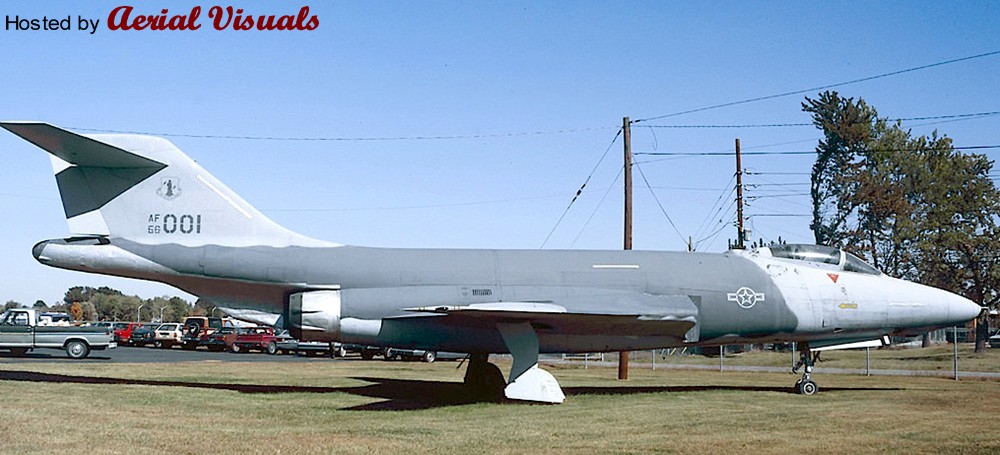
This preserved machine wore a rather unusual (for a Voodoo) ‘Hill’ low-viz scheme with toned-down markings, quite similar to the late USAF F-4 Phantom IIs of the early Eighties. The big aircraft looked quite good in this simple livery, and I kept the idea of a Hill scheme Voodoo in the back of my mind for some years until I recently had the opportunity to buy a cheap Matchbox Voodoo w/o box and decals. With its optional (and unique) RF-101B parts I decided to take the Hill Voodoo idea to the hardware stage and create another submission to the “Reconnaissance and Surveillance” group build at whatifmodellers.com around July 2021: an ANG recce conversion of a former two-seat interceptor, using the RF-101B as benchmark but with a different suite of sensors.
However, the Matchbox Voodoo kit is rather mediocre, and in a rather ambitious mood I decided to “upgrade” the project with a Revell F-101B as the model’s basis. This kit is from 1991 and a MUCH better and finely detailed model than the rather simple Matchbox kit from the early Eighties. In fact, the Revell F-101B is actually a scaled-down version of Monogram’s 1:48 F-101B model kit from 1985, with many delicate details. But while this downscaling practice has produced some very nice 1:72 models like the F-105D or the F-4D, the scaling effect caused IMHO in this case a couple of problems. Revell's assembly instructions for the 1:72 kit are not good, either. While the step-by-step documentation is basically good, some sketches are so cluttered that you cannot tell where parts in the cockpit or on the landing gear are actually intended to be placed and how. This is made worse by the fact that there are no suitable markings on the parts – you are left to guessing.
Worse, there is a massive construction error: the way the wings section is to be assembled and mounted to the hull is impossible! The upper wing halves have locator pins for the fuselage, but they are supposed to be glued to the lower wing half (which also encompasses the aircraft's belly) and the mounted to the hull. The locator pins make this impossible, unless you bend the lower wing section to a point where it might warp or break, or you just cut the pins off - and live with some instability. Technically the upper wing halves have to be mounted to the fuselage before you glue the lower wing section to them, but I am not certain if this would work well because you also have to assemble the air intakes at the same time “from behind”, which is only feasible when the wings have already been completed but still left away from the fuselage. It’s a nonsense construction! I cannot remember when I came across a kit the last time with such an inherent design flaw?
Except for the transplanted RF-101B nose section, which did not fit well because the Matchbox Voodoo apparently has a more slender nose, the Revell kit was built mostly OOB. However, this is already a challenge in itself because of the kit’s inherent flaws (see above), its complex construction and an unorthodox assembly sequence, due to many separate internal modules including the cockpit tub, a separate (fully detailed) front landing gear well, a rotating weapon bay, air intakes with complete ducts, and the wing section. A fiddly affair.
Only a few further changes beyond the characteristic camera fairing under the radome were made. The rotating weapon bay was faired-over with the original weapon pallet, just fixing it into place and using putty to blend it into the belly. The small underwing pylons (an upgrade that actually happened to some late Voodoos) were taken from a vintage Revell F-16. The SLAR antenna fairings along the cockpit flanks were created with 0.5mm styrene sheet and some PSR. They are a little too obvious/protruding, but for a retrofitted solution I find the result acceptable. The drop tanks came from the Revell kit, the underwing ordnance consists of an ALQ-119 ECM pod from a Hasegawa aftermarket set and a SUU-42 dispenser, scratched from a Starfighter ventral drop tank, bomb fins and the back of a Soviet unguided missile launcher.
Painting and markings:
Very simple and basic. While I originally wanted to adopt the simple two-tone ‘Hill’ scheme from the gate guard for my fictional Voodoo, I eventually settled for the very similar but slightly more sophisticated ‘Egypt One’ scheme that was introduced with the first F-16s – it just works better on the F-101’s surfaces. This scheme uses three grey tones: FS 36118 (Gunship Gray, ModelMaster 1723) for the upper wing surfaces, the “saddle” on the fuselage and the canopy area with an anti-glare panel, FS 36270 (Medium Grey, Humbrol 126) on the fin and the fuselage area in front of the wing roots, and FS 36375 (Light Ghost Grey, Humbrol 127) for all lower surfaces, all blended into each other with straight but slightly blurred edges (created with a soft, flat brush). The radome and the conformal antennae on the flanks became Revell 47 for a consistent grey-in-grey look, but with a slightly different shade. The model received an overall black ink washing and some post panel shading, so that the large grey areas would not look too uniform.
As an updated USAF aircraft I changed the color of the landing gear wells’ interior from green zinc chromate primer to more modern, uniform white, even though the red inside of the covers was retained. The interior of the flaps (a nice OOB option of Revell’s kit) and the air brakes became bright red, too.
The cockpit retained its standard medium grey (Humbrol 140, Dark Gull Grey) interior and I used the instrument decals from the kit – even though these did not fit well onto the 3D dashboards and side consoles. WTF? Decal softener came to the rescue. The exhaust area was painted with Revell 91 (Iron) and Humbrol’s Steel Metallizer (27003), later treated with graphite for a dirty, metallic shine.
Markings/decals primarily come from a 1:72 Hi-Decal F-4D sheet that contains (among others) several Texas ANG Phantoms from the mid-Eighties. Some stencils were taken over from the original Voodoo sheet, the yellow formation lights had to be procured from a Hasegawa F-4E/J sheet (the Matchbox sheet was lost and the Revell sheet lacks them completely!). The characteristic deep yellow canopy sealant stripes came from a CF-101 sheet from Winter Valley Decals (today part of Canuck Models as CAD 72008). I was lucky to have them left over from another what-if build MANY moons ago, my fictional CF-151 kitbashing.
Everything went on smoothly, but the walkway markings above the air intakes became a problem. I initially used those from the Revell sheet, which are only the outlines so that the camouflage would still be visible. But the decal film, which is an open square, turned out to be so thin that it wrinkled on the curved surface whatever I tried, and what looked like a crisp black outline on the white decal paper turned out to be a translucent dark blue with blurry edges on the kit. I scrapped them while still wet… Enter plan B: Next came the walkway markings from the aforementioned Winter Valley sheet, which were MUCH better, sharper and opaque, but they included the grey walking areas. While the tone looked O.K. on the sheet it turned out to be much too light for the all-grey Voodoo, standing out and totally ruining the low-viz look. With a bleeding heart I eventually ripped them off of the model with the help of adhesive tape, what left light grey residues. Instead of messing even more with the model I finally decided to embrace this accident and manually added a new black frame to the walkway areas with generic 2mm decal stripe material from TL Modellbau The area now looks rather worn, as if the camouflage had peeled off and light grey primer shows through. An unintentional result, but it looks quite “natural”.
The “Rhino Express” nose art was created with Corel Draw and produced with a simple inkjet printer on clear decal sheet. It was inspired by the “toenail” decoration on the main landing gear covers, a subtle detail I saw IIRC on a late CF-101B and painted onto the model by hand. With its all-grey livery, the rhino theme appeared so appropriate, and the tag on the nose appeared like a natural addition. It’s all not obvious but adds a personal touch to the aircraft.
Finally, after some more exhaust stains had been added to various air outlets around the hull, the model was sealed with matt acrylic varnish, position lights were added with clear paint and the camera windows, which had been created with black decal material, received glossy covers. The IRST sensor was painted with translucent black over a gold base.
Well, while the all-grey USAF livery in itself is quite dull and boring, but I must say that it suits the huge and slender Voodoo well. It emphasizes the aircraft's sleek lines and the Texas ANG fin flash as a colorful counterpoint, as well as the many red interior sections that only show from certain angles, nicely break the adapted low-viz Egypt One livery up. The whole thing looks surprisingly convincing, and the subtle rhino markings add a certain tongue-in-cheek touch.
Iktinos and Kallikrates, Parthenon, Acropolis, Athens, 447 – 432 B.C.E.
Phidias directed the temple's sculptural program
Base figure is Michelle Pfeiffer action figure from Batman Returns, resculpted and repainted, 4.25 inches tall
+++ DISCLAIMER +++
Nothing you see here is real, even though the conversion or the presented background story might be based on historical facts. BEWARE!
Some background:
The McDonnell Douglas (now Boeing) T-45 Goshawk was a highly modified version of the BAe Hawk land-based training jet aircraft. Manufactured by McDonnell Douglas (now Boeing) and British Aerospace (now BAe Systems), the T-45 was used by the United States Navy and the United States Marine Corps (USMC) as an aircraft carrier-capable trainer.
The Goshawk's origins began in the mid-1970s, when the US Navy began looking for a single aircraft replacement for both its T-2 and TA-4 jet trainers. The US Navy started the VTXTS advanced trainer program in 1978. Several companies made submissions, e. g. North American or Northrop/Vought. Due to the size of the potential contract, European companies made submissions, too, including a navalized Alpha Jet from Dassault/Dornier and a fully carrier-capable version of the BAe Hawk Mk.60, mutually proposed by British Aerospace (BAe) and McDonnell Douglas (MDC). The latter eventually won the competition and BAe and MDC were awarded the T-45 contract in 1981.
The Hawk had not been designed for carrier operations and numerous modifications were required to make it suitable for use on carriers. These included improvements to the low-speed handling characteristics and a reduction in the approach speed. It was found that the aircraft was apt to stall at the low approach speed required. Modifications were designed by BAe in England; most notably a simple slat system was devised, operated by an actuator and linkage mechanism to fit into the small space available. Strakes were also added on the fuselage to improve airflow. Other changes were a strengthened airframe, a more robust and wider landing gear with a two-wheel nose landing gear, a catapult tow bar attachment and an arresting hook. The modified aircraft was christened “Goshawk”, flew in 1988 for the first time and became operational in 1991.
Beyond being a naval trainer the T-45 was also adapted for first-line duty with strike capabilities, in the form of the OA-45 for the USMC. The role of this aircraft dated back to the Vietnam War when twenty-three A-4 two-seaters were converted into OA-4Ms for “FastFAC” (Fast Forward Air Controller) missions, in order to control interdiction sorties dedicated to shaping the battlefield for future operations. Basically, the OA-4M was a TA-4F equipped with A-4M electronics. The most visible and characteristic change was the fitting of the A-4M’s dorsal electronics hump, neatly faired into the rear of the two-seat canopy. The nose sensor group of the OA-4M was basically the same as that of the A-4M, but the Angle/Rate Bombing system was not installed as it would not be needed.
When the T-45 was introduced in the early Nineties, the USMCs OA-4Ms had reached the end of their service life and the USMC started looking for a replacement, wanting a comparable, light and fast fixed-wing aircraft. The USMC did not accept the LTV A-7 as an A-4 replacement (even though a two-seater version was available), because it was already dated, too, and not part of the USMC inventory. The USMC's A-4Ms were supposed to be replaced by the VTOL AV-8 by the mid-nineties, but the AV-8, even as a two-seater, was deemed unsuitable for FFAC duties. The new T-45 looked like a good and economical alternative with future potential, since the airframe was brand new and the type's infrastructure was fully established, so that a small number of specialized aircraft could easily be supported without much extra cost.
With fresh experience from the 1st Gulf War in 1990-91 the decision was made to buy 25 extra T-45A airframes and convert them to OA-45A standard. Most important change were modified wings, using structures and systems from the BAe Hawk 100 series. While the T-45 only had two underwing and a single ventral hardpoint, the OA-45A featured a total of seven: four underwing and one ventral hardpoints, plus wingtip stations for defensive air-to-air missiles. Upgraded avionics allowed the deployment of a wide range of external stores, including air-to-ground missiles and rocket launchers, a reconnaissance pod, retarded and free-fall bombs of up to 1,000 pounds (450 kg) caliber, runway cratering, anti-personnel and light armor bombs, cluster bombs, practice bombs as well as external fuel tanks and ECM pods. This was a vital asset, since Desert Storm had proved that FFAC aircraft had to have an offensive capability to handle targets of opportunity on their own, when no air assets to control were available. A total ordnance load of up to 6,800 lb (3,085 kg) was possible, even though the aircraft was not supposed to play an offensive role and rather act from a distance, relying on its small size and agility.
Communication modifications for the FastFAC role included a KY-28 secure voice system, an ARC-159 radio and an ARC-114 VHF radio. Similar to the Skyhawk, a hump behind the cockpit had to be added to make room for the additional electronic equipment and a heat exchanger. Other additions were a continuous-wave Doppler navigation radar under a shallow ventral radome underneath the cockpit, a ground control bombing system, an APN-194 altimeter, an ALR-45 radar warning suite, a retrofitted, fixed midair refueling probe and cockpit armor plating that included Kevlar linings on the floor and the lower side walls as well as externally mounted armor plates for the upper areas.
VMA-131 of Marine Aircraft Group 49 (the Diamondbacks) retired its last four OA-4Ms on 22 June 1994, and the new OA-45A arrived just in time to replace the venerable Skyhawk two-seaters in the FastFAC role. Trainer versions of the Skyhawk remained in Navy service, however, finding a new lease on life with the advent of "adversary training". OA-45A deliveries were finished in 1996 and the 25 aircraft were distributed among the newly established Marine Aviation Logistics Squadron (MALS, formerly Headquarters & Maintenance Squadron/H&MS) 12 & 13. The USMC crews soon nicknamed their new mounts "GosHog", to underlöine ist offensive capabilities and to set themselves apart from the USN's "tame" trainers. Even though thos name was never officially approved it caught on quickly.
After initial experience with the new aircraft and in the wake of technological advances, the USMC decided to upgrade the OA-45As in 2000 to improve its effectiveness and interaction capabilities with ground troops. This primarily resulted in the addition of a forward-looking infrared camera laser in the aircraft’s nose section, which enabled the aircraft to execute all-weather/night reconnaissance and to illuminate targets for laser-guided infantry shells or ordnance launched by the OA-45 itself or by other aircraft. Through this measure the OA-45 became capable of carrying and independently deploying light laser-guided smart weapons like the GBU-12 and -16 “Paveway II” glide bombs or the laser-guided AGM-65E “Maverick” variant. The update was gradually executed during regular overhauls in the course of 2001 and 2002 (no new airframes were built/converted), the modified machines received the new designation OA-45B.
After this update phase, the OA-45Bs were deployed in several global conflicts and saw frequent use in the following years. For instance, MALS 13 used its OA-45Bs operationally for the first time in October 2002 when the squadron was tasked with providing support to six AV-8B Harrier aircraft in combat operations in Afghanistan during Operation Enduring Freedom. This mission lasted until October 2003, four aircraft were allocated and one OA-45B was lost during a landing accident.
On 15 January 2003, MALS 13 embarked 205 Marines and equipment aboard the USS Bonhomme Richard in support of combat operations in Southwest Asia during Operation Southern Watch. Four OA-45Bs successfully supported these troops from land bases, marking targets and flying reconnaissance missions.
Furthermore, six MALS 13 OA-45Bs took actively part in Operation Iraqi Freedom from Al Jaber Air Base, Kuwait, and An Numiniyah Expeditionary Air Field, Iraq, where the aircraft worked closely together with the advancing ground troops of the USMC’s 15th Marine Expeditionary Unit. They successfully illuminated targets for US Navy fighter bombers, which were launched from USS Abraham Lincoln (CVN-72) in the Persian Gulf, and effectively guided these aircraft to their targets. Two OA-45Bs were lost during this conflict, one through enemy MANPADS, the other through friendly AA fire. In late May 2003 the surviving machines and their crews returned to MCAS Yuma.
On 16 March 2007, the 200th T-45 airframe was delivered to the US Navy. From this final batch, six airframes were set aside and modified into OA-45Bs in order to fill the losses over the past years.
Later T-45 production aircraft were built with enhanced avionics systems for a heads-up display (HUD) and glass cockpit standard, while all extant T-45A aircraft were eventually converted to a T-45C configuration under the T-45 Required Avionics Modernization Program (T-45 RAMP), bringing all aircraft to same HUD plus glass cockpit standard. These updates, esp. concerning the cockpit, were introduced to the OA-45Bs, too, and they were re-designated again, now becoming OA-45Cs, to reflect the commonality with the Navy’s Goshawk trainers. Again, these modifications were gradually introduced in the course of the OA-45s’ normal maintenance program.
In 2007, an engine update of the whole T-45 fleet, including the OA-45s, with the Adour F405-RR-402 was considered. This new engine was based on the British Adour Mk 951, designed for the latest versions of the BAe Hawk and powering the BAe Taranis and Dassault nEUROn UCAV technology demonstrators. The Adour Mk 951 offered 6,500 lbf (29 kN) thrust and up to twice the service life of the F405-RR-401. It featured an all-new fan and combustor, revised HP and LP turbines, and introduced Full Authority Digital Engine Control (FADEC). The Mk 951 was certified in 2005, the F405-RR-402 derived from it was certified in 2008, but it did not enter service due to funding issues, so that this upgrade was not carried out.
The final delivery of the 246th T-45 airframe took place in November 2009, and both T-45 and the OA-45 "GosHog" are supposed to remain in service until 2035.
General characteristics:
Crew: 2 (pilot, observer)
Length: 39 ft 4 in (11.99 m)
Wingspan: 30 ft 10 in (9.39 m)
Height: 13 ft 5 in (4.08 m)
Wing area: 190.1 ft² (17.7 m²)
Empty weight: 10,403 lb (4,460 kg)
Max. takeoff weight: 14,081 lb (6,387 kg)
Powerplant:
1× Rolls-Royce Turbomeca F405-RR-401 (Adour) non-afterburning turbofan with 5,527 lbf (26 kN)
Performance:
Maximum speed: Mach 2 (2,204 km/h (1,190 kn; 1,370 mph) at high altitude
Combat radius: 800 km (497 mi, 432 nmi)
Ferry range: 3,200 km (1,983 mi) with drop tanks
Service ceiling: 15,240 m (50,000 ft)
Wing loading: 283 kg/m² (58 lb/ft²)
Thrust/weight: 0.97
Maximum g-load: +9 g
Armament:
No internal gun; seven external hardpoints (three on each wing and one under fuselage)
for a wide range of ordnance of up to 6,800 lb (3,085 kg), including up to six AIM-9 Sidewinder for
self-defense, pods with unguided rockets for target marking or ECM pods, but also offensive weapons
of up to 1.000 lb (454 kg) weight, including iron/cluster bombs and guided AGM-65, GBU-12 and -16.
The kit and its assembly:
This fictional T-45 variant is actually the result of a long idea evolution, and simply rooted in the idea of a dedicated OA-4M replacement for the USMC; in real life, the FFAC role has been transferred to F-18 two-seaters, though, but the T-45 appeared like a sound alternative to me.
There's only one T-45 kit available, a dubious T-45A from Italeri with poor wings and stabilizers. Wolfpack also offers a T-45, but it’s just a re-boxing of the Italeri kit with some PE parts and a price tag twice as big – but it does not mend the original kit’s issues… After reading the A-4 Skyhawk book from the French "Planes & Pilots" series, I was reminded of the USMC's special OA-4M FAC two-seaters (and the fact that it is available in kit form from Italeri and Hasegawa), and, cross-checking the real-world timeline of the T-45, I found that it could have been a suitable successor. The ide of the USMC’s OA-45 was born! :D
Building-wise the Italeri T-45 remained close to OOB, even though I transplanted several parts from an Italeri BAe Hawk Mk. 100 to create a different look. I modified the nose with the Mk. 100’s laser fairing and added some radar warning sensor bumps. This transplantation was not as easy as it might seem because the T-45’s nose is, due to the different and more massive front landing gear quite different from the Hawk’s. Took some major PSR to integrate the laser nose.
An ALR-45 “hot dog” fairing from a late A-4M (Italeri kit) was added to the fin, together with a small styrene wedge extending the fin’s leading edge. This small detail markedly changes the aircraft’s look. I furthermore added a refueling probe, scratched from coated wire and some white glue, as well as a low “camel back” fairing behind the cockpit, created from a streamlined bomb half with air outlets for an integrated heat exchanger. Blade antennae were relocated and added. A shallow bump for the Doppler radar was added under the fuselage behind the landing gear well – left over from an Airfix A-4B (from an Argentinian A-4P, to be correct, actually a dorsal fairing).
On the wings, a tailored pair of pylons and wing tip launch rails from the Italeri BAe Hawk Mk. 100 kit were added, too, as well as the donor kit’s pair of Sidewinders. The rest of the ordnance consists of drop tanks and LAU-19 pods for target marking missiles. The tanks were taken from the Hawk Mk. 100 kit, too, the rocket launchers came from an Italeri NATO aircraft weapons set. The centerline position carries an ALQ-131 ECM pod from a Hasegawa US aircraft weapons set on a pylon from the scrap box.
Painting and markings:
The low-viz idea prevailed, since I had some leftover OA-4M decals from Italeri kits in store, as well as some other suitable low-viz decals from a Revell A-4F kit. However, an all-grey livery was IMHO not enough, and when I came across a picture of a USN low-viz A-7E with an improvised desert camouflage in sand and reddish brown applied over the grey (even partly extending over its markings) from Operation Iraqi Freedom, I had that extra twist that would set the OA-45 apart. MALS-13 was chosen as operator because I had matching codes, and, as another benefit, the unit had actually been deployed overseas during the 2003 Iraq War, so that the whif’’s time frame was easily settled, adding to its credibility.
The livery was built up just like on the real aircraft: on top of a basic scheme in FS 36320 and 36375 (Humbrol 128 and 127) with a slightly darker anti-glare panel in front of the cockpit (FS 35237, I used Revell 57 as a slightly paler alternative) I applied the low-viz marking decals, which were protected with a coat of acrylic varnish. Next, additional desert camouflage was added with dry-brushed sand and millitary brown (supposedly FS 33711 and 30400 in real life, I used, after consulting pictures of aircraft from both Gulf Wars, Humbrol 103 (Cream) and 234 (Dark Flesh). They were applied with a kind of a dry-brushing technique, for a streaky and worn look, leaving out the codes and other markings. The pattern itself was inspired by an USMC OV-10 Bronco in desert camouflage from the 1st Gulf War.
On top of that a black ink washing was applied. Once things had thoroughly dried over night, I wet-sanded the additional desert camouflage away, carefully from front to back, so that the edges became blurred and the underlying grey became visible again.
The cockpit interior was painted in standard Dark Gull Grey (Humbrol 140), while the air intakes and the landing gear became white, the latter with red trim on the covers’ edges – just standard. Finally, the model was sealed with a coat of matt acrylic varnish (Italeri).
The upgraded T-45 is an interesting result. The add-ons suit the aircraft, which already looks sturdier than its land-based ancestor, well. The improvised desert paint scheme with the additional two-tone camouflage over the pale grey base really makes the aircraft an unusual sight, adding to its credibility.
Hardware-wise I am really happy how the added dorsal hump blends into the overall lines – in a profile view it extends the canopy’s curve and blends into the fin, much like the A-4F/M’s arrangement. And the modified fin yields a very different look, even though not much was changed. The T-45 looks much beefier now, and from certain angles really reminds of the OA-4M and sometimes even of a diminutive Su-25?
Charlie Base Camp bash during the 2023 National Scout Jamboree at The Summit Bechtel Reserve in Mount Hope, West Virginia. (BSA Photo by Tom Copeland)
**********Beginning of Shooting Data Section**********
20230721-19-46-27-05-TC date - 7/21/23 time - 7:46:27 PM
+++ DISCLAIMER +++
Nothing you see here is real, even though the conversion or the presented background story might be based on historical facts. BEWARE!
Some background:
The McDonnell Douglas (now Boeing) T-45 Goshawk was a highly modified version of the BAe Hawk land-based training jet aircraft. Manufactured by McDonnell Douglas (now Boeing) and British Aerospace (now BAe Systems), the T-45 was used by the United States Navy and the United States Marine Corps (USMC) as an aircraft carrier-capable trainer.
The Goshawk's origins began in the mid-1970s, when the US Navy began looking for a single aircraft replacement for both its T-2 and TA-4 jet trainers. The US Navy started the VTXTS advanced trainer program in 1978. Several companies made submissions, e. g. North American or Northrop/Vought. Due to the size of the potential contract, European companies made submissions, too, including a navalized Alpha Jet from Dassault/Dornier and a fully carrier-capable version of the BAe Hawk Mk.60, mutually proposed by British Aerospace (BAe) and McDonnell Douglas (MDC). The latter eventually won the competition and BAe and MDC were awarded the T-45 contract in 1981.
The Hawk had not been designed for carrier operations and numerous modifications were required to make it suitable for use on carriers. These included improvements to the low-speed handling characteristics and a reduction in the approach speed. It was found that the aircraft was apt to stall at the low approach speed required. Modifications were designed by BAe in England; most notably a simple slat system was devised, operated by an actuator and linkage mechanism to fit into the small space available. Strakes were also added on the fuselage to improve airflow. Other changes were a strengthened airframe, a more robust and wider landing gear with a two-wheel nose landing gear, a catapult tow bar attachment and an arresting hook. The modified aircraft was christened “Goshawk”, flew in 1988 for the first time and became operational in 1991.
Beyond being a naval trainer the T-45 was also adapted for first-line duty with strike capabilities, in the form of the OA-45 for the USMC. The role of this aircraft dated back to the Vietnam War when twenty-three A-4 two-seaters were converted into OA-4Ms for “FastFAC” (Fast Forward Air Controller) missions, in order to control interdiction sorties dedicated to shaping the battlefield for future operations. Basically, the OA-4M was a TA-4F equipped with A-4M electronics. The most visible and characteristic change was the fitting of the A-4M’s dorsal electronics hump, neatly faired into the rear of the two-seat canopy. The nose sensor group of the OA-4M was basically the same as that of the A-4M, but the Angle/Rate Bombing system was not installed as it would not be needed.
When the T-45 was introduced in the early Nineties, the USMCs OA-4Ms had reached the end of their service life and the USMC started looking for a replacement, wanting a comparable, light and fast fixed-wing aircraft. The USMC did not accept the LTV A-7 as an A-4 replacement (even though a two-seater version was available), because it was already dated, too, and not part of the USMC inventory. The USMC's A-4Ms were supposed to be replaced by the VTOL AV-8 by the mid-nineties, but the AV-8, even as a two-seater, was deemed unsuitable for FFAC duties. The new T-45 looked like a good and economical alternative with future potential, since the airframe was brand new and the type's infrastructure was fully established, so that a small number of specialized aircraft could easily be supported without much extra cost.
With fresh experience from the 1st Gulf War in 1990-91 the decision was made to buy 25 extra T-45A airframes and convert them to OA-45A standard. Most important change were modified wings, using structures and systems from the BAe Hawk 100 series. While the T-45 only had two underwing and a single ventral hardpoint, the OA-45A featured a total of seven: four underwing and one ventral hardpoints, plus wingtip stations for defensive air-to-air missiles. Upgraded avionics allowed the deployment of a wide range of external stores, including air-to-ground missiles and rocket launchers, a reconnaissance pod, retarded and free-fall bombs of up to 1,000 pounds (450 kg) caliber, runway cratering, anti-personnel and light armor bombs, cluster bombs, practice bombs as well as external fuel tanks and ECM pods. This was a vital asset, since Desert Storm had proved that FFAC aircraft had to have an offensive capability to handle targets of opportunity on their own, when no air assets to control were available. A total ordnance load of up to 6,800 lb (3,085 kg) was possible, even though the aircraft was not supposed to play an offensive role and rather act from a distance, relying on its small size and agility.
Communication modifications for the FastFAC role included a KY-28 secure voice system, an ARC-159 radio and an ARC-114 VHF radio. Similar to the Skyhawk, a hump behind the cockpit had to be added to make room for the additional electronic equipment and a heat exchanger. Other additions were a continuous-wave Doppler navigation radar under a shallow ventral radome underneath the cockpit, a ground control bombing system, an APN-194 altimeter, an ALR-45 radar warning suite, a retrofitted, fixed midair refueling probe and cockpit armor plating that included Kevlar linings on the floor and the lower side walls as well as externally mounted armor plates for the upper areas.
VMA-131 of Marine Aircraft Group 49 (the Diamondbacks) retired its last four OA-4Ms on 22 June 1994, and the new OA-45A arrived just in time to replace the venerable Skyhawk two-seaters in the FastFAC role. Trainer versions of the Skyhawk remained in Navy service, however, finding a new lease on life with the advent of "adversary training". OA-45A deliveries were finished in 1996 and the 25 aircraft were distributed among the newly established Marine Aviation Logistics Squadron (MALS, formerly Headquarters & Maintenance Squadron/H&MS) 12 & 13. The USMC crews soon nicknamed their new mounts "GosHog", to underlöine ist offensive capabilities and to set themselves apart from the USN's "tame" trainers. Even though thos name was never officially approved it caught on quickly.
After initial experience with the new aircraft and in the wake of technological advances, the USMC decided to upgrade the OA-45As in 2000 to improve its effectiveness and interaction capabilities with ground troops. This primarily resulted in the addition of a forward-looking infrared camera laser in the aircraft’s nose section, which enabled the aircraft to execute all-weather/night reconnaissance and to illuminate targets for laser-guided infantry shells or ordnance launched by the OA-45 itself or by other aircraft. Through this measure the OA-45 became capable of carrying and independently deploying light laser-guided smart weapons like the GBU-12 and -16 “Paveway II” glide bombs or the laser-guided AGM-65E “Maverick” variant. The update was gradually executed during regular overhauls in the course of 2001 and 2002 (no new airframes were built/converted), the modified machines received the new designation OA-45B.
After this update phase, the OA-45Bs were deployed in several global conflicts and saw frequent use in the following years. For instance, MALS 13 used its OA-45Bs operationally for the first time in October 2002 when the squadron was tasked with providing support to six AV-8B Harrier aircraft in combat operations in Afghanistan during Operation Enduring Freedom. This mission lasted until October 2003, four aircraft were allocated and one OA-45B was lost during a landing accident.
On 15 January 2003, MALS 13 embarked 205 Marines and equipment aboard the USS Bonhomme Richard in support of combat operations in Southwest Asia during Operation Southern Watch. Four OA-45Bs successfully supported these troops from land bases, marking targets and flying reconnaissance missions.
Furthermore, six MALS 13 OA-45Bs took actively part in Operation Iraqi Freedom from Al Jaber Air Base, Kuwait, and An Numiniyah Expeditionary Air Field, Iraq, where the aircraft worked closely together with the advancing ground troops of the USMC’s 15th Marine Expeditionary Unit. They successfully illuminated targets for US Navy fighter bombers, which were launched from USS Abraham Lincoln (CVN-72) in the Persian Gulf, and effectively guided these aircraft to their targets. Two OA-45Bs were lost during this conflict, one through enemy MANPADS, the other through friendly AA fire. In late May 2003 the surviving machines and their crews returned to MCAS Yuma.
On 16 March 2007, the 200th T-45 airframe was delivered to the US Navy. From this final batch, six airframes were set aside and modified into OA-45Bs in order to fill the losses over the past years.
Later T-45 production aircraft were built with enhanced avionics systems for a heads-up display (HUD) and glass cockpit standard, while all extant T-45A aircraft were eventually converted to a T-45C configuration under the T-45 Required Avionics Modernization Program (T-45 RAMP), bringing all aircraft to same HUD plus glass cockpit standard. These updates, esp. concerning the cockpit, were introduced to the OA-45Bs, too, and they were re-designated again, now becoming OA-45Cs, to reflect the commonality with the Navy’s Goshawk trainers. Again, these modifications were gradually introduced in the course of the OA-45s’ normal maintenance program.
In 2007, an engine update of the whole T-45 fleet, including the OA-45s, with the Adour F405-RR-402 was considered. This new engine was based on the British Adour Mk 951, designed for the latest versions of the BAe Hawk and powering the BAe Taranis and Dassault nEUROn UCAV technology demonstrators. The Adour Mk 951 offered 6,500 lbf (29 kN) thrust and up to twice the service life of the F405-RR-401. It featured an all-new fan and combustor, revised HP and LP turbines, and introduced Full Authority Digital Engine Control (FADEC). The Mk 951 was certified in 2005, the F405-RR-402 derived from it was certified in 2008, but it did not enter service due to funding issues, so that this upgrade was not carried out.
The final delivery of the 246th T-45 airframe took place in November 2009, and both T-45 and the OA-45 "GosHog" are supposed to remain in service until 2035.
General characteristics:
Crew: 2 (pilot, observer)
Length: 39 ft 4 in (11.99 m)
Wingspan: 30 ft 10 in (9.39 m)
Height: 13 ft 5 in (4.08 m)
Wing area: 190.1 ft² (17.7 m²)
Empty weight: 10,403 lb (4,460 kg)
Max. takeoff weight: 14,081 lb (6,387 kg)
Powerplant:
1× Rolls-Royce Turbomeca F405-RR-401 (Adour) non-afterburning turbofan with 5,527 lbf (26 kN)
Performance:
Maximum speed: Mach 2 (2,204 km/h (1,190 kn; 1,370 mph) at high altitude
Combat radius: 800 km (497 mi, 432 nmi)
Ferry range: 3,200 km (1,983 mi) with drop tanks
Service ceiling: 15,240 m (50,000 ft)
Wing loading: 283 kg/m² (58 lb/ft²)
Thrust/weight: 0.97
Maximum g-load: +9 g
Armament:
No internal gun; seven external hardpoints (three on each wing and one under fuselage)
for a wide range of ordnance of up to 6,800 lb (3,085 kg), including up to six AIM-9 Sidewinder for
self-defense, pods with unguided rockets for target marking or ECM pods, but also offensive weapons
of up to 1.000 lb (454 kg) weight, including iron/cluster bombs and guided AGM-65, GBU-12 and -16.
The kit and its assembly:
This fictional T-45 variant is actually the result of a long idea evolution, and simply rooted in the idea of a dedicated OA-4M replacement for the USMC; in real life, the FFAC role has been transferred to F-18 two-seaters, though, but the T-45 appeared like a sound alternative to me.
There's only one T-45 kit available, a dubious T-45A from Italeri with poor wings and stabilizers. Wolfpack also offers a T-45, but it’s just a re-boxing of the Italeri kit with some PE parts and a price tag twice as big – but it does not mend the original kit’s issues… After reading the A-4 Skyhawk book from the French "Planes & Pilots" series, I was reminded of the USMC's special OA-4M FAC two-seaters (and the fact that it is available in kit form from Italeri and Hasegawa), and, cross-checking the real-world timeline of the T-45, I found that it could have been a suitable successor. The ide of the USMC’s OA-45 was born! :D
Building-wise the Italeri T-45 remained close to OOB, even though I transplanted several parts from an Italeri BAe Hawk Mk. 100 to create a different look. I modified the nose with the Mk. 100’s laser fairing and added some radar warning sensor bumps. This transplantation was not as easy as it might seem because the T-45’s nose is, due to the different and more massive front landing gear quite different from the Hawk’s. Took some major PSR to integrate the laser nose.
An ALR-45 “hot dog” fairing from a late A-4M (Italeri kit) was added to the fin, together with a small styrene wedge extending the fin’s leading edge. This small detail markedly changes the aircraft’s look. I furthermore added a refueling probe, scratched from coated wire and some white glue, as well as a low “camel back” fairing behind the cockpit, created from a streamlined bomb half with air outlets for an integrated heat exchanger. Blade antennae were relocated and added. A shallow bump for the Doppler radar was added under the fuselage behind the landing gear well – left over from an Airfix A-4B (from an Argentinian A-4P, to be correct, actually a dorsal fairing).
On the wings, a tailored pair of pylons and wing tip launch rails from the Italeri BAe Hawk Mk. 100 kit were added, too, as well as the donor kit’s pair of Sidewinders. The rest of the ordnance consists of drop tanks and LAU-19 pods for target marking missiles. The tanks were taken from the Hawk Mk. 100 kit, too, the rocket launchers came from an Italeri NATO aircraft weapons set. The centerline position carries an ALQ-131 ECM pod from a Hasegawa US aircraft weapons set on a pylon from the scrap box.
Painting and markings:
The low-viz idea prevailed, since I had some leftover OA-4M decals from Italeri kits in store, as well as some other suitable low-viz decals from a Revell A-4F kit. However, an all-grey livery was IMHO not enough, and when I came across a picture of a USN low-viz A-7E with an improvised desert camouflage in sand and reddish brown applied over the grey (even partly extending over its markings) from Operation Iraqi Freedom, I had that extra twist that would set the OA-45 apart. MALS-13 was chosen as operator because I had matching codes, and, as another benefit, the unit had actually been deployed overseas during the 2003 Iraq War, so that the whif’’s time frame was easily settled, adding to its credibility.
The livery was built up just like on the real aircraft: on top of a basic scheme in FS 36320 and 36375 (Humbrol 128 and 127) with a slightly darker anti-glare panel in front of the cockpit (FS 35237, I used Revell 57 as a slightly paler alternative) I applied the low-viz marking decals, which were protected with a coat of acrylic varnish. Next, additional desert camouflage was added with dry-brushed sand and millitary brown (supposedly FS 33711 and 30400 in real life, I used, after consulting pictures of aircraft from both Gulf Wars, Humbrol 103 (Cream) and 234 (Dark Flesh). They were applied with a kind of a dry-brushing technique, for a streaky and worn look, leaving out the codes and other markings. The pattern itself was inspired by an USMC OV-10 Bronco in desert camouflage from the 1st Gulf War.
On top of that a black ink washing was applied. Once things had thoroughly dried over night, I wet-sanded the additional desert camouflage away, carefully from front to back, so that the edges became blurred and the underlying grey became visible again.
The cockpit interior was painted in standard Dark Gull Grey (Humbrol 140), while the air intakes and the landing gear became white, the latter with red trim on the covers’ edges – just standard. Finally, the model was sealed with a coat of matt acrylic varnish (Italeri).
The upgraded T-45 is an interesting result. The add-ons suit the aircraft, which already looks sturdier than its land-based ancestor, well. The improvised desert paint scheme with the additional two-tone camouflage over the pale grey base really makes the aircraft an unusual sight, adding to its credibility.
Hardware-wise I am really happy how the added dorsal hump blends into the overall lines – in a profile view it extends the canopy’s curve and blends into the fin, much like the A-4F/M’s arrangement. And the modified fin yields a very different look, even though not much was changed. The T-45 looks much beefier now, and from certain angles really reminds of the OA-4M and sometimes even of a diminutive Su-25?