View allAll Photos Tagged Transfiguration
"Transfiguration of Christ" is a unique 3 1/4" by 5 1/4" (when folded) paper souvenir dated 1943 from Knott's Berry Farm in Buena Park, CA. This small folder opens to reveal a copy of the famous Paul V. Klieben painting "Transfiguration of Christ" revealed at the end of the free five minute presentation accompanied by Beethoven's Moonlight Sonata within Our Little Chapel by the Lake at Knott's Berry Farm. The print of Jesus appears benevolent with eyes closed under bright light. Then the eyes printed with radium/phosphorus glow and appear to be open when viewed in the dark. The presentation is reproduced in text on the inside of the flaps - but first, the text on the back:
Transfiguration
The original of this miraculous painting by Artist Paul V. Kleiben is now permanently enshrined in the Little Chapel on the grounds of Knott's Berry Farm at Buena Park, California
Inspired by Matt XVII-2
This picture glows in the dark and the eyes open.
Hold Near a Bright Light, Then, Look at Face in Dark Room.
Copyright 1943 v.Kleiben.
Down through the centuries, man in his quest for truth has slowly opened the portals of knowledge—uncovering the mysteries of his being and interpreting the hidden wisdom of the scriptures. From a flickering spark to a brilliant flame his search has been intensified—motivated by a passionate desire to light the way for posterity. A genius receives and interprets that others might share the understanding of things.
Many versions as to the true description of Christ have been given to the world. Among the most authentic is this one, written by Publius Lentulus, President of Judea, to Tiberious Ceasar, the first appeared in the writings of Saint Anselm of Canterbury in the Eleventh Century.
"There lived at this time in Judea a man of singular virtue — whose name is Jesus Christ whom the barbarians esteem as a prophet, but his followers love and adore him as the offspring of the immortal God. He calls back the dead from the graves and heals all sorts of diseases with a word of touch. He is a tall man, well shaped, and of an amiable and reverend aspect—his hair of a color that can hardly be matched, falling into graceful curls, waving about and very agreeably couched about his shoulders, parted on the crown of his head, running as a stream to the front after the fashion of the Nazarites, his forehead high, large and imposing, his cheeks without spot or wrinkle, beautiful with a lovely red, his nose and mouth formed with exquisite symmetry, his beard of a color suitable to his hair, reaching below his chin and parted in the middle like a fork; his eyes bright and blue, clear and serene, look innocent, dignified, manly and mature. Often times however, just before he reveals his divine powers, his eyelids are gently closed in reverential silence. In proportion of body most perfect and captivating, his arms and hands are delectable to behold. He rebukes with majesty, counsels with mildness, his whole address, whether in word or deed, being eloquent and grave. No man has seen him laugh, yet his manners are exceedingly pleasant, but he has wept frequently in the presence of men. He is temperate, modest and wise. A man for his extraordinary beauty and divine perfection, surpassing the children of men in every sense."
The dramatic portrayal which is now unfolding before you will reveal one of the most important moments in Christ's life:
"And Jesus was transfigured before them and his face did shine like the sun, and his raiment was white as the light." — Matthew 17:2
Stained glass window in the nave of St. Mary's parish church, Stradsett, Norfolk. This is one of a series dedicated to the memory of Philip Salisbury Bagge, Rector of Walpole St. Peter.
Lavers, Baraud & Westlake, 1891, designed by William Christian Symons (1845-1911)
Saviour Monastery of St. Euthymius (named after its first abbot) was erected in 1352. A small temple over the tomb of Euthymios (1564) eventually became the current Transfiguration Cathedral. The whole of the cathedral interior is covered with frescoes from 17th cecntury painters Gury Nikitin and Sila Savin, depicting stories of Jesus and the saints.
You can see from the scaffolding that the frescoes were under repair.
Transfiguration Cathedral, Suzdal, Russia (Monday 20 Aug 2012 @ 5:34pm)
I took this photo with my mobile phone ( Nokia Lumia 820). // It shows an old artwork ( a painting with mostly pencil-technique on canvas) by an Italian artist. The poem ( taken from a collective book and translated into Italian) is by the Russian poet Esenin ( title: Transfiguration).
Maker:
Born:
Active: Russia
Medium: albumen print
Size:6.5 in x 4.5 in
Location: Russia
Object No. 2017.007
Shelf: B-68
Publication:
Other Collections:
Provenance:
Notes: Transfiguration Cathedral (official name: The Cathedral of the Lord's Transfiguration of all the Guards) is an Eastern Orthodox cathedral. It is located on Transfiguration Square, just off Liteyny Prospekt near the Chernyshevskaya metro station. Unlike most Russian places of worship, this archictural monument has never ceased operating as a place of worship. The church has provided both Transfiguration Square and a nearby lane, which was formerly known as Church Lane, and is now known as Radishchev Lane with their names.
To view our archive organized by themes and subjects, visit: OUR COLLECTIONS
For information about reproducing this image, visit: THE HISTORY OF PHOTOGRAPHY ARCHIVE
La basilica della Trasfigurazione, opera dell'architetto Barluzzi, fu edificata nel 1924. Le due torri sulla facciata sorgono sopra le due cappelle preesistenti dedicate a Mosè ed Elia.
The Church of the Transfiguration, the architect Barluzzi was built in 1924. The two towers on the façade rise above the existing two chapels dedicated to Moses and Elijah.
Stained glass in the north aisle by Hardman's from the final decades of the 19th century..
The attractive town of Tewkesbury has been dominated by its superb abbey church since the beginning of the 12th century, and we can be forever grateful to its townspeople for purchasing the monastic church in 1540 for £453 for use as their parish church, saving it from the fate that befell countless similar great churches across the land during the turmoil of the Dissolution. It reminds us both how lucky we are to still marvel at it today, yet also how great a loss to our heritage the period wrought when many more such buildings were so utterly plundered as to have gone without trace (the fate of the monastic buildings here and even the lady chapel of the church whose footings are laid out in the grass at the east end).
Tewkesbury Abbey is thus rightly celebrated as one of our greatest non-cathedral churches, and remarkably much of the original Norman church remains substantially intact, most apparently in the great central tower, a fine example of Romanesque architecture adorned with rows of blind-arcading. The west front is dominated by a massive Norman-arched recess (enclosing the somewhat later west window) and the nave and transepts remain largely as originally built, though this is less clear externally owing to the changes made to the windows, nearly all of which were enlarged in the 14th century in the Decorated Gothic style. This century also saw the complete rebuilding of the eastern limb of the church, of a form less common in England with radiating chapels surrounding the eastern apse of the choir (the central lady chapel sadly missing since 1540).
The interior reveals far more of the Romanesque structure with mighty columns supporting the round Norman arches of the nave arcades giving the building a great sense of solidity. The space is further enlivened by the changes made during the 14th century by the stunning vault over the nave (adorned with a rewarding series of figurative bosses) which sits surprisingly well with the Norman work below. Beyond the apsidal choir beckons, and both this and the space below the tower are enriched with stunningly complex vaulted ceilings (replete with further bosses and gilded metal stars), all ablaze with colour and gilding.
There is much to enjoy in glass here, most remarkably a complete set of 14th century glazing in the clerestorey of the choir, seven windows filled with saints and prophets (and most memorably two groups of knights in the westernmost windows on each side). A few of the figures have fared less well over the centuries but on the whole this is a wonderfully rare and well preserved scheme. There is much glass from the 19th century too, with an extensive scheme in the nave of good quality work by Hardman's, and more recently a pair of rich windows by Tom Denny were added in one of the polygonal chapels around the east end.
Some of the most memorable features are the monuments with many medieval tombs of note, primarily the effigies and chantry chapels of members of the Despenser family around the choir (two of the chantries being miniature architectural gems in their own right with exquisite fan-vaulting). In one of the apsidal chapels is the unusual cenotaph to Abbot Wakeman with his grisly cadaver effigy, a late medieval reminder of earthly mortality.
Tewkesbury Abbey is not to be missed and is every bit as rewarding as many of our cathedrals (superior in fact to all but the best). It is normally kept open and welcoming to visitors on a daily basis. I have also had the privilege of working on this great building several times over the years (as part of the team at the studio I once worked for), and have left my mark in glass in a few discreet places.
I think what makes this Monastery is the people. The gent next to me, in the video, is of the Anglican Faith, well schooled in religious history. He had been coming here for around 20 years. I asked him why hadn't he converted to Russian Orthodox, the Abbot thought this highly amusing. He was about to head off and cut firewood with the monks. He had been friends with the Abbot since first coming here. The night before, the Abbot invited me to chat with him and his friend. The Abbot is a highly intelligent person, with diverse interests. Father "G", the candle maker monk, is too, I think. We shared coffee and chatted, along with his "biological" father, later in the morning. This Monastery is engaged with the community, servicing the people of the Eden/Monaro and Canberra. At Easter 6 monks looked after around 230 people. The monks have a disciplined life, eating two meals a day and working long days, yet they clearly enjoy life and laugh easily.
"Jesus took with him Peter and James and John and led them up a high mountain where they could be alone by themselves. There in their presence he was transfigured: his clothes became dazzlingly white, whiter than any earthly bleacher could make them. Elijah appeared to them with Moses; and they were talking with Jesus. Then Peter spoke to Jesus: ‘Rabbi,’ he said ‘it is wonderful for us to be here; so let us make three tents, one for you, one for Moses and one for Elijah.’ He did not know what to say; they were so frightened. And a cloud came, covering them in shadow; and there came a voice from the cloud, ‘This is my Son, the Beloved. Listen to him.’ Then suddenly, when they looked round, they saw no one with them any more but only Jesus.
As they came down from the mountain he warned them to tell no one what they had seen, until after the Son of Man had risen from the dead. They observed the warning faithfully, though among themselves they discussed what ‘rising from the dead’ could mean." - Mark 9:2-10
Today, 6 August, is the feast of the Transfiguration of the Lord, and this detail is from a 16th-century reredos in Salamanca.
The Holy Transfiguration of Our Lord Chapel, a Russian Orthodox church, sits near the bluff above the Ninilchik Small Boat Harbor, where the Ninilchik River empties into Cook Inlet on the west side of Alaska’s Kenai Peninsula. Mt. Iliamna, one of four active volcanoes in the Cook Inlet region is silhouetted on the far side of the Inlet. This image, taken in the mid-1980’s, can no longer be duplicated because willows have grown up all along the edge of the bluff almost totally obscuring one’s view of the Inlet and the mountain.
Digital scan of a Kodachrome transparency.
Room VIII of the Vatican Pinacoteca is largely dedicated to works by Raphael (Raffaello Sanzio).
On the wall in front of the main entrance are three huge paintings by Raphael. On the left here is the 'Madonna of Foligno' and at centre the 'Transfiguration'.
The painting on the right in my photo was removed for restoration. I believe this was part of a large project or restoration and renovation in the room to mark the 500th year anniversary of the artist's passing (1520 - 2020).
The restoration has since been completed, and on reopening after the covid-19 closure of 2020, all three paintings were again exhibited and now presented in their original golden wood frames.
[ Link:- www.romeing.it/wp-content/uploads/2020/06/16-Pinacoteca-V... ]
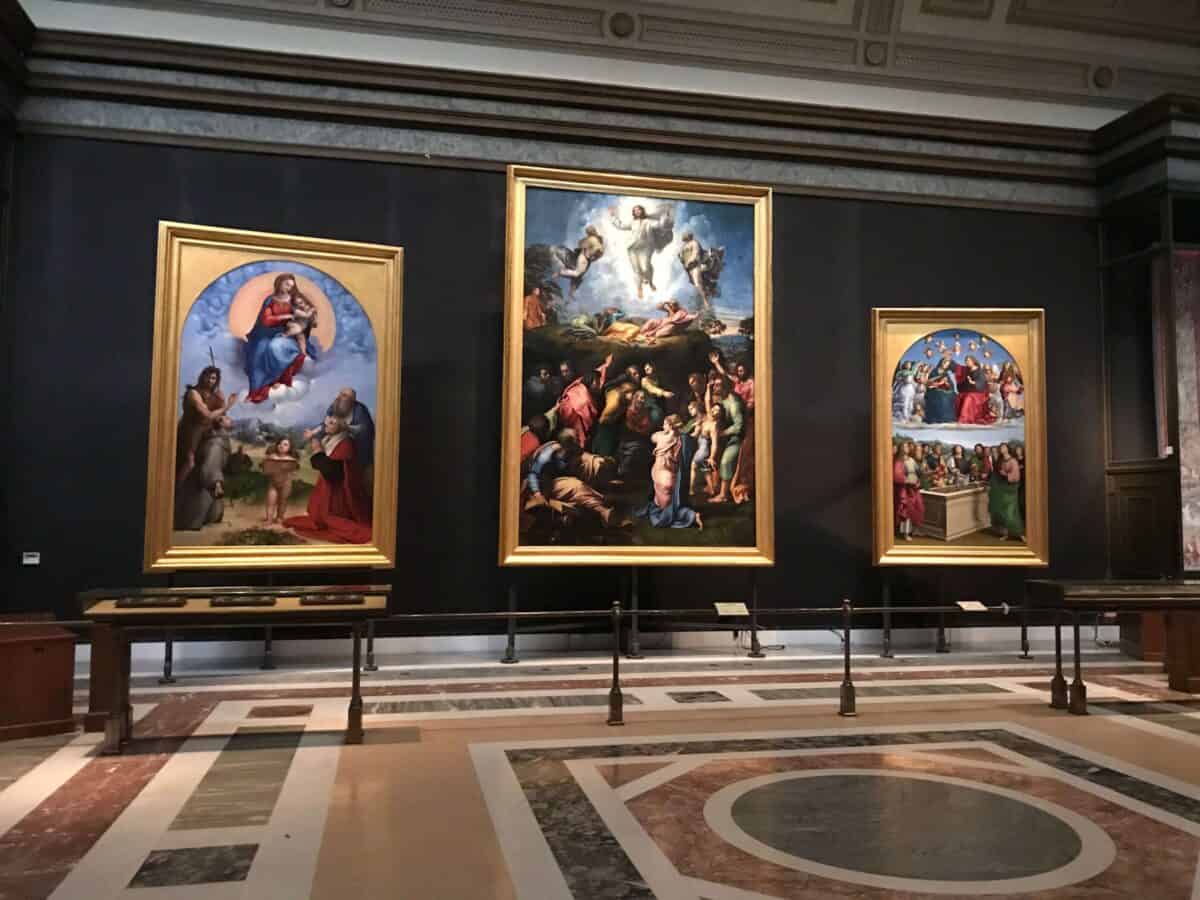
Room VIII was rather dark when I visited. The lighting is reportedly much enhance with the restoration/reopening.
On all four walls of the room are a number of huge 16th Century Flemish tapestries, almost all based on drawings/cartoons by Raphael. They include the Raphael’s tapestries that had been in the Sistine Chapel from the 'Acts of the Apostles' series.
Sala VIII, Pinacoteca Vaticana; July 2019
Sculpture By The Sea | Tamarama Beach | Sydney
Sculpture By The Sea, Bondi 2009, the 13th annual exhibition, is on from 29 October - 15 November 2009.
"And after six days Jesus took with him Peter and James and John his brother, and led them up a high mountain apart. And he was transfigured before them, and his face shone like the sun, and his garments became white as light. And behold, there appeared to them Moses and Eli'jah, talking with him. And Peter said to Jesus, "Lord, it is well that we are here; if you wish, I will make three booths here, one for you and one for Moses and one for Eli'jah." He was still speaking, when lo, a bright cloud overshadowed them, and a voice from the cloud said, "This is my beloved Son, with whom I am well pleased; listen to him." When the disciples heard this, they fell on their faces, and were filled with awe. But Jesus came and touched them, saying, "Rise, and have no fear." And when they lifted up their eyes, they saw no one but Jesus only.
And as they were coming down the mountain, Jesus commanded them, "Tell no one the vision, until the Son of Man is raised from the dead."
- Matthew 17:1-9, which is the Gospel for the Second Sunday of Lent.
Detail from the medieval windows at Fairford parish church.
"The Gospel of the Transfiguration of the Lord puts before our eyes the glory of Christ, which anticipates the resurrection and announces the divinization of man. The Christian community becomes aware that Jesus leads it, like the Apostles Peter, James and John “up a high mountain by themselves” (Mt 17: 1), to receive once again in Christ, as sons and daughters in the Son, the gift of the Grace of God: “This is my Son, the Beloved; he enjoys my favor. Listen to him” (Mt 17: 5). It is the invitation to take a distance from the noisiness of everyday life in order to immerse oneself in God’s presence. He desires to hand down to us, each day, a Word that penetrates the depths of our spirit, where we discern good from evil (cf. Heb 4:12), reinforcing our will to follow the Lord."
- Pope Benedict XVI, Message for Lent 2011.
This window of the Transfiguration is in All Souls' College chapel in Oxford.
Transfiguration Monastery / Преображенски манастир - 7km north from Veliko Tarnovo / Велико Търново - Samovodene - България / Bulgaria
Modern Stained glass window. The Transfiguration window was installed in 2010 in memory of Archbishop Michael Ramsey, a past Bishop of Durham.
Transfiguration Monastery / Преображенски манастир - 7km north from Veliko Tarnovo / Велико Търново - Samovodene - България / Bulgaria
This necklace started as a ball bearing that came off of my boyfriend's "Nordic Track". Once cleaned up, it was a functional/industrial/beautiful object just waiting to be worn. I first built it into a ring, but that wasn't right. It then became a pendent- that was a little better. But I knew I had to build a blindingly brilliant necklace around it. Perfect.
Besides the ball bearing, I used lots of steel wire, and a shade of copper wire called "gun metal" (though it seems to have a brownish tone). Also in the mix: a silver filigree earring, fresh water pearls, mother-of-pearl buttons, rhinestones, screw eyes, glass beads, a giant embroidery needle, vintage chain, vintage buttons, a belt buckle, a 'chain maille' earring, and an intricate network of woven wire...Even with all that, I'm sure I left something out.
Window in the north aisle by Heaton, Butler & Bayne, c1880.
St Mary Magdalene's at Knighton serves one of the former villages on Leicester's outer fringes that are now more or less incorporated into the suburban sprawl whilst still retaining some of its separate identity. It is set back from the streets in a quiet corner surrounded by greenery, its tall, slender spire announcing its presence above the roofs and trees.
On closer inspection it's immediately clear that this church is a bit more unusual, the medieval building consisted of just nave and chancel with the slim and elegant west tower and spire (which has a medieval statue of its patron saint, in a curiously off-centre niche high up on the eastern face) but had a south aisle added in the Victorian period. Then in the mid 20th century came a rather more dramatic transformation when a new nave was built, between the old church and the Victorian aisle, which necessitated dismantling the latter and rebuilding it further to the south so that the modern nave sits inbetween, largely unnoticed from outside, but very much apparent within. Entry is via the west porch which forms part of this modern enlargement.
Once inside one is confronted by the light and spacious modern nave, culminating in a plain-glazed oriel window at the east end. The south arcade is also modern and separates the short Victorian south aisle that was reassembled here. The nortn arcade however is medieval and divides the old part of the church from the new, the present north aisle having been the nave and chancel of the original church. There is much Victorian glass here, but the really significant piece is the beautiful Arts & Crafts window at the west end with two glorious angels in blue and red. The ancient font also stands close by.
The church isn't normally open outside of services, it had been a familiar sight to me for a few years having lectured the Leicester Stained Glass Appreciation Society (that meet in the parish rooms over the road) on many occasions. On all my visits I'd never found it open so on one occasion one of the group members kindly arranged for someone to come and open the church up for me, but sadly despite their best efforts whoever this keyholder was never showed up. An opening for a previous Ride & Stride day also failed to materialise, but happily this year it was open and a thriving space (people were gathering at the west end and there was a condolence book out in memroy of the Queen who'd died two days earlier). I'm glad to be able to say it was worth the wait to see inside at last.
Carved stone tympanum above the west door of Holy Trinity, Sloane Square in London, depicting the Gospel of the 2nd Sunday of Lent: Christ is transfigured.
This necklace started as a ball bearing that came off of my boyfriend's "Nordic Track". Once cleaned up, it was a functional/industrial/beautiful object just waiting to be worn. I first built it into a ring, but that wasn't right. It then became a pendent- that was a little better. But I knew I had to build a blindingly brilliant necklace around it. Perfect.
Besides the ball bearing, I used lots of steel wire, and a shade of copper wire called "gun metal" (though it seems to have a brownish tone). Also in the mix: a silver filigree earring, fresh water pearls, mother-of-pearl buttons, rhinestones, screw eyes, glass beads, a giant embroidery needle, vintage chain, vintage buttons, a belt buckle, a 'chain maille' earring, and an intricate network of woven wire...Even with all that, I'm sure I left something out.
The Second Sunday of Lent recounts the Transfiguration of Christ, when he appeared to three of his apostles in glory, seen between Elijah and Moses. Why is this remembered during Lent? This sermon explains why.
This 17th-century window is the west window of Wells Cathedral.
The Halland Collection, 381.
---
Daphni or Dafni (Modern Greek: Δαφνί; Katharevousa: Δαφνίον, Daphnion) is an eleventh-century Byzantine monastery eleven kilometers (6.8 miles) northwest of central Athens in the suburb of Chaidari, south of Athinon Avenue (GR-8A). It is situated near the forest of the same name, on the Sacred Way that led to Eleusis. The forest covers about 18 km2 (7 sq mi), and surrounds a laurel grove. "Daphni" is the modern Greek name that means "laurel grove", derived from Daphneion (Lauretum).
The Daphni Monastery was founded towards the end of the sixth century A.D. on the site of the Sanctuary of Apollo which had been desecrated by the Goths in 395. The Sanctuary of Apollo was built in the Ionic style using the thinnest and smallest columns. The columns stand on a base with an ornamental scroll at the top. A few of the columns of the temple have been preserved. One of the four Ionic columns of the ancient Sanctuary of Apollo remains at the site, as it was re-used in the Daphni Monastery. The other columns were removed and taken to London by Thomas Bruce, Earl of Elgin (of Elgin Marbles fame). The columns, column bass, and column tops from the Sanctuary of Apollo are currently in the possession of the British Museum; they are currently not on display but can be seen on the museum’s website .
The first monastery on the site was constructed in the style of a castle with a basilica in the middle. It was fortified with enclosing walls and small cells that were usually just inside the walls and used by monks or nuns. The walls were attached to the church rather than standing free around the perimeter of the property and one of the columns from Apollo was built into the southern wall of the church.[1] Some of the rectangular blocks of porous stone were also salvaged and used in the western outer wall of the church. This first monastery fell into decline when Greece was severely damaged following invasions of barbarians from the North and the sea in the ninth and tenth Centuries A.D.
During a period of renewed prosperity In the eleventh and twelfth centuries, the Daphni Monastery was restored. A new octagonal church, a refectory and a chapel for the cemetery were built.[2] The old basilica was completely demolished except for the enclosing walls and cells from the former church which were incorporated into the new church. Traces of old frescoes found on the walls show a person with bands, perhaps Emperor Basil II, holding a scroll. The craftsmanship used in the church construction suggests Basil II brought in workers from Constantinople.
The Daphni Monastery fell into decline after it was sacked by Frankish crusaders in 1205. The region became part of the Duchy of Athens under Othon de la Roche. Othon gave the Daphni Monastery to the Cistercian Abbey of Bellevaux, who added their own cloister and twin pointed arches in the Gothic style to the façade of the church. The Daphni Monastery became a popular burial place for Knights. In 1458, immediately after the coming of the Turks and the visit of Sultan Mehmed II to Athens, the Cistercians abandoned the Daphni Monastery and the Duchy of Athens was abolished.
The Daphni Monastery, along with the famous monasteries of Hosios Loukas near Delphi and Nea Moni on the island of Chios, are designated UNESCO World Heritage Sites for their significant historical and architectural value. These monasteries are famed as masterpieces of middle Byzantine architecture, and are especially noted for their sumptuous interior gold mosaics.
Architecture
The exterior of the church has a cloisonné style, which is very common for middle Byzantine churches in Greece. The cloisonné style of masonry consists of rectangular blocks of stone separated or framed on all four sides by bricks. The windows are set off from the cloisonné work by arched frames made of brick. The contrast between the light color of the stone blocks of the cloisonné and the red bricks around the windows, and the orange roof create a sophisticated and understated elegance.
The floor plan for the Church of Daphni is a simple Greek cross-octagon arranged with various levels of light and illumination. The upper church, particularly the dome symbolizes the Heavens while the lower area symbolizes the earth. A square bay in the center of the church is covered by a broad dome. Squinches, small half-domes that span the corner of a square are connected by tall L-shaped piers to form the transition from the square to the circle of the dome. The four squinches in the square bay transform it into an octagon. The wall surfaces fan out at the top above the squinches and join together to form the circular base of the dome.
A Greek cross is formed by four barrel-vaulted arms of the same length that project from the center bay. Small bays covered with groin vaults (ceilings made up of two barrel vaults) that intersect at right angles give the building its rectangular shape. The bays that fill in the cross are only one-story high and with a low-level of illumination to subordinate them from the Greek cross.
The interior of The Daphni Monastery has an elegant interplay of spaces and light with the windows at the base of the dome illuminating the vertical space above; as the space becomes taller, it also become brighter. This graduated light enhances the radiant gold-ground tesserae used to create the remarkable quality of the mosaics. The unknown artist was from the early Komnenian period (c. 1100). The wide assortment of colored shades of glass tesserae further enhances the mosaics. Several important studies have been conducted on the composition of the glass used in the tesserae for these mosaics as the unusually bright color of the gold-ground tesserae and the deep brilliance of the colors combine with important stylistic qualities to make these mosaics unique. One of the factors that identifies mosaics from different areas is the variance in glass used. The glass can be crafted locally or imported from other areas; in the case of Daphni, it is believed the glass was created on site. This group of mosaics is considered one of the most important and best-preserved mosaic cycles from this period. They are evidence of the iconographic and stylistic conceptions formulated at the end of the iconoclastic crisis (AD 843) by the Church of Constantinople. The decoration shows a rigid consistency in the distribution of subject characteristic of Constantinopolitan art.
In Byzantine theology, the church building was a symbol of the Christian universe, intended to reflect the splendor of heaven. A standardized program in Byzantine churches established the order in which the representations were arranged. The most sacred characters were depicted in the dome and the apse, while below, the dome scenes were arranged from higher to lower levels relating to their level of religious importance.
Visitors to the church are immediately drawn to the most important and famous of the mosaics: Christ Pantocrator (Lord of the Universe) watching over all from the crown of the dome. He is depicted with a stern face and a threatening gaze with only his head and shoulders shown. This medallion is recognized as representing high artistic quality and as “one of the greatest creations in art”
Christ is wearing a purple robe and a blue mantle, he is the King of Kings and shows strength, austerity and power. The artist created a bold and realistic drawing, executed with very simple means. The eyebrows are shown with a strong arch to accentuate the vertical lines and the long nose that intersects with the horizontal lines of the halo to create a symbolic cross. Several studies have been conducted in an attempt to determine whether significant changes have been made during restorations to the appearance of the Christ Pantocrator mosaic, but there is general agreement that changes have not been significant. Christ is surrounded by sixteen Prophets at the base of the dome, between the windows that illuminate Christ as the dominant figure in the church. The prophets are wearing ancient garments and hold a parchment containing text proclaiming the glory of Christ or the Second Coming.
On the pendentives there are four scenes from the life of Christ. The Crucifixion scene shows three figures: Christ on the cross, with Mary and Saint John are at the foot of the cross, one on each side. The figures are arranged in the shape of a triangle against the empty golden background. Each figure is separate and unified with the other figures. This balanced arrangement is similar to the way Greek sculptors placed their figures in the pediments of temples. The figure of St. John is depicted in a bending position, with his weight on one leg – a pose used by Greek sculptors. The body of Christ is depicted in a classic, athletic style, but unlike Greek sculpture, the anatomy is not true to life. The faces of Saint John and the Madonna have the flatness and heavy lines of the Byzantine style, but they express the calm of Greek statues.
According to the Encyclopædia Britannica, "the ensemble represents a visualization of the Christian cosmos, its effect created by an intricately conceived interplay of pictures and architecture. Space in fact fuses the decoration into one giant image, in which the ruler, hailed by the prophets surrounding him, presides in his sphere above the host of saints that people the lower part of the room."
Other important mosaics include: Prayers of Joachim and Anna, Annunciation of Joachim, The Virgin with Anna, Annunciation of the Mother of God, The Baptism of Christ, The Washing of the Disciples, Entering Jerusalem, Christ at the Last Supper, The Crucifixion, The Resurrection, Dormition of the Mother of God, Angel to Receive the Mother of God, Prophet Sophonia, St. Bacchus.
Byzantine art often survives as an ecclesiastical art. The Daphni Monastery was built during a period of renaissance in culture and art and a return to classical traditions. The figures in the mosaics are more naturalistically represented, and they blend more smoothly into their surroundings. The decoration of the monastery is inspired by the spirit of the times. Faces are dematerialized, austere and depicted with unemotional expressions. The bodies are heavy and rigid, common characteristics in depicting the icons of the Bishops, Monks and the Martyrs. The pictorial perspective, the figure styles and gestures, the modeling of the figures along with simplicity of design, and the dazzling splendor of color reflecting from the gold and silver tesserae distinguish the Daphni mosaics among the mosaics of the eleventh and twelfth centuries as particularly grand specimens of Byzantine art in general (Wikipedia).
Cathedral of Transfiguration of the Savior
Rybinsk, Yaroslavl Oblast, Russia 15 June 2013 . . N 58.04834 E 38.85875
www.waymarking.com/waymarks/WM32N2_Savior_Transfiguration...
Included in SET "Buildings/Structures Pt 10"
www.flickr.com/photos/30496606@N05/sets/72157634740576466...
www.flickr.com/photos/30496606@N05/collections/7215763030...
www.flickr.com/photos/30496606@N05/collections/
Included in SET "Russia 2013 Pt 3"
www.flickr.com/photos/30496606@N05/sets/72157634867955174...
www.flickr.com/photos/30496606@N05/collections/7215763473...
www.flickr.com/photos/30496606@N05/collections/
Camera: Canon PowerShot SX50 HS, Handheld. PSE11 / RPS / ZB / DPP
RAW Conversion, Cropped and compressed JPEG
Data: A.D.O.F. available on request
....... Gre