View allAll Photos Tagged Testbed
That was an unexpected shot! We went to Büchel AFB to see if we could get some German Tonkas, and the only one we got was probably the rarest!
98+79 is a testbed for the next upgrade of the Tornado fleet, the ASSTA 3.1 (Avionic System Software Tornado ADA).
Here it is seen landing in Büchel after a test flight, with 2 AGM-88 HARM antiradar missiles.
The Museum of Flight's Jumbo jet aircraft was the first 747 ever built - serial number 001. It first flew on February 9, 1969 over Western Washington. Later, this aircraft served as a testbed for 747 systems improvements and new engine developments for other Boeing commercial jets, including the state-of-the-art Boeing 777 engine program.
Boeing NB-47E. Used as testbed by USN. MASDC, Tucson Arizona, August 1978. Scanned from Kodak Kodachrome transparency.
✈ 🇯🇵 #JA731J #JapanAirlines #JAL #JL #Boeing #B777-300ER #Painted #SkyEco #RWY #Paris #CDG #LFPG #France #AWP #CHR
@ JAPAN AIRLINES | B773 | JA731J
• Country : JA | Japan 🇯🇵
Aircraft Type Built as Boeing 777-346ER
• Manufacturer Serial Number : msn 32431 / 429
• First Flight : 6 Apr 2003
• Production Site : Everett (PAE)
Airframe Status
• 2003-2004 : Boeing N5016R Second 777-300ER Test Aircraft
• 2004-present : JAL JA731J
47601 Tinsley Depot.
47601 was a testbed for the engine to be used in the Class 58, The former Pullman coach behind was being used as a test coach
8 September 1977
BC011ar
Conrail's BUEN of the 15th of May 1993 rolls south on the Northern Central. Behind the usual SD60M/SD40-2 duo is a four-of-a-kind GM SD60MAC demonstrator, being delivered to Conrail for testing for a few weeks.
Painted in a special GM/Burlington Northern scheme, the SD60MAC series paved the way for the thousands of AC-powered EMDs to come. The 9503 spent some time in the BN coal pool, then went back to EMD as a testbed. Conrail never bought the SD60MAC (no one did), but Conrail stepped up for SD80MACs and SD70MACs later on.
The BUEN's counterpart was rolling north in this view from an overpass at Heckton.
A Gulfstream G-III operated by G&G Aero as a sensor pod testbed banks away from the camera ship at sunset over the Arizona desert.
Shot in coordination with the Centre of Aviation Photography for an upcoming article I'm writing on G&G.
Former MAS A380-841 2-JAYN ex 9M-MNF & EI-HKF was ferried from Tarbes to Shannon today to be painted by IAC in Airbus colours to be used as n engine testbed.
Boeing B.747SP-B5
Korean Air (Korean Air Lines)
Zürich-Kloten (ZRH/LSZH)
01 July 1984
Among the more than 80 Boeing 747s operated by Korean Air over the decades, there were to examples of the B.747SP (Special Performance). Both were built and delivered to Korean Air in 1981, and registered HL7456 and HL7457.
Both became regulars at Zürich, superseding the DC-10-30s used since the launch of the service in 1976. HL7457 was captured arriving on runway 14 on the regular flight from then Seoul-Kimpo, and showing the carrier's original blue, red and white livery, featuring the full "Korean Air Lines" titles and the original airline logo in fin. This livery was changed in 1984, upon the rebranding as Korean Air after several security relevant incidents and two shoot downs over the Soviet Union.
Both B.747SPs were sold back to the manufacturer in 1998, and HL7457 is now registered as C-GTFF since 2010, and in service with Pratt & Whitney Canada as an engine testbed, making it one of the very last still airworthy Boeing 747SPs.
This restored Leyland National is based in Cumbria. It was new to Leyland Vehicles as a testbed for a new type of gearbox, hence the demonstrator livery. It also has a DAF engine, although this was a later modification.
C-FFDK, the Bombardier CSeries CS300 test bed seen here departing off RWY 04 at Belfast City Airport. Having made its public debut at the Paris Airshow this aircraft stopped off at Belfast to show the workers of Bombardier Belfast this new aircraft. The wings of the CSeries are manufactured in the facility in the background of the photo.
Photo taken by Norbert Kröpfl. Scan kindly provided by Stephan Barth for inclusion on this page.
München-Riem
January 1978
G-AXCK
BAC 111-401AK One-Eleven
90
Dan-Air London
G-AXCK in Dan-Air’s second 1-11 colour-scheme just before a snowstorm.
Dan-Air One-Elevens were regulars at Riem during the 1970s. G-AXCK would become the last One-Eleven to fly, making its last flight as the N164W electronic testbed with Northrop Grumman on 6 May 2019 from Baltimore/Washington (BWI).
Information from flick - thanks to Paul:
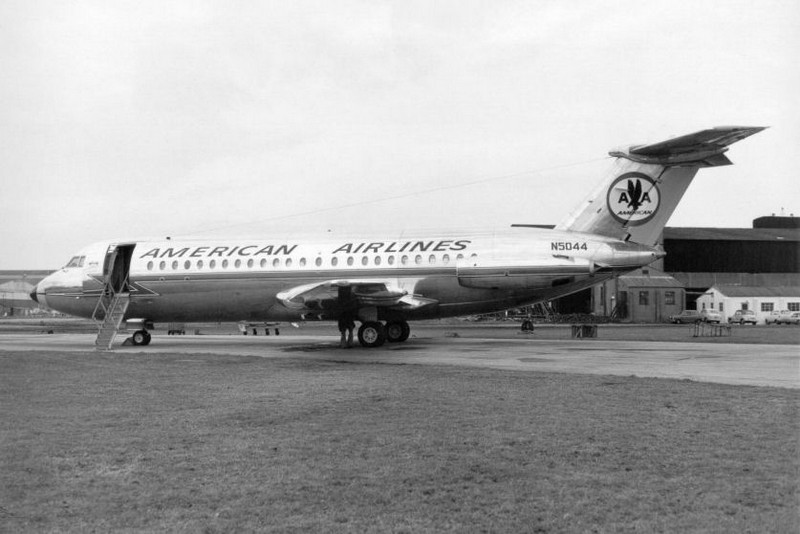
c/n 090. Delivered to American Airlines as N5044 in 1966. To Dan-Air as G-AXCK in 1969 then to Westinghouse Electric Corp as N164W in 1983 and used as a radar test aircraft, To Northrop Grumman Systems Corp in 1996. Still operational in 2018.
Registration details for this airframe:
www.planelogger.com/Aircraft/Registration/G-AXCK/834907
A report on N164W’s final mission including many photos:
photorecon.net/northrop-grummans-final-mission-in-the-bac...
This airframe as N5044 with American Airlines:
www.danairremembered.com/gallery/dan_axck4.jpg
G-AXCK with Dan-Air at PMI in February 1973 (earlier colours):
imgproc.airliners.net/photos/airliners/6/1/9/0487916.jpg

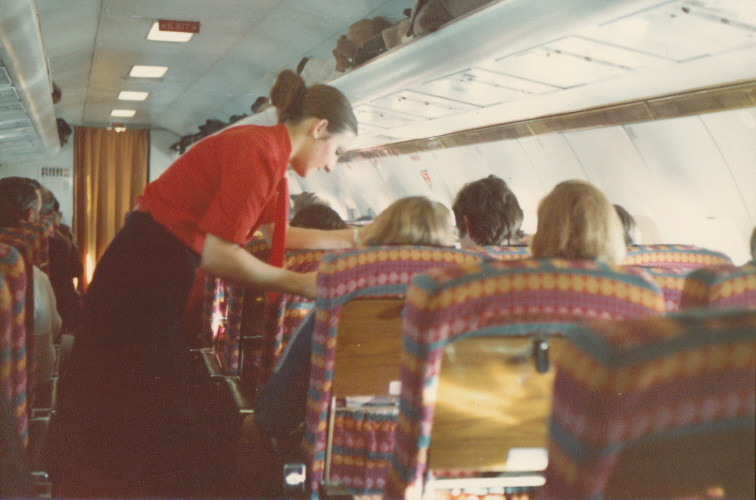
Interior of G-AXCK in 1976:
www.danairremembered.com/gallery/dan_axck_interior.jpg
G-AXCK with Dan-Air landing at Riem in February 1981 (later colours):
cdn.jetphotos.com/full/6/26893_1483109268.jpg

This airframe as N164W with Westinghouse at BWI in October 1985 (basic Dan-Air colours):
www.flickr.com/photos/23032926@N05/4968865269
N164W with Northrop Grumman at BWI in May 2011:
www.flickr.com/photos/42637873@N06/5793534954
N164W with Northrop Grumman at BWI in March 2013 (later colours):
www.flickr.com/photos/planes/8574179445
N164W fly-by prior to its final landing at BWI on 6 May 2019:
photorecon.net/wp-content/uploads/2019/05/1May6flyby1.jpg

Scan from Kodachrome slide.
Photo taken by Wilhelm Hell, scan kindly provided by Michael Bernhard for inclusion on this page.
München-Riem
July 1986
D-AMAP
Airbus A300B4-103
009
Hapag-Lloyd
D-AMAP is taxiing to Riem’s runway 25 for take-off. Note Oman Royal Flight's VC10 A4O-AB parked in the "Ostpilz" area in the distance.
Information from airhistory.net - thanks to Michael Röser and Kerry Taylor:
Built 1976 for Air Siam but not taken up. Delivered to Airbus Industrie on 26 Dec 1974 as F-WLGA and used as a testbed. Reregistered to F-ODCY on 04 Jun 1976. To Bavaria-Germanair as D-AMAP on 20 Feb 1978. Merged into Hapag-Lloyd on 01 Jan 1979. To Dan-Air as G-BMNB on 17 Dec 1986. To Air Inter as F-GIJT on 15 Jan 1990. To GrandAir as RP-C8881 on 03 Jul 1995. WFU and stored at TLS in Apr 1997. Broken up in Nov 1998.
Registration details for this airframe:
rzjets.net/aircraft/?reg=61331
This airframe as G-BMNB with Dan-Air London at LGW in October 1989:
www.flickr.com/photos/cooke1/8195944909
This airframe as F-GIJT with Air Inter at LBG in July 1994:
www.flickr.com/photos/jaydeekay/33272312795
This airframe as RP-C8881 at MNL in February 1996:
www.flickr.com/photos/guidojet/50406789461
RP-C8881 derelict at TLS in December 1998:
cdn.jetphotos.com/full/2/70235_1103112629.jpg

Scan from Kodachrome slide.
#4
The number 4 prototype of the Embraer E190-E2 made a fuel stop at Schiphol Airport while on its way to launch customer Widerøe in Norway
Gromov Flight Research Institute
FACT - Future Aircraft Control Testbed, used for developing fly-by-wire elements for fighter aircraft, on static display at MACKS 2019, Zhukovsky International Airport
29-08-2019
An aircraft with some history background.
Former c/n 002 Airbus Industrie testbed aircraft. Later Virgin Atlantic as G-VHOL.
Flying for Iran Anseman Airlines as EP-APA since 2012.
A PLM SD40X leads a wild consist of CP, D&H and NYS&W units on Susqhehanna HAN-1X. Included are both of NYS&Ws F45s. The train has passed under I-80 in Ridgefield Park as it nears the end of its journey. Today this area is occupied by Susquehanna's MC Yard and the surrounding area is quite built up. Thirty years ago, this location seemed almost bucolic and it was a good location to catch eastbounds arriving in the afternoon. 3041 was built by EMD in 1965 as a testbed for the 645 prime mover. Numbered EMDX 434B, it was built on an SD35 frame and included flared radiators similar to that of an SD45. Later SD40X models had standard radiators. It would become UP 3041 before being sold to PLM. Sadly this unique unit was reported as scrapped around 2010 after working for both MK and Helm Leasing.
NYS&W HAN-1X:
PLMX 3041 SD40X
CP 5672 SD40-2
DH 7324 GP38-2
NYSW 3638 F45
NYSW 3636 F45
NYSW 3614 SD45
The BAE Systems’ owned Jetstream (G-BWWW) is a unique aircraft. Known as ‘The Flying Testbed’; it is an aerial laboratory which has been developed to be flown by pilots or as an Uninhabited Air Vehicle (UAV). Here seen as it align itself on Warton Aerodrome's Runway 25.
Between my junior and senior year of high school I moved to Adrian, Missouri and attended school senior year at Drexel and graduated from there. The KCS was always an elusive one to me growing up on the opposite side of the state. So, with it suddenly within striking range, I spent a lot of time before and after school looking for gray EMD's as the "Retro Belle" deliveries really kicked into high gear as the Haywire reequipped their roster with modern power.
For months dozens of new SD70ACe's and ES44AC's showed up, most of them in glistening Southern Belle paint, some in primer at first, but they were all displacing the worn out SD40 variants they had all over the place. Long into the distant future, or so it seemed, was the CPKC Merger. Hell, at the date of this picture, the DM&E/IC&E acquisition by CP was still 29 days from being announced on September 4, 2007. It sure felt at the time that KCS was in it for another century, but that sure didn't end up being the case.
We moved in the day prior, and my first solo trip to the KCS Pittsburg Sub. armed with a highly advanced 5.0 megapixel Kodak Z740 and a Radio Shack scanner netted KCS Train M-KCSH-06 with an ultra rare EMD SD40X up front. KCS owned all 4 of these SD50 testbeds that were built curiously in 2 consecutive orders of 2 units, all in 8-1978. KCS 702 carried builder and frame number 786286-1, and served its entire career with the same number and initials—fairly rare for a locomotive of that era, escaping mergers and system renumbering programs.
Where is this stuff now? You guessed it, all scrapped or sold off, usually both. Where were you back then? Out shooting Retro Belles? Yeah, me too a lot of days. That sucks, huh? I probably should have chased this train to Oklahoma that day, but there was another one right behind it with who-knows-what on it, so we'll sit here and wait. Yikes, huh?
Locomotives: KCS 702, TFM 1428, TFM 1407
8-6-07
Drexel, MO
Don't ask me what OneWorld was doing here in Miami because I also asked myself the question... I say this because I live very close to the Miami International Airport.
Well, due to the confusion that this company may have, because it was a plane that passed by my sight, by chance, here I leave a note, I think it is important: Oneworld (stylized as oneworld; CRS: * O) is an airline alliance founded on February 1, 1999. The alliance's stated objective is to be the first choice airline alliance for the world's frequent international travelers. Its central alliance office is in New York, New York, United States. Its member airlines are American Airlines, British Airways, Cathay Pacific, Finnair, Iberia, Japan Airlines, Malaysia Airlines, Qantas, Qatar Airways, Royal Air Maroc, Royal Jordanian, S7 Airlines and SriLankan Airlines, as well as Fiji Airways as a connect partner and some 30 affiliated airlines. As of October 2017, Oneworld is the third-largest global alliance in terms of passengers with more than 527.9 million passengers carried, behind SkyTeam (630M) and Star Alliance (762M).
As of October 2017, its member airlines collectively operate a fleet of 3,447 aircraft, serve about 1,000 airports in more than 158 countries, carrying 527.9 million passengers per year on 12,738 daily departures, generating annual revenues of more than US $ 130 billion.
Boeing 747
Description
DescriptionThe Boeing 747 is a large, long–range wide-body airliner and cargo aircraft manufactured by Boeing Commercial Airplanes in the United States. After introducing the 707 in October 1958, Pan Am wanted a jet 2½ times its size, to reduce its seat cost by 30% to democratize air travel.
First flight: February 9, 1969
Number built: 1,558 (incl. 2 undelivered Boeing testbeds) as of June 2020
Program cost: US$1B in 1968 (7.4B today)
Variants: Boeing 747SP; Boeing 747-400; Boeing 747-8; Boeing VC-25; Boeing E-4
Developed into: Boeing YAL-1; Boeing Dreamlifter
Manufacturer: Boeing Commercial Airplanes
Produced: 1968 to the present, it keeps flying and this model is still being made with different variants.
View from Phoenix Sky Harbor Airport looking toward the Honeywell facility (former Garrett/AiResearch) August 2003. Camelback mountain in the background. Note the Boeing 720 testbed aircraft then in use. Later replaced with a 757.
N757HW, the Boeing 757 flying testbed owned by Honeywell International, about to touchdown at Geneva after flying down from Amsterdam
Excerpt from the plaque:
The Canadair CT-133 Silver Star was the Canadian license-built-version of the Lockheed T-33 jet trainer aircraft, in service from the 1950’s to 2005.
The Canadair CT-133 was the result of a 1951 contract to build T-33 Shooting Star Trainers for the Royal Canadian Air Force. The power plant is a Rolls-Royce Nene 10 turbojet instead of the Allison J33 used by Lockheed in the production of the original T-33. A project designation of CL-30 was given by Canadair and the name was changed to Silver Star. The appearance of the CT-133 is very distinctive due to the large fuel tanks usually carried on each wingtip.
A total of 656 CT-133 aircraft were built by Canadair.
The CT-133 entered service in the RCAF as its primary training aircraft for fighter/interceptors.
The CT-133 was reliable and had forgiving flight properties. Its service life in the RCAF was extremely long. One of the more unusual roles it played was as an aerobatic demonstration aircraft, the RCAF’s Red Knight. Although the aircraft stopped being used as a trainer in 1976, there were still over 50 aircraft in Canadian Forces inventory in 1995. The youngest of these airframes was then 37 years old and had exceeded its expected life by a factor of 2.5. During this period, the Canadair T-33 was employed in communication, target towing and enemy simulation.
The final Canadair Silver Star Mk. 3 was retired from the Aerospace Engineering Test Establishment at CFB Cold Lake, Alberta, Canada, where it was used as an ejection seat testbed after 46 years of service. CT-133 number 133648 was delivered to CFD Mountain View on 26 April 2005. Having been built in March 1959 as a CT-133 with original RCAF serial number 21648, it had reached a total of 11394.6 flight hours at the time of its retirement from military use. It has been sold on the civil market, along with fifteen other CT-133s. These aircrafts will join the fifty others on the United States Civil Register and continue to fly as a part of the living legacy of the early jet age.
Saab Gripen 39-7, the testbed for the next generation Gripen. Here we fly over the St. Anna archipelago just outside the hometown of Saab, Linköping, Sweden.
The photoship here was a Saab 105.
The low morning sun finds Delaware-Lackawanna Railroad (DL) M630 locomotive 1776 and M636 locomotive 3643 sitting quiet at Bridge 60. Number 1776 was built by Montreal Locomotive Works (under license from ALCO) in 1970 as Pacific Great Eastern 707, later BC Rail 707, and subsequently a GE testbed. Prior to May 2026 it was DL 3007, after which it was repainted into a semiquincentennial scheme inspired by the bicentennial scheme worn by Delaware & Hudson locomotives in the 1970s.
Northrop Grumman's "new" Gulfstream IV-SP N37WH arriving Runway 10 at BWI with lots of cool bumps and attachments. This looked a little different when it flew for Wayne Huizenga - www.flickr.com/photos/bwi2muc/12075948265/
98+98 / Bell UH-1D Iroquois / German Army
This one of a kind testbed was one of the last two operational german Hueys to retire in summer of 2022
98+98 / Bell UH-1D Iroquois / German Army
This one of a kind testbed was one of the last two operational german Hueys to retire in summer of 2022
NASA (US National Aeronautics & Space Agency) Boeing B747SP-21 N747NA
"NASA747" rotating RWY33 at Hamburg for a 6h testflight after heavy maintenance. This is no doubt the most expensive SP and definatly also the heaviest modified version of the plane around with the large airborne telescope sliding door in the back.
- although I need to thank ally my travel companions for the great day , special thanks to Dirk Gröthe and Wout Goossens for the many many updates -
HAM, 11-May-2018
Nikkormat FTn w/Vivitar 28mm f 2.8 Prime on Agfachrome 100
Disney World
Walt Disney World Resort (commonly known as Walt Disney World or Disney World) is an entertainment and vacation resort complex located about 20 miles (32 km) southwest of Orlando, Florida, United States. Opened on October 1, 1971, the resort is operated by Disney Experiences, a division of the Walt Disney Company.
Covering an approximate 27,000 acres (42 sq mi; 109 km2), Walt Disney World contains numerous recreational facilities designed to attract visitors for extended stays, including four theme parks, two water parks, four golf courses, conference centers, a competitive sports complex and a major shopping, dining and entertainment complex. Additionally, there are 31 Disney-owned resort hotels and one camping resort on the property, and many other non-Disney-operated hotels on and near the property.
Designed to supplement Disneyland in Anaheim, California, which had opened in 1955, the complex was planned and conceptualized by Walt Disney in the 1960s. Walt's vision for the complex was to build a new, self-contained destination resort on ample land, as he felt Disneyland had become limited by the third-party establishments that had sprung up around it. "The Florida Project", as it was then known, was intended to present a distinct vision with its own diverse set of attractions. Walt's original plans called for the inclusion of an "Experimental Prototype Community of Tomorrow" (EPCOT), a planned community intended to serve as a testbed for new city-living innovations. Walt's original vision would not progress past conceptualization, as he died on December 15, 1966, during the initial planning of the complex before construction had begun. After his death, the company wrestled with the idea of whether to bring the Disney World project to fruition; however, Walt's older brother, Roy O. Disney, came out of retirement to ensure the project was realized.
Construction began in 1967, with the company abandoning the planned community concept, instead choosing to build a theme park resort similar to Disneyland. Magic Kingdom was the first theme park to open in the complex in 1971, followed by EPCOT (then known as EPCOT Center) in 1982, Disney's Hollywood Studios (then known as the Disney-MGM Studios Theme Park) in 1989, and Disney's Animal Kingdom in 1998. Initially known as Disney World, the name of the entire resort was named Walt Disney World at Roy's insistence, to memorialize his brother.
In 2024, Walt Disney World was the most visited vacation resort in the world, with an average annual attendance of more than 49 million, while Magic Kingdom has been the most visited theme park in the world for at least the past 24 years. The opening of Walt Disney World helped turn Central Florida into a major global tourism destination and the resort has contributed singificantly to Florida's economy, generating billions in economic activity and supporting a large number of jobs across the state. The resort is the largest single-site employer in the United States, the flagship destination of Disney's worldwide corporate enterprise and has become a staple of American popular culture.