View allAll Photos Tagged Testbed
Industrial automation is always interesting, because nothing ever stays the same. On the right is an Opto 22 R1 Programmable Automation Controller, (PAC); the original version was released over 20 years ago, but due to an increasing shortage of its aging processor, a complete redesign using a modern processor was required. The important thing for us is to try to make the new version a drop-in replacement for the original so the customers can continue to use all of their existing programming without any modifications. I've been privileged to work with a talented team of co-workers who have worked for at least a year to make this happen. We're finally starting to see the light at the end of the tunnel.
N757HW - Boeing B-757-225 - Honeywell International Inc.
"Connected Aircraft"-titles and various other stickers
at Hamilton International Airport (YHM)
c/n 22.194 - built in 1982 for Eastern Airlines -
operated by Honeywell since 2005 as a flying testbed
LBG 10.1984 - on display at the museum at Le Bourget. Used as a testbed by the Centre d'Essais en Vol (CEV) for Turbomeca/Snecma Larzac 01 jet engine (scan from my collection - not my shot).
C-FETB : Pratt & Whitney B-720 flying testbed for engines returning to it's home base at St-Hubert Airport (CYHU) in the vicinity of Montréal, Canada
'VooDoo One', highly modified 727 operated as an avionics testbed by Raytheon, on the go and turning crosswind, runway 25 at Palmdale.
BOE57A Returning from a test flight. This is the first 757 Prototype now used as a testbed by Boeing with an F-22 Nosecone and avionics. Nicknamed the "Catfish." This is the first time it has come to PMD in the recently repainted retro scheme.
2/2023 - NS 1000 SD45 testbed unit hasn't seen much use lately but it's still here if needed. This dinosaur was built for the Erie Lackawanna.
FR – 28 mars 2007 09h08 – Tilloy-et-Bellay (Marne) – Km 166 LGV Est-Européenne
La motrice intermédiaire TGV P 150 R4
Au départ, cette caisse était conçue comme une voiture-bar pour TGV Duplex Dasye – Euroduplex. Sur la photo, elle est devenue une motrice de technologie AGV (Automotrice à Grande Vitesse), à motorisation répartie. En 2007, c’était une nouvelle technologie Alstom, encore en cours de mise au point. Son installation sur la rame V150 a été de nature expérimentale, c’était une banc d’essai roulant, un prototype à usage unique.
Les équipements électriques standard sous le compartiment bar ont été remplacés par une chaîne de traction type AGV (et un convertisseur statique pour la climatisation de la rame). Les bogies comportent chacun deux moteurs synchrones à aimants permanents de 800 KW de puissance nominale pour 25 KV à la caténaire, soit 3200 KW / 4350 chevaux. Le bar a été remplacé par une régie vidéo-télévision et un studio d’enregistrement.
A l’arrivée, c’est-à-dire au moment où la vitesse atteignait 574 km/h le 3 avril 2007, c’était une puissante motrice qui apportait environ 3800 KW / 5200 chevaux de puissance mécanique, c’est-à-dire 18,2% de la puissance nécessaire pour atteindre le record.
Et après le record, lorsque la V150 a été démantelée pour remettre ses différentes parties au type standard et les réintégrer à des rames TGV commerciales, cette remorque motorisée n’a pas trouvé de réemploi. Elle est retournée chez Alstom à Aytré.
- - - - - - - - - - - -
EN – 28 March 2007 09:08 – Tilloy-et-Bellay (Marne) – Km 166 East-European HSL
The intermediate power car – TGV P150 R4
Originally, this bodyshell had been designed as a bar car for the TGV Duplex Dasye / Euroduplex fleet. In this photograph, it has been transformed into a powered vehicle incorporating AGV (Automotrice à Grande Vitesse) technology, with distributed traction. In 2007, this was a new Alstom development still undergoing refinement. Its installation within the V150 trainset was therefore experimental in nature, a rolling testbed, effectively a one-off prototype.
The standard electrical equipment beneath the former bar compartment was replaced by an AGV-type traction chain, along with a static converter supplying the train’s air-conditioning. Each bogie was fitted with two permanent-magnet synchronous motors rated at 800 kW under 25 kV overhead supply, giving a total of 3,200 kW (4,350 hp). The bar area itself was converted into a television control room and recording studio.
By the time of the record run on 3 April 2007, when the train reached 574 km/h (356.7 mph), this vehicle had become a fully fledged power car, contributing around 3,800 kW (5,200 hp) of mechanical output, equivalent to 18.2% of the total power required to achieve the record.
Following the record, when the V150 trainset was dismantled and its various components returned to standard configuration for reintegration into commercial TGV sets, this powered intermediate vehicle found no further operational use. It was returned to Alstom Aytré.
© Jean-Marc Frybourg – 070328-0276
Merci de ne pas partager ni publier ailleurs sans l’autorisation de l’auteur. Tous droits réservés.
Please do not share or post elsewhere without permission from the photographer. All rights reserved.
Excerpt from Wikipedia:
The Beechcraft Model 18 (or "Twin Beech", as it is also known) is a 6- to 11-seat, twin-engined, low-wing, tailwheel light aircraft manufactured by the Beech Aircraft Corporation of Wichita, Kansas.
Continuously produced from 1937 to November 1969 (over 32 years, a world record at the time), over 9,000 were built, making it one of the world's most widely used light aircraft. Sold worldwide as a civilian executive, utility, cargo aircraft, and passenger airliner on tailwheels, nosewheels, skis, or floats, it was also used as a military aircraft.
During and after World War II, over 4,500 Beech 18s were used in military service—as light transport, light bomber (for China), aircrew trainer (for bombing, navigation, and gunnery), photo-reconnaissance, and "mother ship" for target drones—including United States Army Air Forces (USAAF) C-45 Expeditor, AT-7 Navigator, and AT-11 Kansan; and United States Navy (USN) UC-45J Navigator, SNB-1 Kansan, and others. In World War II, over 90% of USAAF bombardiers and navigators trained in these aircraft.
In the early postwar era, the Beech 18 was the pre-eminent "business aircraft" and "feeder airliner". Besides carrying passengers, its civilian uses have included aerial spraying, sterile insect release, fish seeding, dry-ice cloud seeding, aerial firefighting, air-mail delivery, ambulance service, numerous movie productions, skydiving, freight, weapon- and drug-smuggling, engine testbed, skywriting, banner towing, and stunt aircraft. Many are now privately owned, around the world, with 240 in the U.S. still on the FAA Aircraft Registry in August 2017.
N757HW - Boeing B-757-225 - Honeywell International Inc.
"Connected Aircraft"-titles
at Hamilton International Airport (YHM)
c/n 22.194 - built in 1982 for Eastern Airlines -
operated by Honeywell since 2005 as a flying testbed
In 1957, the U.S. Army identified a new requirement for a lighter but more rugged frontline observation aircraft that could operate from rough airstrips and also have short takeoff and landing (STOL) capabilities. Grumman's proposal was granted, and the development of the YAO-1A soon began. The aircraft's maiden flight was on April 14th, 1959. It was a mid-wing monoplane powered by a pair of turboprop engines, with a tail featuring three vertical stabilizers, much like the previous Lockheed Constellation. The pilot and the observer sat side-by-side in a cockpit with bulged side windows, providing excellent downward visibility.
Three production variants were ordered: the AO-1A, built exclusively for either daytime or nighttime reconnaissance missions; the AO-1B, built with a Sideways Looking Radar (SLAR) pod slung under the right side of the fuselage; and finally, the AO-1C, explicitly designed for infra-red reconnaissance. These designations were later changed to OV-1A, B, and C respectively. An OV-10 “Bronco” version was later developed, and the capabilities of both the OV-1B and C versions were combined. More than 375 OV-1 Mohawks were built over nearly a decade and used extensively throughout the Vietnam War. The aircraft was not designed to carry any armaments, but many were later modified in the field to carry rockets, mortars, rotating-barrel machine guns, and even small missiles. Depending on the mission, they would also use iron bombs or napalm canisters on some occasions.
This OV-1A, BuNo 59-2604, was only the 2nd OV-1 ever built and delivered to the U.S. Army in 1960. Details on its Army career are scarce, though it may have served as a JOV-1 testbed at Fort Rucker, Alabama, for a short time; it may also have served in Vietnam. It was retired in 1973 and used by NASA to research wing icing, then stored or sold to a private owner. By 1998, it was in the possession of the Lone Star Flight Museum in Galveston, Texas; in 2006, 59-2604 was sold to Planes of Fame (This saved the aircraft, as the Lone Star Flight Museum was heavily damaged by Hurricane Ike in 2008).
59-2604 carries the high-visibility markings used by the U.S. Army until about halfway through the Vietnam War, though many OV-1s carried these markings until the war's end. Though 59-2604 is only a static display at the moment, it is currently in the process of being restored to flying condition.
These twin briefcase-sized nanosatellites will manoeuvre around each other, before performing an automated docking in orbit.
The RACE, Rendezvous Autonomous CubeSats Experiment, is ESA’s latest in-orbit demonstration CubeSat mission, presented at this week’s CubeSat Industry Days, taking place at ESA’s technical heart.
CubeSats are low-cost satellites built up from standardised 10-cm boxes, increasingly used to demonstrate promising new technologies and approaches in space, as well as for educational, scientific and commercial applications.
The RACE mission concept involves two ‘6-unit’ CubeSats that will fly together in close formation, proving the capability of nanosatellites to perform close-proximity operations. These will include rendezvous and docking on a cooperative basis, and the ability to perform a close flyby around uncooperative targets, such as derelict satellites.
RACE is being developed by a European consortium led by the GomSpace company, with GMV working on guidance, navigation and control systems, Almatech contributing the docking mechanism and Micos the CubeSats’ visual navigation camera. The mission is being funded through ESA’s Fly element of the General Support Technology Programme, readying new concepts for space and the market.
“RACE will act as an in-orbit testbed for advanced guidance, navigation and control software and autonomous system behaviour,” explains Roger Walker, overseeing ESA’s technology CubeSats programme. “And by making it possible to assemble larger structures in space in this way, these ambitious CubeSats could open up many novel types of missions in future.”
ESA’s fourth CubeSat Industry Days take place this week at ESA’s ESTEC technical centre in Noordwijk, the Netherlands, with more than 260 participants from 25 European countries, representing some 152 companies.
“This event is focused on the current European state-of-the-art in this fast-expanding space sector and discussing key issues for future missions,” adds Roger. By popular demand these Industry Days have been expanded with an extra final day exploring CubeSat propulsion systems.
Credits: GomSpace
TPE331-14 Turboprop mounted on Honeywell's 757 testbed in preparation for data gathering test flight.
This Boeing 707-321B N404PA was an experimental aircraft communications and sensor testbed owned by the Air Force Systems Command and operated by a joint venture between the Air Force’s 350th Electronic Systems Wing and M.I.T.’s Lincoln Labs.
Northrop Grumman Bac 1-11 N164W starting its low pass over Runway 33L at BWI. Ten minutes this aircraft would make the last ever landing for the Bac 1-11.
Geheime Kommandosache
Versuchsträger der Maschinenpistole Verdeckte Operationen, für die Wehrmacht, basierend auf der Maschinenpistole 40. Die MP-4009 wird in Kleinserie hergestellt, es muss unter allen Umständen gewährleistet werden das dieser Versuchsträger und die finalen Modelle, keinen allierten Kräften in die Hände fällt.
Autorisiert durch das Heereswaffenamt, Forschung und Entwicklung, Oberstleutnant Karl von Krevenfelde, am 26. Januar 1941, Berlin.
_______________________________________________
Top Secret
Testbed of the Covert Operation Submachine Gun, for the Wehrmacht, based on the Maschinenpistole (SMG) 40. The MP-4009 is manufactured in small series, it must be ensured under all circumstances that this testbed and the final models, do not fall in the hands of the allied forces.
Authorized by the Army Ordnance Office, Research and Development, Lieutenant Colonel Karl von Krevenfelde, on 26 January 1941, Berlin.
N757HW - Boeing B-757-225 - Honeywell International Inc.
"Connected Aircraft"-titles and various other stickers
at Hamilton International Airport (YHM)
c/n 22.194 - built in 1982 for Eastern Airlines -
operated by Honeywell since 2005 as a flying testbed
ESA’s Rover Autonomy Testbed rover is being run in near darkness by Spain’s GMV company to simulate the low Sun angles experienced at the Moon’s poles.
Permanently shadowed craters around the lunar north and south poles are tempting targets for future robotic missions, seeking water ice and other volatiles believed to be deep frozen in the soil.
Laboratory testing took place as part of ESA’s Lunar Scenario Concept Validation and Demonstration (Lucid) project. Now, as a next step, this and a second rover – ESA’s Heavy Duty Planetary Rover – have travelled to Tenerife in the Canary Islands for day and night testing in the volcanic, Moon-like environment of Teide National Park.
The two rovers carry navigation aids to work in both light and dark, including stereo cameras, lights, GPS, laser rangers and radar-like lidar. They can build digital 3D maps from these various sensors for both autonomous and teleoperated steering.
To follow the progress of the Lucid testing in Tenerife, follow the Twitter hashtag #DarkRover.
Credit: GMV
Registration: F-WLXV
Type: A350-1041
Engines: 2 × RR Trent XWB-97
Serial Number: 065
First flight: Feb 7, 2017
One standout in the A350 family is the A350-1000 test aircraft, registered as F-WLXV (MSN065), which played a pivotal role in the type’s certification campaign. As the second A350-1000 built, it rolled out of Airbus’s Toulouse paint shop in September 2016 sporting the striking Carbon Fiber livery—a visual nod to the aircraft’s composite-heavy construction. Unlike its siblings, F-WLXV was uniquely equipped with a fully fitted passenger cabin during testing, allowing Airbus to evaluate real-world systems performance on long-haul flights, including a notable 2017 test campaign that pushed its endurance and reliability limits.
Beyond its technical contributions, F-WLXV doubled as a promotional star for Airbus. The Carbon Fiber livery, with its sleek black-and-gray weave pattern, became an icon of the A350 XWB program, showcasing the advanced materials that define the jet. This aircraft toured global airshows and demonstration flights—like its 2018 appearance in Sydney—captivating aviation enthusiasts and industry insiders alike. Even after its test duties wound down, F-WLXV’s legacy lived on; it was later repainted and delivered to Air Caraibes in 2019, transitioning from a testbed to a commercial workhorse while retaining its historical significance.
Poster for Aviators
See more car pics on my facebook page!
- - -
The XK120 was launched in roadster form at the 1948 London Motor Show as a testbed and show car for the new Jaguar XK engine. It caused a sensation, which persuaded Jaguar founder and design boss William Lyons to put it into production.
The "120" in its name referred to its 120 mph (193 km/h) top speed (faster with the windscreen removed), which made the XK120 the world's fastest standard production car at the time of its launch.
It was available in two open versions, first as the roadster (designated OTS, for open two-seater, in America), then also as a drophead coupé (DHC) from 1953 – and also as a closed, or "fixed-head" coupé (FHC) from 1951. The DHC was a more deluxe open model, with wind-up windows, and wood-veneer dashboard and interior door caps, as on the FHC.
The roadster was successful in racing.
(Wikipedia)
N757HW - Boeing B-757-225 - Honeywell International Inc.
"Connected Aircraft"-titles and various other stickers
at Hamilton International Airport (YHM)
c/n 22.194 - built in 1982 for Eastern Airlines -
operated by Honeywell since 2005 as a flying testbed
N747GF, a Boeing 747-400 operated by General Electric as an engine testbed based at Southern California Logistics Airport, known better as Victorville. It is pictured here returning to its hangar from an engine ground run, carrying the CFM Leap 1B engine, used on the Boeing 737 Max, on its number 2 engine pylon location.
This former Japan Airlines aircraft was acquired by General Electric in late 2010. It operated alongside GE's 747-100, N747GE, until the 100 was retired at the start of 2017. The 400 is now GE's sole engine testbed.
N757HW, a Boeing 757-200 owned by Honeywell International as a flying testbed aircraft. Used for testing everything from engines to sensors, this 35 year old aircraft is currently involved in testing onboard wifi and communications systems. It is photographed here lining up on Dublin Airport's RWY10 ready to depart to Minneapolis St Paul Airport.
WA638 Gloster Meteor T.7 (mod) Martin Baker. Last operational meteor in use as an ejection seat test-bed
RIAT 2018 RAF Fairford 16th July 2018
N27752, a Boeing 737-10 MAX testbed aircraft being thrown around the skies by the Boeing test pilots at the Farmborough International Airshow 2022.
Making its first flight on 18th June 2021, the MAX 10 made its public debut here at Farnborough 2022. It is the largest of the 737 MAX family of aircraft.
It is currently in the test and certification program with deliveries expected to next year in 2023.
Another day, another nose for Northrop Grumman's CRJ700 N805X. This time it is making a rare departure from Runway 33L due to a planned closure of Runway 10/28.
Photo taken by Klaus Held, scan kindly provided by him for inclusion on this page.
München-Riem
Summer 1969
F-BRIM
Sud SE-210 Caravelle III
193
Panair
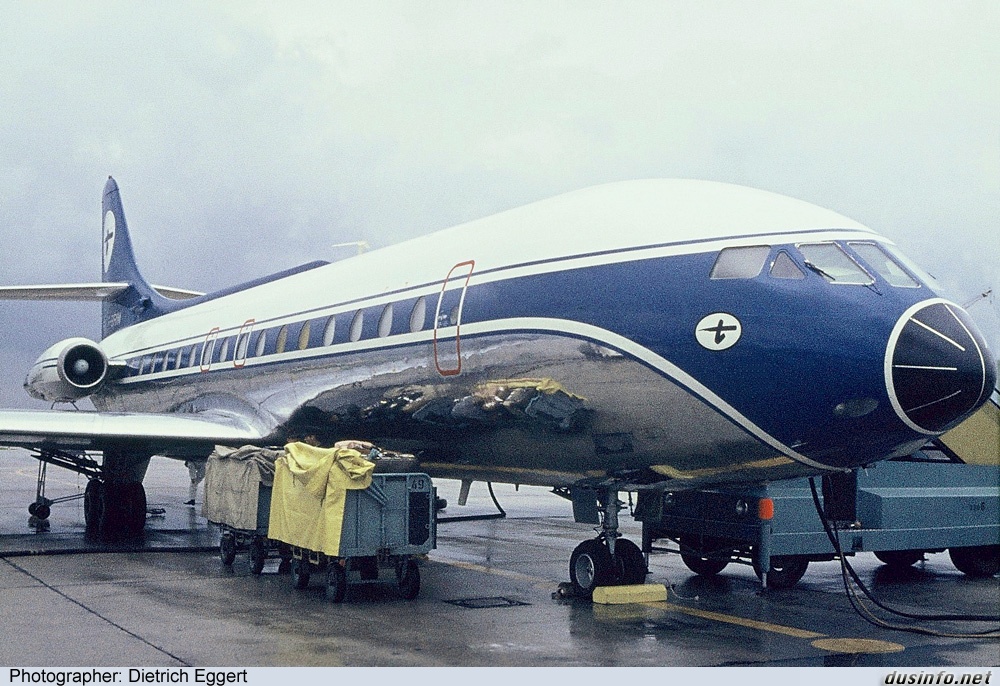
Trans-Union Caravelle flying for German charter airline Panair which later had to change its name to Paninternational. F-BRIM was noted at Riem on 18 May 1969 and 5 June 1969, as well as at Neubiberg Air Base on 15 August 1969.
This Caravelle was delivered to SAS as SE-DAH in March 1965. It went back to Sud Aviation and was leased to Trans Union SA as F-BRIM from April 1969 and then sub-leased to Panair during 1969. In 1971, SOGERMA (Sud Aviation) took over the airframe and leased it to engine manufacturer SNECMA who used it as a testbed for the M53 and CFM56 engines. In October 1978 it went to the Armée de l'Air. Reportedly scrapped at TLS in 1997. (Sources: rzjets.net, bsl-mlh-planes.net)
Information on Panair/Paninternational:
www.airlines-airliners.de/airlines/paninternational.htm
Registration details for this airframe:
www.planelogger.com/Aircraft/Registration/F-ZACF/751843
This airframe as SE-DAH with SAS at PIK late 1960s:
www.flickr.com/photos/intairphoto/16597579366
F-BRIM with Trans-Union/Panair at DUS in 1969 (no titles):
F-BRIM with Trans-Union at LGW in September 1969:
www.airhistory.net/photo/9265/F-BRIM
This airframe as F-ZACF with SNECMA equipped with M53 engine ca. 1973:
i.pinimg.com/originals/c7/68/66/c76866c965e41e9c8cbf03559...

This airframe as F-ZACF with SNECMA equipped with CFM56 engine ca. 1977:
www.letletlet-warplanes.com/wp-content/gallery/caravelle/...

Scan from black-and-white print.
Paris Airshow 2015
F-WWOW Airbus A380-841 Airbus Industrie
27 Apr 2005 Testbed 4x RR Trent 970 Jacques Rosay
FN 001
std at TLS 11 Feb 2017 - 29 Jan 2019
"50 Years" sticker May 2019
std at TLS 20 Sep 2019 - 18 Jan 2021
Dining car VIA 8402 (Alexandra) has been stripped down at CAD and is likely to be scrapped in the near future. It was undergoing what I believe is a tear-down examination at CAD. VIA Rail was mandated by a Transport Canada order released on October 19th of last year to do a number of tests on stainless steel cars. At left is a testbed built on what was an LRC locomotive.
MH-37G “Gallow” Heavy Combat Frame (Gunner variant)
The original Gallow prototype was commissioned by OSC with a set of dual autocannons, until it was repurposed as a testbed for the advanced pulse lasers which would eventually become its standard armament. Still, the autocannons had proven cost-effective and lethal during early testing, and several Gallows were eventually put into service with them.
Equipment:
- Chin-mounted machine gun
- Radar array
- 2 dual autocannons
Seen on a South Yorkshire Transport Society visit to the Foden works, unregistered chassis no 93446 has been used as a testbed for the development of the Foden-NC double decker, in conjunction with Northern Counties. Never completed above lower-deck roof level, it would eventually be sold to Bullock, Cheadle for spares.
Martin-Baker ejection-seat testbed at Abingdon in September 1990. This veteran remains in use by the company as of 2025.
Photo taken by Klaus Held, scan kindly provided by him for inclusion on this page.
München-Riem
ca. September 1969
F-BRIM
Sud SE-210 Caravelle III
193
Trans-Union
Trans-Union had leased F-BRIM to German charter airline Panair which later had to change its name to Paninternational. F-BRIM with Panair was noted at Riem on 18 May 1969 and 5 June 1969, as well as at Neubiberg Air Base on 15 August 1969. This shot was apparently taken after the aircraft’s return to Trans-Union.
This Caravelle was delivered to SAS as SE-DAH in March 1965. It went back to Sud Aviation and was leased to Trans Union SA as F-BRIM from April 1969 and then sub-leased to Panair during 1969. In 1971, SOGERMA (Sud Aviation) took over the airframe and leased it to engine manufacturer SNECMA who used it as a testbed for the M53 and CFM56 engines. In October 1978 it went to the Armée de l'Air. Reportedly scrapped at TLS in 1997. (Sources: rzjets.net, bsl-mlh-planes.net)
Information on Panair/Paninternational:
www.airlines-airliners.de/airlines/paninternational.htm
Registration details for this airframe:
www.planelogger.com/Aircraft/Registration/F-ZACF/751843
This airframe as SE-DAH with SAS at PIK late 1960s:
www.flickr.com/photos/intairphoto/16597579366
F-BRIM with Trans-Union/Panair at DUS in 1969 (no titles):
F-BRIM with Trans-Union at LGW in September 1969:
www.airhistory.net/photo/9265/F-BRIM
This airframe as F-ZACF with SNECMA equipped with M53 engine ca. 1973:
i.pinimg.com/originals/c7/68/66/c76866c965e41e9c8cbf03559...
This airframe as F-ZACF with SNECMA equipped with CFM56 engine ca. 1977:
www.letletlet-warplanes.com/wp-content/gallery/caravelle/...
Scan from black-and-white print.
With the ex US Coast Guard Lockheed EC130V/NC-130H AEW&C test-bed in the foreground, US Air Force Northrop B-2A Spirit
82-1069 makes a 'down and dirty' fly-by during the 1996 Edwards AFB 'Open House'.
Due to budget cuts, that ex 'Hawkeye' AEW APS-125 radar dish modification on the C-130H Hercules, never made it in to production as the USCG terminated the program but here the USAF were evaluating the system which eventually passed onto the US Navy at Patuxent River for the Grumman Hawkeye 2000 program evaluation.
Read more about it here:
www.globalsecurity.org/military/systems/aircraft/ec-130v.htm
Scanned 35mm Transparency