View allAll Photos Tagged Composition
The Garuda is a large bird-like creature, or humanoid bird that appears in both Hinduism and Buddhism. Garuda is the mount (vahana) of the Lord Vishnu. Garuda is the Hindu name for the constellation Aquila. The brahminy kite and phoenix are considered to be the contemporary representations of Garuda. Indonesia adopts a more stylistic approach to the Garuda's depiction as its national symbol, where it depicts a Javanese eagle (being much larger than a kite).
ABOUT GARUDA
In Hinduism, Garuda is a Hindu divinity, usually the mount (vahana) of the Lord Vishnu. Garuda is depicted as having the golden body of a strong man with a white face, red wings, and an eagle's beak and with a crown on his head. This ancient deity was said to be massive, large enough to block out the sun.
Garuda is known as the eternal sworn enemy of the Nāga serpent race and known for feeding exclusively on snakes, such behavior may have referred to the actual short-toed eagle of India. The image of Garuda is often used as the charm or amulet to protect the bearer from snake attack and its poison, since the king of birds is an implacable enemy and "devourer of serpent". Garudi Vidya is the mantra against snake poison to remove all kinds of evil.
His stature in Hindu religion can be gauged by the fact that a dependent Upanishad, the Garudopanishad, and a Purana, the Garuda Purana, is devoted to him. Various names have been attributed to Garuda - Chirada, Gaganeshvara, Kamayusha, Kashyapi, Khageshvara, Nagantaka, Sitanana, Sudhahara, Suparna, Tarkshya, Vainateya, Vishnuratha and others. The Vedas provide the earliest reference of Garuda, though by the name of Śyena, where this mighty bird is said to have brought nectar to earth from heaven. The Puranas, which came into existence much later, mention Garuda as doing the same thing, which indicates that Śyena (Sanskrit for eagle) and Garuda are the same. One of the faces of Śrī Pañcamukha Hanuman is Mahavira Garuda. This face points towards the west. Worship of Garuda is believed to remove the effects of poisons from one's body. In Tamil Vaishnavism Garuda and Hanuman are known as "Periya Thiruvadi" and "Siriya Thiruvadi" respectively.
In the Bhagavad-Gita (Ch.10, Verse 30), in the middle of the battlefield "Kurukshetra", Krishna explaining his omnipresence, says - " as son of Vinata, I am in the form of Garuda, the king of the bird community (Garuda)" indicating the importance of Garuda.
Garuda wears the serpent Adisesha on his left small toenail and the serpent Gulika on his right cerebral cortex. The serpent Vasuki forms his sacred thread. The cobra Takshaka forms his belt on his hip. The snake Karkotaka is worn as his necklace. The snakes Padma and Mahapadma are his ear rings. The snake Shankachuda adorns his divine hair. He is flanked by his two wives ‘Rudra’ and ‘Sukeerthi’ or (Sukirthi). These are all invoked in Vedanta Desika's Garuda Panchashath and Garuda Dandaka compositions. Garuda flanked with his consorts 'Rudra' and 'Sukirthi' can be seen worshipped in an ancient Soumya Keshava temple in Bindiganavile (or Mayura puri in Sanskrit ) in Karnataka state of India.
Garuda Vyuha is worshiped in Tantra for Abhichara and to protect against Abhichara. However, the interesting thing is that Garuda is the Sankarshna form of the lord who during creation primarily possesses the knowledge aspect of the lord (among Vasudeva, Sankarshana, Pradyumna and Aniruddha forms). The important point is that Garuda represents the five vayus within us : prana, apana, vyana, udana, samana through his five forms Satya, Suparna, Garuda, Tarkshya, Vihageshwara. These five vayus through yoga can be controlled through Pranayama which can lead to Kundalini awakening leading to higher levels of consciousness.
Garuda plays an important role in Krishna Avatar in which Krishna and Satyabhama ride on Garuda to kill Narakasura. On another occasion, Lord Hari rides on Garuda to save the devotee elephant Gajendra. It is also said that Garuda's wings when flying will chant the Vedas.
With the position of Garuda's hands and palms, he is also called 'Kai Yendhi Perumal', in Tamil.
IN THE MAHABHARATA
BIRTH AND DEEDS
The story of Garuda's birth and deeds is told in the first book of the great epic Mahabharata.[4] According to the epic, when Garuda first burst forth from his egg, he appeared as a raging inferno equal to the cosmic conflagration that consumes the world at the end of every age. Frightened, the gods begged him for mercy. Garuda, hearing their plea, reduced himself in size and energy.
Garuda's father was the creator-rishi Kasyapa. He had two wives, Vinata and Kadru, who were daughters of Prajapathi Daksha. Kasyapa, on the pleadings of his wives, granted them their wishes; Vinata wished for two sons and Kadru wished for thousand snakes as her sons. Both laid eggs, while the thousand eggs of Kadru hatched early (after steaming the eggs to hatch) into snakes, the hatching of two eggs of Vinata did not take place for a long time. Impatient, Vinata broke open one egg, which was half formed with the upper half only as a human and was thus deformed. Her half formed son cursed her that she would be slave for her sister (she was her rival) for a long time by which time her second son would be born who would save her from his curse; her first son who flew away and came to prominence as Aruna, the red spectacle seen as the Sun rises in the morning, and as also charioteer of the Sun. The second egg hatched after a long time during which period Vinata was the servant of her sister as she had lost a bet with her. When the second egg hatched, a fully grown, shining and of mighty sized bird form emerged as Garuda, the king of birds. Garuda was thus born.
One day, Vinata entered into and lost a foolish bet, as a result of which she became enslaved to her sister. Resolving to release his mother from this state of bondage, Garuda approached the serpents and asked them what it would take to purchase her freedom. Their reply was that Garuda would have to bring them the elixir of immortality, also called amrita. It was a tall order. The amrita at that time found itself in the possession of the gods, who guarded it zealously, since it was the source of their immortality. They had ringed the elixir with a massive fire that covered the sky. They had blocked the way to the elixir with a fierce mechanical contraption of sharp rotating blades. And finally, they had stationed two gigantic poisonous snakes next to the elixir as deadly guardians.
Undaunted, Garuda hastened toward the abode of the gods intent on robbing them of their treasure. Knowing of his design, the gods met him in full battle-array. Garuda, however, defeated the entire host and scattered them in all directions. Taking the water of many rivers into his mouth, he extinguished the protective fire the gods had thrown up. Reducing his size, he crept past the rotating blades of their murderous machine. And finally, he mangled the two gigantic serpents they had posted as guards. Taking the elixir into his mouth without swallowing it, he launched again into the air and headed toward the eagerly waiting serpents. En route, he encountered Vishnu. Rather than fight, the two exchanged promises. Vishnu promised Garuda the gift of immortality even without drinking from the elixir, and Garuda promised to become Vishnu's mount. Flying onward, he met Indra the god of the sky. Another exchange of promises occurred. Garuda promised that once he had delivered the elixir, thus fulfilling the request of the serpents, he would make it possible for Indra to regain possession of the elixir and to take it back to the gods. Indra in turn promised Garuda the serpents as food.At long last, Garuda alighted in front of the waiting serpents. Placing the elixir on the grass, and thereby liberating his mother Vinata from her servitude, he urged the serpents to perform their religious ablutions before consuming it. As they hurried off to do so, Indra swooped in to make off with the elixir. The serpents came back from their ablutions and saw the elixir gone but with small droplets of it on the grass. They tried to lick the droplets and thereby split their tongues in two. From then onwards, serpents have split tongues and shed their skin as a kind of immortality. From that day onward, Garuda was the ally of the gods and the trusty mount of Vishnu, as well as the implacable enemy of snakes, upon whom he preyed at every opportunity.
DESCENDANTS
According to the Mahabharata, Garuda had six sons (Sumukha, Suvarna, Subala, Sunaama, Sunethra and Suvarchas) from whom were descended the race of birds. The members of this race were of great might and without compassion, subsisting as they did on their relatives the snakes. Vishnu was their protector.
AS A SYMBOL
Throughout the Mahabharata, Garuda is invoked as a symbol of impetuous violent force, of speed, and of martial prowess. Powerful warriors advancing rapidly on doomed foes are likened to Garuda swooping down on a serpent. Defeated warriors are like snakes beaten down by Garuda. The field marshal Drona uses a military formation named after Garuda. Krishna even carries the image of Garuda on his banner.
IN BUDDHISM
In Buddhist mythology, the Garuda (Pāli: garuḷā) are enormous predatory birds with intelligence and social organization. Another name for the Garuda is suparṇa (Pāli: supaṇṇa), meaning "well-winged, having good wings". Like the Naga, they combine the characteristics of animals and divine beings, and may be considered to be among the lowest devas.
The exact size of the Garuda is uncertain, but its wings are said to have a span of many miles. This may be a poetic exaggeration, but it is also said that when a Garuda's wings flap, they create hurricane-like winds that darken the sky and blow down houses. A human being is so small compared to a Garuda that a man can hide in the plumage of one without being noticed (Kākātī Jātaka, J.327). They are also capable of tearing up entire banyan trees from their roots and carrying them off.
Garudas are the great golden-winged Peng birds. They also have the ability to grow large or small, and to appear and disappear at will. Their wingspan is 330 yojanas (one yojana being 8 miles long). With one flap of its wings, a Peng bird dries up the waters of the sea so that it can gobble up all the exposed dragons. With another flap of its wings, it can level the mountains by moving them into the ocean.
There were also the four garuda-kings: Great-Power-Virtue Garuda-King, Great-Body Garuda-King, Great-Fulfillment Garuda-King, and Free-At-Will Garuda-King, each accompanied by hundreds of thousands of attendants.
The Garudas have kings and cities, and at least some of them have the magical power of changing into human form when they wish to have dealings with people. On some occasions Garuda kings have had romances with human women in this form. Their dwellings are in groves of the simbalī, or silk-cotton tree.
The Garuda are enemies to the nāga, a race of intelligent serpent- or dragon-like beings, whom they hunt. The Garudas at one time caught the nāgas by seizing them by their heads; but the nāgas learned that by swallowing large stones, they could make themselves too heavy to be carried by the Garudas, wearing them out and killing them from exhaustion. This secret was divulged to one of the Garudas by the ascetic Karambiya, who taught him how to seize a nāga by the tail and force him to vomit up his stone (Pandara Jātaka, J.518).
The Garudas were among the beings appointed by Śakra to guard Mount Sumeru and the Trāyastriṃśa heaven from the attacks of the asuras.
In the Maha-samaya Sutta (Digha Nikaya 20), the Buddha is shown making temporary peace between the Nagas and the Garudas.
The Thai rendering of Garuda (ครุฑ Krut) as Vishnu vehicle and Garuda's quest for elixir was based on Indian legend of Garuda. It was told that Garuda overcame many heavenly beings in order to gain the ambrosia (amrita) elixir. No one was able to get the better of him, not even Narai (Vishnu). At last, a truce was called and an agreement was made to settle the rancor and smooth all the ruffled feathers. It was agreed that when Narai is in his heavenly palace, Garuda will be positioned in a superior status, atop the pillar above Narai's residence. However, whenever Narai wants to travel anywhere, Garuda must serve as his transport.
The Sanskrit word Garuda has been borrowed and modified in the languages of several countries. In Burmese, Garudas are called galone (ဂဠုန်). In Burmese astrology, the vehicle of the Sunday planet is the galone. In the Kapampangan language of the Philippines, the native word for eagle is galura. In Japanese a Garuda is called karura (however, the form Garuda ガルーダ is used in recent Japanese fiction - see below).
For the Mongols, the Garuda is called Khan Garuda or Khangarid (Mongolian: Хангарьд). Before and after each round of Mongolian wrestling, wrestlers perform the Garuda ritual, a stylised imitation of the Khangarid and a hawk.
In the Qing Dynasty fiction The Story of Yue Fei (1684), Garuda sits at the head of the Buddha's throne. But when a celestial bat (an embodiment of the Aquarius constellation) flatulates during the Buddha’s expounding of the Lotus Sutra, Garuda kills her and is exiled from paradise. He is later reborn as Song Dynasty General Yue Fei. The bat is reborn as Lady Wang, wife of the traitor Prime Minister Qin Hui, and is instrumental in formulating the "Eastern Window" plot that leads to Yue's eventual political execution. It is interesting to note The Story of Yue Fei plays on the legendary animosity between Garuda and the Nagas when the celestial bird-born Yue Fei defeats a magic serpent who transforms into the unearthly spear he uses throughout his military career. Literary critic C. T. Hsia explains the reason why Qian Cai, the book's author, linked Yue with Garuda is because of the homology in their Chinese names. Yue Fei's courtesy name is Pengju (鵬舉). A Peng (鵬) is a giant mythological bird likened to the Middle Eastern Roc. Garuda's Chinese name is Great Peng, the Golden-Winged Illumination King (大鵬金翅明王).
As a cultural and national symbol
In India, Indonesia and the rest of Southeast Asia the eagle symbolism is represented by Garuda, a large mythical bird with eagle-like features that appears in both Hindu and Buddhist mythology as the vahana (vehicle) of the god Vishnu. Garuda became the national emblem of Thailand and Indonesia; Thailand's Garuda is rendered in a more traditional anthropomorphic mythical style, while that of Indonesia is rendered in heraldic style with traits similar to the real Javan hawk-eagle.
INDIA
India primarily uses Garuda as a martial motif:
Garud Commando Force is a Special Forces unit of the Indian Air Force, specializing in operations deep behind enemy lines
Brigade of the Guards of the Indian Army uses Garuda as their symbol
Elite bodyguards of the medieval Hoysala kings were called Garudas
Kerala and Andhra pradesh state road transport corporations use Garuda as the name for a/c moffusil buses
Garuda rock, a rocky cliff in Tirumala in Andhra pradesh
13th century Aragalur chief, Magadesan's, insignia was Rishabha the sacred bull and the Garuda
INDONESIA
Indonesia uses the Garuda, called the Garuda Pancasila, as its national symbol, it is somewhat intertwined with the concept of the phoenix.
Garuda Pancasila is coloured or gilt gold, symbolizes the greatness of the nation and is a representation of the elang Jawa or Javan hawk-eagle Nisaetus bartelsi. The black color represents nature. There are 17 feathers on each wing, 8 on the lower tail, 19 on the upper tail and 45 on the neck, which represent the date Indonesia proclaimed its independence: 17 August 1945. The shield it carries with the Indonesian Panca Sila heraldry symbolizes self-defense and protection in struggle.
Indonesian national airline is Garuda Indonesia.
Indonesian Armed Forces United Nations peacekeeping missions is known as Pasukan Garuda or Garuda Contingent
Airlangga University, one of the oldest and leading university in Indonesia uses Garuda on its emblem. The emblem, containing a Garuda in a blue and yellow circle, is called "Garudamukha", and depicts Garuda as the bearer of knowledge, carrying a jug of Amrita, the water of eternity, symbolizing eternal knowledge.
In Bali and Java Garuda has become a cultural symbol, the wooden statue and mask of Garuda is a popular artworks and souvenirs.
In Bali, we can find the tallest Garuda statue of 18 metres tall made from tons of copper and brass. The statue is located in Garuda Wisnu Kencana complex.
Garuda has identified as Indonesian national football team in international games, namely "The Garuda Team".
The stylized brush stroke that resemble Garuda is appear in the logo of 2011 Southeast Asian Games, held in Palembang and Jakarta, Indonesia.
The stylized curves that took form of Garuda Pancasila is appear in the logo of Wonderful Indonesia tourism campaign.
THAILAND
Thailand uses the Garuda (Thai: ครุฑ, khrut) as its national symbol.
One form of the Garuda used in Thailand as a sign of the royal family is called Khrut Pha, meaning "Garuda, the vehicle (of Vishnu)."
The statue and images of Garuda adorned many Buddhist temples in Thailand, it also has become the cultural symbol of Thailand.
MONGOLIA
The Garuda, known as Khangarid, is the symbol of the capital city of Mongolia, Ulan Bator. According to popular Mongolian belief, Khangarid is the mountain spirit of the Bogd Khan Uul range who became a follower of Buddhist faith. Today he is considered the guardian of that mountain range and a symbol of courage and honesty.
The bird also gives its name to Hangard Aviation
Khangarid (Хангарьд), a football (soccer) team in the Mongolia Premier League also named after Garuda.
Garuda Ord (Гаруда Орд), a private construction and trading company based in Ulaanbaatar, also named after Garuda.
State Garuda (Улсын Гарьд) is a title given to the debut runner up in wrestling tournament during Mongolian National Festival Naadam.
SURINAME
In Suriname, there is a TV channel called Garuda. Suriname has a lot of people from Indonesia and Java, as it is a multicultural country.
WIKIPEDIA
Dr. Elliot McGucken Fine Art Landscape & Nature Photography
New book page!
www.facebook.com/epiclandscapephotography/
Epic Landscape Photography: The Mythological Principles of Fine Art Nature Photography
Golden Number Ratio Divine Proportion Compositions Fine Art Photography Dr. Elliot McGucken : Using the Nature's Golden Cut to Exalt Nature Photography!
Join my golden ratio groups!
www.facebook.com/goldennumberratio/
www.facebook.com/groups/1401714589947057/
instagram.com/goldennumberratio
Dr. Elliot McGucken Fine Art Landscape & Nature Photography
New book page!
www.facebook.com/epiclandscapephotography/
Epic Landscape Photography: The Mythological Principles of Fine Art Nature Photography
Ansel Adams used the golden ratio in his photography too:
www.youtube.com/watch?v=WFlzAaBgsDI
www.youtube.com/watch?v=zrOUX3ZCl7I
The Fibonacci Numbers are closely related to the golden ratio, and thus they also play a prominent role in exalted natural and artistic compositions!
I'm working on a far deeper book titled The Golden Ratio Number for Photographers. :)
The famous mathematician Jacob Bernoulli wrote:
The (golden spiral) may be used as a symbol, either of fortitude and constancy in adversity, or of the human body, which after all its changes, even after death, will be restored to its exact and perfect self.
Engraved upon Jacob’s tombstone is a spiral alongside the words, "Eadem Mutata Resurgo," meaning "Though changed, I shall rise again." And so it is that within the Golden Ratio Principle, the golden harmonies rise yet again.
The golden ratio is oft known as the divine cut, the golden cut, the divine proportion, the golden number, and PHI for the name of the architect of the Parthenon Phidias. It has exalted classical art on down through the millennia and it can exalt your art too!
Ask me anything about the golden ratio! :) I will do my best to answer!!
Enjoy my Fine Art Ballet instagram too!
Dr. Elliot McGucken's Golden Ratio Principle: The Golden Number Ratio Principle: Dr. E’s Golden Ratio Principle: The golden ratio exalts beauty because the number is a characteristic of the mathematically and physically most efficient manners of growth and distribution, on both evolutionary and purely physical levels. The golden ratio ensures that the proportions and structure of that which came before provide the proportions and structure of that which comes after. Robust, ordered growth is naturally associated with health and beauty, and thus we evolved to perceive the golden ratio harmonies as inherently beautiful, as we saw and felt their presence in all vital growth and life—in the salient features and proportions of humans and nature alike, from the distribution of our facial features and bones to the arrangements of petals, leaves, and sunflowers seeds. As ratios between Fibonacci Numbers offer the closest whole-number approximations to the golden ratio, and as seeds, cells, leaves, bones, and other physical entities appear in whole numbers, the Fibonacci Numbers oft appear in nature’s elements as “growth’s numbers.” From the dawn of time, humanity sought to salute their gods in art and temples exalting the same proportion by which all their vital sustenance and they themselves had been created—the golden ratio. the golden number, rectangle, and spiral!
Sony A7 r & Super Sharp Carl Zeiss 55mm Glass! The awesome Sony Sonnar T* FE 55mm f/1.8 ZA Lens!
Fine Art Ballet Photography! Pretty Ballerina Portraits! Dancing Classical Ballet in Pointe Shoes! Golden Ratio Composition Ballet Dancer Photography! Graceful Portrait Photography of Professional Ballerina! Leotard & Tutu! Carl Zeiss 55mm f/1.8 ZA Lens & A7 R!
Epic Art & 45EPIC Gear exalting golden ratio designs for your Hero's Odyssey:
Support epic fine art! 45surf ! Bitcoin: 1FMBZJeeHVMu35uegrYUfEkHfPj5pe9WNz
Exalt the goddess archetype in the fine art of photography! My Epic Book: Photographing Women Models!
Portrait, Swimsuit, Lingerie, Boudoir, Fine Art, & Fashion Photography Exalting the Venus Goddess Archetype: How to Shoot Epic ... Epic! Beautiful Surf Fine Art Portrait Swimsuit Bikini Models!
Follow me my good friends!
Facebook: geni.us/A0Na3
Instagram: geni.us/QD2J
Golden Ratio: geni.us/9EbGK
45SURF: geni.us/Mby4P
Fine Art Ballet: geni.us/C1Adc
Some of my epic books, prints, & more!
Epic Poetry inspires all my photography: geni.us/9K0Ki Epic Poetry for Epic Landscape Photography: Exalt Fine Art Nature Photography with the Poetic Wisdom of John Muir, Emerson, Thoreau, Homer's Iliad, Milton's Paradise Lost & Dante's Inferno Odyssey
Exalt your photography with Golden Ratio Compositions!
Golden Ratio Compositions & Secret Sacred Geometry for Photography, Fine Art, & Landscape Photographers: How to Exalt Art with Leonardo da Vinci's, Michelangelo's!
Epic Landscape Photography:
A Simple Guide to the Principles of Fine Art Nature Photography: Master Composition, Lenses, Camera Settings, Aperture, ISO, ... Hero's Odyssey Mythology Photography)
All my photography celebrates the physics of light! dx4/dt=ic! Light Time Dimension Theory: The Foundational Physics Unifying Einstein's Relativity and Quantum Mechanics: A Simple, Illustrated Introduction to the Physical: geni.us/Fa1Q
Ralph Waldo Emerson. The happiest man is he who learns from nature the lesson of worship.
This is a wallpaper version of Composition #84. The original image was rendered at 256 megapixels. Click Here to see the large size.
Compositionally Challenged Week 24 - One object, three ways
This is the flower that came from the bud in photo #1.
Photo: installation by A23H, Ssamzie Space, Seoul 2002
Please see: complete A23H compositions
Alfred Harth - theatre & ballet
1979 "Der Brotladen," by B. Brecht, Schlicksuppteatertrupp, Frankfurt
„Drei Frauen/Mitten im Sumpf/Hunger nach Sinn“ by Alexander Kluge,Regie: Paul Binnert
1984 "Frankfurter Stadtoper," Music theatre,Römerberg Frankfurt
"Die Reise nach Aschenfeld," by F.K. Waechter, Residenztheater, München (with Heiner Goebbels)
"Frühlingserwachen," by F.Wedekind, Nationaltheater, Mannheim
1988 "Der Architekt und der Kaiser von Assyrien," by F.Arrabal, Schillertheater, Berlin
1990 "Antigone," by Sophokles/Hölderlin, Schauspielhaus, Duesseldorf
1992 "Pas de danse, pas de musique," Freies Tanztheater, Frankfurt
1993 "Elysian Park," by M.Streeruwitz, Deutsches Theater, Berlin
1994 „Winterreise," LaMaMa theatre New York City (in collaboration)
1997 "West Side Story" - creative rearrangements and music direction, Schauspiel, Frankfurt
2000 "Time is of the Essence," danceperformance with Tamas Moritz of the ensemble William Forsythe
2002 „That Person Then“,ballet-music for „On&Off“,Byeroreum,National Theater of Korea
„2833 The Blue Spot“,ballet music for „On&Off“,Chongdong Theater + Theatre Zero,Seoul
2003 „Mercury“,ballet music for „On&Off“,Theatre Zero,Seoul
2004 „That Person Then“,ballet music for „On&Off“
2005 ballet music for „On & Off“
tv & cinema
1981 "Schnelles Geld" by Raimund Koplin, Renate Stegmüller,
"Der subjektive Faktor" by Helke Sander(cooperation with Heiner Goebbels),
"Septemberweizen" by Peter Krieg (cooperation with Rolf Riehm)
1982 "Irrgarten" (with Annemarie Roelofs a.o.)
1983 "Luther und die Deutschen," ZDF (Zweites Deutsches Fernsehen, TV)
1984 "Der Beginn aller Schrecken ist Liebe" by Helke Sander (cooperation with Heiner Goebbels)
1985 "Sam Lang" Video-Installation
1986 "Letzte Vernunft," ZDF
1987 "Feuer und Klarheit," ZDF
1988 "Eifel" ,
"Linie 16" ,
"Der irre Spielmann",
"Stimmen der Nacht," ZDF
1989 "Lachen, weinen, lieben" ,
"Roter Mohn",ZDF,
ARD-Solo-Live
1990 "Geheime Welten" ZDF
1992 "Balance Action" tv-portrait of Alfred 23 Harth, TV Moscow,
Oberhausener Kurzfilmtage & Frankfurter Filmschau
1997 "Jazzferien 1996" Frankfurter Filmschau
1998 "Die kritische Masse" by Christian Bau
1999 - live-music to silent movies with Peter Kowald & Xu Feng Xia in Moscow /
- live-music to silent movies with Uwe Oberg to early Avantgardefilms.
- "Winterspruch - Arbeit für Hanns Eisler" with Blixa Bargeld, Hessian Filmprize
2002 "Akupunktur In Gruen“,film music,Seoul
2004 live-music to silent movies with Park Changsoo,Kevin
Norton,Chino Shuichi at Jeonju Fimfestival,Korea
2008 "Ethiopia Project" film by Kim Gyejoong,film music,Jeonju
International Film Festival,Korea
2011 Live music with Park Changsoo, Fabrizio Spera to accompany silent films at Kumho Art Hall Seoul.
2019 portrait film about the German writer Paulus Böhmer,
directed by Gunter Deller
radio plays
1987 "Dass sie im All sind, das ist schon merkwürdig" words Paul
Scheerbart a.o.,
"Boys meet girl" words Gertrude Stein, "Axiom," Hessischer
Rundfunk
1988 "Transport eines nichtexistenten Ortes" - audioperformance
zusammen mit Peter Fey
1989 "Der Raum hinter den Worten" / "Lorita" / "Vol de nuit,"
words Jürgen Ploog,Bayrischer Rundfunk
"if god is dead he surely is in heaven" audioperformance
1992 "WEAST," WDR / "Memoria Eschatologica - Versuch über
den Isenheimer Altar"
1997 "Wäre ich unsterblich, könnte ich leben?" words Paulus
Böhmer
2002 "Seoul Milk," Hessischer Rundfunk
2021 Radio play (SWR) with Sweet Paris texts by Wolf Pehlke together with Peter Fey (Moloko Plus 115, 2CD)
mixed media
1984 "Marry the world by conference call," Frankfurt
1986 "Amphibian Match," underwater concert, Frankfurt
1986 "Telephone World Concert," Frankfurt / "PSI TO LEN" performance
1987 "Red Art" - Solo performance music & art
1990 "1.Kasseler Videosalon," performance with Dmitri Prigov
1993 "alphabeth 25" performance HfbK Hamburg with Dimitrij Prigov and Vladimir Tarasov
1993 "Gedankenhotel"
1994 "Tensides," Filmmuseum Frankfurt
1996 "Instant Composition Clip" videocomposition for orchestra
1997 starting with digital videos & video-photography
1999 "Winterspruch" video (in collaboration) featuring Blixa Bargeld
2001 "brocken biest 0101" live electronic tool remix
2001 "splendor solis" live electronic tool remix
2002 "Terror Milk“,video & audioperformance,Ssamzie-Baram,Seoul (with Kim Hyungtae)
„Conference Tunnel / Provisional Government“,Seoul, (with Kim Hyungtae)
2003 "Kreuzung“,400 digital-pictures,Frankfurt # Seoul
„AA_FESTIVAL“,5 days of mixed-medias,documented on pic-CDR
2004 Mixedmediaperformance,video frame recs & Numark CDX,Seoul
„Kut at Sarubia“,Performance & Video,Seoul
2005 RELAY 1 - 4
"iGnorance“ for string-quartet & electronics
2006 RELAY 5
"For Conrad Schnitzler" video performance at EXiS filmfestival,Seoul (with Kim Gyejoong)
2008 "Taste Tribes",group and CD with Günter Müller,Hans-Joachim Irmler and Eruption
2010 "Hypna Clytemnestra",Free Music Festival Seoul
2011 "MyFashionshow", Dirk Fleischmann, DJing at Arko Theatre Seoul
2012 "Scratching old A23H vinyl" with Dickson Dee in Shenzhen.
"Abstract Walking" for Kim Sora, Artsonje Center
2013 "Shark without Fin", video composition Hong Kong
2014 "invocation orhk", Buddha Machine vol.2/China Collection+Gedankenhotel 90ies video
20090716_8910
Two different pictures, layers and textures
Ik heb hem vervangen (sorry voor de eerste 4 comments). Toen ik aan de eerste versie nog "iets" wilde verbeteren bleek dat ik het hele ding niet eens opgeslagen had..... opnieuw begonnen dus.
Hoewel het een bewerking is van dezelfde twee foto's is deze tweede versie toch totaal anders geworden.
PORTO can be used on its own or combined in rows and side by side. The different heights create a varied landscape and generous seating surfaces.
Design: Espen Voll, Tore Borgersen & Michael Olofsson
Rapid strata formation in soft sand (field evidence).
Photo of strata formation in soft sand on a beach, created by tidal action of the sea.
Formed in a single, high tidal event. Stunning evidence which displays multiple strata/layers.
Why this is so important ....
It has long been assumed, ever since the 17th century, that layers/strata observed in sedimentary rocks were built up gradually, layer upon layer, over many years. It certainly seemed logical at the time, from just looking at rocks, that lower layers would always be older than the layers above them, i.e. that lower layers were always laid down first followed, in time, by successive layers on top.
This was assumed to be true and became known as the superposition principle.
It was also assumed that a layer comprising a different material from a previous layer, represented a change in environmental conditions/factors.
These changes in composition of layers or strata were considered to represent different, geological eras on a global scale, spanning millions of years. This formed the basis for the Geologic Column, which is used to date rocks and also fossils. The evolutionary, 'fossil record' was based on the vast ages and assumed geological eras of the Geologic Column.
There was also circular reasoning applied with the assumed age of 'index' fossils (based on evolutionary beliefs & preconceptions) used to date strata in the Geologic Column. Dating strata from the assumed age of (index) fossils is known as Biostratigraphy.
We now know that, although these assumptions seemed logical, they are not supported by the evidence.
At the time, the mechanics of stratification were not properly known or studied.
An additional factor was that this assumed superposition and uniformitarian model became essential, with the wide acceptance of Darwinism, for the long ages required for progressive microbes-to-human evolution. There was no incentive to question or challenge the superposition, uniformitarian model, because the presumed, fossil 'record' had become dependant on it, and any change in the accepted model would present devastating implications for Darwinism.
This had the unfortunate effect of linking the study of geology so closely to Darwinism, that any study independent of Darwinian considerations was effectively stymied. This link of geology with Darwinian preconceptions is known as biostratigraphy.
Some other field evidence, in various situations, can be observed here: www.flickr.com/photos/101536517@N06/sets/72157635944904973/
and also in the links to stunning, experimental evidence, carried out by sedimentologists, given later.
_______________________________________________
GEOLOGIC PRINCIPLES (established by Nicholas Steno in the 17th Century):
What Nicolas Steno believed about strata formation is the basis of the principle of Superposition and the principle of Original Horizontality.
dictionary.sensagent.com/Law_of_superposition/en-en/
“Assuming that all rocks and minerals had once been fluid, Nicolas Steno reasoned that rock strata were formed when particles in a fluid such as water fell to the bottom. This process would leave horizontal layers. Thus Steno's principle of original horizontality states that rock layers form in the horizontal position, and any deviations from this horizontal position are due to the rocks being disturbed later.”)
BEDDING PLANES.
'Bedding plane' describes the surface in between each stratum which are formed during sediment deposition.
science.jrank.org/pages/6533/Strata.html
“Strata form during sediment deposition, that is, the laying down of sediment. Meanwhile, if a change in current speed or sediment grain size occurs or perhaps the sediment supply is cut off, a bedding plane forms. Bedding planes are surfaces that separate one stratum from another. Bedding planes can also form when the upper part of a sediment layer is eroded away before the next episode of deposition. Strata separated by a bedding plane may have different grain sizes, grain compositions, or colours. Sometimes these other traits are better indicators of stratification as bedding planes may be very subtle.”
______________________________________________
Several catastrophic events, flash floods, volcanic eruptions etc. have forced Darwinian, influenced geologists to admit to rapid stratification in some instances. However they claim it is a rare phenomenon, which they have known about for many years, and which does nothing to invalidate the Geologic Column, the fossil record, evolutionary timescale, or any of the old assumptions regarding strata formation, sedimentation and the superposition principle. They fail to face up to the fact that rapid stratification is not an extraordinary phenonemon, but rather the prevailing and normal mechanism of sedimentary deposition whenever and wherever there is moving, sediment-laden water. The experimental evidence demonstrates the mechanism and a mass of field evidence in normal (non-catastrophic) conditions shows it is a normal everyday occurrence.
It is clear from the experimental evidence that the usual process of stratification is - that strata are not formed by horizontal layers being laid on top of each other in succession, as was assumed. But by sediment being sorted in the flowing water and laid down diagonally in the direction of flow. See diagram:
www.flickr.com/photos/truth-in-science/39821536092/in/dat...
The field evidence (in the image) presented here - of rapid, simultaneous stratification refutes the Superposition Principle and the Principle of Lateral Continuity.
We now know, the Superposition Principle only applies on a rare occasion where sedimentary deposits are laid down in still water.
Superposition is required for the long evolutionary timescale, but the evidence shows it is not the general rule, as was once believed. Most sediment is laid down in moving water, where particle segregation is the general rule, resulting in the simultaneous deposition of strata/layers as shown in the photo.
See many other examples of rapid stratification (with geological features): www.flickr.com/photos/101536517@N06/sets/72157635944904973/
Rapid, simultaneous formation of layers/strata, through particle segregation in moving water, is so easily created it has even been described by sedimentologists (working on flume experiments) as a law ...
"Upon filling the tank with water and pouring in sediments, we immediately saw what was to become the rule: The sediments sorted themselves out in very clear layers. This became so common that by the end of two weeks, we jokingly referred to Andrew's law as "It's difficult not to make layers," and Clark's law as "It's easy to make layers." Later on, I proposed the "law" that liquefaction destroys layers, as much to my surprise as that was." Ian Juby, www.ianjuby.org/sedimentation/
The example in the photo is the result of normal, everyday tidal action formed in a single incident, and subsequently eroded by water flow revealing the strata/layers.
Where the water current or movement is more turbulent, violent, or catastrophic, great depths (many metres) of stratified sediment can be laid down in a short time. Certainly not the many millions of years assumed by evolutionists.
The composition of strata formed in any deposition event. is related to whatever materials are in the sediment mix, not to any particular timescale. Whatever is in the mix will be automatically sorted into strata/layers. It could be sand, or other material added from mud slides, erosion of chalk deposits, coastal erosion, volcanic ash etc. Any organic material (potential fossils), alive or dead, engulfed by, or swept into, a turbulent sediment mix, will also be sorted and buried within the rapidly, forming layers.
See many other examples of rapid stratification with geological features: www.flickr.com/photos/101536517@N06/sets/72157635944904973/
Stratified, soft sand deposit. demonstrates the rapid, stratification principle.
Important, field evidence which supports the work of the eminent, sedimentologist Dr Guy Berthault MIAS - Member of the International Association of Sedimentologists.
(Dr Berthault's experiments (www.sedimentology.fr/)
And also the experimental work of Dr M.E. Clark (Professor Emeritus, U of Illinois @ Urbana), Andrew Rodenbeck and Dr. Henry Voss, (www.ianjuby.org/sedimentation/)
Location: Yaverland, Isle of Wight. Photographed 12/10/2018 This field evidence demonstrates that multiple strata in sedimentary deposits do not need millions of years to form and can be formed rapidly. This natural example confirms the principle demonstrated by the sedimentation experiments carried out by Dr Guy Berthault and other sedimentologists. It calls into question the standard, multi-million year dating of sedimentary rocks, and the dating of fossils by depth of burial or position in the strata.
Mulltiple strata/layers are evident in this example.
Dr Berthault's experiments (www.sedimentology.fr/) and other experiments (www.ianjuby.org/sedimentation/) and field studies of floods and volcanic action show that, rather than being formed by gradual, slow deposition of sucessive layers superimposed upon previous layers, with the strata or layers representing a particular timescale, particle segregation in moving water or airborne particles can form strata or layers very quickly, frequently, in a single event.
And, most importantly, lower strata are not older than upper strata, they are the same age, having been created in the same sedimentary episode.
Such field studies confirm experiments which have shown that there is no longer any reason to conclude that strata/layers in sedimentary rocks relate to different geological eras and/or a multi-million year timescale. www.youtube.com/watch?v=5PVnBaqqQw8&feature=share&.... they also show that the relative position of fossils in rocks is not indicative of an order of evolutionary succession. Obviously, the uniformitarian principle, on which the geologic column is based, can no longer be considered valid. And the multi-million, year dating of sedimentary rocks and fossils needs to be reassessed. Rapid deposition of stratified sediments also explains the enigma of polystrate fossils, i.e. large fossils that intersect several strata. In some cases, tree trunk fossils are found which intersect the strata of sedimentary rock up to forty feet in depth. upload.wikimedia.org/wikipedia/commons/thumb/0/08/Lycopsi... They must have been buried in stratified sediment in a short time (certainly not millions, thousands, or even hundreds of years), or they would have rotted away. youtu.be/vnzHU9VsliQ
In fact, the vast majority of fossils are found in good, intact condition, which is testament to their rapid burial. You don't get good fossils from gradual burial, because they would be damaged or destroyed by decay, predation or erosion. The existence of so many fossils in sedimentary rock on a global scale is stunning evidence for the rapid depostion of sedimentary rock as the general rule. It is obvious that all rock containing good intact fossils was formed from sediment laid down in a very short time, not millions, or even thousands of years.
See set of photos of other examples of rapid stratification: www.flickr.com/photos/101536517@N06/sets/72157635944904973/
Carbon dating of coal should not be possible if it is millions of years old, yet significant amounts of Carbon 14 have been detected in coal and other fossil material, which indicates that it is less than 50,000 years old. www.ldolphin.org/sewell/c14dating.html
www.grisda.org/origins/51006.htm
Evolutionists confidently cite multi-million year ages for rocks and fossils, but what most people don't realise is that no one actually knows the age of sedimentary rocks or the fossils found within them. So how are evolutionists so sure of the ages they so confidently quote? The astonishing thing is they aren't. Sedimentary rocks cannot be dated by radiometric methods*, and fossils can only be dated to less than 50,000 years with Carbon 14 dating. The method evolutionists use is based entirely on assumptions. Unbelievably, fossils are dated by the assumed age of rocks, and rocks are dated by the assumed age of fossils, that's right ... it is known as circular reasoning.
* Regarding the radiometric dating of igneous rocks, which is claimed to be relevant to the dating of sedimentary rocks, in an occasional instance there is an igneous intrusion associated with a sedimentary deposit -
Prof. Aubouin says in his Précis de Géologie: "Each radioactive element disintegrates in a characteristic and constant manner, which depends neither on the physical state (no variation with pressure or temperature or any other external constraint) nor on the chemical state (identical for an oxide or a phosphate)."
"Rocks form when magma crystallizes. Crystallisation depends on pressure and temperature, from which radioactivity is independent. So, there is no relationship between radioactivity and crystallisation.
Consequently, radioactivity doesn't date the formation of rocks. Moreover, daughter elements contained in rocks result mainly from radioactivity in magma where gravity separates the heavier parent element, from the lighter daughter element. Thus radiometric dating has no chronological signification." Dr. Guy Berthault www.sciencevsevolution.org/Berthault.htm
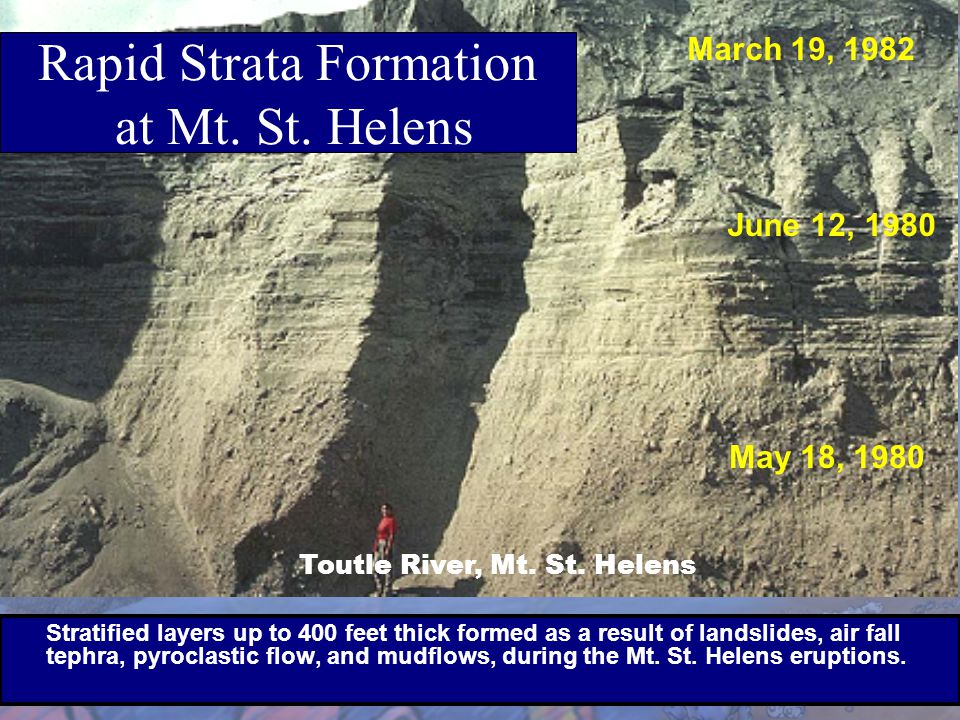
Rapid strata formation and rapid erosion at Mount St Helens.
slideplayer.com/slide/5703217/18/images/28/Rapid+Strata+F...
Visit the fossil museum:
www.flickr.com/photos/101536517@N06/sets/72157641367196613/
Just how good are peer reviews of scientific papers?
www.sciencemag.org/content/342/6154/60.full
www.examiner.com/article/want-to-publish-science-paper-ju...
The neo-Darwinian idea that the human genome consists entirely of an accumulation of billions of mutations is, quite obviously, completely bonkers. Nevertheless, it is compulsorily taught in schools and universities as 'science'.
I was in the area, checking up on the Heath Spotted Orchids, and the church was a five minute drive away, in the grounds of a former country house.
I park at the church and find it locked, as expected, but there were directions to a keyholder nearby, walking into the cobbled squares and converted estate buildings now executive housing.
I ring the bell: nothing
I ring again: nothing
I use the knocker: dog barks. Dog attacks the door.
There is angry voices. Or voice. There was the sound of the dog being put into a side room, and the struggle to close the door.
The front door opened: yes?
Can I have the church key, please?
Not sure if I still have it.
Why'd you want it?
To photograph the interior.
Who're with?
I'm with no one, I am photographing all parish churches in the county, and would like to do this one. I showed him my driving licence which should say under job title: obsessive and church crawler.
He seemed satisfied, and let me have the key.
Phew.
------------------------------------------------
Substantially rebuilt after a fire of 1598. The welcoming interior displays no chancel arch, although the doorways in the arcade show where the medieval rood screen ran the width of the church. The striking east window was designed by Wallace Wood in 1954. There is a good aumbry and piscina nearby. To the north of the chancel stands the excellent tomb chest of Sir John Tufton (d. 1624). The arcade into which it is built was lowered to allow a semi-circular alabaster ceiling to be inserted to set the composition off. Because it is completely free-standing it is one of the easiest tomb chests in Kent to study, with five sons kneeling on the south side and four daughters on the north . In addition there are complicated coats of arms and an inscription which records the rebuilding of the church by Tufton after the fire. On top of the chest lie Sir John and his wife, with their son Nicholas kneeling between their heads. Much of the monument is still covered with its original paint. The organ, which stands in the south aisle, may be the instrument on which Sir Arthur Sullivan composed 'The Lost Chord'. It originally stood in Hothfield Place where Sullivan was a frequent guest.
www.kentchurches.info/church.asp?p=Hothfield
--------------------------------------------
HOTHFIELD
IS the next parish northward from Great Chart, and is so called from the bothe, or heath within it. The greatest part of this parish lies within the hundred of Chart and Longbridge, and the remainder in that of Calehill. It is in the division of East Kent.
THE PARISH of Hothfield lies a little more than two miles from Ashford north-westward, the high road from which towards Lenham and Maidstone goes through it over Hothfield heath. It contains about 1250 acres, and fifty houses, the rents of it are about 1300l. per annum. It is not a pleasant, nor is it accounted a healthy situation, owing probably to the many low and watry lands in and about it. The river Stour, which rises at Lenham, runs along the southern side of the parish, which is watered likewise by several small streams, which rise about Charing and Westwell, from under the chalk hills, and join the Stour here. The heath, which contains near one half of the parish, consists mostly of a deep sand, and has much peat on it, which is continually dug by the poor for firing. On the east and west sides of the heath, the latter being called West-street, are two hamlets of houses, which form the scattered village of Hothfield. The Place-house stands on a hill, at a small distance from the corner of the heath southward, with some small plantations of trees about it, forming a principal object to the country round it. It is a square mansion, built of Portland stone, by the late earl of Thanet, on the scite of the antient mansion, close to the church; it has a good prospect round it. The adjoining grass grounds are extensive, and well laid out for the view over them; the water, which rises at no great distance from the house, becomes very soon a tolerable sized stream, and running on in sight of it, joins the Stour a little above Worting mill; these grass lands are fertile and good fatting land, like those mentioned before, near Godington, in Great Chart. The parsonage house, which is a neat dwelling of white stucco, stands at the southern corner of the heath, at the foot of the hill, adjoining the Place grounds, near West-street. Between the heath and Potter's corner, towards Ashford, the soil begins to approach much of the quarry stone.
Though the land in the parish is naturally poor, it is rendered productive by the chalk and lime procured from the down hills. The inhabitants have an unlimited right of commoning with those of the adjoining parish of Westwell, to upwards of five hundred acres of common, which affords them the means of keeping a cow and their poultry, which, with the liberty of digging peat, draws a number of certificated poor to reside here. There is not one dissenter in the parish.
Jack Cade, the noted rebel, in Henry the VI.th's reign, though generally supposed to be taken by Alexander Iden, esq. the sheriff, in a field belonging to Ripple manor, in the adjoining parish of Westwell, was discovered, as some say, in a field in this parish, still named from him, Jack Cade's field, now laid open with the rest of the grounds adjoining to Hothfieldplace.
The plant caryophyllata montena, or water avens, which is a very uncommon one, grows in a wood near Barber's hill, in this parish.
THE MANOR OF HOTHFIELD seems, in very early times, to have had the same owners as the barony of Chilham, and to have continued so, for a considerable length of time after the descendants of Fulbert de Dover were become extinct here. Bartholomew de Badlesmere, who in the 5th year of king Edward II. had a grant of this manor as well as of Chilham in see, appears to have held this manor of Hothfield by grand sergeantry of the archbishop, and accordingly, in the 8th year of it, at the enthroning of archbishop Walter Reynolds, he made his claim, and was allowed to perform the office of chamberlain for that day, and to serve up the water, for the archbishop to wash his hands; for which his fees were, the furniture of his bedchamber, and the bason and towel made use of for that purpose; (fn. 1) and in the next year he obtained of the king, a charter of free-warren for his demesne lands within this manor among others. After this the manor of Hothfield continued to be held by the like service, and continued in the same owners as that of Chilham, (fn. 2) down to Thomas lord Roos, who became entitled to the see of it, who for his attachment to the house of Lancaster, was, with others, attainted, in the 1st year of king Edward IV.'s reign, and his lands confiscated to the crown. But Margaret his mother, being possessed of it for her life, afterwards married Roger Wentworth, esq. whom she survived, and died possessed of it in the 18th year of that reign; upon which, by reason of the above attaint, the crown became entitled to it, the inquisition for which was found in the 4th year of that reign; immediately after which, the king granted it to Sir John Fogge, of Repton, who was comptroller of his household and one of his privy council, for his life. On king Richard III.'s accession to the crown, he took shelter in the abbey of Westminster, from whence he was invited by the king, who in the presence of a numerous assembly gave him his hand, and bid him be confident that from thenceforward he was sure to him in affection. This is rather mentioned, as divers chronicles have erroneously mentioned that he was an attorney, whom this prince had pardoned for forgery. He died possessed of it in the 17th year of Henry VII. where it remained till Henry VIII. granted it, at the very latter end of his reign, to John Tufton, esq. of Northiam, in Sussex, whose lands were disgavelled by the acts of 2 and 3 Edward VI. who afterwards resided at Hothfield, where he kept his shrievalty in the 3d year of queen Elizabeth. He was descended from ancestors who were originally written Toketon, and held lands in Rainham, in this county, as early as king John's reign; (fn. 3) one of whom was seated at Northiam, in Sussex, in king Richard the IId.'s reign, at which time they were written as at present, Tufton, and they continued there till John Tufton, esq. of Northiam, before-mentioned, removed hither. He died in 1567, and was buried in this church, leaving one son John Tufton, who resided at Hothfield-place, and in July, in the 16th year of queen Elizabeth, anno 1573, entertained the queen here, in her progress through this county. In the 17th year of that reign he was sheriff, and being a person of eminent repure and abilities, he was knighted by king James, in his 1st year, and created a baronet at the first institution of that order, on June 19, 1611. He married Olimpia, daughter and heir of Christopher Blower, esq. of Sileham, in Rainham, by whom he had three daughters; and secondly Christian, daughter and coheir of Sir Humphry Brown, a justice of the common pleas. He died in 1624, and was buried in this church, having had by her several sons and daughters. Of the former, Nicholas the eldest, succeeded him in title and estates. Sir Humphry was of Bobbing and the Mote, in Maidstone, and Sir William was of Vinters, in Boxley, both baronets, of whom further mention has already been made in the former parts of this history.
Sir Nicholas Tufton, the eldest son, was by letters patent, dated Nov. 1, anno 2 Charles I. created lord Tufton, baron of Tufton, in Sussex; and on August 5, in the 4th year of that reign, earl of the Isle of Thanet, in this county. He had four sons and nine daughters; of the former, John succeeded him in honors, and Cecil, was father of Sir Charles Tufton, of Twickenham, in Middlesex. John, the eldest son, second earl of Thanet, married in 1629 Margaret, eldest daughter and coheir of Richard, earl of Dorset, by his wife the lady Anne Clifford, sole daughter and heir of George, earl of Cumberland, and baroness of Clifford, Westmoreland, and Vescy, by which marriage these tithes descended afterwards to their issue. In the time of the commonwealth, after king Charles the 1st.'s death, he was, in 1654, appointed sheriff, and however inconsistent it might be to his rank, yet he served the office. He left six sons and six daughters, and was succeeded by Nicholas his eldest son, third earl of Thanet, who by the deaths of his mother in 1676, and of his cousin-german Alethea, then wife of Edward Hungerford, esq. who died s. p. in 1678, he became heir to her, and sole heir to his grandmother Anne, lady Clifford, and consequently to the baronies of Clifford, Westmoreland, and Vescy; dying s. p. he was succeeded as earl of Thanet and lord Clifford, &c. by his next brother John, who, on his mother's death, succeeded likewise by her will to her large estates in Yorkshire and Westmoreland, and to the hereditary in sheriffdoms of the latter and of Cumberland likewise, for it frequently happened in these hereditary sheriffdoms that female heirs became possessed of them, and consequently were sheriffs of those districts; but this was not at all an unusual thing, there being many frequent instances of women bearing that office, as may be seen in most of the books in which any mention is made of it, some instances of which the reader may see in the differtation on the office of sheriff, in vol. i. of this history. That part of their office which was incompatible for a woman to exercise, was always executed by a deputy, or shyre-clerk, in their name. But among the Harleian MSS. is a very remarkable note taken from Mr. Attorney-general Noys reading in Lincoln's inn, in 1632, in which, upon a point, whether the office of a justice of a forest might be executed by a woman; it was said, that Margaret, countess of Richmond, mother to king Henry VII. was a justice of peace; that the lady Bartlet, perhaps meant for Berkley, was also made a justice of the peace by queen Mary, in Gloucestershire; and that in Suffolk one ..... Rowse, a woman, did usually fit upon the bench at assizes and sessions among other justices, gladio cincta. John, earl of Thanet, died unmarried, as did his next brother earl Richard, so that the titles devolved to Thomas Tufton, who became the sixth earl of Thanet, and lord Clifford, which latter title was decreed to him by the house of peers in 1691. He left surviving issue five daughters and coheirs, the eldest of whom, Catherine, married Ed. Watson, viscount Sondes, son and heir of Lewis, earl of Rockingham; and the four others married likewise into noble families. He died at Hothfield in 1729, having by his will bequeathed several legacies to charitable purposes, especially towards the augmentation of small vicarages and curacies. He died without male issue, so that the titles of earl of Thanet and baron Tufton, and of baronet, descended to his nephew Sackville Tufton, eldest surviving son of his brother Sackville Tufton, fifth son of John, second earl of Thanet. But the title of baroness Clifford, which included those of Westmoreland and Vescy, upon the death of Thomas, earl of Thanet, without male issue, became in abeyance between his daughters and coheirs above-mentioned, and in 1734, king George II. confirmed that barony to Margaret, his third surviving daughter and coheir, married to Thomas Coke, lord Lovel, afterwards created earl of Leicester, which title is now again in abeyance by his death s. p. Which Sackville Tufton died in 1721, leaving Sackville the seventh earl of Thanet, whose eldest son of the same name succeeded him as eighth earl of Thanet, and rebuilt the present mansion of Hothfield-place, in which he afterwards resided, but being obliged to travel to Italy for his health, he died there at Nice in 1786, and was brought to England, and buried in the family vault at Rainham, in this county, where his several ancestors, earls of Thanet, with their countesses, and other branches of the family, lie deposited, from the time of their first accession to that title. He married Mary, daughter of lord John Philip Sackville, sister of the present duke of Dorset, by whom he had five sons and two daughters, Elizabeth; and Caroline married to Joseph Foster Barham, esq. Of the former, Sackville, born in 1769, succeeded him in honors; Charles died unmarried; John is M. P. for Appleby; Henry is M. P. for Rochester, and William. He was succeeded by his eldest son, the present right hon. Sackville Tufton, earl of Thanet, baron Tufton, lord of the honor of Skipton, in Craven, and baronet, and hereditary sheriff of the counties of Westmoreland and Cumberland, who is the present possessor of this manor and seat, and resides here, and is at present unmarried. (fn. 4)
The antient arms of Tufton were, Argent, on a pale, sable, an eagle displayed of the field; which coat they continued to bear till Nicholas Tufton, the first earl of Thanet, on his obtaining that earldom, altered it to that of Sable, an eagle displayed, ermine, within a bordure, argent; which coat was confirmed by Sir William Segar, garter, in 1628, and has been borne by his descendants to the present time. The present earl of Thanet bears for his coat of arms that last-mentioned; for his crest, On a wreath, a sea lion, seiant, proper; and for his supporters, Two eagles, their wings expanded, ermine.
SWINFORT, or Swinford, which is its more proper name, is a manor in this parish, lying in the southern part of it, near the river Stour, and probably took its name from some ford in former times over it here. However that be, it had formerly proprietors, who took their name from it; but they were never of any eminence, nor can I discover when they became extinct here; only that in king Henry V.'s reign it was in the possession of Bridges, descended from John atte Bregg, one of those eminent persons, whose effigies, kneeling and habited in armour, was painted in the window often mentioned before, in Great Chart church; and in this family the manor of Swinford continued till the latter end of king James I.'s reign, when it passed by sale from one of them to Sir Nicholas Tufton, afterwards created earl of Thanet, whose son John, earl of Thanet, before the 20th year of that reign, exchanged it for other lands, which lay more convenient to him, with his near neighbour Nicholas Toke, esq. of Godinton, in which family and name it has continued down, in like manner as that feat, to Nicholas Roundell Toke, esq. now of Godinton, the present possessor of it. A court baron is held for this manor.
FAUSLEY, or FOUSLEY, as it is now usually called, is the last manor to be described in this parish; its more antient name was Foughleslee, or, as it was usually pronounced, Faulesley; which name it gave to owners who in early times possessed and resided at it. John de Foughleslee, of Hothfield, was owner of it in the second year of king Richard II. and in his descendants this manor seems to have continued till about the beginning of queen Elizabeth's reign, when it passed by sale to Drury; from which name, at the latter end of it, this manor was conveyed to Paris, who immediately afterwards alienated it to Bull, who soon afterwards reconveyed it back again to the same family, whence, in the next reign of king James I. it was sold to Sir Nicholas Tufton, afterwards created earl of Thanet, in whose successors, earls of Thanet, it has continued down to the right hon. Sackville, earl of Thanet, the present owner of it.
Charities.
RICHARD PARIS, by deed in 1577, gave for the use of the poor, a rent charge of 16s. per annum, out of land called Hanvilles, in this parish; the trustees of which have been long ago deceased, and no new ones appointed since.
THOMAS KIPPS, gent. of Canterbury, by will in 1680, gave for the use of the same, an annual rent charge of 1l. out of lards in Great Chart.
RICHARD MADOCKE, clothier, of this parish, by will in 1596, ordered that the 11l. which he had lent to the parishioners of Hothfield, towards the rebuilding of their church, should, when repaid, be as a stock to the poor of this parish for ever.
SIR JOHN TUFTON, knight and baronet, and Nicholas his son, first earl of Thanet, by their wills in 1620 and in 1630, gave certain sums of money, with which were purchased eight acres of land in the parish of Kingsnoth, of the annual produce of 10l.
DR. JOHN GRANDORGE, by deed in 1713, gave a house and land in Newington, near Hythe, of the annual produce of 7l. which premises are vested in the earl of Thanet.
THOMAS, EARL OF THANET, and SACKVILLE TUFTON. Esq. grandfather of the present earl, by their deeds in 1720 and 1726, gave for a school mistress to teach 24 poor children, a rent charge and a house and two gardens, in Hothfield, the produce in money 20l. The premises were vested in Sir Penyston Lambe and Dr. John Grandorge, long since deceased; since which the trust has not been renewed; and the original writings are in the earl of Thanet's possession.
Such of the above benefactions as have been contributed by the Tufton family, have been ordered by their descendants to be distributed annually by the steward of Hothfield-place for the time being, without the interference of the parish officers, to such as received no relief from this parish; the family looking upon these rather as a private munisicence intended to continue under their direction.
The poor annually relieved are about twenty-five, casually as many.
HOTHFIELD is situated within the ECCLESIASTICAL JURISDICTION of the diocese of Canterbury, and deanry of Charing.
¶The church, which is small, is dedicated to St. Mary, and consists of three isles and a chancel, having a low spire steeple, covered with shingles at the west end, in which are five bells, and though it stands on a hill, is yet very damp. There is not any painted glass in the windows of it. On the north side in it, is a monument of curious workmanship, having the figures of a man and woman, in full proportion, lying at length on it; at three corners of it are those of two sons and one daughter, kneeling, weeping, all in white marble; round the edges is an inscription, for Sir John Tufton, knight and baronet, and Olympia his wife, daughter and heir of Christopher Blower, esq. On the monument are the arms of Tufton, with quarterings and impalements; on the sides are two inscriptions, one, that he re-edified this church after it was burnt, at his own charge, and under it made a vault for himself and his posterity, and after that he had lived eighty years, departed this life; the other enumerating his good qualities, and saying that by his will he gave perpetual legacies to this parish and that of Rainham. This monument is parted off from the north isle by a strong partition of wooden balustrades, seven feet high. The vault underneath is at most times several feet deep with water, and the few coffins which were remaining in it were some years since removed to the vaults at Rainham, where this family have been deposited ever since. On the north side of the chancel is a smaller one, formerly called St. Margaret's chapel, now shut up, and made no use of. In the south isle is a memorial for Rebecca, wife of William Henman, esq. obt. 1739, and Anna-Rebecca, their daughter, obt. 1752; arms, A lion, between three mascles, impaling a bend, cotized, engrailed. This church, which is a rectory, was always esteemed an appendage to the manor, and has passed accordingly, in like manner with it, down to the right hon. Sackville, earl of Thanet, lord of the manor of Hothfield, the present patron of it.
This rectory is valued in the king's books at 17l. 5s. and the yearly tenths at 1l. 14s. 6d.
There was a pension of ten shillings paid from it to the college of Wye. In 1588 here were communicants one hundred and ninety-three, and it was valued at eighty pounds. In 1640, communicants one hundred and ninety, and valued at only sixty pounds per annum. There is a modus of two pence an acre of the pasture lands in the parish. There are twelve acres of glebe. It is now worth about one hundred and twenty pounds per annum.
Richard Hall, of this parish, by will in 1524, ordered that his feoffees should enfeoffe certain honest persons in his house and garden here, set beside the pelery, to the intent that the yearly serme of them should go to the maintenance of the rode-light within the church.
This church was burnt down in the reign of king James I. and was rebuilt at the sole expence of Sir John Tufton, knight and baronet, who died in 1624. His descendant Thomas, earl of Thanet, who died in 1729, gave the present altar-piece, some of the pewing, and the pulpit.