View allAll Photos Tagged Absorption
Zircon spectra vary a lot - both the absorption and fluorescence lines. I have a few other examples that I have not examined in detail yet. The fluorescence lines here are from dysprosium and samarium at least. In these fluorescence spectra I have corrected for the yellow filter absorption down to 450nm. The purple (upper) and brown (lower) lines refer to the larger, round zircon.
Note that the sharp line at 808nm is the 404nm laser line in the second order of the grating diffraction. Also, I believe that the line at 695nm is a ghost or reflection due to the large amount of laser light entering the spectrometer during this observation.
These berry-looking nano particles are thermal evaporated tin dots. A specially designed process makes their shape and size suitable for ultraviolet light absorption. They will be used in a novel UV detector designed and fabricated at Thayer.
Submitted as part of the 2015 Visionaries in Technology student contest.
Image courtesy of PhD candidate Zhiyuan Wang (advisor: Professor Jifeng Liu.)
These 9 images are illustrations of the principal Fraunhofer absorption lines in the solar spectrum. The data were taken as part of a programme to study the effect on the solar spectrum of a transit of the Earth across the solar disk as seen from the Moon during a lunar eclipse: to be published by Fei Yan et al. (2015, in prep.)
The spectra were obtained using HARPS (High Accuracy Radial velocity Planet Searcher) on the ESO 3.6m telescope at La Silla in Chile on the night of the 15 April 2014. This is the equipment that has been used to find many of the known exoplanets that have been discovered by exploiting the 'wobble' induced in the parent star's radial velocity by an orbiting planet or planets. The spectrometer produces one sample of the spectrum each hundredth of an Ångstrom (a thousand samples per nm). See: www.eso.org/sci/facilities/lasilla/instruments/harps.html
for details.
The data plotted here are from just one of the 382 spectra obtained on that night by pointing the telescope at the Tycho crater on the Moon to look at the reflected light in the umbral and the penumbral shadow of the Earth and, for this spectrum, the fully illuminated Moon. It has been used to extract high resolution spectra of the principal Fraunhofer absorption lines from the telluric molecular oxygen B-band in the far-red to the L-line from atomic iron in the ultraviolet.
The Mg I b triplet is a strong absorption in the solar spectrum and can be seen clearly by eye with a small pocket spectroscope. This transition, from 3p 3P0 - 4s 3S, is not a resonance line like the Na I D and Ca II H & K lines. However, the lower level has no allowed transition to the ground state, 3s2 1S, and so it can build up to a significant level of occupation, allowing absorption to occur. There is an analogous triplet absorption in the ultraviolet, 3p 3P0 - 3d 3D, at at 3838.3, 3832.3 and 3829.4 which is also strong.
I tried inventing my own coconut-flour muffin recipe and failed. Catastrophically. Yes, I know coconut flour is not anything like wheat flour and has vastly different water absorption properties, but I wasn't prepared for the utter failure of structural integrity that awaited me when I inverted the big, deliciously plump looking muffins, fresh from the oven, onto the cooling rack. As soon as they left the protective cocoon of the muffin tin, these muffins just plain collapsed, revealing at their core not fluffy goodness but a heart of molten goo.
Thus trial 1 must go down in the record books as a failure. I have learned from the experience, however, and trial 2 may fare better...
This shows the same data as for the previous (Absorbance) plot using Transmission and Wavelength axes. In addition, it shows the red fluorescence (excited with a 404nm laser) of the Australian Xtal. (thin black line - the transmission is the light blue line).
Of the other sapphires in the plot, both the synth and the lp-br show some chromium fluorescence (the ruby R-lines). The Aus and the sbp do not visibly fluoresce at all under the laser.
The presence of chromium in blue sapphires is thought, possibly, to contribute to their colouration.
( Bruxellisation = terme utilisé par les urbanistes pour désigner le développement anarchique d’une ville ancienne livrée aux promoteurs ; phénomène sensible dans les années 1960 et 1970 à Bruxelles..)
-- Immeuble " Charlemagne", abritant la Commission Européenne --
Sonata Vario Acoustic Absorbers installed to the ceiling within Keighley Civic Centre
www.soundreduction.co.uk/Blog/Article/Arresting-Acoustics...
www.soundreduction.co.uk/Products/Sound-Absorption-Soluti...
Amsterdam
Mei 2012
The Netherlands
Urban life in the Netherlands
Ricoh GRD IV
Please do not reproduce or use this picture without my explicit permission.
If you ask nicely I will probably say yes, just ask me first!
If you happen to be in one of my frames and have any objections to this.
Please contact me!
Please no glossy awards, scripted comments and big thumbnails back to your own work.
I will remove them...
Jojoba Oil Similar structure with human’s sebum, excellent absorption, moisturizing, soften skin without stickiness *Sweet Almond Oil Ease itching, specially for dry skin, recovers tired skin to soften Lip balm and tint combined lip brush container. Delivers moist lips anytime. Menthol ingredient gives cool feelings and plumping effect.
More natural and vivid color as time goes on!
Más info en Español: cosmeticacoreana.blogspot.com.es/2012/03/tony-moly-backst...
True lovers are as shadows, and when the sun shines in glory the shadows vanish away. He is a true lover of God to whom God says, "I am thine, and thou art mine!"
- MEVLANA RUMI (r.a) -
In a survey of 1,000 parents, it found more than half of children under the age of 16 regularly use one. Some parents give their children handsets at a very young age. More than 13 per cent of parents with three-year-olds said their youngster had used a phone. Among three to six-year-olds, the figure was 23 per cent. By secondary school, about 94 per cent of children had their own phone.
Most parents place restrictions on how much their children spend on calls and texts. Three-quarters said they only allowed their youngsters pay-as-you-go phones to avoid them running up huge bills. But only 36 per cent of parents questioned said they stopped their children from accessing the internet on their mobile and just under a third barred them from calling premium rate numbers. But over two-thirds said they did nothing to stop their children downloading ringtones and screensavers that cost up to £3.50 each.
Sonata Vario acoustic absorbers installed within the hall at Aldwyn Primary School Hall in Audenshaw.
Entry in category 3. Locations and instruments; Copyright CC-BY-NC-ND: Philipp Heil
On the picture you can see a neutron absorption grating interferometer installed at a cold neutron beamline at the Paul Scherrer Institute in Villigen. It is designed to measure an upper limit of the charge of the neutron. Single photos merged to a panoramic picture. After several attempts this picture shows the aligned arrangement ready to measure small beam deflections. With this device research beyond standard model physics will be probed. It is not understood yet if the electric charge is quantizized or not. It is not understood why electric charges should be an integral number of some smallest fraction and therefore cannot be explained within the standard model.
David Oyediran is looking at microwave absorption properties of nanomaterials in the Advanced Sensors Development Laboratory.
- MERINO sheepskin lining offers all of the advantages of wool over synthetic fibers, providing efficient shock absorption and superior thermal comfort. Sheepskin contains lanolin, a natural substance, which soothes the horse's sensitive or inflamed skin. When sheepskin is set directly against the animal's body, it stimulates blood circulation and promotes a therapeutic effect.
- The Non-Slip mesh upper assures perfect grip and steadily secures the MerinoLUX Half-Pad under the saddle.
- Breathable 3-Dimensional Spacer fabric reduces heat build-up and provides excellent moisture vapor transfer.
- The black non-slip mesh is not visible under the saddle, conforming to the FEI rules and regulations.
- Optimum thickness of the MerinoLUX Half-Pad does not compromise the fit of the saddle.
The ultra Soft Gel Purple TPU gloss finish abridges your Apple iPhone 5's subtle contours, giving you the sleek look of a hard case and the shock absorption of a soft case. Slip your device into this slim-fitting Soft Gel TPU Skin Case and instantly give your cherished phone a fashion makeover, delivering head-turning glitz & glamour appeal.
Features:
100% Premium Soft Gel TPU Gloss Skin Case exclusively for your iPhone 5.
Precise cutouts for screen, joystick, audio port, speakers, power and charging port.
Special anti-dust and scratch-free properties, preserves your iPhone 5 shining look.
Safeguard and protect your iPhone 5 from bumps, dust and scratches.
Helps to prevent your iPhone 5 from sliding on soft surfaces or angle surfaces.
Installation and removal are very easy.
Available in different colors to match your personality and thought.
Specifications:
Material: Premium silicone material.
Type: Soft Gel TPU Gloss Skin Case.
Manufacturer: Amzer.
Part No.: AMZ94515.
Color: Purple.
Visit www.fommy.com/view-full-page.php?skuno=94515 for more details.
Apple announced iPhone 5 on 12 September 2012. It is good to know in the smart phone market. It is having lots of new features. People will crazy about it. Here is the help to select perfect iPhone 5 Accessories for iPhone 5. Hope it will helpful for everyone to make a perfect selection of iPhone 5 Accessories.
Visit www.fommy.com/iphone-5.htm for iPhone 5 accessories.
SRS supplied 35no 1200x1200 Sonata Vario panels in total to Auchterderran St Fothads Church Hall to reduce reverberation. The panels were supplied in 'White' and 'Stone' fabric to match the existing décor within the hall.
For details on SRS Sonata products see our website here: www.soundreduction.co.uk/Products/Sound-Absorption-Soluti...
Sonata Vario and Memo acoustic absorbers used within the hall at Brownhill School, Leeds
Full case study here: www.soundreduction.co.uk/Blog/Article/Acoustic-Treatment-...
A crane operator moves an "Versabar" lift apparatus during the unloading of an absorption tower off of the ship Thorco Clairvaux at the France Road Wharf in New Orleans on Saturday, May 17, 2014. (Photo by Peter G. Forest)
Jojoba Oil Similar structure with human’s sebum, excellent absorption, moisturizing, soften skin without stickiness *Sweet Almond Oil Ease itching, specially for dry skin, recovers tired skin to soften Lip balm and tint combined lip brush container. Delivers moist lips anytime. Menthol ingredient gives cool feelings and plumping effect.
More natural and vivid color as time goes on!
Más info en Español: cosmeticacoreana.blogspot.com.es/2012/03/tony-moly-backst...
Wetlands are biodiversity rich sensitive ecosystems that harbor hundreds of plants, insects, birds and other animals uniquely adapted to their wetland mode of life.They are crucial to maintain the regional water balance through ground water recharge and absorption of flood waters and also serve as the rice bowl of developing countries. Nevertheless, wetlands play immense role in the socio-economic and livelihood aspects of local communities living around the wetland. In India, rural communities depend wetland for livelihood through farming, mat making etc; for food through fishing and hunting; for roof thatching by collection of reeds and palm leaf ; for firewood; for fodder etc. However, these wetlands are now under a threat of conversion for big industrial and real estate projects, change in lifestyle of local community, over extraction of resources by increased population, pollution,waste dumping, eutrophication and pesticide farming. There are three important wetlands in the Puducherry region namely Oussudu, Bahour and Kaliveli that provide important resources for local communities and also are a home to tens of thousands of migratory birds that visit the Puducherry region in winter. These wetlands have been acknowledged as Important Bird Areas(IBAs) by IBCN, since many of these birds are represented in more than 1% of their global population.
The recent threat on wetlands of Puducherry is more due to the change in life style of local community living around these wetlands. The younger generation is not much dependent on wetland resources, The younger and modern generation has lost the compassion and bonding to the wetland which their forefathers maintained through sustainable livelihood practices. This has resulted in a change in attitude and perception of the community towards unsustainable farming and resource extraction, game hunting, intensive fishing and reclamation, ultimately resulting in shrinking of wetland area and loss of biodiversity at an alarming pace. Local community is leaving the traditional farming practices for more fertilizer and pesticide based farming; fish stock is depleted using invasive Gill nets. Since Puducherry is fast developing region with rapidly growing commercial tourism and industrial establishments, these wetlands are under the threat of reclamation for resort construction and other commercial establishments. Poaching for a sport as well as open selling of birds including the threatened species is common. School drop-out are noticed to get attracted to such practices to make easy money as well as hunting for a sport with peers. With time, they may grow into expert hunters who will depend on poaching as the main source of income for the family. There are many wetland awareness programs organized by Forest Department as well as NGOs targeting school kids and educated community through workshops. School drop-outs are often not specially targeted by any of such programs and often not brought under the ambit of such programs. This gap needs to be addressed for local conservation efforts to be fully effective. We have chosen birds as the umbrella species whose conservation will in turn protect the lake and biodiversity as a whole. Birds are attractive and beautiful; ,which may easily get compassion from drop-out kids if guided appropriately. With proper efforts, the poachers can be turned to protectors and expert tour guides to facilitate ecotourism.
A map of Eastern Europe showing CO2 absorbed and emitted in Belarus, Ukraine and Moldova. / Карта Восточной Европы, отображающая выбросы и поглощение углекислого газа в Беларуси, Украине и Молдове.
English version here.
Sonata Vario Acoustic Absorbers installed to the ceiling within Keighley Civic Centre
www.soundreduction.co.uk/Blog/Article/Arresting-Acoustics...
www.soundreduction.co.uk/Products/Sound-Absorption-Soluti...
- MERINO sheepskin lining offers all of the advantages of wool over synthetic fibers, providing efficient shock absorption and superior thermal comfort. Sheepskin contains lanolin, a natural substance, which soothes the horse's sensitive or inflamed skin. When sheepskin is set directly against the animal's body, it stimulates blood circulation and promotes a therapeutic effect.
- "Open-channel" design alleviates excessive pressure from the horse's spine and promotes increased air circulation.
- Two large pockets are designed specifically to ensure proper fit of the saddle and comfort for the horse by accommodating both specialized and custom-made shims.
- High Resiliency open-cell foam shims (included in the package) allow for the overall weight to be redistributed over a larger area, thus minimizing pressure points.
- Breathable 3-Dimensional Spacer fabric reduces heat build-up and provides excellent moisture vapor transfer.
- The Non-Slip mesh upper assures perfect grip and steadily secures the ComfortLUX Half-Pad under the saddle.
1/ Yam contains amylase, polyphenol oxidase substances conducive to digestion and absorption of the spleen and stomach function is to blindly flat stomach medicine complement the dual-use goods, food. Whether Pi Yang Yin deficiency, or stomach may apply to food. Commonly used clinical governance weak stomach, eat less body fatigue, diarrhea and other diseases.
2/ Yam contains a lot of mucus proteins, vitamins and trace elements, can effectively prevent lipid deposition in blood vessel walls, preventing disease, efforts to obtain Masushi soothe the nerves, the effect of prolonging life;
the role of lowering blood sugar can be used to treat diabetes, is diabetic diet Jiapin.
1/ 山药含有淀粉酶、多酚氧化酶等物质,有利于脾胃消化吸收功能,是一味平补脾胃的药食两用之品。不论脾阳亏或胃阴虚,皆可食用。临床上常用治脾胃虚弱、食少体倦、泄泻等病症;
2/ 山药含有大量的黏液蛋白、维生素及微量元素,能有效阻止血脂在血管壁的沉淀,预防心血疾病,取得益志安神、延年益寿的功效;有降低血糖的作用,可用于治疗糖尿病,是糖尿病人的食疗佳品。
left to right
Urine Collection and Transfer Assembly
Skylab 3
This device was carried in the Skylab 3 command module in 1973. It was assigned to Alan Bean but was not used. Liquid waste (urine) was collected in such a unit, which was worn by an astronaut and had roll-on cuffs to provide personal sanitary protection. The urine was transferred through a tube to a tank, then vented into space.
Fecal Collection Bag
Skylab
Porous bags like this were installed in the Skylab toilet to capture solid waste, which was then dried, stored, and returned to Earth for analysis of the astronauts’ digestion and metabolism.
Fecal Collection Assembly
Apollo
These two bags make up the Fecal collection assembly, part of the personal hygiene system used by Apollo astronauts. These bags were not flown. This self-contained system gave the astronaut flexibility and control in a weightless environment and allowed for simple and hygienic disposal.
Disposable Absorption Trunk
Space Shuttle
This type undergarment was developed for female astronauts on early Shuttle flights to wear during launch and spacewalks. Male astronauts could wear a urine collection hose and bag assembly. Now, most astronauts, male and female, choose to use ordinary, commercially available disposable undergarments when wearing pressure suits.
Couldn't decide if I liked this treatment or the bluer version, so I decided to upload them both. :)
©2010 Tanya Harrison, all rights reserved. Do not reproduce or re-distribute without permission.
Transmission spectrum measured along the axis of the boule (80mm long) using a JAZ for the visible/nir and a USB4000 (higher spectral resolution) spectrometer for the blue/uv part. These two spectra are joined at 480nm. For the UV observation, a Schott BG38 filter was used after the sample to reduce the amount of red light entering the spectrometer to lessen the straylight contribution in the UV spectrum. The higher transmission region in the blue and the absorption line triplet has been enlarged on the plot.
The transitions causing the broad and narrow absorption bands/lines are marked.
Dock workers unhook a "Versabar" lift apparatus during the unloading of an absorption tower off of the ship Thorco Clairvaux at the France Street Wharf in New Orleans on Saturday, May 17, 2014. (Photo by Peter G. Forest)
Anhydrite is a mineral—anhydrous calcium sulfate, CaSO4. Distinctly developed crystals are somewhat rare, the mineral usually presenting the form of cleavage masses. The hardness is 3.5 and the specific gravity 2.9. The color is white, sometimes greyish, bluish, or purple. When exposed to water, anhydrite readily transforms to the more commonly occurring gypsum, (CaSO4·2H2O) by the absorption of water. This transformation is reversible, with gypsum or calcium sulfate hemihydrate forming anhydrite by heating to ~200°C under normal atmospheric conditions. Anhydrite is commonly associated with calcite and halite.
www.researchgate.net/publication/259338144_Proposal_for_A...
The anhydritic horizon is a horizon in which anhydrite has accumulated through neoformation or transformation to a significant extent. It typically occurs as a subsurface horizon. It commonly occurs in conjunction with a salic horizon.
Identification of anhydrite (75-135 cm) is important when determining soil strength. Soils high in anhydrite exhibit fluidity and lack soil strength and load bearing capacity. Moisture content strongly influences soil’s consistence and a water table is commonly within the soil profile. The manner in which specimens of soil fail under increasing force ranges widely and usually is highly dependent on water state. To test for fluidity, a handful of soil material is squeezed in the hand. For moderately fluid materials after exerting full pressure, most flows through the fingers; a small residue remains in the palm of the hand.
For example, if some of the soil flows between the fingers with difficulty, the nvalue is between 0.7 and less than 1.0 (slightly fluid manner of failure class); if the soil flows easily between the fingers, the nvalue is 1 or more (moderately fluid or very fluid manner of failure class) depending on what remains in the palm of the hand.
For more information about describing and sampling soils, visit:
www.nrcs.usda.gov/resources/guides-and-instructions/field...
or Chapter 3 of the Soil Survey manual:
www.nrcs.usda.gov/sites/default/files/2022-09/The-Soil-Su...
For additional information on "How to Use the Field Book for Describing and Sampling Soils" (video reference), visit:
www.youtube.com/watch?v=e_hQaXV7MpM
For additional information about soil classification using USDA-NRCS Soil Taxonomy, visit:
www.nrcs.usda.gov/resources/guides-and-instructions/keys-...
or;
www.nrcs.usda.gov/resources/guides-and-instructions/soil-...
For more information about soil classification in the UAE, visit:
vdocument.in/united-arab-emirates-keys-to-soil-taxonomy.h...
Sonata Vario acoustic absorbers installed within the hall at Aldwyn Primary School Hall in Audenshaw.
Close up of Sonata Memo acoustic noticeboards. More details on the SRS website here: www.soundreduction.co.uk/Products/Sound-Absorption-Soluti...
Full case study here: www.soundreduction.co.uk/Blog/Article/Acoustic-Treatment-...
Note from 11 May 2017: I realise now that the small triangular yellow stone referred to here as a topaz is actually a chrysoberyl ( Be Al2 O4). This has been confirmed with a measurement of the refractive indices as 1.73, 1.74.
The chemical formula of topaz is Al2 SiO4 (F,OH)2, the principal variation between samples being in the ratio of fluorine to hydroxyl.
The spectra shown here are from the yellow and the smaller of the blue samples which have pathlengths of about 2 and 5mm respectively.
The yellow topaz contains chromium as Cr3+ and I have studied both the fluorescence and the transmission of this before.
The broad absorption band in the blue stones, centred at 620nm and largely responsible for the colour, is thought to be a combination of Cr3+, Fe2+ and Mn2+ impurities along with a colour centre: an R-centre (two F-vacancies with two trapped electrons).
The narrow absorption at 1400nm is from the OH in the crystal: the second harmonic of the fundamental stretch mode at 3650cm-1. A weak absorption at 961nm in the spectrum of the larger stone (shown in the next post) is the third harmonic of OH.
The strong absorption at 2080nm ~ 4800cm-1 is thought to be a combination of the OH stretching (3650cm-1) and the Al-OH bending modes (1163cm-1). See: iopscience.iop.org/1757-899X/49/1/012051/pdf/1757-899X_49... (IOP Conf. Series: Materials Science and Engineering 49 (2013) 012051)
David Oyediran is looking at microwave absorption properties of nanomaterials in the Advanced Sensors Development Laboratory.
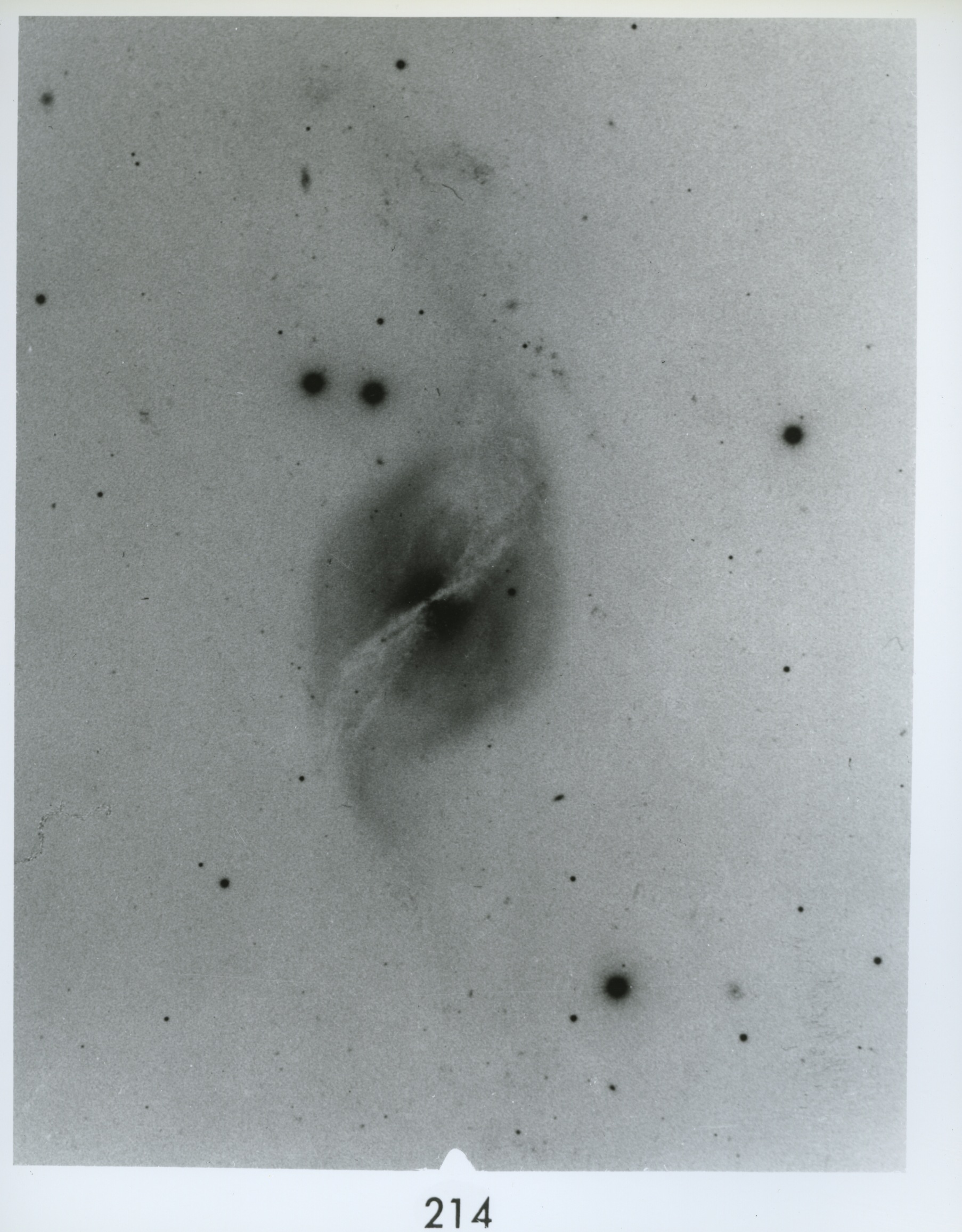
NGC 3718 (PGC 35616 = Arp 214)
Discovered (Apr 12, 1789) by William Herschel
An 11th-magnitude spiral galaxy (type SBa? pec) in Ursa Major (RA 11 32 34.7, Dec +53 04 02) Gravitationally interacting with NGC 3729. Apparent size 8.1 by 4.0 arcmin? Used by the Arp Atlas as an example of a galaxy with irregularities, absorption, and resolution.
"Excerpt courtesy of Courtney Seligman"
cseligman.com/text/atlas/ngc37.htm#3718
Image... Cherryvalley Observatory (I83). Telescope: 0.2-m SCT & SBIG STL-1301E CCD Camera @f7.6. Image Scale 2.17 arcsec/pixel, Field of View 46 x 37 arcmins.
Flat field and dark subtract calibration frames. Combined Stack of four images of 220 seconds each unfiltered and unbinned. CCD operating temperature: -42 degrees. Image acquisition and processing: CCD Soft v5, TheSky6 Professional and Mira Pro v7. December 27th 2014.
Dr. Halton Arp originally compiled the Atlas of peculiar galaxies with photographs he made mainly using the Palomar 200-inch telescope and the 48-inch Schmidt telescope between the years 1961 to 1966. Original image can be found here: ned.ipac.caltech.edu/level5/Arp/Figures/big_arp214.jpeg
Discoloration caused by absorption of mercuric chloride solution in green Douglas-fir, 12 inches above saw cut. Tree medication studies. Jewell, Oregon.
Photo by: J. Whiteside
Date: January 19, 1934
Credit: USDA Forest Service, Pacific Northwest Region, State and Private Forestry, Forest Health Protection.
Collection: Bureau of Entomology Collection; La Grande, Oregon.
Image: BUR-8850
To learn more about this photo collection see:
Wickman, B.E., Torgersen, T.R. and Furniss, M.M. 2002. Photographic images and history of forest insect investigations on the Pacific Slope, 1903-1953. Part 2. Oregon and Washington. American Entomologist, 48(3), p. 178-185.
For additional historical forest entomology photos, stories, and resources see the Western Forest Insect Work Conference site: wfiwc.org/content/history-and-resources
Image provided by USDA Forest Service, Pacific Northwest Region, State and Private Forestry, Forest Health Protection: www.fs.usda.gov/main/r6/forest-grasslandhealth
Function: secretion, absorption
Location: surfaces of ovaries, linings of kidney tubules, and linings of ducts of certain glands
Epithelial Tissue
Sonata Vario and Memo acoustic absorbers installed within the foyer of the Oriental Institute building at Oxford University. Many thanks to Phil Rust at the Oxford University Estates Directorate for his help with this project
Here's the How-to:
1) Prewash your fabric to remove any manufacturers' finishes that might prevent proper dye absorption. You're gonna want to iron it after for a nice smooth surface to work on.
2) Very lightly sketch out a basic composition. I used a light pencil mark that could be washed out. Vanishing fabric markers would be ideal for this purpose.
3) Fill the metal-tipped applicator bottle with Batik EZ resist and start drawing. Let dry fully. You can use a hair dryer if you're in a hurry.
4) Grab your rubber gloves and cover your work surface with plastic.
5) Place fabric on sheets of plastic wrap that has been overlapped so plastic is slightly larger than fabric.
6) Shake Rit Black liquid dye and measure out 1 Tbsp into 1 Cup of very hot 140° water and mix. Paint dye evenly across the fabric panel letting it soak well into the fabric.
Note: I was creating a grey tone with the black dye so I used a weaker dye recipe. If I was going for a pure black color, I would have doubled the amount of dye.
7) Place a layer of plastic wrap over top and seal the edges.
8) Cover bottom of microwave with paper towels. Place plastic-wrapped fabric in microwave. Set on High for 2 minutes. Wearing rubber gloves, remove from microwave. Cut open plastic wrap. Allow fabric and wrap to cool.
9) Rinse under cool running water until water runs clear. Wash in warm water with mild detergent, rinse and dry.
Sonata Vario Class A acoustic absorbers installed within the reception area at Norwood Primary School
Further details on Sonata Vario can be found here: www.soundreduction.co.uk/Products/Sound-Absorption-Soluti...
LEVELS OF ABSORPTION, 2004 by LAURA MAYOTTE
36”w x 20 1/2”h x 16”d
Handmade flax paper, handspun and dyed linen yarn, indigo dye.
Artist’s Statement
Levels of Absorption holds many meanings for me. Literal meanings, such as the actual absorption of the indigo dye on the pages and watermarks, and abstract meanings, such as (being a book form) how much knowledge we absorb over a lifetime, the fact that we never make use of our entire brain, that there is always room for more knowledge, learning and growth, and that also the tree-like shape adds to this idea of growth over time. All the sewing reflects the pathways of the brain and how we think; how everything is connected, how odd things can remind us of seemingly unrelated things, but they are all there and accessible. This sewing is also rather electricity-like in appearance, and metaphorically, referring to how fast our thoughts can be, our natural reflexes or responses to stimuli, and how knowledge gained over time can be instantly accessed once learned.