View allAll Photos Tagged rust
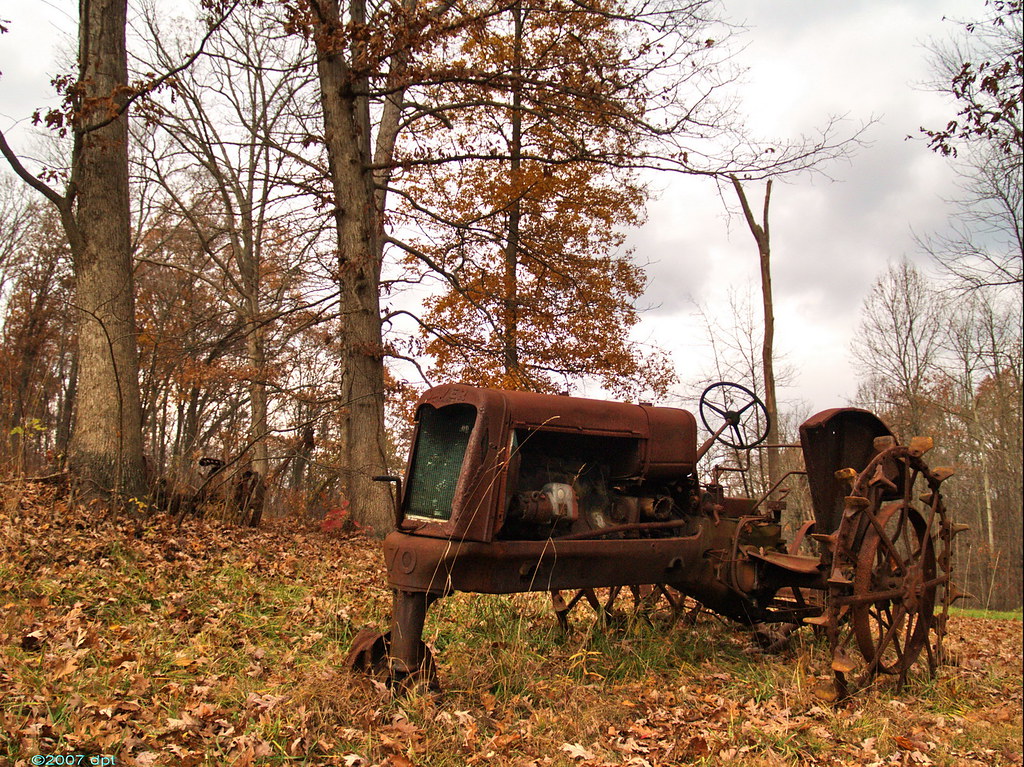
This farm implement was last licensed in 1945 but it surely is a clue as to why our US infrastructure, roads and bridges are being destroyed; well, that and the righties. I am using a McIntosh Ag Museum shot to finish a greenish series by adding rust and weeds. This certainly is a fitting title for this image. This machinery is for the ages, the iron ages! This is some kind of weird plowing implement, it must be an older iron implement and possibly horse-drawn but probably not in 1945. I see some rust on it. It had to be iron heavy in order to be able to "bite" into the soil. I ought to go again and figure out the exact function but I am close.
This June found a return to hot temperatures. Wundermaps reported 101 degrees while I was out there. Whew! The direct sun blazed across the scene. I decided that I had missed some shots at McIntosh and went out in the baking sun.
Highway #66 seemed overloaded with early summer travelers to the hills, probably not knowing summer might not arrive until July in the Rockies. They are still dumped a lot of snow into the rivers yet there are plenty of folks willing to jump in a drown.
This is part of what it looks like a steam boiler. It must have been use as portable mechanical power used in logging back in the day.
Ah yes,
The debate,
What is art?
Wabi sabi says,
Rust is art.
Whether cubist,
Or impressionist,
Who's to say,
This is not art?
I like it.
Observed in the mountains of Colorado. The American Coleman was apparently a line of trucks built from the 1950s into the 1970s. The company was based in Littleton, Colorado.
Image - Copyright 2020 Alan Vernon
The rusty chain the surrounds the Arc de Triomphe protecting the pedestrians from the traffic. Paris, France
Detail on one of the locomotives once used to haul crushed copper ore from the rockhouse (where the ore was crushed) to the smelters. Part of a large US National Park Service historic site in Hancock Michigan and also in Calumet fifteen miles to the north.
Quincy Mine, Keweenaw Peninsula, Houghton County, MI
Carrie Furnace - abandoned ironworks, detail
National Historic Landmark
Carrie Furnace is a former blast furnace located along the Monongahela River in the Pittsburgh area industrial town of Rankin, Pennsylvania. It had formed a part of the Homestead Steel Works. The Carrie Furnaces were built in the 1880s and they operated until 1982.
During its peak, the site produced 1000 to 1250 tons of iron per day. All that is left of the site are furnaces #6 and #7, which operated from 1907 - 1978.
Carrie Furnace was built in 1881. In 1898 it was purchased by Andrew Carnegie and incorporated into U.S. Steel in 1901. It was shut down in 1978. In 2005 it was purchased by Allegheny County. In 2006 the two remaining furnaces were designated as a National Historic Landmark.
Another photo taken for the local camera club's monthly competition subject "Rust and Decay" - This one took 2nd place!
This photo was taken in a old part of the Verkadefabriek, a cultural centre in Den Bosch. Where there are theatre, cinema and restaurants. In the past it was a cookiefactory! A beautiful place where the old and new come together.
Rust never sleeps, this wire cage I thought made for a great repetition shot that if you look closely you can see the rust flake and come closer to claiming another inanimate victim.
This was the highlight and reason for my Southern Arizona Adventure 2024. This is stage 8 of 9.
I was lucky to secure permits for the once monthly photography tour of Kartchner Caverns. Kartchner Caverns State Park strictly forbids any cameras or cellphones in the Caverns. Except for one trip per month for 12 to 15 photographers currently $125. I planned a 4 day 3 night road trip around Southern Arizona anchored by my Kartchner Cavern permit.
I was expecting dark conditions. The State Park turned on all the lights in the Big Room. They don't like turning on all the lights since can cause an increase in algae. This is the reason they only have one photography tour a month.
I found myself adjusting my histograms to not clip the highlights. Adapt, Improvise, and Overcome. Next time I am going to bracket my shots. I almost wish I had brought a ND filter or tried a handheld GND filter.
I don't know speleothems so I won't even try to identify. If anyone can help me with the identification, I will appreciate it.
www.nps.gov/subjects/caves/speleothems.htm#:~:text=The%20...)%20when%20needed.
The features that arouse the greatest curiosity for most cave visitors are speleothems. These stone formations exhibit bizarre patterns and other-worldly forms, which give some caves a wonderland appearance. Caves vary widely in their displays of speleothems because of differences in temperature; overall wetness; and jointing, impurities, and structures in the rocks. In general, however, one thing caves do have in common is where speleothems form. Although the formation of caves typically takes place below the water table in the zone of saturation, the deposition of speleothems is not possible until caves are above the water table in the zone of aeration. As soon as the chamber is filled with air, the stage is set for the decoration phase of cave building to begin.
The term speleothem refers to the mode of occurrence of a mineral—i.e., its morphology or how it looks—in a cave, not its composition (Hill, 1997). For example, calcite, the most common cave mineral, is not a speleothem, but a calcite stalactite is a speleothem. A stalactite may be made of other minerals, such as halite or gypsum.
Classifying speleothems is tricky because no two speleothems are exactly alike. Nevertheless, speleologists have taken three basic approaches: classification by morphology, classification by origin, and classification by crystallography. All three of these approaches have their problems (Hill, 1997), so cavers often take a more practical approach that primarily uses morphology (e.g., cave pearls) but includes whatever is known about origin (e.g., geysermites) and crystallography (e.g., spar) when needed.
nocache.azcentral.com/travel/arizona/southern/articles/20...
The Kartchner Caverns, rated one of the world's 10 most beautiful caves, is an eerie wonderland of stalactites and stalagmites still growing beneath the Whetstone Mountains 40 miles southeast of Tucson.
The limestone cave has 13,000 feet of passages and hundreds of formations built over the past 200,000 years, including some that are unique and world-renowned. It's a "living cave," with intricate formations that continue to grow as water seeps, drips and flows from the walls and slowly deposits the mineral calcium carbonate.
The caverns were discovered by amateur spelunkers Randy Tufts and Gary Tenen in 1974 on land owned by the Kartchner family. They kept the cave a secret until 1988, when the Kartchners sold it to the state to become a state park.
The highlights of the Big Room tour are a stretch of strawberry flowstone, which has been colored red by iron oxide (rust) in the water, and a maternity ward for 1,800 female cave myotis bats, with black grime on the ceiling where the bats hang and piles of guano on the floor. Visitors who look closely will see a bat's body embedded in one of the cave's formations.
Though not all are available on the tours, the caverns' unique features include a 21-foot, 2-inch soda straw that's one the world's largest (Throne Room), the world's most extensive formation of brushite moonmilk (Big Room), the first reported occurrence of "turnip" shields (Big Room), the first cave occurrence of "birdsnest" needle quartz formations (Big Room) and the remains of a Shasta ground sloth from the Pleistocene Age (Big Room).
en.wikipedia.org/wiki/Kartchner_Caverns_State_Park
Kartchner Caverns State Park is a state park of Arizona, United States, featuring a show cave with 2.4 miles (3.9 km) of passages.[1] The park is located 9 miles (14 km) south of the town of Benson and west of the north-flowing San Pedro River. Long hidden from view, the caverns were discovered in 1974 by local cavers, assisted by state biologist Erick Campbell who helped in its preservation.
The park encompasses most of a down-dropped block of Palaeozoic rocks on the east flank of the Whetstone Mountains.
The caverns are carved out of limestone and filled with spectacular speleothems which have been growing for 50,000 years or longer, and are still growing. Careful and technical cave state park development and maintenance, initially established by founder Dr. Bruce Randall "Randy" Tufts, geologist, were designed to protect and preserve the cave system throughout the park's development, and for perpetuity.[3]
The two major features of the caverns accessible to the public are the Throne Room and the Big Room. The Throne Room contains one of the world's longest (21 ft 2 in (6.45 m))[5] soda straw stalactites and a 58-foot (18 m) high column called Kubla Khan, after the poem. The Big Room contains the world's most extensive formation of brushite moonmilk. Big Room cave tours are closed during the summer for several months (April 15 to October 15) each year because it is a nursery roost for cave bats, however the Throne Room tours remain open year-round.[8]
Other features publicly accessible within the caverns include Mud Flats, Rotunda Room, Strawberry Room, and Cul-de-sac Passage. Approximately 60% of the cave system is not open to the public.[9]
Many different cave formations can be found within the caves and the surrounding park. These include cave bacon, helictites, soda straws, stalactites, stalagmites and others.[12] Cave formations like the stalactites and stalagmites grow approximately a 16th of an inch every 100 years.[13]
Haiku thoughts:
Beneath earth's cool veil,
Stalactites in silence grow,
Whispers of stone deep.
Kartchner
Southern Arizona Adventure 2024