View allAll Photos Tagged render
Exported with Mineways, rendered with Blender. Now I need to learn how to make the windows transparent. :)
+++ DISCLAIMER +++
Nothing you see here is real, even though the conversion or the presented background story might be based historical facts. BEWARE!
Some background:
In the grand scope of World War 2 fighter aircraft there is a little-remembered French design designated the Arsenal "VG-33". The aircraft was born from a rather lengthy line of prototype developments put forth by the company in the years leading up to World War 2 and the VG-33 and its derivatives represented the culmination of this work before the German invasion rendered all further work moot.
The Arsenal de l'Aeronautique company was formed by the French government in 1936 ahead of World War 2. It began operations with dedicated design and development of a fast fighter type until the German conquer of France in 1940 after which the company then focused on engine production after 1945. Then followed a period of design and construction of gliders and missiles before being privatized in 1952 (as SFECMAS). The company then fell under the SNCAN brand label and became "Nord Aviation" in 1955.
The VG-33 was the result of the company's research. Work on a new fast fighter began by Arsenal engineers in 1936 and the line began with the original VG-30 prototype achieving first flight on October 1st, 1938. Named for engineer Vernisse (V) and designer Jean Gaultier (G), the VG-30 showcased a sound design with good performance and speed during the tests, certainly suitable for progression as a military fighter and with future potential.
Development continued into what became the VG-31 which incorporated smaller wings. The VG-32 then followed which returned to the full-sized wings and installed the American Allison V-1710-C15 inline supercharged engine of 1,054 horsepower. The VG-32 then formed the basis of the VG-33 which reverted to a Hispano-Suiza 12Y-31 engine and first flight was in early 1939, months ahead of the German invasion of Poland. Flight testing then spanned into August and serial production of this model was ordered.
The VG-33 was one of the more impressive prewar fighter ventures by the French that included the Dewoitine D.520, understood to be on par with the lead German fighter aircraft of the period - the famous Messerschmitt Bf 109.
Only about forty or so French Arsenal VG-33 fighters were completed before the Fall of France in 1940, with 160 more on order and in different states of completion. Despite the production contract, Arsenal' engineers continued work on the basic design for improved and specialized sub-types. The VG-34 appeared in early 1940 outfitted with the Hispano-Suiza 12Y-45 engine of 935 horsepower, which improved performance at altitude. An uprated engine was installed in VG-35 and VG-36, too. They utilized a Hispano-Suiza 12Y-51 engine of 1,000 horsepower with a revised undercarriage and radiator system.
VG-37 was a long-range version that was not furthered beyond the drawing board, but the VG-38 with a Hispano-Suiza 12Y-77 engine that featured two exhaust turbochargers for improved performance at high altitude, achived pre-production status with a series of about 10 aircraft. These were transferred to GC 1/3 for field trials in early 1940 and actively used in the defence against the German invasion.
The VG-39 ended the line as the last viable prototype model with its drive emerging from a Hispano-Suiza 12Z engine of 1,280 horsepower. A new three-machine-gun wing was installed for a formidable six-gun armament array. This model was also ordered into production as the VG-39bis and was to carry a 1,600 horsepower Hispano-Suiza 12Z-17 engine into service. However, the German invasion eliminated any further progress, and eventually any work on the Arsenal VG fighter family was abandoned, even though more designs were planned, e .g. the VG-40, which mounted a Rolls-Royce Merlin III, and the VG-50, featuring the newer Allison V-1710-39. Neither was built.
Anyway, the finalized VG-38 was an all-modern looking fighter design with elegant lines and a streamlined appearance. Its power came from an inline engine fitted to the front of the fuselage and headed by a large propeller spinner at the center of a three-bladed unit. The cockpit was held over midships with the fuselage tapering to become the tail unit.
The tail featured a rounded vertical tail fin and low-set horizontal planes in a traditional arrangement - all surfaces enlarged for improved high altitude performance.
The monoplane wing assemblies were at the center of the design in the usual way. The pilot's field of view was hampered by the long nose ahead, the wings below and the raised fuselage spine aft, even though the pilot sat under a largely unobstructed canopy utilizing light framing. The canopy opened to starboard.
A large air scoop for the radiator and air intercooler was mounted under the fuselage. As an unusual feature its outlet was located in a dorsal position, behind the cockpit. The undercarriage was of the typical tail-dragger arrangement of the period, retracting inwards. The tail wheel was retractable, too.
Construction was largely of wood which led to a very lightweight design that aided performance and the manufacture process. Unlike other fighters of the 1930s, the VG-38 was well-armed with a 20mm Hispano-Suiza cannon, firing through the propeller hub, complemented by 4 x 7.5mm MAC 1934 series machine guns in the wings, just like the VG-33.
The aircraft never saw combat action in the Battle of France. Its arrival was simply too late to have any effect on the outcome of the German plans. Therefore, with limited production and very limited combat service during the defence of Paris in May 1940, it largely fell into the pages of history with all completed models lost.
Specifications:
Crew: 1
Length: 28.05 ft (8.55 m)
Width: 35.43 ft (10.80 m)
Height: 10.83ft (3.30 m)
Weight: Empty 4,519 lb (2,050 kg), MTOW 5,853 lb (2,655 kg)
Maximum Speed: 398 mph (641 kmh at 10.000m)
Maximum Range: 746 miles (1,200 km)
Service Ceiling: 39,305 ft (12.000 m; 7.458 miles)
Powerplant:
1x Hispano-Suiza 12Y-77 V-12 liquid-cooled inline piston engine
with two Brown-Boveri exhaust turbochargers, developing 1,100 hp (820 kW).
Armament:
1x 20mm Hispano-Suiza HS.404 cannon, firing through the propeller hub
4x 7.5mm MAC 1934 machine guns in the outer wings
The kit and its assembly:
I found the VG-33 fascinating - an obscure and sleek fighter with lots of potential that suffered mainly from bad timing. There are actually VG-33 kits from Azur and Pegasus, but how much more fun is it to create your own interpretation of the historic events, esp. as a submission to a Battle of Britain Group Build at whatifmodelers.com?
I had this project on the whif agenda for a long time, and kept my eyes open for potential models. One day I encountered Amodel's Su-1 and Su-3 kits and was stunned by this aircraft's overall similarity to the VG-33. When I found the real VG-38 description I decided to convert the Su-3 into this elusive French fighter!
The Su-3 was built mainly OOB, it is a nice kit with much detail, even though it needs some work as a short run offering. I kept the odd radiator installation of the Suchoj aircraft, but changed the landing gear from a P-40 style design (retracting backwards and rotating 90°) into a conservative, inward retracting system. I even found forked gear struts in the spares box, from a Fiat G.50. The covers come from a Hawker Hurricane, and the wells were cut out from this pattern, while the rest of the old wells was filled with putty.
Further mods include the cleaned cowling (the Su-3's fuselage-mounted machine guns had to go), while machine guns in the wings were added. The flaps were lowered, too, and the small cockpit canopy cut in two pieces in, for an opened position - a shame you can hardly see anything from the neat interior. Two large antenna masts complete the French style.
Painting and markings:
Again, a rather conservative choice: typical French Air Force colors, in Khaki/Dark Brown/Blue Gray with light blue-gray undersides.
One very inspiring fact about the French tricolor-paint scheme is that no aircraft looked like the other – except for a few types, every aircraft had an individual scheme with more or less complexity or even artistic approach. Even the colors were only vaguely unified: Field mixes were common, as well as mods with other colors that were mixed into the basic three tones!
I settled for a scheme I found on a 1940 Curtiss 75, with clearly defined edges between the paint fields. Anything goes! I used French Khaki, Dark Blue Grey and Light Blue Grey (for the undersides) from Modelmaster's Authentic Enamels range, and Humbrol 170 (Brown Bess) for the Chestnut Brown. Interior surfaces were painted in dark grey (Humbrol 32) while the landing gear well parts of the wings were painted in Aluminum Dope (Humbrol 56).
The decals mainly come from a Hobby Boss Dewoitine D.520, but also from a PrintScale aftermarket sheet and the scrap box.
The kit was slightly weathered with a black ink wash and some dry-painting, more for a dramatic effect than simulating wear and tear, since any aircraft from the VG-33 family would only have had a very short service career.
Well, a travesty whif - and who would expect an obscure Soviet experimental fighter to perform as a lookalike for an even more obscure French experimental fighter? IMHO, it works pretty fine - conservative sould might fair over the spinal radiator outlet and open the dorsal installation, overall both aircraft are very similar in shape, size and layout. :D
blender render
model by ZEROKOBO
I just had some "artifice" on the "shell" in photoshop, don't want a realistic render ..
A global illumination result from a render I am working on. May actually look better than the final render!
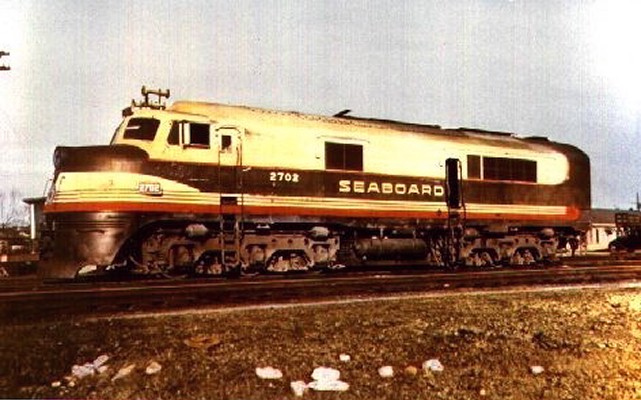
Another 'what if' render. One of the Baldwin 'baby face' diesels in early and late Seaboard Air Line colors. There were only 9 of these ever built and on the SAL, they were only used for branch line passenger trains. This would make for a nice departure from my streamliners and allow me to build some old woodsided baggage and passenger cars that could also be used with steamers (hint hint). The top photo shows the citrus scheme (my fav, but I've already done the citrus 'Silver Meteor'). The bottom shows the late 'mint green' scheme, which is a bit deceiving because at the first hint of sunshine this scheme faded to essentially white. They both have advantages and disadvantages and maybe if I ever build it, I'll have weighed them and choose. This is a pretty simple WIP with scarce roof details and a few pieces in colors that don't exist, but easily substituted (like the orange nose curve).

This is the one. I have been looking for this. There are others that I haven't found yet within the existing archive, but this is the one I saw and knew it was true.
This is a photograph of a construction hoarding. It is a detail of a rendering of the new Whitney Museum in the meatpacking district in NYC, currently under construction and due for completion in 2014. Most of this is real: the street and the High line, the brick building. I'm not sure about the foliage. In this detail, the computer-generated new Whitney building is out of shot.
The men are real too, except they were photographed a long way away, a long time ago. They are two of the "Business People" included in a pack of imagery created some time in the 1990s by RealWorld Imagery. You can see the images here: www.imagecels.com/thumnail/201/201.html - these men are labelled PEOPL114 and PEOPL159 (the latter has been mirrored from the original).
RealWorld is based in Albuquerque, New Mexico, and the original contact sheets are (c) 2000 InterDimensional Publishing. That's all I know about the source of these images. Repeated email enquiries to RealWorld have gone unanswered.
At some point in the last decade, RealWorld's imagery escaped onto the net, and has become the default set for every visualisation artist and studio I've spoken to, pirated and shared across thousands of hard drives. They've marched across hoardings from Shanghai to San Francisco. They've been to the Olympics. They've owned condos and worked in highrise office blocks. They have stood in for the future, time and again.
I don't know who they are. I'm pretty sure they don't know they're here either. But there they are, here and there, endlessly replicated across the network and across architecture.
A cloud head rising over the mesa in Dulce, New Mexico - that is exactly the same, in every detail - as one photographed in Queenstown, New Zealand.
I just installed SolidWorks 2009 the model render PhotoView 360 is fantastic, so easy to apply materials........... hard to tell its computer generated.
This is my first effort with it...
A new era in Structure Synth (at least for me) - generating all the rules via javascript!!!!
I knew you could use javascript but I never went further than to use it for some animations - bad mistake!!
Turns out you can write complete rule sets using javascript and you have access to math functions and variables this way.
I have written a short tutorial over at DA which should be accessible by the public
My 3D Portofolio
Menyediakan jasa pembuatan perspektif 3d, murah dan cepat
Segera hubungi :
email : sobat_lama007@yahoo.com
hp : 0812 9489 4000
blog : eben3d.blogspot.com
jasa render 3d, 3d murah dan cepat, 3d artist impressions, buat 3d rumah
Modelled in Sketchup with post-production in Photoshop.
I don't particularly like the design really as I think it' was too americanised even though it's in Mexico. Anyway, the client pays the wages and so you have to design to their remit.
I do however quite like the render and angle. I think the sky came out quite well.
It took me about 20 minutes in photoshop to achieve that watercolour effect.
Water mobility utilization concept.
Animation: imgur.com/a/vGnNjjz
Hypothetical way of taking advantage of water mobility – the water reserve (10000l) is used to increase the H2O radiation shield to 50 cm (more than enough to shelter against even very powerful, once-a-century SPE).
My 3D Portofolio
Menyediakan jasa pembuatan perspektif 3d, murah dan cepat
Segera hubungi :
email : sobat_lama007@yahoo.com
hp : 0812 9489 4000
blog : eben3d.blogspot.com
jasa render 3d, 3d murah dan cepat, 3d artist impressions, buat 3d rumah