View allAll Photos Tagged proportion
Although shrouded in shadows and with its curtains drawn at present, the Billilla drawing room, built at part of the 1907 extension and renovation, is an elegant and light filled space with two large demilune bays of full-length windows.
As one of the showpiece main rooms of the mansion when guests came to call, the drawing room is not only elegantly proportioned, but also elegantly appointed. As a very femininely oriented room, the ceiling of the drawing room is decorated with ornate stylised foliate Art Nouveau mouldings of roses tumbling about in undulating boiseries. Although not original, the room is papered in softly shaded wallpaper sympathetic to the era, and features its originally gas lit 1907 electroplated sconces of posy vases and bows. Electrified subsequently, the original gas taps can still be seen on each sconce light fixture.
It is however the central chandelier, also once gas lit, with it's original flounced Edwardian shade of russet fabric that perhaps hints at the room's original colour scheme. This matches the gleaming russet Arts and Crafts hearth and inlay tiles of the white marble fireplace. Matching the boiseries and garlands of plaster roses on the ceiling, the in built fire dogs and guard of polished brass also featured roses which are inlaid with losenges of russet coloured glass.
Built in High Victorian style in 1878 for successful gold miner Robert Wright, Billilla mansion was originally a thirteen room mansion erected on seven and a half acres of land.
When economic boom turned to bust in the 1880s, the property was purchased in 1888 by wealthy New South Wales pastoralist William Weatherly who named it Billilla after his land holdings and established a home there for his wife Jeannie and their children Violet, Gladys and Lionel.
The house was substantially altered by architect Walter Richmond Butler in 1907, extending the house beyond its original thirteen rooms and adding the Art Nouveau façade seen today.
After William Weatherly's death in 1914, his wife, who was much younger, remained living there until her own death in 1933. She bequeathed the property to her daughter, Violet, who maintained the home with reduced staff until her own death in 1972.
The property was purchased in 1973 by the Bayside Council who subsequently used Billilla as a historical house with guided tours, a wedding and events venue, a school and finally in 2009 as an artist's precinct in the property's outbuildings. Billilla is a beautiful heritage property retaining many of its original features thanks to its long private ownership still incorporating a stately formal garden and the magnificent historic house.
Billilla, at 26 Halifax Street, Brighton, is one of Melbourne’s few remaining significant homesteads, built on land which had originally been owned by Nicholas Were. The house has a mixture of architectural styles, featuring a Victorian design with Art Nouveau features and has exquisite formal gardens, which retain much of their original Nineteenth Century layout.
Billilla retains many original Victorian elements and a number of outbuildings still stand to the rear of the property including the butler’s quarters, dairy, meat house, stable garden store and coach house.
Billilla was opened to the general public as part of the Melbourne Open House weekend 2022.
Billilla was used as a backdrop in the 1980 Australian Channel 10 miniseries adaptation of Sumner Locke Elliott's "Water Under the Bridge". It was used at the Sydney harbourside home of Luigi, Honor and Carrie Mazzini.
Faith Temple, 296 Broadview Ave
Built in 1894 and designed by E.J. Lennox (Casa Loma, Old City Hall), this was originally the Broadview Avenue Congressional Church. Here's what it used to look like: www.blogto.com/upload/2012/11/20121101-broadview2.jpg
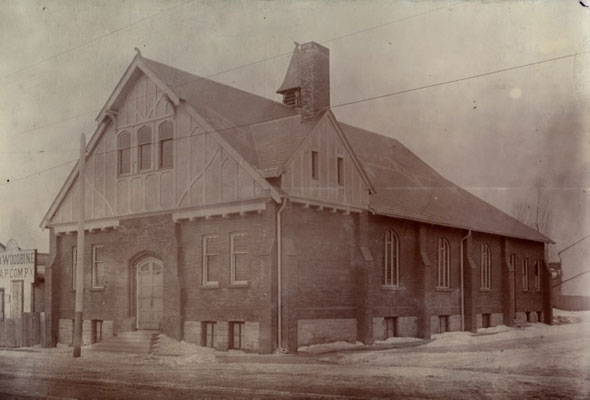
Toronto, Canada
Streetview: maps.google.com/maps?q=http:%2F%2Fwww.flickr.com%2Fphotos...
This photo is a great example of proportion is it shows the woman in the front as very large while the woman at the very back of the line is tiny to our eye, though in reality we know she is probably close to the same size as the woman who appears larger.
viiphoto.com/articles/shirvan-belief/
Photo by: Ali Arkady
Pretty Hero's Odyssey Mythology Greek Goddesses! 45SURF goddesses are the perfect blend of Artemis, Athena, Hera, and Aphrodite! Of Venus, Minerva, and Ares, Demeter, and Nike!
Pretty Hero's Odyssey Mythology Swimsuit Bikini Model! Greek Goddess Nikon D800 Super Sharp AF-S NIKKOR 70-200mm f/2.8G ED VR II ! Golden Hero's Odyssey Goddess!
All of the new Gold 45 Revolver(TM) and 45SURF(R) logos and designs are inspired by the golden number phi and divine proportion! Just as my landscapes oft employ the golden rectangle and fibonacci spiral in composition, all the bikinis, shirts, and lingerie designs are made with the golden section and gold number Phi (1.618) in mind! The golden grids, rectangles, pentagons, and spirals make a far better system for compositions than does the rule of thirds! And too, the golden mean and divine proportion are found in every model--in her pretty face and in the divine proportions of the 45surf goddess's heavenly body! I'm working on a book on all this beautitful craziness in fine art landscapes and models called The Golden Hero's Odyssey, which also ties it to my physics theory Dynamic Dimenions theory (dx4/dt=ic). :)
More of the epic Greek goddess bikini swimsuit models on instagram!
I have been traveling around in Zion, Yosemite, the Grand Canyon, and Bryce Canyon! Will share soon! :)
ALL THE BEST on your Epic Hero's Odyssey from Johnny Ranger McCoy!
Follow me & 45surf!!
www.facebook.com/45surfAchillesOdysseyMythology/
www.facebook.com/elliot.mcgucken
Beautiful Swimsuit Bikini Surfer Girl Athletic Model Goddess ! Sexy, hot, tall, thin, tan,toned, tan, and fit!
Working on a photography book too--Hero's Odyssey Photography! It focuses on my greatest hits while telling the tsory behind each one, thusly teaching how to shoot epic landscapes, ballerinas, and models!
All the best on your Epic Hero's Odyssey!
45SURF! Celebrating epic, heroic poetry, classic goddess beauty and the classical soul! Shakespeare, Homer's Iliad & Odyssey, and Moby Dick!
Dr. Elliot McGucken Fine Art Landscape & Nature Photography!! I love the National Parks!!! :)
New book page!
www.facebook.com/epiclandscapephotography/
Epic Landscape Photography: The Mythological Principles of Fine Art Nature Photography
Golden Number Ratio Divine Proportion Compositions Fine Art Photography Dr. Elliot McGucken : Using the Nature's Golden Cut to Exalt Nature Photography!
Join my golden ratio groups!
www.facebook.com/goldennumberratio/
www.facebook.com/groups/1401714589947057/
instagram.com/goldennumberratio
Dr. Elliot McGucken Fine Art Landscape & Nature Photography
New book page!
www.facebook.com/epiclandscapephotography/
Epic Landscape Photography: The Mythological Principles of Fine Art Nature Photography
Ansel Adams used the golden ratio in his photography too:
www.youtube.com/watch?v=WFlzAaBgsDI
www.youtube.com/watch?v=zrOUX3ZCl7I
The Fibonacci Numbers are closely related to the golden ratio, and thus they also play a prominent role in exalted natural and artistic compositions!
I'm working on a far deeper book titled The Golden Ratio Number for Photographers. :)
The famous mathematician Jacob Bernoulli wrote:
The (golden spiral) may be used as a symbol, either of fortitude and constancy in adversity, or of the human body, which after all its changes, even after death, will be restored to its exact and perfect self.
Engraved upon Jacob’s tombstone is a spiral alongside the words, "Eadem Mutata Resurgo," meaning "Though changed, I shall rise again." And so it is that within the Golden Ratio Principle, the golden harmonies rise yet again.
The golden ratio is oft known as the divine cut, the golden cut, the divine proportion, the golden number, and PHI for the name of the architect of the Parthenon Phidias. It has exalted classical art on down through the millennia and it can exalt your art too!
Ask me anything about the golden ratio! :) I will do my best to answer!!
Enjoy my Fine Art Ballet instagram too!
Dr. Elliot McGucken's Golden Ratio Principle: The Golden Number Ratio Principle: Dr. E’s Golden Ratio Principle: The golden ratio exalts beauty because the number is a characteristic of the mathematically and physically most efficient manners of growth and distribution, on both evolutionary and purely physical levels. The golden ratio ensures that the proportions and structure of that which came before provide the proportions and structure of that which comes after. Robust, ordered growth is naturally associated with health and beauty, and thus we evolved to perceive the golden ratio harmonies as inherently beautiful, as we saw and felt their presence in all vital growth and life—in the salient features and proportions of humans and nature alike, from the distribution of our facial features and bones to the arrangements of petals, leaves, and sunflowers seeds. As ratios between Fibonacci Numbers offer the closest whole-number approximations to the golden ratio, and as seeds, cells, leaves, bones, and other physical entities appear in whole numbers, the Fibonacci Numbers oft appear in nature’s elements as “growth’s numbers.” From the dawn of time, humanity sought to salute their gods in art and temples exalting the same proportion by which all their vital sustenance and they themselves had been created—the golden ratio. the golden number, rectangle, and spiral!
Golden Ratio Ancient Bristlecone Pines Rainbow! Sony A7RII Elliot McGucken Fine Art Landscape Photography! The golden rectangle, spiral, triangle and divine proportion in fine art photography composition!
Golden Ratio Ancient Bristlecone Pines! These ~4,000 year old trees began growing over a thousand years before the Pythagoreans (550 BC) celebrated the golden ratio and even longer before Plato noted it (400 BC) and Euclid (300 BC) defined it! They began growing within a few hundred years of the Great Pyramid of Giza being built circa 2560 BC in accordance with the golden ratio PHI, while yet other Bristlecone Pines close by germinated well before it! :) Do you ever use the golden ratio in your compositions? The Bristlecone pine did, as the spirals in its pinecones are proportional to the Fibonacci numbers whose consecutive ratios approach the golden ratio PHI as the sequence augments. Long story short, the golden angle PHI provides the most efficient manner in which to distribute new cells during growth.
Follow me on facebook!
Sony A7rii & Sony 16-35mm Vario-Tessar T FE F4 ZA OSS E-Mount Lens! Dr. Elliot McGucken Fine Art Photography wide angle
St Peter and St Paul, East Harling, Norfolk
XV: Assumption of the Blessed Virgin: Mary is assumed bodily into heaven (15th Century).
With its aisles, clerestory, porch and chancel, St Peter and St Paul is a textbook example of its century, although there are a number of curiosities that add even more interest. The vestry on the north side of the chancel, for example, which was once a shrine chapel, retains its image niche on its eastern face. And there are more image niches, these with elaborate foliage pedestals, in the buttresses of the tower; everything is topped off by a lead and timber fleche which was apparently the model for the one at St Peter Mancroft in Norwich, a church which has several features in common with this one.
The tower is a delight, the buttressing and pinnacles exactly in proportion to make it appear to rise like a fairy castle from the ground. The south porch, by contrast, is, despite its flushwork, rather austere, a result of its rebuilding early in the 19th century before the ecclesiological movement took hold. All in all, this is as good as 15th century rebuilding gets, the money coming thanks to Anne Harling having no less than three husbands who all wanted to spend as little time in purgatory as possible.
You step down into a wide space which, on a dull day, can be rather gloomy. Although inevitably heavily restored by the Victorians, St Peter and St Paul does not have that depressingly anonymous urban feel you so often find in churches of this size. This is partly because the beautiful parclose screen in the south aisle partitions off so much space, creating a sense of rooms within rooms, altering the way your eyes are inevitably drawn to the east. The rood screen must have been vast here; its dado survives at the west end, a deeply traceried affair with its features presented in carving rather than painting.
When the rood screen was in its proper place, to move from the nave into the chancel must have been like stepping from darkness into light. This is because of the feature that makes East Harling famous, the vast east window with its 15th century glass. After St Peter Mancroft it is the best collection in Norfolk. Unusually, the provenance of the glass is fairly well-documented: we can be fairly certain that it came from this church originally. Still present after the Reformation, it was removed by the Harling family to the Hall in the early 17th century. They may have been Laudians wanting to preserve it from the intentions of the puritans, or merely thought it would look nice in their dining hall; whatever, we know that shortly before Francis Blomefield visited here in the 1730s it was returned to the church and set in its present configuration.
In 1939, when war threatened, it was removed again, being reset just before Cautley visited in the early 1950s. There are parts of at least three sequences here, two of which were almost certainly in the east window originally, and one which almost certainly wasn't.
Essentially, the window contains two rosary sequences; the Joyful Mysteries of the Blessed Virgin, which include the Annunciation, the Nativity and the Assumption, and the Sorrowful Mysteries of the Blessed Virgin, which include the Crucifixion and the Deposition. However, this is open to interpretation, as we shall see. There is also the figure of St Mary Magdalene, which may once have been associated with a nave altar, and would have been located in a window there.
The five lights contain four rows of panels, making twenty altogether.
Top row:
I. Annunciation: Mary at her prayer desk. Gabriel, crowned and haloed, with a sceptre of lilies, kneels in supplication.
II. Visitation: Elizabeth, hooded to show her age, places her hand on Mary's pregnant belly.
III. Nativity: Two midwives look on. The infant in the manger is rayed; a horned cow gazes in awe.
IV. Adoration of the Shepherds: One holds a lamb, one plays pipes. A third appears to offer a fleece.
V. Adoration of the Magi: Two of the wise men gauge each others' reactions as the third offers his gift.
Second row:
VI: collection of fragments.
VII: Presentation in the Temple: Joseph carries the doves, Mary offers the child to Simeon. Anna is not shown.
VIII: The Finding in the Temple: Head covered, Mary bursts in among the men to find her son teaching.
IX: The Wedding at Canaa: Christ, seated at the top table, blesses a chicken and a ham. Mary directs the servant.
X: collection of fragments.
Third row:
XI: Mary of Magdala: Mary holds her long hair ready to anoint Christ's feet. Probably not from this window originally.
XII: The Betrayal at Gethsemane: Judas kisses Christ; Peter cuts off the ear of the high priest's servant.
XIII: Crucifixion: Mary swoons in John's arms.
XIV: Deposition from the cross: The pieta. Tears spring from Mary's eyes.
XV: Assumption of the Blessed Virgin: Mary is assumed bodily into heaven.
Bottom row:
XVI: Donor: Probably Robert Wingfield, second husband of Anne Harling.
XVII: Resurrection: Christ steps fully clothed from the tomb. Unusually, the soldiers are awake.
XVIII: Ascension of Christ: Mary, surrounded by disciples, watches as her son ascends to heaven.
XIX: Descent of the Holy Spirit: Mary, surrounded by disciples, receives the Holy Spirit at Pentecost.
XX: Donor: Probably William Chamberlain, first husband of Anne Harling.
Nowadays, we tend to think of the rosary as consisting of three sequences of five mysteries each, but in the late middle ages things were much more flexible, and rosary sequences often consisted of seven mysteries. The Glorious Mysteries sequence, of which the Assumption is now a part, is a later development, and the two adorations shown here are subsumed into a single mystery. There are a couple of images here that don't quite fit; the Wedding at Canaa is obviously a Marian text, and yet is not traditionally a rosary subject. Similarly the Betrayal, the only one of the images not to feature Mary. I wonder if what we have here are parts of two separate sequences, a Marian sequence of mysteries (I-V, VII-IX, XV), and a Passion sequence (XII-XIV, XVII-XIX). They are both clearly the work of the same workshop, and Mary is always shown with the same face and dress, but this would not preclude them from being two sequences.
Why were they here at all? We need to get away from thinking of such things as a 'poor man's bible', the need for which was superseded at the Reformation. These were devotional objects, designed to be used as meditations while praying and saying the rosary. They were created in the 15th century, a time when the mind of the Church was fiercely concentrated on asserting orthodox Catholic doctrine in the face of local superstitions and abuses. As such, they were anathema to the reformers, and were later elsewhere destroyed for being superstitious, not for being superfluous. An 18th century antiquarian mind, ignorant of the nature of Catholic devotion, might easily mix the two sequences into historical order, and possibly misunderstand the Assumption (obviously, as Mary reappears two images on at the Ascension, it is out of order). I wonder what they thought it was?
A couple of other things about the east window that you shouldn't miss. Firstly, everywhere you look there are tiny baskets - Mortlock calls them 'frails', and tells us that they were simple rush baskets used by workmen to carry tools. Also, though not in such profusion, there are bodices. These symbols are repeated elsewhere in the church in stone on tombs, and as such must be symbols of the Harling family.
Another symbol is high up on the north side, a red squirrel. Curiously, this also appears in the painting A Lady with a Squirrel and a Starling by Hans Holbein, now thought to be a portrait of Anne Lovell - the squirrel is a symbol of the Lovell family, who took over the local manor here from the Harlings in the 16th century, and the starling represents Ea- well, you guess.
In July 2006, Chris Harrison and I came across
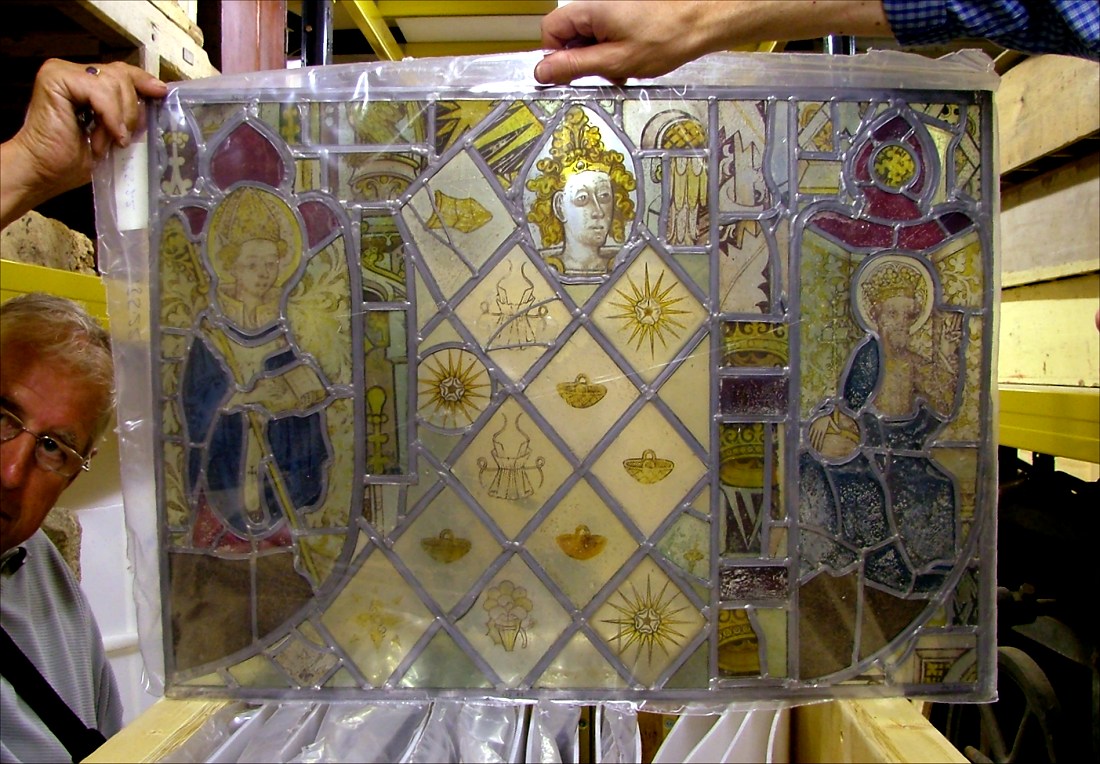
some more glass from East Harling in the Norfolk County Archaeologist Service archive at Gressenhall. It was probably removed from the church for safety in 1939, and then not replaced, possibly ending up at the museum of church art in Norwich at St Peter Hungate, disappearing into storage when that closed in 1993. It depicts a Bishop and Christ seated in Majesty, and the lozenges in between carry the telltale frails and bodices familiar from other glass within the church.
Within the screen is a large chapel, containing two major tombs. One is in alabaster, an early 17th century memorial to Sir Thomas and Lady Alice Lovell (remember the squirrel?) who died in 1604. The piece is good - too good, its 1950s restoration gives it a Festival of Britain air. Their symbols lie at their feet - his a magnificent peacock, hers a gruesome Saracen scalp held aloft.
The other appears to be a composite. It lies to the east, and the two effigies are clearly not from this tomb; they simply don't fit. They are supposed to be Robert Harling, died Paris in 1435, and his wife Dame Joan. Neither are buried here - she is at Rushford near Thetford, he is in some corner of a foreign field that is forever French schoolchildren on picnics excitedly tugging old thighbones from the soil - but in any case it is the trimmings of the tomb rather than the effigies that are most of interest, including a pelican in her piety and one that is almost a lily crucifix.
On the north side of the chancel is a fine tomb with brass inlays - the brasses now gone. Not as magnificent as either of the two previously mentioned, it is actually the most significant, as this is where you'll find Anne Harling, wife of the serial rebuilders of this church. Look out for those flails again.
What more? 17th century Lovells (remember the squirrel) have in-yer-face memorials either side of the sanctuary - that to the north curiously with no inscription. There are hatchments, remains of a wallpainting that are too indistinct to interpret (but may be seven works of mercy), a good set of royal arms, medieval heads, curious 19th century bench ends of a lion and a wild man, heraldic misericords, a Dec font - well, come and see for yourself. You know you want to.
One of the keys to shooting Epic Landscape Photography is exalting the photograph's soul via golden ratio compositions, thusly wedding the photographic art to the divine proportion by which life itself was designed and exalted.
Dr. Elliot McGucken's Golden Number Ratio Fine Art Landscape & Nature Photography Composition Studies!
instagram.com/goldennumberratio
www.facebook.com/goldennumberratio/
Greetings flickr friends! I am working on several books on "epic photography," and I recently finished a related one titled: The Golden Number Ratio Principle: Why the Fibonacci Numbers Exalt Beauty and How to Create PHI Compositions in Art, Design, & Photography: An Artistic and Scientific Introduction to the Golden Mean . Message me on facebook for a free review copy!
www.facebook.com/goldennumberratio/
The Golden Ratio also informs the design of the golden revolver on all the swimsuits and lingerie, as well as the 45surf logo!
The Golden Number Ratio Principle: Dr. E’s Golden Ratio Principle: The golden ratio exalts beauty because the number is a characteristic of the mathematically and physically most efficient manners of growth and distribution, on both evolutionary and purely physical levels. The golden ratio ensures that the proportions and structure of that which came before provide the proportions and structure of that which comes after. Robust, ordered growth is naturally associated with health and beauty, and thus we evolved to perceive the golden ratio harmonies as inherently beautiful, as we saw and felt their presence in all vital growth and life—in the salient features and proportions of humans and nature alike, from the distribution of our facial features and bones to the arrangements of petals, leaves, and sunflowers seeds. As ratios between Fibonacci Numbers offer the closest whole-number approximations to the golden ratio, and as seeds, cells, leaves, bones, and other physical entities appear in whole numbers, the Fibonacci Numbers oft appear in nature’s elements as “growth’s numbers.” From the dawn of time, humanity sought to salute their gods in art and temples exalting the same proportion by which all their vital sustenance and they themselves had been created—the golden ratio.
Ansel Adams is not only my favorite photographer, but he is one of the greatest photographers and artists of all time. And just like great artists including Michelangelo, Monet, Degas, Renoir, Leonardo da Vinci, Vermeer, Rembrandt, Botticelli, and Picasso, Ansel used the golden ratio and divine proportions in his epic art.
Not so long ago I discovered golden regions in many of his famous public domain his 8x10 aspect ratio photographs. I call these golden harmony regions "regions of golden action" or "ROGA"S, as seen here:
www.facebook.com/media/set/?set=a.1812448512351066.107374...
And too, I created some videos highlighting Ansel's use of the golden harmonies. Enjoy!
www.youtube.com/watch?v=AGnxOAhK3os
www.youtube.com/watch?v=WFlzAaBgsDI
www.youtube.com/watch?v=D3eJ86Ej1TY
More golden ratio and epic photography composition books soon! Best wishes for the Holiday Season! Dr. Elliot McGucken :)
Stars & Stripes Forever! Happy 4th of July American Flag Bikini Swimsuit Model Red, White, and Blue Bikini! Golden Ratio Composition Photography Surf Goddesses! Athletic Action Portraits Swimsuit Bikini Models! Athena! Athletic Fitness Models! dx4/dt=ic
My physics equation dx4/dt=ic graces the swimsuits and bikinis, while the golden gun is designed in proportion with the golden ratio, and the photos are oft cropped in divine proportions!
My Epic Gear Guide for Landscapes & Portraits!
Everyone is always asking me for this! Here ya go! :)
My Epic Book: Photographing Women Models!
Portrait, Swimsuit, Lingerie, Boudoir, Fine Art, & Fashion Photography Exalting the Venus Goddess Archetype: How to Shoot Epic ...
Epic! Beautiful Surf Fine Art Portrait Swimsuit Bikini Models!
Bitcoin: 1FMBZJeeHVMu35uegrYUfEkHfPj5pe9WNz
Follow me friends!
facebook.com/goldennumberratio
Epic books, prints, & more!
Exalt your photography with Golden Ratio Compositions!
Golden Ratio Compositions & Secret Sacred Geometry for Photography, Fine Art, & Landscape Photographers: How to Exalt Art with Leonardo da Vinci's, Michelangelo's!
Epic Landscape Photography:
A Simple Guide to the Principles of Fine Art Nature Photography: Master Composition, Lenses, Camera Settings, Aperture, ISO, ... Hero's Odyssey Mythology Photography)
Epic Art & Gear for your Epic Hero's Odyssey:
Enjoy my physics books graces with my fine art photography! Light Time Dimension Theory: The Foundational Physics Unifying Einstein's Relativity and Quantum Mechanics: A Simple, Illustrated Introduction to the Physical
Happy 4th of July American Flag Bikini Swimsuit Model Red, White, and Blue Bikini! Golden Ratio Composition Photography Surf Goddesses! Athletic Action Portraits Swimsuit Bikini Models! Helen, and Aphrodite! Athletic Fitness Models! dx4/dt=ic
My physics equation dx4/dt=ic graces the swimsuits and bikinis, while the golden gun is designed in proportion with the golden ratio, and the photos are oft cropped in divine proportions!
Beautiful Golden Ratio Composition Photography Surf Goddesses! dx4/dt=ic Athletic Action Portraits of Swimsuit Bikini Models! Athena, Artemis, Helen, and Aphrodite! Athletic Fitness Models!
My Epic Gear Guide for Landscapes & Portraits!
Everyone is always asking me for this! Here ya go! :)
My Epic Book: Photographing Women Models!
Portrait, Swimsuit, Lingerie, Boudoir, Fine Art, & Fashion Photography Exalting the Venus Goddess Archetype: How to Shoot Epic ...
Epic! Beautiful Surf Fine Art Portrait Swimsuit Bikini Models!
Bitcoin: 1FMBZJeeHVMu35uegrYUfEkHfPj5pe9WNz
Follow me friends!
facebook.com/goldennumberratio
Epic books, prints, & more!
Exalt your photography with Golden Ratio Compositions!
Golden Ratio Compositions & Secret Sacred Geometry for Photography, Fine Art, & Landscape Photographers: How to Exalt Art with Leonardo da Vinci's, Michelangelo's!
Epic Landscape Photography:
A Simple Guide to the Principles of Fine Art Nature Photography: Master Composition, Lenses, Camera Settings, Aperture, ISO, ... Hero's Odyssey Mythology Photography)
Epic Art & Gear for your Epic Hero's Odyssey:
Enjoy my physics books graces with my fine art photography! Light Time Dimension Theory: The Foundational Physics Unifying Einstein's Relativity and Quantum Mechanics: A Simple, Illustrated Introduction to the Physical
Beautiful Surf Goddesses! Athletic Action Portraits of Swimsuit Bikini Models! Athena, Artemis, Helen, and Aphrodite!
Black Gold 45 Revolver Bikini Swimsuit Model 45SURF Goddess! Golden Ratio Composition Photography Surf Goddesses! Athletic Action Portraits Swimsuit Bikini Models! Athena! Athletic Fitness Models! dx4/dt=ic
My physics equation dx4/dt=ic graces the swimsuits and bikinis, while the golden gun is designed in proportion with the golden ratio, and the photos are oft cropped in divine proportions!
My Epic Gear Guide for Landscapes & Portraits!
Everyone is always asking me for this! Here ya go! :)
My Epic Book: Photographing Women Models!
Portrait, Swimsuit, Lingerie, Boudoir, Fine Art, & Fashion Photography Exalting the Venus Goddess Archetype: How to Shoot Epic ...
Epic! Beautiful Surf Fine Art Portrait Swimsuit Bikini Models!
Bitcoin: 1FMBZJeeHVMu35uegrYUfEkHfPj5pe9WNz
Follow me friends!
facebook.com/goldennumberratio
Epic books, prints, & more!
Exalt your photography with Golden Ratio Compositions!
Golden Ratio Compositions & Secret Sacred Geometry for Photography, Fine Art, & Landscape Photographers: How to Exalt Art with Leonardo da Vinci's, Michelangelo's!
Epic Landscape Photography:
A Simple Guide to the Principles of Fine Art Nature Photography: Master Composition, Lenses, Camera Settings, Aperture, ISO, ... Hero's Odyssey Mythology Photography)
Epic Art & Gear for your Epic Hero's Odyssey:
Enjoy my physics books graces with my fine art photography! Light Time Dimension Theory: The Foundational Physics Unifying Einstein's Relativity and Quantum Mechanics: A Simple, Illustrated Introduction to the Physical
Happy 4th of July American Flag Bikini Swimsuit Model Red, White, and Blue Bikini! Golden Ratio Composition Photography Surf Goddesses! Athletic Action Portraits Swimsuit Bikini Models! Helen, and Aphrodite! Athletic Fitness Models! dx4/dt=ic
A sizeable proportion of the Linz tram fleet wear advertising liveries but this one sports the 'base' colours.
Pretty Athletic Goddess! Nikon D810 Photos Pretty Swimsuit Bikini Fitness Model Goddess: Sigma 50mm F1.4 DG HSM Art Lens for Nikon Cameras!
Loved shooting the awesome Sigma 50mm F1.4 DG HSM Art Lens for Nikon Cameras! It was a bit tough sometimes to achieve optimum focus at F1.4 due to the shallow depth of field, but hey--not every eyelash has to be perfectly sharp! I could do it if I and the model were perfectly still, or F1.8 or F2.0 did the trick too. Kept switching it up! We had fun and she loves the photos! :)
All the best on your epic hero's odyssey from Johnny Ranger McCoy!
Facebook:
www.facebook.com/45surfAchillesOdysseyMythology
Instagram: instagram.com/45surf
blog: 45surf.wordpress.com
Modeling the new black & gold & "Gold 45 Revolver" Gold'N'Virtue swimsuits with the main equation to Dynamic Dimensions Theory on the swimsuits: dx4/dt=ic. Yes I have a Ph.D. in physics! :) You can read more about my research and Hero's Odyssey Physics here:
herosodysseyphysics.wordpress.com/ MDT PROOF#2: Einstein (1912 Man. on Rel.) and Minkowski wrote x4=ict. Ergo dx4/dt=ic--the foundational equation of all time and motion which is on all the shirts and swimsuits. Every photon that hits my Nikon D800e's sensor does it by surfing the fourth expanding dimension, which is moving at c relative to the three spatial dimensions, or dx4/dt=ic!
Instagram: instagram.com/45surf
Fine art swimsuit model, ballerina, and ballet photography!
Nikon D810 Photos Pretty Swimsuit Bikini Fitness Model Goddess Sigma 50mm F1.4 DG HSM Art Lens for Nikon Cameras!
45SURF Fine Art!
After looking through my work,what do you think about Nikon vs. Sony? Do you prefer the Nikon D810 and Nikkor / Tamron / Sigma lenses /glass, or the Sony A7r and Sony Sonnar Carl Zeiss e-mount glass/lenses? I love them both! And I am so excited about the Sony A7rII !
Feel free to ask me any questions! Always love sharing tech talk and insights! :)
And all the best on Your Epic Hero's Odyssey!
The new Lightroom rocks!
View your artistic mission into photography as an epic odyssey of heroic poetry! Take it from Homer in Homer's Odyssey: "Tell me, O muse, of that ingenious hero who travelled far and wide after he had sacked the famous town of Troy. Many cities did he visit, and many were the nations with whose manners and customs he was acquainted; moreover he suffered much by sea while trying to save his own life and bring his men safely home; but do what he might he could not save his men, for they perished through their own sheer folly in eating the cattle of the Sun-god Hyperion; so the god prevented them from ever reaching home. Tell me, too, about all these things, O daughter of Jove, from whatsoever source you may know them. " --Samuel Butler Translation of Homer's Odyssey
All the best on your Epic Hero's Odyssey from Johnny Ranger McCoy!
Pretty Asian model!
Pretty one piece Swimsuit!
From the golden spiral in the whirlpool galaxy and our very own milkway galaxy, to the golden mean of an athletic models' proportions, to the divine proportions found in a beautiful models' face, to the optimum curves and compositions of my fine art photography, I have found the Fibonacci sequence and golden number Phi to be omni-present. And so it makes sense that I found the golden spiral to naturally emerge in my physics theory--Dynamic Dimensions Theory--which postulates that the fourth dimension is expanding at the rate of c relative to the three spatial dimensions, giving rise to relativity, the quantum, and time and all its arrows and asymmetries. Yes! I have a pPh.D. in physics! Photons of ligth are but matter which surfs the fourth expanding dimension en route to creating a beautiful photograph.
And yes I am working on a book combining my philosophies on Phi, fine art photography, physics, the golden mean and number, the divine proportion, and the natgural emergence of the Fibonacci numbers in life and beauty. The book, filled with my photography aongside classic poetry, epic physics, and philosophy, will be called The Golden Hero's Odyssey. :)
Basílica de S. Pedro, Vaticano - Roma
St. Peter's Basilica, Vatican - Rome
Basilique Saint-Pierre, Vatican - Rome
Out of 30 rectangles of Curious paper of 3 x 1 proportion with 7 cm on the long side.
A challenging model
The Church of Saint Matthew is a Church of England Grade II* listed church located in the High Elswick area of Newcastle upon Tyne, within the Georgian suburb of Summerhill.
History
Saint Matthew's was formed out of Saint John's parish in November, 1869, and the Parish is the home of four former parishes - Saint Philip (Elswick), Saint Augustine (Brighton Grove), Saint Matthew (Big Lamp), and Saint Mary the Virgin (Rye Hill).
Tradition
Saint Matthew's was founded after the foundations of the Catholic Revival had been set; with its first Vicar, Father Robert Daunt, being described by the time of his death as "a decided High Churchman, who held strong views on the question of the independence of the Church in spiritual matters.". As such, the church has, from its founding, followed the Anglo-Catholic High Church tradition — a rarity within the diocese.
Elswick is a district and electoral ward of the city and metropolitan borough of Newcastle upon Tyne, in the county of Tyne and Wear, England, 1.9 miles west of the city centre, bordering the River Tyne. Historically in Northumberland, Elswick became part of Newcastle upon Tyne in 1835. Elswick is home to the Newcastle Utilita Arena; and Newcastle College, with approximately 45,000 students.
History
In Roman times the Vallum, a defensive barrier behind Hadrian's Wall, reached its easternmost limit in Elswick. The Wall itself carried on as far as Wallsend.
The township of Elswick had originally formed part of the Barony of Bolam and was owned by Tynemouth Priory from 1120-1539, with a fishery present on the site. One of the earliest references to the coal mining industry of the north east occurs in 1330, when it was recorded that the Prior of Tynemouth let a colliery, called Heygrove, at "Elstewyke" for a rent of £5 per year. Elswick Colliery had 3 pits working from 1860 onwards. Elswick was owned by the Crown from 1539 to 1628, until it was sold by Charles I.
The Priors held a mansion in the middle of Elswick which was later occupied by Elswick Hall. Having been rebuilt a number of times, the last rebuild took place in 1810. The grounds of Elswick Hall became Elswick Park in 1881. Elswick changed significantly in the late 19th century with the extension of the railway from Carlisle to Newcastle in 1839 and the establishment of Armstrong's manufacturing works in 1847. Population increased rapidly during this period, from about 300 in 1801 to 59,165 in 1901. Tyneside flats were built in the area around Scotswood Road to accommodate the workforce.
The Elswick works was founded in 1847 by engineer William George Armstrong. It manufactured hydraulic machinery, cranes and bridges and, later, artillery. In 1882 the company merged with the shipbuilding firm of Charles Mitchell to form Armstrong, Mitchell & Company. Armstrong Mitchell merged again with the engineering firm of Joseph Whitworth in 1897, forming Armstrong, Whitworth & Co.
Elswick railway station was opened in 1889 to serve the area. It was located at the western end of the Elswick Works, whose workforce made up a significant proportion of travellers. The area suffered as a result of the inter-war and subsequent depressions, culminating in the demolition of the Elswick works. The station was closed and then demolished in 1967.
Elswick was hit hard by the decline of Tyneside's shipbuilding industry during the second half of the 20th century, and by the 1990s was widely regarded as one of the worst parts of Tyneside, if not the whole of Britain. According to a report by The Independent newspaper, unemployment stood at nearly 30% and the area had a widespread problem with drug abuse and arson attacks.
Elswick was formerly a township in the parish of Newcastle-St. John, in 1866 Elswick became a separate civil parish, on 1 April 1914 the parish was abolished to form Newcastle upon Tyne. In 1911 the parish had a population of 58,352. It is now in the unparished area of Newcastle upon Tyne.
Elswick today
Present day Elswick consists of a number of distinct neighbourhoods including the Adelaide Terrace area, Bentinck Estate, Condercum and Denhill Park, Cruddas Park (part renamed Riverside Dene), Elswick Triangle, Gill Street and the Courts, Grainger Park, Jubilee Estate, North Benwell, and both from the St John's and St Paul's areas. The local authority ward also incorporates Newcastle College, and the Utilita Arena Newcastle. As of the 2011 census, Elswick had one of the lowest White populations in Newcastle at around 55% with a large Asian population of 33.4% (including 15.9% Bangladeshi, 8.3% Pakistani), and 5.6% Black or Black British. Elswick has a large Muslim population of 31.9% and a Christian population of 43.4%. In 2018 it had an estimated population of 15,869.
The ward profile shows Elswick is the ward with the highest percentage of children under 14 years in Newcastle and has a lower than average number of senior citizens (10%) than Newcastle as a whole. Elswick has a lower than average number of houses in owner-occupation (26.3% compared with 49.9% for Newcastle city).
Elswick's Location
Located at a height of 53.1m, Elswick overlooks the River Tyne and is a suburban area in the West End of Newcastle upon Tyne.
Newcastle upon Tyne, or simply Newcastle is a cathedral city and metropolitan borough in Tyne and Wear, England. It is located on the River Tyne's northern bank, opposite Gateshead to the south. It is the most populous settlement in the Tyneside conurbation and North East England.
Newcastle developed around a Roman settlement called Pons Aelius, the settlement became known as Monkchester before taking on the name of a castle built in 1080 by William the Conqueror's eldest son, Robert Curthose. It was one of the world's largest ship building and repair centres during the industrial revolution. Newcastle was part of the county of Northumberland until 1400, when it separated and formed a county of itself. In 1974, Newcastle became part of Tyne and Wear. Since 2018, the city council has been part of the North of Tyne Combined Authority.
The history of Newcastle upon Tyne dates back almost 2,000 years, during which it has been controlled by the Romans, the Angles and the Norsemen amongst others. Newcastle upon Tyne was originally known by its Roman name Pons Aelius. The name "Newcastle" has been used since the Norman conquest of England. Due to its prime location on the River Tyne, the town developed greatly during the Middle Ages and it was to play a major role in the Industrial Revolution, being granted city status in 1882. Today, the city is a major retail, commercial and cultural centre.
Roman settlement
The history of Newcastle dates from AD 122, when the Romans built the first bridge to cross the River Tyne at that point. The bridge was called Pons Aelius or 'Bridge of Aelius', Aelius being the family name of Roman Emperor Hadrian, who was responsible for the Roman wall built across northern England along the Tyne–Solway gap. Hadrian's Wall ran through present-day Newcastle, with stretches of wall and turrets visible along the West Road, and at a temple in Benwell. Traces of a milecastle were found on Westgate Road, midway between Clayton Street and Grainger Street, and it is likely that the course of the wall corresponded to present-day Westgate Road. The course of the wall can be traced eastwards to the Segedunum Roman fort at Wallsend, with the fort of Arbeia down-river at the mouth of the Tyne, on the south bank in what is now South Shields. The Tyne was then a wider, shallower river at this point and it is thought that the bridge was probably about 700 feet (210 m) long, made of wood and supported on stone piers. It is probable that it was sited near the current Swing Bridge, due to the fact that Roman artefacts were found there during the building of the latter bridge. Hadrian himself probably visited the site in 122. A shrine was set up on the completed bridge in 123 by the 6th Legion, with two altars to Neptune and Oceanus respectively. The two altars were subsequently found in the river and are on display in the Great North Museum in Newcastle.
The Romans built a stone-walled fort in 150 to protect the river crossing which was at the foot of the Tyne Gorge, and this took the name of the bridge so that the whole settlement was known as Pons Aelius. The fort was situated on a rocky outcrop overlooking the new bridge, on the site of the present Castle Keep. Pons Aelius is last mentioned in 400, in a Roman document listing all of the Roman military outposts. It is likely that nestling in the shadow of the fort would have been a small vicus, or village. Unfortunately, no buildings have been detected; only a few pieces of flagging. It is clear that there was a Roman cemetery near Clavering Place, behind the Central station, as a number of Roman coffins and sarcophagi have been unearthed there.
Despite the presence of the bridge, the settlement of Pons Aelius was not particularly important among the northern Roman settlements. The most important stations were those on the highway of Dere Street running from Eboracum (York) through Corstopitum (Corbridge) and to the lands north of the Wall. Corstopitum, being a major arsenal and supply centre, was much larger and more populous than Pons Aelius.
Anglo-Saxon development
The Angles arrived in the North-East of England in about 500 and may have landed on the Tyne. There is no evidence of an Anglo-Saxon settlement on or near the site of Pons Aelius during the Anglo-Saxon age. The bridge probably survived and there may well have been a small village at the northern end, but no evidence survives. At that time the region was dominated by two kingdoms, Bernicia, north of the Tees and ruled from Bamburgh, and Deira, south of the Tees and ruled from York. Bernicia and Deira combined to form the kingdom of Northanhymbra (Northumbria) early in the 7th century. There were three local kings who held the title of Bretwalda – 'Lord of Britain', Edwin of Deira (627–632), Oswald of Bernicia (633–641) and Oswy of Northumbria (641–658). The 7th century became known as the 'Golden Age of Northumbria', when the area was a beacon of culture and learning in Europe. The greatness of this period was based on its generally Christian culture and resulted in the Lindisfarne Gospels amongst other treasures. The Tyne valley was dotted with monasteries, with those at Monkwearmouth, Hexham and Jarrow being the most famous. Bede, who was based at Jarrow, wrote of a royal estate, known as Ad Murum, 'at the Wall', 12 miles (19 km) from the sea. It is thought that this estate may have been in what is now Newcastle. At some unknown time, the site of Newcastle came to be known as Monkchester. The reason for this title is unknown, as we are unaware of any specific monasteries at the site, and Bede made no reference to it. In 875 Halfdan Ragnarsson, the Danish Viking conqueror of York, led an army that attacked and pillaged various monasteries in the area, and it is thought that Monkchester was also pillaged at this time. Little more was heard of it until the coming of the Normans.
Norman period
After the arrival of William the Conqueror in England in 1066, the whole of England was quickly subjected to Norman rule. However, in Northumbria there was great resistance to the Normans, and in 1069 the newly appointed Norman Earl of Northumbria, Robert de Comines and 700 of his men were killed by the local population at Durham. The Northumbrians then marched on York, but William was able to suppress the uprising. That same year, a second uprising occurred when a Danish fleet landed in the Humber. The Northumbrians again attacked York and destroyed the garrison there. William was again able to suppress the uprising, but this time he took revenge. He laid waste to the whole of the Midlands and the land from York to the Tees. In 1080, William Walcher, the Norman bishop of Durham and his followers were brutally murdered at Gateshead. This time Odo, bishop of Bayeux, William's half brother, devastated the land between the Tees and the Tweed. This was known as the 'Harrying of the North'. This devastation is reflected in the Domesday Book. The destruction had such an effect that the North remained poor and backward at least until Tudor times and perhaps until the Industrial Revolution. Newcastle suffered in this respect with the rest of the North.
In 1080 William sent his eldest son, Robert Curthose, north to defend the kingdom against the Scots. After his campaign, he moved to Monkchester and began the building of a 'New Castle'. This was of the "motte-and-bailey" type of construction, a wooden tower on top of an earthen mound (motte), surrounded by a moat and wooden stockade (bailey). It was this castle that gave Newcastle its name. In 1095 the Earl of Northumbria, Robert de Mowbray, rose up against the king, William Rufus, and Rufus sent an army north to recapture the castle. From then on the castle became crown property and was an important base from which the king could control the northern barons. The Northumbrian earldom was abolished and a Sheriff of Northumberland was appointed to administer the region. In 1091 the parish church of St Nicholas was consecrated on the site of the present Anglican cathedral, close by the bailey of the new castle. The church is believed to have been a wooden building on stone footings.
Not a trace of the tower or mound of the motte and bailey castle remains now. Henry II replaced it with a rectangular stone keep, which was built between 1172 and 1177 at a cost of £1,444. A stone bailey, in the form of a triangle, replaced the previous wooden one. The great outer gateway to the castle, called 'the Black Gate', was built later, between 1247 and 1250, in the reign of Henry III. There were at that time no town walls and when attacked by the Scots, the townspeople had to crowd into the bailey for safety. It is probable that the new castle acted as a magnet for local merchants because of the safety it provided. This in turn would help to expand trade in the town. At this time wool, skins and lead were being exported, whilst alum, pepper and ginger were being imported from France and Flanders.
Middle Ages
Throughout the Middle Ages, Newcastle was England's northern fortress, the centre for assembled armies. The Border war against Scotland lasted intermittently for several centuries – possibly the longest border war ever waged. During the civil war between Stephen and Matilda, David 1st of Scotland and his son were granted Cumbria and Northumberland respectively, so that for a period from 1139 to 1157, Newcastle was effectively in Scottish hands. It is believed that during this period, King David may have built the church of St Andrew and the Benedictine nunnery in Newcastle. However, King Stephen's successor, Henry II was strong enough to take back the Earldom of Northumbria from Malcolm IV.
The Scots king William the Lion was imprisoned in Newcastle, in 1174, after being captured at the Battle of Alnwick. Edward I brought the Stone of Scone and William Wallace south through the town and Newcastle was successfully defended against the Scots three times during the 14th century.
Around 1200, stone-faced, clay-filled jetties were starting to project into the river, an indication that trade was increasing in Newcastle. As the Roman roads continued to deteriorate, sea travel was gaining in importance. By 1275 Newcastle was the sixth largest wool exporting port in England. The principal exports at this time were wool, timber, coal, millstones, dairy produce, fish, salt and hides. Much of the developing trade was with the Baltic countries and Germany. Most of the Newcastle merchants were situated near the river, below the Castle. The earliest known charter was dated 1175 in the reign of Henry II, giving the townspeople some control over their town. In 1216 King John granted Newcastle a mayor[8] and also allowed the formation of guilds (known as Mysteries). These were cartels formed within different trades, which restricted trade to guild members. There were initially twelve guilds. Coal was being exported from Newcastle by 1250, and by 1350 the burgesses received a royal licence to export coal. This licence to export coal was jealously guarded by the Newcastle burgesses, and they tried to prevent any one else on the Tyne from exporting coal except through Newcastle. The burgesses similarly tried to prevent fish from being sold anywhere else on the Tyne except Newcastle. This led to conflicts with Gateshead and South Shields.
In 1265, the town was granted permission to impose a 'Wall Tax' or Murage, to pay for the construction of a fortified wall to enclose the town and protect it from Scottish invaders. The town walls were not completed until early in the 14th century. They were two miles (3 km) long, 9 feet (2.7 m) thick and 25 feet (7.6 m) high. They had six main gates, as well as some smaller gates, and had 17 towers. The land within the walls was divided almost equally by the Lort Burn, which flowed southwards and joined the Tyne to the east of the Castle. The town began to expand north of the Castle and west of the Lort Burn with various markets being set up within the walls.
In 1400 Henry IV granted a new charter, creating a County corporate which separated the town, but not the Castle, from the county of Northumberland and recognised it as a "county of itself" with a right to have a sheriff of its own. The burgesses were now allowed to choose six aldermen who, with the mayor would be justices of the peace. The mayor and sheriff were allowed to hold borough courts in the Guildhall.
Religious houses
During the Middle Ages a number of religious houses were established within the walls: the first of these was the Benedictine nunnery of St Bartholomew founded in 1086 near the present-day Nun Street. Both David I of Scotland and Henry I of England were benefactors of the religious house. Nothing of the nunnery remains now.
The friary of Blackfriars, Newcastle (Dominican) was established in 1239. These were also known as the Preaching Friars or Shod Friars, because they wore sandals, as opposed to other orders. The friary was situated in the present-day Friars Street. In 1280 the order was granted royal permission to make a postern in the town walls to communicate with their gardens outside the walls. On 19 June 1334, Edward Balliol, claimant to be King of Scotland, did homage to King Edward III, on behalf of the kingdom of Scotland, in the church of the friary. Much of the original buildings of the friary still exist, mainly because, after the Dissolution of the Monasteries the friary of Blackfriars was rented out by the corporation to nine of the local trade guilds.
The friary of Whitefriars (Carmelite) was established in 1262. The order was originally housed on the Wall Knoll in Pandon, but in 1307 it took over the buildings of another order, which went out of existence, the Friars of the Sac. The land, which had originally been given by Robert the Bruce, was situated in the present-day Hanover Square, behind the Central station. Nothing of the friary remains now.
The friary of Austinfriars (Augustinian) was established in 1290. The friary was on the site where the Holy Jesus Hospital was built in 1682. The friary was traditionally the lodging place of English kings whenever they visited or passed through Newcastle. In 1503 Princess Margaret, eldest daughter of Henry VII of England, stayed two days at the friary on her way to join her new husband James IV of Scotland.
The friary of Greyfriars (Franciscans) was established in 1274. The friary was in the present-day area between Pilgrim Street, Grey Street, Market Street and High Chare. Nothing of the original buildings remains.
The friary of the Order of the Holy Trinity, also known as the Trinitarians, was established in 1360. The order devoted a third of its income to buying back captives of the Saracens, during the Crusades. Their house was on the Wall Knoll, in Pandon, to the east of the city, but within the walls. Wall Knoll had previously been occupied by the White Friars until they moved to new premises in 1307.
All of the above religious houses were closed in about 1540, when Henry VIII dissolved the monasteries.
An important street running through Newcastle at the time was Pilgrim Street, running northwards inside the walls and leading to the Pilgrim Gate on the north wall. The street still exists today as arguably Newcastle's main shopping street.
Tudor period
The Scottish border wars continued for much of the 16th century, so that during that time, Newcastle was often threatened with invasion by the Scots, but also remained important as a border stronghold against them.
During the Reformation begun by Henry VIII in 1536, the five Newcastle friaries and the single nunnery were dissolved and the land was sold to the Corporation and to rich merchants. At this time there were fewer than 60 inmates of the religious houses in Newcastle. The convent of Blackfriars was leased to nine craft guilds to be used as their headquarters. This probably explains why it is the only one of the religious houses whose building survives to the present day. The priories at Tynemouth and Durham were also dissolved, thus ending the long-running rivalry between Newcastle and the church for control of trade on the Tyne. A little later, the property of the nunnery of St Bartholomew and of Grey Friars were bought by Robert Anderson, who had the buildings demolished to build his grand Newe House (also known as Anderson Place).
With the gradual decline of the Scottish border wars the town walls were allowed to decline as well as the castle. By 1547, about 10,000 people were living in Newcastle. At the beginning of the 16th century exports of wool from Newcastle were more than twice the value of exports of coal, but during the century coal exports continued to increase.
Under Edward VI, John Dudley, Duke of Northumberland, sponsored an act allowing Newcastle to annexe Gateshead as its suburb. The main reason for this was to allow the Newcastle Hostmen, who controlled the export of Tyne coal, to get their hands on the Gateshead coal mines, previously controlled by the Bishop of Durham. However, when Mary I came to power, Dudley met his downfall and the decision was reversed. The Reformation allowed private access to coal mines previously owned by Tynemouth and Durham priories and as a result coal exports increase dramatically, from 15,000 tons in 1500 to 35,000 tons in 1565, and to 400,000 tons in 1625.
The plague visited Newcastle four times during the 16th century, in 1579 when 2,000 people died, in 1589 when 1700 died, in 1595 and finally in 1597.
In 1600 Elizabeth I granted Newcastle a charter for an exclusive body of electors, the right to elect the mayor and burgesses. The charter also gave the Hostmen exclusive rights to load coal at any point on the Tyne. The Hostmen developed as an exclusive group within the Merchant Adventurers who had been incorporated by a charter in 1547.
Stuart period
In 1636 there was a serious outbreak of bubonic plague in Newcastle. There had been several previous outbreaks of the disease over the years, but this was the most serious. It is thought to have arrived from the Netherlands via ships that were trading between the Tyne and that country. It first appeared in the lower part of the town near the docks but gradually spread to all parts of the town. As the disease gained hold the authorities took measures to control it by boarding up any properties that contained infected persons, meaning that whole families were locked up together with the infected family members. Other infected persons were put in huts outside the town walls and left to die. Plague pits were dug next to the town's four churches and outside the town walls to receive the bodies in mass burials. Over the course of the outbreak 5,631 deaths were recorded out of an estimated population of 12,000, a death rate of 47%.
In 1637 Charles I tried to raise money by doubling the 'voluntary' tax on coal in return for allowing the Newcastle Hostmen to regulate production and fix prices. This caused outrage amongst the London importers and the East Anglian shippers. Both groups decided to boycott Tyne coal and as a result forced Charles to reverse his decision in 1638.
In 1640 during the Second Bishops' War, the Scots successfully invaded Newcastle. The occupying army demanded £850 per day from the Corporation to billet the Scottish troops. Trade from the Tyne ground to a halt during the occupation. The Scots left in 1641 after receiving a Parliamentary pardon and a £4,000,000 loan from the town.
In 1642 the English Civil War began. King Charles realised the value of the Tyne coal trade and therefore garrisoned Newcastle. A Royalist was appointed as governor. At that time, Newcastle and King's Lynn were the only important seaports to support the crown. In 1644 Parliament blockaded the Tyne to prevent the king from receiving revenue from the Tyne coal trade. Coal exports fell from 450,000 to 3,000 tons and London suffered a hard winter without fuel. Parliament encouraged the coal trade from the Wear to try to replace that lost from Newcastle but that was not enough to make up for the lost Tyneside tonnage.
In 1644 the Scots crossed the border. Newcastle strengthened its defences in preparation. The Scottish army, with 40,000 troops, besieged Newcastle for three months until the garrison of 1,500 surrendered. During the siege, the Scots bombarded the walls with their artillery, situated in Gateshead and Castle Leazes. The Scottish commander threatened to destroy the steeple of St Nicholas's Church by gunfire if the mayor, Sir John Marley, did not surrender the town. The mayor responded by placing Scottish prisoners that they had captured in the steeple, so saving it from destruction. The town walls were finally breached by a combination of artillery and sapping. In gratitude for this defence, Charles gave Newcastle the motto 'Fortiter Defendit Triumphans' to be added to its coat of arms. The Scottish army occupied Northumberland and Durham for two years. The coal taxes had to pay for the Scottish occupation. In 1645 Charles surrendered to the Scots and was imprisoned in Newcastle for nine months. After the Civil War the coal trade on the Tyne soon picked up and exceeded its pre-war levels.
A new Guildhall was completed on the Sandhill next to the river in 1655, replacing an earlier facility damaged by fire in 1639, and became the meeting place of Newcastle Town Council. In 1681 the Hospital of the Holy Jesus was built partly on the site of the Austin Friars. The Guildhall and Holy Jesus Hospital still exist.
Charles II tried to impose a charter on Newcastle to give the king the right to appoint the mayor, sheriff, recorder and town clerk. Charles died before the charter came into effect. In 1685, James II tried to replace Corporation members with named Catholics. However, James' mandate was suspended in 1689 after the Glorious Revolution welcoming William of Orange. In 1689, after the fall of James II, the people of Newcastle tore down his bronze equestrian statue in Sandhill and tossed it into the Tyne. The bronze was later used to make bells for All Saints Church.
In 1689 the Lort Burn was covered over. At this time it was an open sewer. The channel followed by the Lort Burn became the present day Dean Street. At that time, the centre of Newcastle was still the Sandhill area, with many merchants living along the Close or on the Side. The path of the main road through Newcastle ran from the single Tyne bridge, through Sandhill to the Side, a narrow street which climbed steeply on the north-east side of the castle hill until it reached the higher ground alongside St Nicholas' Church. As Newcastle developed, the Side became lined with buildings with projecting upper stories, so that the main street through Newcastle was a narrow, congested, steep thoroughfare.
In 1701 the Keelmen's Hospital was built in the Sandgate area of the city, using funds provided by the keelmen. The building still stands today.
Eighteenth century
In the 18th century, Newcastle was the country's largest print centre after London, Oxford and Cambridge, and the Literary and Philosophical Society of 1793, with its erudite debates and large stock of books in several languages predated the London Library by half a century.
In 1715, during the Jacobite rising in favour of the Old Pretender, an army of Jacobite supporters marched on Newcastle. Many of the Northumbrian gentry joined the rebels. The citizens prepared for its arrival by arresting Jacobite supporters and accepting 700 extra recruits into the local militia. The gates of the city were closed against the rebels. This proved enough to delay an attack until reinforcements arrived forcing the rebel army to move across to the west coast. The rebels finally surrendered at Preston.
In 1745, during a second Jacobite rising in favour of the Young Pretender, a Scottish army crossed the border led by Bonnie Prince Charlie. Once again Newcastle prepared by arresting Jacobite supporters and inducting 800 volunteers into the local militia. The town walls were strengthened, most of the gates were blocked up and some 200 cannon were deployed. 20,000 regulars were billeted on the Town Moor. These preparations were enough to force the rebel army to travel south via the west coast. They were eventually defeated at Culloden in 1746.
Newcastle's actions during the 1715 rising in resisting the rebels and declaring for George I, in contrast to the rest of the region, is the most likely source of the nickname 'Geordie', applied to people from Tyneside, or more accurately Newcastle. Another theory, however, is that the name 'Geordie' came from the inventor of the Geordie lamp, George Stephenson. It was a type of safety lamp used in mining, but was not invented until 1815. Apparently the term 'German Geordie' was in common use during the 18th century.
The city's first hospital, Newcastle Infirmary opened in 1753; it was funded by public subscription. A lying-in hospital was established in Newcastle in 1760. The city's first public hospital for mentally ill patients, Wardens Close Lunatic Hospital was opened in October 1767.
In 1771 a flood swept away much of the bridge at Newcastle. The bridge had been built in 1250 and repaired after a flood in 1339. The bridge supported various houses and three towers and an old chapel. A blue stone was placed in the middle of the bridge to mark the boundary between Newcastle and the Palatinate of Durham. A temporary wooden bridge had to be built, and this remained in use until 1781, when a new stone bridge was completed. The new bridge consisted of nine arches. In 1801, because of the pressure of traffic, the bridge had to be widened.
A permanent military presence was established in the city with the completion of Fenham Barracks in 1806. The facilities at the Castle for holding assizes, which had been condemned for their inconvenience and unhealthiness, were replaced when the Moot Hall opened in August 1812.
Victorian period
Present-day Newcastle owes much of its architecture to the work of the builder Richard Grainger, aided by architects John Dobson, Thomas Oliver, John and Benjamin Green and others. In 1834 Grainger won a competition to produce a new plan for central Newcastle. He put this plan into effect using the above architects as well as architects employed in his own office. Grainger and Oliver had already built Leazes Terrace, Leazes Crescent and Leazes Place between 1829 and 1834. Grainger and Dobson had also built the Royal Arcade at the foot of Pilgrim Street between 1830 and 1832. The most ambitious project covered 12 acres 12 acres (49,000 m2) in central Newcastle, on the site of Newe House (also called Anderson Place). Grainger built three new thoroughfares, Grey Street, Grainger Street and Clayton Street with many connecting streets, as well as the Central Exchange and the Grainger Market. John Wardle and George Walker, working in Grainger's office, designed Clayton Street, Grainger Street and most of Grey Street. Dobson designed the Grainger Market and much of the east side of Grey Street. John and Benjamin Green designed the Theatre Royal at the top of Grey Street, where Grainger placed the column of Grey's Monument as a focus for the whole scheme. Grey Street is considered to be one of the finest streets in the country, with its elegant curve. Unfortunately most of old Eldon Square was demolished in the 1960s in the name of progress. The Royal Arcade met a similar fate.
In 1849 a new bridge was built across the river at Newcastle. This was the High Level Bridge, designed by Robert Stephenson, and slightly up river from the existing bridge. The bridge was designed to carry road and rail traffic across the Tyne Gorge on two decks with rail traffic on the upper deck and road traffic on the lower. The new bridge meant that traffic could pass through Newcastle without having to negotiate the steep, narrow Side, as had been necessary for centuries. The bridge was opened by Queen Victoria, who one year later opened the new Central Station, designed by John Dobson. Trains were now able to cross the river, directly into the centre of Newcastle and carry on up to Scotland. The Army Riding School was also completed in 1849.
In 1854 a large fire started on the Gateshead quayside and an explosion caused it to spread across the river to the Newcastle quayside. A huge conflagration amongst the narrow alleys, or 'chares', destroyed the homes of 800 families as well as many business premises. The narrow alleys that had been destroyed were replaced by streets containing blocks of modern offices.
In 1863 the Town Hall in St Nicholas Square replaced the Guildhall as the meeting place of Newcastle Town Council.
In 1876 the low level bridge was replaced by a new bridge known as the Swing Bridge, so called because the bridge was able to swing horizontally on a central axis and allow ships to pass on either side. This meant that for the first time sizeable ships could pass up-river beyond Newcastle. The bridge was built and paid for by William Armstrong, a local arms manufacturer, who needed to have warships access his Elswick arms factory to fit armaments to them. The Swing Bridge's rotating mechanism is adapted from the cannon mounts developed in Armstrong's arms works. In 1882 the Elswick works began to build ships as well as to arm them. The Barrack Road drill hall was completed in 1890.
Industrialisation
In the 19th century, shipbuilding and heavy engineering were central to the city's prosperity; and the city was a powerhouse of the Industrial Revolution. Newcastle's development as a major city owed most to its central role in the production and export of coal. The phrase "taking coals to Newcastle" was first recorded in 1538; it proverbially denotes bringing a particular commodity to a place that has more than enough of it already.
Innovation in Newcastle and surrounding areas included the following:
George Stephenson developed a miner's safety lamp at the same time that Humphry Davy developed a rival design. The lamp made possible the opening up of ever deeper mines to provide the coal that powered the industrial revolution.
George and his son Robert Stephenson were hugely influential figures in the development of the early railways. George developed Blücher, a locomotive working at Killingworth colliery in 1814, whilst Robert was instrumental in the design of Rocket, a revolutionary design that was the forerunner of modern locomotives. Both men were involved in planning and building railway lines, all over this country and abroad.
Joseph Swan demonstrated a working electric light bulb about a year before Thomas Edison did the same in the USA. This led to a dispute as to who had actually invented the light bulb. Eventually the two rivals agreed to form a mutual company between them, the Edison and Swan Electric Light Company, known as Ediswan.
Charles Algernon Parsons invented the steam turbine, for marine use and for power generation. He used Turbinia, a small, turbine-powered ship, to demonstrate the speed that a steam turbine could generate. Turbinia literally ran rings around the British Fleet at a review at Spithead in 1897.
William Armstrong invented a hydraulic crane that was installed in dockyards up and down the country. He then began to design light, accurate field guns for the British army. These were a vast improvement on the existing guns that were then in use.
The following major industries developed in Newcastle or its surrounding area:
Glassmaking
A small glass industry existed in Newcastle from the mid-15th century. In 1615 restrictions were put on the use of wood for manufacturing glass. It was found that glass could be manufactured using the local coal, and so a glassmaking industry grew up on Tyneside. Huguenot glassmakers came over from France as refugees from persecution and set up glasshouses in the Skinnerburn area of Newcastle. Eventually, glass production moved to the Ouseburn area of Newcastle. In 1684 the Dagnia family, Sephardic Jewish emigrants from Altare, arrived in Newcastle from Stourbridge and established glasshouses along the Close, to manufacture high quality flint glass. The glass manufacturers used sand ballast from the boats arriving in the river as the main raw material. The glassware was then exported in collier brigs. The period from 1730 to 1785 was the highpoint of Newcastle glass manufacture, when the local glassmakers produced the 'Newcastle Light Baluster'. The glassmaking industry still exists in the west end of the city with local Artist and Glassmaker Jane Charles carrying on over four hundred years of hot glass blowing in Newcastle upon Tyne.
Locomotive manufacture
In 1823 George Stephenson and his son Robert established the world's first locomotive factory near Forth Street in Newcastle. Here they built locomotives for the Stockton and Darlington Railway and the Liverpool and Manchester Railway, as well as many others. It was here that the famous locomotive Rocket was designed and manufactured in preparation for the Rainhill Trials. Apart from building locomotives for the British market, the Newcastle works also produced locomotives for Europe and America. The Forth Street works continued to build locomotives until 1960.
Shipbuilding
In 1296 a wooden, 135 ft (41 m) long galley was constructed at the mouth of the Lort Burn in Newcastle, as part of a twenty-ship order from the king. The ship cost £205, and is the earliest record of shipbuilding in Newcastle. However the rise of the Tyne as a shipbuilding area was due to the need for collier brigs for the coal export trade. These wooden sailing ships were usually built locally, establishing local expertise in building ships. As ships changed from wood to steel, and from sail to steam, the local shipbuilding industry changed to build the new ships. Although shipbuilding was carried out up and down both sides of the river, the two main areas for building ships in Newcastle were Elswick, to the west, and Walker, to the east. By 1800 Tyneside was the third largest producer of ships in Britain. Unfortunately, after the Second World War, lack of modernisation and competition from abroad gradually caused the local industry to decline and die.
Armaments
In 1847 William Armstrong established a huge factory in Elswick, west of Newcastle. This was initially used to produce hydraulic cranes but subsequently began also to produce guns for both the army and the navy. After the Swing Bridge was built in 1876 allowing ships to pass up river, warships could have their armaments fitted alongside the Elswick works. Armstrong's company took over its industrial rival, Joseph Whitworth of Manchester in 1897.
Steam turbines
Charles Algernon Parsons invented the steam turbine and, in 1889, founded his own company C. A. Parsons and Company in Heaton, Newcastle to make steam turbines. Shortly after this, he realised that steam turbines could be used to propel ships and, in 1897, he founded a second company, Parsons Marine Steam Turbine Company in Wallsend. It is there that he designed and manufactured Turbinia. Parsons turbines were initially used in warships but soon came to be used in merchant and passenger vessels, including the liner Mauretania which held the blue riband for the Atlantic crossing until 1929. Parsons' company in Heaton began to make turbo-generators for power stations and supplied power stations all over the world. The Heaton works, reduced in size, remains as part of the Siemens AG industrial giant.
Pottery
In 1762 the Maling pottery was founded in Sunderland by French Huguenots, but transferred to Newcastle in 1817. A factory was built in the Ouseburn area of the city. The factory was rebuilt twice, finally occupying a 14-acre (57,000 m2) site that was claimed to be the biggest pottery in the world and which had its own railway station. The pottery pioneered use of machines in making potteries as opposed to hand production. In the 1890s the company went up-market and employed in-house designers. The period up to the Second World War was the most profitable with a constant stream of new designs being introduced. However, after the war, production gradually declined and the company closed in 1963.
Expansion of the city
Newcastle was one of the boroughs reformed by the Municipal Corporations Act 1835: the reformed municipal borough included the parishes of Byker, Elswick, Heaton, Jesmond, Newcastle All Saints, Newcastle St Andrew, Newcastle St John, Newcastle St Nicholas, and Westgate. The urban districts of Benwell and Fenham and Walker were added in 1904. In 1935, Newcastle gained Kenton and parts of the parishes of West Brunton, East Denton, Fawdon, Longbenton. The most recent expansion in Newcastle's boundaries took place under the Local Government Act 1972 on 1 April 1974, when Newcastle became a metropolitan borough, also including the urban districts of Gosforth and Newburn, and the parishes of Brunswick, Dinnington, Hazlerigg, North Gosforth and Woolsington from the Castle Ward Rural District, and the village of Westerhope.
Meanwhile Northumberland County Council was formed under the Local Government Act 1888 and benefited from a dedicated meeting place when County Hall was completed in the Castle Garth area of Newcastle in 1910. Following the Local Government Act 1972 County Hall relocated to Morpeth in April 1981.
Twentieth century
In 1925 work began on a new high-level road bridge to span the Tyne Gorge between Newcastle and Gateshead. The capacity of the existing High-Level Bridge and Swing Bridge were being strained to the limit, and an additional bridge had been discussed for a long time. The contract was awarded to the Dorman Long Company and the bridge was finally opened by King George V in 1928. The road deck was 84 feet (26 m) above the river and was supported by a 531 feet (162 m) steel arch. The new Tyne Bridge quickly became a symbol for Newcastle and Tyneside, and remains so today.
During the Second World War, Newcastle was largely spared the horrors inflicted upon other British cities bombed during the Blitz. Although the armaments factories and shipyards along the River Tyne were targeted by the Luftwaffe, they largely escaped unscathed. Manors goods yard and railway terminal, to the east of the city centre, and the suburbs of Jesmond and Heaton suffered bombing during 1941. There were 141 deaths and 587 injuries, a relatively small figure compared to the casualties in other industrial centres of Britain.
In 1963 the city gained its own university, the University of Newcastle upon Tyne, by act of parliament. A School of Medicine and Surgery had been established in Newcastle in 1834. This eventually developed into a college of medicine attached to Durham University. A college of physical science was also founded and became Armstrong College in 1904. In 1934 the two colleges merged to become King's College, Durham. This remained as part of Durham University until the new university was created in 1963. In 1992 the city gained its second university when Newcastle Polytechnic was granted university status as Northumbria University.
Newcastle City Council moved to the new Newcastle Civic Centre in 1968.
As heavy industries declined in the second half of the 20th century, large sections of the city centre were demolished along with many areas of slum housing. The leading political figure in the city during the 1960s was T. Dan Smith who oversaw a massive building programme of highrise housing estates and authorised the demolition of a quarter of the Georgian Grainger Town to make way for Eldon Square Shopping Centre. Smith's control in Newcastle collapsed when it was exposed that he had used public contracts to advantage himself and his business associates and for a time Newcastle became a byword for civic corruption as depicted in the films Get Carter and Stormy Monday and in the television series Our Friends in the North. However, much of the historic Grainger Town area survived and was, for the most part, fully restored in the late 1990s. Northumberland Street, initially the A1, was gradually closed to traffic from the 1970s and completely pedestrianised by 1998.
In 1978 a new rapid transport system, the Metro, was built, linking the Tyneside area. The system opened in August 1980. A new bridge was built to carry the Metro across the river between Gateshead and Newcastle. This was the Queen Elizabeth II Bridge, commonly known as the Metro Bridge. Eventually the Metro system was extended to reach Newcastle Airport in 1991, and in 2002 the Metro system was extended to the nearby city of Sunderland.
As the 20th century progressed, trade on the Newcastle and Gateshead quaysides gradually declined, until by the 1980s both sides of the river were looking rather derelict. Shipping company offices had closed along with offices of firms related to shipping. There were also derelict warehouses lining the riverbank. Local government produced a master plan to re-develop the Newcastle quayside and this was begun in the 1990s. New offices, restaurants, bars and residential accommodation were built and the area has changed in the space of a few years into a vibrant area, partially returning the focus of Newcastle to the riverside, where it was in medieval times.
The Gateshead Millennium Bridge, a foot and cycle bridge, 26 feet (7.9 m) wide and 413 feet (126 m) long, was completed in 2001. The road deck is in the form of a curve and is supported by a steel arch. To allow ships to pass, the whole structure, both arch and road-deck, rotates on huge bearings at either end so that the road deck is lifted. The bridge can be said to open and shut like a human eye. It is an important addition to the re-developed quayside area, providing a vital link between the Newcastle and Gateshead quaysides.
Recent developments
Today the city is a vibrant centre for office and retail employment, but just a short distance away there are impoverished inner-city housing estates, in areas originally built to provide affordable housing for employees of the shipyards and other heavy industries that lined the River Tyne. In the 2010s Newcastle City Council began implementing plans to regenerate these depressed areas, such as those along the Ouseburn Valley.
Working on a book titled THE GOLDEN HERO'S ODYSSEY!
Check out my epic album: Golden Rectangle, Golden Ratio, Golden Spiral, Phi Grid, and Fibonacci Spiral in Fine Art Photography Compositions!
www.flickr.com/photos/herosjourneymythology45surf/albums/...
Divine Proportion on a Divine Goddess! Golden Rectangle Goddess! Fibonacci Spiral Composition for Classical Goddess and Exalted Fine Art!
Pretty Greek Goddesses! Artemis, Athena, Hera, and Aphrodite! Venus, Minerva, and Ares, Demeter, and Nike!
Pretty Swimsuit Bikini Model Goddess Nikon D800 Super Sharp AF-S NIKKOR 70-200mm f/2.8G ED VR II
All of the new Gold 45 Revolver and 45SURF logos and designs are inspired by the golden number phi and divine proportion! Just as my landscapes oft employ the golden rectangle and fibonacci spiral in composition, all the bikinis, shirts, and lingerie designs are made with the golden section and gold number Phi (1.618) in mind! The golden grids, rectangles, pentagons, and spirals make a far better system for compositions than does the rule of thirds! And too, the golden mean and divine proportion are found in every model--in her pretty face and in the divine proportions of the 45surf goddess's heavenly body! I'm working on a book on all this beautitful craziness in fine art landscapes and models called The Golden Hero's Odyssey, which also ties it to my physics theory Dynamic Dimenions theory (dx4/dt=ic). :)
More of the epic Greek goddess bikini swimsuit models on instagram!
I have been traveling around in Zion, Yosemite, the Grand Canyon, and Bryce Canyon! Will share soon! :)
ALL THE BEST on your Epic Hero's Odyssey from Johnny Ranger McCoy!
Follow me & 45surf!!
www.facebook.com/45surfAchillesOdysseyMythology/
Beautiful Swimsuit Bikini Surfer Girl Athletic Model Goddess ! Sexy, hot, tall, thin, tan,toned, tan, and fit!
Working on a photography book too--Hero's Odyssey Photography! It focuses on my greatest hits while telling the tsory behind each one, thusly teaching how to shoot epic landscapes, ballerinas, and models!
All the best on your Epic Hero's Odyssey!
45SURF! Celebrating epic, heroic poetry, classic goddess beauty and the classical soul! Shakespeare, Homer's Iliad & Odyssey, and Moby Dick!
All the best on your epic hero's odyssey!
I was here, as I had read that Shoreham had a particularly fine Rood Screen and loft still in situ, and that it reached fully across the body of the church.
You approach the church from the river, up a narrow high street with the Lych Gate straight ahead as the road dog legs right.
Once through the Lych Gate, there is a narrow path right ahead of you, lined on both sides by fir trees, the church itself can be glimpsed through gaps in the trees, however in summer it is almost hidden. Until you come level with the wooden porch, and the welcoming sign that the church is open.
Upon entering, you see the church was two cell orginally, with a lean to aisle on the south, which now houses the Lady Chapel. And stretching across both parts is the splendid Rood Screen.
Fully six and a half feet wide at the top, carved and well looked after, it is a glory.
All about were the wardens and volunteers doing the weekly clean up, and refreshing the fine floral displays.
-------------------------------------------
Description: Church of St Peter and St Paul
Grade: I
Date Listed: 10 September 1954
English Heritage Building ID: 447963
OS Grid Reference: TQ5227961590
OS Grid Coordinates: 552279, 161590
Latitude/Longitude: 51.3330, 0.1845
SHOREHAM
771/31/1154 CHURCH STREET
10-SEP-1954 SHOREHAM
(North side)
CHURCH OF ST PETER AND ST PAUL
I
Church sited on the edge of a village rich in historic buildings. The foundations of the Norman chancel were found under the nave in 1956-7. C14 N wall; N chapel early Perp; other features mostly late Perp; c.1775 W tower, rebuilt after a fire. Chancel rebuilt and the north east vestry/organ chamber added in the 1860s restoration by Woodye; restoration in the 1950s.
MATERIALS: Flint and stone rubble with freestone dressings; the tower flint with red brick dressings; tiled roofs.
PLAN: Nave and chancel in one, west tower; south bay south arcade; north chapel, north east vestry/organ chamber; south east chapel, south west porch.
EXTERIOR: Chancel with coped gable, diagonal buttresses with set-offs and 3-light east window of 1953 (following war damage) with reticulated tracery. One Decorated and one Perpendicular style window to the nave. The C14 north chapel (now the vestry) has a 2-light window (tracery much renewed), Woodyer's eastward extension is largely Decorated style but has a 3-light Perpendicular east window. The south aisle is buttressed, one buttress partly rebuilt in red brick with 3-light Perpendicular windows (much stonework renewal) with cinquefoil-headed lights and Tudor arched heads. Very lively design to 3-stage tower with red brick banding to the lower and clasping toothed pilaster buttresses to the upper stages, above a red brick platband. The tower has a pierced red brick parapet and obelisk pinnacles with ball finals. Windows and doorways in the tower have proud architraves with keyblocks and capitals; pedimented clockface on west face, 1857 clock. The south west porch is remarkable: timber-framed and gabled with renewed cusped and pierced bargeboards. Although it has been extensively repaired the front posts and spandrels each side of the doorway are constructed out of the solid. The spandrels are carved with blind tracery. Much of the construction above the doorway and of the side walls appears to be C19 with ad hoc repairs, but the design of a plain crown post braced to the collar purlin may be original. The timber framed sides of the porch sit on a flint base and the tier of panels below the middle rail have flint infill. Above the rail are, to the front, 5-light square-headed timber mullioned openings with traceried heads and, to the rear, panels filled with diagonal boarding.
INTERIOR: The nave has a medieval 4-bay Perpendicular crownpost roof, the crownposts with moulded capitals and bases and 4-way bracing. The south chancel chapel has a probably late medieval boarded, panelled roof with flat carved bosses at the intersections of the ribs and a C19 parclose screen, made locally. 6-bay south arcade with engaged shafts with capitals and moulded arches, one and half bays to the chancel. Probably late medieval tie beam and common rafter roof to the south aisle. The chancel roof is 1860s and is boarded and panelled, including one bay of the nave. C19 reredos of stone panels with painted figures under ogee arches, the stone panelling extending across the width of the sanctuary. Octagonal responds to the moulded arch into the north chapel. Stone flag flooring to nave, salvaged from Shoreham Place and laid in 1955-7. Impressive late medieval (restored) timber screen with rood loft with lierne vaulting extends across the width of the nave and south aisle, the main doorway to the nave off-centre and the south end projecting across one of the aisle windows. This is said to be the only surviving screen in Kent that extends across the full width a church.
SUBSIDIARY FEATURES: Plain medieval octagonal stone font with a rustic conical font cover, said to be Tudor. 1827 timber drum pulpit designed by Blore, originating from Westminster Abbey: a timber drum with well-proportioned blind Gothic tracery below crocketted gables. Organ case 1730, also from Westminster Abbey. Simple nave benches with open backs and ends. Stained glass includes a 1903 Morris and Co window to Burne-Jones's design. C14 tomb canopy on north wall. Wall monuments include 4 of early C18 date by Henry Cheere (Pevsner) to members of the Borrett family.
The path to the church from the village is planted with Irish yews, said to date from 1867.
SUMMARY OF IMPORTANCE: St Peter and St Paul is a largely medieval church with an outstanding late medieval timber-framed porch and very lively polychromatic C18 tower. The interior includes a late medieval rood screen, late medieval roofs and good quality fittings re-used from Westminster Abbey.
SOURCES: Pevsner, West Kent and the Weald, 1980 edn., 521-522
Payne, A, Gliddon, P, Edwards, V, Benbow, D and David, E, St Peter and St Paul, Shoreham, Kent, 1995.
www.britishlistedbuildings.co.uk/en-447963-church-of-st-p...
The porch is of very solid fifteenth-century workmanship with good, though weathered, carvings in the spandrels and plain bargeboards above. Inside the church the greatest treasure is the rood screen, with its original loft - 6 ft 6 in wide. It shows the Pomegranate of Catherine of Aragon carved on its door, and this may help us date it to the visit of Henry VIII and his queen to nearby Otford Palace in 1520. The pulpit of 1827 is by Blore and is one of two in the county that originally stood in Westminster Abbey (the other is at Trottiscliffe). In the south wall is a window of 1903 depicting Joy, Creation and Love by the firm of Morris and Co. A most unusual thing to find is the painting of Lt Verney Cameron, who led the expedition to find David Livingstone in 1873, painted by Charles Cope RA.
I can't remember where or when I first heard about Nunhead Cemetery, but it has been on my list of places to visit.
Then a couple of weeks ago, a friend visited and took some shots, so put it front and centre in my mind. So, when I realised I had to take a week off, going to Nunhead was upmost in my plans.
And for some reason, I thought that going by train, on the slow train from Ashford, would be the best use of our time.
I say our time, as Jools had the day off too.
So, plans were made and timetables studied, and so we would leave Dover on the 08:52 train to Charing Cross, but getting out at Sevenoaks.
It was a bright morning, but was soon to cloud over. But no rain.
Which was nice.
We had breakfast and loaded the car at quarter past eight, driving into what counts as rush hour traffic around here, into Dover and finding a place to park on one of the narrow, steep streets overlooking the station.
I then hed to negotiate with lady in the ticket office about whether a journey could be broken on the outward or inbound leg. I have always thought it the outbound, and indeed have done so in the past, she said inbound only.
In the end she sold me a ticket and said it wouldn't be her fault.
In fact, it was my fault for wanting to take the slow train up and fast train back. But, hey ho.
We waiting for the slow train, watching the High Speed service leave before us, as travelling on that would have meant us paying double as it arrives in London five minutes before ten, thus making it a peak service. Had it arrived six minutes later, would be an off peak.
Sigh.
Anyway, our train rolled in, so we got our seats and prepared for the 90 minute journey into deepest, darkest Kent. Or Sevenoaks as we call it.
The train filled up as we got nearer London, until we reached Sevenoaks and so we got off as more got on. We crossed over to the far platform for the Thameslink service, but there was confusions, the display was showing the 10:52 cancelled, and that being the next planned departure, but the 10:22, as leaving after, but operating.
A train pulled in, so we got in to see where it would go. It was the 10:22 after all, so all good.
The train trundled along the Darent Valley, past places I knew through churches and/or orchids, until we crossed the M25 and into that London.
I can see for miles and miles We passed through places I have never heard of, parts of the urban sprawl of SE London: Swanley, St Mary Cray, Bromley, all of which are technically in Kent, and each having at least one parish church. Which could mean some urban crawling at some point, but I don't think I will do these historical Kent churches, as they are now London boroughs.
Two hundred and seventy six We arrived at Nunhead, and being just gone 11, were hungry. I knew from GSV there was a café, so we sought it out, and both ordered a medium breakfast and a brew.
Even though this is a few miles from the centre of London, traffic passed outside, sometimes an ambulance or police car with sirens blaring and lights flashing. Houses packed so close together than the selection of wheelie bins made the pavement almost impassable, especially as the London Plane Trees were so mature so that they took half the path.
All Saints Cemetery, Nunhead, Southwark, London After eating up, we made our way through a modern housing estate, through a passageway and found ourselves outside the cemetery.
All Saints Cemetery, Nunhead, Southwark, London Nunhead was one of the "magnificent seven" cemeteries built in the 1840s to find places to bury the city's dead when the churchyards near the centre of the city were full.
All Saints Cemetery, Nunhead, Southwark, London Nunhead is perhaps the least known, and the Victorian part has gotten overgrown, with nature reclaiming the land, with graves and monuments covered in plants and ivy.
All Saints Cemetery, Nunhead, Southwark, London It all makes for fine photography, but also a reminder that in death, we are all equal, as the grand tombs and memorials are claimed by nature now, or partially damaged at a time when it was even more wild than it is now.
All Saints Cemetery, Nunhead, Southwark, London We walked to the ruined chapel, locked, sadly, then up and round a rad, lined with grand tombs and memorials, some at alarming angles due to tree roots.
All Saints Cemetery, Nunhead, Southwark, London We stopped at a bench, and tried to spot the parakeets in the trees above. We could hear them, but not see them.
All Saints Cemetery, Nunhead, Southwark, London We had seen enough, so walked back down tot eh gate, through the estate to the station. We caught a train to Blackfriars, which as it neared the river, weaved through buildings and over roads, passing so close to some flats that I could have reached out and knocked on their windows as we went by.
At Blackfriars we crossed to the other platform to catch a train to Luton, going just two stops up the line, under The City to St Pancras.
We had a 50 minute wait, so I got us a coffee and some honey roast peanuts, so we sat on a bench and watched people passing by, all in a hurry and most carrying luggage.
It's funny, that from the same station you can catch trains to Dover and other places in Kent, Nottingham, Derby and other places in the midlands, trains to Brighton, Gatwick and Luton Airports, Cambridge, as well as Paris and Brussels. Quite an amazing place, and a wide selection of people and passengers.
We went up to the platforms above to wait for our train to come in, delays meant there was a shortage of platforms, so as soon as the Margate train left, some 15 minutes late, ours came in, filled up and we slipped back out, into the tunnel under London to Stratford, then out to Dagenham to Dartford, under the river into Kent.
Phew.
We arrived back in Dover at twenty to four, walked to the car and drive back home, getting back at just on the hour, time for Steve on the wireless.
As usual, we were pooped.
------------------------------------------------------------------------------------------
Nunhead Cemetery is one of the Magnificent Seven cemeteries in London, England. It is perhaps the least famous and celebrated of them.[1] The cemetery is located in Nunhead in the London Borough of Southwark and was originally known as All Saints' Cemetery. Nunhead Cemetery was consecrated in 1840 and opened by the London Cemetery Company.[2] It is a Local Nature Reserve.
Consecrated in 1840, with an Anglican chapel designed by Thomas Little, it is one of the Magnificent Seven Victorian cemeteries established in a ring around what were then the outskirts of London. The first burial was of Charles Abbott, a 101-year-old Ipswich grocer; the last burial was of a volunteer soldier who became a canon of Lahore Cathedral.[5] The first grave in Nunhead was dug in October 1840. The average annual number of burials over the ten years 1868–1878 was 1685: 1350 in the consecrated, and 335 in the unconsecrated ground.[6]
In the cemetery were reinterred remains removed, in 1867 and 1933, from the site of the demolished St Christopher le Stocks church in the City of London.
The cemetery contains examples of the imposing monuments to the most eminent citizens of the day, which contrast sharply with the small, simple headstones marking common or public burials. By the middle of the 20th century the cemetery was nearly full, and so was abandoned by the United Cemetery Company. With the ensuing neglect, the cemetery gradually changed from lawn to meadow and eventually to woodland. It is now a Local Nature Reserve and Site of Metropolitan Importance for wildlife, populated with songbirds, woodpeckers and tawny owls. A lack of care and cash surrendered the graves to the ravages of nature and vandalism, but in the early 1980s the Friends of Nunhead Cemetery was formed to renovate and protect the cemetery.
The cemetery was reopened in May 2001 after an extensive restoration project funded by Southwark Council and the Heritage Lottery Fund. Fifty memorials were restored along with the Anglican Chapel.
Notable burials
Robert Abel, 1857–1936, England test cricketer
George John Bennett, 1800–1879, English Shakespearian actor
William Brough, 1826–1870, writer and playwright
Joseph Lemuel Chester, 1821–1882, American genealogist, poet and editor
Bryan Donkin, 1768–1855, engineer who developed a paper-making machine and food-canning process
Edward John Eliot, 1782–1863, Peninsular War soldier
Vincent Figgins, 1766–1844, typefounder
Sir Charles Fox, 1810–1874, civil and railway engineer
Jenny Hill, 1848–1896, music hall performer
Sir Polydore de Keyser, 1832–1898, lawyer and Roman Catholic Lord Mayor of London
Sir George Livesey, 1834–1908, engineer, industrialist and philanthropist
Cicely Nott, 1832–1900, singer and actress
John Proctor, 1836–1914, artist, illustrator and cartoonist
Charles Rolls, 1799–1885, engraver
Thomas Tilling, 1825–1893, bus tycoon
Alfred Vance, 1839–1888, English music hall performer
At 52 acres, Nunhead is the second largest of the Magnificent Seven cemeteries. Views across London include St Paul's Cathedral.[7]
The Victorian part of the cemetery is currently in a poor state of repair, being best described as an elegant wilderness; locals like to call it a nature reserve. Many areas of the cemetery are fairly overgrown with vines, as visible in newer tourist photos. Numerous tombstones lean to the side. Although the Friends of Nunhead Cemetery are doing their best to restore some parts of the cemetery it is badly in need of care and funding. It is about 52 acres (210,000 m2) and is a popular place to walk.
The lodges and monumental entrance were designed by James Bunstone Bunning. There is an obelisk, the "Scottish Political Martyrs Memorial", the second monument (the other is in Edinburgh) dedicated to the leaders of the Friends of the People Society, popularly called the Scottish Martyrs, including Thomas Muir, Maurice Margarot, and Thomas Fyshe Palmer, who were transported to Australia in 1794. It was erected by Radical MP Joseph Hume in 1837. It is immediately on the right on Dissenters Road, when entering through the North Gate.
A memorial commemorates nine Sea Scouts who died in the Leysdown Tragedy off the Isle of Sheppey in 1912, including Percy Baden Powell Huxford aged 12 (named after, but not related to, Lord Baden Powell). The original memorial, designed by Sir Giles Gilbert Scott, was erected in 1914.[8] Most of this was removed after vandalism, and only the base remains.[9] The present replacement memorial was erected in 1992, on the initiative of the Friends of Nunhead Cemetery.
First World War CWGC Australian plot
There are a large number of First and Second World War war graves in the cemetery, the greater proportion (592 graves) being Commonwealth service burials from the former war. Most of those are concentrated between three war graves plots: the United Kingdom plot (Square 89), holding 266 graves, the Australian plot which holds 23 graves, and the Canadian plot (Square 52) which holds 36 graves, including burials of South African and New Zealand servicemen. Those buried in the UK plot and in individual graves outside the three plots are, because of not being marked by headstones, listed by name on a Screen Wall memorial inside the cemetery's main entrance. A second Screen Wall lists 110 Commonwealth service personnel of the Second World War who are buried in another war graves plot (Square 5), and elsewhere whose graves could not be marked by headstones. There is also a Belgian war grave of the First World War
My physics equation dx4/dt=ic graces the swimsuits and bikinis, while the golden gun is designed in proportion with the golden ratio, and the photos are oft cropped in divine proportions!
Beautiful Golden Ratio Composition Photography Surf Goddesses! dx4/dt=ic Athletic Action Portraits of Swimsuit Bikini Models! Athena, Artemis, Helen, and Aphrodite! Athletic Fitness Models!
My Epic Gear Guide for Landscapes & Portraits!
Everyone is always asking me for this! Here ya go! :)
My Epic Book: Photographing Women Models!
Portrait, Swimsuit, Lingerie, Boudoir, Fine Art, & Fashion Photography Exalting the Venus Goddess Archetype: How to Shoot Epic ...
Epic! Beautiful Surf Fine Art Portrait Swimsuit Bikini Models!
Bitcoin: 1FMBZJeeHVMu35uegrYUfEkHfPj5pe9WNz
Follow me friends!
facebook.com/goldennumberratio
Epic books, prints, & more!
Exalt your photography with Golden Ratio Compositions!
Golden Ratio Compositions & Secret Sacred Geometry for Photography, Fine Art, & Landscape Photographers: How to Exalt Art with Leonardo da Vinci's, Michelangelo's!
Epic Landscape Photography:
A Simple Guide to the Principles of Fine Art Nature Photography: Master Composition, Lenses, Camera Settings, Aperture, ISO, ... Hero's Odyssey Mythology Photography)
Epic Art & Gear for your Epic Hero's Odyssey:
Enjoy my physics books graces with my fine art photography! Light Time Dimension Theory: The Foundational Physics Unifying Einstein's Relativity and Quantum Mechanics: A Simple, Illustrated Introduction to the Physical
Beautiful Surf Goddesses! Athletic Action Portraits of Swimsuit Bikini Models! Athena, Artemis, Helen, and Aphrodite!
45EPIC Zion National Park Fine Art Landscapes: Dr. Elliot McGucken Fine Art Landscape and Nature Photography! Zion Autmn Colors and Fall Foliage!
Zion National Park Fine Art Landscapes: Dr. Elliot McGucken Fine Art Landscape and Nature Photography!
Hiking the Zion Narrows and the Zion Subway! Shooting Paradise Cove and Archangel Falls! The Zion National Park autumn is most beautiful!
instagram.com/goldennumberratio
Greetings flickr fans! Many more uploads soon! I have been busy writing, traveling, and shooting! I finished my books on the Tao of Epic Landscape Photography and the Golden Number Ratio Principle! I oft incorporate the golden ratio in my landscape compositions, and you'll also see it in the design and proportion of the 45surf clothes and surfboard and gun logos (More golden ratio information at my facebook page facebook.com/goldennumberratio). Message me on facebook for free review copies of my books here: facebook.com/mcgucken ! :)
I'm working on a book on photographing epic goddesses too! What should I title it? :)
facebook.com/goldennumberratio
Full titles: The Tao of Epic Landscape Photography: Exalt Fine Art with the Yin-Yang Wisdom of Lao Tzu's Tao Te Ching.
And: The Golden Number Ratio Principle: Why the Fibonacci Numbers Exalt Beauty and How to Create PHI Compositions in Art, Design, & Photography: An Artistic and Scientific Introduction to the Golden Mean !
I hope you enjoy reading them as much as I enjoyed writing them! :)
Enjoy the epic landscape and goddess and photography and note the golden ratio overlays in some of the photos, as well as the golden ratio in the Birth of Venus painting by Botticelli!
I've been on the road shooting landscapes in Zion, Yosemite, the Eastern Sierras, Big Sur, and more!
Many of you have seen my physics formula dx4/dt=ic for Light Time Dimension Theory on a lot of the 45surf clothing and in the fine art landscape logos. I finally finished the first book of many on the foundations of photography's best friend--light:
Light Time Dimension Theory: The Foundational Physics Unifying Einstein's Relativity and Quantum Mechanics.
All the best on your epic hero's odyssey!
Follow me! instagram.com/mcgucken
Was so fortunate to be able to photograph the epic Zion glow this year in the Narows and Zion National Park!
I can't believe I might have to explain what this is, it's sort of like explaining the pencil, but apparently in modern printing production the proportion wheel is nowhere to be found. We used this to figure out what percentage to reduce or enlarge images in the preparation of negatives, and to figure out cropping to a set amount of space.
Apparently C-Thru still sells these.
My wife is currently instructing 2d-year college design students on how to use a T-square. I mean, really.
Holy Moly....... This is a nipple alert of epic proportion.
Not ona star, nope,,,,, not two stars,,, not even close,,,,,, But a five star...... Count them.... Five star nipple alert.
Got up this morning. And those girls were standing erect like rockets at that Elon Musk launch site. All gassed up and ready for lift off.......
And then I looked at the temperature, I did...... And it was 1' F. With a wind chill of -17 below... With a high of maybe +5 F forecasted for remainder of day........
Well............... Scratch laying outside in a bikini soaking in some sun rays today.....
And winter doesn't officially start for another 9 days.....
So....... Remember what I always say....... Yup...... Keep things simple.........
Think I'll crawl back in bed and get some shared Sandra heat... And maybe some of her massaging fingers to get a little blood circulation......
Can never have enough blood circulation fiddley dee !!!!!
Autumn in Niagara seems to hold almost endless opportunities, even walking to work I have to a bit of discipline to make sure I'm not late.
If you like my work click the "Follow" button on Flickr.
Check out my Blog rumimume.blogspot.ca/
I'm also on Google+ plus.google.com/106313488075670991016/posts
You can get my "Pic-of-The-day" in your twitter feed by following @rumimumesf on twitter
"The Hessisches Staatstheater Wiesbaden ('Hessian State Theatre Wiesbaden') is a German theatre located in Wiesbaden, in the German state Hesse. The company produces operas, plays, ballets, musicals and concerts on four stages. Known also as the Staatstheater Wiesbaden or Theater Wiesbaden, its orchestra is the Hessisches Staatsorchester. The building was inaugurated in 1894.
The theatre is the host for the annual festival Internationale Maifestspiele Wiesbaden, established in 1896 after the Bayreuth Festival.
The building of the theatre was initiated and substantially supported by the German emperor William II who regularly visited the spa in Wiesbaden. A team of architects from Vienna, Ferdinand Fellner and Hermann Helmer, won the competition. They constructed the building from 1892 to 1894 in Baroque Revival style, following models in Prague and Zurich. The inauguration was on 16 October 1894 in the presence of the emperor. The Foyer was built in 1902 by architect Felix Genzmer. It serves three stages.
After World War I, the theatre was renamed "Preußisches Staatstheater" (Prussian State Theatre). Since 1932, the city of Wiesbaden was responsible for the theatre; therefore it was renamed "Nassauisches Landestheater" (Theater of the Province Nassau). Carl von Schirach was director until 1943.
Detail of the south facade
The building was seriously damaged in World War II by a bomb on 3 February 1945. The front was partially restored and the ceiling of the hall was decorated with a contemporary painting.
In 1946, the State of Hesse took over the operation of the theatre. In 1947, it was re-opened as the "Großhessisches Staatstheater" (State Theater of Great Hesse), later "Hessisches Staatstheater Wiesbaden".
From 1975 to 1978, the auditorium was restored according to the historic model. The technical equipment was modernized. A new tract was built, designed by Hardt-Waltherr Hämer, for rehearsal rooms, workshops and administration.
Wiesbaden (German pronunciation: [ˈviːsˌbaːdn̩]) is a city in central western Germany and the capital of the state of Hesse. As of June 2020, it had 290,955 inhabitants, plus approximately 21,000 United States citizens (mostly associated with the United States Army). The Wiesbaden urban area is home to approximately 560,000 people. Wiesbaden is the second-largest city in Hesse after Frankfurt am Main.
The city, together with nearby Frankfurt am Main, Darmstadt, and Mainz, is part of the Frankfurt Rhine Main Region, a metropolitan area with a combined population of about 5.8 million people.
Wiesbaden is one of the oldest spa towns in Europe. Its name translates to "meadow baths", a reference to its famed hot springs. It is also internationally famous for its architecture and climate—it is also called the "Nice of the North" in reference to the city in France. At one time, Wiesbaden had 26 hot springs. As of 2008, fourteen of the springs are still flowing.
In 1970, the town hosted the tenth Hessentag Landesfest (English: Hessian Day, a state festival).
The city is considered the tenth richest in Germany (2014) boasting 110.3% of the national average gross domestic product in 2017. The average annual buying power per citizen is €24,783.
Rheingau is one of 13 designated German wine regions (Weinbaugebiete) producing quality wines (QbA and Prädikatswein). It was named after the traditional region of Rheingau (meaning "Rhine district"), the wine region is situated in the state of Hesse, where it constitutes part of the Rheingau-Taunus-Kreis administrative district. Although, making up only 3 percent of the total German vineyard area, Rheingau has been the source of many historically important innovations in German wine making, and contains many wine producers of international reputation, such as Schloss Johannisberg. Rheingau, with 3,125 hectares (7,720 acres) of vineyards in 2016, also boasts a higher proportion of Riesling (77.7%) than any other German wine-growing region, with Spätburgunder (Pinot noir) making up most of the rest (12.2%), followed by Müller-Thurgau.
The geography of the Rheingau is very distinct. Around Wiesbaden, the river Rhine detours from its northward flow west for about 30 km before it flows north again. The greater part of the Rheingau is situated here on the river's right bank, but the region also includes the stretch along Rhine after it turns northward again, around the villages Assmannshausen and Lorch. The vineyards in Hochheim on the Main river are also included, just before it flows into Rhine. The Rheingau spans about 50 km from end to end. North of the Rheingau rises the Taunus mountain range, so most of the Rheingau's vineyards are on south-facing slope between hills and streams, which provides excellent wine-growing conditions in these northerly latitudes.
Since the Verona donation in 983, the Rheingau belonged to the archbishopric of Mainz. Legend has it that Charlemagne let the first vineyards be planted in the region, close to present-day Schloss Johannisberg. However finds like a Roman origin grapevine cutting knife point to even earlier cultivation. Better documented is the early influence of the church on Rheingau winemaking, which was controlled from Eberbach Abbey. Augustinians and Benedictines are known to have inhabited the area of the later abbey from 1116, and in 1135 the Cistercians arrived, sent out from Clairvaux. Legend has it that the Cistercians, which are also credited with having founded the wine industry in Burgundy, brought Pinot noir with them to Rheingau, although the earliest record of the grape variety in Rheingau is from 1470. The slopes down from the Taunus mountains belonging to Eberbach Abbey were planted as vineyards in the 12th century, and early in the 13th century the vineyards had reached their present area. In medieval times, more red than white wine was produced, usually as Gemischter Satz, i.e. the vineyards were planted with mixed varieties which were vinified together.
Rheingau Wine Official Classification of 1867
In 2011 it was unveiled, that the Official Wine Classification in the Rheingau has a 150 years history. The classification was the basis for taxation of wineries after the annexation of the Duchy of Nassau by the Kingdom of Prussia in 1866. In the book Der nassauische Weinbau published in 1867 by Friedrich Wilhelm Dünkelberg a historical map Weinbau-Karte des nassauischen Rheingaus (Viticultural map of the Rheingau in the Duchy of Nassau), all known vineyards at that time had been marked up by colour, evaluated and classified in first class vineyards (I. Klasse), second class vineyards (II. Klasse) and the remaining vineyards." - info from Wikipedia.
Summer 2019 I did a solo cycling tour across Europe through 12 countries over the course of 3 months. I began my adventure in Edinburgh, Scotland and finished in Florence, Italy cycling 8,816 km. During my trip I took 47,000 photos.
Now on Instagram.
Giuseppe Terragni's infamous Casa Del Fascio (today casa del populi) built in 1935 as a symbol for the superiority of the rising fascist party shows mainly Terragnis superiority in comosing space with complexity and coherence. The balance of rules and exceptions and the impressive control of light fascinated architects and theorists (such as Peter Eisenman who analysed the building properly) for decades.
architecturality.files.wordpress.com/2010/10/terragni_eis...
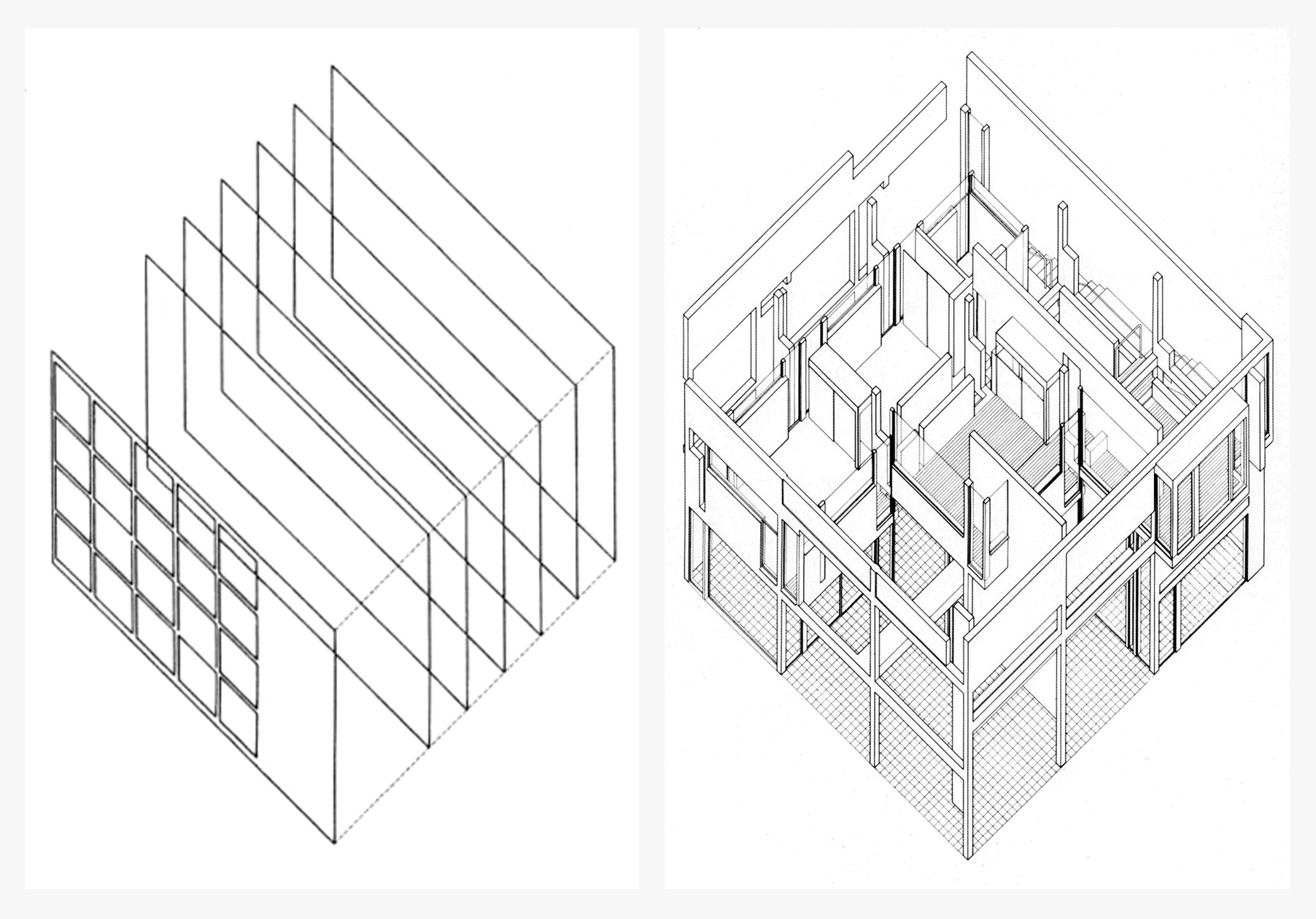
Pretty Hero's Odyssey Mythology Greek Goddesses! 45SURF goddesses are the perfect blend of Artemis, Athena, Hera, and Aphrodite! Of Venus, Minerva, and Ares, Demeter, and Nike!
Pretty Hero's Odyssey Mythology Swimsuit Bikini Model! Greek Goddess Nikon D800 Super Sharp AF-S NIKKOR 70-200mm f/2.8G ED VR II ! Golden Hero's Odyssey Goddess!
All of the new Gold 45 Revolver(TM) and 45SURF(R) logos and designs are inspired by the golden number phi and divine proportion! Just as my landscapes oft employ the golden rectangle and fibonacci spiral in composition, all the bikinis, shirts, and lingerie designs are made with the golden section and gold number Phi (1.618) in mind! The golden grids, rectangles, pentagons, and spirals make a far better system for compositions than does the rule of thirds! And too, the golden mean and divine proportion are found in every model--in her pretty face and in the divine proportions of the 45surf goddess's heavenly body! I'm working on a book on all this beautitful craziness in fine art landscapes and models called The Golden Hero's Odyssey, which also ties it to my physics theory Dynamic Dimenions theory (dx4/dt=ic). :)
More of the epic Greek goddess bikini swimsuit models on instagram!
I have been traveling around in Zion, Yosemite, the Grand Canyon, and Bryce Canyon! Will share soon! :)
ALL THE BEST on your Epic Hero's Odyssey from Johnny Ranger McCoy!
Follow me & 45surf!!
www.facebook.com/45surfAchillesOdysseyMythology/
www.facebook.com/elliot.mcgucken
Beautiful Swimsuit Bikini Surfer Girl Athletic Model Goddess ! Sexy, hot, tall, thin, tan,toned, tan, and fit!
Working on a photography book too--Hero's Odyssey Photography! It focuses on my greatest hits while telling the tsory behind each one, thusly teaching how to shoot epic landscapes, ballerinas, and models!
All the best on your Epic Hero's Odyssey!
45SURF! Celebrating epic, heroic poetry, classic goddess beauty and the classical soul! Shakespeare, Homer's Iliad & Odyssey, and Moby Dick!
Sony A7R2 Fine Art Bryce Canyon Hoo Doos Covered in Snow! Dr. Elliot McGucken Winter Bryce Canyon Fine Art Landscapes
Well I was shooting fall colors in Zion National PArk when I saw that they had forecast snow for Bryce Canyon, so instead of heading back to LA, I headed out to Bryce Canyon! And I was treated to snow, sun, clouds, snowstorm, and then a glorious sunrise over the s-capped hoo-doos in Bryce! :)
Sony A7RII Bryce Canyon & Zion National Park Autumn Dr. Elliot McGucken Fine Art Landscapes
Been busy traveling and shooting landscapes and working on my books The Golden Hero's Odyssey about the golden rectangle and divine proportion I use in a lot of my compositions! Also working on my physics book on Dynamic Dimensions Theory! The equation d4/dt=ic is on a lot of the 45surf swimsuit and shirts and all! :)
Follow me & 45surf!!
www.facebook.com/elliot.mcgucken
Beautiful snow covered hoo-doos in Bryce Canyon! Bryce Canyon hoodoos all covered in snow! Beautiful Bryce Canyon Fine Art Sunrise!
My fine art landscape lenses for the A7RII are the Sony 16-35mm Vario-Tessar T FE F4 ZA OSS E-Mount Lens and the Sony FE 24-240mm f/3.5-6.3 OSS Lens ! Love the Carl Zeiss and super sharp Sony Glass!
I love October!
New Epic Landscape Photography Guide book page!
www.facebook.com/epiclandscapephotography/
Epic Landscape Photography: The Mythological Principles of Fine Art Nature Photography
Golden Number Ratio Divine Proportion Compositions Fine Art Photography Dr. Elliot McGucken : Using the Nature's Golden Cut to Exalt Nature Photography!
Join my golden ratio groups!
www.facebook.com/goldennumberratio/
www.facebook.com/groups/1401714589947057/
instagram.com/goldennumberratio
Dr. Elliot McGucken Fine Art Landscape & Nature Photography
New book page!
www.facebook.com/epiclandscapephotography/
Epic Landscape Photography: The Mythological Principles of Fine Art Nature Photography
Ansel Adams used the golden ratio in his photography too:
www.youtube.com/watch?v=WFlzAaBgsDI
www.youtube.com/watch?v=zrOUX3ZCl7I
The Fibonacci Numbers are closely related to the golden ratio, and thus they also play a prominent role in exalted natural and artistic compositions!
I'm working on a far deeper book titled The Golden Ratio Number for Photographers. :)
The famous mathematician Jacob Bernoulli wrote:
The (golden spiral) may be used as a symbol, either of fortitude and constancy in adversity, or of the human body, which after all its changes, even after death, will be restored to its exact and perfect self.
Engraved upon Jacob’s tombstone is a spiral alongside the words, "Eadem Mutata Resurgo," meaning "Though changed, I shall rise again." And so it is that within the Golden Ratio Principle, the golden harmonies rise yet again.
The golden ratio is oft known as the divine cut, the golden cut, the divine proportion, the golden number, and PHI for the name of the architect of the Parthenon Phidias. It has exalted classical art on down through the millennia and it can exalt your art too!
Ask me anything about the golden ratio! :) I will do my best to answer!!
Enjoy my Fine Art Ballet instagram too!
Dr. Elliot McGucken's Golden Ratio Principle: The Golden Number Ratio Principle: Dr. E’s Golden Ratio Principle: The golden ratio exalts beauty because the number is a characteristic of the mathematically and physically most efficient manners of growth and distribution, on both evolutionary and purely physical levels. The golden ratio ensures that the proportions and structure of that which came before provide the proportions and structure of that which comes after. Robust, ordered growth is naturally associated with health and beauty, and thus we evolved to perceive the golden ratio harmonies as inherently beautiful, as we saw and felt their presence in all vital growth and life—in the salient features and proportions of humans and nature alike, from the distribution of our facial features and bones to the arrangements of petals, leaves, and sunflowers seeds. As ratios between Fibonacci Numbers offer the closest whole-number approximations to the golden ratio, and as seeds, cells, leaves, bones, and other physical entities appear in whole numbers, the Fibonacci Numbers oft appear in nature’s elements as “growth’s numbers.” From the dawn of time, humanity sought to salute their gods in art and temples exalting the same proportion by which all their vital sustenance and they themselves had been created—the golden ratio. the golden number, rectangle, and spiral!
What. A. Chore. I couldn’t begin to tell you why proportioning this engine has been such a bane, but between the boiler, the tanks, the cab, the bunker, the wheels…. No combination of sizes or shapes I tried worked. This result here… is the least offensive of my attempts and the last of my patience. At quick glance I think it at least communicates (auto tank). But I want to focus on a new build and need to move on. So here’s my first overhaul of the new year rail ready.