View allAll Photos Tagged pigmentation
Developing blotchy areas of darkened skin for pregnant women is quite common which are usually known as marks of pregnancy.
The equivalent of albinism in animals, erythrism results from the inheritance of two recessive genes for the absence of pigmentation. Normally the katydid colour palette runs the gamut of greens, browns and yellows, colours which keep them camouflaged and aid in their survival. Although it has been hypothesized that pink coloration may increase survival rates amongst red vegetation it is much more likely that the genetic anomaly decreases fitness by increasing the insect's visibility to predators. Therefore it is likely that most individuals with this condition don't survive long and rarely make it to adulthood, which made this discovery all the more noteworthy. Found during a night hike in Vohimana reserve, Madagascar.
OVERVIEW
At Aesthetic Medicine in Portland, Oregon, Dr. Jerry Darm and his dedicated staff have promoted wellness, health and beauty for over a decade. Over 50,000 procedures performed utilizing 25 different lasers and aesthetic devices have made Aesthetic Medicine one of the largest medical spas in the United States. The innovative 21st century technologies, the attention to detail and the dedication to customer service have given Aesthetic Medicine an A+ rating with the Better Business Bureau.
Skin Problems
Skin problems such as acne, rosacea, sun damage, pigmentation, scarring, unwanted hair, and moles can be safely and effectively treated with lasers and aesthetic devices.
Wrinkles
Fine lines, deep wrinkles, pore size, dark circles and overall skin texture are best treated with the Laser Lift™. This exclusive procedure combines microdermabrasion with three FDA approved lasers, which rejuvenate and tighten the skin while building new collagen.
Fine lines, deep wrinkles, pore size, dark circles and overall skin texture are best treated with the Laser Lift™. This exclusive procedure combines microdermabrasion with three FDA approved lasers, which rejuvenate and tighten the skin while building new collagen. For more information visit Dr. Darm or log on to www.drdarm.com
Injectables
Botox® and Dysport® are used to treat wrinkles in motion around the eyes and in the forehead. Injectable fillers including Juvederm® and Restylane® are used to fill in the deeper frown lines around the mouth and chin.
Unwanted Fat / Cellulite
Unwanted fat can be removed from the neck, arms, chest, abdomen, back, flanks and thighs using the unique Lipo Lift™ procedures developed at Aesthetic Medicine with minimum pain and downtime. We are one of the busiest centers in the United States and have performed over 500 Lipo Lift™ III (Laser Lypolysis ) procedures in the past year. For the noninvasive treatment of fat and cellulite we have combined several FDA approved devices (LipoLift™ I ).
Procedures:
Lipolift I – Mesoporation (Mesoderm) and VelaShape used for non-invasive treatment of fat and reduction of cellulite.
Lipolift III - Laser Lipolysis - Better than the traditional liposuction.
Unwanted fat can be removed with minimal pain and downtime by using the SlimLipo. Treatment areas include neck, arms, chest, back abdomen, flanks and thighs.
Weight Loss
Dr. Darm and his staff of dietitians and nutritionists have over 40 years of combined experience in Medical Weight Management. The average participant loses 40 to 60 pounds in a 3-6 month period. Thousands of patients have achieved success in this comprehensive program.
Spider Veins
Unsightly spider veins are successfully removed using sclerotherapy and laser treatments.
Facial Plastic Surgery
Blepharoplasty, Facelifts, Rhinoplasty, Necklifts, Browlifts, and related procedures are performed by our experienced board certified surgeon.
For more information log on to www.drdarm.com.
Sony A7III
🔬 Nikon TU Plan ELWD 50x
⚡ 50x || FOV ~0,6 mm️
Stacking 190 fotos️
ZS + PS
A 50 aumentos, observamos una zona de escamas estructurales en el ala anterior de la mariposa Graphium sarpedon. Estas escamas reflejan luz en tonos verde-azulados mediante interferencia estructural, no por pigmentos.
La superficie aparece uniforme porque las escamas están perfectamente alineadas y poseen nanoestructuras que rebotan la luz en una dirección precisa. Esto da lugar a un brillo metálico que cambia según el ángulo de visión. En contraste, las zonas marrones del ala tienen escamas pigmentarias más opacas y texturizadas.
Esta imagen muestra la diferencia visual y física entre tipos de escama, resaltando cómo la naturaleza genera color sin necesidad de tintes.
At 50x magnification, we observe a patch of structural scales on the forewing of Graphium sarpedon. These scales reflect green-blue tones through light interference, not pigmentation.
The surface looks smooth because the scales are perfectly aligned and built with nanostructures that reflect light in a specific direction. This creates a metallic sheen that shifts depending on the viewing angle. In contrast, the brown areas of the wing contain pigmented scales that are more opaque and textured.
This image reveals the visual and physical contrast between scale types, showing how nature creates color without any dye.
Hector's dolphin seen from the Black Cat in Akaroa harbour, day two of my friends visit from London. I took them over the Port hills to Akaroa. We had such a beautiful day and they enjoyed the trip.
The cruise is packed with highlights including the rare, NZ native dolphin - the Hector's Dolphin, as well as penguins and other sea birds. And you'll see giant volcanic sea cliffs and hear about Akaroa's fascinating past. Cruises depart every day, weather permitting.
The Back Cat is modern catamaran, the 60 foot /20 metre Black Cat (previously the Canterbury Cat), is perfect for viewing the natural wonders of Akaroa Harbour.
For More Info: www.blackcat.co.nz/akaroa-harbour-nature-cruises.html
Hector's dolphin (Cephalorhynchus hectori) is the best-known of the four dolphins in the genus Cephalorhynchus and is found only in New Zealand. At approximately 1.4 m in length, it is one of the smallest cetaceans, and New Zealand's only endemic cetacean.
Hector’s dolphin is the smallest of the dolphins. Mature adults have a total length of 1.2–1.6 m (3 ft 10 in–5 ft 3 in) and weigh 40–60 kg (88–130 lb). The species is sexually dimorphic, with females being slightly longer and heavier than males. The body shape is stocky, with no discernible beak. The most distinctive feature is the rounded dorsal fin, with a convex trailing edge and undercut rear margin.
The overall appearance is pale grey, but closer inspection reveals a complex and elegant combination of colours. The back and sides are predominantly light grey, while the dorsal fin, flippers, and flukes are black. The eyes are surrounded by a black mask, which extends forward to the tip of the rostrum and back to the base of the flipper. A subtly shaded, crescent-shaped black band crosses the head just behind the blowhole. The throat and belly are creamy white, separated by dark-grey bands meeting between the flippers. A white stripe extends from the belly onto each flank below the dorsal fin.
At birth, Hector’s dolphin calves have a total length of 60–80 cm (24–31 in) and weigh 8–10 kg (18–22 lb). Their coloration is the same as adults, although the grey has a darker hue. Four to six vertical pale stripes, caused by fetal folds affecting the pigmentation, are present on the calf’s body until an age of about six months.
For More Info: en.wikipedia.org/wiki/Hector%27s_dolphin
This beautiful, cute and adorable little white Screech Owl, named Luna, is just one of a huge number and variety of birds at the Peace River Wildlife Center that are there for rehabilitation. He’s a male leucistic screech owl. Although most Screech Owls are either gray or a reddish brown, Luna has Leucism, which is a condition that causes a partial loss of pigmentation. In the case of a bird, it results in white, pale, or patchy feathers but does not affect the eyes. Thus, although Luna white, he is not an albino.
Luna was perched on its handler's arm when I took this shot. I subsequently processed it in Color Efex Pro to darken the background.
While in Punta Gorda, Florida over the Christmas break, I visited the PRWC and made a donation. I was able to step into their large open-air bird cages to take photographs. Nestled into the mangroves on Charlotte Harbor at the Ponce de Leon Park, PRWC is a non-profit organization dedicated to the care, preservation and protection of Charlotte County's native wildlife.
To view my growing collection of wildlife pictures shot at the PRWC, see: www.flickr.com/photos/stevefrazier/albums/72157654341403290
You can visit the Peace River Wildlife Center online at peaceriverwildlifecenter.org
_MG_4118-B-WEB-LARG
© Stephen L. Frazier - All of my images are protected by copyright and may not be used on any site, blog, or forum without my permission.
Steve Frazier's main photography website is stevefrazierphotography.com
Contact me at stevefrazierphotography@gmail.com
Jet skiers are l aloud to go out and looks for the dolphins but they are not aloud to go fast. The Heactor's dolphins seem to enjoy the encounter.
Looking for Hector's dolphin seen from the Black Cat in Akaroa harbour, day two of my friends visit from London. I took them over the Port hills to Akaroa. We had such a beautiful day and they enjoyed the trip.
The cruise is packed with highlights including the rare, NZ native dolphin - the Hector's Dolphin, as well as penguins and other sea birds. And you'll see giant volcanic sea cliffs and hear about Akaroa's fascinating past. Cruises depart every day, weather permitting.
The Back Cat is modern catamaran, the 60 foot /20 metre Black Cat (previously the Canterbury Cat), is perfect for viewing the natural wonders of Akaroa Harbour.
For More Info: www.blackcat.co.nz/akaroa-harbour-nature-cruises.html
Hector's dolphin (Cephalorhynchus hectori) is the best-known of the four dolphins in the genus Cephalorhynchus and is found only in New Zealand. At approximately 1.4 m in length, it is one of the smallest cetaceans, and New Zealand's only endemic cetacean.
Hector’s dolphin is the smallest of the dolphins. Mature adults have a total length of 1.2–1.6 m (3 ft 10 in–5 ft 3 in) and weigh 40–60 kg (88–130 lb). The species is sexually dimorphic, with females being slightly longer and heavier than males. The body shape is stocky, with no discernible beak. The most distinctive feature is the rounded dorsal fin, with a convex trailing edge and undercut rear margin.
The overall appearance is pale grey, but closer inspection reveals a complex and elegant combination of colours. The back and sides are predominantly light grey, while the dorsal fin, flippers, and flukes are black. The eyes are surrounded by a black mask, which extends forward to the tip of the rostrum and back to the base of the flipper. A subtly shaded, crescent-shaped black band crosses the head just behind the blowhole. The throat and belly are creamy white, separated by dark-grey bands meeting between the flippers. A white stripe extends from the belly onto each flank below the dorsal fin.
At birth, Hector’s dolphin calves have a total length of 60–80 cm (24–31 in) and weigh 8–10 kg (18–22 lb). Their coloration is the same as adults, although the grey has a darker hue. Four to six vertical pale stripes, caused by fetal folds affecting the pigmentation, are present on the calf’s body until an age of about six months.
For More Info: en.wikipedia.org/wiki/Hector%27s_dolphin
Dr. Darm has practiced aesthetic medicine for the past 15 years, performing over 50,000 laser procedures. Previously, Dr. Darm was a board certified Emergency Medicine physician (ER doctor) with over 20 years experience. He graduated from Stanford University with a Bachelor of Science in Biology and a minor in Psychology. His medical training was obtained at OHSU.
Dr. Darm opened his private practice, Aesthetic Medicine, in 1995. Initially specializing in weight loss, he expanded to include hair removal and rosacea treatments in 1997. Since that time, new services have been added yearly to promote health, wellness and beauty. Dr. Darm has pioneered his own trademark procedure, LaserLift™ for the treatment of wrinkles, and LipoLift™ for the treatment of unwanted fat and cellulite. He is internationally recognized and sought out by patients from all over the world.
For more information log on www.drdarm.com.
KEYWORDS:
"Dr. Darm" "Aesthetic Medicine" "Medical spa Portland" "Day spa Portland" Lasers "Laser Treatments" "Skin clinic Portland" "Laser skin clinic Portland" "Laser liposuction Portland" "Laserlift Portland" "Laser lift Portland" "Lipo lift Portland" "Plastic surgeon Portland" "Dermatologist Portland" Esthetician "Board certified plastic surgeon" "Weight Loss Center Portland" "Medical Weight Management"
"Dr. Darm" "Aesthetic Medicine" Laserlift Lipolift "Laser Lipolysis" Velashape Mesoporation Mesoderm Slimlipo "Lipolift I" "Lipolift III" "Oregon Lipo" Lipo Liposuction "Cosmetic Surgery" "Portland Liposuction" "Laser Liposuction" "Body Sculpting" "Liposuction Portland" "Body Contouring" "Cosmetic Surgery Oregon" "Liposuction Surgeon" "Lipo Portland" "Plastic Surgeon" "Body Contour" "Affordable Liposuction" "Water Liposuction" "Water Lipo" "Board Certified Plastic Surgeon"
"Board Certified Plastic Surgery" "local plastic surgeon" "Liposuction Surgeon Portland" "Portland Liposuction Surgeon"
"Fat and Cellulite" Fat Cellulite "Orange peel" "Body Sculpting" "Lipolift I" "Lipolift III" "Lipolift trilogy" Mesoporation Mesoderm Mesotherapy Velashape Slimlipo "Laser Lipolysis" "Laser Liposuction" IPL "Laser surgery" "Laser surgery Portland" "Intense Pulsed Light"
"treatments of wrinkles" "Anti-aging" "Skin aging" "Age spots" "Age spots treatment" Botox Dysport Fillers Juvederm Restylane Laserlift "Skin resurfacing" "Laser skin resurfacing" "Chemical peel" "Chemical peeling" "Dermal fillers" Microdermabrasion Dermabrasion Photofacial Photorejuvenation Dermatologist Esthetician
"Skin Problems" "Laser skin" Acne "Acne vulgaris" "Acne scar treatment" "Acne cure" Moles "Skin tags" "Sun damage" "Dark circles" Rosacea Birthmarks Scars "Actinic keratosis" "Cosmetic laser" "Skin pigmentation treatment" "Stretch marks" Hyperpigmentation Hipopigmentation
"Hair Removal" "Hair Removal Portland, Oregon" "Laser hair" "Hair laser removal" "Hair laser removal Portland, Oregon" "Unwanted laser hair removal" "ELOS technology"
"Spider veins" "Spider veins treatment" "Spider veins before and after" "Varicose veins" "Vein therapy before and after" "Vein therapy" "Vein therapy Portland" Sclerotherapy "Sclerotherapy before and after" "Sclerotherapy Portland" "Radio Frequency"
"Weight Loss" "Medical weight management" "Medical weight loss program" "Low Calorie Diet program" "Healthy Solutions program" "Weight Loss before and after" "aesthetic medicine" "Dr. Darm" dietician nutritionist
"Facial Plastic Surgery" "Plastic Surgery Portland" "Plastic Surgery" "Plastic surgeries" "Plastic Surgeons"
"Face plastic surgery" Rhytidectomy Facelifts "Face lifts" Abdominoplasty "Tummy tuck" Rhinoplasty "Nose job" Otoplasty "Ear surgery" "Neck lift" "Cheek lift" Broplasty "Brow lifts" Blepharoplasty" "Eyelid surgery" "Reconstructive surgery" Microsurgery "Treatment of burns" "Breast implants" "Breast surgery" "Breast augmentations" "Breast reconstruction" "Boob job" Mammoplasty "Breast reduction" "Buttock augmentation" "Butt implant"
Dr. Darm has practiced aesthetic medicine for the past 15 years, performing over 50,000 laser procedures. Previously, Dr. Darm was a board certified Emergency Medicine physician (ER doctor) with over 20 years experience. He graduated from Stanford University with a Bachelor of Science in Biology and a minor in Psychology. His medical training was obtained at OHSU.
Dr. Darm opened his private practice, Aesthetic Medicine, in 1995. Initially specializing in weight loss, he expanded to include hair removal and rosacea treatments in 1997. Since that time, new services have been added yearly to promote health, wellness and beauty. Dr. Darm has pioneered his own trademark procedure, LaserLift™ for the treatment of wrinkles, and LipoLift™ for the treatment of unwanted fat and cellulite. He is internationally recognized and sought out by patients from all over the world.
For more information log on www.drdarm.com.
KEYWORDS:
"Dr. Darm" "Aesthetic Medicine" "Medical spa Portland" "Day spa Portland" Lasers "Laser Treatments" "Skin clinic Portland" "Laser skin clinic Portland" "Laser liposuction Portland" "Laserlift Portland" "Laser lift Portland" "Lipo lift Portland" "Plastic surgeon Portland" "Dermatologist Portland" Esthetician "Board certified plastic surgeon" "Weight Loss Center Portland" "Medical Weight Management"
"Dr. Darm" "Aesthetic Medicine" Laserlift Lipolift "Laser Lipolysis" Velashape Mesoporation Mesoderm Slimlipo "Lipolift I" "Lipolift III" "Oregon Lipo" Lipo Liposuction "Cosmetic Surgery" "Portland Liposuction" "Laser Liposuction" "Body Sculpting" "Liposuction Portland" "Body Contouring" "Cosmetic Surgery Oregon" "Liposuction Surgeon" "Lipo Portland" "Plastic Surgeon" "Body Contour" "Affordable Liposuction" "Water Liposuction" "Water Lipo" "Board Certified Plastic Surgeon"
"Board Certified Plastic Surgery" "local plastic surgeon" "Liposuction Surgeon Portland" "Portland Liposuction Surgeon"
"Fat and Cellulite" Fat Cellulite "Orange peel" "Body Sculpting" "Lipolift I" "Lipolift III" "Lipolift trilogy" Mesoporation Mesoderm Mesotherapy Velashape Slimlipo "Laser Lipolysis" "Laser Liposuction" IPL "Laser surgery" "Laser surgery Portland" "Intense Pulsed Light"
"treatments of wrinkles" "Anti-aging" "Skin aging" "Age spots" "Age spots treatment" Botox Dysport Fillers Juvederm Restylane Laserlift "Skin resurfacing" "Laser skin resurfacing" "Chemical peel" "Chemical peeling" "Dermal fillers" Microdermabrasion Dermabrasion Photofacial Photorejuvenation Dermatologist Esthetician
"Skin Problems" "Laser skin" Acne "Acne vulgaris" "Acne scar treatment" "Acne cure" Moles "Skin tags" "Sun damage" "Dark circles" Rosacea Birthmarks Scars "Actinic keratosis" "Cosmetic laser" "Skin pigmentation treatment" "Stretch marks" Hyperpigmentation Hipopigmentation
"Hair Removal" "Hair Removal Portland, Oregon" "Laser hair" "Hair laser removal" "Hair laser removal Portland, Oregon" "Unwanted laser hair removal" "ELOS technology"
"Spider veins" "Spider veins treatment" "Spider veins before and after" "Varicose veins" "Vein therapy before and after" "Vein therapy" "Vein therapy Portland" Sclerotherapy "Sclerotherapy before and after" "Sclerotherapy Portland" "Radio Frequency"
"Weight Loss" "Medical weight management" "Medical weight loss program" "Low Calorie Diet program" "Healthy Solutions program" "Weight Loss before and after" "aesthetic medicine" "Dr. Darm" dietician nutritionist
"Facial Plastic Surgery" "Plastic Surgery Portland" "Plastic Surgery" "Plastic surgeries" "Plastic Surgeons"
"Face plastic surgery" Rhytidectomy Facelifts "Face lifts" Abdominoplasty "Tummy tuck" Rhinoplasty "Nose job" Otoplasty "Ear surgery" "Neck lift" "Cheek lift" Broplasty "Brow lifts" Blepharoplasty" "Eyelid surgery" "Reconstructive surgery" Microsurgery "Treatment of burns" "Breast implants" "Breast surgery" "Breast augmentations" "Breast reconstruction" "Boob job" Mammoplasty "Breast reduction" "Buttock augmentation" "Butt implant"
Elvers climbing to base of Conowingo Dam on the Susquehanna River. Elvers are juvenile eels that migrate to brackish waters and begin to develop gray to greenish-brown pigmentation.
Credit: Maryland Fishery Resources Office, USFWS
O novo Site do Micael Tattoo Studio já está no ar !
Nova interface mais dinâmica e interativa com integração a redes sociais.
Visite e deixe seu comentário.
Se você vai fazer mais de uma tattoo, ou quer fazer algo junto com um amigo ou companheiro, consulte nossos pacotes.
Descontos especiais para fechamentos com temas diferenciados.
Venha nos visitar e fazer sua próxima tatuagem.
Atendimento personalizado com hora marcada, segunda a sábado das 10h as 19h.
Arquivo de imagens com mais de 10 mil referências, criação de desenhos exclusivos e acompanhamento total de sua tatuagem.
I was taken by a friend to visit the small colony of hyper-chromatic CSOs at the weekend. But in actual fact, most of the other spikes were almost as mad, with bold wonderful dots and swirls on the lips.
Here is a selection:
-------------------------------------------------
So, after the best part of five weeks doing little else than take photographs, I decided to spend Saturday painting the shed.
No I didn't, I went out orchiding.
Or did once we went to Tesco for the remainder of the shopping.
Another glorious warm day, that would be very good for photography,I thought.
Home for coffee and fruit for breakfast, before I packed my camera and headed to the Medway towns to meet up with two other people from my orchid group to hunt down some super rare orchids.
But then, they always are.
I drove up the A2/M2 to Chatham, turned off, and in a quiet residential area, I found Ian parked, so I pulled up behind him. Graham soon arrived too, and so we got out and set out down a narrow alleyway between the houses, into woodland behind.
Orchids are variable. Even the most common ones can produce spikes that are as rare as the rarest orchid species. And as all species can produce spikes with little or no pigmentation, they can also produce spikes with hyper-pigmentation.
Dactylorhiza fuchsii var. rhodochila, or a hyper-coloured Common Spotted Orchid. And in a colony where most spikes had strongly marked lips, there were four that really stood out, as the rings and dots had been covered by pigmantation, and the lips were a solid block of colour. I mean, I had seen shots of these, but to see them in person was something else.
We all took lots of shots, and then Graham said, I know of a colony of Lesser Butterfly orchids, would you like to see them?
We would.
The Lesser Butterfly at Barham have died out, and the ones at Stockbury seem to have had their flowers deliberately picked off this year, so another colony would be great to know about.
We drove in convoy for half an hour, met up in a pub car park, then drove in Graham's car to the end of a quiet, little used lane. A six-foot-sixer, Tony! And we set out on foot, a mile up the lane to a gate, where climbed over.
A car went by.
"What are you doing?"
We explained about the LBO and how rare they were and we knew they were in the wood. The gamekeeper knew about them too, and was happy to let us go, and if someone stopped us again, we could mention his name to say we had his blessing. We also said we would tell no one about the site.
We climbed over a fence into the wood, and shortly afterwards we saw the first of about twenty spikes, one measuring in at 68cm tall, and one that had a clear green colour to it.
We took shots of them all, though the humidity was getting to me, fogging the viewfinder and by glasses. Sometimes at the same time.
We walked back to the car, then droove back to the pub, so that we could go our separate ways. My plan was to head back to Dover, to call in at the council offices to see if the unusually marked Bee Orchid was showing.
It was, and had only just opened as the pollina had only just dropped and had not been visited by an insect yet.
I got shots, one of which came out rather well, even if i say so myself.
Then back home for a drink, then a bacon butty and a brew.
Phew, it was a scorcher.
I reviewed shots through the afternoon before we had Caprese again with the leftover bread from the day before.
Life was good.
We listened to Craig in the evening before heading up to bed at half eight.
Phew.
-----------------------------------------------
The Common Spotted-orchid is one of the few species that are still thriving in Britain despite the ongoing environmental damage and habitat desctruction that has caused so many other orchids to decline. Its secret is an adaptability that enables it to colonise new areas. Few of us can have failed to spot the vast numbers of Dactylorhiza fuchsii on urban roadside verges and roundabouts - this orchid is living among us. It lives up to its common name on both counts: this orchid is indeed common, and its leaves are profusely marked with dark spots and blotches. Although best known from alkaline habitats such as fens, dune slacks, old quarries and lime pits, the Common Spotted-orchid is also tolerant of mildly acidic substrates and so can sometimes be found on heathland among heather. In Britain and Ireland this orchid flowers from mid May to the end of July. On mainland Europe the range of Common Spotted-orchid extends from Scandinavia in the north through central Europe and southwards to the Mediterranean.
Taxonomy & Hybrids
Pollination is highly successful, and a number of insects - particularly beetles - are attracted to the flowers' nectar.
The specific name 'fuchsii' refers to the German botanist Leonard Fuchs.
There is one subspecies found in Britain: Dactylorhiza fuchsii subsp. hebridensis which is found in Scotland, the Outer Hebrides and western Ireland.
There are a number of varieties and hybrids. Dactylorhiza fuchsii var. albiflora has unmarked white flowers and is fairly widespread. Dactylorhiza fuchsii var. alpina has small, darker flowers and is found in Scotland and parts of northern England; it has also been reported from Wales. Dactylorhiza fuchsii var. cornubiensis is a smaller plant with a relatively large infloresence and larger flowers; it is found in Cornwall. Dactylorhiza fuchsii var. albiflora has unmarked white flowers and unspotted leaves; it is widespread but uncommon. Dactylorhiza fuchsii var. okellyii is somewhat contentious: it resembles Dactylorhiza fuchsii var. albiflora but the leaves can be either spotted or unspotted; this variety is thought to be confined to western Ireland, the Isle of Man and parts of Scotland. Dactylorhiza fuchsii var. rhodochila is a widespread but rare hyperchromatic variant with excessive pigmentation; the lips of its flowers are reddish purple with a paler border, and the leaves can have either heavily marked or completely purple leaves.
There are also several hybrids. Dactylorhiza x transiens is the hybrid with Heath Spotted-orchid Dactylorhiza maculata. Dactylorhiza x kernerorum is the hybrid with Early Marsh-orchid Dactylorhiza incarnata. Dactylorhiza x mixtum is a rare hybrid with the Frog Orchid Dactylorhiza viridis. Dactylorhiza x venusta is the hybrid with Northern Marsh-orchid Dactylorhiza purpurella. Dactylorhiza x grandis is the hybrid with Southern Marsh-orchid and is widespread in southern Britain. Dactylorhiza x silvae-gabretae is the hybrid with Narrow-leaved Marsh-orchid Dactylorhiza traunsteinerioides. Dactylorhiza x braunii is the hybrid with Irish Marsh-orchid Dactylorhiza occidentalis and is recorded from County Clare.
There is also an intergeneric hybrid. X Dactylodenia st-quintinii is the hybrid with Fragrant Orchid Gymnadenia conopsea and possibly with Britain's other two Fragrant Orchids.
www.hardyorchidsociety.org.uk/hos%201012/orchidphotos/dac...
A yearling American paddlefish hatched at GPNFH. This fish is much lighter in color than a normal individual due to a low amount of skin pigmentation.
Gavins Point National Fish Hatchery, Yankton, SD.
Photo: Sam Stukel, USFWS
Jet skiers are l aloud to go out and looks for the dolphins but they are not aloud to go fast. The Heactor's dolphins seem to enjoy the encounter.
Looking for Hector's dolphin seen from the Black Cat in Akaroa harbour, day two of my friends visit from London. I took them over the Port hills to Akaroa. We had such a beautiful day and they enjoyed the trip.
The cruise is packed with highlights including the rare, NZ native dolphin - the Hector's Dolphin, as well as penguins and other sea birds. And you'll see giant volcanic sea cliffs and hear about Akaroa's fascinating past. Cruises depart every day, weather permitting.
The Back Cat is modern catamaran, the 60 foot /20 metre Black Cat (previously the Canterbury Cat), is perfect for viewing the natural wonders of Akaroa Harbour.
For More Info: www.blackcat.co.nz/akaroa-harbour-nature-cruises.html
Hector's dolphin (Cephalorhynchus hectori) is the best-known of the four dolphins in the genus Cephalorhynchus and is found only in New Zealand. At approximately 1.4 m in length, it is one of the smallest cetaceans, and New Zealand's only endemic cetacean.
Hector’s dolphin is the smallest of the dolphins. Mature adults have a total length of 1.2–1.6 m (3 ft 10 in–5 ft 3 in) and weigh 40–60 kg (88–130 lb). The species is sexually dimorphic, with females being slightly longer and heavier than males. The body shape is stocky, with no discernible beak. The most distinctive feature is the rounded dorsal fin, with a convex trailing edge and undercut rear margin.
The overall appearance is pale grey, but closer inspection reveals a complex and elegant combination of colours. The back and sides are predominantly light grey, while the dorsal fin, flippers, and flukes are black. The eyes are surrounded by a black mask, which extends forward to the tip of the rostrum and back to the base of the flipper. A subtly shaded, crescent-shaped black band crosses the head just behind the blowhole. The throat and belly are creamy white, separated by dark-grey bands meeting between the flippers. A white stripe extends from the belly onto each flank below the dorsal fin.
At birth, Hector’s dolphin calves have a total length of 60–80 cm (24–31 in) and weigh 8–10 kg (18–22 lb). Their coloration is the same as adults, although the grey has a darker hue. Four to six vertical pale stripes, caused by fetal folds affecting the pigmentation, are present on the calf’s body until an age of about six months.
For More Info: en.wikipedia.org/wiki/Hector%27s_dolphin
A rare white ellipsen waterbuck calf stood out among his herd as he roamed his exhibit with his mother early this morning at the San Diego Zoo Safari Park. The Safari Park has successfully bred over 20,000 rare and endangered mammals for decades (278 of those were ellipsen waterbuck), but this is its first-ever animal born with leucism, a condition that causes an animal to have reduced pigmentation. The three-week-old calf, named Luke, was born on Sept. 6 in the Safari Park's South Africa exhibit.
Ellipsen or common waterbuck are recognizable by the bull's eye or ellipse-shaped ring on their rump. In Luke's case, the bull's eye is a brown ring on a white body, rather than a white ring on a brown body. In the wild, an animal with leucism is an easy target for prey as it stands out, unable to camouflage itself. Since Luke was born at the Safari Park, he has a good chance of survival as animal care staff can keep close watch on him.
Typical of waterbuck, Luke's mother kept him from harm by tucking him in the rocks in their habitat for his first two weeks while she rejoined the herd, returning to nurse the calf several times a day. Once the calf was strong enough, she allowed him to venture out with her to meet his herd and the 10 other animal species sharing his habitat, including rhinos, wildebeests and eland.
Keepers report the other animals have been curious about the calf, but his mother, father and other members of the waterbuck herd keep a close watch on the youngster.
Ellipsen waterbuck are found from central Kenya to northern Botswana and eastern South Africa. Waterbuck inhabit savannas and woodland areas within reach of permanent water. They are not aquatic but can hide in water from predators, when necessary.
Visitors to the Safari Park may see Luke and his mother on an Africa Tram tour, included with Park admission. www.sdzsafaripark.org
Sanguinelli (Citrus sinensis (L.) Osbeck) is a blood orange variety from Spain. The deep red coloration of the pulp "bleeds" through the rind as it ripens. The University of California Riverside online Citrus Variety Collection states that the "external red pigmentation is rarely equalled by other blood oranges and excelled by none, making the fruit most attractive."
Follow this link to learn more about the California Citrus State Historic Park
experience no pain, discomfort or irritation. We exfoliate area first. By exfoliating the skin you are allowing new skin to surface which in turn helps our skin lightening product work faster. lightening treatments for underarms, elbows, knees, private areas and sphincter. Body Bleaching has quickly become a very popular treatment. use safe lightening cream suitable for all body parts sphincter and private areas for both men and women.
Built in 1919-1920, this Chicago School and Sullivanesque-style building was designed by Louis Sullivan for the Farmers and Merchants Union Bank in Columbus, Wisconsin as one of his late-career “jewel box” bank buildings that are largely located in smaller communities throughout the midwest. The building was the last “jewel box bank” designed by Sullivan, and the second-to-last commission of his career, and was intended to communicate the bank as a modern and progressive institution, rather than employing the stodgier and more traditional Classical design found on most other banks of the era. The bank was commissioned by the president of the bank, J. Russell Wheeler, whose wife, Anna May Wheeler, pushed him to commission Sullivan to design a new home for the bank. In addition to Louis Sullivan, the building’s stained glass windows, were designed by architectural decorator Louis J. Millet, and the terra cotta by clay modeler Kristian Schneider, whom developed moulds for the building’s terra cotta, metal, and plaster details. The two artisans worked alongside Sullivan on several other bank projects. The building was heavily documented in Sullivan’s 1924 “A System of Architectural Ornament”, published shortly before he died.
The building is clad in red tapestry brick, which features blue and green mixed with the red clay mixture in some bricks, creating variation in color and texture across the facade. The brick creates a backdrop to some of the best terra cotta on any of Sullivan’s projects. The terra cotta features many of the floral and geometric motifs found on Sullivan’s other works, and is arranged similarly to other Sullivan banks that utilized brick cladding. The building features two principal facades, with a narrower facade along James Street, and a broader facade facing Dickason Boulevard. The James Street facade features two openings close to ground level, with the eastern bay housing a large plate glass window, and the western bay housing a doorway flanked by skylights, both of which are recessed under a large terra cotta architrave and flanked by square pilasters with decorative Sullivanesque ornament panels at the capitals. The architrave above the doorway and window is divided into three segments by vertical terra cotta elements that feature floral motifs and, like many Sullivan buildings, appear like plants with roots, branches, and crowns. The outer panels of the architrave feature circular cartouches with hexagonal trim, leaves, and geometric elements, with circular central medallions featuring the years 1861, when the bank was founded, and 1919, when the bank was completed. The central panel is clad in marble with the words “Farmers & Merchants Union Bank” and “Louis Sullivan, Architect” engraved into the stone with yellow pigmentation, contrasting against the white and green marble background. Atop the two vertical elements on either side of the central panel are griffin sculptures holding shields, a common element on many of Sullivan’s “Jewel Box Banks,” while the base of the outer vertical elements features the initials of the bank at the base. Above the architrave is an arched bay that houses a stained glass window, trimmed with decorative terra cotta at the inner and outer rings of the arch, with the bay becoming more recessed after each concentric arch, much like the entrances to medieval Romanesque churches. Besides a band of belt coursing that runs on either side of the architrave and wraps the corner to a tapered buttress on the Dickason Boulevard facade, the only other adornment is an eagle sculpture on a vertical trim element at the center of the parapet, which terminates many brick courses above the arched opening below, and another band of terra cotta trim along the top of the parapet, which forms a cap on the parapet around the perimeter of the building’s low-slope roof. On the Dickason Boulevard facade, the building features five recessed clerestory arched bays housing stained glass windows, flanked by tapered buttresses. Surrounding the arched tops of the windows are decorative trim panels with floral motifs, which begin just below the base of the arches, and extend up above the top of the arches, terminating in a band of belt coursing. Atop the buttresses at either end are trim elements featuring large spheres atop rectilinear legs with floral motifs below, undulating in and out with the brick below. Additionally, a band of belt coursing, which wraps the corner of Dickson Boulevard and James Street, runs beneath the windows, only interrupted by the buttresses. Toward the back, on the building’s original rear wing, there are three windows at eye level in the original building, with bands of belt coursing below and at the top of the parapet. The rear window is a recessed bay window flanked by two pilasters with sullivanesque terra cotta panels, while the smaller windows are flanked by sullivanesque relief panels. The rear wing features a roof at multiple heights, and was extended in 1961 with a matching addition by Law, Potter and Nystrom, since removed. The rear of the taller portion of the building features a simple recessed bay with an arched window, and a similar eagle sculpture and vertical trim piece as on the front facade.
Inside, the front wing of the building features a tall banking hall with brick cladding on the walls up to the level of the windows, where it terminates at a wooden sill. The space is split down the middle by a row of brick piers and low walls framing the teller cages, which terminate at the sill line of the windows, dividing the space while still allowing it to read as a single continuous lofty space. The brick forms piers at the teller’s cages, pilasters separating desks on the exterior wall, and low brick walls with marble caps. The upper portion of the walls and the coffered ceiling in this space is finished with white plaster, which gives the space a very vertical and airy feeling, as do the cream-colored terrazzo floors, which feature black edges at the base of the walls, tying the space together. The space features a terra cotta water fountain, or bubbler, also designed by sullivan, which features intricate ornament by Schneider. The space also features two mezzanine balconies with metal railings that run below the arched windows at the front and rear of the space, allowing managers to observe the activities in the lobby and teller area below from the rear balcony, while the front balcony exists solely to balance the space and keep it symmetrical. An office for private conferences with customers was originally located near the front of the space, along with a manager’s office, allowing convenience for customers seeking a meeting with the bank management. The teller’s side of the space also housed the bank’s two vaults and several other private offices. The bank originally featured a large meeting room in the one-story rear wing, behind the vaults, with a women’s waiting room sitting along the Dickason Boulevard side of the rear wing, featuring a bay window and a restroom. The building’s interior has changed in function somewhat due to the growth of the bank, changes in bank operations, and expansion of the building with new additions to house offices and a drive-through in the rear.
The building was listed on the National Register of Historic Places in 1972, was designated a National Historic Landmark in 1976, and is a contributing structure in the Columbus Downtown Historic District, listed on the National Register of Historic Places in 1992. The building saw an addition in 2006, clad in buff brick, which replicated a historic building that formerly stood to the east, and wraps the building to the rear, with a two-story section behind a one-story annex that connects the one-story rear wing of the bank to the new building. This wing replaced older additions made in 1961, which matched the one-story rear wing of the historic building, and 1980, which was modern in appearance and slightly recessed along James Street to give precedence to the historic building. The building still functions as the main office branch of the Farmers and Merchants Union Bank, which has grown substantially. The building has been long considered to be among the best of Sullivan’s “Jewel Box Banks,” and has been kept in excellent condition by the bank’s careful and caring generational stewardship.
The peregrine falcon (Falco peregrinus), also known simply as the peregrine, and historically as the duck hawk in North America, is a cosmopolitan bird of prey (raptor) in the family Falconidae. A large, crow-sized falcon, it has a blue-grey back, barred white underparts, and a black head. The peregrine is renowned for its speed. It can reach over 320 km/h (200 mph) during its characteristic hunting stoop (high-speed dive), making it the fastest member of the animal kingdom. According to a National Geographic TV program, the highest measured speed of a peregrine falcon is 389 km/h (242 mph). As is typical for bird-eating (avivore) raptors, peregrine falcons are sexually dimorphic, with females being considerably larger than males.
The peregrine's breeding range includes land regions from the Arctic tundra to the tropics. It can be found nearly everywhere on Earth, except extreme polar regions, very high mountains, and most tropical rainforests; the only major ice-free landmass from which it is entirely absent is New Zealand. This makes it the world's most widespread raptor and one of the most widely found wild bird species. In fact, the only land-based bird species found over a larger geographic area owes its success to human-led introduction; the domestic and feral pigeons are both domesticate forms of the rock dove, which are a major prey species for Eurasian Peregrine populations. Due to their prevalence over most other bird species in cities, feral pigeons support many peregrine populations as a staple food source, especially in urban settings.
The peregrine is a highly successful example of urban wildlife in much of its range, taking advantage of tall buildings as nest sites and an abundance of prey such as pigeons and ducks. Both the English and scientific names of this species mean "wandering falcon", referring to the migratory habits of many northern populations. Experts recognize 17 to 19 subspecies, which vary in appearance and range; disagreement exists over whether the distinctive Barbary falcon is represented by two subspecies of Falco peregrinus or is a separate species, F. pelegrinoides. The two species' divergence is relatively recent, during the time of the last ice age, therefore the genetic differential between them (and also the difference in their appearance) is relatively tiny. They are only about 0.6–0.8% genetically differentiated.
Although its diet consists almost exclusively of medium-sized birds, the peregrine will sometimes hunt small mammals, small reptiles, or even insects. Reaching sexual maturity at one year, it mates for life and nests in a scrape, normally on cliff edges or, in recent times, on tall human-made structures. The peregrine falcon became an endangered species in many areas because of the widespread use of certain pesticides, especially DDT. Since the ban on DDT from the early 1970s, populations have recovered, supported by large-scale protection of nesting places and releases to the wild.
The peregrine falcon is a well-respected falconry bird due to its strong hunting ability, high trainability, versatility, and availability via captive breeding. It is effective on most game bird species, from small to large. It has also been used as a religious, royal, or national symbol across multiple eras and areas of human civilization.
Description
Falco peregrinus. Royal National Park, New South Wales, Australia
The peregrine falcon has a body length of 34 to 58 cm (13–23 in) and a wingspan from 74 to 120 cm (29–47 in). The male and female have similar markings and plumage but, as with many birds of prey, the peregrine falcon displays marked sexual dimorphism in size, with the female measuring up to 30% larger than the male. Males weigh 330 to 1,000 g (12–35 oz) and the noticeably larger females weigh 700 to 1,500 g (25–53 oz). In most subspecies, males weigh less than 700 g (25 oz) and females weigh more than 800 g (28 oz), and cases of females weighing about 50% more than their male breeding mates are not uncommon. The standard linear measurements of peregrines are: the wing chord measures 26.5 to 39 cm (10.4–15.4 in), the tail measures 13 to 19 cm (5.1–7.5 in) and the tarsus measures 4.5 to 5.6 cm (1.8–2.2 in).
The back and the long pointed wings of the adult are usually bluish black to slate grey with indistinct darker barring (see "Subspecies" below); the wingtips are black. The white to rusty underparts are barred with thin clean bands of dark brown or black. The tail, coloured like the back but with thin clean bars, is long, narrow, and rounded at the end with a black tip and a white band at the very end. The top of the head and a "moustache" along the cheeks are black, contrasting sharply with the pale sides of the neck and white throat. The cere is yellow, as are the feet, and the beak and claws are black. The upper beak is notched near the tip, an adaptation which enables falcons to kill prey by severing the spinal column at the neck. An immature bird is much browner, with streaked, rather than barred, underparts, and has a pale bluish cere and orbital ring.
A study shows that their black malar stripe exists to reduce glare from solar radiation, allowing them to see better. Photos from The Macaulay Library and iNaturalist showed that the malar stripe is thicker where there is more solar radiation. That supports the solar glare hypothesis.
Taxonomy and systematics
Falco peregrinus was first described under its current binomial name by English ornithologist Marmaduke Tunstall in his 1771 work Ornithologia Britannica. The scientific name Falco peregrinus is a Medieval Latin phrase that was used by Albertus Magnus in 1225. Peregrinus is Latin, meaning "one from abroad" or "coming from foreign parts". It is likely the name was used as juvenile birds were taken while journeying to their breeding location (rather than from the nest), as falcon nests are often difficult to get at. The Latin term for falcon, falco, is related to falx, meaning "sickle", in reference to the silhouette of the falcon's long, pointed wings in flight.
The peregrine falcon belongs to a genus whose lineage includes the hierofalcon and the prairie falcon (F. mexicanus). This lineage probably diverged from other falcons towards the end of the Late Miocene or in the Late Pliocene, about 3–8 million years ago (mya). As the peregrine-hierofalcon group includes both Old World and North American species, it is likely that the lineage originated in western Eurasia or Africa. Its relationship to other falcons is not clear, as the issue is complicated by widespread hybridization confounding mtDNA sequence analyses. One genetic lineage of the saker falcon (F. cherrug) is known to have originated from a male saker ancestor producing fertile young with a female peregrine ancestor, and the descendants further breeding with sakers.
Today, peregrines are regularly paired in captivity with other species such as the lanner falcon (F. biarmicus) to produce the "perilanner", a somewhat popular bird in falconry as it combines the peregrine's hunting skill with the lanner's hardiness, or the gyrfalcon to produce large, strikingly coloured birds for the use of falconers. As can be seen, the peregrine is still genetically close to the hierofalcons, though their lineages diverged in the Late Pliocene (maybe some 2.5–2 mya in the Gelasian).
Subspecies
Numerous subspecies of Falco peregrinus have been described, with 19 accepted by the 1994 Handbook of the Birds of the World, which considers the Barbary falcon of the Canary Islands and coastal North Africa to be two subspecies (pelegrinoides and babylonicus) of Falco peregrinus, rather than a distinct species, F. pelegrinoides. The following map shows the general ranges of these 19 subspecies.
A map of the world, green shows on several continents, but there are also several big bare spots marked with E for extinct
Breeding ranges of the 19 subspecies
Falco peregrinus anatum, described by Bonaparte in 1838, is known as the American peregrine falcon or "duck hawk"; its scientific name means "duck peregrine falcon". At one time, it was partly included in leucogenys. It is mainly found in the Rocky Mountains. It was formerly common throughout North America between the tundra and northern Mexico, where current reintroduction efforts are being made to restore the population. Most mature anatum, except those that breed in more northern areas, winter in their breeding range. Most vagrants that reach western Europe seem to belong to the more northern and strongly migratory tundrius, only considered distinct since 1968. It is similar to the nominate subspecies but is slightly smaller; adults are somewhat paler and less patterned below, but juveniles are darker and more patterned below. Males weigh 500 to 700 g (1.1–1.5 lb), while females weigh 800 to 1,100 g (1.8–2.4 lb). It has become extinct in eastern North America and populations there are hybrids as a result of reintroductions of birds from elsewhere.
Falco peregrinus babylonicus, described by P.L. Sclater in 1861, is found in eastern Iran along the Hindu Kush and the Tian Shan to the Mongolian Altai ranges. A few birds winter in northern and northwestern India, mainly in dry semi-desert habitats. It is paler than pelegrinoides and somewhat similar to a small, pale lanner falcon (Falco biarmicus). Males weigh 330 to 400 grams (12 to 14 oz), while females weigh 513 to 765 grams (18.1 to 27.0 oz).
Falco peregrinus brookei, described by Sharpe in 1873, is also known as the Mediterranean peregrine falcon or the Maltese falcon. It includes caucasicus and most specimens of the proposed race punicus, though others may be pelegrinoides (Barbary falcons), or perhaps the rare hybrids between these two which might occur around Algeria. They occur from the Iberian Peninsula around the Mediterranean, except in arid regions, to the Caucasus. They are non-migratory. It is smaller than the nominate subspecies and the underside usually has a rusty hue. Males weigh around 445 g (0.981 lb), while females weigh up to 920 g (2.03 lb).
Falco peregrinus calidus, described by John Latham in 1790, it was formerly called leucogenys and includes caeruleiceps. It breeds in the Arctic tundra of Eurasia from Murmansk Oblast to roughly Yana and Indigirka Rivers, Siberia. It is completely migratory and travels south in winter as far as South Asia and sub-Saharan Africa. It is often seen around wetland habitats. It is paler than the nominate subspecies, especially on the crown. Males weigh 588 to 740 g (1.296–1.631 lb), while females weigh 925 to 1,333 g (2.039–2.939 lb).
Falco peregrinus cassini, described by Sharpe in 1873, is also known as the austral peregrine falcon. It includes kreyenborgi, the pallid falcon, a leucistic colour morph occurring in southernmost South America, which was long believed to be a distinct species. Its range includes South America from Ecuador through Bolivia, northern Argentina and Chile to Tierra del Fuego and the Falkland Islands. It is non-migratory. It is similar to the nominate subspecies, but slightly smaller with a black ear region. The pallid falcon morph kreyenborgi is medium grey above, has little barring below and has a head pattern like the saker falcon (Falco cherrug), but the ear region is white.
Falco peregrinus ernesti, described by Sharpe in 1894, is found from the Sunda Islands to the Philippines and south to eastern New Guinea and the nearby Bismarck Archipelago. Its geographical separation from nesiotes requires confirmation. It is non-migratory. It differs from the nominate subspecies in the very dark, dense barring on its underside and its black ear coverts.
Falco peregrinus furuitii, described by Momiyama in 1927, is found on the Izu and Ogasawara Islands south of Honshū, Japan. It is non-migratory. It is very rare and may only remain on a single island. It is a dark form, resembling pealei in colour, but darker, especially on the tail.
Falco peregrinus japonensis, described by Gmelin in 1788, includes kleinschmidti, pleskei, and harterti, and seems to refer to intergrades with calidus. It is found from northeast Siberia to Kamchatka (though it is possibly replaced by pealei on the coast there) and Japan. Northern populations are migratory, while those of Japan are resident. It is similar to the nominate subspecies, but the young are even darker than those of anatum.
Falco peregrinus macropus, described by Swainson in 1837, is the Australian peregrine falcon. It is found in Australia in all regions except the southwest. It is non-migratory. It is similar to brookei in appearance, but is slightly smaller and the ear region is entirely black. The feet are proportionally large.
Falco peregrinus madens, described by Ripley and Watson in 1963, is unusual in having some sexual dichromatism. If the Barbary falcon (see below) is considered a distinct species, it is sometimes placed therein. It is found in the Cape Verde Islands and is non-migratory; it is also endangered, with only six to eight pairs surviving. Males have a rufous wash on the crown, nape, ears and back; the underside is conspicuously washed pinkish-brown. Females are tinged rich brown overall, especially on the crown and nape.
Falco peregrinus minor, first described by Bonaparte in 1850. It was formerly often known as perconfusus. It is sparsely and patchily distributed throughout much of sub-Saharan Africa and widespread in Southern Africa. It apparently reaches north along the Atlantic coast as far as Morocco. It is non-migratory and dark-coloured. This is the smallest subspecies, with smaller males weighing as little as approximately 300 g (11 oz).
Falco peregrinus nesiotes, described by Mayr in 1941, is found in Fiji and probably also Vanuatu and New Caledonia. It is non-migratory.
Falco peregrinus pealei, described by Ridgway in 1873, is Peale's falcon and includes rudolfi. It is found in the Pacific Northwest of North America, northwards from Puget Sound along the British Columbia coast (including the Haida Gwaii), along the Gulf of Alaska and the Aleutian Islands to the far eastern Bering Sea coast of Russia, and may also occur on the Kuril Islands and the coasts of Kamchatka. It is non-migratory. It is the largest subspecies and it looks like an oversized and darker tundrius or like a strongly barred and large anatum. The bill is very wide. Juveniles occasionally have pale crowns. Males weigh 700 to 1,000 g (1.5–2.2 lb), while females weigh 1,000 to 1,500 g (2.2–3.3 lb).
Falco peregrinus pelegrinoides, first described by Temminck in 1829, is found in the Canary Islands through North Africa and the Near East to Mesopotamia. It is most similar to brookei, but is markedly paler above, with a rusty neck, and is a light buff with reduced barring below. It is smaller than the nominate subspecies; females weigh around 610 g (1.34 lb).
Falco peregrinus peregrinator, described by Sundevall in 1837, is known as the Indian peregrine falcon, black shaheen, Indian shaheen or shaheen falcon. It was formerly sometimes known as Falco atriceps or Falco shaheen. Its range includes South Asia from across the Indian subcontinent to Sri Lanka and southeastern China. In India, the shaheen falcon is reported from all states except Uttar Pradesh, mainly from rocky and hilly regions. The shaheen falcon is also reported from the Andaman and Nicobar Islands in the Bay of Bengal. It has a clutch size of 3 to 4 eggs, with the chicks fledging time of 48 days with an average nesting success of 1.32 chicks per nest. In India, apart from nesting on cliffs, it has also been recorded as nesting on man-made structures such as buildings and cellphone transmission towers.[36] A population estimate of 40 breeding pairs in Sri Lanka was made in 1996. It is non-migratory and is small and dark, with rufous underparts. In Sri Lanka this species is found to favour the higher hills, while the migrant calidus is more often seen along the coast.
Falco peregrinus peregrinus, the nominate (first-named) subspecies, described by Tunstall in 1771, breeds over much of temperate Eurasia between the tundra in the north and the Pyrenees, Mediterranean region and Alpide belt in the south. It is mainly non-migratory in Europe, but migratory in Scandinavia and Asia. Males weigh 580 to 750 g (1.28–1.65 lb), while females weigh 925 to 1,300 g (2.039–2.866 lb). It includes brevirostris, germanicus, rhenanus and riphaeus.
Falco peregrinus radama, described by Hartlaub in 1861, is found in Madagascar and the Comoros. It is non-migratory.
Falco peregrinus submelanogenys, described by Mathews in 1912, is the Southwest Australian peregrine falcon. It is found in southwestern Australia and is non-migratory.
Falco peregrinus tundrius, described by C.M. White in 1968, was at one time included in leucogenys. It is found in the Arctic tundra of North America to Greenland, and migrates to wintering grounds in Central and South America. Most vagrants that reach western Europe belong to this subspecies, which was previously considered synonymous with anatum. It is the New World equivalent to calidus. It is smaller and paler than anatum; most have a conspicuous white forehead and white in ear region, but the crown and "moustache" are very dark, unlike in calidus. Juveniles are browner and less grey than in calidus and paler, sometimes almost sandy, than in anatum. Males weigh 500 to 700 g (1.1–1.5 lb), while females weigh 800 to 1,100 g (1.8–2.4 lb). Despite its current recognition as a valid subspecies, a population genetic study of both pre-decline (i.e., museum) and recovered contemporary populations failed to distinguish genetically the anatum and tundrius subspecies.
Barbary falcon
Main article: Barbary falcon
The Barbary falcon is a subspecies of the peregrine falcon that inhabits parts of North Africa; namely, from the Canary Islands to the Arabian Peninsula. There is discussion concerning the taxonomic status of the bird, with some considering it a subspecies of the peregrine falcon and others considering it a full species with two subspecies (White et al. 2013). Compared to the other peregrine falcon subspecies, Barbary falcons sport a slimmer body and a distinct plumage color pattern. Despite numbers and range of these birds throughout the Canary Islands generally increasing, they are considered endangered, with human interference through falconry and shooting threatening their well-being. Falconry can further complicate the speciation and genetics of these Canary Islands falcons, as the practice promotes genetic mixing between individuals from outside the islands with those originating from the islands. Population density of the Barbary falcons on Tenerife, the biggest of the seven major Canary Islands, was found to be 1.27 pairs/100 km², with the mean distance between pairs being 5869 ± 3338 m. The falcons were only observed near large and natural cliffs with a mean altitude of 697.6 m. Falcons show an affinity for tall cliffs away from human-mediated establishments and presence.
Barbary falcons have a red neck patch, but otherwise differ in appearance from the peregrine falcon proper merely according to Gloger's rule, relating pigmentation to environmental humidity. The Barbary falcon has a peculiar way of flying, beating only the outer part of its wings like fulmars sometimes do; this also occurs in the peregrine falcon, but less often and far less pronounced. The Barbary falcon's shoulder and pelvis bones are stout by comparison with the peregrine falcon and its feet are smaller. Barbary falcons breed at different times of year than neighboring peregrine falcon subspecies, but they are capable of interbreeding. There is a 0.6–0.7% genetic distance in the peregrine falcon-Barbary falcon ("peregrinoid") complex.
Ecology and behaviour
The peregrine falcon lives mostly along mountain ranges, river valleys, coastlines, and increasingly in cities. In mild-winter regions, it is usually a permanent resident, and some individuals, especially adult males, will remain on the breeding territory. Only populations that breed in Arctic climates typically migrate great distances during the northern winter.
The peregrine falcon reaches faster speeds than any other animal on the planet when performing the stoop, which involves soaring to a great height and then diving steeply at speeds of over 320 km/h (200 mph), hitting one wing of its prey so as not to harm itself on impact. The air pressure from such a dive could possibly damage a bird's lungs, but small bony tubercles on a falcon's nostrils are theorized to guide the powerful airflow away from the nostrils, enabling the bird to breathe more easily while diving by reducing the change in air pressure. To protect their eyes, the falcons use their nictitating membranes (third eyelids) to spread tears and clear debris from their eyes while maintaining vision. The distinctive malar stripe or 'moustache', a dark area of feathers below the eyes, is thought to reduce solar glare and improve contrast sensitivity when targeting fast moving prey in bright light condition; the malar stripe has been found to be wider and more pronounced in regions of the world with greater solar radiation supporting this solar glare hypothesis. Peregrine falcons have a flicker fusion frequency of 129 Hz (cycles per second), very fast for a bird of its size, and much faster than mammals. A study testing the flight physics of an "ideal falcon" found a theoretical speed limit at 400 km/h (250 mph) for low-altitude flight and 625 km/h (388 mph) for high-altitude flight. In 2005, Ken Franklin recorded a falcon stooping at a top speed of 389 km/h (242 mph).
The life span of peregrine falcons in the wild is up to 19 years 9 months. Mortality in the first year is 59–70%, declining to 25–32% annually in adults. Apart from such anthropogenic threats as collision with human-made objects, the peregrine may be killed by larger hawks and owls.
The peregrine falcon is host to a range of parasites and pathogens. It is a vector for Avipoxvirus, Newcastle disease virus, Falconid herpesvirus 1 (and possibly other Herpesviridae), and some mycoses and bacterial infections. Endoparasites include Plasmodium relictum (usually not causing malaria in the peregrine falcon), Strigeidae trematodes, Serratospiculum amaculata (nematode), and tapeworms. Known peregrine falcon ectoparasites are chewing lice, Ceratophyllus garei (a flea), and Hippoboscidae flies (Icosta nigra, Ornithoctona erythrocephala).
In the Arctic Peregrine falcons chasing away small rodent predators from their nesting territory and Rough-legged Buzzards (Buteo lagopus) could use these hot spots as a nesting territory.
Feeding
The peregrine falcon's diet varies greatly and is adapted to available prey in different regions. However, it typically feeds on medium-sized birds such as pigeons and doves, waterfowl, gamebirds, songbirds, parrots, seabirds, and waders. Worldwide, it is estimated that between 1,500 and 2,000 bird species, or roughly a fifth of the world's bird species, are predated somewhere by these falcons.The peregrine falcon preys on the most diverse range of bird species of any raptor in North America, with over 300 species and including nearly 100 shorebirds. Its prey can range from 3 g (0.11 oz) hummingbirds (Selasphorus and Archilochus ssp.) to the 3.1 kg (6.8 lb) sandhill crane, although most prey taken by peregrines weigh between 20 g (0.71 oz) (small passerines) and 1,100 g (2.4 lb) (ducks, geese, loons, gulls, capercaillies, ptarmigans and other grouse). Smaller hawks (such as sharp-shinned hawks) and owls are regularly predated, as well as smaller falcons such as the American kestrel, merlin and, rarely, other peregrines.
In urban areas, where it tends to nest on tall buildings or bridges, it subsists mostly on a variety of pigeons. Among pigeons, the rock or feral pigeon comprises 80% or more of the dietary intake of peregrines. Other common city birds are also taken regularly, including mourning doves, common wood pigeons, common swifts, northern flickers, common starlings, American robins, common blackbirds, and corvids such as magpies, jays or carrion, house, and American crows. Coastal populations of the large subspecies pealei feed almost exclusively on seabirds. In the Brazilian mangrove swamp of Cubatão, a wintering falcon of the subspecies tundrius was observed successfully hunting a juvenile scarlet ibis.
Among mammalian prey species, bats in the genera Eptesicus, Myotis, Pipistrellus and Tadarida are the most common prey which taken at night. Though peregrines generally do not prefer terrestrial mammalian prey, in Rankin Inlet, peregrines largely take northern collared lemmings (Dicrostonyx groenlandicus) along with a few Arctic ground squirrels (Urocitellus parryii). Other small mammals including shrews, mice, rats, voles, and squirrels are more seldom taken. Peregrines occasionally take rabbits, mainly young individuals and juvenile hares. Additionally, remains of red fox kits and adult female American marten were found among prey remains. Insects and reptiles such as small snakes make up a small proportion of the diet, and salmonid fish have been taken by peregrines.
The peregrine falcon hunts most often at dawn and dusk, when prey are most active, but also nocturnally in cities, particularly during migration periods when hunting at night may become prevalent. Nocturnal migrants taken by peregrines include species as diverse as yellow-billed cuckoo, black-necked grebe, virginia rail, and common quail. The peregrine requires open space in order to hunt, and therefore often hunts over open water, marshes, valleys, fields, and tundra, searching for prey either from a high perch or from the air. Large congregations of migrants, especially species that gather in the open like shorebirds, can be quite attractive to a hunting peregrine. Once prey is spotted, it begins its stoop, folding back the tail and wings, with feet tucked. Prey is typically struck and captured in mid-air; the peregrine falcon strikes its prey with a clenched foot, stunning or killing it with the impact, then turns to catch it in mid-air. If its prey is too heavy to carry, a peregrine will drop it to the ground and eat it there. If they miss the initial strike, peregrines will chase their prey in a twisting flight.
Although previously thought rare, several cases of peregrines contour-hunting, i.e., using natural contours to surprise and ambush prey on the ground, have been reported and even rare cases of prey being pursued on foot. In addition, peregrines have been documented preying on chicks in nests, from birds such as kittiwakes. Prey is plucked before consumption. A 2016 study showed that the presence of peregrines benefits non-preferred species while at the same time causing a decline in its preferred prey. As of 2018, the fastest recorded falcon was at 242 mph (nearly 390 km/h). Researchers at the University of Groningen in the Netherlands and at Oxford University used 3D computer simulations in 2018 to show that the high speed allows peregrines to gain better maneuverability and precision in strikes.
Reproduction
The peregrine falcon is sexually mature at one to three years of age, but in larger populations they breed after two to three years of age. A pair mates for life and returns to the same nesting spot annually. The courtship flight includes a mix of aerial acrobatics, precise spirals, and steep dives. The male passes prey it has caught to the female in mid-air. To make this possible, the female actually flies upside-down to receive the food from the male's talons.
During the breeding season, the peregrine falcon is territorial; nesting pairs are usually more than 1 km (0.62 mi) apart, and often much farther, even in areas with large numbers of pairs. The distance between nests ensures sufficient food supply for pairs and their chicks. Within a breeding territory, a pair may have several nesting ledges; the number used by a pair can vary from one or two up to seven in a 16-year period.
The peregrine falcon nests in a scrape, normally on cliff edges. The female chooses a nest site, where she scrapes a shallow hollow in the loose soil, sand, gravel, or dead vegetation in which to lay eggs. No nest materials are added. Cliff nests are generally located under an overhang, on ledges with vegetation. South-facing sites are favoured. In some regions, as in parts of Australia and on the west coast of northern North America, large tree hollows are used for nesting. Before the demise of most European peregrines, a large population of peregrines in central and western Europe used the disused nests of other large birds. In remote, undisturbed areas such as the Arctic, steep slopes and even low rocks and mounds may be used as nest sites. In many parts of its range, peregrines now also nest regularly on tall buildings or bridges; these human-made structures used for breeding closely resemble the natural cliff ledges that the peregrine prefers for its nesting locations.
The pair defends the chosen nest site against other peregrines, and often against ravens, herons, and gulls, and if ground-nesting, also such mammals as foxes, wolverines, felids, bears, wolves, and mountain lions. Both nests and (less frequently) adults are predated by larger-bodied raptorial birds like eagles, large owls, or gyrfalcons. The most serious predators of peregrine nests in North America and Europe are the great horned owl and the Eurasian eagle-owl. When reintroductions have been attempted for peregrines, the most serious impediments were these two species of owls routinely picking off nestlings, fledglings and adults by night. Peregrines defending their nests have managed to kill raptors as large as golden eagles and bald eagles (both of which they normally avoid as potential predators) that have come too close to the nest by ambushing them in a full stoop. In one instance, when a snowy owl killed a newly fledged peregrine, the larger owl was in turn killed by a stooping peregrine parent.
The date of egg-laying varies according to locality, but is generally from February to March in the Northern Hemisphere, and from July to August in the Southern Hemisphere, although the Australian subspecies macropus may breed as late as November, and equatorial populations may nest anytime between June and December. If the eggs are lost early in the nesting season, the female usually lays another clutch, although this is extremely rare in the Arctic due to the short summer season. Generally three to four eggs, but sometimes as few as one or as many as five, are laid in the scrape. The eggs are white to buff with red or brown markings. They are incubated for 29 to 33 days, mainly by the female, with the male also helping with the incubation of the eggs during the day, but only the female incubating them at night. The average number of young found in nests is 2.5, and the average number that fledge is about 1.5, due to the occasional production of infertile eggs and various natural losses of nestlings.
After hatching, the chicks (called "eyases") are covered with creamy-white down and have disproportionately large feet. The male (called the "tiercel") and the female (simply called the "falcon") both leave the nest to gather prey to feed the young. The hunting territory of the parents can extend a radius of 19 to 24 km (12 to 15 mi) from the nest site. Chicks fledge 42 to 46 days after hatching, and remain dependent on their parents for up to two months.
Relationship with humans
The peregrine falcon is a highly admired falconry bird, and has been used in falconry for more than 3,000 years, beginning with nomads in central Asia. Its advantages in falconry include not only its athleticism and eagerness to hunt, but an equable disposition that leads to it being one of the easier falcons to train. The peregrine falcon has the additional advantage of a natural flight style of circling above the falconer ("waiting on") for game to be flushed, and then performing an effective and exciting high-speed diving stoop to take the quarry. The speed of the stoop not only allows the falcon to catch fast flying birds, it also enhances the falcon's ability to execute maneuvers to catch highly agile prey, and allows the falcon to deliver a knockout blow with a fist-like clenched talon against game that may be much larger than itself.
Additionally the versatility of the species, with agility allowing capture of smaller birds and a strength and attacking style allowing capture of game much larger than themselves, combined with the wide size range of the many peregrine subspecies, means there is a subspecies suitable to almost any size and type of game bird. This size range, evolved to fit various environments and prey species, is from the larger females of the largest subspecies to the smaller males of the smallest subspecies, approximately five to one (approximately 1500 g to 300 g). The males of smaller and medium-sized subspecies, and the females of the smaller subspecies, excel in the taking of swift and agile small game birds such as dove, quail, and smaller ducks. The females of the larger subspecies are capable of taking large and powerful game birds such as the largest of duck species, pheasant, and grouse.
Peregrine falcons handled by falconers are also occasionally used to scare away birds at airports to reduce the risk of bird-plane strikes, improving air-traffic safety. They were also used to intercept homing pigeons during World War II.
Peregrine falcons have been successfully bred in captivity, both for falconry and for release into the wild. Until 2004 nearly all peregrines used for falconry in the US were captive-bred from the progeny of falcons taken before the US Endangered Species Act was enacted and from those few infusions of wild genes available from Canada and special circumstances. Peregrine falcons were removed from the United States' endangered species list in 1999. The successful recovery program was aided by the effort and knowledge of falconers – in collaboration with The Peregrine Fund and state and federal agencies – through a technique called hacking. Finally, after years of close work with the US Fish and Wildlife Service, a limited take of wild peregrines was allowed in 2004, the first wild peregrines taken specifically for falconry in over 30 years.
The development of captive breeding methods has led to peregrines being commercially available for falconry use, thus mostly eliminating the need to capture wild birds for support of falconry. The main reason for taking wild peregrines at this point is to maintain healthy genetic diversity in the breeding lines. Hybrids of peregrines and gyrfalcons are also available that can combine the best features of both species to create what many consider to be the ultimate falconry bird for the taking of larger game such as the sage-grouse. These hybrids combine the greater size, strength, and horizontal speed of the gyrfalcon with the natural propensity to stoop and greater warm weather tolerance of the peregrine.
Decline due to pesticides
The peregrine falcon became an endangered species over much of its range because of the use of organochlorine pesticides, especially DDT, during the 1950s, '60s, and '70s. Pesticide biomagnification caused organochlorine to build up in the falcons' fat tissues, reducing the amount of calcium in their eggshells. With thinner shells, fewer falcon eggs survived until hatching. In addition, the PCB concentrations found in these falcons is dependent upon the age of the falcon. While high levels are still found in young birds (only a few months old) and even higher concentrations are found in more mature falcons, further increasing in adult peregrine falcons. These pesticides caused falcon prey to also have thinner eggshells (one example of prey being the Black Petrels). In several parts of the world, such as the eastern United States and Belgium, this species became extirpated (locally extinct) as a result. An alternate point of view is that populations in the eastern North America had vanished due to hunting and egg collection. Following the ban of organochlorine pesticides, the reproductive success of Peregrines increased in Scotland in terms of territory occupancy and breeding success, although spatial variation in recovery rates indicate that in some areas Peregrines were also impacted by other factors such as persecution.
Recovery efforts
Peregrine falcon recovery teams breed the species in captivity. The chicks are usually fed through a chute or with a hand puppet mimicking a peregrine's head, so they cannot see to imprint on the human trainers. Then, when they are old enough, the rearing box is opened, allowing the bird to train its wings. As the fledgling gets stronger, feeding is reduced, forcing the bird to learn to hunt. This procedure is called hacking back to the wild. To release a captive-bred falcon, the bird is placed in a special cage at the top of a tower or cliff ledge for some days or so, allowing it to acclimate itself to its future environment.
Worldwide recovery efforts have been remarkably successful. The widespread restriction of DDT use eventually allowed released birds to breed successfully. The peregrine falcon was removed from the U.S. Endangered Species list on 25 August 1999.
Some controversy has existed over the origins of captive breeding stock used by the Peregrine Fund in the recovery of peregrine falcons throughout the contiguous United States. Several peregrine subspecies were included in the breeding stock, including birds of Eurasian origin. Due to the extirpation of the eastern population of Falco peregrinus anatum, the near-extirpation of anatum in the Midwest and the limited gene pool within North American breeding stock, the inclusion of non-native subspecies was justified to optimize the genetic diversity found within the species as a whole.
During the 1970s, peregrine falcons in Finland experienced a population bottleneck as a result of large declines associated with bio-accumulation of organochloride pesticides. However, the genetic diversity of peregrines in Finland is similar to other populations, indicating that high dispersal rates have maintained the genetic diversity of this species.
Since peregrine falcon eggs and chicks are still often targeted by illegal poachers, it is common practice not to publicize unprotected nest locations.
Current status
Populations of the peregrine falcon have bounced back in most parts of the world. In the United Kingdom, there has been a recovery of populations since the crash of the 1960s. This has been greatly assisted by conservation and protection work led by the Royal Society for the Protection of Birds. The RSPB estimated that there were 1,402 breeding pairs in the UK in 2011. In Canada, where peregrines were identified as endangered in 1978 (in the Yukon territory of northern Canada that year, only a single breeding pair was identified), the Committee on the Status of Endangered Wildlife in Canada declared the species no longer at risk in December 2017.
Peregrines now breed in many mountainous and coastal areas, especially in the west and north, and nest in some urban areas, capitalising on the urban feral pigeon populations for food. Additionally, falcons benefit from artificial illumination, which allows the raptors to extend their hunting periods into the dusk when natural illumination would otherwise be too low for them to pursue prey. In England, this has allowed them to prey on nocturnal migrants such as redwings, fieldfares, starlings, and woodcocks.
In many parts of the world peregrine falcons have adapted to urban habitats, nesting on cathedrals, skyscraper window ledges, tower blocks, and the towers of suspension bridges. Many of these nesting birds are encouraged, sometimes gathering media attention and often monitored by cameras.
In England, peregrine falcons have become increasingly urban in distribution, particularly in southern areas where inland cliffs suitable as nesting sites are scarce. The first recorded urban breeding pair was observed nesting on the Swansea Guildhall in the 1980s. In Southampton, a nest prevented restoration of mobile telephony services for several months in 2013, after Vodafone engineers despatched to repair a faulty transmitter mast discovered a nest in the mast, and were prevented by the Wildlife and Countryside Act – on pain of a possible prison sentence – from proceeding with repairs until the chicks fledged.
In Oregon, Portland houses ten percent of the state's peregrine nests, despite only covering around 0.1 percent of the state's land area.
Cultural significance
Due to its striking hunting technique, the peregrine has often been associated with aggression and martial prowess. The Ancient Egyptian solar deity Ra was often represented as a man with the head of a peregrine falcon adorned with the solar disk, although most Egyptologists agree that it's most likely a Lanner falcon. Native Americans of the Mississippian culture (c. 800–1500) used the peregrine, along with several other birds of prey, in imagery as a symbol of "aerial (celestial) power" and buried men of high status in costumes associating to the ferocity of raptorial birds. In the late Middle Ages, the Western European nobility that used peregrines for hunting, considered the bird associated with princes in formal hierarchies of birds of prey, just below the gyrfalcon associated with kings. It was considered "a royal bird, more armed by its courage than its claws". Terminology used by peregrine breeders also used the Old French term gentil, "of noble birth; aristocratic", particularly with the peregrine.
The peregrine falcon is the national animal of the United Arab Emirates. Since 1927, the peregrine falcon has been the official mascot of Bowling Green State University in Bowling Green, Ohio. The 2007 U.S. Idaho state quarter features a peregrine falcon. The peregrine falcon has been designated the official city bird of Chicago.
The Peregrine, by J. A. Baker, is widely regarded as one of the best nature books in English written in the twentieth century. Admirers of the book include Robert Macfarlane, Mark Cocker, who regards the book as "one of the most outstanding books on nature in the twentieth century" and Werner Herzog, who called it "the one book I would ask you to read if you want to make films", and said elsewhere "it has prose of the calibre that we have not seen since Joseph Conrad". In the book, Baker recounts, in diary form, his detailed observations of peregrines (and their interaction with other birds) near his home in Chelmsford, Essex, over a single winter from October to April.
An episode of the hour-long TV series Starman in 1986 titled "Peregrine" was about an injured peregrine falcon and the endangered species program. It was filmed with the assistance of the University of California's peregrine falcon project in Santa Cruz.
its funny you take these birds continuously but every now and again one comes along thats got a brighter pigmentation than the others ,this is one of them jumped out of the screen at me ,minimal P.P ,and again a 1600iso shot
Clio has been trying to use 4% hydroquinone lotion to clear up the hyperpigmentation on her legs.... But once things got to the peeling phase, she decided to abort. Around September or so, she started using them on her arm hyperpigmentations (from where the hypertrophic scars were removed) with better & less disturbing results. Also, she was using the lotion incorrectly, applying it to adjacent areas instead of ONLY to the hyperpigmented areas.
Clio.
hydroquinone gel, legs, pigmentation, pink socks.
trans milestone.
upstairs, Clio and Carolyn's house, Alexandria, Virginia.
March 4, 2018.
... Read my blog at clintjcl at wordpress dot com
... Read Carolyn's blog at CarolynCASL at wordpress dot com
BACKSTORY: I booked an FFS (Facial Feminization Surgery) consultation with Dr. Bart Van Der Ven of 2Pass Clinic (Belgium). I'm really glad I went, because this was the surgeon I ultimately chose to do the surgery on September 4th, 2018. Skype consults are a thing, but there's no substitute for sitting there next to a surgeon, as he holds a metal ruler to parts of your face. Or his photography equipment for the "before" pictures. I received my simulation videos on the bus back to Virginia!
THE PLAN WAS A BIT CRAZY, THOUGH: We go to the club, then when it close at 3AM, we go home, and Clio then drives to DC to get on a bus to New York, arriving around 9AM, then finding her way to the consultation by 11AM, and back to the bus by 2PM, and back home by 7PM. And then straight to bed until the next day.
TRIP IN SUMMARY:
Failed repeatedly to drive into the Union Station parking garage, or any parking garage. End result: panic, hastily chosen street parking, and 4:35AM running toward Union Station dark and alonein DC .. I barely had water for the trip cause I used it all to run
The Megabus wifi sucked, but it was enough to keep up with things. It was that other non-megabus-bus that I took back, that had the broken wifi that didn't work.
I got there with time to spare - completed my consultation before it was scheduled to start - and had to kill like 90+ minutes before I left, as well. So the schedule was tight, but fine. I saw the empty slots in his booking and knew there'd be nobody before me (unless they booked after I did), so I knew if I showed up early I'd probably earn some extra wiggle room
Uber ended up costing more and taking longer than a taxi, because they charge you if you don't get picked up because you can't see the fucking car even tho the app is showing it go down the street right there and you are reading every license plate and the fucker just isn't there when the app says he's there. $5 each time. ... so it was like $9 Uber $12 taxi but I paid like $19 Uber because it took 3 Ubers for them to pick me up... And I had to fuck around for like 15 minutes ... Time for credit card disputes.
But the Uber BACK to the bus went well
IT WAS A TOUGH TRIP, but I did not keel over, and really was only miserable the last 2 hrs of the last bus trip. Though I WAS under-dressed with a light jacket and no hat/scarf, I don't deal with cold well, and I'm not from New York, so there were definitely a lot of moments where everyone in NYC was acting like a normal person, and I was jogging in place like a crazy person, out of breath, just trying to stay warm. At one point I ducked into the subway and hung out in a pissy area near a unconscious homeless dude because he knew what the fuck was up about avoiding this cold. But eventually I had to go into gift shops because the piss smell of NYC's subways is pretty ubiquitous and overwhelming
Dr. Bart Van Der Ven of 2pass Clinic ( www.2pass.eu ) saw me. He said I only need a Type 1 forehead reconstruction... Though if it ended up needing to be a Type 3, he'd only charge me for Type 1 [for reference: facialfeminization.surgery/index.php/forehead/ ]
But basically, he said I only need a Type 1 forehead reconstruction, not Type 3, because of where my brow bossing is
He measured my nose-to-lips and said I didn't need a lip lift. Dr. Bart simply rattles numbers off from his head, holds a ruler up.. I fell within female numbers anyway for the lip-to-nose distance. Something I've become increasingly LESS dysphoric of lately, as I look at more and more women through the eyes of one learning gendered skull structure knowledge.
He didn't want to do the cheek implants, just nasolabial ones. He said 4 implants has more infection chance than 2. Tho taking them out is rote and can be done locally. So why NOT get 4? Hmmm. [But the estimate came with cheek implants, and I ended up getting small ones, so hey! :)]
Sadly informed that something something lower orbital rim too far back compared to most people, not "abnormal" but uncommon means that something something something maybe that's why he only wanted the 2 implants [uh oh -- I got all 4 implants though. Sure wish I remember what that something something was]
He wasn't into wanting to do as aggressive of a jaw shave as I seemed to want, and ultimately it really wasn't that aggressive, and I wonder if I should have insisted on more, though I'm pretty happy with the results, and at the time of posting this (November 2018), swelling still hasn't gone down yet, to make a final judgment on just how happy I am with things. I'm fairly happy with the results so far. :)
O novo Site do Micael Tattoo Studio já está no ar !
Nova interface mais dinâmica e interativa com integração a redes sociais.
Visite e deixe seu comentário.
Se você vai fazer mais de uma tattoo, ou quer fazer algo junto com um amigo ou companheiro, consulte nossos pacotes.
Descontos especiais para fechamentos com temas diferenciados.
Venha nos visitar e fazer sua próxima tatuagem.
Atendimento personalizado com hora marcada, segunda a sábado das 10h as 19h.
Arquivo de imagens com mais de 10 mil referências, criação de desenhos exclusivos e acompanhamento total de sua tatuagem.
Humpback whales have patterns of black and white pigmentation and scars on the underside of their tails that are unique to each whale, just as fingerprints are to humans. This whale sighting off Provincetown, MA was submitted to the North Atlantic Humpback Whale Catalog (NAHWC).
www.messersmith.name/wordpress/2009/12/31/wrapping-up-2009/
After yesterday's dark and whiny rambling through the back alleys of my nearly comatose mind, which prompted friends to call to see if I was planning to depart post-haste to greener pastures (or no pasture at all), I should maybe craft some slightly more upbeat prose. As a recovering (seemingly forever) bipolar, I need to be reminded once in a while that things are never so dark as I may wish to paint them on a down day. The flip side of that, as those who've experienced that hideous roller-coaster will instantly proclaim, is that things are never so bright either.
But, never mind. I'm over that. My craving for sympathy is satiated and I still have plenty of pineapple upside-down cake left. Today we will meet a couple of new characters and visit again with some old friends. A few days ago I took KP Perkins for her first dives after the completion of her Open Water Course. On our second dive, we went to The Eel Garden near Pig Island. There, on the sandy bottom I got this pitiful shot of what we call a Leaf Fish. The "book" common name is Peacock Razorfish. This the juvenile phase of a species variation of Iniistius pavo: It's a funny little thing. Against the creamy white bottom it looks very dark brown. I had to squeeze very hard on the lemon to get a bit of detail out of the body. Tha's why it doesn't look like a very good picture. We call it a Leaf Fish because, unless you are looking for it, you will be fooled by its colour, shape, the little topknot looking like a stem and its insane wobbly swimming motion into believing that it is a leaf.
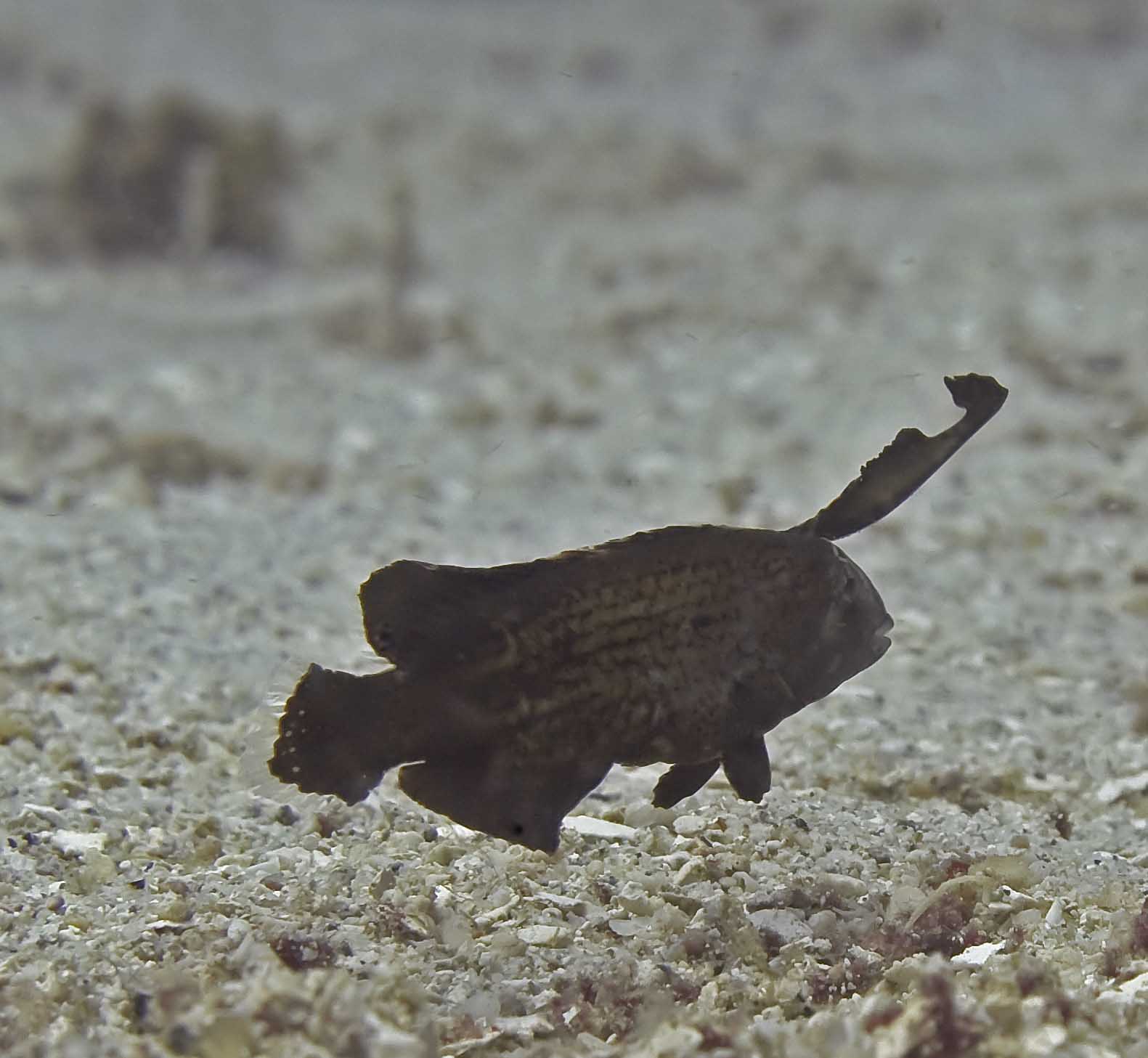
Here is another new something for you. It's a coral, but I'm unable to determine the species name, since I can't find it in my book. So, I'll just call it Spiral Coral for now: What intrigues me about this coral is the striking resemblance between this overhead view and images of the Belousov-Zhabotinsky (BZ) reaction. Say what? Well, it's a famous family of oscillating chemical reactions which can create amazing visible spiral patterns such as this: I wouldn't care to claim that I understand these reactions in anything other than a very general way. The details were not covered in CHEM-101 forty years ago. Nevertheless, the images were still im my mind and I could look them up with "spiral chemical reactions" using Google images. Ain't the web great? Anybody can seem like an authority on anything. Wait, maybe that's not so great.

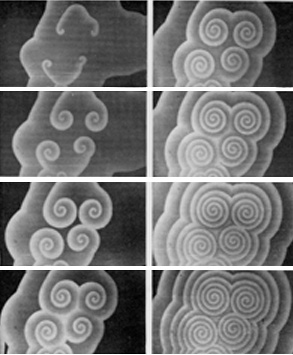
Well, here's a spiky old friend from only a few days ago. It's a Sea Cucumber (Thelenota ananas): I'm sure that it's the same one that I showed you before. It lives there.
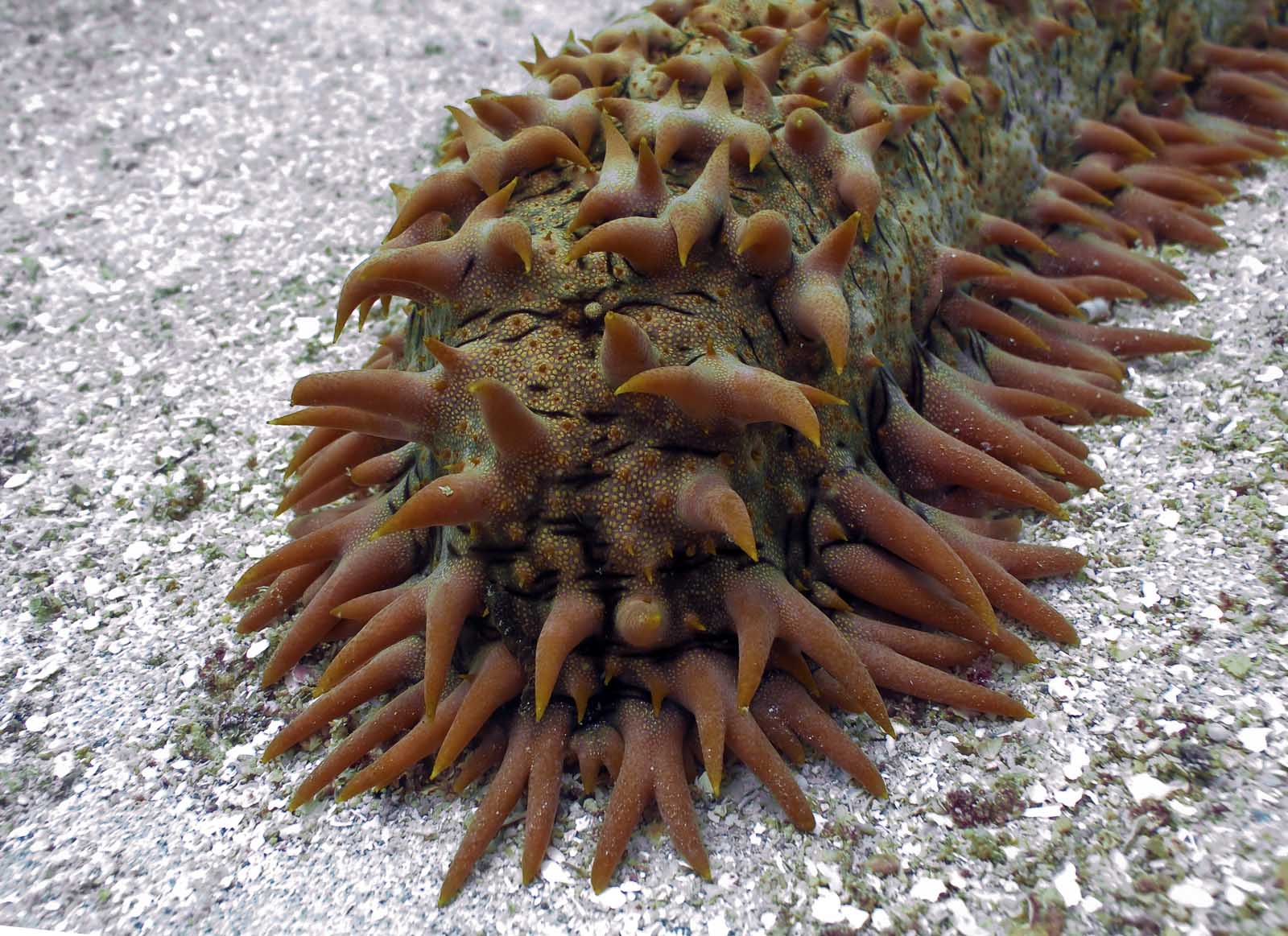
Here's another old buddy, the gorgeous Tomato anemonefish (Amphiprion frenatus): It this shot you can see the strong blue tint that is often seen in the white vertical bars. I'm not sure if this is really pigmentation - it doesn't appear to be so. I think that it either some sort of reflection of the sky (it seems to be more common on a sunny day when most of the sky is blue) or it is a property of the surface of the skin similar to butterfly wings that produces colour by means of optical effects at the nanometric level. But, who knows? Maybe God just paints it that way. I'm no expert.
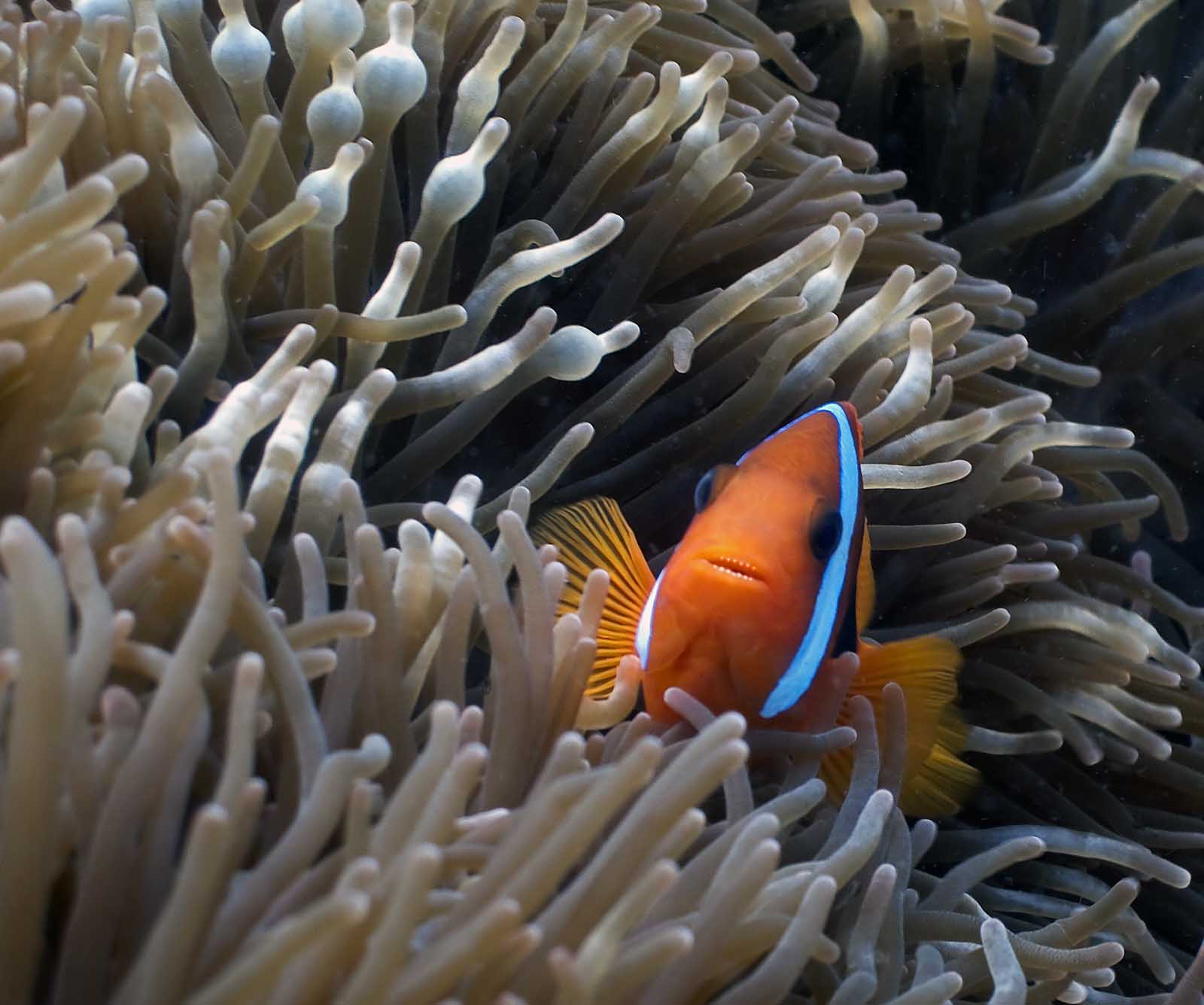
Here's another bit of underwater eye candy that you've seen here before. They are Sea Squirts (Polycarpa aurata): I like to think of them as elf shoes. See, they have nice little elastic bands around the ankles so that they won't fall off in the midst of mischief-making.
This is a shot that I really like. It's our old friend, the Spotted Shrimpgoby (Amblyeleotris guttata) way out at the end of his front porch: They usually stay right next to their hidey-hole. It's rare to see one that doesn't have its tail down the burrow. This one has strayed a few centimetres away. You can see the trail of "dust" that it kicked up when it last came out only a few seconds ago.
I had one chance at the shot above before the little spotted pixy dived back into its burrow. The image turned out perfect. Though it's not colourful, it is exactly as I saw it.
That is as close to diving as I can get you unless you're ready to get wet.
Did You Know?
Males sing complex songs on wintering grounds in Hawaii, that can last up to 20 minutes and be heard 20 miles (30 km) away!
In the Pacific, humpbacks migrate seasonally from Alaska to Hawaii--they can complete the 3,000-mile (4,830 km) trip in as few as 36 days!
Species Description:
Weight:25-40 tons (50,000-80,000 pounds; 22,000-36,000 kg);
newborns weigh about 1 ton (2,000 pounds; 900 kg)
Length:Up to 60 feet (18 m), with females larger than males;
newborns are about 15 feet (4.5 m) long
Appearance: Primarily dark grey, with some areas of white
Lifespan:About 50 years
Diet:Tiny crustaceans (mostly krill), plankton, and small fish; they can consume up to 3,000 pounds (1360 kg) of food per day
Behavior:Breaching (jumping out of the water), or slapping the surface
Humpback whales are well known for their long pectoral fins, which can be up to 15 feet (4.6 m) in length. Their scientific name, Megaptera novaeangliae, means "big-winged New Englander" as the New England population was the one best known to Europeans. These long fins give them increased maneuverability; they can be used to slow down or even go backwards.
Similar to all baleen whales, adult females are larger than adult males, reaching lengths of up to 60 feet (18 m). Their body coloration is primarily dark grey, but individuals have a variable amount of white on their pectoral fins and belly. This variation is so distinctive that the pigmentation pattern on the undersides of their "flukes" is used to identify individual whales, similar to a human fingerprint.
Humpback whales are the favorite of whale watchers, as they frequently perform aerial displays, such as breaching (jumping out of the water), or slapping the surface with their pectoral fins, tails, or heads.
In the summer, humpbacks are found in high latitude feeding grounds, such as the Gulf of Maine in the Atlantic and Gulf of Alaska in the Pacific. In the winter, they migrate to calving grounds in subtropical or tropical waters, such as the Dominican Republic in the Atlantic and the Hawaiian Islands in the Pacific. The Arabian Sea humpback does not migrate, remaining in tropical waters all year.
Humpback whales travel great distances during their seasonal migration, the farthest migration of any mammal. The longest recorded migration was 5,160 miles (8,300 km); seven animals, including a calf, completed this trek from Costa Rica to Antarctica. One of the more closely studied routes is between Alaska and Hawaii, where humpbacks have been observed making the 3,000-mile (4,830 km) trip in as few as 36 days.
During the summer months, humpbacks spend the majority of their time feeding and building up fat stores (blubber) that they will live off of during the winter. Humpbacks filter feed on tiny crustaceans (mostly krill), plankton, and small fish and can consume up to 3,000 pounds (1,360 kg) of food per day. Several hunting methods involve using air bubbles to herd, corral, or disorient fish. One highly complex variant, called "bubble netting" is unique to humpbacks. This technique is often performed in groups with defined roles for distracting, scaring, and herding before whales lunge at prey corralled near the surface.
In their wintering grounds, humpback whales congregate and engage in mating activities. Humpbacks are generally polygynous "having multiple female mates" with males exhibiting competitive behavior on wintering grounds. Aggressive and antagonistic behaviors include chasing, vocal and bubble displays, horizontal tail thrashing, and rear body thrashing. Males within these groups also make physical contact, striking or surfacing on top of one another. These bouts can cause injuries ranging from bloody scrapes to, in one recorded instance, death. Also on wintering grounds, males sing complex songs that can last up to 20 minutes and be heard 20 miles (30 km) away. A male may sing for hours, repeating the song several times. All males in a population sing the same song, but that song continually evolves over time. Humpback whale singing has been studied for decades, but scientists still understand very little about its function.
Gestation lasts for about 11 months. Newborns are 13-16 feet (4-5 m) long and grow quickly from the highly nutritious milk of their mothers. Weaning occurs between 6-10 months after birth. Mothers are protective and affectionate towards their calves, swimming close and frequently touching them with their flippers. Males do not provide parental support for calves. Breeding usually occurs once every two years, but sometimes occurs twice in a three-year span.
Habitat
During migration, humpbacks stay near the surface of the ocean.
While feeding and calving, humpbacks prefer shallow waters. During calving, humpbacks are usually found in the warmest waters available at that latitude. Calving grounds are commonly near offshore reef systems, islands, or continental shores.
Humpback feeding grounds are in cold, productive coastal waters.
Distribution
Humpback whales live in all major oceans from the equator to sub-polar latitudes.
In the North Pacific, there are at least three separate populations:
California/Oregon/Washington stock that winters in coastal Central America and Mexico and migrates to areas ranging from the coast of California to southern British Columbia in summer/fall;
Central North Pacific stock that winters in the Hawaiian Islands and migrates to northern British Columbia/ Southeast Alaska and Prince William Sound west to Kodiak; and Western North Pacific stock that winters near Japan and probably migrates to waters west of the Kodiak Archipelago (the Bering Sea and Aleutian Islands) in summer/fall. There is some mixing between these populations, though they are still considered distinct stocks.
Threats
Humpback whales face a series of threats including:
entanglement in fishing gear
Whale watch harassment
Habitat impacts
Harvest
Humpbacks can become entangled in fishing gear, either swimming off with the gear or becoming anchored. We have observed incidental "take" of humpback whales in the California/ Oregon swordfish and thresher shark drift gillnet fishery. Potential entanglement from gear from several fisheries can occur on their long migration from Hawaii to Alaska. Humpbacks in Hawaii have been observed entangled in long line gear, crab pots, and other non-fishery-related lines.
Inadvertent ship strikes can injure or kill humpbacks. Whale watching vessels may stress or even strike whales. The central North Pacific stock is the focus of a whale-watching industry on their wintering grounds in the Hawaiian Islands. The feeding aggregation in southeast Alaska is also the focus of a developing whale-watching industry that may impact whales in localized areas.
Shipping channels, fisheries, and aquaculture may occupy or destroy humpback whale aggregation areas. Recreational use of marine areas, including resort development and increased boat traffic, may displace whales that would normally use that area. In Hawaii, acoustic impacts from vessel operation, oceanographic research using active sonar, and military operations are also of increasing concern.
Source: www.nmfs.noaa.gov/pr/species/mammals/whales/humpback-whal...
Collected this one from leaf litter. After many photos of its face, it appears to me to have only 1 very long unpaired midfacial setae. It has very dark lateral body pigmentation. Looks strange to me, so I collected it and tried to document it. Will probably turn out to be just a Ptenothrix sp.3.
Taken in Battle Ground, Clark Co., WA, USA
www.simplyaroma.com/LisasSimplyAroma
Essential Oils for Face
List of essential oils for face based on your skin type
There are 8 skin types that we will cover, please carefully choose your skin type. If you're unsure, you can do the following test.
Go to your bed without applying any cream on your face. Next morning, before washing your face pat a few strips of brown paper on your skin zone, especially your T zone - chin, nose, your forehead.
Normal skin will have a little oil in the paper, while oily skin will leave a definite oil stain and dry oil won't leave any oil.
What to do if you fall more than one category for your skin type? You can custom your skin care products and choose techniques and ingredients to suit you best.
Basically, children have normal skin and become oily when we're teenager and as we grow older our skin become drier. For women age forty plus you should combine it with skin mature type. Usually woman's skin is more drier than man.
The basic skin care routine is cleansing, toning and moisturing. But you can add a weekly treatment such as steaming, exfoliation and mask.
Here are the essential oils for face based on the 8 skin types
essential oils for face
•Normal Skin
Moist and clear with even texture, color and pore sizes. Lavender, rose, geranium and neroli are good for normal skin.
•Oily Skin
Large pores, a thick coarse texture and overactive oil glands gives shine look to your skin. Basil, eucalyptus, cedarwood, cypress, rosemary, spike lavender and ylang ylang helps nomalize overactive glands.
•Dry Skin
Skin feels tight and dry after washing. Have a fine texture with no visible pores. Dehydrated skin, which produces enough oil but dose not retain enough moisture often mistaken for dry skin.
Atlas cedar, cypress, palmarosa, patchouli, rosemary, carrot see, spikenard, ylang ylang, vetiver and sandalwood.
German Chamomile to reduce inflammation. Chamomile and lavender soothe irritation, to balance oil glands production use lavender and geranium. Neroli promotes cell rejuvenation and the hydrosol is moisturizing. Small amount of peppermint or rosemary can stimulate oil production and increase circulation.
•Combination skin
You have oily skin in your T zone but dry on your cheek and mouth. Geranium, lavender, rose and neroli are consider normalizer and can be use both oily and dry skin. Ylang ylang can consider an appropriate essential oils for combination skin.
•Acne skin
Pimples, cysts and blackheads can occur in dry but often oily skin. Acne maybe temporarily because of teenage age and hormones make it excess oil production. But sometimes it follow people in adulthood. Click here to see essential oils for acne
•Couperose skin
Skin that marked with tiny dilated capillaries which mostly found in nose and cheeks. Use gentle chamomile - roman or german, to reduce inflammation, soothe delicate skin tissue and strengthen weak capillaries and reduce facial puffiness. Other than that, you can use helichrysum, rose, orange, lavender and neroli.
•Mature skin
The complexion tends to become drier. Skin produces less oil and got a few wrinkles lines. Lavender, rose, rosemary, neroli and geranium are antiaging ingredients for mature skin. Clary sage and fennel benefit to mature skin due their estrogenic properties. Rose hip seed oil use for dryness that accompany mature skin.
•Sun damaged skin
The effects on skin especially premature aging and pigmentation problems become the most apparent as we grow older. Prevention is the best medicine, so consider using these essential oils in skin preparations.
Olive and coconut oil blocks about 20% of sun rays, Helichrysum oil is also screens some UV Rays but don't expect it to provide SPF protection. Research has shown that sandalwood essential oils useful in cancer.
Lavender oil in 2% dillution of aloe vera gel-about 10 to 15 drops per ounce is the best sunburn remedy. Skin patches, skin damaged by sun or prone to early wrinkles, try to dilute 15 to 18 drops per ounce of carrot seed, helichrysum, frankincense and sandalwood ( choose one of them) and applied at least twice a day.
See a doctor if the skin conditions remain after a few weeks.
Le Macaque berbère ou Magot Macaca sylvanus est le seul macaque vivant sur le continent africain, à l'état sauvage dans les forêts relictuelles du Maroc et de l'Algérie ainsi que de manière artificielle sur le rocher de Gibraltar où il représente le seul primate d'Europe avec l'homo sapiens.
Les autres espèces du genre Macaca vivant principalement en Asie du sud et du sud-est, il est considéré comme l'une des formes ancestrales du rameau des macaques qui sont apparus en Afrique il y a 5,5 millions d'années. Néanmoins, sa morphologie et son écologie témoignent d'une réelle adaptation aux conditions de vie dans le Moyen Atlas et donc, bien que l'espèce soit toujours restée sur le continent des origines, elle diffère grandement des premiers macaques apparus.
The Barbary Macaque Macaca sylvanus or is the only macaque living on the African continent, in the wild in the forest remnants of Morocco and Algeria as well as artificially on the rock of Gibraltar, where he is the only primate to Europe with Homo sapiens.
Le macaque berbère présente un certain nombre d'adaptations morphologiques au froid lié à l'environnement montagnard où il vit, tempéré l'été et rigoureux l'hiver. De telles adaptations sont rares chez les primates et témoignent de la grande faculté d'adaptation des macaques puisqu'on en connaît un autre exemple fameux avec le macaque japonais Macaca fuscata capable de survivre dans une épaisse neige. Les adaptations morphologiques du magot sont une réduction de la longueur de la queue et des doigts sur les 4 membres (qui pourraient geler s'ils étaient plus longs, la queue est elle quasi inexistante), un allongement relatif de la longueur de la colonne vertébrale par rapport aux membres (qui permet de maintenir la température du corps grâce à une posture en boule lors de la recherche alimentaire) et bien sûr d'un fort épaississement du pelage en saison froide.
Le pelage est de couleur ocre-fauve à presque noir, selon la saison et les individus. De manière générale la face ventrale est beaucoup plus claire que la face dorsale et l'extrémité des membres plus foncés. Le faciès est glabre et peut présenter une grande variété de taches et de pigmentation selon les individus.
Comme chez tous les macaques, les mâles sont plus lourds et plus puissants que les femelles, présentent un dimorphisme sexuel quant à la longueur des canines et ne restent pas toute leur vie dans le groupe social où ils sont nés. À l'inverse, les femelles elles demeurent toute leur vie au sein de leur groupe de naissance sauf en cas de fission du groupe en plusieurs sous groupes.
Other species of the genus Macaca living mainly in South Asia and Southeast, he is considered one of the ancestral forms of shoot macaques that appeared in Africa about 5.5 million years ago. However, its morphology and ecology show a real adaptation to living conditions in the Middle Atlas and therefore, although the species is still remained on the continent of origin, it differs greatly from the first monkeys appeared.
Macaques Berber has a number of morphological adaptations to cold associated with the mountain environment where they live, temperate summer and harsh winter. Such adjustments are rare among primates and show the great adaptability of macaques because he knows one other example with the famous Japanese macaque Macaca fuscata able to survive in deep snow. The morphological adaptations of the ape is a reduction in the length of the tail and fingers on the 4 members (who would freeze if they were longer, the tail is virtually non-existent), a relative elongation of the length of the spine compared to members (which keeps the temperature of the body through posture ball while searching for food) and of course a strong thickening of the coat in winter.
The coat is tan-tan to almost black, depending on the season and individuals. Generally the underside is much lighter than the dorsum and the tip member darker. The facies is absent and may have a variety of spots and pigmentation among individuals.
As with all monkeys, males are heavier and stronger than females, have a sexual dimorphism in canine length and do not stay their whole lives in the social group they were born. Conversely, the females they remain throughout their lives in their birth group except for group fission into several subgroups.
Summary
The blood orange is a variety of orange (Citrus × sinensis) with crimson, almost blood-colored flesh.
The distinctive dark flesh color is due to the presence of anthocyanins, a family of antioxidant pigments common to many flowers and fruit, but uncommon in citrus fruits.[1] Chrysanthemin (cyanidin 3-O-glucoside) is the main compound found in red oranges.[2] The flesh develops its characteristic maroon color when the fruit develops with low temperatures during the night.[3] Sometimes, dark coloring is seen on the exterior of the rind, as well, depending on the variety of blood orange. The skin can be tougher and harder to peel than that of other oranges. Blood oranges have a unique flavor profile compared to other oranges, being distinctly raspberry-like in addition to the usual citrus notes.[3]
The blood orange is a natural mutation of the orange, which is itself a hybrid, probably between the pomelo and the tangerine,[4] Within Europe, the arancia rossa di Sicilia (red orange of Sicily) has Protected Geographical Status.[5] In the Land of Valencia, it was introduced in the second half of the 19th century.[6]
The three most common types of blood oranges are the 'Tarocco' (native to Italy), the 'Sanguinello' (native to Spain), and the 'Moro', the newest variety of the three.[7][8] Other less common types include 'Maltese', 'Khanpur', 'Washington Sanguine', 'Ruby Blood', 'Sanguina Doble Fina', 'Delfino', 'Red Valencia', 'Burris Blood Valencia', 'Vaccaro', 'Sanguine grosse ronde', 'Entre Fina', and 'Sanguinello a pignu'. The 'Maltese' is known to be the sweetest.[9] While also pigmented, Cara cara navels and Vainiglia Sanguignos have pigmentation based on lycopene, not anthocyanins like blood oranges.[7]
Blood oranges' red pigment anthocyanin is an antioxidant.[1] The pigments begin accumulating in the vesicles at the edges of the segments and at the blossom end of the fruit, and continue accumulating in cold storage after harvest. Due to its pigments, the blood orange contain greater amounts of antioxidants than other oranges.
Some blood orange juice may be somewhat tart, while other kinds are sweet while retaining the characteristic blood orange taste. The oranges can also be used to create marmalade, and the zest can be used for baking.[16][17] A popular Sicilian winter salad is made with sliced blood oranges, sliced bulb fennel, and olive oil.[18] The oranges have also been used to create gelato, sorbet, and Italian soda.[19][20][21] Blood oranges are also popular in vinaigrette-style dressings, and are sometimes used to flavor niche-market beer.[22][23]
Blood oranges are a source of vitamin C like all citrus fruits. A medium-sized (154-g) orange also provides 28% of the recommended daily intake of dietary fiber.[citation needed] Oranges can also be a valuable source of folate, calcium, and thiamine.[24]
The juice of the 'Moro', rich in anthocyanins, improved fatty liver in mice. 'Moro' juice counteracts liver steatogenesis in mice with diet-induced obesity, thus may represent a promising dietary option for the prevention of fatty liver.[25]
en.wikipedia.org/wiki/Blood_orange
In Season: Blood Oranges
Gory name aside, this is one of the tastiest members of the orange family.
Su Reid August 14, 2008
A little history: Because the orange tree can simultaneously produce flowers, fruit, and foliage, these succulent fruits have long been associated with fertility. Although some are grown in California, most blood oranges come from Mediterranean countries (Southern Italy in particular) and are often considered to be among the finest dessert oranges in the world.
What they look like: They sport a thin, red-blushed orange skin, with flesh that ranges in color from pink to brilliant red to burgundy; taste-wise, they're tart-sweet and slightly berry-like.
Selection tips: Pick those that are firm to the touch and heavy for their size. Although bits of green and rough, brownish areas on the skin have no effect on flavor or quality, do avoid any fruits with mold or spongy spots. Note: One pound equals about three medium oranges and one cup of juice.
Storage tips: To keep these ruby gems fresh longer, choose refrigeration over the fruit bowl―they'll only last only a couple of days at room temperature, but up to two weeks in the fridge.
How to eat them: Blood oranges are best eaten fresh―out of hand, or in salads, salsas, or marmalades. If you're following a recipe you may be asked to section the fruit. To do so, peel the orange, cut between the white membranes to expose the flesh, and remove the sections (for more juice, squeeze the leftover membranes).
Peak growing season: The two most popular varieties are the dark-fleshed Moro and the delicately flavored Tarocco. The former is available from December to March, and the latter from January to May.
Health benefits: Oranges are rich in antioxidants―vital for healthy cells―including vitamin C, which aids in healing, boosts your immune system, helps your body absorb iron, and even helps reduce the risk of cancer. This citrus fruit is also a good source of fiber, which helps lower cholesterol and, like vitamin C, reduce your cancer risk. (To maximize your fiber intake, be sure to eat some of the spongy white pith right under the skin.)
Nutritional info: One tasty, medium-sized blood orange will provide you with 70 calories, 3.0 grams of fiber, 1.0 gram of protein, and no fat, sodium, or cholesterol.
Jellyfish, also known sea jellies, are the medusa-phase of certain gelatinous members of the subphylum Medusozoa, which is a major part of the phylum Cnidaria.
Jellyfish are mainly free-swimming marine animals with umbrella-shaped bells and trailing tentacles, although a few are anchored to the seabed by stalks rather than being mobile. The bell can pulsate to provide propulsion for highly efficient locomotion. The tentacles are armed with stinging cells and may be used to capture prey and defend against predators. Jellyfish have a complex life cycle. The medusa is normally the sexual phase, which produces planula larvae; these then disperse widely and enter a sedentary polyp phase, before reaching sexual maturity.
Jellyfish are found all over the world, from surface waters to the deep sea. Scyphozoans (the "true jellyfish") are exclusively marine, but some hydrozoans with a similar appearance live in freshwater. Large, often colorful, jellyfish are common in coastal zones worldwide. The medusae of most species are fast-growing, and mature within a few months then die soon after breeding, but the polyp stage, attached to the seabed, may be much more long-lived. Jellyfish have been in existence for at least 500 million years, and possibly 700 million years or more, making them the oldest multi-organ animal group.
Jellyfish are eaten by humans in certain cultures. They are considered a delicacy in some Asian countries, where species in the Rhizostomeae order are pressed and salted to remove excess water. Australian researchers have described them as a "perfect food": sustainable and protein-rich but relatively low in food energy.
They are also used in research, where the green fluorescent protein used by some species to cause bioluminescence has been adapted as a fluorescent marker for genes inserted into other cells or organisms.
The stinging cells used by jellyfish to subdue their prey can injure humans. Thousands of swimmers worldwide are stung every year, with effects ranging from mild discomfort to serious injury or even death. When conditions are favourable, jellyfish can form vast swarms, which can be responsible for damage to fishing gear by filling fishing nets, and sometimes clog the cooling systems of power and desalination plants which draw their water from the sea.
Names
The name jellyfish, in use since 1796, has traditionally been applied to medusae and all similar animals including the comb jellies (ctenophores, another phylum). The term jellies or sea jellies is more recent, having been introduced by public aquaria in an effort to avoid use of the word "fish" with its modern connotation of an animal with a backbone, though shellfish, cuttlefish and starfish are not vertebrates either. In scientific literature, "jelly" and "jellyfish" have been used interchangeably. Many sources refer to only scyphozoans as "true jellyfish".
A group of jellyfish is called a "smack" or a "smuck".
Definition
The term jellyfish broadly corresponds to medusae, that is, a life-cycle stage in the Medusozoa. The American evolutionary biologist Paulyn Cartwright gives the following general definition:
Typically, medusozoan cnidarians have a pelagic, predatory jellyfish stage in their life cycle; staurozoans are the exceptions [as they are stalked].
The Merriam-Webster dictionary defines jellyfish as follows:
A free-swimming marine coelenterate that is the sexually reproducing form of a hydrozoan or scyphozoan and has a nearly transparent saucer-shaped body and extensible marginal tentacles studded with stinging cells.
Given that jellyfish is a common name, its mapping to biological groups is inexact. Some authorities have called the comb jellies and certain salps jellyfish, though other authorities state that neither of these are jellyfish, which they consider should be limited to certain groups within the medusozoa.
The non-medusozoan clades called jellyfish by some but not all authorities (both agreeing and disagreeing citations are given in each case) are indicated with on the following cladogram of the animal kingdom:
Jellyfish are not a clade, as they include most of the Medusozoa, barring some of the Hydrozoa. The medusozoan groups included by authorities are indicated on the following phylogenetic tree by the presence of citations. Names of included jellyfish, in English where possible, are shown in boldface; the presence of a named and cited example indicates that at least that species within its group has been called a jellyfish.
Taxonomy
The subphylum Medusozoa includes all cnidarians with a medusa stage in their life cycle. The basic cycle is egg, planula larva, polyp, medusa, with the medusa being the sexual stage. The polyp stage is sometimes secondarily lost. The subphylum include the major taxa, Scyphozoa (large jellyfish), Cubozoa (box jellyfish) and Hydrozoa (small jellyfish), and excludes Anthozoa (corals and sea anemones). This suggests that the medusa form evolved after the polyps. Medusozoans have tetramerous symmetry, with parts in fours or multiples of four.
The four major classes of medusozoan Cnidaria are:
Scyphozoa are sometimes called true jellyfish, though they are no more truly jellyfish than the others listed here. They have tetra-radial symmetry. Most have tentacles around the outer margin of the bowl-shaped bell, and long, oral arms around the mouth in the center of the subumbrella.
Cubozoa (box jellyfish) have a (rounded) box-shaped bell, and their velarium assists them to swim more quickly. Box jellyfish may be related more closely to scyphozoan jellyfish than either are to the Hydrozoa.
Hydrozoa medusae also have tetra-radial symmetry, nearly always have a velum (diaphragm used in swimming) attached just inside the bell margin, do not have oral arms, but a much smaller central stalk-like structure, the manubrium, with terminal mouth opening, and are distinguished by the absence of cells in the mesoglea. Hydrozoa show great diversity of lifestyle; some species maintain the polyp form for their entire life and do not form medusae at all (such as Hydra, which is hence not considered a jellyfish), and a few are entirely medusal and have no polyp form.
Staurozoa (stalked jellyfish) are characterized by a medusa form that is generally sessile, oriented upside down and with a stalk emerging from the apex of the "calyx" (bell), which attaches to the substrate. At least some Staurozoa also have a polyp form that alternates with the medusoid portion of the life cycle. Until recently, Staurozoa were classified within the Scyphozoa.
There are over 200 species of Scyphozoa, about 50 species of Staurozoa, about 50 species of Cubozoa, and the Hydrozoa includes about 1000–1500 species that produce medusae, but many more species that do not.
Fossil history
Since jellyfish have no hard parts, fossils are rare. The oldest unambiguous fossil of a free-swimming medusa is Burgessomedusa from the mid Cambrian Burgess Shale of Canada, which is likely either a stem group of box jellyfish (Cubozoa) or Acraspeda (the clade including Staurozoa, Cubozoa, and Scyphozoa). Other claimed records from the Cambrian of China and Utah in the United States are uncertain, and possibly represent ctenophores instead.
Anatomy
The main feature of a true jellyfish is the umbrella-shaped bell. This is a hollow structure consisting of a mass of transparent jelly-like matter known as mesoglea, which forms the hydrostatic skeleton of the animal. 95% or more of the mesogloea consists of water, but it also contains collagen and other fibrous proteins, as well as wandering amoebocytes which can engulf debris and bacteria. The mesogloea is bordered by the epidermis on the outside and the gastrodermis on the inside. The edge of the bell is often divided into rounded lobes known as lappets, which allow the bell to flex. In the gaps or niches between the lappets are dangling rudimentary sense organs known as rhopalia, and the margin of the bell often bears tentacles.
Anatomy of a scyphozoan jellyfish
On the underside of the bell is the manubrium, a stalk-like structure hanging down from the centre, with the mouth, which also functions as the anus, at its tip. There are often four oral arms connected to the manubrium, streaming away into the water below. The mouth opens into the gastrovascular cavity, where digestion takes place and nutrients are absorbed. This is subdivided by four thick septa into a central stomach and four gastric pockets. The four pairs of gonads are attached to the septa, and close to them four septal funnels open to the exterior, perhaps supplying good oxygenation to the gonads. Near the free edges of the septa, gastric filaments extend into the gastric cavity; these are armed with nematocysts and enzyme-producing cells and play a role in subduing and digesting the prey. In some scyphozoans, the gastric cavity is joined to radial canals which branch extensively and may join a marginal ring canal. Cilia in these canals circulate the fluid in a regular direction.
Discharge mechanism of a nematocyst
The box jellyfish is largely similar in structure. It has a squarish, box-like bell. A short pedalium or stalk hangs from each of the four lower corners. One or more long, slender tentacles are attached to each pedalium. The rim of the bell is folded inwards to form a shelf known as a velarium which restricts the bell's aperture and creates a powerful jet when the bell pulsates, allowing box jellyfish to swim faster than true jellyfish. Hydrozoans are also similar, usually with just four tentacles at the edge of the bell, although many hydrozoans are colonial and may not have a free-living medusal stage. In some species, a non-detachable bud known as a gonophore is formed that contains a gonad but is missing many other medusal features such as tentacles and rhopalia. Stalked jellyfish are attached to a solid surface by a basal disk, and resemble a polyp, the oral end of which has partially developed into a medusa with tentacle-bearing lobes and a central manubrium with four-sided mouth.
Most jellyfish do not have specialized systems for osmoregulation, respiration and circulation, and do not have a central nervous system. Nematocysts, which deliver the sting, are located mostly on the tentacles; true jellyfish also have them around the mouth and stomach. Jellyfish do not need a respiratory system because sufficient oxygen diffuses through the epidermis. They have limited control over their movement, but can navigate with the pulsations of the bell-like body; some species are active swimmers most of the time, while others largely drift. The rhopalia contain rudimentary sense organs which are able to detect light, water-borne vibrations, odour and orientation. A loose network of nerves called a "nerve net" is located in the epidermis. Although traditionally thought not to have a central nervous system, nerve net concentration and ganglion-like structures could be considered to constitute one in most species. A jellyfish detects stimuli, and transmits impulses both throughout the nerve net and around a circular nerve ring, to other nerve cells. The rhopalial ganglia contain pacemaker neurones which control swimming rate and direction.
In many species of jellyfish, the rhopalia include ocelli, light-sensitive organs able to tell light from dark. These are generally pigment spot ocelli, which have some of their cells pigmented. The rhopalia are suspended on stalks with heavy crystals at one end, acting like gyroscopes to orient the eyes skyward. Certain jellyfish look upward at the mangrove canopy while making a daily migration from mangrove swamps into the open lagoon, where they feed, and back again.
Box jellyfish have more advanced vision than the other groups. Each individual has 24 eyes, two of which are capable of seeing colour, and four parallel information processing areas that act in competition, supposedly making them one of the few kinds of animal to have a 360-degree view of its environment.
Box jellyfish eye
The study of jellyfish eye evolution is an intermediary to a better understanding of how visual systems evolved on Earth. Jellyfish exhibit immense variation in visual systems ranging from photoreceptive cell patches seen in simple photoreceptive systems to more derived complex eyes seen in box jellyfish. Major topics of jellyfish visual system research (with an emphasis on box jellyfish) include: the evolution of jellyfish vision from simple to complex visual systems), the eye morphology and molecular structures of box jellyfish (including comparisons to vertebrate eyes), and various uses of vision including task-guided behaviors and niche specialization.
Evolution
Experimental evidence for photosensitivity and photoreception in cnidarians antecedes the mid 1900s, and a rich body of research has since covered evolution of visual systems in jellyfish. Jellyfish visual systems range from simple photoreceptive cells to complex image-forming eyes. More ancestral visual systems incorporate extraocular vision (vision without eyes) that encompass numerous receptors dedicated to single-function behaviors. More derived visual systems comprise perception that is capable of multiple task-guided behaviors.
Although they lack a true brain, cnidarian jellyfish have a "ring" nervous system that plays a significant role in motor and sensory activity. This net of nerves is responsible for muscle contraction and movement and culminates the emergence of photosensitive structures. Across Cnidaria, there is large variation in the systems that underlie photosensitivity. Photosensitive structures range from non-specialized groups of cells, to more "conventional" eyes similar to those of vertebrates. The general evolutionary steps to develop complex vision include (from more ancestral to more derived states): non-directional photoreception, directional photoreception, low-resolution vision, and high-resolution vision. Increased habitat and task complexity has favored the high-resolution visual systems common in derived cnidarians such as box jellyfish.
Basal visual systems observed in various cnidarians exhibit photosensitivity representative of a single task or behavior. Extraocular photoreception (a form of non-directional photoreception), is the most basic form of light sensitivity and guides a variety of behaviors among cnidarians. It can function to regulate circadian rhythm (as seen in eyeless hydrozoans) and other light-guided behaviors responsive to the intensity and spectrum of light. Extraocular photoreception can function additionally in positive phototaxis (in planula larvae of hydrozoans), as well as in avoiding harmful amounts of UV radiation via negative phototaxis. Directional photoreception (the ability to perceive direction of incoming light) allows for more complex phototactic responses to light, and likely evolved by means of membrane stacking. The resulting behavioral responses can range from guided spawning events timed by moonlight to shadow responses for potential predator avoidance. Light-guided behaviors are observed in numerous scyphozoans including the common moon jelly, Aurelia aurita, which migrates in response to changes in ambient light and solar position even though they lack proper eyes.
The low-resolution visual system of box jellyfish is more derived than directional photoreception, and thus box jellyfish vision represents the most basic form of true vision in which multiple directional photoreceptors combine to create the first imaging and spatial resolution. This is different from the high-resolution vision that is observed in camera or compound eyes of vertebrates and cephalopods that rely on focusing optics. Critically, the visual systems of box jellyfish are responsible for guiding multiple tasks or behaviors in contrast to less derived visual systems in other jellyfish that guide single behavioral functions. These behaviors include phototaxis based on sunlight (positive) or shadows (negative), obstacle avoidance, and control of swim-pulse rate.
Box jellyfish possess "proper eyes" (similar to vertebrates) that allow them to inhabit environments that lesser derived medusae cannot. In fact, they are considered the only class in the clade Medusozoa that have behaviors necessitating spatial resolution and genuine vision. However, the lens in their eyes are more functionally similar to cup-eyes exhibited in low-resolution organisms, and have very little to no focusing capability. The lack of the ability to focus is due to the focal length exceeding the distance to the retina, thus generating unfocused images and limiting spatial resolution. The visual system is still sufficient for box jellyfish to produce an image to help with tasks such as object avoidance.
Utility as a model organism
Box jellyfish eyes are a visual system that is sophisticated in numerous ways. These intricacies include the considerable variation within the morphology of box jellyfishes' eyes (including their task/behavior specification), and the molecular makeup of their eyes including: photoreceptors, opsins, lenses, and synapses. The comparison of these attributes to more derived visual systems can allow for a further understanding of how the evolution of more derived visual systems may have occurred, and puts into perspective how box jellyfish can play the role as an evolutionary/developmental model for all visual systems.
Characteristics
Box jellyfish visual systems are both diverse and complex, comprising multiple photosystems. There is likely considerable variation in visual properties between species of box jellyfish given the significant inter-species morphological and physiological variation. Eyes tend to differ in size and shape, along with number of receptors (including opsins), and physiology across species of box jellyfish.
Box jellyfish have a series of intricate lensed eyes that are similar to those of more derived multicellular organisms such as vertebrates. Their 24 eyes fit into four different morphological categories. These categories consist of two large, morphologically different medial eyes (a lower and upper lensed eye) containing spherical lenses, a lateral pair of pigment slit eyes, and a lateral pair of pigment pit eyes. The eyes are situated on rhopalia (small sensory structures) which serve sensory functions of the box jellyfish and arise from the cavities of the exumbrella (the surface of the body) on the side of the bells of the jellyfish. The two large eyes are located on the mid-line of the club and are considered complex because they contain lenses. The four remaining eyes lie laterally on either side of each rhopalia and are considered simple. The simple eyes are observed as small invaginated cups of epithelium that have developed pigmentation. The larger of the complex eyes contains a cellular cornea created by a mono ciliated epithelium, cellular lens, homogenous capsule to the lens, vitreous body with prismatic elements, and a retina of pigmented cells. The smaller of the complex eyes is said to be slightly less complex given that it lacks a capsule but otherwise contains the same structure as the larger eye.
Box jellyfish have multiple photosystems that comprise different sets of eyes. Evidence includes immunocytochemical and molecular data that show photopigment differences among the different morphological eye types, and physiological experiments done on box jellyfish to suggest behavioral differences among photosystems. Each individual eye type constitutes photosystems that work collectively to control visually guided behaviors.
Box jellyfish eyes primarily use c-PRCs (ciliary photoreceptor cells) similar to that of vertebrate eyes. These cells undergo phototransduction cascades (process of light absorption by photoreceptors) that are triggered by c-opsins. Available opsin sequences suggest that there are two types of opsins possessed by all cnidarians including an ancient phylogenetic opsin, and a sister ciliary opsin to the c-opsins group. Box jellyfish could have both ciliary and cnidops (cnidarian opsins), which is something not previously believed to appear in the same retina. Nevertheless, it is not entirely evident whether cnidarians possess multiple opsins that are capable of having distinctive spectral sensitivities.
Comparison with other organisms
Comparative research on genetic and molecular makeup of box jellyfishes' eyes versus more derived eyes seen in vertebrates and cephalopods focuses on: lenses and crystallin composition, synapses, and Pax genes and their implied evidence for shared primordial (ancestral) genes in eye evolution.
Box jellyfish eyes are said to be an evolutionary/developmental model of all eyes based on their evolutionary recruitment of crystallins and Pax genes. Research done on box jellyfish including Tripedalia cystophora has suggested that they possess a single Pax gene, PaxB. PaxB functions by binding to crystallin promoters and activating them. PaxB in situ hybridization resulted in PaxB expression in the lens, retina, and statocysts. These results and the rejection of the prior hypothesis that Pax6 was an ancestral Pax gene in eyes has led to the conclusion that PaxB was a primordial gene in eye evolution, and that the eyes of all organisms likely share a common ancestor.
The lens structure of box jellyfish appears very similar to those of other organisms, but the crystallins are distinct in both function and appearance. Weak reactions were seen within the sera and there were very weak sequence similarities within the crystallins among vertebrate and invertebrate lenses. This is likely due to differences in lower molecular weight proteins and the subsequent lack of immunological reactions with antisera that other organisms' lenses exhibit.
All four of the visual systems of box jellyfish species investigated with detail (Carybdea marsupialis, Chiropsalmus quadrumanus, Tamoya haplonema and Tripedalia cystophora) have invaginated synapses, but only in the upper and lower lensed eyes. Different densities were found between the upper and lower lenses, and between species. Four types of chemical synapses have been discovered within the rhopalia which could help in understanding neural organization including: clear unidirectional, dense-core unidirectional, clear bidirectional, and clear and dense-core bidirectional. The synapses of the lensed eyes could be useful as markers to learn more about the neural circuit in box jellyfish retinal areas.
Evolution as a response to natural stimuli
The primary adaptive responses to environmental variation observed in box jellyfish eyes include pupillary constriction speeds in response to light environments, as well as photoreceptor tuning and lens adaptations to better respond to shifts between light environments and darkness. Interestingly, some box jellyfish species' eyes appear to have evolved more focused vision in response to their habitat.
Pupillary contraction appears to have evolved in response to variation in the light environment across ecological niches across three species of box jellyfish (Chironex fleckeri, Chiropsella bronzie, and Carukia barnesi). Behavioral studies suggest that faster pupil contraction rates allow for greater object avoidance, and in fact, species with more complex habitats exhibit faster rates. Ch. bronzie inhabit shallow beach fronts that have low visibility and very few obstacles, thus, faster pupil contraction in response to objects in their environment is not important. Ca. barnesi and Ch. fleckeri are found in more three-dimensionally complex environments like mangroves with an abundance of natural obstacles, where faster pupil contraction is more adaptive. Behavioral studies support the idea that faster pupillary contraction rates assist with obstacle avoidance as well as depth adjustments in response to differing light intensities.
Light/dark adaptation via pupillary light reflexes is an additional form of an evolutionary response to the light environment. This relates to the pupil's response to shifts between light intensity (generally from sunlight to darkness). In the process of light/dark adaptation, the upper and lower lens eyes of different box jellyfish species vary in specific function. The lower lens-eyes contain pigmented photoreceptors and long pigment cells with dark pigments that migrate on light/dark adaptation, while the upper-lens eyes play a concentrated role in light direction and phototaxis given that they face upward towards the water surface (towards the sun or moon). The upper lens of Ch. bronzie does not exhibit any considerable optical power while Tr. cystophora (a box jellyfish species that tends to live in mangroves) does. The ability to use light to visually guide behavior is not of as much importance to Ch. bronzie as it is to species in more obstacle-filled environments. Differences in visually guided behavior serve as evidence that species that share the same number and structure of eyes can exhibit differences in how they control behavior.
Largest and smallest
Jellyfish range from about one millimeter in bell height and diameter, to nearly 2 metres (6+1⁄2 ft) in bell height and diameter; the tentacles and mouth parts usually extend beyond this bell dimension.
The smallest jellyfish are the peculiar creeping jellyfish in the genera Staurocladia and Eleutheria, which have bell disks from 0.5 millimetres (1⁄32 in) to a few millimeters in diameter, with short tentacles that extend out beyond this, which these jellyfish use to move across the surface of seaweed or the bottoms of rocky pools; many of these tiny creeping jellyfish cannot be seen in the field without a hand lens or microscope. They can reproduce asexually by fission (splitting in half). Other very small jellyfish, which have bells about one millimeter, are the hydromedusae of many species that have just been released from their parent polyps; some of these live only a few minutes before shedding their gametes in the plankton and then dying, while others will grow in the plankton for weeks or months. The hydromedusae Cladonema radiatum and Cladonema californicum are also very small, living for months, yet never growing beyond a few mm in bell height and diameter.
The lion's mane jellyfish, Cyanea capillata, was long-cited as the largest jellyfish, and arguably the longest animal in the world, with fine, thread-like tentacles that may extend up to 36.5 m (119 ft 9 in) long (though most are nowhere near that large). They have a moderately painful, but rarely fatal, sting. The increasingly common giant Nomura's jellyfish, Nemopilema nomurai, found in some, but not all years in the waters of Japan, Korea and China in summer and autumn is another candidate for "largest jellyfish", in terms of diameter and weight, since the largest Nomura's jellyfish in late autumn can reach 2 m (6 ft 7 in) in bell (body) diameter and about 200 kg (440 lb) in weight, with average specimens frequently reaching 0.9 m (2 ft 11 in) in bell diameter and about 150 kg (330 lb) in weight. The large bell mass of the giant Nomura's jellyfish can dwarf a diver and is nearly always much greater than the Lion's Mane, whose bell diameter can reach 1 m (3 ft 3 in).
The rarely encountered deep-sea jellyfish Stygiomedusa gigantea is another candidate for "largest jellyfish", with its thick, massive bell up to 100 cm (3 ft 3 in) wide, and four thick, "strap-like" oral arms extending up to 6 m (19+1⁄2 ft) in length, very different from the typical fine, threadlike tentacles that rim the umbrella of more-typical-looking jellyfish, including the Lion's Mane.
Desmonema glaciale, which lives in the Antarctic region, can reach a very large size (several meters). Purple-striped jelly (Chrysaora colorata) can also be extremely long (up to 15 feet).
Life history and behavior
Life cycle
Jellyfish have a complex life cycle which includes both sexual and asexual phases, with the medusa being the sexual stage in most instances. Sperm fertilize eggs, which develop into larval planulae, become polyps, bud into ephyrae and then transform into adult medusae. In some species certain stages may be skipped.
Upon reaching adult size, jellyfish spawn regularly if there is a sufficient supply of food. In most species, spawning is controlled by light, with all individuals spawning at about the same time of day; in many instances this is at dawn or dusk. Jellyfish are usually either male or female (with occasional hermaphrodites). In most cases, adults release sperm and eggs into the surrounding water, where the unprotected eggs are fertilized and develop into larvae. In a few species, the sperm swim into the female's mouth, fertilizing the eggs within her body, where they remain during early development stages. In moon jellies, the eggs lodge in pits on the oral arms, which form a temporary brood chamber for the developing planula larvae.
The planula is a small larva covered with cilia. When sufficiently developed, it settles onto a firm surface and develops into a polyp. The polyp generally consists of a small stalk topped by a mouth that is ringed by upward-facing tentacles. The polyps resemble those of closely related anthozoans, such as sea anemones and corals. The jellyfish polyp may be sessile, living on the bottom, boat hulls or other substrates, or it may be free-floating or attached to tiny bits of free-living plankton or rarely, fish or other invertebrates. Polyps may be solitary or colonial. Most polyps are only millimetres in diameter and feed continuously. The polyp stage may last for years.
After an interval and stimulated by seasonal or hormonal changes, the polyp may begin reproducing asexually by budding and, in the Scyphozoa, is called a segmenting polyp, or a scyphistoma. Budding produces more scyphistomae and also ephyrae. Budding sites vary by species; from the tentacle bulbs, the manubrium (above the mouth), or the gonads of hydromedusae. In a process known as strobilation, the polyp's tentacles are reabsorbed and the body starts to narrow, forming transverse constrictions, in several places near the upper extremity of the polyp. These deepen as the constriction sites migrate down the body, and separate segments known as ephyra detach. These are free-swimming precursors of the adult medusa stage, which is the life stage that is typically identified as a jellyfish. The ephyrae, usually only a millimeter or two across initially, swim away from the polyp and grow. Limnomedusae polyps can asexually produce a creeping frustule larval form, which crawls away before developing into another polyp. A few species can produce new medusae by budding directly from the medusan stage. Some hydromedusae reproduce by fission.
Lifespan
Little is known of the life histories of many jellyfish as the places on the seabed where the benthic forms of those species live have not been found. However, an asexually reproducing strobila form can sometimes live for several years, producing new medusae (ephyra larvae) each year.
An unusual species, Turritopsis dohrnii, formerly classified as Turritopsis nutricula, might be effectively immortal because of its ability under certain circumstances to transform from medusa back to the polyp stage, thereby escaping the death that typically awaits medusae post-reproduction if they have not otherwise been eaten by some other organism. So far this reversal has been observed only in the laboratory.
Locomotion
Jellyfish locomotion is highly efficient. Muscles in the jellylike bell contract, setting up a start vortex and propelling the animal. When the contraction ends, the bell recoils elastically, creating a stop vortex with no extra energy input.
Using the moon jelly Aurelia aurita as an example, jellyfish have been shown to be the most energy-efficient swimmers of all animals. They move through the water by radially expanding and contracting their bell-shaped bodies to push water behind them. They pause between the contraction and expansion phases to create two vortex rings. Muscles are used for the contraction of the body, which creates the first vortex and pushes the animal forward, but the mesoglea is so elastic that the expansion is powered exclusively by relaxing the bell, which releases the energy stored from the contraction. Meanwhile, the second vortex ring starts to spin faster, sucking water into the bell and pushing against the centre of the body, giving a secondary and "free" boost forward. The mechanism, called passive energy recapture, only works in relatively small jellyfish moving at low speeds, allowing the animal to travel 30 percent farther on each swimming cycle. Jellyfish achieved a 48 percent lower cost of transport (food and oxygen intake versus energy spent in movement) than other animals in similar studies. One reason for this is that most of the gelatinous tissue of the bell is inactive, using no energy during swimming.
Ecology
Diet
Jellyfish are, like other cnidarians, generally carnivorous (or parasitic), feeding on planktonic organisms, crustaceans, small fish, fish eggs and larvae, and other jellyfish, ingesting food and voiding undigested waste through the mouth. They hunt passively using their tentacles as drift lines, or sink through the water with their tentacles spread widely; the tentacles, which contain nematocysts to stun or kill the prey, may then flex to help bring it to the mouth. Their swimming technique also helps them to capture prey; when their bell expands it sucks in water which brings more potential prey within reach of the tentacles.
A few species such as Aglaura hemistoma are omnivorous, feeding on microplankton which is a mixture of zooplankton and phytoplankton (microscopic plants) such as dinoflagellates. Others harbour mutualistic algae (Zooxanthellae) in their tissues; the spotted jellyfish (Mastigias papua) is typical of these, deriving part of its nutrition from the products of photosynthesis, and part from captured zooplankton. The upside-down jellyfish (Cassiopea andromeda) also has a symbiotic relationship with microalgae, but captures tiny animals to supplement their diet. This is done by releasing tiny balls of living cells composed of mesoglea. These use cilia to drive them through water and stinging cells which stun the prey. The blobs also seems to have digestive capabilities.
Predation
Other species of jellyfish are among the most common and important jellyfish predators. Sea anemones may eat jellyfish that drift into their range. Other predators include tunas, sharks, swordfish, sea turtles and penguins. Jellyfish washed up on the beach are consumed by foxes, other terrestrial mammals and birds. In general however, few animals prey on jellyfish; they can broadly be considered to be top predators in the food chain. Once jellyfish have become dominant in an ecosystem, for example through overfishing which removes predators of jellyfish larvae, there may be no obvious way for the previous balance to be restored: they eat fish eggs and juvenile fish, and compete with fish for food, preventing fish stocks from recovering.
Symbiosis
Some small fish are immune to the stings of the jellyfish and live among the tentacles, serving as bait in a fish trap; they are safe from potential predators and are able to share the fish caught by the jellyfish. The cannonball jellyfish has a symbiotic relationship with ten different species of fish, and with the longnose spider crab, which lives inside the bell, sharing the jellyfish's food and nibbling its tissues.
Main article: Jellyfish bloom
Jellyfish form large masses or blooms in certain environmental conditions of ocean currents, nutrients, sunshine, temperature, season, prey availability, reduced predation and oxygen concentration. Currents collect jellyfish together, especially in years with unusually high populations. Jellyfish can detect marine currents and swim against the current to congregate in blooms. Jellyfish are better able to survive in nutrient-rich, oxygen-poor water than competitors, and thus can feast on plankton without competition. Jellyfish may also benefit from saltier waters, as saltier waters contain more iodine, which is necessary for polyps to turn into jellyfish. Rising sea temperatures caused by climate change may also contribute to jellyfish blooms, because many species of jellyfish are able to survive in warmer waters. Increased nutrients from agricultural or urban runoff with nutrients including nitrogen and phosphorus compounds increase the growth of phytoplankton, causing eutrophication and algal blooms. When the phytoplankton die, they may create dead zones, so-called because they are hypoxic (low in oxygen). This in turn kills fish and other animals, but not jellyfish, allowing them to bloom. Jellyfish populations may be expanding globally as a result of land runoff and overfishing of their natural predators. Jellyfish are well placed to benefit from disturbance of marine ecosystems. They reproduce rapidly; they prey upon many species, while few species prey on them; and they feed via touch rather than visually, so they can feed effectively at night and in turbid waters. It may be difficult for fish stocks to re-establish themselves in marine ecosystems once they have become dominated by jellyfish, because jellyfish feed on plankton, which includes fish eggs and larvae.
As suspected at the turn of this century, jellyfish blooms are increasing in frequency. Between 2013 and 2020 the Mediterranean Science Commission monitored on a weekly basis the frequency of such outbreaks in coastal waters from Morocco to the Black Sea, revealing a relatively high frequency of these blooms nearly all year round, with peaks observed from March to July and often again in the autumn. The blooms are caused by different jellyfish species, depending on their localisation within the Basin: one observes a clear dominance of Pelagia noctiluca and Velella velella outbreaks in the western Mediterranean, of Rhizostoma pulmo and Rhopilema nomadica outbreaks in the eastern Mediterranean, and of Aurelia aurita and Mnemiopsis leidyi outbreaks in the Black Sea.
Some jellyfish populations that have shown clear increases in the past few decades are invasive species, newly arrived from other habitats: examples include the Black Sea, Caspian Sea, Baltic Sea, central and eastern Mediterranean, Hawaii, and tropical and subtropical parts of the West Atlantic (including the Caribbean, Gulf of Mexico and Brazil).
Jellyfish blooms can have significant impact on community structure. Some carnivorous jellyfish species prey on zooplankton while others graze on primary producers. Reductions in zooplankton and ichthyoplankton due to a jellyfish bloom can ripple through the trophic levels. High-density jellyfish populations can outcompete other predators and reduce fish recruitment. Increased grazing on primary producers by jellyfish can also interrupt energy transfer to higher trophic levels.
During blooms, jellyfish significantly alter the nutrient availability in their environment. Blooms require large amounts of available organic nutrients in the water column to grow, limiting availability for other organisms. Some jellyfish have a symbiotic relationship with single-celled dinoflagellates, allowing them to assimilate inorganic carbon, phosphorus, and nitrogen creating competition for phytoplankton. Their large biomass makes them an important source of dissolved and particulate organic matter for microbial communities through excretion, mucus production, and decomposition. The microbes break down the organic matter into inorganic ammonium and phosphate. However, the low carbon availability shifts the process from production to respiration creating low oxygen areas making the dissolved inorganic nitrogen and phosphorus largely unavailable for primary production.
These blooms have very real impacts on industries. Jellyfish can outcompete fish by utilizing open niches in over-fished fisheries. Catch of jellyfish can strain fishing gear and lead to expenses relating to damaged gear. Power plants have been shut down due to jellyfish blocking the flow of cooling water. Blooms have also been harmful for tourism, causing a rise in stings and sometimes the closure of beaches.
Jellyfish form a component of jelly-falls, events where gelatinous zooplankton fall to the seafloor, providing food for the benthic organisms there. In temperate and subpolar regions, jelly-falls usually follow immediately after a bloom.
Habitats
Most jellyfish are marine animals, although a few hydromedusae inhabit freshwater. The best known freshwater example is the cosmopolitan hydrozoan jellyfish, Craspedacusta sowerbii. It is less than an inch (2.5 cm) in diameter, colorless and does not sting. Some jellyfish populations have become restricted to coastal saltwater lakes, such as Jellyfish Lake in Palau. Jellyfish Lake is a marine lake where millions of golden jellyfish (Mastigias spp.) migrate horizontally across the lake daily.
Although most jellyfish live well off the ocean floor and form part of the plankton, a few species are closely associated with the bottom for much of their lives and can be considered benthic. The upside-down jellyfish in the genus Cassiopea typically lie on the bottom of shallow lagoons where they sometimes pulsate gently with their umbrella top facing down. Even some deep-sea species of hydromedusae and scyphomedusae are usually collected on or near the bottom. All of the stauromedusae are found attached to either seaweed or rocky or other firm material on the bottom.
Some species explicitly adapt to tidal flux. In Roscoe Bay, jellyfish ride the current at ebb tide until they hit a gravel bar, and then descend below the current. They remain in still waters until the tide rises, ascending and allowing it to sweep them back into the bay. They also actively avoid fresh water from mountain snowmelt, diving until they find enough salt.
Parasites
Jellyfish are hosts to a wide variety of parasitic organisms. They act as intermediate hosts of endoparasitic helminths, with the infection being transferred to the definitive host fish after predation. Some digenean trematodes, especially species in the family Lepocreadiidae, use jellyfish as their second intermediate hosts. Fish become infected by the trematodes when they feed on infected jellyfish.
Relation to humans
Jellyfish have long been eaten in some parts of the world. Fisheries have begun harvesting the American cannonball jellyfish, Stomolophus meleagris, along the southern Atlantic coast of the United States and in the Gulf of Mexico for export to Asia.
Jellyfish are also harvested for their collagen, which is being investigated for use in a variety of applications including the treatment of rheumatoid arthritis.
Aquaculture and fisheries of other species often suffer severe losses – and so losses of productivity – due to jellyfish.
Products
Main article: Jellyfish as food
In some countries, including China, Japan, and Korea, jellyfish are a delicacy. The jellyfish is dried to prevent spoiling. Only some 12 species of scyphozoan jellyfish belonging to the order Rhizostomeae are harvested for food, mostly in southeast Asia. Rhizostomes, especially Rhopilema esculentum in China (海蜇 hǎizhé, 'sea stingers') and Stomolophus meleagris (cannonball jellyfish) in the United States, are favored because of their larger and more rigid bodies and because their toxins are harmless to humans.
Traditional processing methods, carried out by a jellyfish master, involve a 20- to 40-day multi-phase procedure in which, after removing the gonads and mucous membranes, the umbrella and oral arms are treated with a mixture of table salt and alum, and compressed. Processing makes the jellyfish drier and more acidic, producing a crisp texture. Jellyfish prepared this way retain 7–10% of their original weight, and the processed product consists of approximately 94% water and 6% protein. Freshly processed jellyfish has a white, creamy color and turns yellow or brown during prolonged storage.
In China, processed jellyfish are desalted by soaking in water overnight and eaten cooked or raw. The dish is often served shredded with a dressing of oil, soy sauce, vinegar and sugar, or as a salad with vegetables. In Japan, cured jellyfish are rinsed, cut into strips and served with vinegar as an appetizer. Desalted, ready-to-eat products are also available.
Biotechnology
The hydromedusa Aequorea victoria was the source of green fluorescent protein, studied for its role in bioluminescence and later for use as a marker in genetic engineering.
Pliny the Elder reported in his Natural History that the slime of the jellyfish "Pulmo marinus" produced light when rubbed on a walking stick.
In 1961, Osamu Shimomura extracted green fluorescent protein (GFP) and another bioluminescent protein, called aequorin, from the large and abundant hydromedusa Aequorea victoria, while studying photoproteins that cause bioluminescence in this species. Three decades later, Douglas Prasher sequenced and cloned the gene for GFP. Martin Chalfie figured out how to use GFP as a fluorescent marker of genes inserted into other cells or organisms. Roger Tsien later chemically manipulated GFP to produce other fluorescent colors to use as markers. In 2008, Shimomura, Chalfie and Tsien won the Nobel Prize in Chemistry for their work with GFP. Man-made GFP became widely used as a fluorescent tag to show which cells or tissues express specific genes. The genetic engineering technique fuses the gene of interest to the GFP gene. The fused DNA is then put into a cell, to generate either a cell line or (via IVF techniques) an entire animal bearing the gene. In the cell or animal, the artificial gene turns on in the same tissues and the same time as the normal gene, making a fusion of the normal protein with GFP attached to the end, illuminating the animal or cell reveals what tissues express that protein—or at what stage of development. The fluorescence shows where the gene is expressed.
Aquarium display
Jellyfish are displayed in many public aquariums. Often the tank's background is blue and the animals are illuminated by side light, increasing the contrast between the animal and the background. In natural conditions, many jellies are so transparent that they are nearly invisible. Jellyfish are not adapted to closed spaces. They depend on currents to transport them from place to place. Professional exhibits as in the Monterey Bay Aquarium feature precise water flows, typically in circular tanks to avoid trapping specimens in corners. The outflow is spread out over a large surface area and the inflow enters as a sheet of water in front of the outflow, so the jellyfish do not get sucked into it. As of 2009, jellyfish were becoming popular in home aquariums, where they require similar equipment.
Stings
Jellyfish are armed with nematocysts, a type of specialized stinging cell. Contact with a jellyfish tentacle can trigger millions of nematocysts to pierce the skin and inject venom, but only some species' venom causes an adverse reaction in humans. In a study published in Communications Biology, researchers found a jellyfish species called Cassiopea xamachana which when triggered will release tiny balls of cells that swim around the jellyfish stinging everything in their path. Researchers described these as "self-propelling microscopic grenades" and named them cassiosomes.
The effects of stings range from mild discomfort to extreme pain and death. Most jellyfish stings are not deadly, but stings of some box jellyfish (Irukandji jellyfish), such as the sea wasp, can be deadly. Stings may cause anaphylaxis (a form of shock), which can be fatal. Jellyfish kill 20 to 40 people a year in the Philippines alone. In 2006 the Spanish Red Cross treated 19,000 stung swimmers along the Costa Brava.
Vinegar (3–10% aqueous acetic acid) may help with box jellyfish stings but not the stings of the Portuguese man o' war. Clearing the area of jelly and tentacles reduces nematocyst firing. Scraping the affected skin, such as with the edge of a credit card, may remove remaining nematocysts. Once the skin has been cleaned of nematocysts, hydrocortisone cream applied locally reduces pain and inflammation. Antihistamines may help to control itching. Immunobased antivenins are used for serious box jellyfish stings.
In Elba Island and Corsica dittrichia viscosa is now used by residents and tourists to heal stings from jellyfish, bees and wasps pressing fresh leaves on the skin with quick results.
Mechanical issues
Jellyfish in large quantities can fill and split fishing nets and crush captured fish. They can clog cooling equipment, having disabled power stations in several countries; jellyfish caused a cascading blackout in the Philippines in 1999, as well as damaging the Diablo Canyon Power Plant in California in 2008. They can also stop desalination plants and ships' engines.
Bald eagle
Haliaeetus leucocephalus
This is "blondie", a leucistic bald eagle. Leucism is similar to albinism except where albinism is complete lack of pigmentation, leucism is partial loss of pigmentation. A happenchance meeting with a fantastic birder, Charlotte, led to me finally meeting Blondie.
A Mold-A-Rama souvenir from a 2012 trip to Gatorland in Orlando, Florida.
Gatorland specializes in alligators but has some other Florida native animals in its park (Great blue heron, Pygmy rattlesnake, et al.). But they have four of the rarest alligators on the planet: leucitic alligators. Not albinism which is a total lack of pigmentation but leucism which is a partial mis-fire of the color genes (same condition that creates white tigers). Here is a link to one of my photos of the four brothers the park has on its site. They're different looking but cool.
Well, 2014 finds me continuing the same activity; documenting colour forms of globular springtails in the genus Sminthurinus.
Towards the end of December 2013, I started seeing darkly-pigmented forms of what looked like Sminthurinus reticulatus. Sminthurinus reticulatus are similar to the reticulata form of Sminthurinus aureus but the reticulate abdominal patterning contains dark pigment.
Here's a selection of Sminthurinus sprintails from today. All show some degree of reticulate patterning but it is very variable and barely noticeable in some. 4 and 5 do show some of the "dark form" characteristics that I've been seeing locally though, with an area of dark pigmentation between the eyes and a "moustache" radiating out underneath with a number of dark "spokes" (compare with 2 and 6).
It's all of little import really, but it keeps me amused!
Canon 5D3 + MP-E 65mm (at 5x) + 1.4x Extender + 36mm extension tube + MT24-EX Flash. Magnification x8. All cropped significantly for the collage.
At Aesthetic Medicine in Portland, Oregon, Dr. Jerry Darm and his dedicated staff have promoted wellness, health and beauty for over a decade. Over 50,000 procedures performed utilizing 25 different lasers and aesthetic devices have made Aesthetic Medicine one of the largest medical spas in the United States. The innovative 21st century technologies, the attention to detail and the dedication to customer service have given Aesthetic Medicine an A+ rating with the Better Business Bureau.
Skin Problems
Skin problems such as acne, rosacea, sun damage, pigmentation, scarring, unwanted hair, and moles can be safely and effectively treated with lasers and aesthetic devices.
Wrinkles
Fine lines, deep wrinkles,pore size, dark circles and overall skin texture are best treated with the Laser Lift™. This exclusive procedure combines microdermabrasion with three FDA approved lasers which rejuvenate and tighten the skin while building new collagen.
Injectables
Botox® and Dysport® are used to treat wrinkles in motion around the eyes and in the forehead. Injectable fillers including Juvederm® and Restylane® are used to fill in the deeper frown lines around the mouth and chin.
Unwanted Fat / Cellulite
Unwanted fat can be removed from the neck, arms, chest, abdomen, back, flanks and thighs using the unique Lipo Lift™ procedures developed at Aesthetic Medicine with minimum pain and downtime. We are one of the busiest centers in the United States and have performed over 500 Lipo Lift™ III (Laser Lypolysis ) procedures in the past year. For the noninvasive treatment of fat and cellulite we have combined several FDA approved devices (LipoLift™ I ).
Weight Loss
Dr. Darm and his staff of dietitians and nutritionists have over 40 years of combined experience in Medical Weight Management. The average participant loses 40 to 60 pounds in a 3-6 month period. Thousands of patients have achieved success in this comprehensive program.
Spider Veins
Unsightly spider veins are successfully removed using sclerotherapy and laser treatments.
Facial Plastic Surgery
Blepharoplasty, Facelifts, Rhinoplasty, Necklifts, Browlifts, and related procedures are performed by our experienced board certified surgeon.
At Aesthetic Medicine in Portland, Oregon, Dr. Jerry Darm and his dedicated staff have promoted wellness, health and beauty for over a decade. Over 50,000 procedures performed utilizing 25 different lasers and aesthetic devices have made Aesthetic Medicine one of the largest medical spas in the United States. The innovative 21st century technologies, the attention to detail and the dedication to customer service have given Aesthetic Medicine an A+ rating with the Better Business Bureau.
Skin Problems
Skin problems such as acne, rosacea, sun damage, pigmentation, scarring, unwanted hair, and moles can be safely and effectively treated with lasers and aesthetic devices.
Wrinkles
Fine lines, deep wrinkles,pore size, dark circles and overall skin texture are best treated with the Laser Lift™. This exclusive procedure combines microdermabrasion with three FDA approved lasers which rejuvenate and tighten the skin while building new collagen.
Injectables
Botox® and Dysport® are used to treat wrinkles in motion around the eyes and in the forehead. Injectable fillers including Juvederm® and Restylane® are used to fill in the deeper frown lines around the mouth and chin.
Unwanted Fat / Cellulite
Unwanted fat can be removed from the neck, arms, chest, abdomen, back, flanks and thighs using the unique Lipo Lift™ procedures developed at Aesthetic Medicine with minimum pain and downtime. We are one of the busiest centers in the United States and have performed over 500 Lipo Lift™ III (Laser Lypolysis ) procedures in the past year. For the noninvasive treatment of fat and cellulite we have combined several FDA approved devices (LipoLift™ I ).
Weight Loss
Dr. Darm and his staff of dietitians and nutritionists have over 40 years of combined experience in Medical Weight Management. The average participant loses 40 to 60 pounds in a 3-6 month period. Thousands of patients have achieved success in this comprehensive program.
Spider Veins
Unsightly spider veins are successfully removed using sclerotherapy and laser treatments.
Facial Plastic Surgery
Blepharoplasty, Facelifts, Rhinoplasty, Necklifts, Browlifts, and related procedures are performed by our experienced board certified surgeon.
Just to warn you, there's going to be a lot of Late Spider shots coming, I had four separate visits to several sites during the third week in June.
--------------------------------------------------
Monday 19th June 2023
Monday.
Back to work.
Sigh.
Double sigh.
All vacations have to end sometimes, I know, but even still, with this it means that I now have to wait until Christmas without a day off, with the exception of the late summer bank holiday.
And it was sunny outside. All I wanted to do was to get out and do anything other than work.
But we have to earn a crust.
Jools was up at five, and as usual bustling about and almost ready to leave for the factory at six, and having made me a coffee too.
THe cats were all settled back down, like we've never been away, so I could listen to a podcast before work, set up the big screen and then sit and try to remember what my work password was.
I did remember, and once logged in, little point in doing much as Windows updates would surely soon be required.
I find that my travel expenses have been rejected, again.
Sigh.
And so back in the saddle like I've ever been away, whilst the rest of the company is on the slow down before the start of summer holidays at the end of next week.
I work through until have three, then think about going for a walk, though it was cloudy again, and by back suggested it wasn't a good idea. So, I put in my ear buds and listened to a podcast whilst looking at the garden, and before long it was dinner time.
Just salad and Jersey Royals for us, and no wine or beer for me, as I had decided, against my better judgement, to look for an orchid.
Not just any orchid. A rare and unusual one.
Blah.
Blah.
Blah.
So it was, I found myself standing at the gate to a little known site, looking at the herd of cattle that have just been introduced, and the bank of spikes behind.
I climb in, and the cows are interested, two even follow me up a while, but give up.
I look at spike after spike, but fail to see what I was looking for.
I climbed over the down to where there is another site, but got lost, and found myself on a steep bank with brambles and four feet high grass. I fell over numerous times, but got myself back, all now hot and bothered.
One final look at the spikes I did find. Nothing there, so I drove back home certain not to watch the football as England were playing their last game of the season against Macedonia.
Back home I did some stuff on the computer, but once the 5th goal went in, I joined Scully on the sofa to watch the last half hour as England made hay and won 7 (seven) - 0.
Picture of the day is our garden Pyramidal Orchid, this year with a second spike.
---------------------------------------------------
Classed as Vulnerable in the Red List of threatened orchids, the Late Spider-orchid is one of Britain's rarest orchids. It is now restricted to a few sites in Kent, where many of the plants are protected by cages to prevent damage by grazing animals and other predators. Like its close relative the Bee Orchid Ophrys apifera, Ophrys fuciflora has evolved to mimic the form of a pollinating insect, and this facilitates pollination. Interestingly, the particular species of bees that pollinate Late Spider-orchids on mainland Europe do not occur in the UK, and so what little pollination takes place here must be facilitated by other insects, possibly small beetles. Seed-set is very low, and the likely factor which saves the small populations of Late Spider-orchids in Kent is that fully developed plants live for a long time and therefore only a small number of new plants are required annually in order to keep the population stable. The Late Spider-orchid flowers from late May to late July. Ophrys fuciflora is widespread in other parts of Europe from France eastwards to Romania and south to Italy.
Plant: 5-30cm.
Leaves: 3-5 lanceolate leaves form a basal rosette of which the lower leaves lie flat on the ground. They are greenish-grey and prominantly veined. There are 2-3 smaller, more pointed leaves higher up and loosely sheathing the stem.
Bracts: lanceolate and grey-green.
Flowers: the sepals vary in colour from pale- to dark pink with a prominent green 'rib' on their outer surfaces, and they are green-veined on the inner surface. The triangular petals are much smaller than the sepals and sometimes have dark reddish swellings (auricles) towards the base. The lip is a rich velvety dark brown and its shape is noticeably square. Square 'shoulders' at the base of the lip vary in size and are often hairy. The speculum (mirror), which is extremely variable in colour and patterning, radiates from a semi-circular 'necklace' that surrounds the column.
The Late Spider-orchid belongs to the Ophrys genus. Its Latin name derives from the words 'focus' and 'flos' meaning 'bee-flowered'.
There are no subspecies, but there is such considerable range of colour and patterning of the lip as to invite numerous suggested variations, notably Ophrys fuciflora var. flavescens which lacks colour pigmentation and has white sepals and petals, a greenish lip with very faint markings. Two hybrids are recorded, Ophrys x albertiana is a hybrid with the Bee Orchid Ophrys apifera, while Ophrys x obscura is a hybrid with the Early Spider-orchid Ophrys sphegodes.
www.hardyorchidsociety.org.uk/hos%201012/orchidphotos/oph...
White Bengal Tiger 🐯 shot by me @abhishekpachauri The scientific name of the White Tiger is Panthera tigris, since it is merely a different coloured version of the Bengal subspecies. The white tiger is a pigmentation variant of the Bengal tiger, which is reported in the wild from time to time in the Indian states of Assam, Bengal, Bihar, Sunderbans and especially in the former State of Rewa. White tigers are Bengal tigers and not albino or their own species like many people think. White tigers occur after breeding two Bengal tigers with a recessive gene that controls coat color. It has been said the entire white tiger population originated from one single white tiger and has been inbred ever since. In order to retain this recessive gene breeders must continually breed father to daughter and father to granddaughter and so on. This inbreeding has caused many genetic problems with tigers such as cleft palates, scoliosis of the spine, mental impairments and cross eyes. In contrast to what some believe, the White Tiger is neither a subspecies in its own right, nor an albino form of a ‘normal’ tiger. Rather, it is simply a rare form of Bengal Tiger that possesses a specific gene, giving it a lighter appearance. This variation is truly exquisite, giving the White Tiger an undeniable sense of mystery and beauty. Their blue eyes, rose-pink noses and light brown stripes make these tigers stand out from their rust-coloured peers.
Second finished canvas from the class, technically my "canvas #1"
My husband prefers this to the first one I finished. I can't choose. I love them both.
For those interested, the white drips were achieved by using Golden airbrush paint. Trick I learned from Donna Downey. Has perfect consistency for dripping without any watering down, so it retains incredible pigmentation. I only sprayed the ones on the middle right just a tiny but, then went back over them fill strength because I liked that look better.
At Aesthetic Medicine in Portland, Oregon, Dr. Jerry Darm and his dedicated staff have promoted wellness, health, and beauty for over a decade. Over 50,000 procedures performed utilizing 25 different lasers and aesthetic devices have made Aesthetic Medicine one of the largest medical spas in the United States. The innovative 21st century technologies, the attention to detail and the dedication to customer service have given Aesthetic Medicine an A+ rating with the Better Business Bureau.
Skin Problems
Skin problems such as acne, rosacea, sun damage, pigmentation, scarring, unwanted hair, and moles can be safely and effectively treated with lasers and aesthetic devices.
Wrinkles
Fine lines, deep wrinkles,pore size, dark circles and overall skin texture are best treated with the Laser Lift™. This exclusive procedure combines microdermabrasion with three FDA approved lasers which rejuvenate and tighten the skin while building new collagen.
Injectables
Botox® and Dysport® are used to treat wrinkles in motion around the eyes and in the forehead. Injectable fillers including Juvederm® and Restylane® are used to fill in the deeper frown lines around the mouth and chin.
Unwanted Fat / Cellulite
Unwanted fat can be removed from the neck, arms, chest, abdomen, back, flanks and thighs using the unique Lipo Lift™ procedures developed at Aesthetic Medicine with minimum pain and downtime. We are one of the busiest centers in the United States and have performed over 500 Lipo Lift™ III (Laser Lypolysis ) procedures in the past year. For the non-invasive treatment of fat and cellulite, we have combined several FDA approved devices (LipoLift™ I ).
Weight Loss
Dr. Darm and his staff of dietitians and nutritionists have over 40 years of combined experience in Medical Weight Management. The average participant loses 40 to 60 pounds in a 3-6 month period. Thousands of patients have achieved success in this comprehensive program.
Spider Veins
Unsightly spider veins are successfully removed using sclerotherapy and laser treatments.
Facial Plastic Surgery
Blepharoplasty, Facelifts, Rhinoplasty, Necklifts, Browlifts, and related procedures are performed by our experienced board certified plastic surgeon.
At Aesthetic Medicine in Portland, Oregon, Dr. Jerry Darm and his dedicated staff have promoted wellness, health, and beauty for over a decade. Over 50,000 procedures performed utilizing 25 different lasers and aesthetic devices have made Aesthetic Medicine one of the largest medical spas in the United States. The innovative 21st century technologies, the attention to detail and the dedication to customer service have given Aesthetic Medicine an A+ rating with the Better Business Bureau.
Skin Problems
Skin problems such as acne, rosacea, sun damage, pigmentation, scarring, unwanted hair, and moles can be safely and effectively treated with lasers and aesthetic devices.
Wrinkles
Fine lines, deep wrinkles,pore size, dark circles and overall skin texture are best treated with the Laser Lift™. This exclusive procedure combines microdermabrasion with three FDA approved lasers which rejuvenate and tighten the skin while building new collagen.
Injectables
Botox® and Dysport® are used to treat wrinkles in motion around the eyes and in the forehead. Injectable fillers including Juvederm® and Restylane® are used to fill in the deeper frown lines around the mouth and chin.
Unwanted Fat / Cellulite
Unwanted fat can be removed from the neck, arms, chest, abdomen, back, flanks and thighs using the unique Lipo Lift™ procedures developed at Aesthetic Medicine with minimum pain and downtime. We are one of the busiest centers in the United States and have performed over 500 Lipo Lift™ III (Laser Lypolysis ) procedures in the past year. For the non-invasive treatment of fat and cellulite, we have combined several FDA approved devices (LipoLift™ I ).
Weight Loss
Dr. Darm and his staff of dietitians and nutritionists have over 40 years of combined experience in Medical Weight Management. The average participant loses 40 to 60 pounds in a 3-6 month period. Thousands of patients have achieved success in this comprehensive program.
Spider Veins
Unsightly spider veins are successfully removed using sclerotherapy and laser treatments.
Facial Plastic Surgery
Blepharoplasty, Facelifts, Rhinoplasty, Necklifts, Browlifts, and related procedures are performed by our experienced board certified plastic surgeon.
Built in 1919-1920, this Chicago School and Sullivanesque-style building was designed by Louis Sullivan for the Farmers and Merchants Union Bank in Columbus, Wisconsin as one of his late-career “jewel box” bank buildings that are largely located in smaller communities throughout the midwest. The building was the last “jewel box bank” designed by Sullivan, and the second-to-last commission of his career, and was intended to communicate the bank as a modern and progressive institution, rather than employing the stodgier and more traditional Classical design found on most other banks of the era. The bank was commissioned by the president of the bank, J. Russell Wheeler, whose wife, Anna May Wheeler, pushed him to commission Sullivan to design a new home for the bank. In addition to Louis Sullivan, the building’s stained glass windows, were designed by architectural decorator Louis J. Millet, and the terra cotta by clay modeler Kristian Schneider, whom developed moulds for the building’s terra cotta, metal, and plaster details. The two artisans worked alongside Sullivan on several other bank projects. The building was heavily documented in Sullivan’s 1924 “A System of Architectural Ornament”, published shortly before he died.
The building is clad in red tapestry brick, which features blue and green mixed with the red clay mixture in some bricks, creating variation in color and texture across the facade. The brick creates a backdrop to some of the best terra cotta on any of Sullivan’s projects. The terra cotta features many of the floral and geometric motifs found on Sullivan’s other works, and is arranged similarly to other Sullivan banks that utilized brick cladding. The building features two principal facades, with a narrower facade along James Street, and a broader facade facing Dickason Boulevard. The James Street facade features two openings close to ground level, with the eastern bay housing a large plate glass window, and the western bay housing a doorway flanked by skylights, both of which are recessed under a large terra cotta architrave and flanked by square pilasters with decorative Sullivanesque ornament panels at the capitals. The architrave above the doorway and window is divided into three segments by vertical terra cotta elements that feature floral motifs and, like many Sullivan buildings, appear like plants with roots, branches, and crowns. The outer panels of the architrave feature circular cartouches with hexagonal trim, leaves, and geometric elements, with circular central medallions featuring the years 1861, when the bank was founded, and 1919, when the bank was completed. The central panel is clad in marble with the words “Farmers & Merchants Union Bank” and “Louis Sullivan, Architect” engraved into the stone with yellow pigmentation, contrasting against the white and green marble background. Atop the two vertical elements on either side of the central panel are griffin sculptures holding shields, a common element on many of Sullivan’s “Jewel Box Banks,” while the base of the outer vertical elements features the initials of the bank at the base. Above the architrave is an arched bay that houses a stained glass window, trimmed with decorative terra cotta at the inner and outer rings of the arch, with the bay becoming more recessed after each concentric arch, much like the entrances to medieval Romanesque churches. Besides a band of belt coursing that runs on either side of the architrave and wraps the corner to a tapered buttress on the Dickason Boulevard facade, the only other adornment is an eagle sculpture on a vertical trim element at the center of the parapet, which terminates many brick courses above the arched opening below, and another band of terra cotta trim along the top of the parapet, which forms a cap on the parapet around the perimeter of the building’s low-slope roof. On the Dickason Boulevard facade, the building features five recessed clerestory arched bays housing stained glass windows, flanked by tapered buttresses. Surrounding the arched tops of the windows are decorative trim panels with floral motifs, which begin just below the base of the arches, and extend up above the top of the arches, terminating in a band of belt coursing. Atop the buttresses at either end are trim elements featuring large spheres atop rectilinear legs with floral motifs below, undulating in and out with the brick below. Additionally, a band of belt coursing, which wraps the corner of Dickson Boulevard and James Street, runs beneath the windows, only interrupted by the buttresses. Toward the back, on the building’s original rear wing, there are three windows at eye level in the original building, with bands of belt coursing below and at the top of the parapet. The rear window is a recessed bay window flanked by two pilasters with sullivanesque terra cotta panels, while the smaller windows are flanked by sullivanesque relief panels. The rear wing features a roof at multiple heights, and was extended in 1961 with a matching addition by Law, Potter and Nystrom, since removed. The rear of the taller portion of the building features a simple recessed bay with an arched window, and a similar eagle sculpture and vertical trim piece as on the front facade.
Inside, the front wing of the building features a tall banking hall with brick cladding on the walls up to the level of the windows, where it terminates at a wooden sill. The space is split down the middle by a row of brick piers and low walls framing the teller cages, which terminate at the sill line of the windows, dividing the space while still allowing it to read as a single continuous lofty space. The brick forms piers at the teller’s cages, pilasters separating desks on the exterior wall, and low brick walls with marble caps. The upper portion of the walls and the coffered ceiling in this space is finished with white plaster, which gives the space a very vertical and airy feeling, as do the cream-colored terrazzo floors, which feature black edges at the base of the walls, tying the space together. The space features a terra cotta water fountain, or bubbler, also designed by sullivan, which features intricate ornament by Schneider. The space also features two mezzanine balconies with metal railings that run below the arched windows at the front and rear of the space, allowing managers to observe the activities in the lobby and teller area below from the rear balcony, while the front balcony exists solely to balance the space and keep it symmetrical. An office for private conferences with customers was originally located near the front of the space, along with a manager’s office, allowing convenience for customers seeking a meeting with the bank management. The teller’s side of the space also housed the bank’s two vaults and several other private offices. The bank originally featured a large meeting room in the one-story rear wing, behind the vaults, with a women’s waiting room sitting along the Dickason Boulevard side of the rear wing, featuring a bay window and a restroom. The building’s interior has changed in function somewhat due to the growth of the bank, changes in bank operations, and expansion of the building with new additions to house offices and a drive-through in the rear.
The building was listed on the National Register of Historic Places in 1972, was designated a National Historic Landmark in 1976, and is a contributing structure in the Columbus Downtown Historic District, listed on the National Register of Historic Places in 1992. The building saw an addition in 2006, clad in buff brick, which replicated a historic building that formerly stood to the east, and wraps the building to the rear, with a two-story section behind a one-story annex that connects the one-story rear wing of the bank to the new building. This wing replaced older additions made in 1961, which matched the one-story rear wing of the historic building, and 1980, which was modern in appearance and slightly recessed along James Street to give precedence to the historic building. The building still functions as the main office branch of the Farmers and Merchants Union Bank, which has grown substantially. The building has been long considered to be among the best of Sullivan’s “Jewel Box Banks,” and has been kept in excellent condition by the bank’s careful and caring generational stewardship.
The start of my day was very interesting, to say the least. First, I woke up around 8:00am on April 30th 2011 and took the dog outside as I usually do. I will often look around the yard and check for new growth of flowers or just to see if I find anything interesting. Well, I did, right next to my angel statue was a robin egg. I did not recall seeing it there the previous day; I picked it up and came back in the house to show the kids my find. My phone rings, it is a friend that often sees the elusive partially white American Robin that I have been trying to photograph for at least a month. A few people had photographed this bird and observe her behavior daily. I have sat during prime birding hours and she never graced me with her presence. With work schedules and only having one vehicle for the last month or so, it has been difficult to do much of anything since my husband and I both have full time jobs and work opposite shifts. That was the case when I got that phone call yesterday that she was bouncing around at the Hallie Burton Memorial in White Hall. My husband was hunting, so I didn’t have the truck, and then, my husband calls me and tells me he just saw the white robin about 15 minutes later! He was on his way home and within minutes I was off to try and sneak a peek and snap off a few for a closer look of a rare bird. When I got there, she was nowhere to be found…Until a minute later when she and her mate finally graced me with her presence. I was able to get closer to observe for about 10 minutes or so before she became spooked and flew to her nest behind the pharmacy, where I am assuming there are chicks because she appeared much thinner that in some previous photos from about a week ago. I was so excited to have finally been able to capture such a beautiful mistake that nature presented for all to see, that I didn’t realize that robin egg I found earlier, fell out of my pocket while getting out of the truck to get closer to Grace (Named by Tammy Mullens, the woman that called me last month to try and get a closer look of the robin) and when I got back in the truck…CRUNCH! I sat on the robin egg that, I believe, gave me the good luck and it was a gift from Mother Nature herself. I was sad for a minute, but realized that most of the robin offspring has hatched already and this egg was pure yolk and not developed at all.
I am still a little confused about color aberrations that occur in Ornithology, there are several terms to describe the genetic defects and variations that produce different results and interpretation still seems unclear. First, Albino, which I can eliminate due to the fact that there is some grey and the chest remains pigmented, also the eyes are not pink or red. Leucism is a genetic mutation that prevents melanin from being deposited normally on feathers. Leucism is relatively unusual in birds, and albinism is rare. From 2000-2006, Project Feeder Watch participants reported fewer than 1000 leucistic birds. Given that participants report about 5.5 million birds each season, the percentage of leucistic birds being reported is very small. Next, Pied or Piebald (Sometimes referred to as partial leucism) which is more localized or incomplete pigmentation which can be symmetrical or asymmetrical. Other terms to describe color aberrations are Schizochroism, Eumelanin and Pheomelanin. I believe that Grace is a female American Robin with Partial Leucism, but I am only about 50% sure at this point and will continue to research this topic to learn more about this genetic mutation.
I do know this; Grace is definitely a special bird in my eyes and I feel blessed that I had the opportunity to capture her on camera and share her with the community and the world. I am an avid nature enthusiast and bird watcher and the fact that I had so many people in the community give me information on her behavior, location and even a place to sit as I waited for her to arrive; mostly without ever seeing her. Thank you Pat Fisher and Tammy Mullens for all your tips and pictures, and I must thank Jennifer Day as well, she has provided me with the tools to observe and identify birds, learn their behavior and share my observations with all that love birding.
Web References- www.sialis.org/leucistic.htm
Photos By-Christina VanMeter