View allAll Photos Tagged generosity
Parc del Port Olímpic
Situat al davant del Port Olímpic, aquest espai verd avança cap al mar en una gran corba que ofereix àmplies perspectives del passeig marítim. La plaça dels Voluntaris, els pals on van onejar les banderes dels països que van participar en els Jocs Olímpics Barcelona'92 i una escultura de Cobi, la mascota dels jocs, recorden en diferents punts del parc aquest gran esdeveniment esportiu.
Aquest parc constitueix la part central de la continuïtat verda que, des del carrer del Doctor Aiguader, s'estén per sobre de la Ronda del Litoral fins al Parc de la Nova Icària. Seguint l'eix lineal que s'inicia en el Parc de les Cascades -el primer d'aquest llarg tram enjardinat-, la porta d'entrada al Parc del Port Olímpic és un gran passeig de saulò amb una doble filera de pals on van onejar les banderes olímpiques.
En un dels costats del passeig, una gran pèrgola esdevé zona de descans amb bancs, jocs infantils i testos de terracota on llueixen plantes molt ornamentals. A l'altre costat, mirant cap al mar, s'inicia un ampli parterre ple d'arbres, arbustos i palmeres que, a mesura que avança, es va eixamplant generosament per donar pas a un gran espai semicircular amb camins, placetes, àmplies extensions de gespa i un llarguíssim i sinuós banc fet amb trencadís.
Vegetació
Entre els arbres que hi ha en aquest parc destaca, per la seva bellesa, un grup de garrofers (Ceratonia siliqua) procedents dels camps de Tarragona. Al Parc del Port Olímpic també hi ha importants exemplars de pi blanc (Pinus halepensis) i de pi pinyer (Pinus pinea), de bellaombra (Phytolacca dioica) i de tipuana (Tipuana tipu). El plàtan (Platanus X hispanica) és present tant als parterres amples i allargassats del començament del parc com a les grans superfícies de gespa que van apareixent a mesura que l'espai es va eixamplant.
Quant a les palmeres, al costat de les datileres i les de Canàries (Phoenix dactylifera i Phoenix canariensis) sobresurten els grans grups de margallons (Chamerops humilis). Els arbustos estan representats, sobretot, pel pitòspor (Pittosporum tobira), l'abèlia (Abelia floribunda), el baladre (Nerium oleander) i extensions molt ornamentals de Juniperus sp.
Art i arquitectura
A l'inici de les fileres de pals de bandera hi ha Marc, una escultura plena de color que l'autor, el pintor Robert Llimós, va dedicar a la memòria del seu fill Marc, mort en accident de cotxe. Cap al mig del parc, al centre d'un petit estany quadrat, hi ha una figura feta amb bronze de Cobi, la mascota dels Jocs Olímpics Barcelona'92 creada per Xavier Mariscal.
Història
El Parc del Port Olímpic és, juntament amb el de les Cascades, el de la Nova Icària, el del Poblenou i el de Carles I, un dels cinc grans espais verds que es van construir als antics terrenys industrials del Poblenou a principis de la dècada de 1990.
Barcelona va recuperar aquests terrenys i en va dedicar una part a la creació de nous espais verds públics: els anomenats Parcs del Litoral. Aquesta actuació va formar part de la important renovació urbanística que es va realitzar a la façana litoral de la ciutat amb motiu dels Jocs Olímpics de 1992.
-------------------------------------------
Situated in front of the Port Olímpic, this green area advances towards the sea in a large curve and offers ample views of the sea front. Plaça dels Voluntaris, the flag poles holding the flags of the countries that took part in the Olympic Games in 1992 and a sculpture of Cobi, the mascot of the games remind us of this great sports event in various areas of this park.
This park constitutes the central part of the green belt that, from Carrer del Doctor Aiguader, stretches above Ronda del Litoral to Parc de la Nova Icària. Following the lineal axis which begins in Parc de les Cascades -the first in this long green area- the entrance to Parc del Port Olímpic is a long restful walk with a double line of flag poles where the Olympic flags hung.
On one side of the walk, a large pergola becomes a rest area with benches, children's play areas and terracotta plant pots holding wonderful ornamental plants. On the other side, looking towards the sea, a wide parterre full of trees, shrubs and palm trees begins and which, as it advances, widens generously to give way to a large semicircular area with pathways, small squares, large areas of lawn and a long winding bench made with pieces of porcelain.
Vegetation
Among the trees in the park a group of carob trees from Tarragona (Ceratonia siliqua) stand out for their beauty. At Parc del Port Olímpic there are also important examples of the white pine (Pinus halepensis) and the stone pine (Pinus pinea), the Ombu (Phytolacca dioica) and the rosewood (Tipuana tipu). The plane tree (Platanus X hispanica), is present both in the long wide parterres at the beginning of the park, as well as in the large areas of lawn which start to appear as the area widens.
With reference to the palm trees, next to the date palm and the Canary Island date palm (Phoenix dactylifera and Phoenix canariensis) large groups of Mediterranean fan palm (Chamerops humilis) grow. There are also many shrubs, such as pittosporum (Pittosporum tobira), abelia (Abelia floribunda), oleander (Nerium oleander) and large areas with the ornamental Juniper tree Juniperus sp.
Art and architecture
At the beginning of the lines of flag poles there is Marc, a sculpture full of colour that the artist, Robert Llimós, dedicated to the memory of his son Marc, who died in a car accident. Towards the centre of the park, in the middle of a small square lake, there is a bronze figure of Cobi, the mascot of the 1992 Olympic Games, created by Xavier Mariscal.
History
Parc del Port Olímpic is, together with Parc de les Cascades, Parc de la Nova Icària, Parc del Poblenou and Parc de Carles I, one of the five large green areas which were built on the old industrial land of Poblenou at the beginning of the 1990s.
Barcelona recovered this land and dedicated part of it to the creation of new green public areas: the Parcs del Litoral. This project formed part of the important urban renovation which was carried out to the coastline of the city in preparation for the Olympic Games of 1992.
--------------------------------------------
Situado delante del puerto Olímpico, este espacio verde avanza hacia el mar en una gran curva que ofrece amplías perspectivas del paseo marítimo. La plaza de Els Voluntaris, las astas donde ondearon las banderas de los países que participaron en los Juegos Olímpicos de Barcelona'92 y una escultura de Cobi, la mascota de los juegos, recuerdan en diferentes puntos del parque este gran acontecimiento deportivo.
Este parque constituye la parte central de la continuidad verde que, desde la calle del Doctor Aiguader, se extiende por encima de la Ronda del Litoral hasta el parque de la Nova Icària. Siguiendo el eje lineal que se inicia en el parque de Les Cascades -el primero de este largo tramo ajardinado-, la puerta de entrada al parque del Port Olímpic es un gran paseo de sablón con una doble hilera de astas donde ondearon las banderas olímpicas.
A uno de los lados del paseo, una gran pérgola se convierte en una zona de descanso con bancos, juegos infantiles y macetas de terracota donde lucen plantas muy ornamentales. Al otro lado, mirando hacia el mar, empieza un amplio parterre lleno de árboles, arbustos y palmeras que, a medida que avanza, se va ensanchando generosamente para dar paso a un gran espacio semicircular con caminos, plazoletas, amplias extensiones de césped y un larguísimo y sinuoso banco de trencadís.
Vegetación
Entre los árboles que hay en este parque destaca, por su belleza, un grupo de algarrobos (Ceratonia siliqua) procedentes de los campos de Tarragona. En el parque del Port Olímpic también hay importantes ejemplares de pino carrasco (Pinus halepensis) y pino piñonero (Pinus pinea), de ombú (Phytolacca dioica) y de tipuana (Tipuana tipu). El plátano (Platanus X hispanica) está presente tanto en los parterres anchos y alargados del comienzo del parque como en las grandes superficies de césped que van apareciendo a medida que el espacio se va ensanchando.
En cuanto a las palmeras, junto a las datileras y las canarias (Phoenix dactylifera y Phoenix canariensis) destacan los grandes grupos de palmitos (Chamerops humilis). Los arbustos están representados, sobre todo, por el pitósporo (Pittosporum tobira), la abelia (Abelia floribunda), la adelfa (Nerium oleander) y extensiones muy ornamentales de Juniperus sp.
Arte y arquitectura
Al principio de las filas de astas de bandera hay Marc, una escultura llena de color que el autor, el pintor Robert Llimós, dedicó a la memoria de su hijo Marc, muerto en accidente de coche. Entrando en el parque, en el centro de un pequeño estanque cuadrado, hay una figura de bronce de Cobi, la mascota de los Juegos Olímpicos de Barcelona'92 creada por Xavier Mariscal.
Historia
El parque del Port Olímpic es, junto con el de Les Cascades, el de la Nova Icària, el de Poblenou y el de Carles I, uno de los cinco grandes espacios verdes que se construyeron en los antiguos terrenos industriales de Poblenou a principios de la década de 1990.
Barcelona recuperó estos terrenos y dedicó una parte de ellos a la creación de nuevos espacios verdes públicos: los llamados Parques del Litoral. Esta actuación formó parte de la importante renovación urbanística que se realizó en la fachada litoral de la ciudad con motivo de los Juegos Olímpicos de 1992.
Some hints and pointers to Viviana that have so generously accepted to give Nival his face.
Doll type, Gender and personality: Male, 30-something, occationally works as a model, mostly for outdoors wear I think.
Faceup style: Natural, masculine, strong brows. His faceup, either in style or colouring, or a bit of both, should somehow match his sister to make the family resemblance obvious. Even though I think the sculpt will do much of that. No purple lips for him though, keep it natural.
Hair colour: medium dark warm brown I think, maybe with lighter tips due to the sun, or with a tinge of aburn when the sun hits it. Natural, not too dark. I will most likely try to make him an alpaca wig in a quiff style, short on the sides and in the neck, and long on top, swept back, with a little wave to it.
Eyebrows: Masculine, strong brows, bushy, not sleek, natural. Think Aidan Turner from Being human. Some examples are on the inspiration board. But if what I add there does not match the sculpt in terms of brow shape, feel free to use my suggestions as just that, suggestions and work with the sculpt.
Expression: Masculine, grown up, stern, maybe a bit sour looking. I'd say just work with the sculpt and see where it takes you.
Lips lines & corners: No black dots in the corner of the lips, other than that... natural lips sounds good to me.
What not to do: No glitter or girly things.
¿Something else?: There are a couple of pictures of Olathe in her album here on my Flickr, feel free to have a look to see her face more clearly than on this inspiration board. Oh, and for the family resemblance, I think that the lips and the chin is probably where the two sculpts already look somewhat similar, at least it was why I immediately thought of Nival as Olathes brother when I saw him for the first time on Harus blog. I like the shape and sternness/strictness of his mouth a lot, or maybe it is an overall sternness in him that I really like. I think I should leave a lot of his faceup to you, after all you know his sculpt best. I am just trying to tell you what I see in him, and I see a grown up sort of handsomeness with a hidden spark of something that will surprise you should you get to know him a bit better. Very vague things to paint after I am sure. ;) But do your best, give it a shot, I am sure you will make something wonderful, after all I already like a lot of your faceups and I believe you will find this elusive brother that is so hard for me to describe in there somewhere.
HISTORY OF ST. JAMES’ AND ST. BASIL’S CHURCH, FENHAM, NEWCASTLE.
J’s and B’s Beginnings
The building of the church began during the winter of 1927/28 with the generosity of Sir James Knott, a wealthy ship merchant. The church was built in memory of two of Sir James’ sons Henry (Basil) and James who were killed in the First World War.
The church was designed by Edward Eric Lofting, Assistant Surveyor to the fabric of Westminster Abbey, who had been a pupil and assistant of Temple Lushington Moore (one of the leading church architects of late Victorian and Edwardian England). It is thought of as amongst the great churches of the Arts and Crafts movement and is recognised as a masterpiece.
Construction took over three years, partly because the foundations were laid so thoroughly that it took one year for any sign of building appeared over the barricades but it was finally ready for consecration by June 1931. The church is grade II listed and said to be built with stone from Dobson’s 1830 Newcastle prison, in Carliol Square, demolished at that time. It is faced however with stone quarried from nearby Kenton.
Sir James Knott
James Knott was born on the 31st January 1855 at Howdon on Tyne. He was the eldest of ten children. His father, Matthew, was a Customs Searcher. James was educated at the Scotch School in North Shields, which he left at the age of 14 to start work as a shipping clerk on Newcastle Quayside. He went on to own his own shipping line.
In 1878, he married Margaret Annie Garbutt (1855 – 1929) and they had three children: Thomas, James and Henry (known as Basil).
The Great War
Major James Knott was killed on the morning of 1st July 1916 – the first day of the battle of the Somme. When the 10th Battalion of the West Yorkshire Regiment advanced across open ground, they were cut down by devastating machine gun fire. Over 90% of the Battalion became casualties.
Captain Henry Basil Knott was wounded in action on 24th August 1915, serving as a Captain of the 9th Battalion of the Northumberland Fusiliers. He eventually died from his wounds on 7th September 1915
James and Basil were just 2 of more than 700,000 British War Dead. They are both buried in a Cemetery at Ypres, and have given their names to the Church. James and Basil are commemorated in the South window of the memorial chapel, and by an inscription on the tenor bell
– ‘we ring in memory of James and Basil Knott, God knows’
75th Anniversary 2006
As part of the 75th Anniversary of St James and St Basil’s in 2006, the memories of a generation who had been very young as the church was built and who had grown up within it’s shadow were recorded. Many of those who recalled events were in their 70’s and 80’s and to read their tales is an insight into local history.
Fenham is an area of the west-end of Newcastle upon Tyne, in the county of Tyne and Wear, England. It lies to the west of the city centre, and is bounded on the north and east by a large area of open land known as the Town Moor. To the south lies Benwell, West Denton lies to the west, Blakelaw and Cowgate to the north, and Arthur's Hill and Spital Tongues to the east. Until 1974 it was in Northumberland.
As of 2018, the area covers two wards of Newcastle: Wingrove Ward, and West Fenham Ward.
Fenham grew up as a separate township from Newcastle, lying on the western outskirts of the city. Much of the land originally belonged to religious charitable institutions, and there are covenant restrictions on the building of any licensed premises.
History
Fenham was part of the manor of Elswick in the Barony of Bolam until the lands were passed into the ownership of the Knights Templar in 1185. Following the suppression of the Templars in 1307 the manor of Fenham was transferred to the Knights Hospitaller in 1313. In the intervening years it is recorded that coal mines on the site were leased to the town's Corporation.
Fenham was formerly a township in the parish of Newcastle-St. Andrew, in 1866 Fenham became a separate civil parish, on 1 April 1914 the parish was abolished to form Newcastle upon Tyne. In 1911 the parish had a population of 1049.[6] It is now in the unparished area of Newcastle upon Tyne.
Fenham Hall
Fenham Hall has its origins in the 14th century. Surrendered by the Hospitallers to the Crown at the Reformation, it was granted initially to the Riddell family before being acquired (along with much of the surrounding land) by the Ords in 1695. The present building was begun by John Ord in 1744; following his death the following year it was continued by his brother William. The Hall was expanded and rebuilt over subsequent decades, and now shows various stages of architectural development; the interior was gutted by fire in 1908. (Three years earlier the hall had been purchased as a school.)
In 1905 Fenham Hall was purchased by the Society of the Sacred Heart to house a secondary school and a Teacher Training College: St Mary's. The hall itself accommodated the convent and dormitories; further buildings were added for the school and lecture rooms. The Training College closed in 1984, but Sacred Heart Catholic High School remains. Since the closure of St Mary's College the Hall and associated buildings have served as student accommodation for Newcastle University.
Fenham Barracks
Fenham Barracks was built in 1804-06 by James Johnson and John Saunders (architects at the Barrack Department of the War Office) on an 11-acre portion of the Town Moor leased from the Newcastle Freemen. Some ten years earlier, the Lord Mayor of Newcastle had written to the Home Secretary expressing local fears of sedition in the wake of the French Revolution.[9] The barracks initially housed units of cavalry and artillery (capable of being deployed locally, as well as overseas during the Napoleonic Wars). Two-storey barrack blocks accommodated the men upstairs and the horses below.
In the 1870s the site was expanded to the north, with the addition of a hospital and other amenities, in the wake of the Cardwell Reforms (which also saw Fenham designated as the regimental depot of both the Northumberland Fusiliers and the Durham Light Infantry). Several of the old barracks blocks were demolished in the 1930s. There was further (almost comprehensive) demolition in the 1970s, when the northern part of the site was redeveloped by the Freemen to provide industrial units, a headquarters for the national Blood Transfusion Service and a new BBC Broadcasting Centre (for BBC Radio Newcastle and BBC Look North); proceeds of the sale help fund the maintenance of the Town Moor. Part of the site remains in military hands and it serves as headquarters for local Army Reserve units.
Modern developments
In 1895 Benwell and Fenham Urban District was created; in 1904 the area was incorporated into Newcastle upon Tyne.
Fenham did not become a residential area until the 20th century. Housing was built on a large scale when tram lines were extended from Central Station via Barrack Road. Further expansion was facilitated by the development of trolley buses and bus links to Westerhope. The Fenham Estates Company undertook residential development and by 1914 both sides Of Fenham Hall Drive had been built up; building continued in Wingrove Avenue, Wingrove Road and Wingrove Gardens up to 1920. The majority of house building up to 1940 was by private builders. City corporation building occurred after 1920 when there was a sale of Blackett-Ord lands and funding became available to purchase and develop areas around Silver Lonnen.
During the 1930s, a period of significant residential development and expansion, two churches opened in Fenham: the Arts & Crafts Church of St James and St Basil (architect: E. E. Lofting) was consecrated on 6 June 1931, having been funded by Sir James Knott in memory of his sons, James and Basil, killed in the First World War; the modernist Holy Cross Church (architect: Henry Hicks) was consecrated on Holy Cross Day 1936, having been funded by local landowner John Reginald Blackett-Ord.
Local amenities
Fenham possesses a public library on Fenham Hall Drive. It is a Grade II listed building. In December 2018 a drug and alcohol rehabilitation centre was opened in the library building. This has faced opposition from the Fenham Library Action Group (FLAG) and local residents; a petition against the development attracted 3,000 signatures. Fenham has an active residents group called Fenham Association of Residents that launched the FAR Community Centre in 2001. The FAR Community Centre offers activities for all age groups offering activities aimed at helping residents improve their self-esteem and skills. There was also a public swimming pool, since August 2005 run as a community organisation. The pool was shut in 2003, but in 2004 the Liberal Democrats took control of Newcastle City Council from Labour; one of their pledges was to re-open Fenham pool, which was achieved with substantial financial backing from residents of the local community. The pool was closed in July 2019.
The main local schools include Westgate Community College on West Road, Saint Cuthberts RC High School on Gretna Road and Sacred Heart RC High School. There are also some private schools situated in Fenham, one is Dame Allan's on Fowberry Crescent.
Ethnic minority
Today Fenham is best known in the local area for its large Asian community, with many of the businesses in the area being Asian-owned and including many specialty stores such as a halal butchers and Asian jewellery and clothing stores. There are many ethnic minority groups living side by side in Fenham, with a significant number of people being of either Pakistani or Bangladeshi origin.
Councillors
There are three councillors for the Fenham electoral ward: Helen McStravick, Matthew Myers and Marion Talbot, who all represent the Labour Party. Marion Talbot won election in May 2012, securing 1735 votes and beating her nearest rival, PJ Morrissey, on 643 votes. Talbot has since been elected to an Executive post of Performance and Resources Portfolio.
Newcastle upon Tyne, or simply Newcastle is a cathedral city and metropolitan borough in Tyne and Wear, England. It is located on the River Tyne's northern bank, opposite Gateshead to the south. It is the most populous settlement in the Tyneside conurbation and North East England.
Newcastle developed around a Roman settlement called Pons Aelius, the settlement became known as Monkchester before taking on the name of a castle built in 1080 by William the Conqueror's eldest son, Robert Curthose. It was one of the world's largest ship building and repair centres during the industrial revolution. Newcastle was part of the county of Northumberland until 1400, when it separated and formed a county of itself. In 1974, Newcastle became part of Tyne and Wear. Since 2018, the city council has been part of the North of Tyne Combined Authority.
The history of Newcastle upon Tyne dates back almost 2,000 years, during which it has been controlled by the Romans, the Angles and the Norsemen amongst others. Newcastle upon Tyne was originally known by its Roman name Pons Aelius. The name "Newcastle" has been used since the Norman conquest of England. Due to its prime location on the River Tyne, the town developed greatly during the Middle Ages and it was to play a major role in the Industrial Revolution, being granted city status in 1882. Today, the city is a major retail, commercial and cultural centre.
Roman settlement
The history of Newcastle dates from AD 122, when the Romans built the first bridge to cross the River Tyne at that point. The bridge was called Pons Aelius or 'Bridge of Aelius', Aelius being the family name of Roman Emperor Hadrian, who was responsible for the Roman wall built across northern England along the Tyne–Solway gap. Hadrian's Wall ran through present-day Newcastle, with stretches of wall and turrets visible along the West Road, and at a temple in Benwell. Traces of a milecastle were found on Westgate Road, midway between Clayton Street and Grainger Street, and it is likely that the course of the wall corresponded to present-day Westgate Road. The course of the wall can be traced eastwards to the Segedunum Roman fort at Wallsend, with the fort of Arbeia down-river at the mouth of the Tyne, on the south bank in what is now South Shields. The Tyne was then a wider, shallower river at this point and it is thought that the bridge was probably about 700 feet (210 m) long, made of wood and supported on stone piers. It is probable that it was sited near the current Swing Bridge, due to the fact that Roman artefacts were found there during the building of the latter bridge. Hadrian himself probably visited the site in 122. A shrine was set up on the completed bridge in 123 by the 6th Legion, with two altars to Neptune and Oceanus respectively. The two altars were subsequently found in the river and are on display in the Great North Museum in Newcastle.
The Romans built a stone-walled fort in 150 to protect the river crossing which was at the foot of the Tyne Gorge, and this took the name of the bridge so that the whole settlement was known as Pons Aelius. The fort was situated on a rocky outcrop overlooking the new bridge, on the site of the present Castle Keep. Pons Aelius is last mentioned in 400, in a Roman document listing all of the Roman military outposts. It is likely that nestling in the shadow of the fort would have been a small vicus, or village. Unfortunately, no buildings have been detected; only a few pieces of flagging. It is clear that there was a Roman cemetery near Clavering Place, behind the Central station, as a number of Roman coffins and sarcophagi have been unearthed there.
Despite the presence of the bridge, the settlement of Pons Aelius was not particularly important among the northern Roman settlements. The most important stations were those on the highway of Dere Street running from Eboracum (York) through Corstopitum (Corbridge) and to the lands north of the Wall. Corstopitum, being a major arsenal and supply centre, was much larger and more populous than Pons Aelius.
Anglo-Saxon development
The Angles arrived in the North-East of England in about 500 and may have landed on the Tyne. There is no evidence of an Anglo-Saxon settlement on or near the site of Pons Aelius during the Anglo-Saxon age. The bridge probably survived and there may well have been a small village at the northern end, but no evidence survives. At that time the region was dominated by two kingdoms, Bernicia, north of the Tees and ruled from Bamburgh, and Deira, south of the Tees and ruled from York. Bernicia and Deira combined to form the kingdom of Northanhymbra (Northumbria) early in the 7th century. There were three local kings who held the title of Bretwalda – 'Lord of Britain', Edwin of Deira (627–632), Oswald of Bernicia (633–641) and Oswy of Northumbria (641–658). The 7th century became known as the 'Golden Age of Northumbria', when the area was a beacon of culture and learning in Europe. The greatness of this period was based on its generally Christian culture and resulted in the Lindisfarne Gospels amongst other treasures. The Tyne valley was dotted with monasteries, with those at Monkwearmouth, Hexham and Jarrow being the most famous. Bede, who was based at Jarrow, wrote of a royal estate, known as Ad Murum, 'at the Wall', 12 miles (19 km) from the sea. It is thought that this estate may have been in what is now Newcastle. At some unknown time, the site of Newcastle came to be known as Monkchester. The reason for this title is unknown, as we are unaware of any specific monasteries at the site, and Bede made no reference to it. In 875 Halfdan Ragnarsson, the Danish Viking conqueror of York, led an army that attacked and pillaged various monasteries in the area, and it is thought that Monkchester was also pillaged at this time. Little more was heard of it until the coming of the Normans.
Norman period
After the arrival of William the Conqueror in England in 1066, the whole of England was quickly subjected to Norman rule. However, in Northumbria there was great resistance to the Normans, and in 1069 the newly appointed Norman Earl of Northumbria, Robert de Comines and 700 of his men were killed by the local population at Durham. The Northumbrians then marched on York, but William was able to suppress the uprising. That same year, a second uprising occurred when a Danish fleet landed in the Humber. The Northumbrians again attacked York and destroyed the garrison there. William was again able to suppress the uprising, but this time he took revenge. He laid waste to the whole of the Midlands and the land from York to the Tees. In 1080, William Walcher, the Norman bishop of Durham and his followers were brutally murdered at Gateshead. This time Odo, bishop of Bayeux, William's half brother, devastated the land between the Tees and the Tweed. This was known as the 'Harrying of the North'. This devastation is reflected in the Domesday Book. The destruction had such an effect that the North remained poor and backward at least until Tudor times and perhaps until the Industrial Revolution. Newcastle suffered in this respect with the rest of the North.
In 1080 William sent his eldest son, Robert Curthose, north to defend the kingdom against the Scots. After his campaign, he moved to Monkchester and began the building of a 'New Castle'. This was of the "motte-and-bailey" type of construction, a wooden tower on top of an earthen mound (motte), surrounded by a moat and wooden stockade (bailey). It was this castle that gave Newcastle its name. In 1095 the Earl of Northumbria, Robert de Mowbray, rose up against the king, William Rufus, and Rufus sent an army north to recapture the castle. From then on the castle became crown property and was an important base from which the king could control the northern barons. The Northumbrian earldom was abolished and a Sheriff of Northumberland was appointed to administer the region. In 1091 the parish church of St Nicholas was consecrated on the site of the present Anglican cathedral, close by the bailey of the new castle. The church is believed to have been a wooden building on stone footings.
Not a trace of the tower or mound of the motte and bailey castle remains now. Henry II replaced it with a rectangular stone keep, which was built between 1172 and 1177 at a cost of £1,444. A stone bailey, in the form of a triangle, replaced the previous wooden one. The great outer gateway to the castle, called 'the Black Gate', was built later, between 1247 and 1250, in the reign of Henry III. There were at that time no town walls and when attacked by the Scots, the townspeople had to crowd into the bailey for safety. It is probable that the new castle acted as a magnet for local merchants because of the safety it provided. This in turn would help to expand trade in the town. At this time wool, skins and lead were being exported, whilst alum, pepper and ginger were being imported from France and Flanders.
Middle Ages
Throughout the Middle Ages, Newcastle was England's northern fortress, the centre for assembled armies. The Border war against Scotland lasted intermittently for several centuries – possibly the longest border war ever waged. During the civil war between Stephen and Matilda, David 1st of Scotland and his son were granted Cumbria and Northumberland respectively, so that for a period from 1139 to 1157, Newcastle was effectively in Scottish hands. It is believed that during this period, King David may have built the church of St Andrew and the Benedictine nunnery in Newcastle. However, King Stephen's successor, Henry II was strong enough to take back the Earldom of Northumbria from Malcolm IV.
The Scots king William the Lion was imprisoned in Newcastle, in 1174, after being captured at the Battle of Alnwick. Edward I brought the Stone of Scone and William Wallace south through the town and Newcastle was successfully defended against the Scots three times during the 14th century.
Around 1200, stone-faced, clay-filled jetties were starting to project into the river, an indication that trade was increasing in Newcastle. As the Roman roads continued to deteriorate, sea travel was gaining in importance. By 1275 Newcastle was the sixth largest wool exporting port in England. The principal exports at this time were wool, timber, coal, millstones, dairy produce, fish, salt and hides. Much of the developing trade was with the Baltic countries and Germany. Most of the Newcastle merchants were situated near the river, below the Castle. The earliest known charter was dated 1175 in the reign of Henry II, giving the townspeople some control over their town. In 1216 King John granted Newcastle a mayor[8] and also allowed the formation of guilds (known as Mysteries). These were cartels formed within different trades, which restricted trade to guild members. There were initially twelve guilds. Coal was being exported from Newcastle by 1250, and by 1350 the burgesses received a royal licence to export coal. This licence to export coal was jealously guarded by the Newcastle burgesses, and they tried to prevent any one else on the Tyne from exporting coal except through Newcastle. The burgesses similarly tried to prevent fish from being sold anywhere else on the Tyne except Newcastle. This led to conflicts with Gateshead and South Shields.
In 1265, the town was granted permission to impose a 'Wall Tax' or Murage, to pay for the construction of a fortified wall to enclose the town and protect it from Scottish invaders. The town walls were not completed until early in the 14th century. They were two miles (3 km) long, 9 feet (2.7 m) thick and 25 feet (7.6 m) high. They had six main gates, as well as some smaller gates, and had 17 towers. The land within the walls was divided almost equally by the Lort Burn, which flowed southwards and joined the Tyne to the east of the Castle. The town began to expand north of the Castle and west of the Lort Burn with various markets being set up within the walls.
In 1400 Henry IV granted a new charter, creating a County corporate which separated the town, but not the Castle, from the county of Northumberland and recognised it as a "county of itself" with a right to have a sheriff of its own. The burgesses were now allowed to choose six aldermen who, with the mayor would be justices of the peace. The mayor and sheriff were allowed to hold borough courts in the Guildhall.
Religious houses
During the Middle Ages a number of religious houses were established within the walls: the first of these was the Benedictine nunnery of St Bartholomew founded in 1086 near the present-day Nun Street. Both David I of Scotland and Henry I of England were benefactors of the religious house. Nothing of the nunnery remains now.
The friary of Blackfriars, Newcastle (Dominican) was established in 1239. These were also known as the Preaching Friars or Shod Friars, because they wore sandals, as opposed to other orders. The friary was situated in the present-day Friars Street. In 1280 the order was granted royal permission to make a postern in the town walls to communicate with their gardens outside the walls. On 19 June 1334, Edward Balliol, claimant to be King of Scotland, did homage to King Edward III, on behalf of the kingdom of Scotland, in the church of the friary. Much of the original buildings of the friary still exist, mainly because, after the Dissolution of the Monasteries the friary of Blackfriars was rented out by the corporation to nine of the local trade guilds.
The friary of Whitefriars (Carmelite) was established in 1262. The order was originally housed on the Wall Knoll in Pandon, but in 1307 it took over the buildings of another order, which went out of existence, the Friars of the Sac. The land, which had originally been given by Robert the Bruce, was situated in the present-day Hanover Square, behind the Central station. Nothing of the friary remains now.
The friary of Austinfriars (Augustinian) was established in 1290. The friary was on the site where the Holy Jesus Hospital was built in 1682. The friary was traditionally the lodging place of English kings whenever they visited or passed through Newcastle. In 1503 Princess Margaret, eldest daughter of Henry VII of England, stayed two days at the friary on her way to join her new husband James IV of Scotland.
The friary of Greyfriars (Franciscans) was established in 1274. The friary was in the present-day area between Pilgrim Street, Grey Street, Market Street and High Chare. Nothing of the original buildings remains.
The friary of the Order of the Holy Trinity, also known as the Trinitarians, was established in 1360. The order devoted a third of its income to buying back captives of the Saracens, during the Crusades. Their house was on the Wall Knoll, in Pandon, to the east of the city, but within the walls. Wall Knoll had previously been occupied by the White Friars until they moved to new premises in 1307.
All of the above religious houses were closed in about 1540, when Henry VIII dissolved the monasteries.
An important street running through Newcastle at the time was Pilgrim Street, running northwards inside the walls and leading to the Pilgrim Gate on the north wall. The street still exists today as arguably Newcastle's main shopping street.
Tudor period
The Scottish border wars continued for much of the 16th century, so that during that time, Newcastle was often threatened with invasion by the Scots, but also remained important as a border stronghold against them.
During the Reformation begun by Henry VIII in 1536, the five Newcastle friaries and the single nunnery were dissolved and the land was sold to the Corporation and to rich merchants. At this time there were fewer than 60 inmates of the religious houses in Newcastle. The convent of Blackfriars was leased to nine craft guilds to be used as their headquarters. This probably explains why it is the only one of the religious houses whose building survives to the present day. The priories at Tynemouth and Durham were also dissolved, thus ending the long-running rivalry between Newcastle and the church for control of trade on the Tyne. A little later, the property of the nunnery of St Bartholomew and of Grey Friars were bought by Robert Anderson, who had the buildings demolished to build his grand Newe House (also known as Anderson Place).
With the gradual decline of the Scottish border wars the town walls were allowed to decline as well as the castle. By 1547, about 10,000 people were living in Newcastle. At the beginning of the 16th century exports of wool from Newcastle were more than twice the value of exports of coal, but during the century coal exports continued to increase.
Under Edward VI, John Dudley, Duke of Northumberland, sponsored an act allowing Newcastle to annexe Gateshead as its suburb. The main reason for this was to allow the Newcastle Hostmen, who controlled the export of Tyne coal, to get their hands on the Gateshead coal mines, previously controlled by the Bishop of Durham. However, when Mary I came to power, Dudley met his downfall and the decision was reversed. The Reformation allowed private access to coal mines previously owned by Tynemouth and Durham priories and as a result coal exports increase dramatically, from 15,000 tons in 1500 to 35,000 tons in 1565, and to 400,000 tons in 1625.
The plague visited Newcastle four times during the 16th century, in 1579 when 2,000 people died, in 1589 when 1700 died, in 1595 and finally in 1597.
In 1600 Elizabeth I granted Newcastle a charter for an exclusive body of electors, the right to elect the mayor and burgesses. The charter also gave the Hostmen exclusive rights to load coal at any point on the Tyne. The Hostmen developed as an exclusive group within the Merchant Adventurers who had been incorporated by a charter in 1547.
Stuart period
In 1636 there was a serious outbreak of bubonic plague in Newcastle. There had been several previous outbreaks of the disease over the years, but this was the most serious. It is thought to have arrived from the Netherlands via ships that were trading between the Tyne and that country. It first appeared in the lower part of the town near the docks but gradually spread to all parts of the town. As the disease gained hold the authorities took measures to control it by boarding up any properties that contained infected persons, meaning that whole families were locked up together with the infected family members. Other infected persons were put in huts outside the town walls and left to die. Plague pits were dug next to the town's four churches and outside the town walls to receive the bodies in mass burials. Over the course of the outbreak 5,631 deaths were recorded out of an estimated population of 12,000, a death rate of 47%.
In 1637 Charles I tried to raise money by doubling the 'voluntary' tax on coal in return for allowing the Newcastle Hostmen to regulate production and fix prices. This caused outrage amongst the London importers and the East Anglian shippers. Both groups decided to boycott Tyne coal and as a result forced Charles to reverse his decision in 1638.
In 1640 during the Second Bishops' War, the Scots successfully invaded Newcastle. The occupying army demanded £850 per day from the Corporation to billet the Scottish troops. Trade from the Tyne ground to a halt during the occupation. The Scots left in 1641 after receiving a Parliamentary pardon and a £4,000,000 loan from the town.
In 1642 the English Civil War began. King Charles realised the value of the Tyne coal trade and therefore garrisoned Newcastle. A Royalist was appointed as governor. At that time, Newcastle and King's Lynn were the only important seaports to support the crown. In 1644 Parliament blockaded the Tyne to prevent the king from receiving revenue from the Tyne coal trade. Coal exports fell from 450,000 to 3,000 tons and London suffered a hard winter without fuel. Parliament encouraged the coal trade from the Wear to try to replace that lost from Newcastle but that was not enough to make up for the lost Tyneside tonnage.
In 1644 the Scots crossed the border. Newcastle strengthened its defences in preparation. The Scottish army, with 40,000 troops, besieged Newcastle for three months until the garrison of 1,500 surrendered. During the siege, the Scots bombarded the walls with their artillery, situated in Gateshead and Castle Leazes. The Scottish commander threatened to destroy the steeple of St Nicholas's Church by gunfire if the mayor, Sir John Marley, did not surrender the town. The mayor responded by placing Scottish prisoners that they had captured in the steeple, so saving it from destruction. The town walls were finally breached by a combination of artillery and sapping. In gratitude for this defence, Charles gave Newcastle the motto 'Fortiter Defendit Triumphans' to be added to its coat of arms. The Scottish army occupied Northumberland and Durham for two years. The coal taxes had to pay for the Scottish occupation. In 1645 Charles surrendered to the Scots and was imprisoned in Newcastle for nine months. After the Civil War the coal trade on the Tyne soon picked up and exceeded its pre-war levels.
A new Guildhall was completed on the Sandhill next to the river in 1655, replacing an earlier facility damaged by fire in 1639, and became the meeting place of Newcastle Town Council. In 1681 the Hospital of the Holy Jesus was built partly on the site of the Austin Friars. The Guildhall and Holy Jesus Hospital still exist.
Charles II tried to impose a charter on Newcastle to give the king the right to appoint the mayor, sheriff, recorder and town clerk. Charles died before the charter came into effect. In 1685, James II tried to replace Corporation members with named Catholics. However, James' mandate was suspended in 1689 after the Glorious Revolution welcoming William of Orange. In 1689, after the fall of James II, the people of Newcastle tore down his bronze equestrian statue in Sandhill and tossed it into the Tyne. The bronze was later used to make bells for All Saints Church.
In 1689 the Lort Burn was covered over. At this time it was an open sewer. The channel followed by the Lort Burn became the present day Dean Street. At that time, the centre of Newcastle was still the Sandhill area, with many merchants living along the Close or on the Side. The path of the main road through Newcastle ran from the single Tyne bridge, through Sandhill to the Side, a narrow street which climbed steeply on the north-east side of the castle hill until it reached the higher ground alongside St Nicholas' Church. As Newcastle developed, the Side became lined with buildings with projecting upper stories, so that the main street through Newcastle was a narrow, congested, steep thoroughfare.
In 1701 the Keelmen's Hospital was built in the Sandgate area of the city, using funds provided by the keelmen. The building still stands today.
Eighteenth century
In the 18th century, Newcastle was the country's largest print centre after London, Oxford and Cambridge, and the Literary and Philosophical Society of 1793, with its erudite debates and large stock of books in several languages predated the London Library by half a century.
In 1715, during the Jacobite rising in favour of the Old Pretender, an army of Jacobite supporters marched on Newcastle. Many of the Northumbrian gentry joined the rebels. The citizens prepared for its arrival by arresting Jacobite supporters and accepting 700 extra recruits into the local militia. The gates of the city were closed against the rebels. This proved enough to delay an attack until reinforcements arrived forcing the rebel army to move across to the west coast. The rebels finally surrendered at Preston.
In 1745, during a second Jacobite rising in favour of the Young Pretender, a Scottish army crossed the border led by Bonnie Prince Charlie. Once again Newcastle prepared by arresting Jacobite supporters and inducting 800 volunteers into the local militia. The town walls were strengthened, most of the gates were blocked up and some 200 cannon were deployed. 20,000 regulars were billeted on the Town Moor. These preparations were enough to force the rebel army to travel south via the west coast. They were eventually defeated at Culloden in 1746.
Newcastle's actions during the 1715 rising in resisting the rebels and declaring for George I, in contrast to the rest of the region, is the most likely source of the nickname 'Geordie', applied to people from Tyneside, or more accurately Newcastle. Another theory, however, is that the name 'Geordie' came from the inventor of the Geordie lamp, George Stephenson. It was a type of safety lamp used in mining, but was not invented until 1815. Apparently the term 'German Geordie' was in common use during the 18th century.
The city's first hospital, Newcastle Infirmary opened in 1753; it was funded by public subscription. A lying-in hospital was established in Newcastle in 1760. The city's first public hospital for mentally ill patients, Wardens Close Lunatic Hospital was opened in October 1767.
In 1771 a flood swept away much of the bridge at Newcastle. The bridge had been built in 1250 and repaired after a flood in 1339. The bridge supported various houses and three towers and an old chapel. A blue stone was placed in the middle of the bridge to mark the boundary between Newcastle and the Palatinate of Durham. A temporary wooden bridge had to be built, and this remained in use until 1781, when a new stone bridge was completed. The new bridge consisted of nine arches. In 1801, because of the pressure of traffic, the bridge had to be widened.
A permanent military presence was established in the city with the completion of Fenham Barracks in 1806. The facilities at the Castle for holding assizes, which had been condemned for their inconvenience and unhealthiness, were replaced when the Moot Hall opened in August 1812.
Victorian period
Present-day Newcastle owes much of its architecture to the work of the builder Richard Grainger, aided by architects John Dobson, Thomas Oliver, John and Benjamin Green and others. In 1834 Grainger won a competition to produce a new plan for central Newcastle. He put this plan into effect using the above architects as well as architects employed in his own office. Grainger and Oliver had already built Leazes Terrace, Leazes Crescent and Leazes Place between 1829 and 1834. Grainger and Dobson had also built the Royal Arcade at the foot of Pilgrim Street between 1830 and 1832. The most ambitious project covered 12 acres 12 acres (49,000 m2) in central Newcastle, on the site of Newe House (also called Anderson Place). Grainger built three new thoroughfares, Grey Street, Grainger Street and Clayton Street with many connecting streets, as well as the Central Exchange and the Grainger Market. John Wardle and George Walker, working in Grainger's office, designed Clayton Street, Grainger Street and most of Grey Street. Dobson designed the Grainger Market and much of the east side of Grey Street. John and Benjamin Green designed the Theatre Royal at the top of Grey Street, where Grainger placed the column of Grey's Monument as a focus for the whole scheme. Grey Street is considered to be one of the finest streets in the country, with its elegant curve. Unfortunately most of old Eldon Square was demolished in the 1960s in the name of progress. The Royal Arcade met a similar fate.
In 1849 a new bridge was built across the river at Newcastle. This was the High Level Bridge, designed by Robert Stephenson, and slightly up river from the existing bridge. The bridge was designed to carry road and rail traffic across the Tyne Gorge on two decks with rail traffic on the upper deck and road traffic on the lower. The new bridge meant that traffic could pass through Newcastle without having to negotiate the steep, narrow Side, as had been necessary for centuries. The bridge was opened by Queen Victoria, who one year later opened the new Central Station, designed by John Dobson. Trains were now able to cross the river, directly into the centre of Newcastle and carry on up to Scotland. The Army Riding School was also completed in 1849.
In 1854 a large fire started on the Gateshead quayside and an explosion caused it to spread across the river to the Newcastle quayside. A huge conflagration amongst the narrow alleys, or 'chares', destroyed the homes of 800 families as well as many business premises. The narrow alleys that had been destroyed were replaced by streets containing blocks of modern offices.
In 1863 the Town Hall in St Nicholas Square replaced the Guildhall as the meeting place of Newcastle Town Council.
In 1876 the low level bridge was replaced by a new bridge known as the Swing Bridge, so called because the bridge was able to swing horizontally on a central axis and allow ships to pass on either side. This meant that for the first time sizeable ships could pass up-river beyond Newcastle. The bridge was built and paid for by William Armstrong, a local arms manufacturer, who needed to have warships access his Elswick arms factory to fit armaments to them. The Swing Bridge's rotating mechanism is adapted from the cannon mounts developed in Armstrong's arms works. In 1882 the Elswick works began to build ships as well as to arm them. The Barrack Road drill hall was completed in 1890.
Industrialisation
In the 19th century, shipbuilding and heavy engineering were central to the city's prosperity; and the city was a powerhouse of the Industrial Revolution. Newcastle's development as a major city owed most to its central role in the production and export of coal. The phrase "taking coals to Newcastle" was first recorded in 1538; it proverbially denotes bringing a particular commodity to a place that has more than enough of it already.
Innovation in Newcastle and surrounding areas included the following:
George Stephenson developed a miner's safety lamp at the same time that Humphry Davy developed a rival design. The lamp made possible the opening up of ever deeper mines to provide the coal that powered the industrial revolution.
George and his son Robert Stephenson were hugely influential figures in the development of the early railways. George developed Blücher, a locomotive working at Killingworth colliery in 1814, whilst Robert was instrumental in the design of Rocket, a revolutionary design that was the forerunner of modern locomotives. Both men were involved in planning and building railway lines, all over this country and abroad.
Joseph Swan demonstrated a working electric light bulb about a year before Thomas Edison did the same in the USA. This led to a dispute as to who had actually invented the light bulb. Eventually the two rivals agreed to form a mutual company between them, the Edison and Swan Electric Light Company, known as Ediswan.
Charles Algernon Parsons invented the steam turbine, for marine use and for power generation. He used Turbinia, a small, turbine-powered ship, to demonstrate the speed that a steam turbine could generate. Turbinia literally ran rings around the British Fleet at a review at Spithead in 1897.
William Armstrong invented a hydraulic crane that was installed in dockyards up and down the country. He then began to design light, accurate field guns for the British army. These were a vast improvement on the existing guns that were then in use.
The following major industries developed in Newcastle or its surrounding area:
Glassmaking
A small glass industry existed in Newcastle from the mid-15th century. In 1615 restrictions were put on the use of wood for manufacturing glass. It was found that glass could be manufactured using the local coal, and so a glassmaking industry grew up on Tyneside. Huguenot glassmakers came over from France as refugees from persecution and set up glasshouses in the Skinnerburn area of Newcastle. Eventually, glass production moved to the Ouseburn area of Newcastle. In 1684 the Dagnia family, Sephardic Jewish emigrants from Altare, arrived in Newcastle from Stourbridge and established glasshouses along the Close, to manufacture high quality flint glass. The glass manufacturers used sand ballast from the boats arriving in the river as the main raw material. The glassware was then exported in collier brigs. The period from 1730 to 1785 was the highpoint of Newcastle glass manufacture, when the local glassmakers produced the 'Newcastle Light Baluster'. The glassmaking industry still exists in the west end of the city with local Artist and Glassmaker Jane Charles carrying on over four hundred years of hot glass blowing in Newcastle upon Tyne.
Locomotive manufacture
In 1823 George Stephenson and his son Robert established the world's first locomotive factory near Forth Street in Newcastle. Here they built locomotives for the Stockton and Darlington Railway and the Liverpool and Manchester Railway, as well as many others. It was here that the famous locomotive Rocket was designed and manufactured in preparation for the Rainhill Trials. Apart from building locomotives for the British market, the Newcastle works also produced locomotives for Europe and America. The Forth Street works continued to build locomotives until 1960.
Shipbuilding
In 1296 a wooden, 135 ft (41 m) long galley was constructed at the mouth of the Lort Burn in Newcastle, as part of a twenty-ship order from the king. The ship cost £205, and is the earliest record of shipbuilding in Newcastle. However the rise of the Tyne as a shipbuilding area was due to the need for collier brigs for the coal export trade. These wooden sailing ships were usually built locally, establishing local expertise in building ships. As ships changed from wood to steel, and from sail to steam, the local shipbuilding industry changed to build the new ships. Although shipbuilding was carried out up and down both sides of the river, the two main areas for building ships in Newcastle were Elswick, to the west, and Walker, to the east. By 1800 Tyneside was the third largest producer of ships in Britain. Unfortunately, after the Second World War, lack of modernisation and competition from abroad gradually caused the local industry to decline and die.
Armaments
In 1847 William Armstrong established a huge factory in Elswick, west of Newcastle. This was initially used to produce hydraulic cranes but subsequently began also to produce guns for both the army and the navy. After the Swing Bridge was built in 1876 allowing ships to pass up river, warships could have their armaments fitted alongside the Elswick works. Armstrong's company took over its industrial rival, Joseph Whitworth of Manchester in 1897.
Steam turbines
Charles Algernon Parsons invented the steam turbine and, in 1889, founded his own company C. A. Parsons and Company in Heaton, Newcastle to make steam turbines. Shortly after this, he realised that steam turbines could be used to propel ships and, in 1897, he founded a second company, Parsons Marine Steam Turbine Company in Wallsend. It is there that he designed and manufactured Turbinia. Parsons turbines were initially used in warships but soon came to be used in merchant and passenger vessels, including the liner Mauretania which held the blue riband for the Atlantic crossing until 1929. Parsons' company in Heaton began to make turbo-generators for power stations and supplied power stations all over the world. The Heaton works, reduced in size, remains as part of the Siemens AG industrial giant.
Pottery
In 1762 the Maling pottery was founded in Sunderland by French Huguenots, but transferred to Newcastle in 1817. A factory was built in the Ouseburn area of the city. The factory was rebuilt twice, finally occupying a 14-acre (57,000 m2) site that was claimed to be the biggest pottery in the world and which had its own railway station. The pottery pioneered use of machines in making potteries as opposed to hand production. In the 1890s the company went up-market and employed in-house designers. The period up to the Second World War was the most profitable with a constant stream of new designs being introduced. However, after the war, production gradually declined and the company closed in 1963.
Expansion of the city
Newcastle was one of the boroughs reformed by the Municipal Corporations Act 1835: the reformed municipal borough included the parishes of Byker, Elswick, Heaton, Jesmond, Newcastle All Saints, Newcastle St Andrew, Newcastle St John, Newcastle St Nicholas, and Westgate. The urban districts of Benwell and Fenham and Walker were added in 1904. In 1935, Newcastle gained Kenton and parts of the parishes of West Brunton, East Denton, Fawdon, Longbenton. The most recent expansion in Newcastle's boundaries took place under the Local Government Act 1972 on 1 April 1974, when Newcastle became a metropolitan borough, also including the urban districts of Gosforth and Newburn, and the parishes of Brunswick, Dinnington, Hazlerigg, North Gosforth and Woolsington from the Castle Ward Rural District, and the village of Westerhope.
Meanwhile Northumberland County Council was formed under the Local Government Act 1888 and benefited from a dedicated meeting place when County Hall was completed in the Castle Garth area of Newcastle in 1910. Following the Local Government Act 1972 County Hall relocated to Morpeth in April 1981.
Twentieth century
In 1925 work began on a new high-level road bridge to span the Tyne Gorge between Newcastle and Gateshead. The capacity of the existing High-Level Bridge and Swing Bridge were being strained to the limit, and an additional bridge had been discussed for a long time. The contract was awarded to the Dorman Long Company and the bridge was finally opened by King George V in 1928. The road deck was 84 feet (26 m) above the river and was supported by a 531 feet (162 m) steel arch. The new Tyne Bridge quickly became a symbol for Newcastle and Tyneside, and remains so today.
During the Second World War, Newcastle was largely spared the horrors inflicted upon other British cities bombed during the Blitz. Although the armaments factories and shipyards along the River Tyne were targeted by the Luftwaffe, they largely escaped unscathed. Manors goods yard and railway terminal, to the east of the city centre, and the suburbs of Jesmond and Heaton suffered bombing during 1941. There were 141 deaths and 587 injuries, a relatively small figure compared to the casualties in other industrial centres of Britain.
In 1963 the city gained its own university, the University of Newcastle upon Tyne, by act of parliament. A School of Medicine and Surgery had been established in Newcastle in 1834. This eventually developed into a college of medicine attached to Durham University. A college of physical science was also founded and became Armstrong College in 1904. In 1934 the two colleges merged to become King's College, Durham. This remained as part of Durham University until the new university was created in 1963. In 1992 the city gained its second university when Newcastle Polytechnic was granted university status as Northumbria University.
Newcastle City Council moved to the new Newcastle Civic Centre in 1968.
As heavy industries declined in the second half of the 20th century, large sections of the city centre were demolished along with many areas of slum housing. The leading political figure in the city during the 1960s was T. Dan Smith who oversaw a massive building programme of highrise housing estates and authorised the demolition of a quarter of the Georgian Grainger Town to make way for Eldon Square Shopping Centre. Smith's control in Newcastle collapsed when it was exposed that he had used public contracts to advantage himself and his business associates and for a time Newcastle became a byword for civic corruption as depicted in the films Get Carter and Stormy Monday and in the television series Our Friends in the North. However, much of the historic Grainger Town area survived and was, for the most part, fully restored in the late 1990s. Northumberland Street, initially the A1, was gradually closed to traffic from the 1970s and completely pedestrianised by 1998.
In 1978 a new rapid transport system, the Metro, was built, linking the Tyneside area. The system opened in August 1980. A new bridge was built to carry the Metro across the river between Gateshead and Newcastle. This was the Queen Elizabeth II Bridge, commonly known as the Metro Bridge. Eventually the Metro system was extended to reach Newcastle Airport in 1991, and in 2002 the Metro system was extended to the nearby city of Sunderland.
As the 20th century progressed, trade on the Newcastle and Gateshead quaysides gradually declined, until by the 1980s both sides of the river were looking rather derelict. Shipping company offices had closed along with offices of firms related to shipping. There were also derelict warehouses lining the riverbank. Local government produced a master plan to re-develop the Newcastle quayside and this was begun in the 1990s. New offices, restaurants, bars and residential accommodation were built and the area has changed in the space of a few years into a vibrant area, partially returning the focus of Newcastle to the riverside, where it was in medieval times.
The Gateshead Millennium Bridge, a foot and cycle bridge, 26 feet (7.9 m) wide and 413 feet (126 m) long, was completed in 2001. The road deck is in the form of a curve and is supported by a steel arch. To allow ships to pass, the whole structure, both arch and road-deck, rotates on huge bearings at either end so that the road deck is lifted. The bridge can be said to open and shut like a human eye. It is an important addition to the re-developed quayside area, providing a vital link between the Newcastle and Gateshead quaysides.
Recent developments
Today the city is a vibrant centre for office and retail employment, but just a short distance away there are impoverished inner-city housing estates, in areas originally built to provide affordable housing for employees of the shipyards and other heavy industries that lined the River Tyne. In the 2010s Newcastle City Council began implementing plans to regenerate these depressed areas, such as those along the Ouseburn Valley.
On 9th March 2018, ESCP Europe's London School and Campus hosted its 13th Annual Gala Dinner Dance.
Staged at The Landmark London five-star hotel, the event attracted record numbers for what is a highlight of the Campus' annual programme and calendar.
With 10 different degree programmes represented and over 350 guests, focus was placed on the School's achievements over the preceding 12 months and the success of its diverse student community.
A highlight of the evening was the award for London Student Society of the Year based on a student vote linked to four core values: Student Life, Community Building, Creativity and ESCP Europe Spirit. The award was shared by the Eventures Association-Regatta and UNITED, the London arm of the diplomatic society that organises the School's participation in the Model UN conference in New York. Both teams won a case of fine wine, generously donated by Tannin & Oak in West Hampstead. In presenting the evening's awards, Prof. Mercado, Dean of the London Campus, also highlighted two other Societies for their activism and initiative throughout the year: Cheer Up, the society campaigning for patients with cancer; and the Women in Finance Society, who we celebrated on our Facebook page to coincide with International Women's Day on 8th March.
Guests unanimously agreed that the Gala was a huge success, with many already looking forward to next year's event.
'I flew from Paris to live the Gala experience organised by the London campus. I was very impressed by the location and I enjoyed very much the reception. During dinner I caught up with the friends I met in my first year of the Master in Management who are now studying in London, and this was definitely the best part. A memorable location with the best company!' – Alba, Master in Management student
'This event was absolutely amazing. I'm participated for the first time and I found it astonishing. I truly felt that I was taking part in something special, surrounded by incredible smart people and with a magic atmosphere. It was a pleasure to have the chance to network with students from other masters and to strengthen friendships. The Gala represents for me a sense of belonging to the ESCP Europe community. I will definitely participate again.' – Davide, MSc in Marketing & Creativity student
'Our journey at ESCP Europe has only just begun, but the London Campus Gala marked a milestone on our journey. It is easy to say that dressing up in an impressive location alongside your best friends regardless of the occasion is always a pleasure; however, what made this evening special was the atmosphere created by the range of guests, from students to academic staff.' Pascal, Bachelor in Management (BSc) student
Thank you to everyone who joined us at this very special event and dressed to impress!
Today was my wedding shower, organized by Mom-o and Sheila, and it was a really lovely day. There was a great group of women whom I love very dearly, and I was "showered" with kind gifts for Tyler and I to enjoy for years to come. Thanks to all for your thoughtfulness and generosity! We are so blessed to have you all in our lives.
Taken for the Macro Mondays group
Generosity comes in many forms, the most obvious that comes to mind of course is monetary. Obviously this isn't always possible for everyone to delve into their pockets and find some spare change, but for me generosity can be found in simple language.
Words, that's all you need, a compliment or a thank you. A recognition for something or a simple hello or good morning.
Communication is the most powerful tool we own, use it don't abuse it.
Oooh get me on a Monday morning ;)
I brought some homework with me and Margie generously lent me her amazing Sajou box of embroidery thread.
Generosity Lesson 69
The essence of generosity is letting go. Pain is always a sign we are holding on to something-usually ourselves. When we feel unhappy, when we feel inadequate, we get stingy; we hold on tight. Generosity is an activity that loosens us up. By offering whatever we can- a dollar, a flower, a word of encouragement-we are training in letting go.
There are so many ways to practice generosity. The main point isn’t so much what we give, but that we unlock our habit of clinging. A traditional practice is simply to offer an object that we cherish from one hand to the other. A woman I know decided that whatever she attached to she’d give away. One man gave money to people begging in the streets every day for six months after the death of his father. It was his way of working with grief. Another woman trained in visualizing giving whatever she most feared losing. Giving practice show us where we are holding back, where we are still clinging.
We start with our well-laid plans, but life blows them apart. From a gesture of generosity, true letting go will evolve. Our conventional perspective will begin to change. The causes of aggression and fear begin to dissolve by themselves when we move past the poverty of holding back and holding on.
The journey of generosity is one of connecting with the wealth of bodhichitta (heart of compassion) so profoundly that we are willing to begin to give away whatever blocks it. We open ourselves and let ourselves to be touched. We build confidence in all-pervasive richness. At the everyday level, we experience it flexibility and warmth.
From the book
Comfortable with uncertainty
Pema Chodron
Actively drilling petroleum well in Licking County, Ohio, USA. (October 2016) (site access generously provided by Gary Sitler for geoscience education purposes)
During the late 1800s, Ohio was the # 1 petroleum exporter on Earth. This is definitely not the case anymore! Despite this, Ohio today still has economic concentrations of oil and natural gas.
Ohio has three significant petroleum occurrences:
1) Trenton Limestone (upper Middle Ordovician) of northwestern Ohio.
2) Clinton Sandstone (Lower Silurian) of eastern Ohio.
3) Knox Group (Beekmantown Dolomite-Rose Run Sandstone-Copper Ridge/Trempealeau Dolomite) (Upper Cambrian to ?lowermost Ordovician) in the eastern ~half of Ohio.
Of these three petroleum systems, the Knox Group generally requires the deepest drilling. Most Knox Group drilling in Ohio targets the Rose Run Sandstone, an interbedded quartzose sandstone-dolostone unit of Late Cambrian age.
The equipment shown above is part of an active drill site (as of late October 2016). The well was targeting a paleotopographic high at the Knox Unconformity and hoping to encounter petroleum in porous dolostone. During this visit, the rig was drilling at a depth between 3,300 and 3,400 feet below the surface.
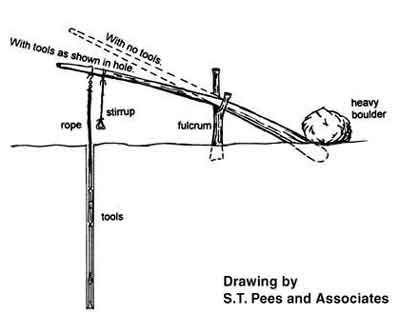
The earliest wells were drilled using a spring pole apparatus - men would use their feet to "kick down" the drill bit and chip away at the rock (see: www.petroleumhistory.org/OilHistory/images/Cable/Sp_pole.jpg). Three feet of hole per day could be achieved using this method. As the oil industry developed, wells were drilled using cable tool rigs and later, rotary drill rigs. Most Ohio oil wells are drilled using rotary drill rigs. Shown above is the actual drilling bit for this type of rig. This is called a tri-cone bit - the knobs are made of carbide. During drilling, the three cones rotate and the knobs abrade and remove rock fragments.
Update: as of spring 2017, this well was making 100 to 125 MCF a day (= 100 to 125 thousand cubic feet of natural gas) and 10 barrels of oil per day. The producing horizon is in the Upper Cambrian Copper Ridge Dolomite (also known as the Trempealeau Dolomite). Petroleum is coming from porous dolostones below the Knox Unconformity. The Knox is a megasequence boundary (Sloss sequence boundary) that separates the Sauk Megasequence below from the Tippecanoe Megasequence above.
The following are formation picks for this well (the numbers are from the completion record filed with the Ohio Division of Natural Resources, Division of Oil and Gas Resources):
430 feet depth = top of the Berea Sandstone (lowermost Devonian)
1182 feet depth = top of the "Big Lime" (= Devonian and Silurian carbonate succession, including the Delaware Limestone, Columbus Limestone, and Silurian dolostones)
1940 feet depth = top of the "Packer Shell" (= Middle Silurian Dayton Formation equivalent)
3252 feet depth = Trenton Limestone (upper Middle Ordovician, sensu traditio; lower Upper Ordovician, sensu novo)
3790 feet depth = Gull River Limestone (Middle Ordovician)
3830 feet depth = Knox Unconformity with Trempealeau Dolomite below (Upper Cambrian)
According to State of Ohio records, this well has produced the following:
2017 - 38 barrels of oil, 12,660 MCF of natural gas (= thousands of cubic feet of natural gas), 516 barrels of brine (= salt water)
2018 - 59 barrels of oil, 2828 MCF of natural gas, 175 barrels of brine
2019 - 144 MCF of natural gas
2020 - 21 MCF of natural gas, 130 barrels of brine
2021 - no production
Locality: Hendren Century Farms # 2 well (permit # 34089261840000) (2026' SL, 1526' WL, Lot 10, 4th Quarter of Township), north of Johnstown, Hartford Township, northwestern Licking County, Ohio, USA
----------------------
See info. at:
en.wikipedia.org/wiki/Drilling_rig
and
en.wikipedia.org/wiki/Well_drilling
and
gis.ohiodnr.gov/MapViewer/WellSummaryCard.asp?api=3408926...
Leaving Deal and driving out into the countryside, I see the octagonal shingled tower of Worth, and winder if it was open.
I drive down the one of the two roads into the village, they meet at the pond, the same corner which the church sits.
Jools went to check if it is open, and I am rewarded with a thumbs up from over the wall of the churchyard.
A lady is on duty all day, armed with a book, newspaper and CD player, I tank her generously as her dedication and of people like her, make ride and stride and heritage weekend possible.
Despite wanting to get back insode for nearly a decoade, truth is, once inside there isn't too much I missed, just the detail, really.
Some fine Victorian tiles, some with a round camel motif, can't say I've see that before, if I'm honest.
-------------------------------------------
WORD.
WRITTEN formerly Worthe, is the next parish eastward from Woodnesborough, which latter is the original Saxon name, the letter d in that language being stricken through, making it the same sound as th. (fn. 1)
There are three boroughs in this parish, viz. Felderland, Word-street, and Hackling; the borsholders for the two former of which are appointed at Eastrycourt, being within the jurisdiction of that manor; for the latter at Adisham, which manor claims over a part of this borough.
THE PARISH OF WORD lies very flat and low, and is very unhealthy; it is in shape very long and narrow, being near three miles from east to west, and not more than one mile across the other way. The village called Word-street, containing twenty-nine houses, having the church close to it, is situated nearly in the middle of the parish; at the southern boundary of which, is the hamlet of Hackling, containing five houses, the principal estate in which, called Hackling farm, belongs to Mrs. Eleanor Dare, of Felderland. At the western extremity of the parish is the borough and hamlet of Felderland, or Fenderland, partly in Word, and partly in Eastry, formerly esteemed a manor, the property of the Manwoods, afterwards of the Harveys, of Combe, and now belonging to the right hon. PeterLewis-Francis, earl Cowper; adjoining to which, in the same borough, is the farm of Upton, situated about a quarter of a mile westward of the church, the estate of which likewise belongs to earl Cowper.
At a small distance further the marshes begin, where there is a parcel of land called Worth, or Worde Minnis, and belongs to the archbishop, the present lessee being Mr. Thomas Rammel, of Eastry. Here are two streams, called the south and north streams, which direct their course through these marshes northwestward towards Sandwich; the latter of these was formerly the famous water of Gestling, through which the sea once flowed, and was noted much for being the water in which felons were punished by drowning, their bodies being carried by the current of it into the sea. The marshes here are called Lydden valley, (from the manor of Lydde-court, in this parish, below described, called formerly Hlyden) which is under the direction of the commissioners of sewers for the eastern parts of Kent; and to which the north stream is the common sewer. The marshes continue beyond this stream about half a mile northward, where the sand downs begin.
These sand downs are a long bank of sand, covered with green swerd of very unequal surface, and edge the sea shore for five miles and upwards from Peppernesse, which is the south east point of Sandwich bay, as far as Deal. They are about a quarter of a mile broad, except about the castle, which is, from its situation, called Sandowne castle, where they end with the beach, but a little way within the shore, about the middle of them is a cut, called the Old Haven, which runs slanting from the sea along these downs, near but not quite into the river Stour, about three quarters of a mile eastward below Sandwich. The castle of Sandowne is situated about half a mile from the north end of the town of Deal; it was built with Deal castle, and several others, by king Henry VIII. in the year 1539, for the desence of this coast, each being built with four round lunets of very thick stone arched work, with many large portholes; in the middle is a great round tower, with a large cistern for water on the top of it; underneath is an arched cavern, bomb proof; the whole is encompassed with a fossee, over which is a draw-bridge. It is under the government of the lord warden, who appoints the captain and other officers of it, by the act of 32d of king Henry VIII. This castle has lately had some little repair made to it, which, however, has made it but barely habitable.
This parish contains about fifty houses. The lands in it are of about the annual value of 3000l. The soil is very rich and fertile, and may properly be called the garden of this part of Kent, and is the most productive for wheat, of any perhaps within the county. There are no woodlands in it. There is no fair.
THE PRINCIPAL MANOR in this parish is that of LYDDE-COURT, written in Saxon,Hlyden, which was given by Offa, king of Mercia, in the year 774, to the church of Christ, in Canterbury, L. S. A. as the charter expresses it, meaning, with the same franchises and liberties that the manor of Adisham had before been given to it. After which, this manor continued with the priory of Christ-church, and king Edward I. in his 7th year, granted to it the liberty and franchise of wreck of the sea, apud le Lyde, which I suppose to be this manor; and king Edward II. in his 10th year, granted to the priory, free-warren within their demesne lands within it; (fn. 2) and in this state this manor continued till the dissolution of the priory in the 31st year of king Henry VIII. when it came into the king's hands, who settled it, among other premises, in his 33d year, on his new erected dean and chapter of Canterbury, by whom it was afterwards, in the 36th year of that reign, regranted to the king, who sold it that year to Stephen Motte, and John Wylde, gent. and they alienated it to Richard Southwell, who in the 1st year of king Edward VI. passed it away by sale to Thomas Rolfe, and he afterwards conveyed it to William Lovelace, serjeant-at-law, who died possessed of it in 1576, and his son Sir William Lovelace, of Bethersden, alienated it to Thomas Smith, esq. of Westenhanger, from whom it descended down to Philip, viscount Strangford, who sold it to Herbert Randolph, esq. and he passed away a part of it, called afterwards Lydde Court Ingrounds, with the manor or royalty of Lydde-court, in Word and Eastry, and lands belonging to it, in 1706, to Sir Henry Furnese, bart. of Waldershare, and his grandson of the same name, dying in 1735, under age and unmarried, his estates became vested in his three sisters, as the three daughters and coheirs of his father Sir Robert Furnese, in equal shares, in coparcenary. After which a partition of them having been agreed to, which was confirmed by an act next year, this manor, with the lands and appurtenances belonging to it, was allotted to Selina, the third daughter, (fn. 3) who afterwards married E. Dering, esq. and entitled him to this estate. He survived her and afterwards succeeded his father in the title of baronet, and continued in the possession of this estate till 1779, when he passed it away by sale to Mr. William Walker and Mr. James Cannon, of Deal, Who are the present owners of it.
The house, called the Downes house, is the courtlodge, but no court has been held for many years.
THE REMAINING, and by far the greatest partof this estate, called, for distinction,
LYDDE-COURT OUTGROUNDS, was likewise in the possession of the Smiths, of Westenhanger, and was demised by Thomas Smith, esq. of that place, to Roger Manwood, jurat of Sandwich, for a long term of years, at which time the outer downs were enwarrened for hares and rabbits.
From Thomas Smythe, esq. this estate descended down to Philip, viscount Strangford, who sold the whole of it, with the manor, royalties, &c. as has been mentioned before, to Herbert Randolph, esq. who passed a way the manor and part of the lands belonging to it, to Sir Henry Furnese, bart. and the other, being by far the greatest part of it, since called Lydde Court Outgrounds, to Richard Harvey, esq. of Eythorne, who in 1720 alienated it to Sir Robert Furnese, bart. before mentioned, in whose descendants it continued down to Catherine, his daughter and coheir, who carried it in marriage, first to Lewis, earl of Rockingham, and secondly to Francis, earl of Guildford, to whom on her death in 1766, she devised this estate. He died possessed of it in 1790, and his grandson, the right hon. George Augustus, earl of Guildford, is the present possessor of it. This estate comprehends all that tract of land, partly sandy, partly marshy, and the whole nearly pasturage, lying on the south side of Sandwich haven, bounded on the east by the sea shore, and on the west by the ditch, along which the footway to Deal leads, and which is the eastern boundary of Lydde court Inngrounds.
In the year 1565, there was a suit in the star chamber, respecting a road from Sandowne gate and Sandwich, to the castle in the Downes, which was referred to the archbishop and Sir Richard Sackville; who awarded, that there should be a highway sixteen feet broad over Lyd-court grounds.
SANDOWNE, so called from the sand downs over which it principally extends, is a manor, which lies partly in this parish, and partly in that of St. Clement's, in Sandwich, within the jurisdiction of which corporation the latter part of it is. This manor was antiently the estate of the Perots, who held the same, as the private deeds of this name and family shew, as high as the reign of king Henry III. Thomas de Perot died possessed of it in the 4th year of that reign, at which time he had those privileges and franchises, the same as other manors of that time; Henry Perot, the last of this name, at the beginning of king Edward III.'s reign, was succeeded by John de Sandhurst, who left an only daughter and heir Christian, who married William de Langley. (fn. 4) After which it continued in his descendants till it passed to the Peytons, and thence in like manner as Knolton above described, by sale to the Narboroughs, and afterwards by marriage to Sir Thomas D'Aeth, bart whose grandson Sir Narborough D's Aeth, bart. now of Knolton, is the present owner of it. A court baron is held for this manor.
There are no parochial charities.The poor constantly relieved are about twenty-five, casually as many.
THIS PARISH is within the ECCLESIASTICAL JURISDICTION of the diocese of Canterbury, and deanryof Sandwich.
¶The church, which is dedicated to St. Peter and St. Paul, is a small mean building, having a low pointed wooden turret at the west end, in which are two bells. The church consists of a nave, two isles, and a chancel, the north isle extending only about halfway towards the west end. In the south wall of the chancel is an arched tomb, on which probably was once the figure of some person, who was the founder, or at least a good benefactor towards the building. In the south isle are several gravestones for the Philpotts, of this parish; and an altar monument for Mr. Ralph Philpott, obt. 1704.
In the church-yard are altar tombs to the memories of the same family of Philpott.
The church of Word, or Worth, has ever been esteemed as a chapel to the mother church of Eastry, and continues so at this time, being accounted as a part of the same appropriation, a further account of which may be seen in the description of that church before. The vicar of Eastry is inducted to the vicarage of the church of Eastry, with the chapels of Shrinkling and Word annexed to it.
It is included with the church of Eastry in the valuation of it in the king's books. In 1578 here were communicants one hundred and forty-four, in 1644 only one hundred and fourteen.
The rectorial or great tithes of this parish, as part of the rectory of Eastry, were demised on a beneficial lease, to the late countess dowager of Guildford, whose younger children are now entitled to the present interest in this lease.
The lessee of the parsonage is bound to repair the chancel of this church.
End of January : today was payday for the Royal Taylor from Prince Vyacheslav.
The tailor visited his office and handed in her invoice.
They are good friends ; but still the Prince examined her invoice carefully and was very happy with the amount.
He also needed to fill in the payment record form carefully for the Ministry of Finance, this is a most important duty.
He always pays generously in cash. Kitezh people do not trust plastic money, bank transfers, cheques, even bank notes. Everything needs to be payed in their currency in hard "cash".
Therefore, luckily enough, there was no feedback resulting from the world-wide credit crunch syndrome.
The Prince asked her to confirm the payment.
But....she was not entirely sure...will her bank accept their currency....!!?? We shall wait and see...
{ Has anyone noticed? The Prince is left-handed : ) }
Little Theatre, Gateshead. Built thanks to the generosity of sisters Ruth, Sylvia and M. Hope Dodds, it is believed that the theatre is the only one built in Britain during the war. The building process was interrupted by hostilities after the site was acquired in 1939, being at one time requisitioned as a barrage balloon station, and at another having windows and doors damaged by a bomb falling in Saltwell Park, just across the road. The opening performance in October 1943, was A Midsummer Night's Dream. The theatre is home to the Progressive Players Ltd, who produce ten plays per year, the theatre is also hired by other groups and performers. It seats 188, and has a good-sized stage behind a proscenium arch. It was extended in 2021 to create a new studio for rehearsals and as a potential cabaret space.
Gateshead, Tyneside, Tyne & Wear, North East England - Little Theatre, Saltwell View
April 2026
O God, please help all parents to teach their children to be generous to the Poor and the Needy.
May all children be inspired with the kind of Love they have received from their parents.
And realize that the Love from their parents are blessings from God.
That through our Love for Our Lord Jesus Christ and Mother Mary,
That we may extend this Love even to those outside of our own immediate family.
That we may extend this Love even to those who wouldn’t give us any material thing in return.
May all children feel sympathy for those who have less or no blessings at all.
For the True Children of God are those who truly care even to those they may not like or love.
As much as many families have been blessed with so much blessings,
Please O God that You always touch our Heart not to be too proud for these material blessings.
That all families may realize that their blessings are to be shared for the least of our brethren.
May the blessings that You give to us O God may never make us think that we are better than others.
But instead, You judge us by the goodness of our Heart how we use them to protect the Poor.
Please bless the Poor and the Needy with generous parents, children and families –
Who are worthy to show Compassion and Generosity to those in need.
These at the very least, we may show our gratefulness for God’s Love.
Amen.
this is Fiddlers Ferry power station near the coast ,the shot was taken 23 miles away from the pennines in lancashire
I'm calling this a macro because the lens brought it closer , and I used macro mode on the Lumix , a very generous 18x zoom and I'm hoping for generous comments Happy macromonday
This second CreativeMornings/Bogotá event was generously hosted by Mai Lirol Darlin.
Julio Rodríguez Bernal was our speaker.
The event was sponsored by Brot bakery and café and SocialColectivo.
Photos by Juan Sebastián Sánchez (@TheMute).
The video, soon on Vimeo, was filmed by Juan David Cortés (vimeo.com/lesmoustaches).
Connect and share
Contáctanos
bogota@creativemornings.com
CreativeMornings/Bogotá
The Bolton community have been thanked for their generosity after a single mum's Christmas was ruined by arsonists.
Mum of three, Emma Almond, 27 from Bolton received a call from her family in the early hours of Thursday 21 December to tell her the news that her home at Rawsthorne Street in Bolton had been set alight on Wednesday 20 December. She had been visiting family in York at the time.
Arsonists had broken into the house, stolen presents from under the tree before moving a sofa to barricade the door and setting it alight.
Moved by their situation the Bolton East Neighbourhood Policing Team took to their Facebook page, which is liked by more than 1,000 people to appeal to the Bolton community to bring back Christmas for the family.
Sergeant Martin Lally said: “To have been victim of such a horrible situation is terrible at any time of the year but it’s particularly terrible at Christmas time which is why it is fantastic to see the family so happy as a result of what the people of Bolton have done for them.
“We have been absolutely overwhelmed by the support of the local businesses and the people who have made Christmas for this family.”
Gifts that have been donated include a Paddington Bear, flat screen TV, Playstation 3, Moses basket, a new cot and stockings filled with gifts.
Emma said: “I was devastated to hear what had happened. I had only been away for one night to see family and to hear that someone could do this is heartbreaking.
“I had only moved the girls and my baby into the house in November and it was going to be my first home with the girls. This was going to be our first Christmas together in the house and I am just so grateful that we weren’t there it is just such a devastating thing to happen.
“When I heard what the community had done I couldn't stop crying I was so overwhelmed. My family have been around me and have been crying as well.
“I would just like to say to everyone the police, business's and people thank you and thank you for making Christmas for my girls.”
Anyone with any information is asked to call police on 101 or call the independent charity Crimestoppers anonymously on 0800 555 111.
First professional cast Eusapia jointed doll is avaiulable for purchase: missmonster.myshopify.com/
"This is Eusapia the demon. She stalks winter forests leaving mysterious melted hoof prints in the fresh snow. If she visits your camp at night , offering her a gift of meat or wine will ensure your safety. If it's an especially good gift she will leave her furred traveling cloak with you to keep warm for the night, the cloak will disappear at dawn. If you fail to offer a gift Eusapia will bring a sleepless night full of nightmares to the camp. It pays to be generous and think of others... especially when they are crabby forest demons."
This is the first of my professionally cast jointed dolls! She's been cast in slightly translucent grey resin that lends a really nice lifelike look. Her eyes can be changed, right now she's wearing a 14mm glass eye but could take a 12mm as well.
This doll can be posed in a variety of positions and holds poses well. Her joints have been sueded with leather. Eusapia stands well on her own but i would use a stand to display her in case the shelf/desk gets bumped! Display stand is included.
Her hair is glued on instead of using a doll wig ( this doll isnt really meant to be customized, more as a stand alone art piece) She does have a removable head cap that is held on with strong magnets. You can remove it to restring her. She is entirely hand painted and blushed and sealed with Mr. Super Clear.
She will be shipped strung, well padded with one of my wooden ooak doll tags. Please treat her with care and gently wipe with a slightly damp cloth if she gets smudged or dirty.
Eyes: 7mm
Height: 13.5" without horns, 15" with horns
Bust: 7"
Waist : 5"
Arm length: 5.75" to claw tip
Leg length: 8" hip joint top to hoof
This doll uses the ball joint doll method of elastic tension to hold the joints. Please familiarize yourself with this style of doll before buying her! You will have to restring her at some point to keep her joints tight. It's very easy but please consult restringing tutorials before attempting it.
Do not recast or use this doll to reverse engineer copies of any kind. Please do not use the accompanying photos or text to sell your own work or for any other reason than online sharing or reposting.
I wish you Health...
So you may enjoy each day in comfort.
I wish you the Love of friends and family...
And Peace within your heart.
I wish you the Beauty of nature...
That you may enjoy the work of God.
I wish you Wisdom to choose priorities...
For those things that really matter in life.
I wish you Generousity so you may share...
All good things that come to you.
I wish you the best of everything...
That you so well deserve.
HAPPY NEW YEAR FRIENDS!
Generous size sewing bag, perfect for carrying all your supplies and a bonus Project bag for the times when you need something smaller.
Behold, my Yashica Mat, generously given to me by a friend. It is the classic example of not judging a book by its cover. It lacks a Yashica Mat nameplate (but I hope to solve that), is dusty and the leather is peeling (I have a kit to replace that), but what it gives up in looks, it more than makes up in performance. It is all boxed up and today I will send it to Mark Hama for CLA and repair.
Update (10/14/2011): spoke to Mark Hama today. What a great guy. He said "your camera looks awful without a name plate" and he has started a quest to find one. He also says it will be a beautiful camera and work wonderfully when he is finished. Can't wait.
Generous layer of white snow covering a tall pine tree in a cold winter day. It is captured against an incredibly clear blue sky.
Or she may be called "The Fat Lady", I've no idea.
From the Sculpture Park beside the Cascade in Yerevan, Armenia.
The European Union should respond to the current refugee crisis with "generosity, solidarity and responsibility", said Felipe VI of Spain when addressing the plenary on Wednesday at noon."I would like that in the coming years, Spain continues contributing with its passion and ideas to Europe's success", said Martin Schulz, President of the European Parliament, at his welcome statement.
Read our whole article here:
www.europarl.europa.eu/news/en/news-room/content/20151007...
This photo is free to use under Creative Commons licenses and must be credited: "© European Union 2015 - European Parliament".
(Attribution-NonCommercial-NoDerivatives CreativeCommons licenses creativecommons.org/licenses/by-nc-nd/4.0/).
For bigger HR files please contact: webcom-flickr(AT)europarl.europa.eu
"Feeling generous shows your love of that moment."
~ unknown
Today (2 Feb 2010), we had snow in Yokohama.
Pink plum blossoms in the ice and snow...
of our firm that the coffee cups are so big! Me in the bus depot Altstätten, Switzerland, Sep 6, 2007. (Photo by Charlie with my camera)
First off, this girl wouldn't have been possible if not for the extreme generosity of a friend I made online- mainly on Live Journal. She's been such a good friend and she surprised me this past birthday by giving me some money as a birthday gift towards a new doll. SO, I saved and ordered my new girl but kept mum because I wanted it to be a surprise.
I have always wanted an elf girl doll but never saw one I had to have, until I saw a ResinSoul Mei. After I decided on her, then came the hard decision to make for skin color! LOL. After a couple of weeks I narrowed it down and then decided on the blue and I am SO happy with her! She has a lovely and soft pale blue coloring that looks darker in some of the pics I took because it started to get dark but I was not about to let that stop me from taking pics! LOL. She took about 3 months to get to me and I was so happy she finally arrived- of course on the day I worked the longest, and that was torture knowing she was home and I wasn't! lol
So, in honor of my girl's dollmother/godmother- sankuri- I have borrowed a name idea from another friend. LJ member, cheshiretiffy, has a doll named Bellamy, which means 'good friend'. SO, since I had a good friend help bring my girl home, I named my girl Bellamy too.....Bellamy Rain, but she is mainly just going to go by the name Rain. She is a little water spirit that joined my family because she figured she was needed in these dry as a bone parts of Texas! LOL. She isn't used to wearing clothing so getting her dressed was interesting but she is enjoying raiding the closet to see what she can wear. She is so much smaller than my other girls, it's been hard finding stuff to fit and she likes the tuff boots I have but they are super huge looking on her. We'll see what we find and also what her idea of style is. She is my first elf eared doll so I had no idea her ears would make it harder to keep a wig on her! LOL Either way we had fun and she's a lovely girl. Thank you so much, sankuri, for your wonderful gift!
Source: livinghistories.newcastle.edu.au/nodes/view/32973
Thomas James Rodoni was born in 1882 at Hotham East, Victoria, to Swiss and Irish parents. While living in Sydney in August 1914 as a man of 31, Rodoni joined the first Australian Imperial Force that would engage in the Great War: the Australian Naval & Military Expeditionary Force.
A week after enlisting, Rodoni’s company embarked on the HMAS Berrima and sailed to German New Guinea among a fleet with orders to seize two wireless stations and to disable the German colonies there.
Rodoni’s unofficial photographs – many of them “candid” shots, captured in the moment – are a rare glimpse of this pivotal moment in Australia’s history. He has documented the energetic atmosphere of prewar Sydney and its surrounds, from civilian and military marches to battleships docked in Sydney Harbour, with accompanying crowds of people brought together for these special events. His camera voyaged with him on the expedition to the Pacific region, taking images both from the ship’s deck and then again on dry land after disembarking.
Rodoni was stationed in New Guinea for five months with the AN&MEF after the successful capture of territory from the German forces. His striking images are testament to his ease with the camera, and the ease of his fellow servicemen around this avid amateur photographer. He used his camera to record daily events and significant moments in the expedition, and made several group portraits of the officers and soldiers in his company. Yet his images also suggest a genuine curiosity for the foreign people and places where he was stationed, and a love of the photographic medium in which he practiced during this early period of the war.
After leaving New Guinea with the AN&MEF and returning home to Australia in January 1915, Rodoni left the force to work in a Small Arms Factory manufacturing munitions for the war. He soon married and settled in Newcastle with his wife, Catherine Annie Wilson, and had four children: Thomas, Mary, Jim and William (Bill).
The wider collection of glass plate negatives – over 600 in total and with many views of Newcastle and its surrounds is an incredible legacy to Thomas Rodoni and his family.
Rodoni died in 1956 as a result of a car accident in Waratah, Newcastle.
The original negatives are held in Cultural Collections at the Auchmuty Library, University of Newcastle (Australia).
You are welcome to use the images for study and personal research purposes. Please acknowledge as Courtesy of the Rodoni Archive, University of Newcastle (Australia)" For commercial requests you must obtain permission by contacting Cultural Collections.
If you are the subject of the images, or know the subject of the images, and have cultural or other reservations about the images being displayed on this website and would like to discuss this with us please contact Cultural Collections.
If you have any further information on the photographs, please leave a comment.
These images are provided free of charge to the global community thanks to the generosity of the Bill Rodoni & Family and the Vera Deacon Regional History Fund. If you wish to donate to the Vera Deacon Fund please download a form here: dl.dropboxusercontent.com/u/21528529/veradeaconform.jpg

At the National Memorial Arboretum, near Alrewas in Staffordshire.
It was opened in 2001 by HRH The Duchess of Kent. On a site that was reclaimed gravel workings alongside the River Tame.
The land was provided by Redland Aggregates (now LaFarge), who generously donated 82 acres of land. Later 70 acres was added which includes a wildlife lake.
Military Police Memorial
Green Zone. No 316.
Royal Military Police Association. Plinth, flagpole and statue.
Flag
SD video clip.
Take 2 much better.
Alesha out on the Town Old Street Shoreditch London Street Sign: Butter Like Love Best when spread generously. The Department of Dairy Scrumptious Affairs
The campaign, jointly funded by AHDB Dairy and Dairy UK, created a spoof government agency – the Department of Dairy Related Scrumptious Affairs – and focused on digital marketing, a move away from the more traditional approach seen in previous industry campaigns
"Generous" designer is butthurt in the sales/promo patterns thread. This post was deleted but her butthurt lives on.
Verde noche
Sin más en las manos que una cámara y un poco de comezón en el dedo índice derecho salimos una noche de domingo a buscar un lugar y una luz generosa que nos regalara un instante un momento en verdes y platas y prismas textiles de robusta enmienda y de partículas vivas, brillantes, que como tocas el hombro, te acaricia la tela, te hipnotizan sus ojos, te deslumbra la actitud y te desnuda el ser…esa noche nos regaló muchos de esos momentos, aquí les compartimos cinco instantes que hicieron que la noche cumpliera su objetivo, la cámara, testigo interpretando y la comezón…bueno la comezón regresará… y bueno, las manos más llenas, sería pecar.
Green Night.
No more in our hands than a camera and a little itching in the right index finger a Sunday night we went out looking for a place and a generous light we give away a moment, a time when green and silver and robust textile prisms amendment and living particles, shiny, which as you touch the shoulder, the fabric caresses you, you hypnotize your eyes, you will dazzle the attitude and being naked ... that night we gave many, here we share five moments that made the evening fulfilled its purpose , the camera playing and itching itching ... well ... and well back, his hands more full, it would be sin.
In sacred memory of Cecily wife of Edward Dixon, esquire, daughter of Sir James Whitlocke, gent,.justice of the peace in the reign of King Charles .(.it praises her piety and her devotion to reading the scriptures, her generosity to the poor and her friendship......the spotless wife of a spotless husband to whom she gave 10 children .. She died 20th July 1647 aged 40 . Edward Dixon, armiger, erected this monument, to himself, his wives and children. so that the tomb should bring together those whom life separated".
The monument with white alabaster figures of Edward Dixon clad in armour, kneeling between his 2 wives, Cecily Whitlocke & Anne Dickins, was erected c1655 after the death of Cecily & after his 2nd marriage
Above the arch is a panel inscribed Domus viventium " (the home of the living)
The heraldic arms on the shield above the monument are those of Dixon, Blower and \Vhitelocke
Cecily was the daughter of Judge Sir James Whitlocke 1632 of Fawley Court, Bucks by Elizabeth daughter of Edward son of Thomas Bulstrode of Hedgeley Bulstrode by Cecily daughter of Speaker John Croke of Chilton flic.kr/p/6mkdJB
Her father records her birth "Cecill my daughter was born in Fleet Street house, 10 March, 1607, in the 5th year of King James . She was christened in St.Dunstan's church, 26 March being Easter even. Her godfather was Sir John Harrington, Knighte of the Bathe, sun and heir to the lord Harrington, and on of the prince's gentlemen ordinarye; her godmothers, my wifes sisters Cecill and Dorothy Bulstrodd, gentlewomen of the queen's bed chamber."
Her brother Bulstrode Whitlocke 1675 Lord Keeper of the Great Seal m2 Frances Willoughby 1649 daughter of Frances Manners d1643 flic.kr/p/HCbaQa daughter of John Manners 4th Earl of Rutland 1588 & Elizabeth Charlton www.flickr.com/gp/52219527@N00/55857n
She m 1632 (1st wife) Edward 1601 - 1659 son of Henry Dixon 1644 of Hilden Park Tunbridge Kent (bought by his grandfather Humphrey Dixon) , Wandsworth & Braughing, Herts, by Mary 1646 co- heiress daughter of William Blower 1597 & 2nd wife Mary 1619 heiress of Zachary Bucat / Bewchet / Brancate from Eeklo in Flanders. Mary who brought "a greate porcion in moneyes 'was also to be heiress of her brother William Blower who died unmarried in 1618 , bringing the manor here to the Dixons. More money came after her mother's death in 1619)
Children - 7 sons & 3 daughters
1 Henry Dixon of Hilden 1634-1669 m 1662 …. having 2 heiress daughters Jane & Sarah who inherited half of the manor each - Jane m 1699 Nathaniel Booth of Grays Inninl 1699 but died childless : Sarah m 1689 Percival Hart of Lullingstone Castle 3 x great grandson of Sir Percival Hart 1580, flic.kr/p/sVtjjh having 1 daughter Anne Dyke (d. 1763) flic.kr/p/sToCnN who inherited the whole manor and her son Sir John Dixon Dyke sold the manor in 1767 to Sir John Reade of Shipton Court, Shipton.under Wychwood. flic.kr/p/4Q4SuH bringing to an end the Dixons' I 50 year tenure
2 James b/d 1635
2. John
1. Elizabeth 1668 m Wiliam Barker of Tonbridge
(Their fathers had been friends for some years. Her brother Bulstrode Whitlocke signed a bond to Edward for £2,000, conditioned for payment of £1,400, June 1632, Dixon in due course, borrowed from Whitelocke and, in return settled land in Wandsworth and Braughing on Whitelocke's son Willoughby)
(In his diary, her brother Sir Bulstrode Whitelocke's records "Mr Dixon desired the consumation of his marryage & to see the Judges Will how the portion might be secured, butt Whitelocke told his the Will was not materiall, bicause the Judge had by deed of guift (which he produced) conveyed all his personall estate to his son, & for the portion Whitelocke offered to secure to them £1,300 to make up the £1,200 they had already received, [to] the summe of £2,500 being the portion agreed uppon, with which they then seemed to be satisfyed, & preparations for the wedding went on, the writings for settlement of Mr.Dixons estate & for the jointure were sealed, & old Mr.(Henry) Dixon with his sons and friends, & Whitelocke with his sister & friends were ready to goe into the Chappell att Fawley Court, to see the marryage solemnised betwixt them." The issue here was that the Judge had put his daughter's inheritance into his will at £2,500. The wedding plans were underway and £1,200 had been paid over to Mr.Dixon when the Judge died in June 1632 When the will was read the son refused to pay his sister £2,500 as £1,200 had already been paid. The wedding would not proceed until Bulstrode had secured the remaining £1,300 and his sister and her fiance had signed that was their full inheritance. The couple were married July 2nd 1632 at Fawley in Buckinghamshire.
One of the items held in the archives at Longleat House is the bills for Cecily' wedding. Ruth quotes . "Her 'milliner's' bill before the wedding amounted to £46.18s.3d. which included rolls of taffeta to line, £1.1s.0d.; 'Left unpaid of the last workinge £7.3s.3d.'; binding for petticoats 2s.; making petticoats and waistcoats 3s.6d.; 20½ yards of straw-yellow satins £15.7s.6d.; 3 rolls of taffeta to line, 'at 14d the elle', £1.4s.6d.; 16 yards of material for Lady Muston / Mostyn, Cecilia's elder sister)
Ruth Spalding in her Contemporaries of Sir Bulstrode Whitelocke 1605-1675 quotes papers at Longleat House showing Anne Bowers (d.1660) wife of Henry Dixon resented her husband's generosity towards the Whitelocke family, - She and her son Whitelocke were joint executors to her husband's estate;
Cecily & Edward spent their first years at Hilden until 1636 when their house building at Little Rollright was finished.
After her death her brother Bulstrode described her as " a good woman of a plain & tender heart, loving to her husband. children, & relations. carefull in her household afcayres, kind to her neighbors & very religious". She had great troubles living in the country in the Lime of the war. the soldiers on both sides being most injurious & insolent. A troupe of the Parlements quartered all her housee in her husbands absence, she then lying in, having bin brought to bed about 14 dayes before. Yet the barbarous domineering soldiers, would not admit this for an excuse, nor be content with their quarters, though fit for better men, but compelled her (though in that condition) to rise out of her bed. to make better preparations for them. with which, she tooke cold, fell into a feaver & dyed"
Edward and his family remained at Lillie Rollright for several years after Cecilia's death.
By 1654 Edward had moved his household back to Hilden
He also had remarried by 1655 to Anne widow of William Dickins esq
When Edward died, 'sicke and weake in body' in March 1660, his will betrayed some anxiety about his financial affairs. Much of his real and personal property was earmarked for the payment of his debts, annuities for his widow Anne and his unmarried daughter Elizabeth and £2,000 for Elizabeth's marriage portion. Edward did not make his son Henry his executor, nominating his daughter instead, and the hint of paternal disapproval is strengthened by a bequest of £ I0 to Dr Thomas ' Walker, 'further desireing my sonne Henry Dixon ... to bee advised by him uppon all occasions'. On 15 March 1660 Edward was buried in Tonbridge church near his father, as he had requested, and a stone in the chancel floor commemorates him there:-.
"Near this place lyeth the body of Edward Dixon of Hllden, esq; having been the tender husband of two wives; the former Cecilia the daughter of Sir James Whitlock; the second Anne (widow of William Dickins esq) of the ancient familie of the Bickertons of Leicester; who surviving, hath set up this memoriall. He exchanged this life for a better the 9th of March, anno redemptionis 1659 aged 58
Generous, approachable and tight 3-piece of some good ol' local guys who've been around "fer a minute or two."
Fantastic live.
Find them on Facebook at www.facebook.com/dUNETX/
Twitter at twitter.com/dunetx.