View allAll Photos Tagged gate
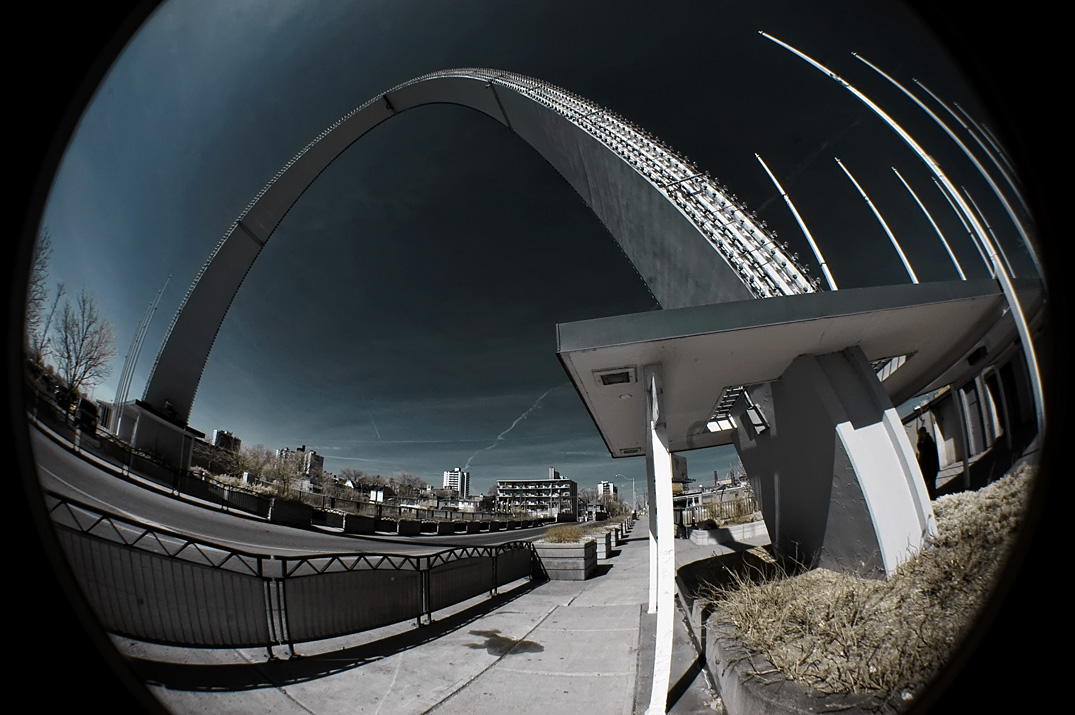
The Dufferin Gates at Exhibition Place. Seen in Infrared through a fisheye lens on a beautiful spring day.
. . . for 145 more fotos go to my set: India - Delhi - Red Fort - 2014
___________________________
The Red Fort was the residence of the Mughal emperor of India for nearly 200 years, until 1857. It is located in the centre of Delhi and houses a number of museums. In addition to accommodating the emperors and their households, it was the ceremonial and political centre of Mughal government and the setting for events critically impacting the region.
The Red Fort was built as the fortified palace of Shahjahanabad, capital of the fifth Mughal Emperor Shah Jahan, in 1648. Named for its massive enclosing walls of red sandstone, it is adjacent to the older Salimgarh Fort, built by Islam Shah Suri in 1546. The imperial apartments consist of a row of pavilions, connected by a water channel known as the Stream of Paradise (Nahr-i-Behisht). The Red Fort is considered to represent the zenith of Mughal creativity under Shah Jahan. Although the palace was planned according to Islamic prototypes, each pavilion contains architectural elements typical of Mughal buildings, reflecting a fusion of Timurid, Persian and Hindu traditions. The Red Fort’s innovative architectural style, including its garden design, influenced later buildings and gardens in Delhi, Rajasthan, Punjab, Kashmir, Braj, Rohilkhand and elsewhere. With the Salimgarh Fort, it was designated a UNESCO World Heritage Site in 2007 as part of the Red Fort Complex.
The Red Fort is an iconic symbol of India. On Independence Day, the prime minister hoists the national flag at the main gate of the fort and delivers a nationally-broadcast speech from its ramparts.
NAME
Its English name, "Red Fort", is a translation of the Hindustani Lal Quila (لال قلعہ, लाल क़िला) deriving from its red-sandstone walls. As the residence of the imperial family, the fort was originally known as the "Blessed Fort" (Quila-i-Mubarak). Agra Fort is also called Lal Quila.
HISTORY
Emperor Shah Jahan commissioned construction of the Red Fort in 1638, when he decided to shift his capital from Agra to Delhi. Its design is credited to architect Ustad Ahmad Lahauri. The fort lies along the Yamuna River, which fed the moats surrounding most of the walls. Construction began in the sacred month of Muharram, on 13 May 1638. Supervised by Shah Jahan, it was completed in 1648. Unlike other Mughal forts, the Red Fort's boundary walls are asymmetrical to contain the older Salimgarh Fort. The fortress-palace was a focal point of the medieval city of Shahjahanabad, which is present-day Old Delhi. Its planning and aesthetics represent the zenith of Mughal creativity prevailing during Shah Jahan's reign. His successor Aurangzeb added the Pearl Mosque to the emperor's private quarters, constructing barbicans in front of the two main gates to make the entrance to the palace more circuitous.
The administrative and fiscal structure of the Mughals declined after Aurangzeb, and the 18th century saw a degeneration of the palace. When Jahandar Shah took over the Red Fort in 1712, it had been without an emperor for 30 years. Within a year of beginning his rule, Shah was murdered and replaced by Farukhsiyar. To raise money, the silver ceiling of the Rang Mahal was replaced by copper during this period. Muhammad Shah, known as 'Rangila' (the Colourful) for his interest in art, took over the Red Fort in 1719. In 1739, Persian emperor Nadir Shah easily defeated the Mughal army, plundering the Red Fort including the Peacock Throne. Nadir Shah returned to Persia after three months, leaving a destroyed city and a weakened Mughal empire to Muhammad Shah. The internal weakness of the Mughal empire made the Mughals titular heads of Delhi, and a 1752 treaty made the Marathas protectors of the throne at Delhi. The 1758 Maratha conquest of Lahore and Peshawar placed them in conflict with Ahmad Shah Durrani. In 1760, the Marathas removed and melted the silver ceiling of the Diwan-i-Khas to raise funds for the defence of Delhi from the armies of Ahmed Shah Durrani. In 1761, after the Marathas lost the third battle of Panipat, Delhi was raided by Ahmed Shah Durrani. Ten years later, Shah Alam ascended the throne in Delhi with Maratha support. In 1783 the Sikh Misl Karorisinghia, led by Baghel Singh Dhaliwal, conquered Delhi and the Red Fort. The Sikhs agreed to restore Shah Alam as emperor and retreat from the fort if the Mughals would build and protect seven Gurudwaras in Delhi for the Sikh gurus.
During the Second Anglo-Maratha War in 1803, forces of British East India Company defeated Maratha forces in the Battle of Delhi; this ended Maratha rule of the city and their control of the Red Fort. After the battle, the British took over the administration of Mughal territories and installed a Resident at the Red Fort. The last Mughal emperor to occupy the fort, Bahadur Shah II, became a symbol of the 1857 rebellion against the British in which the residents of Shahjahanbad participated.
Despite its position as the seat of Mughal power and its defensive capabilities, the Red Fort was not defended during the 1857 uprising against the British. After the rebellion failed, Bahadur Shah II left the fort on 17 September and was apprehended by British forces. He returned to Red Fort as a prisoner of the British, was tried in 1858 and exiled to Rangoon on 7 October of that year. With the end of Mughal reign, the British sanctioned the systematic plunder of valuables from the fort's palaces. All furniture was removed or destroyed; the harem apartments, servants' quarters and gardens were destroyed, and a line of stone barracks built. Only the marble buildings on the east side at the imperial enclosure escaped complete destruction, but were looted and damaged. While the defensive walls and towers were relatively unharmed, more than two-thirds of the inner structures were destroyed by the British; steps were later taken by Lord Curzon to repair some damage.
1911 saw the visit of the British king and queen for the Delhi Durbar. In preparation of the visit, some buildings were restored. The Red Fort Archaeological Museum was also moved from the drum house to the Mumtaz Mahal.
The INA trials, also known as the Red Fort Trials, refer to the courts-martial of a number of officers of the Indian National Army. The first was held between November and December 1945 at the Red Fort.
On 15 August 1947, the first Prime Minister of India Jawaharlal Nehru raised the Indian national flag above the Lahore Gate. On each subsequent Independence Day, the prime minister has raised the flag and given a speech that is broadcast nationally.
After Indian Independence the site experienced few changes, and the Red Fort continued to be used as a military cantonment. A significant part of the fort remained under Indian Army control until 22 December 2003, when it was given to the Archaeological Survey of India for restoration. In 2009 the Comprehensive Conservation and Management Plan (CCMP), prepared by the Archaeological Survey of India under Supreme Court directions to revitalise the fort, was announced.
As the largest monument in Delhi, is one of its most popular tourist destinations and attracts thousands of visitors every year.
THE FORT TODAY
Every year on 15 August (the day India achieved independence from the British), the Prime Minister hoists the national flag at the Red Fort and delivers a nationally-broadcast speech from its ramparts. The Red Fort, the largest monument in Delhi, is one of its most popular tourist destinations and attracts thousands of visitors every year.
A sound and light show describing Mughal history is a tourist attraction in the evenings. The major architectural features are in mixed condition; the extensive water features are dry. Some buildings are in fairly-good condition, with their decorative elements undisturbed; in others, the marble inlaid flowers have been removed by looters. The tea house, although not in its historical state, is a working restaurant. The mosque and hamam are closed to the public, although visitors can peer through their glass windows or marble latticework. Walkways are crumbling, and public toilets are available at the entrance and inside the park.
The Lahore Gate entrance leads to a mall with jewellery and craft stores. There are a museum of "blood paintings", depicting young 20th-century Indian martyrs and their stories, an archaeological museum and an Indian war-memorial museum. Although, Red Fort is still one of the most beautiful and well designed forts in the world.
ARCHITECTURE
The Red Fort has an area of 103.06 ha enclosed by 2.41 kilometres of defensive walls, punctuated by turrets and bastions and varying in height from 18 metres on the river side to 33 metres on the city side. The fort is octagonal, with the north-south axis longer than the east-west axis. The marble, floral decorations and double domes in the fort's buildings exemplify later Mughal architecture.
It showcases a high level of ornamentation, and the Kohinoor diamond was reportedly part of the furnishings. The fort's artwork synthesises Persian, European and Indian art, resulting in a unique Shahjahani style rich in form, expression and colour. Red Fort is one of the building complexes of India encapsulating a long period of history and its arts. Even before its 1913 commemoration as a monument of national importance, efforts were made to preserve it for posterity.
The Lahori and Delhi Gates were used by the public, and the Khizrabad Gate was for the emperor. The Lahore Gate is the main entrance, leading to a domed shopping area known as the Chatta Chowk (covered bazaar).
MAJOR STRUCTURES
The most-important surviving structures are the walls and ramparts, the main gates, the audience halls and the imperial apartments on the eastern riverbank.
LAHORI GATE
The Lahori Gate is the main gate to the Red Fort, named for its orientation towards the city of Lahore. During Aurangzeb's reign, the beauty of the gate was spoiled by the addition of bastions (Like a veil drawn across the face of a beautiful woman). Every Indian Independence Day since 1947, the national flag has flown and the Prime Minister has made a speech from its ramparts.
DELHI GATE
The Delhi Gate is the southern public gate, in layout and appearance similar to the Lahori Gate. Two life-size stone elephants, on either side of the gate, face each other.
WATER GATE
A minor gate, the Water Gate is at the southeastern end of the walls. It was formerly on the riverbank; although the river has changed course since the fort's construction, the name has remained.
CHHATTA CHOWK
Adjacent to the Lahori Gate is the Chhatta Chowk, where silk, jewellery and other items for the imperial household were sold during the Mughal period. The bazaar leads to an open outer court, where it crosses the large north-south street which originally divided the fort's military functions (to the west) from the palaces (to the east). The southern end of the street is the Delhi Gate.
NAUBAT KHANA
The vaulted arcade of the Chhatta Chowk ends in the centre of the outer court, which measured 160 m × 110 m. The side arcades and central tank were destroyed after the 1857 rebellion.
In the east wall of the court stands the now-isolated Naubat Khana (also known as Nakkar Khana), the drum house. Music was played at scheduled times daily next to a large gate, where everyone except royalty was required to dismount.
DIWAN-I-AAM
The inner main court to which the Nakkar Khana led was 160 m wide and 130 m deep, surrounded by guarded galleries. On the far side is the Diwan-i-Aam, the Public Audience Hall.
The hall's columns and engrailed arches exhibit fine craftsmanship, and the hall was originally decorated with white chunam stucco. In the back in the raised recess the emperor gave his audience in the marble balcony (jharokha).
The Diwan-i-Aam was also used for state functions. The courtyard (mardana) behind it leads to the imperial apartments.
NAHR-I-BEHISHT
The imperial apartments consist of a row of pavilions on a raised platform along the eastern edge of the fort, overlooking the Yamuna. The pavilions are connected by a canal, known as the Nahr-i-Behisht ("Stream of Paradise"), running through the centre of each pavilion. Water is drawn from the Yamuna via a tower, the Shahi Burj, at the northeast corner of the fort. The palace is designed to emulate paradise as described in the Quran. In the riverbed below the imperial apartments and connected buildings was a space known as zer-jharokha ("beneath the latticework").
MUMTAZ MAHAL
The two southernmost pavilions of the palace are zenanas (women's quarters), consisting of the Mumtaz Mahal and the larger Rang Mahal. The Mumtaz Mahal houses the Red Fort Archaeological Museum.
RANG MAHAL
The Rang Mahal housed the emperor's wives and mistresses. Its name means "Palace of Colours", since it was brightly painted and decorated with a mosaic of mirrors. The central marble pool is fed by the Nahr-i-Behisht.
KHAS MAHAL
The Khas Mahal was the emperor's apartment. Connected to it is the Muthamman Burj, an octagonal tower where he appeared before the people waiting on the riverbank.
DIWAN-I-KHAS
A gate on the north side of the Diwan-i-Aam leads to the innermost court of the palace (Jalau Khana) and the Diwan-i-Khas (Hall of Private Audience). It is constructed of white marble, inlaid with precious stones. The once-silver ceiling has been restored in wood. François Bernier described seeing the jewelled Peacock Throne here during the 17th century. At either end of the hall, over the two outer arches, is an inscription by Persian poet Amir Khusrow:
If heaven can be on the face of the earth,
It is this, it is this, it is this.
HAMMAM
The hammam were the imperial baths, consisting of three domed rooms floored with white marble.
MOTI MASJID
West of the hammam is the Moti Masjid, the Pearl Mosque. A later addition, it was built in 1659 as a private mosque for Aurangzeb. It is a small, three-domed mosque carved in white marble, with a three-arched screen leading down to the courtyard.
HIRA MAHAL
The Hira Mahal is a pavilion on the southern edge of the fort, built under Bahadur Shah II and at the end of the Hayat Baksh garden. The Moti Mahal on the northern edge, a twin building, was destroyed during (or after) the 1857 rebellion.
SHAHI BURJ
The Shahi Burj was the emperor's main study of the; its name means "Emperor's Tower", and it originally had a chhatri on top. Heavily damaged, the tower is undergoing reconstruction. In front of it is a marble pavilion added by Aurangzeb.
HAYAT BAKHSH BAGH
The Hayat Bakhsh Bagh is the "Life-Bestowing Garden" in the northeast part of the complex. It features a reservoir (now dry) and channels, and at each end is a white marble pavilion (Savon and Bhadon). In the centre of the reservoir is the red-sandstone Zafar Mahal, added about 1842 under Bahadur Shah II.
Smaller gardens (such as the Mehtab Bagh or Moonlight Garden) existed west of it, but were destroyed when the British barracks were built. There are plans to restore the gardens. Beyond these, the road to the north leads to an arched bridge and the Salimgarh Fort.
PRINCES´ QUARTER
North of the Hayat Bakhsh Bagh and the Shahi Burj is the quarter of the imperial princes. This was used by member of the Mughal royal family and was largely destroyed by the British forces after the rebellion. One of the palaces was converted into a tea house for the soldiers.
WIKIPEDIA
Bluebells growing beside a river , where a rusty gate hangs ( grounds of Shugborough Hall Staffordshire)
The two towers that remain of the 14th century Viru Gate entrance into old town Tallinn, Estonia.
Back in the 16th century, Tallinn (then called Reval) was a walled city, surrounded by a 2.4 km long and 3 meter thick wall that was between 14 and 16 meters tall. Along this wall were 46 defensive towers. The wall remained intact until 1825, but subsequent growth caused parts of the wall to be demolished and today just 1.9 km and 20 defensive towers remain.
The Golden Gate Bridge is a suspension bridge spanning the Golden Gate, the opening of the San Francisco Bay onto the Pacific Ocean. As part of both U.S. Route 101 and State Route 1, it connects the city of San Francisco on the northern tip of the San Francisco Peninsula to Marin County. The Golden Gate Bridge had the longest suspension bridge span in the world when it was completed in 1937 and has become an internationally recognized symbol of San Francisco and California. Since its completion, the span length has been surpassed by eight other bridges. It still has the second longest suspension bridge main span in the United States
The Menin Gate Memorial at Ypres in Belgium commemorates more than 54,000 British and Commonwealth troops who perished in the Flanders region during World War 1..
After the last sunset, I now understand why they called it the Golden Gate.
pretty much straight out of camera, sorry if it's a little dark... editing from my laptop
i just had to post this, though. climbed a tree dripping with goo to get this shot. :P
the trip has been lovely, heading back tomorrow to portland for my plane ride home.
Gated bat hibernaculum, used by 5 species of bats including the endangered Indiana bat, on the Wayne National Forest in Ohio where White-nose Syndrome was confirmed in March 2011.
Built between 1788 and 1791 by Prussian King Frederick William II as a key entry point to the city of Berlin, Brandenburg Gate was topped off with a statue known as the “Quadriga,” which depicted a statue of the goddess of victory driving a chariot pulled by four horses. The statue remained in place for just over a decade, before falling into the clutches of Napoleon Bonaparte and his Grand Army. After occupying Berlin that fall and triumphantly marching beneath the arches of the Gate, Napoleon ordered the Quadriga dismantled and shipped back to Paris. The horse and goddess were hastily packed up in a series of crates and moved across the continent. Napoleon, perhaps preoccupied with the crumbling of his recently established empire, appears to have forgotten about the statue, and it languished in storage until 1814, when Paris itself was captured by Prussian soldiers following Napoleon’s defeat. The Quadriga was returned to Berlin and once again installed atop the Brandenburg Gate, this time with one change: As a symbol of Prussia’s military victory over France, an iron cross was added to the statue. The cross was later removed during the Communist era, and only permanently restored in 1990 during the unification of Germany.After a meteoric rise to power at the head of his Nazi Party and a power struggle with German President Paul von Hindenburg, Adolf Hitler was appointed to the position of chancellor on January 30, 1933. That evening, the new chancellor was treated to a torchlight procession through Berlin, as thousands of brown shirted stormtroopers and SS members passed under the Brandenburg Gate to the presidential palace, where Hitler and high-ranking members of the Nazi Party were cheered. It was the first of many large-scale propaganda events held by the Nazis as they tightened their control over Germany in the years leading up to World War II. The end of the war destroyed much of Berlin, but the Brandenburg Gate survived, albeit with heavy damage. In one of the last cooperative measures before the erection of the Berlin Wall in 1961, the East and West Berlin authorities worked together on its restoration. Once the wall went up, however, access to the Gate, located in what was now East Berlin, was cut off.Almost two years after the Berlin Wall was erected, John F. Kennedy delivered one of the most famous addresses of his presidency to a crowd of more than 120,000 gathered outside West Berlin’s city hall, just steps from the Brandenburg Gate. Like Ronald Reagan after him, Kennedy’s speech has been largely remembered for one particular phrase. In Kennedy’s case, it was in German—poorly spoken German, some believed. Kennedy had tried out a variation of the “I am a Berliner” line in an earlier speech, and worked on the German passages with his speechwriters and State Department translators to ensure the correct pronunciation, going so far as to spell the possibly tricky phrases phonetically. In the 50 years since Kennedy’s speech, German linguists have chimed in on the debate, insisting that the president’s grammar was essentially correct and that contrary to popular belief, he did not try to turn a Cold War moment into a culinary one by erroneously announcing to the crowd, “I am a jelly doughnut.”Ronald Reagan had visited Berlin once before in his presidency, in June 1982, when he addressed West German dignitaries and a crowd outside the city’s Charlottenburg Palace, affirming America’s support for the city of Berlin and its people. Five years (and three Soviet leaders later), Reagan prepared to return to West Berlin to celebrate the city’s 750th anniversary. The preceding years had seen an escalation in rhetoric on both sides (with Reagan famously referring to the USSR as an “Evil Empire”), but also the first noticeable “thaws” in the Cold War in nearly a decade, including the Reykjavik Summit in Iceland the year before and ongoing negotiations that would result in an arms treaty in late 1987. Although authorship of the 1987 Berlin speech’s most famous line remains in dispute, there is little doubt that Reagan’s advisors were almost as deeply divided about whether he should use the potentially inflammatory words, as the city of Berlin was itself. Some feared antagonizing Soviet leader Mikhail Gorbachev, with whom Reagan had built a successful working relationship. Others on Reagan’s team, fearful of charges that the administration had gone “soft,” argued that the time had come for a full-throated challenge to the Communists. The back and forth over the text continued for almost a year, but in the end Reagan made the final decision to keep the line in, and on June 12, 1987, he addressed not just the crowd of more than 20,000 gathered at the Brandenburg Gate itself, but millions of listeners in the Unites States, the Soviet Union and around the world, thunderously calling for Gorbachev to “tear down this wall.”One of the most emotionally charged moments in the history of the Brandenburg Gate involved musicians, not politicians. Just weeks after the November 1989 opening of the Berlin Wall, American conductor Leonard Bernstein held a series of concerts in music halls on both sides of the famous divide. Leading an international orchestra comprised of musicians from the four countries that had occupied Berlin following the end of World War II (France, England, the United States and the Soviet Union, which would itself collapse just two years later), both concerts featured performances of Beethoven’s Ninth Symphony. Bernstein, however, eager to honor the momentous historical change afoot, made a crucial change to the work’s famed final movement, known as the “Ode to Joy.” Tweaking the original 18th century text by poet Friedrich Schiller, Bernstein substituted the German word Freiheit for the word Freude, and led a group of singers from two leading East and West German choirs in an emotional rendition of what was now the “Ode to Freedom.” The first of the two concerts, held in West Berlin, ended at midnight on December 23, the same moment that the Berlin Wall became permanently and fully open; the second was held two days later, on Christmas morning, in East Berlin. Both concerts were broadcast to tens of thousands of spectators gathered at the Brandenburg Gate and throughout the two Berlins, and it was the first television events transmitted to both East and West Germany in more than 30 years.
This vehicle is a warranty backed production performance model of the Mitsubishi Evolution. Littered with aftermarket parts, this street car is right at home on a racetrack. Much like Monticello Motor Club, where creator Ryan Gates put it through it's paces.
For more information please visit - 311RS.com/
I created this MOC for the first meeting of Magic City Lego Users Group in Birmingham alabama. I ran out of time so the interior of the castle walls was thrown together the night before the meeting. Originally I'd planned on putting a few house/shops within the walls.
Thanks for looking!
Format: Fotopositiv
Dato / Date: 1893
Fotograf / Photographer: Jørgen Wickstrøm
Sted / Place: Dronningens gate, Trondheim
Lenke / Link: Se diskusjonen rundt de to fotografene Johan Erik Wickstrøm og Jørgen Johan Brock Wickstrøm (Preus Museum)
Litteratur: Trondhjemske Samlinger: 1893 - et år i Trondhjem. Bilder av Jørgen Wickstrøm (Trondheim 2001)
Eier / Owner Institution: Trondheim byarkiv, The Municipal Archives of Trondheim
Arkivreferanse / Archive reference: Tor.H40.B24.F1657 [T0054]
Dronningens gate 36 og 34. Den store murgården på hjørnet av Munkegata / Dronningens gate er nr. 32.
At Gate's Pass ... a sunset event photographed on the evening of October 3rd.
Taken at the "overlook". A rocky ridge and stands of Saguaros are silhouetted with the sunset sky.
In the 1200's, Tulum was an important Mayan seaport along the Yucatan coast. It was the only Mayan city built on a coast. It remained inhabited well after the arrival of the Spanish.
The gate near the Casa del Cenote.
a gate to an urban garden offers an invitation to be opened to a world of unknown delights at Bardon, Queensland.
Sun peeps through the gate.
Dusk view
Facebook link :
www.facebook.com/Flashme.photography.official/photos/a.18...