View allAll Photos Tagged develop
cgi.ebay.co.uk/ws/eBayISAPI.dll?ViewItem&item=2508861...
The 16mm cine film Developing Tank appears unused
or if used has been cleaned meticulously.
The ORIGINAL box shows some signs of wear.
The Developing Tank is from Leningrad, Russian / USSR. It has a certificate.
It dates 18 VIII 1964. (That's 18th of August 1964)
The rubber pipes are in really good condition and not porous or brittle at all.
Quite amazing for this age. The Tank itself is almost scratch free, shining
and just looks fantastic. I do not know how to use it. And I am only selling
as I have course fees to pay, so it is a reluctant sale of an object I adore.
If you are interested in the Developing Tank then please see the
collection of youtube videos I made showing it from all angles
www.youtube.com/playlist?list=PL000C1C02C698EBC3
(at the moment I have 8 or so individual short clips of the developing tank,
arranged in a playlist, please check through them on you tube)
You should be able to see how good it looks. I can re-film any aspect of it
if you are interested, so please just get in touch, with questions and suggestions.
I am uploading the youtube videos at the moment, so they may take an hour or
so before they link up correctly.
I hope you will love this item as I did.
check this page it lists lots of tanks for sale in the US and UK, mine is the cheapest: www.super8camera.com/netsearch.php?zoekterm=developing+ta...
Got some nice shots of flamingos while they were on their yearly migration trail. Pazhaverkadu aka Pulicat Lake (Thiruvallur - Tamil Nadu) India. Instagram - @nagendran_c4777 – 21-03-2026.
Dear Madam/ Sir,
I happy to share that today I published my autobiography titled With Folded Hands in English and கூப்பியகரங்களுடன் in Tamil. It is my long time desire to bring it out mainly to thank all those helped me survive and thrive. I am alive because of the good deeds of many souls who helped me without any expectations. Through this book I thank them all as I don't have any other ways to express my thanks to them though it is not enough.
The book was released at Aarvam IAS Academy,Anna Nagar, Chennai. The function was presided by Mr. Irulappan founder trustee of DVM Seva Palam , the book was released by Mr . Senthil Velavan IRS And was received by Ms. Tamilarasi IRS. Mr. Shibikumaran the founder director of Aarvam IAS Academy welcomed the gathering and Mr. Damodaran a retired banker, script writer and fiction writer wished me all success. 21- DECEMBER - 2025 TIMING -10AM – Instagram ID:- @nagendran_c4777
=====================================================================
With Folded Hands in English C.NAGENDRAN - 21- DECEMBER - 2025 TIMING -10AM :
Nagendran English : drive.google.com/file/d/1_AWQwdUW0m8wOyASsHqrCwEoHEDyvmFM...
and கூப்பியகரங்களுடன் in Tamil C.NAGENDRAN - 21- DECEMBER - 2025 TIMING -10AM :
Nagendran Tamil :
drive.google.com/file/d/1nHhiz_pLGiUEyVRI1Y7ap0ArikbTHOJ6...
YOUTUBE VIDEO LINK :
Titled With Folded Hands in English and கூப்பியகரங்களுடன் in Tamil | C.NAGENDRAN - 21-12-2025 @10AM : youtube.com/live/TZXvgzzcQac
First roll developing film at home. Diafine. Results are mixed, a bit dodgy, but promising. Can't wait to try the next roll.
However, I think I have bromide drag. Is that what those lines are on the left side in the sky?
My old Ansco/GAF daylight tank and reel, I used this as a teenager in the early 1970's. Still works. The two plastic graduated cylinders with handles are from then too.
Natural arch developed in chalk & impure chalk in the Cretaceous of Kansas, USA.
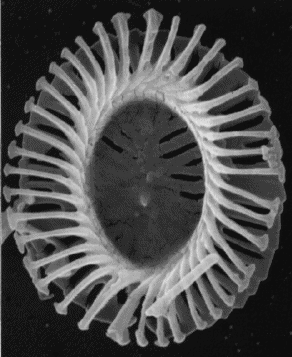
This western Kansas landscape consists of chalk badlands and chalk pillars and a natural arch. The rocks are chalks and impure chalks (e.g., argillaceous chalk and chalky shale) that range in color from whitish to light gray to yellowish. Chalk is a biogenic, calcitic, marine sedimentary rock composed of numerous coccolith microfossils (see: www.soes.soton.ac.uk/staff/tt/eh/pics/lith2.gif). Coccoliths are individual calcareous plates that covered a single-celled photosynthetic marine organism called a coccolithophorid (a.k.a. coccolithophore) (see: upload.wikimedia.org/wikipedia/commons/d/d9/Emiliania_hux...). These beds were deposited in the ancient Western Interior Seaway, a section of ocean that existed during parts of the Mesozoic Era in what is now the American and Canadian Great Plains.
.png)
Rock arches are rare erosional features - those developed in chalk beds are even rarer. If a stream goes under an arch, it is known as a natural bridge. If no stream is present, the feature is a natural arch. Along lakeshores, they are called lake arches. Along oceanic coastlines, they are called sea arches. The highest concentration of natural arches on Earth is Arches National Park in eastern Utah.
Stratigraphy: Smoky Hill Chalk Member (a.k.a. Smoky Hills Member), Niobrara Formation, mid-Upper Cretaceous
Locality: Monument Rocks (also known as the Chalk Pyramids), along Gove County Road 16, north of the Smoky Hill River, Gove County, western Kansas, USA (38° 47' 43.24" North latitude, 100° 45' 52.06" West longitude)
Developing Film in Coffee
2013.01.19 photoed in New Taipei City, Taiwan
咖啡顯影
2013年1月19日於新北市
Caffenol-C-M 14mins
Meopta Flexaret VII
Ilford Delta 400
R09 (rodinal) 1:50, 20m, 23 °C
Inversions, first 40s and 5x each minute.
The Reykjavik Roundtable on Human Rights 2016
"Developing Initiatives to Implement Human Rights Legislation"
(Parliament of Iceland, Reykjavik, Iceland; April 27th - 29th, 2016)
Developped in Caffenol. Photo Hall color prints 200 iso (a.k.a. Fujifilm superia). Taken by Eho Altissa Altix IV (trioplan 50mm 2,9)
I developed this film using QWD ECN-2 chemistry. It's a long story about a gift of 4 Silbersalz rolls that should have included developing and scanning back in Stuttgart. Instead, the film took a round trip from New York to Frankfurt, getting stuck in German customs for months with indifferent support from Silbersalz. So upon their return to me, I developed and scanned them myself. QWD makes a great product for home development of Vision3.
This event provided teams from seven countries (Mozambique, Ghana, Tanzania, Zambia, Ethiopia, Vietnam, Ecuador) with the opportunity to present the final tax-benefit microsimulation models and share the lessons learnt in the model-building process.
Part of the UNU-WIDER SOUTHMOD project run in collaboration with ISSER, the University of Tampere, and the University of Essex, the meeting also provided a forum for joint discussion on the ways ahead in terms of model updating and promoting their use.
my 1st roll of film developed with CAFFENOL-C. a combination coffee, sodium carbonate & vitamin C.
The recipe I used was
15g instant coffee (6 'rounded' teaspoons) mixed with 150 ml water
8g washing powder (4 'level' teaspoons mixed with 200ml water)
then both combined & 1gm (1/4 tea spoon) ascorbic acid (aka vitamin c) added.
I devloped a roll of lucky100 for 9 min @ 20 deg c & fixed with agfix. Although it worked It was underexposed; mainly because I pushed the lucky film 1 stop & failed to compensate when developing.
Still the results are interesting enough to have me try devloping with CAFFENOL-C again.
thanks to www.caffenol.org for the great recipes.
Taken with a Yashica Samurai 4000iX camera which uses the now obsolete APS film. Expired Kodak Advantix ISO 400 film, developed in the Bellini C41 chemistry.
A 22 Oct view of some developing Autumn colors at a walking trail adjacent to my favorite summer frog pond. The frogs and dragonflies that I enjoy photographing so much in summer are gone for another year but there is some nice autumn Colors developing in the trees along the path and around the pond.
War Memorial of Korea, Seoul, South Korea. Complete indexed photo collection at WorldHistoryPics.com.
We recently designed & developed a multitouch data visualization for Novartis of the conversations happening throughout the world as seen through 6 media sources: Facebook, Twitter, YouTube, blogs, forums, and news sites. The final installation of the piece resides in Basel, Switzerland, and is approximately 6ft tall and 14ft wide.
Our directive was to bring the outside world inside, by allowing key topics, sentiments, influencers, languages, and other factors to reveal patterns about how people were communicating. Working with two 3rd-party firehose and aggregators, we developed a system that allows visitors to quickly scale from macro to micro views and read individual postings, comments, tweets, and even watch videos.
The entire project was just the first step towards developing a desktop analysis tool, and iPad version, and a smaller system that can be used in conferences, personal spaces, or even visitor centers.