View allAll Photos Tagged castlegate
Public domain photo of the Castlegate area of Aberdeen, Scotland in the late 19th century that was altered with the Topaz Adjust plug-in (French countryside), then the Topaz Detail plug-in (overall detail light), then the Topaz Detail plug-in (memory effect), then the Alien Skin Exposure plug-in (Kodak Technical Pan B&W film), then the Topaz Detail plug-in (soft and dreamy effect), then FotoSketcher (vivify effect), and then the Alien Skin Snap Art 3 charcoal plug-in. Public domain image courtesy of the Library of Congress.
Bratislava Castle sits on a rocky hill in Bratislava, Slovakia overlooking the Danube River. There has been a castle on this hill since the 9th century. It was the main castle for the kingdom of Hungary from 1531 until 1783 when it became a military barracks. The castle was destroyed by fire in 1811 and remained as ruins until 1953. The castle was restored between 1953 and 1964.
Formerly known as the Tilted Wig , now renamed The Wig .
Pub is located within the Castlegate Aberdeen.
Arriva North East 7532 NK64 EET in Castlegate Berwick Upon Tweed on the 12:05 X18 Berwick to Newcastle Service
Arriva North East 7547 YX17 NNW In Castlegate Berwick Upon Tweed Running 5 Minutes Late On the 11:05 X15 Berwick to Newcastle Service
Six units lead a westbound hotshot past CastleGate on the climb to Soldier Summit on June 23, 1975. Scanned from a Kodachrome 64 slide.
The Castlegate in Aberdeen was chosen as the site for this Gordon Highlanders statue because this was the site of their original 1700s barracks before moving to the Bridge of Don. Castlegate Barracks was located at the end of Union Street and Castle Street, affording views over the harbour. Sculptor: Mark Richards
Bruce’s Coaches National Express BU18 OSV in Castlegate Berwick Upon Tweed On the 09:25 591 Glasgow to London Via Edinburgh Service
Bruce’s Coaches National Express BW67 EVP in Castlegate Berwick Upon Tweed on the 09:25 591 Glasgow to London Via Edinburgh Service
Bruce’s Coaches National Express BW67 EVP in Castlegate Berwick Upon Tweed on the 09:25 591 Glasgow to London Via Edinburgh Service
Borders Buses 11209 AE12 AZC In Castlegate Berwick Upon Tweed On the 11:10 267 Berwick Ramparts to Wooler Service
Arriva North East 7527 NK14 GDE in Castlegate Berwick Upon Tweed 8 Minutes Late on the 12:05 X18 Berwick to Newcastle Service
An empty Utah Railway empty coal train destined for home rails at Martin Yard is seen passing Castle Gate at about MP 629 on the modern day Union Pacific's Provo Sub, the one time Rio Grande Utah Division mainline.
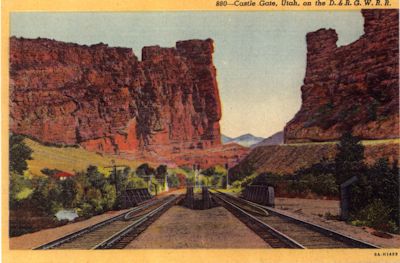
Castle Gate, Utah is a signature location on the old D&RGW Utah Division. It is heartbreaking to look at what the Utah department of transportation did here...blasting down half of the gate to widen the highway. Take a look at this link to see what once was:
www.carbon-utgenweb.com/Castlegate/T-14L.jpg
For over a century the UTAH Railway has been a staple of railroading in its namesake state sharing these rails with the Denver and Rio Grande Western, and then successors Southern Pacific and Union Pacific. Founded in 1912 and completed in 1914 the UTAH was a 100 mile long road whose sole purpose in life was to haul coal for its parent the United States Fuel Company (itself a subsidiary of United States Smelting, Refining and Mining) that owned extensive coal lands in east central Utah. The UTAH constructed a new line from Provo to Thistle then negotiated with the D&RG (it wasn't the D&RGW yet) to exchange trackage rights on the Grande's single track line. Concurrently the D&RG double tracked and realigned its route from Thistle to Helper and the UTAH was granted trackage rights over those 50 miles creating a 70 mile long jointly operated double track railroad. Just two miles west of Helper at Utah Railway Junction the UTAH's own line struck off 25 miles through their new headquarters town of Martin and on to the mines at Hiawatha and Mohrland.
The Grande operated the line for the new owners for its first three years until they assumed their own control in 1917 and it stayed that way ever since. I could go into much more detail but honestly everything you ever wish to know about this road has already been researched and written by Don Strack so check out this link:
utahrails.net/utah-ry/utah-ry-history.php
In 2002 the railroad was sold by its parent company Mueller Industries (corporate successor to United States Fuel) to Genesee & Wyoming. But by that date the UTAH was a much different railroad. Though still a major coal hauler it had expanded into the carload business as result of the UP/SP merger. When the BNSF was granted trackage rights across the Central Corridor (the old Grande) they contracted with the UTAH to handle their local business in the Salt Lake valley including crewing BNSF's run thru trains between Provo and Ogden. In addition to that, the UTAH was also granted overhead rights east to Grand Junction and rights to serve additional Utah coal mines and loadouts that had been exclusively Grande and SP served. And in 1999 it grew a bit more when it took over Railtex's Salt Lake City Southern operation.
As late as 2008 the UTAH was running up to three coal trains a day and all that growth required new power. Consequently they acquired this unique fleet. Seen leading is UTAH 5004 an MK50-3 and trailing are three siblings and an Australian built SD50S. The MK50-3s were built as a MK5000C demonstrators in 1994 and 1995 by Morrison-Knudsen spinoff MK Rail in their failed bid to break into the high horsepower road frieght market in direct competition with EMD and GE. At the time of its introduction in 1994, the MK5000C was the most powerful single prime mover diesel-electric locomotive ever made. After testing for a year on SP and UP with no orders the project was shut down and the six unique units languished until the UTAH bought them in 2001.
However, after one year of operation, all units were out of service due to problems with the main bearings on the Caterpillar 3612 diesel engine and Kato main alternator. They were returned to MK successor Wabtec who replaced them with EMD 3500 horsepower 16-645F3B diesel engines from retired SD50 and G50s and EMD alternators functionally turning them into rebuilt SD50s with one of a kind cabs.
They would remain stalwarts on the UTAH coal trains until the UTAH lost its last contract and the final coal train departed in January 2017 after 103 years. With no need for so many big six axle units to battle the grades anymore parent G&W shipped them all east within a couple months to the Kyle Railroad where they now haul grain on the plains of western Kansas on former Rock Island rails.
Oh and one other historical nugget here. Note the old weed grown yard tracks at right. This was the Castle Gate load load out site for Willow Creek Mine. Alas the last trainload (hauled by the UTAH) departed on September 27, 2000. The mine was closed permanently following a tragic mine fire and explosion on August 1st of that year that killed 2 and injured 12 more. To read an interesting article on that tragedy check out this link: archive.sltrib.com/article.php?id=6973289&itype=NGPSID
Castle Gate
Carbon County, Utah
Friday June 15, 2012
Borders Buses 11209 AE12 AZC in Castlegate 5 Minutes Late on the 08:45 60 Galashiels to Berwick Service
Arriva North East 7525 NK14 GFV in Castlegate Berwick Upon Tweed on the 08:03 X18 Newcastle to Berwick Service
Arriva North East 7556 SN15 LLG in Castlegate Berwick Upon Tweed on the 11:05 X15 Berwick to Newcastle Service
Western Utah Railway coal train on the Southern Pacific's former Denver and Rio Grande Western Railroad at Castle Gate, Utah, on December 28, 1995. Rio Grande acquired the much bigger SP in 1988, but retain the name of the larger road. Union Pacific purchased the entire system in 1996. Photograph by John F. Bjorklund, © 2015, Center for Railroad Photography and Art. Bjorklund-49-18-10
Union Street, Aberdeen
Looking up Union Street from the Citadel (over Castlegate, before Union Street begins)
Union Street looking east
Union Street is a major street and shopping thoroughfare in Aberdeen, Scotland. It is named after the Acts of Union 1800 with Ireland.
Union Street was built to relieve the strain of the small, cramped streets that caused problems for people coming into the city. It was built higher than the old town and was designed to include the five entrances from the city: Queens Road - Rubislaw from Hazelhead; George Street from Inverurie and Morayshire; King Street from the north from Bridge Of Don, Peterhead and Fraserburgh; Market Street, which leads to the fishing town of Torry; and Holburn Street to the Ruthrieston and Garthdee areas.
The street was designed in the beginning of the 19th century under plans suggested by Charles Abercrombie and nearly bankrupted the city. The Denburn River still runs under Union Bridge but has been covered over by a dual carriageway road.
The street is approximately one mile long (0.8 miles and a feat of engineering skill involving the partial levelling of St. Catherine's Hill and the building of arches to carry the street over Putachieside.
The Denburn Valley was crossed by Union Street by Union Bridge (constructed 1801–05), which has a single span arch of 130 feet (40 m).
.
The Castlegate in Aberdeen was chosen as the site for this beautiful Gordon Highlanders statue because this was the site of their original 1700s barracks before moving to the Bridge of Don. Castlegate Barracks was located at the end of Union Street and Castle Street, affording views over the harbour.
The Gordon Highlanders was a line infantry regiment of the British Army that existed for 113 years, from 1881 until 1994 when it was amalgamated with the Queen's Own Highlanders (Seaforth and Camerons) to form the Highlanders (Seaforth, Gordons and Cameron's.
Motto(s): Bydand
Battle honours: Relief of Ladysmith; Battle of Kandahar
March: Cock o' the North
Part of: Scottish Division
Garrison/HQ: Castlehill Barracks, Aberdeen (1881–1935); Gordon Barracks, Bridge of Don (1935–94)
Branch: British Army
Engagements: Mysore; Seringapatam; Peninsular War; South Africa 1899–1902
The regiment was formed on 1 July 1881 instigated under the Childers Reforms. The new two-battalion regiment was formed out of the 75th (Stirlingshire) Regiment of Foot - which became the 1st Battalion of the new regiment - and the 92nd (Gordon Highlanders) Regiment of Foot, which became the 2nd Battalion.
The 1st battalion fought at the Battle of Tel el-Kebirin September 1882 during the Anglo-Egyptian Warand then took part in the Nile Expedition in an attempt to relieve Major-General Charles Gordon during the Mahdist War.
The 1st Battalion then took part in the Chitral Expedition and then the Tirah Campaign: it was during operations on the North West Frontier in October 1897, during the storming of the Dargai Heights, that one of the regiment's most famous Victoria Crosses was earned. Piper George Findlater, despite being wounded in both legs, continued to play the bagpipes during the assault. Another of the heroes involved the charge of the Gordon Highlanders at Dargai Heights, was Piper John Kidd. Piper Kidd was with Piper Findlater when, half-way up the heights, both pipers were shot down. Unmindful of his injuries, Piper Kidd sat up and continued to play "The Cock o' the North" as the troops advanced up the heights.
The 2nd Battalion fought at the Battle of Elandslaagte in October 1899 and the Siege of Ladysmith in November 1899 during the Second Boer War
Meanwhile the 1st Battalion, who arrived a little later, saw action at the Battle of Magersfontein in December 1899 and was again in action at Doornkop, where they suffered severe losses, in May 1900.
First World War
British troops, believed to be the 2nd Battalion, The Gordon Highlanders (20th Brigade, British 7th Division) crossing no man's land near Mametz on 1 July 1916, the first day of the Battle of the Somme.
Regular Army
The 1st Battalion landed at Boulogne-sur-Mer as part of the 8th Brigade in the 3rd Division in August 1914 for service on the Western Front; they suffered heavy losses at the Battle of Le Cateau in August 1914.[7] The 2nd Battalion landed at Zeebrugge as part of the 20th Brigade in the 7th Division in October 1914 for service on the Western Front and then moved to Italy in November 1917.
Territorial Force
The 1/4th (City of Aberdeen) Battalion landed at Le Havre as part of the 8th Brigade in the 3rd Division in February 1915 for service on the Western Front
.The 1/5th (Buchan and Formartin) Battalion landed at Boulogne-sur-Mer as part of the 153rd Brigade in the 51st (Highland) Division in May 1915 for service on the Western Front. The 1/6th (Banff and Donside) Battalion landed at Le Havre as part of the 20th Brigade in the 7th Division for service on the Western Front.
The 1/7th (Deeside Highland) Battalion landed at Boulogne-sur-Mer as part of the 153rd Brigade in the 51st (Highland) Division in May 1915 for service on the Western Front.
New Armies
The 8th (Service) Battalion landed at Boulogne-sur-Mer as part of the 26th Brigade in the 9th (Scottish) Division in May 1915 for service on the Western Front.[7] The 9th (Service) Battalion and the 10th (Service) Battalion landed at Boulogne-sur-Mer as part of the 44th Brigade in the 15th (Scottish) Division in July 1915 for service on the Western Front.
The folk singer and Scottish Traveller Jimmy MacBeath served with the regiment during the war.
Second World War
British tanks supported by men of the 6th Battalion Gordon Highlanders in the Netherlands in November 1944
The 1st Battalion, Gordon Highlanders was a Regular Army battalion that served originally with the 2nd Infantry Brigade, part of the 1st Infantry Division, and was sent to France in September 1939, shortly after the declaration of war, as part of the British Expeditionary Force (BEF): it remained there until May 1940.
On 7 March 1940 the 1st Battalion exchanged with the Territorial 6th Battalion and transferred to the 153rd Infantry Brigade, part of the 51st (Highland) Division. The battalion served with the 51st Division during the Battle of France in 1940 when they were trapped and the majority of the division was forced to surrender at Saint-Valéry-en-Caux, with very few men escaping capture. The 1st Battalion was, however, reformed in the United Kingdom in August 1940 and went on to serve with the second formation of the 51st (Highland) Division (formed by redesignation of the 9th (Highland) Infantry Division throughout the rest of the Second World War, serving in North Africa at El Alamein, Tunisia, Sicily and North-western Europe, ending the war in Germany.
The 2nd Battalion was based in Malaya as part of the Singapore garrison and fought in the battle for Singapore in February 1942, surrendering along with 130,000 other British Commonwealth soldiers on 15 February. The men of this battalion suffered more casualties as Prisoners of War in Japanese captivity than they did during the fighting on Singapore Island and Malaya. The 2nd Battalion was reformed in May 1942 from personnel of the 11th Battalion and fought with the 15th (Lowland) Division, throughout North West Europe. They formed part of 227th (Highland) Brigade - the Junior brigade in the division. They were involved in the heavy fighting around Cheux and Tourville-sur-Odon in Normandy, the fight for the Netherlands and in the Battle of Uelzen in Germany near to the end of the war.
The 4th (City of Aberdeen) Battalion served as a Machine Gun Battalion in the Battle of France and was later converted to a Royal Artillery regiment on 1 November 1941, becoming the 92nd Anti-Tank Regiment, Royal Artillery, as part of the 9th Armoured Division, but saw no active service during the war.
The 5th Battalion went to France as part of the British Expeditionary Force: they were serving as part of the 153rd Brigade in the 51st Division during the Battle of France in 1940 when they were trapped and the majority of the division was forced to surrender at Saint-Valéry-en-Caux. The 5th Battalion was, however, reformed in the United Kingdom in August 1940 and went on to serve with the second formation of the 51st (Highland) Division (formed by redesignation of the 9th (Highland) Infantry Division throughout the rest of the Second World War, serving in North Africa and taking part in the Normandy landings.
The 6th (Banffshire) Battalion, a Territorial Army battalion, was transferred from the 153rd Brigade in the 51st (Highland) Division before it joined the 2nd Infantry Brigade of the 1st Infantry Division. It took part in the Dunkirk evacuation. The 6th Battalion fought through the Tunisian, North African and Italian campaigns, in both the Battle of Anzio and Operation Diadem, and later the Battle for the Gothic Line, before ending the war on garrison duty in Palestine.
The 7th (Mar and Mearns) Battalion amalgamated with the 5th Battalion, becoming the 5th/7th Battalion, Gordon Highlanders, and served with the second formation of the 51st (Highland) Division throughout the war.
The 8th (City of Aberdeen) Battalion was also converted to artillery, becoming the 100th Anti-Tank Regiment, Royal Artillery. This battalion served with the 2nd Infantry Division in the Burma Campaign.
The 9th (Donside) Battalion (originally part of the 9th (Highland) Infantry Division along with the 11th Battalion) were initially posted to the Shetland islands. Later they were amalgamated with the 5th Battalion and sent to India for training. Converted to an armoured regiment in 1942 as the 116th Regiment Royal Armoured Corps (Gordons), they continued to wear the Gordons cap badge on the black beret of the RAC.
116th RAC were sent to India and joined 267th Indian Armoured Brigade; later they served in Burma where as part of 255th Indian Tank Brigade they were involved in the dash for Rangoonand were heavily involved in the battle of Meiktila, signalling the end of Japanese hopes in Burma.
Post-War
After the war the Gordons saw active service in the Malayan Emergency, Cyprus, and Northern Ireland. The Regiment was amalgamated with The Queens' Own Highlanders (Seaforth and Camerons) on 17 September 1994 to form the Highlanders (Seaforth, Gordons and Camerons). In 1997, the Gordon Highlanders Museum opened, in the former regimental headquarters in Aberdeen.
The Valleyline is the brand new service offered from The Blackburn Bus Company, with a fresh new image. Using former Keighley and Lancashire United Volvo B10BLEs, which have been 'revitialised' after overhaul, with additional USB power, Free Wi-Fi, next stop audio/visual announcements and high specification seats.
This new service combines the old 22 Blackburn to Clitheroe service with the former 24 Blackburn to Shadsworth via the Royal Blackburn Hospital.
Here 566 is seen in Castlegate in Clitheroe heading for the main interchange bus and train station area.
Bruce’s Coaches National Express BV66 WPF In Castlegate Berwick Upon Tweed 5 Minutes Early On the 08:10 591 Glasgow to London Via Edinburgh Service
Arriva North East 7529 NK64 EFM In Castlegate Berwick Upon Tweed On the 13:05 X15 Berwick to Newcastle Service
Parks of Hamilton National Express BV67 JYZ In Castlegate Berwick Upon Tweed on the 08:40 591 Glasgow To London Via Edinburgh Service
the same picture, edited with different dreamscope apps
Original (1496 x 374): www.flickr.com/photos/ololiuqui/19981107999/sizes/o/
CASTLEGATE GETS GREY TO GREEN TRANSFORMATION
The scheme links Castlegate to the under-visited ‘hidden jewel’ of Victoria Quays and has transformed the almost redundant former inner ring road from a barrier to a green corridor with sustainable drainage, floral meadows, segregated cycle lanes and public art.
Castlegate (the Street) has been closed to vehicles to create a large riverside terrace with potential to accommodate outdoor seating for existing and future cafes and bars including the former public toilet due to open as the Two Rivers Bar and the Tap and Barrel, now under new management by the Peddlers Market team. The street will also hold the newly established Sheffield Pollen Market, the first fresh flower market in Sheffield, which will take place every third Sunday of the month.
Fifty-seven new trees have been planted as part of the scheme, along with a multitude of low maintenance perennial meadow plants and bulbs which will provide a year long succession of colour and natural habitat for insects, birds and mammals.
The scheme includes four distinctive, specially designed ‘totems’ containing ‘bug hotels’ which provide places for bees and other insects to thrive, along with nature and heritage insights.