View allAll Photos Tagged TurboFan
General description
Crew: 4 - pilot / commander, co-pilot, offensive systems officer and defensive systems officer
Capacity: 56,700 kg (125,000 lb) of internal and external load
Length: 44.5 m (150 ft)
Wingspan: 41.8 m (140 ft)
Reinforced wingspan: 24 m (79 ft)
Height: 10.4 m (34 ft)
Alarm area: 181.2 m² (1 950 ft²)
Empty weight: 87 100 kg (192 000 lb)
Gross weight (loaded): 148,000 kg (326,000 lb)
Take-off weight: 216 400 kg (477 000 lb)
Fuel capacity: 44,049 l (11,600 US-gal)
Motorization
Number of engines: 4x
Engine Type: Turbofan
Manufacturer / Model Name: General Electric F101-GE-102
Motor buoyancy: 13 962 kgf (30,800 lbf) (136.92 kN)
Performance
Maximum speed: 1 335 km / h (830 mph)
Total Mach Speed: 1.25 Ma
Total Node Speed: 721 kn (1 340 km / h)
Range: 11,999 km (7,460 mi)
War range: 5 544 km (3 440 mi)
Service ceiling: 18 000 m (59 100 ft)
Two Pratt & Whitney PW2040 high-bypass turbofans, 40,000-lbf each
----
en.wikipedia.org/wiki/Columbanus
P9245171 Anx2 Q90 1200h
Dayton, OH
National Museum of the U.S. Air Force
The Fairchild Republic A-10 Thunderbolt II is a single-seat, twin turbofan engine, straight wing jet aircraft developed by Fairchild-Republic for the United States Air Force. It is commonly referred to by the nicknames "Warthog" or "Hog", although the A-10's official name comes from the Republic P-47 Thunderbolt, a World War II fighter-bomber often used in a close air support role during World War II. it's role is to support friendly ground troops and o attack armored vehicles and tanks and for quick-action support against enemy ground forces.
The A-10 is very maneuverable at low speeds and low altitudes to ensure accurate weapons delivery, and it carries the systems and armor needed to survive in this environment.
The Thunderbolt II's endurance gives it a large combat radius and long loiter time in a battle area. Its short takeoff and landing capability permits operation from airstrips close to the front lines.
Information courtesy of Wikipedia and The National Museum of the U.S. Air Force
Die An-27 ist ein STOL-Transportflugzeug für Kurz- und Mittelstrecken.
Die Kurzstart- und Landeeingenschaften werden durch die beiden Turbofan-Triebwerke, die vor und über den Tragflächen angeordnet sind, erreicht. Der Luftstrom wird damit über die Tragflächen geleitet, um so den Auftrieb zu erhöhen. Von diesem Transportflugzeug wurden 121 Exemplare gefertigt.
Das Vorbild des Modelles der estnischen Fluggesellschaft Enimex hat die Seriennummer 36572070695 und wurde am23.07.1997 ausgeliefert
Standing in front of the starboard General Electric GE90-110B1 turbofan of Delta Air Lines Boeing 777-232/LR, N704DK.
A pair of these engines propel a 300+ ton Boeing 777 along at 500+ miles per hour for 6500+ miles!
Scary to imagine the ingestive force when throttled up!
Photographed at Detroit Metropolitan Airport (DTW), Dec 17, 2017.
Pratt & Whitney F135 low-bypass afterburning turbofan, 43,000-lbf
----
www.rafmuseum.org.uk/research/collections/lockheed-martin...
P4190723 Anx2 Q90 1024h
Amazing close-up of the Polish Air Force MiG-29 Fulcrum doing his signature go-around after a low pass in landing configuration. Some children next to me were sad that the MiG was landing and the show was over. Knowing what was to come, I kept my mouth shut and heard their joyful screams as the Fulcrum lit the burners and went vertical right net to us. Awesome!
Captured during the display at ILA, Internationale Luft-und Raumfahrtausstellung Berlin. For your enjoyment and because the air was so clear at that time of day, I am doing my first upload at 3000 pixels wide. Tell me what you think about this format. Enjoy!
Categories:
Mikoyan - MiG-29 - Polish Air Force - ILA 2016
Collections:
1 G-CIVB British Airways 747 has been transformed into a party plane at Cotswolds Airport - and it is available to hire.
2 The BA B744 at Cotswold Airport in Kemble has been transformed into an events space to host everything from private birthday parties to product launches and corporate events.
The aircraft is being preserved at the site near Cirencester after British Airways retired its fleet early because of the travel downturn caused by the Covid pandemic.
It was bought for just £1 in 2020 and has since been a labour of love for the airport's chief executive Suzannah Harvey.
3 The Rolls-Royce RB211 is a British family of high-bypass turbofan engines made by Rolls-Royce. The engines are capable of generating 41,030 to 59,450 lbf of thrust. Wikipedia
The Bombardier CRJ200 is a regional jet designed and manufactured by Bombardier Aerospace between 1991 and 2006, the first of the Bombardier CRJ family. The 50 seat aircraft is powered by two GE CF34 turbofans, mounted on the rear fuselage. The CRJ200 has more efficient turbofan engines for lower fuel consumption, increased cruise altitude and speed
18 secs of Victor power (its hard to find video of it actually flying with good sound):
www.youtube.com/watch?v=YVIHn5GdWhI
The Handley Page Victor K.2 tanker evolved from the original Victor B.2, ‘V’-bomber, which entered service with the Royal Air Force in October 1961. The first K.2 flew at Woodford on 1 March 1972. It had a crew of five, and was powered by four Rolls-Royce Conway turbofans of 20,600 lb thrust each. It had a maximum speed of 640 mph (Mach 0.92) at 40,000 feet, a ceiling of 59,000 feet and a range of 3,500 miles.
Victor K.2s made a substantial contribution in the Falklands War, flying over 3,000 hours and making over 600 air refuelling sorties from Ascension Island, in support of the Vulcans, Nimrods, Hercules and Harriers. They also flew in the Gulf War, refuelling the Tornado and other allied aircraft. The Victor’s outstanding versatility and advanced design enabled it to have the longest service of all the ‘V-bomber’ generation.
XL231 joined 139 Squadron on 1 February 1962, returning to Handley Page for conversion to a B(S.R) Mk 2 in November 1963 and joining the Wittering Wing in July 1964. It was converted to become the prototype K.2 Tanker on 23 January 1972 and saw service in the Falklands War, in support of the air operations from Ascension Island, and later in the Gulf War. It was flown into retirement at Elvington in November 1993. The aircraft is kept in ground operational condition by Andre Tempest and his ground crew.
On finals to land at Glasgow Prestwick airport in Ayrshire Scotland is the AN225.
The Antonov An-225 Mriya is a strategic airlift cargo aircraft that was designed by the Antonov Design Bureau in the Ukrainian SSR within the Soviet Union during the 1980s. It is powered by six turbofan engines and is the heaviest aircraft ever built, with a maximum takeoff weight of 640 tonnes. It also has the largest wingspan of any aircraft in operational service. The single example built has the Ukrainian civil registration UR-82060.
A few of the large number of Boeing 707s and 720s bought by Boeing in the 1980s to facilitate the conversion of KC-135As to turbofan power. The airliners donated their engines, pylons and throttle pedestals, as well as horizontal stabilisers, all of which were needed to carry out the upgrade. In this image, taken in rather dull weather, ex-Conair 720B TF-AYB (previously OY-APW) is on the left and on the right is ex-Saudia 707 N1673B (previously HZ-ACD). Both had arrived earlier in 1987.
Die Antonow An-225 „Mrija“ ist ein in der Sowjetunion entwickeltes sechsstrahliges Frachtflugzeug und das größte Flugzeug der Welt. Es erreicht mit 640 t die größte zugelassene Startmasse aller bisher gebauten Flugzeuge. Das einzige Exemplar wurde auf der ILA 2018 in Berlin gezeigt.
The Antonov An-225 “Mriya” is a cargo aircraft that was designed in the Soviet Union. It is powered by six turbofan engines and is the heaviest aircraft ever built, with a maximum takeoff weight of 640 tonnes. It is the biggest aircraft of the world. The single example built has been displayed at Berlin Air Show ILA 2018.
[explore-2018-05-01]
Two General Electric GEnx-1B67 dual-rotor axial-flow high-bypass turbofans, 69,400-lbf each
----
Sigma 50-500mm 1:4-6.3 APO DG HSM EX
DSC_5752 Anx2 1400h Q90
retired air force T-43 training aircraft in a desert boneyard. the T-43 was the military version of the the boeing 737-200 passenger jet.
nikon D7000 + nikkor 10-24mm, 60 exposure under full moon + 5x 60sec stacked exposures for star trails. light painting with LED flashlight and blue, magenta and purple colored gels.
taken during the "boneyard" night photography workshop hosted by mike hows and joe reed.
world toy camera day 2018. retired NASA boeing 747 SCA shuttle carrier aircraft at the palmdale airpark. holga 120S plastic camera, arista ultra EDU 100 black & white film. lab: the icon, los angeles, ca. scan: epson V750. EXIF tags: lenstagger.
OK-PRJ leaving Norwich Int. Airport (NWI) for Faro Airport (FAO), Portugal.
Flight number PAV261, flight time 2:36.
Model: EMB-550 Praetor 600
Manufacturer: Embraer
Year built: 2025
Serial number: 55020222
Registration: OK-PRJ
Owner: Atmospherica Aviation, Prague, Czech Republic
Delivery date: May 2025
Flight crew: 2
Passengers: 9
Length: 68 ft. 0.5 in. (20.74 m)
Height: 21 ft. 1.5 in. (6.44 m)
Wingspan: 70 ft. 6.5 in. (21.5 m)
Wing area: 482.8 sq. ft. (44.85 m2)
Max payload: 4,001 lb. (1,815 kg)
MTOW: 42,858 lb. (19,440 kg)
Fuel capacity: 16,140 lb. (7,320 kg)
Engines: 2 x Honeywell HTF7500E turbofan
Thrust: 2 x 7,528 lb. (33.48 kN)
Cruise speed: 466 knots (536 mph - 863 km/h)
Service ceiling: 45,000 ft. (13,716 m)
Range: 4,018 nm (4,624 miles - 7,441 km)
Tale off distance: 4,436 ft. (1,352 m)
Landing distance: 2,165 ft. (660 m)
Registration history:
OK-PRJ, Atmospherica Aviation, delivered 6th. May 2025
D-BIFH, VistaJet Germany, delivered 9th. April 2025
PR-GQS, test registration
Pulling Gs and creating a huge cloud of condensation above the the fuselage. The quality of this photo is quite bad, I know, and would never be accepted to a major website like A.net. However, for me as an aviation engineer and passionate photographer, it is important because it captures the dynamic of flight and rare atmospheric effects. That is why I like Flickr, because I have the creative freedom to add such grainy, 100% crop photos.
Categories:
Saab - JAS-39 Gripen - Czech Air Force - Rostock Laage 2014
Collections:
After years of dreaming about it, the moment finally came to be face-to-face with the IL-96. This aircraft, CU-T1717 is a former Aeroflot frame, registered RA-96008. In 2014 Aeroflot retired all IL-96 and most were sold to Cubana. However, this is the only one still flying, the others being parts donors. The aircraft retains the Aeroflot colours, with Cubana titles painted on. Note the fracturing of the letters, must have been cheap paint :). It is named after Iakov Moiseev.
Categories:
Ilyushin - IL-96 - RussianAircraft - Cubana - MAD/LEMD
Collections:
Later this evening REX airlines were placed into administration and all 737 flights stopped. This was one of the last 737 flights to work out of Melbourne.
Seeing my first B-52 take-off was really quite something. One thing that I will remember for a while is the sound of those 8 P&W TF-33 turbofans helping this big lump of an aircraft take-off right in front of my lens.
Training circles with low approach and touch and go
Callsign:NATO40
Made:1983
SN:22845/959
Engines:4× Pratt and Whitney TF33-PW-100A turbofan
From:NATO Air Base Geilenkirchen/GKE/ETNG/Germany/DE To Pardubice/LKPD/PED/Czech Republic/CZ
35 Years NATO AWACS livery
Nikkormat FTn w/Vivitar 28mm f 2.8 Prime on Plus-X.
Possibly an Eastern Airlines '727
Boeing 727
The Boeing 727 is an American narrow-body airliner that was developed and produced by Boeing Commercial Airplanes. After the heavier 707 quad-jet was introduced in 1958, Boeing addressed the demand for shorter flight lengths from smaller airports. On December 5, 1960, the 727 was launched with 40 orders each from United Airlines and Eastern Air Lines. The first 727-100 rolled out on November 27, 1962, first flew on February 9, 1963, and entered service with Eastern on February 1, 1964.
The only trijet aircraft to be produced by Boeing, the 727 is powered by three Pratt & Whitney JT8D low-bypass turbofans below a T-tail, one on each side of the rear fuselage and a center one fed through an S-duct below the tail. It shares its six-abreast upper fuselage cross-section and cockpit with the 707 that was also later used on the 737. The 133-foot-long (41 m) 727-100 typically carries 106 passengers in two classes over 2,250 nautical miles [nmi] (4,170 km; 2,590 mi), or 129 in a single class. Launched in 1965, the stretched 727-200 flew in July 1967 and entered service with Northeast Airlines that December. The 20 ft (6.1 m) longer variant typically carries 134 passengers in two classes over 2,550 nmi (4,720 km; 2,930 mi), or 155 in a single class. A freighter and a "Quick Change" convertible version were also offered.
The 727 was used for domestic flights and on international flights within its range. Airport noise regulations have led to hush kit installations. Its last commercial passenger flight was in January 2019. It was succeeded by the 757 and larger variants of the 737. There have been 353 incidents involving the Boeing 727.[4] Production ended in September 1984 with 1,832 having been built. The 727 was an industry workhorse for many years, often fondly referred to as "the DC-3 of the Jet Age."
Source: en.wikipedia.org/wiki/Boeing_727
Boeing 777 - According to Wikipedia it is the largest twin-jet aircraft with the largest diameter turbofan engine. An impressive beast when taxiing right towards you.
April 17, 2018
Memphis International Airport (MEM), Memphis, Tennessee
Two General Electric CF34-10E5A1 high-bypass turbofans, 18,500-lbf each
----
Sigma 50-500mm 1:4-6.3 APO DG HSM EX
_DSC4255 Anx2 800h Q90 f25
Two General Electric GE90-94B high-bypass turbofans, 93,700-lbf each
----
Nikon Nikkor 18-135mm 1:3.5-5.6 G ED-IF AF-S DX
_DSC9388 Anx2 1400h Q90
Three General Electric CF6-80C2D1F turbofans, 59,000-lbf each
----
Parked at FedEx facility
PC053401 Anx2 Q90 1200h
A Royal Canadian Air Force CF-18A Hornet (188730), second of a pair, operating out of RAF Waddington - carrying out low flying ops in LFA7 during Ex Cobra Warrior 23-2.
As Hollywood as it sounds I managed to get to an acceptably elevated position just a couple minutes before the roar of GE turbofan engines filled the valley. Phew!
The day was pretty tricky with the heat, & with dust being carried in the air & rain from recent Sahara storms getting on the chest & on the camera.
I was glad for a shower that evening.
© Ben Stacey All Rights Reserved - Any use, reproduction or distribution of this image without my explicit permission is strictly prohibited.
Nice detail viewed large.
The BAe Nimrod MR2 was a maritime patrol and anti-submarine warfare aircraft based on the de Havilland Comet, the world’s first jet airliner. Other roles were anti-surface warfare and search and rescue. The long-range Nimrod MR1 and MR2, with a normal crew of 12 and powered by four Rolls-Royce Spey turbofan engines and variously armed with air-to-surface missiles, torpedoes or mines, served with the Royal Air Force from the early 1970s until March 2010 when the fleet was withdrawn from service. The replacement Nimrod MRA4 project was cancelled and the airframes scrapped following the Strategic Defence and Security Review.
Nimrod XV250 was built at Woodford as an MR.1 aircraft and first flown on 21 January 1971. It was delivered to RAF Kinloss on 18 February 1971 and was transferred to 203 Squadron at RAF Luqa, Malta on 4 February 1972. The aircraft returned to Kinloss in 1975 and was transferred to Woodford on 16 June 1982 for conversion to MR2 specification. It made its initial flight in that configuration on 10 June 1983 and was re-delivered to RAF Kinloss on 8 July 1983. Except for periods at RAF St Mawgan in 1979 and the 1980s, XV250 remained based at Kinloss with deployments elsewhere until withdrawn from RAF service on 31 March 2010. The aircraft made its last flight to Elvington on 13 April 2010, where it is maintained in ground operational condition.
Four Engine Alliance GP7270 high-bypass turbofans, 81,500-lbf each
en.wikipedia.org/wiki/Engine_Alliance_GP7000
www.planespotters.net/airframe/airbus-a380-800-a6-edd-emi...
----
Sigma 12-24mm 1:4.5-5.6 DG HSM EX
_DSC2615 Anx2 1400h Q90 f25 f50
155214 - British Aerospace CT-155 Hawk - Canadian Forces - Royal Canadian Air Force (RCAF)
in the dank blue colours of the NTFC-program
at London International Airport (YXU) during the 2019 London Air Show
The CT-155 Hawk was selected for the NATO Flying Training in Canada (NFTC) program because of its similarities to frontline fighter aircraft. Student pilots graduate from the CT-156 Harvard II to this highly advanced jet trainer. Its Rolls-Royce turbofan engine generates more than 6000lbs of thrust and powers the jet to supersonic speeds.
TC-TJR on approach to London Stansted Airport from Antalya Airport (AYT), Turkey.
Flight number XC8481, flight time 4:22.
Model: 737-82R
Manufacturer: Boeing
Year built: 2011
First flight: 9th. April 2011
Serial number: 40723
Registration: TC-TJR
Owner: Corendon Airlines
Delivery date: 26th. June 2019
Flight crew: 2
Number of seats: 189
Length: 129 ft. 6 in. (39.47 m)
Height: 41 ft. 2 in. (12.55 m)
Wingspan with winglets: 117 ft. 5 in. (35.79m)
Wing area: 1,341.2 sq. ft. (124.60 m2)
Empty weight: 91,300 lb. (41,413 kg)
MTOW: 174,200 lb. (79,016 kg)
MLW: 146,300 lb. (66,361 kg)
Fuel capacity: 5,725 gall. (26,022 litres)
Engines: 2 x CFM International CFM56-7B26 turbofan
Thrust: 2 x 27,290 lb. (121.4 kN)
Cruise speed: 455 knots (523 mph - 842 km/h)
Service ceiling: 41,000 ft. (12,497 m)
Range: 2,935 nm (3,378 miles - 5,436 km)
Take off distance: 7,598 ft. (2,316 m)
Registration history:
TC-TJR, Corendon Airlines, delivered 31st. March 2025
TC-TJR16/12/2024Indigo, delivered 16th. December 2024, operated by Corendon Airlines
TC-TJR, Corendon Airlines, delivered 25th. January 2023
TC-TJR, SpiceJet, delivered 31st. October 2022, operated by Corendon Air
TC-TJR, Corendon Airlines, delivered 24th. March 2020
TC-TJR, SpiceJet, delivered 21st. October 2019
TC-TJR, Corendon Airlines, delivered 26th. June 2019
TC-AMP, Pegasus Airlines, delivered 23rd. April 2011
Aircraft named 'Nil'
Test registration unknown
My first encounter with a Flanker...words are not enough, but hopefully my photographs will be. Breathtaking and exhilarating performance from a legendary aircraft. Many thanks to the Ukrainian Air Force and the organizers of the Bucharest International Air Show 2016 for this unique opportunity!
Categories:
Sukhoi - Su-27 - Cold War Aircraft - Ukrainian Air Force - BIAS - BIAS 2016
Collections:
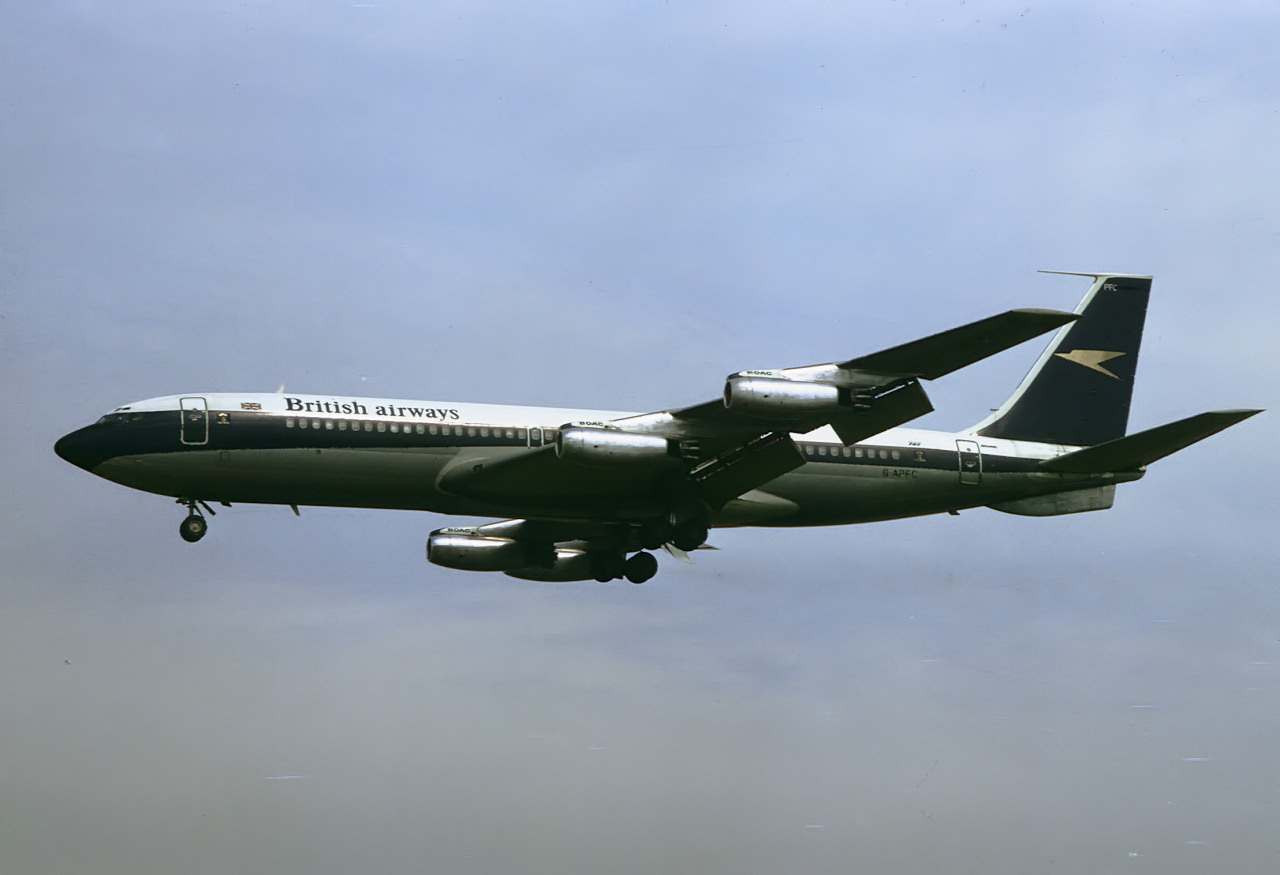
Photo taken by Herwart Schneider and kindly provided by him for inclusion on this page.
München-Riem
ca. April 1973
G-APFC
Boeing 707-436
17704/101
British Overseas Airways Corporation (BOAC)
The slide was undated, but G-APFC was noted at Riem on 7 April 1973, which may well be the date of this shot. The aircraft is taxiing to runway 25 for take-off, with the Rolls-Royce Conway turbofans prominently in view. This shot was taken from outside of the airport fence.
First flight on 24 January 1960 and delivered to BOAC on 16 May 1960. Transferred to British Airways in April 1974 and stayed with the airline until wfu and sold back to Boeing in 1975 for destructive testing. The cockpit seems to have ended up at Wade’s Salvage Yard in New Jersey (see link below).
G-APFC with BOAC at PIK in the early 1960s (initial colours):
www.airhistory.net/photo/427686/G-APFC
G-APFC with British Airways ca. mid-1970s (basic BOAC colours):
www.airlines-airliners.com/fotoserien/boac/g_apfc.jpg
G-APFC‘s cockpit at Wade’s Salvage yard:
www.707jet.com/g-apfc-cockpit/
Scan from Kodachrome slide.