Sponsored images from 
View allAll Photos Tagged Testbed
In the back of a commuter jet used as a testbed at Sandia National Laboratories, Dennis Roach and Ciji Nelson examine piezoelectric sensors placed on a printed circuit board for mounting to an aircraft structure (more information). Photo courtesy Sandia National Laboratories.
c/n 18384/237. At Phoenix. Used as an engine testbed. New to TWA as N795TW in 1961. To Northwest Orient as N733US in 1962 then to Maersk Air as OY-APZ in 1972. Leased to Trans European Airways as OO-TYA from 1979 to 1980 and returned as OY-APZ. To Conair of Scandinavia in 1981, then Allied-Signal as N720GT in 1987. To Honeywell as N720H in 2000. Scrapped at Phoenix in 2008.
This paper model is the Tiangong-1 Space Station with the Shenzhou 9 spacecraft, created by Bartek Biedrzycki, and the scale is in 1:144.
Tiangong-1 is China's first space station, serving as both a manned laboratory and an experimental testbed to demonstrate orbital rendezvous and docking...
www.papercraftsquare.com/shenzhou-9-and-tiangong-1-space-...
The Gloster Meteor was the first British jet fighter and the Allies' first operational jet. It first flew in 1943 and commenced operations on 27 July 1944 with 616 Squadron of the Royal Air Force (RAF). The Gloster Meteor was not an aerodynamically advanced aircraft but the Gloster design team succeeded in producing an effective jet fighter that served the RAF and other air forces for decades. Meteors saw action with the Royal Australian Air Force (RAAF) in the Korean War, and remained in service with numerous air forces until the 1970s. Two Meteors, WL419 and WA638, remain in service with the Martin-Baker company as ejection seat testbeds.
This shot was taken at Duxford Autumn Air Show.
www.gettyimages.co.uk/detail/news-photo/the-gloster-meteo...
CN SD75I 5781 and SD40-2W 5258 (this unit was one of the LNG fuel testbeds) wheel through Brighton Park, Chicago, with a local from Glenn Yard.
Gulfstream's G800 prototype/testbed diverted into MSP today on account of poor weather at CID; sadly the large probe up front has been removed, but was interesting to see a couple of window plugs with some sort of equipment installed.
N800G (SAV-MSP) Feb 12, 2025
Please bear with me; it's a long story. This aircraft is currently undergoing reconstruction. The nose section is from 44-85813, an aircraft used as an engine testbed by Curtiss-Wright. This aircraft, civil registration N6694C, crashed in 1980 - registration cancelled. Major parts of another B-17, one used for atomic tests in Nevada, 44-83722 are being used; its civil registration, N3154S, is being adopted but will now be associated with 44-85813. This is an example of the fragments with which these expert restorers have to work!
Arriva London Ltd.:
DW411 was retrofitted with a new driveline, as a testbed for what would become the Wrightbus StreetDeck. The original 6-cyl Cummins ISBe engine was replaced with the Mercedes-Benz (Daimler) OM934. The vehicle caught fire shortly after arrival to the London fleet in 2011, so instead of being written off, she was given a new lease of life, and a slightly different identity!
VDLbus DB300 (Daimler) /
Wrightbus Gemini 2DL (10.5m)
H41/24D - 2011
Rockwood Road, Stamford Hill
Saturday 1st August 2015
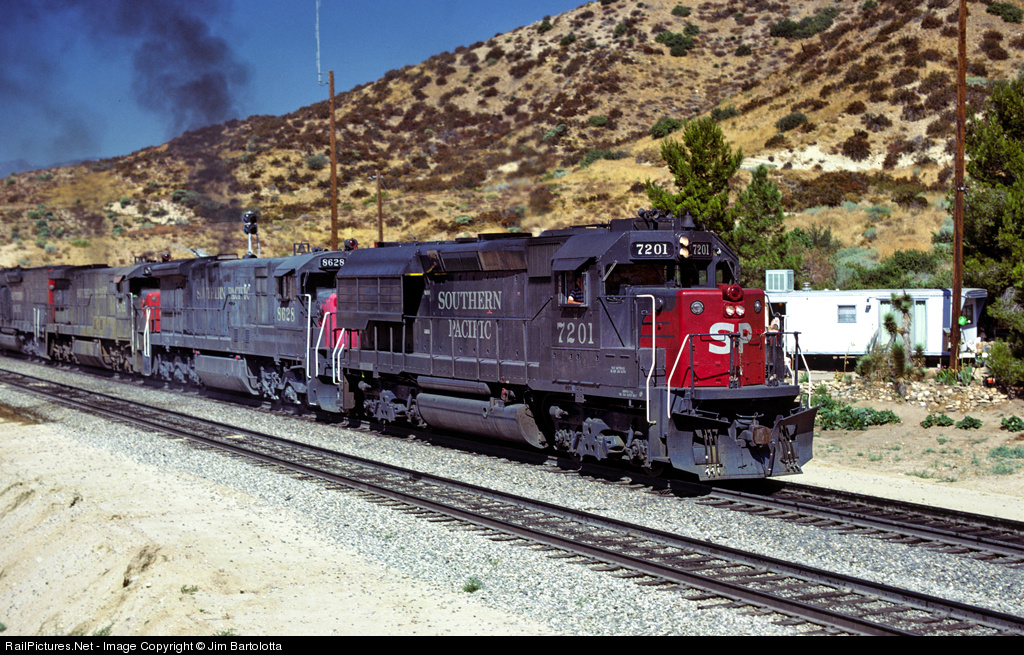
The GP40X was EMD's testbed for the future GP50 and introduced the unpopular HT-B truck. The 'elephant ears' version shown here was an experiment in normalizing the tunnel motor concept. The ears eventually were removed and the HT-B trucks were never reproduced. I needed a powered SP unit to haul around some heavy trains so all those unique qualities fit the bill just right. Originally I wanted to build the UP version, but the SP is more iconic with those elephant ears. The UP version will follow someday.
A transporter moves an electronic testbed version of a U.S. Navy Trident D5 submarine-launched ballistic missile from NASA's Kennedy Space Center to the interactive test facility at the Naval Ordnance Test Unit, or NOTU, located at Cape Canaveral Air Force Station adjacent to the space center. The inert missile will be used to evaluate the new facility. The space center, which has transformed into a multi-user spaceport servicing numerous government and commercial launch vehicles, spacecraft and companies, retains numerous transportation hubs including the railway system that connects the center to the Florida mainland and the rest of the Florida East Coast railroad network. Photo credit: NASA/Kim Shiflett
The XK120 was launched in roadster form at the 1948 London Motor Show as a testbed and show car for the new Jaguar XK engine. It caused a sensation, which persuaded Jaguar founder and design boss William Lyons to put it into production.
The "120" in its name referred to its 120 mph (193 km/h) top speed (faster with the windscreen removed), which made the XK120 the world's fastest standard production car at the time of its launch.
It was available in two open versions, first as the roadster (designated OTS, for open two-seater, in America), then also as a drophead coupé (DHC) from 1953 – and also as a closed, or "fixed-head" coupé (FHC) from 1951. The DHC was a more deluxe open model, with wind-up windows, and wood-veneer dashboard and interior door caps, as on the FHC.
The roadster was successful in racing.
(Wikipedia)
- - -
Der Jaguar XK 120 war ein zweisitziger Roadster, den Jaguar 1948 als Nachfolger des S.S.100 auf den Markt brachte.
Der Jaguar XK 120 OTS (Open Two Seater, so die etwas umständliche Bezeichnung für den Roadster) besaß einen Sechszylinder-Reihenmotor mit 3442 cm³ Hubraum und 160 bhp.
Ab 1951 gab es den Jaguar XK 120 FHC (Fixed Head Coupé), ein Coupé mit gleicher Motorisierung und 194 km/h Höchstgeschwindigkeit. Bis zur Einstellung 1954 wurden 2678 Stück gebaut.
1953 kam der Jaguar XK 120 DHC (Drop Head Coupé), ein Cabriolet mit gefüttertem Stoffdach und der gleichen Motorisierung, auch als SE, dazu. Es wurde allerdings nur ein Jahr lang angeboten und erreichte in diesem Zeitraum die Stückzahl von 1767 Exemplaren.
(Wikipedia)
This 1970 Boeing 747-100 (ex-Pan Am) is the aircraft used by General Electric to test their jet engines. The #3 engine is replaced with whatever engine is being tested. The aircraft is stored and maintained here in Victorville.
The XK120 was launched in roadster form at the 1948 London Motor Show as a testbed and show car for the new Jaguar XK engine. It caused a sensation, which persuaded Jaguar founder and design boss William Lyons to put it into production.
The "120" in its name referred to its 120 mph (193 km/h) top speed (faster with the windscreen removed), which made the XK120 the world's fastest standard production car at the time of its launch.[4]
It was available in two open versions, first as the roadster (designated OTS, for open two-seater, in America), then also as a drophead coupé (DHC) from 1953 – and also as a closed, or "fixed-head" coupé (FHC) from 1951. The DHC was a more deluxe open model, with wind-up windows, and wood-veneer dashboard and interior door caps, as on the FHC.
The roadster was successful in racing.
(Wikipedia)
- - -
Der Jaguar XK 120 war ein zweisitziger Roadster, den Jaguar 1948 als Nachfolger des S.S.100 auf den Markt brachte.
Der Jaguar XK 120 OTS (Open Two Seater, so die etwas umständliche Bezeichnung für den Roadster) besaß einen Sechszylinder-Reihenmotor mit 3442 cm³ Hubraum und 160 bhp.
Ab 1951 gab es den Jaguar XK 120 FHC (Fixed Head Coupé), ein Coupé mit gleicher Motorisierung und 194 km/h Höchstgeschwindigkeit. Bis zur Einstellung 1954 wurden 2678 Stück gebaut.
1953 kam der Jaguar XK 120 DHC (Drop Head Coupé), ein Cabriolet mit gefüttertem Stoffdach und der gleichen Motorisierung, auch als SE, dazu. Es wurde allerdings nur ein Jahr lang angeboten und erreichte in diesem Zeitraum die Stückzahl von 1767 Exemplaren.
(Wikipedia)
slide scan - B747SP-J6 N1304E of CAAC (Civil Aviation Administration of China) at London-Gatwick. This airframe later became Pratt & Whitney's testbed C-FPAW. CAAC was the forerunner of Air China.
Russian Federation Air Force Mikoyan-Gurevich MiG-29OVT 156 White. The aircraft is one of the six pre-built MiG-29Ms before 1991. It later received a thrust-vectoring engine and fly-by-wire technology to serve as a thrust-vectoring engine testbed and technology demonstrator in various air shows to show future improvement in the MiG-29M. (Photo 1315-1)
Not many photographs of the Chiswick testbed motor RT3995 to be found. Here it is at Richmond in 1972 still displaying its Speners Coaches name , having just been acquired by Ted Brackell. Sadly to scrap the following year. (c)J.Marshall.
General Electric Boeing 747-121(A/SF) / N747GE (cn 19651/25) / The General Electric classic 747 engine testbed (line number 25, previously registered N744PA)
Daimler Reitwagen
(built by Gottlieb Daimler and Wilhelm Maybach as a testbed for their gasoline engine. This is basically the first motorcycle in the World. The engine was called "Standuhr" because of its format.)
Chassis type/no: Dennis Dart SLF - SFD4D8ER32GW46900
Body type/no: Plaxton Pointer 2 - 2047/6
Seating: B42F
New to Lothian Buses Ltd (61) in December 2002. Acquired by the Scottish Vintage Bus Museum, Lathalmond, in July 2019 having been converted by Artemis Intelligent Power of Loanhead to use hydraulic hybrid driveline as a testbed vehicle for such conversions
This is an artist concept of the X-34 Technology Test-bed Demonstrator. The X-34 will demonstrate key vehicle and operational technologies applicable to future low-cost reusable launch vehicles.
1999
The unpiloted X-34 is a technology testbed demonstrator that is designed to demonstrate key vehicle and operational technologies applicable to future low-cost reusable launch vehicles. The vehicle structure is all-composite with a one-piece delta wing design. The vehicle is 58.3 feet long and has a 27.7-foot wingspan.
The suborbital vehicle was designed and built by Orbital Sciences Corporation, Dulles, Virginia, and is powered by an oxygen and kerosene Fastrac engine that was designed and built by NASA's Marshall Space Flight Center (MSFC), Huntsville, Alabama. Fastrac is only the second American-made engine of the 29 engines developed in the last 25 years. The vehicle is designed to reach speeds of up to Mach 8 and altitudes of up to approximately 250,000 feet. Specific technologies built into the vehicle include composite structures, composite reusable propellant fuel tanks, an advanced thermal protection system, low-cost avionics, leading-edge tiles, and autonomous flight operation systems.
The project's goal is to reduce the cost of launching payloads into orbit from $10,000 per pound today to one of $1,000 per pound, thereby improving U.S. economic competitiveness. NASA and Orbital, using a small workforce, plan to demonstrate the ability to fly the X-34 every two weeks.
The X-34 was expected in early 2000 to undergo testing in New Mexico, California, and Florida. The first of three X-34 vehicles, a structural test vehicle designated A-1, began captive-carry flights at Edwards Air Force Base, California, in June 1999. Technicians from Dryden Flight Research Center, Edwards, California, have assisted in upgrading the A-1 vehicle with structural modifications and integrating avionics, hydraulics, landing gear, and other hardware needed to turn it into a flight vehicle-now known as A-1A-for unpowered glide tests in New Mexico.
Following a series of tow tests on the ground at Dryden, the X-34 A-1A will be used to conduct unpowered test flights at the U.S. Army's White Sands Missile Range, New Mexico, according to plans current in early 2000. This test series was expected to use Orbital's L-1011 carrier aircraft to air-launch the X-34. Powered flights, using the second and third vehicle (designated A-2 and A-3 respectively), are scheduled to be conducted at the Dryden Flight Research Center, California, and the Kennedy Space Center, Florida. The X-34 vehicle A-3 was expected in early 2000 to be brought to Dryden for envelope expansion to the maximum capability of an approximate speed of Mach 8 and altitude of 250,000 feet. Plans called for A-3 to explore additional reusable launch vehicle technologies as carry-on experiments. Dryden's project manger was Seunghee Lee as of early 2000.
Palomar Observatory is a privately owned astronomical observatory located in San Diego County, California (USA), 145 kilometers (90 mi) southeast of Los Angeles, California, in the Palomar Mountain Range. It is owned and operated by the California Institute of Technology (Caltech) located in Pasadena, California. Research time is granted to Caltech and its research partners, which includes the Jet Propulsion Laboratory (JPL) and Cornell University.
The observatory operates several telescopes, including the famous 200-inch Hale Telescope (5.1 m) and the 48-inch Samuel Oschin Telescope (1.2 m). In addition, other instruments and projects have been hosted at the observatory, such as the Palomar Testbed Interferometer and the historic 18-inch Schmidt telescope (0.46 m), Palomar Observatory's first telescope, dating from 1936.
History
Hale's vision for large telescopes and Palomar Observatory
Astronomer George Ellery Hale, whose vision created the Palomar Observatory, built the world's largest telescope four times. He published an article in the April 1928 issue of Harper's Magazine called "The Possibilities of Large Telescopes". This article contained Hale's vision for building what was to become the 200-inch Palomar reflector; it was an invitation to the American public to learn about how large telescopes could help answer questions relating to the fundamental nature of the universe. Hale hoped that the American people would understand and support his project. In fact the 200-inch telescope was the most important telescope in the world from 1949 until 1992 when the Keck I telescope (at approximately 10 metres (390 in)) on Mauna Kea in Hawaii became the world's largest.
Hale followed this article with a letter to the International Education Board (later absorbed into the General Education Board) of the Rockefeller Foundation dated April 28, 1928, in which he requested funding for this project. In his letter, Hale stated:
"No method of advancing science is so productive as the development of new and more powerful instruments and methods of research. A larger telescope would not only furnish the necessary gain in light space-penetration and photographic resolving power, but permit the application of ideas and devices derived chiefly from the recent fundamental advances in physics and chemistry."
Etymology
The word palomar is a Spanish term dating from the time of Spanish California that means pigeon house (in the same sense as henhouse). The name may be in reference to the large shoals of pigeons that can be seen during the spring and autumn months atop Palomar Mountain, or reminiscent of an old pigeon-raising facility built there by the Spaniards.
The Hale Telescope
The 200-inch telescope is named after astronomer George Hale. It was built by Caltech with a $6 million grant from the Rockefeller Foundation, using a Pyrex blank manufactured by Corning Glass Works. The telescope (the largest in the world at that time) saw first light January 26, 1949 targeting NGC 2261. The American astronomer Edwin Powell Hubble, perhaps the most important observer of the 20th century, was given the honor of being the first astronomer to use the telescope.
Astronomers using the Hale Telescope have discovered distant objects at the edges of the known universe called quasars and have given us the first direct evidence of stars in distant galaxies. They have studied the structure and chemistry of intergalactic clouds leading to an understanding of the synthesis of elements in the universe and have discovered thousands of asteroids. A one-tenth-scale engineering model of the telescope at Corning Community College in Corning, New York, home of the Corning Glass Works (now Corning Incorporated) was used to discover at least one minor planet, (34419) Corning †.
Architecture and design
Hale Telescope Dome
According to the Observatory's Public Affairs Office, Russell W. Porter was primarily responsible for the Art Deco architecture of the Observatory's buildings, most notably the dome of the 200–inch Hale Telescope. Porter was also responsible for much of the technical design of the Hale Telescope and Schmidt Cameras, producing a series of cross-section engineering drawings that are considered among the finest examples of such work.] Porter worked on the designs in collaboration with many engineers and Caltech committee members. The gleaming white building on Palomar Mountain that houses the 200–inch Hale Telescope is considered by many to be "The Cathedral of Astronomy".
The Palomar Observatory is an active research facility. However, parts of it are open to the public during the day. Visitors can take self-guided tours of the 200-inch telescope daily from 9 a.m. to 3 p.m. Guided tours of the 200-inch Hale Telescope dome and observing area are available Saturdays and Sundays from April through October. Details are available at the Observatory's web site. There is a visitor's center and a gift shop on the grounds. Behind-the-scenes tours for the public are offered through the community support group, Friends of Palomar support group. Periodic tours are also organized by the Reuben H. Fleet Science Center in San Diego. The observatory is located off State Route 76 in northern San Diego County, California, is two hours' drive from downtown San Diego, and three hours' drive from central Los Angeles ( UCLA, LAX airport ).
This airframe was seen with NL 200 modex markings in 1981, with VF-111 "Sundowners". Here's a slightly later photo from 1982:
www.flickr.com/photos/nicanair/366523894/
That Flickr page includes references to other photos showing 160666 at different times in its career and wearing different markings.
Notably, it points to a VX-30 web site which describes 160666 thus:
(www.thenorthspin.com/page_roster_vx30.html)
"On official SQ list with notes: "MCAP Instrument, ALE-50 Mod" 2/95. Spotted with no markings on VX-4 ramp 9/94. Spotted with NAWC-WD 2/95. Photo with basic gray and color 'eagle logo' on tail ?/98. Western Aerospace Museum, CA ?/99"
A number of F-14A models were rebuilt as NF-14A, to be used as testbeds. Maybe N covered wires to power and control cameras, avionics replaced by recorders or storage systems... It had a test establishment blue circle with stuff (An Eagle?) in it, painted on the fin and rudder when it arrived at Oakland Aviation Museum.
Oakland Aviation Museum www.oaklandaviationmuseum.org/hours-and-location
The X-34 Technology Testbed Demonstrator being delivered to NASA Dryden FRC. The X-34 will demonstrate key vehicle and operational technologies applicable to future low-cost reusable launch vehicles. 16 April 1999
NASA Armstrong Fact Sheet: X-34 Advanced Technology Demonstrator
NASA's X-34 program was initiated in 1996 to provide a low-cost advanced technology flight demonstration test bed vehicle for space access and to demonstrate a streamlined management approach with a rapid development schedule and limited testing.
Initiated and managed by NASA's Marshall Space Flight Center, the program's objective was to build and demonstrate a space access vehicle with greater reliability than was currently available, while reducing the cost of launching payloads into orbit from $10,000 per pound to about $1,000 per pound.
To accomplish this, the craft had several unique features: lightweight composite airframe structures; reusable composite propellant tanks, tank insulation; advanced thermal protection systems capable of surviving subsonic flights through inclement weather; integrated low-cost avionics, including differential Global Positioning System and Inertial Navigation System; and integrated automated vehicle health monitoring and checkout.
A completely new rocket motor, the reusable Fastrac engine, was to be the X-34's power. It was designed and developed by Marshall Space Flight Center engineers and built by NASA's industry partners.
The unmanned X-34 was expected to fly at speeds up to eight times the speed of sound and reach altitudes of approximately 50 miles before descending to a controlled landing on a runway, similar to landings performed by the space shuttles. Three airframes were planned, designated A-1, A-2, and A-3, but only two airframes were completed before the project was canceled.
Following initial testing by the builder, the first X-34 arrived at NASA's Dryden Flight Research Center, Edwards, CA, in the late 1990s to begin a series of captive-carry and unpowered flights that would lead to actual powered test flights. The craft was to have an automatic landing system, linked to GPS, enabling it to fly a mission profile and land itself.
The first X-34 captive carry flight, using Orbital Sciences Corporation's Lockheed L-1011 as the mothership, took place on June 29, 1999. NASA and its partner completed two more captive-carry flights later that same year. The vehicle never flew again.
A joint NASA/Orbital Sciences Corporation review of the project in 2000 revealed the need to redefine the project's approach, scope, budget and schedule. Among risks identified were inadequate system testing, single-string avionics, and the lack of auto-land validation. To ensure safety and mission success of the X-34 would have required increased government technical insight, hardware testing and integrated systems assessments.
As a result, the projected cost of completing the X-34 program at an acceptable level of risk rose significantly above the planned budget. NASA determined that the benefits to be derived from continuing the X-34 program did not justify the cost, and that Space Launch Initiative (SLI) funds should be applied to higher priority needs.
In March 2001 NASA announced that no funds for the X-34 program under the SLI would be provided, and the cooperative agreement between NASA and Orbital Sciences Corp. of Dulles, Va., for the X-34 program expired on March 31, 2001. The two completed X-34s and components for the third vehicle were transferred in 2002 to the U.S. Air Force and placed in long-term storage pending use for potential future testing or display at the Edwards Air Force Base museum.
X-34 Specifications & Features:
Length: 58.3 feet
Wingspan: 27.7 feet
Weight unfueled: 18,000 lb
Fuel: LOX/RP-1, 30,000 lb
Main propulsion: 1 Marshall-designed Fastrac engine
Thrust: 60,000 lb
Maximum speed: Mach 8
Maximum altitude: approximately 50 miles
All composite primary and secondary structure
Autonomous flight control, including approach and landing
Workers attend a cryogenic insulation training session on Nov. 6, 2018, at the Cryogenics Laboratory at NASA's Kennedy Space Center in Florida. The training is for personnel who will be working to insulate pipes on the mobile launcher (ML). The ML is equipped with cryogenic fluid lines that will deliver hydrogen and oxygen to NASA's Space Launch System rocket. The lines must be kept well-insulated to maintain temperatures cold enough to keep fluids in a liquid state. In a new process, workers are learning how to pack spaces between pipes with aerogel granules in the same manner as they will on the ML. Photo credit: NASA/Ben Smegelsky
Rep. Frank Lucas and University of Oklahoma President James Gallogly, along with about 25 congressional staff members visited the National Weather Center on Thursday, March 21. Their brief tour included the NOAA Storm Prediction Center, NOAA National Weather Service Norman Forecast Office, and the NOAA Hazardous Weather Testbed.
James Fesmire, Ph.D., left, NASA lead engineer for the Cryogenics Testbed, holds a training session on Nov. 6, 2018, at the Cryogenics Laboratory at NASA's Kennedy Space Center in Florida. The training is for personnel who will be working to insulate pipes on the mobile launcher (ML). The ML is equipped with cryogenic fluid lines that will deliver hydrogen and oxygen to NASA's Space Launch System rocket. The lines must be kept well-insulated to maintain temperatures cold enough to keep fluids in a liquid state. In a new process, workers are learning how to pack spaces between pipes with aerogel granules in the same manner as they will on the ML. Photo credit: NASA/Ben Smegelsky
While the F-16A had proven a success, its lack of long-range missile and true all-weather capability hampered it, especially in projected combat against the Warsaw Pact over Central Europe. General Dynamics began work on the upgraded F-16C/D version, with the first Block 25 F-16C flying in June 1984 and entering USAF service that September.
Externally, the only ways to tell apart the F-16C from the F-16A is the slightly enlarged base of the tail and a UHF radio antenna at the base of the tail. The intake is also slightly larger, though later marks of the F-16A also have this feature. Internally, however, the F-16C is a significantly different aircraft. The earlier APG-66 radar was replaced by the APG-68 multimode radar used by the F/A-18, which gave the F-16C the same capability to switch between ground-attack and dogfight mode and vastly improved all-weather capability. Cockpit layout was also changed in response to pilots’ requests, with a larger Heads-Up Display and movement of the radar display to eye level rather than between the pilot’s legs on the F-16A. The F-16C would also have the capability to carry the AIM-120 AMRAAM, though it would not be until 1992 that the missile entered service. Other small upgrades were made throughout the design, including the engine.
The Block 25 initial production was superseded by the Block 30 F-16C in 1987, which gave it better navigation systems, and the capability to carry the either the General Electric F110 or the Pratt and Whitney F100 turbofan. The Block 40/42 “Night Falcon” followed in 1988, equipped with LANTIRN night attack pods, followed by the Block 50/52, which was a dedicated Wild Weasel variant. In USAF service, the latter are semi-officially known as F-16CG and F-16CJ variants.
The F-16C had replaced the F-16A in nearly all overseas USAF units by the First Gulf War in 1991, and as a result, the aircraft was among the first deployed to the theater in August 1990. During the war, the F-16C was used mainly in ground attack and strike sorties, due to delays in the AIM-120, but it performed superbly in this role. USAF F-16s finally scored kills in the F-16C, beginning in 1992, when an Iraqi MiG-23 was shot down over the southern no-fly zone; the victory was also the first with the AMRAAM. Four Serbian G-4 Super Galebs were shot down over Bosnia in 1994. F-16Cs had replaced the F-16A entirely in regular and Reserve USAF service by 1997, and further service was seen over Kosovo, Iraq, Afghanistan, and Libya by 2012. Subsequent upgrades to USAF F-16Cs with GPS allow them to carry advanced precision weapons such as JSOW and JDAM.
Whatever the variant, the F-16 is today the most prolific combat aircraft in existence, with 28 nations operating the type (17 of which operate F-16Cs). Over 4450 have been built, with more in production; the F-16C is also license-produced by Turkey and South Korea. It also forms the basis for the Mitsubishi F-2 fighter for Japan, though the F-2 is significantly different, with a longer nose and larger wing. Though the USAF projects that the F-16C will be replaced by the F-35 beginning in 2020, it will likely remain in service for a very long time.
Built as the sixth production F-16A, 75-0750 never formally reached the USAF. Instead, it was converted as a permanent testbed to serve with General Dynamics and NASA's Advanced Fighter Technology Integration aircraft. Redesignated NF-16A as a test aircraft, the AFTI F-16 would serve from 1981 to 2000 in various roles, testing new avionics and technologies. The AFTI was among the first aircraft to use "glass" cockpit technology, computer touch-screens, voice-activated flight controls, helmet-mounted targeting, advanced ground-collision avoidance systems, and entirely fly-by-wire controls, with no hydraulic or manual backups. When the test program was brought to an end in 2000, the AFTI project had contribued significantly to more advanced F-16 variants, the F-22 Raptor, and the F-35 Lightning II. Afterwards, it was donated to the National Museum of the USAF at Wright-Patterson AFB, Ohio.
Since the NMUSAF already has a F-16A on display (in Thunderbird colors), it was something of a surprise to see one in the Experimental Aircraft Gallery. The AFTI F-16's differences are readily seen: the extended fuselage spine (similar but not as thick as the F-16E/F/I), and the FLIR infrared sensor at the wing root. It is painted in standard USAF F-16 camouflage, aside from the bright blue test colors. "Power By Wire" refers to its entirely fly-by-wire microprocessor flight controls, while the JSF patch on the tail refers to the F-35 project.
The Space Shuttle in the background is not a real Shuttle--it is one of several full-scale mockups built for ground training.
James Fesmire, Ph.D., left, NASA lead engineer for the Cryogenics Testbed, and Adam Swanger, cryogenics engineer, hold a training session on Nov. 6, 2018, at the Cryogenics Laboratory at NASA's Kennedy Space Center in Florida. The training is for personnel who will be working to insulate pipes on the mobile launcher (ML). The ML is equipped with cryogenic fluid lines that will deliver hydrogen and oxygen to NASA's Space Launch System rocket. The lines must be kept well-insulated to maintain temperatures cold enough to keep fluids in a liquid state. In a new process, workers are learning how to pack spaces between pipes with aerogel granules in the same manner as they will on the ML. Photo credit: NASA/Ben Smegelsky
Workers attend a cryogenic insulation training session on Nov. 6, 2018, at the Cryogenics Laboratory at NASA's Kennedy Space Center in Florida. The training is for personnel who will be working to insulate pipes on the mobile launcher (ML). The ML is equipped with cryogenic fluid lines that will deliver hydrogen and oxygen to NASA's Space Launch System rocket. The lines must be kept well-insulated to maintain temperatures cold enough to keep fluids in a liquid state. In a new process, workers are learning how to pack spaces between pipes with aerogel granules in the same manner as they will on the ML. Photo credit: NASA/Ben Smegelsky
Workers practice during a cryogenic insulation training session on Nov. 6, 2018, at the Cryogenics Laboratory at NASA's Kennedy Space Center in Florida. The training is for personnel who will be working to insulate pipes on the mobile launcher (ML). The ML is equipped with cryogenic fluid lines that will deliver hydrogen and oxygen to NASA's Space Launch System rocket. The lines must be kept well-insulated to maintain temperatures cold enough to keep fluids in a liquid state. In a new process, workers are learning how to pack spaces between pipes with aerogel granules in the same manner as they will on the ML. Photo credit: NASA/Ben Smegelsky
Workers attend a cryogenic insulation training session on Nov. 6, 2018, at the Cryogenics Laboratory at NASA's Kennedy Space Center in Florida. The training is for personnel who will be working to insulate pipes on the mobile launcher (ML). The ML is equipped with cryogenic fluid lines that will deliver hydrogen and oxygen to NASA's Space Launch System rocket. The lines must be kept well-insulated to maintain temperatures cold enough to keep fluids in a liquid state. In a new process, workers are learning how to pack spaces between pipes with aerogel granules in the same manner as they will on the ML. Photo credit: NASA/Ben Smegelsky
Boeing 737-683
cn: 28297 / ln: 30
ff: 02-03-1998 N1786B
02-03-1998 N35135 rr Boeing testbed for C of A for the B737-600 series
21-01-1999 SE-DNS SAS "Signe Viking" config CY112
28-07-2001 LN-RRY rr SAS "Signe Viking"
02-2005 Painted in SAS Braathens colours as the first 736, and opf SAS Braathens from 01-04-2005 (allthough AoC change to CNO was officially made 20-04-2006 for LN-RRY ).
01-07-2007 LN-RRY SAS Norge "Signe Viking", op in SAS Braathens ciolours,
cfr photo as it departs from rwy 19L in september 07.
SAS Norge colour update was not before 12-2008 (!)
01-10-2009 Scandinavian Airlines - SAS tfd, "Signe Viking" config CY120
Again: LN-RRY did not get updated to std SAS colours before 2013 (.... )
07-08-2019 wfu and std ENGM/OSL, after 20,5 years in SAS service
27-08-2019 Departed ENGM/OSL at 13:20 pm as SK9121 to St. Athan EGSY/DGX for part-out and scrap
Handley Page HP.115 XP841 at the Fleet Air Arm Museum, Yeovilton.
The HP.115 was a testbed aircraft built in the early 1960's as part of the development program for the supersonic transport (SST) aircraft which would eventually become Concorde. It was designed to test the low speed handling characteristics of the tailless delta wing configuration.
This was the sole HP.115 built and flew for the first time in August 1961 from RAE Bedford, and continued in service through to 1974. In 1964 it was joined in the Concorde development program by the BAC 221 (modified Fairy Delta 2) which was used for research in the high speed regime and which is also displayed alongside the HP.115 at at Yeovilton.
The HP.115 was powered by a single Bristol Siddeley Viper turbojet and featured a 75 degree sweep delta wing with similar planform and aerofoil section expected to be used on the full size SST. It also had a fixed landing gear. The canister under the wing and u-shaped black pipe extending from it over the wing leading edge is the smoke generator, which allowed airflow over the wing to be observed.
This is from my "Stupid Airplanes of the Luftwaffe" collection. Huma's 1/72 Junkers Ju-287 FSW testbed represents a highly unlikely design that was actually built and flown towards the end of World War 2.
C/n 01 the testbed for SAAB 35 Draken. The wing was about 70 % of the size of the projected aircraft. Built in 1951 as 210A marked Swedish Air Force U, in 1952/1953 modified to 210B. Draken = the kite. When SAAB 35 was introduced it took over the name Draken, and SAAB 210 was renamed Lilldraken (The small kite). In Flygvapenmuseum - Swedish Air Force Museum in Malmslätt outside Linköping, Sweden 5. August 2013.
The success of the AC-47 Spooky COIN aircraft in Vietnam led to consideration given to an upgraded version in a larger, newer aircraft—the AC-47s already approaching 30 years old during the war. The C-130 was the natural choice, and in 1967 a JC-130A testbed was modified as a gunship. It was initially given the callsign Super Spooky, but later changed to Spectre. After successful operational trials over both South Vietnam and the Ho Chi Minh Trail in Laos, several more C-130As and C-130Es were modified to Project Spectre standard, mounting four GAU-2/A 7.62mm Minigun gatling cannons and four M61A1 Vulcan 20mm gatling cannons. A few were in turn modified by removing two of the Vulcans in favor of two Bofors 40mm cannon for use against armored targets under Project Surprise Package.
Besides their heavy weaponry, the AC-130s also had a comphrensive electronics suite, consisting of night vision equipment, FLIR, improved avionics and navigation equipment, and a digital fire-control system. In addition, AC-130s also carried a modified MAD sensor called Black Crow, which allowed the gunships to detect spark plugs used by North Vietnamese trucks. Following the end of the Vietnam War, the USAF retired all other gunship designs but kept the AC-130 in service, standardizing them as the AC-130H with two Vulcans, a single Bofors, and a M102 105mm howitzer, as the gatlings and the 40mm cannon had proven inadequate against hardened targets (such as tanks) or area attacks.
This proved to be a prescient choice, as AC-130s have seen service in every war fought by the United States since Vietnam: Grenada, Panama, both Gulf Wars, Bosnia, Kosovo, Afghanistan, and Libya. During the Panama operation, Spectre crews successfully decapitated Panamanian Defense Force leadership by destroying the PDF’s headquarters, while they were instrumental in stopping an Iraqi armored column during the Battle of Khafji. In Afghanistan in 2001, AC-130s were the first USAF aircraft to see action, and proved so devastating in their first combat, the Battle of Konduz, that the city fell the next day to Northern Alliance forces without a shot. The Spectre’s absence has contributed to battles: the lack of gunship support in the 1993 Battle of Mogadishu, Somalia, was one of the contributing factors to the debacle the battle became.
The Spectre has been continually improved, and current USAF units use AC-130H/U variants. The AC-130U deletes the two Vulcans in favor of a single trainable GAU-12/A Equalizer 25mm gatling cannon, and has a much more advanced sensor suite over the H model. The “U-Boats” use an APQ-180 synthetic aperature radar and GPS-guided fire control, and can attack two targets simutaneously with twice the ammunition storage of the AC-130H. Increasing scarcity of Bofors parts has led to studies for a replacement weapon. It is also planned in the near future to retire the AC-130H for a new version, the AC-130J, based on the MC-130J Combat Shadow II.
The effect of the AC-130 in any form is devastating; no camp or unit defended by Spectres has ever been overrun by an enemy force. The guns of a Spectre can place a bullet on every square foot of a football field every second until the ammunition runs out. The only real weakness of the AC-130 is its vulnerability to ground fire, though most threats to the Spectre from light antiaircraft fire are usually eliminated quickly, while heavier flak can be defeated by escorts. Spectres carry a range of powerful ECM and countermeasures against SAMs, but aside from shoulder-fired SAMs, AC-130s rarely operate in such a high-threat environment and never in areas where enemy fighters could intercept them. Currently, the USAF has a single wing of AC-130s, with AC-130Hs being slated for retirement soon, while the AC-130U will serve for some years to come.
Dad took this picture during the rainy 1976 Bicentennial airshow at Malmstrom AFB. This was the first time we saw a AC-130, especially up close with the ramp open. I'm not sure of the aircraft (it may be 69-6577, which was retired in 2014), but it belonged to the 1st Special Operations Wing, based at Hurlburt Field, Florida.
Panel: Testbeds and Open Innovation in the Public Sector
Speakers: David Clark, Takuya Hirai, Nadia Calviño, Raymond Knops, Veronika Remišová, Marten Kaevats
Photos by Aron Urb
Interesting Royal Navy vessels in and around No.2 Basin, HMNB Portsmouth.
On the outside wall is HMS Severn (P282), a batch one River Class OPV. She is painted in a Western Approaches camouflage scheme, from WW2.
Inside are three P2000 / Archer class patrol boats and two BAE Systems Fast Interceptor / Insertion Craft. These are fast and stealthy boats used by the Special Boat Service. (SBS).
The larger 'triangular' shaped vessel, top right, is XV Patrick Blackett (X01) an experimental ship used by the Royal Navy as a testbed for new technologies, including unmanned underwater vehicles and unmanned surface vehicles. One of these can be seen at her stern.
Another 'autonomous' vessel can be seen bottom left
Looks like N-G's Broad-Area Maritime Surveillance test ship is now pulling double-duty for N-G's bid for the renewed Aerial Common Sensor program.
20th July 2007., Phoenix Sky Harbour Airport, Arizona, United States
When this picture was taken this Boeing 720 was the last flying example of its kind.
First flown on 15th September 1961, it changed hands a few times and flew in European skies with Maersk Air of Denmark as OY-APZ
Instead of being preserved in a museum, it was broken up over almost 5 hours on 21st June 2008, as this time-lapse video shows ...