View allAll Photos Tagged Technical
Technical information
The weight of the car: 1830 KG
Engine capacity : 5700 cm³
Cilinders : V8
Power : 275Kw 300 Hp
Historie
Date of commencement of registration : 2012
Date of first issue in the Netherlands : 1994
Date of first admission : 1959
Photos made by JR de Vreeze.
My OpFor Technical rebuilt at 6-wide scale. Designed in LDraw. Features detailed engine and cabin, opening hood and doors, and a tilting & swiveling rear-mounted machine gun.
One way to put a hinged top on a box is with Technic.
Part of an ongoing series called Boxes ... making useful or decorative containers out of LEGO.
Top left: I think of this as the official LEGO hinge, as seen in sets like 40118 Buildable Brick Box. It's bulky but very strong.
Top right: Opposing modified plates joined with a pin. Fairly strong and closes neatly.
Bottom left: Opposing modified plates, without using the relatively new inverted one. The opening exactly fits two opposing cheese slopes.
Bottom right: Modified 2x2 plate pinned to a 1x2 Technic brick. Also quite strong, but leaves a gap at the back of the box.
Technical information
The weight of the car 2186 kg
Engine capacity : 6600 CC
Amount of cilinders : 8
Power : 117 kw 159 HP
Historie
Date of commencement of registration in the Netherlands 2020
Date of first issue of registration in the Nederlands: 2003
Date of first admission : 1979
Photos and information made by JR de Vreeze.
All this material has been borrowed with permission from J R de Vreeze
My entry to Lego Technic BMW Rebrick Challenge, the BMW DO22, a one wheeled turbine vessel of speed and maneuverability. Functioning steering, and kickstand
Technical data:
Jaguar XK 6-cylinder engine
Cylinder capacity: 3781cc
Carburation: 3x double Weber
Power:> 300 hp at 6600 rpm
Torque: 350 Nm.
Top speed:> 225 km / h
Acceleration 0-100: 4.6 sec
Gears: 4 manual
Brakes: Discs all around
Weight: 900 kg.
Registration: Dutch registration
TORONTO, ON - JULY 09: Jacqueline Simoneau and Karine Thomas of Canada compete in the Synchronized Swimming Duet Technical Routine at the CIBC Aquatic Centre on July 09, 2015 in Toronto, Ontario, Canada. (Photo by Vaughn Ridley/Canada Synchro)
Type Ty2 steam locomotive with open smokebox, after a completed service and freshly preserved interior. You can see the radiator that warms up the applied preservation.
PKP classes Ty2 and Ty42 is a class of freight (T) 2-10-0 (y) steam locomotive used by Polish State Railways, PKP from 1942 (42) onwards. They are Deutsche Reichsbahn class 52 Kriegslokomotiven (war locomotives), either acquired new (Ty42), or secondhand (Ty2), having been built during World War II in factories in many European countries.
____
Tech:
Leica M 240
Leica Noctilux 50mm f/1 v4
A type of steering system that allows for tight wheel wells. This is the narrowest I was able to build it; roughly 5.5 studs wide between the inner wheel tips. Animated demonstration here.
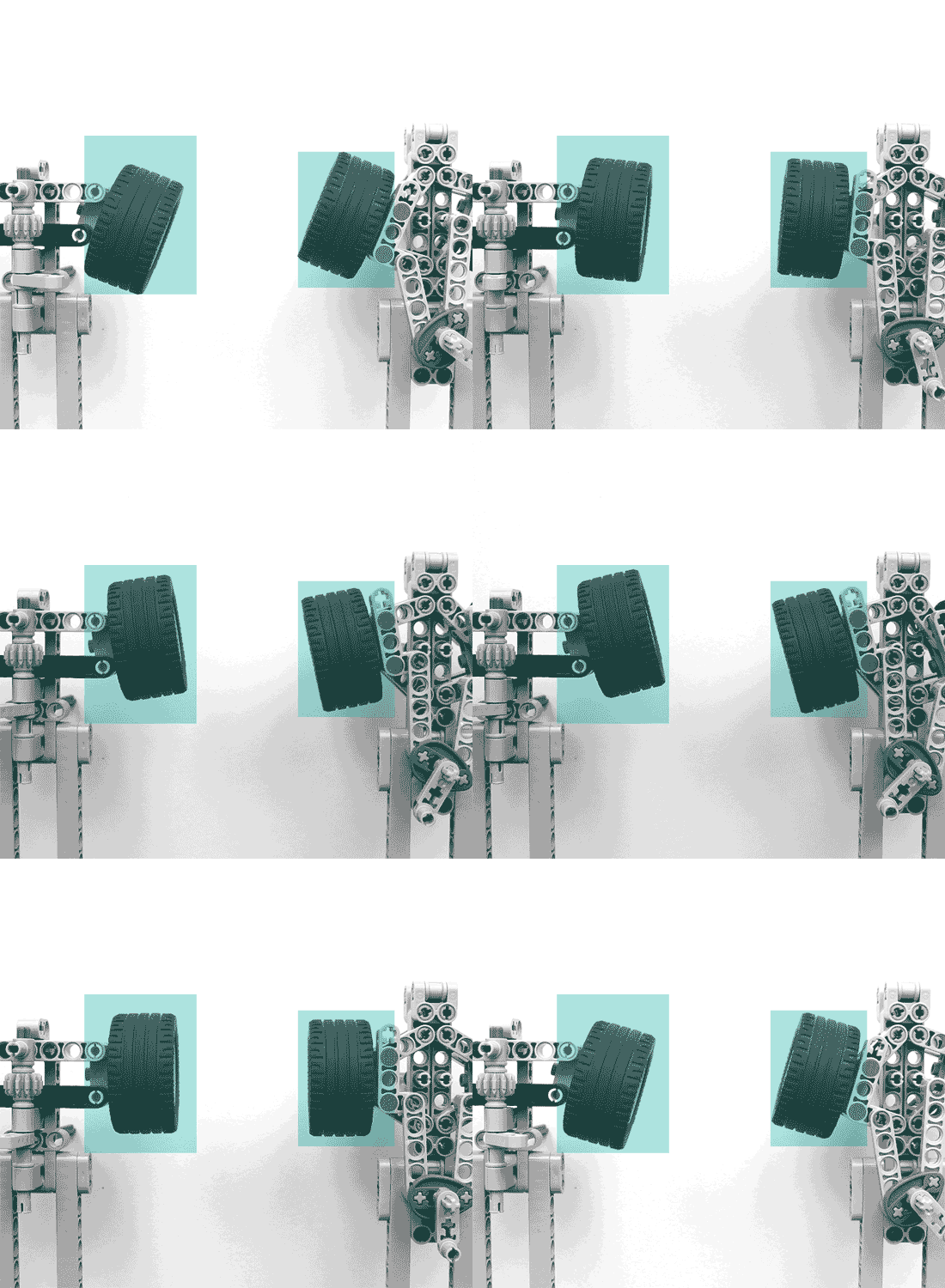
And yes, it can be motorised: youtu.be/ue55xXgIHiE
I got yesterday many Mails about the Eyebrow-Building Technic of my latest Lego Model, which can be seen here: flic.kr/p/Fw2oG4
It´s not that complicated, you need a Lego thread (the thin one) and put a few knots in both sides, than try to cram those knots into the tiny holes of the Minifig arms, so that the arms doesn´t fell of. Put this construct between plates and fix it as near as possible to the plates, because if you let them hang down, it would makes a very depressed face expression :D
Afterwards you must hide the rest of the thread under the other parts of the head.
I hope you can understand what i mean :D
Try it by yourself ;-)
Sincerly Max
Railway bogies with working shock absorbers.
-Prototype 6-6-2N (gauge 6, step 6, 2 Normal Springs).
-Prototype 4-6-2N (gauge 4, step 6, 2 Normal Springs) specific for narrow gauge.
-New prototype 6-7-4S (gauge 6, step 7, 4 Soft Springs).
www.flickr.com/photos/103263579@N08/51244227357/in/datepo...
Had fun with this one. Used Technic pieces to create this look. I used wings to create the lace curtains.
15 SECONDS DURATION;
640x480 pixels;
Created using CorelPHOTO-PAINT x6;
Objects created using TurboCAD 2013;
.AVI converted to .MP4 using cyberlink powerdirector 10...
SPLICE: 4...
I loaded a 03/1989 dated Kodak Technical Pan into my 1984 MAMIYA C220 + 135mm f4.5 Blue Dot Sekor set and went over the land at the back of the Brentwood BT Building . I rated film at 25 ASA and processed kin the remnants of my Very Old Dark Brown RODINAL 1+30 for 10 mins @ 20oC . The negs were dense enough. I used a small metal tripod.
An homage to the classic space 886 set.
Lego system built onto a technic chassis. Has working steering and the radar dish rotation is driven through a differential from the rear wheels.
The 886+ is a single-seater exploration and reconnaissance vehicle, designed for zero-atmosphere, low gravity planetoids.
Power is supplied by a large 500kW replaceable lithium-ion battery pack located behind the drivers seat. In a 0.3G environment, this gives it an effective range of over 500KM and a top speed of 200KPH. Although this speed is inadvisable as there is no seatbelt.
The main air tanks have enough for a 24hr trip and there's an emergency 1 hour tank stowed underneath the dash.
It also comes equipped with a fast-burst RF transmitter, adjustable height steering wheel and a side tray for storage of moon soil samples.
Axle Mosaic.
Thanks to Carson Hart to give it a different shape, it does look better than the previous version.
One has to move fast when shooting sunsets as the light changes so quickly. When combining rapidly changing light and long exposure photography you need to be on your game - a mistake in overall timings can set you back and having to start again may mean the beautiful light you started with, has gone. This is a 5 minute exposure on the south-eastern side of Derwent Water in the Lake District in England. The combination of long exposure and a very lazy wind that evening worked well - the clouds in the sky are moving creting an effect like a paintbrush but I like how the detail in the pink clouds can still be seen.
Technical Details: Nikon D800 | 305 seconds, 20mm, f/11, ISO 100
Please follow me : Website | Twitter | 500px | Tumblr | Facebook
For framed print of this photo, please purchase from my store : John Fÿn Fine Art
I wanted to share something a little different today. And for those in Melbourne, the reason will become clear very soon.
This is a Technic Racer frame. It's about as bare bones as it can be. It uses a servo motor for steering. But that's the only part I'd describe as uncommon.
Why am I sharing this? Because I want to demystify it for anyone who might be a LEGO fan, but has always felt a little intimidated by Technic building.
And truth is, there was a time when Technic intimidated me too. I put this together in under 20 minutes today so I could race it around the house with my son. It was so much fun I'll make a racing partner for it tomorrow. and I'll pretty it up along the way.
My point is really that you could do this too. In fact, I believe you could improve on it. So I wanted to offer this as a basic guide on how to make your own. A leaping off point if you will; and a way to start the conversation about Technic Racers.
There's more to come. This is only a start. So stay tuned, and let's see where this can take us.
Technical information
The weight of the car 1400 kg
Engine capacity : 3000CC
Amount of cilinders : 6
Power : 47 KW / 54HP
Historie
Date of first admission : 1927
Date of first registration in the Netherlands : 1990
Date of second of registration in the Nederlands: 2000
Photos and information made by JR de Vreeze.
All this material has been borrowed with permission from J R de Vreeze
During the long weekend in UAE for Commemoration Day and National Day celebrations, we drove from Fujairah City to Hatta Wadi Hub by Meraas. While the amusement park proved to be a disappointment, we were fortunate to witness a typical dramatic sunset in the mountains, with the sky turning a dramatic red. Captured this handheld and with my run-of-the-mill equipment. Not technically perfect, but I hope I've been able to capture some of the beauty I witnessed.
An attempt to make a more "filled in" sphere with #3 Technic axle connectors. I ran out of them in light grey/bley before I could finish the entire sphere, but I got far enough to convince myself it basically works. I noticed the areas where 3 connectors come together had a tendency to pull apart a little... Could be that the clutch power on some parts weren't as good, that the sphere needed to be finished to be really structurally sound, or that this design isn't 100% legal.
+++ DISCLAIMER +++
Nothing you see here is real, even though the conversion or the presented background story might be based on historical facts. BEWARE!
Some background:
The OV-10 Bronco was initially conceived in the early 1960s through an informal collaboration between W. H. Beckett and Colonel K. P. Rice, U.S. Marine Corps, who met at Naval Air Weapons Station China Lake, California, and who also happened to live near each other. The original concept was for a rugged, simple, close air support aircraft integrated with forward ground operations. At the time, the U.S. Army was still experimenting with armed helicopters, and the U.S. Air Force was not interested in close air support.
The concept aircraft was to operate from expedient forward air bases using roads as runways. Speed was to be from very slow to medium subsonic, with much longer loiter times than a pure jet. Efficient turboprop engines would give better performance than piston engines. Weapons were to be mounted on the centerline to get efficient aiming. The inventors favored strafing weapons such as self-loading recoilless rifles, which could deliver aimed explosive shells with less recoil than cannons, and a lower per-round weight than rockets. The airframe was to be designed to avoid the back blast.
Beckett and Rice developed a basic platform meeting these requirements, then attempted to build a fiberglass prototype in a garage. The effort produced enthusiastic supporters and an informal pamphlet describing the concept. W. H. Beckett, who had retired from the Marine Corps, went to work at North American Aviation to sell the aircraft.
The aircraft's design supported effective operations from forward bases. The OV-10 had a central nacelle containing a crew of two in tandem and space for cargo, and twin booms containing twin turboprop engines. The visually distinctive feature of the aircraft is the combination of the twin booms, with the horizontal stabilizer that connected them at the fin tips. The OV-10 could perform short takeoffs and landings, including on aircraft carriers and large-deck amphibious assault ships without using catapults or arresting wires. Further, the OV-10 was designed to take off and land on unimproved sites. Repairs could be made with ordinary tools. No ground equipment was required to start the engines. And, if necessary, the engines would operate on high-octane automobile fuel with only a slight loss of power.
The aircraft had responsive handling and could fly for up to 5½ hours with external fuel tanks. The cockpit had extremely good visibility for both pilot and co-pilot, provided by a wrap-around "greenhouse" that was wider than the fuselage. North American Rockwell custom ejection seats were standard, with many successful ejections during service. With the second seat removed, the OV-10 could carry 3,200 pounds (1,500 kg) of cargo, five paratroopers, or two litter patients and an attendant. Empty weight was 6,969 pounds (3,161 kg). Normal operating fueled weight with two crew was 9,908 pounds (4,494 kg). Maximum takeoff weight was 14,446 pounds (6,553 kg).
The bottom of the fuselage bore sponsons or "stub wings" that improved flight performance by decreasing aerodynamic drag underneath the fuselage. Normally, four 7.62 mm (.308 in) M60C machine guns were carried on the sponsons, accessed through large forward-opening hatches. The sponsons also had four racks to carry bombs, pods, or fuel. The wings outboard of the engines contained two additional hardpoints, one per side. Racked armament in the Vietnam War was usually seven-shot 2.75 in (70 mm) rocket pods with white phosphorus marker rounds or high-explosive rockets, or 5" (127 mm) four-shot Zuni rocket pods. Bombs, ADSIDS air-delivered/para-dropped unattended seismic sensors, Mk-6 battlefield illumination flares, and other stores were also carried.
Operational experience showed some weaknesses in the OV-10's design. It was significantly underpowered, which contributed to crashes in Vietnam in sloping terrain because the pilots could not climb fast enough. While specifications stated that the aircraft could reach 26,000 feet (7,900 m), in Vietnam the aircraft could reach only 18,000 feet (5,500 m). Also, no OV-10 pilot survived ditching the aircraft.
The OV-10 served in the U.S. Air Force, U.S. Marine Corps, and U.S. Navy, as well as in the service of a number of other countries. In U.S. military service, the Bronco was operated until the early Nineties, and obsoleted USAF OV-10s were passed on to the Bureau of Alcohol, Tobacco, and Firearms for anti-drug operations. A number of OV-10As furthermore ended up in the hands of the California Department of Forestry (CDF) and were used for spotting fires and directing fire bombers onto hot spots.
This was not the end of the OV-10 in American military service, though: In 2012, the type gained new attention because of its unique qualities. A $20 million budget was allocated to activate an experimental USAF unit of two airworthy OV-10Gs, acquired from NASA and the State Department. These machines were retrofitted with military equipment and were, starting in May 2015, deployed overseas to support Operation “Inherent Resolve”, flying more than 120 combat sorties over 82 days over Iraq and Syria. Their concrete missions remained unclear, and it is speculated they provided close air support for Special Forces missions, esp. in confined urban environments where the Broncos’ loitering time and high agility at low speed and altitude made them highly effective and less vulnerable than helicopters.
Furthermore, these Broncos reputedly performed strikes with the experimental AGR-20A “Advanced Precision Kill Weapons System (APKWS)”, a Hydra 70-millimeter rocket with a laser-seeking head as guidance - developed for precision strikes against small urban targets with little collateral damage. The experiment ended satisfactorily, but the machines were retired again, and the small unit was dissolved.
However, the machines had shown their worth in asymmetric warfare, and the U.S. Air Force decided to invest in reactivating the OV-10 on a regular basis, despite the overhead cost of operating an additional aircraft type in relatively small numbers – but development and production of a similar new type would have caused much higher costs, with an uncertain time until an operational aircraft would be ready for service. Re-activating a proven design and updating an existing airframe appeared more efficient.
The result became the MV-10H, suitably christened “Super Bronco” but also known as “Black Pony”, after the program's internal name. This aircraft was derived from the official OV-10X proposal by Boeing from 2009 for the USAF's Light Attack/Armed Reconnaissance requirement. Initially, Boeing proposed to re-start OV-10 manufacture, but this was deemed uneconomical, due to the expected small production number of new serial aircraft, so the “Black Pony” program became a modernization project. In consequence, all airframes for the "new" MV-10Hs were recovered OV-10s of various types from the "boneyard" at Davis-Monthan Air Force Base in Arizona.
While the revamped aircraft would maintain much of its 1960s-vintage rugged external design, modernizations included a completely new, armored central fuselage with a highly modified cockpit section, ejection seats and a computerized glass cockpit. The “Black Pony” OV-10 had full dual controls, so that either crewmen could steer the aircraft while the other operated sensors and/or weapons. This feature would also improve survivability in case of incapacitation of a crew member as the result from a hit.
The cockpit armor protected the crew and many vital systems from 23mm shells and shrapnel (e. g. from MANPADS). The crew still sat in tandem under a common, generously glazed canopy with flat, bulletproof panels for reduced sun reflections, with the pilot in the front seat and an observer/WSO behind. The Bronco’s original cargo capacity and the rear door were retained, even though the extra armor and defensive measures like chaff/flare dispensers as well as an additional fuel cell in the central fuselage limited the capacity. However, it was still possible to carry and deploy personnel, e. g. small special ops teams of up to four when the aircraft flew in clean configuration.
Additional updates for the MV-10H included structural reinforcements for a higher AUW and higher g load maneuvers, similar to OV-10D+ standards. The landing gear was also reinforced, and the aircraft kept its ability to operate from short, improvised airstrips. A fixed refueling probe was added to improve range and loiter time.
Intelligence sensors and smart weapon capabilities included a FLIR sensor and a laser range finder/target designator, both mounted in a small turret on the aircraft’s nose. The MV-10H was also outfitted with a data link and the ability to carry an integrated targeting pod such as the Northrop Grumman LITENING or the Lockheed Martin Sniper Advanced Targeting Pod (ATP). Also included was the Remotely Operated Video Enhanced Receiver (ROVER) to provide live sensor data and video recordings to personnel on the ground.
To improve overall performance and to better cope with the higher empty weight of the modified aircraft as well as with operations under hot-and-high conditions, the engines were beefed up. The new General Electric CT7-9D turboprop engines improved the Bronco's performance considerably: top speed increased by 100 mph (160 km/h), the climb rate was tripled (a weak point of early OV-10s despite the type’s good STOL capability) and both take-off as well as landing run were almost halved. The new engines called for longer nacelles, and their circular diameter markedly differed from the former Garrett T76-G-420/421 turboprop engines. To better exploit the additional power and reduce the aircraft’s audio signature, reversible contraprops, each with eight fiberglass blades, were fitted. These allowed a reduced number of revolutions per minute, resulting in less noise from the blades and their tips, while the engine responsiveness was greatly improved. The CT7-9Ds’ exhausts were fitted with muzzlers/air mixers to further reduce the aircraft's noise and heat signature.
Another novel and striking feature was the addition of so-called “tip sails” to the wings: each wingtip was elongated with a small, cigar-shaped fairing, each carrying three staggered, small “feather blade” winglets. Reputedly, this installation contributed ~10% to the higher climb rate and improved lift/drag ratio by ~6%, improving range and loiter time, too.
Drawing from the Iraq experience as well as from the USMC’s NOGS test program with a converted OV-10D as a night/all-weather gunship/reconnaissance platform, the MV-10H received a heavier gun armament: the original four light machine guns that were only good for strafing unarmored targets were deleted and their space in the sponsons replaced by avionics. Instead, the aircraft was outfitted with a lightweight M197 three-barrel 20mm gatling gun in a chin turret. This could be fixed in a forward position at high speed or when carrying forward-firing ordnance under the stub wings, or it could be deployed to cover a wide field of fire under the aircraft when it was flying slower, being either slaved to the FLIR or to a helmet sighting auto targeting system.
The original seven hardpoints were retained (1x ventral, 2x under each sponson, and another pair under the outer wings), but the total ordnance load was slightly increased and an additional pair of launch rails for AIM-9 Sidewinders or other light AAMs under the wing tips were added – not only as a defensive measure, but also with an anti-helicopter role in mind; four more Sidewinders could be carried on twin launchers under the outer wings against aerial targets. Other guided weapons cleared for the MV-10H were the light laser-guided AGR-20A and AGM-119 Hellfire missiles, the Advanced Precision Kill Weapon System upgrade to the light Hydra 70 rockets, the new Laser Guided Zuni Rocket which had been cleared for service in 2010, TV-/IR-/laser-guided AGM-65 Maverick AGMs and AGM-122 Sidearm anti-radar missiles, plus a wide range of gun and missile pods, iron and cluster bombs, as well as ECM and flare/chaff pods, which were not only carried defensively, but also in order to disrupt enemy ground communication.
In this configuration, a contract for the conversion of twelve mothballed American Broncos to the new MV-10H standard was signed with Boeing in 2016, and the first MV-10H was handed over to the USAF in early 2018, with further deliveries lasting into early 2020. All machines were allocated to the newly founded 919th Special Operations Support Squadron at Duke Field (Florida). This unit was part of the 919th Special Operations Wing, an Air Reserve Component (ARC) of the United States Air Force. It was assigned to the Tenth Air Force of Air Force Reserve Command and an associate unit of the 1st Special Operations Wing, Air Force Special Operations Command (AFSOC). If mobilized the wing was gained by AFSOC (Air Force Special Operations Command) to support Special Tactics, the U.S. Air Force's special operations ground force. Similar in ability and employment to Marine Special Operations Command (MARSOC), U.S. Army Special Forces and U.S. Navy SEALs, Air Force Special Tactics personnel were typically the first to enter combat and often found themselves deep behind enemy lines in demanding, austere conditions, usually with little or no support.
The MV-10Hs are expected to provide support for these ground units in the form of all-weather reconnaissance and observation, close air support and also forward air control duties for supporting ground units. Precision ground strikes and protection from enemy helicopters and low-flying aircraft were other, secondary missions for the modernized Broncos, which are expected to serve well into the 2040s. Exports or conversions of foreign OV-10s to the Black Pony standard are not planned, though.
General characteristics:
Crew: 2
Length: 42 ft 2½ in (12,88 m) incl. pitot
Wingspan: 45 ft 10½ in(14 m) incl. tip sails
Height: 15 ft 2 in (4.62 m)
Wing area: 290.95 sq ft (27.03 m²)
Airfoil: NACA 64A315
Empty weight: 9,090 lb (4,127 kg)
Gross weight: 13,068 lb (5,931 kg)
Max. takeoff weight: 17,318 lb (7,862 kg)
Powerplant:
2× General Electric CT7-9D turboprop engines, 1,305 kW (1,750 hp) each,
driving 8-bladed Hamilton Standard 8 ft 6 in (2.59 m) diameter constant-speed,
fully feathering, reversible contra-rotating propellers with metal hub and composite blades
Performance:
Maximum speed: 390 mph (340 kn, 625 km/h)
Combat range: 198 nmi (228 mi, 367 km)
Ferry range: 1,200 nmi (1,400 mi, 2,200 km) with auxiliary fuel
Maximum loiter time: 5.5 h with auxiliary fuel
Service ceiling: 32.750 ft (10,000 m)
13,500 ft (4.210 m) on one engine
Rate of climb: 17.400 ft/min (48 m/s) at sea level
Take-off run: 480 ft (150 m)
740 ft (227 m) to 50 ft (15 m)
1,870 ft (570 m) to 50 ft (15 m) at MTOW
Landing run: 490 ft (150 m)
785 ft (240 m) at MTOW
1,015 ft (310 m) from 50 ft (15 m)
Armament:
1x M197 3-barreled 20 mm Gatling cannon in a chin turret with 750 rounds ammo capacity
7x hardpoints for a total load of 5.000 lb (2,270 kg)
2x wingtip launch rails for AIM-9 Sidewinder AAMs
The kit and its assembly:
This fictional Bronco update/conversion was simply spawned by the idea: could it be possible to replace the original cockpit section with one from an AH-1 Cobra, for a kind of gunship version?
The basis is the Academy OV-10D kit, mated with the cockpit section from a Fujimi AH-1S TOW Cobra (Revell re-boxing, though), chosen because of its “boxy” cockpit section with flat glass panels – I think that it conveys the idea of an armored cockpit section best. Combining these parts was not easy, though, even though the plan sound simple. Initially, the Bronco’s twin booms, wings and stabilizer were built separately, because this made PSR on these sections easier than trying the same on a completed airframe. One of the initial challenges: the different engines. I wanted something uprated, and a different look, and I had a pair of (excellent!) 1:144 resin engines from the Russian company Kompakt Zip for a Tu-95 bomber at hand, which come together with movable(!) eight-blade contraprops that were an almost perfect size match for the original three-blade props. Biggest problem: the Tu-95 nacelles have a perfectly circular diameter, while the OV-10’s booms are square and rectangular. Combining these parts and shapes was already a messy PST affair, but it worked out quite well – even though the result rather reminds of some Chinese upgrade measure (anyone know the Tu-4 copies with turboprops? This here looks similar!). But while not pretty, I think that the beafier look works well and adds to the idea of a “revived” aircraft. And you can hardly beat the menacing look of contraprops on anything...
The exotic, so-called “tip sails” on the wings, mounted on short booms, are a detail borrowed from the Shijiazhuang Y-5B-100, an updated Chinese variant/copy of the Antonov An-2 biplane transporter. The booms are simple pieces of sprue from the Bronco kit, the winglets were cut from 0.5mm styrene sheet.
For the cockpit donor, the AH-1’s front section was roughly built, including the engine section (which is a separate module, so that the basic kit can be sold with different engine sections), and then the helicopter hull was cut and trimmed down to match the original Bronco pod and to fit under the wing. This became more complicated than expected, because a) the AH-1 cockpit and the nose are considerably shorter than the OV-10s, b) the AH-1 fuselage is markedly taller than the Bronco’s and c) the engine section, which would end up in the area of the wing, features major recesses, making the surface very uneven – calling for massive PSR to even this out. PSR was also necessary to hide the openings for the Fujimi AH-1’s stub wings. Other issues: the front landing gear (and its well) had to be added, as well as the OV-10 wing stubs. Furthermore, the new cockpit pod’s rear section needed an aerodynamical end/fairing, but I found a leftover Academy OV-10 section from a build/kitbashing many moons ago. Perfect match!
All these challenges could be tackled, even though the AH-1 cockpit looks surprisingly stout and massive on the Bronco’s airframe - the result looks stockier than expected, but it works well for the "Gunship" theme. Lots of PSR went into the new central fuselage section, though, even before it was mated with the OV-10 wing and the rest of the model.
Once cockpit and wing were finally mated, the seams had to disappear under even more PSR and a spinal extension of the canopy had to be sculpted across the upper wing surface, which would meld with the pod’s tail in a (more or less) harmonious shape. Not an easy task, and the fairing was eventually sculpted with 2C putty, plus even more PSR… Looks quite homogenous, though.
After this massive body work, other hardware challenges appeared like small distractions. The landing gear was another major issue because the deeper AH-1 section lowered the ground clearance, also because of the chin turret. To counter this, I raised the OV-10’s main landing gear by ~2mm – not much, but it was enough to create a credible stance, together with the front landing gear transplant under the cockpit, which received an internal console to match the main landing gear’s length. Due to the chin turret and the shorter nose, the front wheel retracts backwards now. But this looks quite plausible, thanks to the additional space under the cockpit tub, which also made a belt feed for the gun’s ammunition supply believable.
To enhance the menacing look I gave the model a fixed refueling boom, made from 1mm steel wire and a receptor adapter sculpted with white glue. The latter stuff was also used add some antenna fairings around the hull. Some antennae, chaff dispensers and an IR decoy were taken from the Academy kit.
The ordnance came from various sources. The Sidewinders under the wing tips were taken from an Italeri F-16C/D kit, they look better than the missiles from the Academy Bronco kit. Their launch rails came from an Italeri Bae Hawk 200. The quadruple Hellfire launchers on the underwing hardpoints were left over from an Italeri AH-1W, and they are a perfect load for this aircraft and its role. The LAU-10 and -19 missile pods on the stub wings were taken from the OV-10 kit.
Painting and markings:
Finding a suitable and somewhat interesting – but still plausible – paint scheme was not easy. Taking the A-10 as benchmark, an overall light grey livery (with focus on low contrast against the sky as protection against ground fire) would have been a likely choice – and in fact the last operational American OV-10s were painted in this fashion. But in order to provide a different look I used the contemporary USAF V-22Bs and Special Operations MC-130s as benchmark, which typically carry a darker paint scheme consisting of FS 36118 (suitably “Gunship Gray” :D) from above, FS 36375 underneath, with a low, wavy waterline, plus low-viz markings. Not spectacular, but plausible – and very similar to the late r/w Colombian OV-10s.
The cockpit tub became Dark Gull Grey (FS 36231, Humbrol 140) and the landing gear white (Revell 301).
The model received an overall black ink washing and some post-panel-shading, to liven up the dull all-grey livery. The decals were gathered from various sources, and I settled for black USAF low-viz markings. The “stars and bars” come from a late USAF F-4, the “IP” tail code was tailored from F-16 markings and the shark mouth was taken from an Academy AH-64. Most stencils came from another Academy OV-10 sheet and some other sources.
Decals were also used to create the trim on the propeller blades and markings on the ordnance.
Finally, the model was sealed with a coat of matt acrylic varnish (Italeri) and some exhaust soot stains were added with graphite along the tail boom flanks.
A successful transplantation – but is this still a modified Bronco or already a kitbashing? The result looks quite plausible and menacing, even though the TOW Cobra front section appears relatively massive. But thanks to the bigger engines and extended wing tips the proportions still work. The large low-pressure tires look a bit goofy under the aircraft, but they are original. The grey livery works IMHO well, too – a more colorful or garish scheme would certainly have distracted from the modified technical basis.
Kanohi Tallus - the Mask of Walking
The wearer of this mask is granted the ability to walk on any surface regardless of density and orientation. The more it defies physics, the more the user must concentrate to keep the power active.
This mask was a project I actually planned on doing a couple years ago, initially inspired by the mask maker contest, which I didn't find time to take part in. Back then I bought the Technic 24-hour race car for parts for the build, but the threshold to start such a project proved too high. Only a bit over a month ago did I actually start making the mask, and ironically it took only 7 hours over two sessions. I think it helped that I had been thinking of the design and color scheme for a couple of years.
The color scheme was initially meant to be black at the bottom, green in the middle and white at the top, but due to part limitations and the color of the eyes that changed to primarily green and black. I mainly used parts from the 24-hour race car and air race jet technic sets, with a couple extras from my bin. The blue was not initially meant to be included, but when I was running out of green to define the eyes, the blue turned out to give a great accent, so I went along with it.
I wore the mask at Pii Poo 2018 lego event last month and a lot of jaws dropped when the kids saw it. It was kinda priceless.
1975
This dark National Technics amp from 1975 was a bestseller of the higher Hifi amp class. The 19" format with rack mounts stand out from the standard models of Kenwood, Sansui, Marantz or Sony etc.
The circuitry and mechanical design is designed for durability and it works without problems like on the first day. With 73 watts per channel, it produces a powerful true seventies sound.
The plastic caps of the toggle switches of all SU 8600 and tuner ST 8600 are loosened due to material fatigue after many years. So I have replaced precautionary toggle control caps with aluminium versions. Why was National Technics at that time so economical?
A good machine listen to music it is definitely.
Technically the first character to ever appear in Doctor Who.
This Set is available to vote for on LEGO’s crowd-sourcing platform, LEGO Ideas. If you want the opportunity to purchase this set, let LEGO know by voting for it!
On 23 November 1963 a legend was forged, the BBC aired the first episode of Doctor Who, entitled ‘An Unearthly Child’ it set the ground for over fifty years of time and space exploration. This set depicts that momentous event of television history. Other sets on LEGO Ideas are based around the latest incarnations of Doctor Who, this idea aims to go back to where it all began and tell the origin story of the legendary time lord.
This set includes the entrance to 76 Totter’s Lane, where the First Doctor parked his TARDIS so his granddaughter Susan could visit the local Coal Hill School to learn about the twentieth century, but her strange unworldly behaviour intrigues two of the staff members; history teacher Barbara Wright and Science teacher Ian Chesterton, who decide to visit Susan at home, only to find Susan entering the mysterious junkyard!
Its also available to like on LEGO's Re:Brick Site, be sure to like it there as well!
If you have a blog or website and you've featured this idea on it, be sure to let me know, and I'll update the project with the links.