View allAll Photos Tagged Sequentially

www.messersmith.name/wordpress/2010/05/12/the-quintessent...

In the realm of Geekdom, I believe that I have one of the more peculiar obsessions. I enjoy getting up early in the morning, say 05:00, and looking out at the sky. If it looks very black over town, that is a promising portent. If it looks orangish, that means that there are low clouds over the peninsula and the sunrise will probably be a flop.. I go and fire up the computer and start the day's work. At 05:30, I have another look. If I can see any colour, I make my preparations for the morning's quest for The Quintessential Sequential Sunrise.


The preparations consist of the following, which must be performed in less than ten minutes: (1) get Canon G-11 and attach to cheap tripod, (2) pick the appropriate selection of neutral density and polarising filters from the filter box (3) retrieve a Fanta Orange soda from the bar fridge and slip it into a cozy, (4) grab a folding chair from the overflowing junk room, (5) check to make sure that I have my pants on, (6) stumble outside in the dark with no light (don't want to ruin my night vision), (7) sit down and wait for the action to begin. It's not that much different from going to a footie game, except for the part about pants. I'm sure that it's quite acceptable to show up at a footie game sans pants.


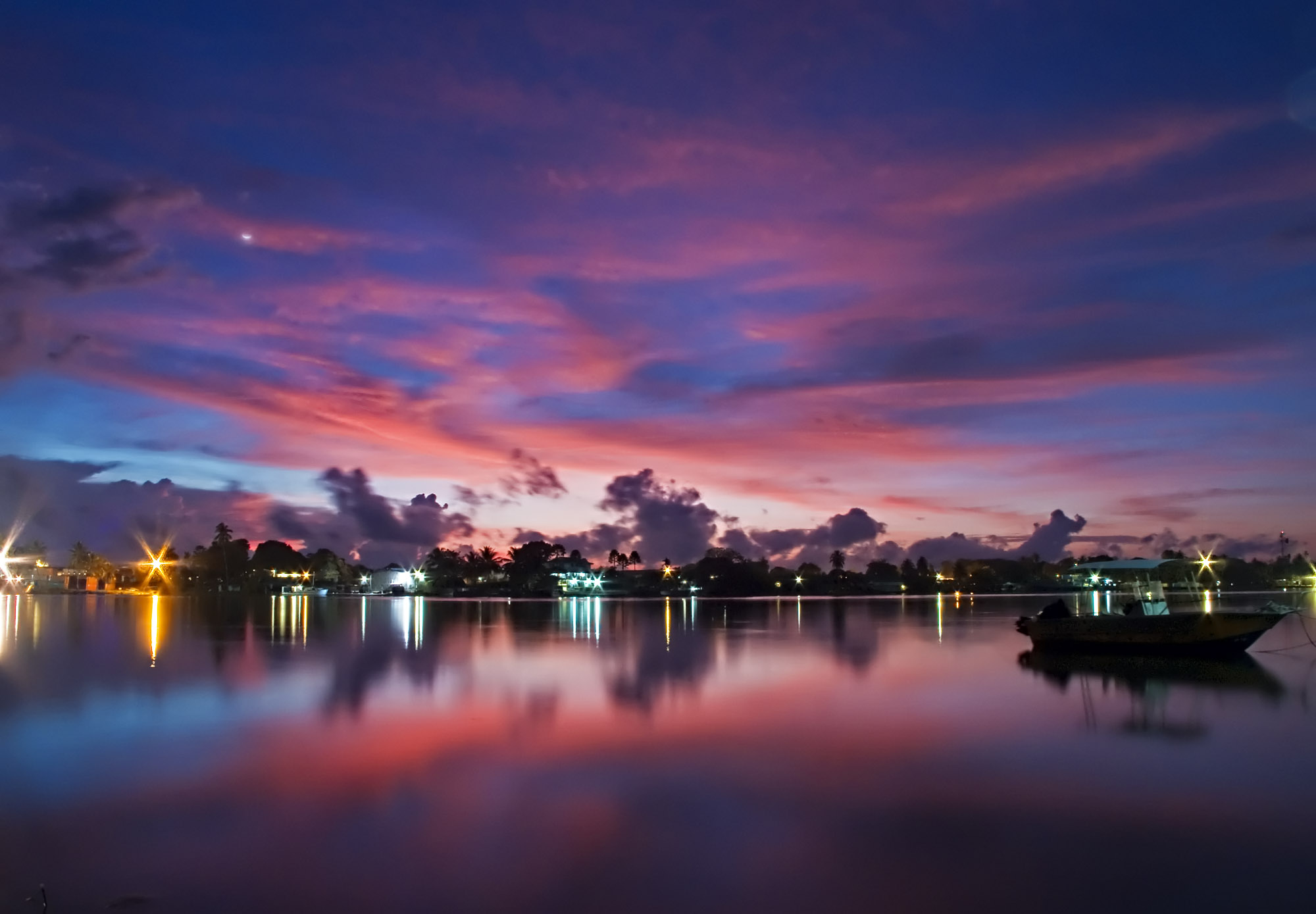
And, this why all the fuss. Yeah, baby, this is what I'm talkin' about: That's the moon up there in the corner. It was so dark at 05:41 that I couldn't see the controls on the camera; I had to work by feel. Fortunately, I have great hands. The shot above was a fifteen second exposure. This long exposure time has the effect of turning the water into a mirror. The town lights are very bright in comparison to the sky.
 

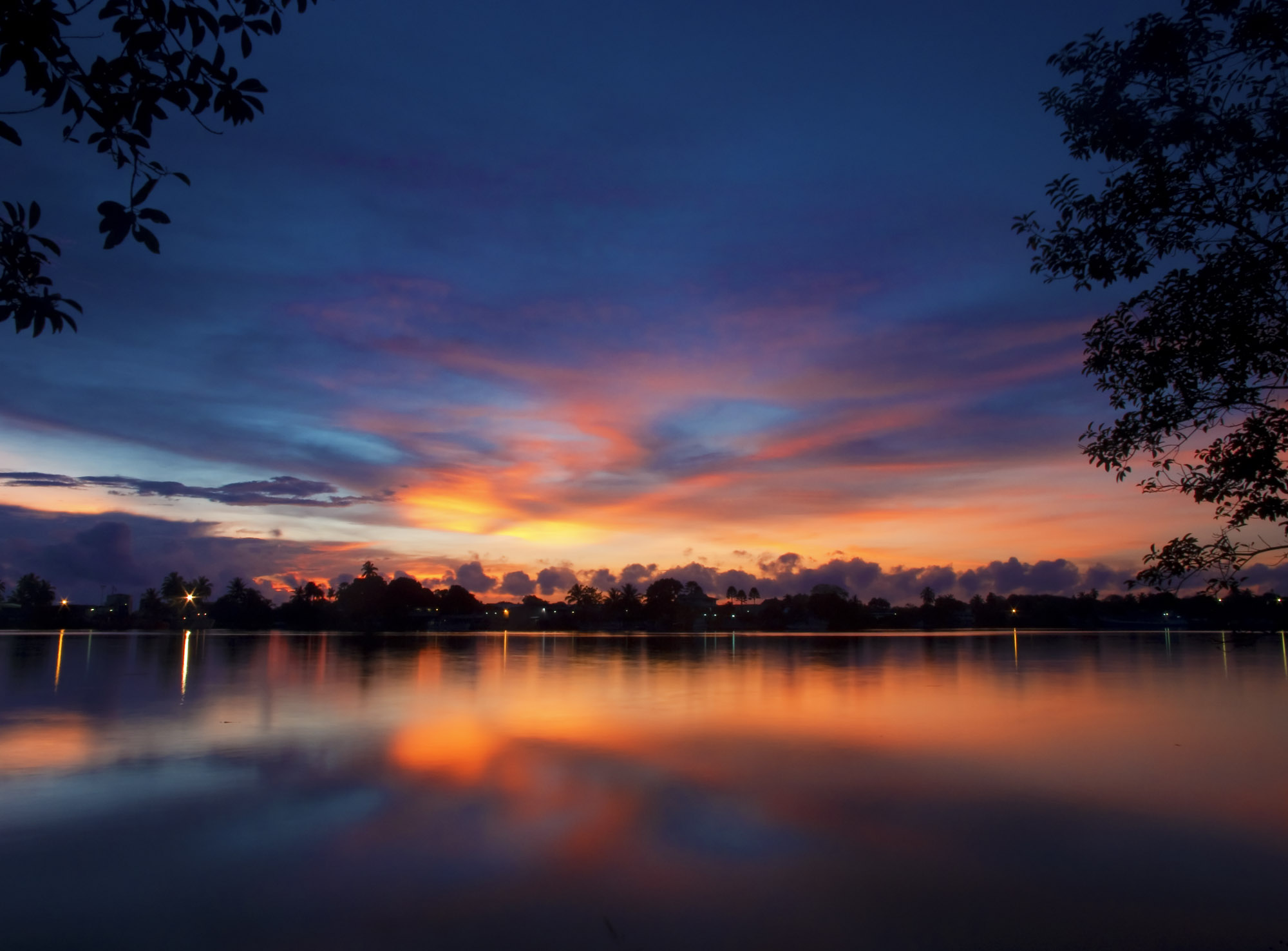
Four minutes later and I have moved to what it becoming my favourite spot. I like the way the trees frame the sky. This is still at fifteen seconds, so the water of the harbour is as shiny as mercury.


At -6:02 the sky is getting much brighter. This is when it gets fast and furious. I now have less than a ten minute window to catch the best of the sunrise: The sun is still well below the horizon, but it is beginning to light up the clouds much brighter. Note that you can barely see the lights of town. The sky is probably several hundred times brighter than it was a few minutes ago.
 

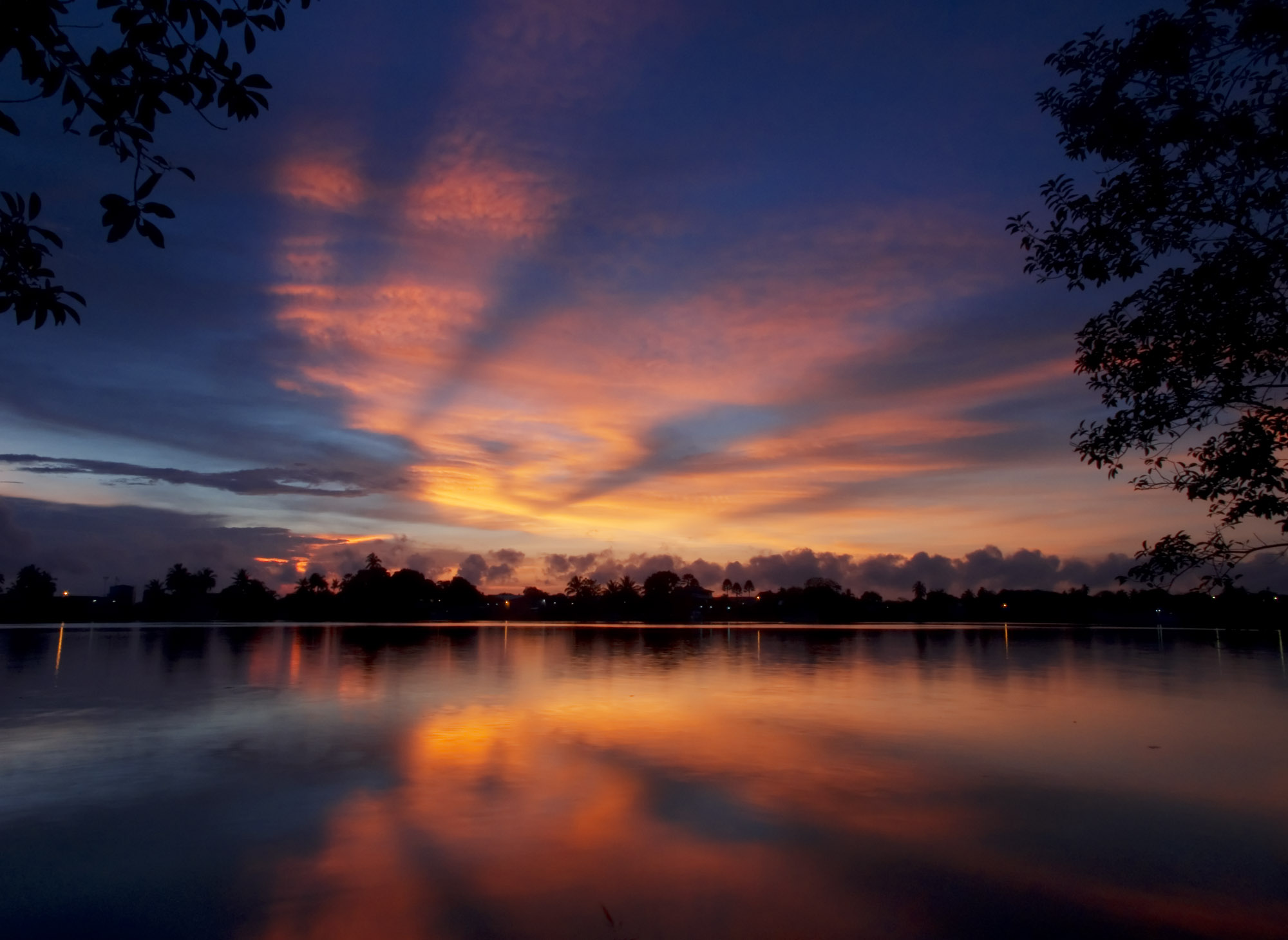
At 06:06 the sun's light is being broken up into beams shining between clouds near the visible horizon. This accounts for the radiating pattern of light and dark: This is only four minutes after the previous shot. We are now nearing the end of the show.
 

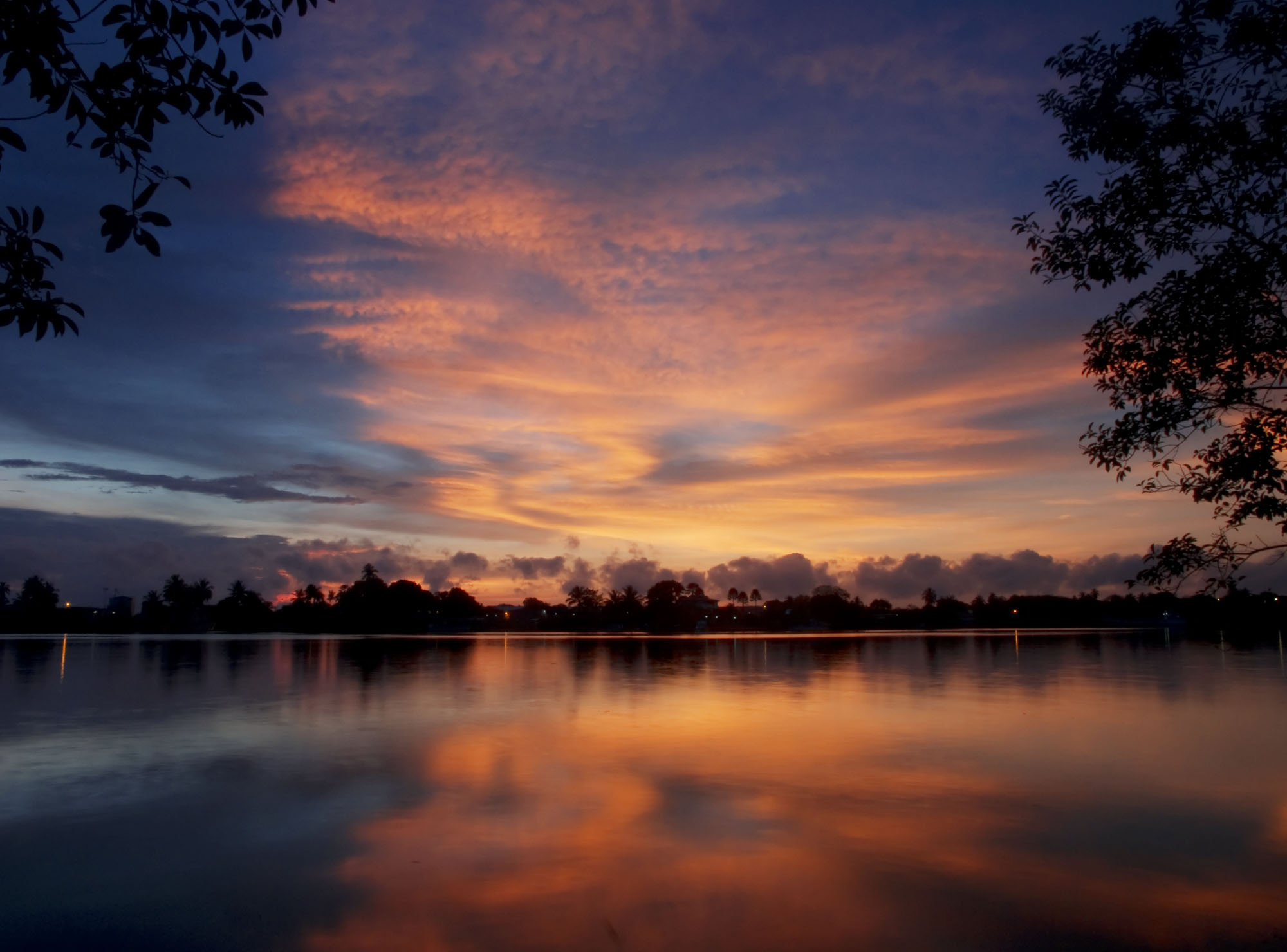
Two minutes later, at 06:08, the display it pretty much over: The colours will fade quickly now as the sunrise moves into its second phase when the shiny orb pops above the horizon.
 

What follows is simultaneously less visually interesting and more difficult for the photographer. As the sun rises, the saturation of the colours will become more washed out by the intensity of the light and the contrast ratio of the brightness surrounding the sun compared to the rest of the scene will overwhelm nealy any camera that an individual human can afford.


I suppose the very rich might be able to afford such cameras, but I'm sure that they have more profitable things to do with their time. Anyway, they would simply hire someone like to to do it for them.


If there are any of the very rich out there reading this (seems unlikely to me), keep in mind that I'm very serious about my art and I work cheap.


If I've hooked you on sequential sunrises, you can see more of mine here, here, and here.


That should keep you occupied until the next time the boss comes around to see what you're up to.

© james stewart 2014


MINI odometer in perfect sequence!


Selective Laser Melting (SLM) is an additive manufacturing process that can be used for many different applications.


The SLM process starts by numerically slicing a 3D CAD model into a number of finite layers. For each sliced layer a laser scan path is calculated which defines both the boundary contour and some form of fill sequence, often a raster pattern. Each layer is then sequentially recreated by depositing powder layers, one on top of the other, and melting their surface by scanning a laser beam.


The powder is spread uniformly by a wiper. A high power-density fibre laser with a 40µm beam spot size fully melts the pre-deposited powder layer. The melted particles fuse and solidify to form a layer of the component.


For more information please visit www.twi-global.com/technologies/welding-surface-engineeri...


If you wish to use this image each use should be accompanied by the credit line and notice, "Courtesy of TWI Ltd".


86627 is the older of the two locos, E3110 & E3185 respectivly...


86627 & 86605 | Warrington Bank Quay | 4M11 Coatbridge to Crewe

Got buzzed a few more times today :)


The original size of this image is MASSIVE (every frame uncropped) and the detail so fine that you can see the texture of this girls belly including every last stretch mark from a recent pregnancy.

pages / covers for Marvel comics project that never got offa tha ground. All characters © Marvel Comics

This electron micrograph (1100 nm wide) depicts nanoscopic trenches etched deeply into a silicon substrate using a mask comprised of a self-assembled block copolymer film modified with alumina sequential infiltration synthesis. These high-aspect-ratio nanostructures are of potential interest in applications ranging from solar cells to computer memory.


Seth Darling (Center for Nanoscale Materials)

Yu-Chih Tseng (Center for Nanoscale Materials)

Qing Peng (Energy Systems)

Jeffrey Elam (Energy Systems)


Photo courtesy of Argonne National Laboratory.


Sequential Discovery Lego Puzzle Box - A Treasure Chest Full of Adventure


Support now on Lego Ideas: ideas.lego.com/projects/5ff51711-6072-49fe-8d39-aa8c0bd815b4

para grupo sequential_nmbrs pool

Sequential NR's 114 & 115 power through Bargo with 2PS7

sequential shot of pursuit qualifying

Sequential Discovery Lego Puzzle Box - A Treasure Chest Full of Adventure


Support now on Lego Ideas: ideas.lego.com/projects/5ff51711-6072-49fe-8d39-aa8c0bd815b4

Sequential Roof, Arch_Tec_Lab ITA, ETH Zürich

Gramazio Kohler Research, 2016


Neighbors

Karin Sander and Philip Ursprung, 2023 Venice Biennale

Sequentially standing my NDLS-BCT Duronto Exp, Flying Ranee Exp, Gujarat Exp and The King BCT-NDLS Rajdhani captured on an busy evening at Mumbai Central.

Sequential Discovery Lego Puzzle Box - A Treasure Chest Full of Adventure


Support now on Lego Ideas: ideas.lego.com/projects/5ff51711-6072-49fe-8d39-aa8c0bd815b4

This number 39 is for the Sequential Numbers Group here on Flickr. Aware that we needed a number 39, I drove by a storage unit place today, and crept along the parking lot hoping the units would go up to 40, and I could get my 39. Well, at first, it looked as if they wouldn't go that high. Then I spotted a 40, and thought, "Ahah! There will be a 39! I get my camera ready, and drive up to the unit between 38 and 40, and sadly, there was only a 9. The 3 had long ago fallen off. So, I go to the Heartland Humane Society, to take some cat pictures, and when I am driving back home, I see a big truck full of ears of corn going by, north on Hwy. 99W in Corvallis, Oregon. Big as life it says 39! I decide a dedicated player should turn around and go after it. I do. Usually there are some ears of corn on the road behind the truck, kind of like Hansel's trail. None when you want them. By the time I turned around, I couldn't tell if the truck continued north through town or took the cutoff East to Hwy. 34. I picked the town, because he was already coming from the countryside. I caught up with him and picked correctly. I got my picture. I went back home and noticed the traffic stuck on the cutoff, was STILL stuck on the cutoff. I had almost decided I would have a better chance of catching up with him if I took that. I am so glad I didn't. So, ears my story! Ouch, that was corny! Oh well, there is a kernel of truth to it!

For the "My Life As" group, this addresses My Life As as serious Sequential Numbers Player. ON Sept. 26, 2006 I also added this to "My Story (Pool)" and to "Pictures with Stories (Pool)".


*******************************************************************

Tenuous Link: 39


PLEASE VIEW ON BLACK --- My backyard

Sequential Discovery Lego Puzzle Box - A Treasure Chest Full of Adventure


Support now on Lego Ideas: ideas.lego.com/projects/5ff51711-6072-49fe-8d39-aa8c0bd815b4

Photograph taken at 09:33am on May 19th 2012 off Banks Road B3369 on the golden sandy shoreline of Sandbanks, a small peninsula crossing the mouth of Poole Harbour on the English Channel coast at Poole in Dorset, England.


SLIPPER LIMPETS (Crepidula Fornicata) lay awaiting the return of the tide. As sequential hermaphrodites, the larger and older ones at the base are females, the smaller ones on top males, and if the females die, the largest males will become females.


Nikon D7000 195mm 1/250s f/11.0 iso200


Nikkor AF-S 55-300mm f/4.5-5.6G VR. UV filter. Nikon GP-1 GPS.


LATITUDE: N 50d 41m 16.60s

LONGITUDE: W 1d 56m 15.10s

ALTITUDE: 9.0m

The Messerschmitt KR200, or Kabinenroller (Cabin Scooter), was a three-wheeled bubble car designed by the aircraft engineer Fritz Fend and produced in the factory of the German aircraft manufacturer Messerschmitt from 1955 to 1964.


HISTORY

Messerschmitt, temporarily not allowed to manufacture aircraft, had turned its resources to producing other commodities. In 1952, Fend approached Messerschmitt with the idea of manufacturing small motor vehicles. These were based on his Fend Flitzer invalid carriage.


The first of Fend's vehicles to enter production at Messerschmitt's Regensburg factory was the KR175. The title Kabinenroller means "scooter with cabin". While the Messerschmitt name and insignia were used on the car, a separate company, incorporated as Regensburger Stahl- und Metallbau GmbH, was created to manufacture and market the vehicle.


The KR200 replaced the KR175 in 1955. While using the same basic frame as the KR175 with changes to the bodywork (notably including wheel cutouts in the front fenders) and an improved canopy design, the KR200 was otherwise an almost total redesign. The rear suspension and engine mounting were reworked, and hydraulic shock absorbers were installed at all three wheels. Tire sizes were enlarged to 4.00×8.


Retailing for around DM 2,500, the KR200 was considered an instant success with almost 12,000 built during its first year, which was the highest annual production for Kabinenroller models. A maximum speed in excess of 90 km/h despite a claimed power output of only 10 PS reflected the vehicle's light weight and low aerodynamic drag. An "Export" package included a two-tone paint scheme, painted hubcaps, a fully trimmed interior, a heater, a clock, and a sunshade for the canopy.


In 1956, Messerschmitt was allowed to manufacture aircraft again and lost interest in Fend's microcars. Messerschmitt sold the Regensburg works to Fend who, with brake and hub supplier Valentin Knott, formed Fahrzeug- und Maschinenbau GmbH Regensburg (FMR) to continue production of the KR200 and his other vehicles.


In 1957, the KR200 Kabrio model was released, featuring a cloth convertible top and fixed side window frames. This was followed by the KR201 Roadster without window frames, using a folding cloth top, a windscreen, and removable side curtains. A Sport Roadster was later offered with no top and with the canopy fixed into place so that the driver would have to climb in and out at the top of the car.


Production of the KR200 was heavily reduced in 1962 and ceased in 1964 as sales had been dropping for a few years. The demand for basic economical transport in Germany had diminished as the German economy boomed. A similar situation developed in other parts of Europe such as in the manufacturer's biggest export destination, the United Kingdom, where sales were particularly affected by the increasing popularity of the Mini.


24-HOUR RECORD RUN

In 1955, in order to prove the KR200's durability, Messerschmitt prepared a KR200 to break the 24-hour speed record for three-wheeled vehicles under 250 cc. The record car had a special single-seat low-drag body and a highly modified engine, but the suspension, steering, and braking components were stock. Throttle, brake, and clutch cables were duplicated. The record car was run on 29-30 August 1955 at the Hockenheimring for 24 hours and broke 22 international speed records in its class, including the 24-hour speed record, which it set at 103 km/h.


MESSRSCHMITT SERVICE CAR

Messerschmitt, and subsequently FMR, made factory-converted Service Cars to order for the automobile service industry. Similar in concept to the Harley-Davidson Servi-Car and the Indian Dispatch Tow, the Service Car had a detachable tow bar and clamp, a revised front suspension to accommodate the tow bar when in use, and a storage system inside the car to accommodate the tow bar when not in use. The service technician would drive the Service Car to the customer's car and, if the customer's car was drivable, attach the tow bar to the front of the Service Car, clamp the other end of the tow bar to the bumper of the customer's car, and drive the customer's car to the garage. When the service was complete, he would drive the car back to the customer while towing the Service Car, detach the Service Car from the customer's car, and drive back to the garage. Approximately 12 were built; only one is known to exist at present.


FEATURES

The KR200 incorporated several features unique to the KR line and its four-wheeled derivative, the FMR Tg500. Externally, the narrow body, the transparent acrylic bubble canopy and low stance were among the more obvious features.


TANDEM SEATING

The narrow body, and corresponding low frontal area, was achieved with tandem seating, which also allowed the body to taper like an aircraft fuselage, within a practical length. 10 PS propelled the KR200 to around 105 km/h. The claimed fuel consumption of the car was 3.2 L/100 km.


The tandem seating also centralized the mass of the car along the longitudinal axis which, combined with the low center of gravity, low weight, and wheel placement at the vehicle's extremes, gave the KR200 good handling characteristics. A more minor advantage of tandem seating was that it made an export version to countries that drive on the left unnecessary. An "Export" model was built, but this denoted a more luxurious trim level.


BUBBLE CANOPY

Entry to most KR models except the KR201 Sport Roadster and a corresponding Tg500 version was through a canopy door hinged on the right side of the vehicle. The door included all the windows (windshield, window frames on all but the Roadster models, folding top on Roadster and Kabrio models, and acrylic bubble on other versions) and the frame in which it was set, extending from the right side of the monocoque tub to the left. On Sport Roadster models, the canopy was fixed and there was neither a top nor any windows at all, only a tonneau cover. The bubble top on the KR200 was simplified over that of the KR175 by the use of a larger curved glass windshield that formed A-pillars with the side window frames. This allowed the bubble to be simpler and more compact than the KR175 bubble, and it was consequently easier and less expensive to produce. The windshield wiper, manual on the KR175, was electric on the KR200.


ENGINE AND TRANSMISSION

The KR200 ran on a 191 cc Fichtel & Sachs forced-air (fan) cooled single cylinder two-stroke engine positioned in front of the rear wheel, just behind the passenger's seat. The engine had two sets of contact breaker points and, to reverse, the engine was stopped and then restarted, going backwards. This was effected by pushing the key further in the ignition switch than normal, whether intentionally or not. One result of this was that the KR200's sequential, positive-stop transmission provided the car with the same four gear ratios available in reverse as in forward movement.


CONTROLS

Apart from the dual-mode ignition, the KR200 had a steering bar reminiscent of that of an aircraft. To steer the KR200, the driver would swivel the steering bar about its axis from the horizontal (straight-ahead) position instead of rotating it as with a conventional steering wheel. The mechanism was connected directly to the track rods of the front wheels, providing an extremely direct response best suited to small amounts of movement, unlike other common steering mechanisms which involved reduction gearing. The gearshift lever had a secondary lever on it which, when actuated, would put the car in neutral regardless of what gear it had been in before, although the transmission would have to be shifted back to first before the car would be able to move from a standstill.


Unlike the KR175, the KR200 had a full set of pedals: clutch, brake, and accelerator. The brake pedal still operated mechanical brakes using cables.


WIKIPEDIA

Sequential Discovery Lego Puzzle Box - A Treasure Chest Full of Adventure


Support now on Lego Ideas: ideas.lego.com/projects/5ff51711-6072-49fe-8d39-aa8c0bd815b4

Sequential Discovery Lego Puzzle Box - A Treasure Chest Full of Adventure


Support now on Lego Ideas: ideas.lego.com/projects/5ff51711-6072-49fe-8d39-aa8c0bd815b4

Sequential Discovery Lego Puzzle Box - A Treasure Chest Full of Adventure


Support now on Lego Ideas: ideas.lego.com/projects/5ff51711-6072-49fe-8d39-aa8c0bd815b4

Sequential Discovery Lego Puzzle Box - A Treasure Chest Full of Adventure


Support now on Lego Ideas: ideas.lego.com/projects/5ff51711-6072-49fe-8d39-aa8c0bd815b4

Ferrari F430 Spider F1 Sequential ShowCar Detailing @ AutoDetailer


Strobist Info: Three Sunpak 383's @ 1/8th power placed at front bumper just out of camera frame and the other two on the wheels to bring out some details from underneath the shadows. Triggered via Elinchrom Skyports. Shot with an A900.


Cheers!

macdude

an urban detailer's blog

Sequential Discovery Lego Puzzle Box - A Treasure Chest Full of Adventure


Support now on Lego Ideas: ideas.lego.com/projects/5ff51711-6072-49fe-8d39-aa8c0bd815b4

These headlights are shown in the stock chrome finish with no paint or carbon. They're the first of their kind, demonstrating our 32 piece PowerLED boards from exLED, running on a 7 channel sequencer from our friends at The Lighting Firm! The upgrade white LEDs from Diode Dynamics are being driven to 800mA to pump out more light than the stock pieces for better daytime visibility which look killer at night. The color of the white is a much more neutral hue, instead of the slightly yellowish weaker factory LEDs.

Sunflowers have a field life of about a week, so we plant a batch of sunflowers every week for our Pick-Your-Own flower patch. Here you can see the first batch starting to flower on the left. The small plants on the right will flower Labor Day weekend.

Sequential Discovery Lego Puzzle Box - A Treasure Chest Full of Adventure


Support now on Lego Ideas: ideas.lego.com/projects/5ff51711-6072-49fe-8d39-aa8c0bd815b4

Commander Sequential by Joe Hogan for the "As You Wish" project for Star Wars Celebration VI.

Sequential Discovery Lego Puzzle Box - A Treasure Chest Full of Adventure


Support now on Lego Ideas: ideas.lego.com/projects/5ff51711-6072-49fe-8d39-aa8c0bd815b4

Sequential Discovery Lego Puzzle Box - A Treasure Chest Full of Adventure


Support now on Lego Ideas: ideas.lego.com/projects/5ff51711-6072-49fe-8d39-aa8c0bd815b4

the prophet

sequential circuits


(original ad)

Sequentially fused the frame then proceeded with adding filler. I worked from the bottom bracket and seat tube but finished with the head tube. Things finally started to click at the last weld on the head tube / down tube junction. Still need to make some adjustments and get more bead definition. Lot's still to learn and hone! But a good start with titanium.


www.44bikes.com

Sequential Discovery Lego Puzzle Box - A Treasure Chest Full of Adventure


Support now on Lego Ideas: ideas.lego.com/projects/5ff51711-6072-49fe-8d39-aa8c0bd815b4

Copyright photo. Best sequentially in Sets/albums.


Enlarge

Click diagonal arrows and press F11 Fullscreen.

(or use flickr's + cursor and move mouse.)


Wikimapia:

wikimapia.org/#lat=-38.4073131&lon=176.0892105&z=...


Chris Valenduuk and team architectural, MWD-PD.

Commissioned 1961. 112 MW for fifty years.


Now uncared for, the modern architecture was of remarkably leading design for the time. The emphasis on human values hand-in-hand with the industrial engineering, and the manipulation of scale as an architectural tool were important features of the design treatment. Care in large-scale landscaping integrated the man-made forms with the existing terrain and plant material. Eye-level windows, open balconies and walkways with an uninterrupted awareness of surrounding landscape, combined with the use of indigenous materials, produced a working architectural statement which fused technical engineering and human aspects. The architects were part of a professional multi-discipline team working in the long-term public interest. They were disbanded by short-term politicians two or three decades later. Today, buildings like Ohakuri and Huntly show sad lack of architectural care, with amateur building alterations and degredation. Irresponsible politics.


.

.


Sequential Discovery Lego Puzzle Box - A Treasure Chest Full of Adventure


Support now on Lego Ideas: ideas.lego.com/projects/5ff51711-6072-49fe-8d39-aa8c0bd815b4

1 2 3 4 6 ••• 79 80