View allAll Photos Tagged Sentences
Je suis allé en 2009 à la tristement célèbre prison S-21 à Phnom Penh, Cambodge. C'était extrêmement triste. Selon moi, la sentence aurait dû être "Prison à vie" pour ce monstre.
I have visited in 2009 the sadly famous prison S-21 in Phnom Penh, Cambodia. It was extremely sad. In my opinion, the sentence should have been "Life imprisonment" for this monster.
Tuol Sleng - Le musée de Tuol Sleng est un ancien lycée (Tuol Svay Prey : la colline du manguier sauvage) situé à Phnom Penh, la capitale du Cambodge, qui a été transformé par les Khmers rouges en centre de détention, de torture et d'exécution entre 1975 et 1979. Le lycée avait alors comme nom secret prison de Sécurité 21 ou S-21. Sur les 17 000 à 20 000 prisonniers de Tuol Sleng, personne ne s'est échappé. À la libération du camp, il y avait sept survivants. De 1975 à 1979, quelques 17.000 personnes ont été incarcérées à Tuol Sleng (selon certaines estimations le nombre serait aussi élevé que 20.000, bien que le nombre réel est inconnu). À tout moment, il se trouvait dans la prison entre 1 000-1 500 prisonniers. Ils ont été torturés à plusieurs reprises et contraints de nommer des membres de leur famille et de leurs proches collaborateurs, qui ont été à leur tour arrêtés, torturés et tués. Dans les premiers mois de l’ouverture de S-21, la plupart des victimes étaient de l'ancien régime de Lon Nol et incluait des soldats, des responsables gouvernementaux, ainsi que des universitaires, médecins, enseignants, étudiants, ouvriers, moines, ingénieurs, etc. Ultérieurement, la paranoïa de la direction du parti se tourna contre ses propres rangs et des purges dans tout le pays ont amené des milliers de militants du parti et leur famille à Tuol Sleng et il furent par la suite assassinés. Parmi les personnes arrêtées figuraient même les plus élevés politiciens de la hiérarchie communiste comme Khoy Thun, Vorn Vet et Nim Hu. Bien que la raison officielle de leur arrestation fût «espionnage», ces hommes peuvent avoir été vu par le chef des Khmers rouges, Pol Pot, comme dirigeants potentiels d'un coup d'Etat contre lui. Les familles des prisonniers ont souvent été regroupées en masse pour y être interrogées et, plus tard, assassinées au centre d'extermination Choeung Ek (Champ d’extermination) .
Tuol Sleng Genocide Museum - The Tuol Sleng Genocide Museum is a museum in Phnom Penh, the capital of Cambodia. The site is a former high school which was used as the notorious Security Prison 21 (S-21) by the Khmer Rouge regime from its rise to power in 1975 to its fall in 1979. Tuol Sleng means "Hill of the Poisonous Trees" or "Strychnine Hill". On the 17 000 to 20 000 prisonners of Tuol Sleng, no one has ever escaped. At the liberation, there were only 7 survivors. From 1975 to 1979, an estimated 17,000 people were imprisoned at Tuol Sleng (some estimates suggest a number as high as 20,000, although the real number is unknown). At any one time, the prison held between 1,000-1,500 prisoners. They were repeatedly tortured and coerced into naming family members and close associates, who were in turn arrested, tortured and killed. In the early months of S-21's existence, most of the victims were from the previous Lon Nol regime and included soldiers, government officials, as well as academics, doctors, teachers, students, factory workers, monks, engineers, etc. Later, the party leadership's paranoia turned on its own ranks and purges throughout the country saw thousands of party activists and their families brought to Tuol Sleng and murdered. Those arrested included some of the highest ranking communist politicians such as Khoy Thoun, Vorn Vet and Hu Nim. Although the official reason for their arrest was "espionage", these men may have been viewed by Khmer Rouge leader Pol Pot as potential leaders of a coup against him. Prisoners' families were often brought en masse to be interrogated and later murdered at the Choeung Ek extermination center (Killing fields).
20090716
On 21 August 2015, three judges of the Appeals Chamber held a hearing for the purpose of the review concerning the reduction of sentence of Mr Thomas Lubanga Dyilo, pursuant to article 110 of the Rome Statute.
Pictured here: Judge Piotr Hofmański at the hearing in Courtroom 1 of the International Criminal Court in the Heague on 21 August 2015 © ICC-CPI
Project 365 251/365
Thornton, Colorado
Canon 5d
135mm f2l
Speedlite 580ex II
Random sentence Saturday?!?
Lewis Jr Charles Lewis Jr., 15, and his mother Trisha Lindsey listen in court in Lansing Tuesday 4/10/2012 to testimony about Lewis' chances for rehabilitation. Testimony is ongoing for Lewis' sentencing in his first-degree murder conviction in the homicide of Shayla Johnson when Lewis was 13. Lewis was convicted in February in the homicide which involved seven other adults including his father. (Rod Sanford | Lansing State Journal)
Haha, Classic! Eh.. I'm really tired and have to work in 3 hours doesn't help..
Different edit style, mainly done by Ej himself..
50mm f1.8
Strobist:
AB800 Through reflector camera left
Came across the Handwriting Meme group today. Basically you just write a pangram, which is a sentence that uses every letter of the alphabet. I decided to start with the most common one. I'm going to try to do this everyday.
Our innocent Schapelle today in tears after sentencing in Bali for 20
years.
A Bali court has sentenced our girl, Australian Schapelle Corby to 20
years in prison for trying to smuggle 4.1kgs of marijuana into
Indonesia.
Judges also fined Corby 100 million rupiah ($A13,875). Her lawyers
immediately said they would appeal. Prosecutors had sought a life
sentence.
"Longer sentence than the bali bombers? What did they get for their
hundreds of murders and lifelong injuries... two to three years.
That's your priorities for you.
The Indonesian police did not take fingerprints, nor take into account
vital evidence proving Corby's innocence. Many feel this is payback for
Australia's role as part of the Coalition of the Willing, bombing us
wasn't enough.
"I am devestated with the verdict of the Indonesian Courts for
Schapelle Corby. When the verdict was given, I fell into a bit of a
heap, but Schapelles strength made me gain my composure pretty quickly.
"I will continue to work with others to try and bring the girl home.
The Sentence Schapelle has recieved (sic) is absolutely bloody
disgusting - Australians need not travel to Bali or help Indonesia
anymore. They have done nothing for us or Schapelle. NO MORE HELPING
BALI - NO MORE MONEY FOR THEM
Where does our Government get off offering her the support of a QC
today after the vicious verdict was handed down.Too little too late for
our Indo bum sniffer PM.
MORNING JOURNAL/SAM GREENE
Robert Shaw gives his statement to the court with his attorney Michael Duff in the courtroom of Judge Christopher Rothgery at the Lorain County Court of Common Pleas in Elyria, Ohio, on Wednesday, June 26, 2013. Shaw pleaded guilty to aggravated arson after Shaw making explosive gun targets at the Diamond Products plant in Elyria where he injured himself and set the plant on fire.
Former Penn State Vice President Gary Schultz arrives for his sentencing at the Dauphin County Courthouse Friday June 2, 2017 in Harrisburg, Pa. (Bradley C Bower/Philadelphia Inquirer)
24 year-old Charly Pitman, of Brislington, Bristol, was found guilty of riot following a trial at Bristol Crown Court in April. On 7th July 2022 she was sentenced to three years in prison.
During her trial jurors heard how she positioned herself at the front of the crowd challenging police officers as they attempted to separate them from the neighbourhood police station.
They were shown footage of her acting aggressively towards the officers, striking their shields and helmets, and were told her actions caused them and others to fear for their safety.
Judge Julian Lambert said Pitman made a conscious decision not to leave the riot and encouraged others to attack police officers. He added jurors decided quickly there was ‘no basis for self-defence’, as Pitman had claimed during the trial.
Including Pitman, those jailed for offences committed during the riot have been imprisoned for a combined total of 74 years and nine months.
DEATH PENALTY.
EDWARDS EXECUTED.
"YOU'VE COME TO THIS."
BODY NOT CLAIMED.
John Hubert Edwards, sentenced to death at the Auckland Supreme Court on November 2 for the murder of Mrs. Christian Cunningham at her home, 111, Crummer Road, Grey Lynn, on August 16, was executed at the Mount Eden prison this morning.
Since he was taken to Mount Eden prison after sentence of death had been passed upon him Edwards had occupied the condemned cell. He had during the six weeks been constantly visited by the Rev. G. E. Moreton, who was with him at 8.30 last evening and again just before seven o'clock this morning. Edwards had a little sleep during the early hours of this morning, but when brought from his cell by two warders was very pale. His arms were pinioned and on each side was a warder. He walked steadily behind Mr. Moreton, who read the special form of service prescribed by the Anglican Church, and also the prescribed prayer.
Immediately before his end Edwards was asked by the sheriff if he wished to say anything. He moved his hands slightly, and, the hood being removed, he said, almost inaudibly: "My God, my God. Jack Edwards, you've come to this.''
Dr. C. H. Tewsley, medical officer to the Auckland prison, inspected tlie body immediately after the execution, and said death was instantaneous. At nine o'clock a formal inquest was held by Mr. F. K. Hunt, S.M. Evidence was given by James Dickison, prison superintendent, C. J. Hewlett, sheriff of the Supreme Court, and Dr. C. H. Tewsley.
So far as is known Edwards had no relatives in New Zealand. He was born in Cheshire, England. The body has not been claimed and will be given a last resting place by the Rev. G. E. Moreton at Waikumete Cemetery to-day.
"The authorities," said Mr. Moreton, "have done everything possible for him, and in the cell this morning he asked me to thank them. He also thanked me."
Those present at the execution were the prison superintendent, Mr. J. Dickison, the sheriff of the Supreme Court, Mr. C. J. Hewlett, the medical officer to the Auckland prison, Dr. C. H. Tewsley, the Rev. G. E. Moreton, four warders and three Pressmen.
Defence of Insanity.
Edwards, a labourer, aged 41, was an itinerant vendor of tea. About midnight on August 15 he called at the house of Mr. and Mrs. Cunningham, with whom he had been friendly. He was allowed to stay the night and left early next morning, only to return alone, after all members of the Cunningham family except Mrs. Cunningham had gone either to work or school. Just before noon a daughter came home, and on entering the sitting room found her mother dead on the floor and Edwards lying alongside with his throat cut. Mrs. Cunningham had been brutally assaulted on the head and also had her throat cut, Edwards was taken to the Auckland Hospital; where he recovered, and was arrested and charged with murder. He stood his trial before Mr. Justice Herdman and jury, and on November 2 was found guilty, with a strong recommendation to mercy. The defence set up a plea of insanity.
The Executive Council last Monday decided not to interfere with the sentence of the Court.
paperspast.natlib.govt.nz/newspapers/AS19331211.2.112
Execution of Edwards
paperspast.natlib.govt.nz/newspapers/NZH19331212.2.181
Plot 45: John (Jack) Hubert Edwards (42) 11/12/1933 – Labourer – hanged
unmarked grave
The moment a man hears his sentence from a judge. His freedom ends in an instant; for the first time in his life his self-determination is taken from him. Life as he has known it ends and a future in which his every move is controlled begins,
Representations of amphitheatre spectacle: the death sentence to the beasts. End of 2nd century AD.
Sollertiana domus
Enoch Powell, a British Conservative politician, delivered an infamous speech
on this day, 20 April 1968, now known as the Rivers of Blood speech. He quite
openly discussed the rampant immigration of non-white people into the UK as
the end of white supremacy and the despoiling of white rule, a situation he likened
to the fear mongering in Virgil's Aeneid, line 6, 1.86, in which the Sibyl prophesies
'wars, terrible wars, and the Tiber foaming with much blood'.
Unfortunately, this speech overshadowed anything else he subsequently achieved
as a politician, a commendable writer of history or otherwise. It is still seen as a highly contentious speech, and often quoted by the far right political groups in the UK in order
to justify their demands for voluntary repatriation of all non-white peoples in this country, namely to rid the nation of all non-white presence.
[All photos collected from various websites in the public domain]
Hear and see Enoch Powell presenting his speech - 'The supreme function of statesmanship is to provide against preventable evils. In seeking to do so, it encounters obstacles which are deeply rooted in human nature. One is that by the very order of things such evils are not demonstrable until they have occurred: at each stage in their onset there is room for doubt and for dispute whether they be real or imaginary. By the same token, they attract little attention in comparison with current troubles, which are both indisputable and pressing: whence the besetting temptation of all politics to concern itself with the immediate present at the expense of the future. Above all, people are disposed to mistake predicting troubles for causing troubles and even for desiring troubles: 'If only, 'they love to think, 'if only people wouldn't talk about it, it probably wouldn't happen.'
Perhaps this habit goes back to the primitive belief that the word and the thing, the name and the object, are identical. At all events, the discussion of future grave but, with effort now, avoidable evils is the most unpopular and at the same time the most necessary occupation for the politician.
Those who knowingly shirk it deserve, and not infrequently receive, the curses of those who come after. A week or two ago I fell into conversation with a constituent, a middle-aged, quite ordinary working man employed in one of our nationalised industries. After a sentence or two about the weather, he suddenly said: 'If I had the money to go, I wouldn't stay in this country.' I made some deprecatory reply to the effect that even this government wouldn't last for ever; but he took no notice, and continued: 'I have three children, all of them been through grammar school and two of them married now, with family. I shan't be satisfied till I have seen them all settled overseas. In this country in 15 or 20 years' time the black man will have the whip hand over the white man.'
I can already hear the chorus of execration. How dare I say such a horrible thing? How dare I stir up trouble and inflame feelings by repeating such a conversation? The answer is that I do not have the right not to do so. Here is a decent, ordinary fellow Englishman, who in broad daylight in my own town says to me, his Member of Parliament, that his country will not be worth living in for his children. I simply do not have the right to shrug my shoulders and think about something else. What he is saying, thousands and hundreds of thousands are saying and thinking - not throughout Great Britain, perhaps, but in the areas that are already undergoing the total transformation to which there is no parallel in a thousand years of English history. In 15 or 20 years, on present trends, there will be in this country three and a half million Commonwealth immigrants and their descendants. That is not my figure. That is the official figure given to parliament by the spokesman of the Registrar General's Office. There is no comparable official figure for the year 2000, but it must be in the region of five to seven million, approximately one-tenth of the whole population, and approaching that of Greater London. Of course, it will not be evenly distributed from Margate to Aberystwyth and from Penzance to Aberdeen. Whole areas, towns and parts of towns across England will be occupied by sections of the immigrant and immigrant-descended population.
As time goes on, the proportion of this total who are immigrant descendants, those born in England, who arrived here by exactly the same route as the rest of us, will rapidly increase. Already by 1985 the native-born would constitute the majority. It is this fact which creates the extreme urgency of action now, of just that kind of action which is hardest for politicians to take, action where the difficulties lie in the present but the evils to be prevented or minimised lie several parliaments ahead.
The natural and rational first question with a nation confronted by such a prospect is to ask: 'How can its dimensions he reduced?' Granted it be not wholly preventable, can it be limited, bearing in mind that numbers are of the essence: the significance and consequences of an alien element introduced into a country or population are profoundly different according to whether that element is 1 per cent or 10 per cent. The answers to the simple and rational question are equally simple and rational: by stopping, or virtually stopping, further inflow, and by promoting the maximum outflow. Both answers are part of the official policy of the Conservative Party.
It almost passes belief that at this moment 20 or 30 additional immigrant children are arriving from overseas in Wolverhampton alone every week - and that means 15 or 20 additional families a decade or two hence. Those whom the gods wish to destroy, they first make mad. We must be mad, literally mad, as a nation to be permitting the annual inflow of some 50,000 dependants, who are for the most part the material of the future growth of the immigrant-descended population. It is like watching a nation busily engaged in heaping up its own funeral pyre. So insane are we that we actually permit unmarried persons to immigrate for the purpose of founding a family with spouses and fiances whom they have never seen. Let no one suppose that the flow of dependants will automatically tail off. On the contrary, even at the present admission rate of only 5,000 a year by voucher, there is sufficient for a further 25,000 dependants per annum ad infinitum, without taking into account the huge reservoir of existing relations in this country – and I am making no allowance at all for fraudulent entry. In these circumstances nothing will suffice but that the total inflow for settlement should be reduced at once to negligible proportions, and that the necessary legislative and administrative measures be taken without delay.
I turn to re-emigration. If all immigration ended tomorrow, the rate of growth of the immigrant and immigrant-descended population would be substantially reduced, but the prospective size of this element in the population would still leave the basic character of the national danger unaffected. This can only be tackled while a considerable proportion of the total still comprises persons who entered this country during the last ten years or so. Hence the urgency of implementing now the second element of the Conservative Party's policy: the encouragement of re-emigration. Nobody can make an estimate of the numbers which, with generous assistance, would choose either to return to their countries of origin or to go to other countries anxious to receive the manpower and the skills they represent. Nobody knows, because no such policy has yet been attempted. I can only say that, even at present, immigrants in my own constituency from time to time come to me, asking if I can find them assistance to return home. If such a policy were adopted and pursued with the determination which the gravity of the alternative justifies, the resultant outflow could appreciably alter the prospects.
The third element of the Conservative Party's policy is that all who are in this country as citizens should be equal before the law and that there shall be no discrimination or difference made between them by public authority. As Mr Heath has put it we will have no first-class citizens and second-class citizens. This does not mean that the immigrant and his descendent should be elevated into a privileged or special class or that the citizen should be denied his right to discriminate in the management of his own affairs between one fellow-citizen and another or that he should be subjected to imposition as to his reasons and motive for behaving in one lawful manner rather than another.
There could be no grosser misconception of the realities than is entertained by those who vociferously demand legislation as they call it 'against discrimination', whether they be leader writers of the same kidney and sometimes on the same news papers which year after year in the 1930s tried to blind this country to the rising peril which confronted it, or archbishops who live in palaces, faring delicately with the bedclothes pulled right up over their heads. They have got it exactly and diametrically wrong. The discrimination and the deprivation, the sense of alarm and of resentment, lies not with the immigrant population but with those among whom they have come and are still coming. This is why to enact legislation of the kind before parliament at this moment is to risk throwing a match on to gunpowder. The kindest thing that can be said about those who propose and support it is that they know not what they do.
Nothing is more misleading than comparison between the Commonwealth immigrant in Britain and the American negro. The negro population of the United States, which was already in existence before the United States became a nation, started literally as slaves and were later given the franchise and other rights of citizenship, to the exercise of which they have only gradually and still incompletely come. The Commonwealth immigrant came to Britain as a full citizen, to a country which knew no discrimination between one citizen and another, and he entered instantly into the possession of the rights of every citizen, from the vote to free treatment under the National Health Service. Whatever drawbacks attended the immigrants arose not from the law or from public policy or from administration, but from those personal circumstances and accidents which cause, and always will cause, the fortunes and experience of one man to be different from another's.
But while, to the immigrant, entry to this country was admission to privileges and opportunities eagerly sought, the impact upon the existing population was very different. For reasons which they could not comprehend, and in pursuance of a decision by default, on which they were never consulted, they found themselves made strangers in their own country.
They found their wives unable to obtain hospital beds in childbirth, their children unable to obtain school places, their homes and neighbourhoods changed beyond recognition, their plans and prospects for the future defeated; at work they found that employers hesitated to apply to the immigrant worker the standards of discipline and competence required of the native-born worker; they began to hear, as time went by, more and more voices which told them that they were now the unwanted. They now learn that a one way privilege is to be established by act of parliament; a law which cannot, and is not intended to, operate to protect them or redress their grievances is to be enacted to give the stranger, the disgruntled and the agent-provocateur the power to pillory them for their private actions.
In the hundreds upon hundreds of letters I received when I last spoke on this subject two or three months ago, there was one striking feature which was largely new and which I find ominous. All Members of Parliament are used to the typical anonymous correspondent; but what surprised and alarmed me was the high proportion of ordinary, decent, sensible people, writing a rational and often well-educated letter, who believed that they had to omit their address because it was dangerous to have committed themselves to paper to a Member of Parliament agreeing with the views I had expressed, and that they would risk penalties or reprisals if they were known to have done so. The sense of being a persecuted minority which is growing among ordinary English people in the areas of the country which are affected is something that those without direct experience can hardly imagine. I am going to allow just one of those hundreds of people to speak for me:
'Eight years ago in a respectable street in Wolverhampton a house was sold to a negro. Now only one white (a woman old-age pensioner) lives there. This is her story. She lost her husband and both her sons in the war. So she turned her seven-roomed house, her only asset, into a boarding house. She worked hard and did well, paid off her mortgage and began to put something by for her old age. Then the immigrants moved in. With growing fear, she saw one house after another taken over. The quiet street became a place of noise and confusion Regretfully, her white tenants moved out.
The day after the last one left, she was awakened at 7am by two negroes who wanted to use her phone to contact their employer. When she refused, as she would have refused any stranger at such an hour, she was abused and feared she would have been attacked but for the chain on her door. Immigrant families have tried to rent rooms in her house, but she always refused. Her little store of money went, and after paying rates, she has less than 2 per week. She went to apply for a rate reduction and was seen by a young girl,.who on hearing she had a seven-roomed house, suggested she should let part of it. When she said the only people she could get were negroes, the girl said, 'Racial prejudice won't get you anywhere in this country.' So she went home.
'The telephone is her lifeline. Her family pay the bill, and help her out as best they can. Immigrants have offered to buy her house – at a price which the prospective landlord would be able to recover from his tenants in weeks, or at most a few months. She is becoming afraid to go out. Windows are broken. She finds excreta pushed through her letter box. When she goes to the shops, she is followed by children, charming, wide-grinning piccaninnies. They cannot speak English, but one word they know. 'Racialist', they chant. When the new Race Relations Bill is passed, this woman is convinced she will go to prison.' And is she so wrong? I begin to wonder.
The other dangerous delusion from which those who are wilfully or otherwise blind to realities suffer, is summed up in the word 'integration'. To be integrated into a population means to become for all practical purposes indistinguishable from its other members. Now, at all times, where there are marked physical differences, especially of colour, integration is difficult though, over a period, not impossible. There are among the Commonwealth immigrants who have come to live here in the last 15 years many thousands whose wish and purpose is to be integrated and whose every thought and endeavour is bent in that direction. But to imagine that such a thing enters the heads of a great and growing majority of immigrants and their descendants is a ludicrous misconception, and a dangerous one.
We are on the verge here of a change. Hitherto it has been force of circumstance and of background which has rendered the very idea of integration inaccessible to the greater part of the immigrant population - that they never conceived or intended such a thing, and that their numbers and physical concentration meant the pressures towards integration which normally bear upon any small minority did not operate. Now we are seeing the growth of positive forces acting against integration, of vested interests in the preservation and sharpening of racial and religious differences, with a view to the exercise of actual domination, first over fellow-immigrants and then over the rest of the population. The cloud no bigger than a man's hand, that can so rapidly overcast the sky, has been visible recently in Wolverhampton and has shown signs of spreading quickly. The words I am about to use, verbatim as they appeared in the local press on 17 February, are not mine, but those of a Labour Member of Parliament who is a minister in the present government The Sikh communities' campaign to maintain customs inappropriate in Britain is much to be regretted. Working in Britain, particularly in the public services, they should be prepared to accept the terms and conditions of their employment. To claim special communal rights (or should they say rites?) leads to a dangerous fragmentation within society. This communalism is a canker; whether practised by one colour or another it is to be strongly condemned.' All credit to John Stonehouse for having had the insight to perceive that, and the courage to say it.
For these dangerous and divisive elements the legislation proposed in the Race Relations Bill is the very pabulum they need to flourish. Here is the means of showing that the immigrator communities can organise to consolidate their members, to agitate and campaign against their fellow citizens, and to overawe and dominate the rest with the legal weapons which the ignorant and the ill-informed have provided. As I look ahead, I am filled with foreboding; like the Roman, I seem to see '... the River Tiber foaming with much blood'. That tragic and intractable phenomenon which we watch with horror on the other side of the Atlantic but which there is interwoven with the history and existence of the States itself, is coming upon us here by our own volition and our own neglect. Indeed, it has all but come. In numerical terms, it will be of American proportions long before the end of the century. Only resolute and urgent action will avert it even now. Whether there will be the public will to demand and obtain that action, I do not know. All I know is that to see, and not to speak, would be the great betrayal.
[Photo and text of speech courtesy: The Sterling Times]
Sentence of Consecration of the additional Burial Ground at Singleton by the Right Reverend The Lord Bishop of Newcastle Dated [n.d.] day of November AD 1862. [Unsigned Draft] on vellum.
This image can be used for study and personal research purposes. If you wish to reproduce this image for any other purpose you must obtain permission by contacting the University of Newcastle's Cultural Collections.
If you have any further information about this image, please contact us or leave a comment in the box below.
These are my personal notes taken during a presentation. I give them here because they may be of some interest. Do not expect the notes to always be in complete sentences, etc.
-----------------------------------
Creationism and Evolution in the U.S., On Anti-Intellectualism and Scientism
Presented by: Massimo Pigliucci (University of Tennessee, Knoxville, Tennessee, USA) (now with the Department of Philosophy at CUNY-City College, New York, New York, USA) (www.ccny.cuny.edu/profiles/Massimo-Pigliucci.cfm)
(en.wikipedia.org/wiki/Massimo_Pigliucci)
21 April 2000
----------
Aspects of anti-intellectualism:
1) Anti-rationalism - says that intellectualism is bad because it leads to moral relativism and leads to skepticism for authority. Also, it says that reason is cold and dull.
2) Anti-elitism - it is not good to have people who know better than you (intellectualism is anti-democratic). This is an American attitude. It is not something you see in Europe. Europeans don’t have a problem with accepting the reality of an intellectual hierarchy in society. As a culture, Americans tend to be skeptical of experts. But, this thinking doesn’t apply to sports experts or health care experts (doctors).
3) Unreflective instrumentalism - thought has no value if it is not practical (the basis for capitalism). This idea leads to disdain for theoretical inquiry.
4) Unreflective hedonism - points out that the media and mass entertainment provide pre-interpreted information to the public, which willingly accepts it without objection, because thinking is hard work, and therefore thinking is not desirable.
5) Post-modernism - the only non-American idea of this list, it originates from France. This idea says that all knowledge is relative (all opinions are equal, and equally good), and therefore you must have equivalency of different cultural traditions. Also, this idea concludes that science has not and should not have special pre-eminence. Advocates of post-modernism are considered the academic and cultural left, but they agree with creationist thinking. This is ironic, because creationists represent the academic and cultural far-right.
Anti-intellectualism converges upon public education by suggesting that book learning is elitist, vocational schooling is preferrable, and social development of students is more important than critical thinking or teaching of information.
A problem on the other side is excess of scientism. Scientism says that the scientific method is the most powerful tool for investigating reality. This is an OK statement and is fairly defensible, though some disagree with it. What isn’t OK to say is that science can solve any problem given enough time and money and resources (though this is what you say to the National Science Foundation!). The problem with this idea is that is gives people a too-high expectation for science. It is important to realize and admit that science does have limits, though. This is difficult to explain to the general public or the media or politicians.
Science is based on philosophical assumptions, but they are well-founded assumptions:
1) realism - says there is a real world to be investigated, and that it is not a figment of one’s imagination.
2) naturalism - says that all things can be explained using only natural laws. Intelligent design advocates reject this, of course.
3) Occam’s Razor - an idea from a 13th century monk that says the simplest explanation is likely the correct one. This is an assumption that works very well, but not always.
4) Hume’s Dictum - extraordinary claims require extraordinary evidence. This was a view held and emphasized by Carl Sagan.
Intellectual snobbism is dangerous and unjustified. No society could exist with only intellectuals. Intellectual achievement is admittedly an arbitrary human value - lots of human societies in history and now lived and live without intellectual advancement, but they were more than happy and content with their lot in life. It is also important to recognize that the products of science are not always good.
Logical fallacies of creationism (this listing is just a subsample):
1) science must be ethical - tree of evil metaphor, with the root of unbelief and the tree of evolution and the fruits of the tree include racism, abortion, alcohol, humanism, drugs, dirty books, hard rock, inflation, etc. Why the metaphor? Well, some consequences of science can lead to things that are not good. Therefore, science is bad. Is genetics bad because Hitler wanted to use eugenics to improve the Aryan race? Is physics bad because we dropped atomic bombs? There is no excuse for scientists to not care or to be unethical, though. Science per se is not bad - it’s what people (scientists, the public, politicians, anybody) do with that science that can be bad (or not).
2) discussions among scientists are a sign of crisis - Gould’s punctuated equilibrium is the classic example. He pushed the idea to sound like it was very different from Darwinism, but it isn’t very different. This argument misses the point of science - changing your mind and progress are what science is all about.
3) evolution is “just” a theory - the old and tired mixing up of 2 definitions of the word “theory”.
4) natural processes occur at random - how can complex human beings be the result of randomness? Well, evolution is not the same as a jumbo jet being assembled from a junkyard by a tornado. Two forces shape evolution - mutations (which are random) and natural selection (which is anything but random).
5) no intermediate fossils - by now, it is quite puzzling why creationists continue to raise this point. Actually, it is not a puzzle. They will always see and point out a gap in the fossil record no matter how many fossils are found to fill pre-existing gaps.
6) the world is easy and simple to understand - this is just plain wrong. The world is not easy to explain. For example, the Flood could not possibly covered the entire world, and could not possibly have created the Grand Canyon. The entire biosphere could not fit onto Noah’s Ark.
7) living organisms are perfect and therefore were designed - this is a very important argument behind why lots of people believe creationism. Watchmaker argument. Well, have you ever wondered why people have hemorrhoids, back pain, and vericose veins? Ever wonder why it takes a year for babies to learn how to walk? It’s because humans aren’t well-designed for bipedal locomotion. This isn’t a perfect design. The design is easy to understand using evolutionary theory - humans relatively recently became bipedal from arboreal & ground-dwelling, knuckle-walking apes. Design? Yes. Perfect design? Well...
8) science is an arbitrary assemblage of disconnected facts - this denies biology, astronomy, geology, and physics. You have to come up with better substitutes for explaining the universe before you can toss these out.
9) education must be democratic - this idea is obvious for many. After all, taxpayers fund public schools, therefore taxpayers must have a say in what is taught and how it is taught. Europeans don’t make this argument, though. To counter this, we can point out examples of other possible equal-time curricula (there are people who are living today that believe these): flat-earthers, geocentrists.
10) science is a religion - well, let’s compare the two:
Religion
- immutable doctrine
- based on faith
- taught by authority
- dogma
Science
- self-correcting
- based on evidence
- discovery by critical thinking
- peer-review & hypothesis-testing
Common mistakes of scientists:
1) We don’t really understand macroevolution [sic] - scientists need to recognize and admit this. For example, the phylogeny of cetaceans (whales) shows that what we know now is incomplete and is a work in progress. Admitting this is not a defeat, but should be an encouraging thing. If everything is already solved, why should new people become scientists? What more would there be to do? While Behe's idea of irreducible complexity is a non-concept, understanding of molecular evolution is at a beginning. Just because we don’t know doesn’t imply or demand a designer. There is plenty we know and there is plenty we don’t know.
2) We don’t have much of a clue as to the origin of life [~sic] - we really don’t know. We may never solve the problem, but we’ll certainly learn more in the future. This is not an evolutionist’s problem, though. Evolution is concerned with what happens after life appears, not how life appears.
3) Anthropic Principle is flawed, but we don’t know the origin of physical constants [sic] - the old fine-tuning argument. There are several versions of the Anthropic Principle. We know something about these things (from quantum mechanics and general relativity and superstring theory).
4) Scientists make mistakes - not admitting this is bad. The classic example is Piltdown Man. Yes, it was a fraud, but the fraud was discovered by scientists (evolutionary biologists, in this case), not creationsists. And it was discovered by finding and learning about numerous other fossil finds. This led to the realization that Piltdown Man didn’t fit in at all, prompting a re-examination. This is a good example of how science works, not how it fails. Science is self-correcting.
What to do?
1) Adapt the style (but not the content) to the audience - there are 3 types of audiences, and your approach has to be different in front of the 3 different types. One type is the teachers and educators (teach them how to teach). Second is the general public (emphasize science is relevant to them - not all the little details, but the big ideas are relevant). The third type is the religious fundamentalists - talking to them is almost a waste of time, but the "almost" makes it worth it. The key with the 3rd type of audience is to teach them to think critically. Remember that it isn’t essential for the entire world’s population to understand evolution, but it is essential for as many people as possible to know how to think critically.
2) Good teaching of science - science is an open-ended inquiry. Science is a process, not just a body of knowledge. Hands-on learning is OK, but not to the exclusion of minds-on learning.
3) Learn from neurobiology - much is known about the psychology of education, but we don’t apply neurobiological knowledge to it. We know nowadays a lot about how the brain works - this should be applied to teaching methodologies. For example, the left brain is the rationalizing hemisphere, and the right brain is the challenging hemisphere. The left side controls what is considered to be acceptable paradigm. The right side supplies seeds of doubt (i.e., critical thinking!!). It turns out that lecture is one of the worse ways for communicating information. [sic]
If you want to change a creationist’s mind, ask questions and put seeds of doubt in their right hemispheres. If they change their minds, it won’t be instantaneous. Just be content to put seeds of doubt and questions in an audience’s mind & in debate opponents’ minds. This sort of thing does work. The threshold for how much seed of doubt is required to result in a change of mind is low in some, and high in others.
4) If all else fails, remind people that teaching creationism is illegal - use this argument as a last resort only.
Lots of Pigliucci’s colleagues say that he’s wasting his time with this interest in creationists. But, there is a need for people to do this work.
-------------------
Lawyer Pulaski Marijuana Possession Virginia Drug
Lawyer Pulaski Marijuana Possession Virginia Drug
Pulaski Virginia Drug Possession Defense – Lawyer
A Drug Possession conviction can result in serious consequences. Most of our clients will do anything they can to keep their criminal record clean. A criminal conviction has a much greater impact than the immediate penalties imposed by the court. In Virginia, a first offense Possession of Marijuana is a Misdemeanor and carries a maximum of 30 days jail sentence and $500 fine. A second or subsequent offense becomes a Class 1 Misdemeanor and can carry a maximum 12 month jail sentence and a $2,500 fine. However, if you are a college student or have a job that might be impacted by this conviction, then this is just the beginning of your problems.
For a college student, a conviction for a drug-related crime could keep you from receiving student aid or loans. If you are applying for jobs, employers will see your conviction when they conduct a criminal background check. This is especially true for jobs requiring a security clearance. These are just some of the ways a minor drug conviction such as possession of marijuana or another drug crime in Pulaski can wreak your life.
Lawyer Pulaski Marijuana Possession Virginia Drug
If you have been charged with even a simple possession of marijuana charge in Pulaski, talk to an experienced Virginia Attorney who handles Drug Possession Charges in Pulaski. This will enable you to decide how a conviction may affect you. A knowledgeable and experienced Virginia Attorney who defends drug possession charges in Pulaski will discuss the facts of the case with you and will be able to fight for you and obtain the best possible outcome based on the facts of the case.
The lawyers at SRIS Law Group will do their best to help you. Do not hire a lawyer whose primary goal is to plea your case in Pulaski Court, without seriously considering the opportunities to beat the charge at trial.
VIRGINIA MARIJUANA LAW
Marijuana Possession Penalties
A simple possession of marijuana in Virginia is a misdemeanor. The maximum penalties for a first offense possession of marijuana are 30 days in jail and a $500 fine for a first offense.
A simple possession of marijuana second (2nd) offense in Virginia is a Class 1 misdemeanor. The maximum penalty for a Virginia Class 1 misdemeanor is 12 months in jail and $2500 fine.
The other penalty as with any drug conviction is the suspension of your license in Virginia.
The Virginia marijuana law regarding possession is codified in Virginia Code 18.2-250.1.
pulaskivirginialaws.com/2013/08/28/lawyer-pulaski-marijua...
Steven sat nervously on the edge of the examination table. He mused that time must crawl to a halt inside a doctor's office. It seemed that he had been sitting there for hours waiting to hear the bad news, when in fact he knew it must have only been five, ten minutes tops.
He had researched his symptoms endlessly: Loss of appetite, sleeplessness, headaches, and a general malaise that trailed him everywhere like an unwanted stray. It would be only moments before the doctor would confirm what he already knew: he had cancer... probably leukemia.
By preparing himself ahead of time, he figured he could skip the first four stages and go right to the last one: acceptance. He already planned out he would break the news to his friends and family. He would urge them not to cry for him and that he lived a full, albeit, shortened existence and they would just have to carry on without him the best they could. He would undoubtedly have to give up the partnership track at his accounting firm that he toiled over for the last few years so he could enjoy the few, remaining months he would have left. Probably his fiancee would be the hardest hit; he would break off the engagement knowing it was in her best interest not marry a man who had no future.
A cold breeze washed over him when the door to the examination room flew open. The doctor appeared, an elder man in his early seventies, chart in hand.
"Hey Steven. Well I've got your blood results here. Cholesterol...good, triglycerides...good, red blood cells, white blood cells, platelets, enzymes...all normal."
"In other words, you're healthy as a horse"
Steven shook his head in disbelief. "You mean I don't have cancer?"
"Cancer? What? No, of course not!"
"Nope, your going to live a long, healthy time on this planet. "
Before the doctor turned away, he added with a smile...
"I'm afraid it's a life sentence for you!"
Today was the first time ever I discussed verbs, nouns, and adjectives with the children. They got it in about two seconds flat. In Phoenix's case, he'd self-educated about it a bit, but as far as I know today was Halle's first time.
In Boston, about 45 demonstrators, including a dozen speakers, out for Pvt. Manning on the day of her sentencing. A number of speakers took up the PVT Manning Support Network's call to urge people to sign the petition at pardon.privatemanning.org that calls on President Obama to issue a pardon. Other speakers expressed the view that this approach will be ineffective and that other approaches need to be considered. Everyone who spoke agreed that the 35 year sentence for acts of whistle-blowing is excessive. A number of folks discussed the issues with onlookers and passers-by.
VIsit www.privatemanning.org to learn more about the heroic whistleblower.
These are my personal notes taken during a geology presentation. I give them here because they may be of some interest. Do not expect the notes to always be in complete sentences, etc.
-----------------------------------
Planet Earth and Its Moon
Presented by: Robert Malcuit (Denison University, Granville, Ohio, USA) (denison.edu/people/robert-malcuit)
24 May 2011
----------
The Moon has been melted down to 600 km. It has an anorthosite crust (light-colored) - ~all plagioclase feldspar-rock. It also has mare with basalts (dark-colored). The Moon is basically black and white. The astronauts who visited observed that the Moon was “black and white and gray” - no colors.
(www.flickr.com/photos/silversolo/16875006978)
(www.flickr.com/photos/jsjgeology/16602236679)
Earth’s composition indicates it is made of chondritic meteorites.
Most scientists have considered the Moon to have had little significance to the history of Earth. This is now known not to be the case.
Without the Moon, Earth’s rotation rate today would be 12 to 14 hours per day.
Earth’s actual 24 hours per day rotation rate is due to tidal friction from the presence of the Moon.
What is the origin of the Moon? Most advocate the impact model. Here, Malcuit is presenting a different view.
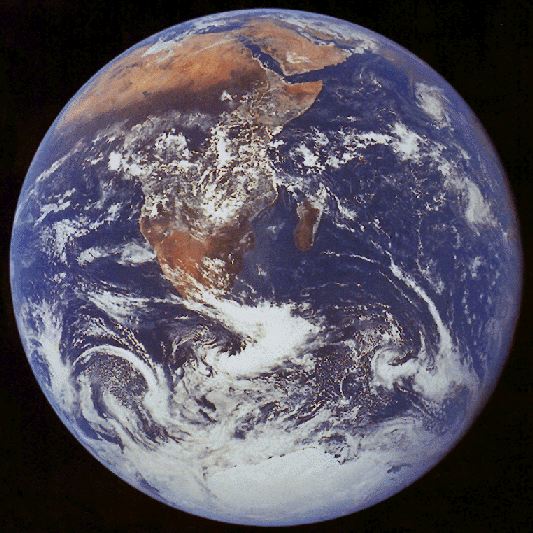
Earth is special - it has liquid water at the surface, it has free oxygen in the atmosphere, it has a highly developed biologic system, it has a strong magnetic field (Jupiter and the Sun have way stronger magnetic fields), it has a very large Moon (mass ratio of 1:81), it’s the only planet with true granite, it’s the only planet with continental crust, it’s the only planet with operational plate tectonics.
(nssdc.gsfc.nasa.gov/image/planetary/earth/apollo17_earth.jpg)
Moon’s mare deposits (younger) have a weaker magnetic signature than the anorthosite crustal rocks (older). This means that the lunar magnetic field died out from 3.9 to 3.6 Ga.
Earth’s continental crust mostly formed over subduction zones.
Earth plate tectonics have been operating since the beginning of the Earth, some say. Others say modern plate tectonics didn’t start until 1 billion years ago. Before that, Earth was too hot to get subduction. But, there are volcanic arcs that predate 1 billion years. However, a different plate tectonics style probably operated then.
If Earth did not have the Moon, Earth’s rotation rate would be ~12 hours/day, there would be no significant tides (only 10 to 15 centimeters from solar tides), there would be no granite and no continents, there would probably be some ocean water, and Earth would have an all-enclosing basaltic crust. Earth would probably develop bacterial life, and maybe algal life. It would have been difficult to have higher forms of life.
If the Moon was larger than it is, Earth would have 36 hours per day, resulting in extremely cold nights.
If the Moon was smaller than it is, Earth would be very different.
Earth is truly in a goldilocks zone.
Harold Urey (1893-1981), the discoverer of heavy hydrogen, said this: the Moon was a very primitive planetoid; it was a “survivor” of a class of planetoids that did not get consumed by collision with other bodies; the Moon is a major recorder of solar system events; the Moon is a captured satellite; the Moon is the “Rosetta Stone of the Solar System”.
Well, the Moon is as old as the Earth, so it is primitive. The Moon may be a little older than the Earth.
The Moon’s maria are in a straight line - the largest is first, the next largest is next, the next largest is next.
--------
The origin of the Moon - 4 models.
1) fission models
2) co-formation models
3) capture models - a minority view; calculations demonstrating capture have only been done at Denison University in Granville, Ohio.
4) giant impact models - a popular view; there’s actually not much evidence for it; proponents can’t make a lunar-sized body from the impact debris; if they can, they can’t get the Moon to be the right composition.
-------
Fission model - Darwin (1880) proposed the fission model. Early Earth spun so fast that the Moon pinched off and orbited Earth. See Wise (1963). Problem with the fission model - how does Earth get to be spinning so quickly for this to happen?
Co-formation model - was popular from 1930 to 1975, after the fission idea died out. Earth and the Moon formed from the same material. Calculations showed that this model didn’t provide a Moon in stable orbit. Plus, Earth & the Moon have different compositions.
Prograde capture model - calculations have been done by Malcuit and others. The Moon moved from a Sun-centered orbit to a geocentric orbit. The energy generated by the Moon capture event was 2.2 x 10 to the 28th power Joules.
Giant impact model - first seriously proposed in 1984 at a Hawaii conference. It has been favored ever since. It doesn’t relate to the geology of Earth or the Moon very well. The model has a Mars-mass body smashing into Proto-Earth. The impact event melts Proto-Earth completely. The debris coalesced into the Moon, which originally formed at 3 Earth radii distance, according to the model. It was 24 hours between the impact and the embryonic Moon. Earth initially rotated ~5 hours per day. No one has made a Moon from the debris, though.
Capture calculations have been done at Denison University since 1987.
---------
A viable Moon origin model has to explain the following:
1) anhydrous nature of the Moon
2) Potassium index (K index) for Solar System bodies (“banana index”) - the potassium content of planetary bodies decreases in a regular way in the Solar System
3) volatile element depletion patterns for Solar System bodies - water and other volatile element contents of planetary bodies decrease in a regular way in the Solar System
4) body density differences - the Moon has a 5 grams/cubic centimeter density; the Earth has a 3.3 g/cc density
5) lunar crust & mare rock dates
6) maria origin
7) asymmetry of lunar mass distribution
8) temporal patterns of lunar rock magnetization
--------
The discovery of Moon water was much hyped - it wasn’t quite a hoax, but it was very overstated - wishful thinking. The very thin, scattered coating of water ice on the Moon was mostly implanted by solar wind. People can’t live on the amount of water there.
--------
The giant impact model talking points:
1) it accounts for the masses of the Moon and the Earth (actually, it doesn’t)
2) it accounts for the angular momentum of the Earth-Moon system (actually, it doesn’t)
3) it accounts for the iron depletion of the Moon (yes, it does)
---------
The tidal capture model talking points:
1) it accounts for the masses of the Moon and the Earth (yes)
2) it accounts for the angular momentum of the Earth-Moon system (yes, it does) - a 10 hours/day rotating Earth that captures the Moon results in an angular momentum that we have now
3) it accounts for iron depletion of the Moon, relative to Earth (this is now explained by the capture model since 2003 understandings)
-------
The Earth-Moon system is unique. Moon origin models require an unusual explanation. Uncommon objects, like the Moon, require an uncommon origin.
Leaning toward the capture model - it was the default explanation from 1975 to 1984.
Capture vs. collision models - a David vs. Goliath scenario.
Tens of millions of dollars have been spent on computer simulations of the giant impact model, mainly at Los Alamos. There’s lots of investment in the impact model.
Earth can’t dissipate the high amounts of energy generated by the capture event over short periods of time. The Moon can.
If capture happened, where did the Moon come from? Didn’t know, originally.
When Malcuit retired in 1999, he still didn’t have an answer.
The capture scenario turns out to be far more complex and fascinating than realized 15 years ago.
Compare the Moon capture model with plate tectonics and Milankovitch climate cyclicity. It took 60 years for plate tectonics to be accepted (1912 to 1972) - a long incubation period for the concept. It took 64 years for the Milankovitch model of Ice Ages to be accepted (1912-1976) - also a long incubation period.
The capture model is simple in principle but complex in the details.
---------
Where did the Moon come from?
Possibilities:
1) near Earth’s orbit. If so, would get a Moon with the same composition as Earth. (which it isn’t)
2) in the inner part of the Asteroid Belt. If so, would get a Moon with ices/water. (which it doesn’t)
3) in the inner part of the Solar System, near the Sun - a near-Sun origin for the Moon was first suggested in the 1970s.
-----------
Relevant ideas - X-Wind Model, Cool Early Earth Model, K Index for Solar System Bodies, calculations by Evans & Tabachnik (1999)
The X-Wind Model allows for an iron-poor Moon forming near the Sun. Calcium-aluminum inclusions (CAIs) in carbonaceous chondrite meteorites are also explained by the X-Wind Model. The giant impact model can’t explain CAIs.
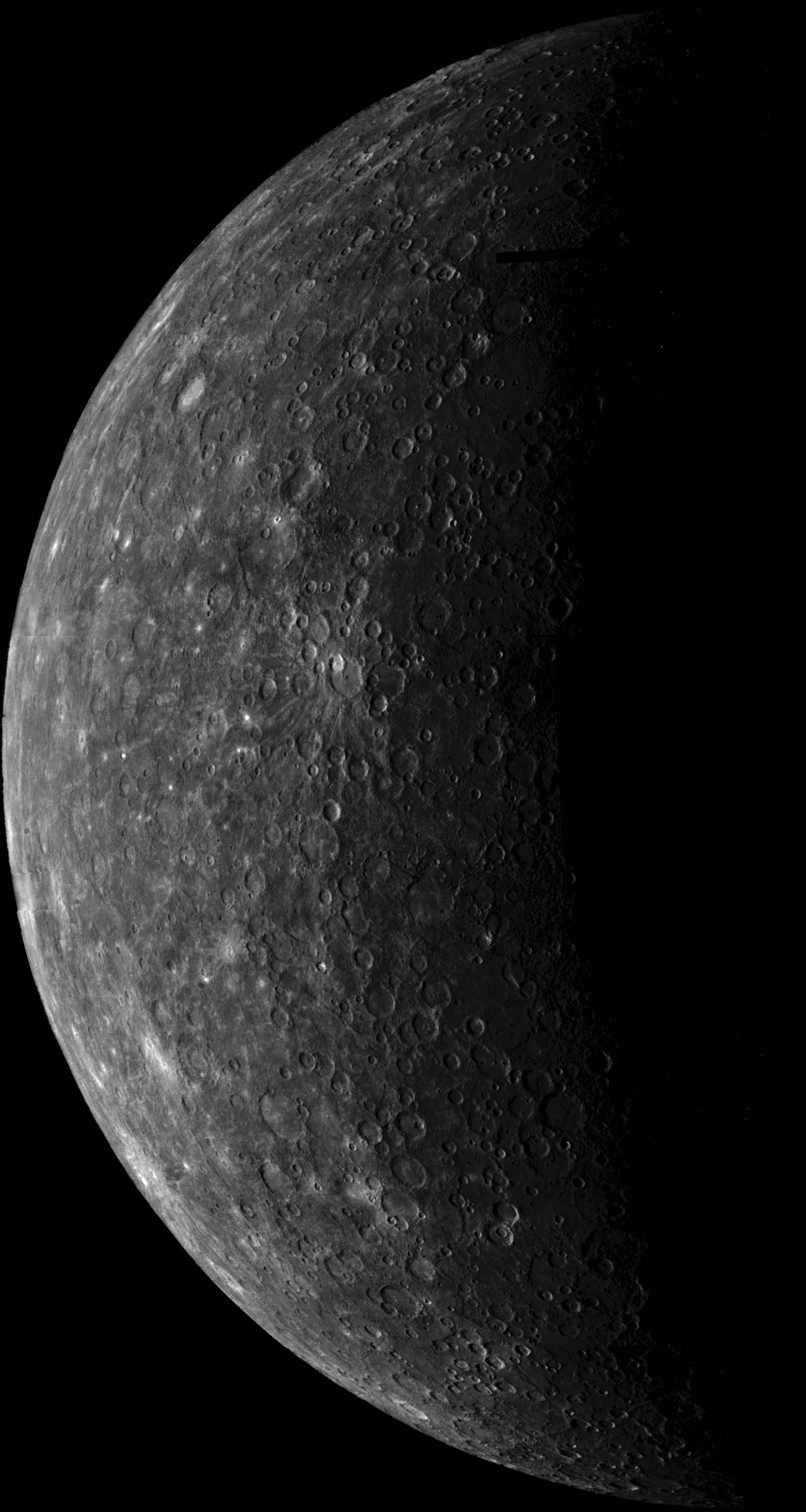
The most stable orbits in the Solar System have been found to occur at 0.1 to 0.2 AU (astronomical units). Orbits at this distance from the Sun are stable for up to 1 billion years. Objects that orbited the Sun at this distance (= closer than Mercury - solarviews.com/raw/merc/mercury.jpg) have been called Vulcanoids. No one has seen a Vulcanoid, it’s been thought. Let’s start the Moon in a Vulcanoid orbit.
Potassium (K) depletion trends:
carbonaceous chondrite meteorites (CI, CM, CV chondrites) have high K contents.
(www.flickr.com/photos/jsjgeology/albums/72157645997754616)
From there, in order of decreasing K content:
Mars (mysite.du.edu/~jcalvert/astro/mars2003.jpg)

Earth
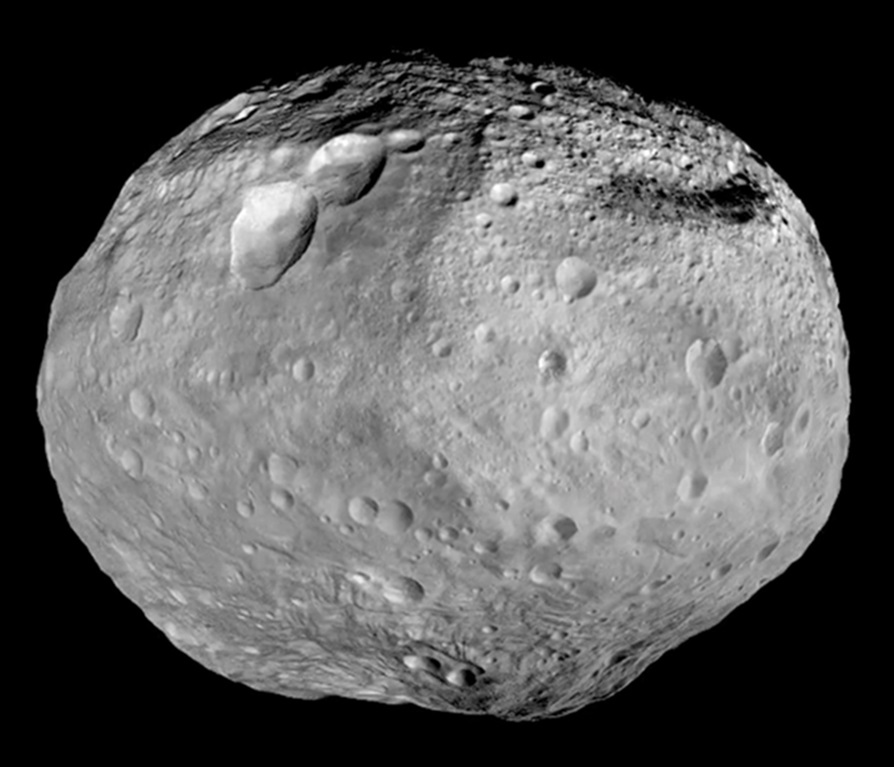
Vesta (= parent body of eucrite meteorites) (upload.wikimedia.org/wikipedia/commons/1/14/Vesta_full_mo...) (www.flickr.com/photos/jsjgeology/14785947504)
Moon
Angra (= parent body of angrite meteorites - not yet identified, but probably in the Asteroid Belt now - www.flickr.com/photos/jsjgeology/5867996330).
The Moon is chemically associated with Vesta and Angra (eucrites & angrites).
Primitive meteorites have chondrules, calcium-aluminum inclusions (CAIs), and matrix. Chondrules are 1-5 mm spherical structures in primitive meteorites (www.flickr.com/photos/jsjgeology/14778331004). Calcium-aluminum inclusions (CAIs) are 1-3 mm spherical structures in primitive meteorites (www.flickr.com/photos/jsjgeology/14787764392). They are rare, except in a meteorite that fell in 1969. The matrix is fine dust - it has element ratios very similar to the Sun.
Compositions of planets & planetoids - Mars is ~90% matrix material. Earth and Venus are a combination of chondrules and matrix + some CAI material. The Moon, Vesta, and Angra have ~90% CAI compositions.
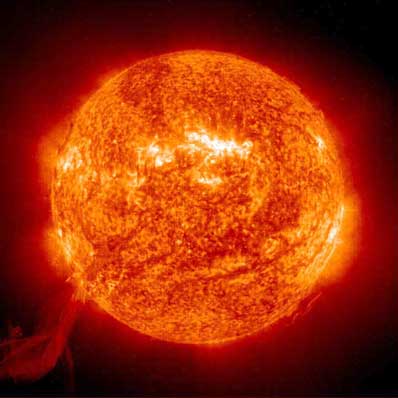
When the Sun formed (very hot) (www.daviddarling.info/images/Sun_021203.jpg), it pushed water and all other volatiles out to the snowline, at 5 AU. Jupiter picked up that material and grew like mad. (sos.noaa.gov/images/Solar_System/jupiter.jpg)
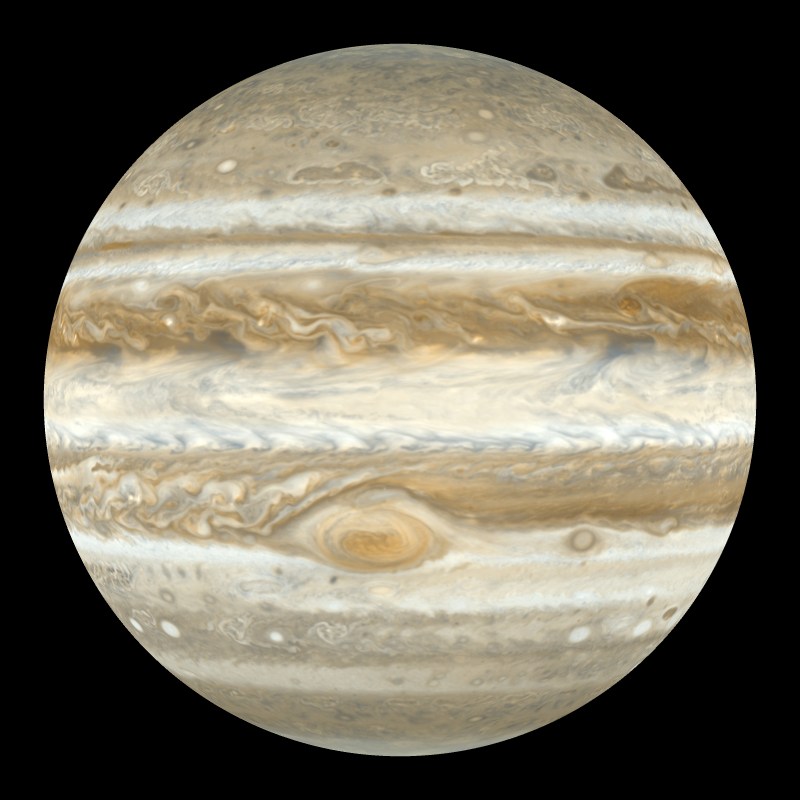
The iron line is at 0.4 AU, where Mercury orbits. ~1200° C. Get a concentration of iron at 0.4 AU - this is why Mercury is so Fe-rich (huge Fe core, compared to planet size).
~0.15 AU is where the Moon formed - inside the iron line, resulting in an Fe-depleted Moon (which it is). ~0.15 AU is a stable orbit zone.
The X-Wind Model explains CAIs - they formed at the reconnection ring shown in an X-Wind diagram and then they got swept elsewhere in the Solar System.
(www.sciencemag.org/content/277/5331/1475/F1.large.jpg)

Cool Early Earth - proposed by John Valley et al. (2002).
4.4 billion year old zircons from the Jack Hills, Australia were discovered in 1986. The zircons indicate Earth was cool at 4.4 Ga - cool enough to have surface water. Many Earth geologic time scales start with the Hadean - Earth was supposed to have been hotter-than-hell back then. 4.4 Ga zircons indicate that wasn’t the case.
The Moon capture event occurred at 3.95 billion years ago. The older lunar maria rocks came into existence then.
Earth’s primitive crust got recycled at 3.95 Ga - this is seen in Australia, Greenland, and South Africa.
Earth was moonless for 600 million years after its formation. Lunar capture started at 3.95 Ga.
Looking at the relationship between Mercury, the Moon, and Vesta. The spacecraft Dawn will orbit Vesta soon.
SPZ - the stable planetoid zone inside Mercury’s orbit. Angra was closest to the Sun, Luna (the Moon) was a bit farther out, and Vesta was a bit farther than that - all inside the orbit of Mercury. The reconnection ring (= CAI formation locality) is inside the orbit of Angra. The area had fluctuating ~1600° K temperatures. There were other bodies in the SPZ - “No Names”.
Why did the Moon get melted to a depth of 600 km? The same thing happened to Mercury.
The Sun entered a T-Tauri stage, after the X-Wind stage. X-Wind involved generation of x-rays and more powerful radiation. The T-Tauri stage was a slow burn - microwave radiation. Luna (Moon), Vesta, and Angra were heated & baked from the outside-in by the T-Tauri event. This melted the top 600 km of the Moon. Luna then had a stronger electromagnetic field.
Luna formed at 0.15 AU and ended up as a Moon of the Earth at 1 AU by prograde gravitational capture - a “benign estrangement” scenario.
Capture models in general - captured bodies can enter a retrograde orbit or a prograde orbit - there’s a 50-50 chance for each. Happily for us, the Moon was captured in a prograde orbit - it has been getting farther away from Earth through time. If it was captured in a retrograde orbit, the Moon would be getting closer to Earth through time - that would be bad.
Vesta was born at 0.19 AU and ended up at 2.4 AU, in the Asteroid Belt. Vesta was tossed around Mercury and Venus. Vesta is too small to have been captured. Options for Vesta - collision with larger bodies or passed by larger bodies. The latter is what happened - it's now in the Asteroid Belt.
Angra was born at 0.1 AU - it’s current location is unknown, but it is probably in the Asteroid Belt.
Adonis - a 0.5 Moon-mass body born at ~0.22 AU. Was gravitationally captured by Venus (0.7 AU) into a retrograde orbit. Adonis approached Venus through geologic time, and eventually coalesced with Venus at ~1 billion years to ~500 million years ago. This is why Venus is a basalt cauldron - a smoldering mass - campfire.andycamper.com/wp-content/media/2011/05/venus.jpg. This is a “fatal attraction” scenario - retrograde capture + coalescence at half a billion to a billion years ago.

Earth would have been like Venus & Adonis if the Moon was captured in retrograde orbit.
So, looking at the Moon as a vulcanoid. Vulcanoids were named in 1978. No one’s seen a vulcanoid. Well, we have been seeing a vulcanoid all this time.
The Moon has a blow-out hole (Mare Orientale - cumbriansky.files.wordpress.com/2012/12/screenshot_2012-1...) - material necked out by tidal disruption and fell back to the Moon’s surface to form the maria in a great circle pattern. ~18 orbits after Moon capture, there was possibly a solar perturbation that pushed the Moon closer to Earth - got maria splashes.

The X-Wind Model well explains CAIs and dehydration events. It doesn’t explain chondrules. The T-Tauri phase microwaved the Moon.
Where did chondrules form? After the dehydration event, the entire inner Solar System must have been chondrules. Chondrules formed by shock waves in the inner Solar System. The shock waves may have originated during Jupiter planetesimal coalescence events. Jupiter formed from large balls of hydrogen and helium and solid material. If two of these balls collided, would get a shock wave. With another ball collision, another shock wave was generated. Chondrules formed by melting of material by the shock waves, like a lightning strike, resulting in droplets in space. They cooled quickly into glass and later crystallized. Very rapid formation for chondrules.
The potassium index pattern developed before chondrules formed.
Earth and Venus are ~the same.
Moon, Adonis, Vesta, Angra - 4 vulcanoids.
Capture is simple in principle. Capture is complex in detail.
Earth has a large Moon - prograde capture.
Triton, a moon of Neptune, was captured for sure - it’s going the wrong way, orbit-wise.
Most of the energy generated by the Moon capture event was absorbed by the Moon.
--------------
See Professor Malcuit's new book, published in 2015: "The Twin Sister Planets Venus and Earth, Why Are They So Different?" (www.springer.com/us/book/9783319113876)
This book summarizes the contents of the above talk.
________________________________________
Summary of talk provided by Professor Malcuit: The origin of the Moon is still an unsolved problem in the natural sciences. In recent years many investigators have jumped onto the “bandwagon” to espouse the merits of the Giant Impact Model. This model proposes that the Moon was formed as a result of a collision of a mars-mass body with the primitive earth about 30 million years after the formation of the Earth. Although the Giant Impact Model appears to be physically possible, at least in part, the model does not relate very well to the rock records of the Earth or the Moon.
The other physically possible model is the Gravitational Capture Model. Most of the recent work, 1972 to present, has been done at Denison University as a combined geology and physics project. Our Capture Model is now undergoing a “renaissance” in light of (1) the Potassium Index for solar system bodies (~1995), (2) the discovery of a multitude of stable planetoid orbits between the orbits of planet Mercury and the Sun (~1999), and (3) the Cool Early Earth Model (~2002). In other words, the Gravitational Capture Model does relate to a number of features of the rock records of both the Earth and the Moon.
This presentation will summarize some of the scientific evidence in favor of the Gravitational Capture Model and compare and contrast this information with the main features of Giant Impact Model.
________________________________________
Biographical information on Professor Malcuit: Bob Malcuit received his Bachelor and Master degrees in Geology from Kent State Univeristy in 1968 and 1970 and his Ph.D in Geology from Michigan State University in 1973. Bob’s current research is in Planetary Geology and one of the themes of several of his projects is that “THE MOON IS THE ROSETTA STONE OF THE SOLAR SYSTEM”. He inherited this concept from Harold Urey (American chemist) and Zdenek Kopal (Czech astronomer). In other words, Bob thinks that the Earth’s Moon is one of the most important recorders of scientific information in the Solar System (a minority view at the present time). He is also promoting the view that without a large satellite like our Moon, planet Earth would be very different from what it is today. For example, without the Moon and the associated rock and ocean tidal action, the Earth would probably not be habitable for life forms higher than bacteria and algae.
--------------
Five members of United Cafeteria and Restaurant Workers union Local 471 are sentenced to six months in jail for clashes on the picket line during their 78-day strike in 1948.
The April 18, 1948 Washington Post article reports on the sentences that were given after the strike was settled.
As the article reports, the harsh sentences were designed to send a message to Local 471 and other unions.
For more information and related images, see flic.kr/s/aHsm1ZnVra
For a deep dive into the 1948 cafeteria workers strike, see washingtonspark.wordpress.com/2018/01/02/against-the-cold...
The image is part of an article published in the Washington Post April 18, 1948.
Rate or Get this shirt at: ift.tt/16mKQZK
People hate when sentences do not end the way they potato.
Like this design? Come and give Sentences That End In Potato a rating on www.ShirtRater.com.
Barry Robinson was a prisoner in Gartree prison in the 80s when he discovered his talent for scraperboard. His parents were from Staffordshire and held exhibitions of his work. He died after his release, some time before 2006.
Anyone that can offer any more information regarding this fine talent, please get in touch or join the Barry Robinson Flickr Group
Looking forward to hearing from you.