View allAll Photos Tagged Sentences
Twenty offences incurring a potential death sentence as laid out in a document from July 1945 originating in the Allied Kommandatura, and signed by Colonel General AV Gorbatov, USSR, Major General FL Parks, USA and Major General LO Lyne, Great Britain. Note the absence of a French representative, at this time they were still demanding a slice of Berlin. The Soviet Government refused to make any adjustment to their sector to accommodate the French, so the Americans and British gave up part of theirs, hence the Western Allied sectors being smaller than the Soviet Sector.
One evening, in July 1994, shortly before posting back to UK to the Joint Arms Control Implementation Group, I was walking past HQ British Military Government in London Block and noted a skip outside into which they were throwing out a lot of their "rubbish", including this handbook. I helped myself to a bit of Berlin History, taking several various booklets from 1945 to the 1971 Quadripartite Agreement which governed inter-allied procedures during my time in Berlin.
These are my personal notes taken during a geology presentation. I give them here because they may be of some interest. Do not expect the notes to always be in complete sentences, etc.
-----------------------------------
Microscopic Treasures - Scolecodonts from the Type Cincinnatian
Presented by: Mats Eriksson (Department of Geology, Lund University, Lund, Sweden) (portal.research.lu.se/portal/en/persons/mats-eriksson(c4d0dbd0-2ec2-46b4-bbe6-b87549717793).html)
16 November 2001
----------
Polychaete annelid worms are a very abundant & successful animal group. (www.flickr.com/photos/artour_a/242680976) They are diverse in feeding habit, morphology, preferences for depth & substrate, and geographically widespread. They have a scanty fossil record, due to their soft-bodied nature. They occur from the Middle Cambrian onward. Scolecodonts (= polychaete worm jaws) range from the earliest Ordovician (latest Cambrian?) to the Recent.
Many modern marine polychaetes are colorful.
The oldest polychaete fossils are Middle Cambrian.
Types of polychaete fossils:
1) jaws (scolecodonts); 2) traces; 3) dwelling tubes; and 4) body imprints.
One animal could give rise to all of these fossils.
The taxonomy of these different fossil categories has not been assimilated - there are different systematics for traces, tubes, imprints, and scolecodonts.
scolex - worm
odous - tooth
Polychaete annelid jaw apparatuses consist of paired, commonly asymmetrical elements called scolecodonts. (scolecodonts.net/scol.jpg) Individual scolecodonts are acid-resistant microfossils that are commonly 0.1-2 mm long. The jaw apparatus disaggregates quickly - one finds isolated scolecodonts in the rocks.

Maxillae are numbered from back to front - I, II, III, IV, V. There are right-hand side & left-hand side elements. Carriers and basal plates are complementary elements to the maxillae.
There is a wide variety of jaw apparatus architecture and a wide variety of jaw forms.
Polychaete annelid worms usually have multielement apparatuses, but not all of them do.
One modern polychaete annelid has 4 almost identical conical jaw elements.
Another modern form has 1 pair only of nearly identical jaw elements.
Some polychaete annelids lack jaws altogether.
Retrieving scolecodonts from rocks involves acid processing and kerosene/paint thinner disaggregation of rock - these are the two standard microfossil extraction methods.
Why the general lack of interest in scolecodonts? Possibly because they have a confused taxonomy. And possibly due to their claimed uselessness in biostratigraphy, which is not justified and not supported by the data. However, some scolecodonts are restricted to certain types of rocks (they are facies restricted) and some forms are long-ranging. Some scolecodonts do have short ranges and are widespread, in terms of facies preferences.
Parataxonomy - the plague of scolecodontology. Rapid post-mortem disarticulation results in each element being systematically treated/described, traditionally. This violates naming rules and causes systematic chaos.
Research history of scolecodonts:
1) Phase I - single-element taxonomy (1854-~1946)
1854-1856 - Pander, Massalongo & Eichwald
1864 - Angelin suggests scolecodonts are polychaete jaws
1879-1896 - Hinde has 4 important papers
1933 - Croneis & Scott - coined the term “scolecodont”
1933-1946 - Stauffer, Potter, Gries, Eller
2) Phase II - apparatus-based taxonomy (1947-~1978)
1947 - Lange
1956-1969 - Polish school, with Kozlowski, Kielan-Jaworowska, Kozur, Taugourdeau, Sylvester, Schwab
1970-1978 - Szaniawski, Wrona, Mierzeyweski, Zawidska.
The phase II folks didn’t integrate the old single-element taxonomy into the new apparatus-based taxonomy.
3) Phase III - multi-element taxonomy (1979-2001) - researchers at this time include Bergman, Colbath, Eriksson, and Hints.
Scanning electron microscopy is a standard tool that has allowed for better comparisons of published finds (compared with potential artistic enhancement of line drawings in the older literature).
Morphology and statistical methods are used in reconstructions while doing multi-element taxonomy.
Cincinnatian scolecodonts - looked at 65 samples from 9 sections from the Upper Ordovician of the Cincinnati, Ohio area. Got a sample of ~100,000 scolecodonts ranging from the Edenian Stage to the latest Richmondian Stage. This includes ~dozen articulated apparatuses. The Cincinnatian has abundant scolecodonts - up to a couple thousand specimens can be retrieved per kilogram of rock. This study has involved sorting out the older confused taxonomy. There is noticeable asymmetry in apparatuses - the corresponding elements on both sides of the jaw don’t match in terms of morphology and size.
Eight different families are common in the Cincinnatian Series. One family dominates - the Polychaetaspidae, which are sometimes >95% of the fauna, but are rare in the trilobite shales of the Waynesville Formation [Richmondian Stage, upper Cincinnatian Series, upper Upper Ordovician].
Looked at the diversity trend of scolecodonts in the Cincinnatian Series. Diversity increases from the Kope Formation [Edenian Stage] up to the Richmondian Stage - this is a deep-water to shallow-water trend. There is a higher diversity of scolecodonts in shallow water deposits.
Cincinnatian associations - 5 tentative ones were identified based on different frequencies of occurrences of different scolecodonts.
I - Kope Formation association
II - Miamitown Shale association
III - Arnheim Formation-Waynesville Formation association
IV - trilobite shale association
V - Liberty Formation-Whitewater Formation association
Most families and genera are shared between Laurentia and Baltica in coeval deposits. Some rare forms in Laurentia are common in Baltica & some common forms in Laurentia are absent in Baltica.
The Cincinnatian has 40 to 50 species in 12 families, dominated by the Family Polychaetaspidae. None of these scolecodont families are still alive today. There are 5 faunal associations within the ~10 million year interval of the Cincinnatian, which implies they have biostratigraphic utility. There is an apparent biotic response in the scolecodont fossil record at Holland's (1993) C3-C4 sequence boundary (= base of the Waynesville Formation).
Can see an increase in taxonomic diversity in shallow water deposits. Most families & genera have an intercontinental distribution. The faunal composition differs between Laurentia and Baltica (“endemic” species vs. non-endemic species).
There's a new genus & species in the Silurian of Gotland that has >5 mm long scolecodont elements, which is huge by scolecodont standards.
There's not much correlation between the size of scolecodonts and the size of the animal. There are some living decimeter-sized worms with ~1 cm sized elements.
Feeding ecology - need to be careful about interpreting feeding ecology based on fossils. These horrific-looking jaws suggests predation, but many modern forms with such jaws aren’t predators.
Why do the polychaete animals have bilaterally-symmetrical bodies and yet have asymmetry in the jaw apparatuses? Don’t know.
Drop in diversity index - this corresponds with the trilobite shale of the Waynesville Formation (scolecodont abundance is high, but species diversity is very low). Is this change taphonomic or due to the temporary deeper water setting?
----------------
Irish Penal Reform Trust Open Forum 2010: 'Exploding Prisoner Numbers'. Main contributing guest speakers included Tom O'Malley NUI Galway; Inspector of Prisons, Judge Michael Reilly (Chairperson); Dr Mary Rogan, IPRT; Vivian Geiran, Director of Operations, The Probation Service; Louis Harkin, Assistant Commissioner, An Garda Síochána. Photo by Derek Speirs.
Pedro Aviles of New York City, shown in a November 1954 photograph, was a Puerto Rican Nationalist Party member accused of conspiracy to overthrow the government of the United States.
Aviles, 28, was sentenced in 1955 to four years in prison for sedition.
Sedition trial:
Following the wounding of five U.S. Representatives in the Capitol building March 1, 1954 by four Puerto Rican nationalists who opened fire on them from a visitor gallery, the U.S. government began a series of mass arrests that resulted in two conspiracy trials 1954-55. A third trial took place in Puerto Rico.
The four participants in the shooting—Delores Lolita Lebron, Rafael Cancel Miranda, Irvin Flores Rodriguez and Andres Figueroa Cordero—were quickly arrested and convicted in the attack with sentences varying from 16 years to 75 years in jail.
But the federal government went further, convening three different grand juries, summoning 91 Puerto Ricans and bringing indictments against 17 members of the Puerto Rican Nationalist Party for “seditious conspiracy to overthrow the United States government by force.”
The four charged in the shootings were also among the 17 charged with conspiracy.
The indictment alleged that the defendants were “active members, leaders, officers or persons in control of the Nationalist Party of Puerto Rico, which is charged to be an organization dedicated to bringing about the political independence of Puerto Rico from the United States by force of violence or armed revolution.”
In effect, the government was using the same strategy it was using to break up the U.S. Communist Party during that period. If you were an active member of the Nationalist Party, you were guilty even if you committed no illegal acts yourself.
Four of those charged turned state’s evidence and gave testimony against the other defendants.
At the first month-long trial in October 1954, much of the evidence against the group consisted of testimony by police or informers of speeches given by Nationalist Party leaders who had used slogans like, “Throw the Yankees out at pistol point,” “give your life and property for independence,” and saying that President Harry Truman “could be hanged in a place in San Juan.”
Many of the speeches dated prior to the 1950 attempted armed revolution in Puerto Rico by the Nationalist Party that was defeated and for which many party members were jailed in Puerto Rico.
Defense attorney Conrad J. Lynn charged the government sought “proscription of a dissenting political group because of its ideas.”
Julio Pinto Gandia, a defendant who was acting as his own counsel and was the alleged leader of the group in the U.S., told the court that the party, founded in 1922, was not “a band of terrorists” and that any violent actions arose out of individual “despair.”
The most sensational specific testimony came from one of those indicted who turned state’s evidence--Gonzalo Lebron Sotomayor, brother of Delores Lolita Lebron who was the leader of the four shooters.
Lebron Sotomayor testified that Pinto Gandia told him there would be attacks on Congress, President Dwight Eisenhower and the Puerto Rican Resident Commissioner in Washington, but could not say how the plans would be carried out.
Other specific testimony involved another of those indicted who turned state’s evidence. Angle Luis Medina testified he had purchased a number of pistols and three carbines in Chicago at the direction of a party leader who told him “to be ready in case of a revolution” to free Puerto Rico.
The evidence against most of the defendants committing any specific illegal act was thin.
U.S. Attorney J. Edward Lumbard summed up the case saying that the Nationalist Party had supplied the pistols used in the U.S. Capitol shooting and a 1950 attempt to assassinate President Harry Truman and that each of the 13 defendants had their “moral fingerprints on the guns” used.
Lumbard further told the jury that the government did not have to prove that the defendants were part of a conspiracy to overthrow the U.S. government—only that they had conspired to overthrow the authority of the United States in Puerto Rico.
The defense called five witnesses to testify that the Nationalist Party did not advocate overthrow of the U.S. government and only sought total independence for Puerto Rico.
Lynn told the jury that the government was trying “proscription of a dissenting political group because of its ideas.”
Pinto Gandia had earlier sought dismissal of the indictments against the four shooters as double jeopardy and because the government, “intended to bring the guilt of the four defendants upon the other defendants by association or inference.”
He added, “it is not a crime to preach and work for the freedom of a nation and that membership in the Nationalist Party itself did not indicate anyone was part of a conspiracy.
The jury deliberated only a few hours before finding all the defendants guilty.
Two weeks after the verdicts, more arrests took place and a second trial scheduled.
The trial of 11 other Nationalists took place February-March 1955 and followed the same lines as the first trial, except that Lebron Sotomayer gave additional details to his earlier testimony.
Ten of the 11 were found guilty. Serafin Colon Olivera, 28 of New York, was acquitted. Testimony had indicated he was a Nationalist Party member in 1949 and attended a Nationalist dance in 1953.
Those found guilty in the two trials received sentences ranging from 18 months to six years in prison. Appeals failed.
In Puerto Rico, Nationalist Party leader Pedro Albizu Campos hailed the attack as “sublime heroism.” The governor revoked a previous pardon of the party leader and he was arrested after a shootout and imprisoned.
Charges were placed against 15 party members on the island, however 12 were acquitted at trial in late 1954. The three found guilty were sentenced to prison terms ranging from 3-10 years.
Albizu Campos’ health suffered badly in prison where he suffered a stroke in 1956 that left him unable to talk or walk. He was pardoned in 1964, but died a few months afterward.
The Nationalist Party was all but dead as a result of the U.S. trials and by suppression by authorities in Puerto Rico, although it continues to exist today.
First trial sedition trial in 1954:
Jorge Luis Jimenez, sentenced to six years imprisonment
Manuel Rabago Torres, sentenced to six years imprisonment
Rosa Collazo, sentenced to six years imprisonment
Juan Bernardo Lebron, sentenced to six years imprisonment
Juan Francisco Medina, sentenced to six years imprisonment
Armando Diaz Matos, sentenced to six years imprisonment
Julio Pinto Gandia, sentenced to six years imprisonment
Carmelo Alvarez Roman, sentenced to six years imprisonment
Jose Antonio Otero Otero, sentenced to six years imprisonment
Andress Figueroa Cordero, one of 4 convicted shooters, sentenced to additional six years imprisonment
Rafael Cancel Miranda, one of 4 convicted shooters, sentenced to additional six years imprisonment
Dolores Lolita Lebron, one of 4 convicted shooters, sentenced to additional six years imprisonment
Irvin Flores Rodriguez, one of 4 convicted shooters, sentenced to additional six years imprisonment
Second trial in 1955:
Juan Hernandez Valle, Puerto Rico, sentenced to six years imprisonment
Maximino Pedraza Martinez, sentenced to six years imprisonment
Santiago Gonzalez Castro, sentenced to six years imprisonment
Esteban Quinones Escute, sentenced to four years imprisonment
Angel Luis Arzola Velez, sentenced to four years imprisonment
Antonio Herrera Moreno, sentenced to four years imprisonment
Carmen Dolores Otero Torresola, sentenced to four years imprisonment
Pedro Aviles, sentenced to four years imprisonment
Julio Flores Medina, sentenced to 18 months imprisonment
Miguel Vargas Nieves, sentenced to 18 months imprisonment
Those who turned state’s evidence:
Gonzalo Lebron Sotomayor, suspended sentence
Francisco Cortez Ruiz, suspended sentence
Carlos Aulet, suspended sentence
Angel Luis Medina, suspended sentence
Acquitted at May 1955 trial:
Serafin Colon Olivera
For more information and related images to the 1954-55 conspiracy trials of the Puerto Rican Nationalist Party, see flic.kr/s/aHskRMRawC
For more information and related images to the 1950 attempted assassination of President Truman and the 1954 wounding of five U.S. Representatives, see flic.kr/s/aHskghBC71
The photographer is unknown. The photo is believed to be a mugshot. The image is courtesy of the D.C. Public Library Washington Star Collection © Washington Post.
This a snapshot of UX concept before design. The general idea is using "sentence-based" UI, where the buttons/actions are part of a sentence that explains what can be done at this point in time.
Responses from Twitterverse:
Leandro Katz (Argentine, born 1938)
The decoded sentence reads, "When we pulverize words, what is left is neither mere noise nor arbitrary, pure elements, but still other words, reflection of an invisible and yet indelible representation: this is the myth in which we now transcribe the most obscure and real powers of language."
Created with twenty-six phases of the moon, each phase representing a letter of the alphabet.
An invented alphabet!
Angel Luis Medina, shown in a November 1954 photograph, was a Puerto Rican Nationalist Party member accused of conspiracy to overthrow the government of the United States.
Medina was described as the secretary for Nationalist Party in New York.
Medina turned state’s evidence, pleaded guilty to sedition and was given a suspended sentence.
Sedition trial:
Following the wounding of five U.S. Representatives in the Capitol building March 1, 1954 by four Puerto Rican nationalists who opened fire on them from a visitor gallery, the U.S. government began a series of mass arrests that resulted in two conspiracy trials 1954-55. A third trial took place in Puerto Rico.
The four participants in the shooting—Delores Lolita Lebron, Rafael Cancel Miranda, Irvin Flores Rodriguez and Andres Figueroa Cordero—were quickly arrested and convicted in the attack with sentences varying from 16 years to 75 years in jail.
But the federal government went further, convening three different grand juries, summoning 91 Puerto Ricans and bringing indictments against 17 members of the Puerto Rican Nationalist Party for “seditious conspiracy to overthrow the United States government by force.”
The four charged in the shootings were also among the 17 charged with conspiracy.
The indictment alleged that the defendants were “active members, leaders, officers or persons in control of the Nationalist Party of Puerto Rico, which is charged to be an organization dedicated to bringing about the political independence of Puerto Rico from the United States by force of violence or armed revolution.”
In effect, the government was using the same strategy it was using to break up the U.S. Communist Party during that period. If you were an active member of the Nationalist Party, you were guilty even if you committed no illegal acts yourself.
Four of those charged turned state’s evidence and gave testimony against the other defendants.
At the first month-long trial in October 1954, much of the evidence against the group consisted of testimony by police or informers of speeches given by Nationalist Party leaders who had used slogans like, “Throw the Yankees out at pistol point,” “give your life and property for independence,” and saying that President Harry Truman “could be hanged in a place in San Juan.”
Many of the speeches dated prior to the 1950 attempted armed revolution in Puerto Rico by the Nationalist Party that was defeated and for which many party members were jailed in Puerto Rico.
Defense attorney Conrad J. Lynn charged the government sought “proscription of a dissenting political group because of its ideas.”
Julio Pinto Gandia, a defendant who was acting as his own counsel and was the alleged leader of the group in the U.S., told the court that the party, founded in 1922, was not “a band of terrorists” and that any violent actions arose out of individual “despair.”
The most sensational specific testimony came from one of those indicted who turned state’s evidence--Gonzalo Lebron Sotomayor, brother of Delores Lolita Lebron who was the leader of the four shooters.
Lebron Sotomayor testified that Pinto Gandia told him there would be attacks on Congress, President Dwight Eisenhower and the Puerto Rican Resident Commissioner in Washington, but could not say how the plans would be carried out.
Other specific testimony involved another of those indicted who turned state’s evidence. Angle Luis Medina testified he had purchased a number of pistols and three carbines in Chicago at the direction of a party leader who told him “to be ready in case of a revolution” to free Puerto Rico.
The evidence against most of the defendants committing any specific illegal act was thin.
U.S. Attorney J. Edward Lumbard summed up the case saying that the Nationalist Party had supplied the pistols used in the U.S. Capitol shooting and a 1950 attempt to assassinate President Harry Truman and that each of the 13 defendants had their “moral fingerprints on the guns” used.
Lumbard further told the jury that the government did not have to prove that the defendants were part of a conspiracy to overthrow the U.S. government—only that they had conspired to overthrow the authority of the United States in Puerto Rico.
The defense called five witnesses to testify that the Nationalist Party did not advocate overthrow of the U.S. government and only sought total independence for Puerto Rico.
Lynn told the jury that the government was trying “proscription of a dissenting political group because of its ideas.”
Pinto Gandia had earlier sought dismissal of the indictments against the four shooters as double jeopardy and because the government, “intended to bring the guilt of the four defendants upon the other defendants by association or inference.”
He added, “it is not a crime to preach and work for the freedom of a nation and that membership in the Nationalist Party itself did not indicate anyone was part of a conspiracy.
The jury deliberated only a few hours before finding all the defendants guilty.
Two weeks after the verdicts, more arrests took place and a second trial scheduled.
The trial of 11 other Nationalists took place February-March 1955 and followed the same lines as the first trial, except that Lebron Sotomayer gave additional details to his earlier testimony.
Ten of the 11 were found guilty. Serafin Colon Olivera, 28 of New York, was acquitted. Testimony had indicated he was a Nationalist Party member in 1949 and attended a Nationalist dance in 1953.
Those found guilty in the two trials received sentences ranging from 18 months to six years in prison. Appeals failed.
In Puerto Rico, Nationalist Party leader Pedro Albizu Campos hailed the attack as “sublime heroism.” The governor revoked a previous pardon of the party leader and he was arrested after a shootout and imprisoned.
Charges were placed against 15 party members on the island, however 12 were acquitted at trial in late 1954. The three found guilty were sentenced to prison terms ranging from 3-10 years.
Albizu Campos’ health suffered badly in prison where he suffered a stroke in 1956 that left him unable to talk or walk. He was pardoned in 1964, but died a few months afterward.
The Nationalist Party was all but dead as a result of the U.S. trials and by suppression by authorities in Puerto Rico, although it continues to exist today.
First trial sedition trial in 1954:
Jorge Luis Jimenez, sentenced to six years imprisonment
Manuel Rabago Torres, sentenced to six years imprisonment
Rosa Collazo, sentenced to six years imprisonment
Juan Bernardo Lebron, sentenced to six years imprisonment
Juan Francisco Medina, sentenced to six years imprisonment
Armando Diaz Matos, sentenced to six years imprisonment
Julio Pinto Gandia, sentenced to six years imprisonment
Carmelo Alvarez Roman, sentenced to six years imprisonment
Jose Antonio Otero Otero, sentenced to six years imprisonment
Andress Figueroa Cordero, one of 4 convicted shooters, sentenced to additional six years imprisonment
Rafael Cancel Miranda, one of 4 convicted shooters, sentenced to additional six years imprisonment
Dolores Lolita Lebron, one of 4 convicted shooters, sentenced to additional six years imprisonment
Irvin Flores Rodriguez, one of 4 convicted shooters, sentenced to additional six years imprisonment
Second trial in 1955:
Juan Hernandez Valle, Puerto Rico, sentenced to six years imprisonment
Maximino Pedraza Martinez, sentenced to six years imprisonment
Santiago Gonzalez Castro, sentenced to six years imprisonment
Esteban Quinones Escute, sentenced to four years imprisonment
Angel Luis Arzola Velez, sentenced to four years imprisonment
Antonio Herrera Moreno, sentenced to four years imprisonment
Carmen Dolores Otero Torresola, sentenced to four years imprisonment
Pedro Aviles, sentenced to four years imprisonment
Julio Flores Medina, sentenced to 18 months imprisonment
Miguel Vargas Nieves, sentenced to 18 months imprisonment
Those who turned state’s evidence:
Gonzalo Lebron Sotomayor, suspended sentence
Francisco Cortez Ruiz, suspended sentence
Carlos Aulet, suspended sentence
Angel Luis Medina, suspended sentence
Acquitted at May 1955 trial:
Serafin Colon Olivera
For more information and related images to the 1954-55 conspiracy trials of the Puerto Rican Nationalist Party, see flic.kr/s/aHskRMRawC
For more information and related images to the 1950 attempted assassination of President Truman and the 1954 wounding of five U.S. Representatives, see flic.kr/s/aHskghBC71
The photographer is unknown. The photo is believed to be a mugshot. The image is courtesy of the D.C. Public Library Washington Star Collection © Washington Post.
The illegal occupationist forces lead by the United States Government had no right to try Saddam Hussein and any other Iraqis for purported crimes. The invasion was illegal and the consequent occupation is a serious crime against humanity. MECAWI is calling for demonstrations if and when the death sentence is enforced.
Irish Penal Reform Trust Open Forum 2010: 'Exploding Prisoner Numbers'. Main contributing guest speakers included Tom O'Malley NUI Galway; Inspector of Prisons, Judge Michael Reilly (Chairperson); Dr Mary Rogan, IPRT; Vivian Geiran, Director of Operations, The Probation Service; Louis Harkin, Assistant Commissioner, An Garda Síochána. Photo by Derek Speirs.
Carlos Aulet, shown in a November 1954 photograph, was a Puerto Rican Nationalist Party member accused of conspiracy to overthrow the government of the United States.
Aulet was described as a courier and bodyghuard for Nationalist Party in Chicago.
Cortez Ruiz turned state’s evidence, pleaded guilty and was given a suspended sentence.
Sedition trial
Following the wounding of five U.S. Representatives in the Capitol building March 1, 1954 by four Puerto Rican nationalists who opened fire on them from a visitor gallery, the U.S. government began a series of mass arrests that resulted in two conspiracy trials 1954-55. A third trial took place in Puerto Rico.
The four participants in the shooting—Delores Lolita Lebron, Rafael Cancel Miranda, Irvin Flores Rodriguez and Andres Figueroa Cordero—were quickly arrested and convicted in the attack with sentences varying from 16 years to 75 years in jail.
But the federal government went further, convening three different grand juries, summoning 91 Puerto Ricans and bringing indictments against 17 members of the Puerto Rican Nationalist Party for “seditious conspiracy to overthrow the United States government by force.”
The four charged in the shootings were also among the 17 charged with conspiracy.
The indictment alleged that the defendants were “active members, leaders, officers or persons in control of the Nationalist Party of Puerto Rico, which is charged to be an organization dedicated to bringing about the political independence of Puerto Rico from the United States by force of violence or armed revolution.”
In effect, the government was using the same strategy it was using to break up the U.S. Communist Party during that period. If you were an active member of the Nationalist Party, you were guilty even if you committed no illegal acts yourself.
Four of those charged turned state’s evidence and gave testimony against the other defendants.
At the first month-long trial in October 1954, much of the evidence against the group consisted of testimony by police or informers of speeches given by Nationalist Party leaders who had used slogans like, “Throw the Yankees out at pistol point,” “give your life and property for independence,” and saying that President Harry Truman “could be hanged in a place in San Juan.”
Many of the speeches dated prior to the 1950 attempted armed revolution in Puerto Rico by the Nationalist Party that was defeated and for which many party members were jailed in Puerto Rico.
Defense attorney Conrad J. Lynn charged the government sought “proscription of a dissenting political group because of its ideas.”
Julio Pinto Gandia, a defendant who was acting as his own counsel and was the alleged leader of the group in the U.S., told the court that the party, founded in 1922, was not “a band of terrorists” and that any violent actions arose out of individual “despair.”
The most sensational specific testimony came from one of those indicted who turned state’s evidence--Gonzalo Lebron Sotomayor, brother of Delores Lolita Lebron who was the leader of the four shooters.
Lebron Sotomayor testified that Pinto Gandia told him there would be attacks on Congress, President Dwight Eisenhower and the Puerto Rican Resident Commissioner in Washington, but could not say how the plans would be carried out.
Other specific testimony involved another of those indicted who turned state’s evidence. Angle Luis Medina testified he had purchased a number of pistols and three carbines in Chicago at the direction of a party leader who told him “to be ready in case of a revolution” to free Puerto Rico.
The evidence against most of the defendants committing any specific illegal act was thin.
U.S. Attorney J. Edward Lumbard summed up the case saying that the Nationalist Party had supplied the pistols used in the U.S. Capitol shooting and a 1950 attempt to assassinate President Harry Truman and that each of the 13 defendants had their “moral fingerprints on the guns” used.
Lumbard further told the jury that the government did not have to prove that the defendants were part of a conspiracy to overthrow the U.S. government—only that they had conspired to overthrow the authority of the United States in Puerto Rico.
The defense called five witnesses to testify that the Nationalist Party did not advocate overthrow of the U.S. government and only sought total independence for Puerto Rico.
Lynn told the jury that the government was trying “proscription of a dissenting political group because of its ideas.”
Pinto Gandia had earlier sought dismissal of the indictments against the four shooters as double jeopardy and because the government, “intended to bring the guilt of the four defendants upon the other defendants by association or inference.”
He added, “it is not a crime to preach and work for the freedom of a nation and that membership in the Nationalist Party itself did not indicate anyone was part of a conspiracy.
The jury deliberated only a few hours before finding all the defendants guilty.
Two weeks after the verdicts, more arrests took place and a second trial scheduled.
The trial of 11 other Nationalists took place February-March 1955 and followed the same lines as the first trial, except that Lebron Sotomayer gave additional details to his earlier testimony.
Ten of the 11 were found guilty. Serafin Colon Olivera, 28 of New York, was acquitted. Testimony had indicated he was a Nationalist Party member in 1949 and attended a Nationalist dance in 1953.
Those found guilty in the two trials received sentences ranging from 18 months to six years in prison. Appeals failed.
In Puerto Rico, Nationalist Party leader Pedro Albizu Campos hailed the attack as “sublime heroism.” The governor revoked a previous pardon of the party leader and he was arrested after a shootout and imprisoned.
Charges were placed against 15 party members on the island, however 12 were acquitted at trial in late 1954. The three found guilty were sentenced to prison terms ranging from 3-10 years.
Albizu Campos’ health suffered badly in prison where he suffered a stroke in 1956 that left him unable to talk or walk. He was pardoned in 1964, but died a few months afterward.
The Nationalist Party was all but dead as a result of the U.S. trials and by suppression by authorities in Puerto Rico, although it continues to exist today.
First trial sedition trial in 1954:
Jorge Luis Jimenez, sentenced to six years imprisonment
Manuel Rabago Torres, sentenced to six years imprisonment
Rosa Collazo, sentenced to six years imprisonment
Juan Bernardo Lebron, sentenced to six years imprisonment
Juan Francisco Medina, sentenced to six years imprisonment
Armando Diaz Matos, sentenced to six years imprisonment
Julio Pinto Gandia, sentenced to six years imprisonment
Carmelo Alvarez Roman, sentenced to six years imprisonment
Jose Antonio Otero Otero, sentenced to six years imprisonment
Andress Figueroa Cordero, one of 4 convicted shooters, sentenced to additional six years imprisonment
Rafael Cancel Miranda, one of 4 convicted shooters, sentenced to additional six years imprisonment
Dolores Lolita Lebron, one of 4 convicted shooters, sentenced to additional six years imprisonment
Irvin Flores Rodriguez, one of 4 convicted shooters, sentenced to additional six years imprisonment
Second trial in 1955:
Juan Hernandez Valle, Puerto Rico, sentenced to six years imprisonment
Maximino Pedraza Martinez, sentenced to six years imprisonment
Santiago Gonzalez Castro, sentenced to six years imprisonment
Esteban Quinones Escute, sentenced to four years imprisonment
Angel Luis Arzola Velez, sentenced to four years imprisonment
Antonio Herrera Moreno, sentenced to four years imprisonment
Carmen Dolores Otero Torresola, sentenced to four years imprisonment
Pedro Aviles, sentenced to four years imprisonment
Julio Flores Medina, sentenced to 18 months imprisonment
Miguel Vargas Nieves, sentenced to 18 months imprisonment
Those who turned state’s evidence:
Gonzalo Lebron Sotomayor, suspended sentence
Francisco Cortez Ruiz, suspended sentence
Carlos Aulet, suspended sentence
Angel Luis Medina, suspended sentence
Acquitted at May 1955 trial:
Serafin Colon Olivera
For more information and related images to the 1954-55 conspiracy trials of the Puerto Rican Nationalist Party, see flic.kr/s/aHskRMRawC
For more information and related images to the 1950 attempted assassination of President Truman and the 1954 wounding of five U.S. Representatives, see flic.kr/s/aHskghBC71
The photographer is unknown. The photo is believed to be a mugshot. The image is courtesy of the D.C. Public Library Washington Star Collection © Washington Post.
Juan Bernardo Lebron from New York City is shown in a November 1954 photograph. He was a Puerto Rican Nationalist Party member accused of conspiracy to overthrow the government of the United States.
Lebron was convicted of sedition and sentenced in 1954 to six years in prison in prison for sedition.
Sedition trial:
Following the wounding of five U.S. Representatives in the Capitol building March 1, 1954 by four Puerto Rican nationalists who opened fire on them from a visitor gallery, the U.S. government began a series of mass arrests that resulted in two conspiracy trials 1954-55. A third trial took place in Puerto Rico.
The four participants in the shooting—Delores Lolita Lebron, Rafael Cancel Miranda, Irvin Flores Rodriguez and Andres Figueroa Cordero—were quickly arrested and convicted in the attack with sentences varying from 16 years to 75 years in jail.
But the federal government went further, convening three different grand juries, summoning 91 Puerto Ricans and bringing indictments against 17 members of the Puerto Rican Nationalist Party for “seditious conspiracy to overthrow the United States government by force.”
The four charged in the shootings were also among the 17 charged with conspiracy.
The indictment alleged that the defendants were “active members, leaders, officers or persons in control of the Nationalist Party of Puerto Rico, which is charged to be an organization dedicated to bringing about the political independence of Puerto Rico from the United States by force of violence or armed revolution.”
In effect, the government was using the same strategy it was using to break up the U.S. Communist Party during that period. If you were an active member of the Nationalist Party, you were guilty even if you committed no illegal acts yourself.
Four of those charged turned state’s evidence and gave testimony against the other defendants.
At the first month-long trial in October 1954, much of the evidence against the group consisted of testimony by police or informers of speeches given by Nationalist Party leaders who had used slogans like, “Throw the Yankees out at pistol point,” “give your life and property for independence,” and saying that President Harry Truman “could be hanged in a place in San Juan.”
Many of the speeches dated prior to the 1950 attempted armed revolution in Puerto Rico by the Nationalist Party that was defeated and for which many party members were jailed in Puerto Rico.
Defense attorney Conrad J. Lynn charged the government sought “proscription of a dissenting political group because of its ideas.”
Julio Pinto Gandia, a defendant who was acting as his own counsel and was the alleged leader of the group in the U.S., told the court that the party, founded in 1922, was not “a band of terrorists” and that any violent actions arose out of individual “despair.”
The most sensational specific testimony came from one of those indicted who turned state’s evidence--Gonzalo Lebron Sotomayor, brother of Delores Lolita Lebron who was the leader of the four shooters.
Lebron Sotomayor testified that Pinto Gandia told him there would be attacks on Congress, President Dwight Eisenhower and the Puerto Rican Resident Commissioner in Washington, but could not say how the plans would be carried out.
Other specific testimony involved another of those indicted who turned state’s evidence. Angle Luis Medina testified he had purchased a number of pistols and three carbines in Chicago at the direction of a party leader who told him “to be ready in case of a revolution” to free Puerto Rico.
The evidence against most of the defendants committing any specific illegal act was thin.
U.S. Attorney J. Edward Lumbard summed up the case saying that the Nationalist Party had supplied the pistols used in the U.S. Capitol shooting and a 1950 attempt to assassinate President Harry Truman and that each of the 13 defendants had their “moral fingerprints on the guns” used.
Lumbard further told the jury that the government did not have to prove that the defendants were part of a conspiracy to overthrow the U.S. government—only that they had conspired to overthrow the authority of the United States in Puerto Rico.
The defense called five witnesses to testify that the Nationalist Party did not advocate overthrow of the U.S. government and only sought total independence for Puerto Rico.
Lynn told the jury that the government was trying “proscription of a dissenting political group because of its ideas.”
Pinto Gandia had earlier sought dismissal of the indictments against the four shooters as double jeopardy and because the government, “intended to bring the guilt of the four defendants upon the other defendants by association or inference.”
He added, “it is not a crime to preach and work for the freedom of a nation and that membership in the Nationalist Party itself did not indicate anyone was part of a conspiracy.
The jury deliberated only a few hours before finding all the defendants guilty.
Two weeks after the verdicts, more arrests took place and a second trial scheduled.
The trial of 11 other Nationalists took place February-March 1955 and followed the same lines as the first trial, except that Lebron Sotomayer gave additional details to his earlier testimony.
Ten of the 11 were found guilty. Serafin Colon Olivera, 28 of New York, was acquitted. Testimony had indicated he was a Nationalist Party member in 1949 and attended a Nationalist dance in 1953.
Those found guilty in the two trials received sentences ranging from 18 months to six years in prison. Appeals failed.
In Puerto Rico, Nationalist Party leader Pedro Albizu Campos hailed the attack as “sublime heroism.” The governor revoked a previous pardon of the party leader and he was arrested after a shootout and imprisoned.
Charges were placed against 15 party members on the island, however 12 were acquitted at trial in late 1954. The three found guilty were sentenced to prison terms ranging from 3-10 years.
Albizu Campos’ health suffered badly in prison where he suffered a stroke in 1956 that left him unable to talk or walk. He was pardoned in 1964, but died a few months afterward.
The Nationalist Party was all but dead as a result of the U.S. trials and by suppression by authorities in Puerto Rico, although it continues to exist today.
First trial sedition trial in 1954:
Jorge Luis Jimenez, sentenced to six years imprisonment
Manuel Rabago Torres, sentenced to six years imprisonment
Rosa Collazo, sentenced to six years imprisonment
Juan Bernardo Lebron, sentenced to six years imprisonment
Juan Francisco Medina, sentenced to six years imprisonment
Armando Diaz Matos, sentenced to six years imprisonment
Julio Pinto Gandia, sentenced to six years imprisonment
Carmelo Alvarez Roman, sentenced to six years imprisonment
Jose Antonio Otero Otero, sentenced to six years imprisonment
Andress Figueroa Cordero, one of 4 convicted shooters, sentenced to additional six years imprisonment
Rafael Cancel Miranda, one of 4 convicted shooters, sentenced to additional six years imprisonment
Dolores Lolita Lebron, one of 4 convicted shooters, sentenced to additional six years imprisonment
Irvin Flores Rodriguez, one of 4 convicted shooters, sentenced to additional six years imprisonment
Second trial in 1955:
Juan Hernandez Valle, Puerto Rico, sentenced to six years imprisonment
Maximino Pedraza Martinez, sentenced to six years imprisonment
Santiago Gonzalez Castro, sentenced to six years imprisonment
Esteban Quinones Escute, sentenced to four years imprisonment
Angel Luis Arzola Velez, sentenced to four years imprisonment
Antonio Herrera Moreno, sentenced to four years imprisonment
Carmen Dolores Otero Torresola, sentenced to four years imprisonment
Pedro Aviles, sentenced to four years imprisonment
Julio Flores Medina, sentenced to 18 months imprisonment
Miguel Vargas Nieves, sentenced to 18 months imprisonment
Those who turned state’s evidence:
Gonzalo Lebron Sotomayor, suspended sentence
Francisco Cortez Ruiz, suspended sentence
Carlos Aulet, suspended sentence
Angel Luis Medina, suspended sentence
Acquitted at May 1955 trial:
Serafin Colon Olivera
For more information and related images to the 1954-55 conspiracy trials of the Puerto Rican Nationalist Party, see flic.kr/s/aHskRMRawC
For more information and related images to the 1950 attempted assassination of President Truman and the 1954 wounding of five U.S. Representatives, see flic.kr/s/aHskghBC71
The photographer is unknown. The photo is believed to be a mugshot. The image is courtesy of the D.C. Public Library Washington Star Collection © Washington Post.
Julio Flores Medina, 44, of Chicago is shown in a November 1954 photograph. He was a Puerto Rican Nationalist Party member accused of conspiracy to overthrow the government of the United States.
Medina was convicted of sedition and sentenced in 1955 to 18 months in prison for sedition.
Sedition trial:
Following the wounding of five U.S. Representatives in the Capitol building March 1, 1954 by four Puerto Rican nationalists who opened fire on them from a visitor gallery, the U.S. government began a series of mass arrests that resulted in two conspiracy trials 1954-55. A third trial took place in Puerto Rico.
The four participants in the shooting—Delores Lolita Lebron, Rafael Cancel Miranda, Irvin Flores Rodriguez and Andres Figueroa Cordero—were quickly arrested and convicted in the attack with sentences varying from 16 years to 75 years in jail.
But the federal government went further, convening three different grand juries, summoning 91 Puerto Ricans and bringing indictments against 17 members of the Puerto Rican Nationalist Party for “seditious conspiracy to overthrow the United States government by force.”
The four charged in the shootings were also among the 17 charged with conspiracy.
The indictment alleged that the defendants were “active members, leaders, officers or persons in control of the Nationalist Party of Puerto Rico, which is charged to be an organization dedicated to bringing about the political independence of Puerto Rico from the United States by force of violence or armed revolution.”
In effect, the government was using the same strategy it was using to break up the U.S. Communist Party during that period. If you were an active member of the Nationalist Party, you were guilty even if you committed no illegal acts yourself.
Four of those charged turned state’s evidence and gave testimony against the other defendants.
At the first month-long trial in October 1954, much of the evidence against the group consisted of testimony by police or informers of speeches given by Nationalist Party leaders who had used slogans like, “Throw the Yankees out at pistol point,” “give your life and property for independence,” and saying that President Harry Truman “could be hanged in a place in San Juan.”
Many of the speeches dated prior to the 1950 attempted armed revolution in Puerto Rico by the Nationalist Party that was defeated and for which many party members were jailed in Puerto Rico.
Defense attorney Conrad J. Lynn charged the government sought “proscription of a dissenting political group because of its ideas.”
Julio Pinto Gandia, a defendant who was acting as his own counsel and was the alleged leader of the group in the U.S., told the court that the party, founded in 1922, was not “a band of terrorists” and that any violent actions arose out of individual “despair.”
The most sensational specific testimony came from one of those indicted who turned state’s evidence--Gonzalo Lebron Sotomayor, brother of Delores Lolita Lebron who was the leader of the four shooters.
Lebron Sotomayor testified that Pinto Gandia told him there would be attacks on Congress, President Dwight Eisenhower and the Puerto Rican Resident Commissioner in Washington, but could not say how the plans would be carried out.
Other specific testimony involved another of those indicted who turned state’s evidence. Angle Luis Medina testified he had purchased a number of pistols and three carbines in Chicago at the direction of a party leader who told him “to be ready in case of a revolution” to free Puerto Rico.
The evidence against most of the defendants committing any specific illegal act was thin.
U.S. Attorney J. Edward Lumbard summed up the case saying that the Nationalist Party had supplied the pistols used in the U.S. Capitol shooting and a 1950 attempt to assassinate President Harry Truman and that each of the 13 defendants had their “moral fingerprints on the guns” used.
Lumbard further told the jury that the government did not have to prove that the defendants were part of a conspiracy to overthrow the U.S. government—only that they had conspired to overthrow the authority of the United States in Puerto Rico.
The defense called five witnesses to testify that the Nationalist Party did not advocate overthrow of the U.S. government and only sought total independence for Puerto Rico.
Lynn told the jury that the government was trying “proscription of a dissenting political group because of its ideas.”
Pinto Gandia had earlier sought dismissal of the indictments against the four shooters as double jeopardy and because the government, “intended to bring the guilt of the four defendants upon the other defendants by association or inference.”
He added, “it is not a crime to preach and work for the freedom of a nation and that membership in the Nationalist Party itself did not indicate anyone was part of a conspiracy.
The jury deliberated only a few hours before finding all the defendants guilty.
Two weeks after the verdicts, more arrests took place and a second trial scheduled.
The trial of 11 other Nationalists took place February-March 1955 and followed the same lines as the first trial, except that Lebron Sotomayer gave additional details to his earlier testimony.
Ten of the 11 were found guilty. Serafin Colon Olivera, 28 of New York, was acquitted. Testimony had indicated he was a Nationalist Party member in 1949 and attended a Nationalist dance in 1953.
Those found guilty in the two trials received sentences ranging from 18 months to six years in prison. Appeals failed.
In Puerto Rico, Nationalist Party leader Pedro Albizu Campos hailed the attack as “sublime heroism.” The governor revoked a previous pardon of the party leader and he was arrested after a shootout and imprisoned.
Charges were placed against 15 party members on the island, however 12 were acquitted at trial in late 1954. The three found guilty were sentenced to prison terms ranging from 3-10 years.
Albizu Campos’ health suffered badly in prison where he suffered a stroke in 1956 that left him unable to talk or walk. He was pardoned in 1964, but died a few months afterward.
The Nationalist Party was all but dead as a result of the U.S. trials and by suppression by authorities in Puerto Rico, although it continues to exist today.
First trial sedition trial in 1954:
Jorge Luis Jimenez, sentenced to six years imprisonment
Manuel Rabago Torres, sentenced to six years imprisonment
Rosa Collazo, sentenced to six years imprisonment
Juan Bernardo Lebron, sentenced to six years imprisonment
Juan Francisco Medina, sentenced to six years imprisonment
Armando Diaz Matos, sentenced to six years imprisonment
Julio Pinto Gandia, sentenced to six years imprisonment
Carmelo Alvarez Roman, sentenced to six years imprisonment
Jose Antonio Otero Otero, sentenced to six years imprisonment
Andress Figueroa Cordero, one of 4 convicted shooters, sentenced to additional six years imprisonment
Rafael Cancel Miranda, one of 4 convicted shooters, sentenced to additional six years imprisonment
Dolores Lolita Lebron, one of 4 convicted shooters, sentenced to additional six years imprisonment
Irvin Flores Rodriguez, one of 4 convicted shooters, sentenced to additional six years imprisonment
Second trial in 1955:
Juan Hernandez Valle, Puerto Rico, sentenced to six years imprisonment
Maximino Pedraza Martinez, sentenced to six years imprisonment
Santiago Gonzalez Castro, sentenced to six years imprisonment
Esteban Quinones Escute, sentenced to four years imprisonment
Angel Luis Arzola Velez, sentenced to four years imprisonment
Antonio Herrera Moreno, sentenced to four years imprisonment
Carmen Dolores Otero Torresola, sentenced to four years imprisonment
Pedro Aviles, sentenced to four years imprisonment
Julio Flores Medina, sentenced to 18 months imprisonment
Miguel Vargas Nieves, sentenced to 18 months imprisonment
Those who turned state’s evidence:
Gonzalo Lebron Sotomayor, suspended sentence
Francisco Cortez Ruiz, suspended sentence
Carlos Aulet, suspended sentence
Angel Luis Medina, suspended sentence
Acquitted at May 1955 trial:
Serafin Colon Olivera
For more information and related images to the 1954-55 conspiracy trials of the Puerto Rican Nationalist Party, see flic.kr/s/aHskRMRawC
For more information and related images to the 1950 attempted assassination of President Truman and the 1954 wounding of five U.S. Representatives, see flic.kr/s/aHskghBC71
The photographer is unknown. The photo is believed to be a mugshot. The image is courtesy of the D.C. Public Library Washington Star Collection © Washington Post.
Santiago Gonzales Castro, 36, of New York is shown in a November 1954 photograph. He was a Puerto Rican Nationalist Party member accused of conspiracy to overthrow the government of the United States.
Gonzales Castro had previously been convicted of a murder committed on behalf on the Nationalist Party in Puerto Rico in 1938 where he had been sentenced to life in prison, but was later pardoned.
Gonzales Castro was convicted of sedition in 1955 and sentenced to six years in prison
Sedition trial:
Following the wounding of five U.S. Representatives in the Capitol building March 1, 1954 by four Puerto Rican nationalists who opened fire on them from a visitor gallery, the U.S. government began a series of mass arrests that resulted in two conspiracy trials 1954-55. A third trial took place in Puerto Rico.
The four participants in the shooting—Delores Lolita Lebron, Rafael Cancel Miranda, Irvin Flores Rodriguez and Andres Figueroa Cordero—were quickly arrested and convicted in the attack with sentences varying from 16 years to 75 years in jail.
But the federal government went further, convening three different grand juries, summoning 91 Puerto Ricans and bringing indictments against 17 members of the Puerto Rican Nationalist Party for “seditious conspiracy to overthrow the United States government by force.”
The four charged in the shootings were also among the 17 charged with conspiracy.
The indictment alleged that the defendants were “active members, leaders, officers or persons in control of the Nationalist Party of Puerto Rico, which is charged to be an organization dedicated to bringing about the political independence of Puerto Rico from the United States by force of violence or armed revolution.”
In effect, the government was using the same strategy it was using to break up the U.S. Communist Party during that period. If you were an active member of the Nationalist Party, you were guilty even if you committed no illegal acts yourself.
Four of those charged turned state’s evidence and gave testimony against the other defendants.
At the first month-long trial in October 1954, much of the evidence against the group consisted of testimony by police or informers of speeches given by Nationalist Party leaders who had used slogans like, “Throw the Yankees out at pistol point,” “give your life and property for independence,” and saying that President Harry Truman “could be hanged in a place in San Juan.”
Many of the speeches dated prior to the 1950 attempted armed revolution in Puerto Rico by the Nationalist Party that was defeated and for which many party members were jailed in Puerto Rico.
Defense attorney Conrad J. Lynn charged the government sought “proscription of a dissenting political group because of its ideas.”
Julio Pinto Gandia, a defendant who was acting as his own counsel and was the alleged leader of the group in the U.S., told the court that the party, founded in 1922, was not “a band of terrorists” and that any violent actions arose out of individual “despair.”
The most sensational specific testimony came from one of those indicted who turned state’s evidence--Gonzalo Lebron Sotomayor, brother of Delores Lolita Lebron who was the leader of the four shooters.
Lebron Sotomayor testified that Pinto Gandia told him there would be attacks on Congress, President Dwight Eisenhower and the Puerto Rican Resident Commissioner in Washington, but could not say how the plans would be carried out.
Other specific testimony involved another of those indicted who turned state’s evidence. Angle Luis Medina testified he had purchased a number of pistols and three carbines in Chicago at the direction of a party leader who told him “to be ready in case of a revolution” to free Puerto Rico.
The evidence against most of the defendants committing any specific illegal act was thin.
U.S. Attorney J. Edward Lumbard summed up the case saying that the Nationalist Party had supplied the pistols used in the U.S. Capitol shooting and a 1950 attempt to assassinate President Harry Truman and that each of the 13 defendants had their “moral fingerprints on the guns” used.
Lumbard further told the jury that the government did not have to prove that the defendants were part of a conspiracy to overthrow the U.S. government—only that they had conspired to overthrow the authority of the United States in Puerto Rico.
The defense called five witnesses to testify that the Nationalist Party did not advocate overthrow of the U.S. government and only sought total independence for Puerto Rico.
Lynn told the jury that the government was trying “proscription of a dissenting political group because of its ideas.”
Pinto Gandia had earlier sought dismissal of the indictments against the four shooters as double jeopardy and because the government, “intended to bring the guilt of the four defendants upon the other defendants by association or inference.”
He added, “it is not a crime to preach and work for the freedom of a nation and that membership in the Nationalist Party itself did not indicate anyone was part of a conspiracy.
The jury deliberated only a few hours before finding all the defendants guilty.
Two weeks after the verdicts, more arrests took place and a second trial scheduled.
The trial of 11 other Nationalists took place February-March 1955 and followed the same lines as the first trial, except that Lebron Sotomayer gave additional details to his earlier testimony.
Ten of the 11 were found guilty. Serafin Colon Olivera, 28 of New York, was acquitted. Testimony had indicated he was a Nationalist Party member in 1949 and attended a Nationalist dance in 1953.
Those found guilty in the two trials received sentences ranging from 18 months to six years in prison. Appeals failed.
In Puerto Rico, Nationalist Party leader Pedro Albizu Campos hailed the attack as “sublime heroism.” The governor revoked a previous pardon of the party leader and he was arrested after a shootout and imprisoned.
Charges were placed against 15 party members on the island, however 12 were acquitted at trial in late 1954. The three found guilty were sentenced to prison terms ranging from 3-10 years.
Albizu Campos’ health suffered badly in prison where he suffered a stroke in 1956 that left him unable to talk or walk. He was pardoned in 1964, but died a few months afterward.
The Nationalist Party was all but dead as a result of the U.S. trials and by suppression by authorities in Puerto Rico, although it continues to exist today.
First trial sedition trial in 1954:
Jorge Luis Jimenez, sentenced to six years imprisonment
Manuel Rabago Torres, sentenced to six years imprisonment
Rosa Collazo, sentenced to six years imprisonment
Juan Bernardo Lebron, sentenced to six years imprisonment
Juan Francisco Medina, sentenced to six years imprisonment
Armando Diaz Matos, sentenced to six years imprisonment
Julio Pinto Gandia, sentenced to six years imprisonment
Carmelo Alvarez Roman, sentenced to six years imprisonment
Jose Antonio Otero Otero, sentenced to six years imprisonment
Andress Figueroa Cordero, one of 4 convicted shooters, sentenced to additional six years imprisonment
Rafael Cancel Miranda, one of 4 convicted shooters, sentenced to additional six years imprisonment
Dolores Lolita Lebron, one of 4 convicted shooters, sentenced to additional six years imprisonment
Irvin Flores Rodriguez, one of 4 convicted shooters, sentenced to additional six years imprisonment
Second trial in 1955:
Juan Hernandez Valle, Puerto Rico, sentenced to six years imprisonment
Maximino Pedraza Martinez, sentenced to six years imprisonment
Santiago Gonzalez Castro, sentenced to six years imprisonment
Esteban Quinones Escute, sentenced to four years imprisonment
Angel Luis Arzola Velez, sentenced to four years imprisonment
Antonio Herrera Moreno, sentenced to four years imprisonment
Carmen Dolores Otero Torresola, sentenced to four years imprisonment
Pedro Aviles, sentenced to four years imprisonment
Julio Flores Medina, sentenced to 18 months imprisonment
Miguel Vargas Nieves, sentenced to 18 months imprisonment
Those who turned state’s evidence:
Gonzalo Lebron Sotomayor, suspended sentence
Francisco Cortez Ruiz, suspended sentence
Carlos Aulet, suspended sentence
Angel Luis Medina, suspended sentence
Acquitted at May 1955 trial:
Serafin Colon Olivera
For more information and related images to the 1954-55 conspiracy trials of the Puerto Rican Nationalist Party, see flic.kr/s/aHskRMRawC
For more information and related images to the 1950 attempted assassination of President Truman and the 1954 wounding of five U.S. Representatives, see flic.kr/s/aHskghBC71
The photographer is unknown. The photo is believed to be a mugshot. The image is courtesy of the D.C. Public Library Washington Star Collection © Washington Post.
Antonio Herrera Moreno of New York, shown in a November 1954 photograph, was a Puerto Rican Nationalist Party member accused of conspiracy to overthrow the government of the United States.
Moreno, 28, was convicted and sentenced in 1955 to four years in prison for sedition.
Sedition trial:
Following the wounding of five U.S. Representatives in the Capitol building March 1, 1954 by four Puerto Rican nationalists who opened fire on them from a visitor gallery, the U.S. government began a series of mass arrests that resulted in two conspiracy trials 1954-55. A third trial took place in Puerto Rico.
The four participants in the shooting—Delores Lolita Lebron, Rafael Cancel Miranda, Irvin Flores Rodriguez and Andres Figueroa Cordero—were quickly arrested and convicted in the attack with sentences varying from 16 years to 75 years in jail.
But the federal government went further, convening three different grand juries, summoning 91 Puerto Ricans and bringing indictments against 17 members of the Puerto Rican Nationalist Party for “seditious conspiracy to overthrow the United States government by force.”
The four charged in the shootings were also among the 17 charged with conspiracy.
The indictment alleged that the defendants were “active members, leaders, officers or persons in control of the Nationalist Party of Puerto Rico, which is charged to be an organization dedicated to bringing about the political independence of Puerto Rico from the United States by force of violence or armed revolution.”
In effect, the government was using the same strategy it was using to break up the U.S. Communist Party during that period. If you were an active member of the Nationalist Party, you were guilty even if you committed no illegal acts yourself.
Four of those charged turned state’s evidence and gave testimony against the other defendants.
At the first month-long trial in October 1954, much of the evidence against the group consisted of testimony by police or informers of speeches given by Nationalist Party leaders who had used slogans like, “Throw the Yankees out at pistol point,” “give your life and property for independence,” and saying that President Harry Truman “could be hanged in a place in San Juan.”
Many of the speeches dated prior to the 1950 attempted armed revolution in Puerto Rico by the Nationalist Party that was defeated and for which many party members were jailed in Puerto Rico.
Defense attorney Conrad J. Lynn charged the government sought “proscription of a dissenting political group because of its ideas.”
Julio Pinto Gandia, a defendant who was acting as his own counsel and was the alleged leader of the group in the U.S., told the court that the party, founded in 1922, was not “a band of terrorists” and that any violent actions arose out of individual “despair.”
The most sensational specific testimony came from one of those indicted who turned state’s evidence--Gonzalo Lebron Sotomayor, brother of Delores Lolita Lebron who was the leader of the four shooters.
Lebron Sotomayor testified that Pinto Gandia told him there would be attacks on Congress, President Dwight Eisenhower and the Puerto Rican Resident Commissioner in Washington, but could not say how the plans would be carried out.
Other specific testimony involved another of those indicted who turned state’s evidence. Angle Luis Medina testified he had purchased a number of pistols and three carbines in Chicago at the direction of a party leader who told him “to be ready in case of a revolution” to free Puerto Rico.
The evidence against most of the defendants committing any specific illegal act was thin.
U.S. Attorney J. Edward Lumbard summed up the case saying that the Nationalist Party had supplied the pistols used in the U.S. Capitol shooting and a 1950 attempt to assassinate President Harry Truman and that each of the 13 defendants had their “moral fingerprints on the guns” used.
Lumbard further told the jury that the government did not have to prove that the defendants were part of a conspiracy to overthrow the U.S. government—only that they had conspired to overthrow the authority of the United States in Puerto Rico.
The defense called five witnesses to testify that the Nationalist Party did not advocate overthrow of the U.S. government and only sought total independence for Puerto Rico.
Lynn told the jury that the government was trying “proscription of a dissenting political group because of its ideas.”
Pinto Gandia had earlier sought dismissal of the indictments against the four shooters as double jeopardy and because the government, “intended to bring the guilt of the four defendants upon the other defendants by association or inference.”
He added, “it is not a crime to preach and work for the freedom of a nation and that membership in the Nationalist Party itself did not indicate anyone was part of a conspiracy.
The jury deliberated only a few hours before finding all the defendants guilty.
Two weeks after the verdicts, more arrests took place and a second trial scheduled.
The trial of 11 other Nationalists took place February-March 1955 and followed the same lines as the first trial, except that Lebron Sotomayer gave additional details to his earlier testimony.
Ten of the 11 were found guilty. Serafin Colon Olivera, 28 of New York, was acquitted. Testimony had indicated he was a Nationalist Party member in 1949 and attended a Nationalist dance in 1953.
Those found guilty in the two trials received sentences ranging from 18 months to six years in prison. Appeals failed.
In Puerto Rico, Nationalist Party leader Pedro Albizu Campos hailed the attack as “sublime heroism.” The governor revoked a previous pardon of the party leader and he was arrested after a shootout and imprisoned.
Charges were placed against 15 party members on the island, however 12 were acquitted at trial in late 1954. The three found guilty were sentenced to prison terms ranging from 3-10 years.
Albizu Campos’ health suffered badly in prison where he suffered a stroke in 1956 that left him unable to talk or walk. He was pardoned in 1964, but died a few months afterward.
The Nationalist Party was all but dead as a result of the U.S. trials and by suppression by authorities in Puerto Rico, although it continues to exist today.
First trial sedition trial in 1954:
Jorge Luis Jimenez, sentenced to six years imprisonment
Manuel Rabago Torres, sentenced to six years imprisonment
Rosa Collazo, sentenced to six years imprisonment
Juan Bernardo Lebron, sentenced to six years imprisonment
Juan Francisco Medina, sentenced to six years imprisonment
Armando Diaz Matos, sentenced to six years imprisonment
Julio Pinto Gandia, sentenced to six years imprisonment
Carmelo Alvarez Roman, sentenced to six years imprisonment
Jose Antonio Otero Otero, sentenced to six years imprisonment
Andress Figueroa Cordero, one of 4 convicted shooters, sentenced to additional six years imprisonment
Rafael Cancel Miranda, one of 4 convicted shooters, sentenced to additional six years imprisonment
Dolores Lolita Lebron, one of 4 convicted shooters, sentenced to additional six years imprisonment
Irvin Flores Rodriguez, one of 4 convicted shooters, sentenced to additional six years imprisonment
Second trial in 1955:
Juan Hernandez Valle, Puerto Rico, sentenced to six years imprisonment
Maximino Pedraza Martinez, sentenced to six years imprisonment
Santiago Gonzalez Castro, sentenced to six years imprisonment
Esteban Quinones Escute, sentenced to four years imprisonment
Angel Luis Arzola Velez, sentenced to four years imprisonment
Antonio Herrera Moreno, sentenced to four years imprisonment
Carmen Dolores Otero Torresola, sentenced to four years imprisonment
Pedro Aviles, sentenced to four years imprisonment
Julio Flores Medina, sentenced to 18 months imprisonment
Miguel Vargas Nieves, sentenced to 18 months imprisonment
Those who turned state’s evidence:
Gonzalo Lebron Sotomayor, suspended sentence
Francisco Cortez Ruiz, suspended sentence
Carlos Aulet, suspended sentence
Angel Luis Medina, suspended sentence
Acquitted at May 1955 trial:
Serafin Colon Olivera
For more information and related images to the 1954-55 conspiracy trials of the Puerto Rican Nationalist Party, see flic.kr/s/aHskRMRawC
For more information and related images to the 1950 attempted assassination of President Truman and the 1954 wounding of five U.S. Representatives, see flic.kr/s/aHskghBC71
The photographer is unknown. The photo is believed to be a mugshot. The image is courtesy of the D.C. Public Library Washington Star Collection © Washington Post.
These are my personal notes taken during a geology presentation. I give them here because they may be of some interest. Do not expect the notes to always be in complete sentences, etc.
-----------------------------------
A Look at Biotic Events at High Southern Latitudes at the End of the Cretaceous
Presented by: William Zinsmeister (Department of Earth and Atmospheric Sciences, Purdue University, West Lafayette, Indiana, USA) (www.eaps.purdue.edu/people/faculty-pages/zinsmeister.html)
19 November 1998
----------
The Cretaceous-Tertiary (K-T) extinction is the smallest of the big 5 extinctions. 11% of all families go extinct at the K-T boundary. But, the K-T extinction is a favourite of many people, mainly because it included the extinction of the dinosaurs. There have been many theories proposed about why the dinosaurs went extinct, including mammals eating their eggs, the evolution of angiosperms interfering with their digestive systems, and other ideas.
But, all these dinosaurs extinction hypotheses are flawed because they only deal with dinosaurs. Many terrestrial and marine groups (plant and animal) went extinct at the same time.
Then, the impact hypothesis came along in the early 1980s, proposed by Alvarez. This idea explained the K-T extinction in both the terrestrial and marine realm - basically, the global food chain collapsed. Also, the impact theory caught people’s imaginations, and was immediately accepted as fact by the media and the general public. There is much debate among scientists, though.
Now, there is much compelling evidence for an impact. Lots of computer modelling has been done to see what an impact would do the the Earth. One idea is that debris would be thrown up high into the atmosphere and would fall back down as an enormous meteor shower, which would heat the atmosphere to 800˚ and everything on the surface was cooked. Other scary ideas: rainshowers of nitric acid and sulfuric acid, nuclear winter scenario, and global forest fires.
Problem: If things were so bad, how did anything survive? Where are the burned/charred dinosaur bones and trees if all this happened?
There are a few diehards who still say an impact didn’t happen.
Other than that, there are 2 hypothese: 1) Bad Day Hypothesis; 2) Impending Doom Hypothesis.
The Impending Doom Hypothesis says that the Earth’s biosphere had been under a long period of stress up to the time of the impact. The impact was the capstone to the extinction. This seems like a logical idea.
Seymour Island - located near the northeastern tip of the Antarctic Peninsula. The geology on Seymour Island is mostly a homoclinal succession of rocks - Cretaceous to upper Paleocene. (www.geologicallocations.com/antarctica/seymour-island.htm)
Post-impact scenarios - it has been difficult to assess post-impact scenarios because there are few areas in the world with Danian-age rocks (= earliest Tertiary). Danian rocks occur in northwestern Europe, a few other places, and on Seymour Island. The north part of Seymour Island is Tertiary in age.
There are about 70 square kilometers of outcrop to look at on Seymour Island (upper Cretaceous and lower Tertiary). The island has a desert-like topography similar to southwestern USA. These are good exposures, and they are packed with fossils with a high diversity and good preservation. About 800 species of fossils have been described from Seymour Island. Lots of ammonites are just lying on the surface. The ammonites are aragonitic. There are also good gastropods and bivalves (all fresh looking). There are also fossil echinoids (including 1 form with 5 brood pouches - the juveniles live in the parent up to a certain point). There are also plesiosaurs and mosasaurs. Ammonites are common.
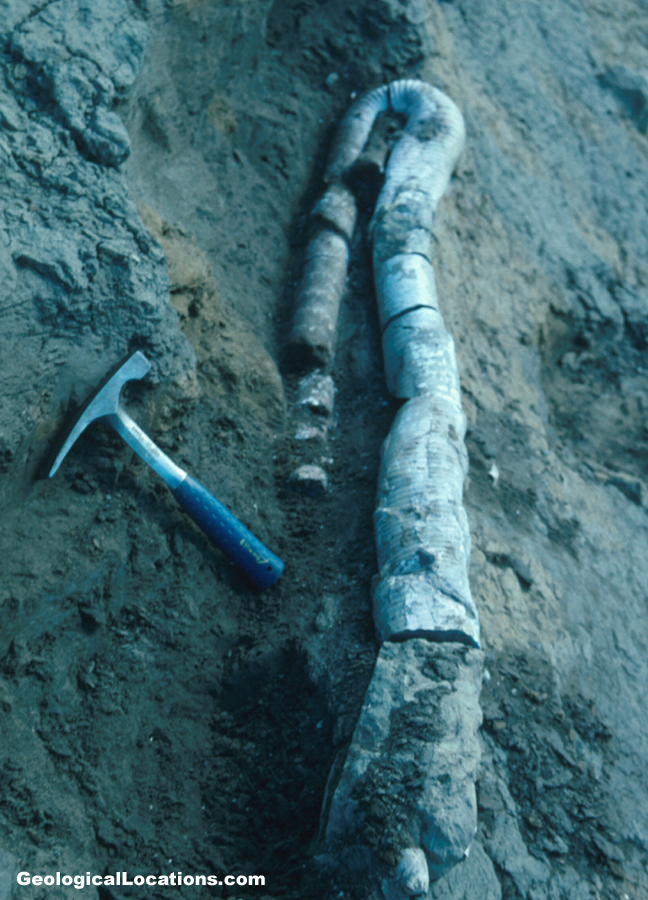
A spectacular specimen of Diplomoceras was found last year - a specimen that was 1.5 meters long (but curved; uncurved, it would be 14 feet long). The animal itself was ~6 feet long (a 6 feet long living chamber). Smaller pieces of this fossil are relatively common, but this specimen was unusually preserved. It is the nicest, most remarkable specimen known. (www.geologicallocations.com/assets/photos/antarctica/Seym...)
Seymour Island is very muddy to work on - it is always above freezing during the field seasons.
An iridium anomaly does occur here on Seymour Island. It occurs in a unit referred to as the K-T glauconite, which is a greenish, glauconitic sandstone that occurs at the boundary. The glauconitic sandstone is easily correlatable across the island. (www.geologicallocations.com/assets/photos/antarctica/Seym...)
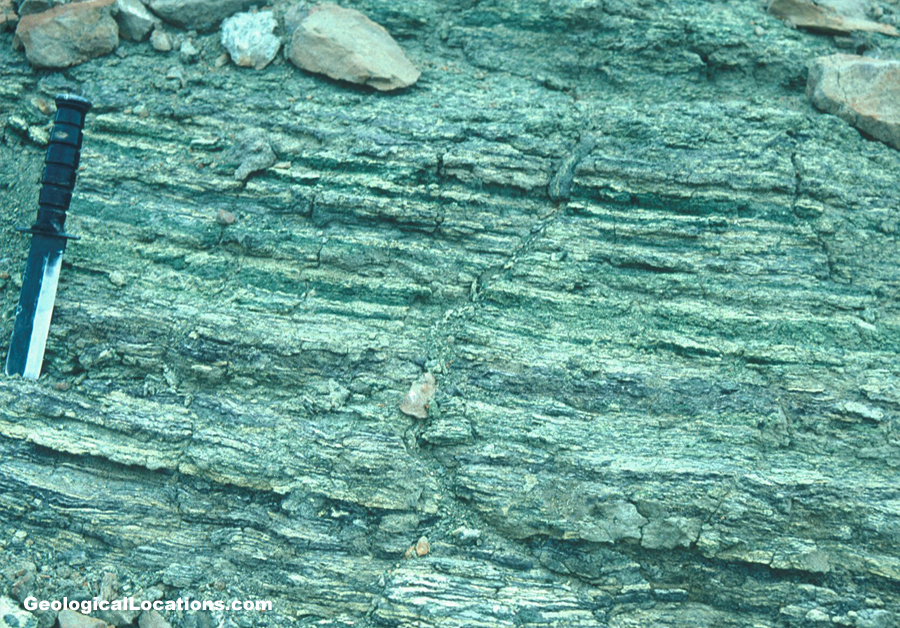
There are no stratigraphic or sedimentological signatures at the K-T boundary within the glauconitic sandstone interval. There is no boundary clay, as classically seen at Gubbio, Italy.
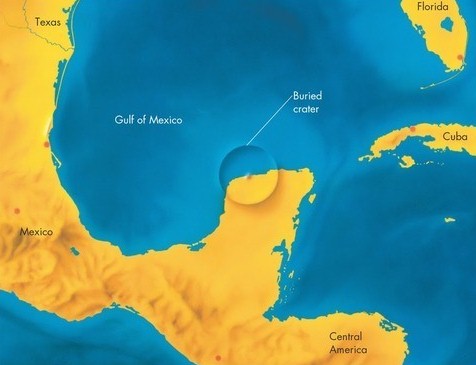
Antarctica is ~8000 miles away from the Chicxulub Crater in Yucatan, Mexico, which is a significant point as far as considering the after-effects expected to be seen in Antarctica. (www.theyucatantimes.com/wp-content/uploads/2014/06/Chicxu...)
Rudist record - there is a gradual increase in the diversity of rudist bivalves in the Cretaceous. (www.paleotax.de/rudists/intro-Dateien/image002.jpg) Most rudists went extinct at 67.5 to 68 million years ago (~early-late Maastrichtian boundary). This pattern mirrors other groups’ diversity patterns as well - all mostly go extinct before the K-T boundary.
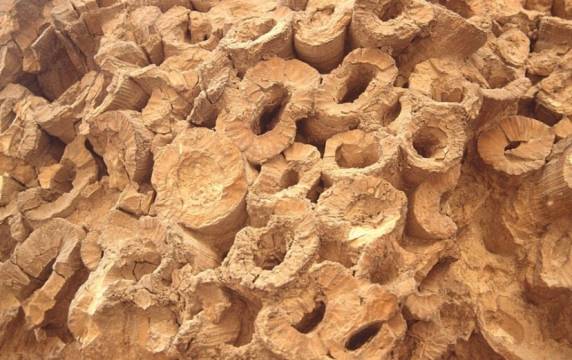
Seymour Island ammonites crash at the end of the Campanian. Seymour Island inoceramid bivalves are gone near the end of the Campanian. (www.flickr.com/photos/jsjgeology/19921135882) Seymour Island belemnites virtually disappear at the end of the Campanian. Seymour Island ammonites are quite diverse in the Campanian (35-36 species), but their diversity crashes to 10 species in the Maastrichtian (= latest Cretaceous), and they are gone at the K-T boundary. Several Campanian cosmopolitan ammonite families disappear in the Campanian in the Seymour Island area, but they extend to the K-T boundary in lower latitudes. So, their disappearance in the Seymour Island area indicates a general temperature decline (cooling).
A regression occurred at the mid-Maastrichtian.
Superimposed on the Maastrichtian temperature decline are several rapid warming spikes. 50,000 years before the K-T boundary event was a warming event, documented from some ODP sites.
Note the restricted occurrence to 1 horizon on Seymour Island of the ammonite Zealandites varuna in the Maastrichtian Lopez de Bertodano Formation. Its presence probably represents a warming spike.
The faunal transition across the K-T boundary on Seymour Island - no single extinction event seen - a gradual decline is seen instead. There is no marked extinction horizon.
Then, someone suggested that this pattern is due to the Signor/Lipps Effect, a phenomenon produced by collection/preservation biases. One can get a gradual extinction pattern purely due to collecting and preservation biases. So, Zinsmeister and others recollected the fossils on Seymour Island, and collected fossils spatially, doing detailed mapping.
The K-T glauconite (~5 meters thick) is actually 3 units - a lower glauconite, a middle fish bed/horizon, and an upper glauconite. The fish debris bed could represent a victim bed from the K-T impact.
Renewed fossil collecting has resulted in a new diversity record - the extinction is less gradual now - it is more abrupt, but all groups are dying out just before the iridium anomaly. The K-T extinction is now more abrupt is high southern latitudes than previously thought.
Fish horizon - interpreted to be the effect of extreme ocean disruption; fish kills are not due to ocean poisoning (strangelove ocean), but by pulses of nutrients into the oceans. This is the only fish horizon in 1600 meters of section. It could be an interval of slow deposition, but this is not likely because fish degrade relatively quickly, and one needs special conditions to preserve fish. The fish debris bed represents conditions after the K-T event - lots of fish kills occurred.
The biosphere is far more robust than we give it credit for. Organisms have been able to survive truly catastrophic events in geologic history.
Example: the Millbrig Bentonite (Middle Ordovician, eastern USA and Scandinavia). This large volcanic eruption resulted in no extinctions. Therefore, Earth’s biosphere is very robust. But, if the biosphere is already stressed, then a big event can push the biosphere into a mass extinction.
------------------
Seamen are arrested at the German Embassy at 1335-39 Massachusetts Ave. NW in Washington, DC November 30, 1936 after protesting the trial of American sailor Lawrence Simpson for subversion in Germany and Nazi aid to the Spanish fascists.
The police charged the men from Baltimore, Maryland with demonstrating without a permit while the seamen protested that they were engaged in legal picketing. The 40 arrested were ultimately found guilty of parading without a permit and five were sentenced to 30 days in jail when they were unable to pay the $100 fine.
The seamen went on strike at Atlantic and Gulf coast ports for four months in October and came to Washington during the strike to protest after the Nazi regime recognized Franco's fascist forces and sentenced Simpson to three years in prison.
There had been numerous demonstrations at German facilities around the world and even sit-down strikes aboard ships in support of Simpson prior to this event.
Simpson was arrested on the United States liner Manhattan and charged with attempting to spread communist literature in Germany and espionage. He was jailed in a concentration camp for 15 months before his trial. A plea agreement was reached where Simpson pled guilty to trying to set up "a Popular Front Government in Germany" and was released shortly after.
Franco's forces ultimately defeated the government of Spain in 1939 after three years of fighting when both Barcelona and Madrid fell. His fascist government remained in power until 1975.
The seamen's four month strike under the leadership of Joseph Curran helped to lay the basis to establish the National Maritime Union in 1937 as a separate union from the conservative International Seamen's Union.
For more information and photos of anti-fascist protests in Washington, DC during the 1930s, see flic.kr/s/aHsjDnzCe7
For an article on Paddy Whalen, the seamen's leader, see washingtonspark.wordpress.com/wp-admin/post.php?post=1683...
Photo by Harris and Ewing. Courtesy of the Library of Congress, no known restrictions. Reproduction Number: LC-DIG-hec-21869.
SYDNEY, 11 July 2014. As Jonathan Moylan faces sentencing for sending a press release purporting to be from ANZ bank saying they have divested from the Maules Creek project, over 150 supporters gathered in silent vigil outside the courtroom.
Serafin Colon Olivera was a one-time member of the Puerto Rican Nationalist Party that was charged with conspiracy to overthrow the U.S. government in 1954.
Colon Olivera, 43, of New York was the only defendant acquitted in the two U.S. trials.
Testimony had been presented at the 1955 trial that Colon Olivera was a member of the party in 1949 and that he had attended a Nationalist Party dance in 1953.
Sedition trial:
Following the wounding of five U.S. Representatives in the Capitol building March 1, 1954 by four Puerto Rican nationalists who opened fire on them from a visitor gallery, the U.S. government began a series of mass arrests that resulted in two conspiracy trials 1954-55. A third trial took place in Puerto Rico.
The four participants in the shooting—Delores Lolita Lebron, Rafael Cancel Miranda, Irvin Flores Rodriguez and Andres Figueroa Cordero—were quickly arrested and convicted in the attack with sentences varying from 16 years to 75 years in jail.
But the federal government went further, convening three different grand juries, summoning 91 Puerto Ricans and bringing indictments against 17 members of the Puerto Rican Nationalist Party for “seditious conspiracy to overthrow the United States government by force.”
The four charged in the shootings were also among the 17 charged with conspiracy.
The indictment alleged that the defendants were “active members, leaders, officers or persons in control of the Nationalist Party of Puerto Rico, which is charged to be an organization dedicated to bringing about the political independence of Puerto Rico from the United States by force of violence or armed revolution.”
In effect, the government was using the same strategy it was using to break up the U.S. Communist Party during that period. If you were an active member of the Nationalist Party, you were guilty even if you committed no illegal acts yourself.
Four of those charged turned state’s evidence and gave testimony against the other defendants.
At the first month-long trial in October 1954, much of the evidence against the group consisted of testimony by police or informers of speeches given by Nationalist Party leaders who had used slogans like, “Throw the Yankees out at pistol point,” “give your life and property for independence,” and saying that President Harry Truman “could be hanged in a place in San Juan.”
Many of the speeches dated prior to the 1950 attempted armed revolution in Puerto Rico by the Nationalist Party that was defeated and for which many party members were jailed in Puerto Rico.
Defense attorney Conrad J. Lynn charged the government sought “proscription of a dissenting political group because of its ideas.”
Julio Pinto Gandia, a defendant who was acting as his own counsel and was the alleged leader of the group in the U.S., told the court that the party, founded in 1922, was not “a band of terrorists” and that any violent actions arose out of individual “despair.”
The most sensational specific testimony came from one of those indicted who turned state’s evidence--Gonzalo Lebron Sotomayor, brother of Delores Lolita Lebron who was the leader of the four shooters.
Lebron Sotomayor testified that Pinto Gandia told him there would be attacks on Congress, President Dwight Eisenhower and the Puerto Rican Resident Commissioner in Washington, but could not say how the plans would be carried out.
Other specific testimony involved another of those indicted who turned state’s evidence. Angle Luis Medina testified he had purchased a number of pistols and three carbines in Chicago at the direction of a party leader who told him “to be ready in case of a revolution” to free Puerto Rico.
The evidence against most of the defendants committing any specific illegal act was thin.
U.S. Attorney J. Edward Lumbard summed up the case saying that the Nationalist Party had supplied the pistols used in the U.S. Capitol shooting and a 1950 attempt to assassinate President Harry Truman and that each of the 13 defendants had their “moral fingerprints on the guns” used.
Lumbard further told the jury that the government did not have to prove that the defendants were part of a conspiracy to overthrow the U.S. government—only that they had conspired to overthrow the authority of the United States in Puerto Rico.
The defense called five witnesses to testify that the Nationalist Party did not advocate overthrow of the U.S. government and only sought total independence for Puerto Rico.
Lynn told the jury that the government was trying “proscription of a dissenting political group because of its ideas.”
Pinto Gandia had earlier sought dismissal of the indictments against the four shooters as double jeopardy and because the government, “intended to bring the guilt of the four defendants upon the other defendants by association or inference.”
He added, “it is not a crime to preach and work for the freedom of a nation and that membership in the Nationalist Party itself did not indicate anyone was part of a conspiracy.
The jury deliberated only a few hours before finding all the defendants guilty.
Two weeks after the verdicts, more arrests took place and a second trial scheduled.
The trial of 11 other Nationalists took place February-March 1955 and followed the same lines as the first trial, except that Lebron Sotomayer gave additional details to his earlier testimony.
Ten of the 11 were found guilty. Serafin Colon Olivera, 28 of New York, was acquitted. Testimony had indicated he was a Nationalist Party member in 1949 and attended a Nationalist dance in 1953.
Those found guilty in the two trials received sentences ranging from 18 months to six years in prison. Appeals failed.
In Puerto Rico, Nationalist Party leader Pedro Albizu Campos hailed the attack as “sublime heroism.” The governor revoked a previous pardon of the party leader and he was arrested after a shootout and imprisoned.
Charges were placed against 15 party members on the island, however 12 were acquitted at trial in late 1954. The three found guilty were sentenced to prison terms ranging from 3-10 years.
Albizu Campos’ health suffered badly in prison where he suffered a stroke in 1956 that left him unable to talk or walk. He was pardoned in 1964, but died a few months afterward.
The Nationalist Party was all but dead as a result of the U.S. trials and by suppression by authorities in Puerto Rico, although it continues to exist today.
First trial sedition trial in 1954:
Jorge Luis Jimenez, sentenced to six years imprisonment
Manuel Rabago Torres, sentenced to six years imprisonment
Rosa Collazo, sentenced to six years imprisonment
Juan Bernardo Lebron, sentenced to six years imprisonment
Juan Francisco Medina, sentenced to six years imprisonment
Armando Diaz Matos, sentenced to six years imprisonment
Julio Pinto Gandia, sentenced to six years imprisonment
Carmelo Alvarez Roman, sentenced to six years imprisonment
Jose Antonio Otero Otero, sentenced to six years imprisonment
Andress Figueroa Cordero, one of 4 convicted shooters, sentenced to additional six years imprisonment
Rafael Cancel Miranda, one of 4 convicted shooters, sentenced to additional six years imprisonment
Dolores Lolita Lebron, one of 4 convicted shooters, sentenced to additional six years imprisonment
Irvin Flores Rodriguez, one of 4 convicted shooters, sentenced to additional six years imprisonment
Second trial in 1955:
Juan Hernandez Valle, Puerto Rico, sentenced to six years imprisonment
Maximino Pedraza Martinez, sentenced to six years imprisonment
Santiago Gonzalez Castro, sentenced to six years imprisonment
Esteban Quinones Escute, sentenced to four years imprisonment
Angel Luis Arzola Velez, sentenced to four years imprisonment
Antonio Herrera Moreno, sentenced to four years imprisonment
Carmen Dolores Otero Torresola, sentenced to four years imprisonment
Pedro Aviles, sentenced to four years imprisonment
Julio Flores Medina, sentenced to 18 months imprisonment
Miguel Vargas Nieves, sentenced to 18 months imprisonment
Those who turned state’s evidence:
Gonzalo Lebron Sotomayor, suspended sentence
Francisco Cortez Ruiz, suspended sentence
Carlos Aulet, suspended sentence
Angel Luis Medina, suspended sentence
Acquitted at May 1955 trial:
Serafin Colon Olivera
For more information and related images to the 1954-55 conspiracy trials of the Puerto Rican Nationalist Party, see flic.kr/s/aHskRMRawC
For more information and related images to the 1950 attempted assassination of President Truman and the 1954 wounding of five U.S. Representatives, see flic.kr/s/aHskghBC71
The photographer is unknown. The photo is believed to be a mugshot. The image is courtesy of the D.C. Public Library Washington Star Collection © Washington Post.
The Postcard
A Woodbury Series postcard published by Eyre & Spottiswood.
It was posted on Sunday the 5th. January 1913 to:
Mrs. Fortune,
95, Shepherds Bush Road,
West Kensington,
London W.
The message on the back of the card was as follows:
"Thanks for gloves etc. You
are very good.
Enjoy yourself another week -
go on the river and see the
sights.
Writing later. I don't suppose
you will get it before Monday.
Love to all,
Lucie".
John Collier
John Maier Collier (1850-1934) was a leading English artist and author. He painted in the Pre-Raphaelite style, and was one of the most prominent portrait painters of his generation. He painted a particularly striking image of Darwin.
Both of his marriages were to the daughters of the biologist Thomas Henry Huxley who was president of the Royal Society from 1883 to 1885. He was also "on terms of intimate friendship" with his son, the writer Leonard Huxley.
'Sentence of Death' was given by the artist's widow to Wolverhampton Art Gallery.
Jack Haig (Actor)
So what else happened on the day that Lucie posted the card?
Well, the 5th. January 1913 marked the birth in Streatham, London of Jack Haig.
Jack Haig, who was born John Cecil Coppin, was an English actor who specialised in supporting roles, mainly in television comedy. He was best known for playing Monsieur Roger Leclerc in the British sitcom 'Allo 'Allo!.
Biography of Jack Haig
Haig was the son of music hall actors Bertha Baker and Charles Coppin, whose act went under the name "Haig and Esco".
He was seen in a long list of British TV favourites including: Hugh and I, Are You Being Served?, Terry and June and Dad's Army (although he turned down the role of Corporal Jones which then went to Clive Dunn).
Jack was in the Crossroads soap opera as occasional character Archie Gibbs from 1967 to 1982 and a couple of cinema films. He achieved his greatest success as Monsieur Roger Leclerc in BBC's 'Allo 'Allo!, a role he played until his death.
Jack's last appearance was in the final episode of Series 5, where he impersonated a Spanish guitarist, alongside Kenneth Connor (Monsieur Alfonse), who had an Enigma machine hidden in his accordion. He is remembered for his signature line, "It is I, Leclerc!"
He appeared in pantomime at Wimbledon in Babes in the Wood in 1965, and again in 1967 as the Emperor of China in Aladdin, alongside Bruce Forsyth and Tommy Trinder.
His earlier TV work included a regular spot as a comic on The One O'clock Show and Happy Go Lucky, a children's TV show during the 1960's. The One O'Clock Show was shown every weekday in the Tyne Tees Television area of ITV. He usually appeared in sketches as 'Wacky Jackie', generally playing the fool in a music hall comedy style.
The Personal Life and Death of Jack Haig
In 1989, Haig became too ill to work, and later died in Hampstead, London at the age of 76 of stomach cancer on the 4th. July 1989.
His wife was revue actress Sybil Dunn, who had died the previous year, just two days before their golden wedding anniversary. They had one daughter.
...caused by a complete lack of any sort of punctuation, demonstrates how today's lax education standards are now filtering through to big business.
That's part of the Sellafield Thermal Oxide Reprocessing Plant (THORP) in the background.
Irish Penal Reform Trust Open Forum 2010: 'Exploding Prisoner Numbers'. Main contributing guest speakers included Tom O'Malley NUI Galway; Inspector of Prisons, Judge Michael Reilly (Chairperson); Dr Mary Rogan, IPRT; Vivian Geiran, Director of Operations, The Probation Service; Louis Harkin, Assistant Commissioner, An Garda Síochána. Photo by Derek Speirs.
Maximino Pedraza Martinez, 28, of Chicago is shown in a November 1954 photograph. He was a Puerto Rican Nationalist Party member accused of conspiracy to overthrow the government of the United States.
Pedraza Martinez was convicted of sedition and sentenced in 1955 to 18 months in prison.
Sedition trial:
Following the wounding of five U.S. Representatives in the Capitol building March 1, 1954 by four Puerto Rican nationalists who opened fire on them from a visitor gallery, the U.S. government began a series of mass arrests that resulted in two conspiracy trials 1954-55. A third trial took place in Puerto Rico.
The four participants in the shooting—Delores Lolita Lebron, Rafael Cancel Miranda, Irvin Flores Rodriguez and Andres Figueroa Cordero—were quickly arrested and convicted in the attack with sentences varying from 16 years to 75 years in jail.
But the federal government went further, convening three different grand juries, summoning 91 Puerto Ricans and bringing indictments against 17 members of the Puerto Rican Nationalist Party for “seditious conspiracy to overthrow the United States government by force.”
The four charged in the shootings were also among the 17 charged with conspiracy.
The indictment alleged that the defendants were “active members, leaders, officers or persons in control of the Nationalist Party of Puerto Rico, which is charged to be an organization dedicated to bringing about the political independence of Puerto Rico from the United States by force of violence or armed revolution.”
In effect, the government was using the same strategy it was using to break up the U.S. Communist Party during that period. If you were an active member of the Nationalist Party, you were guilty even if you committed no illegal acts yourself.
Four of those charged turned state’s evidence and gave testimony against the other defendants.
At the first month-long trial in October 1954, much of the evidence against the group consisted of testimony by police or informers of speeches given by Nationalist Party leaders who had used slogans like, “Throw the Yankees out at pistol point,” “give your life and property for independence,” and saying that President Harry Truman “could be hanged in a place in San Juan.”
Many of the speeches dated prior to the 1950 attempted armed revolution in Puerto Rico by the Nationalist Party that was defeated and for which many party members were jailed in Puerto Rico.
Defense attorney Conrad J. Lynn charged the government sought “proscription of a dissenting political group because of its ideas.”
Julio Pinto Gandia, a defendant who was acting as his own counsel and was the alleged leader of the group in the U.S., told the court that the party, founded in 1922, was not “a band of terrorists” and that any violent actions arose out of individual “despair.”
The most sensational specific testimony came from one of those indicted who turned state’s evidence--Gonzalo Lebron Sotomayor, brother of Delores Lolita Lebron who was the leader of the four shooters.
Lebron Sotomayor testified that Pinto Gandia told him there would be attacks on Congress, President Dwight Eisenhower and the Puerto Rican Resident Commissioner in Washington, but could not say how the plans would be carried out.
Other specific testimony involved another of those indicted who turned state’s evidence. Angle Luis Medina testified he had purchased a number of pistols and three carbines in Chicago at the direction of a party leader who told him “to be ready in case of a revolution” to free Puerto Rico.
The evidence against most of the defendants committing any specific illegal act was thin.
U.S. Attorney J. Edward Lumbard summed up the case saying that the Nationalist Party had supplied the pistols used in the U.S. Capitol shooting and a 1950 attempt to assassinate President Harry Truman and that each of the 13 defendants had their “moral fingerprints on the guns” used.
Lumbard further told the jury that the government did not have to prove that the defendants were part of a conspiracy to overthrow the U.S. government—only that they had conspired to overthrow the authority of the United States in Puerto Rico.
The defense called five witnesses to testify that the Nationalist Party did not advocate overthrow of the U.S. government and only sought total independence for Puerto Rico.
Lynn told the jury that the government was trying “proscription of a dissenting political group because of its ideas.”
Pinto Gandia had earlier sought dismissal of the indictments against the four shooters as double jeopardy and because the government, “intended to bring the guilt of the four defendants upon the other defendants by association or inference.”
He added, “it is not a crime to preach and work for the freedom of a nation and that membership in the Nationalist Party itself did not indicate anyone was part of a conspiracy.
The jury deliberated only a few hours before finding all the defendants guilty.
Two weeks after the verdicts, more arrests took place and a second trial scheduled.
The trial of 11 other Nationalists took place February-March 1955 and followed the same lines as the first trial, except that Lebron Sotomayer gave additional details to his earlier testimony.
Ten of the 11 were found guilty. Serafin Colon Olivera, 28 of New York, was acquitted. Testimony had indicated he was a Nationalist Party member in 1949 and attended a Nationalist dance in 1953.
Those found guilty in the two trials received sentences ranging from 18 months to six years in prison. Appeals failed.
In Puerto Rico, Nationalist Party leader Pedro Albizu Campos hailed the attack as “sublime heroism.” The governor revoked a previous pardon of the party leader and he was arrested after a shootout and imprisoned.
Charges were placed against 15 party members on the island, however 12 were acquitted at trial in late 1954. The three found guilty were sentenced to prison terms ranging from 3-10 years.
Albizu Campos’ health suffered badly in prison where he suffered a stroke in 1956 that left him unable to talk or walk. He was pardoned in 1964, but died a few months afterward.
The Nationalist Party was all but dead as a result of the U.S. trials and by suppression by authorities in Puerto Rico, although it continues to exist today.
First trial sedition trial in 1954:
Jorge Luis Jimenez, sentenced to six years imprisonment
Manuel Rabago Torres, sentenced to six years imprisonment
Rosa Collazo, sentenced to six years imprisonment
Juan Bernardo Lebron, sentenced to six years imprisonment
Juan Francisco Medina, sentenced to six years imprisonment
Armando Diaz Matos, sentenced to six years imprisonment
Julio Pinto Gandia, sentenced to six years imprisonment
Carmelo Alvarez Roman, sentenced to six years imprisonment
Jose Antonio Otero Otero, sentenced to six years imprisonment
Andress Figueroa Cordero, one of 4 convicted shooters, sentenced to additional six years imprisonment
Rafael Cancel Miranda, one of 4 convicted shooters, sentenced to additional six years imprisonment
Dolores Lolita Lebron, one of 4 convicted shooters, sentenced to additional six years imprisonment
Irvin Flores Rodriguez, one of 4 convicted shooters, sentenced to additional six years imprisonment
Second trial in 1955:
Juan Hernandez Valle, Puerto Rico, sentenced to six years imprisonment
Maximino Pedraza Martinez, sentenced to six years imprisonment
Santiago Gonzalez Castro, sentenced to six years imprisonment
Esteban Quinones Escute, sentenced to four years imprisonment
Angel Luis Arzola Velez, sentenced to four years imprisonment
Antonio Herrera Moreno, sentenced to four years imprisonment
Carmen Dolores Otero Torresola, sentenced to four years imprisonment
Pedro Aviles, sentenced to four years imprisonment
Julio Flores Medina, sentenced to 18 months imprisonment
Miguel Vargas Nieves, sentenced to 18 months imprisonment
Those who turned state’s evidence:
Gonzalo Lebron Sotomayor, suspended sentence
Francisco Cortez Ruiz, suspended sentence
Carlos Aulet, suspended sentence
Angel Luis Medina, suspended sentence
Acquitted at May 1955 trial:
Serafin Colon Olivera
For more information and related images to the 1954-55 conspiracy trials of the Puerto Rican Nationalist Party, see flic.kr/s/aHskRMRawC
For more information and related images to the 1950 attempted assassination of President Truman and the 1954 wounding of five U.S. Representatives, see flic.kr/s/aHskghBC71
The photographer is unknown. The photo is believed to be a mugshot. The image is courtesy of the D.C. Public Library Washington Star Collection © Washington Post.
lifted this sentence from this news article describing Jenna Jameson's addiction to Oxycontin. The literal meaning of the sentence (that is, physically battling an addiction) from a retired pornographic actress caught my attention. Typographic-wise, the sequence of double letters is also interesting.
Küçük Ayasofya Cami Sokak, between Sultanahmet, Cankurtaran & Kadırga
(527-536)
According to a legend, during the reign of Emperor Justin I (518-527), Justinian, his nephew, was accused of plotting against the throne and was sentenced to death. The execution, however, was avoided after Saints Sergius and Bacchus appeared before the Emperor, vouching for Justinian's innocence. When Justinian acceeded to the throne in 527, one of his first decisions was to build a church in honour of the two saints that had saved him.
The church was constructed in the area between the Palace of Hormisdas, where Justinian and his wife Theodora had lived, and the Church of the Saints Peter and Paul. The latter church, located to the north, was a typical palace chapel and a typical Roman basilica. The new church originally served the Monophysites of Constantinople, who, favoured by Theodora, had settled in the Palace of Hormisdas after the imperial couple had moved to the Great Palace. In the 6th century, the two churches had the same narthex and atrium. Some time later the Church of Saints Peter and Paul was abandoned, while the Church of Saints Sergius and Bacchus became the katholikon of a monastery.
The church, an octagon inscribed in an irregular quadrilateral, can be seen as the oldest surviving church that attempts to combine the basilica plan with a dome. The umbrella dome that the church is surmounted by is divided into 16 compartments and is lit by 8 windows. The dome is supported by 8 heavy piers which form an octagon. The space between the piers is spanned by marble columns, with two columns in each bay except for the bema. A two-storey gallery, unique in Istanbul, circles the central space. The columns of the lower gallery carry an architrave, while those of the upper gallery are interlaced with small arches. Columns at the four corners are arranged to form semi-circular niches. These niches are crowned by semi-domes on the upper gallery level.
The imperial sponsorship is reflected in the superb sculptural decoration of the church. The columns are folded, a Byzantine derivation of the classical Corinthian capital, where the emphasis on the corners and on the centers of the four sides are retained, but the plastic articulation of acanthus leaves and volutes is replaced by a uniform web of leaves and tendrils. Many capitals still bear the monograms of Justinian and Theodora. Even more interesting is the thick entablature, where egg-and-dart and bead-and-reel motifs can be seen, together with an acanthus rinceau, a carved frieze and a bracketed cornice. The frieze bears an inscription in 12 Greek hexameters – a dedication to Justinian, Theodora and Saint Sergius (Saint Bacchus has been omitted for some reason). The lower side of the architrave is decorated with bold patterned carvings.
The exterior of the original church shows the use of pure brick masonry. The double-story narthex in the west of the structure is a later addition, but it probably still dates back to the 6th century, as can be judged from its brickwork. Some walls of the church, showing alternating bands of brick and stone, must be from a later period, erected possibly between the 7th and 10th centuries.
The Church of the Saints Sergius and Bacchus was built a short time before Hagia Sophia. There are a number of similarities between the two churches, justifying the nickname Little Hagia Sophia of the older church. Its combination of the elements of a longitudinal basilica and a centralised building is similar to that of Hagia Sophia, as are the molding of space and the manipulation of light. Little Hagia Sophia also has some imperfections, such as different lengths of the sides of the octagon, low proportions and the clumsiness of the arches. Its architectural plan was repeated, in a more masterly way, in the Basilica of San Vitale in Ravenna (completed in 547).
The church was turned into a mosque in 1506-1513. The interior walls were plastered over and the windows were modified. The porch was added as well before the narthex.
...sentenced to hang.
forever.
or until the rope breaks.
241/365
Move yourself
You always live your life
Never thinking of the future
Prove yourself
You are the move you make
Take your chances win or loser
See yourself
You are the steps you take
You and you - and that's the only way
Shake - shake yourself
You're every move you make
So the story goes
Owner of a lonely heart
Owner of a lonely heart
Much better than - a
Owner of a broken heart
Owner of a lonely heart
Say - you don't want to chance it
You've been hurt so before
Watch it now
The eagle in the sky
How he dancin' one and only
You - lose yourself
No not for pity's sake
There's no real reason to be lonely
Be yourself
Give your free will a chance
You've got to want to succeed
Owner of a lonely heart
Owner of a lonely heart
Much better than - a
Owner of a broken heart
Owner of a lonely heart
Owner of a lonely heart
After my own decision
They confused me so
My love said never question your will at all
In the end you've got to go
Look before you leap
And don't you hesitate at all - no no
Owner of a lonely heart
Owner of a lonely heart
Owner of a lonely heart
Owner of a lonely heart
Much better than - a
Owner of a broken heart
Owner of a lonely heart
[repeat]
Owner of a lonely heart
Sooner or later each conclusion
Will decide the lonely heart
It will excite it will delight
It will give a better start
Owner of a lonely heart
Owner of a lonely heart
Don't deceive your free will at all
Don't deceive your free will at all
Don't deceive your free will at all
Just receive it
Owner of a lonely heart
~ Yes