View allAll Photos Tagged RetroStyle
Portrait of a man wearing a military uniform with decorative embroidery, glasses, and a distinctive mustache, Austria, 1931.
Model, MUAH: Miss Diversity
www.facebook.com/Mss.Diversity
Photographer: Hans
Coat: Collectif Clothing
Dress: Stop Staring/ Topvintage
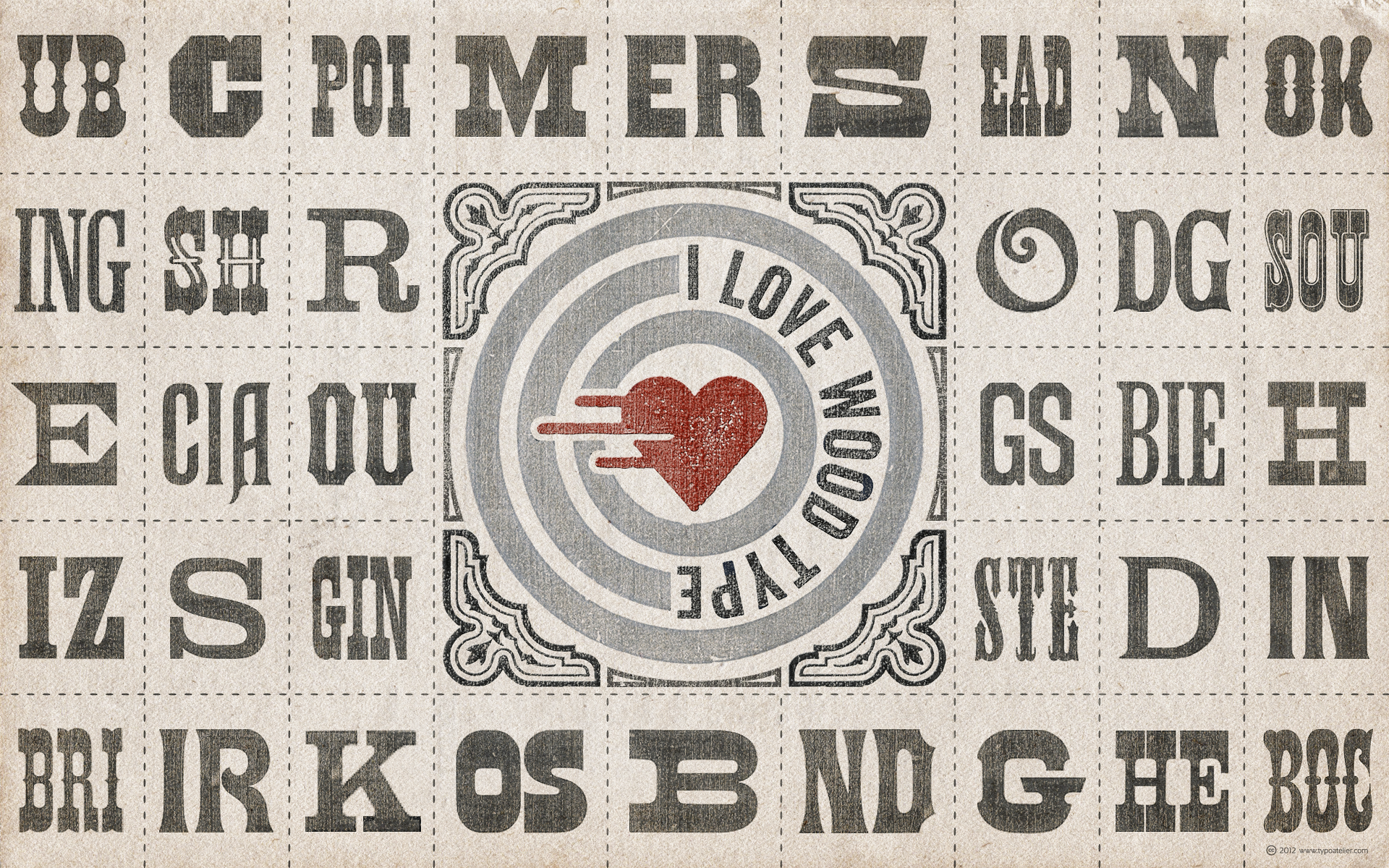
This wallpaper shows 36 reasons why I love »Wood Type«. All »Wood Type« samples I reproduced based on the »HAMILTON Specimen Catalogue No. 14«, edition 1899. Some of the samples may slightly differ from the original.
The typeface in use for the lettering »I Love Wood Type« in the center inside the circle is called »Veneer« and was created by Ryan Martinson | Yellow Design Studio.
Veneer from Yellow Design Studio is a high resolution hand-crafted letterpress font that’s vintage and authentic with a touch of grunge. It’s highly customizable with six distress options for every letter and three for all other characters, and because it’s remarkably detailed, it looks great even at very large sizes. In addition it includes a matching set of funky extras…for free!
The Veneer family includes Veneer, Veneer Two, and Veneer Three with Veneer containing the least distressed characters and Veneer Three the most. Mix and match as desired to create realistic letterpress type.

Typeface in use:
Alejandro Paul’s (SUDTIPOS) unique, striking script face »Candy Script«.
Candy Script: Inspired by Argentina and its culture, Alejandro Paul’s Candy Script captures the country’s spirit. It comes from the tradition of window sign painting, but its thick hand-brushed characters, with alternates for almost every upper and lowercase letter, have a personality all their own.
A black-and-white photograph from the 1950s showing a group of men celebrating at a Hungarian wine tavern. The scene features traditional wine barrels marked "Bikavér" (Bull's Blood) and "Kádár," rustic decor, and festive ambiance, likely during a New Year’s Eve (Szilveszter) celebration.

A group of friends and family dressed in Victorian and steampunk attire pose together during the Victorian Picnic at the Rumford Denkmal in the English Garden, Munich, Bavaria, Germany. The sepia tone adds a vintage touch to this beautifully styled portrait.
The "Rumford Denkmal" refers to a monument dedicated to Sir Benjamin Thompson, Count Rumford, who was a physicist, inventor, and social reformer with strong ties to Bavaria.
page 129
Beige hat, white blouse, ecru cardigan, beige pleat over-knee skirt, red polka-dot shoes, red parasol, red bag
Victorian Picnic, with British summeer weather, cold and wet
A full-body black-and-white portrait of a woman in a delicate Victorian-inspired dress, adorned with pearls and lace gloves. She holds a floral parasol and exudes elegance and charm. Taken at a Victorian picnic near the Monopteros in Munich's English Garden, this image highlights intricate historic fashion and poise.
Raspberry Pi 3B+/Volumio > Signstek USB-to-S/PDIF > Muse Mini TDA1543 DAC > Altec 15356 transformer mixer > Grommes LJ (Little Jewel) PP6V6 amp > Heathkit AS10 + Sansui T104 horn tweeter
Black-and-white photo capturing a candid moment with a smiling man and group of people outdoors in Kóka, Hungary, 1950s.
Happy Memorial Day everyone, and stay tuned for a bonus pic to follow this one! For Memorial Day itself, our mini-tour of regional, retro-style McDonald's concludes with this awesome one in Jackson Tennessee. The building's style looks more like the modernized version in Jonesboro, as opposed to the larger one in Muscle Shoals. But this one is much cooler-looking than either of those methinks, especially so when compared to the yucky, modern paint job and more up-to-date logo given to Jonesboro's wannabe/mutant eyebrow version! While this Jackson example seems to be the most retro of my bunch posted this weekend, note also something quite sneaky, as evidenced by the high roof situated just a ways behind the front. Yep, this location certainly looks to be hiding a built-in playplace, which can be confirmed by Google Earth! This one actually wasn't remodeled from a mansard style (with playplace on the very front back then), until sometime between 2008 and 2010, if you can believe that. This is no doubt one of the best late 2000's remodeled McD's in the entire region!
As for the promised bonus (actually, "bonus/teaser") photo: not McDonald's, but another well-known institution. Let's see what latest hijinx(!) they're up to (cont.)...
____________________________________
McDonald's, N. Highland Ave. (Hwy. 45) near Old Hickory Blvd., Jackson TN
Black-and-white photo of three women and two children relaxing on a stone balustrade outdoors in the 1950s Balatonalmádi, Hungary. Magyary-Kossa Katalin
Bar Fetish at The Luxe Club - they do shows every Sunday.
More eye candy from one of Second Life's most beautiful and consistently artistic places - Elysion. The atmosphere and ambiance is so inspiring.
Classic Car, Oldtimer, vintage, Antique car, old but gold, retro style, classics
Maybach enpuppt sich als genialer Autokonstrukteur , der DMG, Daimler-Motoren-Gesellschaft Cannstatt .
Gottlieb Wilhelm Daimler starb im März 1900.
Seiner Familie hinterließ er etwa ein Viertel des Aktienkapitals der Daimler-Motoren-Gesellschaft. Daimler hatte Lizenzgebühren aus Frankreich unterschlagen, und Duttenhofer erwirkte, mit der Androhung eines Skandals, von der Familie einen Verzicht auf alle Führungsansprüche. Kurz darauf wurde eine Kapitalerhöhung beschlossen, durch die die Familie Daimler in die Rolle eines Kleinaktionärs der Daimler-Motoren-Gesellschaft zurückgedrängt wurde, und keinerlei Einfluss auf deren weitere Entwicklung mehr nahm. 1926 wurde die Daimler-Motoren-Gesellschaft mit der Firma Benz & Cie. von Carl Benz zur Daimler-Benz AG verschmolzen.
Von 1902 bis 1906 entstanden verschiedene Modelle bei der Daimler-Motoren-Gesellschaft in Cannstatt und ab 1904 in Untertürkheim:
Um 1900 konstruierte Maybach auf Anregung des österreichischen Kaufmanns und Generalkonsuls Emil Jellinek (1853–1918) den Mercedes-Simplex, einen Rennwagen mit einem 35-PS-Vierzylindermotor und zwei Vergasern.
Das Fahrzeug, ausgestattet mit Maybachs Erfindungen, dem Bienenwabenkühler und dem Zahnradgetriebe, stellte für damalige Verhältnisse das Auto der Zukunft dar.
Jellinek nannte das Modell nach seiner Tochter „Mercedes“.
1904 entwickelte Maybach den ersten Sechszylinder-Mercedesmotor mit 70 PS und 1906 konstruierte er einen zukunftsweisenden 120-PS-Rennmotor mit hängenden Ein- und Auslassventilen, obenliegender Nockenwelle und Doppelzündung.
Diese Kennzeichen werden später bedeutend für die Mercedes-Flugmotoren (Mercedes D III) und für alle anderen Hochleistungsmotoren.
°°°
# 1 Mercedes-Simplex 40/45 PS (1902–1905)
# 2 Mercedes-Simplex 28/32 PS (1902–1905)
# 3 Mercedes-Simplex 60 PS (1902–1905)
Es gab auch noch ein größeres Modell mit einem Radstand von 2750 mm und einem Vierzylindermotor mit 9240 cm³ Hubraum und einer Leistung 70 PS (51 kW). Seine Höchstgeschwindigkeit lag bei 120 km/h.
Der Motor war mit sehr großen, hängenden Einlassventilen (Durchmesser: 88 mm) ausgeführt. Die stehenden Auslassventile hatten 60 mm Durchmesser. Der Ladungswechsel dieses wechselgesteuerten Motors konnte über eine verschiebbare Zahnstange geregelt werden, die den Hub der Einlassventile veränderte.
Der Kaufpreis erreichte mit 25.000 Goldmark (etwa 129.250 Euro) auch bei diesem großen Wagen bei weitem nicht die Regionen des 40/45 PS – Wagens.
# 4 Mercedes-Simplex 36/65
# 5 Mercedes-Simplex 18/22 PS (1903–1904)
# 6 Mercedes-Simplex 18/28 PS (1904–1906)
Bereits im Herbst 1901 machte sich Maybach an die Weiterentwicklung der ersten Mercedes-Typenreihe. Als neues Topmodell und direkter Nachfolger des Mercedes 35 PS entstand zunächst der Mercedes-Simplex 40/45 PS.
°°°
Der Radstand wuchs auf 2450 Millimeter, seine Bedienung wurde weiter vereinfacht durch „automatisches“ Auskuppeln und Abbremsen der Antriebswelle beim Betätigen des Schalthebels.
Diese frühe Verbesserung des Bedienkomforts schlug sich im Namenszusatz „Simplex“ nieder.
Mit dem Jahr 1905 fiel der Name „Simplex“ für alle Mercedes-Modelle weg.