View allAll Photos Tagged Relator
Title: Roll call votes relating to the impeachment of President Andrew Johnson on Articles II, III, and XI., 05/26/1868
Production Date: May 26, 1868
Creator(s): U.S. Senate. (03/04/1789 - )
Roll call votes relating to the impeachment of President Andrew Johnson on Articles II, III, and XI., 05/26/1868 ; Senate Papers Pertaining to the Impeachment of Andrew Johnson, ca. 1867 - ca. 1869; Records of the U.S. Senate, 1789 - 2005; Record Group 46; National Archives.
The first Senate vote in the impeachment of President Andrew Johnson was taken on May 16, 1868. Article XI was called the “omnibus article” because it combined all of the charges against the President. As a result of 19 voting “Not Guilty” and 35 voting “Guilty” the Senate fell 1 vote short of the two-thirds majority required for removal. After a 10-day recess, the Senate reconvened and voted on Articles II and III. In each case, the result was identical: Johnson was not guilty by a single vote. The Senate then voted to end the trial.
Persistent URL: arcweb.archives.gov/arc/action/ExternalIdSearch?id=306275
Access Restrictions: Unrestricted
Use Restrictions: Unrestricted
A micro-injector is used to place a droplet of known volume of Bacillus thuringiensis (Bt) material on a hemlock needle. The apparatus is used in feeding studies on the western hemlock looper to relate Bt deposit with looper mortality. Corvallis, Oregon.
Photo by: Wally C. Guy
Date: November 1963
Credit: USDA Forest Service, Pacific Northwest Region, State and Private Forestry, Forest Health Protection.
Collection: Portland Station Collection; La Grande, Oregon
Image: PS-2853
For additional information see: archive.org/details/CAT92272778
Carolin, V.M. and C.G. Thompson. 1967. Field testing Bacillus thuringiensis for control of western hemlock looper. Research Paper PNW-38. Portland, OR: USDA Forest Service, Pacific Northwest Forest and Range Experiment Station. 26 p.
For additional historic forest entomology photos, stories, and resources see the Western Forest Insect Work Conference site: wfiwc.org/content/history-and-resources
Image provided by USDA Forest Service, Pacific Northwest Region, State and Private Forestry, Forest Health Protection: www.fs.usda.gov/main/r6/forest-grasslandhealth
20 Of the best craft memes you can totally relate to
When I discovered craft memes recently, I laughed way too hard at a lot of them and just knew that I had to share a few of my favourites with you.
I’m not kidding when I tell you that you will be able to relate to almost all of them....
Biosphere 2 is a 3-acre earth science research facility built between 1987 and 1991 in the foothills of the Santa Catalina mountains near Tucson, Arizona. The sealed biosphere structure recreates five of Earth's biomes, including a rainforest, an ocean with a coral reef, wetlands, a savannah grassland and a desert. A crew of eight people were sealed inside the glass structure for two years from 1991 to 1993 during the first research mission, and a crew of seven were sealed inside for six months in 1994 during the second mission. Biosphere 2 is now owned by the University of Arizona which uses it in researching Earth's water cycle and how it relates to climate change, among other things.
立法會跟進免遣返聲請統一審核機制有關事宜小組委員會
參觀青山灣入境事務中心
立法会跟进免遣返声请统一审核机制有关事宜小组委员会
参观青山湾入境事务中心
LegCo Subcommittee to Follow Up Issues Relating to the Unified Screening Mechanism for Non-refoulement Claims visits Castle Peak Bay Immigration Centre (2018.07.19)
Documents from the early 1990s relating to blood plasma transfusion by Henan provincial government and military blood plasma collection stations that led to the spread of HIV to many people who sold blood. The blood collection stations were closed in the mid 1990s though some continued this very profitable business underground.
HIV Blood Transfusion Disaster Documents For more information see: en.wikipedia.org/wiki/Plasma_Economy The Wound by He Aifang on the history of blood disaster museums.cnd.org/CND-Global/CND-Global.01-01-25.html
Links to US Embassy website mentioned at the end of the report above are archived on the Internet Archive web.archive.org/web/20010809150226fw_/http://www.usembass...
See also article Dr. Gao Yaojie Human Rights China at www.hrichina.org/content/4754
The photo of the British cemetery at Salonica relates to LJ Moon who died during World War 1 fighting in Salonica. LJ Moon was an Assistant Master at St Peter's Court who then became a joint partner/headmaster at Wellesley House in 1913 with Shirley Russell just before war broke out. He joined up in 1914 and lost his life in 1916.
In 1915, during World War I, a large Allied expeditionary force established a base at Thessaloniki "Salonica" for operations against pro-German Bulgaria. This culminated in the establishment of the Macedonian Front, also known as the Salonika Front. In 1916, pro-Venizelist Greek army officers and civilians, with the support of the Allies, launched the Movement of National Defence, creating a pro-Allied temporary government by the name of the "State of Thessaloniki" that controlled "new lands" (lands that were gained by Greece in the Balkan Wars, most of Northern Greece including Greek Macedonia, the North Aegean as well as the island of Crete); the official government of the King in Athens, the "State of Athens", controlled the "old lands" which were traditionally monarchist. The State of Thessaloniki was disestablished with the unification of the two opposing Greek governments under Venizelos, following the abdication of King Constantine in 1917.
A repository of images relate to Banana (Musa spp) shared by members of MusaNet. The album depicts images from different African, Asian and countries from the Americas where collaborative work on Banana research is done.
©CIAT
Please credit accordingly and leave a comment when you use a CIAT photo.
For more info: alliance-comms@cgiar.org
Krishna [1](/ˈkrɪʃnə/; Sanskrit: कृष्ण, Kṛṣṇa in IAST, pronounced [ˈkr̩ʂɳə] ( listen)) is considered the supreme deity, worshipped across many traditions of Hinduism in a variety of different perspectives. Krishna is recognized as the eighth incarnation (avatar) of Lord Vishnu, and one and the same as Lord Vishnu one of the trimurti and as the supreme god in his own right. Krishna is the principal protagonist with Arjuna in the Bhagavad Gita also known as the Song of God, which depicts the conversation between the Royal Prince Arjuna and Krishna during the great battle of Kurukshetra 5000 years ago where Arjuna discovers that Krishna is God and then comprehends his nature and will for him and for mankind. In present age Krishna is one of the most widely revered and most popular of all Indian divinities.[2]
Krishna is often described and portrayed as an infant eating butter, a young boy playing a flute as in the Bhagavata Purana,[3] or as an elder giving direction and guidance as in the Bhagavad Gita.[4] The stories of Krishna appear across a broad spectrum of Hindu philosophical and theological traditions.[5] They portray him in various perspectives: a god-child, a prankster, a model lover, a divine hero, and the Supreme Being.[6] The principal scriptures discussing Krishna's story are the Mahabharata, the Harivamsa, the Bhagavata Purana, and the Vishnu Purana.
Krishna's disappearance marks the end of Dvapara Yuga and the start of Kali Yuga (present age), which is dated to February 17/18, 3102 BCE.[7] Worship of the deity Krishna, either in the form of deity Krishna or in the form of Vasudeva, Bala Krishna or Gopala can be traced to as early as 4th century BC.[8][9] Worship of Krishna as Svayam Bhagavan, or the supreme being, known as Krishnaism, arose in the Middle Ages in the context of the Bhakti movement. From the 10th century AD, Krishna became a favourite subject in performing arts and regional traditions of devotion developed for forms of Krishna such as Jagannatha in Odisha, Vithoba in Maharashtra and Shrinathji in Rajasthan. Since the 1960s the worship of Krishna has also spread in the Western world, largely due to the International Society for Krishna Consciousness.[10]The name originates from the Sanskrit word Kṛṣṇa, which is primarily an adjective meaning "black", "dark" or "dark blue".[11] The waning moon is called Krishna Paksha in the Vedic tradition, relating to the adjective meaning "darkening".[12] Sometimes it is also translated as "all-attractive", according to members of the Hare Krishna movement.[13]
As a name of Vishnu, Krishna listed as the 57th name in the Vishnu Sahasranama. Based on his name, Krishna is often depicted in murtis as black or blue-skinned. Krishna is also known by various other names, epithets and titles, which reflect his many associations and attributes. Among the most common names are Mohan "enchanter", Govinda, "Finder of the cows" or Gopala, "Protector of the cows", which refer to Krishna's childhood in Braj (in present day Uttar Pradesh).[14][15] Some of the distinct names may be regionally important; for instance, Jagannatha, a popular incarnation of Puri, Odisha in eastern India.[16]Krishna is easily recognized by his representations. Though his skin color may be depicted as black or dark in some representations, particularly in murtis, in other images such as modern pictorial representations, Krishna is usually shown with a blue skin. He is often shown wearing a silk dhoti and a peacock feather crown. Common depictions show him as a little boy, or as a young man in a characteristically relaxed pose, playing the flute.[17][18] In this form, he usually stands with one leg bent in front of the other with a flute raised to his lips, in the Tribhanga posture, accompanied by cows, emphasizing his position as the divine herdsman, Govinda, or with the gopis (milkmaids) i.e. Gopikrishna, stealing butter from neighbouring houses i.e. Navneet Chora or Gokulakrishna, defeating the vicious serpent i.e. Kaliya Damana Krishna, lifting the hill i.e. Giridhara Krishna ..so on and so forth from his childhood / youth events.
A steatite (soapstone) tablet unearthed from Mohenjo-daro, Larkana district, Sindh depicting a young boy uprooting two trees from which are emerging two human figures is an interesting archaeological find for fixing dates associated with Krishna. This image recalls the Yamalarjuna episode of Bhagavata and Harivamsa Purana. In this image, the young boy is Krishna, and the two human beings emerging from the trees are the two cursed gandharvas, identified as Nalakubara and Manigriva. Dr. E.J.H. Mackay, who did the excavation at Mohanjodaro, compares this image with the Yamalarjuna episode. Prof. V.S. Agrawal has also accepted this identification. Thus, it seems that the Indus valley people knew stories related to Krishna. This lone find may not establish Krishna as contemporary with Pre-Indus or Indus times, but, likewise, it cannot be ignored.[19][20]The scene on the battlefield of the epic Mahabharata, notably where he addresses Pandava prince Arjuna in the Bhagavad Gita, is another common subject for representation. In these depictions, he is shown as a man, often with supreme God characteristics of Hindu religious art, such as multiple arms or heads, denoting power, and with attributes of Vishnu, such as the chakra or in his two-armed form as a charioteer. Cave paintings dated to 800 BCE in Mirzapur, Mirzapur district, Uttar Pradesh, show raiding horse-charioteers, one of whom is about to hurl a wheel, and who could potentially be identified as Krishna.[21]
Representations in temples often show Krishna as a man standing in an upright, formal pose. He may be alone, or with associated figures:[22] his brother Balarama and sister Subhadra, or his main queens Rukmini and Satyabhama.
Often, Krishna is pictured with his gopi-consort Radha. Manipuri Vaishnavas do not worship Krishna alone, but as Radha Krishna,[23] a combined image of Krishna and Radha. This is also a characteristic of the schools Rudra[24] and Nimbarka sampradaya,[25] as well as that of Swaminarayan sect. The traditions celebrate Radha Ramana murti, who is viewed by Gaudiyas as a form of Radha Krishna.[26]
Krishna is also depicted and worshipped as a small child (Bala Krishna, Bāla Kṛṣṇa the child Krishna), crawling on his hands and knees or dancing, often with butter or Laddu in his hand being Laddu Gopal.[27][28] Regional variations in the iconography of Krishna are seen in his different forms, such as Jaganatha of Odisha, Vithoba of Maharashtra,[29] Venkateswara (also Srinivasa or Balaji) in Andhra Pradesh, and Shrinathji in Rajasthan.The earliest text to explicitly provide detailed descriptions of Krishna as a personality is the epic Mahabharata which depicts Krishna as an incarnation of Vishnu.[30] Krishna is central to many of the main stories of the epic. The eighteen chapters of the sixth book (Bhishma Parva) of the epic that constitute the Bhagavad Gita contain the advice of Krishna to the warrior-hero Arjuna, on the battlefield. Krishna is already an adult in the epic, although there are allusions to his earlier exploits. The Harivamsa, a later appendix to this epic, contains the earliest detailed version of Krishna's childhood and youth.
The Rig Veda 1.22.164 sukta 31 mentions a herdsman "who never stumbles".[31] Some Vaishnavite scholars, such as Bhaktivinoda Thakura, claim that this herdsman refers to Krishna.[32] Ramakrishna Gopal Bhandarkar also attempted to show that "the very same Krishna" made an appearance, e.g. as the drapsa ... krishna "black drop" of RV 8.96.13.[33] Some authors have also likened prehistoric depictions of deities to Krishna.
Chandogya Upanishad (3.17.6) composed around 900 BCE[34] mentions Vasudeva Krishna as the son of Devaki and the disciple of Ghora Angirasa, the seer who preached his disciple the philosophy of ‘Chhandogya.’ Having been influenced by the philosophy of ‘Chhandogya’ Krishna in the Bhagavadgita while delivering the discourse to Arjuna on the battlefield of Kurukshetra discussed about sacrifice, which can be compared to purusha or the individual.[35][36][37][38]
Yāska's Nirukta, an etymological dictionary around 6th century BC, contains a reference to the Shyamantaka jewel in the possession of Akrura, a motif from well known Puranic story about Krishna.[39] Shatapatha Brahmana and Aitareya-Aranyaka, associate Krishna with his Vrishni origins.[40]
Pāṇini, the ancient grammarian and author of Asthadhyayi (probably belonged to 5th century or 6th century BC) mentions a character called Vāsudeva, son of Vasudeva, and also mentions Kaurava and Arjuna which testifies to Vasudeva Krishna, Arjuna and Kauravas being contemporaries.[35][41][42]
Megasthenes (350 – 290 BC) a Greek ethnographer and an ambassador of Seleucus I to the court of Chandragupta Maurya made reference to Herakles in his famous work Indica. Many scholars have suggested that the deity identified as Herakles was Krishna. According to Arrian, Diodorus, and Strabo, Megasthenes described an Indian tribe called Sourasenoi, who especially worshipped Herakles in their land, and this land had two cities, Methora and Kleisobora, and a navigable river, the Jobares. As was common in the ancient period, the Greeks sometimes described foreign gods in terms of their own divinities, and there is a little doubt that the Sourasenoi refers to the Shurasenas, a branch of the Yadu dynasty to which Krishna belonged; Herakles to Krishna, or Hari-Krishna: Methora to Mathura, where Krishna was born; Kleisobora to Krishnapura, meaning "the city of Krishna"; and the Jobares to the Yamuna, the famous river in the Krishna story. Quintus Curtius also mentions that when Alexander the Great confronted Porus, Porus's soldiers were carrying an image of Herakles in their vanguard.[43]
The name Krishna occurs in Buddhist writings in the form Kānha, phonetically equivalent to Krishna.[44]
The Ghata-Jâtaka (No. 454) gives an account of Krishna's childhood and subsequent exploits which in many points corresponds with the Brahmanic legends of his life and contains several familiar incidents and names, such as Vâsudeva, Baladeva, Kaṃsa. Yet it presents many peculiarities and is either an independent version or a misrepresentation of a popular story that had wandered far from its home. Jain tradition also shows that these tales were popular and were worked up into different forms, for the Jains have an elaborate system of ancient patriarchs which includes Vâsudevas and Baladevas. Krishna is the ninth of the Black Vâsudevas and is connected with Dvâravatî or Dvârakâ. He will become the twelfth tîrthankara of the next world-period and a similar position will be attained by Devakî, Rohinî, Baladeva and Javakumâra, all members of his family. This is a striking proof of the popularity of the Krishna legend outside the Brahmanic religion.[45]
According to Arthasastra of Kautilya (4th century BCE) Vāsudeva was worshiped as supreme Deity in a strongly monotheistic format.[41]
Around 150 BC, Patanjali in his Mahabhashya quotes a verse: "May the might of Krishna accompanied by Samkarshana increase!" Other verses are mentioned. One verse speaks of "Janardhana with himself as fourth" (Krishna with three companions, the three possibly being Samkarshana, Pradyumna, and Aniruddha). Another verse mentions musical instruments being played at meetings in the temples of Rama (Balarama) and Kesava (Krishna). Patanjali also describes dramatic and mimetic performances (Krishna-Kamsopacharam) representing the killing of Kamsa by Vasudeva.[46][47]
In the 1st century BC, there seems to be evidence for a worship of five Vrishni heroes (Balarama, Krishna, Pradyumna, Aniruddha and Samba) for an inscription has been found at Mora near Mathura, which apparently mentions a son of the great satrap Rajuvula, probably the satrap Sodasa, and an image of Vrishni, "probably Vasudeva, and of the "Five Warriors".[48] Brahmi inscription on the Mora stone slab, now in the Mathura Museum.[49][50]
Many Puranas tell Krishna's life-story or some highlights from it. Two Puranas, the Bhagavata Purana and the Vishnu Purana, that contain the most elaborate telling of Krishna’s story and teachings are the most theologically venerated by the Vaishnava schools.[51] Roughly one quarter of the Bhagavata Purana is spent extolling his life and philosophy.
Life[edit]
This summary is based on details from the Mahābhārata, the Harivamsa, the Bhagavata Purana and the Vishnu Purana. The scenes from the narrative are set in north India mostly in the present states of Uttar Pradesh, Bihar, Haryana, Delhi and Gujarat.Based on scriptural details and astrological calculations, the date of Krishna's birth, known as Janmashtami,[52] is 18 July 3228 BCE.[53] He was born to Devaki and her husband, Vasudeva,[54][55] When Mother Earth became upset by the sin being committed on Earth, she thought of seeking help from Lord Vishnu. She went in the form of a cow to visit Lord Vishnu and ask for help. Lord Vishnu agreed to help her and promised her that he would be born on Earth. On Earth in the Yadava clan, he was yadav according to his birth, a prince named Kansa sent his father Ugrasena (King of Mathura) to prison and became the King himself. One day a loud voice from the sky (Akash Vani in Hindi) prophesied that the 8th son of Kansa's sister (Devaki) would kill Kansa. Out of affection for Devaki, Kansa did not kill her outright. He did, however, send his sister and her husband (Vasudeva) to prison. Lord Vishnu himself later appeared to Devaki and Vasudeva and told them that he himself would be their eighth son and kill Kansa and destroy sin in the world. In the story of Krishna the deity is the agent of conception and also the offspring.[citation needed] Because of his sympathy for the earth, the divine Vishnu himself descended into the womb of Devaki and was born as her son, Vaasudeva (i.e., Krishna).[citation needed] This is occasionally cited as evidence that "virgin birth" tales are fairly common in non-Christian religions around the world.[56][57][58] However, there is nothing in Hindu scriptures to suggest that it was a "virgin" birth. By the time of conception and birth of Krishna, Devaki was married to Vasudeva and had already borne 7 children.[59] Virgin birth in this case should be more accurately understood as divine conception. Kunti the mother of the Pandavas referenced contemporaneously with the story of Krishna in the Mahabharata also has divine conception and virgin birth of Prince Karna.
The Hindu Vishnu Purana relates: "Devaki bore in her womb the lotus-eyed deity...before the birth of Krishna, no one could bear to gaze upon Devaki, from the light that invested her, and those who contemplated her radiance felt their minds disturbed.” This reference to light is reminiscent of the Vedic hymn "To an Unknown Divine," which refers to a Golden Child. According to F. M. Müller, this term means "the golden gem of child" and is an attempt at naming the sun. According to the Vishnu Purana, Krishna is the total incarnation of Lord Vishnu. It clearly describes in the Vishnu Purana that Krishna was born on earth to destroy sin, especially Kansa.
Krishna belonged to the Vrishni clan of Yadavas from Mathura,[60] and was the eighth son born to the princess Devaki, and her husband Vasudeva.
Mathura (in present day Mathura district, Uttar Pradesh) was the capital of the Yadavas, to which Krishna's parents Vasudeva and Devaki belonged. King Kansa, Devaki's brother,[61] had ascended the throne by imprisoning his father, King Ugrasena. Afraid of a prophecy from a divine voice from the heavens that predicted his death at the hands of Devaki's eighth "garbha", Kansa had the couple locked in a prison cell. After Kansa killed the first six children, Devaki apparently had a miscarriage of the seventh. However, in reality, the womb was actually transferred to Rohini secretly. This was how Balarama, Krishna's elder brother, was born. Once again Devaki became pregnant. Now due to the miscarriage, Kansa was in a puzzle regarding 'The Eighth One', but his ministers advised that the divine voice from the heavens emphasised "the eight garbha" and so this is the one. That night Krishna was born in the Abhijit nakshatra and simultanously Ekanamsha was born as Yogamaya in Gokulam to Nanda and Yashoda.
Since Vasudeva knew Krishna's life was in danger, Krishna was secretly taken out of the prison cell to be raised by his foster parents, Yasoda[62] and Nanda, in Gokula (in present day Mathura district). Two of his other siblings also survived, Balarama (Devaki's seventh child, transferred to the womb of Rohini, Vasudeva's first wife) and Subhadra (daughter of Vasudeva and Rohini, born much later than Balarama and Krishna)Nanda was the head of a community of cow-herders, and he settled in Vrindavana. The stories of Krishna's childhood and youth tell how he became a cow herder,[64] his mischievous pranks as Makhan Chor (butter thief) his foiling of attempts to take his life, and his role as a protector of the people of Vrindavana.
Krishna killed the demoness Putana, disguised as a wet nurse, and the tornado demon Trinavarta both sent by Kamsa for Krishna's life. He tamed the serpent Kāliyā, who previously poisoned the waters of Yamuna river, thus leading to the death of the cowherds. In Hindu art, Krishna is often depicted dancing on the multi-hooded Kāliyā.
Krishna lifted the Govardhana hill and taught Indra, the king of the devas, a lesson to protect native people of Brindavana from persecution by Indra and prevent the devastation of the pasture land of Govardhan. Indra had too much pride and was angry when Krishna advised the people of Brindavana to take care of their animals and their environment that provide them with all their necessities, instead of worshipping Indra annually by spending their resources.[65][66] In the view of some, the spiritual movement started by Krishna had something in it which went against the orthodox forms of worship of the Vedic gods such as Indra.[67] In Bhagavat Purana, Krishna says that the rain came from the nearby hill Govardhana, and advised that the people worshiped the hill instead of Indra. This made Indra furious, so he punished them by sending out a great storm. Krishna then lifted Govardhan and held it over the people like an umbrella.
The stories of his play with the gopis (milkmaids) of Brindavana, especially Radha (daughter of Vrishbhanu, one of the original residents of Brindavan) became known as the Rasa lila and were romanticised in the poetry of Jayadeva, author of the Gita Govinda. These became important as part of the development of the Krishna bhakti traditions worshiping Radha Krishna.[68]
Krishna’s childhood reinforces the Hindu concept of lila, playing for fun and enjoyment and not for sport or gain. His interaction with the gopis at the rasa dance or Rasa-lila is a great example of this. Krishna played his flute and the gopis came immediately from whatever they were doing, to the banks of the Yamuna River, and joined him in singing and dancing. Even those who could not physically be there joined him through meditation.[69] The story of Krishna’s battle with Kāliyā also supports this idea in the sense of him dancing on Kāliyā’s many hoods. Even though he is doing battle with the serpent, he is in no real danger and treats it like a game. He is a protector, but he only appears to be a young boy having fun.[70] This idea of having a playful god is very important in Hinduism. The playfulness of Krishna has inspired many celebrations like the Rasa-lila and the Janmashtami : where they make human pyramids to break open handis (clay pots) hung high in the air that spill buttermilk all over the group after being broken by the person at the top. This is meant to be a fun celebration and it gives the participants a sense of unity. Many believe that lila being connected with Krishna gives Hindus a deeper connection to him and thus a deeper connection to Vishnu also; seeing as Krishna is an incarnation of Vishnu. Theologists, like Kristin Johnston Largen, believe that Krishna’s childhood can even inspire other religions to look for lila in deities so that they have a chance to experience a part of their faith that they may not have previously seen.On his return to Mathura as a young man, Krishna overthrew and killed his maternal uncle, Kansa, after quelling several assassination attempts from Kansa's followers. He reinstated Kansa's father, Ugrasena, as the king of the Yadavas and became a leading prince at the court.[73] During this period, he became a friend of Arjuna and the other Pandava princes of the Kuru kingdom, who were his cousins. Later, he took his Yadava subjects to the city of Dwaraka (in modern Gujarat) and established his own kingdom there.[74]
Krishna married Rukmini, the Vidarbha princess, by abducting her, at her request, from her proposed wedding with Shishupala. He married eight queens—collectively called the Ashtabharya—including Rukmini, Satyabhama, Jambavati, Kalindi, Mitravinda, Nagnajiti, Bhadra and Lakshmana.[75][76] Krishna subsequently married 16,000 or 16,100 maidens who were held captive by the demon Narakasura, to save their honour.[77][78] Krishna killed the demon and released them all. According to social custom of the time, all of the captive women were degraded, and would be unable to marry, as they had been under the Narakasura's control. However Krishna married them to reinstate their status in the society. This symbolic wedding with 16,100 abandoned daughters was more of a mass rehabilitation.[79] In Vaishnava traditions, Krishna's wives are forms of the goddess Lakshmi— consort of Vishnu, or special souls who attained this qualification after many lifetimes of austerity, while his two queens, Rukmani and Satyabhama, are expansions of Lakshmi.[80]
When Yudhisthira was assuming the title of emperor, he had invited all the great kings to the ceremony and while paying his respects to them, he started with Krishna because he considered Krishna to be the greatest of them all. While it was a unanimous feeling amongst most present at the ceremony that Krishna should get the first honours, his cousin Shishupala felt otherwise and started berating Krishna. Due to a vow given to Shishupal's mother, Krishna forgave a hundred verbal abuses by Shishupal, and upon the one hundred and first, he assumed his Virat (universal) form and killed Shishupal with his Chakra. The blind king Dhritarashtra also obtained divine vision to be able to see this form of Krishna during the time when Duryodana tried to capture Krishna when he came as a peace bearer before the great Mahabharat War. Essentially, Shishupala and Dantavakra were both re-incarnations of Vishnu's gate-keepers Jaya and Vijaya, who were cursed to be born on Earth, to be delivered by the Vishnu back to Vaikuntha.Once battle seemed inevitable, Krishna offered both sides the opportunity to choose between having either his army called narayani sena or himself alone, but on the condition that he personally would not raise any weapon. Arjuna, on behalf of the Pandavas, chose to have Krishna on their side, and Duryodhana, Kaurava prince, chose Krishna's army. At the time of the great battle, Krishna acted as Arjuna's charioteer, since this position did not require the wielding of weapons.
Upon arrival at the battlefield, and seeing that the enemies are his family, his grandfather, his cousins and loved ones, Arjuna is moved and says his heart does not allow him to fight and he would rather prefer to renounce the kingdom and put down his Gandiv (Arjuna's bow). Krishna then advises him about the battle, with the conversation soon extending into a discourse which was later compiled as the Bhagavad Gita.[82]Krishna asked Arjuna, "Have you within no time, forgotten the Kauravas' evil deeds such as not accepting the eldest brother Yudhishtira as King, usurping the entire Kingdom without yielding any portion to the Pandavas, meting out insults and difficulties to Pandavas, attempt to murder the Pandavas in the Barnava lac guest house, publicly attempting to disrobe and disgracing Draupadi. Krishna further exhorted in his famous Bhagavad Gita, "Arjuna, do not engage in philosophical analyses at this point of time like a Pundit. You are aware that Duryodhana and Karna particularly have long harboured jealousy and hatred for you Pandavas and badly want to prove their hegemony. You are aware that Bhishmacharya and your Teachers are tied down to their dharma of protecting the unitarian power of the Kuru throne. Moreover, you Arjuna, are only a mortal appointee to carry out my divine will, since the Kauravas are destined to die either way, due to their heap of sins. Open your eyes O Bhaarata and know that I encompass the Karta, Karma and Kriya, all in myself. There is no scope for contemplation now or remorse later, it is indeed time for war and the world will remember your might and immense powers for time to come. So rise O Arjuna!, tighten up your Gandiva and let all directions shiver till their farthest horizons, by the reverberation of its string."Krishna had a profound effect on the Mahabharata war and its consequences. He had considered the Kurukshetra war to be a last resort after voluntarily acting as a messenger in order to establish peace between the Pandavas and Kauravas. But, once these peace negotiations failed and was embarked into the war, then he became a clever strategist. During the war, upon becoming angry with Arjuna for not fighting in true spirit against his ancestors, Krishna once picked up a carriage wheel in order to use it as a weapon to challenge Bhishma. Upon seeing this, Bhishma dropped his weapons and asked Krishna to kill him. However, Arjuna apologized to Krishna, promising that he would fight with full dedication here/after, and the battle continued. Krishna had directed Yudhisthira and Arjuna to return to Bhishma the boon of "victory" which he had given to Yudhisthira before the war commenced, since he himself was standing in their way to victory. Bhishma understood the message and told them the means through which he would drop his weapons—which was if a woman entered the battlefield. Next day, upon Krishna's directions, Shikhandi (Amba reborn) accompanied Arjuna to the battlefield and thus, Bhishma laid down his arms. This was a decisive moment in the war because Bhishma was the chief commander of the Kaurava army and the most formidable warrior on the battlefield. Krishna aided Arjuna in killing Jayadratha, who had held the other four Pandava brothers at bay while Arjuna's son Abhimanyu entered Drona's Chakravyuha formation—an effort in which he was killed by the simultaneous attack of eight Kaurava warriors. Krishna also caused the downfall of Drona, when he signalled Bhima to kill an elephant called Ashwatthama, the namesake of Drona's son. Pandavas started shouting that Ashwatthama was dead but Drona refused to believe them saying he would believe it only if he heard it from Yudhisthira. Krishna knew that Yudhisthira would never tell a lie, so he devised a clever ploy so that Yudhisthira wouldn't lie and at the same time Drona would be convinced of his son's death. On asked by Drona, Yudhisthira proclaimed
Ashwathama Hatahath, naro va Kunjaro va
i.e. Ashwathama had died but he was nor sure whether it was a Drona's son or an elephant. But as soon as Yudhisthira had uttered the first line, Pandava army on Krishna's direction broke into celebration with drums and conchs, in the din of which Drona could not hear the second part of the Yudhisthira's declaration and assumed that his son indeed was dead. Overcome with grief he laid down his arms, and on Krishna's instruction Dhrishtadyumna beheaded Drona.
When Arjuna was fighting Karna, the latter's chariot's wheels sank into the ground. While Karna was trying to take out the chariot from the grip of the Earth, Krishna reminded Arjuna how Karna and the other Kauravas had broken all rules of battle while simultaneously attacking and killing Abhimanyu, and he convinced Arjuna to do the same in revenge in order to kill Karna. During the final stage of the war, when Duryodhana was going to meet his mother Gandhari for taking her blessings which would convert all parts of his body on which her sight falls to diamond, Krishna tricks him to wearing banana leaves to hide his groin. When Duryodhana meets Gandhari, her vision and blessings fall on his entire body except his groin and thighs, and she becomes unhappy about it because she was not able to convert his entire body to diamond. When Duryodhana was in a mace-fight with Bhima, Bhima's blows had no effect on Duryodhana. Upon this, Krishna reminded Bhima of his vow to kill Duryodhana by hitting him on the thigh, and Bhima did the same to win the war despite it being against the rules of mace-fight (since Duryodhana had himself broken Dharma in all his past acts). Thus, Krishna's unparalleled strategy helped the Pandavas win the Mahabharata war by bringing the downfall of all the chief Kaurava warriors, without lifting any weapon. He also brought back to life Arjuna's grandson Parikshit, who had been attacked by a Brahmastra weapon from Ashwatthama while he was in his mother's womb. Parikshit became the Pandavas' successor.Krishna had eight princely wives, also known as Ashtabharya: Rukmini, Satyabhama, Jambavati, Nagnajiti, Kalindi, Mitravinda, Bhadra, Lakshmana) and the other 16,100 or 16,000 (number varies in scriptures), who were rescued from Narakasura. They had been forcibly kept in his palace and after Krishna had killed Narakasura, he rescued these women and freed them. Krishna married them all to save them from destruction and infamity. He gave them shelter in his new palace and a respectful place in society. The chief amongst them is Rohini.
The Bhagavata Purana, Vishnu Purana, Harivamsa list the children of Krishna from the Ashtabharya with some variation; while Rohini's sons are interpreted to represent the unnumbered children of his junior wives. Most well-known among his sons are Pradyumna, the eldest son of Krishna (and Rukmini) and Samba, the son of Jambavati, whose actions led to the destruction of Krishna's clan.According to Mahabharata, the Kurukshetra war resulted in the death of all the hundred sons of Gandhari. On the night before Duryodhana's death, Lord Krishna visited Gandhari to offer his condolences. Gandhari felt that Krishna knowingly did not put an end to the war, and in a fit of rage and sorrow, Gandhari cursed that Krishna, along with everyone else from the Yadu dynasty, would perish after 36 years. Krishna himself knew and wanted this to happen as he felt that the Yadavas had become very haughty and arrogant (adharmi), so he ended Gandhari's speech by saying "tathastu" (so be it).[83][84][85]
After 36 years passed, a fight broke out between the Yadavas, at a festival, who killed each other. His elder brother, Balarama, then gave up his body using Yoga. Krishna retired into the forest and started meditating under a tree. The Mahabharata also narrates the story of a hunter who becomes an instrument for Krishna's departure from the world. The hunter Jara, mistook Krishna's partly visible left foot for that of a deer, and shot an arrow, wounding him mortally. After he realised the mistake, While still bleeding, Krishna told Jara, "O Jara, you were Bali in your previous birth, killed by myself as Rama in Tretayuga. Here you had a chance to even it and since all acts in this world are done as desired by me, you need not worry for this". Then Krishna, with his physical body[86] ascended back to his eternal abode, Goloka vrindavan and this event marks departure of Krishna from the earth.[87][88][89] The news was conveyed to Hastinapur and Dwaraka by eyewitnesses to this event.[86] The place of this incident is believed to be Bhalka, near Somnath temple.[90][91]
According to Puranic sources,[92] Krishna's disappearance marks the end of Dvapara Yuga and the start of Kali Yuga, which is dated to February 17/18, 3102 BCE.[7] Vaishnava teachers such as Ramanujacharya and Gaudiya Vaishnavas held the view that the body of Krishna is completely spiritual and never decays (Achyuta) as this appears to be the perspective of the Bhagavata Purana. Lord Sri Chaitanya Mahaprabhu (an incarnation of Lord Sri Krishna according to the Bhavishya Purana) exhorted, "Krishna Naama Sankirtan" i.e. the constant chanting of the Krishna's name is the supreme healer in Kali Yuga. It destroys sins and purifies the hearts through Bhakti ensures universal peace.
Krishna never appears to grow old or age at all in the historical depictions of the Puranas despite passing of several decades, but there are grounds for a debate whether this indicates that he has no material body, since battles and other descriptions of the Mahabhārata epic show clear indications that he seems to be subject to the limitations of nature.[93] While battles apparently seem to indicate limitations, Mahabharata also shows in many places where Krishna is not subject to any limitations as through episodes Duryodhana trying to arrest Krishna where his body burst into fire showing all creation within him.[94] Krishna is also explicitly described as without deterioration elsewhere.[95]The worship of Krishna is part of Vaishnavism, which regards Vishnu as the Supreme God and venerates His associated avatars, their consorts, and related saints and teachers. Krishna is especially looked upon as a full manifestation of Vishnu, and as one with Vishnu himself.[96] However the exact relationship between Krishna and Vishnu is complex and diverse,[97] where Krishna is sometimes considered an independent deity, supreme in his own right.[98] Out of many deities, Krishna is particularly important, and traditions of Vaishnava lines are generally centered either on Vishnu or on Krishna, as supreme. The term Krishnaism has been used to describe the sects of Krishna, reserving the term "Vaishnavism" for sects focusing on Vishnu in which Krishna is an avatar, rather than as a transcendent Supreme Being.[99]
All Vaishnava traditions recognise Krishna as an avatar of Vishnu; others identify Krishna with Vishnu; while traditions, such as Gaudiya Vaishnavism,[100][101] Vallabha Sampradaya and the Nimbarka Sampradaya, regard Krishna as the Svayam Bhagavan, original form of God.[102][103][104][105][106] Swaminarayan, the founder of the Swaminarayan Sampraday also worshipped Krishna as God himself. "Greater Krishnaism" corresponds to the second and dominant phase of Vaishnavism, revolving around the cults of the Vasudeva, Krishna, and Gopala of late Vedic period.[107] Today the faith has a significant following outside of India as well.[108]The deity Krishna-Vasudeva (kṛṣṇa vāsudeva "Krishna, the son of Vasudeva") is historically one of the earliest forms of worship in Krishnaism and Vaishnavism.[8][39] It is believed to be a significant tradition of the early history of the worship of Krishna in antiquity.[9][109] This tradition is considered as earliest to other traditions that led to amalgamation at a later stage of the historical development. Other traditions are Bhagavatism and the cult of Gopala, that along with the cult of Bala Krishna form the basis of current tradition of monotheistic religion of Krishna.[110][111] Some early scholars would equate it with Bhagavatism,[9] and the founder of this religious tradition is believed to be Krishna, who is the son of Vasudeva, thus his name is Vāsudeva; he is said to be historically part of the Satvata tribe, and according to them his followers called themselves Bhagavatas and this religion had formed by the 2nd century BC (the time of Patanjali), or as early as the 4th century BC according to evidence in Megasthenes and in the Arthasastra of Kautilya, when Vāsudeva was worshiped as supreme deity in a strongly monotheistic format, where the supreme being was perfect, eternal and full of grace.[9] In many sources outside of the cult, the devotee or bhakta is defined as Vāsudevaka.[112] The Harivamsa describes intricate relationships between Krishna Vasudeva, Sankarsana, Pradyumna and Aniruddha that would later form a Vaishnava concept of primary quadrupled expansion, or avatar.[113]
Bhakti tradition[edit]
Main article: Bhakti yoga
Bhakti, meaning devotion, is not confined to any one deity. However Krishna is an important and popular focus of the devotional and ecstatic aspects of Hindu religion, particularly among the Vaishnava sects.[100][114] Devotees of Krishna subscribe to the concept of lila, meaning 'divine play', as the central principle of the Universe. The lilas of Krishna, with their expressions of personal love that transcend the boundaries of formal reverence, serve as a counterpoint to the actions of another avatar of Vishnu: Rama, "He of the straight and narrow path of maryada, or rules and regulations."[101]
The bhakti movements devoted to Krishna became prominent in southern India in the 7th to 9th centuries AD. The earliest works included those of the Alvar saints of the Tamil country.[115] A major collection of their works is the Divya Prabandham. The Alvar Andal's popular collection of songs Tiruppavai, in which she conceives of herself as a gopi, is the most famous of the oldest works in this genre.[116][117] [118] Kulasekaraazhvaar's Mukundamala was another notable work of this early stage.
Spread of the Krishna-bhakti movement[edit]
The movement, which started in the 6th-7th century A.D. in the Tamil-speaking region of South India, with twelve Alvar (one immersed in God) saint-poets, who wrote devotional songs. The religion of Alvar poets, which included a woman poet, Andal, was devotion to God through love (bhakti), and in the ecstasy of such devotions they sang hundreds of songs which embodied both depth of feeling and felicity of expressions. The movement originated in South India during the seventh-century CE, spreading northwards from Tamil Nadu through Karnataka and Maharashtra; by the fifteenth century, it was established in Bengal and northern India[119]While the learned sections of the society well versed in Sanskrit could enjoy works like Gita Govinda or Bilvamangala's Krishna-Karnamritam, the masses sang the songs of the devotee-poets, who composed in the regional languages of India. These songs expressing intense personal devotion were written by devotees from all walks of life. The songs of Meera and Surdas became epitomes of Krishna-devotion in north India.These devotee-poets, like the Alvars before them, were aligned to specific theological schools only loosely, if at all. But by the 11th century AD, Vaishnava Bhakti schools with elaborate theological frameworks around the worship of Krishna were established in north India. Nimbarka (11th century AD), Vallabhacharya (15th century AD) and (Lord Sri Chaitanya Mahaprabhu an incarnation of Lord Sri Krishna according to the Bhavishya Purana) (16th century AD) all inspired by the teachings of Madhvacharya (11th century AD) were the founders of the most influential schools. These schools, namely Nimbarka Sampradaya, Vallabha Sampradaya and Gaudiya Vaishnavism respectively, see Krishna as the supreme God, rather than an avatar, as generally seen.
In the Deccan, particularly in Maharashtra, saint poets of the Varkari sect such as Dnyaneshwar, Namdev, Janabai, Eknath and Tukaram promoted the worship of Vithoba,[29] a local form of Krishna, from the beginning of the 13th century until the late 18th century.[6] In southern India, Purandara Dasa and Kanakadasa of Karnataka composed songs devoted to the Krishna image of Udupi. Rupa Goswami of Gaudiya Vaishnavism, has compiled a comprehensive summary of bhakti named Bhakti-rasamrita-sindhu.[114]In 1965, the Krishna-bhakti movement had spread outside India when its founder, Bhaktivedanta Swami Prabhupada, (who was instructed by his guru, Bhaktisiddhanta Sarasvati Thakura) traveled from his homeland in West Bengal to New York City. A year later in 1966, after gaining many followers, he was able to form the International Society for Krishna Consciousness (ISKCON), popularly known as the Hare Krishna movement. The purpose of this movement was to write about Krishna in English and to share the Gaudiya Vaishnava philosophy with people in the Western world by spreading the teachings of the saint Chaitanya Mahaprabhu. In an effort to gain attention, followers chanted the names of God in public locations. This chanting was known as hari-nama sankirtana and helped spread the teaching. Additionally, the practice of distributing prasad or “sanctified food” worked as a catalyst in the dissemination of his works. In the Hare Krishna movement, Prasad was a vegetarian dish that would be first offered to Krishna. The food’s proximity to Krishna added a “spiritual effect,” and was seen to “counteract material contamination affecting the soul.” Sharing this sanctified food with the public, in turn, enabled the movement to gain new recruits and further spread these teachings.[10][120][121]In South India, Vaishnavas usually belong to the Sri Sampradaya[citation needed]. The acharyas of the Sri Sampradaya have written reverentially about Krishna in most of their works like the Thiruppavai by Andal[122] and Gopala Vimshati by Vedanta Desika.[123] In South India, devotion to Krishna, as an avatar of Vishnu, spread in the face of opposition to Buddhism, Shaktism, and Shaivism and ritualistic Vedic sacrifices. The acharyas of the Sri Sampradaya like Manavala Mamunigal, Vedanta Desika strongly advocated surrender to Vishnu as the aim of the Vedas. Out of 108 Divya Desams there are 97 Divya Desams in South India.While discussing the origin of Indian theatre, Horwitz talks about the mention of the Krishna story in Patanjali's Mahabhashya (c. 150 BC), where the episodes of slaying of Kamsa (Kamsa Vadha) and "Binding of the heaven storming titan" (Bali Bandha) are described.[124] Bhasa's Balacharitam and Dutavakyam (c. 400 BC) are the only Sanskrit plays centered on Krishna written by a major classical dramatist. The former dwells only on his childhood exploits and the latter is a one-act play based on a single episode from the Mahābhārata when Krishna tries to make peace between the warring cousins.[125]
From the 10th century AD, with the growing bhakti movement, Krishna became a favorite subject of the arts. The songs of the Gita Govinda became popular across India, and had many imitations. The songs composed by the Bhakti poets added to the repository of both folk and classical singing.
The classical Indian dances, especially Odissi and Manipuri, draw heavily on the story. The 'Rasa lila' dances performed in Vrindavan shares elements with Kathak, and the Krisnattam, with some cycles, such as Krishnattam, traditionally restricted to the Guruvayur temple, the precursor of Kathakali.[126]
The Sattriya dance, founded by the Assamese Vaishnava saint Sankardeva, extols the virtues of Krishna. Medieval Maharashtra gave birth to a form of storytelling known as the Hari-Katha, that told Vaishnava tales and teachings through music, dance, and narrative sequences, and the story of Krishna one of them. This tradition spread to Tamil Nadu and other southern states, and is now popular in many places throughout India.
Narayana Tirtha's (17th century AD) Krishna-Lila-Tarangini provided material for the musical plays of the Bhagavata-Mela by telling the tale of Krishna from birth until his marriage to Rukmini. Tyagaraja (18th century AD) wrote a similar piece about Krishna called Nauka-Charitam. The narratives of Krishna from the Puranas are performed in Yakshagana, a performance style native to Karnataka's coastal districts. Many movies in all Indian languages have been made based on these stories. These are of varying quality and usually add various songs, melodrama, and special effects.
In other religions[edit]
Jainism[edit]
Further information: Salakapurusa
The most exalted figures in Jainism are the twenty-four Tirthankaras. Krishna, when he was incorporated into the Jain list of heroic figures, presented a problem with his activities which are not pacifist. The concept of Baladeva, Vasudeva and Prati-Vasudeva was used to solve it.[neutrality is disputed] The Jain list of sixty-three Shalakapurshas or notable figures includes, amongst others, the twenty-four Tirthankaras and nine sets of this triad. One of these triads is Krishna as the Vasudeva, Balarama as the Baladeva and Jarasandha as the Prati-Vasudeva. He was a cousin of the twenty-second Tirthankara, Neminatha. The stories of these triads can be found in the Harivamsha of Jinasena (not be confused with its namesake, the addendum to Mahābhārata) and the Trishashti-shalakapurusha-charita of Hemachandra.[127]
In each age of the Jain cyclic time is born a Vasudeva with an elder brother termed the Baladeva. The villain is the Prati-vasudeva. Baladeva is the upholder of the Jain principle of non-violence. However, Vasudeva has to forsake this principle to kill the Prati-Vasudeva and save the world. [128][129]The story of Krishna occurs in the Jataka tales in Buddhism,[130] in the Vaibhav Jataka as a prince and legendary conqueror and king of India.[131] In the Buddhist version, Krishna is called Vasudeva, Kanha and Keshava, and Balarama is his older brother, Baladeva. These details resemble that of the story given in the Bhagavata Purana. Vasudeva, along with his nine other brothers (each son a powerful wrestler) and one elder sister (Anjana) capture all of Jambudvipa (many consider this to be India) after beheading their evil uncle, King Kamsa, and later all other kings of Jambudvipa with his Sudarshana Chakra. Much of the story involving the defeat of Kamsa follows the story given in the Bhagavata Purana.[132]
As depicted in the Mahābhārata, all of the sons are eventually killed due to a curse of sage Kanhadipayana (Veda Vyasa, also known as Krishna Dwaipayana). Krishna himself is eventually speared by a hunter in the foot by mistake, leaving the sole survivor of their family being their sister, Anjanadevi of whom no further mention is made.[133]
Since Jataka tales are given from the perspective of Buddha's previous lives (as well as the previous lives of many of Buddha's followers), Krishna appears as the "Dhammasenapati" or "Chief General of the Dharma" and is usually shown being Buddha's "right-hand man" in Buddhist art and iconography.[134] The Bodhisattva, is born in this tale as one of his youngest brothers named Ghatapandita, and saves Krishna from the grief of losing his son.[131] The 'divine boy' Krishna as an embodiment of wisdom and endearing prankster forms a part of the pantheon of gods in Japanese Buddhism .[135]Bahá'ís believe that Krishna was a "Manifestation of God", or one in a line of prophets who have revealed the Word of God progressively for a gradually maturing humanity. In this way, Krishna shares an exalted station with Abraham, Moses, Zoroaster, Buddha, Muhammad, Jesus, the Báb, and the founder of the Bahá'í Faith, Bahá'u'lláh.[Members of the Ahmadiyya Community believe Krishna to be a great prophet of God as described by their founder, Mirza Ghulam Ahmad. This belief is maintained by the Qur'anic Principle that God has sent prophets and messengers to every nation of the world leaving no region without divine guidance (see for instance Quran 10:47 and Quran 16:36).
Ghulam Ahmad also claimed to be the likeness of Krishna as a latter day reviver of religion and morality whose mission was to reconcile man with God.[138] Ahmadis maintain that the Sanskrit term Avatar is synonymous with the term 'prophet' of the Middle Eastern religious tradition as God's intervention with man; as God appoints a man as his vicegerent upon earth. In Lecture Sialkot, Ghulam Ahmed wrote:
Let it be clear that Raja Krishna, according to what has been revealed to me, was such a truly great man that it is hard to find his like among the Rishis and Avatars of the Hindus. He was an Avatar—i.e., Prophet—of his time upon whom the Holy Spirit would descend from God. He was from God, victorious and prosperous. He cleansed the land of the Aryas from sin and was in fact the Prophet of his age whose teaching was later corrupted in numerous ways. He was full of love for God, a friend of virtue and an enemy of evil.[138]
Krishna is also called Murli Dhar. The flute of Krishna means the flute of revelation and not the physical flute. Krishna lived like humans and he was a prophet.[139][140]Krishna worship or reverence has been adopted by several new religious movements since the 19th century and he is sometimes a member of an eclectic pantheon in occult texts, along with Greek, Buddhist, biblical and even historical figures.[141] For instance, Édouard Schuré, an influential figure in perennial philosophy and occult movements, considered Krishna a Great Initiate; while Theosophists regard Krishna as an incarnation of Maitreya (one of the Masters of the Ancient Wisdom), the most important spiritual teacher for humanity along with Buddha.[142][143]
Krishna was canonized by Aleister Crowley and is recognized as a saint in the Gnostic Mass of Ordo Templi Orientis.[144][145]
These are my personal notes taken during a geology presentation at: "Evolving Form and Function, Fossils and Development", a Symposium Honoring Adolf Seilacher for his Contributions to Paleontology, and Celebrating his 80th Birthday, which was held at Yale University in New Haven, Connecticut, USA in 2005. I give the notes here because they may be of some interest. Do not expect them to always be in complete sentences, etc.
-----------------------------------
Ediacaran Organisms: Relating Form to Function
Presented by: Jim Gehling (South Australian Museum, Adelaide, Australia) (www.samuseum.sa.gov.au/about/staff/dr-jim-gehling)
1 April 2005
----------
Vendobionts have a quilted construction. (palaeos.com/proterozoic/proterozoic2.html) They are constructed from inflated pneu, filled with fluid. There's no evidence of muscular contraction or dehydration shrinkage. There's no evidence of internal organs.
Ediacaran Biostratigraphy:
Namibian Ediacarans - 540-550 million years old - also known from western USA; includes the 1st mineralizers (Cloudina) (palaeos.com/proterozoic/neoproterozoic/ediacaran/images/C...).
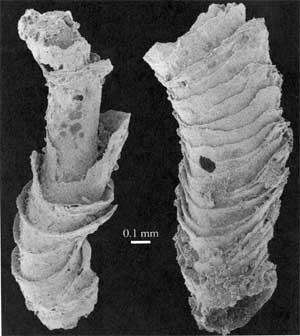
Vendian Ediacarans - 550-560 million years old - seen in South Australia and the White Sea area of Russia; this is the time of greatest Ediacaran diversity.
Avalon Ediacarans - 560-575 million years old
These biozones may be environmental assemblages.
Australia has three zones with Ediacarans, mostly in the Ediacara Member. They are also in the Wonoka Formation & the Uratanna Formation/Rawnsley Quartzite.
Ediacaran diversity in the White Sea area of Russia is high, but probably artificially high - probably many taphospecies.
Taphonomy of Ediacarans - terminology has been borrowed from ichnology - epirelief, hyporelief, etc.
Evidence of biomats - wrinkle marks, mistaken for traces. Old rhino hide textures - molds of pustular mats - the hallmark of mature microbial mats - they often occur with Ediacarans. Petee structures - desiccated mat-bound sands. Petee structures are syndepositional, but are not dewatering/degassing features (remember, there is no clay in the South Australian succession).
Ediacarans include recumbent & stalked upright frond forms.
Ediacaran discs have very high preservation potential.
Dickinsonia and Tribrachidium - they appear rather resistant; they hold up well enough to get casts from below. Why no collapse after decay?
(www.flickr.com/photos/jsjgeology/albums/72157647055182319)
(www.flickr.com/photos/awildsheepchase/4742518583)
Often, there is an iron stained veneer on Dickinsonia fossils - there's never any clay layer that separates the molds from the casts.
Namibian 3-D distorted Pteridinium fossils - they have iron oxide coatings, which act as parting planes. (www.flickr.com/photos/conservationbytes/17220503944)
White Sea fossils - there's pyrite replacement of filamentous mats in this area, but the pyrite oxidizes to limonite by the time samples reach the lab. Pyrite filaments are well preserved & obvious in field. Pyrite death masks are the possible preservation mechanism of Ediacarans.
At Mistaken Point, Newfoundland, there is a richly fossiliferous Ediacaran bedding plane, with volcanic tuff above. (www.flickr.com/photos/24428993@N08/4074992305) Beautiful impressions of Ediacarans (Pompeii Effect). Frondose forms are relatively poorly preserved. Mats of Avalon assemblages - iron oxide stained pustular mat texture occurs below the ash bed.
65% of White Sea Ediacaran fossil organisms are recognized in South Australia.
Australia's Ediacaran Reserve still has lots of small taxa on uncollected slabs - Tribrachidium, Praecambridium, Spriggina, Parvancorina, Rugoconites. So, the idea that Ediacarans are all large is wrong.
Three successive beds in the Ediacara Member have remarkable taxonomic heterogeneity.
New bedding plane excavations are covered with fossils, including lots of Dickinsonia on bedding planes (including down to <1 cm in size).
Also found some Namibian style things (3-D) in new South Australian excavations.
Found tangled Phyllozoon and organic tubes on a slab - a transported assemblage.
(4.bp.blogspot.com/_sQUMEIlMJX0/TJ7XPNGTnPI/AAAAAAAAAsw/E1...)

Dickinsonia is most important fossil in the area. The smallest Dickinsonia are 6 mm maximum length (5-6 segments). The apparent alternation of Dickinsonia segments across the midline is a taphonomic artifact.
There are probably only three genuine Dickinsonia species (tenuis, costata, rex). brachina and lissa are synonyms of tenuis.
A giant Dickinsonia rex specimen has been found - the largest whole Ediacaran organisms in any collection - 1 meter long (85-90 cm long), 70 cm wide & associated with other Ediacaran fossils.
Dickinsonia is the king of worms.
Dickinsonia elongata is a disturbed Dickinsonia costata.
Concentric wrinkles are often seen in Dickinsonia. No two specimens show exactly the same pattern of concentric wrinkles. They probably represent muscular shrinkage - maybe dehydration.
The Russians consider the concentric wrinkling in Dickinsonia is evidence of internal organs.
Seeing a contraction history in Dickinsonia is not an uncommon phenomenon.
A torn Dickinsonia specimen has been found - its morphology is still retained (so, it does not have a pneu construction - Dickinsonia is a tissue grade organism).
Isometric growth is seen in Dickinsonia.
No particular orientation is seen in specimens of Dickinsonia on bedding planes.
Dickinsonia was tactophobic - no two ever overlap. One sample shows a retreat gap between two Dickinsonia. Gel-like barrier? Chemical repulsion? Agonistic behavior?
“Digestive caecae” are seen in one sample of Dickinsonia costata, possibly? Not sure. Only seen in two Dickinsonia, out of thousands collected.
Dickinsonia ghosts - pedal impressions near buried specimen. They get progressively clearer close to the organism. They are serial resting traces. Dickinsonia was sitting on microbial mats, not the sea bottom. Dickinsonia moved along the mat & rotted areas of biomats. So, a biomat model - it fed by rotting mats. Analogy - doormat on a lawn. Cestodes/tapeworms - the modern functional analogue.
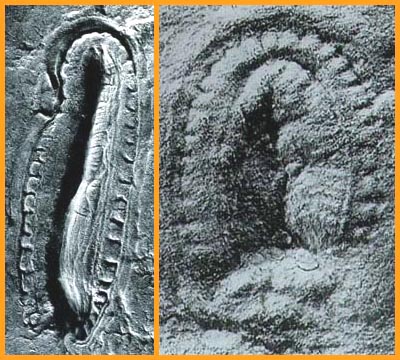
Kimberella - a cubo-medusoid or a bilaterian?
(www.ucmp.berkeley.edu/vendian/kimberella.jpg)
------------------
Dolf Seilacher: this is a nice advance with the excavation of extensive slabs in South Australia, which complement the Mistaken Point planes.
Mistaken Point is clearly deep water. Hummocky cross-stratification is not there, it turns out. So, the Mistaken Point is a slope/basin setting - very deep water. The Ediacarans there are clearly not photosynthetic.
The White Sea & Ediacaran Hills localities are clearly shallow water with sand dump events - they are at ~10-100 meters water depth; no clay at all in South Australia. So, there was a transparent ocean. Ediacaran fossils in the White Sea area & South Australia area were in the photic zone.
Flattened segments occur at the edges of Dickinsonia.
Sometimes pebbles have been found with Ediacaran casts/molds. So, morphological resolution is controlled by grain size.
The Russians claim Dickinsonia had segment alternation, but the Russians don’t take compaction into account.
There are many cases where segments clearly cross the midline of the organism.
---------------
Marakoopa Cave is a wet cave and contains spectacular decoration, sediment deposits relating to past periods of glaciations and significant communities of cave fauna – including the largest glow-worm display in any public-access cave in Australia.
Typical of a wet cave, Marakoopa Cave displays signs of former stream activity in its upper levels, including stratified deposits of sand, clay and conglomerate.
Marakoopa Cave contains numerous attractively decorated chambers on different levels, extensive areas of flowstone and a variety of other interesting formations.
Marakoopa Cave has four surface openings associated with the entrance and exit of the two creeks which run through the cave, three of which are navigable. These two streams, known as Long Creek and Short Creek, begin as runoff from the slopes of Western Bluff, some 100 metres above the cave, and have created two independent cave passages.
A little background on the development of Marakoopa Cave
Like King Solomons Cave, Marakoopa Cave was first discovered in 1906 and it was initially known as Byards Cave. Two boys, James and Harry Byard, are believed to have originally entered the cave via its top entrance. The boys kept their discovery a secret, returning to the cave in 1910. James Byard obtained a land grant which included the cave area and its discovery became common knowledge in 1911, by which time a track had been cut to the river entrance, which is currently in use, and a heavy iron door covered the entrance.
In 1912 Marakoopa Cave was opened to the public, lit by 24 handheld carbide bicycle lamps which were carried by James, Harry and their younger siblings. In 1921 the cave was purchased from James Byard by the Tasmanian Government Tourist Bureau, but Harry stayed on as a guide for a number of years and helped with the installation of the first electric lighting system, switched on in May 1940 by the then Premier of Tasmania.
Dundalk overwhelm Bangor in All Ireland Final
by Roger Corbett
Bangor’s amazing run in the All Ireland Junior Cup came to an abrupt end when they were comprehensively beaten by Dundalk, eventually losing by 55-5.
Where do you start when trying to relate and absorb the events of Saturday’s final at Chambers Park? Firstly, congratulations to worthy winners Dundalk who nullified the Bangor attack, then went on to produce some stunning plays which racked up no less than 8 tries, each by a different player. For Bangor’s part, they were unable to respond to the intensity of Dundalk’s game, and lacked the cutting edge which their opponents used to great effect.
The day started full of promise, as the strong support from North Down made their way to Chambers Park in Portadown, knowing Bangor would be fielding their best team. Once again, the pundits had Bangor as the underdogs – just as they had done so in the previous three rounds! In confounding the experts earlier, Bangor produced some awesome performances against top quality opposition to get to the final. Dundalk had produced some convincing wins in the early rounds of the competition, but had struggled to get past CIYMS in the semi-final, just managing to squeeze ahead at the second time of asking. However, with a number of key players returning to the side in time for this game, they were now back at full strength and would be a formidable force to contend with.
Having won the toss, captain Jamie Clegg elected to play into the stiff wind in the first half. For the first 5 minutes, Bangor doggedly retained possession and tried to play their way into Dundalk’s half through a series of determined forward moves. However, little ground was made and, when possession was finally lost, the Dundalk back line produced a burst that simply cut through the Bangor defence resulting in an easy touch down under Bangor’s posts for a 7-0 lead.
Bangor stuck to their plan and slowly, but patiently, got their attack moving forward, eventually winning a penalty to the left of Dundalk’s posts, but Mark Widdowson’s kick into the wind drifted just wide of the mark.
The contrast in play between the two teams was becoming clear, with Bangor trying to keep the ball close while Dundalk were throwing it wide. The latter strategy was proving to be the more effective as, with 20 minutes gone, a quick back line move with players looping around resulted in an overlap on the right wing which gave a clear run in to again, score under the posts. A further 9 minutes later, they did it again and, although the Bangor defence had sensed the danger and moved across to cover it, their tackling let them down allowing Dundalk to get over in the right hand corner, taking their lead to 19-0.
By now, Bangor were trying to hang on until half time when they could regroup and come out with the wind at their backs. Dundalk, on the other hand were anxious to press home their advantage and give them a more comfortable lead. To Bangor’s credit, although camped on their own line for lengthy spells, they dug in and managed to hold on until the referee’s half time whistle.
As the teams reappeared from the dressing rooms, it was obvious Bangor were ringing the changes, particularly in the backs. With the wind advantage having lessened considerably, Bangor got the second half underway. It was now Dundalk’s turn to adopt the slow, steady approach, just as Bangor had done earlier. However, their more confident off-loading and support play was, once again, taking play deep into Bangor’s territory. Frustration at not being able to gain possession and take play out of their danger area eventually resulted in a yellow card for Clegg after a succession of penalties. Dundalk kicked the penalty to touch, won their lineout and drove for the line. Although initially held up by the Bangor defence, Dundalk’s repeated drives were eventually rewarded with another converted score, extending their lead to 26-0.
From the touchline, the Bangor faithful had felt that if their players had managed to score first in the second half, they may have been able to mount a fight-back and close the gap to their opponents. As it was, this Dundalk score simply bolstered their confidence and pushed Bangor deeper into trouble. With Bangor still a man down, Dundalk added to the score with a penalty and then another score in the corner. Everything was now working for the Leinster men, as even the difficult touchline conversion into the biting wind successfully split the posts, bringing the score to 36-0.
As the game entered the final quarter, and with Dundalk all but holding the cup, Bangor were now on the ropes. By contrast, the Dundalk players were in almost total control, and were not going to slow down now. In a 10 minute spell, they ran in a further 3 tries, making the scoreline 55-0. By now, any sense of dejection the Bangor supporters may have been feeling was now moved to feelings of sympathy for their players. However, pride was at stake and once again Bangor rallied as the game entered its final minutes. At last, the forwards got within striking distance of the Dundalk line and, although their repeated attacks were repelled, they finally managed to do what their opponents had done so effectively, and quickly passed the ball wide to Davy Charles. Even though they were 55 points ahead, the Dundalk defence made Charles work hard to drive through the tackles and score Bangor’s consolation try, bringing the final score to 55-5.
From Bangor’s point of view, the final score doesn’t tell the whole story of this competition. While the final may have resulted in a sad anti-climax for Bangor, the remarkable journey to get there will be remembered for some time. On the day, Dundalk were by far the better side, and Bangor would have to concede that their game was not up to the usual standard. However, there is no doubt the experience of competing at this level is something to relish and the goal now will be to secure a top four place in the league and try again next year.
Everybody at the club has nothing but the highest respect and praise for what has been achieved this year by not just the 1sts, but all the senior teams, and one poor result isn’t going to change that – the welcome at Upritchard Park for the returning players is testament to that. With that in mind, the players now need to put this disappointment behind them and provide the best possible response against a struggling Portadown side at home in the league next Saturday.
Bangor side: J Leary, A Jackson, P Whyte, F Black, G Irvine, R Latimer, J Clegg, C Stewart, R Armstrong, K Rosson, D Charles, M Aspley, M Weir, M Widdowson, C Morgan
Subs: S Irvine, O McIlmurray, D Kelly, M Rodgers, C Harper, D Fusco, M Thompson
Bangor scores: D Charles (1T)
Dundalk Storm To Title Dundalk 55 v Bangor 5 from KnockOn.ie
Dundalk Scorers: Christopher Scully, Owen McNally, Jonathan Williams, John Smyth, Ultan Murphy, Tiernan Gonnelly, James McConnon and Stephen Murphy 1 try each. Ultan Murphy 6 cons, 1 pen.
Bangor Scorers: David Charles 1 try.
In front of a big crowd at Chambers Park on Saturday afternoon Dundalk delivered a stunning and ruthless display to see off the challenge of Bangor and capture the All Ireland Junior Cup title for the very first time.
Three first half tries had them firmly in control at 19-0 ahead having played with the elements at the Portadown venue during the first half and while the wind dropped somewhat after half time the Dundalk intensity most certainly didn’t as they cut loose scoring five more tries.
Dundalk returned to a heroes welcome at their Mill Road clubhouse on Saturday night after a display of pure brilliance throughout the afternoon.
Precision, pace and skill from the Louth men from start to finish left Bangor playing second fiddle for long periods.
Dundalk overwhelm Bangor in All Ireland Final
by Roger Corbett
Bangor’s amazing run in the All Ireland Junior Cup came to an abrupt end when they were comprehensively beaten by Dundalk, eventually losing by 55-5.
Where do you start when trying to relate and absorb the events of Saturday’s final at Chambers Park? Firstly, congratulations to worthy winners Dundalk who nullified the Bangor attack, then went on to produce some stunning plays which racked up no less than 8 tries, each by a different player. For Bangor’s part, they were unable to respond to the intensity of Dundalk’s game, and lacked the cutting edge which their opponents used to great effect.
The day started full of promise, as the strong support from North Down made their way to Chambers Park in Portadown, knowing Bangor would be fielding their best team. Once again, the pundits had Bangor as the underdogs – just as they had done so in the previous three rounds! In confounding the experts earlier, Bangor produced some awesome performances against top quality opposition to get to the final. Dundalk had produced some convincing wins in the early rounds of the competition, but had struggled to get past CIYMS in the semi-final, just managing to squeeze ahead at the second time of asking. However, with a number of key players returning to the side in time for this game, they were now back at full strength and would be a formidable force to contend with.
Having won the toss, captain Jamie Clegg elected to play into the stiff wind in the first half. For the first 5 minutes, Bangor doggedly retained possession and tried to play their way into Dundalk’s half through a series of determined forward moves. However, little ground was made and, when possession was finally lost, the Dundalk back line produced a burst that simply cut through the Bangor defence resulting in an easy touch down under Bangor’s posts for a 7-0 lead.
Bangor stuck to their plan and slowly, but patiently, got their attack moving forward, eventually winning a penalty to the left of Dundalk’s posts, but Mark Widdowson’s kick into the wind drifted just wide of the mark.
The contrast in play between the two teams was becoming clear, with Bangor trying to keep the ball close while Dundalk were throwing it wide. The latter strategy was proving to be the more effective as, with 20 minutes gone, a quick back line move with players looping around resulted in an overlap on the right wing which gave a clear run in to again, score under the posts. A further 9 minutes later, they did it again and, although the Bangor defence had sensed the danger and moved across to cover it, their tackling let them down allowing Dundalk to get over in the right hand corner, taking their lead to 19-0.
By now, Bangor were trying to hang on until half time when they could regroup and come out with the wind at their backs. Dundalk, on the other hand were anxious to press home their advantage and give them a more comfortable lead. To Bangor’s credit, although camped on their own line for lengthy spells, they dug in and managed to hold on until the referee’s half time whistle.
As the teams reappeared from the dressing rooms, it was obvious Bangor were ringing the changes, particularly in the backs. With the wind advantage having lessened considerably, Bangor got the second half underway. It was now Dundalk’s turn to adopt the slow, steady approach, just as Bangor had done earlier. However, their more confident off-loading and support play was, once again, taking play deep into Bangor’s territory. Frustration at not being able to gain possession and take play out of their danger area eventually resulted in a yellow card for Clegg after a succession of penalties. Dundalk kicked the penalty to touch, won their lineout and drove for the line. Although initially held up by the Bangor defence, Dundalk’s repeated drives were eventually rewarded with another converted score, extending their lead to 26-0.
From the touchline, the Bangor faithful had felt that if their players had managed to score first in the second half, they may have been able to mount a fight-back and close the gap to their opponents. As it was, this Dundalk score simply bolstered their confidence and pushed Bangor deeper into trouble. With Bangor still a man down, Dundalk added to the score with a penalty and then another score in the corner. Everything was now working for the Leinster men, as even the difficult touchline conversion into the biting wind successfully split the posts, bringing the score to 36-0.
As the game entered the final quarter, and with Dundalk all but holding the cup, Bangor were now on the ropes. By contrast, the Dundalk players were in almost total control, and were not going to slow down now. In a 10 minute spell, they ran in a further 3 tries, making the scoreline 55-0. By now, any sense of dejection the Bangor supporters may have been feeling was now moved to feelings of sympathy for their players. However, pride was at stake and once again Bangor rallied as the game entered its final minutes. At last, the forwards got within striking distance of the Dundalk line and, although their repeated attacks were repelled, they finally managed to do what their opponents had done so effectively, and quickly passed the ball wide to Davy Charles. Even though they were 55 points ahead, the Dundalk defence made Charles work hard to drive through the tackles and score Bangor’s consolation try, bringing the final score to 55-5.
From Bangor’s point of view, the final score doesn’t tell the whole story of this competition. While the final may have resulted in a sad anti-climax for Bangor, the remarkable journey to get there will be remembered for some time. On the day, Dundalk were by far the better side, and Bangor would have to concede that their game was not up to the usual standard. However, there is no doubt the experience of competing at this level is something to relish and the goal now will be to secure a top four place in the league and try again next year.
Everybody at the club has nothing but the highest respect and praise for what has been achieved this year by not just the 1sts, but all the senior teams, and one poor result isn’t going to change that – the welcome at Upritchard Park for the returning players is testament to that. With that in mind, the players now need to put this disappointment behind them and provide the best possible response against a struggling Portadown side at home in the league next Saturday.
Bangor side: J Leary, A Jackson, P Whyte, F Black, G Irvine, R Latimer, J Clegg, C Stewart, R Armstrong, K Rosson, D Charles, M Aspley, M Weir, M Widdowson, C Morgan
Subs: S Irvine, O McIlmurray, D Kelly, M Rodgers, C Harper, D Fusco, M Thompson
Bangor scores: D Charles (1T)
Dundalk Storm To Title Dundalk 55 v Bangor 5 from KnockOn.ie
Dundalk Scorers: Christopher Scully, Owen McNally, Jonathan Williams, John Smyth, Ultan Murphy, Tiernan Gonnelly, James McConnon and Stephen Murphy 1 try each. Ultan Murphy 6 cons, 1 pen.
Bangor Scorers: David Charles 1 try.
In front of a big crowd at Chambers Park on Saturday afternoon Dundalk delivered a stunning and ruthless display to see off the challenge of Bangor and capture the All Ireland Junior Cup title for the very first time.
Three first half tries had them firmly in control at 19-0 ahead having played with the elements at the Portadown venue during the first half and while the wind dropped somewhat after half time the Dundalk intensity most certainly didn’t as they cut loose scoring five more tries.
Dundalk returned to a heroes welcome at their Mill Road clubhouse on Saturday night after a display of pure brilliance throughout the afternoon.
Precision, pace and skill from the Louth men from start to finish left Bangor playing second fiddle for long periods.
Relates to Leeds TOTW: Simplicity (18 Jan 2009)
Here my friend's garden takes on a contemporary artistic look with simplistic ready-made artefacts. These two items appear nicely placed together somehow!
Dundalk overwhelm Bangor in All Ireland Final
by Roger Corbett
Bangor’s amazing run in the All Ireland Junior Cup came to an abrupt end when they were comprehensively beaten by Dundalk, eventually losing by 55-5.
Where do you start when trying to relate and absorb the events of Saturday’s final at Chambers Park? Firstly, congratulations to worthy winners Dundalk who nullified the Bangor attack, then went on to produce some stunning plays which racked up no less than 8 tries, each by a different player. For Bangor’s part, they were unable to respond to the intensity of Dundalk’s game, and lacked the cutting edge which their opponents used to great effect.
The day started full of promise, as the strong support from North Down made their way to Chambers Park in Portadown, knowing Bangor would be fielding their best team. Once again, the pundits had Bangor as the underdogs – just as they had done so in the previous three rounds! In confounding the experts earlier, Bangor produced some awesome performances against top quality opposition to get to the final. Dundalk had produced some convincing wins in the early rounds of the competition, but had struggled to get past CIYMS in the semi-final, just managing to squeeze ahead at the second time of asking. However, with a number of key players returning to the side in time for this game, they were now back at full strength and would be a formidable force to contend with.
Having won the toss, captain Jamie Clegg elected to play into the stiff wind in the first half. For the first 5 minutes, Bangor doggedly retained possession and tried to play their way into Dundalk’s half through a series of determined forward moves. However, little ground was made and, when possession was finally lost, the Dundalk back line produced a burst that simply cut through the Bangor defence resulting in an easy touch down under Bangor’s posts for a 7-0 lead.
Bangor stuck to their plan and slowly, but patiently, got their attack moving forward, eventually winning a penalty to the left of Dundalk’s posts, but Mark Widdowson’s kick into the wind drifted just wide of the mark.
The contrast in play between the two teams was becoming clear, with Bangor trying to keep the ball close while Dundalk were throwing it wide. The latter strategy was proving to be the more effective as, with 20 minutes gone, a quick back line move with players looping around resulted in an overlap on the right wing which gave a clear run in to again, score under the posts. A further 9 minutes later, they did it again and, although the Bangor defence had sensed the danger and moved across to cover it, their tackling let them down allowing Dundalk to get over in the right hand corner, taking their lead to 19-0.
By now, Bangor were trying to hang on until half time when they could regroup and come out with the wind at their backs. Dundalk, on the other hand were anxious to press home their advantage and give them a more comfortable lead. To Bangor’s credit, although camped on their own line for lengthy spells, they dug in and managed to hold on until the referee’s half time whistle.
As the teams reappeared from the dressing rooms, it was obvious Bangor were ringing the changes, particularly in the backs. With the wind advantage having lessened considerably, Bangor got the second half underway. It was now Dundalk’s turn to adopt the slow, steady approach, just as Bangor had done earlier. However, their more confident off-loading and support play was, once again, taking play deep into Bangor’s territory. Frustration at not being able to gain possession and take play out of their danger area eventually resulted in a yellow card for Clegg after a succession of penalties. Dundalk kicked the penalty to touch, won their lineout and drove for the line. Although initially held up by the Bangor defence, Dundalk’s repeated drives were eventually rewarded with another converted score, extending their lead to 26-0.
From the touchline, the Bangor faithful had felt that if their players had managed to score first in the second half, they may have been able to mount a fight-back and close the gap to their opponents. As it was, this Dundalk score simply bolstered their confidence and pushed Bangor deeper into trouble. With Bangor still a man down, Dundalk added to the score with a penalty and then another score in the corner. Everything was now working for the Leinster men, as even the difficult touchline conversion into the biting wind successfully split the posts, bringing the score to 36-0.
As the game entered the final quarter, and with Dundalk all but holding the cup, Bangor were now on the ropes. By contrast, the Dundalk players were in almost total control, and were not going to slow down now. In a 10 minute spell, they ran in a further 3 tries, making the scoreline 55-0. By now, any sense of dejection the Bangor supporters may have been feeling was now moved to feelings of sympathy for their players. However, pride was at stake and once again Bangor rallied as the game entered its final minutes. At last, the forwards got within striking distance of the Dundalk line and, although their repeated attacks were repelled, they finally managed to do what their opponents had done so effectively, and quickly passed the ball wide to Davy Charles. Even though they were 55 points ahead, the Dundalk defence made Charles work hard to drive through the tackles and score Bangor’s consolation try, bringing the final score to 55-5.
From Bangor’s point of view, the final score doesn’t tell the whole story of this competition. While the final may have resulted in a sad anti-climax for Bangor, the remarkable journey to get there will be remembered for some time. On the day, Dundalk were by far the better side, and Bangor would have to concede that their game was not up to the usual standard. However, there is no doubt the experience of competing at this level is something to relish and the goal now will be to secure a top four place in the league and try again next year.
Everybody at the club has nothing but the highest respect and praise for what has been achieved this year by not just the 1sts, but all the senior teams, and one poor result isn’t going to change that – the welcome at Upritchard Park for the returning players is testament to that. With that in mind, the players now need to put this disappointment behind them and provide the best possible response against a struggling Portadown side at home in the league next Saturday.
Bangor side: J Leary, A Jackson, P Whyte, F Black, G Irvine, R Latimer, J Clegg, C Stewart, R Armstrong, K Rosson, D Charles, M Aspley, M Weir, M Widdowson, C Morgan
Subs: S Irvine, O McIlmurray, D Kelly, M Rodgers, C Harper, D Fusco, M Thompson
Bangor scores: D Charles (1T)
Dundalk Storm To Title Dundalk 55 v Bangor 5 from KnockOn.ie
Dundalk Scorers: Christopher Scully, Owen McNally, Jonathan Williams, John Smyth, Ultan Murphy, Tiernan Gonnelly, James McConnon and Stephen Murphy 1 try each. Ultan Murphy 6 cons, 1 pen.
Bangor Scorers: David Charles 1 try.
In front of a big crowd at Chambers Park on Saturday afternoon Dundalk delivered a stunning and ruthless display to see off the challenge of Bangor and capture the All Ireland Junior Cup title for the very first time.
Three first half tries had them firmly in control at 19-0 ahead having played with the elements at the Portadown venue during the first half and while the wind dropped somewhat after half time the Dundalk intensity most certainly didn’t as they cut loose scoring five more tries.
Dundalk returned to a heroes welcome at their Mill Road clubhouse on Saturday night after a display of pure brilliance throughout the afternoon.
Precision, pace and skill from the Louth men from start to finish left Bangor playing second fiddle for long periods.
This album by Colin Durrant is of 1930s images and documents relates to British Fermentation's Yeast Factory in Ipswich. Colin has first-hand knowledge of the company that he served over many years. The Works were built on the site of the former Stoke Tide Mill, which, in succession became the Eastern Union Mills and later still Fisons. The premises were converted into the Yeast Factory – one of only two in the country – in 1933.
The operation closed around 1968 with the coming of the new factory at Felixstowe (run by NGSF of the Netherlands). The brand name was ‘Chieftain Yeast’. The yeast production at the Ipswich works was small-scale and the process very different from the process at Felixstowe.
Local companies often commissioned Ipswich photographers to carry out work for them; photographs of staff at work would have been posed to promote the company. The images in this album were probably used in promotional material with some others showing some of the firm’s maltings in London.
From: Barry Girling (September 2019)
The description and specifications relate to the Pitts Special as this is an identical aircraft to the S1 and S2S.
The Pitts Special is a light aerobatic biplane designed by Curtis Pitts. It has accumulated many competition wins since its first flight in 1944. The Pitts Special dominated world aerobatic competition in the 1960s and 1970s and, even today, remains a potent competition aircraft and is a favourite for many an aerobatic pilot.
General characteristics
•Crew: Two
•Length: 18 ft 9 in (5.71 m)
•Wingspan: 20 ft 0 in (6.10 m)
•Height: 6 ft 7⅓ in (2.02 m)
•Wing area: 125 ft² (11.6 m²)
•Empty weight: 1,150 lb (521 kg)
•Max takeoff weight: 1,625 lb (737 kg)
•Powerplant: 1× Textron Lycoming AEIO-540-D4A5 flat-six air cooled piston engine, 260 hp (194 kW)
Performance
•Never exceed speed: 182 knots (210 mph, 338 km/h)
•Cruise speed: 152 knots (175 mph, 282 km/h) (max cruise)
•Stall speed: 52 knots (60 mph, 97 km/h)
•Range: 277 NM (319 mi, 513 km)
•Service ceiling: 21,000 ft (6,400 m)
•Rate of climb: 2,700 ft/min (13.7 m/s)
•Wing loading: 13.0 lb/ft² (63.6 kg/m²)
•Power/mass: 0.16 hp/lb (0.26 kW/kg)
Text and specifications based on Wikipedia article under the Creative Commons License for non-profit use.
Ganesha, also spelled Ganesh, and also known as Ganapati and Vinayaka, is a widely worshipped deity in the Hindu pantheon. His image is found throughout India and Nepal. Hindu sects worship him regardless of affiliations. Devotion to Ganesha is widely diffused and extends to Jains, Buddhists, and beyond India.
Although he is known by many attributes, Ganesha's elephant head makes him easy to identify. Ganesha is widely revered as the remover of obstacles, the patron of arts and sciences and the deva of intellect and wisdom. As the god of beginnings, he is honoured at the start of rituals and ceremonies. Ganesha is also invoked as patron of letters and learning during writing sessions. Several texts relate mythological anecdotes associated with his birth and exploits and explain his distinct iconography.
Ganesha emerged as a distinct deity in the 4th and 5th centuries CE, during the Gupta Period, although he inherited traits from Vedic and pre-Vedic precursors. He was formally included among the five primary deities of Smartism (a Hindu denomination) in the 9th century. A sect of devotees called the Ganapatya arose, who identified Ganesha as the supreme deity. The principal scriptures dedicated to Ganesha are the Ganesha Purana, the Mudgala Purana, and the Ganapati Atharvashirsa.
ETYMOLOGY AND OTHER NAMES
Ganesha has been ascribed many other titles and epithets, including Ganapati and Vighneshvara. The Hindu title of respect Shri is often added before his name. One popular way Ganesha is worshipped is by chanting a Ganesha Sahasranama, a litany of "a thousand names of Ganesha". Each name in the sahasranama conveys a different meaning and symbolises a different aspect of Ganesha. At least two different versions of the Ganesha Sahasranama exist; one version is drawn from the Ganesha Purana, a Hindu scripture venerating Ganesha.
The name Ganesha is a Sanskrit compound, joining the words gana, meaning a group, multitude, or categorical system and isha, meaning lord or master. The word gaņa when associated with Ganesha is often taken to refer to the gaņas, a troop of semi-divine beings that form part of the retinue of Shiva. The term more generally means a category, class, community, association, or corporation. Some commentators interpret the name "Lord of the Gaņas" to mean "Lord of Hosts" or "Lord of created categories", such as the elements. Ganapati, a synonym for Ganesha, is a compound composed of gaṇa, meaning "group", and pati, meaning "ruler" or "lord". The Amarakosha, an early Sanskrit lexicon, lists eight synonyms of Ganesha : Vinayaka, Vighnarāja (equivalent to Vighnesha), Dvaimātura (one who has two mothers), Gaṇādhipa (equivalent to Ganapati and Ganesha), Ekadanta (one who has one tusk), Heramba, Lambodara (one who has a pot belly, or, literally, one who has a hanging belly), and Gajanana; having the face of an elephant).
Vinayaka is a common name for Ganesha that appears in the Purāṇas and in Buddhist Tantras. This name is reflected in the naming of the eight famous Ganesha temples in Maharashtra known as the Ashtavinayak (aṣṭavināyaka). The names Vighnesha and Vighneshvara (Lord of Obstacles) refers to his primary function in Hindu theology as the master and remover of obstacles (vighna).
A prominent name for Ganesha in the Tamil language is Pillai. A. K. Narain differentiates these terms by saying that pillai means a "child" while pillaiyar means a "noble child". He adds that the words pallu, pella, and pell in the Dravidian family of languages signify "tooth or tusk", also "elephant tooth or tusk". Anita Raina Thapan notes that the root word pille in the name Pillaiyar might have originally meant "the young of the elephant", because the Pali word pillaka means "a young elephant".
In the Burmese language, Ganesha is known as Maha Peinne, derived from Pali Mahā Wināyaka. The widespread name of Ganesha in Thailand is Phra Phikhanet or Phra Phikhanesuan, both of which are derived from Vara Vighnesha and Vara Vighneshvara respectively, whereas the name Khanet (from Ganesha) is rather rare.
In Sri Lanka, in the North-Central and North Western areas with predominantly Buddhist population, Ganesha is known as Aiyanayaka Deviyo, while in other Singhala Buddhist areas he is known as Gana deviyo.
ICONOGRAPHY
Ganesha is a popular figure in Indian art. Unlike those of some deities, representations of Ganesha show wide variations and distinct patterns changing over time. He may be portrayed standing, dancing, heroically taking action against demons, playing with his family as a boy, sitting down or on an elevated seat, or engaging in a range of contemporary situations.
Ganesha images were prevalent in many parts of India by the 6th century. The 13th century statue pictured is typical of Ganesha statuary from 900–1200, after Ganesha had been well-established as an independent deity with his own sect. This example features some of Ganesha's common iconographic elements. A virtually identical statue has been dated between 973–1200 by Paul Martin-Dubost, and another similar statue is dated c. 12th century by Pratapaditya Pal. Ganesha has the head of an elephant and a big belly. This statue has four arms, which is common in depictions of Ganesha. He holds his own broken tusk in his lower-right hand and holds a delicacy, which he samples with his trunk, in his lower-left hand. The motif of Ganesha turning his trunk sharply to his left to taste a sweet in his lower-left hand is a particularly archaic feature. A more primitive statue in one of the Ellora Caves with this general form has been dated to the 7th century. Details of the other hands are difficult to make out on the statue shown. In the standard configuration, Ganesha typically holds an axe or a goad in one upper arm and a pasha (noose) in the other upper arm.
The influence of this old constellation of iconographic elements can still be seen in contemporary representations of Ganesha. In one modern form, the only variation from these old elements is that the lower-right hand does not hold the broken tusk but is turned towards the viewer in a gesture of protection or fearlessness (abhaya mudra). The same combination of four arms and attributes occurs in statues of Ganesha dancing, which is a very popular theme.
COMMON ATTRIBUTES
Ganesha has been represented with the head of an elephant since the early stages of his appearance in Indian art. Puranic myths provide many explanations for how he got his elephant head. One of his popular forms, Heramba-Ganapati, has five elephant heads, and other less-common variations in the number of heads are known. While some texts say that Ganesha was born with an elephant head, he acquires the head later in most stories. The most recurrent motif in these stories is that Ganesha was created by Parvati using clay to protect her and Shiva beheaded him when Ganesha came between Shiva and Parvati. Shiva then replaced Ganesha's original head with that of an elephant. Details of the battle and where the replacement head came from vary from source to source. Another story says that Ganesha was created directly by Shiva's laughter. Because Shiva considered Ganesha too alluring, he gave him the head of an elephant and a protruding belly.
Ganesha's earliest name was Ekadanta (One Tusked), referring to his single whole tusk, the other being broken. Some of the earliest images of Ganesha show him holding his broken tusk. The importance of this distinctive feature is reflected in the Mudgala Purana, which states that the name of Ganesha's second incarnation is Ekadanta. Ganesha's protruding belly appears as a distinctive attribute in his earliest statuary, which dates to the Gupta period (4th to 6th centuries). This feature is so important that, according to the Mudgala Purana, two different incarnations of Ganesha use names based on it: Lambodara (Pot Belly, or, literally, Hanging Belly) and Mahodara (Great Belly). Both names are Sanskrit compounds describing his belly. The Brahmanda Purana says that Ganesha has the name Lambodara because all the universes (i.e., cosmic eggs) of the past, present, and future are present in him. The number of Ganesha's arms varies; his best-known forms have between two and sixteen arms. Many depictions of Ganesha feature four arms, which is mentioned in Puranic sources and codified as a standard form in some iconographic texts. His earliest images had two arms. Forms with 14 and 20 arms appeared in Central India during the 9th and the 10th centuries. The serpent is a common feature in Ganesha iconography and appears in many forms. According to the Ganesha Purana, Ganesha wrapped the serpent Vasuki around his neck. Other depictions of snakes include use as a sacred thread wrapped around the stomach as a belt, held in a hand, coiled at the ankles, or as a throne. Upon Ganesha's forehead may be a third eye or the Shaivite sectarian mark , which consists of three horizontal lines. The Ganesha Purana prescribes a tilaka mark as well as a crescent moon on the forehead. A distinct form of Ganesha called Bhalachandra includes that iconographic element. Ganesha is often described as red in color. Specific colors are associated with certain forms. Many examples of color associations with specific meditation forms are prescribed in the Sritattvanidhi, a treatise on Hindu iconography. For example, white is associated with his representations as Heramba-Ganapati and Rina-Mochana-Ganapati (Ganapati Who Releases from Bondage). Ekadanta-Ganapati is visualized as blue during meditation in that form.
VAHANAS
The earliest Ganesha images are without a vahana (mount/vehicle). Of the eight incarnations of Ganesha described in the Mudgala Purana, Ganesha uses a mouse (shrew) in five of them, a lion in his incarnation as Vakratunda, a peacock in his incarnation as Vikata, and Shesha, the divine serpent, in his incarnation as Vighnaraja. Mohotkata uses a lion, Mayūreśvara uses a peacock, Dhumraketu uses a horse, and Gajanana uses a mouse, in the four incarnations of Ganesha listed in the Ganesha Purana. Jain depictions of Ganesha show his vahana variously as a mouse, elephant, tortoise, ram, or peacock.
Ganesha is often shown riding on or attended by a mouse, shrew or rat. Martin-Dubost says that the rat began to appear as the principal vehicle in sculptures of Ganesha in central and western India during the 7th century; the rat was always placed close to his feet. The mouse as a mount first appears in written sources in the Matsya Purana and later in the Brahmananda Purana and Ganesha Purana, where Ganesha uses it as his vehicle in his last incarnation. The Ganapati Atharvashirsa includes a meditation verse on Ganesha that describes the mouse appearing on his flag. The names Mūṣakavāhana (mouse-mount) and Ākhuketana (rat-banner) appear in the Ganesha Sahasranama.
The mouse is interpreted in several ways. According to Grimes, "Many, if not most of those who interpret Gaṇapati's mouse, do so negatively; it symbolizes tamoguṇa as well as desire". Along these lines, Michael Wilcockson says it symbolizes those who wish to overcome desires and be less selfish. Krishan notes that the rat is destructive and a menace to crops. The Sanskrit word mūṣaka (mouse) is derived from the root mūṣ (stealing, robbing). It was essential to subdue the rat as a destructive pest, a type of vighna (impediment) that needed to be overcome. According to this theory, showing Ganesha as master of the rat demonstrates his function as Vigneshvara (Lord of Obstacles) and gives evidence of his possible role as a folk grāma-devatā (village deity) who later rose to greater prominence. Martin-Dubost notes a view that the rat is a symbol suggesting that Ganesha, like the rat, penetrates even the most secret places.
ASSOCIATIONS
OBSTACLES
Ganesha is Vighneshvara or Vighnaraja or Vighnaharta (Marathi), the Lord of Obstacles, both of a material and spiritual order. He is popularly worshipped as a remover of obstacles, though traditionally he also places obstacles in the path of those who need to be checked. Paul Courtright says that "his task in the divine scheme of things, his dharma, is to place and remove obstacles. It is his particular territory, the reason for his creation."
Krishan notes that some of Ganesha's names reflect shadings of multiple roles that have evolved over time. Dhavalikar ascribes the quick ascension of Ganesha in the Hindu pantheon, and the emergence of the Ganapatyas, to this shift in emphasis from vighnakartā (obstacle-creator) to vighnahartā (obstacle-averter). However, both functions continue to be vital to his character.
BUDDHI (KNOWLEDGE)
Ganesha is considered to be the Lord of letters and learning. In Sanskrit, the word buddhi is a feminine noun that is variously translated as intelligence, wisdom, or intellect. The concept of buddhi is closely associated with the personality of Ganesha, especially in the Puranic period, when many stories stress his cleverness and love of intelligence. One of Ganesha's names in the Ganesha Purana and the Ganesha Sahasranama is Buddhipriya. This name also appears in a list of 21 names at the end of the Ganesha Sahasranama that Ganesha says are especially important. The word priya can mean "fond of", and in a marital context it can mean "lover" or "husband", so the name may mean either "Fond of Intelligence" or "Buddhi's Husband".
AUM
Ganesha is identified with the Hindu mantra Aum, also spelled Om. The term oṃkārasvarūpa (Aum is his form), when identified with Ganesha, refers to the notion that he personifies the primal sound. The Ganapati Atharvashirsa attests to this association. Chinmayananda translates the relevant passage as follows:
(O Lord Ganapati!) You are (the Trinity) Brahma, Vishnu, and Mahesa. You are Indra. You are fire [Agni] and air [Vāyu]. You are the sun [Sūrya] and the moon [Chandrama]. You are Brahman. You are (the three worlds) Bhuloka [earth], Antariksha-loka [space], and Swargaloka [heaven]. You are Om. (That is to say, You are all this).
Some devotees see similarities between the shape of Ganesha's body in iconography and the shape of Aum in the Devanāgarī and Tamil scripts.
FIRST CHAKRA
According to Kundalini yoga, Ganesha resides in the first chakra, called Muladhara (mūlādhāra). Mula means "original, main"; adhara means "base, foundation". The muladhara chakra is the principle on which the manifestation or outward expansion of primordial Divine Force rests. This association is also attested to in the Ganapati Atharvashirsa. Courtright translates this passage as follows: "[O Ganesha,] You continually dwell in the sacral plexus at the base of the spine [mūlādhāra cakra]." Thus, Ganesha has a permanent abode in every being at the Muladhara. Ganesha holds, supports and guides all other chakras, thereby "governing the forces that propel the wheel of life".
FAMILY AND CONSORTS
Though Ganesha is popularly held to be the son of Shiva and Parvati, the Puranic myths give different versions about his birth. In some he was created by Parvati, in another he was created by Shiva and Parvati, in another he appeared mysteriously and was discovered by Shiva and Parvati or he was born from the elephant headed goddess Malini after she drank Parvati's bath water that had been thrown in the river.
The family includes his brother the war god Kartikeya, who is also called Subramanya, Skanda, Murugan and other names. Regional differences dictate the order of their births. In northern India, Skanda is generally said to be the elder, while in the south, Ganesha is considered the first born. In northern India, Skanda was an important martial deity from about 500 BCE to about 600 CE, when worship of him declined significantly in northern India. As Skanda fell, Ganesha rose. Several stories tell of sibling rivalry between the brothers and may reflect sectarian tensions.
Ganesha's marital status, the subject of considerable scholarly review, varies widely in mythological stories. One pattern of myths identifies Ganesha as an unmarried brahmacari. This view is common in southern India and parts of northern India. Another pattern associates him with the concepts of Buddhi (intellect), Siddhi (spiritual power), and Riddhi (prosperity); these qualities are sometimes personified as goddesses, said to be Ganesha's wives. He also may be shown with a single consort or a nameless servant (Sanskrit: daşi). Another pattern connects Ganesha with the goddess of culture and the arts, Sarasvati or Śarda (particularly in Maharashtra). He is also associated with the goddess of luck and prosperity, Lakshmi. Another pattern, mainly prevalent in the Bengal region, links Ganesha with the banana tree, Kala Bo.
The Shiva Purana says that Ganesha had begotten two sons: Kşema (prosperity) and Lābha (profit). In northern Indian variants of this story, the sons are often said to be Śubha (auspiciouness) and Lābha. The 1975 Hindi film Jai Santoshi Maa shows Ganesha married to Riddhi and Siddhi and having a daughter named Santoshi Ma, the goddess of satisfaction. This story has no Puranic basis, but Anita Raina Thapan and Lawrence Cohen cite Santoshi Ma's cult as evidence of Ganesha's continuing evolution as a popular deity.
WOSHIP AND FESTIVALS
Ganesha is worshipped on many religious and secular occasions; especially at the beginning of ventures such as buying a vehicle or starting a business. K.N. Somayaji says, "there can hardly be a [Hindu] home [in India] which does not house an idol of Ganapati. [..] Ganapati, being the most popular deity in India, is worshipped by almost all castes and in all parts of the country". Devotees believe that if Ganesha is propitiated, he grants success, prosperity and protection against adversity.
Ganesha is a non-sectarian deity, and Hindus of all denominations invoke him at the beginning of prayers, important undertakings, and religious ceremonies. Dancers and musicians, particularly in southern India, begin performances of arts such as the Bharatnatyam dance with a prayer to Ganesha. Mantras such as Om Shri Gaṇeshāya Namah (Om, salutation to the Illustrious Ganesha) are often used. One of the most famous mantras associated with Ganesha is Om Gaṃ Ganapataye Namah (Om, Gaṃ, Salutation to the Lord of Hosts).
Devotees offer Ganesha sweets such as modaka and small sweet balls (laddus). He is often shown carrying a bowl of sweets, called a modakapātra. Because of his identification with the color red, he is often worshipped with red sandalwood paste (raktacandana) or red flowers. Dūrvā grass (Cynodon dactylon) and other materials are also used in his worship.
Festivals associated with Ganesh are Ganesh Chaturthi or Vināyaka chaturthī in the śuklapakṣa (the fourth day of the waxing moon) in the month of bhādrapada (August/September) and the Gaṇeśa jayanti (Gaṇeśa's birthday) celebrated on the cathurthī of the śuklapakṣa (fourth day of the waxing moon) in the month of māgha (January/February)."
GANESH CHATURTI
An annual festival honours Ganesha for ten days, starting on Ganesha Chaturthi, which typically falls in late August or early September. The festival begins with people bringing in clay idols of Ganesha, symbolising Ganesha's visit. The festival culminates on the day of Ananta Chaturdashi, when idols (murtis) of Ganesha are immersed in the most convenient body of water. Some families have a tradition of immersion on the 2nd, 3rd, 5th, or 7th day. In 1893, Lokmanya Tilak transformed this annual Ganesha festival from private family celebrations into a grand public event. He did so "to bridge the gap between the Brahmins and the non-Brahmins and find an appropriate context in which to build a new grassroots unity between them" in his nationalistic strivings against the British in Maharashtra. Because of Ganesha's wide appeal as "the god for Everyman", Tilak chose him as a rallying point for Indian protest against British rule. Tilak was the first to install large public images of Ganesha in pavilions, and he established the practice of submerging all the public images on the tenth day. Today, Hindus across India celebrate the Ganapati festival with great fervour, though it is most popular in the state of Maharashtra. The festival also assumes huge proportions in Mumbai, Pune, and in the surrounding belt of Ashtavinayaka temples.
TEMPLES
In Hindu temples, Ganesha is depicted in various ways: as an acolyte or subordinate deity (pãrśva-devatã); as a deity related to the principal deity (parivāra-devatã); or as the principal deity of the temple (pradhāna), treated similarly as the highest gods of the Hindu pantheon. As the god of transitions, he is placed at the doorway of many Hindu temples to keep out the unworthy, which is analogous to his role as Parvati’s doorkeeper. In addition, several shrines are dedicated to Ganesha himself, of which the Ashtavinayak (lit. "eight Ganesha (shrines)") in Maharashtra are particularly well known. Located within a 100-kilometer radius of the city of Pune, each of these eight shrines celebrates a particular form of Ganapati, complete with its own lore and legend. The eight shrines are: Morgaon, Siddhatek, Pali, Mahad, Theur, Lenyadri, Ozar and Ranjangaon.
There are many other important Ganesha temples at the following locations: Wai in Maharashtra; Ujjain in Madhya Pradesh; Jodhpur, Nagaur and Raipur (Pali) in Rajasthan; Baidyanath in Bihar; Baroda, Dholaka, and Valsad in Gujarat and Dhundiraj Temple in Varanasi, Uttar Pradesh. Prominent Ganesha temples in southern India include the following: Kanipakam in Chittoor; the Jambukeśvara Temple at Tiruchirapalli; at Rameshvaram and Suchindram in Tamil Nadu; at Malliyur, Kottarakara, Pazhavangadi, Kasargod in Kerala, Hampi, and Idagunji in Karnataka; and Bhadrachalam in Andhra Pradesh.
T. A. Gopinatha notes, "Every village however small has its own image of Vighneśvara (Vigneshvara) with or without a temple to house it in. At entrances of villages and forts, below pīpaḹa (Sacred fig) trees [...], in a niche [...] in temples of Viṣṇu (Vishnu) as well as Śiva (Shiva) and also in separate shrines specially constructed in Śiva temples [...]; the figure of Vighneśvara is invariably seen." Ganesha temples have also been built outside of India, including southeast Asia, Nepal (including the four Vinayaka shrines in the Kathmandu valley), and in several western countries.
RISE TO PROMINENCE
FIRST APEARANCE
Ganesha appeared in his classic form as a clearly recognizable deity with well-defined iconographic attributes in the early 4th to 5th centuries. Shanti Lal Nagar says that the earliest known iconic image of Ganesha is in the niche of the Shiva temple at Bhumra, which has been dated to the Gupta period. His independent cult appeared by about the 10th century. Narain summarizes the controversy between devotees and academics regarding the development of Ganesha as follows:
What is inscrutable is the somewhat dramatic appearance of Gaņeśa on the historical scene. His antecedents are not clear. His wide acceptance and popularity, which transcend sectarian and territorial limits, are indeed amazing. On the one hand there is the pious belief of the orthodox devotees in Gaņeśa's Vedic origins and in the Purāṇic explanations contained in the confusing, but nonetheless interesting, mythology. On the other hand there are doubts about the existence of the idea and the icon of this deity" before the fourth to fifth century A.D. ... [I]n my opinion, indeed there is no convincing evidence of the existence of this divinity prior to the fifth century.
POSSIBLE INFLUENCES
Courtright reviews various speculative theories about the early history of Ganesha, including supposed tribal traditions and animal cults, and dismisses all of them in this way:
In the post 600 BC period there is evidence of people and places named after the animal. The motif appears on coins and sculptures.
Thapan's book on the development of Ganesha devotes a chapter to speculations about the role elephants had in early India but concludes that, "although by the second century CE the elephant-headed yakṣa form exists it cannot be presumed to represent Gaṇapati-Vināyaka. There is no evidence of a deity by this name having an elephant or elephant-headed form at this early stage. Gaṇapati-Vināyaka had yet to make his debut."
One theory of the origin of Ganesha is that he gradually came to prominence in connection with the four Vinayakas (Vināyakas). In Hindu mythology, the Vināyakas were a group of four troublesome demons who created obstacles and difficulties but who were easily propitiated. The name Vināyaka is a common name for Ganesha both in the Purāṇas and in Buddhist Tantras. Krishan is one of the academics who accepts this view, stating flatly of Ganesha, "He is a non-vedic god. His origin is to be traced to the four Vināyakas, evil spirits, of the Mānavagŗhyasūtra (7th–4th century BCE) who cause various types of evil and suffering". Depictions of elephant-headed human figures, which some identify with Ganesha, appear in Indian art and coinage as early as the 2nd century. According to Ellawala, the elephant-headed Ganesha as lord of the Ganas was known to the people of Sri Lanka in the early pre-Christian era.
A metal plate depiction of Ganesha had been discovered in 1993, in Iran, it dated back to 1,200 BCE. Another one was discovered much before, in Lorestan Province of Iran.
First Ganesha's terracotta images are from 1st century CE found in Ter, Pal, Verrapuram and Chandraketugarh. These figures are small, with elephant head, two arms, and chubby physique. The earliest Ganesha icons in stone were carved in Mathura during Kushan times (2nd-3rd centuries CE).
VEDIC AND EPIC LITERATURE
The title "Leader of the group" (Sanskrit: gaṇapati) occurs twice in the Rig Veda, but in neither case does it refer to the modern Ganesha. The term appears in RV 2.23.1 as a title for Brahmanaspati, according to commentators. While this verse doubtless refers to Brahmanaspati, it was later adopted for worship of Ganesha and is still used today. In rejecting any claim that this passage is evidence of Ganesha in the Rig Veda, Ludo Rocher says that it "clearly refers to Bṛhaspati—who is the deity of the hymn—and Bṛhaspati only". Equally clearly, the second passage (RV 10.112.9) refers to Indra, who is given the epithet 'gaṇapati', translated "Lord of the companies (of the Maruts)." However, Rocher notes that the more recent Ganapatya literature often quotes the Rigvedic verses to give Vedic respectability to Ganesha .
Two verses in texts belonging to Black Yajurveda, Maitrāyaṇīya Saṃhitā (2.9.1) and Taittirīya Āraṇyaka (10.1), appeal to a deity as "the tusked one" (Dantiḥ), "elephant-faced" (Hastimukha), and "with a curved trunk" (Vakratuņḍa). These names are suggestive of Ganesha, and the 14th century commentator Sayana explicitly establishes this identification. The description of Dantin, possessing a twisted trunk (vakratuṇḍa) and holding a corn-sheaf, a sugar cane, and a club, is so characteristic of the Puranic Ganapati that Heras says "we cannot resist to accept his full identification with this Vedic Dantin". However, Krishan considers these hymns to be post-Vedic additions. Thapan reports that these passages are "generally considered to have been interpolated". Dhavalikar says, "the references to the elephant-headed deity in the Maitrāyaṇī Saṃhitā have been proven to be very late interpolations, and thus are not very helpful for determining the early formation of the deity".
Ganesha does not appear in Indian epic literature that is dated to the Vedic period. A late interpolation to the epic poem Mahabharata says that the sage Vyasa (Vyāsa) asked Ganesha to serve as his scribe to transcribe the poem as he dictated it to him. Ganesha agreed but only on condition that Vyasa recite the poem uninterrupted, that is, without pausing. The sage agreed, but found that to get any rest he needed to recite very complex passages so Ganesha would have to ask for clarifications. The story is not accepted as part of the original text by the editors of the critical edition of the Mahabharata, in which the twenty-line story is relegated to a footnote in an appendix. The story of Ganesha acting as the scribe occurs in 37 of the 59 manuscripts consulted during preparation of the critical edition. Ganesha's association with mental agility and learning is one reason he is shown as scribe for Vyāsa's dictation of the Mahabharata in this interpolation. Richard L. Brown dates the story to the 8th century, and Moriz Winternitz concludes that it was known as early as c. 900, but it was not added to the Mahabharata some 150 years later. Winternitz also notes that a distinctive feature in South Indian manuscripts of the Mahabharata is their omission of this Ganesha legend. The term vināyaka is found in some recensions of the Śāntiparva and Anuśāsanaparva that are regarded as interpolations. A reference to Vighnakartṛīṇām ("Creator of Obstacles") in Vanaparva is also believed to be an interpolation and does not appear in the critical edition.
PURANIC PERIOD
Stories about Ganesha often occur in the Puranic corpus. Brown notes while the Puranas "defy precise chronological ordering", the more detailed narratives of Ganesha's life are in the late texts, c. 600–1300. Yuvraj Krishan says that the Puranic myths about the birth of Ganesha and how he acquired an elephant's head are in the later Puranas, which were composed from c. 600 onwards. He elaborates on the matter to say that references to Ganesha in the earlier Puranas, such as the Vayu and Brahmanda Puranas, are later interpolations made during the 7th to 10th centuries.
In his survey of Ganesha's rise to prominence in Sanskrit literature, Ludo Rocher notes that:
Above all, one cannot help being struck by the fact that the numerous stories surrounding Gaṇeśa concentrate on an unexpectedly limited number of incidents. These incidents are mainly three: his birth and parenthood, his elephant head, and his single tusk. Other incidents are touched on in the texts, but to a far lesser extent.
Ganesha's rise to prominence was codified in the 9th century, when he was formally included as one of the five primary deities of Smartism. The 9th-century philosopher Adi Shankara popularized the "worship of the five forms" (Panchayatana puja) system among orthodox Brahmins of the Smarta tradition. This worship practice invokes the five deities Ganesha, Vishnu, Shiva, Devi, and Surya. Adi Shankara instituted the tradition primarily to unite the principal deities of these five major sects on an equal status. This formalized the role of Ganesha as a complementary deity.
SCRIPTURES
Once Ganesha was accepted as one of the five principal deities of Brahmanism, some Brahmins (brāhmaṇas) chose to worship Ganesha as their principal deity. They developed the Ganapatya tradition, as seen in the Ganesha Purana and the Mudgala Purana.
The date of composition for the Ganesha Purana and the Mudgala Purana - and their dating relative to one another - has sparked academic debate. Both works were developed over time and contain age-layered strata. Anita Thapan reviews comments about dating and provides her own judgement. "It seems likely that the core of the Ganesha Purana appeared around the twelfth and thirteenth centuries", she says, "but was later interpolated." Lawrence W. Preston considers the most reasonable date for the Ganesha Purana to be between 1100 and 1400, which coincides with the apparent age of the sacred sites mentioned by the text.
R.C. Hazra suggests that the Mudgala Purana is older than the Ganesha Purana, which he dates between 1100 and 1400. However, Phyllis Granoff finds problems with this relative dating and concludes that the Mudgala Purana was the last of the philosophical texts concerned with Ganesha. She bases her reasoning on the fact that, among other internal evidence, the Mudgala Purana specifically mentions the Ganesha Purana as one of the four Puranas (the Brahma, the Brahmanda, the Ganesha, and the Mudgala Puranas) which deal at length with Ganesha. While the kernel of the text must be old, it was interpolated until the 17th and 18th centuries as the worship of Ganapati became more important in certain regions. Another highly regarded scripture, the Ganapati Atharvashirsa, was probably composed during the 16th or 17th centuries.
BEYOND INDIA AND HINDUISM
Commercial and cultural contacts extended India's influence in western and southeast Asia. Ganesha is one of a number of Hindu deities who reached foreign lands as a result.
Ganesha was particularly worshipped by traders and merchants, who went out of India for commercial ventures. From approximately the 10th century onwards, new networks of exchange developed including the formation of trade guilds and a resurgence of money circulation. During this time, Ganesha became the principal deity associated with traders. The earliest inscription invoking Ganesha before any other deity is associated with the merchant community.
Hindus migrated to Maritime Southeast Asia and took their culture, including Ganesha, with them. Statues of Ganesha are found throughout the region, often beside Shiva sanctuaries. The forms of Ganesha found in Hindu art of Java, Bali, and Borneo show specific regional influences. The spread of Hindu culture to southeast Asia established Ganesha in modified forms in Burma, Cambodia, and Thailand. In Indochina, Hinduism and Buddhism were practiced side by side, and mutual influences can be seen in the iconography of Ganesha in the region. In Thailand, Cambodia, and among the Hindu classes of the Chams in Vietnam, Ganesha was mainly thought of as a remover of obstacles. Today in Buddhist Thailand, Ganesha is regarded as a remover of obstacles, the god of success.
Before the arrival of Islam, Afghanistan had close cultural ties with India, and the adoration of both Hindu and Buddhist deities was practiced. Examples of sculptures from the 5th to the 7th centuries have survived, suggesting that the worship of Ganesha was then in vogue in the region.
Ganesha appears in Mahayana Buddhism, not only in the form of the Buddhist god Vināyaka, but also as a Hindu demon form with the same name. His image appears in Buddhist sculptures during the late Gupta period. As the Buddhist god Vināyaka, he is often shown dancing. This form, called Nṛtta Ganapati, was popular in northern India, later adopted in Nepal, and then in Tibet. In Nepal, the Hindu form of Ganesha, known as Heramba, is popular; he has five heads and rides a lion. Tibetan representations of Ganesha show ambivalent views of him. A Tibetan rendering of Ganapati is tshogs bdag. In one Tibetan form, he is shown being trodden under foot by Mahākāla, (Shiva) a popular Tibetan deity. Other depictions show him as the Destroyer of Obstacles, and sometimes dancing. Ganesha appears in China and Japan in forms that show distinct regional character. In northern China, the earliest known stone statue of Ganesha carries an inscription dated to 531. In Japan, where Ganesha is known as Kangiten, the Ganesha cult was first mentioned in 806.
The canonical literature of Jainism does not mention the worship of Ganesha. However, Ganesha is worshipped by most Jains, for whom he appears to have taken over certain functions of Kubera. Jain connections with the trading community support the idea that Jainism took up Ganesha worship as a result of commercial connections. The earliest known Jain Ganesha statue dates to about the 9th century. A 15th-century Jain text lists procedures for the installation of Ganapati images. Images of Ganesha appear in the Jain temples of Rajasthan and Gujarat.
WIKIPEDIA
This photo relates to my travel blog at http://www.heatheronhertravels.com/a-cycle-in-the-turia-gardens-in-valencia/
Restaurants
This photo is licensed under Creative commons for use including commercial on condition that you link back to or credit http://www.heatheronhertravels.com/.
See my profile for more detail.
Kinetic: Relating to, caused by, or producing motion.
These are called “Kinetic” photographs because there is motion, energy, and movement involved, specifically my and the camera’s movements.
Most of these are shot outdoors where I have the room to literally spin and throw my little camera several feet up into the air, with some throws going as high as 15 feet or more!
None of these are Photoshopped, layered, or a composite photo...what you see occurs in one shot, one take.
Aren’t I afraid that I will drop and break my camera? For regular followers of my photostream and this series you will know that I have already done so. This little camera has been dropped many times, and broken once when dropped on concrete outside. It still functions...not so well for regular photographs, but superbly for more kinetic work.
Albeit supremely risky this is one of my favorite ways to produce abstract photographs.
If you'd like to see more please check out my set, "Vertigo:"
www.flickr.com/photos/motorpsiclist/sets/72157630591282642/
.
To read more about Kinetic Photography click the Wikipedia link below:
en.wikipedia.org/wiki/Kinetic_photography
.
My photographs and videos and any derivative works are my private property and are copyright © by me, John Russell (aka “Zoom Lens”) and ALL my rights, including my exclusive rights, are reserved. ANY use without my permission in writing is forbidden by law.
From one of the mosaics installed on columns of the Allmendinger Park pavillion. Per a plaque on the building, this would be one of the student portraits contributed by Slauson middle schoolers in 2012.
Tracy Tran @tracytran shares a tip on recruiting Millennials.
T2: Talent Tomorrow
SHRM 2012 Talent Management Conference & Exposition in Washington D.C.
For more recruiting tips, visit the Security Clearance Jobs Resource Center:
In optics, particularly as it relates to film and photography, the depth of field (DOF) is the portion of a scene that appears acceptably sharp in the image. Although a lens can precisely focus at only one distance, the decrease in sharpness is gradual on each side of the focused distance, so that within the DOF, the unsharpness is imperceptible under normal viewing conditions.
In some cases, it may be desirable to have the entire image sharp, and a large DOF is appropriate. In other cases, a small DOF may be more effective, emphasizing the subject while de-emphasizing the foreground and background. In cinematography, a large DOF is often called deep focus, and a small DOF is often called shallow focus.
The DOF is determined by the camera-to-subject distance, the lens focal length, the lens f-number, and the format size or circle of confusion criterion.
For a given format size, at moderate subject distances, DOF is approximately determined by the subject magnification and the lens f-number. For a given f-number, increasing the magnification, either by moving closer to the subject or using a lens of greater focal length, decreases the DOF; decreasing magnification increases DOF. For a given subject magnification, increasing the f-number (decreasing the aperture diameter) increases the DOF; decreasing f-number decreases DOF.
When the “same picture” is taken in two different format sizes from the same distance at the same f-number with lenses that give the same angle of view, and the final images (e.g., in prints, or on a projection screen or electronic display) are the same size, the smaller format has greater DOF.
Many small-format digital SLR camera systems allow using many of the same lenses on both full-frame and “cropped format” cameras. If the subject distance is adjusted to provide the same field of view at the subject, at the same f-number and final-image size, the smaller format has greater DOF, as with the “same picture” comparison above. If pictures are taken from the same distance using the same f-number, and the final images are the same size, the smaller format has less DOF. If pictures taken from the same subject distance are given the same enlargement, both final images will have the same DOF. The final images will, of course, have different sizes.
Cropping an image and enlarging to the same size final image as an uncropped image taken under the same conditions is equivalent to using a smaller format under the same conditions, so the cropped image has less DOF.
When focus is set to the hyperfocal distance, the DOF extends from half the hyperfocal distance to infinity, and the DOF is the largest possible for a given f-number.
The advent of digital technology in photography has provided additional means of controlling the extent of image sharpness; some methods allow extended DOF that would be impossible with traditional techniques, and some allow the DOF to be determined after the image is made.
Dundalk overwhelm Bangor in All Ireland Final
by Roger Corbett
Bangor’s amazing run in the All Ireland Junior Cup came to an abrupt end when they were comprehensively beaten by Dundalk, eventually losing by 55-5.
Where do you start when trying to relate and absorb the events of Saturday’s final at Chambers Park? Firstly, congratulations to worthy winners Dundalk who nullified the Bangor attack, then went on to produce some stunning plays which racked up no less than 8 tries, each by a different player. For Bangor’s part, they were unable to respond to the intensity of Dundalk’s game, and lacked the cutting edge which their opponents used to great effect.
The day started full of promise, as the strong support from North Down made their way to Chambers Park in Portadown, knowing Bangor would be fielding their best team. Once again, the pundits had Bangor as the underdogs – just as they had done so in the previous three rounds! In confounding the experts earlier, Bangor produced some awesome performances against top quality opposition to get to the final. Dundalk had produced some convincing wins in the early rounds of the competition, but had struggled to get past CIYMS in the semi-final, just managing to squeeze ahead at the second time of asking. However, with a number of key players returning to the side in time for this game, they were now back at full strength and would be a formidable force to contend with.
Having won the toss, captain Jamie Clegg elected to play into the stiff wind in the first half. For the first 5 minutes, Bangor doggedly retained possession and tried to play their way into Dundalk’s half through a series of determined forward moves. However, little ground was made and, when possession was finally lost, the Dundalk back line produced a burst that simply cut through the Bangor defence resulting in an easy touch down under Bangor’s posts for a 7-0 lead.
Bangor stuck to their plan and slowly, but patiently, got their attack moving forward, eventually winning a penalty to the left of Dundalk’s posts, but Mark Widdowson’s kick into the wind drifted just wide of the mark.
The contrast in play between the two teams was becoming clear, with Bangor trying to keep the ball close while Dundalk were throwing it wide. The latter strategy was proving to be the more effective as, with 20 minutes gone, a quick back line move with players looping around resulted in an overlap on the right wing which gave a clear run in to again, score under the posts. A further 9 minutes later, they did it again and, although the Bangor defence had sensed the danger and moved across to cover it, their tackling let them down allowing Dundalk to get over in the right hand corner, taking their lead to 19-0.
By now, Bangor were trying to hang on until half time when they could regroup and come out with the wind at their backs. Dundalk, on the other hand were anxious to press home their advantage and give them a more comfortable lead. To Bangor’s credit, although camped on their own line for lengthy spells, they dug in and managed to hold on until the referee’s half time whistle.
As the teams reappeared from the dressing rooms, it was obvious Bangor were ringing the changes, particularly in the backs. With the wind advantage having lessened considerably, Bangor got the second half underway. It was now Dundalk’s turn to adopt the slow, steady approach, just as Bangor had done earlier. However, their more confident off-loading and support play was, once again, taking play deep into Bangor’s territory. Frustration at not being able to gain possession and take play out of their danger area eventually resulted in a yellow card for Clegg after a succession of penalties. Dundalk kicked the penalty to touch, won their lineout and drove for the line. Although initially held up by the Bangor defence, Dundalk’s repeated drives were eventually rewarded with another converted score, extending their lead to 26-0.
From the touchline, the Bangor faithful had felt that if their players had managed to score first in the second half, they may have been able to mount a fight-back and close the gap to their opponents. As it was, this Dundalk score simply bolstered their confidence and pushed Bangor deeper into trouble. With Bangor still a man down, Dundalk added to the score with a penalty and then another score in the corner. Everything was now working for the Leinster men, as even the difficult touchline conversion into the biting wind successfully split the posts, bringing the score to 36-0.
As the game entered the final quarter, and with Dundalk all but holding the cup, Bangor were now on the ropes. By contrast, the Dundalk players were in almost total control, and were not going to slow down now. In a 10 minute spell, they ran in a further 3 tries, making the scoreline 55-0. By now, any sense of dejection the Bangor supporters may have been feeling was now moved to feelings of sympathy for their players. However, pride was at stake and once again Bangor rallied as the game entered its final minutes. At last, the forwards got within striking distance of the Dundalk line and, although their repeated attacks were repelled, they finally managed to do what their opponents had done so effectively, and quickly passed the ball wide to Davy Charles. Even though they were 55 points ahead, the Dundalk defence made Charles work hard to drive through the tackles and score Bangor’s consolation try, bringing the final score to 55-5.
From Bangor’s point of view, the final score doesn’t tell the whole story of this competition. While the final may have resulted in a sad anti-climax for Bangor, the remarkable journey to get there will be remembered for some time. On the day, Dundalk were by far the better side, and Bangor would have to concede that their game was not up to the usual standard. However, there is no doubt the experience of competing at this level is something to relish and the goal now will be to secure a top four place in the league and try again next year.
Everybody at the club has nothing but the highest respect and praise for what has been achieved this year by not just the 1sts, but all the senior teams, and one poor result isn’t going to change that – the welcome at Upritchard Park for the returning players is testament to that. With that in mind, the players now need to put this disappointment behind them and provide the best possible response against a struggling Portadown side at home in the league next Saturday.
Bangor side: J Leary, A Jackson, P Whyte, F Black, G Irvine, R Latimer, J Clegg, C Stewart, R Armstrong, K Rosson, D Charles, M Aspley, M Weir, M Widdowson, C Morgan
Subs: S Irvine, O McIlmurray, D Kelly, M Rodgers, C Harper, D Fusco, M Thompson
Bangor scores: D Charles (1T)
Dundalk Storm To Title Dundalk 55 v Bangor 5 from KnockOn.ie
Dundalk Scorers: Christopher Scully, Owen McNally, Jonathan Williams, John Smyth, Ultan Murphy, Tiernan Gonnelly, James McConnon and Stephen Murphy 1 try each. Ultan Murphy 6 cons, 1 pen.
Bangor Scorers: David Charles 1 try.
In front of a big crowd at Chambers Park on Saturday afternoon Dundalk delivered a stunning and ruthless display to see off the challenge of Bangor and capture the All Ireland Junior Cup title for the very first time.
Three first half tries had them firmly in control at 19-0 ahead having played with the elements at the Portadown venue during the first half and while the wind dropped somewhat after half time the Dundalk intensity most certainly didn’t as they cut loose scoring five more tries.
Dundalk returned to a heroes welcome at their Mill Road clubhouse on Saturday night after a display of pure brilliance throughout the afternoon.
Precision, pace and skill from the Louth men from start to finish left Bangor playing second fiddle for long periods.
Correspondence with the Chief Mechanical Engineer, Royal Arsenal, Woolwich, and various military establishments, relating mainly to the supply of lead piping and flanges.
Dated 21st May 1940
Cheshire Archives and Local Studies ZCR 245/19
Dundalk overwhelm Bangor in All Ireland Final
by Roger Corbett
Bangor’s amazing run in the All Ireland Junior Cup came to an abrupt end when they were comprehensively beaten by Dundalk, eventually losing by 55-5.
Where do you start when trying to relate and absorb the events of Saturday’s final at Chambers Park? Firstly, congratulations to worthy winners Dundalk who nullified the Bangor attack, then went on to produce some stunning plays which racked up no less than 8 tries, each by a different player. For Bangor’s part, they were unable to respond to the intensity of Dundalk’s game, and lacked the cutting edge which their opponents used to great effect.
The day started full of promise, as the strong support from North Down made their way to Chambers Park in Portadown, knowing Bangor would be fielding their best team. Once again, the pundits had Bangor as the underdogs – just as they had done so in the previous three rounds! In confounding the experts earlier, Bangor produced some awesome performances against top quality opposition to get to the final. Dundalk had produced some convincing wins in the early rounds of the competition, but had struggled to get past CIYMS in the semi-final, just managing to squeeze ahead at the second time of asking. However, with a number of key players returning to the side in time for this game, they were now back at full strength and would be a formidable force to contend with.
Having won the toss, captain Jamie Clegg elected to play into the stiff wind in the first half. For the first 5 minutes, Bangor doggedly retained possession and tried to play their way into Dundalk’s half through a series of determined forward moves. However, little ground was made and, when possession was finally lost, the Dundalk back line produced a burst that simply cut through the Bangor defence resulting in an easy touch down under Bangor’s posts for a 7-0 lead.
Bangor stuck to their plan and slowly, but patiently, got their attack moving forward, eventually winning a penalty to the left of Dundalk’s posts, but Mark Widdowson’s kick into the wind drifted just wide of the mark.
The contrast in play between the two teams was becoming clear, with Bangor trying to keep the ball close while Dundalk were throwing it wide. The latter strategy was proving to be the more effective as, with 20 minutes gone, a quick back line move with players looping around resulted in an overlap on the right wing which gave a clear run in to again, score under the posts. A further 9 minutes later, they did it again and, although the Bangor defence had sensed the danger and moved across to cover it, their tackling let them down allowing Dundalk to get over in the right hand corner, taking their lead to 19-0.
By now, Bangor were trying to hang on until half time when they could regroup and come out with the wind at their backs. Dundalk, on the other hand were anxious to press home their advantage and give them a more comfortable lead. To Bangor’s credit, although camped on their own line for lengthy spells, they dug in and managed to hold on until the referee’s half time whistle.
As the teams reappeared from the dressing rooms, it was obvious Bangor were ringing the changes, particularly in the backs. With the wind advantage having lessened considerably, Bangor got the second half underway. It was now Dundalk’s turn to adopt the slow, steady approach, just as Bangor had done earlier. However, their more confident off-loading and support play was, once again, taking play deep into Bangor’s territory. Frustration at not being able to gain possession and take play out of their danger area eventually resulted in a yellow card for Clegg after a succession of penalties. Dundalk kicked the penalty to touch, won their lineout and drove for the line. Although initially held up by the Bangor defence, Dundalk’s repeated drives were eventually rewarded with another converted score, extending their lead to 26-0.
From the touchline, the Bangor faithful had felt that if their players had managed to score first in the second half, they may have been able to mount a fight-back and close the gap to their opponents. As it was, this Dundalk score simply bolstered their confidence and pushed Bangor deeper into trouble. With Bangor still a man down, Dundalk added to the score with a penalty and then another score in the corner. Everything was now working for the Leinster men, as even the difficult touchline conversion into the biting wind successfully split the posts, bringing the score to 36-0.
As the game entered the final quarter, and with Dundalk all but holding the cup, Bangor were now on the ropes. By contrast, the Dundalk players were in almost total control, and were not going to slow down now. In a 10 minute spell, they ran in a further 3 tries, making the scoreline 55-0. By now, any sense of dejection the Bangor supporters may have been feeling was now moved to feelings of sympathy for their players. However, pride was at stake and once again Bangor rallied as the game entered its final minutes. At last, the forwards got within striking distance of the Dundalk line and, although their repeated attacks were repelled, they finally managed to do what their opponents had done so effectively, and quickly passed the ball wide to Davy Charles. Even though they were 55 points ahead, the Dundalk defence made Charles work hard to drive through the tackles and score Bangor’s consolation try, bringing the final score to 55-5.
From Bangor’s point of view, the final score doesn’t tell the whole story of this competition. While the final may have resulted in a sad anti-climax for Bangor, the remarkable journey to get there will be remembered for some time. On the day, Dundalk were by far the better side, and Bangor would have to concede that their game was not up to the usual standard. However, there is no doubt the experience of competing at this level is something to relish and the goal now will be to secure a top four place in the league and try again next year.
Everybody at the club has nothing but the highest respect and praise for what has been achieved this year by not just the 1sts, but all the senior teams, and one poor result isn’t going to change that – the welcome at Upritchard Park for the returning players is testament to that. With that in mind, the players now need to put this disappointment behind them and provide the best possible response against a struggling Portadown side at home in the league next Saturday.
Bangor side: J Leary, A Jackson, P Whyte, F Black, G Irvine, R Latimer, J Clegg, C Stewart, R Armstrong, K Rosson, D Charles, M Aspley, M Weir, M Widdowson, C Morgan
Subs: S Irvine, O McIlmurray, D Kelly, M Rodgers, C Harper, D Fusco, M Thompson
Bangor scores: D Charles (1T)
Dundalk Storm To Title Dundalk 55 v Bangor 5 from KnockOn.ie
Dundalk Scorers: Christopher Scully, Owen McNally, Jonathan Williams, John Smyth, Ultan Murphy, Tiernan Gonnelly, James McConnon and Stephen Murphy 1 try each. Ultan Murphy 6 cons, 1 pen.
Bangor Scorers: David Charles 1 try.
In front of a big crowd at Chambers Park on Saturday afternoon Dundalk delivered a stunning and ruthless display to see off the challenge of Bangor and capture the All Ireland Junior Cup title for the very first time.
Three first half tries had them firmly in control at 19-0 ahead having played with the elements at the Portadown venue during the first half and while the wind dropped somewhat after half time the Dundalk intensity most certainly didn’t as they cut loose scoring five more tries.
Dundalk returned to a heroes welcome at their Mill Road clubhouse on Saturday night after a display of pure brilliance throughout the afternoon.
Precision, pace and skill from the Louth men from start to finish left Bangor playing second fiddle for long periods.
[T]wo enemy transport vessels under escort of two light naval vessels ... were attacked and sunk. None of the Japanese ships suffered any damage': so ran a Japanese report of a naval engagement which took place 500 kilometres off the south coast of Java on 4 March 1942. This rather sparse entry in a Japanese log relates to the fate of the Grimsby class sloop, HMAS Yarra, and the small convoy she was ordered to escort to Australia after the collapse of Allied resistance in Singapore. The first week of March 1942 was disastrous for the British and Australian navies, with the loss of over twenty ships. When we remember the fierce naval battles of late 1941 and 1942, the story of HMAS Yarra is often lost against the destruction of the British capital ships Prince of Wales and Repulse and Australia's Perth, Sydney and Vampire. Here we remember Yarra's short but dramatic history in Australia's Second World War.
016263
Grimsby class sloop, HMAS Yarra II, sunk by Japanese naval forces on 4 March 1942. Photograph taken while on operations in the Persian Gulf, August 1941.
AWM 016263
Commissioned in 1936, the lightly armed sloop of 1,080 tons was commanded by Lieutenant Commander W. H. Harrington. Yarra spent the early part of war in Australian waters. But in August 1940 she left for the Middle East where she undertook patrol and escort duties. The following year Yarra escorted a convoy from Bombay to the Persian Gulf and took part in campaigns against Iraq and Iran. While in the Mediterranean as part of the Red Sea Force the Yarra was subject to high-level bombing from Italian aircraft. The bombing proved ineffective and after months of anticipation the sudden excitement bolstered the crews' spirits. Harrington remarked:
The morale of the ship's company is very high, due partly to their interest being maintained by the fairly frequent opportunity of firing the guns ... I fear that some do not land even when they could do so in case they should miss an air raid.
The novelty of battle did not last. While escorting convoys from Alexandria to beleaguered forces at Tobruk, Yarra encountered the more experienced Luftwaffe. On 7 December 1941, 35 aircraft including dive-bombers launched a fierce attack. Although Yarra escaped with minor damage, the deadly intensity of the war was brought home to the crew. Only a week earlier HMAS Parramatta lost 138 of her crew after being torpedoed and sunk by a U-boat while on the Alexandria-Tobruk run.
With the outbreak of war with Japan, hostilities drew close to Australian waters. On 9 December Yarra sailed for duties in the Java Sea, in what was known as the ABDA area - the combined Australian, British, Dutch and American theatre in south-east Asia. Here she carried out escort and patrol duties and on 5 February, while under attack, rescued 1800 men off the burning troopship Empress of Asia. Harrington commended his crew on their performance, but singled out Acting Leading Seaman Ronald 'Buck' Taylor, for special mention. Taylor, he wrote, deserved commendation because 'on this occasion, as on many others, he controlled his gun with judgement and determination. The rating's keenness and courage are a good example to all those in his vicinity'. Following the rescue, 36-year-old Lieutenant Commander Robert W. Rankin took over as captain, replacing Harrington whom went on to achieve the rank of Vice Admiral and later Chief of Naval Staff (1962-65).
P00871.004
Lieutenant Commander Robert William Rankin RAN, lost in the sinking of HMAS Yarra on 4 March 1942.
AWM P00871.004
Japanese success in the Battle of the Java Sea on 27 February dashed any lingering hope that allied forces might stop the invasion of Java. Allied command ordered all remaining British auxiliary craft to leave Batavia. A flotilla of Australian corvettes made the hazardous journey home. By 10 March, HMAS Ballarat, Bendigo, Burnie, Goulburn, Maryborough, Toowoomba, Wollongong were safely moored in Fremantle Harbour. The Yarra would not be so fortunate.
On 2 March Yarra and the Indian sloop HMIS Jumna escorted a convoy to Tjilatjap on Java's south coast. But prowling Japanese forces made the harbour too dangerous to enter. Instead, Jumna was ordered to Colombo; Yarra was ordered to escort the depot ship Anking, the tanker Francol and the motor minesweeper MMS 51 on a longer and more perilous journey to Fremantle. There was not time to lose. Steaming steadily south-east at an economical speed of 8.5 knots, the Yarra and her convoy made good progress during the night of 2-3 March. In the morning she came across survivors from two lifeboats from the Dutch merchant ship Parigi - sunk two days earlier - and took them aboard. During the day there was little sign of the enemy, save for the distant appearance of reconnaissance aircraft in the evening.
The 'glorious sunrise' of 4 March soon revealed the topmasts of a squadron of Japanese heavy cruisers steaming in from the north-east. Led by Admiral Kondo, the squadron consisted of Atago, Takao and Maya, each armed with ten 8-inch guns, and two destroyers, Arashi and Nowaki. As G. Hermon Gill, official historian of the RAN in the Second World War, put it: 'Yarra's clanging alarm rattles struck a chill to the hearts of men who were hoping to be in Australia within four days'. Rankin immediately made a sighting report, ordered the other ships to scatter and laid smoke in a vain attempt to aid the escape of his convoy. He then turned Yarra and prepared to engage.
Yarra's guns, consisting of three 4-inch anti-aircraft guns, four 3-pounder guns, a quadruple .5-inch anti aircraft machine-gun, were no match for three of the most powerful ships in the Japanese fleet. Outgunned and out-ranged, no ship could escape the attack. The cruisers opened fire while remaining outside Yarra's range. Anking sank in less than 10 minutes with the loss of one officer and 25 ratings. The crew of MMS.51 took scuttling action and abandoned ship before close range pom-pom fire finally sent the vessel to the bottom. Francol took heavy punishment from a circling destroyer and remained afloat until 7.30am, almost one hour after the first attack. Yarra continued firing, despite listing heavily to port and drifting helplessly after shells destroyed the engine room and steering. Just minutes after Rankin gave the order to abandon ship he was killed when an 8-inch salvo destroyed the bridge. Blasted beyond recognition by constant shelling and bombing from the cruiser's aircraft, Yarra finally sank at 8.00am following a barrage of close-range fire from the destroyers. In a final act of defiance, Ronald Taylor ignored Rankin's final command, manned a 4-inch mount, and continued firing as the ship sank.
Survivors of HMS Stronghold, sunk two days earlier, looked on from the cruiser Maya. One man reported:
The Yarra was the only ship left afloat ... The two destroyers were circling Yarra which appeared to be stationary, and were pouring fire into her. She was still firing back as we could see odd gun flashes ... The last we saw of Yarra was a high column of smoke, but we were vividly impressed by her fight.
Perhaps the gun flashes they saw came from Taylor, still operating the only functional gun. The scene must have been even more poignant for Yarra's 34 survivors (from a complement of 151), who watched her last moments from two Carley floats. As the Japanese made off to the northeast a destroyer paused to collect one of two boats of survivors from Francol, but left more that 100 men scattered widely over the area. The other group of men was never heard of again.
That evening, in fading light, a passing Dutch vessel, Tawali, rescued 57 officers and ratings from Anking's life-boat, but failed to sight the other floats. Two days later on 7 March, a passing Dutch steamer Tjimanoek picked up the 14 survivors from MMS 51 and took them to Fremantle. Meanwhile, the men of the Yarra faired much worse. With just 9 litres of water and a tin of biscuits to share, the men set a course for Christmas Island, some 500 kilometres away. Of the 34 who survived attack, 21 perished on the rafts from wounds, exposure and thirst. Survivor Bill Witheriff recalled the experience: 'During those five days all except thirteen of us went either mad, died of exhaustion or [the] sharks had a meal ... .Poor old Charlie just couldn't take it and after three days went silly through drinking salt water and finally jumped over the side'.
On 9 March, the Dutch submarine KII, on her way to Ceylon, picked up the sloop's 13 survivors. Australia waited another two weeks before learning if there were any survivors from Yarra, when Admiral Geoffrey Layton of the Royal Navy signalled news of KII's arrival in Colombo. Writing to his family, Witheriff told of the excitement surrounding their arrival:
On arrival at Colombo we were local heroes and so we were well looked after by the authorities who could not do enough for us and after particulars being taken and cables forwarded to you we were sent to the Australian General Hospital to be looked after ... Here we found many friends, and nurses looked after us and waited on us ... and so you can see we are quite contented where we are and really don't want to leave.'
From the moment the crew of HMAS Yarra saw Admiral Kondo's squadron they must have known their ship was doomed. Rankin, all his officers, and most of his crew died defending the convoy they had been ordered to escort. Rankin had few options, but his decision to engage and not attempt to escape or surrender is widely regarded as one of the bravest acts in Australian naval history.
The loss of HMAS Yarra and her convey was certainly not the greatest loss suffered by the RAN during the Second World War, nor was it of great strategic significance. But for the RAN and the Australian public, the dramatic loss of Yarra confirmed the growing perception of the Japanese as a formidable and ruthless enemy. At that moment, Australia seemed more vulnerable and exposed than it did at any other time in the war. Like the bombing of northern Australia, the sinking of HMAS Yarra was one of many events in early 1942 that helped dispel the illusion of Australia's inviolability.
Sources and further reading:
[1] Chris Coulthard-Clark, The encyclopaedia of Australia's battles, Sydney, Allen & Unwin, 2001.
[2] Peter Dennis et al., The Oxford companion to Australian military history, Oxford University Press, Melbourne, 1995.
[3] G. Hermon Gill, Royal Australian Navy 1939-1942, Canberra, Australian War Memorial, 1957.
[4] A.F. Parry, HMAS Yarra: the story of a gallant ship, Sydney, Angus & Robertson, 1944.
[5] Greg Swindon, "Their Finest Hour": the story of Leading Seaman Ron Taylor and the loss of HMAS Yarra, 4 March 1942, Naval Historical Society of Australia, 1996.
The description and specifications relate to the Pitts Special as this is an identical aircraft to the S1 and S2S.
The Pitts Special is a light aerobatic biplane designed by Curtis Pitts. It has accumulated many competition wins since its first flight in 1944. The Pitts Special dominated world aerobatic competition in the 1960s and 1970s and, even today, remains a potent competition aircraft and is a favourite for many an aerobatic pilot.
General characteristics
•Crew: Two
•Length: 18 ft 9 in (5.71 m)
•Wingspan: 20 ft 0 in (6.10 m)
•Height: 6 ft 7⅓ in (2.02 m)
•Wing area: 125 ft² (11.6 m²)
•Empty weight: 1,150 lb (521 kg)
•Max takeoff weight: 1,625 lb (737 kg)
•Powerplant: 1× Textron Lycoming AEIO-540-D4A5 flat-six air cooled piston engine, 260 hp (194 kW)
Performance
•Never exceed speed: 182 knots (210 mph, 338 km/h)
•Cruise speed: 152 knots (175 mph, 282 km/h) (max cruise)
•Stall speed: 52 knots (60 mph, 97 km/h)
•Range: 277 NM (319 mi, 513 km)
•Service ceiling: 21,000 ft (6,400 m)
•Rate of climb: 2,700 ft/min (13.7 m/s)
•Wing loading: 13.0 lb/ft² (63.6 kg/m²)
•Power/mass: 0.16 hp/lb (0.26 kW/kg)
Text and specifications based on Wikipedia article under the Creative Commons License for non-profit use.
The performance relates the shorter version of the epic Ramayana Saga with dancers playing as Rama, Shinta (Sita), Lakshmana, Rahwana (Ravana), Hanoman (Hanuman), Sugriwa (Sugriva), and other characters. The storyline starts when Prince Rama wanders into the woods with his wife Shinta and brother Lakshmana. There, the giant Rahwana kidnaps Shinta and holds her in his palace. Rama then seeks help and sends Lakhsmana to find his friend Sugriwa, the King of the Monkey Kingdom. Sugriwa sends his commander the white monkey, by the name of Hanoman, to check on Shinta in Rahwana’s Palace.
A dramatic scene is portrayed when Hanoman is captured by Rahwana’s troops and put inside a circle of fire to burn him alive. Instead of burning to crisp, the white monkey warrior remains unharmed and breaks out only to burn Rahwana’s palace instead. Thus, began the battle between the two forces.
At first, Rahwana and his troops manage to overrun Rama. However, Sugriwa and Hanoman then come to Rama’s aid along with the rest of the monkey troops, defeat the evil king once and for all
Taken @Bali, Indonesia
Correspondence with the Chief Mechanical Engineer, Royal Arsenal, Woolwich, and various military establishments, relating mainly to the supply of lead piping and flanges. Dated 3rd February 1941
Cheshire Archives and Local Studies ZCR 245/19
House Bill 980, relating to “Highway Safety” (aka Distracted Driving Bill) – This measure is effective July 1, 2013. While all counties have some form of a distracted driving ordinance in place, this measure establishes a state law that creates consistent requirements across all counties for the use of mobile electronic devices while driving and will simplify enforcement. Crash data from the DOT shows that during 2007, 32 percent (2,871 of the 8,770 collisions) were attributed to inattention to driving.
Senate Bill 4, relating to “Motor Vehicles” (aka Universal Seatbelt Bill) – This measure requires all front seat and back seat occupants to buckle up, effective immediately. Adults and children must use their seat belts and child restraints at all times. Unrestrained back seat passengers were more than three times as likely to have injuries that were fatal or required hospitalization compared to restrained back seat passengers, based on DOH’s analysis of Emergency Medical Services (EMS) records. Additionally, among back seat passengers who were treated for injuries by EMS, average medical charges were nearly tripled among those who did not use seat belts ($11,043), compared to restrained passengers ($3,817).
The bill signings were done in conjunction with the DOT’s launch of the annual “Click It or Ticket” enforcement campaign, held in partnership between the state and counties with federal funding. During the national Click It or Ticket mobilization from May 20 to June 2 and throughout the year, police statewide will be continuing strict enforcement of the state seat belt and child passenger restraint laws.
Track and Field archives
The National Athletics Archive is held at the Cadbury Research Library, University of Birmingham, and comprises an extensive volume of archival materials. These papers primarily relate to the history and development of athletics in the United Kingdom throughout the 1800s and 1900s. In addition to organisational collections, such as the papers of the Amateur Athletics Association, the National Athletics Archive includes various discrete collections of individual athletes. These include papers relating to Sydney Wooderson MBE, 1914-2006. Wooderson was an English athlete who was dubbed ‘The Mighty Atom’. His athletics career peaked in the 1930s and 1940s and he set the world mile record of 04:06:40 at London’s Motspur Park on 28 August 1937. This record stood for nearly five years.
The collection also includes ephemeral and grey literature relating to various athletics clubs, meetings and events. Papers relating to major athletics championships include material generated during the 1958 British Empire and Commonwealth Games held in Cardiff. These Games introduced the ‘Queen’s Baton Relay’ which has been conducted as a prelude to every British Empire and Commonwealth Games since.
Programmes and manuscript results compiled by the athlete and coach, Dennis Cullum, 1913-1985.
Reference: ATH/DC/2/1
Kinetic: Relating to, caused by, or producing motion.
These are called “Kinetic” photographs because there is motion, energy, and movement involved, specifically my and the camera’s movements.
Most of these are shot outdoors where I have the room to literally spin and throw my little camera several feet up into the air, with some throws going as high as 15 feet or more!
None of these are Photoshopped, layered, or a composite photo...what you see occurs in one shot, one take.
Aren’t I afraid that I will drop and break my camera? For regular followers of my photostream and this series you will know that I have already done so. This little camera has been dropped many times, and broken once when dropped on concrete outside. It still functions...not so well for regular photographs, but superbly for more kinetic work.
Albeit supremely risky this is one of my favorite ways to produce abstract photographs.
If you'd like to see more please check out my set, "Vertigo:"
www.flickr.com/photos/motorpsiclist/sets/72157630591282642/
.
To read more about Kinetic Photography click the Wikipedia link below:
en.wikipedia.org/wiki/Kinetic_photography
.
My photographs and videos and any derivative works are my private property and are copyright © by me, John Russell (aka “Zoom Lens”) and ALL my rights, including my exclusive rights, are reserved. ANY use without my permission in writing is forbidden by law.
Dundalk overwhelm Bangor in All Ireland Final
by Roger Corbett
Bangor’s amazing run in the All Ireland Junior Cup came to an abrupt end when they were comprehensively beaten by Dundalk, eventually losing by 55-5.
Where do you start when trying to relate and absorb the events of Saturday’s final at Chambers Park? Firstly, congratulations to worthy winners Dundalk who nullified the Bangor attack, then went on to produce some stunning plays which racked up no less than 8 tries, each by a different player. For Bangor’s part, they were unable to respond to the intensity of Dundalk’s game, and lacked the cutting edge which their opponents used to great effect.
The day started full of promise, as the strong support from North Down made their way to Chambers Park in Portadown, knowing Bangor would be fielding their best team. Once again, the pundits had Bangor as the underdogs – just as they had done so in the previous three rounds! In confounding the experts earlier, Bangor produced some awesome performances against top quality opposition to get to the final. Dundalk had produced some convincing wins in the early rounds of the competition, but had struggled to get past CIYMS in the semi-final, just managing to squeeze ahead at the second time of asking. However, with a number of key players returning to the side in time for this game, they were now back at full strength and would be a formidable force to contend with.
Having won the toss, captain Jamie Clegg elected to play into the stiff wind in the first half. For the first 5 minutes, Bangor doggedly retained possession and tried to play their way into Dundalk’s half through a series of determined forward moves. However, little ground was made and, when possession was finally lost, the Dundalk back line produced a burst that simply cut through the Bangor defence resulting in an easy touch down under Bangor’s posts for a 7-0 lead.
Bangor stuck to their plan and slowly, but patiently, got their attack moving forward, eventually winning a penalty to the left of Dundalk’s posts, but Mark Widdowson’s kick into the wind drifted just wide of the mark.
The contrast in play between the two teams was becoming clear, with Bangor trying to keep the ball close while Dundalk were throwing it wide. The latter strategy was proving to be the more effective as, with 20 minutes gone, a quick back line move with players looping around resulted in an overlap on the right wing which gave a clear run in to again, score under the posts. A further 9 minutes later, they did it again and, although the Bangor defence had sensed the danger and moved across to cover it, their tackling let them down allowing Dundalk to get over in the right hand corner, taking their lead to 19-0.
By now, Bangor were trying to hang on until half time when they could regroup and come out with the wind at their backs. Dundalk, on the other hand were anxious to press home their advantage and give them a more comfortable lead. To Bangor’s credit, although camped on their own line for lengthy spells, they dug in and managed to hold on until the referee’s half time whistle.
As the teams reappeared from the dressing rooms, it was obvious Bangor were ringing the changes, particularly in the backs. With the wind advantage having lessened considerably, Bangor got the second half underway. It was now Dundalk’s turn to adopt the slow, steady approach, just as Bangor had done earlier. However, their more confident off-loading and support play was, once again, taking play deep into Bangor’s territory. Frustration at not being able to gain possession and take play out of their danger area eventually resulted in a yellow card for Clegg after a succession of penalties. Dundalk kicked the penalty to touch, won their lineout and drove for the line. Although initially held up by the Bangor defence, Dundalk’s repeated drives were eventually rewarded with another converted score, extending their lead to 26-0.
From the touchline, the Bangor faithful had felt that if their players had managed to score first in the second half, they may have been able to mount a fight-back and close the gap to their opponents. As it was, this Dundalk score simply bolstered their confidence and pushed Bangor deeper into trouble. With Bangor still a man down, Dundalk added to the score with a penalty and then another score in the corner. Everything was now working for the Leinster men, as even the difficult touchline conversion into the biting wind successfully split the posts, bringing the score to 36-0.
As the game entered the final quarter, and with Dundalk all but holding the cup, Bangor were now on the ropes. By contrast, the Dundalk players were in almost total control, and were not going to slow down now. In a 10 minute spell, they ran in a further 3 tries, making the scoreline 55-0. By now, any sense of dejection the Bangor supporters may have been feeling was now moved to feelings of sympathy for their players. However, pride was at stake and once again Bangor rallied as the game entered its final minutes. At last, the forwards got within striking distance of the Dundalk line and, although their repeated attacks were repelled, they finally managed to do what their opponents had done so effectively, and quickly passed the ball wide to Davy Charles. Even though they were 55 points ahead, the Dundalk defence made Charles work hard to drive through the tackles and score Bangor’s consolation try, bringing the final score to 55-5.
From Bangor’s point of view, the final score doesn’t tell the whole story of this competition. While the final may have resulted in a sad anti-climax for Bangor, the remarkable journey to get there will be remembered for some time. On the day, Dundalk were by far the better side, and Bangor would have to concede that their game was not up to the usual standard. However, there is no doubt the experience of competing at this level is something to relish and the goal now will be to secure a top four place in the league and try again next year.
Everybody at the club has nothing but the highest respect and praise for what has been achieved this year by not just the 1sts, but all the senior teams, and one poor result isn’t going to change that – the welcome at Upritchard Park for the returning players is testament to that. With that in mind, the players now need to put this disappointment behind them and provide the best possible response against a struggling Portadown side at home in the league next Saturday.
Bangor side: J Leary, A Jackson, P Whyte, F Black, G Irvine, R Latimer, J Clegg, C Stewart, R Armstrong, K Rosson, D Charles, M Aspley, M Weir, M Widdowson, C Morgan
Subs: S Irvine, O McIlmurray, D Kelly, M Rodgers, C Harper, D Fusco, M Thompson
Bangor scores: D Charles (1T)
Dundalk Storm To Title Dundalk 55 v Bangor 5 from KnockOn.ie
Dundalk Scorers: Christopher Scully, Owen McNally, Jonathan Williams, John Smyth, Ultan Murphy, Tiernan Gonnelly, James McConnon and Stephen Murphy 1 try each. Ultan Murphy 6 cons, 1 pen.
Bangor Scorers: David Charles 1 try.
In front of a big crowd at Chambers Park on Saturday afternoon Dundalk delivered a stunning and ruthless display to see off the challenge of Bangor and capture the All Ireland Junior Cup title for the very first time.
Three first half tries had them firmly in control at 19-0 ahead having played with the elements at the Portadown venue during the first half and while the wind dropped somewhat after half time the Dundalk intensity most certainly didn’t as they cut loose scoring five more tries.
Dundalk returned to a heroes welcome at their Mill Road clubhouse on Saturday night after a display of pure brilliance throughout the afternoon.
Precision, pace and skill from the Louth men from start to finish left Bangor playing second fiddle for long periods.
House Bill 980, relating to “Highway Safety” (aka Distracted Driving Bill) – This measure is effective July 1, 2013. While all counties have some form of a distracted driving ordinance in place, this measure establishes a state law that creates consistent requirements across all counties for the use of mobile electronic devices while driving and will simplify enforcement. Crash data from the DOT shows that during 2007, 32 percent (2,871 of the 8,770 collisions) were attributed to inattention to driving.
Senate Bill 4, relating to “Motor Vehicles” (aka Universal Seatbelt Bill) – This measure requires all front seat and back seat occupants to buckle up, effective immediately. Adults and children must use their seat belts and child restraints at all times. Unrestrained back seat passengers were more than three times as likely to have injuries that were fatal or required hospitalization compared to restrained back seat passengers, based on DOH’s analysis of Emergency Medical Services (EMS) records. Additionally, among back seat passengers who were treated for injuries by EMS, average medical charges were nearly tripled among those who did not use seat belts ($11,043), compared to restrained passengers ($3,817).
The bill signings were done in conjunction with the DOT’s launch of the annual “Click It or Ticket” enforcement campaign, held in partnership between the state and counties with federal funding. During the national Click It or Ticket mobilization from May 20 to June 2 and throughout the year, police statewide will be continuing strict enforcement of the state seat belt and child passenger restraint laws.
This image relates to the departure of the Kangaroos rugby team onboard AWATEA, July 1937. The photo was taken at Sydney Cricket Ground before the team left for the Australia Rugby League Tour 1937-1938. Pictured from left to right, back row: I. Ward, B. Williams, E.Collins, J.Gibb, C. Hazleton, A. Norval, D. Mclean, P. Farrall. Second row: P. Griffiths, R. Mckinnon, G. Maclennan, l. Heidke, S. Pearce, F. Curran, H. Robison, H. Pierce, R. Stehr. Third row: l. Dawson, G. Whittle, J. Reardon, R. Savage ( joint manager), W. Prigg (captain), H. Sunderland (joint manager), E. Lewis, P. Nolan, J. Beaton. Infront: P. Gilbert, R. Thompson, B. Norman, P. Williams.
The Australian National Maritime Museum undertakes research and accepts public comments that enhance the information we hold about images in our collection. If you can identify a person, vessel or landmark, write the details in the Comments box below.
Thank you for helping caption this important historical image.
Photographer: Samuel J Hood
Object number 00022598
This image possibly relates to the United States Navy visit to Sydney on 23 July 1925. This image was possibly taken on Hickson Road in Walsh Bay and the banner on the car reads: 'Welcome...Australia's...Commonwealth Band...'
The fleet departed for New Zealand on 6 August. The fleet included USS CALIFORNIA (V), USS COLORADO (III), USS TENNESSEE (III), USS MARYLAND (III), USS WEST VIRGINIA (II), USS NEW MEXICO (I), USS MISSISSIPPI (III) and USS IDAHO (IV).
This photo is part of the Australian National Maritime Museum’s Samuel J. Hood Studio collection. Sam Hood (1872-1953) was a Sydney photographer with a passion for ships. His 60-year career spanned the romantic age of sail and two world wars. The photos in the collection were taken mainly in Sydney and Newcastle during the first half of the 20th century.
The ANMM undertakes research and accepts public comments that enhance the information we hold about images in our collection. This record has been updated accordingly.
Photographer: Samuel J. Hood Studio Collection
Object no. 00034728
I’ll relate to y’all, my beautiful readers, a simple tale of an ordinary average Central Texas Trumpet Case Bear. It was 95 degrees F (35 C) out of doors. Little Texas Aggie Trumpet Case Bear was about to go into heat exhaustion (symptom before heat stroke).
Alamo Basement Fightin’ Texas Aggie Ring whispered to me, “We need to get frozen Margaritas into the little bear immediately before he goes into a coma and dies. Have you looked at the price of black market bears lately?” I pulled out the large container for the Ninja and fired it up.
After about quatro or cinco Margaritas necesitas, Little Texas Aggie Osa (bear) was starting to feel much, much better. At this point, there was a spilt Margarita. It’s not important who spilt the Margarita, but it did totally soak Little Texas Aggie Bear.
I for one, am not about to allow a trumpet case bear who smells of tequila and is all sticky, near my 1947 Rudy Mück jazz trumpet. I had two options — Take him out to the woods and shoot him or — give him a bath in the kitchen sink.
Bears know how to swim. In fact, they love water. In some states, they will come into your backyard and take the waters in your swimming pool or jacuzzi. There are videos on YouTube.
I sanitized the sink and prepared a nice, warm bubble bath for Little Texas Aggie Bear. He hesitantly lowered himself into the sink. He let out a “bear sigh” of pleasure. When I took out the camera, Little Texas Aggie Bear started to cry. “What’s wrong?” asked Alamo Basement Aggie Ring.
“It’s the bubble bath.” sobbed the little bear. “If anyone in the Trumpet Case Bear Union sees those photos, I’ll loose my certification and be forced to become the worst sort of bear ever — a tuba/Sousaphone case bear.”
I assured the little bear that no one would ever see any of these photos and think that he’s some sort of “Barbie Dream House” bear. This seemed to put him at ease and please him.
After I rinsed him a couple of times, Aggie Ring and I realized we had a very, very wet bear to deal with. “If you don’t get him dry soon. He’ll start to smell like wet dog!” said Aggie Ring.
My first thought was, “Well… the ceiling fan will get him dry! I’ll just hang him up by the neck to it.” Sadly, when I turned on the fan, Aggie Bear went flying across the room and onto the hard floor like a child who wasn’t strapped in properly in a Disney World wild ride.
[More to follow]
"relating to the motion of material bodies and the forces and energy associated therewith"
A creative outing with my photo club - Inland Empire Photo Club - where we played with light and motion and long exposures to create kinetic art. It was a wonderful, creative evening.
I have no information relating to the artist.
Today I experimented with a Sigma 180mm lens mounted on a Sony A7RM2 body using a Metabones adaptor.
This combination does not work in Auto-Focus mode so I had to use manual focusing and this was not easy and it certainly would have been impossible without focus peaking [a feature that I have never properly employed before]. In case you are unaware focus peaking is a tool to assist you while manual focusing. It highlights the areas that are in focus so you are able to quickly focus the camera and not miss crucial shots. However, focus peaking is not as easy as it sounds because it shows you what's sharp on the viewfinder screen, not what's sharp in the actual image. Since the screen or viewfinder has a much lower resolution than the actual camera sensor areas that are highlighted as being sharp in the viewfinder can be very much out of focus in the image you actually capture.